
7—
Conveying the Spirit
Portrayal is the selection of the appropriate type.
E. H. Gombrich, "The Grotesque Heads"
In preceding chapters I have been concerned with elucidating the meaning of the Seven Worthies reliefs to the viewers for whom they were intended, and I have argued that they were pictorial symbols for a social ideal. I have also maintained that these are portraits, reliefs intended to be like specific individuals (whose historicity, including Rong Qiqi's, was not doubted by either the makers or the viewers). The subjects portrayed had therefore to be seen not only as carriers of that ideal, as embodiments of values shared by certain social groups over time, but in ways that evoked a sense of their personal presence.
By definition, exemplary portraits, works of art, function in a triangular relationship of maker to subject to intended viewer. The artist's goal can never be solely the production of an aesthetic object, for the depiction of the subject of the work of art must act upon the
viewer to achieve a second intent, that of moving him to acts of emulation. At the same time, the subject of the portrait has an outside history, in this case study one certainly known to the viewer, who therefore does not come empty to the work of art. Moreover, the viewer also has a history, one that affects his response to the portrait and his capacity to identify with the subject. His reaction to the portrait cannot be divorced from these multivalent tensions, but rather arises from them, and is more likely to be couched in referential terms ("how like him it is!") than in aesthetic terms ("it is beautiful"). If the latter response occurs at all, it is most probably because the viewer has experienced the former. In this final chapter, therefore, I shall discuss the Seven Worthies portraits from the standpoint of verisimilitude (xingsi ) and examine in further detail the pictorial devices most essential for conveying the sense of a man's presence, and their consequent effect upon the viewers.
Signals of the Body
Heretofore I have discussed the three extant sets of portraits as if they were identical, as indeed they are in the sense that all three are portraits of the Seven Worthies and Rong Qiqi. However, there are small differences among them, and comparison of the sets may sharpen our understanding of early Chinese portraiture and of the pictorial constants that conveyed the essence of an individual.
Both Danyang murals, like their predecessor, are composed of multiple bricks, and each figure is depicted in thin lines of relief. Both maintain the same pictorial arrangement of figures separated from each other by single trees, with no ground or other setting. At Wujiacun, the first two figures of the relief on the west wall are now missing, and only a segment of the third figure remains (fig. 4). Even if there were no inscribed brick naming him, we would recognize Shan Tao as he sits holding his wine bowl, his right hand clutching his left sleeve.
Facing him, the last figure on this wall reclines with his left elbow resting on a rectangular box, his left leg bent upward from the knee, the upturned foot perching on his right knee (fig. 47). In his left hand he balances a ruyi. Beside his bared right leg is a footed bowl. Icono-graphically, the figure conforms to that of Wang Rong in the Nanjing
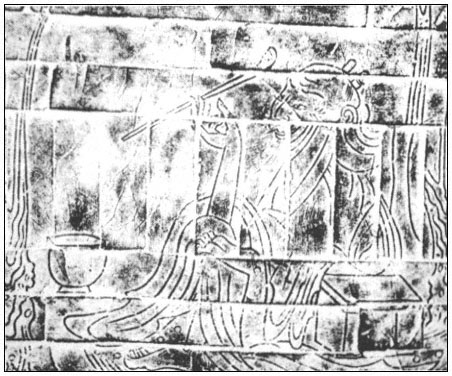
47.
Ruan Ji
at Wujiacun. Detail of figure 4. (From Yao and Gu, Liuchao yishu. )
mural. Here, however, the inscribed brick reads, "Ruan bubing" (Officer Ruan), that is, Ruan Ji.
Similarly, on the opposite wall, the four figures correspond in postures and order to the images in the Nanjing tomb (figs. 48–50). The inscribed names, however, differ in their sequence. The figure slumped against a tree, for example, whom we know as Xiang Xiu, is here identified as Rong Qiqi. The long-haired figure plucking the zither on his knees, formerly seen at Nanjing as Rong Qiqi, is now, at Wujia, called Wang Rong.
In the tomb at Jinjiacun, the eight figures (all extant) are divided precisely as they are at Wujiacun, four figures on each side. On the west wall, an elaborately tangled gingko opens the scene, while next to it a figure depicted in frontal view sits erectly and turns his face in
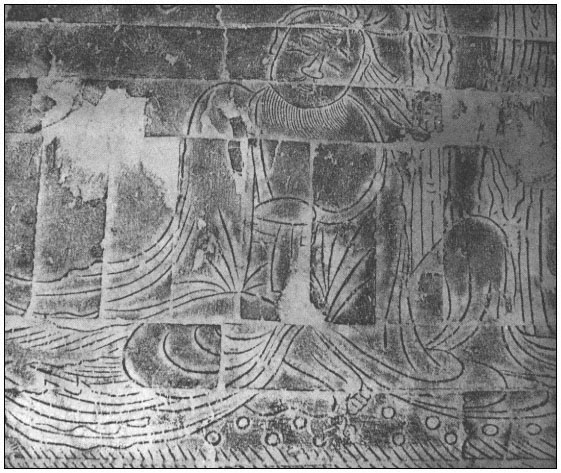
48.
Rong Qiqi at Wujiacun.
Detail of figure 5.
(Photograph courtesy of James and Nicholas Cahill.
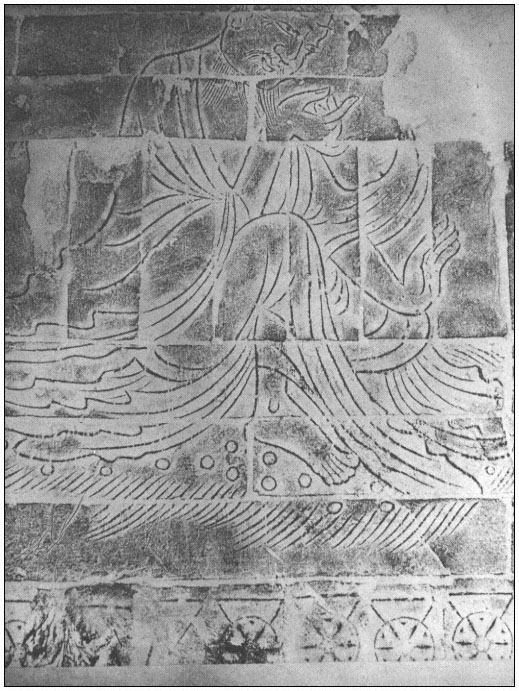
49.
Ruan Xian at Wujiacun.
Detail of figure 5.
(Photograph courtesy of James and Nicholas Cahill.)
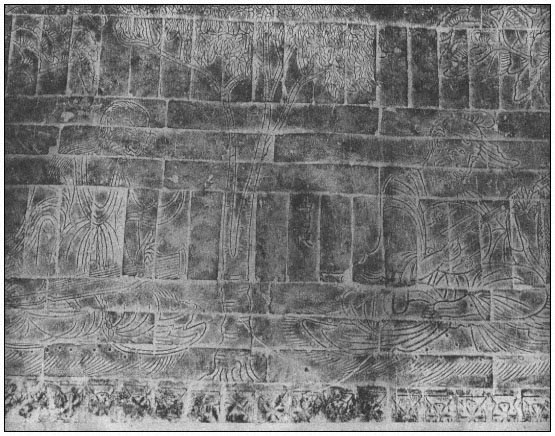
50.
Wang Rong and Shan Tao at Wujiacun.
Detail of figure 5.
(Photograph courtesy of James and Nicholas Cahill.)
the direction of the next figure (fig. 51). The image is virtually identical to that of Xi Kang in the Nanjing mural, and so he is named here.
The second figure sits in profile view, his left leg outstretched, his right knee raised (fig. 52). Only the proximity of a small shrub, its wavy stems ending in ribbon like projections and a cluster of four overlapping rings, distinguishes this whistling image from its Nanjing counterpart, Ruan Ji. The inscribed brick, however, reads Liu Ling.
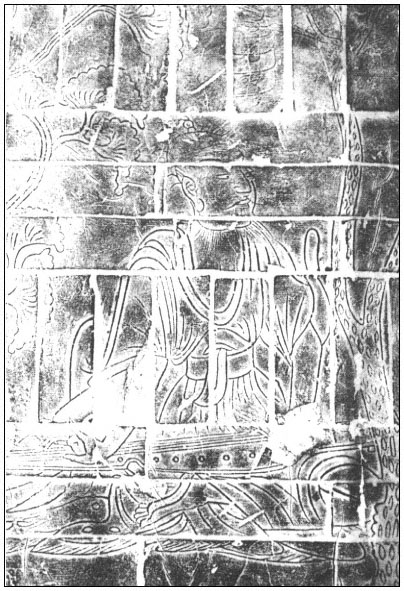
51.
Xi Kang at Jinjiacun.
Detail of figure 6, west wall.
(Photograph courtesy of Amy and Martin J. Powers.)
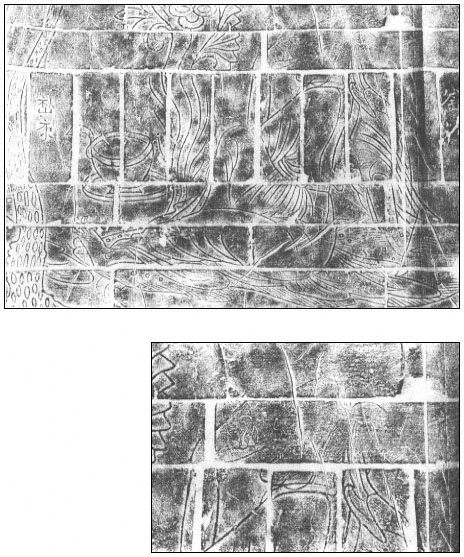
52.
Liu Ling at Jinjiacun.
Details of figure 6, west wall.
(Photographs courtesy of Amy and Martin J. Powers.)
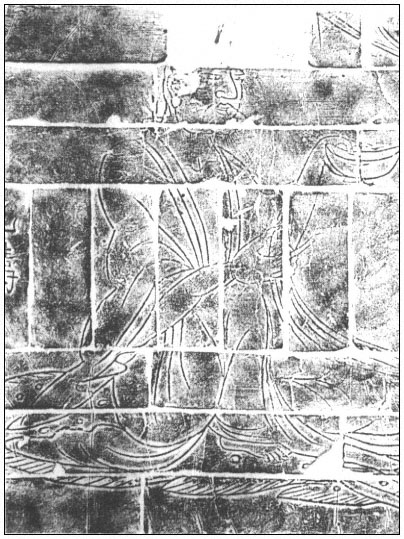
53.
Shan Tao at Jinjiacun.
Detail of figure 6, west wall.
(Photograph courtesy of Amy and Martin J. Powers.)
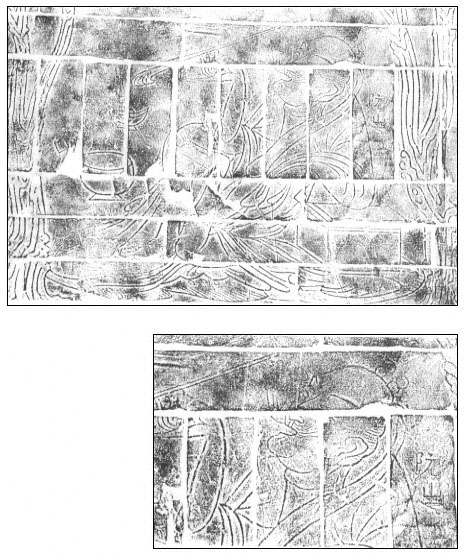
54.
Ruan Ji at Jinjiacun.
Details of figure 6, west wall.
(Photographs courtesy of Amy and Martin J. Powers.)
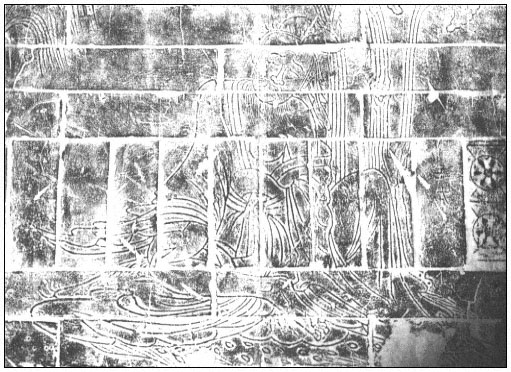
55.
Wang Rong at Jinjiacun.
Detail of figure 6, east wall.
(Photograph courtesy of Amy and Martin J. Powers.)
In general form and sequence, the remaining figures at Jinjiacun are like those of the Wujiacun mural (figs. 53–58). However, the names accompanying the individual figures do not always follow the order of either the Nanjing or the Wujia inscriptions. For example, although the same figure in all three sets of reliefs is identified as Shan Tao, another figure is named Liu Ling on the Nanjing mural, Ruan Xian at Wujiacun, and Shan situ (Shan Tao) at Jinjiacun. Table 1 indicates the variations.
It should be noted that the first two names for Wujiacun are determined by inference from the order at Jinjiacun. Different characters are used for the same names (e.g., Liu Ling); official titles as well as personal names are used for figures (e.g., Shan Tao and Shan situ); on the Jinjia mural, one of the Seven Worthies, Xiang Xiu, is not named
| ||||||||||||||||||||||||
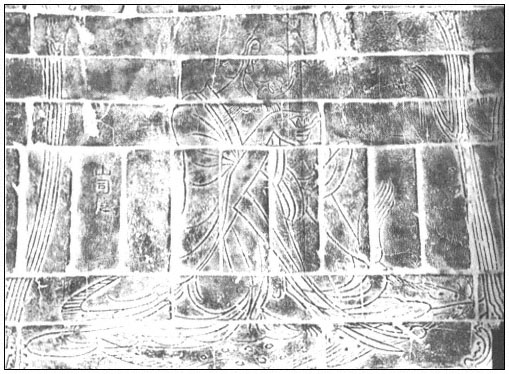
56.
Another Shan Tao at Jinjiacun.
Detail of figure 6, east wall.
(Photograph courtesy of Amy and Martin J. Powers.)
at all. Rather, Shan Tao is named twice, once by his official title. If the authors of the excavation report are correct in their inference that the two missing inscriptions at Wujiacun are those of Xi Kang and Liu Ling, then the name of Xiang Xiu would also have been omitted from the Wujia mural. Since Shan Tao's name (in one form or another) appears twice on both murals, then obviously the name of one of the Seven Worthies must have been omitted. Perhaps it is mere coincidence that Shen Yue omitted one of Yan Yanzhi's five poems to the Seven Worthies in his history of the Song dynasty.[1] The missing poem is the one to Xiang Xiu. I can think of no reason for a deliberate omission of the famous Lao-Zhuang exegete, unless, perhaps, his rejection of the search for long life made him unpopular in court circles.
Although the order of the names varies, a first glance at the two sets
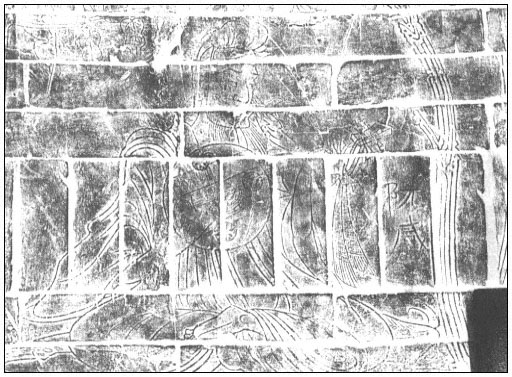
57.
Ruan Xian at Jinjiacun.
Detail of figure 6, east wall.
(Photograph courtesy of Amy and Martin J. Powers.)
of Southern Qi forms and their order of presentation suggests that they are identical to each other and to the Jin-Liu-Song mural. Closer examination, however, reveals many differences between the former, and between them and the latter. A comparison of the same figure on each mural illuminates these differences. In the earliest relief, for example, the figure of Wang Rong reclines in the contortionist pose described above (figs. 21 and 22). His head, depicted in three-quarter view, tilts back slightly. The long, firm, and slightly curving lines of his robe wrap his upper torso and tightly cover his left arm and hand.
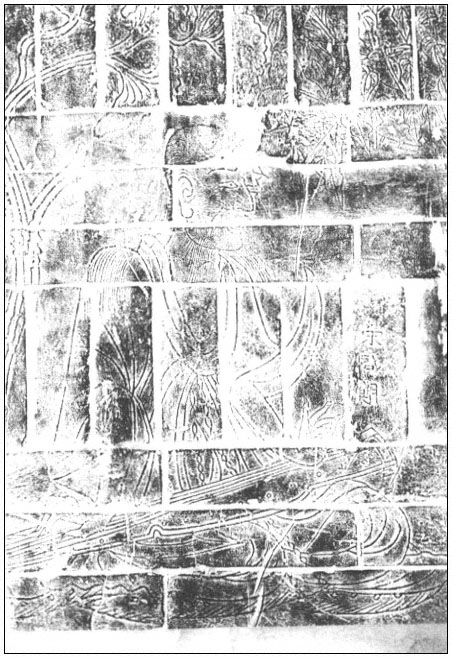
58.
Rong Qiqi at Jinjiacun.
Detail of figure 6, east wall.
(Photograph courtesy of Amy and Martin J. Powers.)
The wrinkled fabric of sleeve—evident from the short, broken curves—hangs in dangling excess of trailing loops. In contrast, calves are bared, as is part of the left thigh, while the pushed-back skirt of the robe cascades behind the right calf in gentle, soft folds, convincingly depicted by long and varied curves. That the robe is bunched under Wang Rong's left thigh is clearly indicated by the narrowly spaced, wavy and broken lines of the fabric as it streams down over the top of the thigh. The dangling loops and frequent lines of falling and wrinkled cloth suggest a weightlessness of fabric that combines with the firm, unmodulated, slow curves of the body to suggest those qualities of remoteness and repose that I have interpreted as total tranquillity. The same figure at Wujiacun (identified as RuanJi) is depicted in precisely the same contortionist posture (fig. 47). Here, however, he has long hair, a full beard, and a furrowed brow. The same form in the same position at Jinjiacun (also identified as Ruan Ji) has a fuller face and, like the Nanjing image, lacks the marks of age exhibited by the Wujia figure (fig. 54). Unlike the Nanjing image, however, the Jinjia figure has an open mouth.[2]
Although the faces of both Southern Qi figures are depicted in three-quarter view, their heads tilt at different angles. Whereas the head of the figure's ruyi tilts down at Jinjiacun, at Wujiacun it tilts up. The most significant difference between the two later forms and the earlier, however, is in the depiction of fabric. The lines suggesting weight and hang of cloth are more patterned, less varied, than are the drapery lines of the Nanjing figure. At Wujiacun, for example, the folds of cloth (which on this figure cover the right calf) are depicted by a series of virtually identical lines, curves, and loops. This is observable as well on its Jinjia counterpart, where the greater number of dangling loops and rippling lines of hanging cloth convey a greater sense of movement. Despite the differences, on both figures (and, indeed, on all those of the two later murals) the lines of drapery tend to be more regular and patterned than on the Nanjing relief. They suggest, that is, design, rather than any concern for the actual hang of cloth.
On the earliest mural Ruan Ji's weight rests on his right hand, and his left hand makes the gesture of whistling (figs. 17 and 18). The same Jinjia figure (identified as Liu Ling), however, reverses the arm gestures, so that we see the figure's robed back rather than his open robe and bared chest (fig. 52). The curious shrub of the Jinjia scene does not appear on the Nanjing relief.
As another example, we may compare details of the image that at
Nanjing is identified as Liu Ling, at Wujiacun as Ruan Xian, and at Jinjiacun as Shan Tao (figs. 25 and 26, 49, 56). On the Nanjing relief the left arm of the figure is bent at the elbow, and the hand holds a wine cup. But at Wujiacun and Jinjiacun, the left arms of the figures extend out and down with the hands upraised and slightly cupped.[3] All three figures, however, are depicted with faces in three-quarter view, tilting downward slightly, as if staring at their fingers. The shapes of the two Southern Qi faces, however, are different: the curve of the Jinjia cheek, for example, is rounder than that of Wujia; the jaw of the former is depicted by a curve, that of the latter by an almost straight line, and so on. Whereas the original report describes the Nanjing figure as holding his bowl in a self-possessed, perfectly composed manner, the other two figures are characterized as staring frozenly at their fingers and grinning.[4] I do not see these differences in expression, and although there are a surprising number of small differences in the depiction of the two Southern Qi images—such as in the way in which the draperies fall and reveal the form beneath and in the exact position of the elbows—the general postures of all three images are the same.
I have noted only a few examples of the many differences among the mural images. Shapes of vessels, their presence or absence, differ; details of clothing vary, both in style and in the way they drape the figures; names, although drawn from the same pool, are not always attached to the same figures; and so forth.[5] Moreover, whereas the draperies of the Nanjing images fall and flutter as they are observed to do in life, on the later reliefs they fold, hang, fly, curve, and swoop with occasional disregard for gravity or other laws of the observable universe.
These differences, especially those of the names, raise the question of verisimilitude in portrayal. When the Danyang portraits were first published, the author of one of the original reports argued that the Nanjing portrayals were the closest of the three to historical fact. The correct names, that is, were associated with the correct figures.[6] To summarize the argument with one example, the Nanjing figure of a long-haired, bearded man wearing a robe belted by a cord and playing a zither and named Rong Qiqi by inscription is the accurate depiction of Rong Qiqi, according to the texts. The same aged musician at Wujiacun is surely not the "historical" Wang Rong, as the inscription there states, for nothing in the records characterizes Wang Rong as an aged, reclusive musician. On the other hand, the same image at Jinjiacun, inscribed as Rong Qiqi, is historically accurate, for although
the face is different from those at Nanjing and Wujiacun, the attributes—of zither, belted robe, long hair—correspond to the texts.
When compared with the two later examples, the Nanjing mural does suggest a greater interest in depicting historical figures in ways that conform to a shared conviction of reality—that is, to a contemporary tradition perceived as historical fact. This interest in pictorial individuation, however, is confined, save for Ruan Ji's one gesture, to the use of attributes. For, as I have argued, all eight images conform, by virtue of their postures (even though no two are identical) and placement in the composition, to the same conviction of reality—that is, to the same set of values all the subjects were believed to exemplify. As I noted earlier of the Nanjing portraits, had the artist reversed the inscriptions and transferred Liu Ling's attribute, the wine cup, to the figure of Xiang Xiu, the men of the fourth and fifth centuries would have had no difficulty accepting the identification, nor would we. Scramble the attributes (but do not remove them entirely, for they are crucial to the depiction of character), shuffle the inscriptions, and we are still left with the Seven Worthies of the Bamboo Grove and Rong Qiqi. By the end of the fifth century, it no longer mattered (as perhaps it did in the earlier period).
One may argue artisan error or ignorance, as indeed Zheng Minzhong adduces for his case that the original Seven Worthies composition was designed by a craftsman.[7] He offers, as partial evidence, that the musical instruments held by Xi Kang and Rong Qiqi are in the wrong positions (the bridge of the qin should be at the proper right) and that the fingering is therefore irrational (figs. 16, 58). He rules out copyist's error and notes that the famous painters of the time were all familiar with the instrument. Hence they could not possibly have made such a mistake.[8]
However, and regardless of the status of the creator, one cannot argue ignorance for the patrons of these particular funerary reliefs. If the "errors"—whether for musical instruments or for the naming of the figures—were not corrected, it is because the patrons did not care, which is to say that they did not see them as important.[9] As the trees, regardless of species, were, to the men who saw them, the Bamboo Grove, so the men depicted were the rightful occupants of that Grove, cultivated gentlemen. Whatever the small quantum of individualization of the earliest extant portraits, by the later period that concern is apparent only in the continued use of variations in posture, all of which have the same significance. The Bamboo Grove had become a classic, its pictorial depiction, a stereotype. Nevertheless, and not
exceptionally, these continue to be portraits, with specific identities, as the application of inscriptions insists.[10] Precisely because the composition was, by the later date, a convention, the order of inscriptions was unimportant. Everyone—everyone who mattered, that is—knew who the subjects were.
Similarly, one might argue that the disregard for the effects of gravity on the draperies of the later reliefs is the result of inferior workmanship.[11] Is quality the issue, however, when, in the same tomb, a celestial being is depicted in such a way that the twisting posture, the curving and zigzag ribbons, convince the viewer that the image flies through space, while another image wears draperies, the stiff, patterned lines of which fail to convince? At the least, it can be argued that "convincingness," or "lifelikeness," or verisimilitude did not always matter, or mattered only selectively, itself a significant finding if we are concerned with the meaning of portraiture.[12] On the other hand, a discerning viewer might perceive in Xi Kang's clothing—where a tongue of drapery points straight up while a flap of sash points straight down—information more important than the direction of the wind that stirs but one of them. Immortals, after all, are not subject to the laws of gravity. I cannot know if the seeming discrepancy was intentional. I do argue, however, that it was, at the least, irrelevant to the patron (else it would, and could, have been corrected), and that at the most, it had meaning.
The differences among the three sets of reliefs, however, are minor compared with their similarities. For example, although the names are distributed differently among the eight images of each tomb, the same names appear throughout all three murals, and all are among the group known as the Seven Worthies of the Bamboo Grove plus the recluse Rong Qiqi. The basic composition—an individual separated from other figures by a single tree on either side—remains constant. All the informal, lounging postures of the Nanjing mural are found on the two later ones, and they appear in exactly the same sequence. All the figures are seated at the same level on fur mats, and although there are differences in details of clothing, all the robes may be characterized as loose, casually worn. The significance of the clothing for the interpretation of the reliefs is such as to warrant its classification as an attribute.[13] All the men are barefoot. Not only are the same attributes found in all three reliefs, but, with the exception of Liu Ling's wine cup (missing from the later scenes), all are associated with the same forms. The ruyi, for example, always accompanies the figure who leans on a box or a pillow and who sits in a position that is anatomi-
cally impossible. The zither is associated in both extant depictions with the figure of Xi Kang (and I do not doubt that it was also included with the missing first image at Wujiacun); the round stringed instrument is always associated with the seventh, penultimate figure; the same kind of zither always accompanies the last figure. And so on.
It was the pictorial constants that retained cultural relevance over time. Body behavior, as I have repeatedly stressed—not the face, not the eyes—defined the man and offered the pictorial key to his character.[14] Attributes, clothing, postures, and gestures—depicted with a superb subtlety of line and combined with a deceptively simple arrangement of forms—achieved the pictorial expression, the embodiment of a character that was a shared ideal for a particular social class in a specific region of China at the same time that it was perceived as the personal makeup of a specific group of individuals.[15] This emphasis on the body and its movements should not surprise. We have only to ask ourselves where in Rigaud's portrait of Louis XIV lies the unwavering conviction of a man's innate right to rule (fig. 59). The superb hauteur resides, not in Louis's face as he glances at us, but in Louis's stance, its grandeur confirmed by the Sun King's robes.
Such were the devices of the maker; what of their effect on the viewer?
Spiritual Communion
What concerned [them] was the capacity of the inner to permeate the outer. They expected their soul to display its quality in their body, and, along with the body, in those concrete and visible particulars of poise and lifestyle that counted for them. . . . They believed without question that moral paradigms that had bitten to any depth in the soul would and should show themselves by reassuringly consistent body signals—by poise, by tone of voice, even by the control of breathing.[16]
It is a percipient characterization, one offered, however, not about the inhabitants of the Middle Kingdom, but about the educated elite of Greek-Roman antiquity. The generalization is remarkably appropriate to the men, makers and viewers, discussed in this study. As Mencius had stated:
That which a profound person [junzi ] follows as his nature, that is to say, humanity, rightness, the rites and wisdom, is rooted in his heart, and man-
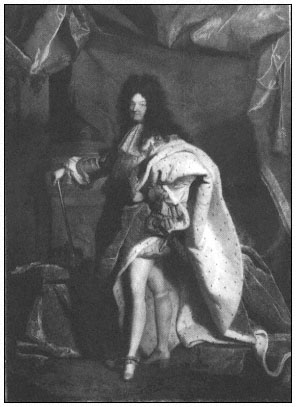
59.
Portrait of Louis XIV, by Hyacinthe Rigaud. 1701.
Château de Versailles. (Cliché des Musées Nationaux—Paris.)
ifests itself in his face, giving it a sleek appearance. It also shows in his back and extends to his limbs, rendering their message intelligible without words.[17]
To the Chinese, too, a "human person not only [drew] encouragement and validation from the moral exemplars of the past, but [was] actually able to make himself transparent to the values summed up in these exemplars."[18] The analogy is not fortuitous, for the two worlds, despite their many differences, were imbued with the conviction that "the Classics, a literary tradition, existed for the sole purpose of 'making [persons] into classics.'"[19]
As Confucius, self-consciously exemplary, was the model for Han dynasty Confucians, so the Seven Worthies (and Rong Qiqi) became a collective model for later men. Morality itself never ceased to be the standard; its criteria and their manner of expression, however, changed as the new world covered the ashes of the old. And where the exemplar of the earlier period had been a unifying agent, a model with whom the entire community could identify, the later model was divisive. Only a small segment, a governing elite, could identify with it and thus aspire to emulate it.
Emperors, perhaps, admired the Seven Worthies for their talents and style. For their courtiers, however, the model retained its potency, and not merely as a new classic on which they projected their own values. On the contrary, the Bamboo Grove survived because it had been humanized.[20] The evidence of their lives and the anecdotes—amusing, earthy, defying of convention—commingled to invest these exemplars with those all too human qualities that later men, whether they admired or despised them, could recognize as their own.[21] The moral dilemmas that confronted Xi Kang or Ruan Ji or Rong Qiqi, the choices for which prices always had to be paid, were those faced by later men. Shen Yue spoke of the distance that blurred the significance of the Bamboo Grove; yet he deplored time's distance in the very context of expressing his understanding and, I would say, his kinship with its cohort.[22] The poets who wrote in the style of Xi Kang or RuanJi were not only exercising their craft, they were also expressing their identification with these earlier men.[23] "Only that man [Ruan Ji], grief-racked at the end of his road / Can know how hard is the way I travel," mourned Yu Xin (513–581).[24]
What linked the men of two different centuries was their shared human frailty, and to the later men these exemplars' means of coping seemed a model for heroic action—or nonaction. "When one establishes a 'spiritual communion' (shen-hui ) with the ancients, one emerges as their spokesman and delegate. One bridges the gap between one's spiritual contemporaries and one's temporal contemporaries in performing the creative act of a living transmitter."[25] It was precisely for their frailties, for their purely human heroism, that later men identified with them and gave to the Seven Worthies immortality.[26]
Generalizations aside, however, can we know how contemporary viewers responded to the Seven Worthies portraits? For what were they looking? That the portraits found favor in their eyes is evidenced, of course, by their repeated facture—once, from a painting to a
tomb relief, twice more, with certainty, as later tomb reliefs. Other evidence, however, enables us to imagine more specifically their response:
Ku K'ai-chih [Gu Kaizhi] painted a picture [hua ] of P'ei K'ai [Pei Kai] and added three hairs to his cheek. When someone asked his reason, Ku said, "P'ei K'ai was an outstanding and transparent person who possessed a knowledge of human capabilities. It's precisely these [three hairs] that are his knowledge of human capabilities."
Those who looked at the painting searched for this, and actually did feel that the added three hairs seemed somehow to make it possess spirit and intelligence to a far greater degree than at the time before they had been applied.[27]
Regardless of any event to which the attribute (three hairs) might be an allusion, Gu Kaizhi's remark is very clear about his intent. The three hairs have nothing to do with a physical characteristic of Pei Kai (who died long before the artist's time), and everything to do with his ability, which is to say, with his character. The viewers, in turn, actually felt it to be so (ding jue ).
When Xiao Ziliang, king of Jingling, first retired to his dwelling in the mountains, he looked around and said, "'Were the dead able to return to life, who might enter this chamber?' Thinking over the roster of worthies of olden times, . . . he had painters depict them by his windows. There he could visualize them in all their nobility, and imagine their talent and goodness."[28] As in the previous example, Ren Fang, who relates the incident, makes no mention of physical characteristics. By gazing at the portraits, the prince, he tells us, was able to imagine their virtues—he felt their presence as companions.
Yao Zui, who lived during the Liang dynasty, tells us of his response to one artist's depictions of people. Xie He, an older contemporary, was concerned with resemblance (si ), he remarks. He paid close attention to expressions of the eye, to details of hairstyle and clothing, to recording the minutest changes of fashion, and many artists followed his example. "But the consequence is that he has set [them all] to chasing after unessentials. . . . For in what concerns spirit resonance [qi yun ] and essential soul [jing ling ] he was far from fathoming the meaning of vitality [sheng dong ]"[29] Like Roger Fry on viewing Sargent's portrait of General Sir Ian Hamilton, Yao Zui could not "see the man for his likeness."[30]
Finally, I cite once again the great literary critic Liu Xie: "Recently, literary writers have valued resemblance in description. They spy out the inner structure [kui qing ] of a landscape and penetrate the appearance
[zuan mao ] of grass and plants."[31] The purpose of describing physical properties, in short, is to convey not the outer appearance but the inner. Resemblance or verisimilitude means capturing, not just any external appearance, but only that external appearance that conveys the inner reality.[32] In her discussion of the descriptive mode in lyric poetry of the period, Kang-i Sun Chang interprets Liu Xie's use of verisimilitude in its particular meaning of "'presenting details' so as to give 'the semblance' of reality."[33]
The semblance of reality is precisely what a portrait must convey. "When a portrait is said to be like the sitter, what is meant is that the spectator, when he looks at the portrait, 'feels as if' he were in the sitter's presence."[34] Those who saw Gu Kaizhi's portrait of Pei Kai, or Xiao Ziliang when he gazed at the portraits on his walls, felt this immediacy, this sense of the subject's presence, because the artists had achieved illusions of reality. The portraits of the Seven Worthies conveyed, by a complex relationship of postures, gestures, clothing, and attributes, the only illusion of reality that mattered in fostering a "spiritual communion"—the inner that permeated the outer.[35] In this sense, maker and viewer perform equally creative acts. The maker must select and deploy pictorial devices so as to trigger memory. Inevitably, he must draw on conventions, established types—what else can trigger memory?—before transforming them into a unique reality.[36] The viewer, thus prompted, selects (not necessarily consciously) from the subject's outside history (as known to him), what resonates with his own history. In return, he invests the pictorial configuration with those linkages.[37] Without this investment of associations, there may be a picture, perhaps even a work of art, but there is no exemplary portrait.
From our point of view these are "imaginary" or "ideal" portraits, lacking whatever warts, squints, or dewlaps the historical subjects may have had—those individual imperfections that many viewers associate with "likeness."[38] It is by no means clear, however, that the viewers of these portraits would have concurred in the modern characterization. Physical resemblance, as we have seen, was an irrelevance. Yet we cannot doubt, from the fact of their repetition, that they were successful in arousing a sense of authenticity, of that ineffable "vitality" so highly valued by Yao Zui and, I note with irony, by Xie He. If pictorial forms are capable of arousing in viewers that sense of living presence, then their roots in stereotype may be an irrelevance, for they have been transformed by art to effect a new reality, to which the viewer responds.[39] One may well wonder, however, if it is
not their comfortable familiarity, like a well-worn lounging robe, that evokes memory and therefore the sense of the subject's presence. In which case, of course, the stereotype is far from being irrelevant to the issue of portraiture.[40]
Like the Roman portrait statues of honored elders, so long dead "as to preclude the survival of any valid tradition of their appearance," the images created for the Seven Worthies and Rong Qiqi embodied "contemporary notions of how they should have looked, [incorporating] the available traditions of their personal character and appearance, but more importantly [giving] visual expression to their significance to the community."[41] It was the successful depiction of how they should have looked—adding three hairs to the cheek—that aroused the feeling of verisimilitude, a matter of art creating reality anew, as Picasso's Iberian mask created an enduring reality of Gertrude Stein.
The artist who painted the original of the Seven Worthies murals created portraits. Devising pictorial substitutes to capture that sense of movement essential for recognition, he achieved the only likeness that could have mattered to him and his audience.[42] By externalizing his view of the world, he also created a work of art, forms that vibrated across the centuries, repeatedly arousing both recognition and appreciation.[43] But truly
only those who are free and detached can find pleasure in them; only those who are profound and serene can rest quiet in them; only those who are liberated can abandon themselves to them; only those who are of the utmost refinement will be able to discern their principles.