
2—
Individuals' Skills As Information Processing: Charles F. Sabel and the Division of Labor
Introduction
The basic argument of this chapter is that when we say a person is "skilled," "semiskilled," or "professional," we are describing what sort of an information-processing system he or she is. If organizations have to deal with uncertainties, then someplace in the organization there have to be people who bring information to bear on those uncertainties. The flow of unpredictable events to a worker's or professional's area of responsibility sets problems for that worker or professional. The capacity to use the news about what uncertainty has come in, to decide what to do and then to do it or arrange to have it done in a fast and effective way, is what a skill consists of.
Thus, to describe a skill is to specify what sort of information-processing mechanism a given worker is. We will argue that the best way to describe the individual as an information-processing structure is by the routines he or she can use, and then by the principles he or she uses to decide which routine to invoke as chance brings in now this, now that task to be accomplished.
If we then develop a theory of the conditions under which more complex information processing by individual workers is required, then we will have a theory of the skill distribution of different sorts of organizations, and of different parts of organizations. To develop such a theory we first develop the notion of routines, of routinization as part of what skill is, and the relation of the number of routines in the repertoire of a worker and the complexity of that worker as an information-processing system. We also discuss the routinization of the relations among workers' routines in "fordist" production. Fordist production allows the use of semiskilled workers in the production of complex products.
The theory of routinization and skill will then give us a theory of the conditions under which complex production requires complex in-
formation processing by individual workers. This provides the basis for describing what technical, raw materials and market conditions are necessary for fordist production, and conversely what conditions will require a high skill mix in the labor force of organizations.
Thus, the central dependent variable, the thing to be explained, is the skill mix of an organization or of parts of an organization, such as why maintenance departments cannot be deskilled the way mass production departments can. The ultimate independent or causal variables are technical, raw materials and market uncertainty, concretely enough described so that we can tell where that uncertainty is higher and where it is lower. The core mechanism that connects causes to effects is the place of routines, discretion, and information about how to respond to uncertainty that have to be trained into the worker; these determine his or her skill level. So it is to the theory of routines in skilled and semiskilled work that we turn first.
Relations Between Routines and Skills
The key thing to get out of the next few subheads is a picture of routinization within the individual , that is, a skilled person becoming really expert and fast at doing some number of distinct tasks, which enter in different combinations into different jobs. The basic argument is that skilled workers' skill consists of a set of routines , a set of smaller skills for particular tasks that they do very well, and many principles of decision which tell workers when to use one routine, when to use another.
In preindustrial society, the skill that artisans had was by and large the ability to do all the things necessary to carry on a given business, such as baking or shoemaking or goldsmithing. What distinguished artisans, such as blacksmiths or wheelwrights, from outworkers, rural people doing one task in one routine like weaving, was that they had many skills, all that were required to produce some complex object or set of objects, and could switch among these task skills in an intelligent way.
First we need to specify more exactly what we mean by a routine, and what we mean by a complex set of routines tied together by worker discretion. We will do that by making an analogy between work and computer programs. The part of the total task in use of a computer that is programmed into the computer is a part that is completely routinized —all decisions are prespecified. The parts of an individual's skill that are completely routinized are those that he or she does not have to think about—once a routine is switched on in the worker's mind, it goes to its end without further consultation of the higher faculties.
Furthermore, a whole factory's work is like the work of a skilled
person, a combination of decision-making parts, requiring human discretion, and more or less completely routinized parts, parts that can go forward without consultation of either the higher faculties within the individual workers or higher authorities for decisions. These completely routinized parts of a social organization consist not only of routines within the individual workers that do not require decisions (meaning that the worker can be either semiskilled, as an assembly line worker is, or highly skilled, as a symphony musician is) but also of relations among workers that do not involve decisions. The model of such a social structure is the early Ford assembly line, and Sable (1982) has used the term fordism to refer to such socially organized routinization.
We treat briefly the variation across organizations of the total amount of routinization. For example, in universities we find highly routinized work in the registrar's office; in hospitals we find fairly routinized work in pathology laboratories. Overall, however, both types of organizations have many highly skilled workers using discretion in their work. At the opposite extreme, an automobile assembly plant has a high ratio of semiskilled production workers hooked together by completely routinized connections among their tasks. But there are still unroutinized parts of such assembly plants, in management and in maintenance departments or tool and die shops. We will analyze why some parts can be more completely routinized than others, and consequently why only a small part of a university is like an assembly line, only a small part of an assembly plant is like the professional staff of a university, but why small parts of each have an atmosphere much like the main part of the other.
Routinization within the individual without individual decision making (i.e., semiskilled work on complex products) is thus the outcome of a social process, the routinization of production. Historically, this has involved two causal determinants, which are analyzed separately later in the chapter: (1) the movement of work into factories and the winning by factory management of the right to specify the content and performance standards of jobs (the specification is often done by engineers, so we study in particular the establishment of authority of engineers) and (2) the finding of the kinds of markets in which firms using such fordist production systems are viable.
Two Relations Between Routines and Human Decisions
Let us start by deepening the analogy mentioned above between the structure of work and the basic structural features of computer programs.
A computer program is made up of two main parts, the part done by the machine and the part done by humans. The part done by machine has to be completely routine . That is, when the machine starts running, every single step that the machine is going to do before showing some output has to be completely specified and has to depend only on things that are already in the machine (by machine I mean the whole system, all the machines controlled by the computer). This part of the program is unforgiving; if the wrong directions are put in, the wrong results come out.
The human part can be arranged in two main ways. One is so-called batch processing, in which the humans try (and almost always fail) to put in everything necessary at the beginning to specify every part of the machine routine. There is only one set of human inputs, and one set of outputs that tells the programmer he or she was wrong or (more rarely) right. The other arrangement is called "interactive computing." The basic notion is that the program asks the person at the terminal to specify the first step or first few steps, then shows the results and asks him or her to specify the next step(s). Again, a person always makes mistakes but can go back to the previous step and correct each mistake as he or she goes along. So when people get to the end of a series of human inputs and computations on them, they are fairly likely to have corrected most of their mistakes already, and thus to have usable outputs. The contrast in structure between batch and interactive computation in outlined in Fig 1.
Similarly, the routines of an organization can be thoroughly pre-
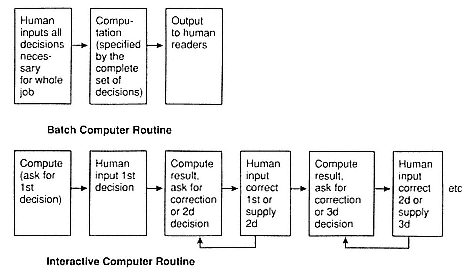
Fig. 1.
Batch vs. Interactive Structures of Programs
specified, or they can have many stages at which human discretion can be applied. For an example of a system that is "interactive," consider the whole process involving the registrar's routines in a university. That system is built so as to have multiple points at which the human input of the professor (sometimes a committee of professors) is entered: in the title of the course, in the schedule of class meetings, in the flunk notices, in the grades; the input of the department and the school on what is required for graduation; and some more limited input of students at registration time and drop/add time on what courses they choose.
But most student input is fed not to the registrar but to professors, who translates pages of messy prose or check marks on a test sheet into the few alternatives allowed by the registrar's routines. So the sixty or so course grades that are most of the sixty or so professors' human input to the registrar about a given student are actually the result of the professors turning a mass of written and oral work into quarter grades, to be output as GPA's, and so on, which in turn qualify a student for this or that major or for remedial classes or get a student advised to take "poet's science." These multiple human inputs from multiple professors make this routine a more or less "interactive" one. This interactive structure is closely related to the use of skilled professionals in the "human" part of the routine.
The thing that the professors as "complex human translators" at intermediate points in the registrar's routines makes possible is an enormous variety of outputs—especially in the various "majors" or degrees that qualify people for different lines of work. That is, the process makes it possible to have simple routines or "programs" in the registrar's office, yet to produce a large variety of outputs that would ordinarily require great complexity in the registrar's routine. If it were the registrar, rather than the professor of biochemistry or biophysics, who had to decide what should go into a course on membranes, the registrar's routines would have to be much more complex.
But let us look now at the routines for producing biochemists (or sociology majors, or whatever). We do find some guidelines in the requirements in the catalog, but those are the result of pulling and hauling within the department faculty—occasionally with input from student complaints. It will turn out that if an important professor is working on membranes (and if, mirabile dictu , he or she likes to teach), then a course in membranes at least will be an option in the training of biochemists. (Some general difficulties of management of people who know more about the work to be done than their managers are treated in Chapter 9 on university administration.)
The content of the courses may "improve" to keep up with new scholarship, but the professor-hours per student graduated shows no general tendency to go down over time. Quite often the routine parts of the teaching—say, elementary calculus for engineers if taught in the mathematics department—tend to be slighted. People in mathematics may want to get rid of such courses because they cannot teach new and interesting things there. A university may get more and more efficient registration but no real "improvement" (i.e., rise) over time in the student/professor ratio, because the nonroutine parts do not "improve" much over time.
When an organization has routines that are "interactive," we usually find a very complex structure with many parts that do not seem very efficient. Hospitals, research laboratories, universities, law firms, and so forth tend to have most of their routines with such human inputs built into the middle; they therefore look inefficient and anarchic to a modern business school eye.
But let us go to the automobile assembly line, which more nearly resembles a "batch" computer program. A "batch" in this case may be a year's production of a few models of cars. The engineering of the car and the tooling up for model changes are supposed to be the final input for all this year's cars. Of course, there are more bugs in the production process at the beginning, so more cars do not pass the inspection at first and line speed is slower. And maybe the manager will not be able to be as flexible about producing several models in short runs on the same line at first because, for example, the supply and inventory system for parts for running several models interspersed is not fully developed. Still, the basic structure of an assembly line is the "batch" program. The parts of the program are fixed, and the management have enough control so that even if they have a carburetor attacher who is widely respected among his colleagues, they do not increase the amount of carburetors to be installed the way a university increases training in membranes.
In particular, the manager on an assembly line can really work on making each component part of the routine efficient. Taylorism—improving the pieces of the routine—will not work in a university (or it mostly will not), because a university does not want to teach the same courses efficiently year after year and end up producing 1950 model biochemists forever. Deans and college presidents cannot "engineer" the product and the production process in detail.
Similarly, when in a study of a hospital—a relatively unroutinized organization—someone finds that it takes, say, ninety minutes on average to get a neurosurgeon to an emergency room to operate on an acci-
dent victim, a time-study engineer specialized in improving routines would have difficulty knowing what to do about it. One does not know that a neurosurgeon is needed until someone makes a diagnosis of severe head or spine damage; a hospital is not trying to produce as many brain operations per day as possible, but only as many as are necessary (and the exact ones that are necessary) given the automobile accident experience and stroke or tumor damage on that day. On an unroutinized job, timing the elements of a routine may not answer the crucial questions. (One thing hospitals may do is to start trauma centers that can afford to have a neurosurgeon there on duty all the time; what can be routinized is the presence of a neurosurgeon, not how to move him or her from place to place or get operations performed faster [Schwartz 1975; 1978a,b]).
Notice that quite often in an unroutinized organization like a hospital there will be a big enough flow for some routines to warrant "assembly line" structures. In a modern hospital the pathologist (usually a man) is more an engineer for an assembly line of tests (usually carried out by women) than he is a person who does diagnoses. Pathologists do keep a monopoly over writing out the "interpretation," especially of things like biopsies. Similarly, in a university multiple choice test grading can be routinized, and an industrial engineer would be a lot of use in designing procedures for that. But an industrial engineer usually would not help much in turning a heterogeneous group of term papers into grades acceptable to the registrar.
That is, there are bit of work even in a hospital in which the physician specifies a lot of decisions for a laboratory worker's routine (check marks on a lab form), the routine runs, and the output comes back the next day to the physician. The "compute" boxes on the interactive diagram that would represent the production process in a nonroutinized organization, then, can be fairly complex batchlike processes, much like assembly lines. For example, the compute process in an American university for turning a transcript into a certification by the registrar that a given student has satisfied all the requirements for graduation is a pretty complex routine, but it does not require the discretion of a leading biochemist even when the person being certified is a student graduating in biochemistry.
So the first big distinction we want to make among routines is, Are there large elements of human discretion in the course of the routine (interactive) or are all the decisions preformed (batch programs)? Keep in mind here the model of the registrar's relation to the information coming from a student's term paper versus the assembly line. This first variable essentially asks, is there complexity outside the routine that is input (in simplified form) into the routine?
Complexity of the Routine
A second variable has to do with complexity in the routine . Compare the old Ford assembly lines that made black Model Ts or black Model As and nothing else to the modern assembly line that makes the same model in different colors and makes several variants of a given model. Now one may have several different bodies that are mounted on the same chassis, a couple of alternative engines on the chassis, and an automatic or stick shift variant of each of these, or maybe even a couple of different lengths of chassis. In order to make the modern complex assembly line run, one has to supply the appropriate sequence of parts so the line does not produce a two-door body with front seats that do not fold down.
Obviously each one of these model options on the modern complex assembly line itself has the structure of batch program. All the decisions are made in advance, so that everybody knows folding seats go into two-doors. One wants to build the routine of the assembly line so that as word comes back from the dealers that there are many station wagon liberals out there this year, one increases the frequency with which one "calls" the subroutine for station wagons, and one hopes all the links in that routine work as efficiently as all the other routines.
In such a complex assembly line, one has a bunch of subroutines, all very similar, and an overall routine that selects out or "calls" the subroutines according to results in the market. When that control routine says, "twenty station wagons, one hundred two-doors, and two hundred four-doors," this entails a whole set of twenty decisions about the special placement of the station wagon spare tire, one hundred decisions about two-door folding front seats, and maybe twenty decisions about a longer chassis. But once the quantities are selected, each production run of those quantities is a batch process and entirely routinized. That is, the hundred decisions about whether to put in folding front seats are part of a hundred-unit-long batch program for producing two-doors and within that routine are completely automatic, at least if the routine is working properly.
Obviously, this is a much more complex program or routine than that of the Model T assembly line and requires more flexible systems for inventorying and buying parts, for organizing the storerooms to put out the parts in the right sequence, and so on. The routine itself is more complex. This in turn means that it will be harder to make all its parts work smoothly. There are more things to go wrong with three kinds of seats than with one kind, and more color of paints to run out of when there are six colors, not just one.
Adding complexity to a computer program is one of the main activities of programmers, and it takes a lot of person-hours to write a modification, and even more to get it really running. The same thing is true of increasing the complexity of the routines of an organization so that they routinely yield a wider variety of options, in order to respond to a wider variety of states of the world. Batch programs with human parts need debugging, and the more complicated they are the more bugs they will have.
Artisans at the Beginning of the Industrial Revolution
It is useful in specifying the relationship among the organization of work, the division of labor, and the skill of individuals to examine artisan production in the early nineteenth century in England, as presented in E. P. Thompson's great Making of the English Working Class (1963). Somewhere around a fourth of the labor force of London was made up of artisans in the time Thompson was writing about, including masters who ran small businesses in a given trade, journeymen who had all the skills to do so but not the property or managerial responsibility of a master, and apprentices who were learning the skills. This ratio was probably somewhat less than a quarter in most other urban areas, except for a few places that specialized in metal goods (Sheffield, Birmingham).
The main thing that made up the skill of such an artisan, and that makes up the skill of a modern craftsman such as Sabel talks about (1982), is flexibility . The reason it took several years to become a craftsman was that a person had to be able to do many different things well in order to make the product. The reason craftsmen were so hard to replace by part-time agricultural laborers, who might also work as outworkers in a cottage industry like weaving, was that there was no one thing craftsmen did (craft workers were almost always men in those days, and still are usually ) that one could teach a rural laborer to do in a short period of time. Running a loom to make one kind of cloth is one routine, making shoes of all different sizes and styles is more craftsmanlike, and making pieces for machines with the technology of metalworking of 1790 to 1830 required the worker to master many different routines. The first job, then, is not protected from the competition of unskilled rural laborers, while the last is subject to the competition only of very skilled artisans.
For instance, the way one ran a lathe in the days Thompson wrote about was to get the piece of work spinning, then to hold the tool up against it on a long, heavy lever that the machinist supported on his
shoulder and, with practiced judgment, to adjust the cut by varying the pressure and angle of the tool with slight movements of the shoulder (see Wallace 1972, 148). Nowadays the machine holds the tool in place, in those days a person did, and it required strength and coordination. Since machinists had to make many different pieces to make, say, a spinning jenny, they had to know how to do many different things with this primitive lathe technology, and to do them fast and correctly.
This variety in the work, with a consequent variety in the routines that an individual had to master, gave craftsmen protection from some of the rigors of competition and made technical advance in their trades into something they incorporated into their skills , rather than something that drove them down to subsistence wages as they tried to compete—as technical advance did to the handloom weavers, for instance (see Smelser 1959, 245–264). A power-driven loom by about 1830 seems to have been about 25 percent more efficient than a hand loom (Smelser 1959, 205–209), so a cottage industry could compete if the folks were willing to be about 25 percent more miserable than urban workers were. But if one introduced, say, a new sewing machine into the shoemaking trade (until the development of automatic shoemaking machinery in the late nineteenth century), it became incorporated into the skill of the shoemaker and increased the difference between such an artisan and the untrained agricultural worker. The artisan knew how to operate a sewing machine as well as having other skills that the unskilled workers could not match. This contrast in the position of artisans versus the more single-routine trades gave the former a collective capacity to resist disruption of their system of work social relations by capitalism and technical change.
A modern carpenter does relatively few of the detailed jobs that an eighteenth-century carpenter did. Technical change has almost completely changed the content of the craft. But he (98.8 percent of carpenters were men in 1985; Statistical Abstract of the United States, 1987 , 386) still occupies about the same place in the general labor market, union or nonunion, because as one after another element changed it got incorporated into the skill of a personally flexible craftsman. So it still takes about three years to learn to be a carpenter, though now an apprentice, rather than learning how to smooth logs into beams with an adze, learns to form a frame of a house with nails, glue, and plywood. The structure of the program that represents the carpenter's skill is still interactive, with many subskills that are almost entirely habitual. Carpenters are intelligent human decision makers who allocate their time among those subskills. The subskills have been almost entirely replaced, or at least very substantially modified, since the time Thompson wrote about.
To give a more concrete picture of what artisanal skill consists of, consider the example of a housepainter (because I have been a housepainter). The skill consists essentially of three elements: (1) speed and accuracy of doing pieces of routines (or subroutines); (2) efficient and accurate switching among routines; and (3) creation of routines for new purposes. (Roughly speaking, in computer systems the people responsible for these aspects of running the machine are, respectively, the machine operators , the users , and the programmers or systems architects .) For a housepainter, skill consists first of all in being able to paint windows so that the paint does not get all over the glass, to enamel or varnish a door so that the paint does not "sag" or "run," to slop paint evenly on flat surfaces at a high speed, to do small plaster-patching jobs so they are imperceptible when painted, and so on. Speed and accuracy in doing the subroutines, the parts of the job, are the first things an apprentice learns.
A second part of the skill is to adjust the trade-off between speed and accuracy, between cost and quality, in a way appropriate to the job. For example, if upper-middle-class people are going to be living with a window a few inches away, sitting in a soft chair and contemplating it, one wants the paint to go just enough onto the glass to make a clean smooth line, but the overlap onto the glass should be very narrow, very straight, and very neat at the corners. In a restaurant they want a considerably faster job, because extra accuracy will not pay off in restaurant profits except in very tony places. People do not contemplate windows in commercial establishments. In a factory they want to let the light through the glass—at least through the middle—and to make sure the metal sash is covered so it does not rust. They want to do it as cheaply as possible just so it looks good from the road. College students' dormitories or apartments were very likely painted at a "commercial" standard, while the homes they came from were likely painted to a "residential" standard. So painters really need three different routines—residential, commercial, and industrial—for painting windows, at three different speeds (industrial fastest), three different qualities (residential highest), and three different prices (residential highest).
In the construction industry, nonunion firms in general use less skilled labor than union firms. By hiring nonunion painters one is likely to get a commercial standard in a residence, because the painter cannot do residential-quality painting. A union painting company can pay about 30 percent more per hour and still compete with nonunion painters. For a given quality of work, people seem to increase in speed for about three to five years; thus nonunion contractors by and large employ these workers for the first three to five years, the union contractor after that.
This discussion of painters brings out the contrast between the first
two components of skill: speed and accuracy within the routines and ability to switch among routines depending on the situation. Being able to paint windows at the three different speeds, qualities, and prices is the first kind of skill; knowing when each is appropriate is the second kind. These two components of skill correspond to the distinctions among computer programs that we talked about, between batch and interactive programs; the more elements of painter discretion built into a painting role, and the more routines painters are required to switch among, the more the role has the structure of an interactive program with decisions between one routine part and the next.
Skills embedded in the role of an individual painter depend on the overall routines of the painting contractor. In a big city one can find industrial painting contractors that never do commercial or residential jobs, and so their painters do not have to switch levels of speed and accuracy. And there will be commercial painters and residential painters (sometimes even outside versus inside residential). So the structure of the overall routines of the contractor, the degree of specialization, will determine what kinds of skills he or she needs in a painter. Linoleum laying and wallpapering are also (or at least were thirty years ago) in the painters' union jurisdiction. The larger the city, the more likely it is that there will be specialized linoleum and wallpapering firms. The more specialized the contracting firms, the more narrow the specialization of painters will be, on average—the less variety there will be in each individual painter's skill, the faster and better each will be with those subroutines or task skills he or she actually uses, and the less switching there will have to be between those task skills. But in the big city painters are still "artisans," in that they know all the skills and the switching routines that are necessary to produce their firm's product. The division of labor among occupations in construction is still basically the division of labor among firms, but the firms are more specialized in the big city.
The discussion above may seem to imply that only skilled jobs have multiple routines and involve worker discretion in choosing among them. Yet operators of simple machines and bank tellers, jobs that take less than two months to learn to do "adequately," have to use much technical knowledge and discretion too (Kusterer 1978, 45–62, 75–94).
The Division of Skill Between Workers and Professionals
We will now discuss three ideal types of ways people can learn to make the decisions involved in a skill. I will call them craft, young professional, and senior professional. I will discuss each of these in terms of three
topics: (1) what kind of basic training each type of worker needs for the exercise of his or her decision-making skill; (2) what sort of knowledge this leaves him or her with; (3) how the "jurisdiction" of the occupation, the set of activities and decisions over which it normally has control, could best be described.
After analyzing these three ways of socially organizing to divide decisions about work routines within roles and to learn how to do those roles, we will turn to a big historical change in the social structure of decision making about manufacturing work, which Reinhard Bendix has studied in his Work and Authority in Industry (1956, 274–287), namely the introduction of time and motion study, or "industrial engineering," especially in the steel industry, between about 1890 and 1920.
Industrial engineering was central to the establishment in American industry of the right of management to enter into the jobs of the workers and to reorganize the work itself, to redefine its skill level, to break it up into more specialized occupations. This assumption of authority over the organization of each person's work was involved in the transition to a whole new way of organizing the definition of "skilled worker." The new skilled worker in the steel industry—or later, say, in the automobile industry—was not a person who knew how to do everything in the business of making steel (or automobiles). Instead, after the transition to a modern factory organization of production the highly skilled worker was either an engineer or manager on the one hand or a craftsman on the other, a person who was master of various routines or tasks that have to be done occasionally, adapting to the situation. The skilled craftsman in an industrial plant nowadays can almost be defined as a specialist in everything that has not yet been routinized by industrial engineers.
The point here, then, is that defining the skill of a skilled worker is no longer like the process that defined artisan skill in prefactory manufacturing (which still is found in construction). For an artisan enterprise, every skill needed to produce the product of the firm was part of the repertoire of the most skilled workers. Modern factory management got authority to define routines, to assign them to different workers, and to assign to factory-trained skilled workers tasks still requiring many routines used occasionally at worker discretion. After engineering authority was established in factories, skilled workers had skills created by managerial authority rather than by market processes. Further, routines or tasks now down by factory skilled workers could be reorganized, at any time it became economical, so that they could be done by semiskilled workers in mass production.
Three Organizations for Learning Routines and Decision Skills
Table 1 gives a brief outline of the main ways different skilled workers learn their roles, what their knowledge consists of, and how the jurisdiction of the craft or profession is typically defined.
Craftsmen
Craftsmen, in ideal circumstances, learn their job by supervised experience , the supervision often being one-on-one. First they learn the bunch of skills that hang together practically in a certain job, whether these involve the same principles or not. For instance, the thing that connects painting and paperhanging into the same trade union jurisdiction is that they come at the same stage of the finishing of the building and have the same purpose—looking good. They have to be coordinated with each other, so that the ceiling is not painted after the wallpaper is on, putting splashes on the paper. The knowledge of an all-around painter thirty years ago would have included both being able to paint (and to paint various things at different speeds) and being able to hang wallpaper; wallpaper has pretty much gone out of fashion since then.
So the training of craftsmen is in the first instance to learn these skills one after another from someone who knows how to do them, in the course of doing the work the journeyman or master assigns to them according to their developing skill. When they have worked enough so
| ||||||||||||||||||||
that they will have learned almost all the routines involved in the job, the apprenticeship will be over. There is nothing "intellectual" that connects the job of wallpapering to the job of painting, the physics of making the paper adhere, the skill of making the pattern of one strip of paper match another, and so on are very different from the physics of making a paint film cure into a viable wall covering or the skill of "cutting in" an edge where the woodwork meets the glass so that it looks good.
It is possible to train for the intellectual professions by an apprenticeship method. For instance, the Inns of Court in Great Britain have traditionally trained barristers (lawyers who appear in court and who are likely to become judges) by apprenticeship (Flood 1982; Abbott 1988). What lawyers end up knowing through such training is the law connected to a large number of practical situations that appear in the courts, and what painters end up knowing is how to cut in window sash, how to align wallpaper so the patterns match and so they still match when they get around the room and attach the last strip of wallpaper to the first one, how to get paint evenly on the ceiling in a hurry but without lap marks, and so on. That is, in both cases what people learn is a list of routines.
The basic training of craftsmen, then, is supervised experience in practical work. What they end up learning is a list of routines and knowledge of "indications" of when this routine applies, when that one; and the set of routines they learn are those that connect practically to get a given kind of job done, not a set connected by intellectual principles.
Young Professionals
Young engineers just out of engineering school are perhaps the ideal type of school-taught young professionals of a modern system. They are taught a series of principles in a set of courses. Courses in engineering schools are not so much a list of things engineers ought to know how to do as a set of principles that engineers will likely find useful in doing the various things (which we cannot very well anticipate now) that they will end up being assigned to do. So if the knowledge of craftsmen is a set of routines unbound by intellectual principles, the knowledge of young professionals is a set of principles they can apply. Young professionals go to work without much practice in the routines in which these principles are in fact applied practically, and certainly without practice in routines enough to cover all the sorts of things they have to do to get an engineering job done. So the job of young engineers is defined in some sense by what the school has taught them—by whether they have been taught as electrical engineers to solve problems with electricity or as civil engineers to solve problems with strength of materials for supporting heavy weights.
Senior Professionals
Senior professionals have, of course, had the abstract training of young professionals and the hands-on experience of many years so they command the routines of working in a given field. In some sense senior professionals have the three years of actual coursework of the young engineer, as well as three or four year of apprenticeship of the electrician or plumber, and the advantages of both. But the crucial thing that a senior professional has, which craftsmen usually do not, is the experience of many years in applying abstract principles to various routine situations, and so improving the routines . In the civil service they sometimes say that a person "hasn't got twenty years of experience—he's got one year of experience repeated twenty times." A crucial thing about a senior professional is that one year of experience repeated twenty times is unlikely: each added year of experience of engineers add (on average) to their value, because they can do routines that have been developed and improved in their own experience—improved by the application of a deep abstract understanding of the objectives and the causal processes involved in the profession. So professionals' wages keep going up for a long time with experience, while the craftsman's wages level out after three or four years.
Earnings Curves for Craftsmen, Professionals, and Managers
In general, brand new professionals just out of professional school are not as valuable as craftsmen, simply because they have not really mastered any routines. But experienced professionals are a lot more valuable than craftsmen, and are eligible for positions in higher management. The two (or really three, with the upper management branch for professionals) wage curves look something like those in Fig. 2. (These curves are not based on systematic research, but on happenstance data seen in the course of paying attention to the problem for many years.)
The general picture is that craftsmen become more valuable at their craft for the first three to six years of experience but (except perhaps for promotion to foreman) do not increase in value after that time. They generally cannot do a lot more different kinds of tasks at fifty than they could at twenty-four, nor can they do them any faster. Engineers, in contrast, cannot really do anything until after graduation and are rarely hired at a skilled worker wage rate even after they have had as much training as craftsmen have. Young professionals may get their first job at

Fig. 2.
Wage-Age Profiles (Idealized) of Craftsmen, Professionals, and Professionals Who Go into Management
below the wage rate of craftsmen (for example, an assistant professor of sociology often makes less than a fully qualified plumber).
But engineers do not (as they say in the trade) "burn out" until about thirty-five years of age. They keep increasing in competence because the routines they learn by experience are placed in an abstract framework of engineering knowledge and are improved by further applications of engineering principles to the engineer's experience. At around thirty-five one starts to perceive which engineers are "on the fast track," headed for managerial responsibilities. If they move into management, their incomes tend to increase substantially up to about age fifty. The flat places on these curves are not really flat, because people keep getting increases to keep up with inflation and with the general growth of real
incomes (the curves in Fig. 2 represent wages relative to the median of a given year). In general, the jurisdictions of professionals increase in size up to about age thirty-five as they "get more professional experience," and of course managers have more general responsibilities than specialized professionals, increasing further after age thirty-five. So one feature of senior professionals is that their jurisdictions, the areas of competence within which they operate, may have been substantially modified since their education (Faulkner 1983).
It is important to keep in mind that these differences, say between young professionals and senior ones, are analytical rather than concrete. For instance, in graduate school in chemistry the work of a graduate student is more like the work of a beginning chemist than it is like the work of a student in a first-year undergraduate chemistry class. Graduate students do take classes; but to a considerable extent they are practicing the routines used in chemistry so that they can do them right every time, analyzing those routines in relation to their own scientific problems, finding new techniques, and improving a technique for their particular application of it. Already they are in the process of becoming "experienced professionals," and they are paid in graduate school at a rate that is in general already about equal to that of a craftsman (of a low level) rather than of an unskilled worker. When chemists with newly minted Ph.D.s go on the market for the first time, they will already be part way along the curve of "experienced professional."
A rather similar thing happens in medical education, with its division into the basic science years, the clinical years, and the residency years: by the time specialists get their board certification, they are quite experienced professionals.
Jurisdictions of Occupations
The jurisdiction of the craft union is not just a matter of union cantankerousness or self-interest, though it is certainly that also. It really is essential that it be defined which craftsmen should learn a given skill, so that at least somebody will know how to do the work. For example, is the list of routines for finishing plasterboard joints to be with the finishing trades (painters or plasterers) or with the ones who put up the plasterboard (carpenters), and if it is a finishing trade, should it be with plasterers or painters? The final decision is arbitrary. It went one way (carpenters) west of the Mississippi, the other way (painters) east of the Mississippi. The main point is that the bundle of things that fall in a craft's purview is determined by practical connections, not theoretical
ones. No abstract principle says whether plastering and sanding the joints of wallboard should be considered plastering (because one uses a plasterer's trowel first), sanding (because one uses sandpaper, a traditional painter's tool, next), or carpentry (because it is part of installing things put up mainly with hammer and nails).
Similarly, both plumbers and electricians install pipe, one to put wires in (it is then called "conduit") and one to run water through (it is then called pipe or tubing). But pipe and wires are connected to the jurisdiction of electricians in one case, pipe and waste lines to the jurisdiction of plumbers in another, because of installation connections (one puts in conduit at the same time and in the same place as wires and connects them to switch boxes; the other puts in tubing at the same time and in the same place as sinks and connects these to waste lines). It is important to put the skills of pipe installation in both places because otherwise technically interdependent things (wire and conduit, tubing and waste lines) would not be done by the same people. Construction management would have a mess trying to coordinate plumbers with electricians (neither of whom ever come when they say they will).
Of course, there are also political resolutions of jurisdictional questions, as when the compromise was worked out saying that the painters would finish plasterboard in the East, the carpenters in the West. Once one has decided where the jurisdiction goes, then a whole series of social arrangements follows: painting contractors will bid on the job of finishing and painting plasterboard in the East, general contractors employing the carpenters will bid on it in the West, so the competence of the businesses follows the lines of the jurisdictions of the workers. The apprentices of painters (or workers for nonunion painting contractors) will learn to finish the joints of plasterboard in the East, the apprentices of carpenters in the West. When a big job involving plasterboard comes up in the East, the placement of finishing workers will take place through the painters' union; when in the West, through the carpenters' union. The jurisdiction of a craft is a central principle in the social organization of firms, of apprenticeship programs, and of the placement of workers.
The jurisdiction of an applied science tends to be some compromise between the reach of a given cognitive discipline and the practical unities of a job. For example, while from about 1900 to 1940 the best definition of the applied-science aspect of medicine was applied bacteriology (medicine did whatever one could do by killing germs, by preventing infections, and by quarantining sick people), there was also a sort of patient-educational task as well. A doctor had to learn the "normal course" of a lot of diseases in order to tell people what was happening
and when they would get over it—not because we then knew scientifically the immunological response to bacteria or to viruses, but simply because the patients wanted to know. So the patients to whom physicians were applying what we knew then about the applied science of bacteriology happened to come to the doctor with a series of questions about the disease: Do people usually die from it? When will the fever go down? When will I be able to go back to work? When does the rash go away? How sure are you that this is really chicken pox? Doctors thus had to learn the course of various diseases, even though that was not particularly a part of bacteriology that made medicine into an applied science.
Now, in fact, the normal course of infections is a part of medical science. Physicians specializing in particular diseases write in Scientific American about the mechanisms that produce the fever, the mechanisms that produce the continuing tiredness after the fever goes away, the end of the contagious period when the free viruses (that can infect other people) will be killed inside the body and the only remaining function of the immune system will be killing the cells of the patient's own body that are infected (the fever is connected with the first phase). This is because now medicine, as an applied science, has a lot of knowledge of how the immune system works, and the immune system determines the course of most diseases.
Nevertheless, a lot of medical learning takes the form of learning a bit about a lot of disease and about a lot of parts of the body—a sort of jurisdiction defined the same general practical way as craftsmen's jurisdiction. So medicine is (and even more was , between 1990 and 1940) a combination of an applied science and a "craft" of healing. Young professionals tend to be bad at the "accidentally" attached tasks of their profession, for these are not in the applied science taught in classes.
The jurisdiction of senior professionals tends to be much more vaguely and individually defined. Within the broad range of, say, surgery, one surgeon specializes in the thyroid. He (or she) can accumulate a wide variety of experience in the alternative ways that that organ can lie or can malfunction, guess the likely meaning of oddities on the X-ray of that organ, relate alternative treatments to the symptoms various patients show after surgery, and so on. A physician can only specialize solely in thyroid surgery if he or she has sufficient reputation, and the only way to learn enough to get that reputation is by analyzing a lot of experience, so it is somewhat a matter of chance who gets to be a world expert on surgery of the thyroid.
To some degree, the jurisdiction of senior professional is self-defined. But a general tendency is that experienced professionals' jurisdiction is in
those parts of the professional practice that have the most uncertainty. Senior professionals in engineering are more on the preproject roughing out of the plan, less on the detailed work, then more again on the management of the actual building or starting up of the assembly line, where technical knowledge has to be combined with managerial experience. Similarly, senior surgeons are more likely to be referred difficult and esoteric cases, while junior surgeons do more routine surgery.
The Determinants of the Division of Labor Between Engineers and Skilled Workers
So far we have not said anything to indicate that one rather than the other of these methods of creating skill would be better for a particular economic operation, except for some obvious disadvantages of a newly minted degree; if average new engineers can get 70 to 80 percent of the questions right (which might be the percentage for a passing grade in an engineering class), then 100 percent of the bridges they design will fall down.
The big difficulty is that senior professionals are too expensive for operations involving a rapidly changing mix of quite routinized suboperations. For machining a die, senior engineers are too expensive, young engineers do not know enough about metal working, so it goes to craftsmen, to machinists. Frederick Taylor himself, the main originator of "industrial engineering" and an engineer with a lot of experience supervising workers in a steel plant, could figure out how to do skilled operations faster than skilled craftsmen—eventually. But someone with a new degree could not.
Often no one can tell early on which way of organizing a given kind of work is better. An example is the recent history of numerical control (Sabel 1982, 63–70; Noble 1984, 79–192). In numerical control a built-in computer controls the machine. That computer has to be programmed for each different piece to be produced. The question was, should it be programmed by "record and playback" or by an engineer programming a big computer? In the United States, the air force decided to have engineers do the programming before a skilled worker ever saw the operation. In Germany and Japan, in contrast, users of numerical control and machine designers mimicked the activity of a skilled worker by having their most skilled workers operate the machine, recording all the behavior of the machine during that person's operation, and then making that recording tell the machine to repeat those motions. Such tools provided for workers to correct certain bits of the recorded program (to go to the correct point, to rerecord a section, then to go to the
end of the section and go on from there) as they learned to do that part of the operation more efficiently.
In the United States many managers and engineering departments put obstacles in the way of "machinist-programmed" numerical control. This was partly because they wanted the work for themselves, partly because they did not want to give the unionized skilled workers the power advantage of being the only ones able to run the machines, and partly because they really believed that programming by engineers would be the best in the long run ("technological utopianism" I call it in Chapter 5). Part of the air force's reason for choosing the engineer-programmed version of numerical control was that no machinists knew how to produce the complex shapes of aerodynamical surfaces that they wanted, so machinist-programmed numerical control simply would not have worked for what they wanted to do.
The result is that nowadays most of the machines are being programmed by less expensive skilled workers rather than by senior engineers who, much more expensively, know both the abstract language of numerical-control programming and the concrete routines of metalworking. This means that now the Japanese and Germans control the international sales of most machine tools, whereas thirty or so years ago the United States was the dominant force in that market. Obviously, someone in the United States made a big mistake in what kind of skill system to build numerical control into, and we are all paying for it in our negative balance of trade.
Part of the problem here is a general danger of trusting engineers too much. If managers go with what an engineer thinks is "state of the art," then generally no one can make it run all the time. And at any rate, they need engineers to run it. For instance, fighter pilots are trained to a considerable extent as aeronautical engineers, as well as in the routines of piloting. That makes a fighter pilot a very expensive product indeed. But even having engineers with years of experience flying our fighter airplanes does not work. Twenty-three percent of navy pilots, for instance, in an average career of twenty years, are killed in flying accidents (Perrow 1984, 126; citing Wolfe 1979, 17). Even senior engineers cannot always manage a "state-of-the-art" airplane landing on a "state-of-the-art" aircraft carrier.
Manufacturing Artisans in the Early Industrial Revolution
In this section I want to discuss how authority is organized in a typical artisan trade (above we treated the organization of skill in such a trade)
and what this means for the structure not only of work but also of class consciousness. Then I want look at how the factory changed that organization, by discussing the erection of the authority of senior professionals and managers over the content of jobs. Authority over job content was the central thing that remained pretty much in the hands of the worker in a preindustrial "artisan" mode of manufacturing.
Because early industrial artisans (I will call such workers "he" in what follows, for the reasons discussed briefly above—women in manufacturing in the early nineteenth century mostly worked in unskilled work in the textile and apparel trades) had all the skills necessary to complete the manufacture of a product, artisans could, if they did not like the authority system or the wages where they worked, go elsewhere or organize their own firms. In many respects the artisan was invulnerable to employer sanctions.
This meant that there were tough social structures that could carry working-class culture, structures that did not get disrupted, that young apprentices were exposed to for years in a one-on-one supervisory relation in which they learned the trade. The government could not suppress the carriers of this working-class culture without suppressing the craft. Many of the traditions carried by these artisans in 1790, when E. P. Thompson (1963) took up his story (a very similar story is told for France in Sewell 1980, 1986), were sort of "trade union" traditions, about wages and working conditions. But there were also technical traditions, including in particular notions of what good work really ought to look like, tricks of the trade, an idea of how fast a good workman reasonably ought to be expected to work, and the like.
There were also political and philosophical traditions. For instance, the radical "Enlightenment" values of scientific belief (which in those days was more often antireligious than is true nowadays), republicanism, freedom of speech, and the whole complex of notions that Thompson connects with the writings of Tom Paine were part of the culture of machinists in England, France, and the United States at least from about 1800 to 1850 or so (on the United States, see Wallace 1972, chap. 5, esp. 211–219; on France, see Sewell 1980, 64–72, and chap. 9, 194–218).
A key fact in the stability of these deviant systems of working-class culture was that capitalists, the "masters," were themselves virtually always craftsmen as well. They really had to be, because otherwise they could not glance at the hundred different things their workers were doing and see whether they were being done right and at a reasonable speed. Another key fact was that in general the number of people in a given artisan trade even in the big cities was reasonably small, and that
people moved around from shop to shop or from one construction job to another. There was therefore a dense social network in a given trade. The network crossed class lines (it included masters) but did not include the nonmanufacturing upper classes, which had a different culture from the artisan workers. Cross-class contact was still within craft culture.
Informal culture supported craft or artisan guild and union organizations when there were any and kept the traditions of organization alive during times of repression (Thompson 1963). Thus Sheffield, a metalworking center north of Birmingham, could come out of the period of wartime authoritarianism (ca. 1800–1815) with a lot of its radical tradition intact. When he was doing politics from about 1807 to the mid 1830s, Francis Place, the London working-class reformer, could still talk the language of the people he had helped organize in the 1970s (Thompson 1963, passim). Sewell (1980) shows for France that artisan corporate culture from the old regime still existed, in modified form, in the revolutions of 1830 and 1848, after periods of Napoleonic and restorationist repression.
Economic and Technical Threats to Artisan Organization
An artisan trade is threatened by one of two things: such big growth in the market that it pays capitalists to break the elements of a craftsman's skill into separate jobs and train a large number of semiskilled workers to do those jobs—the mass production threat; or radical technical change in the product or, more rarely, in the process of production. When E. P. Thompson talks about how the son of the boss wheelwright had to learn from the workers what was good work on a wheel (1963, 235–236), we as modern readers hardly know what a wheelwright is. The reason for our ignorance is that today the job of making wheels is broken down in an auto factory into its component parts, and these parts are done by semiskilled workers who would never tell their boss what the customary way to do things was because workers no longer have authority over the content of the job.
This threat due to growth of the market is perhaps most dramatically manifested in what happened in the U.S. steel industry in the 1890s and the first decade of this century (Stone 1975). Through bitter strikes and reorganization of management, a well-organized craft method of production was reshaped into a system of mass production using semiskilled workers. The steel industry still has a high proportion of workers classified as skilled in the census, so not all the complexity of work was ex-
tracted from the work force and concentrated in management. In the 1890s, control of the definition of jobs was wrested from workers and relocated in the management of the biggest steel companies. From the point of view of the argument here, a crucial fact is that these were the companies making rails for the railroad boom (cf., e.g., Chandler 1962, 53; 1977, 258–269), companies with a large market for uniform goods.
In both wheels and steel, a huge growth of the market for uniform goods made the flexible wheelwright or the flexible steelmaker replaceable by a division of labor organized along rigid bureaucratic lines. We will return to this point later when analyzing the market conditions for the success of "fordism" (Sabel 1982).
The other main threat to artisan trades is a radical technical change that makes the whole product archaic. The craft of sailmakers was destroyed in the period between the decline of sailing merchant ships and warships around 1900 and the rise of the middle-class leisure sailor after World War II. Technical change made sails archaic for freight and passenger traffic, and they did not become modern again until a mass of middle-class people could afford leisure sailboats. More recent examples of technically archaic crafts (since World War II) are the plasterer and the marble-setter crafts, which both disappeared with the growth of new wall materials such as gypsum board and ceramic tile.
From the point of view of working-class culture, it is important not only that craftsmen or artisans can carry a deviant (working-class, trade union, or radical) culture and that they were relatively invulnerable to capitalist and governmental oppression. They were also respected in the working class. They could do things that other workers could not do. They had often traveled to far places because their skill was transportable (Tom Paine, for example, was a craftsman—a corset maker—when he left England, and eventually he became a printer, also an artisan trade).
Authority Reorganization and Artisan Skill
Let us go back to the problem of the disappearance of wheelwrights. Everybody started buying wheeled vehicles, the market expanded, and the wheelwright shop with artisans each of whom could make dozens of kinds of wheels was replaced by a factory with separate divisions of labor for each kind (cf., e.g., Buick Motors creating a wheel factory in Flint, in Chandler 1962, 117–118). Within that factory, management broke up the dozens of things a wheelwright did into specialized jobs for semiskilled workers. So the skill of the wheelwright became the skill of the factory as a social unit.
The individuals within the factory may have a socially defined skill
anywhere from unskilled worker to engineer (engineers have a college education about equivalent to the apprenticeship of a wheelwright—three years of actual experience in classes—but, as we have discussed, they keep gaining valuable experience up to about age thirty-five). But the crucial thing to notice is that the deskilling of, say, the person who makes the hole in the wheel fit the axle (once a wheelwright, now a semiskilled machine tender) is an active managerial process. Deskilling is creating a semiskilled job out of a piece of a wheelwright job by management effort, authority, and thought. The job of the semiskilled workers is designed by someone (or a group) of higher skill. For instance, an engineer may specify what has to be done by the lathe (and by the foundry before that), and a tool and die maker may shape the tool to put into the lathe to do it. The engineers, die makers, and machine tenders are tied together by a social structure, a "management," which defines their jobs, their skill levels, the standards to which they are supposed to work, performance measurement to see whether they are working fast enough and well enough, the incentive or pay system, and so on.
This proliferation of managerial functions and relationships is the crucial development that turns a craft shop into a mass production factory. And the authority of management is absolutely crucial to making the whole thing work.
Reinhard Bendix (1956) is interested in the development of the ideology that justified managerial authority. That authority has to take from workers the right to define their own job, their own skill level, their own standards of quality, and put these rights into the hands of an engineer or manager. I am speaking historically here—of course the particular worker who is now a semiskilled lathe operator was not in general the same worker who was once an all-around wheelwright, so the process Bendix is talking about took the authority from a social group and transferred it to another social group, not actually (usually) degrading the work of someone actually on the job. An engineer's skill is, so to speak, half managerial, half technical. Engineers are not going to be making precise holes in wheels; rather, they will be designing the jobs and skill levels of folks that do. Engineers often move out of engineering into pure management (see, e.g., Chandler 1962, 317–319).
The Ideology of Mass Production Management
The idea of efficiency was the basic thrust of the early-twentieth-century campaign (Bendix wrote about the period from about 1900 to 1940) to establish the authority of management over jobs that used to be artisan
jobs. A fine quotation from the Review of the National Metal Trades Association (comprising steelmaker and machinist managers) shows this clearly: "The employer is willing to pay for results, and in fact results are the only thing on which the value of labor can be based" (Bendix 1956, 271). The right to measure and determine results, and to specify what results are satisfactory and what they are worth, is the central component of managerial authority based on the idea of efficiency. This ideology of efficiency reserved to management not only the right to determine the value of labor, and hence what it should be paid, but also various other elements that went into the definition of a job.
The most developed paradigm of this conception of efficiency justifying the complete control over job definition by engineers and managers is the "Scientific Management" movement led by Frederick W. Taylor. Taylor, an engineer who worked as a manager in the steel industry, helped build up the bureaucratic version of steel management after the breaking of the craft system in the 1890s. The modern version of the same ideology is represented in the field of "industrial engineering."
The movement was based on time-and-motion study. This involved breaking down the job of the worker into its components and describing the motions that went into those components. Then, after redesigning the machine, the material, the work flow, or the worker motions to make the motions most efficient, the time-and-motion study engineer (or manager) tried to estimate what the efficient minimum time is for each of these motions, and hence for each task, and hence for the unit of output. This is the "result" referred to above by the National Metal Trades Association writer. Time-and-motion study gave management a measure of result on which to base their authority.
The first thing to notice about this process is that it theoretically reduces worker skill from a matter of the worker selecting from a repertoire of skills to do a certain job to a matter of making the motions he or she is instructed to make. Anyone who has tried to learn to do the motions required to play a Bach piano piece or do the butterfly stroke in a way acceptable to a swimming judge knows that doing the motions fast and accurately can still be quite a learning task. But the cognitive part of the skill, the creation of the routines, is moved to Bach or the swimming coach, and the performer or athlete only does the motions. The same is true for the lathe operator after an industrial engineer is through with him.
But for Taylor this efficiency picture of the worker's job entailed still more. He thought that this picture—not collective bargaining or craft traditions or a fair day's work for a fair day's pay—should determine the
compensation scheme. First, the efficiency conception would determine what an efficient day's work should produce, allowing output quantity measures to be substituted for a craftsman's pacing of his or her own work. Second, the same conception allowed one to measure extra effort above the norm accurately, where the norm was described for all jobs because the engineer had supposedly described exactly the efficient time and motions for each job—what went into given worker outputs—in minutes required. The manager could translate the number of widgets produced and the number of wing nuts screwed on them into the same metric, the same system of measurement: "the number of minutes an ideal efficient worker" would take to do them.
This picture enabled management to base the compensation scheme of the whole factory on a set of efficiency models for each and every job. They could then compensate people who produced over the norm above the "competitive labor market wage" because they supposedly knew what was the absolute standard an efficient worker, hired off the labor market, could work to. In this ideology the skill and effort of the worker, and the definition of the job of the worker, come to be a "scientific" or "engineering" matter rather than a matter of competing interests, of class conflict over the division of the surplus, or of defense of skilled workers' stake in their investments in their skill. Further, it is the industrial engineer, the scientific specialist in management, who knows how to define all these things.
Scientific Management Authority in Practice
What happened in fact when time-and-motion study people went out to set up this "time needed by the ideal efficient worker" for a given job? They timed a worker, got an average for all the motions, redesigned the job by trying to improve the time-consuming motions, and timed it again. But what they now had was a measure of how long it took, on the average, for John Johnson to pick up a wheel blank, put it into a lathe, tighten the clamps, align it, cut the hole, remove it from the machine, and lay it on the conveyor. This was a detailed picture of John Johnson, not of the pristine idea of the efficient worker. If they were going to let John Johnson define the job, they would not have needed scientific management.
So the time study engineer supplied an estimate of how far John Johnson was from perfectly efficient . If he was working at a normal speed for workers, he might be marked down as 65 percent efficient. If this was a new operation (e.g., on a new design of the wheel), he would be marked
down at 45 percent. Now the industrial engineer found the efficient ideal by dividing John Johnson's performance by the efficiency estimate, for instance:

Of course, this is exactly as "scientific" as the time-and-motion study people's estimate of what percentage of an "efficient" worker's speed John Johnson is working. And this is obviously a subjective managerial judgment, about as good as our wheelwright master's son's judgment as reported by Thompson.
If the industrial engineer is young, just out of industrial engineering school, and socially naive, an old hand in the factory will sweat and strain and move super fast and get nothing done—or, in the post office, a mail carrier will go to the crosswalk and wait for the WALK light to cross the street, which he or she would never do if the time-and-motion study person were not there—and still be marked 98 percent efficient. Then again, if the new industrial engineer is bucking to get promoted by setting high standards, he or she will not be "taken in" even by a worker who is really busting ass and will set a "scientific" standard no one can achieve.
The point is that if management conceals managerial standard-setting as a "scientific" estimate of a number, it may take a fairly clever union bargaining agent to find out exactly where they have built the speedup into their science.
The converse is also true. If "science" does not impress workers into working 1 1/2 times as fast for the same wage (1/.65

In the Ford plant, engineers had authority to redesign and set time standards for the jobs because otherwise the assembly line would not run—one could not tie hundreds of jobs to an assembly line without con-
trolling all the workers in considerable detail. So the Ford management controlled them, science or not, and made a lot of cars—and that , not scientific management, justified their authority.
Conflict over the New Authority System
For all the reasons specified by Thompson (1963), a lot of craft workers were not very enthusiastic about this destruction of the social definition of their skill within the factory. The trade union organizations in the United States (Taylor worked in the United States) were quite generally, up until about 1937, powerful only in the crafts. When the steel industry was reorganized from a craft to a mass production industry in the 1890s, it became in many ways a model for the mass production factory of the twentieth century (and the place where Taylor began to develop the ideology that defended such a reorganization of the authority to say what a job was). The big steel companies explicitly beat a strike in order to get the right to define jobs and skill levels managerially, and then to set up hierarchies of jobs and training for those jobs by the factory rather than by other skilled craftsmen. This reorganization eventually resulted in about a 30 percent increase in productivity (Stone 1975). This is the opposite of what usually happens. Union plants are almost always more efficient (Freeman and Medoff 1984). In fact, in the construction industry union workers usually do about 30 percent more work per day. The increase in productivity by breaking the union must have been due to going over to a system of job description and control more compatible with mass production industry: managers do not need flexible workers when they are producing one ton after another of identical rails for a railroad boom.
Many further innovations in management, such as those described by Alfred Chandler (1962, and esp. 1977), depend on the system for defining work by management described above. Many of these techniques were first introduced into American managerial practice in the first large-scale industry, railroads. For example, Andrew Carnegie moved into making steel rails from the railroad industry (Chandler 1962, 406; Chandler 1977, 258–269; Beniger 1986, 240), bringing with him cost accounting (Chandler 1977, 267–269) and an orientation to precise specification of what time it should take to get a given bit of work done. This was part of his attitude in being willing to take on an expensive and violent strike in order to reorganize production management in the steel industry. Pierre du Pont learned the cost statistics approach to financial measurement of work in the steel industry before bringing it to Du Pont
and General Motors. Cost accounting depends on managerial standardization of costs, and a very important part of costs is labor cost. So management definition of adequate work standards is intimately bound up with modern cost accounting and quantitative management technique.
But the engineering ideology of what a manager and a worker were like did not resolve all industrial conflicts. Not every worker believed his work was captured in fully by a cost-per-piece figure in the cost accountant's statistics, or in the motions and times associated with specific tasks by a time-and-motion study expert. In fact, like E. P. Thompson's workers, steel workers often thought that depriving them of their status, self-control, and traditional levels of remuneration so that the corporation could make more money was a heartless way to proceed. And they eventually said so again with unions in the 1930s, with the "soldiering" on the job that Taylor complained about, and with cutting no corners when the time-and-motion expert measured their work. People were hard to manage heartlessly.
"Fordism"
A principal purpose of the conceptual development above is to have the concepts to define precisely "mass production," or "fordism" in Sabel's more evocative terminology (1982). "Fordism" we will define to be a productive system characterized to a high degree by five characteristics:
1. Batch programming mode. The main productive activity, the one that employs the most people, is one that has the structure of a "batch," rather than an "interactive," computer program. That is, for a great many activities in the firm, all the relevant decisions—and so virtually all characteristics of a given activity—are prespecified. The batch program may have a number of subroutines that are called with different frequency, depending on what the market wants; thus an assembly line, for example, may produce more four-doors, fewer two-doors, more black, fewer red, and so on, and still be running in batch mode. The key is that the discretion is only in the orders for the whole line, and once the numbers of red and black two-doors and four-doors are specified, the actions of almost all the workers are specified. Very little discretionary human input informs the decisions of what activity a given worker should carry out at a given time.
2. Semiskilled production workers. The skills of many
or most workers, then, include only a few routines, which they develop to a high degree so that they can do them fast and make very few mistakes. But their task skills do not form a large repertoire. This is what we usually call a "semiskilled" worker. After only a short time in the plant the workers can produce as fast as they are ever going to, and they know all the routines they are ever going to use, at least until the new batch program (the "model changeover") is brought in. Such workers are inflexible and know few routines, and are in that sense far from craftsmen.
3. Management with authority to create jobs. Management has the authority to create jobs, to specify the routines of jobs, and (quite often by way of collective bargaining) to specify the system of incentives and pay for the job and the measurement of performance (e.g., the speed, or the proportion of rejects, that will be satisfactory).
4. Engineering staff as designers of work. This authority to specify jobs that is "taken from" worker social structures like craft unions and put into the hands of management is used by professionals, especially engineers, to make the routines as efficient as possible, to rewrite the "program" of worker actions for a model changeover, and the like. The cognitive functions of designing a job are to a large extent located in a group of professionals rather than, for example, in supervisors who are flexible workmen promoted from the ranks because of their exceptional skill. The higher management tends to be recruited from senior professionals, and they design systems for creating routines for the workers, for enforcing them, and for measuring, rewarding, and punishing workers on their performance.
5. Skilled maintenance and related workers. The work of correcting difficulties, introducing changes in the productive process, and so on is not routinizable. This work includes maintenance, making the tools for stamping out metal parts, programming numerical control machines, "setup" of machines for producing different products, and mechanical drafting for the new products. Because many routines are involved, because the routines are not highly repetitious, and because the use of the routines has to be decided on according to the situation (they amount to "interactive" programming struc-
tures), they will tend to be done by skilled workers or semiprofessionals.
To put it another way, the remaining sources of uncertainty in the production process will tend to be "buffered" or "controlled" (J. Thompson 1967) by skilled workers or semiprofessionals as well as by professionals and higher management, because uncertainty is too great. Dealing with the uncertainty so that routine production can go on involves learning a lot of routines. There will generally be a separate set of skilled manual work departments (maintenance, tool and die making, and special departments that vary with the technology, such as the crew who lay firebrick inside steel furnaces) and skilled staff workers at the managerial levels (engineering, quality control and inspection, scheduling and inventory), besides the whole routinized structure of the production line and the "line" supervisory structure that keeps it running.
So this is what a "fordist" factory's social structure looks like: a large number of semiskilled workers doing many different jobs, each worker using a few routines and having little discretion; a smaller group of skilled workers in maintenance and related work; engineers designing the product and the production process, improving the routines in that process, and hoping to be promoted to management; and management, mostly former engineers, organized in a strong hierarchy ("line" management) to drive the people on the production line to work as fast as they can. Management also coordinates the engineering and maintenance process with the requirements of production.
It is characteristic of such production processes that, except for maintenance and related workers at the lower levels who have a great deal of discretion, the higher people are in the hierarchy the more discretion they have, the more time they spend planning how to do things in the more distant future, and the less hierarchical relations—the more "committee meetings"—they have in their own work situation. Authority and discretion are arranged very hierarchically toward the bottom, more democratically toward the top. The way such a system looks from the bottom is described in Walker and Guest's (1952) account of a General Motors assembly line; the way it looks from the top is described by Chandler (1962, 114–162).
The Impact of Certainty and Uncertainty on Fordism
For such a massive investment in developing and integrating routines to produce a fordist system to make sense, the production process must be
protected from uncertainty. If we contrast such a process as that described by Walker and Guest (1952) with, say, building construction, in the latter the workers, as much as management, deal with the variability in what the firm does one day as opposed to the next. It is construction foremen who adjust the amount of labor the firm hires to the amount of work there is to do. It is construction workers as well as foremen or managers who coordinate the work of different crafts. There is no particular "buffering" of the work of the skilled workers in their routines to take out the uncertainty; after all, the firm hired skilled construction workers in the first place because it was in an uncertain work environment.
There are basically two ways of getting low uncertainty so that the technology will not be disrupted and routinization can be made to pay. The first is to select that part of the market that has demands with low uncertainty (we will come back to exactly what that means), and the second is to "buffer" the routinized part from the fluctuations of the environment (Thompson 1967). The registrar does not need to know that Sociology C-15 at Northwestern University is a fairly different course when I teach it than when Arnold S. Feldman teaches it, so the registrar can treat the grade that a student receives from me exactly like the grade a student receives from him. This means that the registrar can completely routinize the processing of C-15 credits and grades. As long as we keep the course basically the same so that students would not be permitted to take it twice, it will create no trouble. The registrar's routines are completely "buffered" by the professors giving the same simplified output, even though scholarship and the tastes of the different professors change the content of the course, the types of assignments that are graded, and so forth.
That is, the professors "buffer" the uncertainty deriving from new scholarship, from differences in approach to a problem within the discipline, from differences in teaching philosophy, and the like, and provide the registrar with a standardized or "leveled" input, regardless of variations in the environment. The routinization of pathology work in a hospital relies on similar buffering by physicians of the variety of patients that come in, changing their various conditions into a few checks on lab test requisition forms.
One can get the same buffering from outside the work organization itself. For instance, the outworkers in weaving that E. P. Thompson (1963, 269–313) talks about were given their work by merchants, who turned the variety of demands in the market, the difficulties of getting a supply of raw cotton or wool, and the troubles of getting the wool or cotton spun into yarn into parcels of routinizable tasks that could be given
to part-time rural weavers in small towns who had a loom at home. The "absorption of uncertainty" was done by merchants who did not run the weaving operation themselves.
Sources of Uncertainty in the Market
But the big determinant of routinization of the whole productive process of an organization is the lack of uncertainty in the flow of demands on the organization; only with low uncertainty of demand is routinization possible. We therefore need to analyze where uncertainty in the demands on an organization comes from. I will argue that there are four main sources of uncertainty which tend to prevent the development of fordism, or to undermine it later: (1) unstable markets; (2) unstable specifications of the product (short production runs or "made-to-order" goods); (3) unstable technology; and (4) variable raw materials, parts, or environments.
The basic argument takes the form that we will find fordism in one form or another more often when there is (1) stable demand (2) for a standardized product (3) whose technology of production is not changing rapidly and (4) which uses raw materials or parts that are easily available in standardized form and a technology that can be used in a stable environment (e.g., inside a building). It is in such conditions that firms can best use batch-program-like production processes, where there may be many decisions that have to be made once (such as for a complex product like automobiles) but once they are made the firm needs relatively low levels of discretion—there are few new decisions per unit produced.
Conversely, we will expect to find organizations with a lot of skilled workers or senior professionals when (1) the market has wide fluctuations, or (2) each product produced is more or less unique or is produced in small batches, or (3) there is rapid technical change, so that either the firm has to produce a new product because there are new possibilities that someone else will exploit if they do not or the firm has to change their production processes a lot to keep costs competitive, or (4) the work has to go on in very unstable environments or use very variable parts or raw materials.
1. There are very stable markets in industries like electricity production, gasoline, beer, food products (especially those such as dairy products that are not seasonal), some kinds of textile goods such as sheets or towels; there are very unstable markets in contract construction or in producing capital goods such as machine tools or airplanes, and so to a
slightly lesser extent in industries that market to those industries, such as building materials or steel. One finds markets of intermediate stability in "consumer durables" such as appliances, automobiles, furniture, or rugs.
In electricity and gasoline production, a lot of the decisions that need to be made for each kilowatt or gallon are actually built into the machines, so there are not very many semiskilled workers in those fields. Automation has gone furthest where production is most routinized. The main place where manufacturing firms still need flexible humans (and also where robots are most rapidly replacing humans) is in "quite routinizable" markets of intermediate stability. In such markets many decisions have to be made to produce each unit of the product, so routinization pays off even if one can only routinize for a year or so, and even if after a year one has to lay off half of the semiskilled workers, each of whom has been trained in a single routine.
It is also important that there be a big stable market for the product. When the oil industry was mainly producing kerosene for lamps and each consumer did not use much kerosene, oil refining was much more of a small-batch process, with workers moving the stuff from one stage to the next.
When routinization goes far enough so that the firm can completely automate the routine decisions, then they do not have so many semiskilled workers. But to do that the firm has to build the electricity plants or the oil refineries to be useful for twenty years or so of a steady market for gasoline or electricity. Where there is a stable market but the product itself is reasonably simple (that is, fewer decisions, routine or not, need to be made because there are so few parts), as in some parts of the textile industry that produce standard white goods, then one often finds a lot of automation and semiskilled workers buffering the uncertainty (e.g., getting the loom running again when the thread breaks; see Blauner 1964, 59, 62–65.
2. Industries with unstable specifications for the final product include contract construction; the movie industry; some building of very big machines such as oil platforms (Alvarez 1986a,b; Stinchcombe 1985c); ships and airplanes (Newhouse 1982), where it pays to adjust the machine specifically to the environment or the size of the market of the firm buying it; art products or the artsy end of craft products (jewelry, for example); academic publishing (Powell 1978); and the fashion end of the apparel industry (Vernon 1960). In all these cases each customer, or each small batch of customers, wants something somewhat different, and so one has to adjust the work process to produce exactly that. In contract construction (Stinchcombe 1959), the building has to be fitted to the site and to
local building codes and has to be the right size for the market of the firm it is being built for (or the size that the family buying it can afford). To some degree there is a new design for every building, and the contract for each building will have a unique combination of tasks for the building work process to accomplish.
Similarly, one does not want to produce the same movie, even a smash hit like Beverly Hills Cop , over and over again until one can produce it in a month instead of a year and produce it with semiskilled actors (Faulkner 1983). Fashion goods need to be produced mostly after "the market" finds out what is going to sell in fancy shops this season, what will sell in the intermediate-level "women's department store" market, and what will sell in the mass ready-made market (Vernon 1960). So the specifications for what will be produced have to be adjusted to the latest market information.
In contrast, men's clothes, especially work clothes, or white textile goods, or work shoes, have a much slower changing set of specifications. Automobile specifications are set more by the factories than by the consumers, and at any rate mainly change once a year, and models of refrigerators or stoves often stay on the market for years. Quite a few basic industrial goods have very stable specifications (e.g., various grades of plate steel, steel I-beams, cement, bulk aspirin, or fertilizer).
We would expect more skilled workers (for a given complexity of product) in ladies garments than in other apparel, in contract construction than in the construction of mobile homes, in rugs than in other textiles, in the construction of big machines than in the production of standard machine tools or hand tools, and so on. Conversely, we would expect more fordism in appliances that sell in the same model for a year or more, in textiles other than rugs, in industrial chemicals or other industrial raw materials than in the finished goods made of them, and so on.
3. Unstable technologies produce unstable specifications when the developing technology makes new products possible. We would expect that at present computer manufacturers, as compared with builders of other machines of the same complexity, would have more skilled workers and professionals not only because their production processes are always changing, but also because their product this year is twice as powerful as it was last year (Fishman 1981; Kidder 1981). Changing technology in general produces changing specifications. Especially when there are powerful reasons for the consumer to be up with the "state of the art," as in weapons of a high-tech sort, rapidly changing technology will tend to produce rapidly changing specifications of the product and consequently
short production runs. By the time a company routinizes the production process for a fighter airplane, the order is canceled (Coulam 1977).
But a changing technology also produces changes in the production process, even aside from those involved in the changing specifications of the product. Computer chips are produced by a different technology this year than last year, while the locks on a car door are produced using pretty much the same technology this year as last. So one needs more skilled workers on the new production line of computer chips than on the old production line of car locks.
One expects, then, to find a high proportion of skilled workers and professionals in the high-tech industries: weapons, computers and computer software, telecommunications, pharmaceuticals, medical hardware, or scientific instruments manufacturing. Conversely, in industries with relatively low rates of technical change, such as canning, beer production, steelmaking, and most appliance manufacturing, one would expect to find more fordism.
4. Finally, variability of the inputs into the production process produces a need for a lot of decisions that are very hard to routinize. For example, fishing on the North Atlantic, at least in the old days, was done in boats small enough that the weather was a big determinant of whether one could stay afloat. Fishing is still one of the most dangerous industries in most counties where there is any substantial fishery, because a firm needs a small and economical boat to be economically viable, since in any given area of the ocean one can find only a relatively small quantity of fish. Fishermen do not want to sail an enormous boat around to be safe when they are only going to catch a few tons of fish before they have to take them back to shore. So the weather is a variable input into the fishermen's production process because the main way to control it nowadays, building bigger and more capital-intensive boats, is not economically feasible.
Similarly, underground mining, especially of soft rocks such as tend to be found in coal areas, is done in an environment that is very unstable, with variations in the width of the seam, the physical stability of the roof rock, or the underground water conditions. So although coal is, of course, a very simple product in both underground mines and strip mines, underground mines need more professionals and skilled workers.
In addition to such natural variability, inputs can vary greatly too. For instance, one reason factories are so much bigger in the Soviet Union than in the United States is that Soviet manufacturers cannot manage to motivate parts suppliers to supply highly standardized parts (Granick 1967, 144–147). Consequently, instead of depending on other firms for
parts, a factory builds an annex and makes the parts itself so it can institute quality controls. The more routinized they want to make the assembly process, the more they have to be able to depend on standardized part. One can go into an assembly plant in some underdeveloped countries and see people sitting and filing off the imperfections in the parts before assembly (I happened to see this in mainland China in 1975, but it occurs elsewhere). In these circumstances, a factory has to have workers with files making decisions about when a part is ready to be assembled, because it cannot trust the supplier to supply standardized parts. Finishing parts in a highly standardized way to eliminate workers with files may therefore require larger factories.
In particular, when the parts than an organization has to work with are individual people, it is in general quite hard to standardize them. And the more complex the thing the organization wants to do with them, the more difficult it becomes. Hospitals, psychiatric institutions, schools and universities, and other institutions that perform complex tasks on people have to take account of more variability in the qualities the individuals input to the process than do supermarkets, prisons, census takers, and the like. One can routinize the treatment of people more in the latter cases, less in the former (Leidner 1988). And the more one wants to influence individual decisions by clients, the more one needs to adapt to the clients' varying vulnerability to influence; thus it is harder to routinize the selling of expensive goods, especially goods that people buy only occasionally, like automobiles and houses, than of cheap repeat purchases like groceries or dimestore goods.
Conclusion
Let us now look back at what we have been trying to do. We start off with the fact that some things that people want to produce in the economy are inherently more complex, in the sense that somewhere along the way someone had to make a lot decisions for it to turn out right. But fordism consists in making such complex products cheaper by routinizing not only all the decisions but also the production process to a high degree. The key here is that the more a fordist factory can routinize the whole process, the fewer decisions have to be made anew for each unit produced. So the real dependent variable here, the thing we are trying to explain, is, How many new decisions, nonroutinized decisions made by human intelligence and discretion, are there per decision that has to be made to make the product? Thus a formal measure of fordism would take the following form:

This is the level of routinization or degree of fordism of production. The more complex the product, in the sense of the more total decisions required to produce it, the more time and expense will be saved by routinizing. Mass production in the fordist sense saves more on a complex product like an automobile or refrigerator than it does on a simpler one like a sheet or towel.
We have specified four variables that produce uncertainty in a production process, and have argued that the more uncertainty there is, the less the production can be routinized and so the less one can turn skilled work into semiskilled work by many different workers with different tasks (a "collective skilled worker with semiskilled parts"). We have also argued that the most opportunity for routinization will exist when there is less uncertainty from (1) unstable markets, (2) unstable specifications, (3) unstable technologies, and (4) unstable natural conditions or unstandardized parts that affect the process of production.
The ratio of skilled workers and professionals to semiskilled in any given industry should be raised by all these kinds of uncertainty, because there will be more decisions (out of the total necessary) that cannot be routinized, and therefore have to be built into the skill of the worker:

where f is a decreasing function of fordism and an increasing function of complexity. The basic argument of Sabel (1982) is that there are many more industrial situations than we have imagined that are very uncertain, where both firms and individual workers have to adapt to a changing situation and yet do the tasks they do very efficiently to remain competitive. Further, the ratio of work settings that can be highly routinized to the numbers with irreducible amounts of uncertainty has not been going steadily upward, in the fashion argued by, say, Braverman (1974) and Noble (1984), because there are still just about as many fluctuations of the market, just as many people who want unique goods, just as rapid change of technology, and just about as much variability in the inputs to productive processes as there always was.
There is, then, no steady tendency to turn all jobs into semiskilled assembly line jobs. If anything, Sabel would argue the reverse. The total skill level of the work force is not going down. In industries with large stable markets for standardized goods, with stable technologies, and with stable qualities of raw materials and working environment, we will expect
an approach to an equilibrium with a minimum of skilled workers and engineers, relative to the inherent complexity of the product, and a large number of semiskilled workers doing a few things each, with the routines of one intimately connected with those of another. Or in the extreme, we will expect that completely routinizable decisions will be built into automatic machinery.
The first variable determining the information-processing structure of an organization is how complex the information processed by each worker needs to be. This determines how skilled the individual worker needs to be: how many different routines he or she will have in his or her menu of things that he or she can do fast and well, and how complex his or her reading of the environment needs to be to select the right routine. Stability of markets, of product specifications, of technology, and of raw materials produces an opportunity to routinize. Routinization, or "fordism," lowers the skill level by simplifying the information that needs to be processed by the average worker to make decisions; it does this by decreasing the number of decisions that have to be made anew for each unit of product.