
PART THREE—
RESTORATION EFFORTS:
POLITICAL-LEGAL PERSPECTIVES
The broad outlines of environmental restoration schemes are determined in the legal-political realm. In that realm, the merits of a particular set of facts or feelings don't necessarily make a difference. Success in politics means making government work in one's favor. That is basic politics, the common element of the six chapters of Part Three. A corollary: The concept of virtue is out of place in law or politics because virtue is an unreliable concept—right to one side is probably wrong to another. Indeed, as the late Randolph Collier, powerful state senator from Yreka, California, is quoted in Chapter 17, "There is no rule that you have to be fair here."
The California environmental movement, of which salmon and steelhead restoration is an integral part, exists in the context of state water politics. So far, the alliance of agriculture and the water development industry has won more political support than have environmental restoration interests. Pete Chadwick, a Department of Fish and Game policymaker, recently stated the implications bluntly: during the 1990s, he predicts, success of fishery restoration efforts will depend more upon good politics than good science.
The authors represented here, as veterans of governmental and quasi-governmental service, understand these facts and implications very well. For reasons discussed in preceding chapters, all are convinced that changes in water management policies must occur. But not one of them is optimistic about prospects for major immedi-
ate change. Although the day of giant state or federal water projects may be over, the political history of water development in California, with its solidly entrenched interests and political traditions, is still being written. The January 1989 decision of the State Water Resources Control Board to distance itself from staff recommendations regarding water quality issues in the Sacramento/San Joaquin Delta revealed intensified determination of water interests to fight to retain their advantage.
The perspectives in Part Three vary considerably. We begin in Chapter 17 with a political success story for the environmental movement. The water industry and compliant—captive at times—government agencies have long wished to remove funds from northern California's water bank and send them south to enrich farms and urban communities in water-deficient central and southern California. They realized part of this goal with completion of the Trinity Division of the Central Valley Project. Still eluding them is a 30 percent larger branch of that bank, the Eel River. Former state Senator Peter Behr, in an interview with Jim Tarbell, recalls the intricate political maneuvering that accompanied his efforts to place the Eel and several other streams in the California (and ultimately national) Wild and Scenic Rivers System. As a freshman senator, Behr blundered immediately onto the turf of the "father of California's freeway system," Randolph Collier. His account of that experience reveals, as a textbook never could, the bare-knuckles strategies and tactics that mark California water politics.
In Chapter 18, Stanley M. Barnes, water engineer and chairman of the California Water Commission, presents in conciliatory perspective the ongoing "fish folk/water folk" debate. His 1989 speech at the annual California conference of the American Fisheries Society reflects a relatively new trend: the society, given to scholarly reports on technical matters, has in recent years incorporated presentations by legal and political decision makers in their conferences. Barnes, keynote speaker in a cluster of presentations by state and federal policymakers, describes what he perceives to be a changed climate for dialogue and assures a skeptical audience that a reasoned, systematic approach toward identification and solution of common problems would best serve all parties' interests. Particularly notable is his account of political efforts to ensure funding of
improvements at Coleman National Fish Hatchery—still an unresolved issue.
The next four chapters deal with other legal-political perspectives of fish and wildlife restoration, as well as legal avenues available to help activists make government work in their interests. Chapter 19 focuses on a major concern: fish hatcheries. To most people in water-conscious California, artificial hatching and rearing of juvenile salmonids would seem to be the logical way to restore the fisheries. This belief fails to recognize that hatcheries require enormous amounts of cool, clean water. It also ignores the dangers of "hatchery dependency," a major concern of fishery professionals. Drawing upon genetic findings such as those reported earlier by Patrick Higgins, and viewing such data from the broad perspective of fishery management, Bill Kier explains why hatchery success can pose serious risks to natural stocks: natural runs falter as hatchery stocks flourish, with a resultant narrowing of the gene pool that makes all fish in a given population vulnerable to disease outbreaks and other natural catastrophes from which they may be unable to recover. Hatcheries have a respected place as a fishery management tool, but the need to maintain genetically diverse wild stocks as well is abundantly clear. Toward that end, federal and state legislatures have adopted policies encouraging habitat restoration to protect and enhance wild stocks and limit further growth of hatchery dependence.
The authors of the next three chapters discuss implications of the public trust doctrine, upon which much of the environmental movement relies. In his lucid discussion of this concept in Chapter 20, Felix Smith defines public trust, in part, as "the affirmation of the duty of the state to protect the people's common heritage of [water resources], surrendering that right of protection only in rare cases." This concept, its roots in Roman history, evolved through English common law, finally reaching its present form in American democracy. It is relevant to preservation of all natural resources, including the fish and wildlife that depend on the state's water resources. The CVP's effects on fish and wildlife resources provide the setting for Smith's presentation.
In Chapter 21, William Davoren invokes the public trust concept in his "Century of the Fish" speech to members of the Califor-
nia Senate's Committee on Agriculture and Water. The speech is built around a capsule history of water development in California. He dates the "Century of the Farm" from the late 1880s to 1982, when legislation authorizing construction of the Peripheral Canal was overturned by voters. Success of the new "Century of the Fish"—symbol for the remaining annually renewable values of our river systems—depends heavily on the outcome of the Bay/Delta controversy over water quality presently occupying the State Water Resources Control Board.
A more strident note marks Chapter 22. "Lock arms and say, 'I'm damn mad, and I'm not going to take it any more!' " That is the exhortation of William Sweeney, retired California area manager, U.S. Fish and Wildlife Service. This chapter presents one of the rousing lectures he began making soon after he left office, when James Watts was secretary of interior. In it he excoriates agribusiness and government agencies he holds responsible for the demise of Central Valley fish and wildlife resources. He explains how the public trust doctrine, migratory bird treaties, and the Endangered Species Act may be used as bases for legal action. Sweeney, like Behr with his coalition building, emphasizes that the success of environmental restoration efforts ultimately depends on the determined actions of an aroused citizenry working individually or through environmental organizations. The closing words of that speech: "How it all comes out is up to you." (In an epilogue dated August 1989, Sweeney points out that nothing has happened since he gave that speech to invalidate his advice.)
Chapter Seventeen—
The North Coast Water War:
An Interview with Peter Behr
Jim Tarbell
In 1969, before I got to the Senate, there was interest in North Coast water going to southern California, and the Corps of Engineers had settled on the Dos Rios area near Covelo as the most desirable location for a dam. It was to be a joint federal/state project, but Governor Reagan withdrew state support from the Dos Rios Dam. I think this decision was due to a Round Valley rancher named Richard Wilson who was very close to Ike Livermore, the director of the State Resources Agency at the time. I guess Richard talked to Ike, and Ike got the rest of the cabinet to talk to the governor, and he decided that it wasn't a good idea.
If that dam had been built, the water would have been moved over to the Sacramento River. It was a tremendously expensive project, and it would have taken an enormous acreage. At any rate, that was, and is, Reagan's finest hour as an environmentalist.
At that time they were already taking water out of the headwaters of the Trinity River at Lewiston Dam. The Trinity never has recovered from that dam. During the hearings on SB 107, the chairwoman of the Trinity Board of Supervisors came to Sacramento to testify that Lewiston Dam had ruined the Trinity and they hadn't got any jobs out
This interview first appeared in Ridge Review (July 1988); reprinted courtesy Jim and Judy Tarbell, publishers. After serving as a planning commissioner, Mill Valley city councilman, and Marin County supervisor, Peter H. Behr was elected to the California State Senate in 1970.
of it either. There were about forty different large dams suggested for all of these northern rivers. The Dos Rios Dam was the dam of choice, though, and when they lost that, it set them back a bit.
So when I got to the legislature in 1970, I introduced the California Wild and Scenic Rivers Bill as SB 107. I just put this bill into the hopper without ever discussing it with Randy Collier.
The Foe
Randolph Collier was the dean of the California State Senate and chairman of the Finance Committee, representing the North Coast for some twenty-odd years before I got there. He was from Yreka and was known as the Father of the Freeway System because, indeed, he was just that. He was a very wily and powerful old gentleman who had been known to say that "there is no rule that you have to be fair here." He knew all the tricks. He was tough. He was perhaps the most powerful state senator in the history of California and through whose district all of these rivers ran. He was simply outraged that I had introduced this bill, and I don't blame him. I quickly realized that I had made a terrible mistake and apologized. I told him I would never do it again, but I wasn't going to take it back. He was absolutely determined to beat this bill.
The Coalition
The impetus for the California Wild and Scenic Rivers Act came from different sources. I had been an environmentalist most of my life, but the spiritual father of this effort was a nationally known sportfisherman named Joseph Paul, who was born and raised in Eureka. At the time he was living in San Francisco and had started the Committee of Two Million (the number of sportfishing licenses issued in California each year). He was a man of tremendous public relations abilities and social skills, and in this committee he had collected all the sportfishing organizations in the state. He helped tremendously.
The Bill
A year earlier a California congressman, Jerry Waldie, had introduced a bill into the U.S. Congress declaring the Eel, Trinity, and
Klamath rivers as rivers under the National Wild and Scenic Rivers Act. I wrote Congressman Waldie and asked him if it would be a problem for him if I introduced the California Wild and Scenic Rivers Act in the California State Senate. He wrote back saying, "Go ahead, because this bill of mine isn't going anywhere."
So I took the descriptions he had of those three rivers and lifted them bodily from his bill and laid them into the California Wild and Scenic Rivers Bill. Then I patterned the rest of it after the National Wild and Scenic Rivers Act. The difference between the national and the state act was that, under federal legislation, if the act resulted from an act of Congress the federal government would have powers to condemn property along rivers far greater than the state's. In addition, the people at the federal level could control the Forest Service, the Bureau of Land Management, and the Corps of Engineers over building dams. The state would, or could, have trouble doing that.
The Battle Begins
Of these three rivers, the only one in serious contention for protection was the Eel River, which represented the plumbing of the North Coast. So the battle was over the Eel, and the first thing Randy did was introduce a bill asking for a study. If you wanted to slow things down, you asked for a study. His bill directed the secretary of the Resources Agency to prepare detailed waterway management plans for all nineteen rivers and streams in his First Senatorial District. Not just the Eel, the Klamath, and Trinity, but all the ones along the coast, including Big River, the Garcia, the Navarro, the Noyo, and so forth. There was no deadline and no moratorium in his bill while these studies were being prepared.
The coastal rivers were not included in my bill because we relied on a study that rated rivers by priority of national importance for scenic and other purposes. The Trinity, Klamath, and Eel all received the highest priority in this study, but the rivers along the coast did not.
Slowly we began to gather momentum for this bill. We had a strange coalition. What was really significant was that for the first time the fishermen joined with the conservationists, not as equals, but with fishermen leading the efforts. We had the Native Sons of the Golden West, the Native Daughters of the Golden West, the
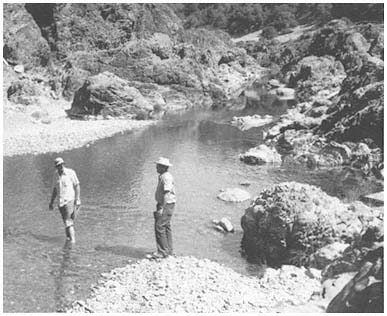
Teamwork. This citizen volunteer and Department of Fish and Game
biologist are gathering data on summer flow of the upper Eel River below
the Van Arsdale diversion to the Russian River.
(Herbert Joseph)
California Real Estate Association, and every conservationist group you could think of, including Friends of the River. We had all the California Rod and Gun Clubs and all the California Sportsmen's Associations. Then we started to knock off the counties. We got Trinity, Siskiyou (where the old gentleman had his home in Yreka), Marin, but not Mendocino or Sonoma.
Collier didn't think it was going to be much of a problem defeating the bill, because it was going through his Finance Committee, and he figured he could handle his own committee. In addition, it needed a two-thirds vote on the Senate floor.
Now, there was a senator named Lou Cusovanich from down south who was in Randy's camp. He was stared to death of the old man, always voted with him. But the Friends of the River raised such hell in his district that he came to me and said, "Look, these crazies are driving me up the wall and I'm going to have to vote for your . . . bill." That was Friday. We put it on the calendar for
Monday. Collier never questioned the fact that he had his vote. So I got it out of the Finance Committee with one extra vote. But then Collier did me in on the floor of the Senate. I couldn't get more than nineteen votes. Cusovanich was quickly brought in line. So I lost that, and that was the end of the year. Then the next session I put the bill in again. By then we had begun to get a great deal of momentum behind the bill. In fact, we thought it would he very difficult to stop. Then Joe Paul died. We realized then that we could lose the bill because he had been so important and everyone had loved him so much and he could scare the bejeezus out of Randy Collier. But we went right ahead in memory of Joe.
In that second year Randy Collier introduced SB 4, a carbon copy of my bill but excluding the Eel River. And every time we would amend my bill, he would amend his. I couldn't stop his bill, and he couldn't stop mine.
His bill was supported by the Metropolitan Water District of Southern California, all of the irrigation associations, the California Water Resources Association, and the Eel River Water Council with Jerry Boucherg. The counties along the Eel River created the Eel River Water Council to preserve the water of the Eel for those same counties, but it was captured by the major water interests who became members. Jerry Boucherg became the executive director and lobbied for the big Metropolitan Water District and everybody else. The whole wonderful world of water was opposed to SB 107.
We led a charmed life in the end, though. My bill was tied up because Randy Collier wouldn't set a time for it to be heard in his Finance Committee. We turned on the heat. We went to the Rules Committee and raised hell until Collier heard it, but then we only had three weeks until the end of the session. In three weeks it had to go through the floor of the Senate, through two Assembly committees, and off the floor of the Assembly; and we had to do it with no changes, or we would have had a conference committee on the Assembly side and we'd be screwed, blued, and tattooed.
So we did it on the last night of the Assembly, which is always a madhouse. Nobody knows what is going on. You can't. Things are going too fast.
On this last night, the speaker, Leo McCarthy, whom I knew and worked with, put the bill up for a vote, and when the Speaker puts
a bill tip for a vote, it goes through because he has the ultimate ability to punish you. So Leo took it off to the governor on the last night of the Assembly. Both bills landed on Reagan's desk at the same time, and Reagan had to choose which to sign.
We had to draw up very careful charts showing why and how the Collier bill differed from mine. By this time Collier's bill had all sorts of little loops and crannies designed to make the bill harmless to the big California water interests that sponsored it. These loopholes were very hard to find. He was a very agile man. But we finally got the governor to sign my bill.
On to the Feds
I had put a stipulation into my bill that the secretary of the State Resources Agency request the secretary of the interior to place the California wild and scenic rivers in the National Wild and Scenic Rivers Act.
Then years went by, and what happened was amusing. Near the end of Governor Jerry Brown's term, Huey Johnson, secretary of the State Resources Agency, suddenly realized he was the secretary of the Resources Agency and could request that these rivers be placed into the national system. So he called up the assistant secretary of interior and there was no problem except that there had to be an environmental impact report (EIR).
So the EIR was going to cost $350,000. The federal government said they didn't have any money, and Huey didn't have any money. So Huey decided he would tithe all the departments in his agency to come up with this $350,000. The problem was that you can't move money around without approval of the legislature. But the Budget Committee never found out about this until later, and then they were absolutely outraged. They were going to strip him of his medals and throw him out. But anyway, it became part of the national system.
The Future
Though Congress can do it, nothing has ever been taken out of federal wilderness protection. When Doug Bosco was in the California Assembly, though, he did take some of the Smith River tributar-
ies out of the Wild and Scenic designation. Initially I had not included the Smith River in the bill because it wasn't really threatened. To make up for it, I included all the tributaries to the Smith. So when Bosco was an assemblyman, he took out about sixty miles of the tributaries to benefit a mining operation.
But I think, in general, the rivers are pretty safe for future generations. It is my understanding that the upper echelons of both the Corps of Engineers and the Bureau of Land Management have decided that there will be no more large dams. Large dams cost too much now; their cost overruns are very high, and most of the good locations have already been taken. They are similar to atomic plants; no one wants them any more. Then, of course, they have to get appropriations every year, and if you start fighting it, and it takes eight or ten years to finish a dam, you can usually kill it by then.
No, I don't think the North Coast rivers are at risk but, then again, if it involves water, they are always at risk.
Chapter Eighteen—
Water and Salmon Management in the 1990s
Stanley M. Barnes
I was quite interested last night listening to Allen Johnson. I asked some of the folks sitting around me, "Would that kind of speech have been made ten years ago?" and the reply was, "Probably not." On the other hand, neither Bob Potter nor Larry Hancock nor I would have been asked to show up for a meeting of the American Fisheries Society; and if we had been invited I don't know what we would have said that would have been constructive. Looking out at Don Kelly [former CDFG official], I think we first got acquainted following a time of great disharmony between the water folks and the fish folks. The fish folks were putting a little pressure on the new director of the Department of Water Resources, Dave Kennedy, and the water folks were putting a little pressure on the same fellow. Now, Dave isn't the dumbest guy in Sacramento, you know, and he asked the fish folks if they would be willing to talk to the water folks and the water folks if they'd be willing to talk to the fish folks. We all agreed to do that. The first meeting that I remember took place in Los Angeles, in a not-too-grand meeting room, but at least there was a table, and we all sat around it. My recollection of the meeting was that only two things happened. First, one by one, we all insulted everybody on the other side of the table, and received a reciprocal insult in one form or another coming back at us.
From the keynote address at the annual conference of the American Fisheries Society, Napa, California, February 11, 1989.
Second, and the only constructive thing to come out of the meeting, was that we agreed to meet again.
From that inauspicious beginning has come the two-agency fish agreement, which nobody thinks is too terrific, but it was a positive step. So I think we are heading in good directions.
I might give you very briefly just a summary of who our people are on the California Water Commission. There are nine of us appointed by the governor, confirmed by the Senate, four-year terms. I've been on six years. Our fishery enhancement committee consists of Clair Hill from Redding, Audrey Tennis from Chico, and myself. The other members of the commission include Jim Lenihan from Santa Clara Valley, Jack Thomson, a farmer from Bakersfield, Martin Matich from San Bernardino, Harold Ball from San Diego County, Katherine Dunlap from Los Angeles. Our other member, Lee Henry, has just resigned to go to Great Britain for an eighteen months' stint for the Mormon church. So we're without a person. The group really does look at itself as trying to do something to provide for and participate with others in constructive solutions to all these situations that we've collectively allowed to deteriorate, I think, relative to the fish problem.
Among its other activities, our fishery enhancement committee has been involved as an informal monitor, you might say, of the Upper Sacramento River Fisheries Advisory Council. We've been very favorably impressed by the fact that there has been participation by a broad group of federal, state, and local interests, including the farmer landowners along the river. Many of the participants have come to realize that it makes more sense to work out problems amicably than to fight continually against things they don't really oppose. There really are many more common objectives on fishery issues than they had believed. We look forward to seeing the report. I don't know of anyone who thinks it's the last word on Sacramento River problems. But the council did look at twenty fishery items and two riparian items. They've put priorities on them, and they've put estimated costs on them, and have said, "Hey, let's look at these matters in the priorities listed."
I'd like to talk about two things that I think collectively we can have some influence in—and when I say "we," this isn't just the Water Commission. These are matters on which the water and fishery communities can have some impact. One of them is Cole-
man National Fish Hatchery. It has disease problems; it has water temperature problems; both are well known to the Fish and Wildlife Service folks. They're as frustrated as any of the rest of us. They have an expensive, carefully developed plan for rehabilitation of Coleman that totals some $22 million. The proposal is to do approximately $7 million worth of work in Phase One, which would be water treatment, ozonization of the waters for disease problems, and cooling. The second phase would be approximately another $7 million, which would be for additional water treatment and cooling. The remaining money would be for additional water treatment, but would not be spent except as needed and as the results of the first two phases became known.
That report was prepared in draft form two years ago; it was finalized in November 1987. The California Water Commission, through its appropriations process, has been meeting with the technical people and the regional director types from the Fish and Wildlife Service and the folks in Washington. The situation we find is that not only can we not get the $22 million, we can't get the $14 million, we can't even get the first $7 million. We can't get a penny! The local folks at the Portland level have put in requests for the president's budget in amounts for at least a start on the program, at least a few improvements. However, the only things that have been done in the way of funding have been congressional add-ons. The administration simply, for "budgetary reasons," has not seen fit to fund these things. We sat in a meeting in Washington—I don't want to get too far afield, but I want you to know the perspective from which we see the thing—we sat in a meeting with a gentleman named Bill Horne, who was assistant secretary of the interior for fish and wildlife and parks. He's, you might say, the boss of the Fish and Wildlife Service, and we said, "We're here to try to get this thing funded." He replied, "My national budget for new construction of fisheries facilities in the United States is $15 million, and you don't fit into it." So we said, "Suppose we just get a little congressional add-on. Give us a line item and we'll get a congressional add-on." "No," he said, "if you do get the funds, I'm committed to the administration to see that they're not spent." Now, when the highest level of the Fish and Wildlife Service looks you in the eye and says those things, ladies and gentlemen, you've got problems.
This last fall the commission made a serious run at funding Cole-
man improvements—the Portland office put in for $1.8 million total in three separate specific line items for Coleman rehab; it came back from the president's budget—I've not seen the Bush budget, but the Reagan budget was for zero. Zero in each item. It's an impossible situation. In the meantime we, as a commission, have worked with the California state administration and with the Central Valley water users and the Central Valley power users, actually through WAPA, and we got an agreement by those folks, a commitment from Secretary Van Vleck and the directors of the Department of Fish and Game and the Department of Water Resources, to have state funding for Coleman rehab at the same level as the Trinity formula, which most of you know is 15 percent California. This would be a million dollars of California state money for Phase One, another million for Phase Two, and the water and power users agreed that they would pay, as reimbursement from water tolls and power charges, that they would reimburse 50 percent of the total. So, from our perspective, the local people have done all that you could ask of them. The water and power users have said, yes, we will cooperate, we'll pledge our funds, and the state has said they will do that. But some place we've got to adjust things at the federal level. The proposal now is that we would seek to have the custody of Coleman returned to the Bureau of Reclamation. Funds would then be provided through congressional committees that are more sympathetic to the problem, and more sympathetic to correcting the problem, than the committees with present jurisdiction appear to be.
This is not in any way meant to be a slap at the technical people or the operational people at the Fish and Wildlife Service, all of whom we feel have done as well as they could without money—but how it will shake out, whether it will end up like Nimbus, owned by the United States, administered by the Bureau of Reclamation, and operated by Cal Fish and Game, whoever it would be, or just funded by the bureau and the money go back into Fish and Game, that hasn't been determined. But anyway, we are working on that, and we think it's an important program.
Another program that I want to comment on is a matter that a lot of people in the audience know a great deal more about than I do, so I hope you'll forgive me. I'm talking about the spawning gravel restoration program in the Sacramento River system. This is a
matter on which the commission—and not just the commission but individual members of the commission, and members of the water community, and the Departments of Fish and Game and Water Resources, and some of the federal folks—can have an impact. There is a compounding of jurisdictions of different state agencies, all well intended, and if you take each regulation by itself, it may make a great deal of sense. But when you put them all together, you've got an almost impossible situation.
The story unfolds about like this: You have a federal agency in charge of handling releases from Shasta and Keswick, and they can't just turn the valve on and off whenever they want to. They have certain water requirements both for their users through the Sacramento and San Joaquin systems and also for Delta outflow requirements, so they don't have a completely free hand. They're operating within the Coordinated operation Agreement and everything else that most of you are quite familiar with. Next, there is an agency called the State Reclamation Board, which is concerned with flooding, making sure that these floodways, the Sacramento River and major tributaries to the Sacramento River, have the capabilities to take floodwaters away without shoving the water to the other side of the bank on the neighbor or something like that. Because of that, during the flood season, from approximately the middle of October through perhaps May, you can't stockpile gravel within the floodway. You have to stockpile the gravel outside the floodway. Where do you stockpile it? That's the problem. Taken by itself that's a reasonable requirement.
Another requirement is from the Central Valley Regional Water Quality Control Board. They don't want silt in the water. The fish folks don't want silt in the water. But someplace there's got to be a reasonable balance—you can't take the spawning gravels mined from someplace and wash them to the point that when you put them in the stream it causes absolutely no silt whatsoever. A good half-inch or an inch of rain in the same watershed would create a great deal more turbidity. So someplace or other we need to find a balance between what is reasonable and what is not, relative to the turbidity for the short period of time when you would be placing the spawning gravels.
Fish and Game has its own regulations relative to what is reasonably required relative to the fish and when you can put these
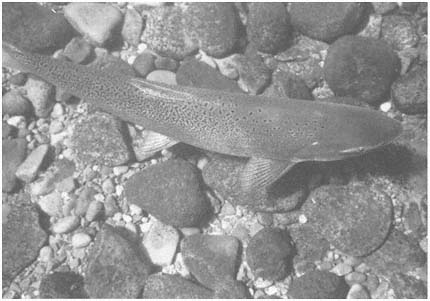
Chinook salmon in spawning grounds of a Sacramento River tributary.
(Dave Vogel)
gravels in relative to spawning time and so on. Someplace along the line we hope to get all of these agencies together in the same room and chat about a program where you don't have to pay three to five times as much for the gravel as you would otherwise pay, and where you can find some way to stockpile reasonable quantities of it so you can achieve the common objective, which is to get the fish counts back up. That's really the objective. Someplace or other when we're establishing these criteria, whether we be the Department of Fish and Game or the water quality control board or whoever, we want to look at the final objective. The final objective is to make the doggone thing work for the fish.
Another element that's somewhat related to that is the increased pressures for mining of gravel for commercial gravel operations. The one that strikes me is the one recently on Cottonwood Creek between Tehama and Shasta counties. That got caught in local politics, and some of us took the view that it is really a more important issue than just a zoning thing or just a permit process
through a local county. To spend tremendous amounts of time, energy, and money to restore spawning gravels at one location in the system and have someone else destroying them at another location is probably not in the best interests of the whole program!
The other message that I'd just like to touch on briefly relates to fishery impacts of the State Water Project. Most of you know that I represent people in my engineering practice who are users of water from the State Water Project. There's no denying that the State Water Project has had stone adverse impact on the fisheries in the Delta system. But our message goes like this: the problems are many and varied; the causes are many and varied; the State Water Project and the federal Central Valley Project have caused some of the problems but not all of the problems. There are other water projects that have caused problems. What we need to do is continue to work as we have in recent months, and for the past couple of years now, in trying to develop specific solutions for mitigation of the Delta pumps, mitigation of the State Water Project operations, but also to look at the system as a whole, to look at how can we really achieve mitigation of the whole system. I'm not trying to point the finger at Hetch Hetchy, East Bay MUD, or anyone like that. I'm just trying to say, "Let's take the system as it exists, and look for specific solutions. Let's address those potential solutions, and not spend too much time trying to find out who caused the problems."
I heard a pretty good statement at a recent meeting, which went about like this: Here's the problem, do we have a program or programs for its solution or at least its partial solution—some positive steps? Yes we do. We have program "A" or program "B." Okay. Program "A" will be a positive thing; it may be partially mitigating or help to resolve problems caused by a dozen different people or agencies or activities. Let's do this first program, and let's find a reasonable cost allocation, and go about it, and seek funding from a variety of sources to do it. My experience is that when you come back to the people, whoever they may be, water people or fish people or anybody, when you come to them with a specific program that makes some sense, both physically and economically, you can get cooperation in terms of both personal participation and money.
Chapter Nineteen—
California Hatcheries:
They've Gone about as Fer as They Can Go!
William M. Kier
Between 1872 and the 1920s, California fishery managers were enamored with the idea that depleted stocks could be restored artificially. Hatcheries (first called "fish breederies") seemed to hold great promise. California has operated as many as one hundred and sixty-nine artificial reproduction facilities, ranging from simple egg-taking stations to factory-size hatcheries handling millions of eggs and fry.
Fish of many species were planted willy-nilly in about every stream and lake in the state. Resort developers arranged for hatcheries to promote tourism. Politicians promoted hatcheries for their home districts.
Over the years, enthusiasm for hatcheries has waned. Today there are nine government salmon and steelhead hatcheries in California. Eight of these were built by dam developers under laws that required them to "mitigate" for blocking upstream spawning migrations. (The ninth, the Mad River Hatchery, was originally built by the state to "enhance," or increase, salmon production.)
Although the art of fish culture has become quite sophisticated, problems apparent almost from the start persist. Other states and countries have experienced serious difficulties with artificial fish production programs, and now California has set the stage for its own costly salmon and steelhead hatchery disaster.
Projects to exploit the streams of California's Central Valley,
primarily for irrigated agriculture, have cut off salmon and steelhead trout from 95 percent of their traditional spawning and nursery habitat. As the scant remaining stream habitat has been steadily degraded by water project operations, the valley's remaining spawning runs—70 percent of the state's total—are increasingly the progeny of fish that were artificially spawned at the region's mitigation hatcheries. In this way, California has become unwittingly "hatchery dependent." This dependency has worried some California fishery scientists and managers for more than a decade.
The survival of salmon and steelhead through the ages was possible because of the genetic diversity created through the interaction of natural breeding populations. As drought or disease diminished one race of fish, another race, better able to adapt to the particular hardship, would take its place. Wild populations with sufficient genetic diversity show amazing resilience to natural environmental change.
By their very nature, modern hatcheries, like modern cornfields, create a lot of progeny from very few parents and, consequently, narrow the total "gene pool" over time. In contrast, natural, inriver spawning maintains and enlarges salmon and steelhead genetic resources by distributing the fish over the available spawning grounds and throughout the months of suitable spawning conditions. Natural spawning therefore spreads the risks that a population of salmon or steelhead can be decimated by drought, disease, or other disaster, while hatchery spawning, restricted in time, space, and genetic variability, heightens those same risks.
Recent studies of the steelhead trout in Oregon's Kalama River watershed found that the offspring of wild trout there survived at three times the rate of those produced by hatchery-born spawners. Oregon's effort to increase silver salmon production by expanding hatchery output, beginning in the early 1960s, led to a gradual deterioration of the survival in the wild of both hatchery- and stream-produced fish.
Canada began a costly expansion of king salmon hatchery production in the 1970s. The salmon catch in Canada's Georgia Straits collapsed in 1987—down 80 percent in less than a decade. Scientists believe the increasingly poor survival of hatchery fish led to Canada's costly mishap.
California hatchery managers have increased the efficiency of
their Central Valley facilities enormously since 1968 by growing larger fish, at substantially higher holding costs, and trucking the fish to the San Francisco Bay-Estuary—or even releasing them directly into the bay. At the State Water Resources Control Board's 1987 Bay/Delta water rights hearings, experts reported that, as a result of these improved hatchery operations, 46 percent of the king salmon returning to the Sacramento River system to spawn now come from two artificial production facilities: the Nimbus (American River) and Feather River state hatcheries.
During the same period that the hatcheries have become so successful, the Sacramento River's natural salmon and steelhead spawning populations have deteriorated steadily. What were once four healthy races of wild king salmon spawners—fall run, late fall run, winter run, and spring run—have dwindled to a fall run half its former size and two remnant runs; one, the winter run, is precariously close to extinction.
California's hatchery dependency—still viewed by the state's water development community as the final solution to the conflict between water exploitation and fish conservation—has set the stage for serious trouble. A disease outbreak, an event that could be tolerated by the region's genetically diverse wild breeding populations, could literally wipe out California's Central Valley salmon and steelhead resources.
California's fishery professionals have understood for a long time that the protection and improvement of stream habitat is the only responsible means of assuring the conservation of California's salmon and steelhead trout resources—and they have appeared powerless to stop the constant assault against stream habitat by dam builders and other developers. Recently, however, their concern has found its way into state and federal policymaking. In recommending adoption of 1986 legislation to restore the fishery resources of California's Klamath River basin, for example, Congress's Committee on Merchant Marine and Fisheries commented: "The Committee wishes to emphasize its view that rehabilitation efforts to support restoration of wild stocks offer the most significant and cost-efficient long-term benefits and should be the primary focus of the program."
Two years later, in adopting the Salmon, Steelhead Trout, and Anadromous Fisheries Program Act to conserve and restore the
state's dwindling anadromous salmonid stocks, the California legislature commented: "Reliance upon hatchery production of salmon and steelhead trout in California is at or near the maximum percentage that it should occupy in the mix of natural and artificial hatchery production in the state."
As Rodgers and Hammerstein noted of turn-of-the-century Kansas City, "They've gone about as fer as they can go!"
Chapter Twenty—
Water and Salmon Management in the Central Valley
Felix E. Smith
The state of California is the trustee of its waters. The state, as trustee, is empowered to bring suit to protect the corpus of the trust—the water—for the beneficiaries of the trust—the people. The state is also the trustee for the fish and wildlife resources found within its borders.
Water is free in California. There are no royalty charges. When one receives a water right permit or license, one pays an application fee and the cost to develop and transport the water. Water is seldom free of public trust interests. It is unconstitutional to waste or destroy water. When the water returns to natural watercourses or other waters of the state after use, it must meet water quality standards to protect the public and private interests and trust uses of those waters.
Water is both a resource and an ecosystem. All too frequently, however, water is viewed as a commodity. Water development is the basis of California's prosperity. California's natural, renewable resources have been altered drastically to achieve California's modern prosperity.
This essay is taken from the introduction of the June 1987 discussion paper "Water Development and Salmon Management in the Central Valley of California and the Public Trust"; revised August 1989. The views expressed do not necessarily represent those of the U.S. Fish and Wildlife Service or the Department of Interior.
Water as a commodity is transferred from one region of the state to another. As a commodity, water is used as a raw material in agriculture, in industry, and in the home. When this water has been used, or when it is no longer needed, or when it has been severely degraded, it is cast aside or thrown away. This casting aside usually occurs as a point-source or a non-point-source discharge to surface waters or, in a few instances, to the groundwater. In this process the role and function of water, as an important life support system, as an ecosystem important to fish and wildlife resources and for numerous other beneficial uses, are usually ignored.
Social and political values once supported a water management system that destroyed entire rivers in order to serve agriculture and cities. Friant Dam-Millerton Reservoir (Bureau of Reclamation) on the San Joaquin River is probably the most dramatic example in central California. In northern California the Trinity Project (Bureau of Reclamation) has become infamous for its impact on anadromous fish resources. About 90 percent or more of the Trinity River runoff was diverted at Lewiston to the Central Valley for agricultural purposes. In the last few years diversion to the Central Valley has been reduced and greater streamflows have been released to the Trinity River as part of a special study. There has been an increase in the number of salmon and steelhead returning to the spawning areas. A portion of this increase is attributed to greater instream releases. People have forgotten or are too young to know about the great runs of chinook salmon that used to migrate up the San Joaquin River and spawn where Millerton Reservoir is located.
Today there are indications that a more balanced water management policy is being pursued. Changing social values and great public pressure to protect the public rights, interests, and resources of small streams in faraway places like Rush Creek and Mono Lake, as well as well-known places like the Sacramento/San Joaquin Delta and San Francisco Bay-Estuary, are gaining public attention.
Change Is in the Wind
In the Mono Lake case (National Audubon Society v. Superior Court, 33 Cal. 3d 419; 189 Cal Rpt 346, 658 P.2d 709, February
1983), the public trust doctrine was the primary legal basis used by Audubon. The meaning of the Mono Lake decision is:
1. The state has an affirmative duty to take the public trust uses into account in allocating water and, insofar as feasible, avoid harm or degradation to public trust resources, uses, and values.
2. The state has continuous jurisdiction over previously issued water rights and therefore can reconsider previous water allocation at any time.
3. The public trust is an affirmation of the state's duty to protect the people's common heritage of streams, lakes, marshlands, and tidelands, surrendering that right of protection only in rare cases when the abandonment of that right is consistent with the purposes of the trust.
4. The public trust doctrine, under which the state holds title to navigable waterways and the lands lying beneath them as trustee for the benefit of the people, protects navigable waters from harm caused by diversion of nonnavigable tributaries.
5. The public trust includes the protection of ecological and biological values.
6. Any member of the general public has standing to raise a claim of harm to the public trust.
In the Delta Decision (United States v. State Water Resources Control Board, 227 Cal Rpt 161-1986), the court ruled or reaffirmed among other things that:
1. Water rights are limited and uncertain.
2. The rule of reasonable use is now the cardinal principle of California water law.
3. The State Board has a mandate under state and federal laws to set water quality standards necessary to protect fish and wildlife.
4. The State Board has authority to modify permit terms and conditions to prevent waste or unreasonable use or unreasonable methods of water diversion.
5. No party has a vested right to use water in a manner harmful to the interests protected by the public trust.
These and other points, in combination with the Mono Lake Decision, set the stage for future water management consistent with the public trust and in the long-term public interest.
The Appellate Court decision in California Trout v. State Water Resources Control Board (207 Cal. App. 3d 585-1989), a case involving diversion dams on four tributaries to Mono Lake, supported the understanding that fish as a trust resource have a unique status. The title to and property in fish within the waters of the state are vested in the state and held by it in trust for the people.
The Appellate Court also indicated that the provisions of Section 5937 of the Fish and Game Code—"The owner of any dam shall allow sufficient water at all times to pass through a fishway, or in the absence of a fishway, allow sufficient water to pass over, around or through the dam, to keep in good condition any fish that may be planted or exist below the dam"—are an expression of both the California constitution and the state legislature for protecting the value of the state's instream waters as an ecosystem and the fish resources that use that ecosystem. The effect of that provision is to limit the amount of water that may be appropriated by diversion by requiring that sufficient water first be released to assure that fish life below the dam is maintained in good condition.
The criterion "in good condition" is not defined in Section 5937. However, "in good condition" should include the conservation and protection of the biological, physical, and chemical aspects of the aquatic environment that are necessary to support self-maintaining or renewable fish populations, associated ecological values, and other beneficial and public trust uses of the stream. The Appellate court also stated that the public interest of a fishery in a non-navigable stream is in the nature of a property interest and that there are a variety of public interests in addition to fish and the fishery that pertain to such waters.
The State Water Resources Control Board (State Board) and the regional water quality control boards collectively are responsible for protecting instream flows and the quality of all waters of the state. These boards have a continuous responsibility to review, amend, or revoke any permit or license in order to protect water quality, public health, fish and wildlife resources, and other aspects of water having intense public interest. This applies equally to a water right and to a discharge permit.
Historical Summary
California's Central Valley is a continuous valley extending over four hundred miles from Red Bluff in the north to Bakersfield and adjacent foothills in the south. This valley is bordered on the east by the Sierra Nevada and on the west by the Coast Range. The Sacramento River and tributaries flowing in from the north and the San Joaquin River and tributaries flowing in from the south form the Delta as these waters merge and flow to San Franciso Bay, the Golden Gate, and the Pacific Ocean.
Before the construction of levees and reservoirs on the major Central Valley rivers, rainfall and snowmelt runoff during the fall, winter, and spring months frequently flooded the lowlands. This flooding provided several important ecological functions. It helped cleanse the stream and river channels, marshes, and wetlands of any natural silt, salts, and massive amounts of decaying organic material. This material, washed downstream to the Delta and San Francisco Bay, helped nourish and renew the estuarine ecosystem. The flooding process also irrigated the valley's marshes and grasslands with fresh water that supports numerous migratory birds and other wildlife. This flooding cycle, repeated annually, was a critical component of the ecological process. The gravels used by chinook salmon and steelhead for spawning were also cleansed of their silt and replenished. These runoff waters also helped young salmon and steelhead migrate to the Delta/San Francisco Bay and the Pacific Ocean.
In the early days of California, the process for obtaining water was a simple one. Rivers were dammed and their waters diverted to meet local economic needs. The riparian owners diverted water for mining, agriculture, and household uses. As cities grew and agricultural demands increased, the rivers nearest the area of demand were developed and diverted first. The large rivers at a distance went next and so on. While this was occurring, there was little concern for instream uses, products, and values. The thinking and reasoning at the time was simplistic: there is little rain in the Central Valley during the summer and the dry lands needed water to produce crops to feed a growing nation. In this vast state there seemed to be an endless supply of rivers from which the desired water could be obtained, an abundance of marshlands to reclaim, and vast areas of good land to irrigate.
At the time little concern was expressed for protecting the enormous runs of salmon and steelhead that migrated up the great rivers. Just as there seemed to be an endless supply of rivers to supply water, this same endless supply of rivers would be available to meet the needs of salmon, steelhead, and other fishes. These fishes, it was assumed, would use one of the other rivers for spawning and rearing. In addition, the wetlands were deemed wastelands to be diked, drained, or filled. Vast acreages were diked and drained for agriculture or for urban and industrial growth. The economic values, products, and opportunities (both commercial and recreational) provided to communities by these fish and migratory bird resources were usually far removed from, and out of, sight of the community that diverted the water.
Any public interest valuation at the time was limited to the traditional water uses and values such as irrigation and municipal and industrial supplies. These uses were more easily translated into monetary, "beneficial" terms, especially at the local level, than were the public values of instream flows, water quality, renewable wildlife and fish resources, and aesthetic and other instream uses. As a result, instream flows, wetland and aquatic ecosystems, as well as fish and wildlife resources and their values to commercial fisheries, recreation, and tourism, did not fare well. In some cases streamflows were so altered that there was no remaining aquatic ecosystem and therefore no resource renewability. In a few streams, the entire flow was diverted and the streambed left virtually dry. In the San Joaquin River, for example, a large salmon run was eliminated, groundwater recharge was greatly reduced, wetlands were left dry, Delta inflows were eliminated, and the quality of any remaining water greatly degraded.
The Picture Today
Protection, conservation, and prudent use of the state's waters are currently matters of great public concern. The waters of the Sacramento and San Joaquin rivers, the Sacramento/San Joaquin Delta, and San Francisco Bay-Estuary are critically important habitats for chinook salmon, striped bass, and numerous other fish species and to the waterfowl and other migratory bird resources of the Pacific flyway. As the number and quality of our free-flowing streams de-
cline and the number of people desiring instream resources grows, the total value of the remaining rivers increases tremendously. These rivers provide nursery and spawning areas for chinook salmon that support sport and commercial fisheries far removed from their parent stream. They are areas for recreation, open space, and transportation. They are valued as public places. These rivers and their associated wetlands, even in their degraded state, support runs of salmon and steelhead, millions of wintering waterfowl, and other migratory birds. These water and wetland ecosystems contribute significantly to our aesthetic sense, to our appreciation of natural beauty, to the economy, and to our daily lives.
In simplistic terms the conflict over water, its uses, products, and values, is based on the scarcity of water both as a commodity and as an ecosystem. But in an absolute sense there is no scarcity of water. What is scarce is water in both amounts and quality to assure the continued maintenance of instream flows, the renewability of resources, uses, products, and their associated commercial, agricultural, and recreational opportunities. There is a shortage of cheap or subsidized water to irrigate or reclaim vast areas of semidesert while at the same time assuring the renewability of instream resources and protecting numerous instream beneficial uses in the area of origin.
Municipalities and industries are capable of paying, and are paying, significantly higher prices for water compared to agriculture. In some areas, agriculture is competing against agriculture for water. There is private water its well as water from the State Water Project and the federal Central Valley Project. Products from this agriculture frequently compete in the marketplace. In other areas, industry is competing against agriculture. In some cases industry is reclaiming and reusing its wastewater at a price higher than it would be paying for new water. Urban and industrial users are expected to meet wastewater discharge standards, while agricultural users downplay the hazards or toxic effects of agricultural wastewater or chemicals in the groundwater while complaining about (or claiming exemption from) federal and state clean water standards.
The public is starting to focus on those who have taken more than their fair share of water and on those uses of water that may not be considered reasonable and beneficial. For example, there is
heightened concern regarding (1) the continued statewide movement of water, (2) the intense competition for water, (3) the need to protect and assure the renewability of fish and wildlife resources, (4) contaminants in the aquatic environment (including groundwater) and their potential impact on beneficial uses, (5) water conservation, and (6) the need to protect other interests, uses, or values covered by the public trust.
As developed water becomes shorter in supply, as agricultural chemicals and trace elements degrade water quality and affect the beneficial uses of water, as the public learns more about fish and wildlife resources lost and opportunities forgone and develops restoration skills, the past failure of government agencies to accept and implement their public trust responsibilities for managing the people's water, fish, and wildlife will be the foundation for people's lawsuits against these agencies.
Chapter Twenty-one—
The Century of the Farm and the Century of the Fish
William T. Davoren
This unusual meeting location for the Senate Committee on Agriculture and Water Resources may signify the arrival of the "Century of the Fish." This new century began about three years ago with the discovery that the subsurface agricultural waste drainage of the San Joaquin Valley did not consist of ordinary "salts," such as those found in the ocean or the bay, as we were told by the agricultural experts. We soon learned, nature's way, that these drain wastes include toxic elements such as selenium, boron, and molybdenum. These kill or maim animals or harm plants.
Thus did an unknowing society learn that giving agriculture the top rung on the water ladder could lead eventually to poisoning the well that nourished agriculture and California. Some historians trace agriculture's water dominance to the federal appeal court decision of 1884—the so-called Sawyer Decision—that outlawed hydraulic mining for gold as a public nuisance. The farmers took over from the gold miners at that point as the dominant force in California's politics and allocating water—though it took ten more years to really shut down "hydraulicking," as the most destructive form of making a living on California's frontiers was called.
So this began the "Century of the Farm," as far as water use in California is concerned. This century began to die in 1979, when
This statement was originally delivered to the California State Senate Committee on Agriculture and Water Resources meeting, Antioch, December 10, 1986.
the three "responsible agencies" decided that all of the San Joaquin Valley drainage, with the drainage of the Tulare Lake basin to come later, could and should be discharged into San Francisco Bay at Chipps Island. Completion of this two-hundred-mile drainage canal would have raised the curtain on the second Century of the Farm.
Fortunately for the bay, and for the Century of the Fish, inflation and a growing public suspicion of the diseconomies of the large federal and state water projects—plus the passing of the wave of federal and state officeholders who had built the infrastructure for completing the Century of the Farm between 1935 and 1979—made it possible for the Century of the Farm to begin to give way to the Century of the Fish. Progress has been slow but steady.
The political defeat of the Peripheral Canal in June 1982 strengthens the case for 1982 being classified as the last year of the Century of the Farm. Or the first year of the Century of the Fish. Some observers may prefer 1983 as the opening year of the Century of the Fish, as that was the year the creators of the Kesterson hallmark, the Bureau of Reclamation, began accepting the fact that selenium—in all its forms—is real and that drainage and dilution may not be an acceptable solution to the valley's problems of farm pollution. Kesterson's fishes were the first messengers; the birds came with their message in 1983; small mammals contributed their data in 1984.
Applying ancient methods of dealing with farm drainage problems—but on an exorbitant scale to match California's topography, social history, and political climate—will not work. Now we know, that dumping subsurface agriculture drainage wastes anywhere in the Bay/Delta environment would be the final, ignorant blow by modern man to destroy one of nature's greatest gifts: the annually renewing, self-sustaining, community of life of the Bay/Delta estuary that brings spirit, joy, and economic enrichment to the lives of all Californians.
The Century of the Fish can restore the bay. At the same time it can restore California's confidence in its own public agencies. The recommendations that follow, if applied by this committee, can help clean up the problems left over from the Century of the Farm. California's new interest is to make sure that our three branches of government begin functioning sensibly to maintain the momentum
of the Century of the Fish. We need ninety-six more years, starting now.
We recommend that this committee use its considerable influence to help protect and buffer the actions on the Bay/Delta problems that must be completed in the next four years by the State Water Resources Control Board. The preliminaries for these historic hearings are now behind us. The thirty-one-page workplan for the hearings has been issued. The board acting as best it can under the legislation that created it, in 1967 and 1969, and using the guidance of the State Supreme Court (Audubon, Racanelli ) emerging in the past three years, will need all the protection it can get—from the legislature and from the administrative agencies—to produce the long-awaited decision on Bay/Delta water quantities and qualities. California has postponed, until this year, resolution of the Bay/Delta issue. In an ideal society the Bay/Delta issue would have been resolved before the large federal and state water projects were constructed in the past fifty-one years. That did not happen because our civic temperament doesn't tolerate delay. At this point the subsidies and economies of scale offered by the large public projects also offer the destruction of the remaining annually renewable values of our river systems, symbolized in this statement in the form of the Century of the Fish, as well as the destruction of water quality for all Californians.
Specifically, we request this committee to support any budget requests of the State Board for funds to make the Bay/Delta hearing process as open as possible to public participation. The fishery values already sacrificed in the Bay/Delta system amount to $2 billion since the federal and state project pumps began serious depletions and egg and larvae destruction in 1955. That estimate is for salmon, steelhead, and striped bass only. Annual losses amount to at least $117 million, according to Meyer Resources, Inc., in a report prepared for the Department of Fish and Game. Costs for involving the public in the hearing process are minuscule in comparison. The people of California, through the legislature and the polling place, have spoken out before to help guide this state's water decisions at critical times. All twenty-three or twenty-four million of us should be able to participate in the State Board's historic hearings, to the extent this is possible, in some way.
We request that this committee, and the legislature, apply their
considerable influence on the administrative branch to encourage that branch to support fair, statesmanlike, and cooperative performance on the part of the major participating agencies involved in the Bay/Delta hearings. This applies primarily, of course, to the Department of Water Resources and the Department of Fish and Game. Both of these agencies, incidentally, are months or years behind in completing the research on Delta outflow/San Francisco Bay issues that the State Board ordered them, in 1978 (D 1485/Delta Plan), to have ready for the hearings now getting under way.
Such bilateral agreements—or "trilateral," if you include the State Water Project Contractors Association—as the present one, approved by the two departments to resolve some poorly defined "mitigations" of SWP Delta pump damages to fisheries for $15 million, should be shelved for the duration of the State Board's Bay/Delta hearings. There are other trilateral agreements in this same class. There seems to be a steady stream of agreements being worked on in Sacramento by the DWR/DFG/Contractors trio. Now such bilateral or trilateral contracts should be tabled for four years. This is no time for business-as-usual, and it is no time for administrative agencies to be making deals to undercut, preempt, or circumscribe decisions the State Board must make by 1990.
Similarly, this Senate committee, or the legislature as a whole, may have to do something to help protect the State Board hearings from the machinations of the U.S. Bureau of Reclamation. Perhaps a resolution requesting the secretary of interior or the Congress to rein in the Bureau of Reclamation's regional director is advisable. That agency's use of the approval of the Coordinated Operation Agreement (in HR 3113) as a launching pad to sell another million acre-feet of stored water—under the guise of new "water marketing" strategies whose time has come—is both premature and premeditated. Obviously the bureau is attempting to give and to make commitments before any State Board decision can require the bureau to help carry the load of unmet water quality and fish and wildlife needs that might be assigned to it by the State Board decision in 1990. The bureau's unmet fish and wildlife obligations are documented. These failures stretch from the Trinity River to Fresno County and now include San Francisco Bay.
Chapter Twenty-two—
The Central Valley Project and the Public Trust Doctrine
William D. Sweeney
My name is Bill Sweeney. I retired from the U.S. Fish and Wildlife Service a little less than two years ago, after thirty-three years. At the time of my retirement, I was the service's area manager for California—a position I had held since state-level area offices were established in 1976. Those offices were abolished in one of the first (and one of the worst) decisions affecting the Fish and Wildlife Service early in the Watt-Arnett regime at Interior.
I suspect you've already heard and read more than you really wanted to know about selenium, and I don't know much about it anyway—except, like sex, a little bit is good for you but too much could kill you. For you fatalists who figure, "What the hell, I've got to die of something," I recommend the former. All of my research convinces me that croaking from overindulgence with the opposite sex beats selenium poisoning by a mile. However, let's not declare the discovery of selenium in San Joaquin Valley drainwater an unmitigated disaster just yet. Perhaps its appearance, and the well-founded scare it has caused, will serve to focus attention on the bigger problem of how we are squandering our clean water resource and, with it, the fish and wildlife legacy which depends on that resource.
From a speech presented at a public meeting on "The Use of Agricultural Drainage Water on Private and Public Wetlands for Waterfowl" at Los Banos Fairgrounds, October 6, 1984; reprinted with permission; epilogue, August 1989.
My premise is this: Construction and operation of the Central Valley Project, spawned of a political alliance among the Bureau of Reclamation, the giant agribusiness industry centered in this valley, and certain present and former members of the U.S. Congress, has (1) resulted in unparalleled destruction of migratory bird and anadromous fish resources for which the federal government holds a trust responsibility and (2) turned the San Joaquin River into the lower colon of California—a stinking sewer contaminated with salts, heavy metals, trace elements, and the residue from the annual application of hundreds of tons of insecticides, herbicides, and fertilizers.
All of you duck hunters and fishermen are helping to subsidize this project. We pay in at least four different ways. First, the government sells water and power for a fraction of what it costs to develop. Then we pay again to support the prices of surplus crops produced; again in the loss of our fish and wildlife resources; and again for living in, and trying to clean up, a fouled environment.
Is it possible to effectively cope with the problems the Central Valley Project has created, and if so, how do we go about it? I think it can be done, but the process will be difficult, expensive, and time-consuming. One thing is certain—at least in my opinion—it will never get done if we wait for the state and federal agencies responsible for natural resource conservation to do it for us. They simply will not prevail against the water development agencies and their well-financed supporters in the agribusiness industry.
Fish and wildlife resources have suffered immense losses as a consequence of water development works. Although larger, more costly, more heavily subsidized, and more destructive than most, the CVP is only one among hundreds of similar federal boondoggles. In nearly thirty-five years of professional experience its a field biologist and as an administrator attempting to cope with these projects throughout the western United States, I can state without equivocation that fish and wildlife always come out on the short end of the stick. Despite tens of millions of dollars spent on biological field studies, tens of thousands of "coordination" meetings with water developers, thousands of reports, more thousands of recommendations, beaucoup pledges from politicians that the natural environment will be protected, fish and wildlife resources take a
severe beating every time one of these projects is built. That's simply a stark political reality.
As a "for instance," twenty-five or thirty years ago the salmon run in the San Joaquin basin exceeded one hundred thousand fish. It's now down to five or ten thousand, mostly supported by hatcheries, with no natural spawning in the San Joaquin itself. That represents a loss to the offshore commercial troll fishery of at least two hundred thousand fish—equivalent to 1.5 to 2 million pounds worth $3–5 million at dockside. The commercial salmon fishing industry is going belly up, while we pay for more surplus cotton and feed grains. These crops are being grown by taking huge quantities of water swiped from our migratory birds and anadromous fish and applying it to land, much of which is alkaline desert that should never have been plowed. I tend to gag every time BuRec refers to the slopes on the west side of the valley as "prime" agricultural land.
Okay, you say. We know all that. We've heard it before. But if the state and federal environmental agencies are overwhelmed by the political clout of the water hustlers and the agribusiness industry, where do we turn for help? In my view, the time has come to turn to our last, and best, hope—the courts, particularly the federal courts.
Private environmental organizations such as the National Audubon Society, Defenders of Wildlife, National Wildlife Federation, Natural Resources Defense Council, and many others are today the country's first line of defense against polluters and exploiters. They're turning to state and federal courts with increasing frequency—and they're winning many more battles than they're losing. NRDC just took on Bethlehem Steel for polluting Chesapeake Bay in flagrant violation of its discharge permit—while EPA stood around and did nothing.
The Audubon Society, in its Mono Lake case against the Los Angeles Department of Water and Power (LADWP), which went all the way to the U.S. Supreme Court, established that the public trust doctrine is alive and well in California. This occurred despite the intervention of the U.S. Justice Department (at the request of BuRec) on the side of the LADWP. Mark this down in your little black notebook—the Mono Lake case is the most important water issue to be litigated in California in many years, and it was a private
conservation organization, the National Audubon Society, that had the moxie to bring it to court.
As an aside, you may be interested in learning that as a result of testimony in early 1982 by me and members of my staff in support of the public trust doctrine and certain other water issues, Fish and Wildlife Service field personnel were forbidden by the service director to speak in any form on the subject of California water rights, state or federal legislation or initiatives afflecting water rights, or the public trust doctrine. That prohibition, which is still in effect today, was generated within the department by the Bureau of Reclamation, which piously claims it would never attempt to muzzle a sister agency.
Unfortunately, there is no longer any focal point of accountability for the Fish and Wildlife Service in California. The responsibilities that were mine as area manager are now divided among a half-dozen or more people sitting safely out of the line of fire some six hundred miles away in the Portland, Oregon, Regional Office. And current political realities dictate that they listen much more carefully to the voices of the Interior Department's political administration three thousand miles away in Washington than to the cries for help coming from the environmental community in California.
The Fish and Wildlife Service's field people in California, and the Regional Office folks in Portland, are just as capable and dedicated as at any time in the past and there's plenty they'd like to say; but you're not going to hear it on the record. And while service personnel are forbidden to open their mouths on California water issues, no such constraint has been laid on Reclamation. Its officials are free to run up and down the Central Valley and say anything they want. So if you want your air and water and fish and wildlife resources protected, get a good lawyer and prepare to charge into federal court.
Okay, you say again. Lemme at 'em! But what laws are being trifled with, who do I sue, and what are the grounds?
Let's begin with the public trust doctrine. A large body of case law has been developed over the years based on application of this doctrine. For one of the most comprehensive discussions of the subject I'd recommend reading "The Public Trust Doctrine in Natural Resource Law: Effective Judicial Intervention," published in a 1970 issue of the Michigan Law Review by Professor Joseph Sax.
But for right here and now, one of the things that doctrine means to me is that there are public trust restrictions on the power of state to inordinately reduce streamflows. But that's not just my opinion. Ron Robie, in a paper delivered when he was director of the State Department of Water Resources, pointed out that the waters of the state are owned by the people of the state and that the state may not lawfully surrender title or control of that water in any way inconsistent with the administration of the trust under which that title is held. While the state can transfer the right to use the water, it cannot do so if it defeats the public rights in the trust.
I believe a defensible legal position can be taken that all water rights granted by the state are subordinate to the paramount duty of the state to carry out its public trust responsibilities. The Mono Lake case supports that view. If an existing water right results in the derogation of trust interests, it can be argued that sufficient water to protect those interests was never transferable. Migratory birds and anadromous fish are trust resources. Shutting off the natural flow of the San Joaquin River through construction and operation of Friant Dam and turning that stream into a sewer pipe for irrigation drainwater has derogated the very hell out of those resources. I believe the Bureau of Reclamation and the State Water Resources Control Board are vulnerable to a legal action brought under the public trust doctrine. If someone tackles them on this issue, I think there's a good chance to get some clean water back in the river.
There are other avenues that present real possibilities for legal challenges. Migratory bird treaties with Great Britain, Mexico, Japan, and the USSR have been signed by the president and ratified by the U.S. Senate. The Congress has enacted the Migratory Bird Treaty Act and other legislation implementing these treaties—which provide for the conservation and development of migratory birds and their habitats—in recognition of the trust responsibility of the federal government.
Construction and operation of the Central Valley Project has resulted, both directly and indirectly, in enormous losses of migratory bird habitat. Those massive reductions in habitat are directly reflected in fewer birds. In addition, the poison in the San Luis Drain is killing birds directly, God knows how many. I believe this constitutes a "taking" of migratory birds—a violation of the Migra-
tory Bird Treaty Act, just as surely as that of a poacher sneaking out and ground-sluicing a few sprig (shooting sitting ducks) thirty minutes before shooting time.
Is a water right granted to Reclamation inviolate even when exercise of that right is adverse to the health and welfare of migratory bird resources for which the federal government has a trust responsibility? Is a treaty signed by the president and ratified by the Senate on behalf of migratory birds somehow inferior to a contract signed by Reclamation to deliver water to a private user? I'd love to see these questions argued in court. Oil companies and other corporate polluters have been successfully prosecuted under the Migratory Bird Treaty Act. Why not BuRec or the Westlands Water District?
Then there's the Endangered Species Act. Just about every one of the several San Joaquin Valley critters on both the state and federal lists are endangered because massive expansion of irrigated agriculture has nearly wiped out their habitats. The law not only prohibits federal agency actions that are inimical to endangered species but also mandates those agencies to modify their programs, whenever possible, to benefit endangered species. I've seen little evidence that Reclamation is very much aware of its responsibilities under the Endangered Species Act, much less in actual compliance with it. Maybe a suit brought under Section 9 of that act—the "taking" provision—would get their attention.
At the state level, the Water Resources Control Board has not developed water quality standards for irrigation drainwater. Why not? No municipality or industry can dump the kind of stuff into the state's waterways that frequently is discharged or leaks from many irrigation drainage systems. I'm not saying that no city or industry ever dumps bad stuff. We all know they do it now and then and get away with it, but it's done in violation of their discharge permits and it's prosecutable. For irrigation drainwater, there aren't even any standards, much less a permit system that can be enforced in the interest of public health and safety, to say nothing of the public's fish and wildlife resources. Somebody ought to be asking the State Water Resources Control Board to do its job.
The California constitution requires that waste or unreasonable use or unreasonable method of use of water be prevented. I believe a strong argument could be made in a court of law that it is unrea -
sonable to apply vast quantities of water to certain lands—not to provide the moisture needed for the crop but solely to flush salts and other poisonous chemicals from alkaline soils closely underlaid with impervious layers of clay and then to dump that dirty water on people downslope and downstream. It would be interesting to see that issue argued in state courts.
Right down here at the local level, how many of you members of Grasslands Water District hunting clubs have become thoroughly familiar with the delivery and drainage systems that control your water and appreciate the fact that managing wetland habitat with irrigation drainwater is a complex and risky business?
Six years ago, when I was area manager, service personnel here in California recognized the need for detailed research on the use of drainwater in San Joaquin Valley marsh management. No water-fowl biologist in his right mind would accept, without reservation, the extravagant claims being made by proponents of a valley drain regarding the benefits to waterfowl of all the dirty water soon to be available.
With funds scrounged from ongoing programs, we put together a plan of study. As long ago as 1980, the Portland Region of the FWS highlighted drainwater research as its highest priority. We couldn't get a dime from BuRec, the SWRCB, DWR, or Fish and Game to help fund it. What was even worse, we couldn't even get our own Washington office to put anything in the budget for it. Now that the manure, or the selenium, is in the fan with respect to the long-term effects of drainwater on waterfowl habitat, everyone wants to get into the act. A "bobtailed" version of our original plan of study is now being rushed into action with funds to be made available by many of the agencies that couldn't help three or four years ago. Unfortunately, the three years of water quality monitoring called for in the original plan, badly needed to provide baseline data as a point of departure for experimental marsh management techniques, was never carried out. Now the service is leaping into a crash program without the time, the funds, the specially trained personnel, or the background data to do it right. It will probably yield the results common to most crash research efforts—a conclusion that more study is needed.
The Fish and Wildlife Coordination Act, even though it hasn't worked worth a damn at protecting fish and wildlife resources from
the ravages of federal water projects, does offer some possibilities for judicial review. The act imposes some very clear requirements on federal agencies—both the Fish and Wildlife Service and the construction agencies. It mandates "equal consideration" for fish and wildlife resources in project planning, close coordination between construction and fish and wildlife agencies, reports on measures to compensate for fish and wildlife losses, and specific recommendations to Congress.
Only infrequently are all of these steps followed in a timely fashion, and when they are, Congress more often than not simply looks the other way. But according to Oliver Houck, former general counsel to the National Wildlife Federation, in an article in the Environmental Law Reporter, there are a number of avenues through which to seek judicial relief under this statute that have not yet been carefully and thoroughly explored by the legal profession. The Central Valley Project, in my view, presents some marvelous opportunities to test Houck's suggested approaches.
Recommending that you haul the bad guys up in front of a judge probably strikes you as a hopelessly impractical solution to your water problems. I'm well aware that not many individuals have the money, the time, or the persistence to take on a government agency or one of its contractors in court. The big advantage the agencies have is literally unlimited money and time to defend themselves. They can turn hordes of staffers loose developing data and testimony to prove that black is white. And there are no meaningful constraints on how much staff time and taxpayers' money can be spent by the government, state or federal, in its own defense.
But perhaps a few of you can afford it and do have the time and patience to see it through. I understand one person with certain interests down here has started legal proceedings. I'm not familiar with the specifics of his allegations, but I hope he's zeroed in on the right agencies for the right reasons. Perhaps one or two more of you feel strongly enough about what's going on to institute a court challenge.
For those of you who can't afford to go it alone, join one of the organizations that do litigate environmental issues and urge that organization, on its own or in concert with others, to come to your aid. The state and federal water development agencies and their big water contractors are zealous in promoting and defending their
narrow objectives. Despite much rhetoric, they're not nearly so zealous in cleaning up the environmental messes their projects leave behind.
It's taken nearly twenty years to push Reclamation into doing something about the monstrous salmon and steelhead losses resulting from the Trinity River Division of the CVP. Many of the problems on the Trinity were predicted by fish and wildlife biologists before the project was built. The diversion dam at Red Bluff on the Sacramento River, in operation since 1966, has been a known anadromous fish bottleneck for over fifteen years; but only during the last year has Reclamation started to do something about it. Nothing much has actually happened yet on either the Trinity or at Red Bluff; but for the first time in nearly two decades it appears that something might. In the case of the Trinity, special legislation is slowly working its way through Congress to force Reclamation to clean up its mess. The legislation, wouldn't you know it, only requires the water users to pay half of the cost. The rest of us taxpayers have to pay the other half—to ransom back our own fish and wildlife resources. The important lesson here is that in both cases, the Trinity River and Red Bluff Diversion Dam, private individuals and organizations outside of state and federal government have been instrumental in forcing these issues.
When it comes to cleanup, the water agencies will do only as much as they're forced to do, and the best forcing mechanism is an outraged, and organized, private citizenry. There's a water-related crisis in the San Joaquin Valley, and selenium in the San Luis Drain is just one tentacle of the octopus. Chop it off and a new one will grow. Huge groundwater overdrafts. Taxpayer-subsidized water, taken from our migratory birds and anadromous fish without even token compensation, applied to alkaline soils to grow surplus crops. Irrigation drainwater, all of dubious quality and some of it downright poisonous, coming off the land in increasing volume every year. The San Joaquin River—which once supported tens of thousands of spawning salmon and whose overflow waters nourished thousands of acres of wetlands—now a public disgrace.
Lock arms and say, "I'm damn mad, and I'm not going to take it any more!" You can't turn this valley back to what it was a hundred and fifty years ago, but you can make it a hell of a lot better for fish and wildlife than it is now. You've got some public trust rights as
citizens that have been trampled upon. And you've got the legal tools to obtain a fair measure of redress. How it all comes out is up to you.
Epilogue
Nothing has happened since I delivered my paper in October 1984 on the "Central Valley Project and the Public Trust Doctrine" that would alter its original thrust:
1. Reclamation has conned the State Water Resources Control Board into permitting a minimal effort at cleaning up Kesterson Reservoir.
2. The State Board, prompted by screams from Reclamation, the San Joaquin Valley agribusiness lobby, and southern California's Metropolitan Water District, rejected its own staff's report on how to make things a little better in the Delta.
3. Reclamation has attempted (unsuccessfully for the moment) to ram through three half-baked environmental impact statements supporting its proposal to sell the last remaining drop of uncontracted CVP water (if, in fact, there really is a drop left).
4. Nearly ten thousand acres of evaporation ponds in the Tulare basin, as contaminated as Kesterson Reservoir, are killing and deforming migratory birds daily—in direct violation of the Migratory Bird Treaty Act.
5. A new secretary of interior, Manuel Lujan, says he can do nothing to prevent the renewal of Friant Unit water contracts—the original issuance of which, forty years ago, resulted in the total destruction of the San Joaquin River and its run of nearly one hundred thousand salmon.
6. That same Lujan, with convoluted and tortured reasoning, approves a smelly proposition put forth by the J. G. Boswell Company that will permit Boswell (like many other big San Joaquin Valley landowners) to continue to violate certain conditions of current Reclamation law.
7. The regional director of the Fish and Wildlife Service in Portland is forced out of office for having the temerity to take a few modest stands in favor of fish and wildlife resources.
The list goes on and on. Most of these issues will only be finally resolved in federal court. At least one of them, the fifth item, is already being litigated. The Natural Resources Defense Council and the several other environmental organizations that have joined with the council will win that suit. Of that I have no doubt. The Bureau of Reclamation, the State Water Resources Control Board, the L.A. Department of Water and Power, the Metropolitan Water District, and all of the big landowners and water hustlers up and down the Sacramento and San Joaquin valleys can be beaten in court, because they have violated the people's rights to its water. Let us hope that the funds and the resolve of the private environmental community hold out long enough to get the job done.