
Goningumi
The goningumi (fig. 11), or five-household division, was introduced by the bakufu in the 1620s as a means of more thoroughly articulating its authority at the local level. Within a village, the gonin-
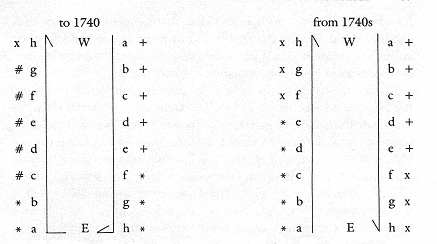
Fig. 11.
Goningumi registration. +, *, and # indicate goningumi groups, and
x signifies unaffiliated households. The goningumi households are
aligned along the north and south sides of Oume Road.
gumi functioned as a system of interhousehold surveillance and constraint, for the transgressions of one member would make the remaining four subject to castigation. The goningumi may be described as a janus-faced system of collective culpability and collective responsibility.
Aspects of the organization of this division are gleaned from the goningumi-cho, or register. Until roughly 1740, households were registered in groups of five, beginning with the westernmost and proceeding to the easternmost household on the north side of Oume Road, and continuing without a break from the easternmost to the westernmost household on the south side. From the 1740s onward, however, north- and south-side households were registered separately, from west to east and east to west, respectively (Kimura and Ito 1972, 151). Register entries clearly establish that in Ogawa-mura exactly five households comprised a goningumi, which was not always the case in other villages (ibid.; cf. Befu 1968, 304). Several households, consequently, were not incorporated into a goningumi. Perhaps their inclusion within the tax and neighborhood divisions was sufficient from an administrative point of view, a possibility I broach again in the context of the neighborhood divisions. Or perhaps only the households of titled farmers were incorporated. Also, the Shinto and Buddhist clergy, along with the village head, were exempt from this and other divisions. In Ogawa-mura, the goningumi did not coincide with the tax division, although there may
have been some overlap. It is also clear that the composition of each five-household division changed in accord with the rise and fall of the village's population. Thus, previously unincorporated households may have been included in the goningumi at a later time.
Ostracism was one of the most severe punishments meted out during the Edo period (see Smith 1961). The equivalent of murahachibu, or ostracism from the village(rs), was known as goningumi hazushi, or ostracism from the five-household division. Murahachibu seems to have been typical in "old" and "parent" villages, whereas goningumi hazushi characterized the system of sanctions in "new" or shinden villages (Kimura and Ito 1972, 157). The existence of goningumi hazushi is further evidence that Ogawa-mura as a whole did not operate as a kyodotai, or communal corps, from which errant households were ostracized.
Kinjogumi
Documentary evidence suggests that the kinjogumi, or neighborhood divisions (fig. 12), were in existence in Ogawa-mura by 1690, as were the goningumi. The neighborhood divisions were partly a local-level manifestation of bakufu authority and partly a local-level approach to the making of the nascent village. The kinjogumi were formed prior to the other two divisions, and in Ogawa they constituted the fundamental social matrix onto which the tax and five-household divisions were superimposed.
Today the Ogawa kinjogumi comprise five subdivisions, which I have categorized as either "fluid" or "fixed" with respect to their constituency. In the Edo period, the fluid subdivisions represented local-level approaches to the making of the shinden village, whereas the fixed subdivisions represented bakufu -dictated village structures. The "fluid" category includes the following units:
A. The ryodonari muko, the smallest neighborhood unit, centering on a single household and including the two households on its left and right and the one directly across from it. The terms ryodonari and muko first appear in documents dating to the 1750s. The ryodonari muko are not to be confused with a similar style of kinjogumi referred to as muko sangen ryodonari, a six-household unit made up of a central household, the two households on its left
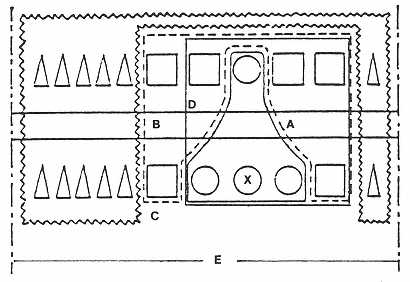
Fig. 12.
Ogawa-mura kinjogumi. X = central household; A = ryodonari muko; B = sashiba;
C = ogumi; D = kumiai; E = bangumi. (Adapted from KK 1983, 138)
and right, and the three households across (usually a thoroughfare) from them.[15]
B. The sashiba, two three-household clusters on either side of the ryodonari muko unit.
C. The ogumi, which encompasses within a single bangumi those households not incorporated into either A or B. The term ogumi first appears in a 1708 document, which may suggest indirectly that A was present at that time or that C preceded A as the primary unit of neighborhood organization.
The "fluid" category of neighborhood division was the basis for the organization and execution of ceremonial activities, particularly weddings and funerals. This is so to a limited extent in the Ogawa Eight today. The ryodonari muko were and remain especially important and operative on such occasions. Several Ogawa Eight natives believe that postwar social and politicoeconomic changes, together with the recent proliferation of commercial wedding halls, have reduced the ceremonial function of these neighborhood units.
The "fixed" category of neighborhood division includes the following:
D. The kumiai, or cooperative group, which encompasses eight households.[16] The cooperative group includes households on both sides of Oume Road, whereas the goningumi was limited to clusters of five households on either the north or the south side of that thoroughfare.
E. The eight bangumi, discussed earlier in reference to the tax division.
The "fixed" category of neighborhood divisions was the basis for the administrative, as opposed to ceremonial, organization of Ogawa-mura, although parish-related activities today are organized on a bangumi basis.
All of these fluid and fixed divisions were created by either the village head or the bakufu within a half-century or so after the initial reclamation of Ogawa-mura. By the eighteenth century, Ogawa-mura was a complex weave of interhousehold ties that bound households to both the village and the bakufu. These same neighborhood divisions, moreover, are operative in Ogawa-cho today. A review of several key morphological features of the kinjogumi system concludes the discussion on kumi.
First is its striking linear arrangement. The diapered ryodonari muko network was absent in Kishi-mura, very likely because of that village's cluster formation. Also, the preponderance of mutual strangers in the nascent Ogawa-mura meant that parishes and other place-linked units, such as the kumi thus far described, either took the place of or took precedence over "blood" and/or fictive kin ties as the basis of villagemaking. With the exception of the village head and clergy—both of whom were exempt from the tax, five-household, and neighborhood divisions—Ogawa-mura settlers were incorporated into a system of interlocking geographic units.
That the clergy constituted another order of villager entirely is illustrated by the following anecdote. On the occasion of our first interview, Miyazaki H., the chief priest of Shinmei-gu, insisted that Ogawa-mura originally was settled by "same-name groups" (shizoku ) and therefore was a "clannish" village. Although this may have been an accurate portrayal of the Miyazakis, as privileged Shinto clergy, it is not an accurate portrayal of the shinden' s initial residents. Since the vast majority of
settlers hailed from rather distant villages, ties between them and their relatives "back home" were attenuated, if not severed altogether. Only the Ogawas are acknowledged in the local literature as having maintained close relations with their Kishi line ever since the reclamation period (KC 1959, 900).
Much of the tenacity of the natives' society in Kodaira today, however, has to do with the gradual metamorphosis of the original placelinks into a network of kindred (shinrui ) relations as the original settler households established branches, which in turn produced branches. The operation of this network of main and branch households is especially evident in the yard shrine oblations discussed in the next chapter. Finally, the present-day descendants of both elite and ordinary settlers have in common a "nativeness" that now transcends historical status inequities and has been reified as a type of primordial solidarity.