
2—
The Lotissements and Building Contracts
Two practical factors conditioned the evolution of the form and style of the sixteenth-century Parisian hôtel . The organization of the lotissements for building development of the 1540s determined the size and shape of new houses, and the terms and system of costing of the notarial Parisian building contract provide a basis for understanding the stylistic choices available and the decisions made by patrons and architects.
The costs of a new war against the Emperor Charles V is the principal reason given by François I in the edict of the 23 September 1543, for the division into lots and sale of the royal Hôtels de Bourgogne, d'Artois, de Flandre, d'Etampes and Saint-Pol, leaving only the Louvre in the west, and the rambling Hôtel des Tournelles in the east on the north side of the rue Saint Antoine.[8] The expenses of a campaign was the traditional motive for a monarch to sell land, titles and offices, but in this case an unusual
16
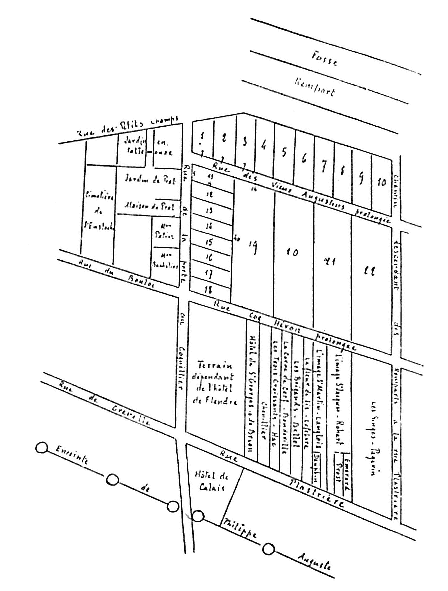
Plan of the lotissement of the Hôtel de Flandre in 1543, from Dumolin.
rider was included in the text of the edict, that these royal properties were ' . . . vieils, inutiles, inhabités et délaissées en ruyne ou décadance . . .' and do nothing more than ' . . . encombrer, empescher et defformer grandement la ville de Paris . . .', and these holdings as a result of the royal edict could become ' . . . fort propres, utiles, et avesnables a bastir et ediffier plusieurs beaux logis, maisons et demeures'. Not since the Hundred Years War had there been an initiative on the scale and importance of the lotissement of the Hôtel Saint-Pol, with its novel straight streets, and at 10 metres in width they were wide for Paris of the period. Medieval royal palaces in Paris, with the exception of the compact Louvre, covered large areas with numerous corps de logis , halls and service buildings, connected by
17
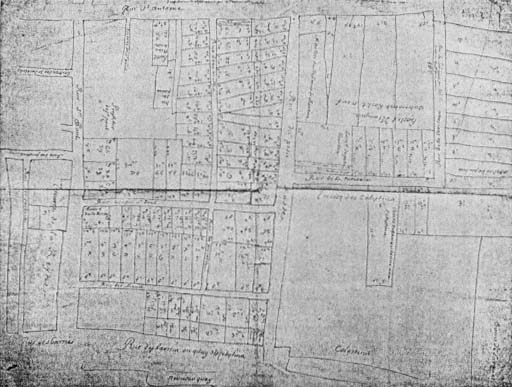
Plan of the lotissement of the Hôtel Saint-Pol from 1543 to 1556, from Mirot.
galleries and arbours and separated by irregular courtyards and gardens, as was the Hôtel Saint-Pol of Charles V and VI. Parts of these sprawling complexes had been given or leased to royal favourites up to the 1520s, and the resolve of the Crown to generate the maximum revenue from these lotissements is shown in the revocation of all gifts and termination of leases on small and large portions of the properties, so that these new quartiers could be methodically developed with grid pattern streets and regular building plots to attract those with means. As can be seen in the outline plans of the lotissements of the Hôtel de Flandre and the Hôtel Saint-Pol (Figs 16–17) the scale of the plots varies with the smaller lots usually lining those streets which were expected to be the busiest, for houses with shops or offices on the ground floor of a kind seen in du Cerceau's first project (Figs 8–9). The large plots for substantial houses were on the streets which were quieter without direct access between the main thoroughfares.
Encouraged by the example and initiative of the Crown, the prior of the Church of Sainte-Catherine, which stood north-west of the Hôtel Saint-Pol on the north side of the rue Saint-Antoine, resolved to sell for upper-class development the meadows and market gardens north of the church. Saint-
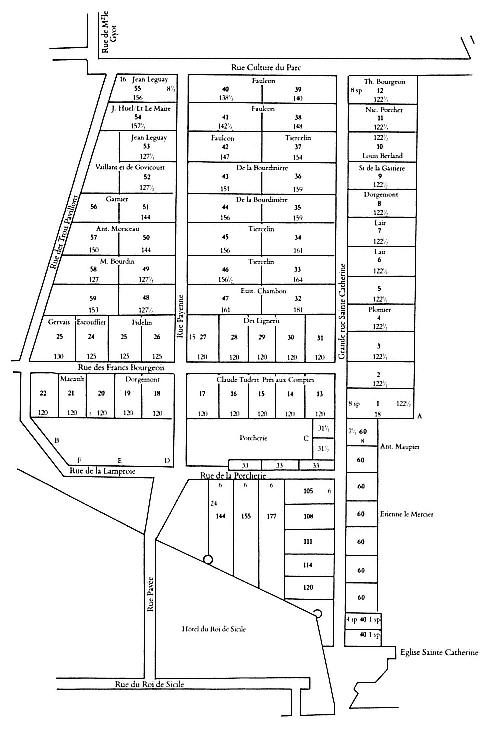
Catherine already drew part of its income from some houses which stood between the church and the rue Saint-Antoine, which from the fourteenth century had been leased for periods of ninety-nine years. By the 1540s the increased number of monks meant that income from existing leases and other sources of revenue was inadequate and they set about exploiting their major asset the Culture Sainte-Catherine. During the first three months of 1545 (new style) the legal formalities of the conditions of sale and lease were decided upon and completed, and the plan of the lotissement was drawn up by the prior, a notary and other unidentified professional men,[9] with a scale of prices for leases (Fig. 18). At the south-east a new area was opened at the west end of the church from which started the Grande rue Sainte-Catherine, one of two long streets running from south to north, the other being the shorter rue Payenne named after Payen the monks' notary, and from west to east across the middle of the area an extended rue des Francs Bourgeois. Of the fifty-nine circled numbered plots shown in the outline plan (Fig. 18), fifty-three were sold between March and June 1545, most of which were between 120 and 150 square toises . As the outline plan shows, the greater number of lots were bought up in multiples of two to five, and the list of the first buyers and later owners on the Culture Sainte-Catherine is full of the names of leading lords, courtiers, diplomats and administrators. Robert Dallington writing in or shortly after 1598, having described the Tuileries noted, 'There be other very many and stately buildings, as that of Mons. Sansuë, Mons. de Monpensier, de Nevers, and infinite others, whereof especially towardes the East (i.e. the Marais and especially the Culture Sainte-Catherine) and this towne is full, in so much as ye may say of the French Noblesse, as is elsewhere said of the Agrigentines, "They build as if they should live ever, and feede, as if they should die tomorrow". But among all these, there is none (sayth this Author) that exceed more than the Lawyers, "Les gens de Justice (et sur tout les Tresoriers) ont augmenté aux seigneurs l'ardeur de bastir": The Lawyers and especially the Officer's of the King's money, have enflamed in the Nobilitie the desire of building: . . .'[10]
On 18 March 1545 (new style), only eight days after two notaries had been instructed to 'dresser les baux à rente des terrains', Jacques des Ligneris, seigneur de Crosne and President of the Parlement de Paris exactly the kind of man referred to by Dallington, bought the five plots 27 to 31, a total of 600 toises . Des Ligneris built a house on this land which is of central importance in the history of French Renaissance architecture and sculpture, and which in company with documented or surviving houses from the reigns of Henri II, Charles IX and Henri III made the lotissement of the Culture Sainte-Catherine the greatest architectural event and opportunity of the period, and a remarkable commercial success for the monks.[11]
The stimulus for the upper classes to build in Paris during the middle and late sixteenth century has been attributed to decisions made by François I. The speed with which the leases on the Culture Sainte-Catherine were
18
Plan of the lotissement of the Culture Sainte-Catherine in 1545, from Dumolin.
snapped up proves the strength of the need and demand for building land within the walls of Charles V. Other royal edicts put further pressure on the available land between the two sets of medieval walls, the inner and earlier set of Philippe Auguste and the outer range from the reign of Charles V. Henri II's ordonnance of 23 November 1548 forbade any new building in the faubourgs just outside the walls on both banks, and the act was to be enforced by demolition at the owner's expense with other penalties. The ordonnance was renewed on a number of occasions during the later sixteenth and seventeenth centuries because of the problems of policing and servicing an uncontrolled expansion of the city. The royal and municipal jurisdiction might have been extended to areas beyond the walls, but this was not considered to be in the interests of the city's privileges, economy or security.
After the death in 1559 of Henri II from wounds after a jousting accident at the Hôtel des Tournelles, his superstitious widow Catherine de Medici decided to sell the rambling palace. The exact limits of the Tournelles are not easy to follow now, but it was a considerable area on the north side of the rue Saint-Antoine, opposite the Hôtel Saint-Pol, the neighbour of the Culture Sainte-Catherine to the west with the walls of Charles V on the east. Letters patent published on 23 January 1563 describe a programme for the development of the quarter which is the earliest record of a fully coherent royal initiative in town planning.[12] The document starts with the usual preamble on the city daily growing more populous and how the majority of newcomers and natives are obliged to build outside the walls of the city because of the shortage of building space. Philibert de l'Orme's brother Jean was to design a pattern of streets and open spaces; land was to be sold in regular plots on condition that the purchasers built their houses within two years. The novel clause in the text is the proviso on the houses being 'uniformes et semblables'. Jean de l'Orme was to design a comprehensive scheme with architecturally coherent street elevations, but unfortunately the letters patent do not specify whether the intention was to create an haut-bourgeois and aristocratic residential quarter or one which incorporated a mixture of commercial premises with housing for a wide social spectrum. Any drawings made by l'Orme for the transformation of the area have not survived and the project was never started, but something of the 1563 scheme may be echoed in the Place des Vosges built forty years later for Henri IV on part of the site of the derelict Hôtel des Tournelles, which determined the east of the Marais as haut bourgeois and aristocratic.
Estimates of the size of the population of Paris during the sixteenth century vary, and considerable fluctuations are to be expected with the horrors of the Wars of Religion in the second half of the century. Figures of 350,000 to 500,000 have been given for the late 1520s, with one million in 1577, which drops to 200,000 to 300,000 souls in 1596. The guesses of a Venetian ambassador or a modern historian of the city's population do
little to help with the history of the physical development and rate of building expansion of Paris. The periods of pressure of population led to taller tenement building in the older quarters on or near the main arteries, the rue Saint-Denis, the rue Saint-Martin on the Right Bank and the rue Saint-Jacques on the Left Bank. The story of the lotissements illustrates one aspect of the filling in of the area within the walls, but this process should not be related to pressures from a growing population, but to the ambitions of speculators, and of the wealthy for a more salubrious life in the town with gardens and other agreeable features. The first large addition to the limits of Paris on the Right Bank since the fourteenth century was the start made in 1566 on new fortifications for the west of the city, and which moved the Porte Saint-Honoré out by 950 metres.[13] Only with the completion of the fossés jaunes under Louis XIII, which ran from the west end of the Tuileries gardens round to the Porte Poissonière in the north, did a full and rational lotissement of the area take place. The improvement in the city's appearance foreseen by François I in 1543 was not a radical or grandiose proposal to embellish the capital of the kind which preoccupied architects under all of the Bourbon Kings and Napoleon, but it was a practical wish to see accommodated a larger resident professional aristocratic class in new and renewed portions of the Right Bank, and at a profit to the crown.
Once a gentleman or businessman had bought his land on one of the lotissements , he was usually obliged as a condition of the sale to build within a prescribed number of years, and one of the results of such stipulations was numerous cases of sale and resale before any building was started. The design of the house might be entrusted to an architect, but from the evidence of the great majority of surviving building contracts, an architect was consulted or employed on surprisingly few occasions in the second half of the century. Custom and architectural books advised the patron to seek competent advice before any commitment by contract to building, on all matters of form and size, materials and their cost, and of course style. Social connections greatly influenced the appearances of some buildings in sixteenth-century France, where groups of amateurs and craftsmen convened to discuss ideal and practical matters,[14] but records of such collaborations do not survive for any Parisian hôtel although they must have taken place. Amongst the upper classes were men who had travelled and who had read Vitruvius and other architectural literature, but only rarely is there any trace of their taste, and their impact is impossible to judge.[15] Only in the case of Pierre Lescot, the designer of the Louvre, do we have an exceptional and spectacular case of a courtier prevailing in favour over the specialized architect who, in the early history of the new Louvre, was Sebastiano Serlio.[16] The most common and convenient intermediary for a patron was his notary, the man who for all important contracts drew up the terms to be agreed between patron and master mason, and their growing expertise in the economics of building led to the
appointment of notaries to the senior post in the Royal Works under Henri III and Henri IV. The building contract may or may not mention a drawing on which the agreement has been based, and contracts are never good records of the stylistic details of buildings, for they are concerned with type, quality and price of materials, but contracts are invaluable for information about the dispositions of a house, and without them few reconstructions of the plans of lost buildings could be attempted. In such precise and detailed documents as Parisian masonry contracts it is surprising and frustrating to find only the most cursory descriptions of the decorative elements of the projected building, as these would be agreed on the basis of a drawing provided by or on behalf of the patron, and which would be initialled by all the parties to the contract. The loss of the drawings once attached to contracts in the notarial archives is almost total, and so it is from the costings, and the amount of more expensive toises , that a notion of the architectural interest of a building can be extracted. These documents almost never specify the particularities of any classical ornament to be made; whether a column or pilaster was to be Doric, Ionic or Corinthian presumably had little bearing on the amount of money involved in a bargain. The notarial building contract gave the patron assurances on the cost of work and on the date on which work would be started. Many contracts only describe a portion of a full scheme foreseen by patron, architect or master mason. The story of sixteenth-century architecture in Paris is full of curious fragments and never completed hôtels and judgements on the success or failure of a design should be cautious.
19
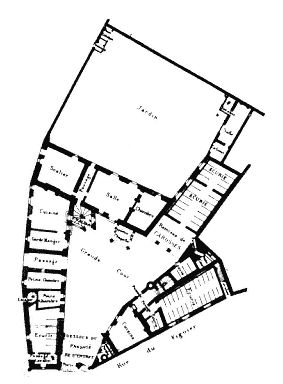
Hôtel de Sens. Ground-floor plan with supposed original dispositions.
20
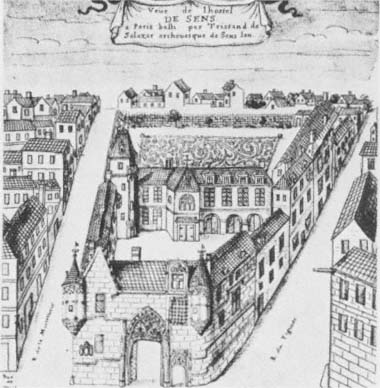
Hôtel de Sens. Bird's-eye view by Gaignières.