
7. Fault Lines in the Afghan Jihad
When I interviewed Qazi Amin in 1984, we met in the nondescript, concrete building on the outskirts of Peshawar that he used for his personal office. There were many such buildings on the western fringe of Peshawar, which was in the midst of a massive construction boom, a result of the influx of arms, money, and drugs that followed in the wake of the Soviet invasion of Afghanistan and the migration of more then three million refugees to Pakistan. Qazi Amin’s office was on the floor of a ground-level room looking out on a scraggly garden. There were no chairs or couches. He sat cross-legged on one of the three uncovered foam mattresses that lined the sides of the room. His briefcase doubled as his desk, and on a short pine table off to the side he kept stacks of books, mostly on religious subjects, including one that advised which suras of the Qur’an to recite for different disorders such as insomnia and marital discord. There was also a box of teacups and saucers ready for guests, a telephone close at hand, a bell that he used to summon his servant or assistant, and a notepad with Hizb-i Islami letterhead stationery and an official stamp, which he used to authenticate the letters and directives he sent out to various subordinates and associates. I also noted a large hole in the upper corner of one wall, I assumed for the eventual installation of an air conditioner. Construction in Pakistan was so frenzied at that time that builders rarely planned ahead or worried about the end use of their buildings. Consequently, in many of the homes and offices I visited, I found similar gaping holes made after the fact to accommodate wiring or gas fixtures or air-conditioning units.
When Qazi Amin was at home, his bodyguards lounged in the room next to the office, where one of his assistants could be found punching away at a Persian typewriter. Outside, the garden was filled with young Afghan men who milled about while awaiting the opportunity to meet with the leader. Some would request his assistance in getting a ration card or an increase in their allotment of food supplies or a family member admitted to a hospital; others were there looking for a job or funds for one worthwhile project or another. In the compound of every major and minor leader in Peshawar, a similar scene took place every day, and Peshawar was full of leaders—from the heads of the Afghan parties to the directors of the parties’ myriad committees, directorates, and offices. And there were the hard-eyed commanders, just in from the provinces and trailed by a pack of scruffy-looking mujahidin, making their way from office to office in search of the weapons and supplies they needed to go back for more fighting. Peshawar was full of leaders, but as everyone knew, no one was in charge.
In this chapter, I examine the evolution of the Islamic party infrastructure in Peshawar, focusing in particular on the transformation of the Muslim Youth Organization into Hizb-i Islami Afghanistan and the role of Hizb in fashioning the fragmented and vituperative refugee political culture of the mid-1980s. Trying to conduct fieldwork in this environment (for eighteen months from 1982 to 1984 and for six months in 1986), I found the profusion of parties puzzling, particularly since Islam had seemed such a taken-for-granted but politically insignificant part of Afghan society a decade earlier, when I lived in Kabul. I also found all the party business and the readiness of Afghans to speak of it, usually in disparaging terms, something of a bad joke and not easy to take seriously. On one level, it seemed like so much individual bickering and power grubbing—all sound and fury, signifying nothing. But it was there, the political culture of the moment, and I spent most of my time trying to make sense of it. In retrospect, I attribute greater importance to the political machinations swirling around me back then. Specifically, I see that they made possible the rise of the Taliban, for that movement was a direct response to the infighting within the Islamic resistance, which was becoming increasingly bitter during the period I was conducting research. The fissioning of the resistance climaxed after the Soviet pullout in 1989, when the parties were engaged in an armed struggle for control of Kabul. However, the process that culminated then had its origins in the period between the Marxist revolution of 1978 and the founding of the radical (seven-party) and moderate (three-party) alliances in September 1981. This was the formative period of the Islamic resistance—when the fault lines that later sundered it first revealed themselves—and it is vital to understand what transpired then in order to make sense of what happened later.
In preceding chapters, I discussed several factors in the early ascendance of Islam. Here, I take up the matter of how the Islamic jihad failed. Specifically, I am concerned with how there came to be ten separate parties in Peshawar, all claiming to represent Islam, all claiming to represent the best interests of Islam, all working to advance their own interests and to undermine the interests of their rivals. [1] In previous encounters between Islam and the state, a variety of religious figures had often been involved, but they generally were in agreement about the meaning of Islam and about the sect or school that was most entitled to paramount status. Thus, leaders like the Mulla of Hadda and Mulla Mushk-i Alam, who played a prominent role in the Second Anglo-Afghan War (1878–1880), could unite other religious figures behind them, in part because they thought of themselves and were thought of by others as scholars, Sufis, and reformers—not as potential kings. During the early stages of the counterrevolution against the Khalqi government, however, the façade of Islamic unity crumbled as philosophical differences became magnified and rivals competed for power among themselves with greater alacrity than they showed in their prosecution of the conflict with the Kabul regime.
Muslims generally agreed that a cornerstone of their faith is the principle of God’s singularity. For Muslims, God is one, indivisible, and eternal, but the preeminent characteristics of the Islamic resistance in Afghanistan were multiplicity, fragmentation, and impermanence. The evolution of this disjuncture can be traced through a series of sequential ruptures that occurred between 1975 and 1980, in each of which an effort at unifying the resistance was followed by confrontation and the establishment of a new political party. The creation of new factions followed familiar patterns related to the particular nodes of Islamic authority that had long existed in Afghanistan as well as to more recent innovations. The flight to Peshawar brought together representatives of all the Sunni Islamic traditions active in Afghanistan, and while these representatives were all more or less dedicated to the cause of jihad, they had different approaches and often violent disagreements with one another over who should lead the jihad and how it should be conducted. [2] At the time, it seemed that many of these tussles were the result almost solely of personal ambition rather than of more meaningful social and political divisions, but it is clearer today—especially since the emergence of the Taliban—that these disputes had a larger significance than was then apparent. In what follows, I describe these divisions in the chronological order in which they occurred, the principal personalities involved, and the relationship of particular disputes and ruptures to the evolving structure of Islamic authority in Afghanistan.
The Last Sufi
Daud’s coup d’état initiated a new era of politics in Afghanistan. Though groups like the Muslim Youth had been involved in violent demonstrations prior to the coup, the focus of most of their anger was the leftist student groups. From this point on, however, attention turned to the government itself, and the major concern became how to unseat President Daud himself. The Muslim Youth Organization was not alone in changing direction. Other underground Islamic political parties also began making plans to overthrow the government. These included three parties with strong links to the military officer corps that joined forces as Hizb-i Tauhid (the Monotheism Party) under the leadership of a Sufi pir named Maulana Muhammad Attaullah Faizani whose life story interweaves traditional and modern elements in a unique way. Born in 1924 in western Herat Province, Faizani grew up in a family of miagan (descendants of a venerated saint) and religious scholars, from whom he gained his primary education, and he later chose to attend the teacher-training college in Kabul. [3] Faizani began teaching in Herat in 1947 but quit after a few years, first to travel to other Muslim countries in search of Islamic knowledge and, then, for three years, reportedly to live a life of purification, fasting, and meditation in a secluded cave. After this period of ascetic retreat, Faizani resumed his traveling and ended up in Mazar-i Sharif, where he became enmeshed in his first political controversy after delivering a sermon in which he criticized the corrupt practices of clerics, government officials, and feudal landlords.
This incident led to the first of several arrests resulting from his defamation of those wielding power. Between prison stays, Faizani established a Sufi khanaqa, or center, near Pul-i Khumri in northern Baghlan Province, where he managed to secure a growing following, particularly among teachers, students, and mid-level military officers and government officials. He also attracted the attention of local clerics, who resented his popularity and accused him of claiming to have extraordinary spiritual powers. These accusations led to another arrest and a two-year prison term. Undeterred, he participated in the organization of the Pul-i Khishti demonstration shortly after his release in 1969, which resulted in his fifth stint in prison, this time for a year and a half. When he was released in 1970, Faizani remained in Kabul, where he set up a library near the Pul-i Khishti mosque and presided over weekly zikr ceremonies. Faizani’s library and zikr circle attracted numerous visitors, including Muslim Youth leaders like Engineer Habib-ur Rahman and Maulavi Habib-ur Rahman, and many government officials and military officers. When Daud executed his coup d’état, Faizani was initially supportive, as he had long opposed the corruption of the monarchy, but he became increasingly pessimistic about the direction in which Daud was leading the government, and this pessimism led to his association with Hizb-i Tauhid. Despite the involvement of several high-ranking military officers, Hizb-i Tauhid was short-lived, as its plans for a coup d’état against the government were uncovered. Faizani was once again imprisoned, along with a number of his principal disciples and supporters, and he was still in prison when the Khalqis took power in 1978. Though his exact fate has never been ascertained (some disciples believe he is in occultation), it is probable that he was executed with other political prisoners before the Soviet invasion in 1979.
Maulana Faizani is one of the most interesting and enigmatic figures in contemporary Afghan history. In many respects, his life story is an updated version of the Mulla of Hadda’s; the Sufi elements of his story are numerous—the period of youthful wandering followed by a lengthy retreat from society, the fearless disregard for secular authority, the clashes with traditional clerics and government officials, the claims of supernatural powers, the devotion of his disciples. [4] All these are standard features of saintly hagiography, but Faizani was a man of the modern age as well. Educated and knowledgeable about science and technology, he differed from many traditional scholars and Sufis in wanting to integrate spiritual and secular forms of knowledge. In a time of general decline for Sufism, when most of the established saintly families had lost their influence and clerics either ignored science or claimed it was an infidel trick, Faizani espoused a mystical theology that embraced science and technology as ways of understanding and appreciating God’s creation.
For Faizani, science and politics were important and necessary activities, though he claimed that both were secondary to spiritual enlightenment, which had to precede and govern them. Only a person with knowledge of God could fully comprehend science’s capabilities or the political needs of the moment, and the way to achieve that knowledge was first and foremost through study of the Qur’an and the Sufi practice of zikr. Even this process, though, was susceptible to refinement of a modern sort, as one of Faizani’s disciples explained:
In this age due to the progress and advance of science and other technological fields the spiritual methods have also changed. For instance, we are able to travel the distance [that used to take] one month in one or two hours. Similarly by adopting new methods we can gain spiritual understanding in a very short time. In this advanced age of science there is very little need for seclusion, and physical hardship. In old days it took many years to attain self-purification. Nowadays we can gain the inner purification in a very short time, provided we put into practice the teachings of Maulana Sahib [Faizani]. [5]
Faizani was threatening to traditional clerics not only because of his synthetic approach to spirituality and science but also because of his ecumenical openness to people from a variety of backgrounds. A native Pakhtu speaker, he wrote mostly in Persian, and his followers included many Shi’as as well as Sunnis like himself. Hizb-i Tauhid, the party he helped to form after Daud’s coup, was equally inclusive, bringing together sectarian groups that had formerly worked separately from one another. [6] After Faizani’s arrest, no other Afghan religious leader was able to unite Sunni and ShiShi’aa followers, and, with his arrest and the breakup of Hizb-i Tauhid, activists from these two principal Islamic sects tended to go their separate ways and have remained disunited to the present. [7] For a brief time, the Muslim Youth did manage to hold the loyalty of some Shi’a students, but most of the prominent Shi’as in the Muslim Youth also worked with Faizani and were arrested with him after his failed coup attempt. Thereafter, the Muslim Youth remained solidly Sunni in orientation and made few inroads in Shi’a areas. Some Shi’as would later come to Peshawar seeking arms from the Sunni parties in control there, but the alliances struck in this context were strictly pragmatic. No leader since Faizani has been able to engender true cross-sectarian loyalty, and these divisions are more pronounced now than ever before.
Faizani probably enjoyed his greatest support among military officers. He used the traditional zikr circle as an avenue not just for spiritual enlightenment but also for political organizing. In tapping into the officer corps in this way, Faizani was following a longstanding tradition of Sufi association with the military, a tradition that went back at least to the turn of the century and that had periodically generated considerable paranoia within the government. [8] Indeed, one of the early points of contention between Amir Amanullah and the Hazrat of Shor Bazaar and other prominent Sufi pirs in the mid-1920s was the amir’s attempt to forbid members of the military from active participation in Sufi circles. Amanullah recognized the conflict of loyalty that could emerge when officers swore fealty to both their secular leader and a spiritual mentor, a conflict that played itself out when the Hazrat and other leaders called on their disciples within the military to take up arms against the king. Many believe that Daud faced the same threat from Faizani and his followers. Although, ultimately, Marxist cadres in the military undid Daud, many believe that the Muslim officers were more politically active—if also less fortunate—than the Marxists. The arrest of Faizani and many of his leading disciples forestalled this burgeoning movement, however, effectively crippling Muslim organizing efforts within the military and ultimately making it far easier for Hafizullah Amin to intensify his recruitment within the officer corps in the years leading up to the Saur Revolution.
Another feature of Faizani’s leadership was his ability to appeal to younger people. Some of Faizani’s surviving disciples contend that he was closely aligned with Abdur Rahim Niazi, the founder of the Muslim Youth Organization, and that it was Faizani who originally convinced Niazi to enroll in the university in order to recruit students away from Marxism to the Muslim cause. This assertion is impossible to prove, but there is evidence that Engineer Habib-ur Rahman, probably the leading member of the Muslim Youth after Niazi’s death, was a Faizani ally. A number of informants have told me that Rahman was a frequent visitor to Faizani’s library and zikr circle and was at least aware of, if not involved in, the organization of Hizb-i Tauhid’s planned coup d’état. He was also among those arrested when the coup d’état was uncovered, and he was executed with other plotters in 1974.
After Engineer Habib-ur Rahman’s death, the Muslim Youth turned away from alliances of this sort, keeping to themselves and trusting no one other than those whose loyalty to the party was assured. They also took to disparaging Faizani and his role in the Islamic movement. Thus, when I asked members of Hizb-i Islami who had previously been in the Muslim Youth about the activities of Maulana Faizani, I generally received condescending replies: Faizani was an old-style pir who had his disciples engage in the Sufi practice of repeatedly reciting God’s name in zikr circles rather than organizing them politically:
In seeking spiritual reform as a prelude to political reform, Faizani was in fact following a venerable Sufi adage that jihad against infidels or corrupt rulers was the “lesser” jihad compared with the “greater” spiritual jihad that the individual carried out against his own baser instincts and motivations (nafs). To the Muslim Youth, however, talk of “greater” and “lesser” jihads only mystified what was going on in the country, and this confusion made it easier for leftists to gain an advantage.Faizani’s approach to political things was different from that of the Muslim Youth. We were trying to challenge the communists right away in the university. We said that if we wait until every Afghan becomes a religious scholar, it will take ages, and then finally we will all become communists. So now is the time: if you don’t stop the spread of communism on the university campus, you won’t be able to stop it tomorrow. . . . Our belief was that the Russian plan was to bring communism through the educational institutions and to bring intellectual communism to Afghanistan. They were giving a lot of Afghans scholarships because of their long-run plans. . . . Hundreds of Faizani’s own men went to the Soviet Union for training. When Daud was toppled [in 1978,] no one knew what had happened except the Muslim Youth, who explained to the people that it was a Soviet move. [9]
When I was conducting research in Peshawar in the mid-1980s, I could identify only two of Faizani’s disciples who had escaped arrest. They had become active with other parties, not having the wherewithal or support to organize a movement of their own, but they maintained their loyalty to their absent spiritual mentor. Both disciples believed that Faizani was still alive, despite the prevalence of reports indicating that he had been executed either by President Daud or after the Khalqi takeover. One of the men told me that he thought Faizani was possibly in a state of spiritual occultation, waiting for the right moment to return. [10] The other man believed that Faizani might have been taken to the Soviet Union but that he could use his supernatural powers to come back whenever he chose. This disciple told me that Faizani was, in fact, the “deputy of the messiah of the end of time” (khalifa-i mahdi akhir al-zaman) and could not be contained, controlled, or killed by any secular power. So he and other true believers waited patiently for Faizani’s reappearance, when his true status would be revealed and the mess in Peshawar would be set right. [11]
The most interesting aspect of these stories is how they connect to a venerated tradition of Sufi hagiography. In Heroes of the Age, I recount several stories regarding the Mulla of Hadda and his deputies that also involved miraculous escapes from prison and other acts of defiance against the state. Faizani’s disciples kept that tradition alive, but in my experience they were the only ones to do so. In the many interviews I conducted, I never heard any stories like these concerning any other contemporary religious figure, though I knew that the stories themselves were still remembered from the past because I collected a large number about the Mulla of Hadda and his circle during this same period, as well as miracle stories about common mujahidin who had been martyred in the fighting. [12] It seemed that the kind of mystical power associated with the saints of the past and the veneration that went along with it were almost entirely absent from popular attitudes toward the leaders of this jihad and that Faizani was perhaps the last of the breed of old-style Sufi saints to whom were attributed supernatural deeds and powers. As discussed later in this chapter, heredity leaders of Sufi tariqats like Sibghatullah Mujaddidi and Sayyid Ahmad Gailani would emerge as significant players in the Peshawar milieu, but their leadership was based on their being offspring of famous pirs rather than on any mystical power or charisma of their own. Faizani, however, was a self-made Sufi from the premodern mold whose reputation rested on his personal magnetism and spirituality as well as his political activities, and no comparable figure has emerged since his arrest and disappearance.
| • | • | • |
Faizani is largely a forgotten figure today, but it is worth remembering him, if only to note what the Islamic jihad did not become. While there would be many subsequent attempts to establish a unified Islamic front in the wake of the Soviet invasion, Faizani’s was the first and, in many respects, the most genuine, in that his following extended across regional, sectarian, class, and professional lines. It is impossible to know whether this alliance would have stayed together if Faizani had managed to escape to Pakistan. Probably its success would have depended on the survival of certain of his key disciples, notably General Mir Ahmad Shah Rizwani, his leading follower in the military, and Engineer Habib-ur Rahman, his leading ally within the Muslim Youth. With the arrest of Rizwani, networks within the military became severed. Rahman’s arrest left the leadership of the Muslim Youth in the hands of Hekmatyar, who was not known to be interested in Sufism or sympathetic to alliances with other Islamic groups, preferring instead to stake out control of the jihad for the Muslim Youth alone.
Likewise, Faizani would probably have found Peshawar a less sympathetic place to operate than Kabul, and not just because of the fractious political climate that developed in Pakistan. Faizani was fluent in Persian, and though he himself was a Pakhtun from the Kakar tribe and had many Pakhtun followers, his core group of disciples was from Kabul and the Persian-speaking regions. Peshawar, however, was overwhelmingly, even belligerently Pakhtun, and Persian speakers felt themselves at a disadvantage there. Pakhtuns newly arrived in Kabul from the provinces were often made to feel that they were country bumpkins. However, Kabul was a more welcoming city than Peshawar, and even the roughest Pakhtun could eventually feel at home there. Indeed, several generations of rural Pakhtuns came of age in the tribal boarding schools of Kabul, learning Persian and becoming a part of the city’s cosmopolitan culture. Peshawar was a less inclusive city that incubated Pakhtun chauvinism, which is a reason why one saw relatively few non-Pakhtun refugees on the streets of Peshawar during the 1980s. The need for weapons and supplies ensured that Tajik, Uzbek, and other non-Pakhtun mujahidin groups would come and pay their respects to the party bosses. However, they tended not to stay long, and they rarely brought their families with them; when they did, they usually settled them in refugee camps in the Mardan and Hazara districts, as far from Peshawar and the Pakhtun tribal areas as possible.
Faizani might have overcome the problem of language and ethnic background on the strength of his personality, but he would also have had to confront the fact that Sufism of the sort he practiced had little purchase in the refugee world created in Peshawar. During my research, I visited a few Sufi pirs who oversaw zikr circles, but these were generally low-key affairs, held sporadically in out-of-the-way camps and mosques. The only other pir who combined spirituality and politics and enjoyed general respect was Miagul Jan, the son of the Mulla of Tagab, who was one of the Mulla of Hadda’s principal deputies. Many people told the story of how the communists unsuccessfully tried to bomb Miagul Jan in his mosque and how his disciples carried him on a bed all the way to Pakistan. The tone of these stories was invariably respectful, even sometimes rather awestruck, but as the story implies, Miagul Jan was an old man when he fled Afghanistan, and, shortly after his arrival in Pakistan, he left to spend his few remaining days in Mecca. In 1983, I attended the “turban-tying” ceremony (dastarbandi) by which his son was anointed as his successor. However, the son, while respected, clearly was not venerated with the same fervor as his father had been, and he did not have the kind of intensely devoted following his father enjoyed.
With the exception of Sibghatullah Mujaddidi and Sayyid Ahmad Gailani, who are discussed later in the chapter, none of the pirs in Peshawar had any significant role in the jihad, and it seemed to me that the personalistic ties of respect and deference that had traditionally bound disciples to their pirs no longer mattered as much as they once had, except to the few scattered souls who still found individual solace in Sufism. [13] A Sufi pir like the Mulla of Hadda developed over many years a base of support that allowed him to mobilize thousands of disciples to take part in any battle he thought worth fighting. These battles are what is remembered best about the Mulla and others like him, but it is forgotten that preceding these conflicts—and making them possible—were years of daily encounters between the master and his disciples. Devotees of the pir would travel long distances to his center, eat from his langar, and wait to sit in his presence in order to receive a few minutes of his time. In Peshawar, this kind of spiritual devotion was not in evidence, and party leaders like Hekmatyar ensured that a new model of relationship would take hold in its place—the model of the authoritarian political party.
The Radicals
Following the failure of the Faizani coup d’état and the subsequent arrests of numerous Muslim militants, leaders of the Muslim Youth Organization and other well-known Muslim figures fled to Peshawar. Among the refugees were Qazi Amin’s old friend and mentor Maulavi Habib-ur Rahman, Hekmatyar (Fig. 13), and one of their former professors at Kabul University, Ustad Burhanuddin Rabbani (Fig. 14). A Persian-speaking Tajik from northern Badakhshan Province, Rabbani had studied at madrasas in Afghanistan, graduated from the Faculty of Islamic Law in 1963, and then was employed to teach at the university. In 1966, he traveled to Egypt to study at al-Azhar, from which he received a master’s degree in Islamic philosophy. While in Cairo, he became familiar with the activities of the Muslim Brotherhood and, on his return to Kabul, devoted himself to translating into Persian various works by Sayyid Qutb, the chief theoretician of that organization. He also resumed his position at the university and became closely associated with his fellow professor, Ghulam Muhammad Niazi, whom he served as secretary in 1969 and 1970. After Professor Niazi’s imprisonment in 1974, the government reportedly sent police to arrest Rabbani at his campus office, but he was warned ahead of time and managed to flee to Peshawar, arriving there a few months after Hekmatyar, Maulavi Habib-ur Rahman, and other Muslim Youth leaders.
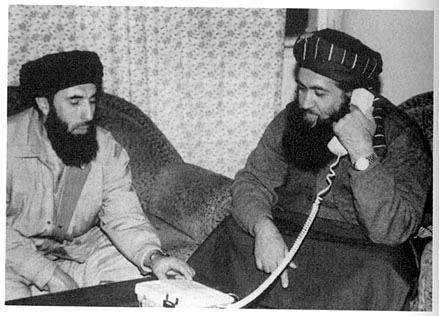
13. Qazi Amin (right) with engineer Gulbuddin Hekmatyar, Charasiab, post-1989 (courtesy of Qazi Amin).
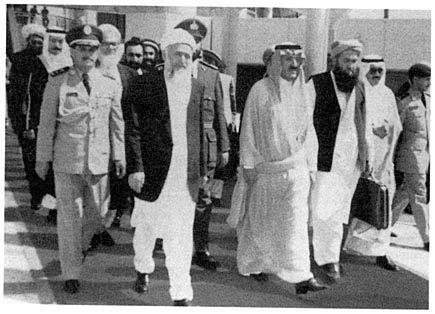
14. Qazi Amin (with briefcase) with Professor Burhanuddin Rabbani (in dark suit coat), Saudi Arabia, n.d. (courtesy of Qazi Amin).
The most pressing issue for the refugees was deciding how to press their political agenda, and a split immediately developed between the younger group, which wanted to commence armed operations against the government, and Rabbani, who was more cautious in his approach and did not think the refugees were ready to begin an armed struggle. The dispute continued for some time, but while Rabbani was away in Saudi Arabia in the summer of 1975, the student group went ahead and initiated the abortive attacks that led to the arrest of many of the top student leaders. The failure of this plot decimated the Muslim Youth, as a number of the chief figures in the movement were arrested and later executed by the government. [14] Of equal importance, the uprisings cemented a lasting rupture between what was to become the Tajik-dominated wing of the party (which became known as Jamiat-i Islami Afghanistan) and the Pakhtun-majority wing (which was to become Hizb-i Islami Afghanistan). At the center of this dispute were Hekmatyar, who had been a strong advocate of the attacks, and Rabbani.
A Kharoti Pakhtun from northern Kunduz Province, Hekmatyar was a student in the School of Engineering at Kabul University when he became one of the founding members of the Muslim Youth Organization. [15] Considered one of the most militant of all the Muslim activists, Hekmatyar was actively involved in many of the violent demonstrations that flared up on the campus of Kabul University in the early 1970s, including one in the spring of 1972 in which a member of the Maoist Eternal Flame party (Shula-yi Jawed) was killed. Whether he was responsible for this killing has been disputed, but there is little doubt as to his advocacy of violence in pursuit of political objectives. In the case of the uprisings carried out in 1975, criticism of Hekmatyar centers on the naiveté of the plan, its devastating impact on the party’s leadership, and the fact that, while strongly supporting the attacks, Hekmatyar—almost alone among the party’s student leaders—stayed in Peshawar rather than participate. Enemies of Hekmatyar have seen his noninvolvement as evidence that he wanted the uprisings to fail and its leaders to be captured so that he could consolidate his own power.
Another source of controversy and criticism of Hekmatyar concerns the purported existence of a military coup d’état that was supposed to happen concurrently with the attacks on rural government offices. According to one informant in Rabbani’s party, those who were involved in the provincial attacks were told that once they had succeeded in securing their objectives, they were to listen on the radio for word of the progress of the Kabul coup attempt. If the coup succeeded, they were to stay in place. If it failed, they were to leave their positions and make their way back to Pakistan. Those who participated in the uprisings were assured that as soon as the troops in Kabul heard that the provincial operations had begun, they would immediately mobilize their own assaults. But in fact there is little evidence that a military coup d’état was under consideration or even conceivable following the arrest of Faizani’s group. Engineer Habib-ur Rahman had been the Muslim Youth’s chief contact with the military, along with Hekmatyar himself, and since Rahman’s execution and Hekmatyar’s flight to Pakistan, it appears that military recruitment and mobilization had effectively ceased. In the view of many of Hekmatyar’s critics, the assumption that Muslim officers would mount an attack against the government when they heard word of the rural insurrections was no more than a wish, and on this feeble premise idealistic Muslim militants were sent off on their mission.
In their criticism of Rabbani, Hekmatyar loyalists contend that he was all along a moderate who had never had a significant role in the Islamic movement prior to his flight and therefore had no right to a leadership role in Peshawar. Rabbani, it was charged, was an apologist for the government who supplied articles to government journals and associated with government officials. Some have even declared, without apparent evidence, that Rabbani informed friends in the government ahead of time of the planned uprisings and thereby contributed to their failure. Rabbani’s involvement in the Islamic movement in Afghanistan prior to 1975 was a controversial issue, for precedence in the movement was one of the principal bases on which authority was premised. Hekmatyar’s assertion of preeminence in the jihad was grounded in the early militancy of the Muslim Youth, originally against Zahir Shah and then against President Daud. Muslim Youth activists were the first to recognize the threat of Soviet communism in Afghanistan, and they had called for a jihad against the government before anyone else. On this basis and despite their youth and lack of Islamic credentials, they claimed the right to lead the resistance.
For Rabbani, what counted more than anything else was his close relationship with Professor Niazi, as well as his own early involvement in the Islamic movement inside Afghanistan. Because of Niazi’s generally accepted status as the first Afghan to import the ideas of the Muslim Brotherhood in Egypt into Afghanistan, the question of who worked most closely with him prior to his arrest was a matter of great importance within the ranks of the Afghan Islamic leadership in Peshawar. [16] Members of Rabbani’s Jamiat party claimed that Rabbani was Niazi’s chief assistant, and while acknowledging that Rabbani’s activities were necessarily carried out discreetly because of his position as a government employee, they asserted that he was actively involved with Niazi long before the founding of the Muslim Youth Organization. Further, they noted that Rabbani’s role in translating works of Sayyid Qutb proved both his knowledge of and his commitment to Islamic reform, and they contended that he was selected as the leader of the original Jamiat-i Islami party in 1972 by a fifteen-member council that comprised “all active youths with leading members of Jamiat including Ghulam M. Niazi.” [17] Hekmatyar and other members of the Muslim Youth discount this history, maintaining that the Jamiat party was founded in Peshawar only after the split between Hekmatyar and Rabbani and that the person closest to Professor Niazi was his student Abdur Rahim Niazi. The elder Niazi, they argued, was an enlightened man, but because of his position he would not take an active role in political activities. This role was assigned to the younger Niazi, through whose leadership the Muslim Youth Organization was founded and the Islamic movement was begun in Afghanistan. Rabbani, in this accounting, was a minor figure, a colleague of Professor Niazi’s in the Faculty of Islamic Law, but not himself a significant actor in the drama then beginning to unfold.
These claims and counterclaims will never be resolved conclusively since most of the principals are dead and those still alive are entangled in political arrangements that compromise their neutrality. However, the relative merits of the different positions aside, the dispute demonstrates the importance given to history and lineal succession as different parties jockeyed for position in Peshawar. In a politically turbulent and uncertain environment, Hekmatyar and Rabbani each made claims of precedence, rooting these assertions in their connection to venerated ancestors who were dead and could not contest claims made in their names. For Hekmatyar in particular, the issue of precedence was vitally important because he had little else to offer by way of justification for his leading the jihad. Still in his twenties, from an insignificant family and tribe, and without any substantial religious education or even a college degree, the only basis he could offer for leadership in the jihad was his connection to an obscure student group, most of whose members were now dead. Rabbani had better credentials. He was older, a respected scholar familiar with both the traditional madrasa and the university, a man of experience who had studied abroad and spoke numerous foreign languages.
The fact that Rabbani’s partisans were forced to assert their leader’s historical link to Niazi can be seen, at least in part, as an indication of Hekmatyar’s success in dictating the terms of the debate over the right to leadership. It is also, however, a demonstration of the importance that lineality plays in Afghan culture. Lineality is the primary basis of tribal relations, just as it is in Sufi orders and madrasas, where claims to rights and privileges are premised on connections to respected mentors. In this light, the fact that both Hekmatyar and Rabbani wanted to prove their relationship not to a Sufi saint or a traditional religious scholar but to a little-known university professor speaks to the marginalization of the clerical establishment and the decline of the great saintly families. Regardless, this was one of the principal grounds on which Hekmatyar and Rabbani contested their claims to authority, and their inability to resolve their differences led to the first major rupture in the Peshawar-based community of Muslim refugees, as Hekmatyar and Rabbani became the heads of separate parties. [18]
This split occurred in the winter of 1976, at a time when Peshawar was beginning to fill up with Afghan religious leaders, among them Maulavi Jalaluddin Haqqani from Paktia, Maulavi Hussain from Pech, and Qazi Amin. The Afghan ulama in Peshawar were upset over the Hekmatyar-Rabbani rupture and as Qazi Amin indicates, joined together to try to heal this rift in their ranks:
We appointed a council of six people to try to find a compromise between Hekmatyar and Rabbani that would unite them. The council worked for about two months. The members of the council talked separately with each of them and asked them which one should be the leader. According to their own declarations, neither of them was ready to accept the other’s leadership, so the neutral members of the delegation, who had more authority, proposed that there should be a third choice for amir. . . . The delegation said that they didn’t want to choose the third person themselves. They had to confer with both sides to find a person that both of them would agree on. First, they asked Engineer Hekmatyar, and he mentioned two or three names. My name was among the names he mentioned. When they asked Rabbani to choose a possible third man, my name was again among the suggestions. Since my name was on the list of both of the opposed leaders, I was selected, and the dispute was solved. [19]
In this way on May 11, 1976, Qazi Amin was selected as the amir of the unified Islamic movement, which was given the name Hizb-i Islami Afghanistan. Both Hekmatyar and Rabbani agreed in the presence of the council to accept his leadership and merge their own factions within the unified party. Both were also included as members of the executive committee of this newly constituted party. [20] Though still small at this point, the Islamist movement that first developed at Kabul University seemed to have resolved its difficulties and put itself in a position to spearhead efforts against the Daud regime. Between them, Rabbani and Hekmatyar represented the faculty and student wings of the Islamist movement. That Rabbani was a Persian-speaking Tajik and Hekmatyar a Pakhtun was also significant for building a national front. So too was the fact that the executive council of the party included Maulavi Haqqani and Maulavi Nasrullah Mansur, who were more traditional clerics from Paktia Province, where earlier antigovernment movements had successfully developed, and Maulavi Hussein of Pech, the most important and visible representative of the reformist Panj Piri movement, which was influential in Kunar Province.
Qazi Amin’s role as amir of the party is of particular interest here. Clearly a compromise candidate, Qazi Amin was not exclusively associated with any one group, and his lack of ties was his greatest advantage. In Kabul, he had been an important, but second-tier member of the Muslim Youth, more closely aligned with Maulavi Habib-ur Rahman than with Hekmatyar. Even though he was associated with the student wing of the movement, he was madrasa-educated and a graduate of the Faculty of Islamic Law, which undoubtedly made him more acceptable to Rabbani as well as to the clerics on the council. Finally, the fact that he was still living in Afghanistan during the uprisings of 1975 meant that he was not directly implicated in the still-bitter dispute over who was responsible for that disaster. What Qazi Amin was not, however, was a strong leader who brought strategic assets of his own to the party. Qazi Amin’s role in the coalition was a traditional one for a cleric—that of the stana, or holy man, whose principal function was to mollify and mediate between the heavyweight factional leaders who otherwise would be at each other’s throats. Qazi Amin was a fundamentally decent person who was not likely to play any tricks or push his own agenda on the council. Throughout the years of jihad, when treachery became standard operating procedure for many leaders, Qazi Amin maintained a reputation for trustworthiness, and this quality more than any other apparently gained for him the honor of being the first amir of Hizb-i Islami Afghanistan and the leader who issued the first formal declaration (fitwa) of jihad against the Afghan government. This declaration was distributed widely within Afghanistan in the last year of Daud’s regime and spread the name of Hizb-i Islami throughout the country, so that when the Marxists succeeded in taking power in 1978, many ulama looked to this party and to Qazi Amin for leadership after they had fled to Pakistan.
During the time the party was united under Qazi Amin, the primary concerns were solidifying its organizational structure (a shura was established, articles of association and a manifesto were drafted, a party emblem was designed, and a newspaper was published), expanding its activities inside Afghanistan in order to establish more and more cells and branches, and attempting to generate financial support in the Arab Middle East—an activity in which Rabbani, with his command of Arabic, took the lead. The party also reportedly continued to pursue its political objective of overthrowing the government. The avenue of the military coup d’état was assayed unsuccessfully, but according to both Qazi Amin and Hekmatyar, the party did manage to dispatch hit squads to assassinate Afghan communist leaders. [21]Although most of the major leftist leaders were targeted, the only attack that ultimately proved successful was against the Parchami ideologue Mir Akbar Khyber. Ironically, this assassination precipitated the street demonstrations that led President Daud to arrest Taraki and Hafizullah Amin, who then launched the Saur Revolution in April 1978. [22] By this time, however, the united Hizb-i Islami under Qazi Amin’s leadership had broken apart, with Rabbani establishing (in the fall of 1977) Jamiat-i Islami as a separate party and Qazi Amin and Hekmatyar staying in Hizb-i Islami.
A major point of contention between Rabbani and Hekmatyar was Rabbani’s willingness to negotiate with the Afghan government. At the end of his tenure in power, President Daud was moving increasingly away from his Soviet allies and seeking new alliances with Saudi Arabia and the Shah of Iran. Rabbani spent much of the year prior to the Taraki coup in Saudi Arabia and reputedly was in contact with Daud’s minister of justice, Wafiullah Sami’e, an old friend and former colleague of Rabbani’s in the Faculty of Islamic Law. Rabbani’s discussion with Sami’e supposedly concerned the release of imprisoned activists in Kabul as a sign of the regime’s good faith. Despite this purported goal, however, which might have led to the release of many jailed members of the Muslim Youth, Hekmatyar opposed Rabbani’s initiative on the grounds that it would diffuse the jihad and lead to Daud’s remaining in power. Hekmatyar’s opponents counter that Hekmatyar didn’t want his own leadership undermined by the release of prisoners who had a better claim to leadership than his own. In any event, the effort—if it took place at all—proved futile, and the united Islamic front was already history well before the Marxists took power.
| • | • | • |
The feud between Hekmatyar and Rabbani that began before the revolution proved to be one of the defining fault lines of the Afghan jihad and the subsequent civil war. Underlying this feud were the personal ambitions and animosities of the chief protagonists, but there were other factors as well—notably the generational divide that lay between them. Hekmatyar represented a younger generation, which came of age in the political confrontations that tore apart the Kabul University campus during the late 1960s and early 1970s. Hekmatyar’s reality was shaped by his experiences as a member of the inner circle of the Muslim Youth, and, for him, all issues, relationships, and options were judged in relation to the party, its ideological tenets, and its organizational interests. Rabbani, however, grew up in a less polarized climate. Politics were subordinate to studies for most of his youth, and they took on importance only gradually as he was exposed to the Muslim Brotherhood in Egypt and then came back to Kabul to join colleagues in discussions about Afghanistan’s future. These discussions were less tense and urgent for Rabbani, who found time to translate documents, teach, travel to foreign countries, and learn other languages. Rabbani ultimately was more open to compromise than Hekmatyar, in part at least because he had wider experience in and awareness of a world larger than Afghanistan. Like many university students, Hekmatyar lived in a world defined by personal experiences and peer relations. As his experiences became increasingly antagonistic and his peer relations narrowed to the confines of the party, Hekmatyar came to see all compromise as potentially threatening to the welfare of the party and his own leadership, and therefore he believed that it had to be opposed.
Another underlying factor in the feud between Rabbani and Hekmatyar was ethnicity. While it would be an overstatement to say that it was a cause of the feud, ethnic division within the resistance became one of the legacies of the dispute. In its first campus incarnation, the Muslim Youth Organization included Pakhtuns, Tajiks, and members of other ethnic groups, and the group around Professor Niazi was equally diverse. However, over time, Hizb and Jamiat, the two parties that claimed the mantle of the early organizing activity at Kabul University, became increasingly polarized along ethnic lines. During the Taraki and Amin period, Hizb and Jamiat had commanders on their rosters representing the range of ethnic groups found in Afghanistan. Thus, in Pakhtun areas like Kunar, Hizb and Jamiat mujahidin groups existed side by side in nearly every locality, and the same was true in Tajik-majority Kohistan, north of Kabul, and many other regions as well. However, that situation gradually changed during the course of the war, as Jamiat became increasingly associated with Tajiks and Hizb with Pakhtuns.
In certain respects, the division between Hizb and Jamiat can be compared with that between the Marxist Khalq and Parcham parties. In its early years, the PDPA had also included in its inner circle individuals from different ethnic and linguistic groups. Over time, this inclusiveness had broken down, and an atmosphere of distrust had taken hold. Like Hizb, Khalq recruited mostly among Pakhtuns and was the more militant of the two parties. Parcham’s support came mainly from Tajiks, and it had a more experienced and moderate leadership, which was willing to compromise with the government in power to achieve its ends. As with Hizb and Jamiat, distrust within Marxist circles ultimately gave way to outright hostility and organizational schism, which helped obscure the common purpose the parties were striving for and ensured that neither would be able to get a solid hold on power for long.
One factor in the increasing ethnic polarization of the Islamic movement was the role of Ahmad Shah Massoud, the famous Jamiat commander in Panjshir Valley, who was minister of defense after the collapse of the Najibullah regime in 1992. Massoud was an early member of the Muslim Youth Organization, though not one of the inner circle. Like other members of the organization, he emigrated to Pakistan after Daud’s coup and was one of those who went inside Afghanistan in 1975 to lead attacks against the government. His assault on the government offices in Panjshir failed, and a number of his compatriots were captured in the operation. Massoud, it appears, never fully forgave Hekmatyar for his role in these uprisings or trusted him again, and, after that time, Massoud generally stayed inside Afghanistan, rarely setting foot in Pakistan, in part because of his distrust of Hekmatyar. On his side, Hekmatyar showed a marked disdain for Massoud, as I discovered in an interview in 1983, when he derided the man the Western press was lauding as “the Lion of Panjshir.”
The Clerics
The coming of the Khalqis brought with it a massive disgorgement of Afghan religious leaders over the border to Pakistan. Most of these leaders congregated in Peshawar and tried to make contact with the leadership of Hizb-i Islami, which they had heard of prior to their arrival because of the party’s declaration of jihad and the clandestine distribution of publications critical of President Daud. [23] When they discovered that Hizb-i Islami had already split into two factions, newly arrived members of the ulama urged the principals to reunify, but Rabbani and Hekmatyar each refused to accept the other’s party as the umbrella. The compromise that was arrived at this time was the creation of a new alliance that was to be called Harakat-i Inqilabi-yi Islami Afghanistan (the Revolutionary Islamic Movement of Afghanistan). After various candidates were proposed and rejected for the position of amir, the assembled members of the ulama decided in early September 1978 on Maulavi Muhammad Nabi Muhammadi as the leader of the new alliance.
Muhammad Nabi was a respected member of the ulama who had first come to public attention in 1969, when he was elected to the parliament from his home district of Barak-i Barak in Logar Province. As one of only a handful of religious scholars in the parliament, he took it upon himself to be a first line of defense against the Marxist deputies who constituted the most vociferous group in the parliament. Nabi’s most famous experience in the parliament was the altercation with Babrak Karmal that led to Karmal’s being hospitalized. When the parliament was dissolved by President Daud, Nabi returned to teaching in madrasas, first in Logar and then in Helmand, from where he emigrated to Quetta after the revolution. According to Muhammad Nabi, thirty Afghan religious scholars were in Quetta at that time, and they decided to send a delegation to Peshawar to obtain arms so that they could begin jihad in the southern part of the country. When the delegates arrived, they discovered that while neither Hizb nor Jamiat had extra weapons to provide, they were looking for a new leader to unify their parties, and both Hekmatyar and Rabbani accepted Nabi for the job.
Hekmatyar had known Nabi in Afghanistan. Unlike many members of the ulama who had been standoffish toward the Muslim Youth, Nabi had invited Hekmatyar and other leaders of the organization to graduation ceremonies at his madrasa in Logar, and when Hekmatyar was arrested, Nabi had tried to get him released. These prior contacts made Hekmatyar well-disposed toward Nabi, as did the fact that Maulana Maududi, who had been a longstanding supporter of the Muslim Youth Organization, urged Hekmatyar to accept Nabi as the leader of the alliance. These factors undoubtedly encouraged Hekmatyar to throw his support to the older cleric; but he also probably recognized that Nabi’s status as a respected scholar and former parliamentary deputy would make him an acceptable compromise leader not only to the exiled ulama but also to the ordinary people inside Afghanistan whom the alliance needed to mobilize and lead.
In my interview with him in Peshawar in 1983, Nabi indicated that personally he had no interest in taking on this responsibility or even of staying in Peshawar, but he was forced to accept the position by his fellow clerics:
Following Nabi’s election, another informant told me:A maulavi named Muhammad Gul, who was from Mashriqi and was an imam in Kabul, rose up, took hold of my hand, and said, “You look in the face of God and be afraid of God because they are disunited; they have destroyed themselves and destroyed the homeland. Today they form a union through you, and you say that you will think about it and give a positive or negative answer.” He said to the meeting, “There is no negative answer. All of you raise your hands and pray that Maulavi Muhammad Nabi is amir.”
They announced that all the brothers of Hizb and Jamiat should come to the Masjid-i Madina in Sikandarpura [a mosque in one of the quarters of Peshawar] the next day. Then we all went and gathered, and all the members of Hizb and Jamiat declared their allegiance [bayat] to Maulavi Sahib Muhammad Nabi and gave their hands to him. [Dr. Musa] Tawana was the president of the conference and spoke as the representative of Jamiat. Engineer [Hekmatyar], Qazi Amin, and [Muhammad Jan] Ahmadzai also spoke, . . . and Muhammad Nabi gave his speech at the end. That day, there was so much crying and so much emotion from the people that the whole mosque trembled. With great affection and love, Maulavi Sahib Muhammad Nabi was selected as the president [ra’es] of the alliance. Tsaranwal Muhammad Rasul was so moved that he took out his pistol and called out that he would shoot anyone who broke the alliance. [24]
After this meeting, an office was opened, and all the committees of Hizb and Jamiat were officially disbanded or subsumed within Harakat. >From this point on, every newly arrived refugee was referred directly to this office and was given clothing and a new pair of sandals and fifty rupees a month for expenses. Provincial committees were also established to coordinate resistance activities in each of the twenty-six provinces of Afghanistan. A number of experienced former military officers began to develop coordinated plans for the resistance. Symbolic of his new status, Nabi was taken to the Bala Hissar fort in Peshawar by Rabbani and Hekmatyar. There he was introduced to the Pakistani authorities in charge of Afghan refugee affairs as the elected leader of the Afghan resistance, who was henceforth in charge of relations with the Pakistani authorities and responsible for all assistance directed to the mujahidin.
Shortly after the establishment of Harakat, however, efforts began in earnest to undermine the alliance. Rumors began to spread that Nabi was incapable of organizing the party, that he hadn’t done a day’s work since the alliance was announced, and that his family members were draining the party coffers. During this period, a secret plan was also approved for an uprising by military officers in Qandahar, but the timing of the uprising was botched, information was leaked, and the government succeeded in capturing the officers involved in the plan. While the causes of this failure have never been adequately explained, many assume that the mix-up was brought about by either miscommunications within the leadership or outright sabotage by disaffected members of the party who wanted to see the alliance destroyed. Nabi himself was blamed by many of those involved in the Qandahar uprising. They had been told that Harakat had weapons and would support the operation, but support never appeared, and those involved were decimated. Nabi subsequently claimed that he had had no involvement in the order to begin the uprising in Qandahar, and he accused Hekmatyar and Rabbani of working behind his back.
About the same time, Hazrat Sibghatullah Mujaddidi, from the family of the famous Hazrat of Shor Bazaar, arrived in Peshawar, and Nabi asked him to join Harakat. Mujaddidi refused, however, setting up his own party instead, which Rabbani himself initially joined though he retained his membership in Harakat as well. Hekmatyar protested Rabbani’s dual allegiance, and Rabbani eventually left Harakat to join Mujaddidi’s party. Hekmatyar himself stayed in Harakat for a few more months. However, with Rabbani no longer a party to the alliance, Hekmatyar had no further obligation or reason to stay, and he soon abandoned Harakat to reestablish Hizb-i Islami. [25] In the following months, both Hekmatyar and Rabbani reportedly tried to convince Nabi to join their parties, but, with the encouragement of loyal ulama who refused to break their oaths of allegiance, Nabi decided to keep Harakat-i Inqilab-i Islami alive as a separate party to represent the Afghan madrasa-educated ulama. This party received strong backing and financial support from influential Pakistani clerics. Through this support, Harakat was able to rebound, with Nabi continuing as its head and Mansur serving as his deputy (mawen). In the new configuration of Peshawar parties, Harakat became known as the party of the ulama and religious students (taliban), the majority of whom joined its ranks and helped Harakat gain ground on Hizb and Jamiat in the competition to establish bases inside Afghanistan.
At the same time, what was to become a continuing dispute over the rightful leadership of Hizb-i Islami emerged between Qazi Amin and Hekmatyar. For several years, Hekmatyar had accepted Qazi Amin as the putative leader of Hizb in order to bolster the party’s support among the ulama, with whom Qazi Amin continued to have good relations. With the establishment of Harakat as a separate ulama party, however, that pretense was no longer useful to Hekmatyar’s purposes, and he demanded that the party have an election to choose its rightful leader. In a close vote, Hekmatyar won out over Qazi Amin, who then became Hekmatyar’s deputy, a position that more accurately reflected the balance of power in the party. According to Qazi Amin, ulama tried to persuade him to leave Hizb after the election, and Nabi promised him a leadership position in Harakat if he joined. However, he decided to remain with Hekmatyar because, in his words, “I had a background in the Islamic movement and believed that in order to establish an Islamic government after jihad in Afghanistan, ulama alone can’t run the affairs of the government.” [26]
Another division occurred about this time that also affected Hizb-i Islami in its relations with the ulama. This split involved Maulavi Yunis Khales, another older cleric who—despite his age—had been aligned with the Muslim Youth Organization in the early 1970s. Educated in madrasas, he had spent part of his career as a civil servant in Kabul and part teaching in madrasas in his native Ningrahar Province. In addition to his ties to the Muslim Youth, he was also closely associated with Menhajuddin Gahez, who published the only independent Islamic newspaper, Gahez, during the late 1960s, when Khalq, Parcham, and other leftist and nationalist papers were stirring up so much controversy. Khales himself had been involved in political organizing during this period and wrote and translated several books on Islamic political philosophy, but he curtailed his activities and spent some time in Mecca after Gahez was assassinated by unknown assailants in 1970. Khales emigrated to Pakistan after his son, who was a member of the Muslim Youth, was arrested by the Daud government. He lived quietly for some time on the outskirts of Peshawar, serving as the imam of a mosque and running a shop in Land-i Kotal, outside of Peshawar, where he was when the Saur Revolution took place.
Initially, Khales played a minor role in party affairs because his son was still in prison and much of his family remained in Afghanistan. As other leaders were converging on Peshawar, he remained in his shop in an effort to persuade any spies who might be watching that he had given up politics and had become a simple shopkeeper. When the first split between Hekmatyar and Rabbani broke out, Qazi Amin and other clerics in the mediation group asked Khales to join them in their attempts to heal the breach, but Khales declined. Later, when Hizb and Jamiat were disbanded in favor of Harakat, Khales again refused to join, but this time he set aside his pose of detachment and formed a separate party with other madrasa-trained clerics, claiming for his party the name of Hizb-i Islami, which had been formally dropped when Harakat was formed. In an interview, Khales stated that he viewed the Hizb name, with which people were already familiar, as too valuable to abandon. [27] After the breakup of the Harakat alliance and the reestablishment of the original Hizb-i Islami under Hekmatyar and Qazi Amin, two parties continued to operate under this name—one in which younger students dominated and the other in which older clerics under Khales played the leading role.
Khales’s reasons for refusing to join Harakat are obscure, and my own interview with him did not clarify matters. When I discussed the matter with Nabi, he indicated that he went to Khales to ask him to join Harakat, but Khales refused. [28] Khales, in response to the same question, stated, “I and some of my friends didn’t accept him because he couldn’t lead this union. He is a good scholar and can teach, but he can’t do this work.” [29] Khales may have had other reasons for his refusal, but it is also the case that, despite having secured the support of some excellent military commanders, Harakat had gained the reputation as one of the more corrupt and least well-organized parties, in part because of the abuses attributed to Nabi’s son, who was his principal lieutenant. By contrast, Khales’s group maintained a relatively positive reputation, mostly on the strength of its commanders, especially Abdul Haq in Kabul and Jalaluddin Haqqani in Paktia.
The relationship between Khales and Hekmatyar is also ambiguous. In part because of his son’s involvement with the Muslim Youth Organization, Khales was more supportive of the students’ efforts than were most older clerics, so much so in fact that Khales stored arms at his home in Ningrahar for use by Muslim Youth activists in the abortive uprisings in 1975. [30] Once in Peshawar, Khales quietly threw in his lot with Hizb-i Islami, before using the occasion of Nabi’s ascendance to announce the formation of his own Hizb-i Islami. Khales had long been known for his independence and idiosyncrasies, but apparently the principal factor in this decision to establish his own Hizb-i Islami was his resentment at being subordinate to younger and less experienced men. Although he did not want to discuss the reasons for his split with Hizb in my interview with him, he did comment on Hekmatyar’s lack of understanding of religious matters, a subject on which he had previously written a polemical pamphlet:
The Muslim Youth wanted to do demonstrations and talk about the government, but we wanted to work deeply and bring about a theological revolution. Our work was ripe, but the work of the Muslim Youth was unripe, like young people themselves. The Muslim Youth would make up slogans just like the communists. [They would chant,] “Death to Zahir Shah,” but they didn’t know who would come after him if Zahir Shah was kicked out. [31]
To Khales, Hekmatyar and his followers were “unripe” (kham), and he questioned how Hekmatyar could claim to lead an Islamic jihad when he had only a rudimentary understanding of Islamic scripture. The term most commonly applied to Hekmatyar and the other erstwhile student revolutionaries by Khales and other older clerics was maktabian, or “schoolboys,” which reflects the fact that most of them were young and had gone to state schools rather than madrasas. Some clerics were willing to forgive the maktabian their lack of training because their hearts at least were with Islam, but increasingly that sympathy was strained as the political environment in Peshawar became more polarized.
For their part, Hizb-i Islami adherents had a long list of complaints against Khales, Nabi, and other members of the ulama, beginning with their condoning of popular religious practices that had no basis in Islamic scripture. As various informants told me, the people had little understanding of Islam, and the ulama as a group did nothing to counteract that lack of knowledge. Islam in Afghanistan was confined to the mosque. A person would go there for prayers, but when he left the mosque, he would accept all kinds of laws that were against Islam. Likewise, they believed that most people used the Qur’an only for ritual and talismanic purposes. For example, when a person died, the family would invite a qari (someone who had memorized the Qur’an) to their home, and he would recite a few verses of the Qur’an. People also kept copies of the Qur’an in their houses for protection from fairies or jinns or so that a thief wouldn’t steal something. Travelers embarking on a journey customarily passed under a copy of the Qur’an to ensure their safe return, and mothers placed verses of the Qur’an in lockets around their children’s necks to keep them from physical harm and the evil eye. Aside from these ritualistic uses of the Qur’an, however, few people—so the Hizbis argued—knew anything of the sacred book’s contents, and the ulama had to shoulder the blame for this state of affairs. They indulged the people in their superstitions and benefited economically from such abuses.
The Hizbis also condemned the backwardness of the ulama who, in the words of one informant, “just kept us busy with old philosophy.”
By contrast, Muslim Youth leaders were familiar with Western science and society, and, in the pamphlets they wrote and the speeches they delivered, they addressed scientific and social issues from an informed Islamic perspective that neither ignored nor condemned the intellectual and technological advances of the West. They were aware of the way leftists made fun of the “backwardness” of Islamic scholars and were intent on showing the compatibility of religion and science.If our brothers talked with mullas about the scientific issues in the mosque, they would issue a fitwa of infidelity [takfir] against us. . . . They were severely antiscience. Even when they traveled in cars and planes, they would say that these were magic and that they would be destroyed once people hit them with swords. If we told them that America, the Soviet Union, and France had atomic bombs and could destroy the world, they would say that we were mad and told lies. If we told them that there was poverty and illiteracy in Afghanistan and urged them to learn about contemporary affairs, they would say that we had turned away from Islam. [32]
Another criticism of the ulama was their support of Zahir Shah when the Muslim Youth Organization was getting started. In the view of the Hizbis, the ulama’s failure to recognize and respond to the infidelity of the monarchy created the need for the Muslim Youth to band together in the first place. Thus, citing one oft-mentioned example, a former member of the Muslim Youth noted how clerics employed by the government used Qur’anic passages to justify Zahir Shah’s reign:
Islam should be broadcast by the Department of Propaganda [tablighat], but the people who worked there used the Qur’an and hadith solely for the benefit of Zahir Shah and his government. For example, the Prophet (peace be upon him) said, “The Sultan is the shadow of God on the land.” The ulama who worked for Zahir Shah would use this hadith to argue that Zahir Shah was “the shadow of God,” but the purpose of this hadith is different. . . . The power and domination of God is the shadow on the land, not a person. The powers of God on the land are the Qur’an and sunnat [religious obligations] established by the Prophet, [peace be upon Him]. Now, if the sultan or king is a follower of the Qur’an and hadith, God will assist him. If [God] is offended by him, then [the king] will be discredited. But, unfortunately, those ulama who worked in the government would say that Zahir Shah was the shadow on the land. [33]
Condemnations of government-employed ulama had a particular saliency in Peshawar since Khales had been an employee in a government ministry and Nabi had been a member of parliament who had accepted the king’s sovereignty. As one former Muslim Youth activist noted, “What difference was there between Zahir Shah and Pharaoh? Pharaoh said, ‘I am your God. I am the one that feeds you. I am the one that no one can question. You are my servants and must obey.’ Zahir Shah also said, ‘I am to be respected and cannot be held responsible. Anything I want, I will do.’” [34] At the same time, while the secularly educated Hizbis were quick to deride the ignorance and political cautiousness of the clerical class, they recognized that they had a problem in challenging their authority because the clerical class had one thing they were sorely lacking—working knowledge of Islamic scripture. Thus, while the younger activists could condemn the clerics for being backward and accepting un-Islamic practices back home, they were in a poor position to debate them on much of anything having to do with religion because of their own rudimentary familiarity with scriptural sources. By the time the Muslim Youth evolved into Hizb-i Islami, its adherents had been well schooled in revolutionary doctrines, but it was the older clerics who could quote line and verse of scripture and apply hadith to the variety of circumstances and disputes that arose on the battlefronts and in the Afghan diaspora. The clerics also bore the titles deriving from an Islamic education and enjoyed the respect of the people, and when it came time to issue a fitwa of jihad against the Khalqis, the bulk of the names on the document belonged to clerics. Theirs were the names people recognized and responded to, and they were the ones who knew the formal protocols of drafting and sending forth such a document.
Another of Khales’s strengths in comparison with Hekmatyar was that he was as much a man of the tribe as he was a party leader. For Hekmatyar, the party was all-important, and as the events in Pech Valley illustrated, he and his subordinates never hesitated to undermine tribal alliances if it was advantageous for the party to do so. One of the marks of Khales’s wing of Hizb-i Islami, conversely, was its ability to work with tribal leaders and to accommodate tribal customs, even if it meant contravening the formal dictates of Islamic law. I experienced this personally in the summer of 1984, when I visited mujahidin bases in Paktia Province that were run by Haqqani, Khales’s chief deputy. Khales’s local commanders worked closely with tribal leaders, sharing jurisdiction with them and allowing them to apply customary tribal law to resolve internal disputes. In areas controlled by Hekmatyar’s Hizb, local commanders generally insisted that all disputes and criminal proceedings be handled according to Islamic law under the supervision of party leaders. Khales’s commanders took a different approach, which helps to explain the considerable military and political success his groups enjoyed in the early 1980s in the areas under their jurisdiction; in comparison, the early victories of Hekmatyar’s Hizb-i Islami were more modest.
The Great Saints
As fractured as the political situation was by the winter of 1979, when Harakat and Khales’s Hizb-i Islami were formed, it was about to get worse. This time, the principals were the scions of Afghanistan’s two most prominent saintly families—Hazrat Sibghatullah Mujaddidi, the grandnephew of the Hazrat of Shor Bazaar, and Sayyid Ahmad Gailani, a descendant of the venerated twelfth-century Sufi saint ‘Abd al-Qadir al-Jilani (d. 1166), known by many Sufi adherents as the pir-i piran—“the saint of the saints.” [35] The involvement of these two men in the Islamic resistance began in the summer of 1978, when Mujaddidi, then living in exile in Copenhagen, traveled to Saudi Arabia to meet with Gailani, Rabbani, and a representative of Zahir Shah. Before going to Saudi Arabia, Mujaddidi had telephoned the former king to urge him to join him in Pakistan to rally the tribes against the Khalqi regime. In essence, it was 1930 all over again, when Sibghatullah’s great uncle and Zahir Shah’s father spearheaded the tribal assault on Kabul that deposed Bacha-i Saqao. This time, Sibghatullah would be playing the role of spiritual firebrand, and, like his famous forebear, he intended to be more than a figurehead:
I contacted some leaders of the tribes—secretly. I called them to Peshawar. Some ulama from my own Jamiat-i Ulama Muhammadi [Society of Muhammadan Clerics]. They had come already. Some of them were here. . . . Then I went back. I contacted some friends in Saudi Arabia, Egypt—Afghanistan people. They were here, there, and everywhere—America, Europe. I said, “We have to arrange a meeting in Mecca. We came to Mecca—fifteen to twenty persons. Rabbani was also with us at that time. . . . And then we agreed that we should establish a front in this name—Jabha-yi Nejat-i Milli Afghanistan [Front for the National Salvation of Afghanistan]—and this front would be a platform for all the groups. . . . All the tribes, all the people must come together on one platform, under one umbrella. [36]
The result of the meeting was the formation of a new alliance (hereafter referred to as Jabha) with Mujaddidi as the amir and Rabbani serving as his deputy. Nabi and his deputy, Maulavi Mansur, initially agreed to fold their Harakat party into this new union, with each taking a seat on the council. Though not publicly involved, Zahir Shah was waiting in the wings, and his son-in-law and main advisor, Sardar Abdul Wali, was in close contact with Sibghatullah, pending the king’s own appearance on the scene. Following the meeting in Mecca, Sibghatullah remained in Copenhagen, between trips to Pakistan, awaiting final permission from the Pakistan government to establish his base there. The Pakistanis, however, put him off for some time, probably because they saw the existing parties as more dependent and subservient to their wishes than a coalition involving Mujaddidi and the ex-king, both of whom had overseas backing and the ability to secure arms and resources on their own, without the help of the Pakistanis.
If this was the source of Pakistan’s resistance to Mujaddidi’s return, it was at least well reasoned, for no one was better positioned to break through the divisiveness that had prevented the formation of an Islamic alliance than Mujaddidi, members of whose family had been recognized as kingmakers for most of the modern history of Afghanistan. Descended from Sheikh Ahmad Sirhindi, the seventeenth-century mystic and philosopher, who is one of the central figures in the development of Sufism in the Indian subcontinent, the family claims to have come to Afghanistan originally at the behest of Ahmad Shah Abdali, the founder of the Afghan state, in the latter part of the eighteenth century. [37] Once ensconced, the family established an independent base of support, especially among the Pakhtun tribes of Paktia, Logar, and Ghazni. Members of the tribes in these areas became their disciples in the Naqshbandiya Sufi order.
The high-water mark of family political influence probably occurred in the late 1920s, when Fazl Umar Mujaddidi, known as the Hazrat of Shor Bazaar, helped to rally members of the ulama and several powerful Pakhtun tribes against the government of Amanullah. Given land, royal marriages, and influence in the councils of court following Nadir’s victory, the family maintained its exalted position, but not its political edge. Most members of the extended family pursued secular careers in medicine, engineering, and business. Sibghatullah was an exception however. Born in 1925, he attended a secular high school in Kabul, but then chose to study Islamic law. Although he did not attend a formal madrasa, he was tutored in Islamic subjects at home and, through the intervention of his uncle, the former ambassador to Egypt, was admitted to al-Azhar University in Cairo, where he earned his degree in Islamic jurisprudence in 1953. Like Ghulam Muhammad Niazi, who arrived in Cairo the year after him, Sibghatullah made his first forays into politics while in Cairo, meeting with Hasan al-Bana, Sayyid Qutb, and other leading figures in the Muslim Brotherhood and attending some of their meetings. After returning to Kabul, he taught at several secondary schools and the teacher-training college, and began meeting with like-minded scholars distressed by the government’s policies, the increasing role of the Soviet Union in Afghan affairs, and the diminishing role of Islam in society generally. As a member of the Mujaddidi family and an effective speaker, Sibghatullah was one of the first Islamic leaders to attract the government’s attention when he argued against Soviet involvement in Afghanistan. Since Prime Minister Daud was solidly aligned with the Soviets at that time and was busy wooing Soviet development assistance, Sibghatullah’s pronouncements were embarrassing to the government, and in 1959 he was arrested on a charge of conspiring to assassinate Nikita Khrushchev during a state visit to Kabul. Despite his denials and the influence of his family, Sibghatullah, along with a number of family loyalists, was imprisoned for three and a half years, while other members of his family were prohibited from going outside the city to meet their disciples.
Sibghatullah’s release from prison came at the beginning of a period of remarkable change in the Afghan state. In 1963, Prime Minister Daud was forced to resign his office after becoming enmeshed in an intractable dispute with the Pakistan government over the issue of sovereignty for the border tribes, and in 1964 Zahir Shah introduced the period of democratic liberalization. As a result of Zahir Shah’s policy, there was the sudden relaxation of government control over political activity, the consequent emergence of previously covert or inchoate interest groups and political parties, and the establishment of a number of newspapers with widely disparate points of view. In this environment, the Hazrat family was coming increasingly to appear a throwback to an earlier era of political activism. The old Hazrat of Shor Bazaar had died in 1960, and his eldest son, Muhammad Ibrahim, had succeeded him as head of their Sufi order. While Muhammad Ibrahim took an active part in political affairs as the leader of the conservative faction in parliament and a loyal supporter of the monarchy, his influence with the emerging urban-based students, military officers, and government officials was negligible, and events such as the abortive Pul-i Khishti demonstration only reinforced the growing irrelevance of the family’s traditional tribal/clerical coalition. The one member of the family with the credentials and capacity to take a leadership role in activist politics was Sibghatullah; but, despite his association with the Muslim Brotherhood and his stint in prison, he was denied membership in the Muslim Youth Organization when he applied and was thus effectively precluded from gaining access to the student population, which, as a teacherand activist, he considered his natural constituency. A second effort by Sibghatullah to develop a political party within the ranks of the ulama (Jamiat-i Ulama Muhammadi) also proved unsuccessful, although opposition in this case came not from the Muslim Youth but from his cousin Muhammad Ismail. The son of Muhammad Ibrahim, Muhammad Ismail seems to have viewed Sibghatullah’s efforts as an attempt to usurp his role as heir apparent in the family, and he responded by forming a party of his own (Khodam ul-Forqan—Servants of the Qur’an), effectively negating the influence of both parties. [38] When Muhammad Daud overthrew Zahir Shah in 1973, Sibghatullah was attending an Islamic conference in Libya. Since he had long been at odds with President Daud, he chose to remain overseas with his immediate family, settling first in Saudi Arabia and later moving to Denmark, where he became the director of the Islamic center in Copenhagen. The head of the Hazrat family, Muhammad Ibrahim Mujaddidi, stayed on in Afghanistan with his family and appears not to have had any particular problems with the government but also not to have taken an active political role.
The other figure who appeared alongside Sibghatullah in 1979 at the founding of the Front for the National Salvation of Afghanistan in Saudi Arabia was Sayyid Ahmad Gailani, the second son of Naqib Sahib, a pir of the Qaderiya Order who was born in Baghdad. Naqib and his brother, Abdul Salam, both struck out for India early in the century, it being a common practice for the younger sons of renowned Sufi pirs to establish orders in new locations. Since he had had a Pakhtu-speaking tutor as a boy, Naqib was encouraged to move to Afghanistan but was initially prevented from doing so by Amir Abdur Rahman, who had enough problems with homegrown pirs without inviting an even more exalted personage from abroad to stir up additional intrigues. Consequently, Naqib lived in Quetta for a number of years before finally being invited to settle in Afghanistan in 1915, during the reign of Amir Habibullah, who welcomed him and provided an allowance and land in Kabul and eastern Ningrahar Province. [39]
Naqib died in 1943 and was succeeded by his eldest son, Sayyid ‘Ali (known as Sher Agha), who had a reputation for dissolute behavior. Sayyid ‘Ali’s younger brother, Sayyid Ahmad Gailani, attended a private madrasa as a boy and later audited classes in the Faculty of Theology, where one of his classmates was Rabbani. Like most members of the Mujaddidi family of his generation, however, he turned from a career in religion to one in business, founding the Peugeot dealership in Afghanistan and spending much of his time in France and England. When Taraki came to power, he is reported to have tried to gain Sayyid Ahmad’s support. Instead, Sayyid Ahmad arranged to flee with his family over the border to Pakistan, arriving early in 1979.
The first action undertaken by Mujaddidi’s party was a nationwide uprising planned for mid-March 1979. Letters were sent to provincial leaders, front commanders, and sympathetic military officers informing them that they were to rise up simultaneously on the appointed day. Small-scale uprisings occurred in Jalalabad, Kunar, Nuristan, and Kabul, but the most serious incident was in Herat, where some two hundred thousand people are said to have rallied against the regime. For two days, anticommunist protesters stalked the street looking for Khalqis and Soviet advisors. Some were armed with weapons taken from government stockpiles, and it is said that at least fifty Soviets were killed during these attacks. When Afghan pilots refused to go into action against their own people, the Soviets dispatched aircraft from Tajikistan to bomb the rebels. Eventually, the Khalqi rulers managed to bring in loyal troops to suppress the insurrection, and the government is reported to have killed as many as thirty to forty thousand people in the process of restoring its authority over the city. [40] If similar uprisings had been ignited in other locations, the Khalqis might have been routed. But the insurrection in Herat was not associated with any more general mobilization, and the resistance in the city and surrounding areas was decimated.
According to Sibghatullah, he never intended for uprisings to occur in urban areas. His plan was for operations to begin in mountainous areas and later spread to the plains, and the abortive insurrection in Herat happened as a result of sabotage by factions within the alliance:
Whatever the truth of this assertion, Mujaddidi’s party lost much of its credibility as a result of the failed rebellion in Herat, and consequently it was in effect demoted from a unifying national front to one among the multitude of resistance parties. [42]Everyone agreed on this plan, and we chose the time. Two days before [the planned date], letters were delivered to all [front commanders inside Afghanistan], but unfortunately Jamiat—they did something dishonest with me. Because I was busy with all the other things, I signed the letters. All of these went out with my signature, all over Afghanistan. . . . I told them—for Herat, Khost, Qandahar, for these flat areas, don’t deliver now. After our activity is very warm, very hot in the mountainous areas, then we shall start there. But, unfortunately, they sent out all the letters at one time. . . . And Herat people tell me, “When we saw your signature, we thought, ‘Oh, this man is the right man. We shall start.’” They started, and in one day twenty-five thousand people were killed. This was all from Jamiat. This Sayyid Nurullah from Herat [was with] Jamiat. He sent this [letter], and I did not know it. I was surprised that Herat rose up. We did not inform them. After one year, when the Herat people came here, they said, “It was because of your order.” [41]
Gailani’s National Islamic Front of Afghanistan (Mahaz-i Milli Islami Afghanistan) was established several months after Mujaddidi’s party and, like his, gained its principal support from the devoted disciples of the family’s Sufi tariqat. In Gailani’s case, his base of support was strongest among Pakhtun tribesmen in Paktia, Paktika, and Ningrahar provinces. Gailani also had strong ties to Zahir Shah and his retainers. Since Gailani himself was an uncharismatic politician who didn’t seem to harbor great political aspirations for himself, many assumed from the beginning that his party was a stand-in for the former king himself, a suspicion that was strengthened by the presence in Gailani’s entourage of several politicians who had been prominent during Zahir Shah’s reign.
| • | • | • |
If any leader might have appeared to be in the position to exert leadership over the whole Islamic resistance, it was certainly Sibghatullah Mujaddidi. His inability to accomplish what his great uncle had done forty years earlier was another blow to the ideal of creating a unified response to the Marxist takeover and guaranteed that the ensuing conflict would be a piecemeal and protracted affair. The Herat incident stands out as the immediate cause of Mujaddidi’s decline, but the roots of his failure go much deeper, back ten years to his attempt to join the Muslim Youth Organization and perhaps ten years beyond that, to the first organized attempts to initiate a radical Islamist movement in Afghanistan following his and Ghulam Muhammad Niazi’s return from Cairo in the late 1950s. We have incomplete information concerning these first meetings, and highly partisan information at that, but it does appear that Sibghatullah had an overbearing presence and did little to ingratiate himself with his fellow travelers in the Islamist camp. I derive this inference, in part, from statements made by Sibghatullah himself, who commented to me, for example, that while Niazi was “a nice man, a good man, a sincere man,” he was “not a high-degree scholar. When I was speaking, he was silent. He said, ‘Before you, I cannot speak.’”
Sibghatullah appears to have treated the student leaders of the Muslim Youth Organization with even greater condescension, taking credit for much of their work: “This youth [jawanan] activity was indirectly guided by me. [Abdur Rahim] Niazi was just like a student to me. He respected me so much. I told them, ‘Please Jawanan, I have started this activity in the university indirectly from the outside.’ I called these students whom I knew or who knew me. They came to my house. I taught them. I guided them.” [43] For their part, former members of the Muslim Youth downplayed Mujaddidi’s early activism and cited his family’s connections to the royal family as the principal reason he was denied membership in the party. One can also suppose that the students might have resented Sibghatullah’s superior attitude, and it is probably the case that leaders of the Muslim Youth recognized Sibghatullah as a threat to their own positions. Since Sibghatullah was older and far better trained in Islamic studies than members of the group, most of whom were studying non-Islamic subjects, the student leaders presumably realized that they would have had to defer to Sibghatullah not only as their elder but also as their better in Islamic matters.
When Sibghatullah appeared on the scene following the revolution, Hekmatyar and his Hizbis were not about to cede pride of place. Hekmatyar based his opposition on distrust of the Mujaddidi family and their connections with the king, but he also undoubtedly worried that Sibghatullah would make Hizb-i’s gradual efforts at mobilizing cadres of mujahidin in different localities irrelevant. With his name recognition, Sibghatullah could potentially galvanize a nationwide uprising overnight. If that uprising were to succeed in sweeping out the government, a new moderate Islamic regime would likely come to power, and the Hizbis would find themselves again in the wilderness. For his part, Rabbani, who had been associated with Sibghatullah in the Islamic movement since the 1950s, was initially willing to work with him—whatever his personal misgivings. More than the unbending Hekmatyar, Rabbani appears to have recognized the potential value of Sibghatullah’s standing as a member of the Mujaddidi family in rallying popular support, just as he also seems to have been more open to the possibility of working with the former king if it meant gaining an advantage over the Khalqis. Of all the leaders who emerged in this period, Rabbani seemed the most amenable to compromise and the most willing to share in the credit if it helped to accomplish the common objective. This is seen, for example, in his later readiness to cede the limelight to his famous commander Ahmad Shah Massoud through most of the 1980s. Perhaps, as Sibghatullah contended, the Jamiatis betrayed the plan of the uprisings and brought about the debacle in Herat, but just as likely it was the fault of Sibghatullah himself or of his subordinates. Given the disorganization to which his party was prone during the subsequent years of jihad, this supposition seems entirely plausible.
While Sayyid Ahmad was relatively less known to the Hizbis than Sibghatullah, they viewed him in much the same light—as a proxy for Zahir Shah who would push Afghanistan back into the hands of the monarchy as soon as the communists were defeated. Like Sibghatullah, Sayyid Ahmad had marriage and social connections with the royal family, so such speculation was not entirely unfounded, but he was nevertheless quite different from Sibghatullah. While Sibghatullah had been committed from early in life to his role as a religious leader, Sayyid Ahmad, with his trim goatee and tailored clothes, always seemed to be playing a role that had been allotted to him and that he didn’t necessarily enjoy. To his credit, he stayed with that role, even as many of his relatives emigrated to Europe and the United States, but he nevertheless seemed from the start less than suited to the political struggle that claimed him. Unlike Sibghatullah, who engendered resentment among some for being all too comfortable with the deference of others, Sayyid Ahmad strikes one as an easygoing, unassertive leader who does what he can without forcing anyone’s hand. Regardless, in the final reckoning of the roles different leaders and parties played in the jihad, Sayyid Ahmad and his Mahaz party—though limited in influence mostly to the tribal borderlands—proved relatively effective, in part because of their willingness to work with local leaders without imposing a rigid set of doctrinal expectations on them. Likewise, Gailani and the people around him were not accused of the kind or degree of corruption that Mujaddidi’s associates were.
Relative effectiveness aside, the larger question is why no one from the great saintly families emerged to lead the jihad. Part of the answer must be sought in the rivalries that beset Peshawar. Part also lies in specific events, such as the arrest and execution of Sibghatullah’s uncle, Muhammad Ibrahim, and his family and the tragic accident of the Herat Uprising. More important, the failure of the great saintly families to play a role commensurate with their traditional standing in Afghan society speaks to the erosion of their position since the reign of Habibullah. In many respects, the peak of saintly political influence in modern times came in 1929, when the Hazrat of Shor Bazaar helped topple Bacha-i Saqao and placed Nadir Khan on the throne of Kabul. By this time, the members of some saintly families had already squandered their inherited prestige through dissolute behavior, and many others decided on their own to renounce the life of a pir for the secular opportunities that became increasingly available to the Kabul elite from the 1930s on. Sibghatullah cannot be associated with this development. Nor can he be cited as one who indulged in worldly pleasures. Still, he undoubtedly suffered as a result of this general development since few people beyond the traditional circle of his family’s devotees were willing to suspend what they knew or suspected about the decline of saintly families in order to grant him the sort of allegiance that the Hazrat of Shor Bazaar would have expected as a matter of course. Those days were gone, and consequently Sibghatullah’s destiny was to serve not as kingmaker but merely as another in a list of failed politicians who tried to mold the anticommunist resistance to his liking.
The Absent King
In the winter of 1980, following the Soviet invasion, an ambitious attempt was made to establish a unified resistance under the leadership of a national jirga that would operate outside the framework of the political parties. This effort was spearheaded by Umar Babrakzai from the Zadran tribe in Paktia Province, who had served as a judge before the war and was also well versed in tribal law. Babrakzai came from a renowned family in Paktia. His grandfather, Babrak Khan, had served Afghan kings, beginning with Abdur Rahman until his death defending Amanullah during the rebellion of Mulla-i Lang in 1924. [44]
The impetus for the creation of a national jirga began in 1979 in Miran Shah, where representatives from a number of Paktia tribes gathered to discuss the conduct of the jihad in their territory. Resistance against the government had begun in Paktia within days of the Khalqi coup. The mountainous terrain had allowed opponents of the regime to take control of most of the roads and villages and had forced government troops to hole up in the fortified town of Khost and a few outlying forts that had to be supplied by helicopter. Relative to other areas of the country, Paktia had tribes with well-developed legal codes and traditions of collective action in defense of its laws and customary practices. When the conflict with the government began, the tribes instituted their own procedures for ensuring order in their territories and succeeded in working cooperatively with the Islamic political parties that had established fronts in the province. Thus, in contrast to the situation in Pech, where tribal and party leaders were working to undermine each other, many tribal and party leaders in Paktia had come to accept a division of authority. Party leaders did not insist on adjudicating internal tribal disputes and often accepted the authority of the tribal police force—the arbaki—to enforce tribal law and apprehend lawbreakers. In response, the tribes allowed the parties (principally Gailani’s Mahaz and Khales’s Hizb under Haqqani) to establish bases, recruit local tribesmen, and conduct military operations.
The Paktia jirga that began meeting in Miran Shah in December 1979 was initially concerned with coordinating resistance activities in Paktia itself, but the relative harmony that had been forged in the province led Babrakzai and other Paktia leaders to believe that their experience might provide an example for the resistance movement generally. The Paktia jirga dispatched eighty or so delegates to Peshawar to speak with party leaders and to lay the groundwork for a national jirga. According to Babrakzai, the leaders unanimously agreed to the convening of a national jirga based on traditional tribal principles, and the Paktia leaders set up their own office in Peshawar. [45] During January and February 1980, they met in council with representatives from other areas—mostly elders from various refugee camps—to prepare the ground for the national momasela (provisional) jirga. [46] Nine hundred sixteen representatives convened in Peshawar on May 9. From these participants, two people were selected from each province, along with four representatives of the nomadic tribes, to serve on the “revolutionary council” (shura-yi enqelab), which would continue to meet regularly after the adjournment of the full jirga until an elected government could be established. The seven principal parties were also to have a representative on the revolutionary council, but, despite their initial support of the jirga, all the parties except Gailani’s Mahaz decided to boycott the meeting. According to Babrakzai, the parties recognized that their influence would be considerably diluted in this public forum:
In a jirga where only seven representatives of the parties were present, and sixty-eight representatives from the people of Afghanistan were present, the majority would naturally have been in favor of the tribe [qaum], and the decisions which would have been taken would have been outside the limits of the party [hizbi] system. . . . These parties saw that this would create new problems for them. A party system would have been changed to a comprehensive national system. When the parties studied the matter in-depth, they figured out that this would be against their beliefs. [47]
Having the support of only one party proved more detrimental than having the backing of none at all, for the jirga came to be viewed by many as a tool of Gailani’s party. This perception was amplified when Sayyid Ahmad Gailani’s nephew, Sayyid Hassan, was allowed to chair a session of the jirga, which led more party members to boycott the proceedings. [48] Ultimately, Gailani’s role was not the issue for most of the party leaders. It was rather the conviction that Gailani was a stand-in for Zahir Shah and that the jirga itself was intended as a vehicle for bringing the former king back as the savior of a secularized resistance movement. A related factor in the ultimate failure of the jirga was the attitude of the Pakistani government, which withheld its support for the jirga because of its own uncertainty as to the consequences of the coalescence of the Afghan resistance. In particular, the Pakistanis appear to have been loath to witness the creation of a PLO-like supra-organization on Pakistani soil. [49] Such an organization could become independent of Pakistani control and—given its potential support among the border tribes—could create common cause with independent-minded Pakistani Pakhtuns along the frontier. In addition, President Zia ul-Haq, who was pushing a program of Islamization within his own country, had already thrown his support to the Islamic parties, especially Hizb-i Islami.
Without significant support from either the parties or the Pakistan government, the momasela jirga faded in importance even before it had adjourned. Despite this failure, however, the institution of the jirga had sufficiently hardy roots that a second attempt to convene an assembly was initiated fifteen months later in Baluchistan. This plan again received an enthusiastic response, and the jirga attracted more than three thousand Afghans. The main result of this jirga, which was again opposed by the Islamic parties and the Pakistan government, was to spotlight the intentions of Zahir Shah, who was proposed by the jirga as its national leader (milli qa´id). [50] Unlike his father, however, who came in person to the frontier to right the toppled throne, Zahir Shah dithered, sending forth proclamations supporting armed jihad conducted by a united front but never making any concerted attempt personally to enter the fray. [51] As a result of his inaction and the efforts of party leaders and Pakistani government officials, the second jirga, like the first, ended in failure.
| • | • | • |
The parties balked at accepting the jirgas for understandable reasons. Their leaders reasoned, probably accurately, that if the people of Afghanistan were able to choose the form in which they would conduct their war against the communist government, political parties would lose out—in all likelihood to some moderate coalition led by Zahir Shah and a collection of ex-ministers, courtiers, and mainstream religious figures like Gailani and Mujaddidi. The failure of the two jirgas, however, ensured that there would be no independent and united national front. It also brought an end to the one institution that Afghans had always been able to count on in times of national emergency to bring consensus and reconciliation among warring factions.
National jirgas had been convened periodically throughout modern Afghan history both to draft new constitutions and to provide leadership at times of crisis, such as before and after the country’s several military confrontations with Great Britain in the nineteenth and early twentieth centuries. However, the most famous instance of a national jirga is the one that selected Ahmad Shah to lead the Durrani confederacy in 1747. This is the ur-event of Afghan nationalism and is described in the following passage from an article that appeared in a 1963 volume of Afghanistan, a now-defunct government-sponsored journal of culture and history:
After the assassination of Nadir Shah [Afshar] in 1747, his vast empire began to splinter. The Afghan contingent, headed by Mir Afghan Noor Mohammed Ghilzai and Ahmad Khan Abdali, returned home. On reaching Kandahar, a tribal Jirga was held at the shrine of Sher-i-Surkh (Red Lion) to consider the future of the country. The chief question was who should be elected king. Among the aspirants there were many elderly chieftains of great power and influence. The Jirga met eight times without making any choice. On the ninth day so heated did the discussions and arguments become that recourse to arms seemed inevitable. Seeing this, Sabir Shah, a respectable divine, whom all tribes revered, proposed the name of young Ahmad Khan, who was hardly twenty-five and who had kept quiet during the whole of the session. . . . Seeing this all the contending chiefs came forward to pay homage to him. Young Ahmad Shah, the future king of Afghanistan, raised by his own people to the highest honour and dignity, was seen to prove himself the most worthy of this trust. [52]
This account illustrates not only the crucial role that the institution of the jirga played in Afghan history but also the traditional role assigned to religious figures in political affairs. The “dervish” Sabir Shah is depicted not as a participant in the proceedings but as a mediator, someone who intervenes only as a last resort when “recourse to arms seemed inevitable.” Likewise, the story shows Ahmad Khan, later Ahmad Shah, as a quiet figure and not the strongest of the assembled chiefs. Ahmad Khan, in this account, does not force himself on the assembly but is chosen, as much by divine providence (in the figure of Sabir Shah) as by the assembly itself. The absence of pomp and show also emphasizes that the king has been “raised by his own people” to his position of honor and is not above them. The new king is to be first among equals, and it is via the jirga that this exemplary state of affairs is arrived at and the perils of both divisiveness and tyranny are avoided. This particular rendition of Ahmad Shah’s election comes from a government journal and has a decidedly hagiographic slant, but the story nevertheless demonstrates the role of the jirga in mediating among and binding together the three foci of Afghan political culture—Islam, tribalism, and state rule. Without this assembly, with its established rules and protocols, tribal chiefs posture and bully without bending to the needs of the many; kings emerge from decimating battles—the strongest of the strong, but not necessarily the wisest of the wise; spiritual leaders keep to themselves, cultivating followings and sometimes rising up to cause their own disruptions but never being seen as potential rulers themselves. With the jirga, however, compromise becomes possible. Divergent interests are placated, and the best course is found for the community as a whole, even if it is not the course desired by the mightiest among those assembled.
Thus the origin myth of the jirga, but how different the outcome when the same route was tried in Peshawar and Quetta and how different the balance of power. This time, the tribal leaders were in the subordinate position. The fact that the movement for a jirga was led by Babrakzai, a lawyer educated in Europe, rather than a warrior chief, is one indication of change. More important, though, the Islamic leaders were now the “chiefs” contending for power, while the tribal leaders were in the dependent position, seeking compromise and reconciliation from their party patrons, who this time controlled the arms and were in a position to posture and bully. Consider as well the role of Sayyid Hasan Gailani, who, taking the chair during part of the first jirga, directly reversed the fabled role of Sabir Shah. Unlike Sabir Shah, who intervened at the last minute to prevent conflict and save the proceedings, Sayyid Hasan, with his unwise intervention, effectively undermined what was admittedly an already endangered process. Whether Sayyid Hasan’s involvement in the jirga was an attempted “coup d’état” of the assembly, as some party stalwarts claimed, or merely a clumsy attempt to gain some fame for himself or something altogether more innocent still is a matter of debate. Either way, however, the overreaching entanglement of the Gailanis in the jirga provided a pretext for the other parties to pull out, and in so doing ensured not only that the jirga system would lose its effectiveness as a mechanism of dispute resolution but also that religious leaders, who had long played an important role in keeping the peace in Afghanistan, would henceforth be excluded from that role. Saints, mullas, and other religious figures had provided the service of reconciling enemies and bringing feuds to an end. However, with religious leaders of all kinds implicated as antagonists in the political fighting in Peshawar, they lost the neutrality and noncombatant status that allowed them to play that role—a role that no other group has filled or is likely to fill in the near future.
Another factor to consider is the role of Zahir Shah in these proceedings. Opponents of both the Peshawar and the Baluchistan jirgas believed that they were little more than maneuvers designed to bring Zahir Shah into the fray. This may or may not have been the case, but the vast majority of Afghans would undoubtedly have embraced the decision of a national jirga that elected Zahir Shah as its leader. Afghans, like most people, are oriented toward the idea of a single national leader, and with the death of Muhammad Daud in the 1978 revolution, Zahir Shah was the only figure who still enjoyed a national reputation. One effect of his family’s prolonged dynastic control was that Zahir Shah was thought of as a representative of the royal family rather than a particular tribe, region, or ethnic group. The Pakhtun tribal roots of the dynasty were less salient to most people than the fact of their extended rule, their residence in Kabul, and their assimilation to the Persian-speaking culture of the capital city. The various leaders contending for power in Peshawar had limited constituencies. Mujaddidi and Gailani had the advantage of being outside the ethnic and tribal matrix, and both had some name recognition throughout the country, but their traditional constituencies were still largely Pakhtun. Likewise, while the mullas and maulavis in Nabi’s party were able to build a base of support outside their own native regions, neither he nor Khales was well known nationally. In the eyes of many, they were still “just” mullas, and they retained their strongest support in Pakhtun areas south of the Hindu Kush. This was also the case with Hekmatyar, but he was even more hampered in attracting a national following by his humble roots and lack of prior accomplishment. He was after all “just” a student who had never completed his schooling and who was referred to as “engineer” without having actually earned the credential. For his part, Rabbani was older and a professor as well as a religious scholar; but he was a Tajik, a group that had produced only one major national leader—the ill-fated Bacha-i Saqao—and he hailed from the province of Badakhshan, which was far removed from Kabul and relatively insignificant politically.
The location of all the major Sunni parties in Peshawar also limited their ability to extend their power beyond the eastern provinces of the country as a whole. Peshawar is unmistakably a Pakhtun city. The fact that the parties all had their base of operations there reinforced the sense of non-Pakhtun Afghans (who constitute roughly half the population) that the victory of any of these parties, except Jamiat, would inevitably bring with it the advent of the sort of Pakhtun dominance that the monarchy had managed to keep at bay. Ultimately, none of these parties won out, but, nevertheless, the jirga system was probably Afghanistan’s last best hope for creating a nationwide framework of political rule. For all his evident weaknesses, Zahir Shah was the only leader capable of enlisting the loyalties of all the various ethnic and tribal groups in the country and of forestalling the kind of deep ethnic divide that has since evolved under the Taliban regime.
The Arab Connection
The last major participant to join the Afghan exile political scene was Abdur Rasul Sayyaf, who arrived in Peshawar in 1980 after being released from prison in Kabul under a general amnesty declared by Babrak Karmal soon after he was brought to power by the Soviet invasion. Sayyaf was well known to many of the leaders in Peshawar as he too had been a professor in the Faculty of Islamic Law at Kabul University. Like his former colleagues, Professors Niazi and Rabbani, Sayyaf had spent time at al-Azhar University in Cairo, where he had also associated with members of the Muslim Brotherhood. In the Jamiat version of history, Sayyaf was elected as Rabbani’s deputy (mawen) in 1972, the year in which Jamiatis say their party’s constitution was drafted. [53] Sayyaf was then arrested after Daud’s coup d’état and was still in prison when the Khalqis took power. It is believed that he escaped execution because he was a Kharoti Ghilzai and cousin of Hafizullah Amin; these connections kept him alive long enough to benefit from Babrak’s gesture of clemency. [54]
At yet another meeting to form an alliance—this one inaugurated in response to the Soviet invasion and pressure from potential international donors who wanted the mujahidin to have a single front to facilitate the allocation of assistance—Sayyaf was put forward as a candidate for leadership over Sibghatullah Mujaddidi, who was also pushing hard for the job. [55] As a relative moderate and nationally known leader, Mujaddidi thought he could count on receiving the votes of the delegates from Gailani’s Mahaz party, Nabi’s Harakat, and his own Jabha, but his votes fell short, and Sayyaf was elected. Sayyaf’s success was the result of his having been recently released from prison and his not having been implicated in the divisions and fiascoes of the preceding several years. Under Sayyaf’s leadership, the Islamic Union for the Freedom of Afghanistan (Ettehad-i Islami bara-yi Azadi-yi Afghanistan) came into existence, and one of the new leader’s first responsibilities was representing the Afghan mujahidin at an Islamic conference in Tayef, Saudi Arabia. One of Sayyaf’s strengths was his fluent command of Arabic, and, in Qazi Amin’s words, he greatly impressed his Arab audience, “dressed in his simple Afghan clothes and speaking eloquently in their own language.”
From the outset, Sayyaf overshadowed the other Afghan leaders in the eyes of wealthy Arabs who were eager to bankroll the Afghan jihad. At a time when the mujahidin were still largely dependent on Pakistan for financial support, Sayyaf’s performance at Tayef promised to open the spigot of Arab oil money; but the new alliance quickly became mired in controversy, brought about by the new wealth that Sayyaf had tapped and the jealousies it inspired. Quoting Qazi Amin:
Bitterness over Sayyaf’s handling of Arab funds, as well as accusations that he was secretly conspiring with Hekmatyar to undercut the moderate parties, soon led to the breakup of this newest alliance, with Sayyaf’s party becoming the seventh independent political party—one that had virtually no fighting fronts but a great deal of money. [57]After this conference, some [Arab benefactors] took a personal interest in Sayyaf and gave him aid directly. As a result, the other leaders were frightened that Sayyaf was becoming more popular day by day. At the same time, Hekmatyar was also increasing his popularity, while leaders like Khales, Rabbani, Sibghatullah, and Effendi [Gailani] were not considered important. Sayyaf also was thinking, “These [other leaders] are just bothering me because the aid is coming directly to me.” No one asked them, so all the aid was in his control. [56]
Shortly after the collapse of Sayyaf’s alliance, Sheikh Abdullah, the Commissioner of Afghan Refugees for the Government of Pakistan, who had general oversight over Afghan political activities in Peshawar, stepped in and announced that only the seven Islamic parties (the two Hizbs, Jamiat, Harakat, Jabha, Mahaz, and Sayyaf’s new party) would be allowed to remain in operation. At that time, there were more than a hundred small parties with offices in Peshawar. [58] Some of these parties were nationalist in orientation; some centered around individual personalities; some were regional, tribal, and ethnic coalitions. The government’s restricted recognition meant that only the designated Islamic parties would be authorized to receive assistance from Pakistan and other international donors, and all refugees would have to receive a membership card from one of these parties in order to live in registered camps and receive tents, rations, and other assistance. In response to this move, tribal leaders living in refugee camps near Peshawar formed jirgas in which they publicly announced that the Pakistan government could also outlaw the seven Islamic parties—that all the parties were operating out of self-interest and betraying the Afghan cause. The first of these jirgas, which about two hundred elders attended, was held in the Nasirbagh camp; the second, with more than three thousand participants, was at the Kachagarhi camp. After these jirgas, smaller groups continued to meet in different mosques and public parks in Peshawar, where they pressed their demands for an end to party bickering and threatened to turn in their party identification cards as a sign that they no longer recognized the parties’ authority.
Simultaneously, a group of respected clerics calling themselves ulama dayun began meeting in the Mahabat Khan mosque in Peshawar and declared that they would not leave the sacred precinct until a real and abiding alliance was established. Reminding party leaders of the Prophet’s injunction that if two Muslims met sword in hand with the intention of killing one another both would be condemned to eternal damnation, the clerics succeeded in getting the party leaders to agree to work together through a council of clerics representing each of the parties. Only Gailani in the beginning kept his party out of the new union, which was given the name Islamic Union of Afghanistan Mujahidin (Ettehad-i Islami Mujahidin Afghanistan). The founding accords of this newest alliance were signed on August 14, 1981, and it was soon agreed that each of the seven parties would receive fifteen seats on the alliance council. According to various informants, however, Sayyaf and Hekmatyar recognized that, as the most radical members of the alliance, they would be outnumbered in this forum, and they convinced Mansur, Nabi’s deputy, to separate from Harakat and to set up his own party in order to increase their votes in the executive shura. At the same time, Mujaddidi and Nabi refused to accept Sayyaf as the leader of a party entitled to full representation on the council since he had few fronts and little evidence of popular support inside Afghanistan or within the refugee community. The result of this maneuvering was that by September, Gailani, Mujaddidi, and Nabi had all dropped out and formed a separate alliance also with the name Islamic Union of Afghanistan Mujahidin. This split led to the relatively long-lived division of the Islamic resistance into two wings. The more radical alliance, generally known as the “Seven Party Unity” (Ettehad-i Haft Gana), comprised both Hizb parties; Jamiat; two splinter factions from Harakat, one led by Mansur, the other by Maulavi Moazen; a minor splinter group from Mujaddidi’s Jabha led by his former deputy, Maulavi Muhammad Mir; and Sayyaf’s financially well-endowed but otherwise minor party. The moderate “Three Party Unity” (Ettehad-i Seh Gana) included Nabi’s Harakat, Gailani’s Mahaz, and Mujaddidi’s Jabha.
These two alliances managed to stay intact until 1985, when they disbanded under pressure from the Saudi and Pakistani governments and recombined under the familiar name Islamic Union of Afghanistan Mujahidin. This new union was little more than a shell. Committees that had been unified within the alliances were dissolved, and each of the seven principal parties (the two Hizb-i Islamis, Jamiat, Harakat, Jabha, Mahaz, and Sayyaf’s Ettehad) again took up its separate work. The ostensible reason for taking this step was that the international patrons of the mujahidin wanted the resistance to appear united at international conferences and meetings with statesmen. To this end, a rotating presidency was established, with Rabbani as the first to occupy this position. But the new arrangement only exacerbated tensions and jealousies among the leaders for all the cooperation and unanimity they tried to present to outsiders.
For his part, Qazi Amin claims to have been so upset by the dissolution of the old alliance format that he resigned from Hizb-i Islami and broke off relations with all the parties, calling this “the third darkest day after the communist coup and Russian invasion.” This statement was made many years after the fact (in 1996 to be exact), after the Soviet withdrawal and the collapse of the coalition government in Kabul that arose out of the Peshawar party alliances. In Qazi Amin’s view, “There wouldn’t have been such a disaster in later years, if the original alliance had been kept.” Whatever the accuracy of this view and whatever other factors may have been involved in his decision, Qazi Amin did choose this moment to resign his position in Hizb-i Islami and to promote a small party of his own, which he named Daiya Ettehad-i Islami Mujahidin Afghanistan (Inviting Islamic Mujahidin of Afghanistan for Unity). Qazi Amin’s party was never a factor in the fighting. Its principal objective was to militate for cooperation within the resistance, an objective that was to prove elusive until the Taliban militia came into existence with the explicit aim of putting an end to party abuses and bickering.
| • | • | • |
Of all the major leaders to emerge in Peshawar, Sayyaf had the fewest fronts, but his contribution to the direction of the jihad was significant because, more than anyone else, he was responsible for internationalizing the jihad, making it not just an affair among Afghans but a focal point of concern for Muslims around the world. [59] More than anyone else, he was responsible for bringing in not only Arab money but also Arab mujahidin who saw the conflict in Afghanistan as their jihad just as much as the Afghan people’s. Although the impact of Arabs in the jihad was not felt in substantial ways for several years after the Soviet invasion, this tack in the jihad was signaled as early as 1981, when Sayyaf, speaking at a conference hosted by Jama’at-i Islami Pakistan, stated that “Afghanistan provided a school of Islamic jihad” that “would determine the future of the Muslim world.” [60] Sayyaf was not alone in seeking to internationalize the jihad. Others, notably Maulavi Hussain from Pech Valley, also welcomed the Arab mujahidin and included them in their operations. However, Sayyaf was associated more than anyone else with these efforts, benefited more from them, and accepted the ideological transformations that Arabs insisted on as the price of their support.
With regard to the ideological effect of the Arab connection, a turning point occurred when Sayyaf announced that he would no longer be known as Abdur Rasul (“servant of the Prophet”) Sayyaf but Abd al-Rab (“servant of God”) Rasul Sayyaf. The change was much noted at the time within the Afghan community, as was the related phenomenon of Sayyaf’s allowing his beard to grow to a rather extraordinary length. Both moves, people believed, reflected his coming under the sway of Arab Wahhabi supporters, who told him that to call oneself “the servant of the Prophet” was not in the spirit of monotheism (tauhid) since one should be only the servant of God, not of a human being, even one so exalted as the Prophet. Similarly, some scholars argued that, according to scripture, beards should be allowed to grow and not be trimmed close to the face, as was the custom for many Afghan men. Though personal in nature, these gestures had a general symbolic importance that was much commented on at the time. Sayyaf, it was said, was now so thoroughly aligned with the Arab Wahhabis that he was even willing to change his name and his appearance. Whether these alterations were from sincere conviction or mercenary interest was never certain, but people did notice that Arab money was making it possible for Sayyaf to build a large administrative, scholastic, and residential complex in Pabu, an hour east of Peshawar. Arab backing also enabled him to offer front commanders willing to join his party sophisticated weapons and abundant financial assistance, beyond what most other commanders were able to offer to their forces; these offers increased the suspicion of many Afghans that Sayyaf and a few others like Maulavi Hussain were intent on shaping Afghan culture and religion along Arab lines. [61]
Between 1984, when I left Peshawar after completing my dissertation research, and 1986, when I returned to conduct another six months of fieldwork, the biggest change I noted was the conspicuous presence of Arabs in Peshawar. During my earlier stay, there had been many foreigners, the vast majority of them Europeans and Americans who worked in nongovernmental organizations (NGOs) providing assistance to the Afghan refugees. The Arabs, even those working in NGOs of their own, were fewer in number and didn’t mix much with the other foreigners. Nor did it appear that they had much to do with Afghans, except those leaders aligned with them and dependent on their financial backing. Despite their intense devotion to Islam, Afghans, by and large, had no great fondness for Arabs, and their experience of the volunteer mujahidin did not alter that impression. For the most part, Arabs were perceived as overbearing and insensitive to Afghan traditions. Where they were present, it was felt that the war efforts were altered and diminished. Arabs brought dissension with them, along with a ruthlessness that hadn’t been there before. While noted for their martial skill and keenness for battle, Afghans tempered these characteristics with other concerns. Kinship, honor, respect for elders, compassion for the plight of women and children, recognition of the needs of civilian populations—all might affect the decisions of an Afghan commander considering his options, but Arabs—informants believe—had no such crosscutting loyalties or scruples. They were zealots who had come to Afghanistan to prove a point and build their movement, and they had no particular affection or respect for the people living in the country where they were fighting. The result of this attitude was to make the war both more impersonal and more polarized.
Just as the communists had changed the ideological equation when the status of the Soviets changed from backers to participants so the appearance of Arab mujahidin as full-scale combatants changed the tenor and complexion of the conflict from the other side. One aspect of this change was that many Arab volunteers had militant ideological convictions of their own that were often inimical to Afghan religious beliefs. Since the rise of Hizb-i Islami and Jamiat-i Islami, Afghans had become used to hearing some of their own politicians calling for the creation of an Islamic state along the lines formulated by the first Muslim rulers, but while they maintained a general tolerance, if not a fondness, for homegrown versions of Islamic radicalism, they were much less sympathetic to Arab ideologues, particularly those branded as Wahhabis.
Wahhabism not only rejected the validity of Sufism but also asserted that Muslims should rely solely on the Qur’an and the traditions of the Prophet as guides to everyday behavior and legal judgments. The majority of Afghans, including most of the ulama, believed in Sufism in principle, even if they condemned many Sufi pirs, and they also relied on and strongly espoused the Hanafi school of interpretation (fiqh) as the basis for its legal code and ritual practice. Because of these beliefs, Sayyaf and other leaders who were dependent on Arab aid asserted their continued commitment to Hanafi doctrine, if not to Sufism, in order not to compromise their position among the people. However, some Afghan leaders were genuinely committed to Wahhabi principles and broke away from the parties rather than compromise their beliefs. One such leader was the previously mentioned Maulavi Hussain, who left Hizb-i Islami in 1980 and established an independent base in Bajaur, where he welcomed many of the Arab volunteers who began arriving in the mid-1980s to participate in the Afghan jihad. Though referred to by others as a Wahhabi or Panj Piri, Hussain himself referred to his movement as Salafi, and under his leadership, the Salafis became a major force in Kunar until Hussain was killed, ironically by one of the Arab volunteers he had welcomed into his front. [62]
Conclusion
One evening in 1983, I was leaving a house in the old part of Peshawar, and passed a blind beggar standing in the street. The beggar must have heard one of my companions address me, for he called out, “Doctor Sahib, come here!” When I walked over, the beggar informed me that he was collecting money for a new party of which he was the amir. He was calling his new party Hizb-i Chur o Chapawul-i Islami—the Party of Islamic Thieves and Robbers—and he asked me if I would be willing to make a contribution. [63]
The configuration of seven parties that emerged by 1980 was effectively the core group responsible for winning the war against the Soviet Union. These parties, along with several Shi’a parties linked to Iran, provided the organizational backing for the mujahidin who first forced the Soviets into the cities and finally convinced them by 1989 to cut their losses and withdraw across the border. These same seven parties also lost the peace that followed the Soviet withdrawal by continuing to bicker among themselves, thereby laying the groundwork for the Taliban takeover. The pattern of squabbling that began in the late 1970s persisted throughout the period of Soviet occupation and intensified after the withdrawal; this inability on the part of the resistance organizations to work together provided the opening for the Taliban to challenge and ultimately vanquish the established parties in most of the country.
Given the mixed legacy of victory over a superpower but final failure to conclude the peace, one is left wondering why. Why were the parties never able to find ground for common cause? Why, when all agreed on the ultimate goal of establishing an Islamic state in Afghanistan, could the ideological differences separating them not be overcome? There are, of course, many ways to approach these questions. One could focus on the role of outside governments—Pakistan, the United States, Iran, China, Saudi Arabia—in providing the resources that fueled the rivalries. It is an Afghan obsession to blame “secret hands working behind the curtain” for internal problems whose causes are difficult to assess. While often unjustified, laying blame on foreign interference is justified in this instance, for as much as outside financial, material, and logistical support made the mujahidin victory possible, it also profoundly exacerbated internal divisions in the resistance, particularly since resources were distributed disproportionately, with some parties receiving a great deal and some almost nothing at all. [64]
Another way to approach the rivalries that tore apart the various alliances is to try to assess the motivations and actions of individual actors. Hekmatyar, for example, was the first leader to establish a base in Peshawar, and he was undoubtedly involved in many of the ruptures that beset the resistance. But if Hekmatyar was more inflexible and more ruthless in pursuit of his ambition, the other leaders played their parts with almost equal avidity. Given the failure of the leaders to rise above personal ambitions and rivalries, one is left wondering what might have happened if, say, the two Niazis—Professor Ghulam Muhammad and his student protégé Abdur Rahim—had managed to survive and make their way to Peshawar. These two men were the recognized leaders of the two groups that became Jamiat and Hizb, and their commitment to the cause of creating a just Islamic society in Afghanistan was recognized by all, as was their knowledge of Islamic scripture. There was a bond between them, based on their longstanding relationship as teacher and student, that one supposes might have helped mitigate the generational and ethnic cleavages that made Jamiat and Hizb such bitter enemies. Both Hekmatyar and Rabbani were secondary figures in the early days. Hekmatyar’s main role was as a rabble rouser who pushed the offensive against the leftist students on campus, and one imagines that if some of the other student leaders had survived, he would have ended up as the chief of military or logistical operations, but not as overall head of the party. Perhaps, if the Niazis or some other early party leaders—Maulavi Habib-ur Rahman, Engineer Habib-ur Rahman, Maulana Faizani—had survived, the ruptures that ended up crippling the resistance would have been avoided; but such was not to be.
The role of outside intervention and the personal characteristics of party leaders both are relevant factors for understanding the persistent pattern of discord in the jihad. However, of equal importance is the nature of the parties themselves and what might be called their structural incommensurability. In the first part of this book, I discussed the Marxist PDPA and its attempt at transforming Afghanistan. The PDPA, it was argued, was as much a dysfunctional family as a political party, at least at its upper reaches. Thus, Taraki—the childless older man—gathered around himself a circle of young men who were like children to him. One among them, Hafizullah Amin, assumed the role of favored son and, fueled by his own hubris and ambition, turned the father against his rival—the “bad” son, Babrak Karmal—before finally betraying the father in what amounted to an act of patricide. None of the parties in Peshawar lend themselves to so archetypal an interpretation, but, nevertheless, only one of the parties—Hizb-i Islami—was in the modern sense of the word a political party. The other organizations were hybrids, part party organization and part something else—depending on the backgrounds of the individuals involved. Thus, in addition to variations in ideology and tactics, the parties also differed in how they viewed the role of the leader and how they thought decisions should be made. In a sense, fabricating an alliance between parties in Peshawar would have been structurally equivalent to merging a U.S. political party with a religious sect and a Mafia family. Their ways of conducting business and their respective “corporate cultures” were so varied and so deeply rooted that conflicts among the parties were inevitable. Add to these differences in educational backgrounds, ethnicity, and language, generational divisions, the ambitiousness of the leaders, as well as the interference of outside powers, and it becomes more apparent why alliances in Peshawar were continually breaking up.
Consider in this regard Jabha and Mahaz, the parties of the two saints, Sibghatullah Mujaddidi and Sayyid Ahmad Gailani. Both Mujaddidi and Gailani came to Peshawar as de facto heads of Sufi orders, even though neither man had previously been deeply involved in Sufi activities. [65] One important feature of the Sufi order is personal contact between the pir and his disciples, for it is through the pir that the disciples gain both additional knowledge (through the bestowal of new zikr exercises) and mystical blessing (barakat). Because personal contact with the pir was expected, every petitioner needed to see the pir himself. Translated to the realm of political affairs, there was no way to delegate work or authority effectively, and the result was that the Jabha and Mahaz offices were often empty and the compounds where the pirs lived were nearly always full—with officials seeking the pir’s signature on nearly every piece of paperwork, with commanders seeking weapons, and with common refugees seeking help in resolving financial, medical, and personal problems. Simultaneously, pirs were also expected to be generous patrons, and so, despite having little in the way of work, the pirs’ offices had full complements of officials, mostly disciples and retainers who drew their salaries but did little beyond filling out their time cards and drinking tea. [66] Because of Gailani’s base in Paktia and his close relationship with tribal khans from the areas of his support, his party more than Mujaddidi’s reflected this connection. In Olivier Roy’s words, “There was no party structure; the local khan had freedom of action and people obeyed a local influential leader and not the party. There was no political office, but a small court; weapons were distributed according to the recipient’s personal relationship with Ahmad Gaylani.” [67]
The clerical parties—Nabi’s Harakat and Khales’s Hizb—were less centralized than the Sufi parties. No special status was invested in the heads of these parties, and business did not have to go through them. Consequently, they tended to be somewhat more efficient and less subject to bottlenecks than the Sufi groups, where major and minor decisions always had to await approval from on high. Khales, in particular, had a number of trusted lieutenants and commanders (for example, his deputy, Haji Din Muhammad, and commanders Abdul Haq of Kabul and Maulavi Jalaluddin Haqqani of Paktia) who were able to act independently and effectively. In essence, the clerical parties were networks of maulavis and mullas, some of whom knew each other already, but all of whom had in common their educational experiences and their commitment to a particular vision of Qur’an-centered existence. If there was an “old boys’ network” in Afghanistan, a network of men who didn’t necessarily know each other individually but who acted on each other’s behalf because they knew “where they were coming from,” it was probably this group.
In addition, and in contrast to the Sufi parties, the clerics also had effective avenues of recruitment. Thus, while neither Gailani nor Mujaddidi had any way to recruit new devotees except through the resources they were prepared to hand out—the Sufi orders associated with their families being largely scattered or inactive—the clerical parties had madrasas, which enjoyed a booming renaissance during the jihad years. By 1984, there were 3.5 million refugees in Pakistan, and, beyond the primary schools available in the camps and a handful of secondary schools in Peshawar, the only educational alternative for refugees was to go to religious schools. Prior to the Marxist revolution, mullas and maulavis had limited prestige in Afghanistan. Mostly poor and lacking in influence, clerics generally did not inspire emulation, and few young people, except the genuinely devout, were attracted to religion as a career. With the resistance in the hands of religious parties, however, madrasas became a surer path to advancement than secular schools, whose graduates found a paucity of jobs available to them. The madrasa thus replaced the school as the place to go to get ahead, and the clerical parties first, and later the Taliban, benefited by having this institution at their disposal.
Sayyaf’s Ettehad and Rabbani’s Jamiat were anomalous in not being strongly grounded in a prior institutional culture. Both Sayyaf and Rabbani were university professors prior to becoming party heads, and their political orientations reflected their exposure to international currents beyond the ken of most Afghans. Sayyaf’s association with Arab backers also meant that his party was the most flush with cash and the least characterizable in terms of structure or constituency. According to Roy, Sayyaf’s party appealed mainly to marginal commanders and groups that had come into conflict with their superiors. Others who switched allegiance to Sayyaf had been “elbowed out by newcomers from the dominant party [in the region], or [were] very small ethnic groups seeking to preserve their identity. Finally, there are other much more dubious groups, who border on banditry, for whom it is essential to have weapons to avoid being brought to heel by the dominant party.” [68]
Rabbani’s party also had an amalgam of followers, although not so many of the opportunistic variety that was attracted to Sayyaf. While perhaps best known before the war as a translator of Sayyid Qutb, Rabbani also studied the traditional theological subjects associated with the clerical class, as well as early Sufi texts, and his party reflected its leader’s catholicism in its willingness to embrace groups with diverse backgrounds and interests. Again quoting Roy, “The Jamiat was well placed at the meeting-point of three of the four networks which went to make up the Afghan resistance movement: the Islamists, the Sufis and the mawlawi. With the fourth network (the tribes) its position was much weaker, which explains why it found it so difficult to establish itself in the south.” [69] Another source of Jamiat’s success in developing fronts inside Afghanistan was the high quality of its commanders and the democratic and multiethnic character of many of its fronts. Among those with excellent reputations were both Zabiullah Khan, the Jamiat commander in Mazar-i Sharif until his death in 1985, and Toran Ismail Khan, the Jamiat commander in Herat. [70] The strength of these commanders and the resilience of their fronts stemmed in large part from their ability to work and coexist with local leaders without forcing people in their areas to adhere to a particular ideology. In this respect, Jamiat contrasts with both Harakat, some of whose commanders incurred resentment for their heavy-handed rule, and Hizb, which tended to divide the world between those who were and those who were not party members.
If Jamiat, reflecting its name, was more of an “association” than a formal political party, Hizb-i Islami was a political party in the modern and specifically Leninist sense. In keeping with this status, it proved the least cooperative group to work with at the party level in Peshawar and in the field, and it was also the most hierarchical, disciplined, and secretive. Unlike Rabbani and the other leaders, Hekmatyar came of age in and through the party, and while the other leaders were more likely to see the organizations they led as means to an end, for Hekmatyar the party was the end itself. One became aware of the difference between Hizb and the other Peshawar fronts the moment one walked into Hizb headquarters. In contrast to the other parties in Peshawar, Hizb appeared to be a highly efficient and streamlined organization. Hizb offices were staffed mostly by young, educated men (as opposed to the older clerics with sinecures who decorated the offices of the moderate parties), and they were usually buzzing with activity. Appointments were kept, schedules adhered to, and assignments completed. Rarely did one see the milling crowds outside the Hizb office or Hekmatyar’s home that were so common outside the offices and homes of Mujaddidi, Gailani, and Nabi. While there was never any doubt who was in charge, Hekmatyar had competent people reporting to him and delegated to them many of the mundane responsibilities that other leaders had to fulfill personally.
The underside of Hizb efficiency was the self-righteous discipline of the members. The so-called schoolboys (maktabian) who worked in the Hizb offices were readily identifiable by the nearly identical clothes and caps they wore, their trim beards, and their haughty expressions. For members of most of the other parties, loyalty to their family and kin group was of greater personal importance than allegiance to the party. That was not the case with Hizbis, however, or at least it was not supposed to be. They were expected to hold the party above everything else; as a result, people not associated with the party didn’t trust them and were unwilling to speak freely around them. In Peshawar in the mid-1980s, there were ubiquitous rumors about Hizb prisons and torture centers around the city and about how Hizb had “disappeared” this or that person. It was even said that the Pakistani authorities had once dredged a part of the Indus looking for the body of a drowning victim only to find a score of other bodies—all presumed to have been Afghans killed by Hizb. While those rumors were never verified to my knowledge, the very fact that suspicions always centered on Hekmatyar and his people is an indication of the distrust with which other Afghans viewed the party. So too is the fact that party battlefield collaborations rarely involved Hizb and that Hizb mujahidin groups got into internecine conflicts more consistently than the mujahidin associated with any other party. In the view of Hizbis, theirs was the only legitimate party, and alignments with other parties only compromised them and empowered their unworthy rivals. [71]
Underlying the self-righteousness and intolerance exhibited by Hizb was a profound insecurity, for, alone among the parties, Hizb lacked a firm grounding in Afghan society that could ensure its survival. Thus, unlike Gailani and Mujaddidi, Hekmatyar didn’t have a base of disciples, and he also didn’t have a network of clerics to build on, as Nabi and Khales did, or the sort of established position and role they had as interpreters to the people of Islamic scripture. He also lacked the kind of natural constituency Rabbani had with non-Pakhtuns and the outside financial resources that Sayyaf had at his disposal to attract people to his cause. Basically, Hekmatyar had the party itself and the loyalty of young maktabis who, like their leader, had been alienated from the society they sought to transform. However, instead of trying to build alliances that might expand the base of his party, Hekmatyar worked to undermine his rivals, and his principal preoccupation for much of the war was not defeating the regime in Kabul or forcing the Soviets to withdraw but rather positioning himself to win the end game that would eventually be played among the parties after the victory of the mujahidin.
Notes
1. The ten parties I refer to were all associated with the Sunni sect of Islam. There were also a number of Shi’a parties that represented the 10 percent of the population that professed and practiced Shi’a principles. These Shi’a parties were headquartered in the central Hazarajat region of Afghanistan and received most of their assistance from Iran. See Canfield 1973, Edwards 1986b, Roy 1986, and Mousavi 1998.
2. Although the Peshawar refugee settlements contained representatives of all the major Islamic traditions, they contained relatively few Shi’a and Ismaili leaders. Shi’a leaders in particular tended to gravitate to Iran, while Peshawar remained the center of the Sunni majority, and it is the Sunni leadership with which I am primarily concerned here.
3. My information on Maulana Faizani has a hagiographic quality to it because it comes primarily from two of his disciples (Mirajan Saheqi and Rohullah), whom I interviewed in Peshawar in 1983–1984.
4. Faizani’s disciples recounted a number of Faizani’s miracles and told of the strange occurrences and premonitions that accompanied his birth. Rohullah also noted that Faizani received his instruction in tasawuf directly from the saints (awaliya) and four companions of the Prophet (char yar kubar) and that the Prophet himself “tied his waist” and “selected him for an important task.” Interview, September 4, 1983.
5. From a photocopy of the introduction to Faizani’s “Why Do We Read the Books of the Koranic School,” by Mirajan Saheqi (Shah 1983, 10).
6. The three parties that joined together were Madrasa-i Qur´an, under Faizani; Paiman-i Islami, under Mir ‘Ali Gauhar; and Qiyyam-i Islami, under General Mir Ahmad Shah Rizwani. Hizb-i Tauhid, the united party, was also known as Madrasa-i Tauhid.
7. Although Faizani himself was a Sunni from Herat in western Afghanistan, he was close to Sayyid Ismail Balkhi, a prominent Shi’a spiritual figure and political activist who had been involved in an attempted coup d’état against Prime Minister Shah Mahmud Khan in 1949. Balkhi was arrested for his role in this plot and remained in prison until the advent of democracy in 1964, but many of his followers continued their political activities, a number under the leadership of Faizani. On the evolution of Shi’a political protest through the mid-1980s, see Edwards 1986b and Mousavi 1998.
8. In explaining Faizani’s popularity with military officers, one informant indicated that because they often lived in isolated, out-of-the-way bases and had to spend long hours in the middle of the night on watch, officers had plenty of time to practice zikr. Another informant argued that most officers were politically neutral (bi-taraf) and found Faizani’s tendency to prioritize spirituality over politics to be a more sympathetic approach than the more militant orientations of other groups.
9. Interview with Sur Gul Spin, May 25, 1986.
10. Interview with Rohullah, September 4, 1983.
11. Interview with Mirajan Saheqi, October 3, 1983. See also Edwards 1986b.
12. Most of the miracle stories told of the contemporary period involved signs of special grace associated not with leaders but with devout mujahidin killed in battle. A common theme was the perfumed smell arising from the corpse of a martyr, and sometimes it was said that angels had been seen hovering around the grave of a martyr.
13. Olivier Roy has noted that a number of Sufi commanders were prominent in the jihad inside Afghanistan, particularly in the western and northern regions of the country less closely associated with the situation in Peshawar; Roy 1986, 112–116.
14. Among those captured were Saifuddin Nasratyar in Herat, Khawja Mahfuz in Panjshir, and Dr. Umar in Badakhshan.
15. Though he is referred to as “Engineer,” Hekmatyar never completed his studies because of his involvement in political activities.
16. As is discussed in a later section, the other Afghan with a claim to being the first to import the ideas of the Muslim Brotherhood was Hazrat Sibghatullah Mujaddidi.
17. Interview with Wasil Nur, October 8, 1983.
18. Another, more important point of dispute between Hekmatyar and Rabbani involved Hekmatyar’s arrest and execution of Jan Muhammad, an ally and friend of Rabbani’s. Few people would discuss this matter with me, in part because it was so controversial and also because few people knew much about it. However, the version of events that appears most reliable to me is as follows. Following the failed attacks of 1975, several factions developed in Peshawar, one of which was led by Hekmatyar and the other by Jan Muhammad. Jan Muhammad was from Kunar and part of a group known as the Council of Kunar, which included Maulavi Hussain from Pech Valley and Kashmir Khan from Shigal. Hussain, the story goes, wanted to send an antigovernment night letter (shabnama) inside Afghanistan, a move that Jan Muhammad and other members of the council opposed. However, Hussain went ahead with the plan, and two of his relatives were captured with the night letter in their possession. Hussain accused Jan Muhammad of having informed the government of the plan. Jan Muhammad was taken into custody by Hekmatyar’s group, confessed under torture, and was later executed.
19. Interview with Qazi Amin, April 23, 1984.
20. Other members of the executive council included Maulavi Nasrullah Mansur, Maulavi Jalaluddin Haqqani, Maulavi Hussain (Jamil-ur-Rahman), and Haji Din Muhammad (brother of Commander Abdul Haq and later the deputy to Maulavi Yunus Khales).
21. Qazi Amin told me that Hizb-i Islami planned “three or four coup d’états” against Daud prior to the Saur Revolution (interview, April 23, 1984).
22. Hekmatyar claimed in an interview with me in 1983 that Khyber’s assassination was the doing of Hizbi guerrillas. This claim has not been confirmed, and others claim that Daud himself ordered the killing.
23. For an example of one of these publications, see Edwards 1993b.
24. Interview with Wasil Nur, October 8, 1983.
25. According to one informant, after the establishment of Harakat, Nabi insisted that the leaders of Jamiat and Hizb turn over to him all party documents, information about fronts, and other materials. Both Hekmatyar and Rabbani refused, however, and approximately two months after the initiation of Harakat, Hekmatyar’s faction staged a coup d’état, occupying the Harakat offices and confiscating safes containing the financial resources of the alliance. Some say that Nabi was also briefly held prisoner until the Pakistan government intervened and ordered his release. Thereafter, Nabi remained at home, deciding on his course of action, while the separate offices of Hizb-i Islami and Jamiat-i Islami were reorganized, both sharing in the spoils taken from Harakat. Interview with Wasil Nur, October 8, 1983.
26. Interview with Qazi Amin, April 23, 1984.
27. Interview with Yunus Khales, April 22, 1984.
28. Interview with Muhammad Nabi Muhammadi, April 25, 1984.
29. Interview with Yunus Khales, 1983.
30. Khales’s contact with the Muslim Youth was initiated through Engineer Habib-ur Rahman as well as through his own son, Muhammad Nasim, a madrasa teacher and organization member who was arrested about the same time as Habib-ur Rahman and, like him, is presumed to have been executed.
31. Interview with Yunus Khales, April 22, 1984.
32. Interview with Zemarak Abed, Muslim Youth member from Wardak Province, May 5, 1984.
33. Ibid.
34. Ibid.
35. See Trimingham 1971.
36. Interview, September 12, 1983.
37. See Edwards 1993a, 171. The name “Mujaddidi” derives from Sheikh Ahmad Sirhindi’s honorific title, mujaddid-i alf-i thani (renewer of the second millennium).
38. Most family members and loyalists would not discuss the apparent rivalry between the two Mujaddidi cousins. However, reasons did exist for bitterness between the two wings of the family, especially considering that the leadership of the family had been assumed by the descendants of Fazl Umar (Ibrahim’s father), even though Sibghatullah’s grandfather (Fazl Muhammad, the elder brother of Fazl Umar) was the senior member of the family. Although he did not confirm my suspicion that there was bitterness over this usurpation, Sibghatullah did tell me in an interview on September 12, 1983, that his cousin was jealous of him and had founded his party simply to prevent Sibghatullah from encroaching on his position with the ulama. He also expressed the belief that his cousin’s murder and his own survival were not accidental: “Because I was pure, my heart was pure and I was sincere in my purpose, God protect[ed] me, save[d] me with all my children, family, I came here from abroad, and they were all captured. Some may be killed, some may be in jails up to now. This was really a great fault of family policy. I advised them; I requested them when I started my activities here in Peshawar; I told them, ‘Please, I am secretly coming here.’ Nobody knew I was here. I sent a man [to tell them], ‘You must emigrate to Pakistan because I must start. I can’t stop for you.’ They said, ‘No one will tell us anything. We are happy.’”
39. According to the family history, Naqib refused these gifts because they were public property (bait ul-mal) and insisted on paying for them from his own resources. Whether true or not, the account echoes a similar story told of the Mulla of Hadda when he was offered land by Habibullah a few years earlier. It also tells us that Naqib had both independent resources to draw on and the wisdom to realize that dependence on the government would likely compromise his position.
40. Girardet 1985, 115.
41. Interview, September 12, 1983.
42. The parties worked their separate wiles after this until the summer of 1979, when the garrison at Asmar was looted by Hizb-i Islami. This incident created a stir among the other parties, which joined together under the name Paiman-i Islami, but this alliance was also short-lived, breaking up within three months.
43. Interview, September 12, 1983.
44. In a strange reversal for Babrak Khan, who gave his own life to preserve the state, one of his two sons was held responsible (the circumstances and reasons remain murky) for the assassination of Pakistani Prime Minister Liaqat ‘Ali Khan. His involvement in this episode has never been adequately explained.
45. Interview, June 12, 1984.
46. One of the decisions of this initial council was to call the proposed jirga a momasela (provisional) rather than a loya (“great,” or national) jirga since it would be convened outside the country and circumstances prevented the holding of formal elections to decide who should sit on the council.
47. Interview, January 1983.
48. Kakar 1995, 100.
49. Ibid.
50. Ibid., 101.
51. Ibid., 103. In fairness, Zahir Shah was also not welcomed by the Pakistani authorities, and some of the Islamic parties in all likelihood would have done anything in their power to prevent him from setting up a base of operations in Pakistan. Both the Pakistanis and the Afghan resistance parties recognized Zahir Shah’s popularity within the refugee population and inside the country.
52. Ali 1963, 16.
53. Roy 1986, 73.
54. It is also said that after Amin’s own death members of his family emigrated to Peshawar and took up residence with Sayyaf, proving perhaps that even among the more zealous ideologues blood and honor retained some meaning.
55. This alliance included all the parties except Hekmatyar’s Hizb-i Islami.
56. Qazi Amin, interview, April 23, 1984.
57. Roy 1986, 123.
58. Khan 1981.
59. While Sayyaf had relatively few fronts, he did attract some first-rate commanders, including Abdul Salam Roketi from Zabul, Amir from Khanabad, and Saznur from Ningrahar.
60. Afghan Information Center Bulletin, no. 9, January 1982, 10. Sayyaf took the notion that Afghanistan should provide “a school of Islamic jihad” quite literally; he established for Afghan refugees an Islamic university in exile that also included Arabs in its student body.
61. Hussain, like Sayyaf, changed his name during this time. Known widely in Kunar as Maulavi Hussain or as Panj Pir Maulavi, for his advocacy of Panj Piri doctrines, he came to be known as Maulavi Jamil-ur-Rahman because the name Hussain was associated with Shi’a Islam and was not popular in Arab circles.
62. Most people assume that Hizb was behind Hussain’s assassination. However, some well-placed informants expressed the view that Pakistan’s Inter-Service Intelligence, which coordinated most aspects of Pakistan’s involvement with the Afghan resistance, was behind the killing because Hussain had announced the formation of an Islamic state in Kunar and had clashed with Pakistani militia groups along the border.
63. Personal communication, Dr. Zahir Ghazi Alam, 1986.
64. Yousaf and Adkin 1992, 105.
65. Ibrahim Mujaddidi had been the pir-i tariqat of the Mujaddidi family, while Nur Agha Gailani had been most actively involved in his family.
66. The advantage that accrued to both Mujaddidi and Gailani was that each began with a loyal following, mostly in the tribal areas, but both had difficulty moving beyond this initial base of support, especially since they were given a smaller percentage of total funds than the other parties were. Mujaddidi’s problems were also compounded by the fact that many of his family’s disciples were Ghilzai Pakhtun from Logar, Ghazni, Zabul, and Qandahar; this area had a high concentration of mullas and maulavis, many of whom joined Harakat, particularly when it became clear that Mujaddidi’s party had relatively little in the way of resources. By contrast, Gailani’s strongest support was in Paktia, where clerics as a rule had less influence.
67. Roy 1986, 135.
68. Ibid.
69. Ibid., 131. The Afghan Information Center Bulletin noted in 1983 that while Rabbani was “one of the prominent figures of the young revolutionary Islamic movement,” he had established his reputation as a leader “in a traditional way,” and his doing so had encouraged some local Sufi leaders and brotherhoods in the northern provinces to join his movement; Afghan Information Center Bulletin, nos. 32–33, November–December 1983, 18.
70. Afghan Information Center Bulletin, no. 21, December 1982, 14.
71. The Afghan Information Center Bulletin cites a number of examples of Hizb conflicts or noninvolvement (or both) with other fronts in Tagab (no. 26, May 1983, 7), Wardak (no. 26, May 1983, 7), Panjshir (no. 27, June 1983, 7), Maidan (no. 34, January 1984, 14), Kunduz (no. 34, January 1984, 15), and Kabul (no. 35, February 1984, 10).