
PART 3
THE CITY OF FEELING IN CRISIS
8
Exposition: That Separate World
"That separate world in which the American Negro has his being is now, after 100 years, coming under scrutiny—and by all disciplines, all sorts of people, and for an enormous variety of purposes."[1] Warren Miller, reviewing Claude Brown's Manchild in the Promised Land in 1965, began by framing Brown's Harlem memoir within a growing literature of Northern, urban "black America" to which Miller himself had contributed two novels. In arguing that this "separate world" was "now . . . coming under scrutiny," Miller was not affecting to dismiss a tradition of writing by and about black Americans that stretched back "100 years" to the end of the Civil War (and, of course, further back than that). Rather, he was dramatizing the suddenness and urgency with which the postindustrial inner city, and especially its emergent second ghetto, was moving to cultural center stage in concert with the notion of a national urban crisis. In the late summer of 1965, in the aftermath of the Watts riot, that notion was rapidly developing into mature form.
Long-developing changes like postindustrial transformation become crises when a significant number of people take notice of them, and that usually happens when the consequences of gradual change are displayed all at once in what feels like a sudden, violent disruption. The urban crisis of the 1960s was, among other things, a national recognition of the facts and consequences of postindustrial transformation, and the element of the postindustrial social landscape that drew most of the attention was the second ghetto. Sometimes dramatic and sometimes almost imperceptible, the postindustrial migrations of capital and population—and policy responses to them—had by 1965 produced full-blown second ghettos in American cities. These segregated black districts,
expanded by two decades of massive black migration from the South to the urban North, were increasingly cut off from the rest of the metropolis, and from economic well-being as well, by capital flight to the suburbs and redeveloped downtowns, deindustrialization, selective governmental abandonment, poor schooling and health care, racial segregation and discrimination in the workplace and in housing, high incidence of violent crime, departure of the black middle class . . . the list extended into infinity. The distinctive high-rise form of notoriously dangerous and unclean postwar housing projects marked the efforts of policy makers to fix the second ghetto in place as it grew, and the projects served as beacons warning the rest of the metropolis—residents and businesses—to stay well away from the black inner city.
At the same time, however, those beacons attracted urban intellectuals and their audiences. By 1965, the second ghetto was acquiring new status in the minds of Americans as the principal terrain of "black America," just as "the Negro problem" came to a boil after two decades of increasingly more vigorous simmering. The continuing upheavals surrounding the civil rights movement combined with two forms of anxiety-producing urban violence—a much-publicized rise in reported street crime during the late 1950s and early 1960s and a series of ghetto riots beginning in 1964—to encourage urban intellectuals from across the political and generic spectrum to accept almost without exception the convergence of "the Negro problem" with an urban crisis centered in the black ghetto. Harlem (see fig. 9 for locations referred to in this section), which had for several decades been widely known as a "capital of black America," became a leading example of the postwar ghetto in crisis, and there accrued around Harlem in the late 1950s and 1960s a rapidly growing body of new representations ranging across (as Miller put it) many disciplines and viewpoints.[2]
The social drama of cities in transition attracted urban intellectuals like Warren Miller. Miller was the kind of engaged writer who undertook to make literature—quickly and well—out of the age's principal social and moral crises. Born in 1921 and raised in the Pennsylvania Dutch country around Pottstown, educated at the University of Iowa in the late 1940s, Miller became a New York writer, moving in the overlapping circles of left-liberal urban intellectuals in a continuum formed by Dissent, the Nation (for which he was a literary editor), the New Yorker, and the Saturday Review. At home in both literary and political life, publishing in both widely read and intellectually prestigious venues, well connected in the Village, Jewish (although he did not make much of it), Miller had much in common with that loose grouping of "New York intellectuals," most of them better known than him, who styled themselves the house intelligentsia of the postwar American metropolis. When Miller died relatively young in 1966, a perceptive Newsweek obituarist summed up his brief, prolific literary career by identifying him as a writer "fully
engaged in the moral drama of his time." If he had not written a big novel or notable criticism, he was "one of that band of novelists who provide a literary period, not necessarily with its principal sources of light and power, but with its texture and density."[3] In a decade of publishing, Miller's writing had surveyed pressing issues of his time: he had to his credit not only the two Harlem novels (The Cool World and The Siege of Harlem ) that occupy my attention in this section but also novels of McCarthyism (The Sleep of Reason ), the psychological fallout of Cold War (Looking for the General ), U.S.-Cuban relations (Flush Times, as well as the nonfiction account Ninety Miles from Home ), and the area of overlap in which youth culture encountered the bohemian scene (The Bright Young Things, Love Me Little, The Way We Live Now ). Even his children's books, on which he collaborated with the artist Edward Sorel, offered social critique: The Goings-On at Little Wishful gently skewered the rhetoric of progrowth coalitions; Pablo Paints a Picture meditated on the artist's relationship to the city and to his public's short attention span. In the late 1950s and 1960s, Miller made a modest reputation for himself as a purveyor of literate and literary social critique.
He also made a name for himself as a mimic. Miller specialized in a tour de force style of dialect tale that employed patterns of speech unique to subcultures, especially those of young people. Each of his novels, he told an interviewer in 1959, "was, in a sense, an exercise in reproducing the language of the society I wrote about."[4] His novels of young bohemian life in Greenwich Village, two published under the pseudonym Amanda Vail, were told from the standpoint of young women on the make; his narrating character in Looking for the General is an articulately unreliable spokesman for Cold War cultural malaise. His Harlem novels delved into semiliterate delinquent cant, the smooth talk of politically sophisticated hipsters, and something perilously (for a sensitive white writer) close to blackface minstrelsy.
So it was not only the social drama but also the exotic language of the second ghetto that engaged Miller's roving attention. In addition to reviewing others' books on the subject (a matter to which I will return in chapter 12), Miller contributed two novels to the literature of the second ghetto. Cool World (1959), about juvenile delinquents in Harlem, established Miller as a literary specialist in urban matters. Siege of Harlem (1964), a broad social satire that imagined Harlem's secession from the United States, recorded Miller's engagement with the increasingly apocalyptic logic and language of urban crisis. Both novels received special notice for the urgency of their subject matter and for the highly stylized language in which they were narrated.
Cool World, Miller's biggest success, is a kind of orthographic dialect novel, a long and expressively miswritten letter from its fourteen-year-old black protagonist, gang leader Duke Custis, to a reform school psychologist. The letter explains the geography of the delinquent's inner life to "Doc Levine" in a styl-
ized version of Duke's speech: "They aint law on the streets. No an none in the houses. You ask me why an I tellin you why we do whut we have to do. Because when they aint law you gotta make law. Other wise evry thing wild Man an you dont belong an you alone. . . . So we go in the gang."[5] Detailing Duke's delinquency, his rise to gang leadership, a big rumble, a killing, then reform school, Cool World stays close to standard formulas of a highly developed and immensely popular literature of juvenile delinquency. In the 1950s, especially, Americans were fascinated, frightened, and exhilarated by juvenile delinquency, which commanded a great deal of cultural attention and impressed observers as a key to divining the future of postwar America. Representations of delinquency, pursuing insight into the troubled generation born in the late 1930s and 1940s, illuminated as well the troubled social landscape, and especially the transformed inner city, in which the delinquents moved. Readers and critics therefore received Cool World as both a signal literary achievement and a powerful, important document of life in the inner city in transition—especially its older slums, decaying as the industrial neighborhood order unraveled, and the second ghettos that abutted and supplanted them.
In the early 1960s, Miller followed the conventional line of his period's thinking, the developing notion of ghetto-centered urban crisis, in moving from a primary emphasis on youth and delinquency to an elevation of race as the defining urban subject matter. Siege of Harlem, published just as the urban crisis began to take canonical shape as a racial crisis, recounts the postcolonial struggle that ensues after Harlem's secession from the United States of America. Despite its military premise, the novel is at heart a comedy, meditating with gentle irony on a growing tendency—manifested across the political spectrum—to understand "that separate world" inhabited by black Americans as a distinct ghetto nation at war with the rest of America. Engaging with the separatisms of black nationalists on the one hand and white-flight-encouraging conservatives on the other, Siege of Harlem both replicates and critiques the assumption of a radical division between races so central to the notion of urban crisis as it developed in the mid-1960s.
The novel also explores the implications of urban crisis for urban intellectuals, who experienced their own peculiar disarray and ferment during the upheavals of the 1960s. Not only did the urban crisis and the larger postindustrial transformation behind it signal the advent of a new urbanism, requiring revised stories, new language, and new forms of expertise, but the violence of the crisis reminded everyone that the city of feeling might also be divided along the same stark lines traceable in the city of fact. The logic of separation underlying the urban crisis suggested that if the black inner city and the white housed two radically different and mutually incomprehensible urbanisms, two different languages, then it followed that there should be two different ways— one black and one white—to engage with the corollary problem of how and
who to write about cities. Siege of Harlem records the growing sense of racialized urban crisis not only in its map of a violently divided metropolis, with a double line of fortifications running along East Ninety-seventh Street, but also in its winkingly self-critical dialect strategy: echoes of Joel Chandler Harris's Uncle Remus stories foreground the elaborate disguises and credentials presented by a white author entering a black narrator's speaking voice, showing how the logic of separation, even as espoused by radical critics of American social order, hardens rather than erodes long-standing racial boundaries. Siege of Harlem thus argues for the increasing difficulty of passage across new barriers of racialized rhetoric that the urban crisis erected at the boundaries of "black America" as they were mapped by American letters. By the mid- 1960s, Miller considered the universal assumption of racial separation to have cut him off from writing about the second ghetto, which was by then accepted as ground zero of the period's most compelling domestic problem.
Endorsing these rhetorical walls around "that separate world" of the ghetto and the putatively distinct urbanism it housed, the logic of urban crisis therefore called for a new set of black urban intellectuals to take up the task of mapping it in prose. If whites could not gain access to "black America," blacks could write about it from within, and the authority of these informants would proceed from their demonstrated intimacy with the second ghetto. The great migrations from South to North, and the urban crisis that capped them, produced and inspired black writers in great numbers, and many of them got published: black authors writing about the urban crisis and related issues carved out new avenues of access to major publishing houses and periodicals. Although these authors wrote about all manner of subjects in all manner of ways, national attention to the urban crisis tended to channel their reception into the well-traveled grooves of "problem" literature about the second ghetto. For all the reasons that a genre achieves cohesion—internal reasons (writers reading one another, shared influences, shared social and intellectual milieu) and external reasons (publishers seeking more of what already succeeded in a competitive market, readers and critics rewarding favored models)—the ghetto narratives of the urban crisis developed consistent generic properties. Among those properties were a foregrounding of "raw" first-person voices (even in very sophisticated analytical writing); a narrow angle of difference between narrator and author; analytical and experiential emphasis on those "pathologies" (irregular family life, criminal behavior, moral degradation) generically associated with the second ghetto; a willingness to explain root causes and propose comprehensive solutions.
Claude Brown's Harlem autobiography Manchild in the Promised Land, which not only fits but helped to establish these parameters, was published in 1965, appearing in bookstores at just about the same time as the Watts riots and news of a serious increase in violent crime moved the urban crisis to the top of the domestic agenda. Also published in the same year were TheAutobiography
of Malcolm X, which Manchild at first eclipsed in popular and critical circles, and Kenneth Clark's Dark Ghetto, a path-marking social-psychological study of Harlem. All three books circulated widely among popular audiences and urban intellectuals, becoming standard texts in the literature of urban crisis. Dark Ghetto, especially, became a kind of concordance for Manchild, providing a social scientific template against which to read Brown's richly digressive ghetto memoir-bildungsroman.[6] Manchild thus not only participated in the growing literature of "the American Negro" identified by Miller, it also formed part of a new genre of writing that mapped the content of urban crisis on a ghetto of feeling to which people like Miller believed white outsiders had little or no access except as readers. Brown was part of a new generation of urban intellectuals whose writing and public personas, staking out the ghetto as their bailiwick, cooperated with many whites (including their most conservative antagonists) to develop the notion of a distinct ghetto identity. This group included Clark, Malcolm X, Stokely Carmichael, H. Rap Brown, Eldridge Cleaver, George Jackson, Angela Davis, Ron Karenga, Sonny Carson, James and Grace Boggs, LeRoi Jones (Amiri Baraka), Julius Lester, Sonia Sanchez, and many, many more. Manchild made important opening moves in the literary formulation of a composite, indeed a generic, second ghetto-its social landscape, the principal narratives to be found in it, the character and import of the problem it posed for America in the 1960s.
Claude Brown, who in 1965 was a twenty-eight-year-old novice author with a recent B.A. from Howard University, told in Manchild the story of an urban intellectual shaped by the postwar ghetto and uniquely accredited to represent it. Unlike Warren Miller, Brown was not by training a professional writer. The child of poor Southern migrants, he had grown up in Harlem and various upstate correctional facilities. His "Career" entry in Contemporary Authors reads, in part: "Member of Harlem Buccaneers Gang's 'Forty Thieves' division and served three terms at Warwick School . . . during 1940s; worked confidence games and dealt in drugs, New York City, 1953-54; worked as a busboy, watch crystal fitter, shipping clerk and jazz pianist in Greenwich Village, 1954-57; writer and lecturer."[7] Aspiring to encompass and survey "the experiences of a misplaced generation, of a misplaced people," Manchild builds the story of Brown's delinquency and reform (much like that of Duke Custis in Cool World ) into a much larger story that surveys a number of standard or soon-to-be-standard second ghetto narratives and types: the career and reform of a delinquent, drug dealer, or hustler; the making of a musician, boxer, artist, bohemian, or entrepreneur; the reengagement with the ghetto of an intellectual, social reformer, political or religious activist.[8] Plotting Brown's movements in and out of Harlem, reform school, and Greenwich Village, Manchild maps in great detail not only the second ghetto but its vexed relationship to the city around it. Violent and profane, written in the mixed register of a street voice
incompletely tempered by higher education, Manchild was predictably harrowing and challenging to digest for a large reading public drawn with increasing anxiety to Harlem and the urban crisis. For the vast majority of readers who never went near Harlem or any place like it, Manchild's portraits of delinquency, crime, drug use, precocious sex, reform school, and Southern country people adrift in the big city were at once profoundly alien (did people really live, and talk, like that in America?) and familiar from the newspaper, the talk of concerned neighbors, and other problem literature (especially the literature of delinquency).
Manchild enjoyed enormous popular success and critical response. Its initial readers saw matters of the utmost social and literary importance in Manchild's account of the emergence of a new kind of urban intellectual to represent the ghetto in crisis. The editors of Newsweek, for instance, identified Manchild as one of the most important books of 1965:
There is no elegant Baldwinian rhetoric and none of Langston Hughes's charming folksiness or LeRoi Jones's college-bred temper tantrums. In their place is unmistakable authenticity—the news brought out of the ghetto by a battered but miraculously intact survivor of our unending civil war, a message to Whitey about what hell feels like from the inside of the furnace. Though the scene takes place 3,000 miles away, Brown's best pages could have told Governor Brown more about Watts than all the reports compiled by all the McCone commissions, past, present and—inevitably—yet to come.[9]
The Watts riot and the McCone Commission's effort to explain it lent special force to Brown's representation of Harlem in ways that elevated it above those written by literary sophisticates like Baldwin, Hughes, and Jones (not to mention Warren Miller), all of whom suddenly appeared to be out of touch with what was happening on the streets of contemporary cities. Brown was one of four authors whose photos appeared in Newsweek's year-end literary roundup for 1965 (in which the above-quoted passage appeared). The other three made heady company for an ex-delinquent novice writer whose editors asked him to stop using so many four-letter words: Giinter Grass, the martyred president John F. Kennedy, and Norman Mailer, who supplied a blurb on the front cover of the paperback edition of Manchild describing it as the "first thing I ever read which gave me an idea of what it would be like day to day if I'd grown up in Harlem."
Manchild offered not only an impeccably credentialed insider's account of ghetto street life (and, at over 400 authenticatingly unedited-feeling pages, that account did have a "day to day" density of bruisingly repetitive detail) but also the story of how one apparently foredoomed young delinquent had changed his fate and "got out" of the ghetto. Manchild, then, promised not only to develop postwar ghetto narratives, languages, and maps of the inner city that broke new
ground in the much-traversed literary territory of Harlem but also to shed light on sociological and political questions that the urban crisis had raised to the top of the domestic agenda: what caused the complex, intractable problems posed by the second ghetto and what the solutions might be.
Claude Brown and Warren Miller were part of a community of intellectuals thrown into crisis and into the limelight in the late 1950s and 1960s. The urban crisis, and the postindustrial transformation of cities that led up to it, put enormous pressures on urban intellectuals even as it offered new opportunities— aesthetic, generic, professional—for them to exploit. The development of the crisis caused upheavals and realignments in the ranks of urban intellectuals, who struggled (as we have seen in parts 1 and 2) to represent the changing inner city and manage the traffic in representations. Both Miller's and Brown's books devote important parts of their energies to thinking explicitly about the problem of who writes the ghetto—and how—as it becomes the postindustrial inner city's defining terrain. Cool World and Siege of Harlem both feature subtexts figuring a white author's entry into Harlem and the complementary emergence of black voices from Harlem. Manchild's sprawling story is organized by the theme of a black author's emergence from the ghetto. All three books are in important ways about the need for representations of the ghetto and about the art and politics of meeting that need in a cultural climate supercharged by urban crisis. Each text's physical plot of Harlem and narrative plot of its protagonist's activities enter into a mutually shaping relationship with the author's persona and the possibilities for writing the second ghetto.
This is not to reduce complex, multifaceted texts of considerable artistry to a set of professional maneuvers in the scramble for notoriety and influence occasioned by the urban crisis. Rather, in thinking out the changing calculus of authorship and the terms by which the inner city might be represented—what language to use, what maps to draw, what stories to tell, what manner of narrating personas to position in the ghetto spaces thus delineated—these texts address the relation between textual and material cities in a historical moment when both were seen to be entering into a state of crisis.
Miller, Brown, and the supporting cast of authors assembled around them in this section wrote about Harlem during the period when American culture, spurred by "the Negro problem," developed a comprehensive conceptual response to the urban transformations of the postwar period. That response, the concept of urban crisis, set the pattern for the way Americans have thought, written, and read about cities since then. Miller's and Brown's literary personas, shuttling back and forth in prose across the boundaries of the generic ghetto of feeling as it was mapped by American culture, therefore reveal in their move-
ments the contours of an important historical moment: the subsuming of other sources of urban anxiety, like juvenile delinquency, by the racially ordered rubric of urban crisis; the conventional logic of urban crisis guiding the two writers' and their readers' changing assumptions about the relation between urban literature and urban life; the combined literary and nonliterary standard, entailed by the pressure of urban crisis as both conceptual process and social fact, to which their writing (and critics' reading of their writing) responds; the rules of movement and credentialing evolved by the community of urban intellectuals in response to the inner city's transformation.
Parts 1 and 2 explored the literature of the urban village and the Black Metropolis in transition and their relationship to the redeveloped downtown; this section treats the literary encounter between Miller and Brown as an episode through which we can begin to understand a third aspect of the transformation of literary urbanism tied to the transformation of American cities. Like most Americans at the time (and today), Miller and Brown regarded Harlem as an ideal type of the second ghetto. The two authors participated in the mapping of the second ghetto in relation to the rest of the metropolis—which is why in its spatial emphasis part 3 will devote more attention to the edges of the second ghetto, and their relative permeability, than it does to Harlem's interior landscape—as "the ghetto" came to dominate thinking about the character and meanings of urbanism in the postindustrial metropolis.
Chapter 9 describes what should by now be a familiar set of economic, demographic, and physical changes that framed the emergence of the second ghetto in New York City. It describes as well some of the most important habits of language and thought that characterized the writing of that ghetto, especially the tendency to see the transformation of cities as a sudden, violent process, the meanings of which might be found in analyzing the antisocial behavior of young black men like Duke Custis and Claude Brown. In tracing the parallel contours of change in New York and the writing of New York, chapter 9 therefore provides the background for readings (in chapters 10-12) of Miller's two Harlem novels and Brown's novelistic autobiography—and, crucially, of readers' responses to Miller and Brown.
9
Violence, the Second Ghetto, and the Logic of Urban Crisis
Of the many problems disrupting the present and threatening the future of this city, none is more critical than this growing concern and fear over the increase of fear and violence in the streets, the subways, the elevators and the parks of New York.
"New York City in Crisis," New York Herald-Tribune, 5 February 1965
This study describes a complex set of postindustrial transformations occurring in the city of fact and in the city of feeling from the late 1940s through the mid-1960s—an extended "crisis" defined as much by the problem of how to think and write about cities as by physical and social change in cities. But the term "the urban crisis," as used in popular and scholarly conversation, has a more limited meaning. The term usually describes a period of particularly violent social upheaval in inner cities, accompanied by appropriately extreme rhetorical habits, lasting from the mid-1960s to about 1970. Conventional accounts trace the sources of this urban crisis to a convergence of many factors. Some of them were aspects of the continuing postindustrial transformation of inner cities: black migration to the Northern inner city, largely white and middleclass exodus to the suburbs, the flight of capital and especially manufacturing jobs from urban neighborhoods. These structural changes formed the context for upheavals surrounding the civil rights movement, rising expectations of
urban blacks in tension with social and physical conditions in the second ghetto, and the inadequate or misdirected responses of the state to the continuing problems of racial conflict, poverty, inequities in housing and education, and increases in criminal violence. Urban riots, fear of muggers, and proliferation of the drug trade gave special significance to "crime," by which most people usually meant face-to-face violence and theft, in the litany of second ghetto ills. While it lasted, the urban crisis shared space at the top of the American agenda with the Vietnam War and the more vaguely defined problem of youth culture.
Although the list of contributing factors tends to be long and various, the widely recognized urban crisis of the 1960s—when the term itself came into general use—was and is constructed as fundamentally a matter of violent racial conflict. Its most compelling element was typically described as a "rising tide of violence" in the nation's black ghettos, which did not seem to be party to the general prosperity and economic growth the nation as a whole enjoyed in the 1950s and 1960s. As Robert Beauregard puts it in Voices of Decline,
What made the years between roughly 1960 and the recession of 1973-5 unique in the discourse on urban decline was the emergence of a single theme that unified its various fragments and turned urban decline into a society-wide problem. The theme was race, the problem was the concentration, misery, and rebellion of Negroes in central cities, and the reaction was one of fear and eventually panic.[1]
The language of crisis achieved even greater compression in its foregrounding of criminal violence. In addition to commanding attention in its own right, explicitly racial violence (like the "race riot") and racially coded violence (in common usage after about 1960, the figure of "the mugger" is implicitly assumed to be black or Hispanic) became rubrics under which to reduce the complexity of urban transformation to sharply representable and narratable form. The widespread tendency to understand the relationship between whites and blacks in the postindustrial inner city as primarily a problem of too little law and order in the ghetto (or too much, as critics on the left argued) led to what Sharon Zukin has called "the institutionalization of urban fear" as a defining principle of urbanism during and after the urban crisis.[2]
Urban America was in some ways a more violent place in the 1960s than it had been in the 1950s, and representations of the inner city reflected that change, but the period's cultural fixation on urban violence also marks a collective rude awakening to a gradual change of urban orders. The endless repetition and interpretation of images of "urban disorder"—riots, muggings, police and National Guard responses—chart the sudden shock of Americans' encounter with the slower, duller, more obscure disorder of shifting economic and social arrangements. The racial logic and violence that dominated the
canonical urban crisis gave Americans a way to think about, or not think about, historical processes like the emergence of postindustrial urbanism. One way to understand the urban crisis of the 1960s is to regard it as the period in which Americans—especially Americans who steered clear of the black inner citywere forced to confront that emergent urbanism. The "crisis" ended when they had developed routines for understanding and responding to it. They were used to it, settling into generic understandings of this once-new and strange prospect, by the time the riots petered out at the end of the 1960s.
The urban crisis, then, brought together two traditional sources of American social concern: disorienting urban change and the American dilemma of race flowed together, and the second ghetto—understood to be the point of confluence—moved to cultural center stage. As Beauregard puts it, "Urban decline eventually became fused to the Negro ghetto."[3] The ghetto came to dominate consideration of American urbanism and of the still-emerging postindustrial city, and the Northern ghetto gradually eclipsed the rural and urban South as the principal representative terrain of what Warren Miller called "that separate world in which the American Negro has his being." The report of the National Advisory Commission on Civil Disorders (the Kerner Commission), one of the canonical texts of the urban crisis, articulated and helped to reinforce the confluence of urban and racial discourses. "Our nation is moving toward two societies," the report's most famous sentence argues, "one black, one white—separate and unequal."[4] Defining the urban crisis as it sought to explain the causes and implications of rioting in the inner city, the Kerner Commission report mapped those two separate societies as, in essence, the ghetto and the rest of the country.
Condensing the city into the ghetto and the ghetto into the problem of criminal violence, the Kerner Commission report demonstrates how the logic of urban crisis made analysis of violence in the streets a key to unearthing the racial sources of urban problems. In accounting for rioting in the ghetto, the report notes economic transformations leading to the decline of blue-collar employment opportunities for unskilled workers, and it recognizes that suburbanization may be more complex than simple white flight, but it nevertheless concludes that "white racism is essentially responsible for the explosive mixture which has been accumulating in our cities since the end of World War II."[5] If other observers pursued other readings of the causes and meanings of urban riots, they tended to share with the Kerner Commission an acceptance of riots as somehow communicating the racial essence of what was wrong with American cities. For instance, Stokely Carmichael and Charles V Hamilton's Black Power, another widely read formulation of urban crisis (and an influence on the Kerner Commission), pursues a class-based analysis that nevertheless arrives at an almost identical assessment of the root problem: "The dynamite" in the ghettos "was placed there by white racism and it was ignited by white
racist indifference and unwillingness to act justly."[6] The discourse of urban crisis rendered the complex and many-faceted postwar transformation of American cities as a simplified, divided landscape in which distinct "white" and "black" urbanisms produced violent sparks wherever they met.
Writing about one of the nation's most written-about ghettos in transition, Warren Miller and Claude Brown were advantageously positioned in the late 1950s and early 1960s to participate in the formulation of urban crisis. The pages that follow describe the world in which Miller's and Brown's characters move: the historical and rhetorical dimensions of diffuse urban change as it became sharply defined as urban crisis, the character of the crisis in New York, and, more specifically, the place in that crisis of Harlem, the exemplary ghetto. "After the uprising of 1964," writes James de Jongh in his history of Harlem's place in the American literary imagination, "the symbol of Harlem crystallized questions of racial being in America once again, and the Harlem motif was associated with the riot itself. In the decade after 1964, the fact of rioting in Harlem was a pervasive historical influence and a dominant metaphoric presence associated with the motif of black Harlem."[7] The pages that follow also explore the crucial representational role played by figures of criminal violence in imagining Harlem in particular and the breakdown and emergence of urban orders in general. Violent delinquents like Miller's Duke Custis and Brown's autobiographical persona became lenses—often fantastically distortive lenses— through which to observe the changing inner city.
Postwar New York City in Transition
Americans, especially New Yorkers, tend to regard New York City as sui generis, citing its singular scale, complexity, and "world capital" status in support of the notion that New York is exceptional in all ways. In its general outlines, however, New York's postindustrial transformation recapitulates those of Chicago and Philadelphia. Although many observers did not register the decline of New York's manufacturing complex (the nation's largest, despite being anachronistically dominated by small businesses rather than steel mills or auto plants) and the parallel growth of its service industries until the city's fiscal crisis of the mid-1970s, the transformation was well under way by the mid-1960s. As John Mollenkopf argues, the recessions and fiscal crisis of the 1970s "accelerated and crystallized . . . secular trends" discernible throughout the postwar history of New York:
New York City's economy and society have undergone a profound and often painful transformation since the mid-1950s. At the end of World War II, New York was clearly a white, ethnic, blue collar, industrial city, despite the importance of its office sector. Today [in the late 1980s], high level business service
activities drive the city's economy and its industrial base suffers from seemingly endless decline.[8]
The other principal elements of this story, familiar from the accounts of postwar Chicago and Philadelphia in parts 1 and 2, are a parallel set of physical reconfigurations and ethnic successions. Proliferating steel-and-glass towers in Manhattan, regional highways, housing projects, and the decay of the waterfront and other industrial-era building stock combined with the absolute and relative growth of black, Hispanic, and (later) Asian populations to remake the city's social landscape.
If in its physical, demographic, and economic arrangements "New York in 1940 appeared much as it had for more than a half-century," New York in the late 1960s was a very different place: a service city as much as a manufacturing center, with the balance shifting toward service industries; an increasingly black and Hispanic city; an increasingly postindustrial landscape in which postwar development and redevelopment (concentrating especially in the core) recast the prewar template.[9] In the decade spanning the mid-1950s to the mid-1960s, this recasting began to make itself evident in partial and disorienting ways.
The city builder and neighborhood breaker Robert Moses has often served in popular and scholarly narrative as the personification of transformative forces acting upon "old" New York.[10] Stories of the industrial city's decline single Moses out as the man who tore down a prewar New York distinguished (in the more rhapsodic versions) by the productive vitality of its white-ethnic urban villages, the cultural achievements of its black districts (especially jazz-age Harlem), the scrupulous respect accorded to female pedestrians at all hours and in all parts of the city, and the heroic excellence of its public schools and baseball teams. But Moses, for all his considerable power and vision, is a character symbolic of forces that extend far beyond the capacities of any individual. One can, on the one hand, find causes of postwar New York's transformation operating on the world-historical scale. Jason Epstein's essay "The Last Days of New York," an evocatively titled decline narrative and a classic account of the roots of New York's 1975 fiscal crisis, lists "a general crisis in capitalism; . . . the gradual westward shift of the American population; . . . new technologies and cheaper labor markets."[11] One can, on the other hand, trace the sources of transformation in the machinations of blocs of political and economic players, especially New York's versions of an alliance we have encountered in both Chicago and Philadelphia: the redevelopment-oriented progrowth coalition of local, state, and federal political operatives in league with developers and planners, construction companies and trade unions, bankers and money managers—a large, interconnected interest group with which Moses did business. However one casts the relation between global and local engines driving the change, Epstein argues that
by the middle sixties you could see the city and its people changing all around you. New construction was going up everywhere, herding the old residents and their businesses into ever narrower enclaves, or driving them out of the city altogether. Meanwhile the expanding ghettos were overflowing with refugees driven here by the mechanization of Southern agriculture and by Southern welfare practices that made Northern cities seem deceptively generous by contrast. . . . Between 1960 and 1970 the proportion of blacks in the city had risen from 14 percent to 21 percent, most of them blacks trapped here by a city that didn't need their labor and that had, in fact, begun to export its menial and routine work to less costly labor markets, often to the same areas which these new arrivals had recently abandoned.[12]
For Epstein, as for many others, the story of postwar New York lies in the reduction of the industrial city's residential, economic, physical, and cultural orders to a set of narrow enclaves squeezed among expanding suburbs, spreading ghettos, and a densely redeveloped core. As in the cases of Chicago and Philadelphia, postindustrial transformation and ethnic and racial succession play the leading roles in shaping the postwar city's history and social landscape. The New York City Planning Commission's Plan for New York City of 1969, researched and written during the urban crisis and bearing the marks of its historical moment, concurs with Epstein in its mapping of cleavages in the present and future social landscape: "Greatest of all is the problem of the slums. . . . The blacks and Puerto Ricans crowded in them have been finding the way blocked in a way groups before them did not."[13] As Epstein points out, the ethnic succession of the 1960s coincided with the erosion of the traditional structure of economic opportunities offered by the industrial city, making for the specter of permanent central ghettos that even the plan of 1969—anything but a narrative of decline—identifies as the single most important urban problem.
The plan of 1969 respectfully acknowledges the "fear and hostility"of "blue-collar whites" and "middle class neighborhoods" threatened by the departure of industrial jobs and the expansion of black and Hispanic ghettos.[14] These nervous taxpayers are service professionals and especially white ethnics: some entrenched in their inner-city enclaves "on the edge of" black and Hispanic ghettos (as the plan sees them), more in diasporic movement along the track of upward social mobility from the old European-immigrant slums to the periphery. They are headed for the outer neighborhoods of Brooklyn, Queens, the Bronx, and Staten Island and beyond into a vast arc of suburbs encompassing Long Island, southern Connecticut, upstate New York, and New Jersey. [15] In the plan's view, these whites are responding with natural fear and doubt to a massive process of ethnic succession. New York City's non-Hispanic white population declined by about 2 million during the 1950s and 1960s, during which time whites in the city proper also tended to move toward its edges or concentrate in Manhattan below Ninety-sixth Street. At the same time, migration from the
South and from Puerto Rico helped to increase New York's black and Hispanic populations by about a million each, many of them concentrated around the core in areas that had once housed white-ethnic urban villages.[16]
If the specter of permanent ghettoes was what was most importantly wrong with New York in the 1960s, however, the plan of 1969 hastened to point out "a great deal that is very right with New York City." First, the densely redeveloped core of New York remained an international capital in which were concentrated corporate headquarters, financial markets, communications, advertising, publishing, the arts, theater, and the fashion industry. Second, New York offered on an unrivaled scale the semi-intangible urban quality of "life—more different kinds of people, more specialized services, more stores, more galleries, more restaurants, more possibilities of the unexpected." This weighing of the problem of the ghetto against a set of strengths located in the core and enclaves has a particularly postindustrial ring to it. The plan's introductory list of the city's strengths makes no mention of manufacturing but locates "the engine" of future growth and prosperity in service industries, cultural life, and the "phenomenal" rate at which new office space was being constructed in midtown and downtown Manhattan.[17] Glossing over a contracting but still vital industrial order, the plan stakes its rosy outlook on the service city's growth.
The central problem facing the plan's postindustrial city, the central problem of urbanism in transition as imagined by many of the urban intellectuals who together formulated the notion of urban crisis in the 1960s, was to manage the tension between the ghetto and the rest of the metropolis. As Fainstein, Fainstein, and Schwartz point out, the plan operated on the fundamental assumption that
New York could be redeveloped in an orderly fashion for the rising service industries of the 1970s, as long as its restive minority population did not destabilize the city. . . . The central concern of government [as opposed to private investors in partnership with it] was not so much creating economic development as eliminating slums, providing public infrastructure, and assisting the disadvantaged to receive their share of its benefits.[18]
New York's planners drew a familiar map of complex urban transformations detailed in the first two parts of this study: the breakup, dispersal, and reduction to enclaves of the industrial neighborhood order; the emergence of a new social landscape centered on a densely redeveloped business core and complementary residential areas occupied by service-professional office workers; and the emergence of the second ghetto as the principal terrain of urban crisis, which threatened to destabilize the whole arrangement.
Harlem was, for most observers, the quintessential second ghetto. Although Brooklyn's Bedford-Stuyvesant and Brownsville districts, both of which had once been slums of opportunity for Jewish and other white-ethnic immigrants,
served as important examples of the ghetto in the 1960s, Harlem played the more important role in representations not only of New York's ghettos but of "black America" in crisis.
The Capital of Black America
The Plan for New York City of 1969 framed its consideration of Harlem with two assertions that help to explain Harlem's role as an exemplary ghetto: "Central Harlem is the capital of black America" and Harlem's "physical and social problems" are so " massive and deep-rooted" that "only a total commitment by government and the community can solve them." The plan provided a thumbnail history of Harlem's turnover from German, Irish, Jewish, and Italian to black during the first quarter of the twentieth century, gesturing in capsule form to the turnover from white ethnic to black that formed one cornerstone of inner-city narrative after midcentury. The artistic, intellectual, and political renaissance of the 1920S following the moment of black succession "Harlem's brightest period"—elevated Harlem to both representative and exceptional status among black urban communities. The plan understood Harlem to be in decline since the 1930s, attributing the decline to the exaggerated effect of the Great Depression on the employment and living conditions of blacks, overcrowding exacerbated by residential segregation, substantial migration from the South, and the community's increasing "frustration and disenchantment" (stock terms indicating rioting and other unrest) in the postwar years. [19]
Harlem in the 1960s had become, in the plan's formulation, a textbook second ghetto characterized by a definitive concentration of what were called "pathologies": high rates of poverty, unemployment, drug addiction, homicide, juvenile delinquency, maternal and infant mortality, venereal disease, and "family instability"; poor health conditions, deteriorating and blighted housing, and poor performance in schools; a weak business community dominated by "small stores in poor condition serving a local clientele," interspersed with abandoned and gutted retail space; and, of course, the isolation of blacks (and, in East Harlem, of Puerto Ricans) from the rest of the metropolis. The plan subscribed to the notion, popularized by Daniel Patrick Moynihan a few years before, of a "tangle of pathology" so knotty that only drastic intervention could break its grip on Harlemites. Accordingly, city, state, and federal governments had concentrated in Harlem a variety of ameliorative efforts—poverty programs, job training, expenditures on school buildings, and especially housing projects. Since World War II, large sections of Harlem's prewar landscape of brownstones and tenement residences interspersed with small businesses had been torn down and rebuilt in classic second ghetto form: high-rise apartment slabs, built in superblocks, set obliquely to the street. Harlem had the greatest concentration of public housing in the city, yet it was obvious that renovation of the
physical landscape (especially renovation that involved tearing down existing neighborhoods and local businesses) was not going to be sufficient to ensure social peace. The plan of 1969, a document designed to put the city's best foot forward during a period of extraordinary pessimism about the urban future, could only promise that "the City is firmly committed to physical and social renewal" in Harlem. But if Harlem was indeed the capital of black America, then even this most congenitally optimistic of urban analyses could not, in 1969, bring itself to foresee anything but the persistence of the ghetto's "massive and deep-rooted" problems as the central social fact of the urban future.[20]
Although there were dissenting voices (like that of the novelist and critic Albert Murray, who will reappear in subsequent chapters) arguing that Harlem was neither typical nor a ghetto, the plan's formulation of Harlem as the core terrain of urban crisis went with the grain of Americans' representational habits in the 1960s.[21] There were at least three reasons for Harlem's status as, in the words of one standard urban history, "the ghetto that in this period consistently seemed to stand for all others."[22]
First, even though Harlem had not become a Black Metropolis until the 1920s, it had rapidly become in both popular culture and American letters an instantaneously "traditional" locus of black American urbanism. Because of Harlem, New York shared with Chicago and perhaps Detroit the status of housing a representative community of black Southerners come North to pursue the promise of steady work and social mobility extended by the industrial city to European peasants and other immigrants. Each of these cities was associated in the postwar period with a distinctive musical form identified as quintessentially black culture—New York with bebop, Chicago with blues, Detroit with Motown—but Harlem had since the Harlem Renaissance enjoyed a special status in American letters. A concentration of black writers, artists, and critics had aided Harlem's ascent to representative status by generating a body of work that encouraged black and white Americans to look to Harlem for authoritative black urban culture. After the war, Harlem continued to attract newcomers looking for work and intellectuals—black and white—looking for a vantage point from which to view the changes sweeping American inner cities.
Second, postwar Harlem remained a good position from which to enter into the national urban conversation, in which (for better or worse) New York City played a uniquely important role. In the 120 or so blocks south of Harlem's well-defined lower borders were concentrated disproportionate numbers of nationally accredited urban intellectuals, the nation's main publishing center for periodicals and books, one of two central headquarters for the entertainment and information industries, and a newspaper accepted by many readers across the nation and the world as the "paper of record." These various producers of urban literatures looked to Harlem, and only secondarily to Brooklyn, as the handiest avatar of black America, close by (perhaps too close for some) and yet
a world apart. Thus, a socially engaged writer with Miller's modest but established record had only to move uptown to the edge of Harlem to collect material for a nationally acclaimed novel of the inner city. An ex-delinquent with Claude Brown's impressive experiential credentials had a better chance to publish his writing because Ernst Papanek, director of an upstate reform school in which Brown had served time as a boy, moved in the same circles as the prominent New York intellectuals who edited the journal Dissent, where Brown published his first autobiographical piece on Harlem in 1961.[23] Harlem in the 1960s (like South Central Los Angeles in 1992) had unique access to the national limelight by virtue of its position near the core of a city with outsize influence in discussions of American urbanism and by virtue of its proximity to sites where national culture was produced and disseminated.
Third, Harlem provided an object lesson in urban change. The bankruptcy of the promised land's promise could be read in the collapse of the Black Metropolis of the 1920s into the postwar second ghetto. Ralph Ellison tells a version of that story of generational disappointment in his essay "Harlem Is Nowhere," in which he visits Harlem's Lafargue Clinic, where Fredric Wertham specialized in psychiatric treatment of violent delinquents. The landscape around the clinic "is a ruin" of "crumbling buildings with littered areaways, illsmelling halls and vermin-invaded rooms," and in these details one can read "the cultural history of Negroes in the North." Their story "reads like the legend of some tragic people out of mythology, a people which aspired to escape from its own unhappy homeland to the apparent peace of a distant mountain; but which, in migrating, made some fatal error of judgment and fell into a great chasm of mazelike passages that promise ever to lead to the mountain but end over against a wall."[24] Representations of Harlem could map the form and meanings of the bewildering, "mazelike" inner city by following the sensationalized bad behavior of the inheritors of this "fatal error," violent delinquent children of the postwar inner city like Duke Custis, Claude Brown, and Wertham's patients. Precisely because Harlem had enjoyed the status of America's most modern and sophisticated Black Metropolis, defined by its aspiration to cultural leadership, the casting of Harlem as one among many ghettos defined by its pathologies carried particular ironic or tragic force. Harlem thus suggested itself as a place to engage with the emergence of the postwar inner city by asking what had happened to "black America."
The cover of Manchild (fig. 10) posed that question as well. The hardback edition features a handsome cover photo of three young men at the intersection of Seventh Avenue with 125th Street, Harlem's main thoroughfare (and therefore a main thoroughfare of "black America"). Sporting variously skewed hats, hands stuffed into jacket pockets, striding in a loose, challenging row, they command the attention of an older man approaching them from the opposite direction. With his back to the camera, and therefore sharing the reader's per-
spective, he appears to turn his head a bit to eye them—with interest and perhaps apprehension—as they pass. These young men, successors to the postwar generation of what Ralph Ellison called "transitional boys," move through the heart of Harlem in transition. The young men's situation is marked in time by an advertisement for a televised boxing match between Cassius Clay and Sonny Liston. (Liston's top billing and the use of the name Clay, rather than Ali, identify it as probably the first of their two fights, held in February 1964.) Like the delinquent Malcolm Little's transformation into the political and religious leader Malcolm X, Cassius Clay's public transformation into Muhammad Ali registered his engagement with the political and cultural currents of the period that shaped Claude Brown and his cohorts (including Brown's friend Doug Jones, called "Turk" in Manchild, a heavyweight who lost a close decision to Clay in 1963). The young men's situation is marked in space by the split backdrop against which they move: to the right, a bustling crowd, an industrial-era building with the traditional (for New York City) fire escape running down its street facade, a movie theater, a liquor store, a bowling alley, bar, and restaurant; to the left, austere slab-style housing projects (the General Grant Houses, built in 1955) set at an angle to the street. If the right side of the frame evokes the traditional vigor and bustle of the past of the Black Metropolis, the left side seems to indicate an ominous, inscrutable future. The boys move through the world that hangs in the balance.
Claude Brown's cultural work, and Warren Miller's before him, was to figure and explain that world by using the eyes and voices of these young men to traverse the changing landscape of Harlem. Both addressed an initial reading audience steeped in the notion of urban violence as a sign of larger urban changes, an audience that avidly eyed the "transitional boys" with a mix of unease and fascination.
From the Delinquency Panic to the Urban Crisis
Claude Brown (born in 1937) and Cool World's narrating protagonist Duke Custis (born sometime around the end of World War II) offered themselves as representative members of the first generation to come of age in the postwar inner city, a generation in whose behavior observers sought to read the consequences of urban America's postwar transformation. Brown and Duke, born in Harlem and raised there by parents who migrated from the South, are part of what Brown called "the first Northern urban generation of Negroes," by which he meant the first generation of black Americans raised in the Northern inner city as the spatial and demographic center of "black America" shifted from the South to the urban North. Brown and Duke are also violent young male delinquents, a crucial aspect of their credentialing as actors on the urban stage who do the cultural work of representing their generation's leading role in the
remaking of urbanism.[25] Changing images of violence offer us a way to read the continuities between the delinquency panic of the 1950s and the urban crisis of the 1960s, creating a single stream of violence that ran through representations of postindustrial urbanism as it emerged.
Duke is a juvenile delinquent first and a young black man second. Keeping to the conventions of teen gang formula, Cool World sits squarely in the generic mainstream of a vast literature of the 1950s that represented, exploited, and sought the meanings of juvenile delinquency. Written in the late 1950s, the novel considers race as an important factor underlying the geography of Duke's world and consciousness, but Miller's ultimate responsibility in Cool World is to rendering an account of Duke's membership in a gang as an existential condition. For Miller in the late 1950s, the problem of delinquency organized the dependent variable of race. Along with many other urban intellectuals, however, Miller in the 1960s reversed the relation between delinquency and race, making race the defining urban problem that drove consideration of previously independent problems like delinquency. By 1965, when Manchild in the Promised Land appeared, a large readership was prepared to receive Claude Brown, who claimed to speak for his generation of young inner-city blacks, as a writer who addressed the heart of urban concern and spoke for all black Americans. Brown undertook to map the second ghetto from the inside, to explain what it was like to be a black American by exploring the urban terrain on which that experience was understood to take shape. Brown, then, was black first and delinquent second, his delinquency (like Malcolm X's) serving as the most compelling of the ghetto pathologies that were seen to characterize life in "that separate world" of "black America."
Miller and Brown help to demonstrate how the problem of juvenile delinquency, which played such an important role in discussions of the inner city during the 1950s and early 1960s, was subsumed by the problem of race that defined the urban crisis during the 1960s. In the time between the publication of Cool World in 1959 and Manchild in the Promised Land in 1965, conventional representations of the problem of urban street crime and violence moved the focus from the figure of the street gang (composed of lower-class boys, and girls, of all races and ethnicities) to the figure of the young black man as mugger and rioter. The classic delinquent gang's odd combination of anarchic violence and pseudo-military posturings—at once "disorganized," in the Chicago School's sense of insufficient socialization, and too organized, in a manner that spoke darkly to some postwar observers of incipient fascism—gradually ceased to be an issue of national concern in the early 1960s.[26] A more general concern with "youth culture," embracing both ghetto and campus, succeeded it.[27] But the same paradoxical blend of under- and over-organization characterized the figure of the riot that captured the public imagination from 1964 through the end of the decade. The riot, like the gang, combined the threat of
random savagery embodied in the figures of the mugger and the rapist—young men unable or unwilling to control basic drives—with the threat of organized insurgency theatrically fostered by the paramilitary rhetoric and trappings of black "revolutionaries" and campus radicals. The conventions of the delinquency problem had flowed into both the problem of race and the national fascination with youth culture by the mid-1960s, tending to obscure the prior importance of juvenile delinquency, which had been in its own right an overarching national concern that intersected with discussion of the changing city and helped to guide it.
Before race became the urban subject in the mid-1960s, juvenile delinquency provided the images of violence in the streets used to represent the inner city in transition. A national concern with delinquency, originally linked to the familial dislocations occasioned by the war effort, gathered momentum during World War II and gradually built up to panic proportions in the mid- and late 1950s, becoming one of the period's defining subjects. The threat of a delinquent generation—a "shook-up generation," as the journalist Harrison Salisbury called it[28] —condensed a whole range of anxieties about postwar America, from the power of mass culture to the erosion of traditional sources of authority to the psychic disruptions of the Cold War, but those anxieties also intersected in significant ways with the reordering of American urbanism. The booming suburban periphery, where traditional authorities succumbed to prosperity and mass culture, and the decaying inner city, where poor, undereducated black and Hispanic in-migrants came into violent contact with the contracting white-ethnic neighborhood order, served as the two principal terrains in which the drama of delinquency was enacted.
If delinquency was seen to be dispersed across the American landscape, it was also seen in important ways to proceed from the inner city. Middle-class teenagers in suburbs and small towns seemed to be adopting habits of mind and behavior associated with the urban lower classes. In addition, the inner city was home to the powerfully compelling figure of the violent teen gang. Portrayed in uniform—club jackets, zoot suits, or the more understated "conservative" styles—and given to acts of almost inexplicable cruelty and destructiveness, displaying no allegiance to family or country, opposed to school and other forms of socialization, the gang served as the principal icon of a separate juvenile order with intractably alien systems of value and belief. By examining the gang's behavior and motivations—quintessentially by investigating the violence of the gang's inner life as expressed in heinous criminal offenses perpetrated in public spaces—one could begin to understand the transformed urban world in which delinquency "grew" (as communism was supposed to "grow") like a weed, cancer, or contagion. The redevelopment-minded business leaders and planners of the Greater Philadelphia Movement, for instance, followed this logic in concluding that part of their duty in planning the future of downtown
Philadelphia involved providing funds for journalist Roul Tunley to visit several American cities, as well as Moscow, Bangkok, Tokyo, Tel Aviv, and Cairo, to prepare a report on delinquency and methods of controlling it (published later, in 1962, as Kids, Crime and Chaos ).
On the one hand, the delinquency panic can be seen as a response to a complex of metaphorical associations carried by the delinquent, including associations with urban change, rather than as a response to a genuine crime wave. In A Cycle of Outrage, James Gilbert calls the apparent rise in juvenile crime "an arithmetic observation" that "inspired geometric fears."[29] There had been gangs, juvenile delinquents, and criminal violence in American inner cities before the 1950s, and it is not clear that the cultural prominence during the 1950s of the problem of delinquency was caused by an actual increase in serious crime. Gilbert points out that what looked like a juvenile crime wave might in fact have been a product of changes in the enforcement and definition of crime, combined with the mass entry of Americans below the age of consent into a set of market relations and cultural styles that make up "youth culture." The statistical increase in crime during the 1950s can be traced in part to a surge in status crimes, which involve young people behaving in ways traditionally reserved for adults (drinking, having sex, staying out late), rather than to a surge in violent crimes.[30]
On the other hand, it may be that the proliferation of zip gun shootings, knifings, rumbles, and gang rapes that formed the backbone of delinquency as represented in movies, comic books, and newspaper accounts did actually refer to an increase in certain forms of urban violence. What matters here is that compressed into the subtext of these representations of violence were responses to social and cultural change on the grand scale—not only the flowering of mass culture and the rise of youth culture but also the processes of suburbanization, ghettoization, and ethnic succession that marked the decline of the industrial neighborhood order and the formation of new inner-city orders. Gangs of teenagers committing acts of violence in the streets presented a social problem, but the stock figures of such violence offered as well a repertoire of forms with which to consider and represent—among other complex, often indistinct processes—the transformation of the urban social landscape and the urbanisms it housed.
The language of the delinquency panic therefore had important resonances for urbanists. For instance, in The Death and Life of Great American Cities (1961), a profoundly influential attack on the conventional wisdoms of city planners and redevelopers, Jane Jacobs uses "the barbaric concept of Turf" to describe a destructive ethos of territorial aggressiveness associated with "hoodlum gangs" but shared by "developers of the rebuilt city"—progrowth coalitions. That is, she infuses "turf," one of the slang keywords of the delinquency literature, not only with the violent territoriality of the gang but also with the
territoriality of redevelopment. She concludes that "wherever the rebuilt city rises the barbaric concept of Turf must follow, because the rebuilt city has junked a basic function of the city street and with it, necessarily, the freedom of the city."[31] For Jacobs, who was one of Robert Moses's most prominent antagonists, the city's vital functions (circulation of people, goods, capital) and defining qualities (density, flow between private and public spaces) depend on citizens' confidence in the safety of their streets. Violent juvenile delinquents destroy citizens' sense of freedom of movement in the street, but the delinquents' brand of street violence only expresses in visceral form a more powerful territorial logic. City planners, developers, and government officials destroy the intricately developed, life-giving tissue of urbanism by limiting "the freedom of the city" on the grand scale with housing projects, highways, and the bulldozing of neighborhoods.
Jacobs's use of violence in the street as a metaphor of the principles underlying urban transformation also offers a way to bridge the delinquency panic and the urban crisis. In the course of making her attack on the kind of city planning that was reshaping Chicago's Milwaukee Avenue corridor, Philadelphia's South Street and Center City, and old New York, Jacobs identifies what she calls "the drama of civilization versus barbarism in cities" as the most important story in which to read the content of urban crisis. Jacobs did not yet, in 1961, feel obliged to organize that content under the rubric of race. Writing in the late 1950s and 1960, Jacobs casts the physical threat on the street as a matter of "delinquency and crime," downplaying the role of racial and class differences in the way citizens formulate their city-killing sense of fear. Jacobs's notion of "barbarism" straddles the delinquency panic of the 1950s and the urban crisis of the 1960s, during which the racial ghetto became the conventional site of barbarous violence. Jacobs may, in fact, have believed that differences in race and class did not matter in the calculus of urban fear—she did not find it "illuminating to tag minority groups, or the poor, or the outcast with responsibility for city danger"—but others did find such explanatory categories illuminating. Jacobs herself points out that when we speak of one's sense of relative safety, believing makes it so: "Today barbarism has taken over many city streets, or people fear it has, which comes to much the same thing in the end."[32] She was soon in the distinct minority in separating the "drama of civilization versus barbarism in the cities" from the ghetto-centered drama of racial succession and conflict.
"It all began in about 1963," writes James Q. Wilson in Thinking About Crime: "That was the year, to overdramatize a bit, that a decade began to fall apart." Wilson is describing an increase in crime rates, one "sign of social malaise," that helped to "shatter" the "mood of contentment and confidence in which the decade began."[33] In more measured tones, Stuart Scheingold's The Politics of Law and Order offers a similar periodization: "Beginning in the mid-
1960s, crime, especially street crime, became a political issue of considerable importance at both the local and the national levels."[34] Street crime became, as well, perhaps the most important source of compelling images in which to read and consider the meanings of the divided metropolis. Glossing the Kerner Commission, Wilson explains, "we were becoming two societies—one affluent and worried, the other pathological and predatory." For Wilson, whose addition of "predatory" plays up the fear of the ghetto that the Kerner Commission played down by emphasizing white racism, the latter of these two societies was, in essence, identical with the black inner city.[35]
"Pathological and predatory" might also describe Americans' growing sense of themselves as a people in the 1960s. In the second half of the decade, especially, American culture became particularly obsessed with the idea of Americans' own exceptional, definitive, and racially inflected violence—not just as expressed in street crime, police brutality, and race rioting but also as expressed in the high-tech savagery of the Vietnam War, the assassination of political figures (John and Robert Kennedy, Malcolm X, Martin Luther King), and a great deal of violent talk (and, occasionally, even violent behavior) on college campuses. President Johnson felt obliged to appoint a National Commission on the Causes and Prevention of Violence to expand the Kerner Commission's investigation of urban riots into an effort to explain the larger problem of American violence, and the many studies overseen by the "Violence Commission" constituted one of the most comprehensive of the period's many efforts to read the meanings and provenance of Americans' exceptional barbarism.[36] Johnson's appointment of the Violence Commission is one sign of a general recognition evident during the 1960s, registered across the political spectrum and in the highest reaches of government, of a need to grapple interpretively with violence (or to be seen doing so as a sign of responsiveness to national trauma). The problem of violence in the streets, giving dramatic expression to the many factors underlying the urban crisis, played a central part in the period's obsessive attention to American social violence.
Violence in the streets also played a crucial role in the formulation of urban crisis. In addition to expressing a general sense of violently sudden change in the inner cities, violence in the streets provided occasions to consider in particular the complex of racial successions and physical reconfigurations that shaped the postwar inner city's social landscape. Rioting and street crime, apparently boiling out from a permanent and increasingly immiserated second ghetto, served as the most visible sign of conflict and social cleavage attendant upon urban transformation. The round of ghetto riots that catalyzed the notion of urban crisis began in 1963; there was rioting in Harlem, among other places, in 1964; larger riots followed in Los Angeles, Detroit, Newark, Chicago, echoed by a variety of disorders in smaller and usually more placid cities, until the end of the decade. In the mid-1960s, also, a significant annual increase in
the urban crime rate, measured in the FBI's Uniform Crime Reports (UCR), began to figure prominently in the urban conversation as a "crime wave" centering on the ghetto. Newsweek explained in August 1965 that, according to the UCR, "every category of crime was on the increase" and that since 1958 "serious crime has spiraled upward at a rate of five times that of the population."[37] The inner city appeared to be a more violent place than it had been in the past.
As in the case of the delinquency crisis of the 1950s, violent crime surged so dramatically into a leading place in public discourse in the 1960s that some observers questioned the basis of anxiety in hard facts. Even Newsweek's dramatic cover story in August 1965, which replicated and exploited the talk of a "rising tide" of "crime in the streets," paused to question the relation between violence in the city of fact and in the city of feeling ("How true is the impression?"), quoting dissenting experts who wanted to know how the statistical increases had been affected by changes in the reporting rather than the incidence of crime.[38] But the UCR indexes of assault, robbery, rape, murder, and other face-to-face crime did rise alarmingly, especially in cities. Various experts and lay commentators traced the increase to a statistical bulge in the crimeprone population of young men in general and especially to the shaping influence on young black men of problems that were supposedly native to the second ghetto: the spread of heroin addiction, the increasing dissonance between general prosperity and the permanence of the ghetto, "the culture of poverty," bad schools, and a collapse of parental authority often discussed as the problem of "the Negro family." The same explanations were available to account for urban rioters, whose behavior became a national trauma endlessly rehearsed on television. Street crime and rioting, and the "wave" of both that suffused the news media during the urban crisis, did accelerate the dispersal of the middle class and capital to the suburbs, but one ought to bear in mind that such violence did not for the most part spill out of ghettos into the rest of the metropolis. Most of the damage and suffering took place in the ghettos themselves, largely involving black citizens and the police officers paid by society to contain the shocks of ghetto life. In certain ways, the inner city was more unsafe in the 1960s than it had been before (especially if one lived in the ghetto), but an increasingly suburbanized nation reacted as if the entire inner city had become a free-fire zone. Increases in certain highly charged and representable kinds of violence in the ghetto were received as a general increase in violence that was a fundamental component of American urbanism.[39]
Whatever the relation between actual and perceived increases in urban violence, it is clear that in the early 1960s violent crime and the fear of it rose to the status of a defining urban problem, flowing as such into the racial logic of urban crisis. The second ghetto was widely regarded as the source of violent disorders—or, one might say, as a place in which to measure the traumatic emergence of new urban orders—that spread fear throughout the metropolis.
The conceptual condensations that made up the Negro-ghetto-violence equation, implicit in the subtexts of the word "ghetto" as it came to be used during the urban crisis, were in 1965 just ascending to received status, to be underscored in the next three years by the reports of the President's Commission on Law Enforcement and Administration of Justice, the Kerner Commission, and the Violence Commission. Like so many other previously independent sources of urban concern, crime and juvenile delinquency and other ways to consider the problem of violence in the streets found places within the organizing racial logic of the urban crisis.
Postwar Harlem was, of course, a logical place to look for meaningful violence during both the delinquency panic and the urban crisis. Fredric Wertham, perhaps the most important analyst of juvenile delinquency in the 1950s, did his research on the effects of mass culture on socialization at the Lafargue Clinic. He found that black and Hispanic children, who were more likely than whites to be poor and poorly educated, were particularly susceptible to the dehumanizing effects of comic-book reading. The peculiar cruelty of delinquents' violent behavior, and their insufficient remorse, was the centerpiece of Wertham's critique of mass culture as a root cause of delinquency. Like Wertham, Kenneth Clark conducted his profoundly influential research on "youth in the ghetto" in Harlem. The genesis of Clark's Dark Ghetto shows how during the urban crisis the problem of race subsumed delinquency. As Clark describes it, Dark Ghetto grew "directly from the two years which the author spent as chief project consultant and chairman of the board of directors of the planning stage of the Harlem Youth Opportunities Unlimited" (HARYOU), a group funded by the City of New York and, more important, by the President's Committee on Juvenile Delinquency. Clark's original report, Youth in the Ghetto, described "the conditions of youth in Harlem as background for a comprehensive program for these young people," but he drastically condensed and revised Youth in the Ghetto in preparing Dark Ghetto as "a book for the general public . . . broader and deeper in scope and purpose." Thus, while the original HARYOU report "emphasized the plight of youth in Harlem, the present book concentrates on the problems of ghetto communities everywhere and with all the inhabitants of the ghettos, not with youth alone."[40] Youth flowed into race, delinquency flowed into the ghetto-centered urban crisis, urban intellectuals continued to model the relation between criminal violence and urban change and all these movements were plotted on the ground of postwar Harlem.
New York City in Crisis
Having established a series of historical frames-the emergence of postindustrial New York, the centrality of Harlem in discussions of urbanism in transition, the continuing importance of criminal violence in representing these
changes—I want to suggest how such matters found their way into cultural circulation. Complex urban change is in some ways hard to see (e.g., globalization of markets) and in other ways impossible to miss (e.g., police shooting at fleeing looters on television), and signs of it circulate in the coded form of compressed, formulaic, even ritual representations. To recover some of the texture of those signs and formulas, I will consider how a reader of the New York Herald-Tribune would have experienced them in 1965. Before turning in following chapters to the writing of Warren Miller and Claude Brown, which develops at book length the literary possibilities afforded by postwar urbanism in transition, let us establish one more frame for that inquiry by reading the daily newspaper.
On 25 January 1965, the Herald-Tribune began publishing a series of investigative stories collectively entitled "New York City in Crisis." The series, developed over several weeks and in dozens of stories flagged with a somber image of the New York skyline and harbor in shadow, painted a portrait of a city too weakly governed to survive the massive postwar transformations visible in every aspect of its life. Proceeding from a pair of assumptions typical of New Yorkers' examinations of their city—"New York is the greatest city in the world . . . and everything is wrong with it"—the Herald-Tribune series emphasized the damage done to New York by suburbanization, the decline of manufacturing, rising crime, intractable poverty, and the failures of urban renewal. Jane Jacobs and Kenneth Clark, urban intellectuals who rose to prominence through their treatment of these matters, offered pithy quotations that frame an introductory outline of the premises and agenda of the "New York City in Crisis" series in the 25 January issue. Jacobs, the critic of urban renewal and city planning, warns of popular discontent: "The people are being utterly disregarded." Clark, the expert on ghetto pathologies and youth, warns of impending catastrophe: "Time is running out for this city."[41]
The investigation was, among other things, a political hatchet job. Relentlessly attacking Mayor Wagner, a Democrat, the liberal Republican Herald Tribune respectfully turned whenever possible to the opinions of Manhattan's liberal Republican congressman John Lindsay, who was later to become the paper's chosen candidate and, eventually, Wagner's successor in Gracie Mansion. Above Jacobs's and Clark's properly apocalyptic sentiments in the 25 January issue were juxtaposed two more framing quotations: a defensive sounding plea from Wagner ("I'm willing to listen to anybody") and a more dynamic line from Lindsay ("New York has lost its will power"). Barry Gottehrer, who headed the "New York City in Crisis" investigative team, later joined Lindsay's campaign staff and then became one of Mayor Lindsay's most important advisers, especially during periods of tension and upheaval in New York's ghettos.[42] Gottehrer's Herald-Tribune series lost few chances to play up Lindsay as a reformist alternative to business as usual and to present Wagner's
administration as an obsolescent, corrupt pack of clubhouse regulars unequipped to face a developing urban crisis.
"New York City in Crisis," then, offers a narrative arguing for the decline of the prewar inner city and its orders—a manufacturing-based economy, a social landscape dominated by white-ethnic urban villages, and the regular Democratic coalition rooted in the fraying structure of the industrial neighborhood order. That narrative, intertwining with the rise to cultural prominence of the increasingly city-centered "Negro problem," helped the reporters and editors of the Herald-Tribune, as well as its readers (some of whom recorded their responses in letters to the editor), to define a historical moment.
Reading the Herald-Tribune as the investigation develops through January and February of 1965, one has the sense of passing in a rush through the postwar period. The inaugural article of the series squeezed continuing coverage of Winston Churchill's recent death to the margins of page I. His prominence as a hero of the Cold War notwithstanding, Churchill's name and the eulogies accorded him invoke associations with World War II and with FDR (and thus the Great Depression and New Deal) that seem to recede swiftly into the historical background as the War on Poverty and the Vietnam War rise up in the foreground. Throughout early 1965, "New York City in Crisis" shared the front page with news of America's deepening involvement in Vietnam—stories characterized by a Cold War blend of measured containment, high-tech annihilation, and ambiguous commitment that seems worlds apart from the language of the Good War.[43] Next to the daily bulletins from the battle fronts of Vietnam and the inner cities, Churchill's war and FDR's America—the war in which even Frankie Machine fought, the prewar urban America in which Nelson Algren, Gwendolyn Brooks, Jack Dunphy, and William Gardner Smith grew up—become ancient history. By late February, the "New York City in Crisis" articles were also sharing the front page with another death: that of Malcolm X, who was as much a "political figure" as Churchill but in a particularly 1960s sense of the term. Malcolm X, an ex-delinquent turned urban intellectual whose public persona was grounded in the terrain of the second ghetto, had risen to prominence as the notion of urban crisis became a point of confluence for discussions of postwar urban change and racial conflict.
The Herald-Tribune suggests that confluence by juxtaposing Malcolm X's sensational death in Harlem with information on structural changes in urbanism. On 24 February 1965, page 1 of the Herald-Tribune featured a follow-up story on the assassination of Malcolm X, exploring the meaning of his political and cultural influence. A discussion of various theories about the motives of Malcolm X's killers leads to a consideration of black separatism or nationalism as responses to the ghettoization of blacks—that is, to their confinement in the most deteriorated, blighted parts of the city, where economic opportunity is least accessible and most rapidly diminished by deindustrialization. Economic
opportunity in decline was the subject of another story on page 1 that day, this one under the "New York City in Crisis" graphic. Under the headline "For N.Y., Another Grim Report," Barry Gottehrer detailed the findings of a "long-awaited" consultant's "study of the city's extreme industrial and manufacturing problems." The consultant's report outlines a set of economic conditions structuring the inner city and the urban crisis, as declines in manufacturing lead to erosion of the city's tax base and "increasing deterioration and blight."[44] The logic of urban crisis incorporated both economic change and racial conflict and offered ways to read them together.
The stories resonate with one another, but a number-laden consultant's report did not carry the popular representational charge found in the bloody martyrdom of a controversial public figure. The consultant's report was dutifully noted and logged, but one can see the passion over Malcolm X in the tension between eulogies in the Herald-Tribune of 24 February: on the one hand, American and African political leaders call him a statesman, "the American Lumumba"; on the other hand, he is identified as a member of "the Negro fringe" whose death could lead to what columnist Jimmy Breslin calls "a tong war" among Black Muslims or to more generalized rioting in "potential trouble spots across the nation."[45] Discrete, violent events like murder and riots lend themselves readily to American representational habits, traditions shared by those texts labeled "news" and those labeled "literature." When gunfire in Harlem took center stage, the complex of urban transformations described in the consultant's report on manufacturing became deep background to the story of Malcolm X's life and death. Complex change that over time had produced the second ghetto became terrifically compressed in the figure of Malcolm X, a character infused with the content of crisis. Warren Miller had argued, in his review of the delinquent memoir Out of the Burning a few years before, that "there is a need for stories like this . . . that present us with a life rather than with statistics (which are hard to read and easy to ignore)," but it is hard to recover the consultant's analysis in any depth in the analysis of a murder.[46]
Malcolm X's violent death was one more episode confirming the widely received understanding of Harlem as a dangerous place full to bursting with well-armed and violently disaffected young black men. That death, and the perception that Malcolm X was responsible for fomenting racial violence, further elaborated the constantly repeated motif of street violence recurring in "New York City in Crisis." There had been a riot in Harlem in 1964, which Gottehrer's team interpreted as a response to worsening social conditions: "an already troubled Negro population learned last summer that City Hall could be made to listen."[47] Street crime was also on the rise in Harlem as unemployed young men, casting around for ways to make money, hit upon the drug trade and muggings. (One of them, profiled by Gottehrer, had not worked since 1961, except "as an extra in the movie 'The Cool World' and as a porter at CCNY" for two
months.)[48] Reporters, police experts, and other commentators worried that a tide of drug— and poverty-driven muggings was spilling out from the ghetto to change the character of urbanism throughout the metropolis. Several "New York City in Crisis" stories, and the letters to the editor they elicited, described a fear of leaving one's home after dark, especially in once-safe neighborhoods, as a novel and salient feature of urbanism in the 1960s.[49] The Herald-Tribune offered a narrative of declining civility in which the quantity of violence increased and the spaces and times of citizens' vulnerability to violence expanded: "Today it is no longer only the slum streets and the darkened parks that create this fear. Increasingly, as major crimes of violence continue to rise, New Yorkers have become afraid everywhere in the city—in their streets, in their parks, in their subways, in their own homes, at night and during the day."[50]
The Herald-Tribune printed a number of letters from readers who also understood this increase in fear of violent crime as significant and central to contemporary urbanism. The letters offered visions of "a city besieged" and wished for a return to civility in which women could "walk after dark without fear or molestation." One respondent, having moved to Valley Stream, Long Island, explained that his family had for many years "lived reasonably content in a mixed neighborhood on the edge of the Negro ghetto," accepting as normal an escalating fear of assault, robbery, and burglary. Finally, the "city fathers" had gone too far in declaring that "our children must attend school with slum dwellers"—even though "middle-class Negroes" had "long since fled our neighborhood" to protect their own children from "such a fate"—and the writer had joined the flow of middle-class whites moving from inner city to suburbs. "We have left New York City," the writer concluded. Sketching a generic narrative of what many called "white flight," he explained that the city had lost "one industrious, law-abiding, taxpaying family" as a result of its failure to control pathological ghetto types—"the drug addict, the thief, the prostitute, the sponger, the degenerate"—and the criminal threat they posed to the well-being and property of other urbanites.[51]
Reported violent crime had, in fact, increased substantially during the late 1950s and early 1960s, as a "New York City in Crisis" article reported under the headline "New Figures on Crime: Up, Up, Up," but fear of violence also carried a powerful symbolic charge that extended far beyond a simple response to increases in some criminal activities.[52] Powerfully evocative figures of violence offered ways to consider and respond to the emergence of a new set of urban orders. Riots, muggings, assassinations, and experts' talk of crisis trailed deep roots in processes like long-term economic and demographic change, corporate and governmental decision making, subtle but comprehensive reconfigurations of the city's social landscape. The Herald-Tribune's coverage of Malcolm X's violent death and the recurring language of urban violence and fear that runs through the "New York City in Crisis" series show how the motif of violent
crime served as a way to imagine the traumatic emergence of the second ghetto and other shocks presented by the advent of postindustrial urbanism.
"New York City in Crisis" is a period piece. Not only a portrait of one American metropolis in 1965, caught in motion, it is also an example of the logic and language of urban crisis, which was just then acquiring a canonical status it still enjoys. "New York City in Crisis" thus helps to create a frame of reference for the literature of urban crisis. A regular reader of the Herald-Tribune, having followed the series into the spring of 1965, would have a background in mind against which to read the excerpts of Manchild in the Promised Land the paper ran in July of that year. This hypothetical regular reader would, in particular, be encouraged by "New York City in Crisis" to desire entry into the subjective experience of a leading character in the urban drama, the violent black man represented not only by Brown but also by the delinquents and some Harlem secessionists in Warren Miller's novels. The Herald-Tribune's investigation spun out a bewildering complex of analytical lines in describing the extent of urban crisis, but the increase in criminal violence-which, like the growth of the inner city's black population, was just one aspect of urban change-enabled a powerful simplifying strategy by which the complexity could be condensed and made accessible. Thus, Gottehrer's investigative team could assert that "of the many problems disrupting the present and threatening the future of this city, none is more critical than this growing concern and fear over the increase of fear and violence in the streets, the subways, the elevators and the parks of New York."[53]
Ralph Ellison's Invisible Man (1952), a novel built around a series of violent acts and culminating in a Harlem riot, considers the representational potentialities and limits of street violence in its opening episode. The Invisible Man, on a nighttime excursion from his cellar retreat just outside the border of Harlem ("on the edge of the Negro ghetto," as the letter by the Herald-Tribune's reader from Long Island would put it), runs afoul of a white man and ends up administering a savage beating to him. "The next day," the Invisible Man tells us, "I saw his picture in the Daily News, beneath a caption stating that he had been 'mugged.'"[54]
In one sense, that brief news item makes the Invisible Man visible, or at least legible, by inserting him into a generic event. Although it is his victim who appears in the photograph, the Invisible Man assumes representable form as a stock figure, the mugger emerging from the ghetto to make the city's streets unsafe for pedestrians. In another sense, though, the newspaper story about a mugging renders the Invisible Man invisible once more by condensing to the point of illegibility a much larger story, his tour of midcentury America. His
participation in the black migration from the agrarian South to the Northern inner cities; his disastrous entry into the racially divided workplace; his survey of political responses to the American racial order, ranging from the assimilationism of his Southern college to the radical separatism of Ras the Exhorter; his cultural cartography, surveying the efforts of black Americans to "enter history" in their dress, music, and speech—all these encounters with larger movements and processes that shape the Invisible Man's experience, his inner life, and the postwar inner city move beneath the surface of the Daily News story. So far beneath the surface do these contents move, however, that the generic story of a mugging cannot hope to bring them to light. They become almost invisible to a reader of the Daily News at the same time as the Invisible Man becomes almost visible as a mugger.
Assaulting the white man in the novel's first episode, three paragraphs into the prologue, the Invisible Man inaugurates his encyclopedic narrative with an act of violence. He also makes possible yet another story in the paper about a mugging near the second ghetto, a fragmentary example of the language of fear and violence used to articulate the arrival of postwar urbanism. A growing anxiety about violence in the street joins the Invisible Man's urban world in transition of the 1940s and 1950s to the urban world in crisis of the 1960s. The dutiful reader of the Daily News would, in the early 1950s when the novel was published, have generically assumed that the mugger was one of Ellison's uprooted, zoot-suited, delinquent "transitional boys" who inherited the postwar inner city to which their parents migrated. That same reader in the mid-1960s would assume the mugger was driven by a different set of stock motivations identified by the Herald-Tribune's letter writer from Long Island—drug addiction, moral disorientation produced by ghetto pathologies and permissive governmental response to them, racial antipathy edged with political radicalism. This hypothetical reader would be responding to a portrait of postindustrial urbanism as it was gleaned from the daily papers—in bits and pieces, inflected by received wisdoms and ideological nuances, its meanings simultaneously articulated and garbled by generic formula.
Still, the Invisible Man's prodigious story and the brief, almost opaque item in the paper contain one another—just as the Invisible Man and the mugger contain one another. Although the Invisible Man protests that he is "a man of substance" and not "one of your Hollywood-movie ectoplasms," in his role as mugger he flows easily into a representational niche made available by institutions of culture—in this case the newspapers—and thus marks with violence his passage through the inner city and into history.[55] The postwar generation of "transitional boys" like Duke Custis and Claude Brown likewise occupied a representational niche in violent, formulaic stories infused with the content of urban crisis.
10
Checkpoint Frederick Douglass: Warren Miller and the Boundaries of the Ghetto
You look aroun you see I not the only one who found the way to break thru. They a lot of us an we no worse then some of those down town who just dreamin about it an dont have the nerve for it.
Warren Miller, The Cool World
As the obituarist put it in summing up Warren Miller's literary career in 1966, Miller was "one of that band of novelists who provide a literary period, not necessarily with its principal sources of light and power, but with its texture and density."[1] In Miller's two Harlem novels, The Cool World (1959) and The Siege of Harlem (1964), one can read some of the texture of the urban crisis as it developed in the late 1950s and early 1960s. One can see how the complex and extended transformation of inner cities shaped changes in the literary representation of cities and how urban intellectuals like himself engaged with the material made available to them by the historical moment. Precisely because Miller was an observant, intelligent, but not particularly original writer who worked by exploiting the possibilities presented by genre and the daily newspapers, he makes a portrait of the period's urban orthodoxies as he maneuvers along their forward edge.
Miller reveals, in particular, the mechanics of the fit between authorship and
the changing social landscape. One can trace secondary dramas in Miller's Harlem novels, readable in their manipulations of dialect and in their images of various traffic across the boundaries of the ghetto, in which Warren Miller the author enters the ghetto and the subjectivity of his black narrators. The narrating voices move in a generic landscape of familiar Harlem landmarks and speak formulaic ghetto languages with which the second ghetto can be described from the inside by characters that readers would recognize as exemplary types. The deployment of this authenticating language effects and certifies Miller's, the novel's, and the reader's entry into the ghetto. Like everything else in the urban literature, this motif of authorial entry into Harlem became freighted with the content of crisis in the 1960s: as the reader passes from the signifying landscape of Cool World to that of Siege of Harlem, the erection of fortified barriers around the ghetto argues for its increasingly violent and absolute separation from the rest of the metropolis. Miller, who was nothing if not up to date in his thinking about cities and the emergent politics of identity, understood this development to constrain his, or any other white author's, ability to cross in prose into the ghetto of feeling. As juvenile delinquency flowed into the problem of race and was subsumed by it during the early 1960s, Warren Miller, who had made a name for himself as an urban intellectual in the late 1950s by contributing to the literature of delinquency, found himself repositioned in relation to Harlem and the makings of literature to be found there.
Miller's passionate engagement with the leading social problems of the day gives a special ironic edge to the notion that the urban crisis made it increasingly inappropriate for a white man to write serious literature about Harlem in a "black" voice. Both the delinquency panic and the logic of urban crisis identified Harlem as a place in which the city's deepest structuring forces might be unearthed and seen at work; thus, the literature of Harlem, mapping the Harlem of feeling, commanded a privileged view of urbanism in crisis. Because Miller was so caught up in the cultural "texture and density" of the moment, he found himself in the position of arguing for and subscribing to a racial logic of urban crisis that tended over time to erect barriers to his own entry into literary Harlem, thus pushing him to the margins of the urban conversation. Voices in Cool World, an otherwise relatively standard contribution to the literature of juvenile delinquency that flourished before the urban crisis became a racial crisis, argue that the problem of race structures other urban problems, including those typically compressed in the figure of the delinquent. Siege of Harlem, published just as the canonical urban crisis began to achieve widespread recognition, manifests a tension between critiquing and affirming Americans' growing tendency to assume an absolute divide between white and black as the basis of late twentieth-century urbanism. Like many well-intentioned people during the urban crisis, Miller found himself curiously torn by the violent social and
intellectual conflicts staged in the ghettos of fact and feeling. The signs in his writing of those larger struggles are what make Miller's two Harlem novels so powerfully evocative of period and place.
Even, or especially, the violence evokes period. Cool World builds through knife fights and beatings to a climactic rumble; Siege of Harlem tells a story of insurrection, war, and cold war between Harlem and America: both novels offer and analyze the images of escalating violence so central to postwar urbanism. Miller tends toward the left-liberal reading of this violence: the rumble is rooted in the limitation of young ghetto dwellers' economic and cultural horizons rather than in weak government, moral decline, or individual failures of character or intellect; Siege of Harlem's ghetto insurrection anticipates a reading of the 1960s riots as postcolonial uprising rather than as mass chaos suggesting a culture of poverty, the apotheosis of "crime in the streets," or reasons for moving to the suburbs. Miller, who above all wanted to write topical, timely books that moved readers to engagement with the issues of the day, turned to violence in the streets as the way to represent and account for the emerging postindustrial inner city and the stories it had to offer.
The Literature of Delinquency and the Inner City
In 1959, the publication and critical acceptance of Cool World made a name for Miller as both a literary stylist and an observer of the city. Through his treatment of delinquency, he became a recognized urban intellectual, engaged with social and cultural transformations that would in the mid-1960s become central elements of the urban crisis. Cool World was important to its initial readers because it contributed to the vast network of discourses that converged in the 1950s and early 1960s on the problem of juvenile delinquency in the inner city, a problem personified above all in teenage gang members like its protagonist Duke Custis. Cool World entered a stream of representations of delinquency in a variety of forums—newspapers, magazines, scholarly studies, popular and self-consciously "serious" novels, the movies, comic books—comprising a literature that played an important role in representing the inner city. As I argued in the previous chapter, the youth gangs that occupied the center of the delinquency panic inhabited and seemed to be produced by an urban world in crisis: in the 1950s, to understand one was to understand the other.
Of the various explanation systems proposed to account for delinquency, several called attention to what were seen as quintessentially urban problems: uprooted blacks and Hispanics newly arrived and ghettoized in the cities, the enfeebling of "traditional" structures of authority (family, church, school) as part of the breakup of the industrial neighborhood order, organized crime, ignorance and cultural deprivation proceeding from inadequate education and socialization. If Estes Kefauver's Senate Subcommittee to Study Juvenile
Delinquency in the United States entertained the experts' general critique of mass culture and its effect on all American youth, Kefauver was drawn in particular to the notion that organized gangs of teenage criminals posed a dangerous alternative to the social order of America's cities.[2] If in the 1950s variously accredited intellectuals like Erik Erikson and Paul Goodman were reconsidering the meaning and character of youth and the proper formation of young citizens, the delinquency panic sustained itself in the public forum with more visceral fare: a steady diet of stories detailing heinous crimes, usually committed in urban areas, that located in the violent delinquent gang a complex knot of social and cultural malaise.
The violent gang moved through an urban world in transition. In The Shook Up Generation (1958), a book-length study of delinquent gangs adapted from a seven-part series of investigative reports in the New York Times, respected journalist Harrison Salisbury wrote that suburban New Yorkers traversing the inner city on commuter trains and new highways saw the physical signs of a new social landscape: "phalanxes of new structures . . . new brick towers . . . You can hardly recognize Harlem. The East Side has been transformed. Driving out the Gowanus Super-Highway they admire the rectangular patterns of Fort Greene Houses, Gowanus Houses, Red Hook Houses, Queensbridge Houses."[3] Like the housing projects that have replaced the prewar tenements, the elevated structure of the Gowanus Super-Highway, casting its shadow over Brooklyn's Red Hook (a terrain much traversed in gang literature), becomes a sign of the times. The elevated highway, completed in 1941 and articulating with other highways built during the massive postwar effort to link redeveloped central business districts to the suburban periphery, is a dramatic physical sign of the urban change that forms the context for the gang's delinquency. In Salisbury's account, the historical moment that has produced the projects of the new Harlem and the Gowanus Super-Highway has dislocated a generation of young people, leading to the present crisis. Although Salisbury points to other conventional explanations of delinquency, like the power of mass culture and the weakening of family structure, and although he takes a characteristically global view in accounting for juvenile delinquency (suggesting that the specter of the bomb breeds psychic dislocations; drawing analogies between American and Soviet delinquents, housing projects, and violence), the core of his analysis takes shape around the emergence of the postindustrial metropolis. Salisbury, best known as a foreign correspondent and political reporter, treated delinquency and the urban transformations that framed it as a domestic crisis on par with and linked to the continuing international crisis of the Cold War.[4]
The postwar inner city presented experts with a "new delinquency," for which they had to evolve new models and explanations. The Chicago School's classic immigrant-ethnic jackroller or thief of the 1920s and 1930s, gone astray in the interstices of the industrial city's social organization, no longer provided
an adequate type for delinquents in the emerging postindustrial inner city. Albert Cohen led a movement to rethink delinquency as a subculture at odds with the values and institutions of the expanding postwar middle class. This logic undergirded subsequent analyses that treated delinquency as produced by deprivation of opportunity, traceable to deep race and class divisions in the urban social landscape, and that called into question the Chicago School's prewar assumption of social mobility out of the slums. Subculture theorists like Cohen sought to explain a new order of delinquent: a violent gang member in the inner city; a ghetto-dwelling black or Puerto Rican or a white ethnic "left behind" for some reason in the geography and mentality of the slums; a youth therefore unlikely to exit the delinquent subculture without comprehensive institutional assistance from professionals like youth workers, psychologists, social workers, and teachers in public and reform schools.
Rather than continuing to believe in the Chicago School's classic "delinquency area"—the temporary slum of opportunity constantly remade as immigrant groups moved up and out and new ones replaced them—the subculture theorists addressed the prospect of a permanent ghetto underclass drastically and lastingly cut off from opportunity and the rest of the metropolis by lines of racial difference and class conflict. The ghetto was not "disorganized," Cohen argued (as David Bradley would argue in South Street); rather, the deceptively comprehensive organization of its "vast ramifying network of informal associations among like-minded people" contributed to its status as an established, continuing subculture.[5] In Delinquency and Opportunity (1960), Richard Cloward and Lloyd Ohlin extended Cohen's reading of the delinquent as an indicator of deep class and racial divisions, developing the notion of the delinquent as a kind of organic social critic responding rationally to the denial of genuine economic opportunity to poor, and especially black, young men.[6]
Beginning in the early 1960s, the problem of delinquency as a youth crisis gave way to a more diffuse emphasis on youth culture, and the problem of racial segregation and conflict became the inner city's defining crisis, subsuming all others. Moving in the directions suggested by Cohen, Cloward, and Ohlin, various observers came to link the delinquent gang to the rebellious student subculture and to the emergence of racially defined identity politics in the inner city. The sedimentation of delinquency at the foundations of thinking about the ghetto helps to explain how, during the urban crisis, some delinquent gangs (like Chicago's Blackstone Rangers) succeeded in recasting themselves as political organizations. Federally funded poverty programs accepted them as community organizations through which money and effort might be directed into the ghetto.[7] But in the 1950s and early 1960s, race and urban change were still contributing factors to the independently significant problem of juvenile delinquency, in which could be read various urban and cultural subtexts.
In the 1950 and early 1960s, therefore, delinquency experts like Albert Cohen and Fredric Wertham occupied positions of cultural authority in representing the inner city. Cohen, a social scientist, and Wertham, a psychologist, came at the problem of delinquency from opposite directions—Cohen by way of an analysis of subculture and social inequality, Wertham by way of a critique of mass culture—but they converged on the inner city as the center of the problem. Cohen put the permanent ghettos of the postwar inner city in the foreground of the study of urban subcultures. His influential work, which subordinated psychoanalytical explanations of delinquency to an emphasis on social structure and cultural order, helped launch the crisis-infused urban sociology of the 1960s. Wertham's condemnation of comic books, the movies, and other mass cultural forms made him the star witness at Kefauver's Senate hearings on delinquency. (Wertham even saw himself as a potential martyr, pointing out that certain comic books had taken to advocating violence against thinly fictionalized anti-comics crusaders modeled on himself.)[8] If Cohen was ultimately interested in the nature of deviance and Wertham in the nature of violence, and if both achieved recognition as experts on delinquent youth, they were also regarded in important ways as urban intellectuals. In explaining delinquency, they helped to map and explain the inner city and its social cleavages.
Cohen's and Wertham's books, like Miller's Cool World, moved within a vast literature of delinquency. Like the Chicago neighborhood novels in relation to the work of the Chicago School, a body of variously fantastic and authenticated novels, movies, and first-person accounts paralleled the social scientific and journalistic treatments of delinquency. The nonfiction literature, exemplified by Salisbury's Shook-Up Generation, shared formulas of narrative, landscape, and theme with the genre of delinquent films that enjoyed a golden age in the 1950s, a series extending from early noir treatments like City across the River (1949, the film version of Irving Shulman's seminal novel The Amboy Dukes ) through classic statements like Rebel without a Cause and The Blackboard Jungle (both 1955), the baroque excess of exploitation movies like High School Confidential (1958), and the exhaustion or elevation of genre (depending upon whom you ask) evident in later movies like West Side Story (1961). The movies resonated with luridly packaged paperback novels that formed the backbone of delinquent literature: Irving Shulman's Amboy Dukes, Cry Tough, and Children of the Dark; Harlan Ellison's novel Rumble, drawn from his experience as a participant-observer that also produced his fanciful "report" on gang life, Memos from Purgatory; the sensationalist hackwork (or genius, again depending upon whom one asks) of genre stalwarts like Wenzell Brown (The Hoods Ride In, Gang Girl, The Big Rumble, Jail Bait Jungle ), Hal Ellson (Duke, The Golden Spike, I Take What I Want ), Edward De Roo (Rumble at the Housing Project, The Young Wolves, Go, Man, Go ), Frank Paley (Rumble on the Docks), Willard
Wiener (The Young Killers/Four Boys and a Gun ), and Sal Lombino as "Evan Hunter" (The Blackboard Jungle ).[9]
A brief glance at writers discussed in parts 1 and 2 will remind us that writers with reputably "serious" credentials also explored the literary possibilities of delinquency. Because the delinquency literature owed so much to Chicago realism—the naturalist constriction of slum life and the violent young male protagonists found in Algren, Wright, and Farrell; the Chicago School of sociology's portrait of prewar delinquency as a product of the industrial neighborhood order—it makes sense that Avon Publications sought to market Nelson Algren in the 1950s as a founding father of delinquent literature. Algren revised his 1942 novel Never Come Morning for subsequent printings in 1948 and throughout the 1950s as a novel of juvenile delinquency. Reframed on front and back covers as "TEEN-AGE TRAGEDY!" Algren's Chicago neighborhood novel gained new life as part of the literature that engaged with "the problem that has stunned all thinking Americans: Juvenile Delinquency." Similarly, Algren revised his first novel, Somebody in Boots, for Avon, which retitled it The Jungle and sold it as "a great novel of lawless youth" who "ride the rods to degradation [and] delinquency." Algren's fellow Chicago writer Gwendolyn Brooks was not recycling old material in the 1950s, but she was inspired by delinquency. One can read an intellectual history of the urban crisis in the progression from her much-read portrait of doomed pool-shooting layabouts of the late 1950s in "We Real Cool" to her ringing paeans to the Blackstone Rangers of the late 1960s: the delinquents are now "The Leaders," who help "construct, strangely, a monstrous pearl or grace" that is black urbanism.[10] One can read that same story as well in William Gardner Smith's progression in his treatment of street gangs from the destructive turf-protectors of South Street to the shock troops preparing for the coming race war in Return to Black America.
If Warren Miller preferred to keep company with the "serious" purveyors of social critique and literary stylists (and did so via good reviews in the right places), Cool World found an eminently marketable niche in the middle ground between their work and the gloriously overheated genre fiction of Sal Lombino and company. Cool World shared with this paperback formula literature a defining impulse to make imaginative forays into the mental world of the gang, delving into its subjectivity in order to address the basic question driving the delinquency panic: what possessed young people to do the terrible, apparently senseless, often titillating things they did? The formula novels told stories of gang fights, murders, rapes, and other crimes committed by and against delinquent boys and girls; they imaginatively mapped the decaying older slum order and the ghettos that succeeded it; and they pointed up the inability of parents and social institutions to control the children formed in this inner-city environment. Covering ground familiar from journalistic, social scientific, and filmic accounts, the formula novels made the most sustained attempts to see the inner
city with the delinquent's eyes and speak with the delinquent's voice. In this they surpassed the movies, which tended to shy away from sustained renderings of the inarticulate delinquents' inner lives. The novels surpassed as well the nonfiction accounts, which gestured at delinquents' mentalities with obligatory glossaries of teen slang but usually tended toward the dry, distanced language of explanation favored by delinquency professionals.
An Uncle Tom's Cabin for the City of the Future
Warren Miller made his entry into the delinquent literature with Cool World in 1959, when the generic template codified a decade before by Shulman's Amboy Dukes (1947) was showing its age but still the dominant model. Shulman himself had parlayed a career out of his story of Jewish delinquents caught up in the decline of Brooklyn's decaying urban villages. He had ridden the developing delinquency panic out of the old neighborhood to Hollywood, and in his writing he was now traversing the small cities and suburbs of America, to which many thought delinquency had spread from the inner cities. For Hollywood, Shulman adapted Robert Lindner's Rebel without a Cause, a psychological case study of a violent Polish delinquent living in an Eastern industrial suburb. The movie script moved the scene to a largely de-ethnicized and middle-class suburban setting. His novelization of the same story, Children of the Dark, takes place in a small, dowdy Ohio city—in "the heartland," far from the ethnically and racially heterogeneous Brooklyn mapped in Amboy Dukes. Warren Miller followed the logic of the delinquency panic in the reverse direction, along a complementary, well-worn route into the much-traversed literary terrain of Harlem, and he identified the processes shaping the second ghetto as the main sources of those postwar urban ills typically identified as the conditions breeding delinquency.
Inspired by news reports of sensational teen violence, especially Edward R. Murrow's radio interviews of members of a gang accused of a murder in upper Manhattan's Washington Heights area, Miller set out to write a novel that would demonstrate the literary potential of delinquent literature and redirect its social priorities toward black (and Puerto Rican) ghettos and the problem of race. "The voices of those boys made [writing the novel] seem an urgent matter," Miller told an interviewer for the Saturday Review. "I kept telling myself that writing the book would be an exercise in language and no more. But what I really wanted to do was write a novel that would have all the social and political force of Uncle Tom's Cabin, a book that would finally break through the timidity and concealed arrogance and the aridity of the sociologists' treatises."[11] For Miller, then, Cool World would be timely, meshing with the latest journalistic attention to delinquency. Establishing in young people's own words
why "we go in the gang,"[12] it would speak to the most basic objectives of social scientific research, providing a human face, a compelling narrative frame, and affecting explanations for the endlessly detailed statistical facts of delinquency. The delinquent's voice, the strategy of first-person dialect narration, would carry the reader inside the delinquent's mind with a depth and totality at which glossaries of slang only gestured. As a literary achievement in a culture obsessed with its disaffected adolescent boys, Cool World aspired in its "exercise in language" to negotiate a difficult passage into Duke Custis's subjective world, an accomplishment to rival and surpass J. D. Salinger's passage into the considerably less threatening Holden Caulfield in Catcher in the Rye —to which Cool World was often and favorably compared. Finally, Miller envisioned Cool World as social document, appearing at a moment when perceptive observers could discern that the second ghetto could soon come to dominate American urban and racial landscapes, that would serve as an Uncle Tom's Cabin for its time. The novel would do its part to shape and mobilize the attention of Americans to the inner city, where the problem of delinquency converged with the resurgent problem of race, as Uncle Tom's Cabin had so successfully shaped and mobilized their attention to the South and the institution of slavery a century before. Rather than following delinquency out of the inner city into the suburbs and small towns, as Shulman had done, Miller sought to make an entry into the ghetto, not yet but soon to be the city's most compelling and troubling terrain.
"Doc Levine ast me once. 'Richard.' He say. 'I want you to describe for me the street where you lived"' (69). Describing the street on which he lives becomes Richard "Duke" Custis's cultural work, the job for which he offers impeccable credentials in a chapter entitled "Who Am I?": "Duke Custis. War Lord of the Royal Crocadiles. I been knifed 7 times and I got 9 stitches in my head from where a sonofabitch Wolve bastard hit me with a radio aireal off a car. From behind" (II). Duke's reform school psychologist Doc Levine, a fictional avatar of delinquency intellectuals like Albert Cohen, is the intended recipient of the letter the novel purports to be. Both a delinquency intellectual and an ideal reader of the genre, Doc Levine wants Duke to map the inner-city delinquent's mental world and his social landscape—in so doing, Duke obligingly traces the relation of the delinquency panic to the postwar inner city.
The novel plots Duke's inner life on the turf of his gang, the Royal Crocadiles, so that the twin explorations of mentality and space become figures of one another. The notion of turf fascinated postwar students of the gang, who could not seem to get over the deep emotional and psychological investment made by delinquents in patches of inner-city terrain from which the state and private capital were disinvesting. Delinquent literature had to explain what it meant that gang members invoked turf as a primary rationale for their shocking behavior. As Jane Jacobs suggested in identifying the "barbaric concept of
Turf" as a key to the postwar inner city, an investigation of turf seemed to promise some secret knowledge of the relationship between the inner city and its inhabitants, the way in which threatening urban spaces became places infused with human meanings.
Cool World communicates the narrowness of Duke's world and a sense of his investment in it, so that Duke's delinquency and the social processes readable in the signifying terrain of postwar Harlem help to account for one another. To that end, Duke describes the gang's domain and its way of life, both of which take shape around the street and the project: "The street is three blocks long. That the territory an the Royal Crocadiles control it. . . . Mostly the street jus a dirty place. The bildings is dirty like they bin washt in dirt. It run down they faces. You sit on a stoop an look acrost the street at a house for a while an after awhile it look like that house is cryen. . . . An at the end of the street loomin up is the projeck" (67-69). The projects line the rim of this landscape, giving form to its spatial limits and to the logic of its formation: "Man when they tore down the bildings to make room for the projeck you could see all the crap them old bildings was made of. . . . Some time they goin to tare down the projeck because evry thing get taren down an it will be the same all over again" (69-70). Duke's sense of history and future history both arrive at a dead end in the second ghetto's signature form, the high-rise project. "They tore down" the prewar Black Metropolis to make the second ghetto, and the processes that shaped the second ghetto will eventually produce a subsequent form—"the same all over again"—that will likewise contain and constrain people like Duke. The projects form the limit of Duke's mentality and of his life chances: until his lightning reform in the novel's final pages, set in a rural landscape far from the city, he exemplifies and believes in the paradoxical mix of destruction (of individual lives) and endlessly renewed stasis (for the black lower class) embodied by the projects.
Within the signifying shadow of these projects, Duke lives in the street, a condition that leads inevitably to joining a gang. The delinquency narrative shares with Chicago realism an understanding of the street as the space in which the forces of urban culture and social reality reveal themselves most nakedly as they act on the urban self. Duke tells us that the homes and other private spaces of this landscape do not keep out the street: people in Harlem get dogs and put iron flanges over the hinges on their front doors, Duke notes, "but that dont stop the robbin." Self-preservation in this circumstance requires likeminded allies: only as a gang member walking in the street does he feel the possibility of exercising his will, because the Royal Crocadiles are a homemade order he can sustain by good citizenship in the gang. "They aint law on the streets," he explains. "No an none in the houses. You ask me why an I tellin you why we do whut we have to do. . . . So we go in the gang" (149-50).
The "You ask me why" in this passage refers to Doc Levine and thus to the
reader of delinquent literature who seeks the "why" of delinquency. Cool World offers the literature's stock explanations, each plotted on the constricted ground of the street. The collapse of the old neighborhoods into the new inner city, symbolized above all by the projects "loomin up" over the remnants of old Harlem, turns weeping, dirty buildings into anthropomorphic refugees from cataclysm. The notion of "cultural deprivation," which came into general use in the 1950S to express the limited opportunities and prospects of inner-city children, finds expression in the claustrophobic geography of Duke's life—and in the character of Lu Ann, a young prostitute hired off the street by the Royal Crocadiles, who is shocked to learn that New York is on the ocean and that one can take the subway to the water. The street's relentless entry into the home signals the failure of families like those of the Royal Crocadiles' president, Blood Thurston (Northern and urban in outlook, two-parent, upwardly aspirant), and Duke (Southern and rural in outlook, without consistent male authority, without prospects for entry into the middle class) to raise their children as they wish to or should.
The high-rise housing project, an architectural form that speaks of postwar social engineering and the urban geopolitics of race, is a continuation of the street rather than protection from it. Duke's visit to the projects makes clear that they exacerbate the kind of social failure incarnated in the delinquent, that they are continuous with the social landscape compressed in the three blocks of the Royal Crocadiles' turf. Blood Thurston's family lives in a new high-rise project, in an apartment filled with books and middle-class sensibilities, where "evrything clean and so neat you afraid to sit down." Blood's father works for the post office, his sister is a nurse, and his older brother, Harrison, attends Fisk University. When Duke arrives the family is waiting for Blood to return from the supermarket, although Duke knows better: "Put some money in Bloods hands and he aint goin to no supermarket he goin to the junkman for a fix" (2 ). For all their striving and politesse, Blood's family cannot defeat the "Uptown Stink" that pervades the projects or keep Blood from the street, gang life, and heroin. When Duke leaves they are still waiting hopelessly for Blood's return from the streets.
Duke's, and the text's, sense of the world beyond those three blocks of street that make up the Royal Crocadiles' domain takes form in a few brief excursions, usually by subway, into a broader geography that accentuates the narrowness of Duke's domain. Chief among these is a school field trip to Wall Street, during which he sees a diorama of the City of the Future: "These rocket ships kept flyin back an forth over it. There were on wires you could see the wires. An the City of the Future it was just a big housing projeck" (16). Duke's fantasies of escape revolve around the recurring figure of soaring beyond the limits of his narrow turf, removing himself from the crushing influence of the street. (Such images recur as well in the Chicago neighborhood novels.)[13]
Riding the subway, he vividly recalls a childhood fantasy in which the subway became a rocket to the moon rather than a cousin of Algren's El that can only return him to his three blocks of Harlem. The City of the Future diorama reveals such flights of the imagination as wishful thinking: the rocket ships, like Duke's fantasy vehicle that always takes him back to Harlem, are constrained by visible wires from escaping the giant housing project that the City of the Future will become.
The model of a vast, spreading housing project is the novel's model of the urban future and of the imperatives shaping it. Displayed in the heart of Wall Street, the City of the Future appears bracketed in the narrative by two American flags—the first painted on the box of a street preacher outside the stock exchange, the second, "the biggest American Flag I ever see any where" ( 6), hanging on the wall above the trading floor. Cool World thus suggests an argument that would recur in the critiques of urban renewal and redevelopment that appeared across the political left in the 1960s: the City of the Future takes the form of projects for the poor and "luxury" high rises (which would appear to the "culturally deprived" Duke as more projects) for the rest because it is ordered by the imperatives of capital. Economic growth and development drive the urban future, and the state, acquiescing to this priority by building the projects, directs its energies to sustaining inequities of race and class rather than redistributing wealth or power. Cool World deploys Duke's sharp eye and authenticated speech to contradict the rhetoric of social responsibility"decent housing for all" and a "war" on poverty—that presented urban renewal as a program of reinvestment in the inner city. Duke's narrow delinquent sensibility offers a kind of unconscious, or pastoral, social critique that glosses Jane Jacobs's equation of the gang's and the progrowth coalition's rhyming "barbarisms." Duke sees and remarks upon the signs that express the novel's understanding of postindustrial urban development—he sees the wires that give the lie to the City of the Future's promise—even though he is not equipped to selfconsciously articulate that understanding for Doc Levine.
Duke likewise encounters and absorbs ways of thinking that identify race as the city-structuring problem, the root cause of delinquency and other subsidiary problems. Voices in Cool World, rendered in Duke's voice, offer race as an explanation for delinquency in ways that suggest the change in the delinquent's cultural role that would occur in the 1960s. In Cool World, there are no white delinquents, only blacks and Puerto Ricans. Furthermore, race runs through and helps to drive each of the other explanations of delinquency. For instance, Blood's brother Harrison, the college man, collects the failure of families and the influence of environment under the us/them rubric of race. Looking out at Harlem from the window of the project apartment, Harrison says (in Duke's rendering), "'They make us live like animals. Is it any wunder then that some of us act like animals an some of us become animals. The fantastic thing is how
few of us succum to their idea of us"' (21). Harrison's analysis of the second ghetto's effect on its children is seconded by the "race man" Hermit, proprietor of a hamburger stand on the Royal Crocadiles' turf. Hermit decorates his establishment with pictures of postcolonial heroes Nasser and Nkrumah (for whom William Gardner Smith worked in Ghana), opposes Duke's trade in marijuana as "'Ruinin the Race with the products of white civilization"' (91), and urges Duke to imagine himself removed from the narrow terrain of the ghetto into the expansive promised land of Africa ("'our real home"' [91]) and Brazil (where "'they aint no color line"' [145]).
Duke's grandmother, speaking in a Christian register drawn from the Book of Revelation, connects Harrison's and Hermit's racial analysis to the urban critique offered in the City of the Future scene. Having caught Duke thieving money from her purse (in order to buy a handgun), she preaches Duke a mighty sermon on the effect of the city on their people: "'It this city this hore of Babylon. This hore city is whut happenin to you making you go bad was so sweet and good . . . . You a child of Babylon."' Having paralleled Harrison's naturalist assumption that the urban environment is the force shaping Duke, she gestures at Harrison's and Hermit's racial language by identifying Harrison as "a credit to the Race" (Duke capitalizes the R here as he does when representing Hermit's speech). She then extends and revoices in biblical language the City of the Future scene's portrait of a city structured by capital ("merchants") rather than righteousness:
"Come out of Babylon my people so that you don't receive of her playgs. Therefore shall her playgs come in one day. . . . You shall see the smoke of her burnin boy. . . . Alas alas that mighty city Babylon. For in 1 hour is thy judgment come. An the merchants of the earth is gonna weep because they cant buyeth they merchandise no more. Cinammon and frankincense an horses & slaves & pearls. Ointments & oil & wheat & fine linen. . . . The angel gonna throw the millstone and he sayith thus with vilence shall that great city Babylon be thrown down. For thy merchants were the great men of earth and by thy sorceries were all nations deceeved." (23-24)
Gramma Custis, with her talk of violent retribution for the failure of postwar urbanism she reads in the making of a delinquent black boy, anticipates the language of urban crisis. Were she to preach the sermon in 1965—on 125th Street or in the pages of New Leader —she would find no shortage of sympathetic listeners for an argument that touches upon Harrison's combined environmental and racial analysis (as in Clark's Dark Ghetto), Hermit's separatist racial politics (a forerunner of the Third World internationalism favored by many black nationalists), and the critique of urban social cleavage occasioned by the spectacle of violence in the streets. Gramma's sermon manages to come at this last subject, the "vilence" with which "that great city Babylon" shall "be thrown
down," from both left and right: on the one hand, riots grow from intertwined class and racial conflicts produced by the uneven flow of capital, or "frankincense an horses & slaves & pearls," as argued in Black Power; on the other hand, escalating crime indicates moral and political failure expressed as violent chaos in the streets, as argued by law and order apostles like Chicago's Mayor Daley and Philadelphia's police chief Frank Rizzo.
The City of the Future, prophesied by both Duke and his grandmother, anticipates the generic landscape of the urban crisis. The model of the City of the Future expresses the novel's deepest concern: an urban future dominated by an expansive, delinquency-producing ghetto of blacks and Puerto Ricans, divided from the whites in the rest of the metropolis by permanent and impenetrable boundaries. Cool World thus plots race together with delinquency, and at times at the root of delinquency, on its map of the inner city, defining the narrowness of Duke's personal prospects and his turf—the building blocks of his delinquency—as a racial condition. As a black resident of Harlem, as well as a violent gang member, Duke can only conceive of his urban future in the form of the housing projects "loomin up" at the limits of his three-block world. The racial logic of social cleavage becomes the novel's most viable answer to the "why?" of delinquency. In anticipating the drift from delinquency to racial crisis while telling a familiar story of rumbles and reefers, Miller was both comfortably within the limits of the delinquent genre and just ahead of conventional wisdom.
Duke Custis and Warren Miller
If Cool World devotes itself to mapping a postwar inner city rapidly devolving into the City of the Future, its brief final chapter offers a glimpse of a larger landscape and a competing narrative. Cool World returns Duke to the Royal Crocadiles' turf from each expedition downtown and every flight of fantasy, until the climactic rumble (and a murder, committed by another Crocadile) lands him upstate in reform school, the only locale unconnected to the encompassing ghetto. Forcibly removed from the city into this retreat, he tends to thuddingly regenerative flower beds, makes friends with a Puerto Rican (who teaches him how to say in Spanish that the city is dirty), and narrates the novel in the form of the letters he writes to Doc Levine. As the novel ends, Duke is preparing to attend school in a nearby town, anxiously awaits the spring to see "how good I done" with his flower beds, and shows signs of distancing himself from the mental-geographical complex of inner-city life: "At first I miss it. But now I dont so much any more. I mean Man who need it? Man that one sue cio [his spelling of the Spanish for "dirty"] city an I dont care if I never see it again" (160).
This is how the reform variant of the delinquent story traditionally ends,
with the reforming delinquent reaching escape velocity, suggesting the arc of a movement into a promised but unmapped land beyond the limits of his gang's turf. The caution mitigating Duke's potential movement into this larger landscape lies in the danger that he may prove a signal exception, one of the lucky or extraordinary few who got out. Thus Miller's invocation of Uncle Tom's Cabin when explaining his purpose in writing the novel: this narrative must acquire political weight in order to help change the world it maps. In the end, Cool World cannot show Duke's destination. The novel presents itself as, at best, able to suggest the possibility of an alternative to the City of the Future and to suggest that the state can intervene on Duke's behalf by providing the limited services of teachers, police, jailers, social workers, and psychologists.
The reform endings of delinquent stories, piously tacked onto enthusiastic accounts of delinquents' bad behavior, may seem contrived or weak, and Cool World's resolution struck some reviewers as such. Dan Wakefield, for instance, writing in the Nation, interrupted his praise for the novel (rendered in an authenticatingly inner-city style of literary criticism appropriate to the late 1950s) to take issue with the ending: "Yes man, yes. All through the book I felt the impulse to keep saying 'Yes—this is what it's all about'—until I came to the final chapter, which tacks on a 'hopeful' ending."[14] However, the ending takes on further and vital meaning if we read it as the culmination of a second narrative line detailing the movement in language of Warren Miller's authorial persona through the inner city of feeling.
In the last chapter, Duke Custis, a character who moves through the world of the novel, figuratively meets and fuses with Warren Miller, the author, whose complementary moves in the city of feeling are coded in the text but executed in a world of letters extending far beyond the novel's diegesis. Duke enters into his sudden reform in the novel's final pages by becoming a writer who rethinks the narrative and spatial plot of his life. In Cool World's final and climactic moment, Duke understands Doc Levine's assertion that through reading and writing Duke might challenge the prophecy of the City of the Future, that he will move from the ghetto into a larger world: "'When you can read an write why you can do any thing. Do any thing. Be any thing"' (160). Duke discovers that he can write his way across the boundaries of the ghetto. Plotting the course of his life in his letters to Doc Levine, he begins to conceive of a world beyond the limit of the projects, even as he returns in memory to the three block world of the Royal Crocadiles. That is, he crosses into the ghetto from without to tell the story of crossing out of the ghetto from within. This double principle of boundary crossing also informs Warren Miller's moves in the urban spaces of the city of feeling, his entry into the generic terrain of Harlem. Miller had lived for a time in the 1950s in an apartment on what he describes as the "realtors' frontier" of East Ninety-sixth Street. From that vantage point in the social landscape just outside Harlem's southern border, and from the van-
tage point on textual Harlem enjoyed by a man who read copiously and followed the news, Miller gathered his material and wrote his way into the literary ghetto. We can read in Duke's story a deflected account of Miller's imaginative journey into Harlem, culminating at the same point: "When you can read an write why you can do any thing, Do any thing. Be any thing." The textual device of Duke's authorship also functions as Miller's authorial claim: Miller the writer can speak from the ghetto as Duke, can "do" and therefore "be" Duke.
If Miller's imaginative rendering of Duke's voice felt to readers like the voice of a fourteen-year-old black delinquent from Harlem—never mind whether such a kid would actually write like that—then Miller had taken the readers where he wanted to take them. He had presented the right credentials to traverse in prose the boundaries of the second ghetto. In the narrative of Miller's entry into Harlem, Duke's "Do any thing. Be any thing" climaxes a drama in which Miller's authorial persona has gone to a place where can be found a language of particular effectiveness in imagining and understanding the inner city. Miller's passage into Harlem is marked, in retrospect, by the trail of authenticating language extending behind him through the novel as he arrives, with Duke, at the novel's culminative lines on its last page.
Duke was black and Miller was white, but in 1959 people who mattered (to Miller and his literary circle, anyway) were comfortable with the notion that Duke and Miller could share a voice and the complementary narrative trajectories it articulated. James Baldwin, an established Harlem writer positioned to mind its literary gates, accepted Cool World's authenticating style as sufficient credentials for entry into Harlem. "I consider it a tribute to Warren Miller," he wrote in the New York Times Book Review, "that I could not be certain, when I had read his book, whether he was white or black. I was certain, however, that I had just read one of the finest novels about Harlem that had ever come my way."[15] A reviewer in Commonweal began his evaluation by putting Cool World at the head of the delinquent genre on the strength of Miller's innovative use of Duke's voice:
If anyone had ever suggested to me that I would be able to scurry through yet another novel about New York juvenile delinquents and end up liking it immensely, and if this hypothetical worthy had informed me that though the story was told entirely in dialect I should conclude this was a brilliantly sustained narrative method, I would have had doubts about his sanity. Yet it seems to me that Warren Miller's new novel . . . is something of a small miracle.[16]
Reviewers found a reassuring familiarity in Cool World's standard gang narrative. This generic authenticity mutually reinforced the novelty of rendering the entire text in the delinquent's own voice, a device that took the authenticating impulse behind the genre's standard glossaries of delinquent language to its logical extreme. The dialect strategy and Duke's narrative movement toward the
status of writer together sought to overleap in virtuoso fashion the split between professional writer (like Ira Henry Freeman, the New York Times reporter who wrote Out of the Burning) and knife-scar-authenticated teenage protagonist (like Frenchy, the reformed Brooklyn delinquent who told his story to Freeman), forming one figure more generically potent than either of them. Cool World made an explicit poetry out of the stiltedness that marked the genre's distinctively awkward fit between delinquent and writer, removing the quotation marks and glossary matter that separated the delinquent's language from the writer's craft. The novel asserted in its form that Duke's authorial persona flowed into Warren Miller's and vice versa.
Reviewers understood the formal success of that flow, Cool World's principal generic innovation, as conferring on it special importance as both social document and literary achievement. Writing in the Saturday Review, one reviewer, stating his hope that "the Mayor and the Governor read this book," put Miller in the tradition of" 'naturalistic' or 'socially conscious"' writers stretching back to canonical naturalist writers of the city like Crane, Norris, and Dreiser. He placed Miller as a novelist above writers of the 1930s like Caldwell, Steinbeck, and James T. Farrell, all of whom tended to obscure "the art in the vehemence of the social protest" and were guilty of prolixity, wooden characterizations, and styleless prose. Apparently on the strength of Cool World's effective rendering in dialect of the transformed contemporary inner city, rather than any harsher social reality inherent in the life model, the novel's Harlem therefore made prewar literary terrains of social trauma like "Studs Lonigan's Chicago and Tom Joad's Oklahoma" look like obsolescent "playgrounds for clergymen's children."[17] Miller's rendering of Duke also enjoyed favorable comparisons to the period's literary icon of alienated youth, Salinger's Holden Caulfield, some suggesting that Miller's novel was the more powerful for bringing its narrator's youthful subjectivity to bear on the forbidding social environment of Harlem.[18]
Even when reviewers were not unanimous in ratifying Cool World's literary success, they were more nearly unanimous in noting the importance of Miller's subject matter. Some readers found Cool World to be overly sociological at the expense of its literary qualities, a flawed "topical" novel. Time's reviewer, although completely convinced by Miller's rendering of Duke ("Miller's gift for mimicking the speech of a bitter, neurotic boy is as true as Salinger's"), thought Cool World "too much the composite case history to be a really good novel." The reviewer argued, however, that this sociological stiltedness did not prevent the novel from succeeding as a social document: "but it is powerful reporting and impressive pamphleteering against the savagery of slum life in a great city."[19] Even negative reviews conceded that Miller had made sociological clichés and dry statistics come alive.[20] The most potentially damaging critique came from those few reviewers who found Miller's mimicry of Duke mannered
and unconvincing. This small minority, with no James Baldwin in their ranks, tended to dismiss Cool World on literary grounds as a gimmicky experiment, thereby condemning the novel to obscurity as just another book about delinquents in New York. If Miller did not speak convincingly as Duke, then Duke's crossing out of Harlem would be uncoupled from Miller's crossing into Harlem: the novel would collapse into a blackface rehash of what was by 1959 well-rehearsed and near-exhausted delinquent material.[21]
Happily, for Miller, those few reviewers who questioned Miller's mimicry of Duke were for the most part shouted down by his many enthusiastic supporters. Miller found himself in a commanding position: at the top of the literature of delinquency and with access not only to the language of that genre but to one of the inner city's most representative and represented spaces, where one might encounter besetting urban matters like delinquency and racial conflict in uniquely revealing form. Modest stage and movie adaptations of the novel helped to sustain Miller's cultural currency, especially in the local New York circles that dominated the literature of delinquency. The film version in particular, produced by documentary filmmaker Frederick Wiseman and directed in faux-documentary style by Shirley Clarke (who also directed the well-received drug movie The Connection), helped to keep Miller's authorial persona circulating in connection with delinquency and Harlem. In 1961, the American Academy and Institute of Arts and Letters cited Miller for "his lively imagination and deft expression, and for his willingness to try the tones of many voices while finding his own voice."[22]
Uncle Remus and Checkpoint Frederick Douglass
Miller had written his way into the delinquent canon and thus into literary Harlem, but the urban conversation was changing. Harlem was also at the core of a developing literature of urban crisis, which, even more than the literature of delinquency, would by the mid-1960s come to identify the second ghetto as the place to seek and stage the most important urban dramas. When Cool World appeared in 1959, a perceptive urbanist like Miller could already detect the momentum of processes by which the postwar transformation of cities and representations of them brought into being the race-driven notion of urban crisis. As race came to organize discussion of the inner city in the 1960s, the onceimperative need to account for the delinquent lost its urgency—except in that delinquent black youths were understood to be at the center of a "crime wave." Miller, above all else a writer attuned to changes in the culture around him, was not going to be left behind. Reading The Siege of Harlem (1964, hereafter referred to as Siege), and rereading Cool World through the lens provided by the later novel, we see the parallel development of urban crisis and Miller's changing sense of the problem of writing the inner city.
Siege retells the postwar history of black migration, the struggle for civil rights, and the formation of the second ghetto through Harlem's secession from the United States of America. A great leader named Lance Huggins, "inspired to take the national cancer and localize it for all to see," calls together blacks from all over America to the defense of Harlem in its fledgling moments as an independent nation-state.[23] American blacks stage another great migration to what becomes the literal capital of black America, a "free" Harlem surrounded on all sides by hostile forces. The action of the novel has mostly to do with the heroic efforts of Harlem to resist economic and cultural pressures exerted by the United States to force Harlem to rejoin the nation. Constrained from outright military attack by the close attention of the United Nations, especially its Third World members, the United States employs stratagems recognizable as exaggerated caricatures of Americans' attitudes toward the second ghetto. The mix of neglect and destructive exploitation of Harlem practiced by the state and private industry produces the novel's paired urban and diplomatic crises.
Thus the novel's depiction of America's attempts to stop capital from flowing into Harlem, and of state-sponsored radio broadcasts tempting Harlemites to abandon their free ghetto state with offers of consumer products, caricatures selective disinvestment from the black inner city. The siege of Harlem and a barrage of advertising intended to undermine the solidarity of its people"tempting offers" of "a free trip to Miami; a color teevee set; a complete set of forty copper-bottomed pots; an electric swizzle stick; a lifetime subscription to House and Garden magazine" (16)—provide the foils for Lance Huggins's Harlem Land Reform and mass rent strike against absentee landlords, his nationalization of the hospitals, and his decision to throw open the pawn shops. The novel presents Huggins's measures as designed to counteract the effects of market forces and governmental policy on the postwar inner city.
Similarly, Siege lampoons the tendency to obscure the root causes of urban crisis with hysterical talk of crime in the streets. Desperate to undermine Huggins's government, the "Majority People" of the United States of America introduce black agents provocateurs into free Harlem to orchestrate a crime wave and thus generate an excuse for an armed attack on Harlem by the United States in order to protect blacks from themselves and preserve law and order in the metropolis. The United States' black agents carry the principal icons of postwar crime in the streets, guns and hypodermic needles, and the propaganda machine of the Majority People produces sensational headlines to describe the crime wave in Harlem: "HARLEM A JUNGLE, MUGGINGS AND MURDERS" (88). Siege offers in the episode of the agents provocateurs an argument that white Americans have constructed a pathological black male criminal to carry the blame for causing the urban crisis. The novel argues for shifting the blame for crime in the streets, that rubric under which the complexity of the urban crisis was so often simplified, from inside the ghetto to outside it. "'Products is
what they were,'" says Lance Huggins in describing the cultural construction of a violent black scapegoat, "'and they had been made sick to their souls by their mechanical condition'" (130).
If the novel proposes a scenario that enacts and in some cases anticipates the rhetorical aims of militant separatist manifestos of the 1960s—like Grace Boggs and James Boggs's "The City Is the Black Man's Land" (1966) or Eldridge Cleaver's "The Land Question" (1968)—Miller's objective is broadly satirical social commentary on the status quo in American race relations rather than a self-consciously radical politics.[24]Siege distances its analysis from that of Harlem's most extreme separatists by amalgamating them with juvenile delinquents as "the Tribal People," gangs of knife-toting hoodlums who practice "Karate on the rooftops" and spout a Black Muslim-derived rhetoric of "blue-eyed devils" and "white dogs" (89). The Tribal People pose an interior threat to the stability of the Harlem state, established and led by ironically battle-scarred veterans of the nonviolent civil rights movement, but Huggins neutralizes the threat with a pragmatically liberal blend of tolerance and political maneuver.
The novel also critiques standard notions of racial separation by making a string of postcolonial references equating Harlem's situation with that of Algeria, Ghana, and especially Cuba. As in its treatment of the separatist argument, Siege's portrayal of the ghetto as colony does not advocate the ghetto's independence so much as critique the tendency of both right and left to understand the ghetto as a colony. The Bay of Pigs-era talk of "air support" for an army of blacks recruited to invade Harlem; Huggins's boxes of Cuban cigars and his decision to set up his headquarters in Harlem's Hotel Theresa, where Castro famously stayed in 1960; the United States' sponsorship of radio propaganda portraying America as a consumer paradise and offering defecting Harlemites free trips to Miami—all these parallels to Cuba's situation invoke the colonial metaphor but also offer a critique of the overblown rhetoric of separation. In the same way, the Berlin-style Checkpoint Frederick Douglass at Ninety-seventh and Third satirizes a growing tendency of thought that divided the ghetto from the metropolis in the same kind of Manichaean division as that between East and West proposed by Cold War ideology. Siege wants to show with the device of Harlem's secession how the fortunes and identities of whites rest upon those of blacks and how the labor and the cultural vitality of blacks make American urbanism run. But the novel's guiding impulse is not to advocate postcolonial separation; rather, the novel critiques the growing tendency across the spectrum of urban intellectuals and representations to regard the ghetto, inextricably intertwined with the rest of the metropolis, as a separate world: colony, enemy, alien land.
Harlem has, then, been forced out of the union as much as it has seceded. "'Let me lay on the scene for you,'" Lance Huggins says to Mister Eddie, the
envoy to Harlem from the United States, "'we had this secret space in us and now we have located it geographically and made it public for all the world to see"' (81).Siege imagines being a black American as a separate state, in both the experiential and political sense of the word, mapped in mentality as a "secret space in us" and in social space as a ghetto violently separated from the rest of the metropolis (especially the redeveloped residential and business districts south of Ninety-sixth Street). Siege thus extends fantastically Cool World's habit of finding parallels between what Albert Cohen would call the subculture of the ghetto and the world beyond its boundaries. Duke's drug supplier, for instance, a West Indian entrepreneur named Royal Baron, speaks a hip variant of corporate jargon and compares himself to Henry Ford, pointing up the warping of free enterprise in the ghetto. In Siege, these parallels flower into a full-blown parallel structure, so that "black America" produces not just a drug-dealing subcultural Henry Ford but its own president, economic and foreign policy, armed forces, and history.
The secession of "black America" from America makes for a national crisis and a predictable response: committees of businessmen, professors, and excoaches study the problem, then the state takes steps to reincorporate Harlem into the nation. The crisis of Harlem's secession inspires the same response as did the urban crisis: the problem of the ghetto comes to be seen as one of separation that asks for reincorporation. That was the message of the Kerner Commission, a committee much like those in the novel. The Kerner Commission and many others saw the crisis as one of social dissolution proceeding from the center outward. If the ghetto was the key to the future viability of cities in an urbanized nation, to "lose" the ghetto would be to lose control of social order in one of the nation's core spaces (just as the "loss" of China in 1949, and the threat of "losing" Vietnam, threatened a parallel loss of control on the global scale). Siege, however, imagines a situation in which Lance Huggins and his government have established a separate and self-sufficient order in Harlem, so that the ghetto, stable behind its new walls, does not threaten violent destabilization of the metropolis. The desperation with which Siege imagines America responding to Harlem's secession therefore requires a different explanation. Even in the early 1960s, as the rise in urban crime was just beginning to gain widespread notoriety, there were plenty of Americans who might have thought ringing the ghetto with barbed wire and armed men was not a bad idea. Siege, however, imagines a situation in which America is desperate to reincorporate Harlem and many of those shut out of the ghetto long to get in. There are at least three ways to read that desperation.
First, the federal government's need to reincorporate Harlem has to do with the message the secession sends to the rest of the world. By "localizing" the "national cancer" of racial inequality and literalizing the color line, Harlem's secession threatens to undermine America's Cold War self-conception as the
free world's leading power and a noncolonialist nation. "'I'm on record as being in favor of freedom and the whole world knows it,"' says Mister Eddie, but Harlem's secession refutes that argument, just as the dire conditions in pre- and postseparation Harlem refute the notion that Cold War America provides the world with an example of universal prosperity. Lance therefore responds to Mister Eddie's statement by suggesting that the secession, like urban social unrest in the 1960s, undermines America's Cold War ideology: "'When we pulled out we took the mortar with us and now your house is going to come falling down around your ears"' (81).
Second, the need of individual white New Yorkers to reestablish communication with Harlem reminds us of the interconnectedness of what Americans accepted as radically separate, mutually opposed black and white urbanisms. White New Yorkers, who miss jazz, night life, and Harlem's more illicit pleasures, suddenly realize that urbanism as a way of life depended on the fusion of "black" and "white" spheres. They also miss their housekeepers and nannies, upon whom they suddenly understand the economies and smooth operation of their households have depended: "now your house is going to come falling down around your ears." The fantasy of strict separation caricatures the distance between prevailing assumptions of separate racial spheres and the deep intertwining of black and white in urban social reality.
Third, and this is perhaps where Miller's deepest engagement with his subject can be found, the need of whites to get into Harlem expresses a need to know the black inner city. The political struggle to reincorporate Harlem models the literary struggle to map and interpret the second ghetto, and Siege meditates at length on the art and politics of crossing the boundaries of the ghetto in the city of feeling. As in Cool World, the story of the author's participation in this struggle is modeled in the novel's ostentatious dialect narration.
Miller delivers his satire in Siege by way of a rhetorical strategy tellingly different from that employed in Cool World. In the earlier novel, the author's entry into Duke Custis's subjectivity, and into Harlem, aspires to seamless totality. The author's entry into his narrating character in Siege self-consciously appropriates the form of the white Southerner Joel Chandler Harris's Uncle Remus tales (from which Miller draws the novel's epigraph). In Siege, an old black man narrates stories of his role as a young man in Harlem's break with America and its first year as an independent state, events now seventy-five years in the past. Uncle Remus addresses white children, but the narrator of Siege speaks to an audience of black children, a cosmopolitan postseparation generation of boys with Africanized names, a command of French, and a gently patronizing air toward their cranky, atavistic grandfather: "'Il est très désagréable aujourd'hui,"' Sekou whispers to Ahmed (32). Cool World sought to be an Uncle Tom's Cabin, urgently presuming to enter into the consciousness of both black literary subjects and a white readership in order to mobilize the latter on behalf
of the former (an imperative that helps to explain the need for what some saw as a "sentimental" ending, to propose an objective or alternative akin to Stowe's Quaker abolitionist household). Miller's shift to the model of Uncle Remus proposes a cooler engagement of author and subject, much more cautiously mediated through conventional devices for indicating a literary crossing of racial boundaries, that calls attention to the distance rather than the intimacy between them.
The elaboration in Siege of Miller's characteristic strategy, the dialect tale, acknowledges that distance by foregrounding the old man's role as a mediating convention á la Uncle Remus. The old man employs a mishmash of verbal styles, intermingling hip usages of the 1950s and early 1960s ("'Lance baby, that is the language of diplomacy and protocol. It really wails'" [70]), a kind of courtly epic register ("'oh my dear friend, live and recomfort me somewhat for this grievous life I am having'" [144]), down-home-sounding aphorisms ("'Get your hand out of my pocket and your feet off my back! "' [7] is Harlem's separatist creed and the novel's opening line), and oddly spelled locutions that seem to take Uncle Remus directly as a model ("'I'll get to that bimeby, honey'" [7], "'tooby sure, honey"' [10]). This pointedly artificial mélange calls attention to the presence of dialect as a device and the increasingly complicated politics of mimicry. Where Duke's voice aspired to verisimilitude, the old man's voice aspires to a sly use of convention to comment on the necessity of such conventions.
Siege does not expect that a black urban intellectual will authenticate the novel, as Baldwin did Cool World, by saying that Miller has written like a black man. Instead, Miller uses the model of Uncle Remus to demonstrate in the form of the dialect tale the increasing difficulty of bridging the distance between the races, the accumulation of screens and mediating barriers at the literary boundaries of the ghetto of feeling to match the social and economic barriers that encircle the ghetto in the social landscape. The novel's landscape figures this erecting of new and more impassable barriers around the ghetto as a double line of barricades, across which armed men confront one another and distraught lovers stage tragic dialogues.
"'There were two complete and distinct sets of barriers, let me set you straight on that' " (33). The ruling image of Siege is the double set of barriers, manned by troops on both sides, running around the perimeter of Harlem. Populist collage barricades of "abandoned automobiles, mattresses, orange crates, and such like" (11 ) guard the Harlem side; government-issue barbed wire guards the Majority People's side. At Checkpoint Frederick Douglass on East Ninety-seventh Street, where Third Avenue becomes Luthuli Drive, soldiers stare at one another across the barricades and heartsick whites come on Sunday mornings to entreat resolute black ex-lovers and ex-domestics to cross the wire. The double line of fortifications around Harlem makes concrete the
ghetto's figurative "invisible walls"—self-imposed as well as imposed from outside—and identifies the racial roots of urban social cleavage. The Harlem forces paint "famous sayings by our famous sons, such as, 'The problem of the twentieth century is the problem of the color line' " (33) on the barriers, identifying those barriers as a literalized color line. These images only slightly exaggerated what other observers of the time concluded about the line where the Upper East Side meets East Harlem: V. S. Pritchett, also writing in 1964, duplicated Miller's Cold War and postcolonial metaphors when he observed that East Ninety-sixth Street was "nothing less . . . than Manhattan's Berlin Wall. You stare across it as you stare over the wire at checkpoint Charlie into East Berlin, into another dispensation. You are staring into the Caribbean and Africa."[25]
In both Cool World and Siege, the traffic between dispensations at the checkpoints along the realtors' frontier is both sexual and literary: sexual commerce across the boundaries of the ghetto provides a model of the traffic in representations. The whites who come to Checkpoint Frederick Douglass manifest a set of needs first introduced in Cool World when Duke and other gang members sell their sexual services to white men who gather after dark in Central Park. Duke's friend Chester leaves Harlem and the Royal Crocadiles altogether to live with an older white man in a luxury high-rise well to the south of the realtors' frontier. Anticipating Siege, the homosexual exchange across the boundaries of the ghetto serves as a figure of exploitative commerce, to be developed into a major theme in the later novel's critique of America's economic exploitation of the ghetto. In keeping with the habits of the delinquent literature, Cool World covers well-traveled generic ground in detailing the precocious (and, following the period's dominant reading of homosexuality, degraded) sexuality of delinquents, part of the delinquent literature's signature combination of titillation and social critique. Seamy teen sex was exciting generic material, but it also served to express cultural deprivation, emotional impoverishment, and the lack of normative parental models and authority, all contributing to a failure to date, love, marry, and reproduce social order in the approved ways.
The delinquent's sex life becomes a figure of authorship in Cool World when we turn to Royal Baron's secretary and lover, a white woman Duke calls Miss Dewpont, who explains the attraction of white and black to Duke while they are lying in bed looking at their naked bodies in a ceiling mirror. Having just brought herself to orgasm using the passive Duke's hand, and having told him earlier that (in his rendering) "'They nothin more excitin in the whole world than black skin against white skin"' (115), she explains that "'breakin thru thats what count"':
"I have try to be happy with my own kind an break thru with my own kind but Duke I just cant make it. When you cant make it with you own kind then you have
to break thru with the kind what you can break thru with be they whatever color they may be. . . . You look aroun you see I not the only one who found the way to break thru. They a lot of us an we no worse then some of those down town who just dreamin about it an dont have the nerve for it." (117)
Miss Dewpont explains her movement into Harlem as the search for an orgasmic breakthrough and suggests that there are many more people outside the ghetto ("down town") who feel the way she does. This begins to suggest an affinity between Miss Dewpont's lust and the stated desire of Miller, a downtown intellectual, to write "a book that would break through the timidity and concealed arrogance and the aridity of the sociologists' treatises."
If Cool World offers a sexual metaphor of authorial entry into the ghetto from without, then Miller shows a rich appreciation for the complexity of his project. On the one hand, he is, like Miss Dewpont, shaking off the constraints of fear and convention to break through into the most exciting and satisfying of inner-city terrains. And, like Miss Dewpont, whose speech is articulated by Duke's narrating persona and authenticated by his orthography, Miller's successful breakthrough is marked by the acquisition of Duke's language. Miss Dewpont brings herself to "break thru" by taking control of Duke's hand and manipulating it, an apt analogy to Miller's strategy of writing as Duke. On the other hand (if you will pardon the ramifying pun), Miller is, like both Miss Dewpont and the men in the park who pay for Duke's services, using Duke as an instrument to satisfy himself. In Miller's case, that satisfaction lies in his credentialing himself as an urban intellectual. Miller has employed Duke, and the life models for Duke outside Miller's window when he lived near Harlem, in writing his way across the boundaries of Harlem and into the delinquent canon, the New York Times Book Review, and a movie deal. If Duke's realization that as a reader and writer he can "Do any thing. Be any thing" is also Miller's, then Cool World offers in its system of double-edged sexual metaphor an appreciation of that climactic moment's nuances of exploitation.
The forlorn whites who gather at Checkpoint Frederick Douglass in Siege, "old friends and lovers" bemoaning their separation from their black counterparts across the wire, take on new meaning when read against Cool World's equation of sexual traffic across the boundaries of the ghetto with the traffic in representations across the boundaries of the literary ghetto. The old man tells his audience that in observing the tragedies played out at the checkpoint he learned "what separation meant" (36). Like Siege's dialect strategy, the little tragedies at the checkpoint play up the consequences for urban intellectuals of the notion that the ghetto and the rest of the metropolis are two mutually incomprehensible urban realities. Miller understands both sets of barriers around the ghetto to be increasingly forbidding. Both sides in the novel are forever doubling and redoubling their border guards, just as the developing urban
crisis made both whites and blacks increasingly reluctant to believe that any white novelist—especially as opposed to social scientists, educators, journalists, and others speaking the ostensibly deracinated technical language of professionals—could imaginatively enter the literary ground of "black America."
Just as Siege projects a fantasy of Harlem's separation from the nation, it projects as well a cultural situation in which a socially engaged, white, left-liberal writer like Miller, eagerly pursuing the logic of the cultural moment, will be obliged to consider Harlem as someone else's literary turf. The novel's last lines make the point one last time. The old man, who has throughout his narrative always told the children precisely where he was and when, concludes by saying, "but here I am in Harlem and I'm doing very well; and as dear old Lance said that time to Mister Eddie: It is magnificent to be here!" (166). Read as Miller's concluding statement, these lines stake the author's claim to having passed through Checkpoint Frederick Douglass, presenting winkingly trumped-up linguistic and political credentials, and into the heartland of urban crisis. The forlorn lovers beyond the wire, extending the sexual metaphor of authorship proposed in Cool World, give an edge to this claim by reminding us that the literary repercussions of urban crisis have made such boundary crossing especially illicit, precarious, and difficult to accomplish.
Siege begins with an epigraph from Uncle Remus's "Story of the Deluge," in which the crawfishes, wronged by the other creatures, bore into the ground so that "'de waters squirt out, en riz higher en higher twel de hills wuz kivvered, en de creeturs wuz all drownded.'" Read against that epigraph, Siege's last lines acquire two darkly prescient subtexts. First, the figure of an imminent catastrophe of biblical proportions, emanating from the ground of the wronged beings (the crawfishes initiate the deluge) and constituting a judgment on those who fancy themselves superior (the creeturs who "'let on 'mong deyselves dat dey wuz bigger dan de Crawfishes'"), suggests an expectation of violent social conflict that will recast the novel's last lines as nostalgia for a better time. Second, the author's need to invoke Uncle Remus at all in order to make his entry into Harlem is an acquiescence, however ironic, to the logic of racial separation and mutual incomprehension that rapidly gained conventional status during the mid- and late 1960s.
"A Saggy Bottomed, Tangle Footed Buck and Wing"
Located in Siege where the Upper East Side ends and the projects begin, Checkpoint Frederick Douglass stands a block north of the realtors' frontier. Cold War resonances make the checkpoint a figure of implacable social conflict and ideological struggle. Named for a writer, the checkpoint is also an apt figure of the critical impulse to control and manage the traffic in representations across the hardening boundaries of the city of feeling.
The reception of Siege made clear the new difficulties of authorial movement in the city of feeling that Miller acknowledged in the novel itself. Without the corollary issue of juvenile delinquency to legitimate its imaginative entry into the ghetto, Siege fell into a kind of generic limbo. The novel went against the grain of a time when American culture, "awakening" to the developing urban crisis, was turning to new standards of accreditation for written voices from the ghetto: documentary, violent, and studiously raw rather than highly novelistic, gentle, and sly; urgent, brutal social realism rather than archly ironic folk tales; the ostentatiously unvarnished first-person narratives of black ghetto dwellers and the third-person analyses of accredited professional experts rather than the polished prose of accomplished literary technicians. Critics were on the lookout for ghetto writing but did not seem to be awaiting great new novels of the ghetto. Siege became just another book about race relations by a well-meaning white author, albeit a particularly clever (or, for others, precious) book distinguished by an attempt at humor in what was rapidly becoming a humorless literature.
The reception of Siege was instructively mixed. Siege did receive respectful, even glowing, reviews in some of the same venues that had established Cool World's place in the literature of delinquency. A Time review called Miller "one of the best satirists working in the United States." Saturday Review held that Miller had "done something wonderful" in giving "the most explosive issue of our day focus in a novel-that is, brought under one roof all of the attitudes and conceptions that still keep the races poles apart." New Republic saw Miller as executing trenchant, stinging grotesques in addressing "Topic Number One" of the day.[26]
But there were important questions about Miller's use of language, and to question the success of Siege's dialect strategy was to question Miller's credentials for entry into literary Harlem. Cool World's reviewers, when it was published in 1959, had not mentioned Miller's race except to praise his sensitivity to young black people's voices and habits of mind, and the emphasis in almost every case was on his achievement in bridging the gulf between ages rather than races. Siege, by contrast, appeared in a very different moment in the ever-mutating urban conversation, and the delicate questions of race and authorship acknowledged in Siege's self-consciously contrived narration were very prominently at issue. Miller found his credentials evaluated by the new standards of separation he lampooned in Siege, and with new unpleasant results. Miller had said of Cool World in 1959, "My greatest concern now is: What will the Negro reader think of it?"[27] Black urban intellectuals, selfconsciously writing in the mid-1960s as "the Negro reader" of Siege, argued that Miller had no business in Harlem on the eve of urban crisis.
Several reviewers, among them prominent black intellectuals, took issue with Miller's appropriation of the Uncle Remus form, some finding it unfunny
and less satirical of convention than demeaning to blacks, some merely objecting that it interfered with the narrative. Cool World had also weathered similar criticisms (mostly from the margins), but the critique of Siege's language fed into a much more powerful attack on Miller's accreditation as a writer of the inner city. John O. Killens, a black novelist and founding member of the Harlem Writers Workshop, actually found Siege's intentionally artificial dialect to be "a fairly good imitation of Afro-Americanese" but concluded that "it never achieves its idiomatic and historical truth."[28] When Killens reviewed Siege in August 1964, he was still in the limelight after publishing an essay entitled "Explanation of the 'Black Psyche' " in the New York Times Magazine of 7 June. That essay is a classically stark formulation of identity politics typical of the first blush of urban crisis: "Just as surely as East is East and West is West, there is a 'black' psyche and there is a 'white' one, and the sooner we face up to this social and cultural reality, the sooner the twain shall meet . . . . Your joy is very often our anger and your despair our fervent hope."[29] Extending this line of argument, Killens assumed in his review of Siege that Miller could write something that looked and sounded exactly like voices from the inner city and still fail to write from within the inner city. He located the problem, predictably, in Miller's whiteness.
Killens made the definitive case against Miller's entry into the ghetto, erecting the barrier to keep whites out even as he praised Miller as "one of the few American novelists of European descent who really seems to give a damn about his country and his people." (James Jones and Norman Mailer were the others; J. D. Salinger and John Updike exemplified those who "write page after page of pretty precious prose about nothing of substance.") Killens's review does not take issue with Miller's Uncle Remus strategy: on the contrary, the review endorses the logic of separate racial spheres that informed Miller's use of dialect, and Killens ignores or misses the possibility that Siege might in some way be using dialect and other strategies to criticize that logic of separation. In the vocabulary of urban hipster criticism that Miller's work seemed to attract (recall Wakefield's "Yes man, yes"), Killens argues that Siege collapses into insignificance because Miller cannot write his way convincingly into the language, and thus into the space, of Harlem: "he 'dug' the surface but never dug beneath the surface, and therefore never really 'dug' the essence."[30] Killens goes on to apply the same criticism to Cool World, Miller's principal credential as an urban intellectual, which now becomes in retrospect a similarly superficial effort.
Miller becomes, in Killens's review, one of his own white characters looking forlornly over the barrier at Checkpoint Frederick Douglass to the separate black state beyond. Although Killens lets the "serious" and well-intentioned Miller off the hook as an individual by regarding a white man's failure to "dig" his way into Harlem as socially (if not genetically) foreordained, he still
concludes that Miller has failed to move into the space and language of "black America." The black man "remains a foreigner" to Miller, "an exotic 'noble savage' unreachable in depth or time or space." As long as Miller devotes himself to Topic Number One and the mimicry of black subjects, Killens condemns him to, at best, an inefficacious kind of literary tourism that cannot penetrate Harlem's invisible walls—and, at worst, to the kind of exploitative tourism Miller acknowledged in his own images of sexual traffic across the borders of Harlem. Killens directs Miller instead to his own neighborhood: "One can only wish Warren Miller cared enough to write about that great white jungle of a society which has kept the Harlems of our country in a perpetual state of siege."[31] In effect, Killens understands Miller to be attempting to hurdle the barricades and completely forecloses any prospect of irony or self-awareness in Miller's rendering of those barricades and the author's need to hurdle them. He tells Miller to stay on his own side of the line.
Killens, arguing via the logic of urban crisis that divided America into two countries, closed one gate to Harlem; Albert Murray, who dissented against the idea of racial separation, closed another gate by identifying Miller as contributing to the mutual misunderstanding that divided the races. Murray, a black novelist and critic with strong ties to Harlem, explicitly wrote against the notion of separate black and white worlds upon which Killens's reasoning and the logic of urban crisis rested. He attempted in his criticism of the 1960s, later collected in The Omni-Americans, to
restate the problem formulated by the Report of the National Advisory Commission on Civil Disorders by suggesting that the present domestic conflict and upheaval grows out of the fact that in spite of their common destiny and deeper interests, the people of the United States are being mislead [sic] by misinformation to insist on exaggerating their ethnic differences.[32]
This project had much in common with Siege's ironizing of the rhetoric of separation, but Murray understood Miller to be part of the problem they both addressed. Thus, for Murray, Miller sinned by assuming that a white man had ostentatiously to put on the blackface of exaggerated dialect strategy in order to write black characters. Miller was not guilty of trying to get through the barricades at Checkpoint Frederick Douglass; he was guilty of helping to erect them in the form of the conventional mediating devices he employed in writing as and about black characters.
Murray had some odd notions about what constituted good models for whites writing about Harlem—his enthusiasm for Hemingway's treatment of Spanish characters comes immediately to mind—but, whatever the value of those models, Miller did not come up to their standard. Murray's review denies Miller at every step of the accrediting chain. Murray concludes that Miller's
defender James Baldwin, who had vouched for Cool World's authenticity, knows "much more about the goings on in Greenwich Village, Saint-Germaindes-Prés, and even Saint Tropez than he is ever likely to know about Harlem" and probably has more in common with Oscar Wilde than he does with Harlemites. As a literary stylist, Miller does not possess the means to write his way into Harlem. His "coyness" of language screens his bankruptcy as "an imaginative novelist. [The reader] will find a series of patently contrived situations hastily derived from the currently fashionable generalizations of the socalled social sciences."[33] Murray reduces Cool World to the received wisdom of social workers, reporters, purveyors of psychiatric and Marxist clichés—anything but the work of a novelist.
With Siege, Miller forfeits even his claim to spurious social scientific authority. Stripping away the layers of literary, journalistic, and social scientific authority that made up Miller's case for himself as a writer of Harlem, Murray reduces this second Harlem novel to that which it sought to lampoon, "a minstrel show in which the writer comes pumping on stage doing a saggy bottomed, tangle footed buck and wing in the guise of Joel Chandler Harris, which he ain't."[34] Directly asking Miller's imagined "Negro reader" to bar Miller's movement into literary Harlem, Murray concludes by suggesting that "Negroes would do well to keep an eye cocked on Warren Miller, slapdash, slapstick, and all. With your white Negro anything is possible." Miller struck Murray as the kind of intellectual who might still maneuver along various routes of expertise—in politics, jazz, narcotics, interracial romance, the civil rights movement—to gain a position in which he "could very easily be mistaken as a very genuine and understanding friend of Negroes." Extending Miller's own image of sexual traffic as literary traffic, Murray tells black readers to beware of a seducer who wants to become an expert on, among other things, "Negro sex life as it really is."[35] Given Miller's stated desire to produce social documents that made literature from the richest dramas of his historical moment, the categorical rejections by Murray and Killens read like a letter from Frederick Douglass to Harriet Beecher Stowe telling her to stay off his turf.
Having returned from a visit to Blood's family in the projects, new buildings that are nevertheless pervaded by the "Uptown Stink" of garbage and poverty, Duke Custis returns home and steals money from his grandmother's purse. Just before he decides to rob her, he searches the apartment for money but finds only an old shoe shine box deep in a closet. "I give it a kick. Dont know why I aint ever throw it out. The stink of shoe polish is the worse stink of all" (22). The Uptown Stink and the stink of shoe polish rhyme here, together outlining a systematic foreclosure of economic opportunity and imagination that struc-
tures the geography of the novel and of Duke's inner life. He steals, the novel wants to say, because the only other option connects to the historical train of degradations with which the shoe shine box has been invested. Cool World shows the narrowness and violence of Duke's world from an interior perspective marked by access to the space (Harlem) and language (Duke's interior monologue) of the juvenile delinquent, in whom one might read the failures and imminent crisis of the postwar city. Duke's tortured orthography gives this account of inner-city life the Uptown Stink of authenticity.
Killens's and Murray's reviews of Siege suggest how five years, in which the urban crisis began its move to the center of both urban and racial thinking, might change the valences of "the stink of shoe polish." As Miller's invocation of Uncle Remus itself suggested, the stink of shoe polish surrounding Siege proceeded from the assumption—shared by author and critics—that a white author crossing into the ghetto of feeling and speaking in a "black" voice was obliged to apply to himself the linguistic equivalent of shoe polish. The need to go through the grotesque rituals of "blacking up" had to do with the need to present credentials at the checkpoints policing those boundaries. In the late 1950s, writing within the canons of delinquent literature, Miller presented himself as trying to "pass" through the exercise of prose technique—to write as his predominantly white readers expected a young, inadequately educated black man might think, speak, or write. In the mid-1960s, writing within the emerging canons of urban crisis but in some ways against the grain of their structuring assumptions, Miller's dialect strategy itself asked why it seemed necessary for him to adopt fantastically contrived and baroque dialect masks. Siege asks, and tries to show in parable form, why Miller must go through the ritual steps of "a saggy bottomed, tangle footed buck and wing" in order to effect an entry into the space and language of "black America."
Of course, Miller himself had aspired to help lead the way toward the elevation of race as the urban problem structuring all others. Cool World argues for subsuming delinquency to race in ways that help to raise Siege's slogan-decorated barriers marking the color line around Harlem as the signal feature of the urban landscape. Miller's death of cancer in 1966, freezing his encounter with the inner city before he had a chance to formulate further responses to it, preserves the sharp edges of the irony defining his relation to the advent of the urban crisis. The changing conditions of Miller's imaginative entry into Harlem in Cool World and Siege, conditions about which the novels think in complex and self-critical ways, consider the rising stakes and changing politics of writing about the inner city. The two novels together frame a moment in which urban intellectuals managed and engaged with the emergence of the second ghetto as the ground on which the urban crisis must be staged.
11
The Box of Groceries and the Omnibus Tour: Manchild in the Promised Land
It was as though I had found my place and Harlem had found its place. We were suited for each other now.
Claude Brown, Manchild in the Promised Land
Around the New York offices of the Macmillan publishing company in the early 1960s, the towering 1,500-page draft of Manchild in the Promised Land was known as "Claude Brown's box of groceries." Brown, a novice author, was worried that Macmillan would demand return of its advance payments to him if he did not get the book done on time, so he had rushed to New York from Howard University (where he was enrolled) to deliver a large box containing the manuscript. Macmillan's editors were mystified by the manuscript's diffuse narrative, rough language, and digressive wanderings through the inner city. Manchild meandered through flashbacks and flashbacks within flashbacks, seemingly uninterested in driving toward a clear ending from its dramatic opening episode, in which the thirteen-year-old Claude Brown is shot down in the street near his home. Brown's narrating voice often tended toward conversational imprecision and repetition—in three short paragraphs in Manchild describing a woman's kindness to him, "nice" or a variant of it appears six times and "real" or a variant of it appears four times[1] —and, unlike even the most hard-boiled inner-city writers published by major houses to that time, he used words like
"cunt" and "fuck" not only when representing the speech of his characters but also when speaking directly as narrator. Macmillan asked Brown to cut the manuscript to one-third its original length (which he did), suggested he limit the profanity and clarify the "dialect" usages (which he did not do) so that the Book-of-the-Month Club and Reader's Digest might take an interest in his story, and found a young editor eager to assume responsibility for the book.[2]
Manchild became an instant bestseller upon its publication in late summer, 1965, when the riots in Watts and efforts to interpret them marked the arrival of the full-blown urban crisis. Also published that year were Dark Ghetto and The Autobiography of Malcolm X. These books appeared at—and helped to shape the moment the urban crisis achieved general reception in its canonical form, as a ghetto-centered social and cultural upheaval organized under the rubric of race and its semi-synonymous subtopics of poverty, crime, riots, and urban renewal. The institutions that produced representations of inner cities—not only book publishers but also television networks and stations, magazines and scholarly journals, newspapers, universities—very rapidly adapted themselves to manage the prodigious flow of representations out of the second ghettos that would dominate thinking about cities during the 1960s (and to this day). Publishing houses, caught off guard as Macmillan had been, rushed to develop an editorial apparatus suited to evaluating and processing the writing of the new order of urban intellectuals like Brown and Malcolm X. These new-model black urban intellectuals presented themselves as speaking from behind the second ghetto's increasingly forbidding "invisible walls": they drew a new set of maps and provided a new set of appropriate voices and characters through which American culture undertook to know the ghetto by the testimony of its inhabitants.
Brown's "class of 1965" also demonstrates how the ghetto-centered logic of urban crisis incorporated previously freestanding problems, like that of juvenile delinquency. As the ghetto became the definitive inner-city terrain in which to pursue the definitive urban subject of race, the ex-delinquent authors of first-person ghetto narratives became powerfully authoritative urban intellectuals. Claude Brown, traveling in the vanguard of this group, wrote from the postwar inner city's most crisis-infused subject position. Delinquency took on a new accrediting function for writers of Harlem like Brown, Malcolm X, and Piri Thomas, who cited their own delinquent careers (or, in Kenneth Clark's case, his extensive work with Harlem delinquents) as markers of their intimate experience of ghetto pathology and its root causes.[3] The effusion of prison writing during the urban crisis—by, for example, inmates of the California prison system like Eldridge Cleaver and George Jackson—demonstrated how influential commentators presented their delinquency as a credential, establishing street-level authority to represent the second ghetto and thus to speak for and about "black America." Tracing Brown's movements in and out of Harlem, reform school, and Greenwich Village, Manchild outlines and contains a whole com-
plex of ghetto narratives that developed in the 1950s and 1960s; the delinquent's story becomes merely the authenticating first act of this omnibus narrative. In Manchild, as in the literature of urban crisis, delinquent narrative became incorporated as a standard opening procedure to establish street credibility for a new kind of urban intellectual.
Reading Manchild as about the making of a new-model urban intellectual equipped to engage with the urban crisis—a reading the following pages will pursue—offers ways to account for precisely those aspects of the book that mystified Brown's editors at Macmillan. Like its bruising and untrained language, Manchild's fragmentary narrative and its map of the inner city take form around the project of constructing a literary persona equipped to represent the ghetto in a moment of urban crisis. The narrative and spatial plots of Manchild survey the ground on which Brown places himself as a representative member of what he calls the "first Northern urban generation of Negroes." This claim of social representativeness constitutes an important element of Brown's credentials to represent the ghetto's inner life in prose: his delinquency, like the blood he sheds on the pavements of Harlem, marks Brown's rough grammar and hipster locutions as authoritative language. If Brown's persona was a product of the signature pathologies of ghetto life, then his voice had special authority to address the subject of urban crisis, and people who regarded the second ghetto as a separate world were obliged to rely on experts like him for their maps of that world.
Brown's language and credentials were both on display on 29 August 1966, a year after Manchild's publication, when he and Arthur Dunmeyer, a childhood friend who appears as "Dunny" in Manchild, testified before a U.S. Senate subcommittee examining the "Federal Role in Urban Problems."[4] Senator Abraham Ribicoff, the subcommittee's chairman, explained that Brown was there as "author of Manchild in the Promised Land"; Dunmeyer was there as a character from the book, "even more of a 'manchild' " because he had followed the route Brown avoided, graduating from reform school to a serious criminal career and thus to Sing Sing, Dannemora, and Attica. Senator Ribicoff asked them to "just talk as you will," and Brown and Dunmeyer obliged by expounding in free form on violent crime in particular and life in America's urban ghettos in general. Brown told stories about street life and his family, read excerpts from Manchild, attacked Daniel Patrick Moynihan's study of the Negro family, and concluded his testimony by telling Ribicoff, "I think you are beautiful, baby." Ribicoff responded, "I think I understand what you are saying, and I take it as a compliment . . . . I read your book and it was sensitive and I was deeply touched."[5] Brown and Dunny, characters from the book in the flesh, were there to do the cultural work of mapping an inner life onto the spaces of the second ghetto, to give the senators insight into the minds of violent young men in whom were concentrated a set of social pathologies understood to drive the
urban crisis. In at least one case, they were preaching to the converted: among the committee members was New York's Democratic senator, Robert Kennedy, who as attorney general had helped lead the move to treat juvenile delinquency as an aspect of racial conflict.
Brown, therefore, arrived upon one of the nation's most exclusive ritual grounds of political representation because he had in Manchild established himself as both representative of ghetto dwellers and equipped to represent the ghetto in the appropriate language: "just talk as you will," Ribicoff told him.[6] The resonance between political and literary representation takes on added meaning in light of Brown's own ambitions of the time, unstated in Manchild but developed in interviews, to hold public office. Several reviewers of Manchild noted this ambition; one, writing in the New Republic, suggested that if Martin Luther King ever became president "he might do worse than to appoint Claude Brown as Attorney-General."[7] Brown, developing Norman Podhoretz's assertion that "nobody really represents . . . the lower-class Negro of Harlem, the kind of people [Brown] came up with," explained,
There was not one Negro anywhere in the country whom the white power structure could turn to and say: Look, go down there [in Watts] and reason with those Negroes, who—who are running havoc in the streets. . . . It should have shown the white power structure that Negro masses are not represented. . . . They weren't going to listen to any comedians. They weren't going to listen to any Roy Wilkenses, Martin Luther Kings, Whitney Youngs.[8]
Brown, credentialed by Manchild to represent the ghetto and the "Negro masses" in prose and further credentialing himself in law school for a political career (which, finally, he never pursued), imagined himself to be uniquely equipped to shuttle back and forth across the boundaries of the ghetto in doing the work of representation. Manchild treats the urban crisis centering on "black America" as a set of social conditions giving rise to urban unrest and as a set of intellectual and political conditions giving rise to a new order of urban intellectual. In that sense, Manchild is ordered by its consideration of the fit between the changing inner city and the need to represent it.
"The Cry of the Ghetto"
In his introduction to a collection of excerpts from the autobiographies of black Americans, Henry Louis Gates Jr. remembers that during the urban crisis he and his family, far away from Claude Brown's "urban world" in a "village in the hills of West Virginia," read Manchild as part of their search "for a key to unlock the madness of American racism." That is, Gates turned to Brown for an explanation of what it meant to live in the urban capitals of "black America," the demographic and representational center of which had shifted
after midcentury from the rural "village" to the Northern inner city. In that introduction, Gates also observes that "the autobiographical act" as a strategy for establishing a literary persona has made autobiography the central genre of "the African-American literary tradition." In many cases, black authors run counter to the norm in publishing an autobiography as a first book that establishes a literary persona to do further work rather than publishing an autobiography after first establishing a literary name and oeuvre.[9] Claude Brown's career supports Gates's contention: he made his debut with an autobiography, Manchild in the Promised Land; followed it a decade later with a second book, The Children of Ham, which examines the lives of a group of young runaways; wrote articles on a number of related issues; and has been working for some time on nonautobiographical studies of violence and the social effects of the illegal drug trade. Manchild, which has been by far Brown's best-read and most-discussed writing, illustrates as well the particular importance accorded during the urban crisis to first-person ghetto narrative—one of the postwar inner city's principal contributions to the literary tradition built around the mapping of that mental-social-geographical complex called "black America."
Much of what Manchild has to tell its readers about the second ghetto comes in the form of expletive-laced dialogue with other characters, and Brown's own authorial persona speaks in a similar register even in the absence of quotation marks. Manchild's, and not just its characters', analysis of ghetto life proceeds from such assertions as "Harlem was getting fucked over by everybody" (198). Manchild's self-presentation of first-person speech from the ghetto—so shocking to the editors at Macmillan—took special force from a belief central to the canonical urban crisis: that whites and others outside the ghetto, having no understanding or experience of the separate black inner city and therefore unable to understand what it was like to be black in America, had to rely on black insiders for firsthand descriptions of ghetto life. These descriptions were marked as firsthand by authenticating language and by story lines that plotted the formation of narrators—who spoke that language—on the map of the second ghetto.
Kenneth Clark's Dark Ghetto also suggests the logic by which the first-person narrator claimed a special authority to map the second ghetto from within. Dark Ghetto's first chapter, entitled "Prologue: The Cry of the Ghetto," consists entirely of fragments of testimony from residents of Harlem, identified by gender and age (and, in two cases, as drug addicts), describing their lives and their sense of what it means to be black in America. No analytical framework accompanies these quotations, the implication being that the rest of the book will elucidate their meaning. Clark further weds the analysis to the testimony in asserting that Dark Ghetto "is, in a sense, no report at all, but rather the anguished cry of its author," thus presenting his own expert testimony as continuous with the unvarnished speech of ghetto people. The sociological study derives important
authority from this identity between "the anguished cry of its author" and the cries of Harlemites that form the prologue. Clark therefore lists his own racial credentials ahead of his scholarly credentials—"the reader should know that the author is a Negro, a social psychologist, a college professor"—and plots his authorial persona on the terrain of the ghetto: "Dark Ghetto is a summation of my personal and lifelong experiences and observations as a prisoner within the ghetto."[10]
Clark's rhetorical strategy illustrates the ways in which the figure of first-person speech formed a vital center of a boom in writing the ghetto, a kind of writing that accompanied and helped to constitute the urban crisis. During that boom, a great deal of writing in a variety of genres revised the composite ghetto imagined by American letters. Dark Ghetto, a seminal work in the rapidly expanding and ghetto-obsessed field of urban studies, and Manchild, one of the more widely read first-person ghetto narratives, were part of that revision. The question of what kinds of urban intellectuals would execute the revision and in what form—the calculus of authorship—was conditioned by a growing assumption (both lampooned and seconded in Miller's Siege of Harlem ) that the physical separation of the races in cities, and the violent encounters between them, expressed and reinforced a concomitant, essential difference in how blacks and whites understood themselves, one another, and the world around them.
Those voices that positioned themselves as coming from within the physical and experiential boundaries of the ghetto therefore claimed a special authority in mapping it. During the urban crisis, conceptual movement through the city of feeling encountered new and more difficult obstacles at the boundaries of the ghetto—as one can tell from the formal and thematic grinding of gears that attends such crossings in Miller's Siege of Harlem and others' evaluations of it. As one of the period's typical cases for restricting whites and blacks to separate cultural spaces put it,
The white person, no matter how liberal he may be, exists in the cocoon of a white-dominated society. Living in a white residential area, sending his children to white schools, moving in exclusively white social circles, he must exert a special effort to expose himself to the actual conditions under which large numbers of Negroes live. Even when such exposure occurs, his perception is likely to be superficial and distorted.[11]
The notion of essential differences between white and black identities extended the principle of separation through both the city of fact, the "actual conditions under which large numbers of Negroes live," and the city of feeling as described and written by blacks. The widely received creed of radical separation, appearing in various forms and in remarkably various ideological circumstances, fueled the need for clearly accredited black first-person narrators to
describe the ghetto from within, to explain Claude Brown's world to an increasingly suburbanized and predominantly white national audience.
A growing number of experts and analysts, especially journalists and social scientists, positioned themselves as authoritative investigators with credentials to cross into the ghetto and report back to the world beyond, but for the most part they did not presume to speak from within the ghetto in the voices of its residents. Kenneth Clark did presume to speak in such a voice, but only after making clear that he spoke as both Harlemite and social scientist, thus locating the sources of his authority on both sides of the imaginary barricades. Siege of Harlem's convoluted dialect strategy showed that Warren Miller felt the lack of a similar double credential. Miller discovered that during the urban crisis the ideal of the well-wrought novel was a weak basis for claiming authority in representing the inner city, while stronger claims were based in ostentatiously rough documentary prose and the ideal of testimony and analysis direct from the street (or prison). The climate of urban crisis seemed to demand representations of the inner city that trumpeted their own veneer of factuality rather than technique, the better to speak to the day's headlines. Recall that in choosing Manchild as one of the most important books of 1965 ("The Year of the Fact"), Newsweek suggested that Brown would do more to account for the causes and meanings of the Watts riot than the McCone Commission appointed for that purpose. Claude Brown's inelegant, profane prose scratched an itch for what felt like—what read as—fact. This hunger for the feel of documentary did not eliminate the novel as a form that mapped the ghetto, but it led to a new valuation of documentary styles and a significant expansion of ghetto literature in the crucial area of overlap among literary formulas, social science, and journalism where the popular autobiographies of reformed criminals tend to fall. Looking back, Brown says, "It would have been easier to write Manchild as a novel," but the moment and the public demanded testimony that advertised its factuality in the form of autobiography.[12]
As the rhetorical assumptions behind Clark's "Cry of the Ghetto" demonstrate, there arose a powerful expectation during the urban crisis that black people marked as ghetto dwellers by their speech and their intimacy with social "pathology" might speak the answers to urban questions of the day. Urban blacks, as Robert Beauregard points out, functioned in the logic of urban crisis as personifications of urban decline, and it therefore stood to reason that in describing their supposedly inaccessible inner lives and social being they articulated the essence of what was wrong with cities. Introducing a book of verbatim testimony collected from residents of American ghettos at public hearings, a "Cry of the Ghetto" at book length, the United States Commission on Civil Rights summarized the needs of anxious and confused white readers encountering such testimony: outsiders needed "a picture of ghetto life which affords possible answers to questions sometimes asked by white people about minority
groups, i.e., What do they want? Why don't they work? Why can't they, like early immigrant groups, simply better their condition and move out of slum areas through personal effort?"[13] Placing ostentatiously unedited blocks of authentic ghetto speech in the formal foreground, the commission's report and Clark's "Cry of the Ghetto" acknowledged readers' expectation that black voices speaking from the ghetto might answer these questions. Those generic readers might similarly expect to find such answers somewhere within Claude Brown's rambling, profane, conversational, ostensibly unpolished book, which had the quotidian heft of a "box of groceries."
Manchild as Omnibus Narrative
Manchild in the Promised Land is, of course, anything but free-form unedited testimony: its narrative structure, most crucially, reveals a deep, ordering impulse to show how the second ghetto produced Claude Brown, urban intellectual. We might read the book in three conceptual "acts" abstracted from its meandering and often diffuse narrative. These acts overlap, intertwine, and succeed one another; together, they survey the various narrative possibilities in Brown's changing engagement with Harlem and the world beyond it. In its first act, Manchild tells a familiar story of juvenile delinquency and reform; in its second act, it samples narratives of the making of an artist, bohemian, athlete, professional, politician, or entrepreneur; in its third act, it invokes but rejects stories of conversion: Protestant conversion leading to reformist social work; Coptic or Black Muslim conversions leading to political radicalization. Manchild samples these standard narrative lines as it surveys a set of possibilities, touching upon them in fragmentary and glancing ways but never pursuing any one line to its conclusion or to the exclusion of the others. The resulting omnibus narrative accounts for the making of an urban intellectual, and Brown's sampling of narrative lines serves to generalize his own experience. He pursues his stated purpose of representing a people, and substantiates his authority to do so, by showing how the story of his life intersects with some standard stories by which black males of his generation became known to other Americans during the urban crisis.
Brown plots through the example of his life a conjunction of people and place—how black people live in the second ghetto and in the postindustrial city that contains it. In the last paragraph of his foreword, Brown discusses the children of black Southerners come North, ending with these much-quoted lines: "To add to their misery, they had little hope of deliverance. For where does one run to when he's already in the promised land?" Chapter I then begins with a voice shouting "'Run"' and Claude running and yelling "'I'm shot"' (viii-9). That progression from a people running to a single boy running, from "they" to "one" to "he" to "I," delivers the reader from the generational frame of the fore-
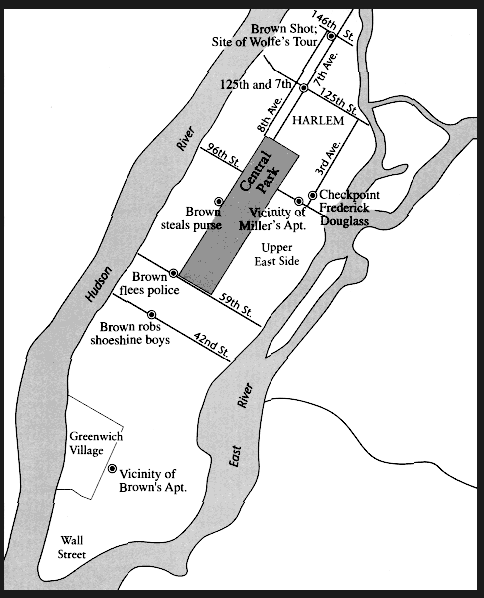
Figure 9.
Manhattan. University of Wisconsin Cartographic Laboratory.
Image not available
Figure 10.
Cover of Manchild in the Promised Land.
Photograph by Leroy McLucas.
Image not available
Figure 11.
Claude Brown. (Newsweek, 16 August 1965, p. 81.)
Newsweek-Robert McElroy. © 1965, Newsweek, Inc.
All rights reserved. Reprinted by permission.
Image not available
Figure 12.
Nelson Algren. (Newsweek, 16 August 1965, p. 82.)
Newsweek-Jeff Lowenthal. © 1965, Newsweek, Inc.
All rights reserved. Reprinted by permission.
word into chapter 1 of a life that will be exemplary of his generation's. The authority of his "I" as producer of a social document rests on that representative status. The story of his delinquency (which begins to end when he is shot and realizes he might die young) positions him to tell readers trained by the logic of the urban crisis what they most want to know: first, the inside details of a genuinely pathological ghetto life and, second, how Brown "survived" to tell about his youth.
In its first act, then, Manchild tells the story of juvenile delinquency and reform, refitting the delinquent genre's formulas and priorities to serve the purposes of ghetto narrative engaged with the urban crisis. Brown exhaustively describes his various delinquent activities, making the case for his intimate and expert encounter with the ghetto's defining pathologies by making it clear that he was on the way to being dead or locked up for good by the age of twenty-one. However, he transforms the traditional teen gang material to make of it an introduction enabling Manchild's piecing together of many narrative lines. In Manchild, delinquency becomes the path by which Brown acquires the information and expertise that equip him to talk (as the foreword's first sentence puts it) about the ghetto.
Brown notes that he was in the "Forty Thieves" branch of the Harlem Buccaneers gang, and he discusses the "bopping" gang culture that flourished in the 1940s and 1950s until the growth of the street trade in heroin, but he uses the teen gang keywords only in passing as he moves to other emphases. "Rumble" and "gang" do not carry the generic charge pointed up by the delinquent literature's glossaries. (Manchild does not have a glossary, and Brown rejected his publisher's suggestions that he include one.)[14]Manchild does use the keywords, for instance, to describe Brown's worries about being sent upstate to the reform school at Warwick while still weak from his stomach wound—"Bumpy from 144th Street was up there," and Brown "had shot him in the leg with a zip gun in a rumble only a few months earlier" (16)—yet Manchild affords not a single glimpse of the formalized gang initiations, rumbles, meetings, and ceremonies that structure teen gang narratives like Cool World. Brown makes no mention of uniform dress or turf and completely eschews the pseudo-military rhetoric of generalship so prevalent in accounts by ex-gang leaders. Although he consistently notes that other delinquents looked up to him and followed his example, Brown makes clear that they did so without encouragement or formal command from him.
Brown understands juvenile delinquency as an entrepreneurial, fiercely individualistic enterprise that reveals what Albert Cohen would call the subcultural structure of the ghetto rather than the secret world of the gang. Brown sees himself and his fellow delinquents not as punks who will become outcasts but as novices in training to become typical Harlemites, who as adults must hustle to get ahead against the long odds of ghettoization. Those of Brown's childhood
associates who survive to adulthood, skirting between prison and violent death, will become the types populating such a community: a handful will be conventional hard-working family men and women; others will be preachers, political operators, numbers runners, drug dealers, sexual hustlers of one kind or another, artists, athletes, even minor celebrities. Brown understands delinquency, rather than reform, to provide their primary training into citizenship.
With the traditional delinquent material subsumed and transformed into a device for establishing Brown's credentials to represent the ghetto, the conventional delinquent's reform becomes instead a process in which he comes to understand the ghetto and bend its lessons to his advantage. Brown dedicated Manchild to "the late Eleanor Roosevelt, who founded the Wiltwyck School for Boys [another reform school], and to the Wiltwyck School, which is still finding Claude Browns," but his long stays in reform schools do not change him in the way they were intended to. The conventional pattern of the delinquent's reform, found in Cool World, for instance, has the delinquent tending to his flower beds and declaring his rejection of the inner city from his pastoral remove. Brown, on the other hand, becomes a better criminal and street fighter in reform school, and upon returning to the streets he deals drugs, associates with a more accomplished class of criminals, and masters the Murphy game and other confidence hustles.
In reform school, Brown (and, therefore, his reader) undergoes a concentrated course in the ghetto's street life, learning about jazz, homosexuality, the Black Muslims, details of criminal technique, how to do time in prison, how to live in the ghetto, and how to make a way for himself in the world—"When they came down on me, I was just going to hit the biggest cat and pray" (135). He also opens avenues out of the ghetto when he enters into the republic of letters. From the moment that the "real" "nice" Mrs. Cohen, a counselor at Warwick, gives him a biography of Mary McLeod Bethune, he begins to understand himself anew as a reader, the first step toward becoming a writer and eventually an urban intellectual. Like Duke Custis, who comes to believe Doc Levine's claim that "when you can read an write why you can do any thing," the adolescent Claude Brown arrives early at an understanding that reading and writing might offer alternatives to the fate mapped out for him along the ghetto-prison axis. Biographies of Bethune and black athletes Jackie Robinson and Sugar Ray Robinson, as well as of Albert Einstein and Albert Schweitzer, lead him to consider for the first time in his life "what might happen if I got out of Warwick and didn't go back to Harlem" (157).[15] Unlike Duke, Brown does not imagine separating himself from the city, and he does, in fact, return to Harlem and prepare to embark upon an adult criminal career, but Manchild presents his jailhouse encounter with his future métier of biography and autobiography as planting in him the notion of a larger narrative and geography extending beyond the limits of the ghetto.
Manchild invests great importance in Brown's reading and writing his way across the boundaries of the ghetto: it will become his cultural role to make such crossings in prose for the reader. Reform school, a condensed version of the ghetto and the place where Brown acquires language in a new and potent way, becomes a cradle of urban intellectuals, where Brown encounters in their nascent stages young jazz musicians, athletes, Black Muslims, political activists, and other future spokesmen for his postwar generation. He treats the first steps he takes in prison toward discovering his own cultural role as the very process that opens up a world beyond the ghetto for him. Like Frederick Douglass and many others in the black literary tradition, he shows himself reading and writing his way out of confinement—not out of Harlem entirely but out of the Harlem-Warwick axis that stands for the interchangeability of jail and street, limited opportunity, and a desolate future.
Mentors like Mrs. Cohen and her husband, Alfred (at Warwick), and Ernst Papanek (director of Wiltwyck) show Brown a whole new way to carry himself in the world by trading in words rather than violence. Papanek, a student of Freud and a survivor of Nazi concentration camps, "never got mad, . . . was always telling the truth," and proves to be "slick . . . real slick" as he "just took over everything with a few words that we couldn't even understand too well" (86). This is the model for Brown's authorial persona: dispassionate, never moralizing, deceptively slippery even when blandly factual. Reform school, then, becomes the place where Brown begins to assemble the tools that will allow him to bend to his advantage the intimate knowledge of ghetto pathologies he gains as a delinquent. The connections he makes there among reading, writing, and the crossing of ghetto boundaries define his role as an intellectual during the urban crisis, which is to write his way back into the ghetto with the reader in tow, in order to show where he lived, what he lived for, and how he "got out."
The premises for "getting out" having been established in act one, Manchild's act two reviews Brown's options with a survey of conventional avenues leading out of the ghetto. Act one grounds his project and credentials in his connection to the "victims"—career criminals, convicts, junkies, those who die young. In act two, moving back and forth between the street life of Harlem and other possibilities—jobs in the garment district, at a fast food place, and elsewhere, as well as the bohemian subcultures of Greenwich Village—Brown touches upon standard narrative models for male delinquents who got clear of the ghetto's street life. In so doing, he adapts the street-derived authority of stock male heroes of deghettoization narratives, positioning himself as an urban intellectual to tell the ghetto's stories.[16]
Brown's associates go down the roads he could have taken. Most of them do not get far: they overdose on heroin, fall from rooftops, are shot or stabbed, go to jail for long terms, or remain on the streets as hookers, petty hustlers, or junkies. Some of them make a niche for themselves within the orders of
Harlem: Turk becomes a professional boxer; Alley Bush, renamed Bashi, becomes a political activist, winning notoriety when he starts an altercation at the United Nations; Danny kicks his heroin habit, has a Protestant conversion experience, and raises a family. During the course of his education in the street life and his forays into the world beyond its limits, Brown lives a part of each possible life. Moving through the stories of the victims, he tries heroin with the junkies, does time with the future jailbirds, gets shot like those who die young, and deals drugs and runs petty cons like those who will become career criminals. Moving through the success stories, he fights with the future boxer; plays the piano with a new generation of jazz musicians; dabbles in paints; discovers the women of Harlem as a consumer market during his stint as a budding cosmetics entrepreneur; and talks politics, rebellion, and black consciousness with reformers, Black Muslims, and other activists wrestling with the conditions that underlie the developing urban crisis.
Each sampled narrative line supplies a piece to his composite story and contributes its authority to his formation as an urban intellectual. For instance, Brown rehearses classic moments in the making of a street fighter, the first step in one standard version of the making of a boxer. The most important moment is a scene in which his father sends him back out to the street to fight the Morris brothers: "I said, 'Dad, these boys are out there, and they messin' with me.' He said, 'Well, if you come in here, I'm gon mess with you too. You ain't got no business runnin' from nobody' " (267). [17] Brown not only attends the same reform school (Wiltwyck) as did two-time heavyweight champion Floyd Patterson, he passes through the narrative "school" of black boxers like Patterson, Sugar Ray Robinson, and, especially, Archie Moore: a delinquent learns to fight in the streets, goes straight (often in reform school), studies the sweet science of boxing, learns to discipline the burning impulse to violence, turns pro, wins the title, and devotes himself to steering a new generation of street fighters toward productive citizenship. [18]
But Brown tells only a piece of that story, and he becomes a writer instead; it is, rather, his friend Turk who succeeds as a professional boxer. Brown identifies Turk, who has pursued one of Brown's possible destinies, as a double of himself: "He was living proof that we could make it—the cats who had come up our way in Harlem . . . We weren't all cursed or destined to end up in jail. I suppose that I was the living proof of it to him too" (303). The sampled story of the doomed street fighter turned athletic celebrity helps Brown to position himself alongside those who, in the popular phrase, "fought their way out of the ghetto" against long odds favoring an early death or a wasted life. The identity between Turk and Brown adapts the familiar steps of the fighter's story to the urban intellectual's. Like the boxer, in this formulation, the intellectual emerges from the ghetto as, in the Old Testament phrase, "a firebrand plucked from out of the burning." He carries within himself the violent destructive force of "the
burning," but he uses its heat to forge rather than destroy himself, and he uses its light to illuminate. In order to keep these two properties in balance, he learns discipline via technique (boxing, writing), turning the generalized conflagration of "the burning" into a useful and controlled "fire in the belly" that on the one hand gives him the strength to leave the ghetto and on the other hand makes him hungrier, wiser, and tougher than those who did not grow up in the ghetto. The imputation of this model of an intellectual's relation to place is that Brown's language, like Turk's punches, contains and controls all the raw anger and unschooled power typically assumed to constitute the ghetto "survivor's" edge. In drawing the lines between Turk's narrative and his own, then, Brown tells a story about his own formation as an intellectual that taps into a familiar ghetto narrative.[19] As suggested above, Manchild touches upon other stock success stories in this manner, but Turk enjoys a special status as Brown's principal alter ego that places him above the artists, social workers, political activists, salesmen, strivers, and ex-junkies made good. Turk frames Brown in Brown's chosen persona—an authentically violent man who fought his way up from the street but sustained his connection to it.[20]
The entry into a larger narrative and geographical terrain effected in acts one and two requires a complementary movement back into the ghetto: "When I went uptown now, I always had a definite purpose" (279). In act three, Brown narrates his reengagement with Harlem, the ways in which he mediates between possible passages into a larger world—represented above all by his Greenwich Village apartment—and returns to his home ground. (Again, these conceptual acts overlap one another as he constantly shuttles in and out of Harlem.) As in his departure, he has multiple models for that return, and he again samples each of his options in constructing his position as an urban intellectual. The problem in act three derives from the central problem of the canonical urban crisis: what to do about the ghetto in general and its violent criminal delinquents in particular. Two principal groups offer competing narrative lines, and competing religious conversions, to propel Brown toward one of two outcomes commonly found in ghetto narratives of the urban crisis: a mainstream Protestant (or, given the influence of the Cohens and Papanek, a "JudeoChristian") conversion leading to social work, the objective of which is to produce future Claude Browns one by one; or conversions offered first by the African Christian Coptic sect and then by the Black Muslims to a self-consciously "black" religion and political radicalization, the objective being to fight for blacks as a class by directing the resources of a generation made strong in street life against the very roots of ghettoization. Predictably, Manchild's composite narrative evaluates both lines of narrative and religious possibilityand draws upon their authority in mapping both the ghetto and its protagonist's cultural role—but pursues neither line to its conclusion.
Brown's most important "definite purpose" in Harlem, more often than not,
involves his younger brother, Pimp, whose first steps into crime, drug use, and the street life cause Brown to consider how he might put his own experience to use in helping others. Brown's encounters with a number of people dedicated to saving junkies and delinquents offer models of such familial social work. Ernst Papanek, for instance, shows the young Claude Brown an efficacious blend of social responsibility and streetwise operator's technique, communicated in smooth, manipulative, politic talk. Similarly, the resonantly named Reverend William James, whose Metropolitan Community Methodist Church administers programs for young people in Harlem, models a knowing distance from street life. "Reverend James seemed to know a lot about street life that I never expected any minister to know" (394), Brown finds, but the reverend is no hustler: "'The cat's a minister, man"' (401), who tends to a community of believers, as opposed to a preacher who hustles a collection of marks. James's simultaneous intimacy with and distance from the street life afford him an analytical insight into Harlem that attracts Brown—not only because he feels James might be able to save Pimp but because James offers a model for a budding urban intellectual looking for ways to engage with his subject matter.
As the dedicatory note prefacing Manchild suggests, patrons like Eleanor Roosevelt and characters like Reverend James and Papanek represent a system of exemplary individuals and at least partially efficacious institutions (reform schools, churches, youth programs) designed to find and save Claude Browns. On his way to becoming a writer, Brown passes through the story of social work offered by this mix of post-Progressives, center-leftists, and Great Society liberals. Manchild thus builds into Brown's own project the authority conferred upon Papanek and Reverend James—and upon social workers like the great light-heavyweight Archie Moore—by the urban crisis, when delinquency in the second ghetto was a central element of the urgent problem posed by the inner city. The engagement of such exemplary social workers with delinquents helps Brown to produce himself as an urban intellectual, and in turn he presents his own example, codified in the book itself, as a form of social work. Thus, walking up 145th Street as an adult, speculating on the strength imparted by the ghetto to the children who survive its hard lessons, he remembers an episode from his youth in which a little boy towing a dog with a black spot over one eye accosted him on 145th Street, saying "'I want to be like you'" (421). At the time of the original encounter, he had been embarrassed because he was a well-known criminal widely expected to die young; now, in the retrospect afforded by the third act of his narrative, he likes the idea of himself as a model of behavior.
However, Brown's second thoughts about this grossly improbable little boy and his dog do not cancel the original encounter. The omnibus narrative Brown patches together in Manchild from his sampling of narrative lines, including the one offered by social workers, fits him to write the ghetto, not to save boys from
delinquency. He does not undergo a religious conversion, he does not enter into the institutional structures offered by social workers, and he cannot save his brother Pimp, who dabbles in heroin, commits armed robbery, and goes to jail. The narrative of social work is subsidiary to Brown's commitment to a larger, composite narrative in which strong individuals sink deep into the street life, learn from it, and emerge with special cultural potential—expressed in the authenticating language of urban insiders—derived from the second ghetto.
Brown's self-construction as an urban intellectual proceeds on that model, and his training in the street teaches serious doubts both about the uses of religious belief and about the efficacy of social work, except by way of example. Brown, therefore, comes to terms with his inability to keep Pimp out of jail by suggesting that Pimp might pursue his older brother's self-reliant route through prison, out of the street life, and into the writing life. "'Pimp's changin', man,'" he tells Danny. "'Or at least I think he is. The cat finished high school in the joint, got a diploma, and he's talkin' some good stuff. He writes a lot of poetry in the joint.' " Danny responds, "'The joint could make a cat deep sometimes, sometimes it'll make him real deep'" (420). Brown and Danny laugh at this cliché, but Manchild nevertheless argues very clearly that "prison" (that is, reform school, which is "jail in disguise"), and not the social workers he encountered there, did in fact make Claude Brown "deep"—and worth reading.
The Black Muslims emerge from the same crucible that produces Brown: they get "deep" in prison as well. As a recent jailhouse convert to the Muslim faith tells Brown, "'A lot of cats are finding out where it's at in the joint' " (330). Prison serves as a social microcosm that provides educational perspective on the inner city for such converts. Working from that perspective, the Muslims (and before them the Coptics) offer Brown a systematic analysis of second ghetto pathologies and various plans to "get Harlem out of Goldberg's pocket," as Brown's old crony Bashi puts it—from economic self-determination to armed revolt, "'even if most of us have to die' "(337).
The Muslims thus offer Brown another ready-made third act, one that would become standard during the urban crisis (and after): the delinquent, recognizing that his criminality proceeds from his encounter with city- and nation-structuring arrangements of power and capital, returns to the ghetto to contribute his hard-won strength and insight to the dirty work of altering those arrangements. This is the story told by Malcolm X, the Black Panthers, Sonny Carson, the Soledad Prison writers, and gang members who turned to politics, among others.[21] Brown recognizes the Muslims' authority to offer this conclusion: "The Muslims were the home team," having won the right to represent Harlem by passing through an act one similar to Brown's in their own delinquent careers. As opposed to the NAACP or the Urban League, the Muslims "were the people who were right out there in the street with you. They had on suits, but their grammar wasn't something that would make the average Negro on the street
feel ill at ease. The words that they used were the same words that the people on the street used. You could associate these people with yourself" (348). The Muslims share a formative experience with Brown and thus present a similar linguistic credential: they know the things he knows about the ghetto, and they speak with his authoritative grammar.
Although the Muslims share a first act and delinquent credentials with Brown, and offer him a possible third act, he only samples that narrative option without pursuing it. Such was the Muslims' cachet as quintessential second ghetto types in the 1960s that Manchild seems obliged to go out of its way to show how refusing the Muslims' third act is consistent with the behavior of a genuinely ghetto-trained urban intellectual. Despite acknowledging the attraction of conversion to Islam, and despite concluding that the "Muslim movement is a good thing" because it encourages black entrepreneurship and lets "the nation know that there are black people in this country who are dangerously angry" (349), Manchild dismisses the Muslims' proposed third act as a false ending. Brown's critique takes root in act one of his story and follows two principal lines, both of which solve his problem: he undermines the Muslims' street credentials, and he reduces them to ghetto types, unequipped to attain the analytical perspective on Harlem that he enjoys.
First, he holds that the Muslims provide a crutch, an easy way out, for the weakest survivors of street life: "There was one common thing I noticed about all the cats in the Muslim movement. They seemed to be the cats who were very uncertain about where they were, who they were, or what they were going to do, the cats who had never been able to find their groove" (342). This argument holds, in essence, that in shedding their "slave" names and taking new ones, Black Muslims have failed the essential test of act one: "'when those niggers start coming down on you,"' explains a seasoned veteran of Warwick to the newly arrived Claude Brown, "'you just run out there as soon as somebody call your name and say, "Who is Claude Brown?" Like, you say, "I am," and run up and hit the biggest nigger first. Hit him first, and hit him as hard as you can'" (134-35). Brown thus undercuts the Muslims' act one-derived delinquent authority, in effect pulling street rank on them by characterizing them as incompletely tempered by the crucible of street life. In the mid-1960s, when the Muslims' claim to represent the second ghetto enjoyed blue-chip status among urban intellectuals, Brown was almost alone in questioning the grounding of their political persona in the street.
Second, Manchild understands the Muslims to offer the wrong act three because they have not outgrown the impulses that motivated Brown in act one. Brown takes the enormous liberty of collapsing Muslims and Coptics together with political radicals, emphasizing the language of violent racial conflict spoken by some Muslims and by many whose rhetoric and self-presentation superficially resembled those of the Muslims. Having achieved that simplifying
compression of religious and political dissenters, creating an extremist foil for the Protestant and Jewish social reformers occupying the vital center, Brown belabors the extremists for their immaturity. "'The revolution you're talking about,"' he tells Bashi, "'I've had it. I've had that revolution since I was six years old. And I fought it every day—in the streets of Harlem . . . —when I was there stealing, raising hell out there, playing hookey."' As Brown tells it this time, he "'rebelled against school,"' robbed stores downtown, and sneaked onto the subways because all of them were owned and operated by white people. In youth homes and reform schools, he met a generation of "'young, rebellious cats who couldn't take it either,"' some of whom went on to preach Bashi's brand of violent revolt. Act one ended, however, when Brown realized that "'nobody was winning. That revolution was hopeless. The cats who had something on the ball and they could dig it in time, they stopped. They stopped. They didn't stop being angry. They just stopped cutting their own throats, you know?"' (340). In Manchild, the Muslims remain trapped in act one, either as a new breed of Harlem street operators (like Alley Bush/Bashi, who preaches abstention and then sneaks a drink with Brown in a secluded bar) or as angry delinquents who have not woken up to the fact that violent rebellion is suicide. "'Look, Alley,'" Brown tells his old running partner at last, "'if you just want to die, why bother to go out there and do it in the name of freedom?'" (341).
These conversations, reported in Manchild, took place in the 1950s and early 1960s. In 1965, Manchild was arguing, in short, that Brown had outgrown the Muslim movement well before the Muslims—and Malcolm X in particular, whose narrative shares an act one with Brown's and goes on to accept the subsequent acts offered by the Muslims—became a prominent set of characters in the canonical dramas of the urban crisis. The notion of outgrowing the kind of hopeless, self-destructive anger Brown associates with the Muslims and "Harlem radicals" runs through Manchild from a formative moment in Brown's life, the Harlem riot of 1943. Despite the lessons he learns about his generation's special frustration, Brown never arrives at an explanation for the riot to refute his resolutely Southern father's description of it: "'just a whole lotta niggers gone fool"' (13). The riot is the apotheosis of the street life, not a political struggle, as the six-year-old Brown and his friends loot and destroy the neighborhood's businesses. Brown has sympathy with the Muslims to the extent that they offer the opposite of the riot—black-owned business, economic self-determination. However, all talk of revolt and separatist violence strikes him as either weak posturing or a case of "niggers gone fool": "'Now, look at it realistically, Alley. How the hell are you gonna come in here and say, "Look, white man, we're living in your world, but I want you to let us have a revolution?" This is what it would amount to, because the black man's just in no position to revolt against anything here"' (340).
Manchild's omnibus narrative appropriates the Muslims' widely recognized
anger and cultural currency in showing that Brown has the experience of act one in common with them, but it stops well short of accepting the change of name and the understanding of the ghetto—in short, the succeeding acts—they offer him. Manchild's gathering of narrative lines runs to a different conclusion, in which the concatenation of those narratives and his intimacy with them equip Brown to represent the ghetto. The assembled narratives of his generation form a portrait of the ghetto in crisis, and his sampling of them credentials him to speak of and for "black America." Manchild is, among other things, about equipping Brown to write with authority about the very conditions that motivate the Muslims to what he presents as their misguided militancy.
In Manchild, Brown positions himself to broker the traffic of representations flowing out of the ghetto to an increasingly anxious reading audience peering through the peepholes made by genre in its walls. It follows, then, that he has no sustained interest in learning Amharic. "The true black man's language," offered by the Coptics, does not equip him to speak to that larger, predominantly white audience outside the ghetto. The Coptics and the Muslims, like the junkies and the criminals, serve instead to provide the structuring "why" of the omnibus narrative: why Brown's generation demands attention, why Brown must write its stories, why the reader must read this book in a climate of urban crisis. During his encounter with the boy and his dog, Brown says "All my life, I've been looking for a dog to walk," an ordering sense of mission. Manchild's composite narrative proposes that Brown discovers that mission in doing the cultural work of representing the second ghetto in prose.
The Best Way to Look at Harlem
Manchild samples, surveys, cuts, and pastes a variety of narratives in assembling its account of Claude Brown's emergence from the second ghetto. They add up to a larger plot: the formation of a new kind of urban intellectual native to the postindustrial inner city. Manchild also plots that character's formation in the spatial sense: the book's map of the inner city establishes Brown's special relationship to the social landscape. In 1965, that landscape already spoke of urban crisis to even (or perhaps especially) the most casual observer. The cover of Newsweek's issue of 30 August 1965, appearing two weeks after the magazine had run a glowing review of Manchild in the Promised Land, showed a motorized National Guard patrol moving past gutted businesses through the rubble—strewn landscape of Watts after the riots. The photograph was captioned with a concise formulation of the urban question of the day: "Los Angeles: Why?" Part of Claude Brown's authority to address that question proceeded from the identity between the landscape in which his authorial persona took form and the landscape of the post-riot ghetto. Brown provides images of Harlem's looted businesses during the riot of 1943, when he was six years old:
"None of the stores had any windows left, and glass was everywhere . . . Everything I picked up was broken or burned or both. My feet kept sinking into wet furs that had been burned and drenched. The whole place smelled of smoke and was as dirty as a Harlem gutter on a rainy day" (13-14). The extraordinary urban cataclysm of the riot collapses into the most everyday of images, a rainy day in Harlem, suggesting that the day-to-day plot of Brown's movements in space will reveal a world that houses the answers—that, with Brown's first-person help, will speak the answers—to Newsweek's "Why?"
Manchild's mapping of Brown's world begins in the foreword's delineation of the "slum ghetto" as "a dirty, stinky, uncared-for, closet-size section" of the metropolis in which "the first Northern urban generation of Negroes" engages in an "endless battle to establish their own place . . . in America itself" (viiviii). As the reader passes from the general to the specific at the end of the foreword, as the generational "they" flows into the "I" of "'I'm shot!'" that opens Brown's personal narrative, the reader enters the landscape of Harlem as Brown inhabits it. A series of violent events introduce and etch in his memory the features of that geography: the thirteen-year-old Brown, thieving as usual, is shot through the belly in an alley and collapses on the floor of a fish-and-chips joint; his mother's screams flow into the remembered scream of a boy he saw thrown from a roof on 149th Street. Continuing what will become a long flashback as he dreams in his hospital bed, he travels in memory to "the dilapidated old tenement building that I lived in," in which the super had beaten a man to death "for peeing in the hall" (12); he passes through the wreckage-strewn streets of Harlem as a six-year-old looter during the riot of 1943; he relives his budding career of violence in the park, in the street, and in the Youth House. This opening movement ends with Brown's memory of being sent to visit his grandparents in the South. When he returns a year later, each stop on the subway ride uptown triggers a memory that makes a violent coda to the initial movement— shaking down white shoe shine boys at Forty-second Street, dodging the police at Fifty-ninth, a purse-snatching at Eighty-first—until he arrives once more in a Harlem awash in vomit, blood, and urine: "vomit was all over the street near the beer gardens" and "there was a lot of blood near the beer gardens and all over the sidewalk at Eighth Avenue." In the hallway of his tenement building, "somebody had got cut the night before, and blood was still in the hall. And somebody had pissed on the stairs, and it was still there, just like it should have been" (53).
The opening movement, then, introduces the landscape on which Manchild plots its omnibus narrative. In describing episodes of drug use and gang rape on the roof of his building, murder and near-murder in its hallways, and Brown's home life, Manchild maps on the blood- and graffiti-spattered form of his tenement building a way of life built by transplanted rural black Southerners and their seemingly unmanageable Northern urban children. Following the young
Claude Brown as he slips easily from his parents' control into the streets, Manchild extends that map across the terrain of Harlem, plotting the content of life as lived by Brown's generation on a landscape of crowded, violence-filled streets, ineffectual schools, and the bars, alleys, storefront churches, and back rooms in which hustlers do their business.
Brown's engagement with this world, and especially with elements of its landscape, produces impeccably pathological credentials to represent Harlem: "By the time I was nine years old, I had been hit by a bus, thrown into the Harlem River (intentionally), hit by a car, severely beaten with a chain. And I had set the house afire" (21). The last item, set off from the others in a melodramatic sentence fragment, suggests that Brown had by the age of nine developed a capacity for destroying a world that was trying to destroy him, a suggestion supported by Brown's unquestioning participation in the riot of 1943. Many of Brown's initial readers bought the book to find out the same thing his mother wants to know: "'Boy, why you so bad?"' (21). Like the gang member Duke, mapping his three-block world for Doc Levine in Cool World, the young rioter Claude Brown accounts for himself by mapping the terrain occupied by his troublesome generation.
Manchild uses this landscape to make and reinforce its arguments. For instance, Brown's contention that the Coptics, Muslims, and others who have pursued similar third acts are "weak cats" finds support in an anecdote about a gang fight in a tenement hallway. Brown remembers that a friend named Lonnie, now a Coptic priest, had in their childhood been a fellow gang member (of the Buccaneers) but had always been "a good boy" who "didn't steal and stuff like that." Cornered in a gang fight with the Chancellors in a hallway on
148th Street, Lonnie let down his partners by failing to gun down the attacking enemy. "This was the sort of cat he was," concludes Brown: "He had no business gang fighting anyway" (236). A boy named Rock, a genuine delinquent, had to save them all by snatching the gun away from the future Coptic holy man and shooting one of the most notorious Chancellors. Lonnie's failure to fill the hallways of that tenement on 148th Street with pools of blood—a failure to establish himself as expertly trained by his environment in authenticating violence—marks the third act he later pursues as an avenue for the weak. Brown's narrating persona can and must absorb Lonnie's talk of the black man's true religion and of white devils and black science, that being some of the most dramatic language of urban crisis on display in the ghetto, but Lonnie's insufficiently consummated engagement with the landscape of Harlem reveals him as a weak vessel. In Manchild, Lonnie is not an urban intellectual equipped to represent Harlem; he is material for such a writer to work with.
The Muslims, despite being "uncertain cats" like Lonnie, fare better. They stake their claim as second ghetto exemplars by taking over the intersection of 125th Street and 7th Avenue, and Brown accepts that claim to the extent that the
Muslims speak the language of Harlem. "The Muslims had become a part of the community," he concedes. "They became the Seventh Avenue speakers" (347). Emerging from jail and the streets of Harlem, they develop a self-presentation—part con and part social critique, in Brown's rendering—that constitutes valid credentials for their claim to represent Harlem. However, as he does in rejecting the Coptics and their offer to teach him Amharic, Brown draws the line at according the Muslims the right to speak beyond the boundaries of Harlem. If Lonnie is too much the good boy, then Bashi (with his big talk of armed revolt and his illicit drinking) is too much the Harlem operator to establish himself as an analyst of the street life and all it might mean. Bashi and the Muslims are Harlem types, representative of the place but not equipped to represent it. Like the prostitutes on 125th between Third Avenue and St. Nicholas Avenue, the Muslims inhabit the grid of Harlem but do not share Brown's credentials—established in his survey of narrative options that includes and subsumes both Muslims and prostitutes—for moving beyond Harlem and returning to it with a hard-won analytical perspective.
Brown's acquisition of that perspective, incorporating but transcending the localisms of ghetto operators and other aspirants to the work of representing Harlem, organizes the spatial plot of Manchild as well as the narrative. Brown moves back and forth across the borders of Harlem: he constantly shuttles in and out of Harlem in his daily movements, and his residence shifts from his parents' home to various reform schools and back, then to his own apartment in Harlem, down to the Village (off Cooper Square), and finally back uptown (in a movement similar to Warren Miller's in the 1950s) to an apartment on Ninetieth Street near the edge of Harlem. These movements combine to establish the proper relation to Harlem and to the rest of the metropolis. Manchild balances the movement of the narrator's emergence from the ghetto (and his continuing rootedness in it) with the movement of crossing into the ghetto from the outside—the journey upon which Brown's readers wish to accompany him.
The spatial drama of Manchild, therefore, has to do with Brown's effort to find the appropriate relation to his subject and credentialing terrain, the second ghetto. He presents his initial move to the Village as the only alternative to an eventual move to Sing Sing. That move to the Village therefore raises the possibility of severing his ties to the ghetto and an appropriately pathologized life story. Brown, however, assures us that "even though I lived downtown and worked and went to school at night, Harlem was still my point of relating to life and events and putting them together, my point of reference" (206). That is, "the ghetto" exists as a mental-spatial complex from which Brown's persona cannot be uprooted, even as he explores a wider world.
The point of moving to the Village, then, is to move back into Harlem, developing the outsider's perspective on Harlem he will need in order to deliver his insider's wisdom to naive readers: "It seemed that every time I came uptown, I
learned something. The best way to look at Harlem was to be on the outside and have some kind of in" (253). The Village serves as a kind of staging ground appropriate for an observer and writer interested in encountering a variety of urban types. Based there, he can sustain access to his accrediting terrain while developing connections to artists, writers, and the larger metropolitan audience he will address. Similarly, Brown comes into contact with a new repertoire of metropolitan subjectivities—white and black bohemians, young blacks raised in Harlem and intent on upward mobility into the middle class, people who plan to go to college—without losing contact with the dead-before-twenty-one way of life practiced by many of his Harlem associates. Manchild does not map the Village in detail, therefore, because the Village's sole function is to change his relation to Harlem. His loft apartment near Cooper Square, like the Invisible Man's "hole in the ground" under a building full of white residents on the edge of Harlem, establishes Brown in a liminal position from which he crosses at will the increasingly forbidding boundaries dividing the inner city.
If in the Village Brown encounters the wider world outside the ghetto generically opened to the reforming delinquent, he makes it clear that he can also find his way back to Harlem. This condition of extraordinary access takes spatial form in Brown's returns to the grid of Harlem's streets. In mapping the ghetto, Manchild orders a vast profusion of details in a series of narrative digressions plotted on a grid of streets. Chapters and episodes tend to begin with a time coordinate pegged to an intersection or landmark: "I came uptown one night and met Danny on the corner of Seventh Avenue and 145th Street" (212); "One night in the fall of 1956, I was walking down Lenox Avenue" (234); "I first heard about the Black Muslims in 1955. They had started talking at night down on 125th Street and Seventh Avenue" (327). The grid organizes both Brown's understanding of social order and his memory. Plotted with personal landmarks where conversations, fights, and other encounters taught him particular lessons about his life and the ghetto, the grid of Harlem holds Brown's living past like a trellis overhung with vines.
Brown treats his many returns to Harlem as providing instant access to this past. If Manchild does not plot the Village on this grid, thus firmly separating the Village from the ghetto, the subway does provide access to the grid uptown (like the El in Stuart Dybek's "Blight," connecting the classroom to the old neighborhood and the present to the past). Manchild establishes this principle of access in the coda to the book's opening movement, already discussed, in which the young Claude Brown rides the subway uptown upon his return from the South. Entering the numbered grid as he approaches Harlem, Brown enters as well into the realm of violent memories that mark him as an ex-delinquent: every numbered station triggers the appropriate memory of rotten behavior. The reader, tagging along as Brown crosses and recrosses with impunity beneath the cultural barbed wire and barricades at the boundaries of the ghetto of feeling,
enjoys the privilege of Brown's intimate access to the inner city's forbidden districts. Brown's impeccable credentials as a child of the ghetto, credentials plotted on the grid of Harlem's streets, give his readers outside the ghetto the sense of sailing past Checkpoint Frederick Douglass into the place where the answers to the "Why?" of urban crisis can be discovered in the landscape's form and the speech of the people.
If, having finished Manchild, such readers felt no closer to an answer to the "Why's?" of urban crisis, that was because Manchild was about "Who?" The book's narrative collage and its spatial survey, dramas of movement in and out of the ghetto, reach closure with Brown and Harlem finding their positions in relation to one another: "It was as though I had found my place and Harlem had found its place. We were suited for each other now" (372). Brown has found the right relation to his subject matter, placing Harlem and himself in their respective metropolitan contexts. Harlem has found in Brown—has made Brown, Manchild argues—an urban intellectual suited to the task of representing it.
The Claude Brown invited to talk about the ghetto by Senators Ribicoff and Kennedy was an amalgam of two characters: Claude Brown the narrating protagonist of the story and Claude Brown the authorial persona responsible for crafting it. The former had the authority of experience that Dunny, also invited to speak, represented; the latter had credentials as a writer, an urban intellectual, akin to those of the novelist Ralph Ellison, who appeared before the senators the day after Brown and Dunny did. Manchild offered a composite narrative in which the delinquent protagonist grew into the author, establishing a two-way flow of identity between them that posited unmediated access between the urban intellectual and the six-year-old rioter he had been. Manchild's occasional gestures at distinguishing between the two are manifestly inadequate, which tends to narrow the distinction between them to nothing: in Manchild, Brown sometimes calls himself "Sonny," but reverts most of the time to "Claude Brown," as if to admit that there is no point in trying to do anything but let the two become one. Manchild's surveys of ghetto narrative and space argue for the expansive reach enjoyed by this composite mind that embraces both "the problem" and imaginative representation of it.
Manchild ends with an image of Brown when he was a little boy, coming in from the streets of Harlem to talk about the violent things he had seen: "You might see somebody get cut or killed. I could go out in the street for an afternoon, and I would see so much that when I came in the house, I'd be talking and talking for what seemed like hours" (429). In Manchild, Brown presents himself as coming in from the street to tell his readers what Saturday night in Harlem is like, what happens in storefront churches, what kids do when they
play hookey and stay out all night, how street reputation works, how to do time in prison, how the coming of heroin changed the inner city forever, why and how to call men "baby," what Black Muslims and Harlem activists meant to what he calls "the era of black self-reflection," how he "got out" when so many others did not. In so doing, Manchild presented to its readers not only an omnibus survey of the second ghetto and its stories but also a model of the urban intellectual's role in crafting the fit between the city of fact and the city of feeling when both were in violent motion.
12
The War of Position
"Motherfucking right, it's confusing; it's a gas, baby, you dig."
"A Harlem intellectual" in Chester Himes,
Blind Man with a Pistol
As Warren Miller put it in opening his review of Manchild in the Promised Land, during the urban crisis the second ghetto was under scrutiny "by all disciplines, all sorts of people, and for an enormous variety of purposes." In the late summer and fall of 1965, all sorts of people were scrutinizing Manchild's rendering of Harlem and evaluating it according to their various interests in the urban crisis. A poet, fiction writer, and translator named Guy Daniels, who reviewed Manchild for the New Republic on the strength of his own personal familiarity with Harlem, mock-confessed to being intimidated by the massive convergence on the book of intellectuals accredited to address inner-city subjects: "By this time both Claude Brown and his book have been analyzed by so many experts—in sociology, education, child psychology, juvenile delinquency, etc.—that the mere lay reviewer is intimidated into a cold sweat."[1]
A pack of reviewers and blurb writers constituting a cross-section of New York City's and the nation's leading urban intellectuals weighed Manchild's virtues and failings in the public forum. In addition to Miller, Daniels, and the many experts in education, social science, social work, and public policy, the critics included novelists Norman Mailer and James Baldwin; New York intellectuals Irving Howe, Norman Podhoretz, Nat Hentoff, and Paul Goodman; Garry Wills, who defended Brown in Commonweal against Miller, Hentoff, and Goodman; Tom Wolfe, who introduced excerpts from Manchild in the New York
Herald-Tribune; Albert Murray, who lumped Brown with Warren Miller as purveyors of clichéd "social science fiction"; columnist Dick Schaap, known primarily as a sportswriter; playwright and novelist Romulus Linney, who compared Manchild to Pilgrim's Progress in a glowing review on page one of the New York Times Book Review; literary critic and historian Daniel Aaron, author of Writers on the Left; jazz critic Whitney Balliett, for the New Yorker; and various reviewers in Time, Newsweek, other magazines, and newspapers across the country.[2] These reviewers held Brown to a twofold standard set up on the one hand by a pressing social dilemma—as delineated in Dark Ghetto, interpretations of ghetto riots, and the news of the day—and on the other hand by literary precedents for writing the postwar inner city. In the matter of literary precedents, Brown was compared not only to writers of Harlem like Ellison, Baldwin, Hughes, and Jones but also to the poet of upward social mobility Horatio Alger and to his opposite numbers, prewar social critics like John Steinbeck and the Chicago realists (especially Wright and Farrell); to model autobiographers Benjamin Franklin, Samuel Pepys, and St. Augustine; and to the vast literature of youth and delinquency that had developed in the 1950s, a generic field in which Cool World had staked out high ground for Warren Miller.
As a politically engaged writer and an expert on the literature of delinquency, Miller was therefore, even as late as 1965, a logical choice to review a reformed delinquent's narrative of life in Harlem. His current status as a writer of Harlem may have been shaky, but he could certainly help readers outside the ghetto receive voices from inside it. Miller saw the literature of delinquency as documenting a powerful source of "social discontent," drawing to the troubled inner cities a readership that might generate the political will needed to transform them. Five years before Manchild's publication, reviewing another reformed black delinquent's story as rendered by New York Times reporter Ira Henry Freeman in Out of the Burning (1960), Miller had argued that "lacking an 'Uncle Tom's Cabin,' one book that will arouse us all, there is a need for stories like this, for books that present us with a life rather than with statistics (which are hard to read and easy to ignore)." In the early 1960s, as Miller took up the notion of urban crisis and turned from delinquency to race, he continued to look for "a view that is new and that matters," one that could mobilize the will of a large and constructively horrified readership.[3]
One would think that Manchild was the kind of book Miller had in mind, but he was quick to say that Brown's view was not new and did not matter. Given that the conjunction of delinquency, race, and the inner city formed the ground of Miller's passionate engagement with pressing social issues, his categorical effort to remove Manchild from the then-formative literary canon of urban crisis comes at first blush as a surprise. Although Manchild was generally received with great fanfare as a timely and indispensable treatment of ghetto life written
by a major new voice in the urban conversation, Miller's review argued that "Brown has nothing to say that has not already been said better by James Baldwin and John Killens; indeed, it has been put more accurately and succinctly by Dr. Kenneth Clark's teams of sociologists in their statistical tables." Having dismissed Brown's value as a reporter of raw experience (Clark, the social psychologist, had done a better job in that regard), Miller then let him have the other barrel: Brown's "vocabulary of a couple of hundred words and phrases" was "not a language at all but an impoverished patois," producing a "shapeless" and repetitive "literary disaster." That is, Brown was not a writer, as opposed to Baldwin (who had ratified Miller's authorial access to Harlem in 1959) and Killens (who had just as authoritatively closed his gate to Miller in 1964). Even so, Miller reported with bitterness, Manchild had been sold for a large advance to a reprint house, book clubs were disseminating it, and, worst of all, "people who ought to know better" were reading it. "All of which," he concluded, "leaves one with the suspicion that we cheer this unnecessary book in order to permit ourselves, with a little better conscience, to turn our backs on the Problem."[4]
Miller's dismissal of Manchild on the grounds of its generic redundancy and lack of literary merit seems especially surprising when we compare it to his enthusiastic review of Out of the Burning. Miller had found value in the formulaic predictability of Out of the Burning, allowing this case study to hang together with others:
Inevitably, such a book will repeat, in part, aspects of others that have been done before. It is not because the author has borrowed from other writers, but because there is an almost ritualistic quality about the gangs—and the boys offer of themselves to the life of the gangs. . . . Indeed, part of the compelling horror of this tale is its sense of the basic sameness of situation of so many thousands of children.
Why, then, identify Manchild as "unnecessary" because it has "nothing to say that has not been said better" by others, especially when so many other readers were exalting Brown as the first insider to map in narrative form the street life of the second ghetto? Why throw out Manchild's wealth of powerful testimony on the grounds that Brown could not write, when Miller overlooked Out of the Burning's lack of "linguistic adventurousness" and even suggested that "the material imposes itself so effectively" that the writing receded to insignificance? Why claim that Clark's research supersedes Brown's memoir when Miller himself saw "a need for" ex-delinquent's stories, "for books that present us with a life rather than with statistics"?[5]
In answering these questions, I will engage with a relatively cohesive critique of Manchild delivered in particular by urban intellectuals who, like Miller, aligned themselves in the left and liberal preserves of the period's political
spectrum. Like the many ringing endorsements of Brown in the role of pioneering cultural cartographer (exemplified by Tom Wolfe's introduction to excerpts from Manchild, discussed below), the attack on Manchild proceeded along lines suggested by the book's principal strategies—the survey of ghetto narratives, the mapping of the inner city, the use of street language—to account for the making of an urban intellectual. The readers' responses, pro and con, demonstrate the stakes and the terms of a messy war of position being fought in 1965 among urban intellectuals, as they scrambled to sort out their hierarchies of influence and expertise in relation to what struck them as a new urban order requiring new imaginative explorations. In Manchild, Brown represented the second ghetto, and presented special credentials for doing that cultural work, in ways that seemed to refuse the offers of alliance extended by downtown social critics like Miller and, further, to shut whites entirely out of the work of writing Harlem from within. Downtown critics, especially those on the left who regarded the urban crisis as an opportunity to launch a persuasive critique of American social order, therefore responded to Brown's failure to ally himself with them as they would to an assault on their own authority to engage with the urban crisis on its most important ground.
The urgency of these considerations in the early moments of urban crisis raised the stakes in determining access to the city's inner spaces and workings and continued to do so as the crisis built toward a peak at the end of the decade. With the further development and then the waning of the crisis in the early 1970s, when the rioting came to an end and the far less incendiary problem of fiscal crisis briefly rivaled that of racial conflict, Manchild's, and Brown's, historical moment seemed to have passed. Manchild is in many ways an initiatory text and was read as such in the mid-1960s. Its form and argument bear the marks of precisely the historical moment when a large readership turned its attention to a new space opening up on the maps that American culture continuously draws and redraws of the nation and of itself.
A Guided Tour
"Most of us who did not grow up in Harlem rely on novelists and journalists to have our experiences for us and pass them on, painlessly, into our lives," wrote Raymond Schroth, a Jesuit commentator on "socio-literary matters" for the magazine America, in his review of Manchild. (If Schroth's observation seems quaintly print-oriented in an age when television and movies dominate the representation of "black America," his larger point about the secondhand quality of most Americans' engagement with places like Harlem still stands up.) Whatever pleasures and lessons Claude Brown as autobiographer might have to offer—for instance, Schroth suggests that "Manchild enunciates a vulgar proof for the immortality of the soul"—his cultural role resembled that of
a tour guide for concerned outsiders. In addition to "drink[ing] beer with Negro friends" and physically entering the spaces of "black America" by wandering "wide-eyed up Lenox Avenue," Schroth continued, people like himself who were concerned about the urban crisis moved through the spaces of "black America" as they were rendered in prose. He read Baldwin, Ralph Ellison, Ebony, and even Black Like Me—in which, Schroth explained via a continuing spatial metaphor, a white man darkened his skin with pigments to manage "a fleeting invasion of forbidden territory."[6]Manchild was an important book because, by guiding the reader through the physical and especially the mental geography of a violent young black man's neighborhood, it guided that reader into what almost everybody agreed was the heart of America's thoroughly intertwined racial and urban crises.
Schroth, whose review manifested an evocative period balance between seeking out juicy representations of ghetto "pathology" and reminding himself that there was more at stake than his own desire for sensation, found himself divided in his response to Brown's story. On the one hand, the book would "survive as a social document" rendering a desperately needed point of view: "At last a plain and primitive voice has tried to speak from the streets." On the other hand, Manchild could only be a substitute for "real experience, while the Negro next to us in the subway stays a million miles away." Manchild tells us, Schroth concluded, "about what it is like to be black in Harlem on Saturday night" but nevertheless "leaves most of us still tourists, slummers, spectators."[7] Whether their interest amounted to social concern or tourism, or the combination of the two that characterized the mentality of urban crisis for many Americans, readers motivated to explore the inner city had in Brown a new and compelling order of guide. He could take them through a landscape that afforded unique and spectacular access to the materials of contemporary urbanism.
Introducing an excerpt of Manchild in the New York Herald-Tribune prior to the book's publication in 1965, Tom Wolfe undertook to show through the metaphor of tourism that Claude Brown's arrival on the literary scene constituted a stirring new development in the writing of American cities. Writing in his patented New Journalistic style—his introduction begins "Fish and Chips; mouldy!"—Wolfe explains Manchild's importance by foregrounding the unique depth of access to Harlem afforded by Brown's street-derived authority. As "the only man who ever grew up in 'the street thing'. . . in Harlem and came out of it and wrote about it," Brown eclipses previously authoritative Harlem writers, especially James Baldwin, who is demoted from tour guide in his own right to "some Moral Rearmament tourist from Toronto come to visit the poor." Brown has new and privileged information to impart to Baldwin, literary critics, students of the urban crisis, and readers of the daily newspaper (who were, in the case of Herald-Tribune readers, probably still reeling from the "New York City in Crisis" series of the previous winter and spring). Wolfe therefore intro-
duces Brown by describing an actual tour, in which Brown takes Wolfe and a photographer to the figurative heart of Harlem. Moving along a narrow alley to the place where Brown was shot when he was thirteen, Wolfe finds himself in "the middle of a Harlem block," a secret inner terrain to which only a man like Brown can conduct him. "Suddenly," Wolfe finds, "we are into some kind of incredible scene from Hogarth," a vast garbage heap in which junkies and drunks accost him: "'What do you want back here?"' a woman asks them. "'You tourists?'"[8]
This journey to the center of a Harlem block neatly figures Brown's cultural role. His engagement with the street cannot be questioned, since he can show Wolfe the spot on the pavement where he almost died with a bullet in his guts, and Brown's access to street life allows even an outsider like Wolfe to play Hogarth by describing the landscape of Harlem. Brown, then, leads Wolfe in two complementary movements: the first begins outside the ghetto and moves into its darkest interior spaces, carrying Wolfe as tourist into the inner city's most restricted landscape; the second begins where Manchild begins, at the fish and chips joint where Brown was shot (thus the "Fish and Chips; mouldy!"), allowing Wolfe to imagine the journey that Brown made out of the ghetto from the inside. In Wolfe's account, Brown grants access to the space, narrative, and language that together make up "the ghetto" as Wolfe understands it; the tour makes Wolfe a better urban intellectual, a Hogarth for his time and place. Rising out of the ghetto and establishing analytical access to it were narrative and spatial movements that obsessed all manner of readers and writers during the urban crisis. The scope of Brown's cultural work, as Wolfe presents it, therefore extends far beyond Harlem. Wolfe generalizes the block in question, 145th Street between Seventh and Eighth Avenues, as the generic type of the black inner city: everything about it "has American City Colored-Section written all over it." Carrying outsiders into hidden layers of ghetto life in ways that Baldwin and other writers with insufficient street credentials cannot, Brown's close engagement with criminality, violence, and other defining "pathologies" of the second ghetto promises access to a deeper understanding of the "American City Colored-Section" and thus of the American city in crisis. Wolfe sees this deeper understanding as enacting an unfulfilled promise held out by genres that have dominated the literature of the second ghetto and its prewar predecessor, the ethnic slum:
At all the conferences and seminars on Negro Writing in America they all get up and put their hands up on their brows like an eyeshade and look out over the horizon for the battalion of Negro writers who are going to tell them what that Harlem scene is, you know, like, but they never come. It is just like the way everybody in the 1930s kept waiting for some Proletarian Prometheus to rise up from the working class and write the saga of America, but that horse never came in, either.
Incredible! No Negro writer ever lived in and told about the whole street thing in Harlem until Claude Brown.[9]
Whether or not Brown was in fact "the first" or "the only one" to provide such a perspective on Harlem, Wolfe deploys the hyperbole to show how the urban stage has been cleared for Brown as both reporter and literary figure. Wolfe goes so far as to invoke and then dismiss the Chicago neighborhood novelists, who were often typed as aspirants to the title of "Proletarian Prometheus," establishing Brown's literary role as their successor. Wolfe is proposing, with his usual needling breeziness, that Brown and the writers to follow will imagine the postindustrial city for us in the same definitive way in which the Chicago realists managed the encounter of the American literary imagination and the industrial city. In a climate of urban crisis occasioned by the violent emergence of the postindustrial city, a large audience of readers with hands figuratively to their brows anxiously awaited Brown's entrance.
Warren Miller was no aspirant to the title of Proletarian Prometheus or Negro writer (although his two Harlem novels, use of dialect, and ethnically polysemous name seem to have earned him listings in reference works as a black writer),[10] but he did write "about the whole street thing in Harlem" as lived by Cool World's juvenile delinquents and by the various hipsters, civil rights activists, and humble citizens who populate Siege of Harlem. Both of his Harlem novels meditate explicitly on the relation between the outsider's movement into the "American City Colored-Section" incarnated in Harlem and the problem of establishing analytical access to that barricaded piece of the social landscape. The novels, finding in the ghetto a system of answers to the question of what is wrong with the postwar city, make secondary drama out of the author's movement into the narrating voices that speak those answers from within the ghetto. As Brown does, then, Miller offers to reader-tourists like Wolfe and Schroth a set of "experiences" that novels and journalism can have for us and pass on, "painlessly, into our lives." Miller's two Harlem novels played their incremental parts in developing the racial logic of urban crisis and constructing the second ghetto of feeling—thus helping to prepare the literary stage for Brown's grand appearance on it. That probably made it all the more galling for Miller to conclude that Brown, whose credentials as a tour guide came in time to eclipse Miller's own, was throwing away his chance to say something meaningful about the urban crisis.
The Worst Boy in the Neighborhood
Miller had no use for Manchild, but plenty of other people did. The people who thought Manchild was an important book made a curious bunch of bed-
fellows. Leftists like Irving Howe, liberals like Garry Wills, and Hollywood centrists like Budd Schulberg (discussed in the next chapter) all thought it was a great book and said so in writing. So did readers from the center to the right like Tom Wolfe, who made it his business to lampoon leftist and liberal intellectuals' responses to "authentic" proletarian voices; Lyndon Johnson's Attorney General Nicholas Katzenbach, chair of the President's Commission on Law Enforcement and Administration of Justice, whose report quoted Brown on ghetto life; and the social scientist Edward Banfield, vilified by left intellectuals for writing essays with titles like "Rioting Mainly for Fun and Profit," who was enthusiastic about the "direct evidence" of ghetto life that Brown could provide.[11] Wolfe, Katzenbach, and Banfield read Manchild as a record of ghetto life, a much-needed tour of black America; readers on the left welcomed the tour, as well, but they also read Manchild as a lost opportunity to deliver a particularly effective, organically "street" version of the kind of social critique one could find in, for instance, the Harlem novels of Warren Miller.
One of the curious aspects of Manchild's literary-historical fate is that the most damaging critical responses to it came from readers on the left, who anticipated a more general consensus in choosing Autobiography of Malcolm X(initially overshadowed by Manchild) as the canonical autobiography of the urban crisis. It was precisely the role of tour guide that Manchild constructed for Brown, the role in which Wolfe confirmed him, that served as the jumping-off point for the attack on Manchild. Miller's review of Manchild advances that attack's two principal and interrelated lines: that Manchild was flawed in its relation to the city of fact by Brown's inability or unwillingness to deliver a systematic social critique; and that Brown was a mediocre writer, a hustler playing at urban intellectual who, although underequipped to build the city of feeling, took advantage of the urban crisis to somehow "con" eager white middle-class readers. The thematic link binding these lines together was a reading of Manchild's survey of narrative possibilities as failing to script an engagement with the downtown community of urban intellectuals.
The historical link between Brown and this community went back at least as far as Ernst Papanek and the reform school at Wiltwyck. In 1961, four years before Manchild appeared, Brown had his first publication in a special issue of Dissent devoted to making a portrait of New York City. The way Tom Wolfe tells it in the Herald-Tribune, the editors of Dissent had asked Ernst Papanek, Brown's mentor at the Wiltwyck School, to contribute an article on Harlem, but Papanek referred them to Brown, who wrote what amounted to a sketch study for Manchild entitled "Harlem, My Harlem." Brown contests Wolfe's version: he acknowledges that the editors of Dissent knew Papanek but claims that his first contact with Dissent was a letter he wrote in response to Norman Mailer's maunderings on "the White Negro."[12] In either case, Brown's "Harlem, My Harlem" was published among articles by a number of prominent left and lib-
eral intellectuals who moved in the ideological orbit of Dissent, a journal founded in 1954 by socialists and other anti-Stalinist leftists opposed on the one hand to totalitarian ideologies and on the other to the Cold War liberalism of exleftists. Among the contributors to the special issue on New York were Daniel Bell, Dorothy Day, Herbert Gans, Michael Harrington, and others whose paths Brown would cross again in print—Irving Howe, Nat Hentoff, Norman Mailer, Paul Goodman. To the extent that the issue manifested a unifying theme, it was the various contributors' "common sadness over [New York City's] decline and its difficulties" in the post-World War II period, a close cousin to the narrative of industrial Chicago's decline examined in part I of this study.[13] The industrial New York of the 1930s, wistfully described by Howe as alive with the faith and political conviction of immigrant ethnics, had receded into the past; the romantically energetic immigrant slums and prewar Black Metropolis of Harlem had given way to the second ghetto and its baffling pathologies; the growing suburban areas of a three-state metropolitan region enveloped the relic of what now felt like a cozily knowable prewar New York.
In 1961, juvenile delinquency persisted as a defining urban problem, but the second ghetto was already showing signs of succeeding delinquency in that role. Given Dissent's emphasis on New York's postwar transformation and decline, especially, it is no surprise that both juvenile delinquency and the ghetto played important roles in Dissent's portrait of New York in 1961. Dry little swatches of social science, in the form of excerpts from a report of the Juvenile Delinquency Evaluation Project of the City of New York, were scattered throughout the special issue, as if to suggest that delinquency pervaded the landscape of postwar New York City because it proceeded from the dislocations treated elsewhere in the issue—black and Puerto Rican migrations, the decline of white-ethnic slums, urban renewal. Norman Mailer supported this impression with an account of his movement through the inner city to visit with a Brooklyn street gang, following the well-beaten generic path of teen gang reportage made familiar by journalists like Harrison Salisbury. Even Herbert Slochower's gaseous critical essay, "The Juvenile Delinquent and the Mythic Hero," gestured sketchily at the context of urban change—"the dislocations in the contemporary scene"—in developing its case for the delinquent as a kind of "mythopoeic hero" on the order of Hamlet, Don Quixote, and Ahab.[14] A number of reminiscences, like Irving Howe's, described the prewar immigrant-ethnic neighborhoods of the Lower East Side and Brooklyn, but Harlem and Greenwich Village were clearly the present-day city's most charged terrains. Michael Harrington, writing about Harlem rather than delinquency, opened with a long epigraph from Miller's Cool World, suggesting that "like the young Negroes of The Cool World, Harlem watches all the wonderful movies about America with a certain bitter cynicism."[15] Brown, of course, also wrote about Harlem, followed by Eileen Diaz on Puerto Rican New York. Separate arti-
cles on "The Village," "The Village Beat Scene," and the politics of housing and renewal in the West Village covered Greenwich Village, the center of the city's thriving countercultural scene and the place where intellectuals could rub elbows with representatives of various subcultures—including black artists and bohemians.
Dissent, then, mapped a city very similar to the one Claude Brown would traverse four years later in Manchild in the Promised Land, and Brown's article in Dissent suggested how the map he had to offer would complement those of the other contributors in covering much the same terrain. Brown begins his piece by offering a rough draft of the credentials he would develop in greater detail in Manchild: "At the age of nine I had already acquired the reputation of being the worst boy in the neighborhood."[16] Brown's language contrasts sharply with that of the other contributors, who tend toward Whitmanian stylings (Robert Nichols's poem "The City" begins "I sing of the city revived"), participant-observer and case-history framings of poor people's and delinquents' stories (Day on poverty, Mailer on teen gangs), and grand overviews of urban process, which predominated. Compare Brown's homely opening to that of, for instance, Percival Goodman and Paul Goodman—"We propose the banning of all cars from Manhattan Island"—or to Daniel Bell's: "In 1956, the Regional Plan Association . . . asked the Harvard School of Public Administration to conduct an economic and demographic survey of the New York metropolitan region."[17] A few first-person forays like those by Diaz, Day, and Mailer tried to capture ground-level perspectives, but most of the contributors came at their subject from Bell's bird's-eye view, pursuing understandings of vast processes like the expansion of service industries and the city's physical transformation in an age of redevelopment, highway building, and suburbanization.
This was a community of concerned intellectuals prepared to value Brown's testimony, as were others across the political spectrum who understood themselves to have little else in common with Irving Howe and company. As respected writers and scholars, the editors of Dissent had access to the forum of printed opinion and could facilitate Brown's entry into it, but they also stood for countless other readers who lacked such access but just as eagerly awaited —hands to brows, in Wolfe's image—the advent of an authentically "street" first-person voice from the second ghetto. Headquartered in the city that enjoyed the status of American urbanism's chief ground and icon, the Dissent intellectuals were also particularly well situated to move Brown to the center of the national urban conversation. Howe, Alfred Kazin, and many others had already mapped the motherland of the prewar urban village to this community's satisfaction, and Dissent's contributors could of course provide the global views of urban changes that were producing a new, troubling inner city, but they understood themselves to need people like Brown to explain the new order of troubles as a way of life for the people of Harlem and places like it.
Four years later, in Manchild, moving through Dissent's schematic Manhattan landscape of Harlem and the Village, Brown both disappointed writers on the left and became a major broker in the traffic in representations of the inner city. In Manchild, he touched with singular authority upon many of the Dissent special issue's subject matters as seen from street level—delinquency, ghetto life, crime, jazz, drug abuse, and the divide between the races that became the urban issue in the years between Brown's first appearance in print and the publication of Manchild. That was the promise of Brown's initial publication in Dissent, and if that promise was realized in many ways for many readers, Manchild turned out to be a disappointment for precisely those who gave Brown his first break—intellectuals who had been scanning the horizon for a writer like Brown to emerge from the ghetto with a book in hand that substantiated their response to American urbanism in transition. Brown, looking back from the vantage point of the early 1990s, observes that Manchild disappointed these readers because "they were expecting a book saying what was wrong with capitalism."[18]
Brown's comment offers a way to specify amorphous terms like "left" and "liberal," at least in this context, by defining them in relation to the postwar transformation of American cities that culminated in the urban crisis. Brown's most disappointed readers understood that transformation to be a crisis brought about not by the moral failure of the welfare state or by a societywide failure to get tough with punks but by the workings of capital. By "capital," they meant that composite of dynamic private interest and acquiescent public authority metaphorically suggested by the American flags and Wall Street locale framing Cool World's model of the City of the Future. For urbanists, the clearest institutional examples of that alliance of private and public elites were the progrowth coalitions of business and government that managed the titanic reconfiguration of inner cities for a postindustrial age in the 1950s and 1960s. We might (with brutal simplicity) divide this basic position into "left" and "liberal" polarities. On the left, where Dissent placed itself, voices argued that the urban crisis demanded and enabled a root-and-branch critique of American capitalism, a system of economic and social organization that was breaking down under the pressure of its internal contradictions. Those voices clustered around the "liberal" polarity tended toward a view of the urban crisis as demonstrating that American capitalism, while sound in principle as the basis for liberal democracy, was not sufficiently humane or efficient and required extensive reform. (Warren Miller was something of a socialist, but his habit of expressing his politics through ironic baffles made him acceptable in liberal venues like the Saturday Review.) Both groups regarded Brown, an ex-delinquent with a violent story to tell, as a natural witness who might testify to the effect that the workings of capital had on people in the streets of the transformed inner city.
If the course of postwar urban change had to do with the workings of capi-
tal, and if this structuring process moved beneath the racial ordering principle of urban crisis, then Manchild's failure to be about what was wrong with capitalism indicated Brown's inadequacy as an urban intellectual. Thus, in the negative reviews, Brown becomes a naif out of his depth. Miller finds that "politically (whatever happened to that School of Hard Knocks we used to hear so much about?) Brown is a baby." Miller finds evidence of Brown's political immaturity in Manchild's lack of references to even the most moderate political organizations (the NAACP, the Urban League, CORE, and SNCC); in Brown's obsolete 1950s-vintage vocabulary of "rebellion" against parental authority, when what the moment requires is a recognition of ghetto people's relation to the authority of the state; and in Brown's weak grasp of the meaning of representation in the political sense. Miller found it significant that Brown, who suggests that Harlem's black congressman Adam Clayton Powell "stays in office . . . because all the women vote for him," does not understand that Powell "holds power because he is useful, in his own way, to the white man; nor does Brown perceive that Powell's true and awful culpability is . . . his utter failure to politicalize his people."[19]
Nat Hentoff, who had contributed a piece on jazz to the 1961 issue of Dissent, understood Manchild to be at least partially conscious of allowing "society to cop out" by restricting its treatment of "the whole ghetto pathology" to one individual's successful travail rather than attempting a systemic critique of "those social forces that maintain the ghetto." In the end, "none of the fragmentary indictments nor the rising motif in Manchild of a growing collective pride in being black brings Brown to a recognition of the need for counterpower in the ghetto if the beautiful cats who make it are not to continue to be small in number." Thus, Hentoff argues, Manchild reassures even as it disturbs "white America" (the necessary corollary to the idea of "black America"), suggesting that ameliorative programs like Operation Head Start and the "'War on Poverty' (with its wooden bullets)" can help others to "make it" and obscuring the deeper need for economic transformation that can be won only through black political "counter-power." In Hentoff's view, Brown falls far short of a comprehensive assessment of "today's under-class" in concentrating on the superficial and highly marketable details of his own story.[20]
Paul Goodman, another contributor to the Dissent issue of 1961, identified Manchild as part of the problem to which Goodman and his allies were seeking solutions. Brown, "as stupid as most others of his age," did not strike the frankly self-important Goodman as "a young ally in making the world I want." Writing as a controversial critic of public education, Goodman predictably takes the contrarian position that Brown's childhood experiences in criminal delinquency and lively sexual experimentation amounted to a "progressive" street education in many ways "superior to the average middle-class or lower-class schooling." However, "getting out of Harlem, [Brown] falls into America," by which
Goodman means that Brown betrays this promising start and the world that formed him by treating Harlem with the spurious detachment typical of American public life and education. Brown treats Harlem as a "'scene,' in a series of reports on heroin, the Muslims, etc., the genre of the New York Post. Instead of groping for universality, self-recognition, and commitment, the young man settles, as a detached observer, for sociological abstractions, and so he legislates himself right out of humanity." The crux of such abdication of humanistic responsibilities is a "total silence about politics." In addition to the predictable list of subjects pertaining to the ghetto—the civil rights movement, economic institutions—Goodman demands to know Brown's views on Cuba and the atom bomb. Goodman discovers in this silence on politics a basic failure to grapple with the meaning of Harlem and thus dismisses Brown as unprepared to pursue the transformation of consciousness to which Goodman would like him to aspire.[21]
For Miller, Hentoff, and Goodman, Brown was too much the victim of capital—inadequately educated, unable to see the larger urban picture, a ghetto operator eager to sell his persona to slumming white tourists—to do the cultural work of analysis thrust upon him by his privileged vantage point on the metropolis. The critique of Manchild tellingly located Brown's inadequacy as an urban intellectual in the overly narrow angle of difference between Brown's authorial persona and Brown's narrating protagonist. This collapse of authorial persona with protagonist was the key to Manchild's success in plotting Brown's persona on the map of Harlem, and it was the central effect of Manchild's linguistic strategies (the language of narrator and protagonist running seamlessly together), its survey of narrative options (yielding a metanarrative in which Claude Brown the urban intellectual and Claude Brown the six-year-old rioter have unlimited access to one another), and its mapping routine (creating a sharply divided city that only Brown's persona can traverse at will). For Miller, it is precisely the success of these strategies, showing that Harlem in all its pathological force has shaped Brown's authorial persona, that unfits Brown for the work of analyzing as opposed to exemplifying ghetto life.
Miller's frustration carried into his reading of Manchild as a literary artifact. Miller was perhaps most extreme in pronouncing Brown's prose "an impoverished patois," but several others also suggested that Brown was not a writer. Rather than providing an efficacious vocabulary peculiarly suited to addressing the urban crisis, Brown was in Miller's view giving readers a touristic taste of local color that obscured, rather than exposed, meaning. Brown thus stood accused of replicating the slippery manipulations he admired in Ernst Papanek's command of language: "If you asked him the hard Wiltwyck questions like, 'When am I going home?' or, 'Why are you keeping me here so long?' and Papanek couldn't tell you, he wouldn't lie about it. He would tell you
something that left you knowing no more than before you asked him the question, but you would feel kind of satisfied about it."[22] Miller and other critics were frustrated by what they saw as Brown's parallel refusal to answer the hard Harlem questions: Why had he been so bad? What was the future of American urbanism? What should we do about the second ghetto? Manchild left these readers feeling that they knew no more about the answers to these questions than they had before they read it but ashamed of the thrill they got from learning intimate, sensational details of ghetto life. For Miller, Brown's authenticating language marked him as a victim of ghetto life rather than as an urban intellectual with valuable material to contribute. It was as if Duke Custis, sensing a chance to make a big score, had wrested control of Cool World away from Warren Miller and rambled on for hundreds of pages, diffusing Miller's well-crafted social critique in a welter of exciting detail.
Brown's Credentials and Miller's Problem
The critique of Manchild advanced by Miller and others, then, is that Brown did not respond to the analytical responsibilities placed upon him by the city of fact in crisis. However, we should also recognize a second, equally important source of friction between Miller and Brown, a source that points to a drama played out entirely within the city of feeling. Miller worried that "people who ought to know better" were reading and accepting what amounted to an urban intellectual's campaign biography, which ended by producing Claude Brown as uniquely equipped to represent Harlem in ways that shunted writers like Miller to the margins of the urban conversation.
To the extent that it was not about what was wrong with capitalism, Manchild posed a significant threat to downtown intellectuals' imaginative access to Harlem. Brown definitively introduced a powerful set of authorial credentials that put university-trained subscribers to the logic of urban crisis, especially white ones, on the defensive: "The credentials needed to write about life as an American Negro are getting tougher," observed a reviewer of Manchild in the Economist. "Soon, perhaps even now, the Negro who has never been a juvenile delinquent will find no listeners for his story of what it is like to have a dark skin in a white society. Mr Claude Brown is an impressive product of the new school."[23] Brown's authoritative mapping of his persona in the violent streets of the ghetto tended to clear those streets of all those who could not demonstrate a similarly intimate knowledge of ghetto pathology. White mavericks like Ed Banfield, who claimed that the urban crisis was not a racial crisis (or a crisis at all), still assumed themselves to have access to the subjectivities of ghetto residents, but most white intellectuals did not. Texts as different as Dissent's special issue on New York, Siege of Harlem, and Tom Wolfe's profile
of Brown suggest the parameters of a hegemonic conventional wisdom: those without appropriate credentials who subscribed to the notion of urban crisis were obliged to regard themselves as waiting for black urban intellectuals to tell them about the future as it took form on the streets of the second ghetto.
Miller therefore needed Brown to make some gesture of alliance to any analytical precedents that Miller could recognize: the kinds of gestures toward Marx and a Marxist pantheon of heroes made by the Black Panthers, the kinds of gestures toward a postcolonial or Third World reading of the ghetto made by William Gardner Smith, or even the kinds of gestures toward reformist social science made by ex-delinquents turned social workers like Piri Thomas. Without such acknowledgments of an ideological and linguistic architecture shared by Brown's city of feeling and those built by his critics, the logic of urban crisis argued that there could be no sustaining connection between Brown's local-scale rendering of ghetto life and the grand-scale critiques of capital (the City of the Future; New York City in decline) purveyed by Miller and the Dissent intellectuals. Failing to import their critique into his textual Harlem in order to endorse it at street level, Brown thus offered downtown intellectuals no conceptual gateways through the barricades around "black America"; rather, his credentials simply trumped theirs. Miller thus found himself at the boundaries of the ghetto of feeling with outdated working papers ("expert on delinquency" was no longer good enough), peering over conceptual barricades that he had enthusiastically helped to construct by promulgating the notion of a city radically divided into two separate nations.
Manchild's authoritative survey of narratives similarly put off the Dissent intellectuals because Manchild refused to invest in any of its sampled narrative fragments, let alone a third act of conversion to their ways of thinking. The narrating protagonist thus failed to "grow" and "change" on the way to what Goodman called "commitment" (as opposed to "sociological" detachment). A narrative that chose one of the many sampled lines and developed it—Claude Brown as organic radical or reformer, jazz musician, fighter, Black Muslim, social worker, or even (especially) doomed career criminal—would have provided satisfaction in a way that the omnibus narrative's "conclusion" did not. The omnibus narrative ended, instead, with Claude Brown's arrival on the scene as an urban intellectual, deploying an intimidating set of credentials but showing no genuine interest in pursuing an alliance with critics of capital. Manchild predicated Brown's singular freedom of movement through the inner city of feeling on his independence from the entangling social, political, and cultural alliances offered to him as a series of narrative options. The Dissent intellectuals had offered him one: ex-delinquent emerges from the ghetto, steeps himself in the language and ideology of political dissent, returns to the ghetto equipped to critique capital in ways that open a two-way flow of access between him and his downtown allies. He had sampled that narrative, turned the encounter to his
advantage, and moved on, leaving Dissent in his wake as one more New York scene to be explored but not invested in.
Miller's review of Manchild thus becomes an evaluation of new rules for writing the ghetto, complicated by the friction between Miller's efforts to de-authorize Brown and Miller's acquiescence to a logic of urban crisis that called for a Claude Brown to write Harlem. Miller's review recognizes Brown's importance as a threat and sets out to deny him the command over representations of the ghetto that Manchild proposes to establish for him. The review thus argues for severing the ties binding Manchild to the Harlem of fact—since, in Miller's estimation, Kenneth Clark's research supersedes Brown's anecdotes and for severing the ties binding Brown to the community of urban intellectuals that helped to get him published. This comprehensive assault on Brown is not merely some mean-spirited pique on Miller's part; rather, Miller struggled mightily to preserve a line of entry into the ghetto for the authorial personas of socially engaged literary intellectuals like himself. The bitterness of the struggle came in great part from the self-contradiction that made it necessary. Miller's antagonist was not Brown; Miller was up against a received wisdom of racial separation in which he deeply believed. One can hear the torment of a passionately conventional student of urban crisis in Miller's plaintive reminder to readers of Manchild "that to be born black does not mean being born with the answers."[24]
Claude Brown and his initial readers, Warren Miller prominently among them, occupied a historical moment of urban crisis that defined them as much as they defined it. Miller's novels and Brown's autobiography are in important ways about that mutual process of definition, which gives them their period feel. There is something powerfully, poignantly dated about these books; they have the charge of combined familiarity and strangeness we find in old maps. In 1960, Miller himself described one of his novels of the 1950s, a satire of McCarthyism entitled The Sleep of Reason that no American publisher would touch until well after McCarthy's fall, as having "a period quality; one almost hears the rustle of the crinolines. It has become a historical novel; it lacks only bosoms, unbridled passion, and smooth-bore cannon."[25] Read now, Cool World's teen gang sensationalism and Siege of Harlem's hep apocalypticism feel "historical" as well. Manchild also seems dated: massive and diffuse because it enjoys the editorial leeway accorded to a hot "problem" book; archaic in its talk of young men "good with their hands" that predates the great inner-city arms race of the 1970s and 1980s, in its earnest explanations of why black men call one another "baby," in its beautiful cats.
As dated as Brown's and Miller's books can seem, they can also seem
remarkably fresh when some later book or movie raises echoes of them. They are part of the foundations of many of our contemporary cities of feeling, but they have been silted over by three decades of postindustrial urbanism that they now seem to anticipate.[26] Miller has almost completely disappeared, remembered only by a few aficionados and some veterans of the Nation and the New Yorker, but one can still find resonances of his writing—of the ideas and social conditions that inflected it—in the urban literature. Readers of the performance artist Sapphire's celebrated first novel Push will recognize a close relative of Duke Custis and Cool World's dialect strategy in the character and voice of the narrating protagonist Claireece Precious Jones. Like Duke's, Claireece's life in Harlem is an index of social pathologies, her possible salvation is a testament to concerned professional help, and her halting but eloquent voice tells a story that codes the author's journey in the protagonist's: Miller-as-Duke writes, "When you can read an write why you can do any thing. Do any thing. Be any thing"; Sapphire-as-Claireece writes, "Sure you can do anything when you talking or writing, its not like living when you can only do what you doing."[27] Like Miller in 1959, Sapphire has made a dramatic entry into an extensive literature that seeks to explore the mental and physical worlds of baffling ghetto teenagers: Claireece is an unwed mother, a type who, with the help of Daniel Patrick Moynihan and countless other policymakers and commentators, has joined the male delinquent at the center of debates over urban poverty. The fact that Sapphire is black should remind us that almost everyone who writes about Harlem or the postindustrial ghetto feels obliged to pass through Checkpoint Frederick Douglass. One can read the subtextual drama of the author's and reader's difficult crossings of the line—and such crossings must, according to standard notions of inner-city life, be marked as difficult—in the language and form of the text. (Miller was nothing if not versatile, and one can read that versatility in another genre that raises echoes of his work. Even more than Catcher in the Rye, Warren Miller's Amanda Vail novels of the 1950s anticipate the postcollegiate angst, backward-looking Gotham romanticism, and breathless self-importance of Jay McInerney's Bright Lights, Big City and so many other tales of bohemian and service-professional life in postindustrial New York City.)
Manchild has not disappeared, remaining in print and continuing in its perennial role as a rough minor classic of street sensibility by a man present at the creation of social and textual cities we recognize as "ours." It surfaces regularly in the curricula of high schools, colleges, and prisons, less often in graduate courses and academic scholarship. It also surfaces all over popular culture. One might see Manchild —the movie rights to which, Brown says, "have been sold a dozen times over"[28] —as an ur-text lurking at the base of the genre of black gangster narratives that played such a large role in imagining the inner city in the 1970s and then again in the late 1980s and 1990s. Manchild adds to the black autobiographical tradition and the delinquent literature that precede it,
but it also suggests within its purposeful wanderings a whole literature of the inner city that developed after it. Countless works of fiction and memoir appearing in the 1960s and the three decades that followed would retell Manchild's first act, often in the terminal form of the dead-before-twenty-one story, and countless others would follow to their conclusions the sampled but refused possibilities of Manchild's second and third acts. The movie of Manchild has not been made, but movies and books that cover essentially the same narrative and social ground remain a cultural staple—and form an avenue for the emergence of black artists and urban intellectuals.
Warren Miller and Claude Brown are two among many founding architects of the generic ghetto that emerged in the mid-1960s and has developed since then into a kind of mythic space in which all manner of social and cultural dramas are rehearsed. The authorial personas of Miller and Brown, passing like ships in the night (Miller firing one broadside at Brown) as they trundled back and forth with their cargos of representations between Harlem and the Village, played their parts in the imaginative mapping of the second ghetto in the moment of its arrival at the center of postindustrial urbanism.