
Shi'is and the Census
The north Indian Shi‘i population in the eighteenth century can only be guessed at, and not until after the fall of the Awadh kingdom do population
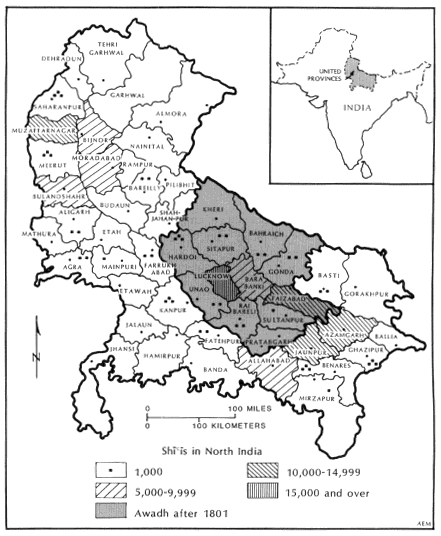
Map 4
Geographical Distribution of Shi‘is in North India, 1881 Census (by
absolute number)
statistics become available for the area. Tables, as of 1881, give Sunni and Shi‘i population figures in each district of the combined British administrative unit of the North-Western Provinces and Oudh (an area nearly equivalent to the Greater Awadh ruled by Shujacu'd-Dawlah in the eighteenth century). But census takers did not divide Muslims by sect when they recorded their occupations. We thus know the number of Muslim weavers in Lucknow district, but not how many of them were Shi‘is.
Without census statistics for the occupations of Shi‘is and Sunnis as separate groups, the question of the specific niches in society filled by Shi‘is cannot be answered. Nevertheless, it must be bound up with the social position of the Muslims in general. Even here the British census figures, frustratingly incomplete, have the disadvantage for the period under study of originating late in the nineteenth century. The census of 1891 first gave tables showing caste and occupation by religion in the North-Western Provinces and Oudh, and Crooke's classic Tribes and Castes supplemented it for ethnographic information, making it, for all the problems mentioned above, a good analytical starting point.
The census for the area of concern here covered two late-nineteenth-century administrative divisions. The first, the North-Western Provinces, constituted areas the British conquered north of Awadh, as well as provinces they annexed from Nawab Sacadat ‘Ali Khan of Awadh in 1801. The second, "Oudh," was the British name for the area of Awadh that remained under the rule of the nawab after he ceded half of it to the British East India Company in 1801. The British later annexed "Oudh" itself in 1856.
The British census takers extensively employed the category of "caste" (jat ), even for Muslims, and preferred this category over occupational ones, creating conceptual problems in their collection of data. A weaver (julahah ), displaced by the influx of cheap British textiles, who began working as a bearer might give his caste as weaver without mentioning his occupation. Census takers created an even more serious problem for historians by recording high-status "caste" groups such as Mughals and Sayyids only under those rubrics, assigning them no occupation.[1] A Shaykh who wove for a living but simply reported his ethnic identity would be included in the Shaykhs rather than in the weavers.
This confusing procedure has left us with over two million Muslims, 37 percent of the Muslim population in the North-Western Provinces and Oudh, classified only as Mughal, Pathan, Sayyid, or Shaykh, all groups being opaque as to actual occupation. Many high-caste Muslims may have been reluctant to admit to being employed, aspiring to at least the appear-
[1] The British overemphasized Muslim high "caste" membership; see Imtiaz Ahmad, "The Ashraf-Ajlaf Dichotomy m Muslim Social Structure in India," Indian Economic and Social History Review 3 (1966) 268-78.
ance of being gentlemen of independent means. Although most Mughals probably owned property and land, and many Sayyids held land, large numbers of Pathans and Shaykhs almost certainly worked as skilled artisans, owning little or no land. On the other hand, the landholding elite no doubt contained numerous Shaykhs and Pathans.