
3
Russian Municipal Reform and Urban Civil Society
The institutions of urban self-government in Russia acquired increasing importance in the last decades of the nineteenth century. New economic practices, expanding migrant communities, and conflicting perceptions of justice and private interests made the urban public arena a place of struggle for political influence and social control. Municipal autonomy raised fundamental questions of order and disorder, self-rule and discipline, and those questions were expressed in a language that ascribed exalted roles to the various actors. "State" and "society" made their voices heard in municipal government, and "society," which included tax-paying citizens and educated Russians, confronted the "people" in a well-defined but constantly expanding arena. Until mid century the city, in its principal architectural and institutional forms, represented the power of the imperial state. Although autocratic power remained a pervasive presence in later years, new actors and activities gave municipal government a separate and increasingly visible part to play in public affairs.
The reasons for the newfound importance of municipal government lie partly in new imperial policies and partly in the dynamic growth of the migrant city. The reforms of Alexander II's regime included the mobilization of public leaders, who were called on to take an active role in addressing social problems. Municipalities, together with regional assemblies (zemstva ), had a designated place in the reformed autocracy. The spread of a protoliberal sense of public service and the pressures that increased economic activity created were as important as state initiatives in raising the
issue of social needs. In this complex intermingling of the state, the public, and the private, areas of conflict and cooperation were not consistent and uniform. Provincial governors at times supported and at times opposed municipal policies and activists; business interests and educated, publicminded leaders agreed on some local priorities and fought bitterly over others. A small segment of the enfranchised voters honored and deferred to their "betters" in municipal elections; the large majority, however, proved indifferent to public affairs. Specialists with technical training such as statisticians and physicians offered authoritative opinions to the state and to municipalities on how to order and to sanitize, for the good of everyone, the urban areas occupied by the impoverished masses.
The meaning and implications of these developments become clear if we examine the political vocabulary in Russia at that time that was inspired by Western European liberalism. Political conditions in eighteenth-century France-and nineteenth-century Germany as well-bore a strong resemblance to late-nineteenth-century Russia (hence the popularity in Russia of the works of Alexis de Tocqueville, somber prophet of monarchical apocalypse, revolution, and democracy). Western European precedents were very much on the mind of Russians—some to decry the trends of the day, others to welcome them—and theories of power derived from the West European experience help to interpret the nature of the conflict and the manner in which some Russians perceived the issues.
Throughout the late nineteenth century political opposition to the autocracy was identified in public discussions not in institutional but in cultural terms. The chairman of the Council of Ministers, Peter Stolypin, used this language in a speech in 1907 that called for reform in order to end the "confrontations between public life and state life [mezhdu obshchestvennosti i gosudarstvennosti ]."[1] His description of a sort of "dual power" recognized the success of an oppositional public (obshchestvennost ') in creating a separate political identity. In sense and derivation the use of this term (or the alternative term "society"—obshchestvo ) resembles the German term bürgerliche Gesellschaft ("civil society"). Friedrich Hegel employed this term in his political writings to designate a key mediating force, based on economic interest, between the family and the state.[2] It was a vital concept in Hegel's theoretical endeavor to reconcile power and freedom in the modern state.
[1] Quoted in Robert Thurston, Liberal City, Conservative State: Moscow and Russia's Urban Crisis, 1906-1914 (New York, 1987), 184.
[2] See Shlomo Avineri, Hegel's Theory of the Modern State (Cambridge, Mass., 1972), 141-47.
The theoretical and historical implications of civil society have been refined in a recent work by the German philosopher Jürgen Habermas. He has proposed the term "civil public sphere" (bürgerliche offentlichkeit , translated alternatively as "bourgeois public sphere") to identify that arena of independent public activity between the state and society that the bourgeoisie opened in the eighteenth century. In Habermas's interpretation of the emergence of political liberties the key factors are critical reasoning—found in literature—and autonomous action—found in commercial c capitalism. The bourgeoisie uses these two factors to challenge the authority of the absolutist state.[3] Hegel's concept of civil society gives him a theoretical model to associate the rise of the bourgeoisie with the development of rational state power. Like Hegel's concept, Habermas's civil public sphere interprets the reordering of power in modern Western society in terms of social practice but places particular stress on two things: the accessibility of the public sphere to groups besides the bourgeoisie, and the public sphere's essential quality of the "publicity" of public affairs, that is, the emergence of public opinion in opposition to the absolutist state's monopoly of power. This manner of explaining the origins of a politically powerful public sphere minimizes the institutional and legalistic issues central to the liberal or Whiggish historical school.
Habermas's theory is germane to the study of Russian public life in the late nineteenth century. It suggests that opposition to absolutism arises in the opening of a public domain that is legitimated by rationalism, more or less rooted in pragmatic political practice and discourse, and defended by writers and politically active representatives of influential social groups—urban business groups, landed gentry—that are convinced of the legitimacy of their own public action. I use Habermas's theory to interpret the origins and development of the activities and rhetoric of Russian municipal affairs. These affairs were explicitly recognized as autonomous in the municipal reform of 1870; implicitly, they occupied a separate sphere from tsarist administration to the extent that they constituted distinct functions of urban public life.
The usefulness of Habermas's (and Hegel's) theory to the history of Russian urbanism lies particularly in its attention to political practice and participation. From the Russian political perspective in the late nineteenth
[3] Jürgen Habermas, L'espace public: Archéologie de la publicité comme dimension de la société bourgeoise , trans. Marc de Launay (Paris, 1978), esp. chap. 3. The original title is Strukturwandel der Offentlichkeit: Untersuchungen zu einer Kategorie der bürgerlichen Gesellschaft (Darmstadt, 1962). I am indebted for this source to Benjamin Nathans, "Habermas's 'Public Sphere' in the Era of the French Revolution" (Unpublished paper, Dept. of History, Univ. of California, Berkeley, 1988).
century the West offered a reservoir of models of political action. The example of Western municipal liberties in itself tended to strengthen the significance of municipal activities to Russians of a liberal persuasion. Vocal intelligenty added their voices—either in chorus or in opposition—to commercial and manufacturing interests to define the proper content and role of municipal practices in a Russian civil public sphere. The practice of municipal power, when legitimated by a belief in its value and importance, enhanced the role of municipalities as political entities distinct from the state. The very intensification of municipal "small deeds," even though restricted largely to the migrant cities, gave the urban elite a sense of autonomous governance. This dimension to the story of nineteenth-century Russian urbanism encompasses both the institutions of municipal power and the practice of that power within the context of rapid economic development and the massive influx of migrants. It is also important to understand the limits to the arena of municipal activism, in terms of both power and participation. Civic activists, tsarist administrators, and townspeople differed widely in their attitude toward the municipal public sphere. The nature and origins of that diversity of views suggest the extent to which Russian urbanism acquired a meaningful political role in public life by the end of the century.
The State and the Municipalities
In the early years of Alexander II's reign the city assumed a special place in administrative as well as in public discussions of political reform. The Urban Affairs Section of the Ministry of Internal Affairs assigned a new role in public affairs to the country's towns, and it defined this role in ways that were fundamentally at variance with the Nicholaevan facade model. Provincial governors drew inspiration from the "spirit of the age" to urge the municipalities to undertake new initiatives. Outside town councils, voices spoke out from the once silent nobility, requesting a part in urban public service. The state's decision in 1858 to cease meddling in urban architectural affairs was symptomatic of the new mood. The decision ended the requirement that private buildings adhere to the model facades that were officially authorized by state agencies.[4] The city of this new age had to demonstrate its inspirational influence not by image but by deed, not through orderly town plans and neoclassical facades but through public service to promote worthy causes.
[4] V. N. Ivanov, ed., 'Obraztsovye' proekty v zhiloi zastroike russkikh gorodov XVIII-XX vv. (Moscow, 1961), 184.
The eagerness of certain Petersburg administrators in the ministry's Urban Affairs Section to reform and activate municipalities inspired them to take unprecedented initiatives. In the previous fifteen years they had conducted investigations into the problems of Russian urban life. This work had persuaded them that they possessed a clear sense of the role of the Russian city as a setting for constructive public activity. They realized that urbanism did not appear "by renaming a settlement a 'city,'" as they emphasized in a memorandum written in early 1860. Their understanding of the "character" of the city was multitiered and encompassed the urban economy as well as municipal policies and priorities. It incorporated a profile of the "real conditions of the urban population," which included commercial affairs, rural occupations, migration, availability of work, and property-holding. These factors in turn determined "local needs," on which was predicated the proper "form of self-rule [obshchestvennoe upravlenie ]." Convinced that they were in a position to act on the problems confronting the Russian city, they prepared instructions that year for a nationwide survey of political and economic conditions in urban areas. The purpose of this survey was "to familiarize [the ministry] with the peculiarities of the cities" and to obtain "accurate indications of [their] real needs." For these "enlightened bureaucrats" cities contained a vast amount of essential information that special local commissions made up of "deputies of all urban estates" would collect and that the Urban Affairs Section would analyze and interpret.[5] Their goal was quick action on municipal reform. Their enthusiasm was not shared, however, by the Council of Ministers, which judged that emancipation and the reform of rural administration were highest priorities. In April 1860 it declared that the creation of the commissions was "premature."[6] Two years later it finally authorized the call to begin work on municipal reform.
The discussions on municipal affairs in these years offer intriguing insight into the expectations of tsarist reformers for local self-rule. These officials proposed a new definition of urbanism. The pressure behind municipal reform was clearly instrumental: it was motivated by a sense of crisis in local and provincial governance. In the judgment of an 1860 memo
[5] Ministerstvo vnutrennikh del, Ekonomicheskoe sostoianie gorodskikh poselenii evropeiskoi Rossii v 1861-1862 g. (St. Petersburg, 1863), 1:v-vi. This introduction spells out the principles that inspired the 1860 initiatives taken by the Urban Affairs Section.
[6] "O sostavlenii soobrazhenii otnositel' no uluchsheniia obshchestvennogo upravleniia v gorodakh," Tsentral'nyi gosudarstvennyi istoricheskii arkhiv (abbreviated TsGIA), f. 1287, op. 37, d. 2137, 124.
the cities would remain unable "to solve many current needs as long as municipal self-government remains in its current condition."[7]
In 1863 the local commissions submitted their "considerations" on economic, social, and administrative conditions in their cities. From these reports the urban affairs officials tendentiously drew the conclusion that "all [cities] unanimously explain the deficiencies of the existing order by their lack of autonomy [samostoiatel' nost' ] in all major actions of urban welfare and economy."[8] The reformers were prepared to carve out a sphere of municipal action separate from the tsarist administration on the assumption that "public self-government" [obshchestvennoe samoupravlenie ] was the solution to the decay of the cities, which they perceived to be emblematic of the decay of the country as a whole.
The role that the urban affairs officials assigned to municipal self-rule did not intentionally encompass the creation of a civil public sphere. In their estimation an urban elite was needed to accomplish certain tasks unworthy of the tsarist administration. Nikolai Miliutin, a key figure in the early discussions of the zemstvo reforms, emphasized in a memo written in 1863 the importance for the central government to "focus on the most notable state affairs." He believed that local bodies, which by implication included the municipalities, ought to concern themselves with "a wide range of local interests, mostly petty, that are unimportant to the central government but that represent real needs for the local population."[9] He failed to explain what might happen if the local institutions did not or could not cope with these needs. His view, which was one generally shared by reform bureaucrats, assumed that a revival of previously moribund local institutions on the basis of self-rule would result in a remarkable improvement in initiative and effectiveness.
Implicit in his reasoning was a second key assumption, namely, that the cities contained an abundance of human talent waiting for the opportunity to serve the public good. In his call in 1862 for the formation of the local urban commissions the minister of internal affairs, Count Valuev, included an appeal that was more than a rhetorical flourish for the participation of "the most experienced and outstanding people" from all estates.[10] In Miliutin's memorandum, cited earlier, such public-spirited citizens were char-
[7] Ibid., 19.
[8] Materialy otnosiashcheisia do novogo obshchestvennogo ustroistva v gorodakh imperii (St. Petersburg, 1877), 1:84.
[9] TsGIA, f. 1275 (Sovet ministrov), d. 33, 105. Excerpts of this memorandum are cited in S. Frederick Starr, The Politics of Decentralization and Self-Government in Russia, 1830-1870 (Cambridge, Mass., 1976), 250-52.
[10] Ibid.
acterized no less grandiloquently as "the best and most educated people." They would find a "practical direction" for their idealism in opportunities for local reform (and presumably would not choose the alternative model of "new people" that was proposed that year by Nikolai Chernyshevsky in his novel What Is To Be Done ).[11]
As in other periods of rapid reform, the Russian state relied as much on the sudden mobilization of committed, talented, and loyal subjects as on major institutional changes for the success of its measures. Like the models of technical ingenuity and social progress that had been singled out for emulation at the national expositions, the appeal for public support revealed the extent to which the reformers' plans idealized public life in the city. The experience of a century of municipal self-rule had taught the public to expect officials to dominate public life. But suddenly townspeople were to believe that local power lay in their hands. This dubious assumption informed much of the discussion of municipal reform. For example, it appeared in the "considerations" drawn up by the town leaders of Perm. After chastising their fellow townspeople for treating civic duties as a "formality that they could easily do without, dreamed up only God knows why," the authors promised that their "apathetic" and "disorderly" municipality would be transformed into a "free, self-governing community" if only arbitrary state intervention were eliminated.[12] Why and how, after decades of mediocre municipal leadership, men of extraordinary ability would suddenly emerge represented a dilemma that the reformers could not resolve.
One group had already laid claim to the title of "best people" in urban affairs. Between 1859 and 1860 numerous petitions reached St. Petersburg from provincial and district noble assemblies, backed at times by the governors, that called for special representation for the nobility in municipal dumas. The reformed St. Petersburg municipality of 1846 was their model. In St. Petersburg deputies representing personal nobles (largely state officials who had risen to a rank conferring on them the title of noble) and those representing hereditary nobles each had their own separate curia; hence they could potentially dominate the merchant estate, which was the sole active public force in most towns. In the province of Penza a delegation of landed nobles and bureaucrats presented their petition to the governor, whose supporting message to the capital explained that these groups could bring "real aid" to urban affairs thanks to "their education and proper
[11] "O sostavlenii soobrazhenii otnositel' no uluchsheniia obshchestvennogo upravleniia v gorodakh," TsGIA, f. 1287, op. 37, d. 2137, 176.
[12] "Mnenie o soobrazhenii," TsGIA, f. 1287, op. 37, d. 2171, 5.
knowledge of the laws."[13] Through their district assembly the members of the Moscow nobility petitioned to participate in the public affairs of their city. Count Stroganov, the governor of Moscow province, officially baptized the local nobility as the "best people" and added that they would end municipal "disorder [rasstroistvo ]."[14] Odessa's nobles followed suit. Although the petitions adapted the nobility's political role to the reform spirit of the times, the legitimating principle behind this appeal for local leadership was the legal preeminence that the tsarist regime granted to the noble estate.
The reasons for the sudden outburst of noble interest in exercising municipal leadership are hidden beneath the rhetoric of the petitions. Perhaps the convocation of the consultative noble committees on serf emancipation and their subsequent dismay at the growing power of the state bureaucracy in controlling the decisions on emancipation inspired nobles to consider the potential benefits of occupying a dominant place in municipal affairs. The petitions came to a quick end—probably dampened by official disapproval—but the issue of a special place for nobles in the new self-governing municipalities remained in public view for several years. Although Minister of the Interior Valuev may have had his doubts, he heeded the tsar's favorable reception to the Moscow petition. In 1862 he approved a new Moscow statute that was modeled on the St. Petersburg statute. The next year Odessa also received a new municipal statute, which did not, however, recognize separate representation for nobles; rather, it created a new curia for large property owners who did not belong to the urban estates (primarily nobles).[15] In a few major cities the doors to urban civic activity were opened to the highest estate of the empire.
Although noble leadership might have seemed anachronistic to those familiar with Western European municipal rule in those years, in the 1860s some Russian nobles assumed an active part in urban affairs. In both Moscow and Odessa the mayoral position passed into the hands of aristocrats, presumably as a consequence of the reforms. Count Shcherbatov, Moscow's mayor from 1863 to 1869, conducted his affairs from the point of view of noblesse oblige, at least if we go by the spirit of his summary report to "urban society" at the end of his term. Wishing to be true to the new principle of "openness" (glasnost' ), he presented Muscovites with a
[13] These petitions are discussed in "O sostavlenii soobrazhenii otnositel' no uluchsheniia obshchestvennogo upravleniia v gorodakh," TsGIA, f. 1287, op. 37, d. 2137, 2-12.
[14] TsGIA, f. 1287, op. 37, d. 2004 (1859-65), 38-39.
[15] Frederick Skinner, "City Planning in Odessa" (Ph.D. diss., Princeton University, 1973), 210-13.
full account of the activities of the municipality that would enable them to make "a correct and dispassionate judgment [about] whether their chosen representatives carried out their duties."[16] One of his colleagues in the duma from the merchant estate, I. A. Liamin, proclaimed that same year the dawn of a new era of social brotherhood in municipal public life. In his opinion the "mutual distrust and alienation of estates" in previous decades had given way to the "rapprochement and union of the so-called upper urban classes." He attributed this situation to the new spirit of cooperation in the duma, where there now existed "a whole, strong, and integral society."[17] His flowery rhetoric suggests the existence, at least in his imagination, of a Muscovite version of civil society.
The reality of municipal life in the reform years is more prosaic and less benign than Liamin's description implies. First, the meager evidence we possess does not reveal an outpouring of civic ardor on the part of the newly empowered urban nobility. In St. Petersburg, where members of the urban nobility had received special electoral rights twenty years earlier, they proved even less zealous in voting than the merchants.[18] As was the case for the urban estates, only a handful of members of the nobility turned out to be civic-minded. Second, the municipal activities of even this small urban elite was narrowly confined by administrative demands and fiscal limitations. Shcherbatov's principal message to Moscow's "urban society" was the heavy burden of obligatory state expenditures—a doubling of funding for the municipal police, repairs on state buildings, etc.[19] When major projects were undertaken, they came about either because the duma accepted new taxes—the case in Moscow—or because the tsarist administration set a high priority on capital improvements in particular cities. For example, Odessa's municipality was able to launch a development program of street paving, lighting, water supply, and harbor improvements thanks to the encouragement and financial backing of the state.[20] In general, the deeds necessary to make the city the symbol of progress entailed both state support and new civic leadership.
In fact, the presence of nobles among the urban elite appeared to be
[16] Otchet Moskovskoi gorodskoi golovy Kniazia Shcherbatova o deiatel' nosti Moskovskoi gorodskoi dumy (Moscow, 1869), 1.
[17] Cited in B. V. Zlatoustavskii, "Moskovskoe gorodskoe samoupravlenie v period reformy 60-kh godov XIX v." (Kandidat dissertation, Moscow State University, 1953), 200-201.
[18] I. I. Ditiatin, Ustroistvo i upravlenie gorodov Rossii, vol. 2, Gorodskoe samoupravlenie (Iaroslavl, 1877), 494.
[19] Otchet Kniazia Shcherbatova, 9-12.
[20] Frederick Skinner, "Trends in Planning Practices: The Building of Odessa," in The City in Russian History, ed. Michael Hamm (Lexington, Ky., 1976), 149-51.
incidental to the activation of civic initiative. Previously moribund municipalities became infused with the spirit of the reform period without any enlargement of their constituency. In Kharkov the city acquired the "appearance of self-government" owing to the encouragement of the new governor-general. The replacement of the Nikolaevan martinet by an activist administrator set the stage for the municipal duma to consider town schooling, gas lighting, a new railroad station, and much more. All these changes were made by the established merchant leaders, whose transformation seemed like "a miracle" to the townspeople.[21] All was not changed as if by magic, however. When the new mayor of the port city of Rostovon-Don, chosen in 1862 by the unreformed duma, set an activist agenda of paving, municipal banking, and schooling, he encountered such disorder and indifference that he concluded that a spirit of "anarchy" reigned there.[22] Such conditions, whether exaggerated or not, suggested to urban activists that they had to form their own faction. They believed that they had been entrusted by default with leadership responsibilities; they also believed that they were endowed with the vision and dedication necessary to build a new city, both literally and figuratively. Although conceiving of a civic sphere of vast proportions and significance, municipal leaders found that their circle of supporters was small and their powers still circumscribed by the indifference or skepticism of townspeople. These unresolved problems were the result of decades of municipal inaction and provincial officials jealously defending tsarist prerogatives.
Under these circumstances it is not surprising that municipal leadership from the nobility made its most visible impact in public conflicts with the state. The reform period brought changes in power relations that transcended urban affairs, where questions of power, prestige, and ideology were acted out in a setting that was incidental to the underlying issues. When in 1865 the new mayor of Odessa, Count Aleksandr Stroganov, discovered what he believed to be deceitful action by the minister of finance in dealings with the municipality, he used a duma meeting to accuse the minister of "lying" and called for a public investigation. "There never has been such a speech in the entire existence of the duma," noted an enthusiastic duma member in his diary, "or in all Russia!" A courtly aristocrat could claim liberties of which townspeople had no experience. Unfortunately for Odessa and Stroganov, the tsar saw in Stroganov's speech an act
[21] D. Bagalei and D. Miller, Istoriia goroda Khar' kova za 250 let ego sushchestvovaniia (Kharkov, 1912), 2:2.
[22] A. M. Baikov, Obzor deistvii Rostovskogo (na Donu) gorodskogo khoziaistvennogo upravleniia za 1863 g. (Odessa, 1864), 2.
of defiance. The municipality lost the right to publish its duma proceedings, and Stroganov's career as mayor came to a quick end.[23]
In 1870 the same outcome ensued when the Slavophile mayor of Moscow, V. A. Cherkasskii, tried to turn his duma into the voice of the Russian people. He obtained from his deputies, among whom were several ardent Slavophile nobles like himself, approval of a motion that stressed the "mutual unshakable ties between the tsar and the people." The motion pointedly lauded the venerable medieval tradition of the gathering of the estates of the land, the zemskii sobor .[24] The tsar was not pleased because Cherkasskii was obviously trying to raise Moscow's duma to a national political role. In words that undoubtedly echoed Alexander II's disdain, Moscow's governor-general later denied the duma's "authority or competence" even to represent "all the inhabitants of Moscow, much less the entire Russian people."[25] His definition of the reformed autocracy left no room for an autonomous public sphere either in the municipalities or in the zemstva , the other forum for oppositional Russian nobles.
Despite these conflicts, the reform of 1870 still retained the municipal autonomy that the reform bureaucrats had defended a decade previously. The "golden words" of the municipal statute accorded a municipality the right to function "autonomously [samostoiatel' no ] within the limits of the authority granted to it."[26] Although its language was somewhat ambiguous, this legislation recognized "public self-government" for the municipalities, something not accorded the zemstva . Perhaps the reason for the exceptional treatment of the municipalities can be found in their relative political insignificance. Despite the disputes I cited earlier, the real institutional base of the nobility in the reformed autocracy lay in the zemstva . Still, in the tsarist universe of those years the "needs" of the city placed it in a new and different institutional context, one that we might describe as "Western" in the same sense that the judicial reform of 1865 adopted in legal form the Western principle of judicial independence. In the historical schema adhered to by tsarist officials progress retained a European imprint.
The Western character of the reform is probably the main reason why the principle of estate representation, which led to noble preeminence,
[23] V. A. Nardova, "Periodicheskie izdaniia gorodskikh dum v 60-kh godakh XIX v.," Vospomogatel' nye istoricheskie distsipliny 6 (1976):226-31.
[24] V. A. Nardova, Gorodskoe samoupravlenie v Rossii v 60-kh-nachale 90-kh godov XIX v. (Leningrad, 1984), 155.
[25] Ibid., 175.
[26] Walter Hanchett, "Tsarist Statutory Regulation of Municipal Government in the Nineteenth Century," in The City in Russian History, ed. Michael Hamm (Lexington, Ky., 1976), 103; Hanchett provides a detailed discussion of the 1870 municipal statute (98-103).
vanished from the new municipal statue. The model of curial elections by estates that was used in the Petersburg and Moscow dumas disappeared. It was replaced by a tripartite schema that was based on the contributions of tax-paying townspeople, both property owners and those merely assessed commercial fees. Because total contributions, not the number of contributors, determined the membership in the three curia, this mode of representation accorded exceptional electoral influence to the handful of residents in each town whose preponderant share of municipal taxes placed them in the first and second curia.
The model of this reform was the Prussian municipal (and legislative) electoral system, which the Urban Affairs Section studied closely in preparation for the reform. The principle behind this procedure of enfranchisement was the presumed responsibility and competence of the propertied and productive classes, which the Russian reformers identified, using Western precedent, as the prime source of the cities' "best people." Late in 1861 Count Valuev gave his approval to this bourgeois principle. He explained to the state council that "those inhabitants personally concerned with these [public] affairs through ownership of urban real estate, trade [permits], and the fulfillment of various obligations" ought properly to receive the right to vote. He acknowledged inequality in wealth (in the form of real estate or trade) but not inequality of social rank in reconstructing urban public life.[27] Although enthusiasm for reform waned later in the decade and conservative warnings about the danger of introducing pernicious Western institutions dominated the political debate (Valuev himself lost his position of minister of the interior in the process), the principle of municipal enfranchisement by property ownership or trade remained at the heart of the reform project.
The 1870 municipal statue was only one ingredient in the transformation of the Russian city in the late nineteenth century. The economic forces of industrialization and the social pressures exerted by migration and population growth had a more profound impact on the direction and shape of urban life. These trends indirectly influenced municipal activities, reshaping the electoral constituency, bringing tsarist officials into urban affairs in spite of the legal autonomy that ostensibly protected municipal self-government, and forcing civic leaders in migrant cities to undertake an activist agenda even when they had little commitment to reform. Municipalities had begun to address the social and cultural needs of their cities even before
[27] "Po proektu polozheniia obshchestvennogo upravleniia goroda Moskvy," 22 December 1861, TsGIA, f. 1287, op. 37, d. 2004, 15-16.
the 1870 statute went into effect, and they continued to do so after a new statute, wiping out the broad electorate and ending municipal autonomy, went into effect in 1892. The fixation of historians on Russian institutional history has tended to exaggerate the importance of tsarist policy on public practices and ideological perceptions. In the process it has turned the contemporary images of "liberal" and "conservative" policies and groups into objective criteria by which to interpret changing power relations. Viewed from within the urban context, however, municipal practices played a shadowy but key part in creating a civic constituency that the state was unable to repress.
The meaning of the 1870 municipal statute lies less in its details of electoral procedures, selection of councils and mayors, fiscal sources, and responsibilities for "local needs" than in its implicit creation of a civic public sphere and its recognition of a civil society. Both creations were very severely restricted and rudimentary. The recognition of autonomy in the statute, however, enhanced the importance that civic-minded Russians had already begun to attach to urban affairs. It forced tsarist officials, even when violating the autonomy provision, to acknowledge the new character of power relations within the city. Similarly, the encouragement given to propertied townspeople to participate in public affairs, even though disregarded by most, strengthened the ideal that estate distinctions would be replaced by commonalities of culture, ideology, and action. Legal definitions of electoral rights played only a minor role in the formation of a civic elite, but they created an institutional context in which that elite could find space for action. The city was a rapidly expanding territory that challenged the elite's sense of public service and tempted them to introduce their own methods of "civilizing" the mass of migrants. In this manner the municipal reform slowly gave shape and substance to a civil public sphere in the Russian city.
Municipal Oligarchs and the Civil Public Sphere
After the introduction of the 1870 municipal statute the search for the "best people" and the efforts to get municipalities to confront their own civic needs essentially became affairs of local political elites, local practices, and local programs. In the next decades municipal histories would reveal both the potential for the creation of a civil public sphere and the severe limits that tsarist authoritarianism and public indifference placed on that
sphere. Political factions coalesced around personal leaders and divisive issues. Leadership and new policies became the source of bitter conflicts, but they also became the points around which emerged consensus about allies and enemies, political priorities and common practices. Smaller, less economically dynamic towns clung to the old habits of deference to local power cliques, conservative leadership, and little municipal action. Migrant cities, however, were an arena of active municipal politics.
Who should speak for the city and what were municipal priorities? Tsarist officials tended to blame the slow pace of action in the major cities and the inaction of small towns on the urban mob and stingy merchants. Municipal activists employed similar rhetorical epithets to chastise their rivals and to portray themselves as "educated," "enlightened," and "progressive" civic leaders. Increasingly, these activists dominated the politics of the migrant cities. Often their pompous language tended to gloss over the prosaic side of their actions and the small size of their constituency. Before 1892 municipal leaders were subject to informal tsarist reprisals and after that year they were subject to sanctioned controls. In addition, they were hamstrung by limited fiscal resources that were never adequate to deal with the needs of a rapidly growing urban population. In other words, municipal autonomy remained a problematical creation.
As a consequence of both the provisions of the 1870 statute and the social conditions of urban centers, the Russian city could not duplicate the mass politics of the English or German municipalities in that period. The legally enfranchised citizenry included only a fraction of the adult male population. To qualify as a voter a citizen had to have one year of residency and either possess real estate subject to tax assessment, or pay municipal commercial fees. Recent migrants, even if possessing property, were excluded from the franchise, as were the owners of the untaxed hovels in which many poor townspeople lived. All renters, whether rich or poor, professionals, laborers, and anyone else not engaged in some form of commerce were also excluded. These restrictions cut severely into the voting population of the migrant towns, with the highest proportion of the disenfranchised among migrants, renters, and the very poor. In these urban areas probably no more than one-fourth of the adult males enjoyed the right to vote.
Further curtailing voting powers was the division of the electorate into curiae according to their tax payments. The handful of wealthy townspeople who contributed two-thirds of municipal revenues controlled the town duma because they elected two-thirds of the deputies. As wealth flowed into the migrant cities in the 1870s and 1880s, the size of the electorate
grew principally because of the expansion of the membership of the lowest, third curia. The first curia, composed of those paying the largest tax burden, scarcely grew at all or stagnated and in some cases even declined (see chapter 2). Nizhny Novgorod, probably typical of the provincial migrant cities, counted a total of approximately sixty voters in its first curia in both 1872 and 1890; its third curia, however, expanded in those two decades by 50 percent (from 2,100 to 3,200).[28] The bulk of the Russian city's enterprising and propertied citizens, gathered from every estate of the realm, were found in the third curia. It was most representative of the male population of the city. As such, the third curia quickly became the epitome of the urban plebe and its members were thought to represent either ignorance or democracy, depending on the social views of municipal activists, intellectuals, and tsarist officials.
The dynamics of municipal elections were more a function of cultural values and social bonds than of legislative statute. The process by which enfranchised townspeople participated in the selection of their best people resembled the workings of a private club for the first two curiae and the confusion of a mass meeting for the third. The Ministry of Internal Affairs kept close watch over elections (of which there were five before a new statute altered procedures). The data, carefully tabulated by statisticians in the Urban Affairs Section, uncovered a high degree of abstention, suggesting pervasive apathy and disinterest, especially in the third curia. Among the "patriarchy" of the first two curiae one-half to one-third of the voters participated; in the third curia the rate of participation fell from about 20 percent in the early 1870s to 5-10 percent in the late 1880s. Only in exceptional cases such as Odessa, where bitter ethnic conflicts were beginning to emerge, did participation reach 30 percent.[29] In terms of voter interest in municipal affairs, the new era very closely resembled the old one.
To the extent one can generalize from limited statistical data the social profiles of the absent voter included both the privileged and the plebe. Our most detailed information comes from a senatorial inspection of the southwestern provinces in 1880, including a number of medium-sized towns as
[28] N. N. Baidakov, "Vvedenie Gorodovogo polozheniia 1870 g. v Nizhnem Novgorode i vybory v 1870-90-kh gg." Uchenye zapiski Gor'kovskogo Gosudarstvennogo Universiteta, seriia gumanitarnykh nauk 105 (1969): 76-77.
[29] Figures on elections in the early and the mid 1870s are collected in "Vvedenie Gorodovogo polozheniia v deistvie," TsGIA, f. 1287, op. 37, d. 1290 (1878), 56-63; the last elections (1888-89) were examined in incomplete returns in "Statisticheskie svedeniia ob uchrezhdenii gorodskogo obshchestvennogo upravleniia po piatoi chetyrekhletii," TsGIA, f. 1287, op. 38 (1892), d. 2336, 2337, 2338; extensive data on municipal voter participation are found in Nardova, Gorodskoe samoupravlenie , 61-70, tables 1-6.
well as Kiev. In Kiev the greatest proportion of abstention (over 90 percent) was among the nobility-bureaucracy, which constituted nearly one-half of the eligible third-curia voters.[30] Their uninterest carried forward the social disdain they had shown for civic affairs in earlier years. And according to Kiev's mayor their uninterest was reinforced by the chaotic voting procedures of the third curia, which were so "debilitating" they were fit only for "the mass of illiterate [townspeople] and for fraudulent voters."[31] His reference to illiterate masses was based on cultural prejudice, not dispassionate observation. The same senatorial inquiry found that almost all illiterate voters (estimated to represent one-third to one-half of the electorate) never participated in elections.[32] Resembling one another only in the minimal tax payments they made, the missing nobles were probably drawn from the ranks of petty property owners and the illiterate voters from poor artisans and traders. Their absence from municipal voting suggests that the borders to this protocivil society to a great extent excluded those townspeople who were marginal to the urban economy.
The abstention of nobles and illiterates made the political voice of the townspeople of the middle ranks more influential than their place among the enfranchised would indicate. The ministry's voting records and the reports of the senatorial inspection left no doubt that the city voter was most likely to belong to one of the urban estates—merchants in the first two curiae and merchants and petty bourgeois in the third. The motives that drew these voters to municipal elections were discussed in contemptuous and patronizing terms by both provincial governors and municipal activists. The comments of both these groups tell us more about their own lofty self-images than they do about the electorate. Many petty bourgeois voters continued to follow the old municipal tradition of cliques and factions, especially in those towns where the forces of commercial and industrial change were little felt. After reviewing senatorial reports on municipal affairs the Kakhanov commission concluded in 1883 that "a few influential people" could control the "subservient [nesamostoiatel'nye ] petty traders." The commission blamed these traders for "the improper conduct of elections, which are often affairs of chance and even corruption."[33]
The Kharkov governor-general gave a contemporary twist to this theme
[30] "Zapiska Senatora Polovtsova," in Trudy komissii Kakhanova (St. Petersburg, 1884), 2:95, table 41; 3:60-61, table 26; 120-21, table 40,
[31] Ibid. 2:138-40.
[32] Ibid., 3:29, table 12, 33, table 14.
[33] M. V. Islavin, Obzor trudov vysochaishe utverzhdennoi, pod predsedatel'stvom statssekretaria Kakhanova, osoboi komissii , vol. 2, Gorodskoe i zemskoe upravlenie (St. Petersburg, 1908), 16.
that was suitable to his provincial capital, where commerce and manufacturing were creating a boom economy. He accused "powerful capitalists" of using the new municipal statute to manipulate "petty homeowners, traders, and shop assistants" by means of "promises, intimidation, vodka, and outright bribes of a very miserly sum."[34] Perhaps he had heard rumors from Kiev about the directors of the Mutual Credit Society, that city's principal home mortgage bank, who reputedly brought pressure on their clients to vote for the directors' political faction.[35] For the Kharkov governor-general, the presence of traders, artisans, and merchants in public life necessarily arose from their personal greed and corruption. By implication they stood for class interests and represented intruders in civic life.
His judgment needs to be set against the evidence that ministry officials collected on voting. This evidence points to another possible reading of urban politics, one that suggests that in the 1870s and 1880s electoral practices incorporated private interests and public needs in a manner that provided, at least in the major cities, a local leadership responsive to both practical issues and social welfare. In other words, an ethos of public service was not incompatible with massive abstentions, the indifference of most petty nobles, and the continued influence of the city's business community among municipal electors. Electoral tabulations, which cited only estate membership in their classification of candidates, reveal a selection of duma deputies that voting based on economic interests would not predict.
Although proportions shifted slightly during these twenty years, estate representation in municipal dumas remained essentially unchanged. The deputies from the upper urban estates—the merchants and honorary citizens (a rank that included both professionals and established entrepreneurs from commerce and manufacturing)—held the majority, and petty bourgeois deputies were but a small minority. Only in small district towns that were little touched by economic and social change was the petty bourgeoisie likely to dominate. In the major provincial and economic centers of the country the urban business elite held up to two-thirds of the seats.[36] There was some justice to the conclusion of one Moscow journal in 1876 that "on the basis of current electoral laws the duma is formed mainly of the
[34] TsGIA, f. 1287, op. 37, d. 1296, 18-19.
[35] Kiev v 80-kh godakh: Vospominaniia starozhila (Kiev, 1910), 70-71.
[36] The sources for these figures are the official surveys cited earlier: "Vvedenie Gorodovogo polozheniia v deistvie," TsGIA, f. 1287, op. 37, d. 1290 (1878), 56-63, and "Statisticheskie svedeniia ob uchrezhdenii gorodskogo obshchestvennogo upravleniia po piatoi chetyrekhletii," TsGIA, f. 1287, op. 38 (1892), d. 2336, 2337, 2338; see also, L. F. Pisar'kova, Moskovskoe gorodskoe obshchestvennoe upravlenie: Avtoreferat (Moscow, 1980), 11, table 2.
| ||||||||||||||||||||||||||||||||||||||||||||||||||||||||||||||||||||||||
patriarchs."[37] Nobles and bureaucrats (who were grouped together in ministry statistical tables) occupied an unexpectedly large place in municipal dumas. These two groups accounted for one-third of total duma representation generally, and in some provincial capitals, such as Kiev, they numbered up to one-half of the representatives. Thus, these privileged segments of the urban population had a role in municipal politics that far exceeded their insignificant presence among voters. To this extent, the merchants did not monopolize municipal representation.
The electoral data from throughout the country suggest that, at this modest level of political activism, municipal voters turned to socially as well as economically distinguished townspeople for leadership. By law, each curia had a fixed number of deputies to elect (which depended on the size of the city), but its choices were not restricted to men from the same curia. In other words, the pool of deputies in each town included all eligible voters, whose ambitions, talents, or social ties might earn them a seat in the duma from any curial bloc. Incomplete returns from the 1890 elections, primarily from the provincial centers and larger cities, offer our best insight into these obscure electoral processes. Table 2 provides the estate background of each curia's elected representatives; table 3 indicates the estate
[37] Cited in E. A. Pavliuchenko, "Moskovskoe gorodskoe upravlenie v 70-80-kh godakh XIX veka" (Kandidat dissertation, Moscow State University, 1956), 57.
| ||||||||||||||||||||||||||||||||||||||||||||||||||||||||||||||||||||||||
background of the deputies arranged by their curial membership. In these elections about one-fifth of the total number of deputies were from the first curia and nearly half (45 percent)_of the deputies were from the third curia. Wealthy town citizens tended to avoid serving as deputies, choosing in their place townsmen who were distinguished either by birth or by public repute but not by their wealth. If in fact a patriarchy of merchants dominated the dumas, they frequently preferred to exercise their influence indirectly through less distinguished deputies.
Although one can only infer political attitudes from these statistics, they suggest that economic interests and social deference were not the only factors at work in choosing a municipal leadership. The post-1870 dumas did not duplicate the narrow merchant representation of the Nicholaevan municipalities. A substantial group of deputies was of noble rank and did not possess great wealth. A "delegation of powers" seems to have occurred from the prosperous commercial and propertied citizens to deputies not noted for their business activities. In Moscow only 7 percent of the first curia representatives were from that body. The education and occupation of the deputy seemed most noteworthy to these electors. The biographical record of the nonmerchant deputies from the upper curiae often included secondary or advanced education and some form of professional work.
The patriarchs of Moscow's first two curiae chose, alongside their merchant-honorary citizen representatives, a sizable number (nearly one-third) from the nobility-bureaucracy. Almost all of these men were by the fiscal
measures of municipal ranking from the "plebeian" third curia.[38] By other standards, however, some were quite distinguished. They included people such as V. I. Ger'e, a noble by birth and a professor of history at Moscow University, and the lawyer I. N. Mamontov. Their willingness to participate in municipal politics implies that they were ready to serve for what they understood to be the public interest, not for private profit. To the extent they were typical of groups of deputies in other migrant cities, their presence suggests the existence of a civic elite that was distinguished to some extent by an ethos of public service. Their presence was particularly important for the emergence of a civil public sphere in the city.
Their activity became especially significant because of the low level of participation within the dumas. Duma leadership tended to fall into the hands of small political factions, whose views of municipal needs set the tone for public debate and whose quarrels fixed the public image of municipal politics. Reports from the capitals and the provinces in the years after the reform repeated a common theme of half-empty duma meetings. The senatorial survey of the southern provinces in 1880 concluded that generally only one-half of the deputies participated regularly. As a result, "the same small group of deputies becomes the only activists who take a real part in urban affairs by their participation in the various issues associated with municipal administration."[39] There was no pronounced tendency for one particular group of deputies to abandon their municipal duties; the reports refer indiscriminately to wealthy merchants, poor nobles, and humble petty bourgeois in identifying the missing representatives. Noncommercial groups—nobles, bureaucrats, priests—predominated in the duma of the central Russian city of Tambov, where the 1880 inspection discovered that "meetings of the duma are conducted by a few people, most often by the mayor himself."[40] Despite the broad suffrage of the 1870 reform, municipal power had, as in the early part of the century, fallen into the hands of relatively few townspeople.
Because of their own interest in urban affairs and because of the indolence of most electors the members of this elite tended to become the stalwarts of municipal life over a long period. In the mid 1880s the interior ministry's statisticians found that longevity in office was a characteristic of deputies in all curiae. Not surprisingly, it was most pronounced in the first,
[38] Pisar'kova, Avtoreferat , 10-11, table 1.
[39] "Gorodskoe khoziaistvo Chernygovskoi gubernii," in Trudy knomissii Kakhanova (St. Petersburg, 1884), 3:247-57, 566-67.
[40] "Gorodskoe khoziaistvo Tambovskoi gubernii," in Trudy komissii Kakhanova (St. Petersburg, 1884), 6:58.
nearly 60 percent of whose deputies had won reelection in three out of the four elections. In the third duma, one-fourth were in their third or fourth terms.[41] These long-serving deputies were the leaders of municipal affairs and the regular duma participants. Such was the case, for example of Moscow's Professor Ger'e, whose term lasted from 1876 to the turn of the century and who made social welfare his special field of municipal expertise.[42] The fact that he subsequently became active in national politics suggests that in his case, as in many others, the possibility for civic activism had political implications that tsarist reformers did not intend.
Despite voter abstention and deputy indifference, post-1870 municipal dumas were far more active than prereform dumas. With considerable pride—and perhaps exaggeration—government urban affairs statisticians revealed in 1879 that duma meetings were occurring throughout the empire with remarkable frequency. By their count, in the first five years after the introduction of the 1870 statute eighteen thousand meetings had taken place and only 10 percent of these had been canceled for lack of a quorum.[43] The vitality that the statisticians claimed to have uncovered was perhaps a product of the heightened expectations for reform that were already apparent in the 1860s. By this measure of activism municipalities were establishing an institutional framework for the civil public sphere. At the same time, however, the social diversity of the deputies and the pressure of local needs made duma activities a subject of growing controversy. Perceived needs, personal ambitions, and social animosity combined to generate bitter debates that often obscured the real issues.
Municipal politics became an arena of conflict between activists, who sought extensive civic programs, and conservatives, who disapproved of what they thought of as spendthrift policies and instead advocated fiscal frugality. The activists, far more vocal, portrayed these controversies as being driven by the ignorant, selfish members of the urban estates who were blind to the ideals of public welfare, enlightenment, and commitment to public service. Estate stereotypes became a convenient weapon in their hands. The activists, together with the tsarist officials, proclaimed that the merchants and the petty bourgeois had a backward, tribal understanding of the city, that is, a fatalistic view of urban life and a proprietary sense of control of urban society. For example, in the late 1870s the activist mayor
[41] G. I. Shreider, Nashe gorodskoe obshchestvennoe upravlenie (St. Petersburg, 1902), 18.
[42] Pavliuchenko, "Moskovskoe gorodskoe upravlenie," 104.
[43] "Vvedenie gorodovogo polozheniia v deistvie," TsGIA, f. 1287, op. 37, d. 1290 (1878), 112-13.
of Tambov explained the ineffectiveness of his municipality by pointing to the deputies he referred to as "half-literate merchants and petty bourgeois."[44] His culturist language permeated the discussions of both urban activists and government officials who were hostile to commercial factions in municipal government. The police chief of the Volga port town of Kuznets, a stalwart tsarist official, explained the inaction of his municipality by referring to its lack of "any cultural aspirations." He noted that this deficiency was the cause of the city's "narrow concern for personal interests" and its unwillingness to do anything that would "disrupt the usual peaceful conditions of life."[45]
The mayor of a south Russian town (who was a university graduate, a gymnasium teacher, and an unsuccessful campaigner for more municipal elementary schools) provided a detailed literary portrait of his ignorant enemies. He regretted the presence in municipal politics of "an unskilled worker whose hovel has neither a brick nor a stone floor" and of "someone who does not even have a simple wax candle or kerosene lamp and gets his light from kindling wood, and even then for economy's sake sits part of the evening in the dark." From such as these, he disparagingly remarked, one could not expect support for improvements in street paving or lighting. He called for the elimination of "illiterates" from municipal affairs. This portrait made his own culturist view of public life quite clear; in fact, all the deputies of his town claimed some level of education.[46] In effect he accorded no public awareness whatsoever to his parsimonious townspeople, whose petty lives and "personal interests" by definition excluded them from his ideal civil society.
The many criticisms of the backwardness of the urban estate deputies tells us a great deal about the educational background, cultural views, and civic ideals of the municipal activists. They adopted a vocabulary that ennobled their aspirations and reforms and demeaned the objectives of their rivals. Their portrayal of urban politics does not, however, constitute a fair characterization of the civic priorities and social outlook of municipal factions. The so-called merchant party, at least in the large towns, usually had a concrete program and was not blind to issues of urban needs. Some factions defended their views by citing traditional practices, others by referring to higher civic goals. The key issues involved the problems of
[44] "Gorodskoe khoziaistvo Tambovskoi gubernii," in Trudy komissii Kakhanova (St. Petersburg, 1884), 6:69.
[45] TsGIA, f. 1290, op. 5, d. 28, 104.
[46] "Gorodskoe khoziaistvo Chernygovskoi gubernii," in Trudy komissii Kakhanova (St. Petersburg, 1884), 3:162.
inadequate resources and, in the migrant towns, burgeoning demands for basic social and public services. All factions addressed these problems to a greater or lesser extent. None had a monopoly on civic action. Each municipal faction claimed in effect to be the voice of the city and sought to occupy the central position in civic affairs.
In the small group of activists "literacy" was both a code word for public service and an indication of a strongly perceived difference between the members of this group and the town public. The isolation of many councils and mayors from their urban constituency was both cultural and political. The figures from the mid 1870s indicate that the estate membership of the mayors and town councillors strongly resembled that of their fellow deputies. In large and small towns alike, merchant councillors were in a majority.[47] There was a substantial difference, however, in the level of education of the councillors. Information is incomplete, but it consistently reveals that the councillors and especially the mayors were men of some advanced educational training. The senatorial investigation of 1880 found that the councillors usually had some secondary education. This tendency was particularly strong in larger towns and cities. The Kiev city council included three merchants with secondary education, an engineer, a professor from the theological academy, and an officer with advanced military training.[48] Mayors also tended to possess an education considerably above that of the average deputy. A mid 1880s survey of thirty-two large towns and cities found that three-fourths of the mayors belonged to the first curia, 60 percent had a secondary or higher education, and over half were employed in some type of state service. By contrast, the same investigation found that only one-third to one-fourth of the deputies had a comparable education.[49] At a time when educated Russians were reordering "society" in their own minds by elevating the "intelligentsia" above estate ranks and honors, the educational level of urban leaders apparently earned them genuine stature and authority in municipal political life.
Whether validated by official degrees or claimed by force of lofty language, educational attainment became a key ingredient in the dynamics of municipal politics. A mayor's language immediately revealed his perception of himself in this ideal world of civic eminence. Tambov's mayor resigned in 1879 after only one year in office because of the "fruitlessness" of his
[47] "Vedomost' o sostave gorodskikh dum i uprav," TsGIA, f. 1287, op. 37, d. 2190, 147-48.
[48] "Zapiska Senatora Polovtsova," in Trudy komissii Kakhanova (St. Petersburg, 1884), 2:190.
[49] Shreider, Nashe gorodskoe obshchestvennoe upravlenie , 19-20.
attempts to implement the reforms he judged to be "excellent and necessary for the good of the city." He blamed the "semiliterate merchant and petty bourgeois deputies" for the failure of his efforts.[50] When mayors lacked these ennobling qualities themselves, officials found an easy explanation for municipal inadequacy. The secret yearly reports of provincial gendarme officials repeatedly referred to an ideal of the "best people" that incorporated the intellectual qualities associated with education. In the new industrial region of the western Ukraine the mayors of the mid 1870s were, in the opinion of one officer, "absolutely unsuitable for their duties because of their low native intelligence and their lack of any education."[51] At this level description was equivalent to condemnation. In characterizing the mayor of the Moscow province town of Kolomna as "an uneducated former peasant, owner of a local tavern, who takes more care of the tavern's needs than the town's," the district gendarme officer encapsulated his own social, cultural, and political agenda for civilizing the city.[52] The similarity of the language that municipal activists and tsarist officials used when judging municipal inadequacies suggests that both groups believed that intellectual (and moral) eminence was essential to the enterprise of making the city a center of progress.
The implicit assumption that education was the key to virtuous and progressive municipal leadership was self-serving and misleading, however. It is not clear, for example, how essential intellectual attainments were to the politics of the Kiev municipality, whose council's educational distinction was noted earlier. The city's mayor of the late 1870s and early 1880s, Gustav Eisman, was professor at St. Vladimir university—and an extremely wealthy man. His power rested on a political "machine" that was adept at using proxy votes from the clients of a major bank to elect loyal deputies, many of whom were presumably from among the well-educated nobles who constituted the majority in the duma.
If we can believe the memoirs of a local journalist, Eisman's faction and his backers in the Mutual Aid Society included property speculation and development in their agenda. These policies were as much a potential benefit to noble as to merchant or petty bourgeois property owners. In one affair the owner of a large commercial and residential building petitioned the duma to be permitted to construct a church on a nearby town square.
[50] "Gorodskoe khoziaistvo Tambovskoi gubernii," in Trudy komissii Kakhanova (St. Petersburg, 1884), 6:69.
[51] "Politicheskii obzor," Tsentral'nyi gosudarstvennyi arkhiv Okt'iabrskoi revoliutsii (TsGAOR), f. 102, d. 9, ch. 21 (1887), 45.
[52] "Politicheskii obzor," TsGAOR, d. 88, ch. 35, 46; ch. 20, 29.
On investigation, the reporter discovered that the petitioner stood to profit financially as well as spiritually. The presence of a church would end an outdoor market on the square, forcing traders to rent shops in nearby buildings, whose rental value would soar. Our muckraking journalist concluded, in terms that echo other judgments of less prestigious municipalities in those years, that "the majority of deputies . . . exclusively [seek] to obtain personal profit."[53] On a more prosaic level the pervasive practice of setting a low value on town real estate indicated that private interests were at work behind the scenes. This practice reduced taxes and resulted in the loss of municipal revenues. In the late 1880s the Moscow provincial zemstvo conducted its own assessment of urban property; it doubled and tripled the values that had been fixed by the municipalities.[54] This disparity is one crude measure of the inherent contradiction between the objectives of tsarist leaders (and of urban activists), which were to find the best people and to resolve local needs, and the economic and social conditions of the migrant city.
Social and cultural stereotypes reveal a great deal about the perceptions that different groups employed to make sense of the encounter between self-government and the townspeople in the postreform years. However, stereotypes could also obscure the municipal practices that emerged in that period. For example, in early 1892 a newspaper dispatch reported that Kharkov politics was split between the "old" merchant bloc and the "new" intelligent faction. However, the journalist only classified the latter's candidate for mayor with the "new" faction because his daughter was married to a pharmacist.[55] Official reports on backward municipalities occasionally revealed other dimensions to public inaction besides ignorance and greed; in particular, they pointed to pervasive impoverishment. A gendarme report on towns in Moscow province complained that the municipalities showed "no effort to improve the well-being of the people" but then noted that they were constrained by "a miserly budget resulting from the poverty of the population."[56] Under these conditions "indifference" to public welfare was less a function of cultural sloth than an effect of hardship; it was a condition that resembled the situation in prereform municipalities. Where new wealth flowed through urban economies, civic leaders, whether shaped in the culturist mold or not, could undertake public works beyond the dreams of those in poor municipalities.
[53] Kiev v 80-kh godakh: Vospominaniia , 80, 92.
[54] TsGIA, f. 1149, op. 11, d. 38 (1892), 296-97.
[55] Moskovskii listok , 14 April 1892.
[56] "Politicheskii obzor," TsGAOR, f. 102, d. 88, ch. 35, 41.
This expanding fiscal base was the singular advantage of the migrant cities. It was the obverse side of the glaring social hardships and constantly growing demands on public services that economic development and the influx of migrants created. Moscow stood out in this respect as the exemplary city. In the years when Nikolai Alekseev was mayor, its politics brought out the new forces in the public life of the city. In his conduct Alekseev combined the traits of his merchant forebears and the qualities of a civic leader (for example, he was educated in a secondary commercial school). To one Muscovite intellectual-activist (and former mayor) Alekseev was a man "born to command and to order."[57] He was both a leader of his business community and a political activist who was elected to the provincial zemstvo and to the Moscow duma, which chose him in 1885 to be city mayor even though he was only thirty-three years old. His ambitious program of public works entailed enormous expense, which led him to launch a program of municipal loans. Part of his duma and the tsarist administration resisted this program. His manner of conducting municipal affairs displeased the tsarist administration because he operated, in the words of one gendarme report, "on too grand a scale and almost without supervision."[58] Until his assassination by a disgruntled municipal employee in 1893, he was a municipal activist whose political ethos bore little resemblance to the stereotypical images of merchants and intellectuals. His example suggests the complexity of the conflicts, political and social, that were contained in the small public sphere of municipal life.
The social rank of municipal voters, deputies, and leaders is of little use in understanding the debates and factional divisions in the body politic of the city. One might expect that the social customs outside the duma would be reflected within its walls, but these customs do not adequately explain municipal politics. When Professor Ger'e pointed to the petty bourgeois deputies' habits of "bowing humbly to 'eminent merchants,'" "preferring silence" in debates, and "voting as their leaders indicated," he was in effect proclaiming his allegiance to the "educated" duma group.[59] The key point is that municipal politics operated in a very small world where debates over local needs confronted the immediate issues of municipal taxes and expenditures. The success or failure of municipalities in resolving these issues is not explainable by praising the self-styled "best people" and singling out the "worst people." One Moscow activist claimed that his city's duma of those years was a remarkable "merging of estates" that was brought about
[57] B. N. Chicherin, Vospominaniia (Moscow, 1934), 182.
[58] "Politicheskii obzor," TsGAOR, f. 102, d. 152, ch. 35 (1893), 12.
[59] Cited in Pavliuchenko, "Moskovskoe gorodskoe upravlenie," 104.
by work "in common municipal tasks." Such a phenomenon, he exclaimed, was "previously completely unknown in the social structure of Moscow."[60] In his optimistic reading of municipal politics the mingling of social ranks was the essential condition for the appearance of a sense of collective endeavor and, by extension, the emergence of civic activism in the city. However, his vision of a new public order was as idealized as the one put forth at Moscow's national exposition of 1882.
The new agenda of municipal reform was subject to very divergent definitions. A large number of deputies were reluctant to approve a substantial enlargement of municipal services and, as a consequence, were branded "semiliterates" by their opponents. Their opposition stemmed in part from their own economic insecurity and their resistance to municipal expenditures and in part from their reluctance to define the city in any terms other than minimal services and economic operations. Similarly, the commercial and manufacturing interests of the city tended to view the municipality as a vehicle to bolster their economic and social activities. For these interests, labeled in public debates as "merchants," the public sphere occupied a minor place in urban affairs.
The term "local needs" was understood either as public service to higher causes such as good health, cleanliness, participatory democracy, and learning, or as concern for the immediate needs of traders, manufacturers, or other local interests. This latter, "merchant" program did not call on an ethical commitment to social welfare or to the commonweal; rather, it relied primarily on an awareness among its backers of pressing local problems. The activist approach to municipal politics, by contrast, depended for success on the leading role of a civic elite. In the migrant towns, however, both the merchant and the activist perceptions of public needs led to some degree of political activism. One might refer to these two approaches as "conservative" and "liberal," but these labels suggest differences in political philosophy that were less meaningful in Russian urban affairs than were certain political and social forces.
State officials, on the one hand, and the urban masses, on the other, placed special demands on municipalities. Local factions were deeply divided on the social responsibility that the city had toward the migrant population, but all shared the belief that the city was a place where the laboring population could be disciplined and "civilized." Both state authorities and activists conceived of public service as crucial to the work of
[60] V. Golitsyn, "Moskva v semidesiatykh godakh," Golos minuvshego (May-December 1919): 119-20.
municipal self-rule. However, these two groups were profoundly divided on the latitude to be accorded municipal action.
The "golden words" in the 1870 statute on municipal autonomy pointed to the key area of conflict between activists and the tsarist administration. The principal reason for the disputes lay in the pervasive autocratic habits of domination and supervision. Provincial officials continually claimed in their reports to the capital that urban "improvements" occurred, as the Ekaterinoslav gendarme commander asserted, "only because of the energetic demands of the administrative authorities."[61] All important personnel moves, particularly the election of mayors in major cities, came under close scrutiny from tsarist officials. The new governor of Moscow province, P. P. Durnovo, forced Moscow's mayor out of office in 1873 because the mayor failed to demonstrate proper "respect." Durnovo dismissed the mayor with the scornful comment that he was "still a merchant, even if he has the title of state councillor."[62] The governor denied the municipalities any authentic place in public life, describing the deputies two years later as "a group of people without mutual ties and general interests [who are] morally irresponsible."[63] To officials such as Durnovo, the proper role for municipalities was to be "obligated to carry out unquestioningly all orders" from officials, who would "supervise all their actions."[64]
Had Durnovo's attitude been implemented in the daily conduct of municipal affairs, there would have been no need to reform the 1872 statute to satisfy the reactionary views of Alexander III. The reformist spirit of the 1860s, however, remained to put occasional restraints on administrative intervention. An interior ministry report of the late 1870s regretted that "several governors" had intervened unjustifiably in municipal matters of "public need and benefit to the city" and reiterated the statutory provision that gubernatorial authority did not include "administrative instructions" to municipalities.[65] Although respect for this statute weakened in the 1880s, it still provided the grounds for municipal appeals to the Senate.
More important than official calls to order was the expansion of municipal responsibilities, which came to form a complex web of affairs over which even the most authoritarian governor was incapable of exercising close supervision. Repeated complaints from provincial officials about municipal "inaction," which usually meant the municipalities' failure to im-
[61] "Politichestkii obzor," TsGAOR, f. 102, d. 152 (1893), ch. 11, 6.
[62] Quoted in Pavliuchenko, "Moskovskoe gorodskoe upravlenie," 119.
[63] "Vsepoddanneishii otchet," TsGIA, f. 1284, op. 69, d. 126 (1876), 13.
[64] "Vsepoddanneishii otchet," TsGIA, f. 1281, op. 7, d. 82 (1875), 19.
[65] "Vvedenie gorodovogo polozheniia v deistvie," TsGIA, f. 1287, op. 37, d. 1290, 86-87.
plement the governors' instructions, reveal the extent to which the governors' powers were limited. We need not accept the governors' accusation, as Richard Robbins appears to do in his excellent history of the "tsar's viceroys," that municipalities were derelict in their concern for "local needs."[66] Perspectives on municipal needs, financial resources, and the ideal city varied greatly. Governors added their powerful voices to the ongoing debates on policy within the municipalities, not necessarily effectively but certainly obtrusively.
The governors succeeded, however, in suppressing overt claims by municipal activists to any higher competence beyond local needs. Only rarely did civic leaders seek publicly to enlarge their sphere of action to national dimensions. In 1870 Moscow's municipal leadership unsuccessfully attempted to lay claim to a voice in the affairs of the nation. A somewhat similar claim came again from Moscow in the early 1880s. The origins of this audacious move lay in the atmosphere of crisis of those years, which was sparked by the terrorist movement. In 1880 Moscow public figures prepared a memorandum that challenged the claim (typical of officials like Durnovo) that "a state as vast as Russia may be run almost exclusively by bureaucrats." Its message was an appeal for "public participation in government" at all levels.[67]
In the uncertain early period of Alexander III's reign, the new Moscow mayor, Boris Chicherin, used his prominent position to restate this claim to some form of popular voice in national affairs. By his own admission this eminent historian and political liberal had been chosen to be mayor by a small clique of duma leaders. Still, speaking to the country's mayors at the time of the tsar's coronation, he presented his views as those of "public self-government." He extolled "public initiative" and proclaimed the readiness of elected officials to aid in the struggle against "internal enemies" when "the state takes note of our collaboration."[68] In the reactionary mood of those years, even these few assertive words provoked the anger of the tsar, who forced Chicherin to resign from his post as mayor.
The affair did not end so simply, however. In its repercussions and consequences it was an exemplar of the conflict between the tsarist administration and urban civic society and of the tensions among the municipal elite. One of Chicherin's supporters, angry at the refusal of the duma to
[66] Richard Robbins, The Tsar's Viceroys: Russian Provincial Governors in the Last Years of the Empire (Ithaca, N.Y., 1987), 168-71.
[67] Cited in P. A. Zaionchkovsky, The Russian Autocracy in Crisis, 1878-82 , trans. and ed. Gary Hamburg (Gulf Breeze, Fla., 1979), 127-28.
[68] Chicherin, Vospominaniia , 166, 235-36.
vote a protest motion after the mayor's resignation, blamed the petty bourgeois "black hundreds" (that is, reactionaries) of the third curia for this failure.[69] In his memoirs the ex-mayor himself scornfully explained that "civic courage" in this crisis was unthinkable from "merchants and petty bourgeois, . . . [who were] accustomed for ages to render obeisance to authority [prekloniat'sia pered vlast'iu ]."[70] His scorn was self-serving and somewhat misplaced. In fact, the "supine" deputies launched at that time a semipassive protest, similar to the tactic other municipalities adopted when governors refused to approve their choices for mayor. For over a year after Chicherin's resignation the deputies did not elect a new mayor. Finally, they picked Nikolai Alekseev over the governor's protest. In the next municipal elections Chicherin was elected as a deputy.[71] These largely symbolic gestures did not weaken the authoritarian pretensions of tsarist officials, particularly in that era of reaction, but they did often force the administration to compromise. These actions also bolstered an awareness of municipal activism among the urban elite, activism that was created in part by its opposition to tsarist intervention in municipal affairs.
The resistance on the part of municipalities to tsarist meddling is a more concrete explanation for the debate over municipal self-rule than such labels as liberal and conservative. The monarchist and patriotic mayor of Kiev, Eisman, justified municipal insubordination when he attributed conflict to "the governors' fears that they might lose authority in the eyes of the population" and to official "hatred for anything that carries even a shadow of autonomy and independence from the bureaucracy."[72] His emphasis on the issues of tsarist authority and municipal autonomy pointed to the substantial institutional role of municipalities in the new power relations of the reformed autocratic regime. Historians, such as Alfred Rieber, who dismiss the political activities of the Russian merchants, have overlooked this relatively quiet but still rapid emergence of an authentic ethos of civic activism among the urban elite.[73] Without either explicit ideological positions or the power of mass support municipal practices were nonetheless forming a new public sphere in the city.
[69] S. A. Muromtsev, "Moskovskaia duma," Vestnik Evropy (February 1885): 847.
[70] Chicherin, Vospominaniia , 256.
[71] Pavliuchenko, "Moskovskoe gorodskoe upravlenie," 144, 149; these semisubterranean municipal conflicts with the administration are described in Nardova, Gorodskoe samoupravlenie , 178-80.
[72] "Zapiska Senatora Polovtsova," Trudy komissii Kakhanova , vol. 2, pt. 2, 456.
[73] See Alfred Rieber, Merchants and Entrepreneurs in Imperial Russia (Chapel Hill, N.C., 1982), esp. 99-103; Robert Thurston offers a more nuanced interpretation of municipal "liberalism" in the Moscow municipality in the early twentieth century; see his Liberal City, Conservative State , 9.
The authority that gradually accrued to municipal leaders led in the 1880s to tsarist opposition to the very principles of the 1870 statute. The specter of "popular democracy" figured occasionally in the complaints of tsarist officials, but the key issue was the legitimacy of the civil public sphere of the city. In his yearly report of 1887, the governor of Moscow province defined the essence of the problem as follows: the "widening circle of [municipal] activities . . . strengthens the importance of municipal administration and thereby lessens the significance of the [state] administration."[74] In 1885 the tsar had already sealed the fate of the statute when, in a marginal notation on a gubernatorial report, he expressed his "doubts" about the "appropriateness of the [1870] reform based on the principle of self-rule without state supervision [kontrol ']."[75] In other words, municipal autonomy had become a defiance of the principles of autocracy.
The revision of the municipal statute dragged on for several years, an affair (as in the 1860s) of less importance to tsarist leaders than the reorganization of the zemstva . Once again the discussion within the central government turned to the problem of identifying the "best people." The interior minister now sought to incorporate in municipal affairs only the "most reliable elements" by excluding from the electorate "petty traders and salesmen, [who are] deprived by their economic position of any independence."[76] The argument echoed the earlier comments of provincial governors; it assumed that well-to-do townsmen, if isolated from the urban "plebes," would form a municipal leadership that would be susceptible to tsarist "supervision." His reasoning was seriously flawed, however, because it completely overlooked the roots of political activism arising from the new conditions within the migrant cities.
As expected, the 1892 reform deleted all references to municipal autonomy. It explicitly authorized tsarist officials to annual any municipal action that they judged to be unacceptable "either for state needs or for the interests of the local population." It also severely cut back the size of the electorate by setting high minimum property valuations (from three hundred rubles in district towns to three thousand in the capitals).[77] By tsarist fiat the municipality, as legally defined, shrank in both power and size. Yet the scope of its responsibilities for local needs remained unchanged.
Although the 1892 reform was reactionary in intent, municipal self-rule
[74] "Vsepoddenneichii otchet za 1887," TsGIA, f. 1284, op. 223, d. 165 (1888), 17-18.
[75] TsGIA, f. 1287, op. 37, d. 2196, 232.
[76] Cited in E. N. Kuznetsova, "Kontrreformy 80-90-kh godov XIX veka v Rossii" (Kandidat dissertation, Leningrad State University, 1977), 94-95.
[77] The new statute is summarized in Walter Hanchett, "Tsarist Statutory Regulations," in The City in Late Imperial Russia , ed. Michael Hamm (Bloomington, Ind., 1986), 109-12.
was only partially reestablished within its pre-1870 limits. The franchise was restricted to an elite, but the elite was one of wealth, not estate. Municipal autonomy was gone, but civic leaders were still expected to devote their energies to improving public services and addressing social problems. The "widening circle of activities" that had been of such concern to the Moscow governor could not be narrowed because the city was an increasingly important presence in Russian public life. Perhaps more than elsewhere, in the city autocracy and modernity proved irreconcilable forces. Reactionary municipal reform was an anachronism.
Tsarist nostalgia for a golden age of restrictive statutory regulations could not undo the accumulated practices of two decades. The reduction in the size of the electorate cut down the municipal constituency but had little effect on the composition of the town elite. Poor voters had had the chance to participate in elections, but massive voter abstention had effectively reduced the electorate years before the 1892 reform. Although the less well-to-do townspeople could not vote after 1892, they could still be elected to the duma, which was open to any tax-paying municipal resident. As a result, this new tsenzovoe obshchestvo ("taxed society," that is, the electorate) bore a remarkable resemblance to the old one in terms of voter participation and elected leadership. Over half of the voters abstained from elections after 1892, and those who voted favored their earlier deputies. When Nizhny Novgorod voters gathered to choose their new municipal leadership, they turned as before to their commercial community; over half of the deputies were members of the local stock exchange or their supporters. Three-fourths of these deputies had previously been elected under the old statute. Presumably, some of them had lost the right to vote under the provisions of the new statute. The small town leadership that had previously dominated municipal life continued to do so. As a local paper remarked, "the spirit of the new duma remains the same as before."[78] Throughout the country the dumas were new in name only; generally, only 10-30 percent of the deputies were new.[79]
In migrant cities the municipal leadership was increasingly composed of entrepreneurial and professional groups even though a handful of activists continued to conduct duma affairs. As before, very wealthy townsmen avoided municipal leadership, leaving civic activism to what by then could properly be called the middle classes. In Moscow throughout the 1890s
[78] "O vvedenii gorodovogo polozheniia," TsGIA, f. 1287, op. 38, d. 2636, 20.
[79] Shreider, Nashe gorodskoe obshchestvennoe upravlenie , 81.
"most [duma] members continued to be those who had earlier belonged to the third curia."[80] The Moscow deputies who were classified as "merchants and honorary citizens," who accounted for fully two-thirds of the total by the late 1890s, included directors in manufacturing enterprises (thirty-two in 1897 compared with only twenty at the end of the 1880s) and many professionals. The old trading merchants occupied a minor place. The label "merchant" duma was becoming as anachronistic as membership in that estate. Secondary or higher education figured in the backgrounds of most deputies—by the end of the decade two-thirds of the deputies had reached this level. As one Soviet historian notes, "the changes in the composition of the duma were based less on the new municipal statute of 1892 than on the economic and political development of the country."[81] These changes, however, did not lead to increased participation in duma affairs. As before, many deputies did not attend regularly. Even in St. Petersburg, only about seventy members (one-half of the total) took an active part in duma meetings. The others, in the opinion of the police prefect, had "an extremely meager interest in public affairs."[82] As a consequence, power and influence gravitated, as under the previous statute, into the hands of a small group of activists.
The changes under way in the migrant cities accentuated the pressures on municipalities to undertake extensive public works. The previous conflicts between those who supported civic improvements and those favoring fiscal prudence seemed to become less pronounced under the new municipal regime. In Kharkov, the elections of 1893 saw the "decisive defeat" of the curiously named "noble party," which was described by a local journalist as "intellectuals united on a program of educational, humanitarian, and progressive aspirations." The victors that year were the members of the merchant party, whom the same journalist characterized as defenders of "frugal administration in the old style, without waste."[83] In the next years, however, the Kharkov municipality undertook a major program of civic improvements, belying the merchant party's reputation for frugality. Local needs demanded increasingly ambitious municipal projects. The activism evident in the civil public sphere of the migrant cities was largely a product of the very social and economic conditions created by rapid urbanization.
[80] Pisar'kova, Avtoreferat , 12.
[81] Ibid., 14; 12, table 3; 13, table 4.
[82] "Otchet za 1900 god," TsGIA, f. 1284, op. 223, d. 332 (1901), 94-95.
[83] Bagalei and Miller, Istoriia goroda Khar'kova , 2:307.
Local Needs and the Sanitized City
The municipalities experienced the migrant city as an ever expanding territory that generated imperative and increasingly complex local needs. The perception of these needs, however, varied greatly from the merchant to the activist factions. The response of the so-called merchant group to the problems associated with migration was to define their city as a workplace whose public areas required municipal investment to facilitate commercial and manufacturing operations. In effect, the merchant party delimited the borders of their city around the places of economic activity. The activists defined their city borders to include all inhabited places that required attention to health, housing, education, and welfare. From both perspectives the lower urban classes needed to acquire orderly habits that were suitable to a civilized, Western-type city. By the end of the century the activist agenda was increasingly the rule among migrant cities.
Among the concerns of the activists public health seems to have been paramount. By identifying and condemning insalubrious urban conditions, medical experts promoted expectations of a healthy, "sanitized" city that was far different from the reality of poor water, filth, and stench. Although many townspeople still referred to "God's will" in order to explain endemic contagious diseases and high mortality, public health officials, state bureaucrats, and an increasingly influential group of civic leaders insisted that major public works projects that focused on preventive measures were absolutely necessary.
The potential improvements to urban life included far more than short-term benefits such as a reduction in mortality rates. The introduction of public health measures removed Russian urban areas from the category of "Asian" city, where epidemics raged uncontrolled, as Koch had reminded the leaders of Hamburg. Public lighting brought the Russian city closer to the "cities of light" of Western Europe. Street paving promised the efficient transportation of goods as well as better health conditions. Municipal public works, in other words, were part of a progressive agenda shaped by Western models of the city. In addition, municipal actions on problems such as clean water, education, and sanitation were the substance and meaning of the "widening circle of activities" that filled the civic public sphere of the city.
The heightened concern for local needs was the product of a new awareness of the public interest, increasing respect for scientific discoveries in areas such as public health, and the threat that mass urbanization posed to
public order. In the reform years, visions of urban progress in Russia emerged from this new understanding of environmental, health, and public needs. Tsarist officials were increasingly concerned about conditions in their provincial towns. In 1869 the governor-general of Orenburg province explained that "paved streets, sidewalks, and a water main" had become "real and unavoidable requirements." The recent economic growth and sudden population expansion of the provincial capital had created "needs" that had been "impossible to anticipate several years ago."[84] He omitted any mention of facade planning; rather, he redefined public orderliness [blagoustroistvo ] to mean vital urban services. His redefinition greatly enlarged the possible array of municipal activities.
In this perspective Russia's urban centers were even less worthy of comparison with Western cities than in the earlier period of facade planning. By the new standards the civilized city was noteworthy not by its public monuments and ceremonies or neoclassical facades and geometrical street plans but by its infrastructure of services for everyday life—paved streets, lighting, water, etc. Any comparison with Europe on those terms could only be invidious. Even more emphatically than before, contemporary judgments condemned the miserable conditions of Russia's cities in the postreform decades. A municipal agenda for remedial action was imposed by the desire for a better future. Public discussions about the backwardness of Russian cities appeared in municipal and state reports, and by late in the century they even appeared in newspaper accounts of urban life. This new manner of writing about Russian urban history in order to criticize contemporary shortcomings to some extent offered an excuse for the inadequacies of public services. For example, Kharkov's governor-general, lamenting the city's meager accomplishments at the end of the century, admitted that "everything possessed by the cities in the form of basic property . . . was created by the efforts and sacrifice of the last two to three generations."[85] Even so, the contrast between past and present cast a somber light on what municipal activists and observers considered to be Russia's intolerable urban conditions.
These woes became a kind of litany that many observers used in reference to "the provinces," a vast and ill-defined territory beyond the pale of progressive (that is, Western-inspired) municipal self-rule. The provincial gendarme commander of the northern province of Vladimir decried the "terrible desolation" of his provincial capital, where streets were "always
[84] "Otchet za 1869 g." TsGIA, f. 1287, op. 37, d. 2139, 299-300.
[85] "Otchet Khar'kovskoi gubernii za 1900," TsGIA, f. 1282, op. 3, d. 444, 4.
covered with dirt or deep in mud, depending on the time of the year," a "terrible stench" overwhelmed passersby near any courtyard, and "filth" fouled the city's drinking water. The conditions to which he objected were all very tangible: they could be smelled, seen, touched, and tasted. Yet he claimed to be alone in his distress: "The people treat the needs of the city with indifference."[86]
In his awareness of these problems he was a product of the "perceptual revolution" that the French historian Alain Corbin argues had appeared in early nineteenth-century France. In Corbin's opinion the standards by which one judged the "intolerable" in cities were redefined in those years to incorporate "noxious" smells, which ranged from putrid drains and stagnant water to body odors. These criteria of acceptable and unacceptable odors were part of a process by which the authorities circumscribed those places and people for which remedial action was required. Typically, these areas were inhabited by the poor laboring population. In medical debates over public health, the cause of the spread of contagious disease was thought by one influential school to be "miasma," which was easily recognizable by its foul smell.[87] Corbin's theory of the essential changes in the "social imagination" of odors fits well with the judgments of Russian officials and urban leaders and makes clear one underlying reason for the importance attached in the late century to the issue of local needs in the cities. For example, newsworthy information in the Moscow popular press included the lament of one special correspondent from the central Russian town of Voronezh that in summer "an enormous cloud of white dust hangs constantly over the city." Blown up from the roads, the dust impeded breathing and irritated the eyes.[88] The condition was not new, but the implication that something ought to be done about it was.
The agenda for municipal public services potentially involved all aspects of Russian urban life in those decades. Commerce became an important inducement for paving when goods could not be moved through towns in fall and spring because mud made the streets impassable. Walking through ankle-deep mud in areas where sidewalks could easily be built offended the proprieties of educated townspeople; travel in winter by sleigh or on foot across mounds of unswept snow that resembled small hills was equally offensive. An urban outdoors whose only lighting at night consisted of moonlight, tavern signs, and a few faint kerosene streetlights was a threatening place, especially when crowds of migrants filled the city. Most urgent
[86] "Politicheskii obzor," TsGAOR, f. 102, d. 89, ch. 43 (1888), 11.
[87] Alain Corbin, The Foul and the Fragrant (Cambridge, Mass., 1986), 55-57.
[88] Moskovskii listok , 17 June 1896.
of all, the dangers of overcrowding and the lack of sanitation stirred concern about health.
It is tempting to attribute the pressures for public services to the members of the new urban middle classes. They were in a good position, both through their reading the urban press and in their daily lives, to become critical of conditions in their cities and to be aware of Western models of progressive urbanism. Their public-spirited leaders had access to civic forums where they could demand that their municipalities create the public services that were imperative for a clean, sanitized city. However, they were not the only townspeople to be aware of and offended by noxious sights and smells and, to judge by their rate of electoral abstention, many of them were indifferent to reform. Although the views of the town poor were missing in such discussions, it is fair to assume that they too had at least some stake in turning urban public space into a useful and healthy place to live and work.
The voices advocating public health reforms spoke for the entire population and did so with the authority of scientific analysis. The public health movement had emerged in Western Europe in the early nineteenth century. It combined new measures by government administrators for the struggle against epidemic diseases, particularly cholera, which first spread across Europe in the 1830s, and medical expertise that could be applied to infectious diseases and to the social conditions that scientists judged were responsible for the spread of these epidemics. The new science of statistics strengthened the claims of these authorities to extensive knowledge of the city. Statisticians applied quantitative measures to compile comprehensive information on urban living conditions (especially in the slums), birth and death rates, and the spread of disease.[89]
By mid century a body of Western literature and an array of policies had come into existence that made public health a new mark of social progress. When examined by educated Russians in the reform years, the writings and official policies in Europe provided models for both analysis and action. In the 1870s Russian medical specialists formed the Society for the Protection of Public Health, and one of its sections specifically focused on urban sanitation. At about the same time Russian medical societies began to appear in provincial cities.[90] Public health officials in the Ministry of In-
[89] See, for example, R. A. Lewis, Edwin Chadwick and the Public Health Movement (London, 1952); Catherine Kudlick, "Disease, Public Health, and Urban Social Relations: Perceptions of Cholera and the Paris Environment, 1830-1850" (Ph.D. diss., University of California, Berkeley, 1988).
[90] E. I. Lotova, Russkaia intelligentsiia i voprosy obshchestvennoi gigeny (Moscow, 1962), 11-13.
ternal Affairs were particularly influential because of their work in compiling a comprehensive picture of the most serious threats to public health in Russian cities. Their observations, together with those of municipal health officials, uniformly damned urban health conditions.
Their reports drew a detailed picture of the insalubrious city: polluted lakes and streams were sources of drinking water; winter accumulations of filth rotted in the streets and courtyards each spring; stagnant ponds collected the water from uncleaned streets and unemptied cesspools and gave off an "intolerable stench"; public squares filled with the refuse that accumulated over periods of months; butcher shops and private slaughter houses dumped their garbage into the streets. In 1880 the medical inspector of Voronezh province recorded a conversation with the mayor of a district town, who "naively explained that the cleanliness of his town was maintained by pigs devouring all the piles of filth." The two parties to this conversation were divided by a cultural gulf. The mayor viewed his town as a villagelike place where acts of nature and the "will of God" decided the conditions of life; the inspector expected civic leaders to take action to enforce sanitary standards that would ensure cleanliness and public health. Using some literary license, a tsarist official summed up the case against the municipalities by concluding that "all the cities of the province are drowning in filth."[91] He very likely shared the judgment of Paul Koch (cited in chapter 1) that such befouled places did not belong within the borders of civilized Europe.
That polluted water, unremoved filth, stench, and dirt were related to infectious diseases and high urban mortality rates was an essential truth among public health specialists and their followers. The government assiduously collected death rates and although the statistics were of dubious precision, they nonetheless reveal great divergences in mortality rates between the better maintained central areas of towns and the dirtier—and poorer—outskirts, between the laboring people and the well-to-do, between infants and adults. Gendarme and gubernatorial reports began to assume a connection between the municipal neglect of local needs and disease, citing medical data to back up their demands for action. Where did the source of this appalling backwardness lie? In the mid 1890s St. Petersburg's so-called medical police compiled a comprehensive list of the ills of the capital. The authors started their analysis by discussing the absence of clean water and sewage removal and proceeded to the topics of overcrowded
[91] "Gorodskoe khoziaistvo Voronezhskoi gubernii," in Trudy komissii Kakhanova (St. Petersburg, 1884), 3:10.
housing and poor food for the "mass of working people," whom they specifically distinguished from the "educated [intelligentnye ] strata." They concluded that a number of "artificial factors resulting from the necessity for an enormous number of people to gather in a disproportionately small territory distort all the conditions of existence of the individual."[92]
Such descriptions established an agenda for social reform. They raised issues that were debated with particular vehemence in the Society for the Protection of Public Health in the 1880s and 1890s when its members confronted the implications of the "bacteriological revolution." Pointing to the evidence on water-carried germs, some specialists argued for immediate measures to filter drinking water rigorously. The "localist" school argued that public health was attainable only through extensive social welfare. The localist program implicitly pointed to the reform of the tsarist regime itself, which it judged to be ultimately responsible for these ills.[93] On one side of this debate, then, the sanitized city was a sort of metaphor for political revolution.
Within the confines of municipal action, however, the larger implications that these debates over local needs raised never emerged in public view, in part because of tsarist surveillance but, more important, because most civic leaders had a much narrower conception of public needs and responsibilities. To judge by the comments of tsarist officials, many municipalities had no conception of a public sphere of action. The benign neglect espoused by the mayor of the district town in Voronezh province that I cited earlier had its counterpart all across the country. The police chief of Kuznets claimed, probably with considerable inventiveness, that the elders of his minor Volga trading center shared the opinion that "sanitary-hygienic qualities [svoistva —i.e., public works] were simply an unnecessary, frivolous distraction that disrupted the normal quiet conditions of life." On a more sober note, he observed that the principal objection to bringing clean water to town by building a water main was that it represented "an unnecessary, unproductive expense."[94] Where the prevalent attitude assumed that a city was a collection of families and private enterprise, this argument carried great weight.
The police chief's observations omitted one vital consideration, namely, the miniscule income of these small municipalities. The pervasive poverty
[92] I. Eremev, ed., Gorod Sanktpeterburg s tochki zreniia meditsinskoi politsii (St. Petersburg, 1897), i, iii.
[93] Lotova, Russkaia intelligentsiia , 64-66, 76-77; for a general view of the politics of the Russian medical profession at the turn of the century see Nancy Frieden, Russian Physicians in an Era of Reform and Revolution, 1856-1905 (Princeton, N.J., 1981), esp. chaps. 7-8.
[94] TsGIA, f. 1290, op. 5, d. 238, 104.
of the trading and laboring populations was a general condition throughout the country. Saratov's campaign in 1880 against tax dodgers collapsed when it discovered that 90 percent of the miscreants "for the most part proved to be artisans in extreme misery and without work," so needy that the municipality had to arrange charitable contributions.[95] When a relatively prosperous property-owning and business community is absent, one senatorial survey into provincial life concluded, urban centers "do not have, and will not have in the foreseeable future, the possibility to improve their public services."[96] Officials and other critics from the outside tended to discount provincial claims of hardship as self-serving, a point underlined by the Saratov governor when he noted in 1895 that duma deputies "may be accused of stinginess but not wastefulness."[97] Municipal parsimony owed its attractiveness as a policy not only to ignorance, superstition, and sloth but also to the slender margin of livelihood of the large majority of townspeople.
Although forceful and persuasive voices in provincial centers and migrant cities spoke out in favor of municipal activism, they confronted another major obstacle to the realization of extensive public services: the tsarist state placed a considerable financial burden on cities to contribute to state operations. Since Peter the Great's time Russia's vast, underadministered empire had turned local self-government into a device for obligatory assistance in administering, and more often simply financing, state-ordered functions. For major towns and cities the most onerous of these in the mid nineteenth century were the quartering of military garrisons and paying for municipal police. Other responsibilities were gradually added in later years. Part of the tsarist reaction to political terrorism in the late 1870s entailed the expansion of the municipal police forces, the cost of which fell, as in the past, on the municipalities. Kiev's mayor complained to the senatorial investigators that his townspeople believed the new municipal self-government meant more taxes and fewer benefits because the "taxes are increasing not for the welfare of the city but for the payment of those state functions that are obligatory and increasing in scope."[98]
The complaint echoed similar hostile comments of earlier decades, and the evidence suggests that the tsarist regime was making the cities pay heavily. Kiev's cost for the municipal police force doubled in the period
[95] Izvestiia Moskovskoi gorodskoi dumy 4 (1880):91.
[96] "Gorodskoe khoziaistvo Saratovskoi gubernii," in Trudy komissii Kakhanova (St. Petersburg, 1884), 4:544.
[97] "Otchet Saratovskoi gubernii za 1895," TsGIA, f. 1284, op. 23, d. 28, 18.
[98] "Zapiska Senatora Polovtsova," in Trudy komissii Kakhanova (St. Petersburg, 1884), vol. 2, pt. 2, 293.
from the mid 1860s to the early 1880s. Moscow's obligatory expenses, which had declined from one-half to one-quarter of the budget between 1860 and 1878 rose again in the following years, with police expenses mounting to 20 percent of its total expenses.[99] Under these circumstances attacks from tsarist administrators on the municipalities' neglect of public services appeared at best hypocritical and at worst a device to shift responsibility onto powerless and impecunious civic leaders.
The principal improvements in municipal finances came about as a result of the economic expansion of certain cities or through the inventiveness of civic leaders. In both cases the locus was the migrant cities. Although the ingenuity of particular leaders was an affair of talent as well as circumstances, increased taxes were the result of urban economic growth. New financial sources included the development, beginning in the 1870s, of revenue-earning municipal enterprises—somewhat on the model of German "municipal socialism" of that period—ranging from slaughterhouses to banks and public transportation. All such enterprises entailed serious financial risks, especially in the depression years of the 1880s. In cities such as Odessa and Moscow they began to return substantial profits by the 1890s. A second innovation was extensive borrowing. Like municipal enterprises, it was largely the prerogative of the provincial capitals and migrant towns, presumably because these cities were both better risks and better governed. By the end of the century the level of municipal debt in those cities averaged 7,000 rubles per capita. In the small towns per capita debt was far lower—2,500 rubles.[100] Municipal borrowing aroused bitter criticism from frugal deputies and townspeople. Moscow's conservative "public opinion," as reported from a tavern gathering in 1892 by one journalist, complained that "future generations will have to answer" for mayor Alekseev's years of heavy borrowing. In an editorial rebuttal the newspaper pointed to Alekseev's program of municipal improvements. "He who hasn't seen the city in fifteen years," the editor boasted, "will not recognize it now."[101]
The editor's civic boosterism suggests that an urban constituency was taking shape behind the activist municipal leadership. By the 1890s many
[99] Pavliuchenko, "Moskovskoe gorodskoe uprovlenie," 180.
[100] These figures are drawn from the comprehensive statistical survey Goroda Rossii v 1904 g . (St. Petersburg, 1907); "small" towns are defined as all those without appreciable population growth, that is, with more than half of its residents locally born.
[101] Moskovskii listok , 3 May 1892; a very different point of view came from a state duma survey in 1907 that concluded that municipal indebtedness in Russian towns (measured as a proportion of annual revenues) was less than half that of Western European municipalities; see Thurston, Liberal City, Conservative State , 47.
municipalities were enjoying a substantial increase in available revenues. Even taking their rapidly expanding population into account, by the end of the century they disposed of twice the per capita income of the small towns.[102] The increase in revenues also outpaced the rise in obligatory expenses, which in Moscow fell to 18 percent of the budget by 1900.[103] However, to say that revenues in these cities were increasing is only to suggest that the needs of the local population could be addressed in part and that the vision of a "civilized" city, whatever this term was understood to mean by competing factions, could be realized in some small measure. Throughout the last decades of the century complaints continued to echo the observation of senators inspecting provincial affairs in 1880, namely, that "all the towns complain of the paucity of their income by comparison with the rapidly growing needs brought out by the spirit of the times."[104] The bitterness of civic debates involved the issue of who was to enjoy the benefits of public services.
By the turn of the century one answer to the question of who would benefit from municipal expenditures was that the urban elite cared for the needs of its own constituency. A map of the location of public services coincided to a remarkable extent with the residential distribution of the well-to-do and entrepreneurial townspeople. A special correspondent for a Moscow paper reported that in the Volga town of Rybinsk the "conveniences from municipal services" were far more accessible to the "owners of brick houses located in the central streets of town . . . than to house-owners whose [wooden] buildings are located on the outskirts." Among these "conveniences" were "more or less acceptable street lighting, relatively decent [paved] streets and sidewalks, [and] more or less vigilant police surveillance." As for the poor inhabitants on the edges of the town, they experienced "impassable mud in the streets and complete darkness after sunset."[105] This physical ordering of the city gave tangible form to central areas, but there was little in the underrepresented (and unrepresented) urban fringes that, by contemporary (ideal) standards, deserved the name of "civilized" urban life.
The reasons for the inequitable distribution of municipal benefits lay in part in the conscious priorities of municipal deputies and councils. But it
[102] The source and method of calculation are identical to those used in footnote 100.
[103] L. Pisar'kova, "Deiatel'nost' Moskovskoi gorodskoi dumy v oblasti meditsiny, narodnogo obrazovaniia i obshchestvennogo prizreniia posle 1862," Problemy istorii SSSR 7 (1978):130.
[104] "Gorodskoe khoziaistvo Voronezhskoi gubernii," in Trudy komissii Kakhanova (St. Petersburg, 1884), 6:1.
[105] Moskovskii listok , 20 April 1899.
was also the result of the very dynamism of these migrant cities, which were constantly enlarging their settled areas and pushing their outskirts further and further away. Voices from the town center were heard much more easily than those from the urban fringes (with the exception of the occasional factory owner). For example, Tambov's mayor could count on a sympathetic hearing from his trading constituency when he warned in the late 1870s that the central streets in his "swampy" town were "absolutely impassable in fall and spring." Paving these streets was a business necessity in a city where commerce in agricultural commodities was becoming increasingly important.[106] In 1893 Kharkov's merchant party demonstrated no reluctance to spend municipal funds on a major program of street construction, the paving of all town squares, and lighting as far as the outlying districts.[107] These investments brought tangible benefits to the "solid citizens" and to vital urban economic activities.
Such programs were also visible evidence of substantial civic achievement. Both economic and cultural considerations were probably behind the Ministry of Finance's decision in the mid-1890s to subsidize an extensive program of paving, electric lighting, and electric streetcar construction in central Nizhny Novgorod. The city was on display for the national exposition of 1896 and that urban "hill of light," which so impressed Maxim Gorky, was a part of the ministry's proselytizing effort as well as a convenience for the visitors to the exposition. The town's back streets, however, still belonged to the migrants and the poor and were a territory that, to urban activists, was as much in need of public works as the center.
The less visible services that were needed for public health and sanitation required more sophisticated justifications. Public health publications presented arguments about the connection between infectious diseases and tainted water, filth, and stench; they relied on reason and scientific authority to challenge the received wisdom of traditional practices. In this area in particular activist reformers were critical of their "illiterate" and "half-educated" opponents who were less prepared to accept the major expenses that capital improvements like municipal water mains and sewage systems required.
In Moscow the principal political leader pushing for major investment in water mains was the mayor, Nikolai Alekseev, who held impeccable merchant credentials. He won the fervent backing of the editor of Moscow's first penny press, N. Pastukhov (himself a former tavern keeper), who
[106] "Gorodskoe khoziaistvo Tambovskoi gubernii," in Trudy komissii Kakhanova (St. Petersburg, 1884), 6:68.
[107] Bagalei and Miller, Istoriia goroda Khar'kova 2:307-8.
foresaw that a beautiful city would emerge "when the sewer is built . . . and the river water becomes clean." He promised that "instead of the stench from filth Moscow's inhabitants will breathe fresh, clean air, and half the infectious disease will disappear."[108] Such arguments proved sufficiently persuasive to win municipal backing in most migrant cities and provincial capitals by the end of the century. An official medical report of the early 1890s found that sixty cities possessed water mains providing "good water, judging by appearance and taste."[109] In these cities a substantial part of the population enjoyed in their daily lives the benefits of their municipalities' "widening circle of activities."
The mortality records of these cities indicate that the investments in sanitation produced tangible improvements in public health. The reliability of the urban mortality figures is dubious for reasons that involve both population turnover and imperfect data collection, but comparisons of data over time provide a fairly reliable picture of the overall trend. When filtration of public water began in St. Petersburg and Moscow, the death rates in the areas served by the mains suddenly dropped; by contrast, in the newer districts inhabited mainly by the laboring population the rate remained unchanged.[110] Similar changes occurred in other cities that were provided with water mains. The figures for death caused by typhus had declined sharply by the 1890s, and the major urban centers were spared the cholera epidemic early in that decade.
In the outlying, newly settled areas of these cities and in towns lacking these sanitary services epidemics remained a critical problem. Public medical care became more widespread through the construction of municipal hospitals, but it was never adequate to the demand (in either the countryside or the city). Critics of municipal public health measures pointed to the inequalities in mortality figures between the central districts and the city outskirts and to the evidence suggesting that mortality in Russian cities, including Moscow and St. Petersburg, remained higher than in the countryside.[111] The point is not that some cities suddenly became sanitized islands in a sea of infectious diseases. By the end of the century municipal politics in the migrant cities had created a consensus on policies of public
[108] Moskovskii listok , 3 April 1982.
[109] "Otchet Meditsinskogo departamenta za 1892 g.," Vrach' 24 (1896):10.
[110] Sanitarnoe sostoianie gorodov Rossiiskoi imperii (St. Petersburg, 1899), 40-42.
[111] The story of St. Petersburg's "deadly districts" is described in James Bater, St. Petersburg: Industrialization and Change (London, 1976), 342-52; Moscow's improved conditions are discussed in Thomas McGivney, "The Lower Classes in the City of Moscow, 1870-1905" (Ph.D. diss., New York University, 1978), 185-86. The most searching statistical inquiry into urban and rural mortality rates is S. A. Novosel'skii, O raslichiiakh v smertnosti gorodskogo i sel'skogo naseleniia Evropeiskoi Rossii (St. Petersburg, 1911).
health reform; their impact and the visible improvements that these reforms made to the urban environment gave civic leaders tangible evidence of their own substantial contribution to the construction of a modern city.
The Russian city was also becoming a place of care for the needy. Venerable religious tradition sanctioned private charity. The idea of public responsibility for alleviating the effects of poverty, however, encountered open hostility from frugal civic leaders, who argued that such efforts confronted an endless stream of poor migrants. Housing was the most acute problem in the growing cities: many migrants moved in and out of urban areas depending on the season and lived on an extremely low income that provided for only the most miserable housing or, in some cases, no housing at all. Many municipal leaders, however, approached the housing problem with the attitude that it was entirely the affair of the workers themselves. For example, when a government inspector charged the municipality of Samara with being derelict in caring for the housing needs of its seasonal dock workers, its mayor, after blaming inadequate revenues and insufficient help from the district zemstvo , added that the stevedors "usually work loading grain and, receiving a very substantial income, have every possibility to rent lodgings in apartments."[112] His roseate assessment was a convenient justification for municipal inaction.
The issue of welfare raised questions about the social role of the city that were as central as the issues posed by public health. Were the conditions of daily life the affair of individuals only? Should the industrious and enterprising be accorded, and the lazy and incompetent be deprived of, such items as adequate food and housing on the basis of individual competition? Were measures to alleviate social inequities a moral imperative for civic leaders or did public order only require minimal efforts to provide palliatives and then only when hardships threatened social unrest? Such questions were asked in cities throughout the West as well, but the scale of the problem in Russia was arguably greater than elsewhere. Poverty was acute, the resources to address the problem very meager, and municipal leaders and provincial officials were deeply divided on the issues. The various ways of addressing the problem rested on different assumptions of urban life and, by extension, of the nascent civil public sphere.
The tsarist administration gave its own authoritative answer to these questions. It conceived of the problem of urban welfare from the point of view of public order. In the early 1870s Odessa's police prefect, adopting a policy typical of other officials, took the problem of unhoused migrants
[112] "Reviziia komissii Kakhanova," TsGIA, f. 1391, op. 1, d. 23, 4.
very seriously. He ordered the police to open four public shelters to house six hundred people "at the expense of private charity." He justified his arbitrary intervention in municipal affairs by citing the "disease and depravity" allegedly rampant in private flophouses and the ease of "police surveillance" of public shelters.[113] In this disciplinary perspective housing regulation and assistance were inseparable from control of the laboring population. In the mid 1860s the Moscow police chief recommended that the municipality provide lodging for the poor and close slum housing. A municipal commission replied to this advice by asserting that his real intent was to enhance police "vigilance" against "idleness, vagrancy, pauperism, depravity, theft, and other crimes in the city."[114] Tsarist paternalism supported urban public welfare but with a strong element of administrative control. In this respect the municipalities were expected to do part of the work of the police.
Although municipal leaders also viewed the laboring masses from a great distance, they did so from a different perspective than tsarist officials. The concept of civil society is particularly useful in interpreting the welfare policies of Russian municipalities because the presence of a small commercial and manufacturing electorate created a cultural and social barrier between the municipal elite and the urban poor. Arguably, this barrier was even stronger in Russia than in Western countries. Party machines did not mobilize the poor to exchange favors for votes, as in cities in the United States; and no socialist parties could force a social welfare agenda on municipalities, as in German cities. Both Russian municipal statutes of the late nineteenth century identified social welfare as a "facultative" municipal activity and the dumas placed it very low on their agendas. One Russian doctor accused the dumas of failing to "hear the voice of the needy" who were for him a substantial collective presence in the city.[115] The response of dumas to poverty suggests that instead of hearing the "voice" of the masses, they continued in the style of the Samara mayor to view the migrants as laborers who were fit to earn their keep; they relegated the needy poor to charitable institutions. Seen in this light, poverty was essentially a social disorder and a private philanthropic concern. Supporters of public welfare, seeking to win municipal support, at times even presented the problem in terms of "dangerous classes." One appeal for municipal action argued that "hundreds of thousands become corrupted by begging, commit crimes, threaten public safety, and ultimately land in prison and
[113] "Vsepoddanneishii otchet," TsGIA, f. 1284, op. 67, d. 165 (1875), 9.
[114] Bradley, Muzhik and Muscovite , 282.
[115] Quoted in Frieden, Russian Physicians , 237.
cost several times more than the most expensive cases of relief."[116] The argument was ingenious but could make converts only where poverty assumed mass proportions in the migrant cities.
The appeal for public welfare, whether understood in terms of public order, parsimony, or spiritual duty, brought some action. Moscow's aid, which has been studied by Joseph Bradley, was the most extensive, but it failed to cope with the influx of migrants. In its regulated approach to "misery" it could not make a serious impact on the world of the poor. Characteristically, Khitrovka remained essentially untouched at the end of the century.[117] Short-term crises caused by recession or sudden increases in food prices produced ad hoc measures such as soup kitchens and temporary shelters. In the 1880s and 1890s an increasing number of municipal pawnshops competed successfully with loan sharks by offering inexpensive credit to those with items to pawn.[118] This type of municipal self-help was compatible with the idea of the city as workplace, which was part of the agenda of the merchant parties as well as the economic practices of townspeople. However, the array of policies to cope with widespread urban poverty remained insignificant in comparison with the obvious need.
Under the circumstances it is not surprising that municipal leadership lacked real vision and failed to occupy a major role in the public life of the country. What is impressive is that despite the serious political and administrative obstacles, municipal public life came to occupy a substantial place in the Russian city. Its importance was primarily a result of the activities that grew in response to local needs. The significance attributed to these activities in public debates was grounded partly in an idealized vision of the city as a civilized place and partly in a practical sense of the economic role of the city as a workplace. The factions that coalesced in municipal politics articulated these competing views, neither of which directly challenged autocratic power and neither of which widened civic life beyond the narrow constituency of a municipal elite. Although the accomplishments of the municipalities in the last decades of the nineteenth century fell far short of the goals of the activists, they were nonetheless both substantial and tangible.
Observers tended to describe the urban elite in disparaging terms of
[116] E. Maksimov, "Statisticheskie i finansovye voprosy obshchestvennogo prizreniia," Novoe slovo (April 1896):8, cited in Adele Lindenmyer, "Why Did They Give? Social Influences on the Motives of Russian Philanthropists" (Paper presented at the AAASS national convention, November 1986), 15.
[117] Bradley, Muzhik and Muscovite , chaps. 6-7.
[118] "Lombardy russkikh gorodov," Isvestiia Moskovskoi gorodskoi dumy 10 (October 1891), pt. 4, 1-4.
patriarchy or oligarchy. Still, the actual autonomy of Russian urban civic leadership supports the view that municipal politics in the postreform period supported the emergence of a civic public sphere in the cities of the land. The world of the municipalities was small because it was confined by both tsarist authoritarianism and the social conditions of the very migrant city within which it emerged. Although urban "society" and the "people" shared a common territory that was delimited by city outskirts and the urban environment, the two groups were separate communities divided by social practices and cultural perceptions. Civic life and municipal services appeared unable to bridge this social gulf, which the growth of the migrant cities made increasingly visible.
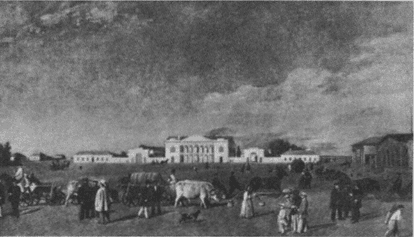
Figure 1.
The bucolic planned city: The Town Square of a Russian Provincial City,
approx. 1850. E. Krendovskii. Istoriia russkogo iskusstva, ed. E. Grabar
(Moscow, 1964), vol. 8, pt. 2, 238.
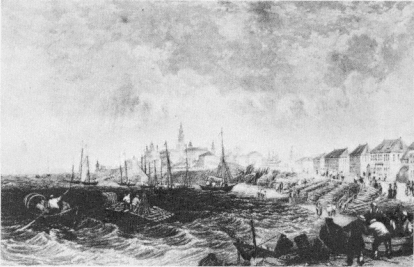
Figure 2.
A mid century Volga river port: Kostroma, approx. 1850. Unknown artist.
Hoover Institution; Russian Pictorial Collection.
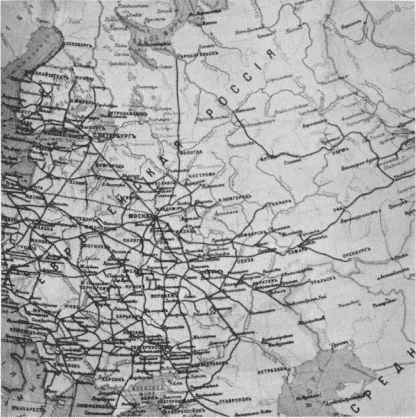
Figure 3.
Railroads and Russian cities: "Carte des voies de communications de la Russie."
Aperçu statistique des chemins de fer et des voies navigables de la Russie
(St. Petersburg, 1900), endpiece.
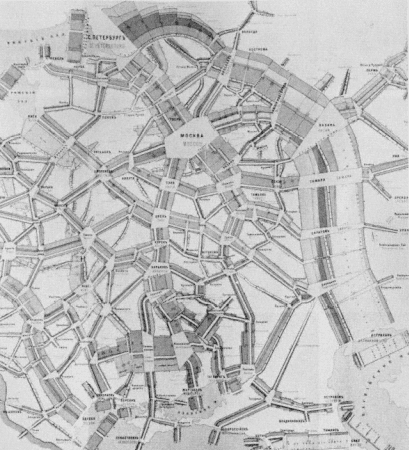
Figure 4.
Schematic flow chart of river and rail shipments of goods, 1897. "Mouvements
des marchandises par chemins de fer et voies navigables de la Russie d'Europe
en connexion avec l'importation et l'exportation par les ports et douanes
frontières d'après les données de 1897." Aperçu statistique des chemin de fer
et des voies navigables de la Russie (St. Petersburg, 1900), endpiece.
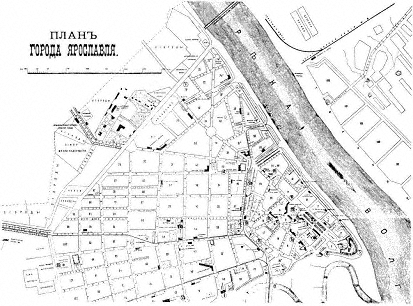
Figure 5.
The imperial planned city: "Modern Plan of Iaroslavl." Iaroslavl' v ego proshlom
i nastoiashchem:{nbIstoricheskii ocherk. Putevoditel' (Iaroslavl, 1913), endpiece.
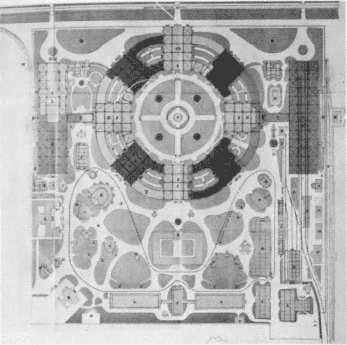
Figure 6.
The fair as planned city :"Plan of All-Russian Industrial-Artistic
Exhibition." Ukazatel' vserossiiskoi promyshlenno-khudozhestvennoi
vystavki 1882 goda v Moskve (Moscow, 1882), following 160.
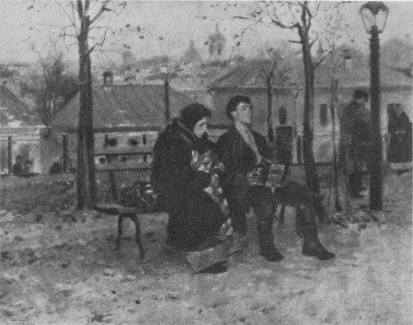
Figure 7.
The migrant laborer and his sweetheart: On the Boulevard, 1886-87. V.
Makovskii. Istoriia russkogo iskusstva, ed. E. Grabar (Moscow, 1964),
vol. 9, pt. 1, 345.
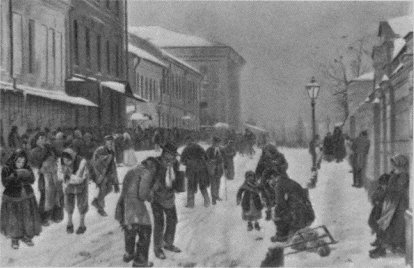
Figure 8.
The lower depths: The Flophouse, 1889. V. Makovskii. Istoriia russkogo
iskusstva, ed. E. Grabar (Moscow, 1964), vol. 9. pt. 1, 341.
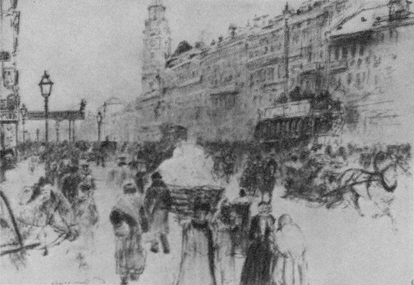
Figure 9.
The metropolis: Nevskii prospekt, 1887. I. Repin. Istoriia russkogo iskusstva,
ed. E. Grabar (Moscow, 1964), vol. 9, pt. 1, 554.
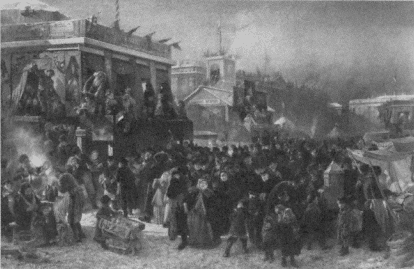
Figure 10.
The city of popular entertainment: Mardi Gras Carnival on Admiralty Square
in St. petersburg. 1869. K. Makovskii. Istoriia russkogo iskusstva, ed.
E. Grabar (Moscow, 1964), vol. 8, pt. 2, 256.
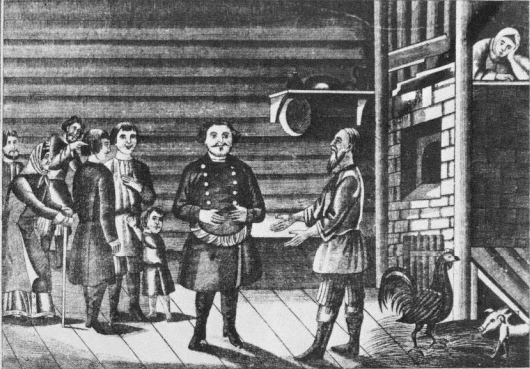
Figure 11.
Popular images of the city (1): "The Return of the Son, Waiter in the City, to His Peasant Family,"
1875. Chapbook illustration. Print Collection, Saltykov-Shchedrin Public Library, Leningrad.
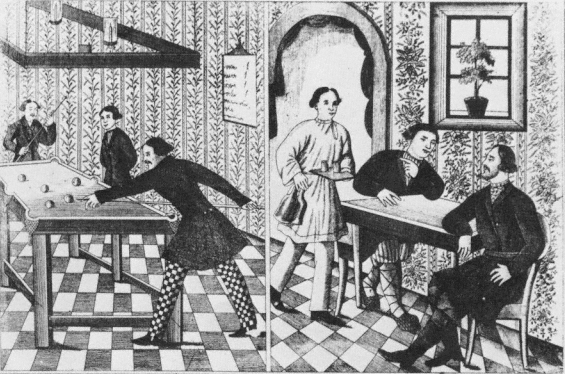
Figure 12.
Popular images of the city (2): "Two Migrant Workers in a Tavern," 1878. Chapbook illustration.
Print Collection, Saltykov-Shchedrin Public Library, Leningrad.