
Painting Stripped Bare
I have been a little like Gertrude Stein
—Marcel Duchamp
In his interview with Marcel Duchamp, Pierre Cabanne asks him to explain the key event of his life: his abandonment of painting. Duchamp's response identifies Nude Descending a Staircase, No. 2 as the turning point. While serving to establish his reputation, the initial rejection of the work alerts him to the norms and strictures that define not just conventional art but also contemporary art movements, such as Cubism:
There was an incident, in 1912, which "gave me a turn," so to speak; when I brought the "Nude Descending a Staircase" to the Indépendants, and they asked me to withdraw it before the opening. In the most advanced group of the period, certain people had extraordinary qualms, a sort of fear! People like Gleizes, who were, nevertheless, extremely intelligent, found this "Nude" wasn't in the line that they had predicted. Cubism had lasted two or three years, and they already had an absolutely clear, dogmatic line on it, foreseeing everything that might happen. (DMD , 17)
Duchamp is less concerned with the rejection of the painting than the fact it embodies a doctrinal gesture—one where a work of art is defined by living up to its nominal expectations. By failing to fall into line, that is to conform to a set of pregiven rules, Nude Descending a Staircase, No. 2 was perceived as a challenge to Cubism, whose precepts had already been laid out by Jean Metzinger and Albert Gleizes. For Duchamp, the turning point that the Nude represents is not merely its challenge to the public but also to his peers, whose artistic and intellectual expectations define the work's conditions of possibility. For Duchamp this incident was symptomatic of the dogmatic, programmatic character of art, and led him to abandon both painting and the artistic milieus he frequented, in favor of a job as a librarian at Sainte-Geneviève Library in Paris.
Was Duchamp's dramatic gesture an expression of his "distrust of systematization," of his inability to contain himself to "accept established formulas" (DMD , 26)? Duchamp rejects Cubism not just as an artistic movement but as a discipline with a set aesthetic program: "Now, we have a lot of little Cubists, monkeys following the motion of a leader
without comprehension of their significance. Their favorite word is discipline. It means everything to them and nothing."[10] Duchamp deliberately distances himself from the aesthetic agendas of Cubism, since his aim is to "detheorize Cubism in order to give it a freer interpretation" (DMD , 28).[11] If this is true, then one must examine in what sense Nude Descending a Staircase, No. 2 challenges preestablished Cubist pictorial and generic formulas. Coming in the wake of a series of representational nudes in 1910, Nude Descending a Staircase, No. 2 marks Duchamp's decisive turn from figuration to abstraction. As this study will demonstrate, however, Duchamp's passage through abstraction involves the speculative goal of getting away from "the physical aspect of painting" by putting "painting once again to the service of the mind."[12] As Arturo Schwarz observes, Duchamp's aim was to liberate the notion of painting from its aesthetic function to please the eye, in order to reassess its intellectual potential.[13] Duchamp's efforts to expand the horizons of painting, by exploring the literal and nominal expectations that define it, led to his subsequent abandonment of the medium.
Duchamp's adoption of the nude as pictorial genre did not have entirely auspicious beginnings. It is also interesting to recall that he failed the Ecole des Beaux-Arts competition over a test that involved doing a nude in charcoal (DMD , 21). In 1910, when Duchamp turns to the genre of the nude
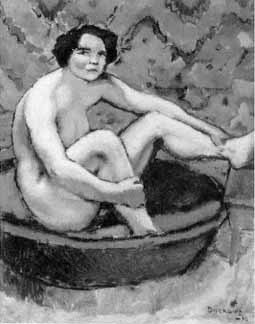
Fig. 1.
Marcel Duchamp, Nude Seated in a Bathtub (Nu
Assis Dans Une Bagnoire), 1910. Oil on canvas,
36 1/4 x 28 3/4 in.
Courtesy of The Art Institute of Chicago.
after extensive work in landscape and portraiture, his explorations of this subject matter reveal an acute awareness of pictorial traditions and contemporary artistic movements and styles. Schwarz notes that in Nude with Black Stockings (Nu aux bas noirs; 1910), the "use of heavy black lines—characteristic of the Fauves' reaction to the Impressionists' careful avoidance of black—is freely adopted."[14] Duchamp's deliberate deployment of one of the signatory gestures of Fauvism, which is itself a reaction to the aesthetic ideology of Impressionism, suggests his recognition of the plastic and strategic character of artistic conventions. It reflects an understanding of the extent to which an artistic movement may be defined by its strategic response to the aesthetic tenets of a previous, or even contemporary, movement. Duchamp's use of heavy black lines to outline the body, as in Nude Seated in a Bathtub (Nu assis dans une bagnoire; 1910) (fig. 1), Nude withBlack Stockings (fig. 2), and Red Nude (Nu rouge; 1910) (fig. 3), establishes a tension between the rhetoric of drawing and that of color. The black lines emphatically reframe the successive color shadings, thus
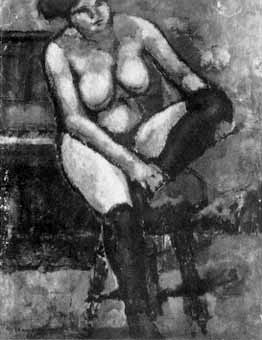
Fig. 2.
Marcel Duchamp, Nude with Black Stockings (Nu
Aux Bas Noirs), 1910. Oil on canvas, 45 3/4 x 35 1/8 in.
Galleria Schwarz, Milan. Courtesy of Arturo Schwarz.
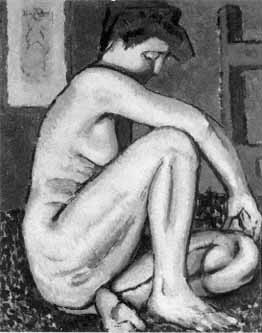
Fig. 3.
Marcel Duchamp, Red Nude (Nu Rouge), 1910. Oil
on canvas, 36 1/4 x 28 3/4 in.
Courtesy of The National Gallery of Canada, Ottawa.
inscribing a graphic dimension into the painterly impact of these works. In the Red Nude, color as one of the constitutive elements of painting is deployed in a manner that reveals its affinity to engraving. The red shadings and black lines compete as color templates that redefine the pictorial appearance of the nude as a successive set of impressions or imprints.
If these nudes are graphic, it is in their treatment of painting and not in their ostensible subject matter. When comparing Duchamp's Nude with Black Stockings with Gustave Courbet's Woman with White Stockings (Femme aux bas blancs; 1861), one is struck by its unerotic demeanor that resists voyeuristic appropriation as an image. Rather than emphasizing and framing genitality, as the white stockings do in Courbet's painting, the black stockings dismember the body by erasing it from the
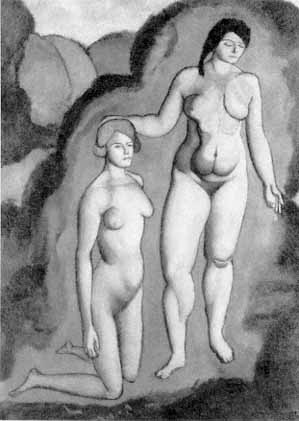
Fig. 4.
Marcel Duchamp, The Bush (Le Buisson), 1910. Oil on
canvas, 50 x 36 1/4 in.
Courtesy of The Philadelphia Museum of Art, Louise and
Walter Arensberg Collection.
knees down. Duchamp's cropping of the nude body displaces the viewer's attention from the frontality of sex to the pictorial frame that cuts the body off—a feature shared by other works, such as Two Nudes (Deux Nus; 1910), and Red Nude. The effort to draw the spectator's attention to framing devices is deliberately underlined in Red Nude , where the profile of the crouching red nude breaking out of the frame of the painting also cuts into the frame of another painting. Located in the upper lefthand corner of the image, this painting is further disfigured by the painter's signature cutting across the head of a female figure. The authorial signature is displaced into a position where its nominal content interferes with the visual content and consumption of the image. Rather than merely stripping the nude, Duchamp begins to strip away the visual conventions that define the nude as a pictorial genre.
By 1910, Duchamp's exploration of the nude enters a new phase, one where issues of pictorial abstraction are reframed by their interplay with nominal expectations triggered by the title. Loosely identified as his "Symbolist" phase because of its visual affinities to the works of Paul Gauguin and Pierre Girieud, Duchamp's works betray the Symbolist conceit of combining word and image.[15] Duchamp challenges notions of visual and verbal reference by playing them against each other through puns. The doubling of female nudes in The Bush (Le Buisson ; 1910) (fig. 4) and in Baptism (1911) is underlined by framing of the figures by a shrublike halo, an aura that conflates their physical outline with the landscape that surrounds them. For Lawrence Steefel, The Bush "seems to point towards the ultimate goal of turning the world inside out."[16] This doubling and melding of background and bodily composition can be seen as a pun on the painting's title, The Bush , which nominally makes available the sexual referent that is traditionally dissimulated or visually veiled in the representation of nudity. Duchamp trivializes the visual referent by his puns on the title "bush," thereby defying the nominal expectations of the spectator as voyeur. In Paradise (Le Paradis; 1910) (fig. 5) the abject representation of the male and female nudes challenges the promissory tone of the title. There is no illumination nor spiritual "Ascension" here. The title Paradise contradicts the viewer's expectations, unless it is interpreted literally, as a pun on the French word paradis, which means no radiance, to be struck out, canceled, or just broken. The lack of radiance in Paradise
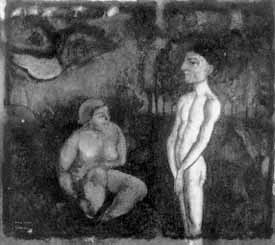
Fig. 5.
Marcel Duchamp, Paradise (Le Paradis), 1910. Oil on
canvas, 45 1/8 x 50 1/8 in.
Courtesy of The Philadelphia Museum of Art,
Louise and Walter Arensberg Collection.
may reflect the fact that Symbolism as a pictorial style, rather than the painting's subject matter, has reached exhaustion.
While Duchamp admits in his interview with Cabanne: "I don't know where I had been to pick up on this hieratic business" (DMD , 23), this statement should not discourage us from considering this question. This halo effect or aura can be found in another work of this period entitled Portrait of Dr. R. Dumouchel (Portrait du Dr. R. Dumouchel; 1910) (fig. 6), where a nimbus surrounds the upper torso of the figure and, especially, the hands. Referring to this painting, Duchamp wrote in a letter to his patrons Louise and Walter Arensberg: "The portrait is very colorful (red and green) and has a note of humor which indicated my future direction to abandon mere retinal painting."[17] The note of humor that Duchamp evokes here may be a reference to the painting's caption "à propos de ta 'figure' mon cher Dumouchel" (loosely translated as, "by way of your 'appearance' my dear Dumouchel"). The word figure means figure, shape, or form, but its use by Duchamp suggests that it refers to Dumouchel's appearance: it is a reflection on the way he looks, his "air," or "aura." The colorful nature of this painting, its red and green colors, is a pun on color blindness. This pun on color blindness in the context of painting foreshadows, as it were, Duchamp's denunciation and subsequent aban-
donment of retinal painting. For Duchamp, the hieratic aura associated with Symbolist painting becomes the locus of investigation of the interplay of word and image, not under the guise of symbols but as puns.
This "halo" effect or aura continues to reappear throughout Duchamp's works, either as an analogy to smell (in such works as Fountain [1917] and Beautiful Breath, Veil Water [Belle Haleine, Eau de Voilette; 1921]), or as an analogy for electricity (in Bec Auer [a gas lamp circa 1902]; The Large Glass [1915–23]; Given: 1) the waterfall, 2) the illuminating gas (1946–66); and in a set of prints entitled The Bec Auer [1968]).[18] The word "aura" (in Greek, breeze or breath) signifies an influence or emanation issuing from the human body, although invisible to ordinary eyes and surrounding it as an atmosphere.[19] In Duchamp's later works the "aura" is deployed as a critique of painting as a visual event, in
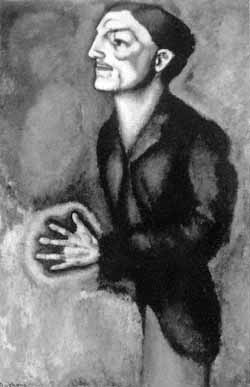
Fig. 6.
Marcel Duchamp, Portrait of Dr. R. Dumouchel (Portrait Du
Dr. R. Dumouchel), 1910. Oil on canvas, 39 1/2 x 25 5/8 in.
Courtesy of The Philadelphia Museum of Art, Louise
and Walter Arensberg Collection.
order to recover its intellectual potential. Considered from this perspective, Duchamp's early experiments with the hieratic can be understood as an allusion to the history of painting. This was at a time when the appearance of the nude, like painting itself, attained value by virtue of its religious, philosophical, and moral function, and was thus in excess of visual semblance. If painting exuded an "aura," this is because its significance was originally defined by its social rather than cultural function. The loss of painting's "aura" in the age of mechanical reproduction heralds the end of painting as a purely manual and visual event and its conceptual rebirth as a practice stripped of the hallowed echoes of visual semblance.[20] Duchamp's antiretinal stance reflects his effort to expand the meaning of painting by returning to a historical understanding of painting that takes into account its functional role. As Duchamp explains to Cabanne:
Since Courbet, it's been believed that painting is addressed to the retina. That was everyone's error. The retinal shudder! Before, painting had other functions: it could be religious, philosophical, moral. If I had the chance to take an antiretinal attitude, it unfortunately hasn't changed much; our whole century is completely retinal, except for the Surrealists, who tried to go outside it somewhat. And still, they didn't go so far! (DMD , 43)
In this context, painting is redefined: it is considered no longer merely visual/erotic stimulation but also conceptual intervention.
If Nude Descending a Staircase, No. 2 (fig. 7) scandalized both the critics and the public alike, this is because it challenged the nominal expectations of the viewer more than any of Duchamp's previous works. Its rejection by the Salon des Indépendants in 1912, and the public furor occasioned by its exhibition at the New York Armory Show in 1913, are a barometer of the painting's transgressive character. Described as an "explosion in a shingle factory," Nude Descending a Staircase, No. 2 was further humored by a cartoon depiction entitled Rude Descending a Staircase. The word rude appropriately captures the impact of the Nude, its deliberate disregard for the artistic conventions of the genre. This work scandalized not only the general public but also the avant-garde circles of the time. Duchamp withdrew his work from the Salon des Indépendants
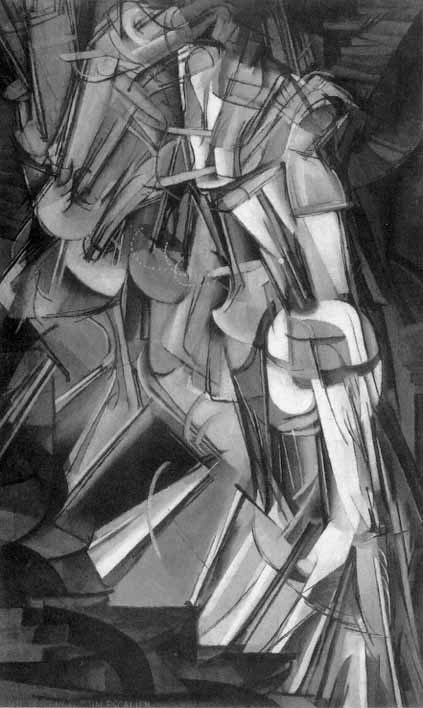
Fig. 7.
Marcel Duchamp, Nude Descending a Staircase, No. 2 (Nu Descendant Un Escalier,
No. 2), 1912. Oil on canvas, 57 1/2 x 35 1/8 in.
Courtesy of The Philadelphia Museum of Art, Louise and Walter Arensberg Collection.
by refusing to comply with Metzinger's and Gleizes's request to change the title because it was too "literary," in a caricatural sense. As Duchamp explains, the title plays a significant role in explaining the particular interest and impact of this work:
What contributed to the interest provoked by the canvas was its title. One just doesn't do a nude woman coming down the stairs, that's ridiculous. It doesn't seem ridiculous now, because it's been talked about so much, but when it was new, it seemed scandalous. A nude should be respected . (DMD, 44; emphasis added)
Duchamp's comments indicate that the reception of this painting was being filtered through a set of expectations, whose nominal character was staged by the title. The abstract nature of this work and thus its failure to provide a visual referent for the title only increased the public's disappointment. Nude. . . No. 2 presents a clash of nominal and visual expectations that are the expression of the history and conventions of painting. Instead of reclining passively, Duchamp's fractured nude is actively descending a staircase. The scandal surrounding the exhibition of Nude. . . No. 2 thus reflects the destruction of the nude as traditional subject matter of painting. In his book The Nude, Kenneth Clark maintains that the nude is not the starting point of a painting but a way of seeing that the painting achieves.[21] The nude embodies a set of representational strategies that imply a particular relation between the spectator and the spectacle of the body reduced toan image on display. Constructed as the subject of desire from the Renaissance to the late nineteenth century, the nude as a pictorial genre involves a structure of spectatorship that relies upon the objectification of the female body. This interplay of visual and nominal expectations staged by the nude as a pictorial genre was put into question by painters such as Edouard Manet, who in Olympia (1863) and Le Dejeuner sur l'herbe (1862–63) challenged the inscription of the desiring look of the spectator.[22] Moving away from figuration into abstraction, Duchamp's Nude. . . No. 2 further challenges this congruence of visual, nominal, and generic expectations.
The Nude. . . No. 2 reduces the anatomical nude to a series of successively fractured volumes: "Painted, as it is, in severe wood colors, the
anatomical nude does not exist, or at least cannot be seen, since I discarded completely the naturalistic appearance of a nude, keeping only the abstract lines of some twenty different static positions in the successive action of descending."[23] The renunciation of the naturalistic appearance of the nude in favor of its twenty positions in the successive act of descent reflects Duchamp's radical critique of painting through chronophotographic freeze-frame techniques.[24] What is at issue here is a challenge of the pictorial medium through sequential photography: a critique of vision as a cognitive medium that conflates spectatorship and pleasure. The splintering of vision into a series of frames that fragment and abstract both the identity of the nude and the process of movement inscribe into the painting an interval, a temporal dimension. Functioning neither descriptively nor prescriptively, the title Nude Descending a Staircase inscribes a temporal delay that interferes with the visual consumption of the image. This strategy of delay also redefines and defers notions of visual reference that are traditionally associated with photography. While appealing to techniques of mechanical reproduction, such as photography, to redefine the pictorial medium and its subject matter, Duchamp succeeds in redefining painting itself as a process whose plasticity includes temporal considerations.
Asked by Cabanne how did the painting originate, Duchamp responded:
In the nude itself. To do a nude different from the classic reclining or standing nude, and to put it into motion. There was something funny there, but it wasn't funny when I did it. Movement appeared like an argument that made me decide to do it.
In the "Nude Descending a Staircase," I wanted to create a static image of movement: movement is an abstraction, a deduction articulated within the painting, without our knowing if a real person is or isn't descending an equally real staircase. Fundamentally, movement is in the eye of the spectator, who incorporates it into the painting. (DMD, 30)
The picture presents the viewer with a "vertigo of delay," to use Paz's term, rather than one of acceleration.[25] Duchamp's interest in kinetics here is conceptual: the movement in the painting is produced through the
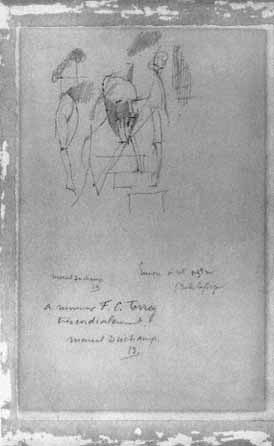
Fig. 8.
Marcel Duchamp, Once More to this Star (Encore
À Cet Astre), 1911. Pencil, 9 3/4 x 6 1/2 in.
Courtesy of The Philadelphia Museum of Art,
Louise and Walter Arensberg Collection.
decomposition of the graphic elements. The staggered motion of the "nude" demonstrates an analysis of movement rather than the Futurist seduction with the dynamics of movement.[26] The kinetic character of the nude is not merely the thematization of movement as a pictorial fact but rather the discovery that the retinal is not an essential given but a rhetorical condition.
But why is the nude descending? This question is all the more interesting, since in its preliminary sketch Once More to This Star (Encore à cet astre; 1911) (fig. 8), based on the title of Jules Laforgue's poem, the primary figure is ascending a staircase. A network of visual puns connects Nude Descending a Staircase, No. 2 to Once More to This Star: instead
of ascending to a star, the star becomes a staircase for the obverse movement of descent. Duchamp explained his interest in Laforgue's poetry, particularly his prose poems Moralités Légendaires, in terms of their humor and poetic quality, as such: "It was like an exit from Symbolism" (DMD, 30). Just as Laforgue's poem denounces the idealist aspirations of Symbolist poetry by pointing out that the stellar image of the sun is undermined by its ordinary and pockmarked appearance, so does Duchamp transform the idealism that underlies pictorial praxis into a mere stair, a pun on the notion of descent understood both literally and figuratively.[27] The fact that the nude may be descending from its pedestal should be of no surprise, given that its ascension into a "genre" is ungendered by being at once sexually and pictorially redefined.
The ambiguous title of the Nude (nu, in French) gives no particular indication as to the referent's gender, although critics have identified it generically as female, de rigueur. Duchamp's Nude Descending a Staircase, No. 2 thus emerges as a critique of pictorial representation to the extent that it challenges the ideological underpinnings of the nude as a genre that is invariably femininely gendered. Unable to incarnate the nominal expectations of the spectator, the nude visually fractures the spectator's gaze by setting it into a spiraling motion. In doing so Duchamp points both to the title and to the spectator's gaze as the sites on which hinges the facticity of gender. This resistance to the equation of spectatorship with visual consumption and delectation is explicitly thematized in Duchamp's later works. In Selected Details After Courbet (Morceaux choisis d'après Courbet; 1968), for instance, the spectator's gaze is conflated with the falcon (faucon, inFrench: a pun on the facticity of sex) in the foreground, thereby revealing the role of language in the constitution of gender as sexual referent. The Nude 's descent thus functions as an index of Duchamp's strategic displacement and rethematization of the nude as a pictorial genre and its declension from the spectator's nominal expectations.
As a descendant from the lineage of painterly traditions, Duchamp's Nude Descending a Staircase, No. 2 stages both its genealogical derivation, as well as its own deviation from this ancestry. The descent of the Nude is not merely the mark of a genealogical decline but also the legal index of the passage of an estate through inheritance.[28] The Nude's
descent illuminates Duchamp's own inheritance of previous pictorial traditions and his efforts to literally draw on this heritage by reproducing it in new ways. Is it surprising then that Nude Descending a Staircase, No. 2 is the first of Duchamp's serial works, having been preceded by Nude Descending a Staircase, No. 1 (Nu descendant un escalier, no. 1; 1911) (fig. 9), only to be followed by Duchamp's full-sized photographic and hand-colored facsimile entitled Nude Descending a Staircase, No.3 (Nu descendant un escalier, no.3; 1916). As Joseph Masheck notes: "Typical of Duchamp is this work's self-illustrative and self-reproductive function, as well as the fact that as an actual photograph it returns to one of the technical sources of the 'original' painting."[29] The self-illustrative and self-reproductive aspects of Duchamp's Nude Descending a Staircase demonstrate his efforts to redefine the notion of pictorial production, as a genealogical intervention based on reproduction.
However, this reproductive industry did not stop short with the fullsized versions of the Nude. This work was further reproduced as a miniature pencil-and-ink drawing Nude . . . No. 4 (1918) for the dollhouse of Carrie Stettheimer. This doll-sized version of the Nude was followed by further miniature reproductions in The Box in a Valise (1938–41). From a single work that is by definition a multiple, insofar as it is part of a series, Duchamp generates an entire corpus. By discovering the self-productive and self-reproductive potential of the Nude, Duchamp redefines the nude as a medium of and for reproduction. Eroticism in this context no longer refers to the visual appearance of the nude but instead functions as an index of its proliferation as modes of appearance. Duchamp challenges the eroticism traditionally associated with spectatorship and voyeurism by proposing an alternative eroticism whose speculative, technical, and humorous character restages through reproduction the notion of artistic creativity and production.
Given Duchamp's explicit rejection of the equation of vision and eroticism, how are we to explain his interest in the nude as pictorial genre? It seems that the entire trajectory of his life's work is defined by the arching movement from Nude Descending a Staircase, No. 2 to The Bride Stripped Bare by Her Bachelors, Even, and culminating in his testamentary work Given: 1) the waterfall, 2) the illuminating gas. While Duchamp maintains that eroticism is the only -ism he believes in, it is
clear that eroticism for him is not linked to an anatomical or essentialist destiny but rather, like humor, it is defined through movement, as transition instead of stasis. Eroticism in the figurative arts is most commonly represented as the relationship between clothing and nudity, and thus, as Mario Perniola suggests, it is conditional on the possibility of movement or transition from one state to another.[30] For Duchamp, however, eroticism signifies conceptually and philosophically as a reflection on representation, a presentation understood in the mode of reproduction, where appearance is the result of repeated modes of impressions.
Now we begin to understand the conceptual import of both engraving and cartooning in Duchamp's work. Engraving is one of the earliest forms of mechanical reproduction that involves a different way of conceiving
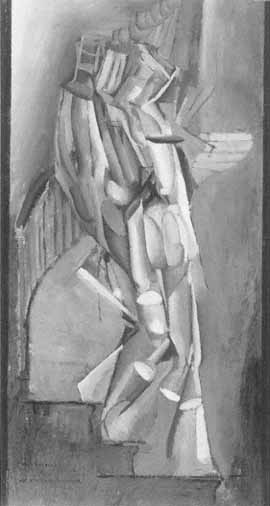
Fig. 9.
Marcel Duchamp, Nude Descending a Staircase, No. 1
(Nu Descendant Un Escalier, No. 1), 1911. Oil on
cardboard, 38 1/8 x 23 1/4 in.
Courtesy of The Philadelphia Museum of Art, Louise and
Walter Arensberg Collection.
the plastic image. Not only is the appearance of the engraved image the result of multiple reproductions but its very identity is defined as a technical process, involving multiple impressions or imprints. An engraving is a template, a sculptural mold that functions like a photographic negative. Engraving as a medium challenges the autonomy of the pictorial image, insofar as the image acts as a temporal record of multiple impressions.[31] Although associated historically with craft rather than art, engravings challenge both the uniqueness of the plastic image and traditional notions of artistic creativity. Duchamp's pictorial series of Nude Descending a Staircase, as a multiple that undergoes extensive reproduction, illustrates the logic of engraving operative in his works. This is not to say that these works are engravings, since they are clearly paintings; rather, the conditions of production and reproduction evidenced in these series suggest conceptual processes akin to those involved in the technical reproduction of engravings.
You may ask how cartoons inform Duchamp's oeuvre? The answer by now is clear. Regarded as a form of popular art associated with the print medium, cartoons are images that are constructed like rebuses, as composites of language and image. Their humor is not just visual but intellectual. They are often visual analogues of linguistic puns. This is not to suggest, however, that Nude Descending a Staircase, No. 2 is merely a cartoon, a rude joke at the expense of painting. Rather, Duchamp's use of the title as nominal intervention in order to restage the expectations of the spectator reframes the reception of this work as an intellectual, instead of a purely visual, experience. Consequently, despite its mechanomorphic character, Duchamp's Nude can also be seen an an "anti-machine." As Octavio Paz explains: "These apparatuses are the equivalent of the puns: the unusual ways in which they work nullify themselves as machines. Their relation to utility is the same as that of delay to movement;they are without sense and meaning. They are machines that distill criticism of themselves."[32] If the Nude is an elaborate visual and linguistic pun, where exactly is the joke? As this study has suggested, Duchamp's humor lies in redefining the visual image as a serial imprint, as a construct where appearance does not refer to an external reality but to a mode of production whose logic is reproductive. Duchamp doubly displaces painting: first, by redefining it through the logic of engraving, as a print medium, and second, by draw-
ing on the linguistic and intellectual logic of cartooning in order "to put painting once again at the service of the mind."[33] Eroticism in this context is no longer defined as a transitional movement between clothing and nudity. Instead, it becomes the rhetorical interplay between language and vision, which constructs the facticity of gender as a pun.