

Roots of North Indian Shi‘ism in Iran and Iraq: Religion and State in Awadh, 1722-1859
J. R. I. Cole
To my beloved wife, Sheena
Table of Contents
- ACKNOWLEDGMENTS
- INTRODUCTION
- PART ONE THE RISE OF A SHI'I STATE IN AWADH
- 1 Middle Eastern Roots of Awadh Shi‘ism
- 2 Shi‘i State Formation in Awadh and the Ulama
- PART TWO THE ORIGINS AND DEVELOPMENT OF POPULAR SHI'ISM IN AWADH
- 3 Shi'ism and Muslim Social Groups
- 4 Popular Shi'ism
- PART THREE THE GROWTH OF A SHICI CLERICAL HIERARCHY IN AWADH
- 5 The Beginnings of Formal Shi‘i Institutions in Awadh
- 6 The New Jurisprudents and the Struggle for Religious Leadership
- 7 Religion, State, and the Second Usuli Generation
- 8 Clericalist Monarchy and Shi‘i Institution Building
- PART FOUR SHICIS AND OTHERS
- 9 Shi‘i, Sunni, Hindu: Communal Relations in Awadh
- 10 The Mujtahids and the West: From Accommodation to Annexation and Revolt
- CONCLUSION
- GLOSSARY OF ARABIC, PERSIAN, AND URDU TERMS
- SELECT BIBLIOGRAPHY
- INDEX
ACKNOWLEDGMENTS
This book could not have been written without the help of many friends and advisers. As a doctoral dissertation submitted in 1984 at the University of California, Los Angeles, it benefited from the direction of Amin Banani and the comments of Nikki Keddie. Virendra Deo Pandey codirected the original dissertation while I was in India. I have been helped in extensively rewriting it by the comments of David Bien, Michael H. Fisher, Jacob Lassner, Victor Lieberman, Francis Robinson, Kaveh Safa-Isfahani, and Thomas Trautmann.
My debts to private libraries and public institutions are large indeed. The director of the Nasiriyyah Library, Mawlana Tahir Jarvali, and his staff showed me endless kindness and helpfulness. The Raja and Maharajkumar of Mahmudabad munificently gave me access to their manuscripts. Naiyir Masoud and Mawlana Kalb-i Sadiq shared with me rare printed works. Shabihu'l-Hasan Naunahravi arranged a guided tour of Shi‘i endowment libraries in Lucknow. I am grateful to the directors and staffs of the Uttar Pradesh State Archives; Lucknow University Library, Amiru'd-Dawlah Public Library, and the Nadwa Academy Library, Lucknow; Mawlana Azad Library, Aligarh; the Regional Archives, Allahabad; the Khudabakhsh Oriental Public Library, Patna; National Library and the Asiatic Society Library, Calcutta; Raza Library, Rampur; the National Archives of India, New Delhi; Punjab University Library and Punjab Public Library, Lahore; the British Library and the India Office Library and Records, London; the University Research Library, UCLA; and Hatcher Research Library at the University of Michigan. Mawlanas Kalb-i `Abid and `Ali Naqi Naqvi kindly allowed me to interview them.
All opinions expressed in this book are mine alone. Having absolved them from responsibility for the final product, I can note with gratitude that my research was funded in 1981-83 by sequential grants from the Fulbright-Hays Doctoral Dissertation Abroad Program and from the Social Science Research Council and the American Council of Learned Societies. The latter grant helped fund intensive language training at the University of California Berkeley Urdu Program in Lahore. I am especially beholden to the people at Fulbright House, New Delhi. Ursula Sims-Williams of the India Office kindly helped with the illustrations.
I want to thank Barbara Daly Metcalf; Phyllis Killen, Gladys Castor,
Susan Stone, and other members of the staff at the University of California Press for their hard work anti helpfulness.
Consonants and vowels are transliterated according to the Library of Congress romanization for Arabic, Persian, and Urdu, with slight modifications to avoid confusion. Transliteration thus depends on the language of the source being discussed. I have joined personal names in construct state (Burhanu'l-Mulk, not Burhan al-Mulk). In Arabic phrases sun letters are shown. Most names are transliterated as if Persian, but nisbahs deriving from Indian place names are in Urdu. Arabic titles, and phrases within titles, of Persian and Urdu books are transliterated according to the rules for Arabic. Place-names are not given diacriticals.
I am grateful to the editors of Iranian Studies and Middle Eastern Studies for permission to use material in this book previously published in a different form. This manuscript was completed for press in May 1986, and works on Awadh or Shi‘ism arriving after that date could not be integrated into the text.
My debt is to my wife, Sheena, for her support, help, and patience, while this book was being researched and written on three continents.
25 August 1987
Ann Arbor, Michigan
INTRODUCTION
Two modern events, the 1947 creation of Pakistan out of India and the 1978-79 Iranian revolution, underline the importance of religion as an element of state formation in West and South Asia. One could almost speak of "Muslim nationalism," but it has recently been suggested that it might be better to substitute an uncontaminated phrase such as "political identity" for the vaguer "nationalism."1 Whatever we wish to label it, Muslim separatism and Muslim state-building on a religious basis have profoundly influenced the modern history of Asia, in sharp contrast to the rise of secular government in modern Europe.
How far back to look for the roots of Muslim separatism and religious state building has become a central debate in the study of Asian Islam. The two major approaches to the problem have been called the "instrumental" and the "primordial." The extreme instrumentalist might say, for instance, that ethnicity is "the pursuit of interest and advantage for members of groups whose cultures are infinitely malleable and manipulable by elites."2 He would argue that pre-1947 Muslims and Hindus in the subcontinent differed little from one another, but that different rates of mobilization and the claims of elites to advantage created a split. The primordialist would counter that Islamic religious conceptions so profoundly shape community identity that "the formation of separatist movements on the basis of religious confession, the assertion of a political identity on the basis of religion... does seem to be an especial characteristic of Muslims."3
Neither of these approaches is often held in its pure form. Instrumentalists can point to many places where religion has not played a major role in separatist movements. Clearly, communities can "imagine" themselves variously
in national terms. Yet the imagination must work with symbols drawn from a collective past, and historical experience and cultural tradition can at least help explain why religious separatism has been more important in North India than in the south, and more important in the Middle East than in East Asia. In North India, even an instrumentalist found that local nationalisms, whether Sikh, Muslim, or Maithili, succeeded best when religious rather than only linguistic bases were used for political identity.4
In some ways, of course, the debate between instrumentalists and primor-dialists centers on the relative weight of short-term causes for political identity formation versus long-term ones. I believe that although the short-term causes arc more important in, say, the creation of Pakistan, we must not lose sight of the long and medium durée. An approach taking the primordial seriously will require a study of cultural tradition and lead one further into the past. Since Muslim separatism as a political movement developed earliest on the Gangetic plain (now the province of Uttar Pradesh), the cultural history of Muslims there becomes especially important to an understanding of their attitudes to communal conflict. A large portion of this area was ruled from 1722 to 1856 by a Shi‘i Muslim ruling house, and one of the questions raised here is what Shi‘i rule and religious ideas meant for communalist traditions in the area.
In studying this Shi‘i Muslim-ruled region of North India, I aim at illuminating both some roots of Muslim communalism in the Gangetic plain and some of the historical con text for the rise of clerical dominance in Shi‘i Iran. I ask whether one form of preindustrial religious organization is more likely to produce modern communalism than another, arguing that in North India a process of community formation, promoted by Shi‘i learned men (‘ulama') and notables, formed an essential background to later politicization. By looking at the formation of ulama ideology, I make a contribution to our understanding of the conceptual bases for their contemporary activism.
This study of Shi‘i Islam and its clerics and organization in the eighteenth and nineteenth centuries treats several themes beyond the important one of the roots of religious communalism. It asks about the role of religion in expressing indigenous Asian cultural values at a time of widening European influence, and about the impact of social and economic change on religious institutions and values. It looks at the power relationship between religious experts and officers of the state in a patrimonial bureaucracy. It illuminates the processes whereby a small, powerless sect can become a "church," or formal religious establishment. The approach seeks to combine social history and the historical sociology of religion. Important for the background of religious communalism, the study raises the question of what impact the transi-
tion to a religious establishment had on relations with other religious communities.
In the course of my research I became convinced that my data could be better elucidated with reference to the sociology of religion, deriving ultimately from seminal ideas of Max Weber. This conviction was confirmed, not only in the course of my own writing, but by the appearance, while I was revising this book, of Arjomand's excellent Weberian treatment of Shi‘ism in Iran, 1501-1890.5 Still, questions of approach remained. Weber has been interpreted variously, and the very terms he made famous, such as "sect" and "church," have been given different content by a host of authors; moreover, their application to a non-Christian milieu raises further questions. I was helped most by the work of Bryan Wilson and Benton Johnson, who have clarified key conceptions in the sociology of religion. An unresolved question, it seems to me, is the role of the state in defining groups as sects and churches, an issue upon which this book dwells.
I also found most useful the work of two "Left Weberians," Bryan S. Turner and Frank Parkin. Both argue for the continued relevance of some Weber-Jan conceptions, even to neo-Marxist debates. I found Parkin's development of the idea of "social closure" especially helpful as a means of understanding both professionalization among nineteenth-century Shi‘i clerics and the setting up of increasing communal boundaries between Shi‘i Muslims and other religious communities. Turner has criticized students of Muslim societies for stressing vertical stratification (the mosaic model of competing religious groups, tribes, and city quarters) often to the exclusion of analysis based on horizontal stratification (social classes as determined by relationship to the means of production). Social stratification plays an important part in my analysis, including my approach to the vexed question of "sect and church." Although modern social classes obviously did not exist in preindustrial South and West Asia, orders or premodern classes (labaqal ) certainly did. The division of Shi‘is into (1) a ruling stratum of large landholders, tax-farmers, and rich merchants, (2) an intermediate stratum of middle and smaller landholders and skilled artisans in the bazaars, and (3) the masses of poorer tradespeople and laborers, clearly had a great impact on their social networks and religious practices.6 Still, in studying a religious group and its clerics, this book emphasizes the importance of vertical cleavages. To ignore social closure based on religion in West and South Asia would be
rather like attempting to analyze South African society without taking full account of race.
For all their importance, little has been written about the history of Imami Shi‘i communities in most of West and South Asia. The Imami, or Twelver, Shi‘i branch of Islam, encompassing ten percent of the world's Muslims, has since 1500 often demonstrated a startling dynamism. Shi‘is overwhelmingly predominate in Iran, constitute a majority in Iraq, and form large and important minorities in Lebanon, Syria, Turkey, the Persian Gulf, Afghanistan, and the subcontinent.
Shi‘ism in early Islamic times has attracted scholarly attention, since the question of the Prophet's successor comes up in any discussion of the early Muslim community. Although Imami Shi‘ism developed over two centuries, its seeds lay in an early contest for leadership between the Prophet's cousin and son-in-law, ‘Ali, and the elders of Quraysh elected by an oligarchic council. Most early Muslims believed that after the Prophet's death his successor was rightfully the Caliph Abu Bakr, followed by ‘Umar and then by ‘Uthman. ‘Ali finally became the fourth caliph, but was soon assassinated, after which his enemies the Umayyads came to power for a century. The partisans (Shi‘ah ) of ‘Ali believed that he and his descendants should have rightfully ruled the Islamic empire. The Shi‘is evolved into an alternative branch of Islam, often challenging the established government of the time.
Several sectarian divisions emerged among the Shi‘is, depending on which of ‘Ali's descendants they accepted as the legitimate successor to the Prophet. Imami Shi‘is believed that eleven of ‘Ali's descendants succeeded him as rightful leaders of the Muslim community, prevented from ruling by the Orthodox caliphs and then the Umayyad and Abbasid monarchies. They particularly mourned the death of the third Imam, Husayn (d. A.D. 680), slain on the battlefield of Karbala in Iraq after his unsuccessful bid to oppose the Umayyad king Yazid. Imami Shi‘is held that the last of the successors to the first Imam, the Twelfth Imam, vanished as a child into a mystical realm from which he secretly ruled the world immortally, and would return at some future time.7 Imamis before 1500, largely political quietists, awaited the return of the Imam from his Occultation, or supernatural disappearance.
Modern scholars have written much less about the religions; later medieval and early modern development, which witnessed the establishment of Shi‘i-ruled states in Iran and India. Most recently, the spectacle of the clerically dominated parliament and cabinet in Iran exercising a near-monopoly over political power has bewildered the secular West and pro-
voked a flurry of publications. Important questions have been raised about the uniqueness in the Islamic world of Imami Shi‘i clerical institutions and ideology. Is this form of Islam more incompatible with secular government than are others, and does it contain a special impetus toward theocracy? Such a question can be answered only with historical studies of clericalism in Imami Shi‘ism.
Controversy over the role of that originally informal body of religious experts known as the "learned" (‘ulama ') has emerged in every Imami-ruled state in history: the Buyid, the Safavid, and the Qajar in Iran; the Qutb-Shahi in medieval South India; and the Nishapuri in eighteenth- and nineteenth-century North India. Sounder generalizations about the nature of the Shi‘i religious and cultural tradition can only be attained through detailed study of the relationship between the government and the religious establishment in each of these historical Twelver Shi‘i-dominated states. The present study treats Shi‘ism in post-Mughal North India, where a Shi‘i dynasty ruled the state of Awadh (or Oudh, in the older British orthography). This work essays comparisons with contemporary developments in Iraq and Iran and emphasizes the intricate international networks created by ulama immigration, pilgrimage, visitation, and travel for study.
Several hotly debated issues have dominated recent writing on the role of the Shi‘i ulama. Some have to do with the role of the clergy according to the Imamis' own scriptural corpus, whereas others focus on the historical actions of the ulama. Joseph Eliash has forcefully argued that the early Shi‘i canonical collections of oral reports from the Prophet and the Imams contain no designation of authority from the Imams to the clergy, and that although relaters (sing. muhaddith ) of the Imams' oral reports were charged with acting as informal judges in disputes between Shi‘is, the community could reverse their decisions if they found them to be based on oral reports not widely accepted as authentic.8
Norman Calder has recently traced the development of Imami jurisprudence from the tenth through the fifteenth century. He showed that after the Occultation of the Twelfth Imam most Shi‘is held that state-related functions could not be carried out until his return. Eleventh-century Imamis largely held that only the Imam could collect and distribute religious taxes, lead Friday congregational prayers, and head up holy war (jihad ) campaigns, and that in his absence such functions of the Islamic state had lapsed. But the scholars adhering to the rationalist Usuli school of jurisprudence gradually assumed the right to act for the Imam as proxies in these and other areas.9
The Usulis advocated the use of independent reason (ijtihad ) and limited sorts of syllogism in deriving legal judgments and counted the consensus of jurisprudents a source of Islamic law. As rationalists, they trusted in the human intellect and Greek philosophical tools to discover the will of the hidden Imam. Since they insisted that laymen emulate their rulings, they emerged as more than legal scholars, approximating a clergy. They were opposed by Imami scholars of the conservative Akhbari school, who limited legal technique to a literal interpretation of oral reports transmitted from the Imams and forbade the use of rationalist tills both in theology and in jurisprudence.
An issue generating controversy has been the relations of the clergy to the state. Some have argued that the Shi‘i ulama in the modern period played an oppositional role to the government, emerging as popular leaders against a tyrannical Qajar state (1785-1925), which increasingly came under hated foreign domination. A corollary proposition stated that the Shi‘i clergy saw the Qajar monarchy in Iran as illegitimate and shunned association with the state.10 Willem Floor and others have recently argued that, on the contrary, "the revolutionary character ascribed to the Shi‘i ulama in Iran has been greatly exaggerated, and that the ulama's perception of the socioeconomic and political structure of Iranian society often did not basically differ from that of the secular power elite."11
One problem has been the "liberal" approach to Shi‘i intellectual history adopted by scholars like Algar. The issue of the role of the ulama is not simply one in the history of ideas, a struggle of a few great minds abstracted from any social context. The clergy, a status group, came from specific social classes. Their views of certain kinds of law, and of their own roles as defined by their principles of jurisprudence, constituted a kind of "political knowledge," or ideology, which can only be studied fruitfully in its social context.12 On the other hand, such knowledge cannot be reduced to simple economic interest.
An analysis of the kinds of religious organizations a social group creates can be made by looking at the class background of its members and the de-
gree of tension that exists between the group and the prevailing values of the state and society. This framework, derived from the sociology of religion, would class a religious organization as "sectarian" where it was in great tension with the outside society, and as a formal religious establishment, or "church," where the tension was minimal. In the twentieth century the heavy influence over Iranian governments by Western imperialists and, later, the rise of a secularist state policy led some prominent members of the clerical establishment to distance themselves from the state.13 But how legitimate is it to project this state of affairs back into the eighteenth and nineteenth centuries?
One way to test the thesis that the Shi‘i ulama, because of their scriptural tradition and training, generally shunned the state, which they considered illegitimate, is to look at Shi‘i communities outside Iran. For this and other reasons, this book concentrates on developments in the Shi‘i community of North India, never before studied academically in the formative period 1722-1859. Indeed, Shi‘ism in Awadh has been thrice orphaned in modern historiography. The eighteenth century, a period of seeming political chaos in the Islamic East, has not attracted the same interest as did the integral Mughal Empire in its heyday. As a regional phenomenon, Awadh tended to be passed over (except at Lucknow University) in favor of a concentration on events in Delhi. Its state religion, Imami Shi‘ism, has been little studied in its Indian environment. Yet a survey of the role of its ulama can fill out Indian, as well as Shi‘i, history.
By looking at about 250 Shi‘i clerics in North India over three generations, I contribute to our understanding of the social history of the region, still an embryonic field. The little work on the regional history of North India produced earlier in this century focused on the reigns of the nawabs of Awadh. More recently, T. Metcalf has investigated the great landholders, Barnett has written on government administrators, and Bayly has delineated the role of Hindu merchants and Muslim middle strata.14 The history of Shi‘i Muslim religious structures in the nineteenth century, set in the context of social and economic developments, can illuminate changes in the little-studied Muslim intermediate strata from which the clerical personnel were largely drawn. Like Bayly's urban merchants building new commercial networks in the shadow of the East India Company, or like Metcalf's large landholders
carving out estates in the interior of Awadh, the Shi‘i ulama formed a distinct social group that reacted in novel ways to social change—from the rise of Awadh as an independent post-Mughal state to the rise of European imperialism and industrial capitalism.
The need for study of such minority but regionally important movements as Shi‘ism in Awadh is beginning to be recognized. The standard surveys of Islam in eighteenth- and nineteenth-century India have narrowly focused on leaders of the Naqshbandi order of Sufi mystics based in Delhi: Shah Valiyu'llah, his son Shah ‘Abdu'l-‘Aziz, and the latter's disciple Sayyid Ahmad of Rai Bareli. The Naqshbandi order, with its greater emphasis on strict legalism and on drawing sharp boundaries between Sunni Muslims and others, has struck many scholars, both Western and Muslim, as a precursor of modern Islamic reform and separatism. Yet this approach at the very least ignores a quantitative issue, insofar as Naqshbandis made up a tiny minority of North Indian Muslims throughout the nineteenth and into the twentieth century. Of course, even a tiny movement could be influential. But the very influence of this tradition among most nineteenth-century Muslims has been brought into question by recent research.15 Moreover, the "orthodox" content of Naqshbandi Sufi practice and thought has probably been exaggerated. Showing a greater recognition of diversity even within the Islamic great tradition in the subcontinent, scholars have been investigating local religious movements and regional institutions beyond Delhi that do not so easily fit the "Naqshbandi paradigm," from Sufi leaders of the Chishti order in the Punjab, to the Qadiri learned and holy men of Lucknow's Farangi Mahall, to the reformists of the Deoband schools.16
The sources for the present work on the development of Shi‘ism in Awadh from 1722 to 1859, many never before used by a modern historian, include biographies and biographical dictionaries of the clergy, court chronicles, rulings and legal and theological works by the ulama, Iranian and European travelers' accounts, Awadh government documents that survived the events of 1857-58, and British archival records. The most important single repository of manuscript material open to me was the Nasiriyyah Library, a Shi‘i-endowed institution in Lucknow, which few modern scholars have used at all, and none intensively.
This book concentrates on changes in religious practices, structures and
ideas. But both because the field is so unfamiliar and because some institutions are more fruitfully studied as they develop over time, I have provided a certain amount of narrative. The study is divided into four parts. In Part 1 the background of Imami Shi‘ism in the Middle East and in South Asia is sketched, and the rise of a Shi‘i-ruled state in Awadh examined. Part 2 explores the social origins of the Shi‘i community in North India and the growth of folk religious practices.
Part 3 deals with the rise of Usuli Shi‘ism in Awadh, the struggle of its rationalist jurisprudents to displace literalist Akhbari and mystical Sufi rivals, and the development of formal institutions, beginning with Friday congregational prayers in 1786 and culminating in the founding of a seminary and a judicial system in the 1840s. This process is discussed in terms of church-sect theory and the neo-Weberian theory of social closure. Changes in ulama views on the principles of jurisprudence and on their own place in society are analyzed as ideology. The chapters in Part 3 also treat the patronage system whereby high notables associated with the Awadh state provided funds to the ulama in return for services rendered. Emphasis is laid on the ways in which this patronage system changed, from a prebendal-feudal bestowal of tax-free villages in the eighteenth century to stipends sometimes ultimately deriving from interest on loans or dividends from modern securities. The social origins of the ulama are also explored.
Finally, Part 4 describes and analyzes the relations between the Shi‘is and their clerical leaders and the other major groups in Awadh: the Sunnis, the Hindus, and the British. This section discusses the roots of religious communalism on the Gangetic plain in the nineteenth century. Finally, the Europeans are a constant behind-the-scenes presence in this study, since the way in which industrial capitalism and colonialism influenced the course of Awadh's history and its development as a state made a fascinating and fateful impact also on the clergy and their institutions. British intervention in religious groups' relations also proved crucial for communal identity and violence throughout the nineteenth century and into the twentieth.
PART ONE
THE RISE OF A SHI'I STATE IN AWADH
1
Middle Eastern Roots of Awadh Shi‘ism
To provide a background to an understanding of its place in eighteenth-century North India, Iran, and Iraq, it will be necessary to put Shi‘ism in its historical context. But first, in order better to comprehend the role of Shi‘i Islam in the cultural conflict between Asian societies and the imperial West, some general features of Middle Eastern and South Asian history since 1500 may be recalled. Although most Westerners think of the period after 1492 as a time of untrammeled Christian European expansion, they focus solely upon the New World and the oceanic trade empires, first of the Portuguese and Spanish, then of the Dutch, and finally of the French and British. If one concentrated instead on the Afro-Asian land mass, one would be struck by the startling rise of prosperous, dynamic Muslim empires. True, these empires (with the partial exception of the Ottomans) based their power on land, neglecting the maritime periphery—to their ultimate peril.1
From 1500 to 1600 the Ottoman Empire expanded from Anatolia into eastern Europe and conquered Syria (1516), Egypt (1517), and Iraq (1534). The Safavid Empire, based in Azerbaijan, subdued the Iranian plateau. The Mughal Empire reached from Kabul down into the Gangetic plain, uniting most of northern India. These three Muslim states, their power based partially on borrowed Chinese and European technical advances in artillery,
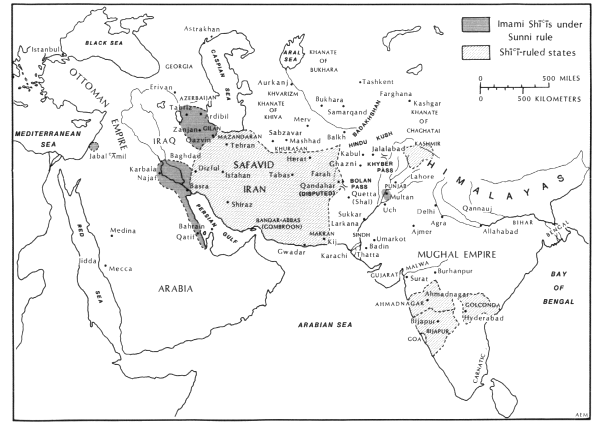
Map 1
The Shi‘i World in 1582
each originated in a tribal alliance, which rulers replaced in time by settled bureaucracies and standing armies. They provided a Pax Islamica to the southern regions of the Old World, which encouraged trade and security, allowing a population increase in sixteenth-century Anatolia and probably elsewhere, certainly in some Arab cities. In the sixteenth century these Muslim empires experienced economic advances, territorial expansion, and religious revival.2
Ottoman Istanbul, Safavid Isfahan, and Mughal Agra dazzled travelers with their splendor in the sixteenth and seventeenth centuries. Their wealth, based primarily on agriculture and only secondarily on trade and manufactures, is indisputable. But their rulers and craftsmen borrowed technology from Europe instead of innovating, so that they gave the world few new developments in weaponry or industry. From at least the fifteenth century, Europe produced more made goods, including, for instance, silk textiles, whereas the Middle East and South Asia sent raw materials (raw silk, spices such as pepper) to Europe. But the western European edge in mechanical inventiveness and the ability to accumulate capital only manifested itself with full force after 1760. Until the late eighteenth century, manufacturing and agricultural productivity, and transportation costs and speed, did not improve dramatically in Europe.
The political and economic flowering of the three sixteenth-century Muslim empires in South and Southwest Asia had a religious impact. The Ottomans promoted the Hanafi rite of Sunni Islam as their state religion, developing a highly institutionalized and bureaucratic religious establishment. The Safavids and their Shi‘i Turkoman followers from Anatolia made Twelver Shi‘ism the religion of state and heavy-handedly imposed it on Sunni Iran. They brought in Arab Shi‘i clerics from southern Lebanon and southern Iraq to man the fledgling religious institution and relied also on notable clerical families within Iran who embraced Shi‘ism. The Mughals, originating in largely Turkish-speaking Central Asia, promoted Hanafi Sunnism. Religious ideology and a corps of ulama organized around institutions useful to the state played an important political role in each of the three Muslim empires.
Of these religious ideologies, Twelver Shi‘ism is the least known. Twelver Shi‘is dwelt in each of the empires. Under the Ottomans, they lived in Jabal ‘Amil (now in Lebanon) and in Iraq. In the Ottoman Arab lands the Twelvers maintained a form of their religion that might be called sectarian, in that they experienced a high degree of friction with the state and with the majority Sunni society around them. They also avoided the development of a great degree of religious organization and structure. Twelver Shi‘is, originally a minority community in Iran, came to form a majority of Iranians under the Safavids, where they elaborated a formal religious establishment, which for the most part cooperated with the Shi‘i state. Organized Safavid Shi‘ism, with its professional clerics and its legitimation of the state, differed starkly from the conservative creed held in most Arab Shi‘i communities.
In South Asia, Twelver Shi‘ism spread on two levels. Iranian merchants and immigrants promoted it among Muslim notables in southern India, so that Shi‘i dynasties came to power in Bijapur, Ahmadnagar, and Golconda. Likewise, a Shi‘i dynasty ruled briefly in sixteenth-century Kashmir. Urban tradespeople and some peasants also created their own form of Twelver Shi‘ism, based especially on mourning rites for the Prophet's martyred grandson, Husayn. The rise of Sunni Mughal power circumscribed the south Indian Shi‘i states and deprived Shi‘is in northern India of governmental protection. The Sunni Mughal Empire gradually absorbed the Shi‘i-ruled polities of the south into itself, disestablishing the rival branch of Islam in the subcontinent.
Early Shi‘ism
Twelver Shi‘i jurisprudence probably began in the eighth century A.D. , when men close to the Imams began arbitrating disputes within their communities.3 Gradually a body of men grew up who had memorized the oral reports attributed to Muhammad and to the Imams. These believers likewise studied the legal reasoning employed by the sixth Imam, Jacfar as-Sadiq (d. A.D. 765). Roy Mottahedeh has pointed out that the "learned," or ulama, included not only professional religious officials who taught or gave legal judgments, but also part-time scholars and even hobbyists.4 Out-of-power Shi‘is were even more likely to have "informal," part-time ulama than the dominant groups who evolved into the Sunnis. Partisans of the Imams endured the hostile rule of the Umayyads until the middle of the eighth century A.D.
when a Shi‘i-tinged revolution brought the Abbasids to power. The Abba-sids, however, also refused to recognize the right of the Imams to rule, and often kept them under house arrest as dangerous rivals.
The events following the death of the eleventh Imam, Hasan al-‘Askari, in Abbasid Iraq in A.D. 873 or 874, are obscure and yet of great importance for the history of Twelver Shi‘ism. Several schisms occurred, with some groups saying that Imam Hasan al-‘Askari had left no heir. Others, especially wealthy Shi‘is close to the Abbasid court, proclaimed that the Imam had had a small son, who supernaturally disappeared and who would one day return to restore the world to justice. A series of agents (wakils ) arose to lead the Twelvers, saying that they transmitted messages from the hidden child-Imam. After the death of the last special agent, Imami Shi‘is found themselves cut off from any direct charismatic authority. Yet during the time of the agents a saying attributed to the hidden Twelfth Imam began to circulate, declaring that men who related oral reports from the Imams had the deputyship (niyabah ) of the Imams.5 Obviously, the relaters (muhaddithun ) of Imami oral reports were making a claim to leadership of the community in the wake of the Imam's disappearance. They did not assert as close a relationship to the Imams as did the four agents, since their only link to the Imams was through the Imami sayings as this body of believers had memorized and transmitted them.
The end of the line of Imams came as a powerful shock to the Twelver community. Early Shi‘i thinkers living after the Occultation, or disappearance, of the Imam felt leaderless. In the absence of the infallible Imam, they believed that no one could conduct Friday congregational prayers, lead believers in an aggressive holy war (jihad ), or collect certain types of land taxes (kharaj ).6 In short, they felt a profound alienation from the world and generally adopted a quietist political policy.
Under the Shi‘i Buyid dynasty (A.D. 932-1055) in Iraq and Iran, Twelver scholars freely collected and studied the oral reports from the Imams. They came from the old Shi‘i centers of Kufa and Qumm to the Buyid capital of Baghdad. In Baghdad, some wealthy Shi‘i intellectuals began employing the cosmopolitan tools of Greek rationalism in Imami theology. But most Shi‘i scholars rejected rationalism in favor of simply quoting the sayings of the Imams as their authority. In this period, the rationalist theologians began to be called Usulis, whereas those rejecting human reasoning in favor of a literalist
adherence to the words of the Imams became known as Akhbaris. Akhbaris were almost certainly the great majority. At that time, it is important to note, most Shi‘i scholars agreed on the invalidity of such Greek rationalist tools as syllogism in deriving legal judgments. The dispute centered on their use in theology.7
The more cosmopolitan, rationalist theologians often had good relations with the Buyid state. Although they considered secular governments to be ultimately unjust (ja'ir ), Shi‘i scholars sometimes felt that there was no objection to working fox the state so long as one's principles were not compromised.8 The victory of the Saljuq Sunni Turks over the Shi‘i Buyids in the middle of the eleventh century scattered Shi‘i scholars for a time, denied them patronage, and forced them into a low profile. Gradually, however, Shi‘i communities under the Saljuqs reorganized themselves and placed considerable wealth in the hands of their ulama for religious institutions.
The Mongol conquest of I ran and Iraq two centuries later freed Twelvers in many ways from the restrictions placed upon them by the strongly Sunni Saljuqs. In the second half of the thirteenth century, some wealthy Shi‘i scholars, who enjoyed the patronage of the Mongols and based themselves in the Iraqi trading center of al-Hillah, began applying the tools of Greek rationalism to law, rather than solely to theology. This probably reflected the need of dynamic Twelver communities, such as that of al-Hillah in the Mongol era, for a more flexible law. From this period the rationalist Usulis and the strict-constructionist Akhbaris constituted rival schools of jurisprudence.
The conflict between the Akhbaris and the rationalist Usuli jurisprudents centered on two sets of issues. The first concerned the sources of law, with the Akhbaris restricting them to the Qur'an and oral reports (akhbar ) from the Prophet and the Imams. The rationalists saw the consensus of the jurisprudents as another source of legal judgment, as they did the independent reasoning (ijtihad ) of the jurist. The Usulis divided all Shi‘is into formally trained jurisprudents (mujtakids ) and laymen, stipulating that the ordinary believers must emulate the mujtahids in matters of subsidiary religious laws.
The rationalists asserted that the mujtahids, as general representatives of the Hidden Imam, could substitute for him in performing such tasks as giving legal judgments, implementing rulings, collecting and distributing alms (zakal and khums ), mandating defensive holy war, and leading Friday congregational prayers. Although Akhbaris allowed the relater of oral reports from the Imams to perform judicial functions, they often disallowed some or all of the other functions in the absence of an infallible Imam. Akhbaris further re-
jected any division of believers into laymen and mujtahid-exemplars, holding that all Shi‘is must emulate the Twelve Imams. In practice, of course, Akhbaris also made interpretations.
Safavid Iran: Shi‘ism, State, and Society
During the Safavid period the Usuli school, associated with the ruling establishment, burgeoned. In 1501 Shah Ismacil, chief of the militant Safavi Sufi order, became Shah of Iran with the aid of Turkish-speaking Shi‘i tribesmen from Anatolia. The new rulers imposed Twelver Shi‘ism on Iran, ideologically reinforcing their territorial victory. They required that imprecations be ritually pronounced upon caliphs holy to Sunnis, burned Sunni mosques, and expropriated the land of Sunnis. Shi‘i folk practices spread in Iran, such as the feast of the killing of Umayyad commander ‘Umar b. Sacd, an enemy of Imam Husayn. Meetings (rawzah-khvani ) for the recitation of the sufferings and death of Imam Husayn began to be held. Religious processions began to be taken out during the mourning month of Muharram, commemorating the martyrdom of Husayn on the tenth day (‘Ashura').9
From the reign of Shah Tahmasp (1533-76), the second Safavid monarch, a corps of Shi‘i ulama attracted from southern Lebanon and Iraq began making extensive changes in the practice of Twelver Shi‘ism which reflected the change in the religion's status from persecuted minority to reigning orthodoxy. The immigrant Arab Twelver clerics went far beyond the Hilli school, or the simple recognition of independent legal reasoning in jurisprudence. They permitted the central functions of the state to be undertaken by someone other than a divinely appointed Imam, making themselves general proxies for the Imam and legitimizing the Shi‘i Safavid regime. They also moved toward the creation of a Shi‘i religious hierarchy, staffed largely by Arabs and based mostly on the newly created offices of Shi‘i prayer leader and Shaykhu'l-Islam (jurisconsult). Safavid Usulism became the ideology of the Arab immigrant ulama within Iran, who wanted upward mobility and the implementation of a new vision of Imami Shi‘ism in cooperation with the Safavid monarchy—an activist, dominating Twelver Shi‘ism rather than the quietist, sectarian version of the religion that had largely predominated before 1500.10
Prominent among these innovators was Shaykh ‘Ali al-Karaki (d. 1534), from Jabal ‘Amil.11 In the first year of Shah Tahmasp's reign al-Karaki
ordered that a Shi‘i prayer leader be appointed in every town and village. Since many Shi‘i ulama held Friday congregational prayers invalid in the absence of the Twelfth Imam, this move dismayed conservatives, especially Arab Shi‘is who still for the most part labored under Sunni rule. But al-Karaki wished to create a religious institution under his own authority. The Safavids cooperated in the endeavor, since Shi‘i Friday prayer leaders throughout Iran said blessings on the Shi‘i monarchs in the Friday afternoon sermon. Al-Karaki also allowed the collection of land tax (kharaj ) in the Imam's absence, and wrote instructions for Safavid tax collectors. In so doing he opened up a source of revenue for the fledgling Twelver state. He ordered that Shi‘is stop dissimulating (taqiyyah ) their faith out of fear of Sunnis, since they now had government protection, and instituted the public cursing of the first two Sunni caliphs on a country-wide scale.
Two groups opposed these institutional innovations. Within Iran, Ar-jomand has demonstrated, the old Iranian families in charge of religious institutions such as judgeships and pious endowment supervision, many of whom embraced Shi‘ism, resented the immigrant Arab clerics.12 Moreover, the Shi‘is of the Arab world found many of al-Karaki's innovations inappropriate to their own situation. Typical of the Arab Shi‘is outside Iran (until the sixteenth century probably the majority of Twelvers) was Shaykh Ibrahim al-Qatifi.13 A former student turned enemy of al-Karaki, he cautiously accepted the necessity of independent legal reasoning (ijtihad ) and so could be categorized as an Usuli. But al-Qatifi, from the Sunni-dominated Persian Gulf, advocated a conservative Usulism that would not exacerbate Sunni persecution of Shi‘is and clung to the conservative political culture of minority Shi‘ism. He rejected the legitimacy of holding Friday prayers during the absence of the Imam of collecting kharaj land taxes, and of associating with rulers. After 1530 the Sunni Ottomans conquered Iraq, including the Shi‘i shrine cities of Karbala and Najaf where al-Qatifi and many other Arab Twelvers were based. Thereafter the shrine dries remained centers of a more cautious, conservative kind of Shi‘ism similar to that advocated by al-Qatifi.
In Iran, the rationalist, establishmentarian Usulism of al-Karaki largely won out. Isfahan's Imarn-Jumcahs (Friday congregational prayer leaders) from Shaykh ‘Abdu'l-‘Ali al-Karaki on adhered for the most part to Usulism, at least until the late seventeenth century. The mujtahids gained further power through becoming wealthy supervisors of pious endowment properties in the seventeenth century, and through revenue-free grants of land made to them by the Safavid shahs.14 The Safavid capital, Isfahan, became the cyno-
sure of the Shi‘i clerisy, a center of learning with 48 colleges and 162 mosques, and a place where important career contacts could be made.15
The clergy became so powerful that a few openly preached the necessity for the ruler to be not only a Sayyid but also a mujtahid, or senior jurispru-dent trained in Twelver law. This stance disputed the claim of the Safavids, laymen given often to loose morals, though the shahs asserted their descent from the Prophet. The dominant Shi‘i view supported the legitimacy of Safavid rule against clerical pretenders.16 Not everyone trusted the ulama, as a seventeenth-century folk saying from Isfahan testifies: "Keep a wary eye in front of you for a woman, behind you for a mule, and from every direction for a mulla."17
Most of the clergy neither enjoyed great wealth nor refused to associate with the government, since they believed it legitimate to work for the state whenever they would otherwise fear for their lives or whenever they felt they could thereby help the Shi‘i community. Clerical support for the Safavids led the Shi‘i monarchs often to persecute the enemies of the ulama, particularly the leaders of mystical Sufi orders, who competed with them for the spiritual allegiance of the masses. Since most Sufis were also Sunnis, and had a form of mass organization outside both the Safavid state and the Shi‘i religious establishment, Usuli ulama saw them as a threat.18
The main opposition to the Usuli school came from Akhbari revivalism. Akhbarism, as was noted above, rejected the legitimacy of independent legal reasoning and denied the need of laypersons to emulate mujtahids. A major intellectual figure in the revival of this strict-constructionist approach to Shi‘ism, Muhammad Amin Astarabadi (d. 1624), attacked the mujtahids from his base in Medina, in the Arab world.19 Astarabadi's reformulation of conservative Shi‘i jurisprudence found great acclaim in the shrine cities of Iraq and, as Arjomand demonstrated, in Iran among ethnically Iranian religious officials in competition with the ethnically Arab mujtahids.
Although Usulism probably predominated in the Safavid capital of Isfahan, the situation outside Isfahan in the late seventeenth century is harder to gauge. In some provincial centers Akhbaris remained influential. The Imam-Jumcah and Shaykhu'l-Islam of Qumm under Sulayman Shah (1667-94), Muhammad Tahir, a committed Akhbari brought up in Najaf, caused a row with the court by censuring the monarch's morals. Al-Hurr al-‘Amili (d. 1708 or 1709) immigrated to Mashhad from Syria, becoming Shaykhu'l-Islam.
A staunch Akhbari, he disallowed the use of reason and wrote against rationalist theology. The family of the Akhbari Nicmatu'llah Jaza'iri (d. 1701) settled in the small Iranian town of Shushtar, in Khuzistan, as Akhbari prayer leaders.20 Southwestern Iran was a major center of Akhbarism. As was noted, the Akhbari school had found favor with many ulama in the shrine cities of Iraq as well.
The Safavid conquest of Iran and promulgation of Twelver Shi‘ism represented the most startling cultural revolution in the Islamic world for centuries. Neither the Ottoman Turks nor the Mughal Timurids did nearly as much to change the religious beliefs of the people they ruled. The rise of Twelver Shi‘ism is comparable in scope—though emphatically not in content—to the Protestant Reformation in Europe. In both Protestantism and Safavid Shi‘ism, regional rulers' desire for political autonomy coincided with the wish of a clerically led group, branded heretics, to establish new religious institutions. Bloody religious and political wars ensued, dividing a cultural area (western Europe, southwest Asia) that had previously been religiously more uniform.
The Deccan Shi‘i States
Indian Ocean trade routes linked the Persian Gulf with southern India, encouraging a migration of people and ideas between the two areas. Iranian notables, administrators, military men, and literati flooded into southern India, or the Deccan, during the Mongol invasions of Iran in the thirteenth century, and thereafter. Especially after the Safavid victory, these Iranian elites often adopted Shi‘ism. Diplomatically and in its elite culture southern India became a dependency of Iran in the sixteenth century. Iranian notables carried with them their new conviction in Usuli Shi‘ism, providing patronage for Friday congregational prayer mosques and other Usuli Twelver institutions.
The longest-lasting of the Shi‘i-ruled states in southern India, the Qutb-Shahi (1512-1687), began with the political rise in Golconda of a Turkoman adventurer from Hamadan, Iran, named Sultan-Quli Qutbu'd-Din. The rulers in his line gave extensive patronage to Shi‘i ulama and built mosques, buildings (cashur-khanah ) for the commemoration of Imam Husayn's martyrdom, seminaries, and Shi‘i burial grounds. They had the Friday prayer sermons said in the name of the Twelve Imams and of the Safavids. Iranians
immigrated in large numbers, many as merchants attracted by the diamond trade, and some local adoption of Shi‘ism occurred. Twelver ulama of the Usuli school predominated in Golconda. In 1636 the Mughal emperor, Shah Jahan, forced the Qutb-Shahis to cease their Shi‘i forms in the Friday congregational prayer sermons, including the mention of the Safavids. In 1687 the capital of Hyderabad fell to the Sunni Mughals, who extinguished Shi‘i Qutb-Shahi rule.21
The role of emigrant Shi‘i scholars from Iran in spreading Twelver ideas in sixteenth-century southern India is exemplified by Shah Tahir Ismacili From a prominent Ismacili family in Iran, he became a Twelver and later emigrated for political reasons to the domains of Burhan Nizam Shah (1508-53) in Ahmadnagar, southern India. There he convinced the monarch to become a Twelver Shi‘i and became a minister in his government. Shi‘ism remained influential in elite culture for several generations thereafter. The Ahmadnagar Nizam Shahs lost their independence when Akbar made them pay tribute, and Shah Jahan formally absorbed the area into the Mughal Empire in 1633.22
The southwestern Deccani kingdom of Bijapur also experienced Shi‘i rule and Iranian influence in the sixteenth century, 1502-34 and 1558-83, under the ‘Adil Shahi dynasty. Shi‘i Iranian merchants plied the horse trade from the Persian Gulf to Bijapur, and Shi‘i notables achieved high office there. Yusuf ‘Adil Shah (1489-1510), an Ottoman Turkish exile with tics to the Safavid Ismacil, proclaimed Shi‘ism the state religion in Bijapur in 1502, on hearing of the Safavid victory. This proclamation encouraged even more Iranians to immigrate, and the ‘Adil Shahis employed them as administrators or military men. The Shi‘i monarchs hired three hundred Iranians to curse the first three caliphs.
The ‘Adil Shahis recognized the Safavids as their ultimate sovereigns, though given their distance from Iran, this recognition remained a mere formality. Shi‘i ulama and notables often came into violent conflict with Sunnis, including local Sufi leaders, and Sunni-Shi‘i riots became endemic during the month of Muharram when Shi‘is cursed the caliphs. From 1583 local Sunni elites came back into power. The Mughal emperor, Shah Jahan, com-
pelled the Bijapuris to pay tribute to him from 1636, and Awrangzib annexed Bijapur into the Mughal Empire in 1686.23
Although the sixteenth might be rightly called the Twelver century in the Indo-Iranian cultural sphere, Shi‘is won only limited and temporary victories outside Iran. Only in Iran did Shi‘i rulers succeed in making their creed into a mass religion, by a combination of brutal persecution, the lavishing of wealth on Twelver institutions, and their appeal to a widespread folk cult of the Prophet's family. Southern India's population, however, clung to its Hinduism, and most Sunni notable families stubbornly resisted the call to curse the caliphs. The Deccani Shi‘i ruling classes, with their Persian literary inclinations and their threnodies for the Imams in the new language of Urdu, remained insulated from the Dravidian, Hindu masses. The Mughal Timurid emperors gradually reduced the Shi‘i states of the south to vassals of a Sunni emperor, then finally they absorbed those territories and dethroned the Shi‘i monarchs.
Shi‘ism in Northern India under the Mughals
Twelver Shi‘ism in northern India under the Mughals, sometimes barely tolerated and at others fiercely persecuted. has left far fewer traces in the chronicles than it did in the south.24 The importance of Iranian immigrants in spreading Safavid-style Twelver Shi‘ism seems indisputable, although hard to trace except at the very top of the social hierarchy. Regions of northern India, particularly Kashmir, had more Shi‘is than others. The popular classes developed creative ways of mourning the wronged Family of the Prophet, although the Mughals sometimes suppressed such displays of proto-Shi‘i piety.
The Mughal, or Timurid, dynasty was begun by Babur (d. 1530), a Chaghatai Turk who originally sought to establish his own state in his native central Asia. Blocked in central Asia by the Uzbeks, he established himself in Kabul and invaded India from this base in Afghanistan. His son Humayun, expelled from India by the Afghan Suri rulers, took refuge in Safavid Iran. There Humayun gained Safavid help in reestablishing his Indian domains, at the price of pretending to embrace Shi‘ism, for which he never showed any actual enthusiasm. Given the great surpluses expropriated by ruling elites in
the agrarian bureaucracies of the seventeenth and eighteenth centuries, had Humayun actually adopted Shi‘ism he could have done much to spread it in northern India. Humayun's son Akbar (1556-1605) put the Mughal Empire on a sound footing, making coalitions with regional Hindu elites and adopting a syncretic religion of his own invention, which combined elements of Islam, Hinduism, and Zoroastrianism. Akbar tolerated but did not promote Twelver Shi‘ism, appointing the renowned Nuru'llah Shushtari, a Shi‘i cleric from Iran, chief judge (qazi ) of Lahore. Tolerance of Shi‘ism in Mughal India often fluctuated according to relations with Iran. The sixteenth-century Mughal-Safavid alliance gave way in the seventeenth to disputes over Qandahar, leading to restrictions on Shi‘is in India.25
The only instance of state adoption of Shi‘ism in northern India occurred in Kashmir, where the Shi‘i Chak ruling house (1561-89) came briefly to power. Shi‘ism came to Kashmir from Iran, and was embraced by some Sayyids and by the Chak clan. Members of the Nurbakhshiyyah Sufi order came to Kashmir from Iran in the years just before the Safavid victory in Azerbaijan. With the rise of Shi‘i power in Iran, the pro-Shi‘i Nurbakhshis formally became Twelvers. Shi‘i Chak rule caused Sunni-Shi‘i clashes in Kashmir, however, which the Mughal Akbar made a pretext to annex the region into his empire. A minority Shi‘i community continued to exist in Kashmir, as did Sunni-Shi‘i violence. Firishtah noted continuing Shi‘i influence in the Kashmiri military.26
The European traveler Manucci wrote that Akbar initiated a deliberate policy of receiving even Shi‘i Iranians who fell from political favor under the Safavids and fled to India. He said that Akbar and his successors gave these political refugees official grants (mansabdari ) and sent them to the province of Kashmir, where they led a comfortable life. When one of them died, rather than repatriating his stipend to the central government, the Iranian Shi‘i political refugees divided it up among the survivors. Ultimately Awrangzib put a stop to this "inheritance" of the mansabdari .27 Since Kashmir had been ruled by the Shi‘i Chak dynasty and had a minority Shi‘i population, it was a logical place for the Mughals to send the Iranian refugees of whom they hoped to make political use. The wealth and standing of this group probably helped Shi‘ism in Kashmir and the neighboring Punjab.
Rizvi has quoted a central Asian traveler's account of Muharram in Lahore around 1635, which reported that the first five days of the month were given over to merrymaking to celebrate the happy portions of the Imams' lives, with male and female singers and dancers giving frequent perform-
ances. From the sixth through the tenth of the month believers mourned, and Shi‘is cursed the enemies of the Imams. On the tenth of Muharram itself, Shi‘is and Hindus stayed at home, but rival Sunni groups took out processions with placards, often, clashing violently.28
The French traveler Tavernier noted the many Iranian nobles and military men in the service of the Sunni Mughals, comparing their numbers to those in Bijapur, which had been Shi‘i-ruled. He wrote of these Iranian social climbers:
It is true that although they regarded the Sunnis with horror they, nevertheless follow, in outward show, the religion of the monarch, believing that to make or secure their fortune they might conceal their true belief, and that it sufficed for them to cherish it in their hearts . . . . Although [Awrangzib] had, as I have said, numerous Persians in his service, he did not allow them to celebrate the festival of Hosen and Hosein, sons of All.29
Other travelers in the late seventeenth century also remark the presence of Muharram processions of mourning for the Imam Husayn in southern India, and their forbidden character in Awrangzib's northern India.30 In 1668, Awrangzib prohibited such mourning processions, during which urban groups paraded decorated wood or bamboo replicas of the Imam's tomb, on the grounds that the custom had resulted in a major riot in Burhanpur among rival groups of mourners.31
Not only military adventurers and political refugees went to India from Iran. At least two members of the preeminent clerical family in seventeenth-century Isfahan, the Majlisis, emigrated to Awrangzib's India. A grandson of Muhammad Taqi Majlisi, Aqa Muhammad Sacid Mazandarani, emerged as a favored court poet in Delhi, with the pen name "Ashraf."32 His brother, Aqa Hasan ‘Ali, followed in his footsteps. For sons of Shi‘i ulama to succeed socially in the strongly Sunni atmosphere of the Mughal court they had to concentrate on literary or medical pursuits, which they did with some success.
Shi‘ism thereforc had a furtive character in sixteenth- and seventeenth-century Mughal India, which makes its culture difficult to recover. Shi‘ism spread to a slight extent among the ordinary folk, probably from Iran and by way of transplanted Iranian notables and Iranian long-distance merchants.
Most Shi‘is in northern India, Akhbaris, opposed the holding of Friday congregational prayers in the absence of the Twelfth Imam. A minority in Mul-tan and Sindh embraced Twelver Shi‘ism after 1500, and the eighteenth-century Sunni Afghan domination of these areas and Kashmir forced many Shi‘is to migrate southward to Delhi or Awadh. Late in the seventeenth century, after Awrangzib's conquest of Shi‘i-ruled Hyderabad, Deccani Shi‘is came north to join Mughal service, spreading their rituals in Delhi.33
Eighteenth-Century Political Transitions and Their Effect on Shi‘ism
In the eighteenth century the three great Islamic empires that had straddled southern and western Asia and North Africa suffered political reversals both externally and internally. Local tribal and peasant groups, suffering from high taxation, pursued successful rebellions against the centralized empires and their standing armies, leading to a decline of bureaucracy in favor of tribal power based on mobility, guerrilla tactics, and hand-held firearms Empires gave way to decentralization, to be replaced by provincial powers. As will be discussed later, the Mughal Empire declined at the center and regional successor states emerged. As the century wore on, the political influence of the British East India Company grew enormously as it swallowed up Bengal and other territories.
The Safavids fell to invading Afghan Sunni tribal armies in 1722, and the Persian Gulf gradually became a British lake. Only one of the three empires, the Ottoman, survived, partially because the European powers could not agree among themselves how to divide it up. Still, the Ottomans suffered loss of control over outlying parts of the empire, such as Egypt and Iraq, with slave-soldier (mamluk ) local regimes taking effective power. These political and economic changes strongly influenced the fortunes of Imami Shi‘ism, disestablishing or crippling clerical institutions in Iran for decades, giving greater autonomy to the Shi‘i shrine cities in southern Iraq under the weak Mamluks, and pcoviding an opportunity for Shi‘i governors in Bengal and Awadh to make a bid for regional independence from the Mughals in India. Moreover, Shi‘i ideological developments in Iraq and Iran had a fateful impact on north Indian Shi‘ism later in the eighteenth century.
The political and financial support that the Safavids gave Shi‘ism and its institutions tied the fortunes of the religion to those of the dynasty. Shah Sultan Husayn (1694-1722) presided over the dissolution of the Safavid Empire. The Shah's secular policies led to weakness, and only in the religious sphere did he take forceful action, giving free reign to the bigotry of clerics such as Shaykhu'l-Islam Muhammad Baqir Majlisi (d. 1699). The last Safavid
ordered forced conversions of Jews and Zoroastrians, the expulsion of thousands of Hindu merchants from Isfahan, and the persecution of Sunni tribal groups, such as the Kurds. Changes in provincial administration and neglect of the military made Iran vulnerable to Baluchi tribal raids and incursions by the tribal Ghilzay Afghans, who seized Qandahar in 1709. An Afghan army of twenty thousand took Kirman in 1721 and marched on to Isfahan, which fell, after a long and terrible siege, to the Ghilzays in 1722. Iran also began to feel mililary pressure from the Russia of Peter the Great, and from the Ottomans.
Tahmasp II, a Safavid aspirant to the throne now occupied by the Afghans, found a military strategist to support him in Nadir Afshar. But once Nadir defeated the Afghans, he claimed the throne for himself in 1736. Nadir's military policies barked back to those of Timur ("Tamerlane") or the early Safavids, in that he put together a coalition of tribal Afghan and Qizilbash armies instead of depending on a bureaucratically ordered standing army. The tribal forces. pastoralists, could only be paid in booty and pasturage, which required constant movement and conquest. Nadir invaded Iraq twice, in the early 1730s and the early 1740s, meeting defeat at the hands of the Ottomans both times, and in the late 1730s undertook a long campaign to India, where he conquered Lahore and Delhi and made the Mughal emperor his vassal for a time. But tribal factionalism between the Sunni Afghan and the Shi‘i Qizilbash wings of his army led to Nadir Shah's assassination in 1747.
Regional contests for power divided for a decade and a half the area that had been Safavid Iran, with the Shiraz-based Zands emerging victorious west of Khurasan. Karim Khan Zand's pragmatic rule (1763-79) reunited Iran and aimed at capturing revived Persian Gulf trade by conquering Basra, Ottoman Iraq's port city. Upon Karim Khan Zand's death the Qajar tribe gained political preeminence, creating a new Shi‘i state, which ruled throughout the nineteenth century and into the twentieth.
Qajar. Iran (1785-1925), unlike Mughal India or the Ottoman Empire, regained central-government control by the end of the eighteenth century over most of the territories held in the seventeenth. The Zands and Qajars benefited from the preoccupation of the Afghans with the Punjab, and of the British with Bengal, so that two centrifugal forces besetting the Mughals were deflected from Iran. But Iran's economy was disrupted for much of the period 1722-97, and growing Russian and British economic and military power chipped away at its territories and the Qajars diplomatic independence throughout the nineteetnth century.34
These political trends made a major impact upon the Shi‘i ulama.35 Under the last Safavid ruler, Shah Sultan Husayn, the high ulama favoring the rationalist Usuli school of jurisprudence, enjoyed great influence, position, and wealth. But the Afghan conquest of Isfahan in 1722 displaced hundreds of scholarly families and delivered a mortal blow to the dynasty that had assured their fortunes. The Sunni Ghilzays and Nadir Shah expropriated the endowments supporting the clergy, leading to a relative impoverishment and a decline in the influence of this group. During the second quarter of the eighteenth century great numbers of Shi‘i clergymen and merchants fled Iran for the shrine cities of Ottoman Iraq, adding a new ethnic component to the Arab quarters of these cities.
Isfahan, although its population may have declined from 250,000 to only 50,000, remained one of Iran's larger cities and a center of rationalism and mysticism throughout this period, exercising a countervailing influence in those directions. Iranian centers of Usulism remained, though we simply do not know much about intellectual currents in Shiraz, Tabriz, and other centers in this period. The frequent description of the eighteenth century as one of Akhbari dominance appears to derive mainly from the experience of Isfahani emigrants to largely Akhbari Iraq, rather than from actual Akhbari hegemony over most major Iranian centers (though Kirman, Qumm, and Khuzistan appear to have favored Akhbarism).
The Shi‘i ulama of Iran adopted varying strategies to deal with the vicissitudes that struck their status group in the eighteenth century. These included emigration to the Iraqi shrine cities, where a constant stream of pilgrims and long-distance merchants provided them with a livelihood as legal advisers and supervisors of charitable contributions and pious endowments. Some managed to retain religious office in a declining Isfahan; others intermarried with rich merchants or well-off artisans when possible. With the decline of court patronage for scholars and the expropriation of endowments, more were probably forced into low-status trades—becoming cotton or silk weavers, smiths, dyers, bleachers, and hat makers—than would normally have been the case. Many settled in Iran's small towns and large villages, where local tribal leaders came into prominence with the decline of central government. The smaller centers were less likely to attract marauding invaders, prospering as local trade depots even as some large cities declined. Members of the Majlisi family colonized high religious office in several provincial cities and small towns. Finally, some sought employment in Bengal (governed
by a Shi‘i family from 1740 to 1757) as literary men, civil servants, and physicians.36
In this period one often sees mullas, clerics, tying themselves to the richer classes of the bazaar, seeking new forms of economic security when their links to the court were so disrupted from 1722 to the rise of the Zands. Their bazaar links and the relative pohtical independence this fostered were to prove crucial to the growth of ulama power in the nineteenth and twentieth centuries.37
Crucial developments also occurred in Iraq during the eighteenth century. The Ottoman governor, Hasan Pasha, governed Iraq firmly (1702-24), but Iraq suffered disruptive Iranian incursions under Nadir Shah during Ahmad Pasha's governorship. Thereafter Sulayman Abu Laylah Pasha (1750-62) created a new, regionally based Mamluk state, which continued under his slave-ruler successors until the reassertion of direct Ottoman rule in 1831. The Mamluk state gained independence in all but name.38
The Iraqi shrine cities laboring under Sunni Ottoman rule, had remained centers of the more conservative Akhbari school. With the collapse of Shi‘i rule in Iran and the anticlericalism of the new rulers, the ulama in any case lost much of their previous opportunity for an active social role. The congregation of hundreds of Iranian clerical families in the Akhbari strongholds brought them under the conservative influence of that school. The decline of the great Shi‘i clerical centers in Iran lent the shrine cities even more glamour in the rest of the Shi‘i world, and Nadir Shah had won from the Ottomans pledges not to tax the pilgrims who frequented them. The pilgrimage trade brought wealth into Iraq from Iran and India, and the Mamluks granted the shrine cities much relative autonomy in view of the dangers of another Iranian invasion should the Shi‘is there feel mistreated. All this gave the Shi‘i ulama based in Najaf, Karbala, Kazimayn, and Samarra great wealth, power, and independence late in the eighteenth century.
Political decentralization and realignments had a differential impact upon Shi‘ism in various regions of the Middle East. In Iran, the fall of the Safavids helped disestablish the Shi‘i ulama, reducing them to comparative powerlessness and poverty. In Iraq, however, the influx of clerical families fleeing Nadir Shah, Iranian attempts to annex the shrine cities, continued pil-
grimage and trade, and the emergence of a regional Mamluk regime all contributed to the greater autonomy and wealth of the Shi‘i ulama.
Neo-Akhbari Dominance, 1722-1763, in Iraq
Against a backdrop of geographical and class dislocation, the ulama of the eighteenth century fought out a decisive battle on the interpretation of Shi‘ism.39 The old struggle between the Usulis and the Akhbaris revived in a new guise. The Akhbarism of the eighteenth century was less conservative than pre-Safavid Akhbarism had been, most Akhbaris in Iran and Iraq having accepted the validity of, for instance, Friday congregational prayers in the Occultation. But Akhbaris still preferred a more conservative approach to juridical decision-making, excluding the rationalist techniques of the Usulis. The Usuli-Akhbari conflict has too often been seen in liberal terms as a battle of great minds. In fact, the ideological struggle reflected the competition of ulama families and of regions, and social and economic forces affected its outcome.
Shaykh Yusuf al-Bahrani (1695-1772), a key figure in the intellectual development of Shi‘ism, grew up in Safavid Bahrain in a family of Usuli clerics who also worked as pearl merchants.40 He fled first to Shiraz from the 1717 Omani invasion of Bahrain, then to Karbala from the Afghan conquest of Iran. Al-Bahrani adopted the Akhbari school, rejecting his early schooling in Bahrain. As a refugee from Iran in Karbala, he would at first have been dependent on the largesse of Akhbari religious dignitaries. Moreover, the same political instability that expelled him from his homeland and deposed the Safavids apparently made an establishment-oriented school of jurisprudence like Usulism less appealing. As time went on, al-Bahrani moved away from a strict Akhbarism to a neo-Akhbari position that had Usuli elements. Nevertheless, he rejected Usuli principles of legal reasoning, the syllogistic logic Usulis allowed in interpreting the law, and the legitimacy of holy war during the Occultation of the Imam.41 With the influx of Iranians into Karbala from Isfahan and other Iranian cities, the Akhbari teachers in the shrine cities em-
ployed their prestige and patronage to convince them to adopt the Akhbari school.
The trend to Akhbarism after 1722 may be witnessed in another major eighteenth-century figure, Aqa Muhammad Baqir b. Muhammad Akmal (1705-90), born in Isfahan and descended on his mother's side from the prominent Majlisi clerical family. His kin and social networks reached beyond the mosque, since he had half-brothers working in Isfahan and Tehran as money changers (sarraf ) and in Zand Shiraz as money coiners (zarrabi ). The young Aqa Muhammad Baqir, emigrating to Karbala in 1722, came under Akhbari influences there and changed for a while to that. school from his Isfahani Usulism.42
Aqa Muhammad Baqir traveled early in the 1730s to Bihbahan on the border of the Iranian provinces of Khuzistan and Fars. Many Isfahani scholarly families scattered to such small towns (qasabahs ) in southern Iran, which, though relatively near to the shrine cities, offered greater security in this period than large cities. Aqa Muhammad Baqir found the religious institutions in Bihbahan dominated by ulama from Bahrain who had newly adopted Akhbarism. Although he may at first have gotten along with them, at some point he reverted to his Isfahani Usulism and engaged in bitter polemics with the Akhbaris. He emerged as a popular prayer leader and teacher and remained for thirty years.43
The Usuli elite of Isfahan, dispersed to the Akhbari-dominated shrine cities and to conservative small towns in the 1720s, suffered in the 1730s further disestablishment by Nadir Shah (1736-47), who supplanted both Afghans and Safavids. He made it one of the cornerstones of his policy that Iranians should renounce the Shi‘i. practice of cursing the first two caliphs of Sunni Islam, and tried to have Shi‘ism incorporated into Sunnism as a fifth legal rite. This policy allowed him to keep loyal to himself both his Afghan troops and his Qizilbash cavalry the former fierce Sunnis and the latter staunch Shi‘is. Nadir Shah forced the Shi‘i ulama to agree to this compromise. Wherever they felt it necessary, they went along, but the assent of many surely represented no more than pious dissimulation (taqiyyah ). In addition, Nadir sought to weaken the clergy and defang any potential clerical opposition to his policies by confiscating the rich endowments that had supported the seminaries and mosques of Isfahan.44
The Usuli Revival in the Zand Period, 1763-1779
Aqa Muhammad Baqir returned to Iraq sometime in the early 1760s. Bihbahani, as he was now known, found the shrine cities an extremely hostile environment for an Usuli. Shaykh Yusuf al-Bahrani, in his late sixties and ten years senior to the newcomer, presided over the religious establishment in Karbala as the dean of Shi‘i scholarship. Al-Bahrani's neo-Akhbaris considered Usulis to be ritually impure, touching Usuli works only with a handkerchief to shield their fingers from its polluting effects. More serious, anyone walking in the street with Usuli literature beneath his arm risked violent assault.45 The power structure in the shrine cities consisted of an Arab landholding elite, a number of mafia-type gangs, and the leading clerics. Any important figure among the ulama would have to make alliances with the Sayyid landholders and with the chief gangsters who ran protection rackets in the bazaars. At this point, the Akhbaris had the important gangster, or luti , contacts, and could employ these to intimidate Usuli rivals.
Bihbahani at first faced so many difficulties in Karbala that he seriously considered returning to Iran. But he soon began teaching Usuli texts secretly in his basement to a select and trusted number of students, many of them former pupils of al-Bahrani. These included his own nephews. When the Iranians had originally come to the shrine cities in the 1720s, many of them penniless refugees, they had been integrated into the Akhbari ideology of their Arab hosts and benefactors. Forty years later the founding of an Usuli cell in Karbala led by members of the Majlisi aristocracy signaled the increasing financial and social independence of the ethnically Iranian quarters in the shrine cities.46 Although the Iranian scholarly families originally depended heavily on government land grants and emoluments in Iran, which many of them lost after 1722, the history of the Majlisi family suggests that they increasingly forged links with merchants and skilled artisans in the bazaars, which gave them a new financial base. Though fallen from their notable status and dispossessed of their lands around Isfahan, many Iranian expatriates could increasingly compete with the wealth of merchant-ulama like al-Bahrani. The partial upturn in ulama fortunes in the Zand period, moreover, coincided with the economic rebound of the artisan and merchant classes, to whom they had become tied.47
Wealth underpinned the success of a great teacher, since he attracted students by providing them with stipends to live on. It also ensured that the
gangster bosses took his side. Aqa Muhammad Baqir's wealth probably derived from merchant in-laws, brothers-in-law serving as high administrators in Bengal, and wealthy legal clients. At some point Bihbahani began to feel that he had enough students, monetary support, and security to challenge al-Bahrani openly, an event that led to the polarization of the scholarly community in Karbala during the 1760s. In 1772, when al-Bahrani expired, Bihbahani had attained such a prestigious position that he read the funeral prayers for his late nemesis. Shaykh Yusuf's demise removed the most vigorous Akhbari leader from the field, allowing Aqa Muhammad Baqir, then sixty-seven, to spend his last clear-minded decade in consolidating his position. A number of other formei students of al-Bahrani, including Bihbahani's nephews the young Tabataba'is, and some Arab scholars, now forsook neo-Akhbarism for the Usuli school.48 These in turn helped their aging mentor to train a whole new generation of youthful mujtahids, who came from Iran to the shrine cities in the last years of Zand dominance and the opening years of Qajar rule.
The Usuli revival was, in Iranian terms, a largely Zand-period phenomenon, .which the Qajars came to support later on. In the shrine cities themselves the Usuli victory coincided with the rise of local Shi‘i power and the decline of central Ottoman control, so that Usuli principles, such as the holding of Shi‘i congregational prayers, could be gradually implemented, something the Ottomans had not tolerated when they had a firmer hand in Iraq. Usulism was promoted in particular by ethnically Iranian immigrant families in the Arab shrine cities, but the school attracted the support of local Arab scholars as well in the 1770s. The Zands provided new patronage and economic security in Iran, encouraging the revival of activist, rationalist Usuli jurisprudence.
Conclusion
The fortunes of Imami Shi‘ism in Iraq and Iran from its inception depended upon two forces. The first, popular-class heterodoxy and love for the family of the Prophet, allowed it to survive among urban artisans in Iraqi and Iranian cities and among the marsh Arabs of Iraq, and to spread among the Turkoman pastoralists of Anatolia. The second, ruling-class support or tolerance, aided the religion in the Buyid period, part of the Mongol period, and under the Safavids and Zands. Popular-class adoption of the religion helped it spread even under hostile governments, such as the Sunni Ottomans and Mughals, though it suffered setbacks in such situations. In seventeenth-
century southern India, ruling-class support for Imami Shi‘ism allowed the development of sophisticated religious and cultural institutions, but failed to secure allegiance to the faith by the masses of Hindus and Sunnis.
The late seventeenth and the early eighteenth century witnessed political setbacks to Imami Shi‘ism of considerable scope. The Sunni Mughals dethroned the remaining Shi‘i monarchs of southern India, the Ottomans ruled the Shi‘i areas of southern Lebanon and southern Iraq, forces from Muscat conquered Shi‘i Bahrain, and Sunni Afghans swept into Iran, dethroning the Safavids. Everywhere Imami Shi‘ism as a religion of the ruling class met defeat, the wealth of its ulama was expropriated, and only the devotion of the common people kept the faith alive. But the second half of the eighteenth century saw a reversal of the Sunni revival. The Mughals grew weak, allowing their Shi‘i governors in Awadh and Bengal to become nearly autonomous. The Zands restored Shi‘i rule to Iran. The declining Ottomans allowed a Sunni Mamluk regime to come to power in Iraq, which granted greater freedom to the Shi‘i shrine cities. The Shi‘i ulama took advantage of the improving political climate in the second half of the eighteenth century to promote their own interests, expressed in the clerical ideology of Usuli Shi‘ism.
2
Shi‘i State Formation in Awadh and the Ulama
The Emergence of Successor States to the Mughals
The eighteenth century witnessed the disruption of political order in much of the Islamic world and the emergence of regionally based successor states to the three great Islamic empires that had held sway from the sixteenth century. The Ottoman Empire met frequent defeat in military encounters with European states, and the Mamluks in Egypt and Iraq showed independence from the Ottomans in the second half of the eighteenth century. In Iran, Afghan tribal armies invaded and defeated the imperial forces. Out of the chaos emerged Nadir Shah (1736-47), who reunited Iran, assaulted Ottoman Iraq, and invaded India. The Mughal center at Delhi, already weak, never recovered from this blow, thereafter suffering Afghan incursions, attacks from south Indian Maratha armies, and assaults by the British East India Company.
The political decline of the Ottomans, Safavids, and Mughals cannot be explained monocausally, though it seems likely that economic forces played a major part. But as Owen argued in the case of the Ottomans, political decline does not necessarily imply that an absolute economic decline occurred (as opposed to a relative economic backwardness compared with Europe).1 In Iran, the silk trade declined in the eighteenth century, but the decline was caused by rather than being the cause of insecure conditions during tribal and elite contests for central power. Halil Inalcik has suggested that, just as
the introduction of cannon early in the sixteenth century had a centralizing effect, so the spread of hand-held firearms among the general populace in subsequent decades contributed to decentralization.2 For India, Irfan Habib argued that the Mughal nobles progressively overtaxed their peasantry, provoking peasant revolts in the eighteenth century, which proved so costly to put down that they permanently weakened the system. M. Athar All, among others, has suggested that such macroeconomic phenomena as the influx of New World silver and the depreciation of currency could help explain the simultaneous political weakening of the Mughals, the Safavids, and the Ottomans3
From the early 1970s some historians began suggesting an alternative to finding causes for the political decline at the center in the three empires. They began to see political decentralization not as a decline of the center but as a rise of the region. Thus, the appearance of independent-minded elites in eighteenth-century Egypt was depicted as a consequence of increased wealth among the Egyptian notable, merchant, and ulama classes, deriving from the coffee trade and other economic activities.4 In Iran, Thomas Ricks found that eighteenth-century regional elites showed a marked continuity even during instability at the center, and John Perry showed how the Zands, based in southwestern Iran, parlayed their regional power into national dominance.5 Barnett has discussed how, with the rise of successor states to the Mughals in India, more revenue remained in the provinces, with local benefits.6 The successor states often provided adequate security to allow long-distance trade and local agriculture to flourish. This approach shows the regional and
limited perspective of the image of unmitigated decline projected upon all of eighteenth-century northern India by Delhi-based Mughal historians as well as by contemporary Europeans.
In India, several successor states to the Mughals emerged. Bengal became increasingly independent, failing to a Shi‘i Muslim elite, until its nawab succumbed to the British in 1757. The Durrani Afghan state swallowed Kabul and much of the Punjab and Kashmir. The old Mughal province of Awadh, southeast of Delhi and northwest of Bengal, with the Himalayas and the Jamuna River as its natural boundaries, became a regional base for the powerful Nishapuri family. In the south, Hyderabad became the autonomous realm of the Nizam, a Mughal-appointed governor and the Hindu Maratha federation ruled much of the Deccan.
The social and urban history of eighteenth-century India supports the argument that the decline of the Delhi-based Mughal Empire and the rise of a regional elite in Awadh, for instance, reflected a shift in resources rather than monolithic decline. H. K. Naqvi described how urban centers west of the Jamuna River, in the regions near the Mughal seat of power, lost population in the course of the eighteenth century, whereas the area (Awadh) east of the river became more urbanized.7 C. A. Bayly demonstrated that the decline of Delhi, Agra, and Lahore (each with populations of about 400,000 in 1700, down to 100,000 in 1800) was partially offset by the rapid emergence of Awadh's Lucknow and Banaras, both with populations of 200,000 or more in 1800. He found about sixty towns of more than 10,000 in eighteenth-century. North India, the number remaining stable from 1730 to 1800, though some declined and others grew. Again, tile small centers (qasabahs ) of about 3,000 suffered losses in the west, but many new settlements grew up in Awadh during that period. Bayly further showed that climatic changes speeded the shift of resources from Delhi and Agra to Lucknow and Banaras, the area west of the Jamuna suffering dry spells in the late eighteenth century while in Awadh the fertile Baiswara area received ample rainfall.8
State formation in many of the successor states to the Mughals involved new local ruling coalitions and the promotion of regional culture. In Awadh, the ethnically Iranian ruling house and many of the notables associated with it favored the Imami Shi‘i branch of Islam. As the province became increasingly autonomous, Shi‘i notables more openly supported the scholars and institutions of their religious community. The declining Sunni elites in Delhi saw both the Awadh nawabate and Shi‘ism as manifestations of decadence, when in reality a shift simply occurred in cultural resources.
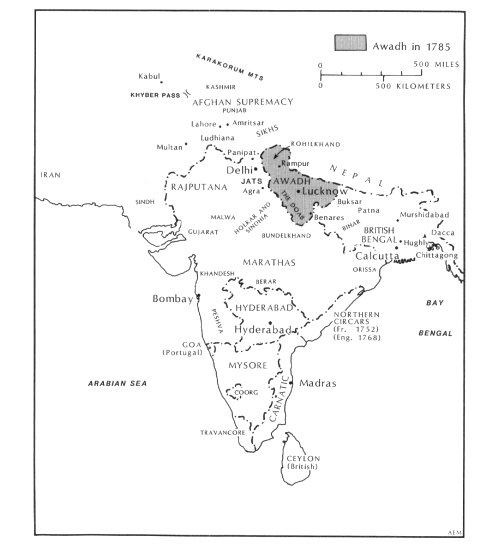
Map 2
The Nawabate of Awadh in 1785
The Rise of the Awadh Successor State
In the period 1722-75 three nawabs reigned through several phases of state formation in Awadh. The. state has been described as "a distinct realm of structured political relations that is defined by contention along its boundaries and among politicians and bureaucrats who, in competing for office and influence, rework social and economic conflict into political terms," and emphasis has shifted in the scholarly study of state making from static institutions to the "structured relations between the state and other spheres of society."9 The question arises of what social forces influenced the rise of the nawabs to regional autonomy in Awadh. As Iranian Shi‘is, the nawabs, originally temporary Mughal appointees, seem at first glance an elite group unlikely to assert strong authority over the Hindu peasants and Sunni townsmen of Awadh. How they made Shi‘i rule at all palatable to Awadh's population must occupy us as a central question. Moreover, it might be asked if there arc any parallels between the rise of Shi‘i rule in Awadh and that of the Safavids earlier in Iran.
The emergence of the province of Awadh as a Shi‘i-ruled state depended in part on developments at the Timurid court, where the Mughal administrative elite allowed Iranian Shi‘i immigrants to rise as provincial governors. On the one hand, pohtical instability in Iran encouraged large numbers of Iranian notables to go to India; on the other, the mood at court after the passing of Awrangzib (d. 1707) grew decidedly more tolerant of Shi‘ism. Awrangzib's successor, Bahadur Shah (d. 1712), leaned heavily toward Shi‘i Islam.10 The Shi‘i Barhah Sayyids, mere Delhi courtiers, made and unmade Mughal emperors, further demonstrating growing Shi‘i power. Greater tolerance at court allowed more elite recruitment of avowed Shi‘is to high office,
The Iranians made an impact, not only on the Delhi court, but on North India as a whole. Mir Muhammad Amin Nishapuri (d. 1739), the first nawab of Awadh, began a dynasty that ruled for 136 years. Nishapuri. known as Burhanu'l-Mulk, derived from a family of Islamic judges (qazis ) in Khurasan, whom Shah Ismacil Safavi of Iran transplanted there from Najaf as part of his campaign to make Iran Shi‘i.11 Nishapuri came to India in 1708, where he worked himself up the bureaucratic ladder to emerge as a power broker in Delhi. He helped free the Mughal emperor, Muhammad
Shah, of the political control of the Barhah Sayyids in 1720, receiving as a reward the governorship of Agra.12
In 1722, after Burhanu'l-Mulk failed to subdue peasant uprisings, the emperor demoted him to the less remunerative governorship of Awadh. There he overcame and co-opted the Sunni Shaykhzadah landholders based in the strategic town of Lucknow, who then collaborated in the emergent Awadh state. Awadh never achieved a high degree of governmental centralization, making the cooperation of such local elites essential to political stability. Burhanu'l-Mulk then brought within his orbit the Hindu Rajput Mohan Singh of Tiloi, who dominated the southern part of Rai Bareli. The Nishapuri satrap spent the next decade and a half establishing stronger central rule in Awadh, greatly increasing its revenue. In something of a declaration of independence, he resisted the Mughal emperor's one attempt to transfer him to the governorship of another province, Malwa.13
In January of 1739 Nadir Shah of Iran took Lahore, invading through Afghanistan. Burhanu'l-Mulk brought his forces into the fray on the side of the Mughal emperor, but was defeated and captured. The nawab, after negotiating an Iranian withdrawal, felt disappointed by the Mughal emperor's subsequent political appointments and treasonably suggested to Nadir Shah that it would be quite Facile and highly rewarding to take Delhi. The Iranian conqueror, delighted to take up the suggestion, victoriously marched into the city, the savage looting of the capital later perpetrated by his troops constituting one of the century's great disasters. Nadir reduced the Mughal emperor to a vassal of Iran, making Burhanu'l-Mulk imperial regent. The nawab of Awadh committed suicide on 19 March 1739, either because of his debilitating leg cancer or because Nadir Shah humiliated him.14
Unlike Ismacil the Safavid. Burhanu'l-Mulk did not acquire his country, solely by conquest. His authority derived from a Mughal appointment, and he used Mughal troops to assert his power. He gradually did achieve an autonomy of sorts, and his behavior with Nadir Shah indicates rather weak loyalty to the Mughal court. But his attempts to restructure Awadh society
took place within the framework of Mughal administrative traditions. He co-opted local large landholders instead of strongly dominating or destroying them, which allowed a polyglot cultural system rather than the wholesale conversion to Shi‘ism undertaken by the Safavids. But Burhanu'l-Mulk did make an assault on Sunni ulama and Sufi holders of revenue-free land grants.
Changes in the Status of Sunni Institutions
Secular opposition to the accumulation of religious lands, as Weber noted, often arose in preindustrial societies.15 The new nawab's determination to carve out a personal power base in Awadh, his Shi‘ism, and the region's exceptionally numerous Sunni revenue-free holdings, all contributed to the conflict. An eighteenth-century observer wrote that in the latter part of the seventeenth century Mughal rulers granted many Muslim scholars in the provinces of Awadh and Allahabad stipends and land revenues (madad-i macash ) for their support. Mosques, seminaries. and Sufi centers proliferated, and great scholars and teachers arose. "Students went in droves from town to town and were everywhere received with helpful sympathy."16
The writer, Bilgrami, asserted that when Burhanu'l-Mulk of Nishapur became the governor of Awadh and much of Allahabad under Muhammad Shah, he confiscated the stipends and land grants of both the old established and the parvenu families. The Muslim notables grew anxious about their affairs, financial worries compelling many students to forsake the classroom for full-time employment. The decline in learning and in the state subvention of education continued under Burhanu'l-Mulk's successors, who extended the confiscations to all of Allahabad, ruining many madrasahs, or Muslim institutions of higher learning. Another historian described Burhanu'l-Mulk's 1728 resumption of land grants supporting old Sunni families and institutions in the southern district of Jaunpur.17 Major exceptions to the Nishapuri family's policy of disendowing Muslim schools included Salon and Lucknow's Farangi Mahall, which received their revenues from Mughal grants throughout this period.18 Such cities as Allahabad, Lucknow, and Banaras also continued to possess important schools.
The Nishapuris' policy of establishing their regional control by calling in land grants to Sunni educational and mystical institutions that had become hereditary hurt the Muslim notables and medium landholders, who relied on these institutions for the training necessary to manage their estates, practice their religion, and celebrate their culture. Yet, as was noted, some prominent Muslim schools survived, chief among them the Farangi Mahall.
The school earned the sobriquet of the "Europeans' Mansion" among the inhabitants of Lucknow's chowk bazaar area because Dutch merchants first built it. In 1692 a group of landholders from his own village murdered Mulla Qutbu'd-Din Sihalavi, a Sunni religious scholar of Sihala near Lucknow, in a dispute over land and the mulla's influence at the Mughal court. In compensation, the Mughal emperor Awrangzib bestowed the Farangi Mahall on the martyr's orphans. One of the younger sons, Nizamu'd-Din Ahmad, a major Sunni scholar, taught with his relatives at home and received land grants and stipends from Mughal emperors. Partially because the nawabs put pressure on the school to train bureaucrats, many of them not Sunni, the students might be Shi‘is or even Hindus, though the teachers, as descendants and disciples of Mulla Qutbu'd-Din, adhered to Hanafi Sunnism. The method of teaching perfected by Mulla Nizamu'd-Din, emphasizing the rational sciences, wore a nonsectarian aspect. Mathematics and Avicennian metaphysics could, after all, be studied with profit by persons from all backgrounds.19
The works most often used in the Nizami method are analyzed in table 1. Most of the works or commentaries and glosses used in the Nizami method were written in Iran between A.D. 1200 and 1600. Also represented were some seventeenth-century north Indian figures.20 This method, concentrating on thought rather than on rote learning, evoked admiration for the speed with which it allowed a student to complete the course of study and for its ability to train Muslim ulama, judges, and administrators to think clearly and to derive solutions to problems.21 The highly rationalist emphasis of the study list reflects the seminary's latent function of producing bureaucrats for land-
|
Table 1 |
|
|
Subject |
Number of Works |
|
Logic |
5 |
|
Mathematics |
5 |
|
Dialectical Theology |
4 |
|
Philosophy |
3 |
|
Arabic Rhetoric |
2 |
|
Islamic Jurisprudence |
2 |
|
Qur'an Commentary |
2 |
|
Principles of Jurisprudence |
1 |
|
The Prophet's Oral Traditions |
1 |
revenue administration. The middle landholders, Shaykh and Sayyid families based in the small towns of North India, wanted some of their sons to go into government service. As nawabi rule grew more regionally centered and more autonomous from Delhi, and as the province's revenues increased, more opportunities arose for government service locally. Farangi Mahall produced a rationalist culture useful to the Muslim and Islamized Hindu notable and service classes who administered their own estates or served in the bureaucratic arm of the prebendal state, and its method spread widely in India.
The first phase of Awadh state formation saw the Mughal appointment of an Iranian Shi‘i governor, who used Mughal troops to assert military power in the region and made the province a personal power base from which he refused to allow the Mughal center to dislodge him. He co-opted local big landed elites by drawing them into revenue administration. He released revenue to his government by resuming on a large scale revenue-free grants of land made by Mughal rulers to Sunni scholarly and mystical families, making a frontal assault on the privileges of the Sunni clerical notables. This policy in some respects recalls that of the Safavids. Burhanu'l-Mulk pursued it, however, not primarily for religious purposes, but for financial and administrative ones. He freed up alienated land for distribution as patronage, and for an enlarged tax base. His Shi‘i faith, however, probably made him less loathe to institute such changes, which were damaging to Sunni institutions. The policy was not a blanket one, as the survival of Farangi Mahall and other Sunni-staffed institutions attests, nor is there evidence of Burhanu'l-Mulk's having promoted Shi‘i schools in the stead of the Sunni ones.
Patrimonial Bureaucracy versus Tribal Conquest
Could the Nishapuris become something other than mere foreign governors appointed over Awadh temporarily from the Mughal center? To do so would require them to establish their legitimacy among regional Sunni and Hindu elites, to build their own bureaucracy and military, and to meet the outside challenge of Maratha Hindu warriors, of pastoral invaders from Afghanistan, and of Bangash and Ruhilah Afghan tribespeople settled in the upper Doab.
Burhanu'l-Mulk paid Nadir Shah Rs. 20 million to assure the succession to Awadh's governorship for his nephew, Safdar Jang. That one family could retain control over a Mughal subah, or province, for two successive generations, rare during the zenith of the Mughals' agrarian bureaucracy, shows the decline of the central government. Earlier, Mughal emperors rotated provincial governors at will, preventing them from building up a regional power base, and although local bureaucracies and elites existed, the center retained control over decisions involving revenues· Hereditary Nishapuri rule in Awadh ultimately allowed the family to become independent of the Mughals altogether.
Safdar Jang established his power base by fighting and co-opting the Rajputs in Awadh from 1739 to 1741. He acquired an armed force loyal to himself by hiring six or seven thousand Shi‘i Qizilbash cavalrymen away from Nadir Shah's army before the latter withdrew from India.22 In Lucknow, he cultivated the local elite, so trusting the Farangi Mahall that he required even Shi‘is to present a diploma from it before he would hire them in the bureaucracy. He appointed members of the Farangi-Mahalli family to judicial posts.23 Leaders of the Shaykhzadahs in the capital, such as Muci zzu'd-Din Khan and Qutbu'd-Din Muhammad Khan, became Shi‘is in order to cement their relations with the nawab.
The Mughal emperor called Awadh's nawab to Delhi in 1743, promoting him the following year and adding to his responsibilities the governorship of Kashmir. Many Shi‘is from Kashmir joined his military, affecting Persian language and dress but receiving less pay than the Qizilbash horsemen. In February 1745 Safdar Jang showed his mettle when he and his forces accompanied Muhammad Shah against tile Ruhilah Afghan ‘Ali Muhammad Khan, whose growing power north of Awadh and east of Delhi posed a threat to both. The Ruhilahs, Sunni Puhktun tribespeople, emigrated from the mountain fastnesses around Peshawar down into the lush Gangetic plain
throughout the medieval period. Safdar Jang's impressive show of force intimidated the Ruhilah, who came to terms with the emperor. His legitimacy as the emperor's standard-bearer also helped him: the ulama of North India gave legal rulings in favor of the emperor's cause, influencing some Ruhilahs to desert their leader.24
The year 1748 gave India a new Mughal emperor, Ahmad Shah Timuri, and a new chief minister, Safdar Jang. In the first years of his ministry he struggled against the Afghani Bangash clans settled in the Doab, who, in the summer and fall of 1750, occupied Awadh.25 The martial Bangash, Pukhtuns like the Ruhilahs, had also emigrated into village North India from largely pastoral Afghanistan. Safdar Jang put together a new political confederation against the Bangash tribes, receiving unexpected support in this campaign from Awadh's urban Sunni Shaykhzadahs, who conducted a remarkable citizens' revolution against the invading tribesmen. The Bangash Afghans who occupied the important Awadh town of Bilgram treated its notables roughly and sacked the town when the locals retaliated by wounding some Afghans. In the streets and quarters, people prepared to defend themselves. In Lucknow, fearful Iranians stored their wealth with Shaykhzadah leader Mucizzu'd-Din Khan, and the haughtiness of the new conquerors and the harshness of their exactions provoked sanguinary riots between the Afghans and the Shaykhzadahs. After a night of rioting in one quarter of the city, seven hundred Afghans assembled against four hundred Shaykhzadahs, the citizens of Lucknow routing the Bangash men and suffering a third fewer casualties.
The Shaykhzadah leader Mucizzu'd-Din Khan, a Shi‘i with strong ties to the Iranians and a man particularly close to Safdar Jang, called a conference of notables, raising an army of live to six thousand men and forcing the Afghans to withdraw. Mucizzu'd-Din Khan then wrote his clansmen in other large towns, detailing the incident and warning of possible Bangash reprisals. In Lucknow and Hardoi districts the "republican" influence of the many large towns historically diluted landed power, leading to a scarcity of very large landlords and a proliferation of small holdings.26 The urban-based Shaykhzadah middle landholders expelled the Afghans and formed an army to fight for Safdar Jang's restoration.
Once again, the ulama rallied to the imperial forces. Maliku'l-‘Ulama' gave a ruling in favor of the emperor at Safdar Jang's behest. In Sandilah the Shi‘i logician Mawlavi Hamdu'llah, although he did not join the militia,
publicly espoused the nawab-vizier's cause, under the banner of which the town's newly militant citizenry gradually rid it of Afghans. The same pattern recurred in Bilgram and Kakori. Safdar Jang completed the task of expelling and overcoming the Bangash forces by forming an alliance with the Hindu Marathas and jointly subduing North India.27
The conflict at one level centered on whether Awadh would be incorporated into a patriarchal state presided over by Bangash clansmen or would continue to evolve as a semiautonomous satrapy with a patrimonial-bureaucratic administration inherited from the Mughal Empire. The Sunni middle landholders based in small towns chose the Shi‘i Safdar Jang over the Sunni Bangash tribesmen because his rule offered more continuity of political culture and revenue structure than did that of the coarse new conquerors. However new and alien the development of nawabi Shi‘i rule in Lucknow may appear against the backdrop of Mughal traditions of tight Sunni rule from the center, the nawabs were perceived to participate in Mughal legitimacy as the appointees of the emperor. The first minister, though victorious, squandered his remaining years in office on a fruitless power struggle in Delhi, which he lost to the Turanian forces.
The second phase of Awadh state formation saw the further definition of state boundaries through conflict with outside forces. The Awadh state developed its own, distinctively Shi‘i-tinged military. Further political bonding of local Sunni political elites to the ruling Nishapuri house occurred through an independent social movement of Muslim townsmen to defend Nishapuri Awadh from extraregional military attackers. The struggles with the Ban-gash demonstrated to the Nishapuri family that they could successfully defend a regional, hereditary power base with the aid of their Qizilbash Shi‘i cavalry and Muslim and Hindu troops, and that a dependable coalition against outsiders could be built with local elites, such as the Shaykhzadahs. The destructive struggles in the Mughal capital, along with growing Durrani Afghan and Maratha challenges, cast doubt on the value of devoting so much time to the affairs of the center. Nishapuri. Awadh began to be born.
State Formation and Sunni-Shi‘i Tension
In the third stage of Awadh state formation, the intervention of a new outside power, the British East India Company, proved decisive. Military conflict with the Europeans further demarcated Awadh's borders to the south and east, and military defeat at the hands of the EIC imposed limitations on the Awadh military that led both to internal decentralization and to external dependence on the alliance with the British. The process of subordinating Sunni
religious institutions to Shi‘i priorities continued, witnessed especially in conflict between the regional court and the Farangi Mahall. Finally, nawabi patronage began subventing Shi‘i scholars and institutions.
Shujacu'd-Dawlah, Safdar Jang's eldest son and deputy governor of Awadh in Lucknow, succeeded his father as nawab in 1754. In the first half of his reign he joined with Ahmad Shah Durrani of Afghanistan in defeating the Marathas, became Mughal chief minister in his own right, added the province of Allahabad to his power base, and attempted to expel the British from Bengal. In the last fateful endeavor he failed, and from that defeat in 1764 he showed increasing willingness to make an autonomous Awadh his power base, forsaking any dream of reinvigorating the Mughal Empire in Delhi. The British imposed restrictions on the size of his military that made him increasingly dependent upon them for Awadh's security, and required from him payments of tribute that eventually mortgaged his realm to them.28
From 1766 Shujacu'd-Dawlah changed his provincial capital from Lucknow to nearby Faizabad and instituted an ambitious building program, with his engineers and workers completing many of these projects within two years. The establishment of a provincial court of great wealth at Faizabad constituted a major cultural and social event. Artisans and scholars flocked there from all over India, its bazaars attracting numerous long-distance traders from Iran, central Asia, China, and Europe. With the peasant-generated tax monies of Awadh and Allahabad flowing into the city, its tax-farming notables and highly paid administrators helped support masses of skilled workers and retailers, who provided them with luxury goods. The new capital grew with remarkable rapidity during the last nine years of the nawab's life.29
The nawab's attack in 1774 in concert with the British on the neighboring Afghan Ruhilah ruler Hafiz Rahmat Khan defanged a potential military threat to the north, filled state coffers with booty, and added to the territory under his control.30 Shujacu'd-Dawlah's governorship, from 1754 to 1775, marked a watershed in the emergence of a semiautonomous, Shi‘i-ruled state in Awadh and Allahabad. Sunni religious leaders became less secure. Although Shi‘i scholarship and institutions showed no efflorescence in the first half of the reign, in the Faizabad period substantial patronage became available to scholars belonging to the ruler's branch of Islam.
The French traveler Laureston found Bengal and North India remarkably free of sectarian rancor in the 1750s. He wrote:
Muslims are enthusiastic about their religion, but here the sectarian followers of ‘Umar and ‘Ali never dispute among themselves for the purpose of establishing which was the true successor to the caliphate. There are few mosques, even fewer mullas, and the nobles, although they are punctual enough in performing their own devotions, hardly ever go to the mosques.31
This idyllic portrait may have been accurate in the 1750s, but Sunni-Shi‘i disputes increased as the Awadh state took on a Shi‘i aspect.
Though Farangi Mahall retained its intellectual leadership, the school's relationship with the government sometimes grew troubled. After Mulla Nizamu'd-Din's passing in 1748, his young son ‘Abdu'l-‘Ali gradually asserted himself as head of the institution. About ten years later, Sunni-Shi‘i tensions in Lucknow put his life in danger. With a Shi‘i potentate ruling the province from Lucknow, ‘Abdu'l-‘Ali felt that he could expect no governmental support against the militant partisans of Imam ‘Ali, and when the Sunni Ruhilah chief of nearby Shahjahanpur, Hafiz Rahmat Khan, offered him patronage, he accepted it.32
The challenge of rising Shi‘i militancy in the old Sunni stronghold of Lucknow, coupled with the political dominance of a Shi‘i ruling house, also bedeviled the next head of the school, Mulla Hasan Farangi-Mahalli. At the height of his eminence in Lucknow, Shi‘i-Sunni tensions again rose, two students being killed in rioting sometime after 1766. Mulla Hasan led a delegation of teachers to the new capital, Faizabad, where they protested to Nawab Shujacu'd-Dawlah the government's failure to stop the violence. When the delegation proved unsuccessful, Mulla Hasan decided to join Mulla ‘Abdu'l-‘Ali in Shahjahanpur rather than continue to risk his life in Lucknow.33
During Shujacu'd-Dawlah's rule Sunni-Shi‘i clashes ostracized two successive leaders of the major Sunni-staffed institution of learning in his dominions. In both cases the government sided, at least tacitly, with the Shi‘is. Although neither of these major Sunni ulama could be assured of their own lives and property under Shujacu'd-Dawlah, most Farangi-Mahallis remained in Lucknow, future leaders accommodating themselves better to an Imami government.
Barnett has outlined the major criteria of regional autonomy in
eighteenth-century India.34 Tile governor acquired the ability to appoint his own revenue officials and successors to the governorship; governors seldom remitted revenues to the center and began to conduct independent diplomatic activity. Then regional ruling families established provincial courts with a distinctive architecture. Finally, coins were minted in the name of the local ruler, and the emperor's name was deleted from the sermon (khutbah ) at the Friday congregational prayers. In Awadh, all but the last two criteria for independence had been met by 1775.
Shujacu'd-Dawlah as regional governor in Awadh from 1754 to 1775 remitted very little revenue to the imperial center. A combination of adverse economic conditions and destructive Iranian, Afghan, and Maratha incursions had enervated the power of Delhi. Until his death in 1775 Shujacu'd-Dawlah "still minted coins and had the Khutbah read in the Emperor's name for the sake of protocol, but for all practical purposes he was an independent prince."35 A further declaration of independence could only come when Friday prayers serrnons were read in the name of the Nishapuris; but that required the emergence of a Shi‘i ulama corps loyal to this regional dynasty.
The Beginnings of Shi‘i Scholarship in Awadh
Shi‘i rule in Awadh necessitated the development of a class of Shi‘i religious experts. Yet, surprisingly, this development took place very slowly. Until the 1780s most Shi‘i scholars in Awadh fell into two categories. They were middle landholding Sayyids in the lineage centers or they served as poets, physicians, or tutors at regional courts. In both cases they resembled gentlemen scholars more than professional clergy. Let us examine the pressures that created a trained, specialized corps of ulama receiving patronage from Awadh's Shi‘i ruling group.
Until 1766, when Nawab Shujacu'd-Dawlah settled down to rule Awadh and Allahabad from Faizabad, he made little patronage available to Shi‘i scholars. Imamis pursued their scholarship on an informal basis, lacking any major institution comparable to Farangi Mahall. Some Shi‘i scholars, such as Mawlavi Sayyid ‘Ata' Husayn Zangipuri, sought and received cash gifts and land grants from Mughal ruler Muhammad Shah, but the increasing confusion at the Mughal center made this form of wealth less and less stable.36 Scholars functioned as independent agents, taking advantage of political decentralization in North India to find patronage with local magnates in Awadh, in Bengal, or even in Hindu-ruled Banaras.
The Hindu raja of Banaras gave patronage to the greatest Shi‘i scholar in North India in this period, Shaykh Muhammad ‘Ali "Hazin" Gilani (1692-1766). He was given a land grant and cash gifts. For instance, when Jit Singh replaced his father, Balwant Singh, as ruler, he gave Hazin 40,000 ashrafis.37 Hazin, an Iranian poet and scholar from an elite family in Isfahan, fled Iran for India in 1734 after becoming embroiled in an insurrection against Nadir's governor of Lar province.
Hazin lived in Multan, Lahore, and Delhi. After 1739 he grudgingly reconciled himself to remaining in Delhi as a teacher, but the ridicule he heaped on India and Indians earned him so many enemies in the Mughal capital that he headed southeast toward Bengal in 1748. He arrived in Banaras in 1750, settling there for the last sixteen years of his life and building two mosques and a tomb for himself. Although Hazin accepted the patronage and land grant of a petty ruler, such as Raja Balwant Singh, he earlier refused to pay court to the Mughal emperor Muhammad Shah and even refused the latter's offer of high office. His haughtiness as an upper-class Iranian caused him to live out his life in a predominantly Hindu provincial city. Still, elite Hindus there cultivated Persian, and the surrounding districts boasted a relatively large Shi‘i population, which provided him with some religious students in his last years.38
Hazin's thought and his role in society were both important for the north Indian Shi‘i tradition. Unlike most Shi‘is in Awadh and Allahabad, he belonged to the Usuli school, believing that a religious scholar had the right to make independent judgments in law based on his own reasoning (ijtihad ). Some of his rulings on religious issues made while in India formed the basis of questions submitted by the faithful to mujtahids even in the nineteenth century. Deeply interested in science and philosophy, he also wrote commentaries on the works of mystical thinkers. In India he devoted the most of his efforts to writing and teaching Persian poetry, without, however, giving up religious subjects. Hazin transported into one of Shujacu'd-Dawlah's cities the intellectual ambience of late Safavid court culture.39
Since Banaras constituted part of the nawab's dominions, Hazin lived ultimately under a Shi‘i ruler, Nawab Safdar Jang, who showed him respect.
When in 1756 Shujacu'd-Dawlah came to Banaras to put down the rebellious Raja Balwant Singh, the nawab conferred with Hazin. The poet-mujtahid urged him to come to terms with the raja, and political events led Shujacu'd-Dawlah to follow this advice.40 In 1764 Shujacu'd-Dawlah and Shah ‘Alam II visited Hazin in Banaras before their close defeat by the British at the Battle of Baksar. The great Shi‘i thinker reportedly gave them the unwelcome advice that they should not attempt to fight the British, but if they chose to do so, they should depend on their cavalry. On that occasion, Hazin only haft-bowed to Shujacu'd-Dawlah, saying that a full bow is reserved for kings and that escorting is reserved for mujtahids and the ulama. This demonstration of the pride of a Shi‘i mujtahid before temporal authority surprised and incensed the nawab-vizier.41
Hazin, though somewhat reclusive in Banaras, did give classes and hold discussions with other Shi‘i scholars.42 One of his students, Mulla ‘Uyuz, taught for a while in Banaras, eschewing glosses and supercommentaries in favor of a direct encounter with his sources.43 A mystic and an ascetic, he was part of a generation of Shi‘i scholars in transition from Sufi ideals of the learned man to more scriptural and rational-legal role models.
Whereas some Shi‘i ulama, such as Hazin, sought independence in their private pursuits, others eagerly entered public life. One entered the ranks of the ulama (a status group, not an economic class) by virtue of learning, though a certain amount of property generally served as a prerequisite for such learning. Few ulama from an artisan or laboring-class background are mentioned in the sources for this period. But although most ulama derived from middle landholding families, they could also come from the very upper ranks of the prebendal-feudal notables. Those recognized as ulama from the upper class pursued knowledge as an avocation, in addition to a political career. Sons of middle landholders more often made a living from a purely religious calling.
Tafazzul Husayn Khan Kashmiri (d. 1800) strikingly exemplified the upper class Shi‘i gentleman scholar in eighteenth-century India.44 His grand-
father, Karamu'llah Khan, served the Mughal Empire, receiving Rs. 300,000 from a huge land grant (jagir ). Tafazzul Husayn, born while his father was stationed in Sialkot, moved with his family at age thirteen or fourteen to Lahore and then to Delhi. He studied rational sciences by the Nizami method in the capital. When his family settled in Lucknow, Kashmiri had an opportunity to study at Farangi Mahall itself, working with Mulla Hasan (later head of the school). He asked Mulla Hasan so many difficult questions that the Farangi-Mahalli finally hurled his book to the ground in exasperation and expelled Kashmiri from his classroom. Tafazzul Husayn then studied on his own, mastering difficult philosophical works by Avicenna in Arabic. He embraced Shi‘ism, rounding out his education by attending the lectures of Shaykh Muhammad ‘Ali Hazin in Banaras, making contact with the learned traditions of late Safavid Isfahan.
He used his family's powerful connections to gain an audience with Nawab Shujacu'd-Dawlah, who appointed him as mentor and tutor (ataliq ) of his second son, Sacadat ‘Ali Khan. Such a position served as a means of political advancement for an upper-class intellectual. Kashmiri accompanied Sacadat ‘Ali to Allahabad in 1769, where the young noble was vice-minister to Shah ‘Alam II. There he engaged in disputes on logic with the Shi‘i Mawlavi Ghulam Husayn Dakani Ilahabadi. The two did not meet, but sent their advanced students with questions and answers. These included Tafazzul Husayn's third cousin, Salamu'llah Khan, and Sayyid Dildar ‘Ali Nasirabadi. The debates by proxy demonstrate the sorts of intellectual networks that bound together Shi‘i ulama-teachers with thinkers holding high government office.
Tafazzul Husayn Khan's links with the nawabi court gave him influence with his larger family. Not only did his own household (including the servants) embrace Shi‘ism, so that he almost ceased to associate with Sunnis at all, but his cousins on his father's side of the family accepted Shi‘ism. Tafazzul Husayn Khan procured offices for Shi‘i relatives, and some of his relatives married into older Shi‘i ulama and notable families. The Kashmiri service family employed Shi‘ism, Islamic learning, and notable status to penetrate the nawabi administrative structure and to acquire patronage from the new ruling class.
Tafazzul Husayn Khan's career was checkered. He led an abortive assassination plot against Asafu'd-Dawlah on behalf of Sacadat ‘Ali, and lived many years in exile, serving later on as Awadh's envoy in Calcutta. In 1797 the British forced him on Asafu'd-Dawlah as first minister, though the public perception of him as the Europeans' candidate impaired his effectiveness.
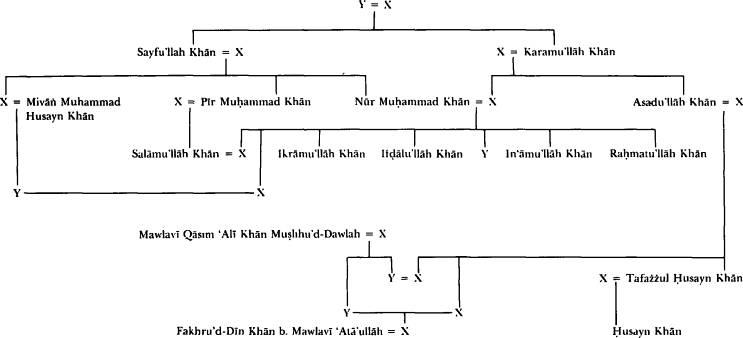
Diagram 1
The Kashmiri Service Family and Adoption of Shi‘ism
After the short-lived anti-British revolt of Asafu'd-Dawlah's successor Vazir ‘Ali in 1798, during which Tafazzul took a pro-British stance, the East India Company put Kashmiri's erstwhile pupil Sacadat ‘Ali Khan into power as nawab. The new ruler sent Tafazzul Husayn Khan back to Calcutta as the Awadh envoy, but Kashmiri soon died, in 1800.45
During his twenty years in Calcutta, Kashmiri learned fluent English and studied Latin so as to be able to read European scientific works. He translated books on the new European mathematics and physics, writing also on Sunni and Shi‘i hadiths and Islamic philosophy. He taught mathematics in the morning to students in Calcutta, then visited English friends until noon. In the afternoon he taught Imami law, and after supper expounded Hanafi law. In the evenings he read philosophy alone. A pious notable, a man of wealth and taste, he had but one vice, from a strict Shi‘i point of view: his love of music.46
Hazin, the displaced poet-mujtahid, and Tafazzul Husayn Khan, the scholar-diplomat, could hardly be considered professional Shi‘i clerics. They lived at a time when Imami Shi‘i institutions in North India barely existed, when a clerical career in itself made little sense for anyone interested in wealth, prestige, or power. Yet the time when court poets and gentlemen scholars could dominate Shi‘i intellectual life was passing. New religious elites were called into being by the rise of the Shi‘i court in Awadh.
The Physicians of Faizabad
The first phases of Shi‘i state formation in Awadh witnessed the establishment of a Shi‘i ruling group at the top of the social hierarchy, the development of a Shi‘i wing in the military, and the subordination of the old Sunni clerical and mystical families through intimidation or resumption of revenue-free land grants. From 1766 a second process began, the gradual formation of a Shi‘i religious class through notable-class patronage. A struggle commenced over the shape of the religious class, and over the control of religious resources. Traditional Shi‘i gentlemen scholars, used to coexisting with Sunnis and Hindus, were ranged against a growing class of professional Shi‘i clerics who emphasized social closure and Shi‘i communal identity.
Within Shujacu'd-Dawlah's new capital, Faizabad, a cabal of physicians trained in Avicennian medicine and the rational sciences at first established a
virtual monopoly over intellectual pursuits within the new capital. Soon after the nawab returned from his defeat at Baksar and took up residence in Faizabad, five religious-minded physicians from Delhi followed him there and were employed by the nawab and his wife, Bahu Begam, at high salaries. Among themselves, they evinced much factionalism and competition, but they closed ranks against outside physicians or scholars.
In the absence of any formal ecclesiastical Structures in the Shi‘i community of North India, literati with a secular training stepped into roles played by ulama in Safavid Iran. They strove to maintain control over both medical and pastoral functions, and over the vast sums of money available to those who claimed to provide both spiritual and physical health.47 Hakim Muhammad Mucalij Khan. the leader of the physicians, took charge of distributing charity to poor Sayyids, receiving donations for that purpose from the growing number of Shi‘i notables in Faizabad. Some critics charged him with embezzling substantial amounts of this charity. The number and financial resources of the medical doctors at court grew impressive; on his deathbed the nawab was attended by thirty physicians, whose combined salaries equaled Rs. 100,000 per year.48 A contemporary manuscript source mentions ten important medical doctors at Shujacu'd-Dawlah's court.49 These ten Shi‘i Sayyids and notables averaged Rs. 5,600 per year in stipends, exclusive of the substantial fees and gratuities they controlled. The pious physicians, some from Iranian or Iraqi ulama backgrounds, were something more than the elders of a nonconformist sect, yet far less than a professional ministry.
Shi‘i ulama of the traditional sort in Faizabad were subordinate to Mucalij Khan's clique of physicians. They had no control over Islamic charitable institutions, nor did Faizabad's Shi‘is have any public mosques or communal prayers, so that preachers lacked the opportunity to address large crowds. In both respects, Faizabad differed radically from Iran and Iraq. The major gatherings for Shi‘is, the meetings held to commemorate the martyrdoms of the Imams, were dominated by eulogizers, who specialized in chanting techniques, rather than by the scholars of Islam, who often frowned on the folk practices involved in such assemblies.50
The grants by Shi‘i notables served to attract increasing numbers of Imami ulama to Awadh's major cities. The arrival on the Awadh scene of numbers of trained experts in Shi‘i law with a scripturalist outlook challenged the reign of the physicians and Sufi pirs in the religious realm. As the nawab's court grew more autonomous, the ruling Nishapuri family favored an assertion of specifically Shi‘i law and ritual in order to accent its peculiar local values and authority. The ulama, rather than physicians or Sufis, could best articulate this statement.
The growing friction between these intellectual groups resulted in a confrontation in Faizabad in 1779, which led to a riot. The most important of the Shi‘i ulama in that city at the time, Mawlavi Muhammad Munir, had recently arrived from the Middle East. The eunuch Javahir ‘Ali Khan, the powerful manager of Bahu Begam's estates, gave the mawlavi a stipend for his support. Mulla ‘Abdu'l-Majid, an Iranian scholar who had previously served as the supervisor of a religious endowment in Najaf, backed Munir.
Hakim Mucalij Khan, perceiving these Iranian clerics as a threat to his own position, began to slander Mawlavi Muhammad Munir. The struggle for influence among the physicians and the ulama crystallized around a doctrinal issue. The clique of medical doctors held that the ‘Alid Zayd b. ‘Ali b. Husayn erred in leading Kufa in a revolt against the Umayyad government in A.D. 740. The Bahu Begam's eunuch courtiers, who competed with Mucalij Khan for influence, bearing him great enmity, sought the opinion of Mulla ‘Abdu'l-Majid on this point. He replied that it was wrong to criticize Zayd. Mucalij Khan stood firm, saying that he based his opinion on oral reports from the Imams.51
This minor issue most likely became a rallying point more because of its utility in expressing the conflict between these two status groups than because of its substance. The view of the physicians, a more quietist one, suited Shi‘is living in India under strong Sunni Mughal rule and in an overwhelmingly Sunni Muslim community. Just as Zayd should not have rebelled against the superior forces of the Umayyads, the physicians may have been implying, so Indian Shi‘is should quietly accept the rule of the Mughals. The immigrant ulama originally came from Iran, where Shi‘is formed a majority and anti-Sunni feeling ran high. Their support for Zayd the revolutionary came from a conviction that Shi‘is must at all odds assert themselves against Sunnis. The foreign-born ulama were more communalist and militant than the Indian intellectuals. With the rapid decline of Mughal power and the ascendancy of the Shi‘i nawab, such militancy became an increasingly viable option for members of the Awadh ruling class, such as the eunuchs in Faiza-bad.
In addition, the eunuchs may have been especially concerned to adopt a
strong position in order to demonstrate their credentials as Muslims. Eunuchs were the children of defeated Hindu Rajputs, who were mutilated and brought up as Shi‘is to attend upon the family of the nawab.52 Suspicion of having Hindu sympathies thus attached to them in the upper-class circles in which they moved, and they often attempted to pass some of their wealth on to Hindu relatives. By adopting a militant stance on the Zayd issue they could at once project their orthodoxy and hit out at the physicians, their competitors for the favors of the begam.
The conflict between the physicians and the ulama grew so heated that their partisans at length proposed a public debate. They fixed a day and announced the venue as the house of Bahar ‘Ali Khan, a eunuch in the service of Bahu Begam. The main parties arrived at dawn with slaves and personal troops. Hakim Mucalij Khan attempted to maintain his view by asserting to his opponent, Mulla‘Abdu'l-Majid, that reliable (muctabar ) oral reports (hadiths ) bore him out. The Iranian cleric challenged the elderly doctor on the technical meaning of the term "reliable" in the Shi‘i science of oral reports. When Mucalij Khan, who had studied primarily the rational sciences rather than oral reports, found himself unable to give a quick reply, Mulla ‘Abdu'l-Majid announced the physician's defeat and abruptly left the room. Fighting broke out and raged for hours among the supporters of the two debaters, with Javahir ‘Ali Khan's troops and retainers emerging the victors.53
The Faizabad riot of 1779 expressed the competition between Indian lay religious literati and immigrant Iranian professional clergy. It may further have symbolized the tensions brought about by the movement of some in Awadh toward a more scripturalist and communalist interpretation of Shi‘ism. The physicians, most of them formerly Delhi courtiers used to coexistence with Sunni superiors, could not meet the demand for specialists in Shi‘i law generated by the growth of the Awadh state.
Early Religious Policy under Asafu'd-Dawlah
As Shujacu'd-Dawlah's successor, Asafu'd-Dawlah (1775-97), became increasingly a ruler in his own right, and the Mughal Empire no more than a convenient fiction for whoever held Delhi, he reversed the parsimonious policy toward the state subvention of religious scholars and institutions pursued by the first three nawabs of Awadh. Indian traditions of rulership required the nawab to dispense huge amounts of patronage to inferiors and to holy men. Some notables who opposed this new direction were replaced by more amenable Shi‘is. Asafu'd-Dawlah not only reconfirmed long-standing endowments and stipends to Sunni, Shi‘i, and Hindu officials, mendicants, and
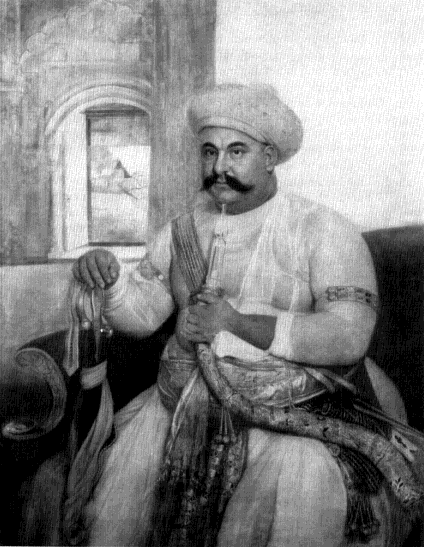
Figure 1
Nawab Asafu'd-Dawlah. Courtesy of the British Library.
religious institutions, but restored some that had been usurped. The nawab's religious munificence denoted no streak of puritanism or fanaticism. At least in the early years of his reign, he drank liquor and associated with common Hindus. Indeed, Sunnis and Hindus profited from the policy more than Shi‘is.54
Asafu'd-Dawlah grew renowned for bestowing hundreds of thousands of rupees on dervishes. Sayyids, and Shi‘i visitors from the Middle East.55 The policy served to attract increasing numbers of Shi‘i ulama to the new capital of Lucknow, to which he moved in order to escape the influence of the Faizabad establishment dominated by his father's courtiers and his mother, Bahu Begam. The administrators and civil servants closely related to the nawabate moved with him, but substantial numbers among the service elite remained in Faizabad in the employ of tax-farming and jagir -holding notables.56
The Shi‘i ulama in North India still enjoyed few of the advantages that accrued to the Sunni ulama under Mughal rule. Shi‘i scholars, to be sure, did participate in the development of the rational sciences, writing commentaries on the works used in the Nizami method. But just as that syllabus paid relatively little attention to the study of law and oral traditions within the Sunni context, so Shi‘i scholars were seldom well trained in the oral traditions of the Imams, Imami law, and the principles of jurisprudence.57 As a small minority in a Sunni intellectual world, Shi‘is most often studied with Sunni teachers. Lacking their own mosques and seminaries, they believed that the holding of Friday congregational prayers was illegitimate until the return of the hidden Twelfth Imam, who alone could rightfully lead them. This lack of integrating institutions and physical sites for communal study and worship inhibited the growth of a formal tradition of Shi‘i scholarship in northern India.
Still, a small ulama corps began to form, beginning with scholars who gathered in Faizabad after 1766, attracted by the patronage of the growing Shi‘i notable class there. Shujacu'd-Dawlah summoned the Akhbari Muhammad ‘Askari Jaunpuri to teach Shi‘i sciences in Faizabad.58 The nawab's wife, Bahu Begam, employed the great and popular teacher Mawlavi Majid Rudauli. Also of note were the legal specialist ‘Ata'u'llah Kashmiri and Sayyid Saricu'd-Din b. Ashraf Mahmud.59 As was mentioned, these ulama were in many ways subordinate to the court physicians.
The Early Career of Sayyid Dildar Ali Nasirabadi
The opportunities for education and patronage available to Shi‘i ulama from 1766 are demonstrated by the career of Sayyid Dildar ‘Ali Nasirabadi (1753-1820).60 Born and raised in the large, Sayyid-dominated village of Nasirabad in Rai Bareli not far from Lucknow, as a youth Sayyid Dildar ‘Ali learned Arabic and studied some basic texts in Nasirabad itself. He set out for other towns in order to pursue the rational sciences with individual scholars in the Muslim small towns. Nasirabadi's search for knowledge took him to the provincial capital of Allahabad, which had a relatively large Shi‘i population. He joined the classes of the Imami philosopher Ghulam Husayn Dakani Ilahabadi, with whom he studied most of the basic textbooks for the rational sciences. As was noted above, in 1769-72 Nasirabadi explored cosmography (hay'at ) with Tafazzul Husayn Khan, conveying questions and answers on the abstrusities of logic between his two mentors. Sayyid Dildar ‘Ali's student days were hard ones before he found a patron, and at one point he reportedly made a deal with a Hindu shopkeeper to serve as a night watchman for his shop if he could sleep on its doorstep.61
Young Nasirabadi's peregrinations also took him north to Shahjahanpur, which served until 1774 as the capital of Hafiz Rahmat Khan's Ruhilah domain. Until that date Shahjahanpur was an important, if small, intellectual center with the Farangi Mahall tradition strongly represented by two former heads of that institution, Mulla ‘Abdu'l-‘Ali and Mulla Hasan. Sayyid Dildar ‘Ali furthered his exploration of the rational sciences at the hands of Mulla ‘Abdu'l-‘Ali, one of the foremost contemporary minds in this field. The Shi‘i student at one point engaged in a heated debate with his distinguished tutor. Mulla Hasan Farangi-Mahalli, who had once angrily ejected Tafazzul Husayn Khan from his class, also debated Sayyid Dildar ‘Ali on matters of metaphysics.62
The encounter of Sayyid Dildar ‘Ali with these former heads of Farangi Mahall in Shahjahanpur is rich in irony. Both were forced to leave Lucknow
by Shi‘i communalists who enjoyed the backing of the nawab. Yet in their exile they taught and engaged in discussions with the future leader of Awadh's Shi‘is. Admittedly, they may not hate known he was a Shi‘i. But even in the face of the most powerful Forces for communal strife and separation, education in Awadh remained strangely ecumenical.
Sayyid Dildar ‘Ali left Shahjahanpur for Nasirabad, then journeyed to nearby Faizabad, where a number of Shi‘i ulama were gathering under the patronage of Shujacu'd-Dawlah and his notables. |He fell ill,| and was chided by the old nawab for studying too hard. When he recovered he followed the new court of Asafu'd-Dawlah to Lucknow, where he taught and also completed his studies.63 The difficulties facing a student without a wealthy patron are illustrated by an incident from Nasirabadi's youth. Unable to afford a servant to bring food from the city market, considered an unclean place where no gentleman would be seen, students had to do their own shopping. One of Nasirabadi's colleagues, Sayyid ‘Abdu'l-‘Ali Deoghatavi, volunteered to go to the bazaar, and was returning when he saw someone he knew coming down the road. He quickly hid himself. Then he considered that to hide a fault indicates a prideful desire to be honored by others. He caught up with his acquaintance, going out of his way to show himself and his bazaar-derived provisions.64
Finally, Nasirabadi's diligence was rewarded. His reputation for piety and ability, as well as some of his early compositions, reached the notice of Awadh's chief minister from 1777, Hasan Riza Khan. The illiterate official, having these works read to him, was favorably impressed and began financially supporting Sayyid Dildar ‘Ali, giving him a stipend of Rs. 30 per month and including him among his companions.65 Still, the young scholar was overshadowed by other, more important recipients of the chief minister's patronage, such as Sufi leaders. The Shi‘i notables in India did not at this point hold the ulama in such high esteem, preferring unlettered mystics to learned scholars.66
As the Shi‘i-ruled state of Awadh began developing a more extensive local bureaucracy, and as its notables increasingly felt a need to promote their branch of Islam, the ulama became more important. The patron-client relationship expanded and changed in character. Younger scholars, such as Sayyid Dildar ‘Ali, pioneered a new phase in ulama-state relations in the last quarter of the eighteenth century. Yet the need felt by the notables for a Shi‘i
clerical class was frustrated by the lack of local scholars trained in specifically Shi‘i sciences. In the absence of a Shi‘i seminary in North India, one solution was to have some teachers trained in the Shi‘i intellectual centers of Iran and Iraq.
Sayyid Dildar ‘Ali took his place among an increasing flow of Awadh Shi‘i scholars to the Shi‘i shrine cities of Mamluk Iraq, who went to study Shi‘i law and help spread the religion in India upon their return.67 An important predecessor, Mirza Khalil, went from Lucknow to Iraq, where he studied with the young Sayyid ‘Ali Tabataba'i, the nephew and son-in-law of Usuli leader Aqa Muhammad Baqir Bihbahani. Mirza Khalil, impressed with his teacher, endeavored to convince him to journey with him to India "in order to eradicate unbelief and ignorance." Sayyid ‘Ali, taken aback, fervently expressed his desire that God would never show him India or part him from the shrine cities. He reacted to the pious entreaty as if someone had prayed that evil might befall him.68 Most high ulama in Iran and Iraq showed reluctance to give up all the benefits they derived from living at the Shi‘i center in order to undertake a missionary career in an alien environment like North India.
Mirza Khalil on his return had his patron, Almas ‘Ali Khan, offer another scholarship of Rs. 2,000 for study in Iraq, to Akhbari notable scholars, but they refused it as too small.69 Finally Mirza Khalil went to another Akhbari, Sayyid Dildar ‘Ali Nasirabadi, who at first begged off on the grounds that he had just married and lacked means to support his wife while traveling. The moral imperative of such a journey, however, outweighed these considerations, and he set out in 1779 with one young companion, Sayyid Panah ‘Ali. They proceeded arduously overland through Rajasthan to Hyderabad in Sindh, and thence to the coast, where they boarded a ship for the sea journey to Basra.
Nasirabadi brought with him a copy of Muhammad Amin Astarabadi's Al-fawa'id al-madaniyyah , a work hugely popular among Shi‘i thinkers in North India. Written nearly two centuries earlier, this major statement of the Akhbari creed attacked such classical Usuli writers as Hasan ibn al-Mutahhar al-Hilli. During the long boat journey up the Euphrates Nasirabadi made friends with an Arab Shi‘i also en route to Najaf, where he had just begun his studies. Their discussions came around to the principles of jurisprudence. Nasirabadi supported the Akhbari position, whereas his Arab friend took the side of the Usulis. In this discussion Sayyid Dildar ‘Ali first
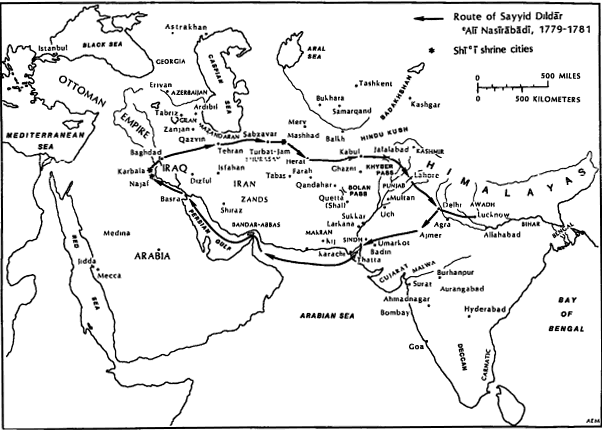
Map 3
Sayyid Dildar ‘Ali Nasirabadi's Journey to the Shrine Cities in 1779-81
encountered the now largely Usuli atmosphere of the shrine cities and found it disturbing.70
After performing visitation to the shrine of Imam ‘Ali, Sayyid Dildar ‘Ali met with prominent Shi‘i scholars in Najaf, committed Usulis. After several debates with them, Nasirabadi decided that if he insisted on arguing with his teachers, he would learn nothing. He then shifted north to Karbala, studying the oral reports from the Imams with Aqa Muhammad Baqir Bihbahani then seventy-five, and law with Bihbahani's younger disciples. Sayyid Dildar ‘Ali determined to throw himself into a study of Usuli works, given their rarity in India. He read widely on the issue of the validity of those oral reports that were related by only a single transmitter in each early generation (khabar al-ahad ).71 After study of the classical writers, Sayyid Dildar ‘Ali began to doubt the validity of Astarabadi's position. In the space of a few months from his arrival in Iraq he adopted the Usuli school, one reason surely being the predominance of this ideology at the centers of Shi‘i scholarship. He later perceived this change of views to be one of the graces he received by virtue of his proximity to the holy tombs of the Imams.72
Nasirabadi then sought out another of Bihbahani's students, Sayyid Muhammad Mihdi Tabataba'i, and studied with him briefly. He pointed out to his teacher that in the Usuli system either a believer must be himself a mujtahid, or he must emulate a living mujtahid. But, he continued, the Shi‘is of India were deprived of any opportunity for either, so that they might land in perdition. Tabataba'i replied that Indian Shi‘is must practice caution (ihtiyat ), following the most strict of the major positions on any matter of law. Nasirabadi riposted that Majlisi I once said that the most cautious position was not always the correct one. Sayyid Muhammad Mihdi answered that such instances were rare.73 Sayyid Dildar ‘Ali's dissatisfaction with the practice of caution as a solution to the dilemma of Indian Usulis suggests that even then he saw the need for religious leadership which the spread of Usulism in Awadh would create.
Because of his Indian background Nasirabadi had great difficulty in being taken seriously as a scholar, some Iranian students insisting that there simply were no ulama in India. They found the very thought of an Indian mujtahid absurd, given that only three scholars at the shrine cities were recognized exemplars.
After about a year and a half, Sayyid Dildar ‘Ali returned to India overland via Kazimayn, Tehran, and Mashhad, wintering in Khurasan and
studying there briefly. On arriving in Lucknow he met with Hasan Riza Khan and had an interview with Nawab Asafu'd-Dawlah. In 1781 he began teaching and writing in Lucknow, producing a wide-ranging attack on Akhbari ideas and beginning the task of training a new generation of Shi‘i scholars in Usuli sciences.
Conclusion
The religion of the ruling house in preindustrial West and South Asia generally became an clement in state formation. The cultural traditions of Islam dictated that a Muslim stale have its sovereignty proclaimed in the Friday afternoon sermons, and in the grandeur of its cathedral mosques. In a patrimonial bureaucracy, religion became an important bond, the adoption of which allowed eunuchs and courtiers to receive appointments to high office. In Awadh, even Sunni elites outside the ruling circle sometimes adopted Shi‘ism or expressed greater love of ‘Ali and his family within a Sunni framework, in order to bond themselves with the ruling house. As will be seen, Hindu notables and government officials also accommodated themselves to Awadh's newly Shi‘i atmosphere.
Awadh's external borders were demarcated by wars with the Bangash and Ruhilah Afghan clans and with the British. In the Bangash battles, not only professional soldiers but Shaykhzadah clansmen defended their region arid championed Nishapuri rule. This gives a clue to internal processes at work in Awadh, whereby local Sunni elites expressed a preference for even Shi‘i nawabi rule over other alternatives. The nawabs derived their legitimacy from Mughal appointment, and their power from Shi‘i and Hindu troops. Although they expropriated many Sunni revenue-free holdings subventing religious institutions, they were seen by most Sunnis as the lesser of evils when compared with the Afghans.
Awadh's move toward greater autonomy from the Mughals, and the desire of Shi‘i notables for experts in Imami law and theology to service their households, created an increasing need for a professional Shi‘i clergy. At first this exigency was partially met by the court physicians, then by an influx of Iranian and Iraqi Shi‘i ulama seeking patronage. The clash of physicians with foreign ulama pointed to the need for an indigenous, trained ulama corps, who Could help to articulate symbolically the growing autonomy of Nishapuri Awadh and spread Shi‘i sciences. Sayyid Dildar ‘Ali's two-year sojourn in Iraq and Iran was a first step toward the formation of such a corps.
PART TWO
THE ORIGINS AND DEVELOPMENT OF POPULAR SHI'ISM IN AWADH
3
Shi'ism and Muslim Social Groups
The origins and social composition of the Shi‘i population in Awadh are central questions for the social historian of religion, albeit questions difficult to answer. The flowering of Imami Shi‘i popular ritual, and the spread of formal Imami religious institutions in the nawabi period took place, not in a vacuum, but against a background of folk beliefs now difficult to recover. The Shi‘i notables that flocked to the nawabi court, many from Iran, Kashmir, and Delhi, are easier to trace than the partisans of ‘Ali in the small towns and in the bazaars. Nevertheless, nineteenth-century British census takers and administrators collected information useful for a reconstruction of the social origins of Awadh's Shi‘is, and local and family histories sometimes also contain relevant data.
This survey of Shi‘i influence on the major Muslim social groups in Awadh will look first at the "noble" (ashraf ) castes, most of them rural gentry, urban administrators and tax-farmers, or merchants. Since these groups often cannot be precisely identified by social class, they will be discussed as status groups, in the Weberian sense. Then the little available information on Shi‘ism among artisans and craftsmen will be presented. Finally, there will be a discussion of links between Shi‘ism and north Indian Sufi brotherhoods, religious organizations that often had mass followings. Shi‘is always remained a small minority in Awadh, but their influence with the nawabi court gave them an importance out of proportion to their numbers, so that they profoundly influenced Awadh culture.
Shi'is and the Census
The north Indian Shi‘i population in the eighteenth century can only be guessed at, and not until after the fall of the Awadh kingdom do population
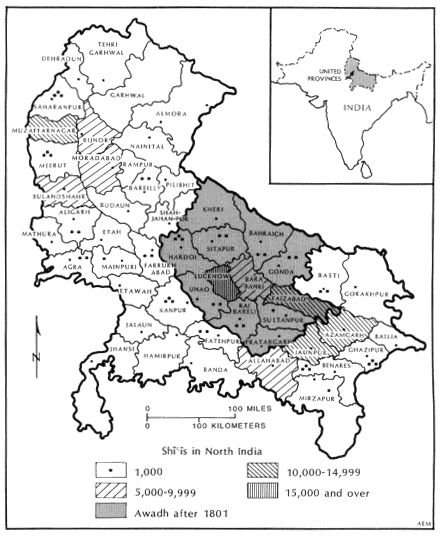
Map 4
Geographical Distribution of Shi‘is in North India, 1881 Census (by
absolute number)
statistics become available for the area. Tables, as of 1881, give Sunni and Shi‘i population figures in each district of the combined British administrative unit of the North-Western Provinces and Oudh (an area nearly equivalent to the Greater Awadh ruled by Shujacu'd-Dawlah in the eighteenth century). But census takers did not divide Muslims by sect when they recorded their occupations. We thus know the number of Muslim weavers in Lucknow district, but not how many of them were Shi‘is.
Without census statistics for the occupations of Shi‘is and Sunnis as separate groups, the question of the specific niches in society filled by Shi‘is cannot be answered. Nevertheless, it must be bound up with the social position of the Muslims in general. Even here the British census figures, frustratingly incomplete, have the disadvantage for the period under study of originating late in the nineteenth century. The census of 1891 first gave tables showing caste and occupation by religion in the North-Western Provinces and Oudh, and Crooke's classic Tribes and Castes supplemented it for ethnographic information, making it, for all the problems mentioned above, a good analytical starting point.
The census for the area of concern here covered two late-nineteenth-century administrative divisions. The first, the North-Western Provinces, constituted areas the British conquered north of Awadh, as well as provinces they annexed from Nawab Sacadat ‘Ali Khan of Awadh in 1801. The second, "Oudh," was the British name for the area of Awadh that remained under the rule of the nawab after he ceded half of it to the British East India Company in 1801. The British later annexed "Oudh" itself in 1856.
The British census takers extensively employed the category of "caste" (jat ), even for Muslims, and preferred this category over occupational ones, creating conceptual problems in their collection of data. A weaver (julahah ), displaced by the influx of cheap British textiles, who began working as a bearer might give his caste as weaver without mentioning his occupation. Census takers created an even more serious problem for historians by recording high-status "caste" groups such as Mughals and Sayyids only under those rubrics, assigning them no occupation.1 A Shaykh who wove for a living but simply reported his ethnic identity would be included in the Shaykhs rather than in the weavers.
This confusing procedure has left us with over two million Muslims, 37 percent of the Muslim population in the North-Western Provinces and Oudh, classified only as Mughal, Pathan, Sayyid, or Shaykh, all groups being opaque as to actual occupation. Many high-caste Muslims may have been reluctant to admit to being employed, aspiring to at least the appear-
ance of being gentlemen of independent means. Although most Mughals probably owned property and land, and many Sayyids held land, large numbers of Pathans and Shaykhs almost certainly worked as skilled artisans, owning little or no land. On the other hand, the landholding elite no doubt contained numerous Shaykhs and Pathans.
The "Noble" Castes
Although the statistics concerning the "noble" (ashraf ) castes therefore tell us little about social classes, they tell us much about status groups. Max Weber's conception of status groups (Stande ) terminologically derives from the preindustrial European division of society into "orders" based on function and privilege. In the industrializing Germany of the early twentieth century Weber appropriated the word "order" (Stand ) to a new use, in English rendered by "status group." In Weber's exposition, social classes are determined by their economic position and by market forces, whereas status groups are culturally determined bodies with a more ambiguous relationship to economic position.2 Status groups depend on honor and on a style of life, and the group's solidarity is often reinforced by marrying only within it (endogamy).
Weber gave as an example of status groups American clubs, in which persons of various social backgrounds might meet. He was aware that the variation tended not to be extreme, and that status groups were linked with social classes in many ways. In the long run, he noted, property is always recognized as a status qualification. But then, so might be the lack of property, as in the case of wandering holy men. Status groups tend to monopolize a set of ideal and material privileges. But material privileges are not solely determinative, and a newly wealthy family might be excluded from a wealthy status group because it is seen to lack the ideal qualifications for membership. Weber also pointed out that status groups could evolve into castes, who religiously felt that contact with persons outside their caste defiled them. Status groups become castes when they involve underlying differences that are held to be ethnic.
A Weberian approach to the Muslim ashraf groups solves many conceptual problems, since Weber saw status groups and castes as similar phenomena on a continuum, beginning with purely conventional clubs and ending with full-blown Hindu-style castes. The Muslim noble groups certainly began as status groups, and through endogamy and declarations of common ancestry moved toward becoming castes. Caste formation in their case seldom achieved the completeness witnessed among the Hindu groups.
For instance, not all members of the Muslim noble castes would see contact with a common Muslim as ritually polluting. Many anthropologists of India have seen the Muslim "castes" as "caste-analogues," social formations that imitated the pure Hindu castes. Weber's approach allows us rather to see them as consequences of status-group development along ethnic lines. Thus, the Sayyids, or putative descendants of the Prophet Muhammad, would be "castes" in the Weberian sense in many parts of the Muslim world, and not only in India. This fact in itself brings into question the necessity of seeing Indian Sayyids as a "caste-analogue" created by the influence of a Hindu environment. The genuine influence of Hindu conceptions on Muslim status groups in transition toward becoming castes can hardly be denied, but influence differs from causation.
The highest status group among Muslims, the Sayyids, included a quarter of a million persons in the area under study, constituting only about 4 percent of the total Muslim population and 10 percent of the noble castes taken as a group. The Sayyids asserted their descent from the Prophet Muhammad or from one of his close relatives. This link to the holy and revered person of the Messenger of God gave Sayyids special status and privileges within the Muslim community. Many who declared their Sayyid descent in India did so as a means to or statement of upward mobility, and lineage claims must be
|
Table 2 |
|||||||||||||||
|
Oudh (Awadh) |
N-W. P. & Oudh |
||||||||||||||
|
Caste |
No. |
% of Ashraf |
% of Muslims |
% of Pop. |
No. |
% of Ashraf |
% of Muslims |
% of Pop. |
|||||||
|
Mughals |
31,220 |
5.7 |
1.9 |
0.3 |
76,683 |
3.3 |
1.2 |
0.2 |
|||||||
|
Pathans |
198,560 |
36.2 |
12.2 |
1.6 |
700,393 |
29.8 |
11.0 |
1.5 |
|||||||
|
Sayyids |
65,814 |
12.0 |
4.0 |
0.5 |
242,811 |
10.3 |
3,8 |
0.5 |
|||||||
|
Shaykhs |
253,353 |
46.1 |
15.6 |
2.0 |
1,332,566 |
56 8 |
20.9 |
2.8 |
|||||||
|
Total |
548,947 |
100.0 |
33.8 |
4.3 |
2,352,453 |
100.0 |
37.1 |
5.0 |
|||||||
|
Total |
1,620,930 |
100.0 |
12.8 |
6,346,651 |
100.0 |
13.5 |
|||||||||
|
Total |
12,650,831 |
100.0 |
46,905,085 |
100.0 |
|||||||||||
treated with circumspection. But the biological reality of such sources of family honor is sociologically irrelevant when the public generally accepts the lineage as authentic. A little over 10 percent of noble Muslims living in the North-Western Provinces and Oudh were Sayyids, whereas in Oudh the percentage was twelve. This slight disproportion may represent Sayyid families attracted to Awadh during the rule of the nawabs, themselves Sayyids, and who, as Shi‘is, guaranteed a special place in their dominions for members of the Prophet's family.
Awadh's Sayyids divided themselves genealogically into many subgroups, the most numerous being those asserting descent from the Prophet through his daughter, Fatimah, and her husband, ‘Ali. For extra honor, or to stress their Shi‘ism, some emphasized descent from ‘Ali and Fatimah through one of their descendants, most often one of the Twelve Imams revered by the Imami Shi‘is. Over a quarter of Awadh's Sayyids asserted descent from Imam Riza, the eighth Imam, and almost 10 percent from Imam Husayn, the third Imam. Another 10 percent reported their lineage as going back to Zayd, another ‘Alid. Altogether, those asserting descent from Fatimah and her descendants, including the Twelve Imams, constituted 67 percent of the Sayyids. The rest gave their forebear as another relative of the Prophet, such as his uncle ‘Abbas, or identified themselves according to Sufi order (Chishti, Qadiri, Jalali Suhravardi) or place of origin (Baghdad, Bukhara, Sabzavar).3
A powerful link existed between Sayyids and Shi‘i Islam. Since the majority of Sayyids emphasized descent from an Imam revered by the Imami Shi‘is, they often sympathized with Shi‘i figures against their foes, the latter often portrayed as heroes by Sunnis. Though most Sayyids remained Sunnis, even they tended to have pro-‘Alid sympathies. The Sayyids were particularly susceptible to the Shi‘i ideas filtering into the Mughal Empire from Iran after 1501. A sociologist who studied Shi‘i marriage customs found that, in a sample drawn from middle- and upper-class social networks in several geographical locations, fully half his respondents said they were Sayyids. A strong Shi‘i presence among Sayyids appears in other sources, many Sayyid families in the upper Doab, for instance, being Shi‘is.4 Such data, admittedly impressionistic, nevertheless give a strong and consistent impression.
Nearly a quarter of Awadh's Sayyids late in the nineteenth century lived in Lucknow district, and another 12 percent dwelled in Faizabad district. Bara Banki, Gonda, and Hardoi also possessed large Sayyid populations, but all the other districts of Awadh had only three to four thousand Sayyids each. The privileges, patronage, and charities bestowed on Sayyids in the nawabi
centers of Lucknow and Faizabad acted as a magnet for them. The rural Sayyids congregated, not in the very small Hindu villages that accounted for most human habitation in North India, but in large villages or small towns (qasabahs ), where they formed part of the landholding class.5
In the qasabahs , local trade depots with small permanent bazaars, landholders built forts, water tanks, mosques, and irrigation facilities. Despite their rural setting, these islands of semiurban settlement fostered some literate culture among the Muslim gentry based there, allowing them to send some of their sons to the imperial court as civil servants and religious dignitaries, and so to maintain links with the cosmopolitan center. Indeed, both rentier and courtly service status were crucial to the qasabah elite families, and if both were not maintained, their fortunes could easily decline.6
The small landholding families based in the provincial towns originally were of several types. The Mughal monarchs often granted revenue from land (madad-i macash ) to religious scholars, mystics, and Sayyid or other noble families. The Mughal rulers did not thereby alienate the land and could resume the grant at any time. A more permanent form of landed wealth was the zamindari , and old provincial zamindar families built up hereditary estates. As Muzaffar Alam has shown, in the late seventeenth and early eighteenth centuries the Delhi court treated holders of madad-i macash favorably in tax assessment, encouraging their power as a balance to the increasingly insubordinate old zamindari families. Many learned and Sayyid families holding revenue grants used their wealth to purchase zamindaris .7 In the nineteenth century some small landholding (zamindar ) houses built up estates consisting of hundreds of villages, becoming very large landholders (tacalluqdars ). Despite their sometimes positive role in keeping up irrigation facilities and in providing security through their forts, many zamindars , whether Muslim or Hindu, preyed parasitically on the labor of the Hindu peasants who worked their estates and lived outside the fort's protecting walls.
Insights into the Sayyid gentry can be gained from considering the histories of some prominent families. In the Akbarpur parganah of Faizabad district twelve Hindu and twelve Muslim landed houses predominated from medieval times. One of the Muslim houses, whose numerous nineteenth-century members were Shi‘is, asserted their descent from Sayyid Taj, said to
have emigrated from Arabia in the mid-fourteenth century. Another family traced itself back to Sayyid Ahmad, also from "Arabia," through the medieval magnates Sayyid Phul and Sayyid Piyare, the Hindi names perhaps indicating Hindu background masked by later usurpation of Muslim noble status.
Also of note were the progeny of Sayyid Sulayman Nishapuri, who settled in Awadh in 1403 and married into the family of the aforementioned Sayyid Ahmad. He acquired a huge estate, and even in the nineteenth century believers venerated his tomb by an annual ceremony. His descendants, Shi‘is, are numerous. They include the Pirpur and Kataria tacalluqdar landholding houses, which produced great-estate builders in the nineteenth century. Shaykh Ahmad Qattal Luristani, said to have come from Iran, arrived in tile early 1400s. At one time eleven distinct branches of his family owned land in Akbarpur parganah, but these villages were absorbed into the tacalluqah estates of Pirpur and Samanpur. Luristani's putative descendants are Shi‘is. In the Birhar parganah, the Sayyids of Nasirabad asserted their descent from Sayyid Nasiru'd-Din, said to have fled Iran during the disruptions caused by Timur's military campaigns. Akbar granted the family revenue-free holdings, although these were partially confiscated by Nawab Sacadat ‘Ali Khan in the nineteenth century.8
In Bara Banki, Muslim Shaykhs and Sayyids owned almost half the villages, though they constituted only 2.6 and 0.6 percent of the district's population, respectively, in the late nineteenth century. In some small towns, Sayyids exercised unquestioned dominance. The Shi‘i Sayyids of Zaydpur had ten mosques and seventeen imambarahs in the late nineteenth century, but permitted no Sunni mosques or Hindu temples.9 In Kintur, Bara Banki, Sayyids held two-thirds of the village lands, including a number of rent-free (mucafi ) grants.10 The Sayyids there asserted their descent from the brothers Sayyids Sharafu'd-Din and Muhammad of Nishapur, said to have forsaken Iran for Awadh in the time of Hulagu the Il-Khanid Mongol ruler. The Nishapuri Sayyids of Kintur produced several outstanding Shi‘i religious scholars in the eighteenth and nineteenth centuries.11
Sayyid landholders exerted great social and cultural influence from tile small towns they helped create in Hardoi, as well. In the nineteenth century a thousand Sayyids owned half the land in parganah Bilgram, saying they were descended from Sayyid Muhammad Wasiti, who conquered it in A.D. 1217. (He is also held to be the progenitor of the Barhah Sayyids in Muzaffarnagar
north of Awadh.) In the time of Shah Jahan, Sayyid Ismacil Bilgrami adopted Shi‘ism.12 Even in the heavily Sunni atmosphere of Awrangzib's India, Bilgrami Sayyids wrote elegies for members of the Prophet's family, such as ‘Ali, thus exalting their own genealogy.13 Some prominent Bilgram Sayyid families embraced Shi‘ism in the late eighteenth century. Their putative cousins. in Barhah, of course, became Shi‘is centuries earlier, and they wielded paramount influence at the Mughal court in the first two decades of the eighteenth century. The Sayyids were also important in Sandila, another renowned qasabah of Hardoi, where they owned 8 percent of the surrounding villages in the nineteenth century.14
The Sayyids of Ja'is and Nasirabad in Rai Bareli district further exemplify the pattern of early settlement, imperial land grants, and later adoption of Shi‘ism. They hold themselves to be in the line of Sayyid Najmu'd-Din Sabzavari, who they say accompanied Salar Mascud Ghazi on his eleventh-century expedition into North India. (Their own genealogies belie such antiquity, going back, at 24.1 years per generation, only to the fourteenth century.) The Sayyid qasabah at Ja'is split seven generations after Sabzavari's arrival when Sayyid Zakariyya moved three miles away, founding a new settlement inside a fort at what became Nasirabad. The Sayyids of Ja'is and Nasirabad held land grants from the central government, dominating surrounding villages, but coming into sanguinary conflict with Hindu martial clans, often having to submit to powerful rajas. They benefited from the trade between Delhi and Allahabad, and, later, from the area's thriving textile trade. One of their number tutored Bahadur Shah (r. 1707-12). During his reign, a time of great Shi‘i influence at court, a few Sayyids in Nasirabad embraced Imami Shi‘ism. Later, Shi‘i nawabi rule in Awadh accelerated the adoption of Shi‘i beliefs.15 Nasirabad produced an important Shi‘i cleric, Sayyid Dildar ‘Ali (1753-1820), whose career will be described in later chapters.
In Jarwal, Bahraich, the Sayyid line derived from Sayyid Zakariyya, who fled Iran during the Mongol invasion by Genghis Khan, obtaining a 15,000 bigha grant from the Delhi sovereign, Ghiyathu'd-Din. In 1800 the Jarwal Sayyids, some of them Shi‘is, displaced the Ansari Shaykhs and came to hold 276 out of 365 villages in the parganah, although their holdings thereafter de-
clined rapidly to (a still formidable) 76 villages in 1877.16
The ‘Alid genealogies of all Sayyids, and the pro-Shi‘i sentiments of many, led them to develop origin myths that tied in with the tragedy of Karbala (where the Prophet's grandson Husayn b. ‘Ali died fighting the Umayyad government in A.D. 680). One Sayyid author from Ja'is wrote of the Awadh qasabahs in the nineteenth century that most of their headmen were Sayyids or Shaykhs because these groups, having supported ‘Ali and the Imams against other claimants to rulership of the Islamic Empire, fled the central Islamic lands for fear of their lives when the holy figures met defeat. They made their way through Afghanistan down to North India, settling in Ja'is, Nasirabad, Manekpur, Salon, Bilgram, Sultanpur, Sethan, Rudauli, Amethi, and so forth. Through royal edicts, they became rent-free landholders (jagirddars ) and middle landlords (zamindars ).17
This myth held that Sayyids and some Shaykhs toiled as Muslim pioneers in an alien and hostile Hindu environment because of the same injustice that struck down ‘Ali and Husayn and denied the Prophet's immediate family
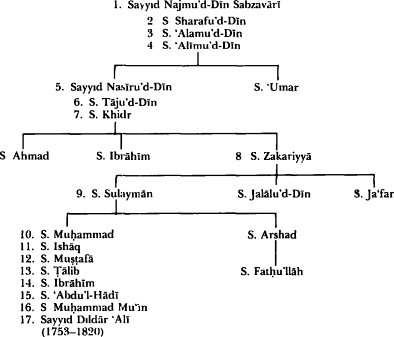
Diagram 2
The Genealogy of Sayyid Dildar ‘Ali of Nasirabad
political power after his passing. Even in their exile, he wrote, the Sayyid and Shaykh partisans of ‘Ali found themselves pursued by fanatical Sunnis, such as the Pushtu-speaking Afghan immigrants to North India. The Afghans, antagonistic toward the Sayyids, refused to give them their daughters in marriage.18 Families declaring themselves Sayyids often competed for land with Shaykh houses tracing their descent from Abu Bakr or ‘Umar, and Shi‘ism had the ideological advantage for Sayyids of rendering the Shaykhs' ancestry a source of shame rather than pride. Shi‘is held that the caliphs usurped rights belonging properly to the family of the Prophet.
Sayyids also pursued trades in urban centers. In the eighteenth century the Sayyid artisans of Amroha were renowned for their gilded pottery decorated with colorful floral designs.19 In Lucknow, Sayyids engaged in all professions and arts save trading.20 Mrs. Ali, who lived among Lucknow's Shi‘is for a decade in the early nineteenth century, wrote of the urban Sayyids: "They rarely embark in trade, and never can have any share in banking, or such professions as would draw them into dealings of usury. They arc chiefly employed as writers, moonshies, maulvees, and moolahs, doctors of the law and readers of the Khoraun; they arc allowed to enter the army, to accept offices of state."21 She noted that a special charity existed among Shi‘is for indigent Sayyids, pious believers giving one-fifth (khums ) of certain kinds of income to them in charity. Mrs. Ali reported that no self-respecting Sayyid with sufficient means of support would accept this charity. Moreover, she indicated that many Sayyids refused gifts if they suspected that the donor gained the money through usury.22
Among the Sayyids, the conflict between status and class can be clearly discerned. Mrs. Ali said that conscientious Sayyid families always regarded birth before wealth in contracting marriages. Some poor Sayyid families preferred that their daughters remain spinsters rather than marry into rich families not of Sayyid background. Since the father's need to provide a costly trousseau (jahiz ) for his daughter posed a major obstacle to marriage for the poor, one form of charity consisted in a well-to-do Shi‘i presenting an indigent Sayyid father with such a trousseau.
Mrs. Ali described a poor Sayyid household with unmarried girls. Highly educated, they could read the Qur'an in Arabic and its commentaries in Persian. This family preferred that the girls spend their days performing needlework rather than wed a wealthy non-Sayyid.23 Those in this situation attempted to maintain their status honor by upholding social conventions of
hypergamy (where the daughter marries a social equal or superior) and by engaging in a style of life not incompatible with their status pretensions.24 Although Mrs. Ali said that "conscientious" Sayyids followed this behavior, less strict Sayyid families sometimes traded their high status for increased economic security by marrying their girls to well-to-do non-Sayyids. Also, no doubt some risked their honor by claiming the "share of the Sayyids" (sahm-i sadat ) even though they were not particularly indigent.
At the nawabi court in Lucknow, courtiers took respect for Sayyids seriously in social intercourse. For instance, in military parades the Sayyid regiments marched ahead of the others. Relevant anecdotes on this theme were recounted by Mir In-sha'a'llah Khan, a Sayyid whose family said they immigrated to North India from Najaf in Iraq, and a respected poet and boon companion of Nawab Sacadat ‘Ali Khan (1799-1814).25 Once in a conversation with the nawab, by a slip of the tongue he referred to a garden called "Imambagh" (the garden of the Imam) as "Imambap" (the father of the Imam). This unintended allusion to the Prophet would ordinarily have been a serious breach of etiquette, but Sacadat ‘Ali Khan grinned and excused the poet on the grounds of his own Sayyid origin. Once the powerful eunuch Afarin ‘Ali Khan had an altercation with Mir In-sha'a'llah Khan. Later at a salon, the poet quoted a verse in which he satirically pronounced imprecations upon himself. Afarin ‘Ali Khan pounced on the opportunity to second the sentiments. The poet angrily replied that a non-Sayyid who curses a Sayyid is himself accursed. The nawab, upset at any hint of disrespect for the House of the Prophet in his court, begged forgiveness for Afarin ‘Ali Khan. Upon seeing that his foe had lost face, Mir In-sha'a'llah pardoned him.26
Sayyids enjoyed ceremonial marks of honor at court and in polite Muslim society, but their position was hardly unassailable. Although Sayyid-oriented philanthropies acted as a safety net, members of this group could become quite badly off. Further, they did not necessarily enjoy political privileges. When Sacadat ‘Ali Khan agreed to cede half his dominions to the British in 1801 to pay off debts that the governor-general maintained the previous nawab had incurred, he grew reluctant to make any more grants of state land to traditional recipients such as Sayyid families. Indeed, he resumed former Sayyid grants in such areas as Birhar, Faizabad, and Sandila, Hardoi.27
The Sunni-Shi‘i schism caused problems for Sayyids, for although both branches of Islam respected the descendants of the Prophet, they revered
only those adhering to their own branch. For instance, the chief mujtahid of Lucknow from 1820 to 1867, Sayyid Muhammad Nasirabadi, ruled that if a Sayyid does not have real faith (i.e., if he is not a Shi‘i), then his being a Sayyid does him no good whatsoever.28 A Sayyid family wishing to maintain high-status honor among both Sunni and Shi‘i neighbors would face difficulties. Ultimately such a family might have to choose which community it desired honor from, and the wealth of Shi‘i notables and patrons in nawabi Awadh helped attract Sayyids to the Imami community.
The Mughals often possessed greater wealth and held higher office than the Sayyids, though they, had lower status.29 Indians applied the term "Mughal" (mughul ), literally meaning "Mongol," indiscriminately to all immigrants from central Asia, including Iran. These Iranians and ethnic Turks generally filled high-ranking posts with the government or served in the cavalry. Though they frequently received land grants in remuneration for their services, they were most often absentee landlords, remaining out of touch with the provincial, rural Muslim elite in the qasabahs .30 Some Mughals also came to India as long-distance merchants.
The Mughal Empire employed Persian both for administrative purposes and as the polite language at court. This meant that educated Iranians immigrating to wealthy India possessed special advantages in procuring positions as administrators, bureaucrats, and men of the pen. Since the Safavid regime in Iran presided over a mass conversion to Imami Shi‘ism, immigrants during the seventeenth and eighteenth centuries often brought with them a Shi‘i identity. Nor were the numbers of such settlers small. The French jeweler and merchant Chardin gave as one reason for Iran's under-population in the late seventeenth century the exodus to India.31 In fact, it seems unlikely that enough Iranians left for the subcontinent to affect Iran's population, but Chardin's observation underscores the large number of Iranians he saw in India. In the 1660s, most of these immigrants must have been Shi‘is. During the early reign of the Mughal emperor Awrangzib, 1658-78, out of 486 high-office holders 136, or 28 percent, were Iranians.32 These mostly Shi‘i Iranians often hid their beliefs at the Sunni Mughal court. If one added to the Iranians the number of Indian Shi‘i officeholders (e.g., the Barhah Sayyids), the proportion of Shi‘i nobles would reach one-third. Moreover, nearly half of the fifty-one highest-office holders were Ira-
nians. The conflict between the Shi‘i Iranians and the Sunni central Asian Turks along religious and ethnic lines much influenced court politics.33
In 1891 nearly half of all the Mughals in the North-West Provinces and Oudh resided in the comparatively small area of Awadh (Oudh) proper. Although they constituted only 3 percent of the noble castes in the whole area, they were almost 6 percent of the ashraf in Awadh. This without doubt reflects the employment opportunities offered them by the Awadh state during the nineteenth century, as the British abolished the old Muslim bureaucracies in Delhi and Bengal.
More than 50 percent of the Mughals in Awadh resided in Lucknow and Faizabad districts, the two great administrative centers of the region, over 40 percent dwelling in Lucknow alone. The only other major Mughal population center was Sitapur district; but Mughal immigration there was probably spurred by the post-annexation splendor of the Mahmudabad estate and most likely did not represent a feature of nawabi Awadh. Two-thirds of the Mughals were not classed under any ethnic subdivisions in the census, but large numbers were Shi‘i Iranians. The remaining third fell into three groups: Chaghatai Turks, Turkman, and Qizilbash. Of the three, the Qizilbash constituted the smallest group, with only 1,237 listed. All Shi‘is, they played an important role in establishing Shi‘ism both in Iran and in the subcontinent, and most of them lived in Awadh proper.
The Qizilbash, originally a federation of Turkish-speaking tribes in Anatolia, moved east in the fifteenth century because of increasing Ottoman control over their grazing lands. They lent their aid in the establishment of the Shi‘i Safavid state in Iran.34 Over two centuries later some served in Nadir Shah's army, playing a central role in the invasion of India and in the sack of Delhi in 1739. The second nawab of Awadh, Safdar Jang (1739-54), made it a point to employ Iranian Mughals for his cavalry, as well as Kashmiri Shi‘is who imitated the Iranians in speech and dress. He hired away six or seven thousand Qizilbash warriors from Nadir Shah's army. Their subsequent career was checkered, and after the defeat of his forces at the hands of the British at Baksar in 1764, Nawab Shujacu'd-Dawlah dismissed many of them and even razed some of the Mughals' houses.35 Nevertheless, the Iranian traveler Shushtari found large numbers of Qizilbash notables in Lucknow in 1796.36 Many Qizilbash cavalrymen may have sunk into the laboring classes in Faizabad and Lucknow, losing their original identity, and the confused lineage of Mughals, owing to their tendency to intermarry with other groups,
including Hindus, may have caused their reported numbers to be low.37 On the other hand, the Qizilbash would have taken local wives and raised substantial numbers of Shi‘i children. Some Rajput converts to Islam attempted to create a Mughal identity for themselves, which may often have involved affecting Iranian, Shi‘i ways.
Although most of the Turkish Mughals adhered to Sunnism, even they sometimes, like others in the upper class, adopted Shi‘ism in the eighteenth century. An example is the family of Khwaja Musa Khan, a professed descendant of the Sufi leader Baha'u'd-Din Naqshband. Emigrating from central Asia to India early in the eighteenth century, he married into the Mughal royal family. Under the influence of Burhanu'l-Mulk, the first nawab of Awadh, he became a Shi‘i. His son, Madaru'd-Dawlah, refused to practice dissimulation in Sunni-dominated Delhi, openly mourning the Imam Husayn during Muharram. His daughter married Nawab Sacadat ‘Ali Khan of Awadh, and his son-in-law granted him a huge rent-free holding worth Rs. 60,000 per year.38 This Turkish family with staunch Sunni origins employed its adherence to Shi‘ism as a means to cement relations with rising Shi‘i powers, such as the nawabs of Awadh.
By far the most numerous of the ashraf groups were the Shaykhs and Pathans. Over half of the "noble" caste members in North-Western Provinces and Oudh were Shaykhs.39 In Awadh the proportion was slightly less, about 46 percent. Most asserted their descent from the first three caliphs or from other companions of the Prophet. The upper-class Shaykhs, often middle or large landholders in the districts, dwelt in qasabahs alongside the Sayyids. But many village and urban artisans and skilled laborers said they were Shaykhs, which accounts for their huge numbers. Shaykhs tended to be Sunnis, though some became partisans of ‘Ali and his eleven descendants. Many Sunni Shaykhs did commemorate the martyrdom of the Imam Husayn, though they frowned on the violent self-flagellation of the Imamis and could not abide the Shi‘i practice of pronouncing imprecations on the first three caliphs.
Pathans, descendants of Pushtu-speaking tribesmen, roamed down into North India from Afghanistan and the area around Peshawar throughout the medieval period. The eighteenth century witnessed a particularly great influx of Pukhtun tribesmen, who in their Indian environment became "Pathans" if they were accepted as noble, but remained known simply by their tribal names (e.g., Ruhilah) if such pretensions were rejected. The 700,000 of them in the province in the late nineteenth century constituted a third of the members of the "noble" castes. Earlier in the century many of
them roamed as pastoral nomads, some settling as landlords and warriors in the fortified qasabahs . Many became artisans and skilled laborers before the 1891 census. Rajput converts often attempted to usurp Pathan status.
Pathans, mostly originally Sunnis, generally retained their ancestral faith in North India. Some few may have been Persian-speaking Shi‘i Hazaras who joined Pukhtuns in southward migrations, or Shi‘i Afghans from the Upper Bangash.40 Elphinstone, who visited the Peshawar region in 1808-9, found Afghans extremely hostile to Shi‘i practices.41 Many Pathans in North India did take up the practice of commemorating the martyrdom of Imam Husayn, though in the middle of the nineteenth century some abandoned the rituals under the influence of Naqshbandi revivalism.42
The piety and spiritual feelings of those who adopted Shi‘ism cannot be glibly explained by the social scientist on an individual level. But the spread of religions among large groups of people does often present patterns amenable to sociological analysis. From the above discussion, it seems clear that noble castes or status groups reacted to Shi‘i ideology differently according to its implications for their own honor and specialized traditions, and for their economic position. Sayyids, as descendants of the Imams revered by the Shi‘is, gained ideologically by embracing Shi‘ism, and in Shi‘i-ruled nawabi Awadh they could often benefit materially from such a move. They received special charities from the believers, as well as gaining favor with the ruling class. Still, the vast majority of Sayyids remained part of the Sunni community, within which they also had great honor. Mughals were Shi‘i when they were from Iran, strong Sunnis when they were from, say, . In the atmosphere of nawabi Awadh, even Sunni Turkish notables of Mughal status sometimes adopted Shi‘ism. Since Mughal status usually required specialization in the higher levels of administration or in the cavalry as military men and officers, Mughals associated closely with the court and came under special pressures to adopt Shi‘ism.
Shaykhs largely remained Sunni, perhaps partially because most dwelt in provincial cities and towns away from the influence of the Nishapuri court. Moreover, for this group to adopt Shi‘ism required them ritually to curse their own putative ancestors, the caliphs and companions of the Prophet who competed with ‘Ali. This requirement posed no insuperable problems to the adoption of Shi‘ism, but may have slowed the rate at which proud Siddiqi, Faruqi, and ‘Uthmani qasabah elites became partisans of ‘Ali. Pathans, with their strong Sunni feelings, seldom embraced Shi‘ism and more often competed with the established Sayyid families in Awadh for land and power.
Artisans and Craftsmen
Many members of the four ashraf groups just discussed came from landholding and military families. In the province under study, Muslims were proportionately represented in these rules. They very seldom, however, labored in the countryside, constituting only about 3 percent of the agricultural work force.43 The Muslim laboring classes worked far more often as village or urban petty artisans and entertainers than as farming peasants.
Muslims were particularly well represented in some occupations. For instance, of 1.8 million weavers almost half were Muslims, though in the general population Muslims constituted about 13 percent. Large weaver conversions to Islam were typical of North India.44 Indeed, weavers, with 12 percent of the Muslim population, formed the largest Muslim occupational group. Only Shaykhs (21 percent) were more numerous, but the latter is an ethnic rather than an occupational category. In fact, many Skaykhs actually worked as weavers, depending on agriculture part of the time.
Weavers in their urban and semiurban settings strongly felt their Muslim identity, the British ethnographers describing them as "factious and bigotted."45 Weavers often knew enough of Islamic law in the late nineteenth century to follow the Islamic Law (sharicah ) in matters of marriage and inheritance. But Muslim weavers in small villages sometimes revered local gods. To some extent their anti-British feelings reflected their competition with European textiles and the adverse impact on them of British commerce even from the eighteenth century.46
No overall estimate of the number of Shi‘is among the weavers can be given. In the extremely important textile center of Tanda, thirty-six miles east of Faizabad, Shi‘is represented 3 percent of the Muslim population.47 This accords with other estimates of Shi‘is in the general population of Awadh, although no conclusions can be drawn from one city. Moreover, the small number of persons identifying themselves explicitly as Shi‘is may be misleading, since they often practiced dissimulation out of fear of Sunni neighbors. Shi‘is had great influence even where their numbers were small.
Tanda had forty-four mosques, thirty-four imambarahs for the commemoration of Imam Husayn's martyrdom, and nine Hindu temples. Clearly, in their devotional lives even the Sunnis included mourning for the wronged family of the Prophet.
A methodological question arises when one speaks of Sunnis and Shi‘is among the artisans and laborers. A revealing passage in the 1891 census suggests that rather inadequate criteria were used to distinguish the two groups: "For the less instructed of Muhammadans and especially amongst Sunnis, the difference between the two sects is little understood, and the enumerator had in general to ascertain the sect by a question as to how the hands were placed in prayer. Sunnis pray with one hand placed over the other in front of the body, Shias with both hands depressed by the sides."48
For the many laboring-class Muslims who did not say their daily prayers, such criteria would have been meaningless. Even for those who did, the Shi‘i willingness to compromise out of fear made members of that group less likely to insist on performing rituals in their own way. Those who reported themselves as Shi‘i were therefore much more likely to be literate and well-off, laboring-class Shi‘is being undercounted.
Other Muslim occupational groups with large numbers included barbers, oil-dealers, tailors, butchers, water-bearers, washermen, and blacksmiths. These seven groups together with the weavers accounted for more than a quarter (26.5 percent) of all Muslims. Other, smaller, such occupational castes brought the total in the category of skilled and specialized workers to 37 percent. Given that many Shaykhs and Pathans also worked as artisans, one receives the impression that most Muslims formed part of a premodern petty bourgeoisie. The successful traders, shopkeepers, owners of small workshops, and skilled artisans among these nonlanded Muslims often had some appreciation of the requirements of scriptural religion, as the ethnographic reports make clear. Low-caste and unskilled groups, and recent converts from Hinduism, tended to practice many Hindu usages.
Muslims were far more likely than Hindus to live in urban settings. The 1881 census showed that only 7 percent of Hindus lived in towns and cities, whereas 25 percent of Muslims did.49 Since over 96 percent of agricultural laborers were Hindus, the Muslims who did not live in towns dwelt in large rather than small villages, where they could pursue their skilled crafts. Of course, the very large proportion of Hindus in the population (87 percent in 1891) meant that they constituted a majority in most urban settlements. They also dominated commerce. Bayly has insightfully described the rural and urban relations of Hindus and Muslims as a mirror image. The qasabah-
based Muslim landholders employed Hindu peasant labor on their lands, whereas the urban Hindu merchants and traders employed Muslim craftsmen.50
One traditional explanation for Hindu-Muslim conversion has been that low-caste groups or those who lost their caste standing attempted to take themselves out of the Hindu system to remove the stigma.51 Conversion, however, also clearly followed patronage networks. Indeed, one explanation for the high number of Muslim weavers in North India may lie in the production of such groups for the Muslim landed classes and for Muslim rulers. The links built up between the weavers and their Muslim patrons facilitated conversion to Islam, especially in a society where people felt strongly about purity and pollution in something as personal as clothing. Likewise, Muslim water carriers (bihishtis ) served Muslim households.52
The same principle of conversion along lines of patronage applied to the spread of Shi‘ism. With a rising Imami regional court in eighteenth-century Awadh, the patronage of Shi‘i notables became a major input into the economy. One finds groups servicing the elite split into Sunni and Shi‘i factions, which often became endogamous. An example is the bards and storytellers (naqqals ), Sunnis except in Awadh urban centers, where they became Shi‘is. Members of the two sectarian divisions did not intermarry. Likewise, the dyer caste, which dyed cloth, divided into endogamous Sunni and Shi‘i groups. In the upper Doab, servants and peasants of Shi‘i Sayyid proprietors became Shi‘is under the influence of their masters. This phenomenon occurred widely in Awadh as well. Many artisans had reason to be grateful for Shi‘i rituals, such as parading replicas of the Imam Husayn's tomb, which generated work for them and even brought into being new crafts, such as that of the ara'ishvalas who constructed the cenotaphs. Cenotaph construction became a major craft in Awadh, and the makers of these ritual props took their place in the bazaars beside the butchers and greengrocers.53
Courtesans (tava'if ), another lower-class group dependent on patronage, became Shi‘is in great numbers. About 85 percent of the courtesans counted by the British were Muslims, many of them Shi‘is. Originally mostly low-caste Hindus, often these women came from the ranks of widows. The men of the caste married, and their wives remained faithful, being purchased from other castes. The women born into the caste became dancing girls and often prostitutes. Girls began to be educated in the appropriate arts at age eight, at which time their parents offered sweetmeats at the local mosque, to be given
to the poor. Shi‘ism attracted this group, since its law permitted temporary marriage (mutcah ), an institution that provided limited legal protection to the courtesan, which simple prostitution did not.54 Shi‘ism also provided a link of identity with the propertied classes, who patronized and exploited the courtesans, a bond that might have proven especially useful to the men of the caste, who acted as pimps. In the rural areas zamindars often assigned lands to Muslim dancing girls and prostitutes.55
Among Sunni groups that did not embrace Shi‘ism, Shi‘i figures and holy days had an impact, though often in a transformed manner. Sunni shopkeepers of the Ranki caste cornmemorated Muharram, the Shi‘i month of mourning for the Imam Husayn, by getting drunk. The Sunnis of Dalmau held a fair at Muharram, which 6,000 people attended annually.56 Days that might for strict Shi‘is be a solemn period of bereavement, in which they pursued no economic activity, became for Sunni villagers an occasion of gaiety or an opportunity for trade. This implied no hostility to Shi‘ism, since all honored the Imam Husayn. It did represent a more typically Indian response to the sacred time of Muharram than the austere mourning rites that Imamis imported from Iran.
Shi‘ism among artisans and laborers went through various permutations, partially because they had little personal contact with the literate of their own branch of Islam, often not having close links with the high ulama identified with the court. The grain parchers (bharbunja ) included Muslims who, when they married, called a Hindu pandit first, then a Muslim mawlavi. 57 Indigent Muslims could not afford the services of the official qazis and ulama, resorting instead to the unofficial "mawlavis" of the Dafali caste. Muslim beggars and musicians devoted to the cult of Salar Mascud Ghazi centered in Bahraich, they officiated at the weddings and funerals of the poor.58
A devotion to the family of the Prophet existed among Muslim artisans and laborers, but this seldom involved a willingness to curse the caliphs. The nawabi high notables and the Shi‘i clerics sought to play on pro-‘Alid sentiments among the popular classes so as to mobilize them into a scripturalist Imami Shi‘ism that did include ritual imprecations on the first three caliphs. The Shi‘i notables' attempt to bring the popular classes into Imami Shi‘ism
succeeded most fully when these artisans and laborers worked for a Shi‘i patron. On the one hand, Imami religious ideas spread along patronage networks among the poorer classes; on the other, artisans and laborers clearly created their own religious culture, devoting themselves to the family of the Prophet for their own reasons. The sense of oppression and martyrdom that pervades Shi‘i stories of the Imams no doubt aroused the sympathies of people themselves oppressed by North India's prebendal feudalism.
Sufism and Shi'ism
In addition to the Dafalis a huge. number of Muslim holy men wandered North India, many of them holding the Shi‘i Imams in special reverence and helping spread Imami ideas among laborers and artisans. The holy men (faqirs ) of the largest of the mass orders, the Madariyyah, did not strictly follow the prescriptions of scriptural law. The 150,000 holy men of the Madariyyah in late-nineteenth-century North India constituted 2.3 percent of the Muslim population. The number of lay devotees must have run into the millions. The Madariyyah cult centered on the shrine of Shah Madar at Makanpur, a saint who arrived in India from Aleppo, Syria, in the fifteenth century. The Madari holy men imitated the Hindu holy men (sanyasis ), seldom prayed or fasted, and used bhang (akin to hashish) freely. Some were settled family men; others wandered about. They revered in particular four sacred personages: Muhammad, Imams ‘Ali and Husayn, and Hasan al-Basri.59 The emphasis on ‘Ali and Husayn, rather than on Abu Bakr and ‘Umar, represented a proto-Shi‘i devotion to the family of the Prophet.
Other, much smaller unorthodox (bi-sharc ) orders included the Qalandar, Azad, Bi-Nava, and Sain groups. The literate, urban orders of the Qadiriyyah, Chishtiyyah, and Jalaliyyah Suhravardiyyah averaged only four or five thousand faqirs each. Although almost all historiography of Islam in eighteenth- and nineteenth-century North India has been locked into a fascination with the Delhi-based Naqshbandiyyah order, it was clearly not very important in the North-Western Provinces and Oudh, where census enumerators found only 658 Naqshbandi faqirs.60 If one takes the number of faqirs enumerated as an indicator of popular support, it is clear that only the Madariyyah was a truly mass order. As such, it was most influential, though it has been greatly neglected in the historical literature. Among the literate
orders, the Chishtiyyah often showed a tolerance of Shi‘ism.61 Shirvani, who visited India early in the nineteenth century, found that members of the Jalali Suhravardi order considered themselves Shi‘is and cursed the Sunni caliphs. Many of these dervishes, he reported, neglected orthodox rituals and used drugs.62 The thousands of members of the Jalali order in North India no doubt helped spread Shi‘i ideas among the popular classes.
Conclusion
Imami Shi'ism existed in Awadh as a popular and not just a ruling-class cultural force. Admittedly, its most powerful proponents were the ethnic Iranians in the upper echelons of government administration and the middle landholding Sayyids. Among some other groups, including the semiurban and urban artisans and laborers, a cult of the Prophet's family existed, although the status of some of these persons as Shi‘is remains unclear. Early in the eighteenth century most of these popular-class believers probably saw no contradiction between devotion to ‘Ali, his wife Fatimah, and their descendants, on the one hand, and honoring the first three caliphs, on the other. As the nawabi state and its clerical clients began promoting Shi‘ism as an exclusivist ideology, some artisans and laborers made a choice for the family of the Prophet and against the caliphs. The group that was mobilized into exclusivist Shi‘ism grew throughout the first half of the nineteenth century. The majority of the Muslim population, however, continued to honor both the family of the Prophet and the caliphs.
The centers of Shi‘i population, as revealed by the 1881 census, show a barbell stretched across the North-Western Provinces and Oudh from Muzaffarnagar to Ghazipur.63 Ironically, aside from those in Lucknow and Faizabad districts, most Shi‘is lived in the upper Doab and in Banaras division. Nawab Shujacu'd-Dawlah had controlled these areas, but the nawabs gradually ceded them to the East India Company in 1775-1801. In the north, the number of declared (and therefore probably only the literate) Shi‘is approached or exceeded 10,000 in Muzaffarnagar, Bulandshahr, and Moradabad, with Bijnor at nearly 6,000. In the southeast the districts with about 10,000 included Allahabad, Jaunpur, and Azamgarh. At the center of the Shi‘i demographic map stood Lucknow district, with 34,550 Imamis, the only district where they exceeded or even approached 5 percent of the population, being 30 percent of the Muslims there. Faizabad had over 11,000 Shi‘is, and Bara Banki over 5,000. The rest of Awadh proper had few Shi‘is.
This pattern suggests that, although the nawabi court encouraged conversion in, and attracted Shi‘is to, its administrative centers, in several districts outside their dominions in the nineteenth century Shi‘ism formed a popular movement independent of the nawabs. The great numbers of Imamis in Lucknow and Faizabad also represent to some extent the amount of talent attracted to the nawabi centers, not only from Awadh, but from the upper Doab and Banaras and Allahabad divisions. Although the census revealed a relatively small number of Imami Shi‘is in northern India, about 3 percent of the Muslims, the movement extended over large areas geographically and attracted adherents from all social classes and status groups. For the reasons discussed above, the census probably undercounted Shi‘is. Whatever their numbers, the Imamis represented a vigorous and influential subculture in eighteenth- and nineteenth-century northern India.
4
Popular Shi'ism
The account of the Awadh Shi‘is' social origins in the preceding chapter explains why scattered Shi‘i lineages existed to support the Nishapuri nawabs and to benefit from their rule. But it does not explain how these Shi‘i or proto-Shi‘i groupings developed into a community. In the Mughal period, and especially under Awrangzib, Shi‘is had no public rituals separate from Sunnis which could serve as the matrix of community formation. Religious identity and social networks within a genuine religious community could only grow up around a set of uniting public rituals. Under the patronage of the nawabs and their Shi‘i courtiers and notables, such public rituals developed in Awadh.1
The Shi‘is of nawabi Awadh created a distinctive set of practices and rituals. Many new believers in the Imams entered the fold in this period, making their own contributions. Their rituals changed over time, shrines grew up, and lay believers of various classes and both sexes practiced their faith in their own ways, sometimes in opposition to the strictures of the growing corps of scripturalist ulama. Large numbers of Sunnis and Hindus were drawn into participation in the mourning rites for the martyred Imam Husayn, bringing their own influence to bear. Yet popular Shi‘i practices most often resulted from the cultural dynamism and creativity of ordinary laborers, artisans, and shopkeepers, themselves partisans of ‘Ali, rather than de-
riving from "corruption" by Hinduism. As Turner argues, popular religion involves a specialization of religious services for different lay markets.2
The rites of popular Shi‘ism in early-nineteenth-century Awadh had two conflicting effects. On the one hand, widespread urban participation in Muharram rituals helped integrate, through a central ritual, the nawabi cities' diverse and growing populations. Lucknow's patron saint became the Imam Husayn. On the other hand, the divisive nature of some Shi‘i practices, especially cursing the caliphs honored by Sunnis and forbidding Hindu celebrations during Muharram, encouraged the growth of an incipient communalism.
The Nawabi Transformation of Lucknow
Under the nawabs, Lucknow became the Realm of the Shi‘ah (Dar ash-Shi‘ah). There, artisans and laborers who newly adopted the faith of the Twelvers inventively honored the Imams. The nawabs' administrative and architectural transformation of the city formed a crucial prerequisite for this development. Nawab Asafu'd-Dawlah (1775-97) moved the Shi‘i nawabi court from Faizabad to Lucknow in 1775. Already more than a small town then—indeed, a major textile-producing center—it had often served as the region's administrative capital.3 Nevertheless, the 1775 move marked the beginning of a new era.
When the nawabs lived primarily in Delhi they could change the provincial capital according to their perception of military and security needs.4 From the last quarter of the eighteenth century, however, they found themselves increasingly boxed in by the British. Unchanging territorial boundaries after 1801 and a stabilization of revenue collection within them brought into existence a fixed capital wherein the service elite congregated. For several decades Faizabad, with its begams, large landholders, and tax-farmers, continued to compete with Lucknow. But the capital soon grew so large that it constituted the only true metropolis in Awadh and one of the great cities of the subcontinent.
The huge expenditures by the notables based in the capital supported tens of thousands of artisans and attracted merchants "of large property" from all over India.5 The substantial textile and horse trade between Kashmir and
Bengal passed through Lucknow, and the town increased rapidly in extent and population. In 1799 Tennant put the city's population at half a million (probably an exaggeration) and marveled at the wide-ranging architectural works undertaken under Asafu'd-Dawlah. "There are," he wrote, "perhaps no buildings in Britain equally brilliant in external appearance as the palaces of Lucknow."6 But he also remarked on the city's great poverty, filth, and vice, and on the large number of idle workers and artisans.
Asafu'd-Dawlah implemented an extensive building program, tearing down old buildings to landscape spacious gardens in the Persian style. Indeed, the city grew so fast in the 1770s and 1780s that Azfari found it "unbalanced" (na-mawzun ). The: building program was given added impetus by the drought years of 1784-85, when, even in Awadh, no rain fell for an entire year. The areas to the west were even more badly hit, causing a great influx of refugees into Lucknow. Laborers and peasants suffered terribly, many being sold as slaves, and the price of wheat in the capital went up to an astronomical nine or ten sers to the rupee. Sayyid ‘Abbas Ardistani's grandfather could remember the drought and told him that people were reduced to eating animal dung.7
Asafu'd-Dawlah, Hasan Riza Khan, and Tikait Ray, in response to this crisis, initiated construction projects on an almost pharaonic scale as a means of absorbing the influx of laborers thrown off the land and of avoiding urban food riots. In 1785 several large works began, including a market, Tikaitganj; a huge gate, the Rumi Darvazah; and the Great Imambarah. Thousands of workers labored day and night on these projects for several years. Tradition has it that even men of respectable family worked incognito at night to earn food. The nawab-vizier spent a million rupees a year on buildings, and his many projects fueled a spiraling inflation rate as construction materials and food soared in price.8
Lucknow's population may have increased in the period 1775-1800 from two hundred to three hundred thousand.9 In about 1805 Shirvani estimated that the city had 100,000 dwellings, 30,000 shops, 2,000 taverns, and 1,000 mosques.10 The expansion was spurred not only by government-sponsored employment and markets and the famine but also by a spurt in the growth of
the textile trade with Calcutta. The resulting influx of uprooted Muslim and Hindu laborers and artisans into the city created new social networks and cultural traditions. Because of the pervasive influence of the Shi‘i ruling class in the capital, they often adopted some Imami practices even where they retained a formal adherence to Sunnism or Hinduism. Urban immigrants held Shi‘i-style mourning sessions for the Imam Husayn, and Muharram processions, organizing them on a neighborhood basis.
The Institution of the Imambarah
The need for a physical site where the partisans of Imam ‘Ali could publicly mourn his martyred son, Husayn, brought into being the Great Imambarah and smaller similar structures. Nawab Safdar Jang raised a building for this purpose in Delhi, though the term imambarah (Urdu for house of the Imam) had not then come widely into use. During Shujacu'd-Dawlah's reign ,Aqa Baqir Khan constructed an imambarah in Lucknow for his nephew, a high Mughal official, and the edifice served as a model for the Husaynabad Imambarah almost a century later. The north Indian imambarah of the eighteenth century may have been influenced by the Iranian Husayniyyah , or takiyyah , and by the south Indian cashur-khanah .11
The court invited architects to submit designs for the Great Imamabarah, the winner being the Delhi architect Kifayatu'llah. Because neither the Mughal emperor nor the nawab-vizier controlled Rajasthan any longer, the sort of marble used in the facade of the Persianate Taj Mahal proved unobtainable, and Kifayatu'llah was forced to have his engineers fall back on more native Indian techniques. They used clay bricks and stone, with ingenious mud molding that allowed the architect to achieve an immense, unsupported ceiling "more durable. . . than our most scientific Gothic vaulting."12 Mashhadi estimated the cost of the building at half a million rupees, but the Iranian traveler Shushtari put the Imamabarah and mosque complex with its lavish decorations at a million rupees.13
Isfahani also attested to the huge expenditures made by the nawabi court on the Imambarah and its ornamentation.14 He said that even after the building's completion in 1791 (A.H. 1205) the nawab spent four or five hun-
dred thousand rupees on its decoration annually. Hundreds of gold and silver replicas of the Imam Husayn's tomb in Karbala were placed in the edifice as offerings to the Imam, along with innumerable glass chandeliers and candelabra. These offerings left no room for spectators and mourners to sit in the main hall. Valentia wrote that the Imambarah was stunningly illuminated with candles during the month of Muharram, and that in various parts of the building believers said prayers. He remarked that "every evening all unbelievers and followers of Omar, Othman, and Abu Bakr were anathematised, to the edification of the Hindoos, who, on this occasion, crowded there in great numbers."15
Asafu'd-Dawlah's courtiers emulated his construction program in their own areas, so that in every neighborhood they put up new mansions, imambarahs , and mosques.16 Hasan Riza Khan built an imambarah and a mosque, and as soon as his mosque was ready he transferred Friday prayers there from his palace. Later they were held in the large mosque Asafu'd-Dawlah constructed next to the Great Imambarah.17 Most of Lucknow's Shi‘i grandees, the likes of Afarin ‘Ali Khan, Tahsin ‘Ali Khan, Ramadan ‘Ali Khan, and Tajammul Husayn Khan, built imambarahs in this period, as did many Sunnis and Hindus. In the early 1800s some 2,000 large imambarahs and 6,000 smaller tacziyah-khanahs embellished Lucknow.18 The eminent Shi‘i cleric Sayyid Dildar ‘Ali Nasirabadi constructed an imambarah in the early 1790s, which became a major center of religious culture and a burial site for many Shi‘i ulama.19 For the notable class, imambarahs performed many functions. They served as places for ritual mourning and worship, as literary salons, as personal monuments, arid as family cemeteries. Increasingly the endowment (waqf ) of such buildings became a secure means of passing on wealth to future generations, since they could not then be sold and any income associated with them could be assigned to descendants as remuneration for supervision.20 This institution also provided employment to subaltern ulama, who served as caretakers and read Qur'an verses for the deceased.
Notables spent much less on such buildings than did the nawab and his immediate circle, however. For instance, Mirza Jangali had a monthly allowance of Rs. 3,000 from his brother, Nawab Sacadat ‘Ali Khan. He bought a
piece of land in Patna toward the end of his life for Rs. 3,000 and built a mosque and an imambarah on it. He appointed Rs. 50 per month for a manager, a caretaker, and the expenses of Qur'an readings and prayers. When the Mirza died he was buried on the grounds of this complex. Later nawabs continued the pension to his descendants, including the money for the upkeep of the imambarah and the mosque, but the British cut it off because of the family's involvement in the 1857-58 rebellion.21 In contrast to Iran, such endowments rarely came under the supervision of the high ulama. In the case just cited the deceased's own sons supervised the endowment.
The elegiac poetry that dominated the religious culture of the imambarahs gave more public exposure to poets and reciters than to the staid ulama. Asafu'd-Dawlah's court attracted numerous poets and reciters of elegies (marsiyyah-khvans ), who came to hold an important place in public life. Mirza Muhammad Riza, a friend of Hasan Riza Khan's and the greatest reader of elegies in his day, used to chant from the Qur'an at the commemorations of Nawab Shujacu'd-Dawlah's passing held by his widow in Faizabad.22 Elegy reciters, such as Mulla Muhammad Shushtari and Shah Husayn Vilayat, came to Lucknow from Iran, and found appreciation at the nawab's court. Asafu'd-Dawlah appointed Shushtari, a poet and rawzah-khvan with some clerical training, to recite elegies in the Great Imambarah. An expert in music (an art forbidden by the legalistic ulama), he had a beautiful voice, which could melt peoples' hearts.23
Poets, such as Mirza Raficu'd-Din Sawda and Mir Taqi Mir, began making their way to Lucknow from fading Delhi, where they often turned their talents to religious elegiac, or marthiyyah , poetry. Some, such as Miyan Sikandar, Gada, Miskin, and Afsurdah, began specializing in the marthiyyah . In the late eighteenth century poets replaced the four-line form of the Urdu elegy, favored in the Deccan, with a more reflective six lines, beginning a transition to the almost epic feel of the mid-nineteenth-century elegies- of Imam Husayn.24
The poetry had both a literary and a ritual purpose. As ritual, reciters read it at mourning sessions as a means of making present the eternal, sacred time of ‘Ashura', when the Prince of Martyrs redeemed Muslims with his
blood. The rhythmic character of poetry lent itself to this task better than prose, the mourners working the rhythms into their fiagellations. The symbolic appeal of Husayn for the Shi‘is of Awadh, who felt themselves to be in exile from Arabia or Iran, is well demonstrated by one of Mir's verses. Imam Husayn stands facing his bloodthirsty foes after the loss of most of his supporting troops, holding his infant son, ‘Ali Asghar. He addresses the Syrians, saying:
I now swear to you an oath
that I shall restore my honor
I shall go elsewhere, having left this Arab
army; I shall make India my abode.25
Even Sunni scholars, such as Mawlavi Mubin Farangi-Mahalli (d.1810), made contributions to devotional literature mourning the Imam Husayn. Shi‘i ulama worked the events of Karbala into their sermons, and produced studies of the tragedy based on Arabic oral reports from the Imams.26
The development of the imambarah as an architectural form under the patronage of the nawabi court and courtiers provided a crucial meeting place for Shi‘is. The Shi‘i community, previously scattered and reticent, could now come out in public to commemorate the death of its Imams. Although the notable classes met in salons in any case, Shi‘i tradespeople and laborers might otherwise have had no place to make one another's acquaintance. The imambarahs and smaller buildings, as well as the homes of believers, became centers of new Shi‘i social networks and places where displaced Sunnis and Hindus could adopt Shi‘ism.
The Shrine to the Standard of Hazrat ‘Abbas
Popular religion in northern India often centered on the tombs of holy men, and Shi‘is no doubt yearned for a like institution within their own branch of Islam. In the late eighteenth century such a shrine grew up. One Mirza Faqir Beg returned to Lucknow with a relic from the shrine city of Karbala in
Mamluk Iraq during the reign of Asafu'd-Dawlah (1775-97). He said that a dream helped him unearth the rectal crest that had surmounted the banner of ‘Abbas, the Imam Husayn's half-brother, at the battle of Karbala. He kept the crest. at his home in Rustamnagar, where people began bringing offerings (sing. nazr ) and giving them into his care. The building at first consisted of four bare walls, an unadorned roof, and a small courtyard.27 The site's growing popularity attracted Nawab Asafu'd-Dawlah's attention, and he built a dome for the dervish's house, rendering it a proper shrine.28 The place became popular for the little people in search of healing, sons, and spiritual blessings, and flower and sweets merchants began doing a booming trade in front of the gate. Brigands and ruffians also began gathering in that part of the town, attracted by the new wealth the shrine brought to Rustamnagar.29
A turning point came when Nawab Sacadat ‘Ali Khan fell seriously ill, in about 1801, making a vow to construct a splendid new building for the standard should he recover. Restored to health in 1803, he took out a magmficent procession with his courtiers to the shrine of ‘Abbas, distributing money along the way to the thronging multitudes lining the streets. At the shrine he said a prayer of thanksgiving, then ordered that a new edifice, with an impressive gilded dome, be raised on the site. He established a fund to cover the shrine's expenses, and people began gathering there regularly on Thursday evenings.
As members of the notable class gradually appropriated the shrine to themselves, it became necessary to provide more security. The nawab stationed patrolling police in the vicinity, with a daroghah over them, who cleared out the ruffians.30 Mrs. All reported that during Muharram "by the condescending permission of the Sovereign, both the rich and the poor are with equal favour admitted," implying that during other months access for the poor was more restricted.31 Ever more precious offerings were kept at the shrine, including a collection of fifty-two priceless jewels. A woman's quarter was added so that females of the notable class could pray in private.32 Notable-class women took out processions to the shrine, with great pomp and parade, after giving birth to a male child and after his circumcision. Female relatives and friends, as well as domestics and eunuchs, accompanied them, with the men riding behind and helping guard the sanctuary while the women were inside. Similar processions were taken out by both men and
women of the upper classes on their recovery from illness or their preservation from possible danger.
After Mirza Faqir Beg's death his son Fath-‘Ali succeeded him as caretaker of the shrine, which in the 1820s yielded great amounts of cash and clothes, some of which the guardian of the shrine distributed to the poor in charity if he was "a good mart."33 Finally, the shrine was integrated into the mourning rites of Muharram in Lucknow, a process discussed below. A Sufi Shi‘i whom the ulama would have excoriated as a heretic founded the shrine of ‘Abbas, a purely folk phenomenon. It remained under the supervision of the founding family. Some ulama cast doubts on the authenticity of the crest of ‘Abbas's standard, which the shrine allegedly housed, and this may indicate their own frustration at having so popular a religious phenomenon outside their control.34 This expression of skepticism had no discernible effect upon the great numbers frequenting the shrine. The notable class made a more successful attempt to assert control over the spiritual resource, and by their patronage they gradually made it and its environs so wealthy that the area had to be strictly policed. The notable class partially restricted the access of the common people, whose creation the shrine had been, so that their ladies might safely visit it.
The shrine was only one manifestation of popular love for the family of the Prophet and belief in the efficacy of supplicating its members. In the event of sickness or loss of property Shi‘is called upon the particular Imam whose characteristics made him suited to deal with the problem. On Fridays believers wrote supplications to the Twelfth Imam, who they thought to rule the world from a supernatural sanctuary until his millennial advent, folding them up and placing them in the Gomti River, certain that they would reach the Imam Mahdi.35
Some Shi‘is drew pictures of the Messenger of God and the Imams, based on what they knew of their virtues and appearance, and set them up as household shrines, to which they performed visitation (ziyaral ). When informed of this practice. Sayyid Dildar ‘Ali ruled that drawing living things large enough to have a shadow was strictly forbidden in Islam, and that the "visitation" of such images had no meaning.36
Another indication of popular beliefs diverging from the mujtahids' orthodoxy was the widespread existence of millenarian expectations among Awadh's Shi‘is. Mrs. All reported that many north Indian Shi‘is believed that the Twelfth Imam would return in A.H. 1260 (A.D. 1844), and that "'When the four quarters of the globe contain Christian inhabitants, and
when the Christians approach the confines of the Kaabah, then may men look for that Emaum who is to come.'" The Imam, they believed, would be accompanied by Jesus Christ, and together they would purge the world of wickedness so that" 'all men shall be of one mind and one faith.'"37
The Shi‘is of North India keenly felt that they were encompassed by Christian power, which had effectively penetrated their quarter of the globe. The insecurity and cognitive dissonance produced by the extension of East India Company rule were involved in the sentiments expressed to Mrs. All that the old world order was about to be rolled up in 1844. Such millenarian expectations devalued existing institutions, posing. a threat to Establishment figures like the mujtahids.
Household shrines to images of the Imams, and the shrine of ‘Abbas's standard made the sacred, manifested for Shi‘is in the Imams, present to the ordinary folk of Lucknow. Yet the sacred, like material goods, became the object of a struggle for control by various social groups. As the shrine to ‘Abbas's standard drew multitudes, including neighborhood toughs running protection rackets, its prestige caused the court and notables to invest it with wealth and with their own aspirations. This patronage in turn made it necessary for the state and the notables to assert control over the shrine through police and restricted access for the public, who had created the shrine by their hopes. In times of large-scale public ritual performances the notables allowed greater access to the shrine. At the same time, scripturalist ulama attempted to discourage such practices as keeping household shrines to the Imams, with their decentralizing implications for religious authority, and beliefs like millenarianism that undermined faith in the Establishment. Nevertheless, the popular classes in Awadh appropriated the Imams for their own devotion.
Observance of Muharram
The story of the martyrdom of Imam Husayn and his family, and the ritual observances Shi‘is developed to commemorate it, proved central to the formation of a Shi‘i community in Awadh. This central story, called by Fischer the "Karbala paradigm," communicated profound existential truths about justice and injustice, life and death.38 The distinctive manner in which Awadh Shi‘is, as well as Sunnis and Hindus, responded to the mourning month of Muharram merits investigation in its own right. But their response is all the more important in that it had implications for communal relations.
Extravagance marked the observance of the month of ritual mourning, Muharram, during the Asafu'd-Dawlah period. In 1784 the nawab beat himself so violently on the tenth of that month that he bled profusely, falling seriously ill after accompanying representations of the Imam's tomb to the river, into which they were thrown at the end of the day. The nawab's officers followed his example in demonstrating particular munificence during the mourning session. Khwaja ‘Aynu'd-Din, the tax-farmer of Bareli as of 1779, used, "every year, after the 10th of Muharram, to scramble his household furniture, and refuse no one who asked him for a present."39
Sacadat ‘Ali, Asafu'd-Dawlah's British-imposed successor, set a rather more restrained tone. Because of his territorial, and hence financial, losses to the British, he pursued greater economy, melting down several of his predecessor's gold ornaments for bullion and spending far less on Muharram ceremonies. Although the scale of expenditure for the ceremonies never again matched that of Asafu'd-Dawlah's days, it remained far from inconsiderable. Roberts, expecting a "fast of the most mournful kind," remarked with surprise that it was "accompanied by so much pomp and splendour that strangers are at some loss to distinguish it from festivals of pure rejoicing."40 Believers manifested the impulse of generosity in many ways. To commemorate the thirst Imam Husayn and his companions felt when denied water by their tormentors, Muslims in Lucknow distributed rose water. Some ladies gave out milk in the streets, and often people erected stands beside their houses where passersby could quench their thirst.41
In the early 1800s, only the high notables had their own imambarahs , whereas the middle notables held mourning ceremonies in their large homes.42 In the 1820s, when Mrs. All lived in the capital, many more of the wealthy had built imambarahs . They erected them on the public, male (mardanah ) side of the house, designing them as square buildings with cupola tops. Their size depended on the wealth of the builder, and they often served also as family mausoleums. Guests sat on a calico covering overlaying a cotton carpet on the floor of the imambarah . Its walls boasted many mirrors, intended to multiply the candles and reflect the brilliance of the chandeliers, and the notables competed in decorating their imambarahs with great splendor.
Two ritual props graced the room, a stairway-like pulpit (minbar ) and a replica of the tomb (zarih or tacziyah ) of the Imam Husayn in Karbala, both facing Mecca. The pulpit, constructed of silver, ivory, ebony, or other fine materials, often matched the cenotaph. The reciter of elegies sometimes sat,
and sometimes stood, on the steps of a pulpit covered with gold cloth or broad cloth (green, if owned by a Sayyid). On each side of the cenotaph were ranged banners of silk or with gold or silver embroidery and fringes, hanging from staffs topped by crests with outspread hands whose five fingers represented the "five pure souls": Muhammad, Fatimah, ‘Ali, Hasan, and Husayn. At the base of the cenotaph the host arranged objects that might have been used by the Imam, such as a fine sword and belt, set with precious stones, a shield, bow and arrows, or a turban.43
Believers fashioned the cenotaphs from all sorts of materials, from pure silver. to paper and bamboo, depending on the wealth of the owner. Different styles of cenotaphs developed in Lucknow, Delhi, Calcutta, and Hyderabad.44 In the Great Imambarah stood fourteen tombs of pure silver, one for each of the Twelve Imams, the Prophet, and Fatimah.45 The tomb replicas designed for an imambarah or a private residence were often made of ivory, ebony, sandalwood, or cedar. Mrs. Ali saw some wrought in silver filigree, and admired one the nawab had made in England of green glass with brass moldings. The inexpensive cenotaphs, made in the bazaar from bamboo and colored materials, ran from two to two hundred rupees in price. The laboring and lower middle classes set these up in their homes during Muharram and carried them in street processions.46
The imambarahs of the notables inspired wonder in the artisans and laborers, who visited them in the early evening before the services began. However, notables did not allow the popular-class pilgrims to remain during the mourning sessions in the imambarahs , to which they invited only their friends and relatives and their servants.47 The imambarahs made statements not only of piety but of wealth, power, and status. They constituted an interface between the wealthy and the poor who honored Husayn. But they also served to demarcate social lines, since the participatory mourning sessions held in them were very exclusive affairs.
The upper-class form of mourning spread from Lucknow into the rural provinces through the influence of the prestigious nawabi court at Lucknow. The nawabs of Farrukhabad became Shi‘is in the late eighteenth century. In Awadh, the great landholder Imam ‘Ali Khan of Bhatwamau (d. 1815) was the first Sunni tacalluqdar to become a Shi‘i and begin mourning practices in his provincial seat of power.48 Some Shaykhzadah leaders in Lucknow had
converted to Shi‘ism under Safdar Jang, maintaining marital links with the Sunni rural magnates. Muhammad Imam Khan (d. 1760s) of the large Mahmudabad estate in Sitapur married a Shi‘i Shaykhzadah woman. One of their sons, Muhammad Mazhar ‘Ali Khan (d. 1790s), under the dual influence of his mother and the Lucknow court, converted to Shi‘ism, inheriting the smaller portion of the estate in Belehra, Bara Banki. Although his conversion gave him an entiée into the ruling circles in Lucknow, he faced a great deal of hostility from his father and other relatives.
The larger Mahmudabad portion of the estate remained under the control of Mazhar ‘Ali Khan's Sunni brother, Ikram ‘Ali Khan (d. ca. 1775). One of Ikram's sons, Musahib ‘Ali Khan, ruled tile Mahmudabad estate 1805-19, ruthlessly building up his holdings to a huge 232 villages and establishing good relations with the Awadh court by supporting it against rebels. Although he remained a Sunni, he initiated mourning rites for the Imam Husayn in a building inside the fort at Sitapur. He had no male issue, and in 1836 his widow adopted a son of the Shi‘i Belehra branch of the family, Raja Nuvvab ‘Ali Khan, who had lived long in Lucknow and become close to Nasiru'd-Din Haydar's court. From his accession, Mahmudabad, one of the largest rural estates in Awadh, was Shi‘i-ruled.49 Even the Sunni Raja of Nanpara kept Shi‘i ulama, many of them from Kashmir, at his provincial seat to read elegies for the Imam Husayn.50
The accounts of European travelers make it very clear that the poor as well as the wealthy commemorated Muharram. Even in villages, Shi‘is during that month marked their homes with the spread-hand symbol.51 Although notable Mughals and Sayyids may have been most prominent in promoting Shi‘i practices. many of the popolino , the little people of Awadh's urban centers, enthusiastically embraced the cult of the Imam Husayn during Muharram. Roberts wrote that "every person who has a small sum to spare subscribes, with others of the same means, to purchase the necessary articles for the purpose."52 The public processions in the streets, where mourners displayed bamboo cenotaphs, banners, and parasols, were easier for the popular classes to participate in, as they did not require ownership of a large room. Persons of all classes took out processions for the Martyr, filling the streets, some effusing pomp and splendor, and "others content with a very humble display."53
Since the lower-middle-class mourners could not afford to build a separate imambarah , they decorated the best room in their dwelling as a substitute. The
banners about the cenotaph in these humble homes were of coarse materials, tinsel or dyed muslin, with cheap metal staffs. Where mirrors proved too expensive, they resorted to oil-burning lamps of various shapes, brightly painted and decorated with cut paper.54
Oil for the lamps came dear to people on the edge of subsistence, and many families of lower-middle-class means scrimped and saved all year so that they could put on an extravagant show for the Imam (and for their neighborhood).55 Such zeal denoted not only piety but something of the same striving for status through lavish expenditure that characterized Awadh's magnates. In this practice as in the extravagant expenses associated with weddings, the artisan and laboring classes attempted to usurp status by emulating the lifestyle of the notables, an emulation financially ruinous for classes more often exploited than exploiting. Only through collectivism, pooling their resources to share in the paraphernalia of Muharram, could many laborers participate in the commemorations at all.
The Mourning Session
Two central rituals for Shi‘is dominated Muharram: the mourning session (majlis ), held in an imambarah or a private dwelling, and the procession. The procession, by far the more ancient of these rituals, originated at least by the time of the Shi‘i Buyid dynasty in early-tenth-century Iraq. The stylized mourning session developed during the Safavid period in Iran, though gatherings to mourn the martyred Husayn had more ancient antecedents.56 In Awadh in the early nineteenth century, notables held mourning sessions in their imambarahs twice a day during the first ten days of Muharram. The evening sessions, with their dazzling lighting derived from myriads of candles, mirrors, and chandeliers, were the best attended. The host and his male relatives sat on the carpeted floor near the cenotaph, the guests crowding in wherever they found room. The host hired a mawlavi to read that day's passage from a Persian prose text that described the sufferings of the Imam Husayn and his supporters and family in their struggle against the Umayyads. Among the Persian-educated notable class in Awadh, such readings could be extremely effective, particularly if the mawlavi wept and groaned with great sincerity from his minbar.57
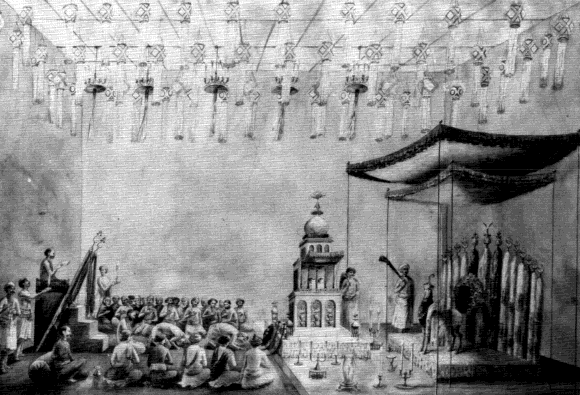
Figure 2
Rawzah-Khvani (mourning session). Courtesy of the British Library.
Since this role only required some Persian education, the mawlavi could be one of the subaltern ulama or even relatively untrained in specialized religious sciences. High ulama often held their own sessions, where they tied their recitations of the martyr's sufferings more closely to Arabic oral reports from the Imams, a style known a hadis-khvani . One of his students described Sayyid Muhammad Nasirabadi, then Lucknow's chief mujtahid, reciting oral reports from the Imams with translation: "I found him on the tenth of Muharram in the mourning session mentioning the calamities that befell the Martyr at Karbala, weeping violently, as was his audience. Then he descended from the minbar, barefoot, bareheaded, tears streaming from his ruddy cheeks. This was always his wont on such days. He thereafter went home and people gathered there."58
After the Persian reading, called the "ten sessions" (dah majlis ) because the works read from had ten chapters (one for each of the first ten days of Muharram), came an intermission during which servants handed around sweetened rose water to the gathering of mourners. Devout Shi‘is in the 1820s refrained from chewing betel leaves during Muharram, so servants passed about an assortment of spices on small silver trays. The highest-ranking members of the assembly smoked water pipes during the intermission, though the rest of the guests, of even slightly lower rank, dared not join them.59
After the refreshments, specialized reciters chanted elegiac poetry in Urdu. Even the illiterate could understand this part of the session, which must have formed the core of popular mourning sessions. Some of the verses had refrains, and the whole assembly often joined in.60 In the early nineteenth century some reciters of such poetry employed a vocal technique that approximated singing. Readers presented verse works commemorating the martyrdom of the Imam Husayn in various rhetorical styles. The ulama favored the straightforward reading of the poetry (taht al-lafz-khvani ), similar to that practiced by poets in secular poetry readings. Another style, antedating in India the rise of Shi‘i culture in Awadh, involved the chanting (suz-khvani ) of elegies. In Asafu'd-Dawlah's time Haydari Khan, a great singer, further innovated in this field, teaching Sayyid Mir ‘Ali, a highly respected performer at the court of Sacadat ‘Ali Khan. In such performances the musical modes (raginis ) could be emphasized or played down, according to taste. Women, and artisans and laborers, whether Shi‘i, Sunni, or Hindu, greatly loved the more musical styles. At the time of Ghaziyu'd-Din Haydar (1814-27) people came from all over Awadh to Lucknow during Muharram in hopes of hearing the courtesan Lady Haydar sing elegiac lyrics mourning
the Imam.61 Women commonly sang marthiyyahs in public, though the ulama condemned such mixed meetings.
Some of the more strict, legal-minded Shi‘is questioned Sayyid Dildar ‘Ali Nasirabadi about the singing of elegiac poetry. He replied that listening to elegiac verses for the Imam Husayn, weeping for him, and mourning him all have great rewards. If read with a sorrowful and pained voice, they presented no difficulty at all. But he disapproved of chanting marthiyyaghs with remodulation (Persian tarjic , Urdu katkar ) as being too close to music, promising that anyone who avoided listening to such performances would be spiritually rewarded.62
After the mourning verses the entire congregation rose and enumerated the legitimate successors after the Prophet Muhammad according to Shi‘is, the Twelve Imams, asking blessings upon them individually. Then they repeated the names of the early caliphs, whom Shi‘is regard as usurpers, pronouncing imprecations on them. These two rituals consisted of taking an oath of allegiance (tavalla ) to the Imams and pronouncing imprecations (tabarra ') on the caliphal usurpers.63 The mourning session concluded with a frenzied period of self-flagellation called the obsequy (ma'tam ). Even Shi‘i notables practiced it, Mrs. All reporting of upper-class ceremonies: "I have even witnessed blood issuing from the breast of sturdy men, who beat themselves simultaneously as they ejaculated the names 'Hasan'! 'Hosein'! for ten minutes, and occasionally during a longer period, in that part of the service called Mortem."64
Again, the ulama disapproved of flagellation. Mrs. All wrote that "Maul-vees, Moollahs, and devoutly religious persons" never joined in beating their breasts, although they were present in the audience while others thus violently expressed their grief. The ulama carried on their own mourning practices for longer than most believers in the 1820s, for a full forty days. They apparently did not participate in the mourning processions.65 Sayyid Muhammad Nasirabadi, asked about self-flagellation in the 1820s or 1830s, replied that wailing and healing one's chest over the calamities that befell the family of the Prophet was only permissible if one lost control of one's self.66
Women also commemorated Muharram, though only a few princesses and wealthy courtesans had their own imambarahs . Almost all the hostesses made their best room in the ladies' quarters into a temporary imambarah , allowing only females in. Mrs. All thought the grief of women during the first ten days of Muharram greater than that of men, such that pious women
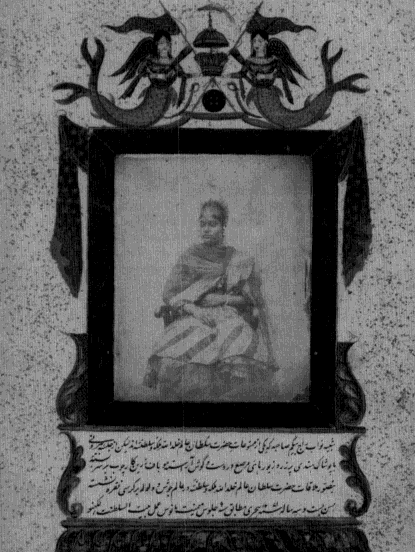
Figure 3
An upper-class Shi‘i woman of Awadh: Nawab Raj Begam Sahibah.
Born c. 1832, wife of Vajid ‘Ali Shah. Courtesy of the British Library.
would neglect their private sorrow during that period. In Hyderabad, Shi‘i women beat their breasts in self-flagellation, just as did men.67 In Lucknow, women gave up betel leaves, the wearing of jewelry, and bright (especially red) clothes, instead loosening their hair and garbing themselves in dark colors. Some even mortified themselves by wearing their mourning clothes in torrid, sultry Lucknow for ten solid days. Mrs. Ali's serving-maid went the entire time without drinking water during the day. Every evening the ladies gathered about the cenotaph they had set up. with female friends, slaves, and servants surrounding the hostess.68
As elsewhere in the Shi‘i world, educated women presided at these distaff sessions.69 In Awadh they derived for the most part from indigent Sayyid families that lacked the dowry to attract a high-status Sayyid groom but refused to accept one from a less prestigious caste, in accordance with the hypergamy (marrying up bu?? not down) widespread among Indian Muslims. They often served as Qur'an teachers for the daughters of notable families. Hostesses hired them for the first ten days of Muharram, presenting them in remuneration not only with a fee but with fine gifts as well. They read both the Ten Sessions in Persian and the elegiac poetry in Urdu.70
The mourning sessions held in homes during Muharram and during other months of the Shi‘i sacred calendar provided crucial opportunities for the development of social networks among Shi‘is, whether male or female, notable or commoner. Mourners went from session to session, spreading news and giving Shi‘is of one neighborhood or village a sense of unity with their coreligionists elsewhere. Lucknow became a place where Shi‘is from all over Awadh could meet at Muharram and thus overcome their sense of being isolated minority communities through congregation in the Realm of the Shi‘ah. The sessions reflected in their social composition the class and status of the host, with tradespeople excluded from notable gatherings. But within social classes and neighborhoods, the sessions did much to foster a sense of community identity.
Processions
The mourning sessions held in homes or imambarahs , although public, largely reflected kin and friendship ties in their composition. The truly civic rites, the
processions, brought together in the streets persons from all over each major city, as well as many visitors from nearby villages. With the development of processions, Shi‘ism came into its own as a religion in Awadh. No longer the furtive creed of isolated Sayyid communities in the service towns, it blossomed as the court's favored rite, central to the ritual life of cities like Lucknow and Faizabad.
Particular activities marked each of the ten days of Muharram. At the end of the preceding month, Dhu'l-Hijjah, middle- and working-class men brought that year's bamboo cenotaphs home from the bazaar with great ceremony. Notable families with permanent cenotaphs prepared a room or an imambarah to receive guests for the mourning sessions. The first day of Muharram witnessed, not activity, but an eerie quiet as shops closed and families began mourning at home.
On the second day, the public marveled at the imambarahs of magnates and visited the cenotaphs of friends. The devout saw such visitation as a ritual obligation substituting for the expensive pilgrimage to Karbala itself.71 From this day multitudes crowded the streets and alleys, most on foot, but with some notables on horseback or in palanquins, making social rounds, visiting cenotaphs, and participating in the twice-daily mourning sessions. On the third day of Muharram women sent sweet dishes to friends and relatives, as well as to poor families, in remembrance of the Imam's passing, just as they would have on the third day after a loved one's death. They repeated this on the seventh and fortieth days after the first of Muharram.72
On the fifth of Muharram believers took out processions throughout Lucknow to Rustamnagar, where they had their standards blessed at the shrine of ‘Abbas. Mrs. Ali witnessed a notable's entourage undertaking the trip. At the head of the procession walked a guard of soldiers around four elephants, which carried men and silk-and-gold banners. In the train of the elephants came a band playing Indian instruments, as well as trumpets. Next in order came a mourner holding a black pole from which two swords hung on a reversed bow. Behind him walked the owner of the banners, accompanied by reciters of verse elegies and a large number of friends. The verses chosen for the procession particularly concerned the sufferings of ‘Abbas. Thereafter came a horse, representing Husayn's steed, Duldul a fine white Arabian. His legs were stained with red, and arrows appeared to be stuck in various parts of his body. A turban rode on the tragically empty saddle. Friends of the family, servants, and private foot-soldiers brought up the rear.73
Thousands of other, less affluent mourners also headed for the shrine with
their banners. They entered it by a flight of steps-from the courtyard. A shrine attendant took the banner of each person through the right entrance and touched it against the crest of ‘Abbas's own staff. Each mourner moved on after his banner touched quickly to the sacred crest. Mrs. All estimated that shrine attendants consecrated forty or fifty thousand banners in a single day.74 Whatever the number, the ritual demonstrates a rather high level of organization and corporate cooperation for a premodern South Asian city, given that neighborhoods of all religions and classes apparently took part.75
The next big day, the seventh of Muharram, commemorated the battlefield wedding of Qasim, the Imam Husayn's doomed nephew, to the Imam's daughter. In Awadh, mourners remembered the wedding through the staging of premarital processions and formalities. Notables took out processions to the imambarah of a social superior, reproducing the pattern of hypergamy as practiced by Indian Muslims. At the imambarah the mourners reposited a model of Qasim's tomb. After the completion of prenuptial ceremonies for Qasim and his bride, notables distributed money to the poor, just as they would have at a real wedding. Middle- and laboring-class people also commemorated the ill-starred wedding, but did so at home rather than with costly processions.76 Elsewhere in India mourners introduced variations on this ritual. In Hyderabad to the south, a man sometimes impersonated Qasim and was prepared for burial at the imambarah . On the seventh of Muharram in that city mourners painted a representation of the Imam's horse made of wood and decorated it with jewels.77
The climax of the mourning period came on the tenth day, the anniversary of the Imam Husayn's own martyrdom. Participants rose in the early hours of the morning and began preparing for the procession, women sometimes lighting candles at the cenotaph before dawn and making requests. At dawn the mourners set out for a symbolic burial ground on the outskirts of the city, called a Karbala. In Safavid Iran, the laboring classes participated in street processions; the wealthy favored the mourning sessions inside.78 In Awadh, however, many notables joined the street processions with great fervor. The wealthy put together a military funeral parade, with elephants, bands, a bearer of the sword staff, banners, and a caparisoned and bloodstained Duldul with a royal umbrella above his head. Friends and family of the owner, elegy chanters, incense bearers, and the owner of the cenotaph display himself walked behind, often barefoot and with heads exposed
to the sun. Next came the cenotaph of Husayn surrounded by banners and covered by a canopy supported by silver poles, in the style of a Muslim funeral, then the cenotaph of Qasim and the wedding paraphernalia. Several elephants brought up the rear, from which servants threw money to the poor, who crowded behind the processions of the grandees. These not only sought money and blessed bread from the train of the notable's parade, but conducted their own humble processions in its wake, with their coarsely made cenotaphs held high. They thereby also sought security, since the wealthy had a guard of matchlock-men in case of trouble from brigands or Shi‘i-Sunni violence.79
From time to time the procession halted, sometimes as often as every five minutes. Then the notables listened to the elegies being chanted, or mourners flagellated themselves to the accompaniment of drums. Although the laboring-class mourners could not compete with the splendid pageants of the notables, they could nevertheless gain divine rewards and social status among their peers through extreme breast-beating. In north Indian cities at this time, tens of thousands of people assembled in the streets. The processions often arrived after nightfall at their Karbalas, four or five miles distant, where mourners ritually interred the cenotaphs and performed the whole ceremony of a funeral. Tempers ran high on this day of collective grief, and Sunni-Shi‘i riots sometimes broke out among Awadh's habitually armed men.
On their return home the rich distributed food, money, and clothes to the poor. The horse Duldul and his expensive attire was donated to a poor Sayyid family.80 In the 1820s the mourning ceremonies were effectively over on the tenth of Muharram. On the third day after, men began shaving their beards again, women threw off their mourning vestments, bathed, and put on jewelry. The populace began chewing betel leaves once more. Only a few very devout persons continued to mourn for forty days.81
Shi‘i ulama took a critical attitude toward some of the Muharram practices, incidentally reinforcing their own status as purists. In 1808 the Iranian immigrant scholar Aqa Ahmad Bihbahani endeavored to convince notables in Faizabad to give up the practice of beating drums to the accompaniment of their breast-beating.82 A believer in Lucknow asked chief Shi‘i cleric Sayyid Dildar ‘Ali Nasirabadi whether it was proper to employ drums and symbolic horses and camels on the tenth of Muharram. He replied that drums were a heretical innovation, but that using camels to evoke the cara-
van of the doomed Imam's family for the purpose of rendering hearts tender presented no difficulties.83 In later years camels draped in black were brought during the month of Muharram to the Nasirabadis' imambarah itself.84 Some later Shi‘i ulama condoned other folk practices. Mawlavi Abu'l-Hasan Kashmiri wrote in defense of even the use of drums in mourning the Imam.85
Ende has discussed how some Arab ulama in the modern period have defended flagellation, suggesting that they felt it to be in their interest, pecuniary or otherwise, to encourage mass participation in Muharram rites.86 Since the Awadh ulama in the early nineteenth century received their patronage from the semifeudal notables rather than from the bazaar, they could afford in general to take a much more elitist approach. Even then, they often had to come to terms with the folk practices of the notables; Sayyid Muhammad's ruling allowed flagellation if the mourner forgot himself, providing a convenient out to those who wished to practice it. The ulama's exclusion of music, including drums, from Muharram practices derived from their greater scrip-turalism, but it had the effect of further differentiating them as a status group from their notable patrons.
In Iran very late in the eighteenth century a new practice associated with mourning the Imam grew up, the passion play (tacziyah ). From representational acts in the tenth-of-Muharram processions, wherein mourners poitrayed Husayn and his enemies, a tradition emerged of folk theater centered in a fixed playhouse. In Awadh, no such indigenous development occurred during the period under discussion. Shi‘i notables there did sponsor Hindu-style plays about Krishna, and perhaps these performances preempted the development of alternative theatrical traditions. Accounts by travelers in Bengal and Bihar reveal a higher level of playacting and representing during Muharram than existed in Awadh.87 Ulama in Awadh gave rulings against the use of tableaux or religious paintings as backdrops during mourning sessions.88
The processions of Muharram filled the streets of Awadh's cities with flagellating mourners. The frenzied multitudes that so impressed Western travelers with their zeal hid, in their numbers and the seeming chaos of the
crowded streets, an underlying organization. Procession marchers grouped themselves by neighborhood, by patron, by status group. The degree of organization that must have been necessary to consecrate thousands of standards at the shrine to the standard of ‘Abbas bespeaks a vast increase in Lucknow's cohesion and a sophistication in Shi‘i and non-Shi‘i Muharram networks.
Non-Shi‘i Participation in Muharram
The culture of Awadh, a preindustrial society, demonstrated syncretic tendencies. Cultural mediators, such as Sufi pirs, drawing their clientele from both Muslim and Hindu, transmitted symbols from one group to another. Muharram rites in Awadh began to serve the same mediating function for some groups. Boundaries between religious communities existed, and riots occurred between Hindu and Muslim or Sunni and Shi‘i. But to a greater extent in the early nineteenth than in the early twentieth century, cultural mediators linked popular-class groups.89
Sunni Muslims in Awadh in the eighteenth and nineteenth centuries also held mourning sessions, but frowned on the breast-beating and ritual cursing of the Shi‘is. Sunnis likewise participated in Muharram processions, but in various ways differentiated themselves from Shi‘is. For instance, although the latter held up five fingers to symbolize the Prophet's immediate family, the Sunnis would hold up three fingers, for the first three caliphs.90 For Awadh's Sunnis, ‘Ali and his sons were the rightful successors of the caliphs, not their victims. Although Sunni-Shi‘i violence frequently broke out on this occasion, it derived from a different conception of the caliphs, rather than from any sympathy for the Umayyad enemies of Husayn. After the 1820s some Sunnis began to speak well of the Umayyads, probably as a reaction against the Shi‘i atmosphere of Awadh. Only in the first decade of the twentieth century did the two communites became so estranged that even Sunnis who mourned Husayn began taking their model cenotaphs to different burial fields than the Shi‘is for interment.91
The vast Hindu majority often also took part in the mourning for Imam Husayn, incorporating his cult into their ritual calendar as yet one more divinity in the pantheon. The Iranian traveler Shushtari saw Hindus com-
memorating Muharram all over North India in the late eighteenth century. He wrote that in Delhi wealthy Hindus with not the least trace of Islam about them went to great trouble to construct imambarahs . They fasted during Muharram, recited elegies for the Imam in Hindi, Urdu, and Persian, pelted each other with stones in mortification, and fed the poor. They constructed replicas of the Imam's cenotaph, bowed to them, and supplicated them for favors. After the tenth of Muharram they threw the cenotaphs in the river or buried them. Shushtari found some of the Hindu approaches to fasting and self-mortification during Muharram quite strange, maintaining that Indian Muslims copied them.92
The Kayastha scribal caste in particular adopted Muslim customs, owing to their long association with Muslim rulers as secretaries and revenue-department civil servants. Many Kayastha notables built their own imambarahs .93 But Hindu popular-class participation in Muharram processions and attendance at public mourning sessions, such as those at the Great Imambarah, cut across caste lines. Roberts wrote, "Hindoos . . . are frequently seen to vie with the disciples of Ali in their demonstrations of grief for the slaughter of his two martyred sons: and in the splendour of the-pageant displayed at the anniversary of their fate. A very large proportion of Hindoos go into mourning during the ten days of Mohurrum, clothing themselves in green garments, and assuming the guise of fakeers."94
Fanny Parkes's Hindu cook spent forty rupees on a bamboo cenotoph for the Imam, performed all the Muharram rites, and then resumed his Hinduism when he had interred his cenotaph with funeral offerings of rice, corn, flowers, and cups of water.95 In the Hindu-ruled provinces of central and southern India, as well, Hindus celebrated Muharram with processions and illuminations. Strict, scripturalist Brahmins often opposed this practice, but even some of them mourned Husayn. In Sunni-ruled Hyderabad riots would sometimes break out between Hindus and Muslims during Muharram, and the Hindus participating in the mourning rites would actually take the Muslim side against their coreligionists.96
Hindus therefore not only widely participated in the Muharram rites but helped influence their shape in India by introducing practices that even high-caste Muslims adopted. Garcin de Tassy pointed out that Muharram, like
the festival for the Goddess of Death, Durga, lasts ten days. On the tenth day of Durga puja Hindus cast a figurine of the goddess into the river, paralleling the Shi‘i custom of often casting the Imam's cenotaph into the river on the tenth day of Muharram. The Muslims made the same offering to the Imam that Hindus proffered their sacred figures.97 Since high-caste Shi‘is and Hindus considered each other ritually impure and unbelievers, popular-class syncretism of this sort sometimes posed problems for strict Shi‘is. Someone asked the chief mujtahids in the early 1830s whether an unbeliever could properly give an offering in cash or kind to the Imams and distribute cooked food to poor believers during Muharram. The mujtahid replied that the most cautious course was for them to bring such food only if the host of the mourning session asked them to do so (ahvat ast kih bar tibq-i guftah-'i malik arand).98
Widespread, though not universal, Sunni and Hindu participation made Muharram rites trans-communal. Sunnis in Awadh genuinely loved and supported Husayn, and the tears they shed for the Prophet's grandson helped soften hardline Shi‘i attitudes toward them. Hindus commemorated Muharram as well, adopting Husayn as a god of death, his bloodstained horse and his severed head lifted aloft on Umayyad staves presenting no less terrible an aspect than Kali Durga with her necklace of skulls. Syncretism and cultural intermediaries, such as readers of elegiac poetry, helped create a Shi‘i tinged traditional culture in a society where, among the popular classes, religious communal identity was still weak or at least not exclusivist in tone.
Conclusion
Muharram rituals constituted a complex of practices carried out on a mass scale. These rituals were highly ambiguous, both in regard to vertical stratification among religious communities and in regard to horizontal stratification within the Shi‘i grouping. Some of these practices, bearing an ecumenical aspect, were joined in by many Sunnis and Hindus. Others helped spread Shi‘i ideals among the masses and promoted social networks among believers, not only within city quarters, but between city dwellers and visitors from the qasabahs in the hinterland. More than anything else, the practice of cursing the caliphs helped erect communal barriers between Shi‘is and others, and the violence it provoked helped reinforce internal Shi‘i solidarity. Yet that solidarity did not completely obscure the social distinctions separating notables and commoners.
The Muharram commemorations, including the "pilgrimages" to the cenotaphs and the focus on death, demonstrate the coexistence of structure
and anti-structure. On the one hand, social distinctions temporarily broke down into liminality and a generalized feeling of leveled community (communits ), which the late Victor Turner found typical of such rites.99 The notables of both sexes demeaned themselves in bereavement for the Imam, men walking barefoot and bareheaded under Lucknow's harsh sun, and highborn ladies wearing the same sweaty clothes for ten days in a climate that called for frequent baths.
The mourning processions and the notables' distribution of largesse created a sense of solidarity among social classes. But in important ways mourners intensified structure, emphasizing distinctions of class and status in the exclusivity of the mourning sessions at imambarahs and in the primacy of notable pageants during the Muharram processions. Indeed, the processions constituted a microcosm of Awadh's prebendal hierarchical social structure. Muharram was a prime opportunity for the display of wealth and various sorts of expenditure that contributed to the expression of high status. Moreover, at the same time that the ceremonies drew together the participants from various classes and religious communities, they often sparked communal violence because some Sunnis and Hindus objected so strongly to them.
The mourners of Husayn in the bazaar or in the large villages worked their own genius on Muharram rites, such that they often created ritual forms later usurped by the notables, including veneration at the shrine of ‘Abbas. Although the notables excluded the popular classes from the services at their private imambarahs , and forced them to march behind their elephants in the procession, the popular classes in many ways led the way in venerating the Martyrs, expressing their grief in everyday ways that helped make the Imam and his family real to them. For they were, after all, the experts in what it meant to be oppressed.
The Shi‘i notable class, whose distribution of gifts and cash during processions helped ensure the participation of the poor, promoted the extensive mourning rites for Husayn. Fenced in by the East India Company, the notables had little opportunity to invest in territorial expansion, expressing their culture and prestige through religious architecture and patronage instead. In addition, informal laboring-class associations shared expenses and promoted the rites. In some places Sufi faqirs organized the ceremonies, during which they received offerings.100
People used the story rhetorically and allegorically as well as ritually.
Some notable-class Shi‘is depicted the encroaching British as the evil Yazid in the 1857-58 rebellion. Among laboring-class devotees of the Imam the tax collectors and police of the Shi‘i government itself may have been seen at times as the real Yazid. Moreover, where Muslim villagers were a small minority surrounded by unbelievers, the Umayyad armies attacking Husayn came to be portrayed as Hindus.101
The artisans, laborers, and peasants depended on the largesse of the Shi‘i rulers, and this link of dependency encouraged the little people to share with the rulers in their religious practices. In this way a general Shi‘i community came into being, still loosely organized, but enjoying new and wide-ranging social networks built around the sacred calendar of Imami mourning sessions and processions. In the early nineteenth century this calendar was also shared by many Sunnis and some Hindus. Yet some Awadh government policies helped make Muharram rites, at times, divisive of religious communities. When the early stages of political mobilization began late in the nineteenth century, Muharram processions and violence began serving a new purpose in creating communal identities, which grew into political ones in the twentieth century.102
PART THREE
THE GROWTH OF A SHICI CLERICAL HIERARCHY IN AWADH
5
The Beginnings of Formal Shi‘i Institutions in Awadh
Imami Shi‘ism in eighteenth-century Awadh originally possessed features that Western sociologists would define as "sectarian." But the distinction between sect and "church" deriving from Max Weber and Ernst Troeltsch, fruitful in the sociological study of religious groupings in Protestant countries, clearly must be employed cautiously in a labyrinthine religious milieu like Mughal India.1 Moreover. one must carefully note that in this context the term "sect" bears no pejorative connotation. Although many definitions of sect and church have been proposed, most suffer from lack of precision and our inability to plot their primary attribute on a continuum, as a scientific definition would demand. Benton Johnson offered a widely accepted solution to this difficulty by restating the sect-church distinction "in terms of a single-variable property, namely the extent to which a religious body accepts the culture of the social environment in which it exists."2 I will
amend this definition slightly to include antagonism or indifference to the state. Sects, then, are religious groups in some tension with the prevailing culture and the state. In what I will term formal religious establishments, called "churches" in Western sociology, this tension lessens, though it seldom disappears altogether.
Accepting this single variable as the central one, we may look at other attributes of sects delineated by researchers like B. R. Wilson as frequent although not universal correlates.3 Many attributes of sectarianism appear in Awadh Shi‘ism, and the primary variable certainly does, since its ethos opposed the prevailing values of Sunni-dominated Mughal society. Shi‘is conceived of themselves as the "saved sect" (firqah-'i najiyah ), the elect of believers who supported the wronged family of the Prophet. Rather than a formal hierarchy of trained jurisprudents, north Indian Imamis possessed merely private experts in the oral reports of the Imams—experts differentiated from the lay community only in their slightly higher level of education. The Akhbari ulama resembled Pentecostalist ministers, who rejected priesthood and whose training emphasized scriptural knowledge, eschewing rationalist theology.4
Akhbari north Indians, denouncing the strong division between the lay and the clerical that marked Usulism, had an egalitarian religious structure within the congregation. The crucial distinctions divided, not laymen and clerics, but notables and commoners. As was noted above, believers segregated their mourning sessions along class lines. Since few north Indian Imami clerics attained a high degree of jurisprudential learning, the typical Usuli jurisprudent immigrated from Iran, and ethnic tensions may also have been involved in the Akhbari attacks on mujtahids.
Awadh's Akhbaris forbade the formal worship of Friday congregational prayers on the grounds that the perfect leader who alone could lead them had departed into supernatural Occultation. The central ritual of sectarian Shi‘ism was the mourning session (majlis ) held for the martyred Imams, particularly Imam Husayn, in which personal piety could be expressed by open demonstrations of grief. In laboring-class processions believers spontaneously showed their faith through violently beating their breasts. Upper-class ceremonies tended to be more restrained, although they still involved weeping
and a touching of the heart. Both the rejection of Friday prayers and the emphasis on mourning sessions underlined the feeling of tension with the outside world that most north Indian Imamis felt.
Shi‘is saw India as the land of unbelief (kafiristan ), chafing under the rule of the Sunni Mughals. Some Muslim caste leaders forbade Sunni-Shi‘i marriage, another sign of sectarian tension. Shi‘is from the propertied classes often departed from a sectarian attitude enough to achieve high rank in the Mughal government, although even here they remained conscious of a distinction between their private inclinations and their duties to the Sunni Mughal sovereign, which strongly emerged during Awrangzib's conquest of the Shi‘i-ruled Deccan.5 The widely scattered Imamis in North India existed on the periphery of the Shi‘i centers in Iraq and Iran. Their loose religious organization and sectarian outlook approximated that of tenth-century Shi‘is in the wake of the Imam's Occultation. But just as the rise of the Safavid state in Iran helped transform Shi‘ism into a formal religious establishment, so the nawabs in Awadh had a similar impact in North India.
Although a Johnson-Wilson description of the sect as an ideal type corresponds to what we know of Imami Shi‘ism under the Mughals, the cultural complexity of India makes it necessary to define our terms more precisely. First, the "prevailing" culture in India, with which a sect would be expected to conflict, was dual. In a sense, two notable class orthodoxies coexisted, Mughal-supported Sunnism and the Hinduism of the twice-born castes. Even though Hinduism suffered some disabilities under Muslim rule and so sometimes also exhibited sectarian tensions with it, Hindus were the great majority of the population, and enough Brahmins and Hindu martial groups were integrated into the Mughal system of prebends and benefices to constitute them as junior partners in the Mughal enterprise. C. A. Bayly has suggested that the Jains and some Hindu ascetic orders constituted sects in eighteenth-century Awadh, and that they avoided entanglement with the government and possessed some degree of corporate organization.6 The definition of sect I am using would agree with the tendency to antagonism toward or indifference to the state, although it would not absolutely require any particular form of organization, which I have not taken as a primary variable. In Mughal India, then, Shi‘is could be considered sectarian in the same way as Jains could, since they opposed and subsisted outside the orthodoxy of the Sunni Muslim establishment, with its ulama, qazis , muftis, and seminaries, much as the Jains subsisted outside Brahminical Hinduism.
Another issue in the definition of sects and religious establishments has been raised implicitly by a group of sociologists considering the dominant
ideology, thesis. Abercrombie, Hill, and Turner showed that although Marx and subsequent sociologists considered the church to have ideologically dominated medieval Europe, in fact the authority of the ecclesiastical institutions sat rather lightly on the majority of the peasant population.7 European peasants continued to practice an autochthonous religion far removed from the theology and ritual of the literate priests who presided over the churches of the aristocracy, though only intermittently did peasant groups come so strongly into conflict with the church as to develop an alternative religious collectivity in the form of a sect. The formal religious establishment provided an ideology and an ecclesiastical structure primarily useful in uniting the ruling class and in socializing members of that class to values appropriate to their social position. It only lightly encompassed the peasant majority, and the underprivileged strata (the great majority in preindustrial societies) threw up most of the sectarian challenges to the religious establishment.
The rise of a Shi‘i ruling class in Awadh, composed of members of the Nishapuri ruling family, high administrators, and tax-farmers, and powerful eunuchs raised as Shi‘is at court, created the need for a formal Shi‘i establishment that could minister to the often literate notables. One of the functions of this religious establishment would be to justify Shi‘i rule. No Shi‘i formal religious establishment had existed in North India under the Sunni Mughals, so that an entire range of institutions needed to be newly created by Shi‘i elites.
The foundation of a formal Shi‘i establishment required specialized clerics. The Shi‘i ulama sought through professional closure practices to assert control over the monetary resources that notables poured into religious institutions, no easy task in the traditional, ecumenical setting of India.8 Among Shi‘i clerics, Usulis attempted to exclude all Shi‘i holy and learned men who did not possess a diploma (ijazah ) that allowed them to derive legal judgments and preside over ritual activity. To monopolize religious authority and the patronage of the Shi‘i state would require the exclusion of popular Sufi leaders and institutions, who mediated between Muslim and Hindu disciples. It also implied the displacement of Sunni ulama already occupying official religious offices.
The growth of sectarian folk practices among Shi‘is in Awadh, discussed in the preceding chapter, paralleled the growth of a formal, literate religious establishment among the notables. The two processes dovetailed only a century and more later, as literacy increased, the printing press spread formal religious ideas and practices, and urbanization brought the need for a clearer
communal (as opposed to village kinship or caste) identity. The process of Shi‘i Islamization (parallel to "Sanskritization" among modernizing Hindus) occurred first of all among the Awadh notables and clerics involved in constructing their dominant ideology.
The Establishment of Friday Prayers
The institution of Friday congregational prayers, the first major religious innovation undertaken by the notables and clerics of Awadh in creating a formal religious establishment, seems in retrospect a natural step. But this move aroused bitter controversy at the time, since it broke with all north Indian Shi‘i tradition. North Indian Akhbarism saw the holding of such prayers as a usurpation of the absent Twelfth Imam's authority, and Shi‘is associated mosque ritual with the arrogance of the Sunni majority. Moreover, the Awadh nawab's authorization of such prayers constituted a slap in the face to the Sunni Mughal emperor and a further declaration of regional independence, not to be undertaken lightly. Only a powerful congruence of secular and religious motives could have brought about this change.
The growth in numbers and authority of Usuli ulama helps account for the change. As the promise of patronage attracted Shi‘i clerics from Kashmir and from Iraq and Iran to Awadh, the number of scholars belonging to the Usuli school, dominant in those areas, increased. Greater political stability in the Middle East and North India in the last quarter of the century and more secure trade routes increased Awadh's contacts with the Shi‘i centers of West Asia. The Imami newly rich could afford pilgrimages to the shrine cities of Karbala and Najaf, and could in addition afford to subvent such travel for scholars such as Mirza Muhammad Khalil and Sayyid Dildar ‘Ali Nasirabadi.
On his return to Lucknow, Nasirabadi rejoined Chief Minister Hasan Riza Khan's inner circle, his penetration into the corridors of power and influence a tribute to his brilliance and ambition. But he was still the junior-most religious thinker patronized by the chief minister. The Sufi pirs Shah Khayru'llah and Shah ‘Ali Akbar Mawdudi wielded more influence. Even the Shi‘i notables of Awadh maintained the Mughal noble tradition of showing respect for Sufi leaders. The chief minister's first cousin Aqa Mirza was a devoted Sufi.9 Hasan Riza Khan saw no contradiction between Sufism and Shi‘ism, and whereas the growing clerical class in Faizabad had primarily to contend with the power of the physicians, in Lucknow their rivals for patronage and influence were Sufi leaders.
In the early 1780s, after Nasirabadi had returned from his sojourn in Iraq and Iran, a new controversy began to polarize the Imami community. The
foreign Usuli ulama wished to see Shi‘i Friday congregational prayers established in North India, whereas Indian Imamis of the Akhbari school resisted this initiative. One early source attributes the dominance of Akhbarism in North India to the school's pro-laity (camm-pasand ) tendencies. The same source states that Akhbaris in Awadh avoided the few mujtahids there completely, some even ritually cursing them. They criticized the Usulis for believing in independent legal reasoning (ijlihad ), allowing considered opinion (zann ) as a basis for legal rulings, employing analogy just as did the Hanafi Sunnis, and recognizing scholarly consensus as a source of law.10 Akhbaris perceived the Usulis to have compromised with Shi‘i principles, adopting the Sunni tenets of their Mughal oppressors. Moreover, Akhbaris may have projected their hostility to the Establishment Sunni clergy onto the professional Usuli ulama. Although the issue of Friday prayers was not one strictly between Usuli and Akhbari, since members of both schools took varying stances on it, north Indian Akhbaris on the whole tended to feel that they were impermissible in the absence of the Imam.11
Many Indian Akhbaris opposed Friday congregational prayers on doctrinal grounds; others feared chat such separate rituals would provoke a Sunni backlash. In the previous decade, Muhammad ‘Askari Jaunpuri (d. 1777), a local Akhbari scholar appointed to the post of court mufti, advised against such prayers.12 Awadh's Shi‘is did not believe that congregational prayers were held even in the majority Shi‘i areas of Iraq and Iran, and they were not customary anywhere in North India.13
Mulla Muhammad ‘Ali "Padshah" Kashmiri, arriving in Awadh in the carly 1770s, lacked this caution and timidity. He settled and taught in Faizabad and in about 1785 wrote a treatise on the virtue of congregational Friday prayers for Shi‘is. The author dedicated the book, five chapters long, to Nawab Asafu'd-Dawlah, calling upon him to establish Friday prayers. In the fourth chapter he mentioned three individuals qualified to lead the prayers. Two of these, Mirza Muhammad Khalil and Sayyid Dildar ‘Ali Nasirabadi, were local scholars who had adopted Usulism in Iraq. Kashmiri argued that instituting this measure would aid the nawab in his quest to spread the Islamic revelation (i.e., in its Imami form) more widely in his dominions. When Chief Minister Hasan Riza Khan went to Faizabad on a visit, Mulla Muhammad ‘Ali Padshah presented him with a copy of the treatise. Hasan Riza Khan made the proposal public on his return to Lucknow. But when he sounded out Sayyid Dildar ‘Ali about the idea, he rejected it. Nasirabadi
feared that such a public display would arouse the hostility of the majority Sunnis, and he asked the chief minister to dismiss the proposal. To avoid further pressure, he retired with his family and attendants to Nasirabad.14
With Nasirabadi gone, Hasan Riza Khan spent more time with other companions, especially with Shah ‘Ali Akbar Mawdudi.15 A leader of the Chishti order orginally from Delhi, he settled in Faizabad in the 1770s. Under the influence of Awadh's court culture, and perhaps in order to gain easier access to court patronage, he accepted Imami Shi‘ism. He did so, however, without giving up his Sufi ideas and rituals and while retaining his followers among the largely Sunni Chishtis.
One Friday afternoon Hasan Riza Khan was shocked to discover that the Sufi leader said congregational prayers with his followers, but Shah ‘Ali Akbar was quick to enumerate the virtues of the ritual in Shi‘ism. The pir's strong support for Friday prayers, coming on the heels of Mulla Padshah's similar proposal, determined Hasan Riza Khan to institute them. Ironically, foreign-born Usulis and local former Sunnis pushed the Awadh court into beginning this ritual, a move doctrinally opposed by local Akhbaris. Even an Usuli like Sayyid Dildar ‘Ali felt uncomfortable with the idea, which demonstrates how strongly Indian Shi‘is felt the need to maintain a low profile and to avoid conflict with the much stronger Sunni community. Other Shi‘is also attempted to dissuade the chief minister from this plan, warning that it might provoke the Sunni Afghan chief ‘Abdu'r-Rahman Qandahari to revolt.16
When Sayyid Dildar ‘Ali returned to Lucknow, Hasan Riza Khan once again pressed him to lead the Friday prayers. The young cleric consulted with some trusted advisers and came to the conclusion that it would be ungrateful not to help with such worthy work. (Moreover, such a slap in the face to his patrons might have signaled the decline of his so far promising career as a court religious scholar.) Sayyid Dildar ‘Ali, however, clearly retained some ambivalence about the prayers. When he first led them, in May 1786 (13 Rajab 1200), some believers from the notable class gathered at the palace, where they prayed the noon and afternoon prayers in congregation. But they followed the same ritual form as if they were praying congregationally on any other day of the week, rather than the special Friday form.17 This may have been an attempt at compromise, though it lasted only a short
time. The controversies behind this incident can no longer be traced.
Two weeks later the same group prayed the Friday congregational prayers (jumcah ) according to the prescribed forms. Some sources indicate that before he agreed to preside over this ceremony, Nasirabadi wrote a treatise on the congregational Friday prayer, showing it to be an "obligation of preference" (vujub-i takhyiri ) rather than an individual, absolute duty (vujub-i cayni ). He firmly disputed the most conservative (and earliest) post-Occultation view that Friday congregational prayers are forbidden in the absence of the Imam.18 In taking the "obligation of preference" position he cautiously required the prayers. Sayyid Dildar ‘Ali said that since some scholars forbade them and others considered them obligatory, caution dictated that believers pray both the Friday prayer in congregation and the individual noon prayer (zuhr ).
The beginning of Friday prayers in Lucknow, a victory for the rationalist Usuli ulama, came about because of a coalition of forces. Sufi leaders, intermediaries between Sunni and Shi‘i disciples, may have hoped to unite their followers in a single congregation by having formal ceremonies to which the Sunnis were accustomed. High Awadh secular officials probably wanted the prayers as symbols of regional autonomy. Foreign Usuli ulama promoted them because they believed them religiously necessary, and as part of their clericalist ideology. Local Usuli ulama, more cautious, finally acquiesced in holding the prayers, more because of outside pressure than inner conviction. Sufi leaders appear not to have recognized the possibility that leadership of the prayers might be taken over by the Usulis, displacing them and bringing a new religious elite to the fore.
Ideological Justification for Friday Prayers and Clerical Authority
The holding of Shi‘i Friday prayers provoked opposition from several quarters. Sunnis disliked it, though the feared violent reaction from them never materialized. Even with the Shi‘i community, many felt misgivings and refused to participate. Shi‘i artisans and laborers apparently rejected the prayers as an upper-class whimsy. The largely Akhbari notables opposed them as a heretical innovation. Sayyid Dildar ‘Ali's response to the criticisms emerged in his Friday afternoon sermons, some of which he collected into a manuscript volume.
Sayyid Dildar ‘Ali wished to justify the need for a professional clergy of the Usuli sort. On that afternoon in May 1786 he told his audience in the chief minister's palace that a man either is a religious scholar or is not. If not,
he must emulate an expert on Islamic law in subsidiary matters. Emulation, necessary in practical matters of complicated law, is forbidden in matters of essential creed (masa'il-i usuliyyah ). Even in areas of belief, however, Shi‘is have the duty of reaching the orthodox conclusions through their own effort. Nasirabadi saw his sermons as one way of sharing his knowledge as a scholar with his lay audience.19 Since his eighteen months in Iraq hardly made him a mujtahid, his attitude was somewhat presumptuous. But in a north Indian context, with few Usulis, someone with even a short experience of studying with mujtahids in Iraq could project an aura of authority.
The prayer leader argued that if Shi‘is did not produce ulama, then they would have to depend on Sunni scholars to teach them, and might be misled by the latter, who would not instruct them in the oral reports from the Imams. Although he drew on an oral report from Imam Jacfar as-Sadiq for this point, Nasirabadi was describing the actual situation in India; he himself had studied extensively with Sunnis. Without ulama, he insisted, people would soon not know to which religion they belonged, and ulama were necessary to guard the moral order.20 In a pluralistic society like India, he believed, only a cadre of professional clerics could maintain a strong sense of communal identity.
That summer in the fasting month of Ramadan, the prayer leader warned his aristocratic audience against deliberately neglecting Friday prayers, fasting, or religious charity (zakat ). He said that whoever refused to say Friday prayers in congregation would receive no benefit from his individual daily prayers; he complained that he needed to voice such warnings because most Shi‘is did not observe the religious laws, owing to their worldly concerns. He urged that religious donations be given to an experienced, upright (‘adil ) mujtahid, and that he be allowed to distribute them to the poor.21 He attacked the Awadh custom of putting religious charities in the hands of court physicians, claiming jurisdiction over this institution for the professional clergy. The handful of Usuli ulama not only would have a platform for the propagation of their views in the official congregational prayers, but also would gain control over vast sums of money.
Sayyid Dildar ‘Ali's first sermon contained a second theme: the need for works and not only faith. It did not suffice, he insisted, to swear allegiance to the Imams and to mourn their martyrdom, but one must also obey, be pious, say one's daily prayers, and help the poor. He condemned those who argued against the prayers because they would tempt some believers to perform this good work in order to be seen of men, pointing out that the believers are commanded, not only to inner purity (safa-yi batin ) but also to outer purity (safa-yi
zahir ), suggesting that Friday prayers were an outward sign of internal piety.22
The first sermon dcalt also with religion and state relations. The young Usuli cleric argued that Shi‘is had not held Friday prayers in India in the medieval period, because of the dominance of tyrannical Sunni emperors, just as they had avoided them in pre-Safavid Iran. The Safavids, he said, established the institution, and he urged the nawab of Awadh to emulate them in continuing to sanction the prayers. He denied that in agreeing to lead them he had sold himself (Shi‘is unhappy with the government obviously had accused him of doing so).23
Nasirabadi felt some tension between his values as a religious scholar and those of even a Shi‘i aristocracy. Sensitive to the charges some hurled at him of moral turpitude in becoming involved with the state and helping move Shi‘ism toward a formal religious establishment, he noted that Sunni and Shi‘i ulama differed over the referent of the qur'anic verse "Obey God and obey the Prophet and those in authority among you" (4:59). Sunnis, he said, made it refer to rulers and nobles, whereas Shi‘is restricted it to the Imams. Shi‘is held that God would not order us to obey someone who might command something not in accord with the religious law. The Sunnis, he continued, branded Shi‘ism worldly and said that Shi‘is had no other aim than to draw close to the notables.
He responded that the opposite was true, and that Sunnis interpreted Qur'an 4:59 in this way precisely in order to please the powers that be. He also pointed out that Shi‘i ulama forbade the wearing of silk, using gold or silver vessels, listening to music, gazing at unrelated women, and homosexuality. Therefore, Shi‘i norms conflicted most strongly with the lifestyle of the Muslim ruling classes. He ended by staking out his own moral independence, saying, "It should not be thought that I have in the course of this talk, when giving thanks to the nawab, embellished my words for the sake of being seen of men or pleasing him, hut only because the holy law demanded it. Giving thanks where due is incumbent."24 Nasirabadi needed to make this disclaimer because he had so highly praised the bibulous, arbitrary Nawab Asafu'd-Dawlah as the establisher of the holy Law, the promulgator of the religion of the Imams, and the center of the sky of justice, and had prayed God to render his rule eternal.25
In his Ramadan sermon for 1786, the prayer leader painted the holding of prayers as the most cautious course, attempting to steal the high ground from critics who felt that they should not be performed in the Occultation on grounds of caution. Such critics objected that uprightness (‘adalat ) in the prayer leader was a prerequisite, but without the direct appointee of an
Imam it would be an attribute difficult to establish. (That is, the appointee of an ordinary mortal might secretly have some vices.) Nasirabadi replied that the same difficulty attended the appointment of Shi‘i qazis and muftis, who must also be upright, yet no one raised similar objections in this regard.26
Even after the passage of a year, the Friday congregational prayers remained controversial. In August 1787 Sayyid Dildar ‘Ali discussed openly the nature of the opposition. He reported that some of the deniers, wealthy men, privately maintained that the Friday prayers actually were not the nawab's idea and that he remained ambivalent about them.27 Quite possibly, he did have mixed feelings. Hasan Riza Khan most strongly sponsored the ceremonies. Nawab Asafu'd-Dawlah, still the titular first minister of the Mughal Empire, may have felt apprehension about the political repercussions of sanctioning the ritual of a branch of Islam different from that of his nominal sovereign. He remained reluctant to cut his last symbolic ties with the empire, even though he refused to respond positively to calls of the emperor that he come to Delhi or provide troops to the center.28
Of course, the political value of ties to the emperor plummeted even further in the late 1780s, which may help explain why the nawab-vizier approved the holding of Shi‘i Friday prayers at all. In the period 1786-87, when they commenced in Lucknow and Faizabad, the Mughal emperor, Shah ‘Alam II, had been reduced to a figurehead over whom the Hindu Marathas and the Sunni Muslim Ruhilah Afghans fought because of his remaining authority as a symbol.29 On the other hand, the visiting Mughal prince, Javan-Bakht Mirza, was allowed to attend the Lucknow prayers, and his presence probably indicates that Delhi did not perceive them as rebellious.30 The nawabs of Awadh became firmly committed to holding Shi‘i ceremonies and supporting the Usuili ulama. As they resorted less and less to the Mughals for the legitimation of their rule, they cast about for other sources of legitimacy. The creation of a supportive Shi‘i clerisy was, in Awadh as in Qajar Iran, one means to this goal.31
Sayyid Dildar ‘Ali attacked the upper-class opponents of Friday prayer for their pride reminiscent of the pre-Islamic Age of Ignorance (hamiyyat-i jahiliyyah ). They did not want to bow behind a prayer leader, because it
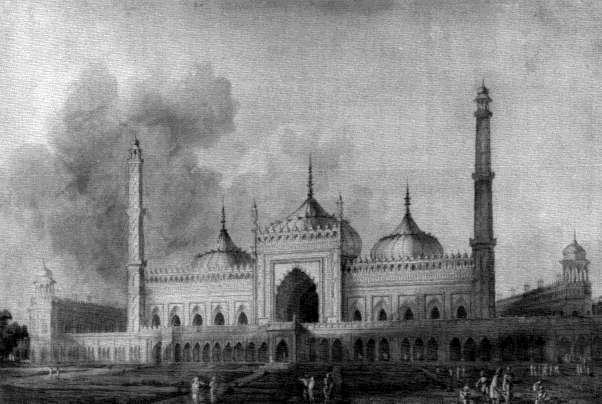
Figure 4
Mosque of the Great Imambarah, a Friday prayers mosque. Courtesy of the
British Library
would detract from their social status. These notables, among the wealthiest and most powerful men in North India, may well have balked at allowing the son of a small landholding qasabah family to lead them in prayer. Nasirabadi depicted his opponents as licentious aristocrats who spent their time listening to music, wearing silk, drinking from gold vessels, hanging paintings on their walls, and patronizing unveiled singing girls.
He denounced their pretensions to religious learning as arrogant, ridiculing them for saying that since Shi‘is at the shrine cities of Karbala and Najaf in Iraq did not openly hold Friday congregational prayers, believers should not hold them in Lucknow either. Since his opponents, as Akhbaris, objected to emulating anyone but the Imams, he pointed out the inconsistency of their imitating the practice in the shrine cities. Moreover, he denied that believers never held Friday congregational prayers in the holy centers of Iraq.
He said the ritual had not previously been performed in North India because the Sunni emperors forced Shi‘i notables to practice dissimulation. The situation, he continued, had now changed and Islam forbade the aping of one's ancestors. He argued that some scholars, such as Aqa Muhammad Baqir Bihbahani in Karbala, considered the Friday group prayers to be preferentially incumbent (vujub-i takhyiri ), holding them privately. Nasirabadi said that he wished to make Bihbahani's stance clear, even though he recognized that most of his opponents, as Akhbaris, either emulated the dead or emulated no one. He emphasized that he himself, as a mujtahid, had come to his own conclusions and was not emulating Bihbahani. He neglected to mention that other scholars he studied with in Iraq, such as Aqa Sayyid ‘Ali Tabataba'i, took a more cautious position on this matter. Neither group in Lucknow referred to the practice in Iran, which indicates that they only considered that of the shrine cities in any sense normative.32
Artisan and laborer Shi‘is also tended to react with hostility to the Friday prayers. Since the court began them in a notable's mansion, the prayers obviously were not meant to encompass the popular classes at this point. Later the nawab had a cathedral mosque (jami cmasjid ) constructed in Lucknow so that the public could attend. Sayyid Dildar ‘Ali betrayed impatience at opposition from this quarter, dismissing the common people as animals and beasts that needed a shepherd who could use his staff to force them to the attainment of happiness.33 A week later, Nasirabadi stressed that all Shi‘is were not saved, and that some were worse than Sunnis. He said that some
put Ali on the same level as Muhammad, while others made him God. Such Shi‘is, for all their love of the Imams, were unbelievers. He thundered that most of the ignorant Shi‘is in his own time deserved to enter hellfire on these grounds. Sayyid Dildar ‘Ali rejected as effeminate the view of some that one should not speak badly of anyone who believes in the Imams34
From his newfound pulpit Sayyid Dildar ‘Ali promoted the Usuli school of Shi‘ism as orthodoxy. He claimed extensive prerogatives for ulama of that school and attempted to displace other competitors for the patronage of the Shi‘i high notables, such as Sufis and Akhbari scholars. He strove against Akhbarism as the ideology of wealthy Shi‘i gentlemen scholars, and against the extremist theological views of the little people. The rituals, law, and religious donations of the Shi‘i community, he argued, should be controlled by the Usuli ulama.
The Spread of Friday Congregational Prayers
The practice of holding Shi‘i Friday prayers and building Shi‘i mosques spread to other cities, and then to smaller towns and villages. Through this institution, Shi‘i medium landholders in the lineage centers enhanced their local prestige and authority. Further, service positions as prayer leaders opened up for them in the cosmopolitan cities where rich and powerful Shi‘i patrons lived. Like the imambarahs , the new mosques united Shi‘i communities, though fewer attended the formal services, which probably catered more to the landed, literate strata.
The same year that Friday prayers began in Lucknow they commenced in Awadh's other major urban, center, Faizabad. As in the case of the riot seven years earlier, Javahir ‘Ali Khan (d. 1799) took the lead in supporting the program of the Usuli ulama. Sayyid ‘Abdu'l-‘Ali Deoghatavi (1749-1827), from a village near Ghazipur, was appointed to lead the prayers in Faizabad. He came there in 1770 to study, pursuing his education with Mulla Muhammad ‘Ali "Padshah" Kashmiri and becoming a mujtahid. He received a land grant (mucafi ) worth Rs. 1,000 per month from Asafu'd-Dawlah to support him in the office of prayer leader.35
Not many Shi‘is attended the prayers at first, being unused to them. Especially in the rainy season and in winter, attendance dropped off sharply. Javahir ‘Ali Khan, who zealously supported the institution, hired twenty men as servants to bring companies of people to the mosque, not only for Friday prayers but for the five daily prayers as well.36 As in Lucknow, the posi-
tion of Friday prayer leader in Faizabad became hereditary. It was next held by Sayyid Muhammad Deoghatavi (d. 1849), Sayyid ‘Abdu'l-‘Ali's son, who studied with Sayyid Dildar ‘Ali Nasirabadi, becoming a mujtahid.37 His son, Sayyid ‘Ali (d. 1897), failed to reach the rank of ijtihad , even though he became Friday prayer leader. By that time personal charisma and specialized training for the post, originally an important consideration, had grown irrelevant in favor of traditional family claims and the charisma of office.38
As was noted, the prayers began to be held in the lineage centers as well. Sayyid Dildar ‘Ali constructed a Friday prayers mosque in his home town of Nasirabad in 1812. In 1807 Sayyid ‘Abdu'l-‘Ali built an impressive mosque in Deoghata. After 1803 the British took over many areas of northern India formerly under Sunni Mughal rule, providing a safe atmosphere for Shi‘is to build mosques and hold Friday prayers.
Mawlavi Sayyid Muhammad ‘Ibadat, having studied with Sayyid Dildar ‘Ali in Lucknow, began leading Friday congregational prayers in Amroha at an old imambarah . In 1808 Hajji Ashraf ‘Ali of Patna settled in Amroha and built a Friday prayers mosque.39 The position of Friday prayer leader passed to the incumbent's son, who likewise trained with Lucknow's mujtahids.40 Later in the century Mawlavi Sayyid ‘Ali Husayn, a zamindar and mucafidar who had studied in Lucknow with Sayyid Dildar ‘Ali's son Sayyid Husayn, also served as prayer leader in Amroha.41 Prominent families and middle landholders in the towns of the area began to enhance their local prestige and authority by having some members study in Lucknow and return to perform such religious leadership functions as leading prayers in the public mosques that these same families had built.
In Awadh the ruling elite appointed mostly Indians to religious posts, despite the large number of qualified Iranian immigrants. The Indian ulama, better acquainted with local protocol, excluded their Iranian competitors. After failing to procure patronage in Awadh, Aqa Ahmad Bihbahani, the grandson of Aqa Muhammad Baqir, became prayer leader of British-ruled Patna in 1809, supported by local Shi‘i notables. He said the sermon in the name of the "king of Islam" (padshah-i Islam ), probably referring to the Qajar monarch. In British-ruled territory Bihbahani felt no compulsion to recognize the weak Mughals in Delhi.42
Shi‘i Religious Education
The handful of Usuli ulama trained more scholars in their school on an informal basis. Sayyid Dildar ‘Ali in addition to bringing up his own five sons as ulama, taught a number of other religious students, though not all became clergymen. Of thirty-one long- and short-term pupils listed in Nasirabadi's biography, eight were clearly gentlemen scholars of the notable class. One sees a contrast between Mirza Kazim ‘Ali, a high notable who taught law and the prmciples of jurisprudence as an avocation, and Mirza Javad ‘Ali (1760-1842), a poverty-stricken student who never composed much because he had difficulty in finding patronage. Another four "students" were Nasirabadi's colleagues, who traded knowledge with him.
Of the remaining nineteen, mostly young men of a religious turn of mind, some came of middle landholding families in the qasabahs . These, like Sayyid Muhammad Quli Kinturi (later principal Sadr Amin at the British court in Mccrut) and Sayyid Muhammad Deoghatavi (later Faizabad's chief prayer leader), went on to careers in the religious or judicial fields. Some of his students, from families specializing in medicine, went on to become physicians themselves. Many of the younger scholars became committed Usulis, writing polemics against Akhbarism, Sufism, and Sunnism. Some of the younger notables trained by Nasirabadi also produced such works. Not everyone who studied with Nasirabadi came to support him; most of his students derived from an Akhbari background and some remained Akhbaris. Moreover, two young men very close to him, his cousin Sayyid Yad ‘Ali Nasirabadi and his old traveling companion Sayyid Panah ‘Ali, turned against him after studying with him, and remained his bitter critics.43 Very firm bonds of loyalty and shared ideology emerged from the social networks centered on informal teaching and study, but sometimes those same networks accommodated strong enmities.
Many other scholars, including Iranian and Kashmiri immigrants, taught in Awadh. In addition to class sessions, notables held salons centered on religious discussion. The prayer leader in Faizabad, Sayyid ‘Abdu'l-‘Ali Deoghatavi, trained numbers of Usuli clerics. Through these informal tutoring systems Usuli ideas spread among Shi‘i literati and notables, not only in Awadh but beyond it to Banaras and Allahabad divisions, the upper Doab, and Bihar. In the next generation Nasirabadi's sons and major students taught hundreds of scholars, and in the 1840s the Awadh rulers finally founded a Shi‘i seminary (madrasah ).
The networks of learning extended even beyond India to Iraq and Iran, as in the case of Sayyid Dildar ‘Ali. Ironically, the Indian connection proved highly lucrative for the Usuli cleries in the shrine cities. In the late 1780s Chief Minister Hasan Riza Khan remitted Rs. 500,000 to Najaf through the
Iranian firm of Hajji Karbala'i Muhammad Tihrani for the construction of a canal in the middle Euphrates, which would bring water to perpetually dry Najaf. The project, aimed at sparing inhabitants and pilgrims inconvenience, was completed in 1793. Later Asafu'd-Dawlah sent another Rs. 200,000 to the mujtahids in Iraq.44 The nawab's channeling of such large sums to the chief Usuli ulama in the shrine cities, on the advice of Sayyid Dildar ‘Ali, strengthened them and further contributed to Usuli dominance. Tafazul Husayn Khan Kashmiri, as chief minister in 1795-98, remitted a great deal of money to Aqa Sayyid ‘Ali Tabataba'i for the poor and the ulama in Karbala.45
The Judiciary and Ulama-State Tensions
Shujacu'd-Dawlah probably appointed a chief qazi , as well as qazis in the provinces, since the Mughal system assumed these. Civil administrators performed many judicial functions. In rural areas large landholders often tried civil and criminal cases according to customary law (‘urf ).46 Elliot gave evidence that religious-law qazis , appointed to each parganah, continued to exist in Awadh right up to the 1856 British annexation. These Sunni provincial qazis often held the post on a hereditary basis, having been given service grants by the Mughal government for undertaking judicial duties. They decided disputes, appeased enmities, performed marriage ceremonies, decided inheritance cases, wrote decrees, led ritual prayers, and instructed the people in religious law. Typical of the evidence available for the continued appointment of qazis in the parganahs is the petition to the nawab from Hafiz Muhammad Basir, who wished to be made judge in Sandila on the death of his father, the former holder of the post. In Kakori as well, the post of qazi was held in the late eighteenth and the early nineteenth century on a hereditary basis.47
In the eighteenth century the rudimentary judiciary of the central government lacked any great authority. Shujacu'd-Dawlah appointed as mufti the Farangi-Mahalli Ghulam Hazrat who held a similar post early in Asafu'd-Dawlah's
Dawlah's reign.48 Isfahani painted a black picture of the judiciary under Nawab Asafu'd-Dawlah as altogether ineffective. He said that in 1783, as a result of pressure exerted by the British resident, Bristow, the deputy chief minister, Haydar Beg, appointed Mawlavi Mubin Farangi-Mahalli as civil judge. After a while the government replaced him with a Shi‘i Iranian, Muhammad Nasir Khan (a cousin of the assassinated chief minister, Mukhtaru'd-Dawlah), a notable rather than a religious scholar. In 1792 the Sunni Mufti Ghulam Hazrat became Lucknow's chief qazi , but the payroll for his court employees was, owing to treasury department problems, always in arrears.49
Nawab Sacadat ‘Ali Khan (r. 1798-1814) likewise depended largely on the Sunni ulama of the Farangi Mahall for his court judges.50 These Sunni judges sometimes came into conflict with the nawab; Sacadat ‘Ali removed Mawlavi Zuhuru'llah (d. 1840) from office after a dispute. Such disputes with the court could be ruinous both to careers and to finances, but Zuhuru'llah sought and received the patronage of a Shi‘i tax-farmer, becoming mufti once again after Sacadat ‘Ali's death.
The judiciary remained weak, and the British, worried about the impact of insecurity on property, constantly urged Nawab Sacadat ‘Ali to establish courts of justice and police throughout his dominions. He astutely turned this demand around and used it as a bargaining chip, saying that such a court system could be established only when the rebels in the countryside were extirpated, an indirect way of asking for more British troops to help his tax collectors.51
The Sunni background of the government qazis made many Shi‘is uncomfortable about resorting to them. A believer asked Sayyid Dildar ‘Ali Nasirabadi if, where two Shi‘is had an unsettled legal dispute, they were permitted to take it to an upright Imami religious scholar. He replied that it was not only permissible, it was the preferred course.52 The Shi‘i ulama enhanced their moral authority and circumvented the Farangi-Mahall judges through giving informal rulings on disputes between Shi‘is.
Only in the 1840s did the government institute a Shi‘i judiciary in Awadh. The major reason for the long delay in this development was that the Shi‘i ulama simply did not trust the nawabs to let them make rulings according to Islamic law and their own consciences. Partially, they may not have wished to put themselves in a position where they would have been sure to come into conflict occasionally with their benefactors, for long remaining content to let Farangi-Mahallis like Mufti Zuhuru'llah undertake this often dangerous and morally compromising work.
An incident in the continuing rivalry between the Indian and Iranian Shi‘i ulama demonstrates the difficulties they faced in this regard. Aqa Ahmad Bihbahani came to India late in the eighteenth century and stayed in Hyderabad, Murshidabad, and Patna. He then came to Awadh in search of patronage, settling at first in Faizabad. In fact, he ought to have gotten the ulama in Lucknow to have the nawab extend an invitation to him, but perhaps because of his Iranian pride he did not abide by-that etiquette. He then committed the even more serious breach of coming to Lucknow without the nawab's permission.53
At the end of Ramadan in 1222 (1807), some believers came to Bihbahani in Lucknow and stated that they had seen the moon, a sign that the month of fasting was over. Aqa Ahmad gave a ruling that the next day was the first of Shawwal and the Holy Day (‘Id al-Fitr ) marking the breaking of the fast. He sent the ruling to Nawab Sacadat ‘Ali Khan, who, he said, at first accepted it. Later the nawab changed his mind and issued orders that the Holy Day would be celebrated a day later. Some friends advised Bihbhani to go along with the nawab's judgment, but he replied that in such matters the mujtahid must be obeyed, not obedient. He asserted that given the Shi‘i faith of the nawab, practicing dissimulation with him could have no meaning, and the Imams forbade the sort of worldly greed that would impel a cleric to obey him on this issue.
The next day Sacadat ‘Ali Khan went to the mosque for the Holy Day prayers, which Sayyid Dildar ‘Ali led. Aqa Ahmad insisted that the Law forbade holding the prayers a day late, but the Lucknow ulama justified it on grounds of pious dissimulation (taqiyyah ) Bihbahani sent a letter to the ulama, protesting that such actions gave an excuse to the Sunnis to criticize them. In reply, they quoted oral reports from the Imams living under the Sunni Abbasids about pious dissimulation, which he felt inappropriate. He complained that many in Lucknow thought that simply receiving a diploma (ijazah ) permitting one to transmit the oral reports of the Imams made a scholar a mujtahid, cattily remarking that in all of North India he never found any true ulama.54 These barbs, directed at Sayyid Dildar ‘Ali, aimed
at disputing his status as a mujtahid.
Sayyid Dildar ‘Ali angrily riposted that he had on many occasions opposed the nawabs, but insisted on the legitimacy of practicing pious dissimulation with them. He gave as an example the time that Nawab Asafu'd-Dawlah fell ill and British friends suggested that he have some liquor for its medicinal effects. The nawab had given up drinking some time before, repenting before Sayyid Dildar ‘Ali. He asked Nasirabadi about this medical advice through a notable. The prayer leader replied without hesitation that many oral reports said that forbidden things have no curative effect. He could not permit the drinking of wine for medicinal purposes, on grounds of Islamic law.
Nasirabadi explained that he had not practiced pious dissimulation in that case because the nawah asked him a direct question. In the incident of the late Holy Day prayers, Sacadat ‘Ali Khan never bothered to inquire as to his opinion, but simply issued orders postponing the ceremonies. Had he asked, Sayyid Dildar ‘Ali would have informed him that he was wrong to do so. But for the prayer leader to have volunteered such information would have been, he insisted, so serious an infraction against court protocol that it might well have put his life in danger. Temporary visitors such as Bihbahani might have been able to defy the nawab, he allowed, but local religious officials were in a much more precarious position.55
This sort of awkward situation made Shi‘i ulama unwilling to accept positions as government-appointed judges. At one point the government of Sacadat ‘Ali Khan attempted to appoint Sayyid Dildar ‘Ali to a judgeship. Nasirabadi explained that his acceptance would have been conditional on the nawab's assurance that the Islamic Law would be implemented. Since this would have meant that Sayyid Dildar ‘Ali would be judging the nawab, he declined to accept.56
Conclusion
The late eighteenth and early nineteenth centuries witnessed two religious processes at work among notable-class Shi‘is in Awadh. As the Shi‘i-ruled state became more autonomous from the Mughals in Delhi, notable Shi‘is felt less tension with their own government, moving away from a sectarian sort of religion to a more formal establishment. As a corollary of this lessening tension with the state, Shi‘is brought into being formal Shi‘i religious institutions, some of them for the first time in North India. These institutions, in turn, required specialized staff, setting in motion the second religious process, the creation of a professional clergy.
The major cause for the transition to a formal religious establishment was clearly the rise of a Shi‘i regional ruling group in post-Mughai Awadh. Just as it produced a new, local patrimonial bureaucracy, it encouraged a more rational and bureaucratic approach in its own branch of Islam. Moreover, the cathedral mosque and Sunni Friday prayers had been powerful symbols of empire in Mughal Delhi. Some said that Asafu'd-Dawlah intended the Shi‘i cathedral mosque he built in the 1790s to rival the one in Delhi.57 The ruling elite, desirous of celebrating its increasing autonomy in Awadh with a new capital, new bazaars, and extensive architectural works, appreciated the symbolic political value of Shi‘i Friday prayers. Thus, the move to a more formal religious establishment paralleled a further stage of state making in Awadh, in which the regional court openly threw off even the emperor's favored form of religion.
A more autonomous Shi‘i state reduced the tension with the Shi‘i community by providing security to it for its religious practices. A little over a century after Awrangzib forbade all Shi‘i rituals in India, Awadh's Shi‘is freely and openly practiced their faith. One of the classic prerequisites recognized by Shi‘i ulama for the holding of Friday prayers was that it be safe to do so.58 In authorizing the prayers, the nawab and the chief minister made a declaration of security for Shi‘is in their realm. Nasirabadi had to accept the sincerity of that declaration before he could agree to lead the prayers, and even then he adopted a rhetoric of independence, urging Shi‘is to obey the Imams before any secular authority. Behind this idiom of independence, however, lay the inescapable fact that Shi‘i clerics like Nasirabadi were being co-opted by the state as adjuncts to its moral authority. In return, the highly trained Usuli ulama, who demanded absolute obedience from laymen on religious matters, were given financial support by the state, beginning their transformation into a professional clergy. This emergence of a body of paid religious experts is one correlate of a formal religious establishment, as opposed to a sect.
Obstacles to the achievement of a religious establishment among Shi‘is remained. The Akhbari gentlemen scholars of the notable class at first refused to bow behind the petty landholding ulama. The ulama themselves still distrusted the state, refusing formal judicial duties. Moreover, since the Friday prayers began among a small circle of the chief minister's intimates in Lucknow, artisans and laborers of the bazaar were excluded. Like the office of mulla-bashi in late Safavid Iran, the office of prayer leader in Awadh resembled in its initial stages the chaplaincy of the ruling household.59 But just as the nawab's arbitrary, patrimonial power had to extend throughout Awadh,
so too did the official school of Shi‘ism he adopted make universal claims to authority.60 Only some Awadh notables at first recognized these claims, as Usuli Shi‘ism became their dominant ideology, and most Shi‘i artisans and laborers retained a more sectarian form of Shi‘ism.
Much of this chapter deals with professional closure by the Usuli ulama.61 The beginning processes of clerical professionalization described here ended in widespread exclusionary practices, which will be dealt with in the next chapter. In this first stage in their appropriation of social and economic opportunities, the Usuli ulama specified a set of religious offices—prayer leader, jurisconsult, endowment and religious charities supervisor, and teacher—which they sought to fill. These often highly remunerative offices, required by the conventions of Muslim states and institutions, attracted pre-bends, benefices, and stipends for their support. The Usulis, having defined the services offered, strongly made the argument that untrained laypersons lacked the professional expertise to provide them. In this first stage of professionalization, the Shi‘i jurisprudents attempted to exclude literate gentleman scholars from what they saw as properly clerical posts. They excluded from their demands for a monopoly on such offices only the Muslim court judgeships. (Here the tendency to professional closure and the demands of their status group's style of life, of fidelity to scriptural principles, came into conflict.) To some extent. this attempt at clerical closure represented the demand by sons of small and middle Shi‘i landholders that service opportunities with the Shi‘i state be expanded for them and wealth shared beyond the narrow circle of notables and administrators.
The professional closure attempted by the handful of Usuli clerics was incomplete in the late eighteenth century. Unwilling to assume the risks and accept the moral compromises involved in the formal judiciary, they left that traditionally ulama-dominated institution to the Sunni Farangi-Mahallis. The Usulis' reluctance indicates both their incomplete transition from sectarian to establishmentarian views and their conviction that the ulama had not yet successfully socialized the Shi‘i ruling class to scriptural values. Competitors for state patronage abounded, in the form of Sufi Shi‘i leaders, conservative Akhbari ulama, and even Sunni and Hindu learned and holy men, so that the Usuli ulama had anything but a monopoly on religious patronage. Yet with the foundation of Friday congregational prayers, and with Nasirabadi's teachings on the authority of mujtahids over laymen and over religious donations, the foundations were laid for the emergence in Awadh of a full-blown hierocracy, a clerical hierarchy that asserted sole authority over the formal religious establishment.
6
The New Jurisprudents and the Struggle for Religious Leadership
Weber isolated two kinds of ruling organization, the political and the hierocratic, or religious. Both, he thought, seek to attain power and to exercise domination (the probability that a command with a given specific content will be obeyed by a given group of persons).1 The Weberian categories shed light on religious developments in Awadh. The Shi‘i-dominated Awadh state depended on the grant of prebends and tax-farming rights for its civil and military administration. The new religious establishment was likewise supported by service land grants, providing an income to scholars, who thus became differentiated as professional clergy from the laity. This gradual emergence of a Shi‘i religious establishment in Awadh alongside the Shi‘i state brought to the fore questions of authority and the sort of domination this "hierocracy" would wield. In the late eighteenth century official Shi‘i clergymen, mostly small and middle landholders from the qasabahs , began performing the functions of prayer leader, informal jurisconsult (mufti), and supervisor of religious charities. The institutions these individuals helped create contained the seeds of an increasingly complex religious establishment with its own bureaucracy and control over wealth.
Usuli ideology, adopted by this new group, had been used in Iran and southern India to justify a clerical monopoly over religious authority, often coupled with aggression toward competitors.2 Usulism was developed by
clerics seeking greater accommodation to the ruling establishment, growing most powerful in Safavid Iran. In accepting that the central institutions of the Islamic state can exist in the absence of the Imam, the Usulis adjusted themselves to the power realities of Shi‘i ruled governments, endeavoring to found a monopolistic religious establishment that encompassed the entire Shi‘i community.3 The search for monopoly brought the Usulis into conflict with other Shi‘i religious leaders, most notably Sufis and Akhbaris, whom they sought to exclude from authority.
How should the struggle between these religious groups be interpreted? A Marxian analysis might lead us to search for conflicts between economic classes as the base of these ideological struggles. On the other hand, a Weberian approach might see the dispute as one between status groups. Certainly, Weberian categories seem at first sight very useful in interpreting the struggle for religious leadership in Awadh. But only a full examination of the conflicts can help decide the applicability of these explanatory models to the material.
Weber distinguished three types of legitimate domination—the charismatic, the traditional, and the rational—recognizing that none of these might occur in its pure form and would more often be found mixed together.4 The types of Awadh religious leadership fall generally under the Weberian headings. Sufi leaders based their right to legitimate domination mainly on charismatic grounds, citing mystical knowledge and the ability to perform miracles. Akhbari ulama stressed the traditional grounds for their authority, in the Imami oral reports. Usuli ulama grounded their claims in their mastery of a premodern sort of rational-legal technique, asserting that the expertise of the mujtahid in deriving legal judgments from the revealed text through reasoning lent him his authority. (Both Sufis and Usulis also made some claims to authority on traditional grounds.) The clash among the mystics, the experts in oral reports, and the rationalist jurisprudents appears to have derived at least partially from the differing types of legitimation to which they appealed in the exercise of their religious domination. The question remains whether conflict between social classes entered into this dispute.
The Battle with Sufism
Within the Shi‘i community the new Usuli school faced no more formidable contenders for control over religious institutions and notable patronage than
Sufi leaders. The notables in Awadh did not originally hold the ulama and mujtahids in high esteem, rather honoring Sufi pirs. Sufis believed in the metaphysical doctrine of existential monism (wahdat al-wujud ), which in its extreme forms approximated pantheism. Sufi leaders, or pirs, claimed to enjoy divine graces (karamat ), to perform miracles, and to be privy to inspiration (kashf ) from God. Indian Muslims practiced Sufism widely, including those in Lucknow, where people attended meditation and chanting sessions, seeking to teach mystical states (vajd va hal ). The legalist ulama objected that music and revelry often accompanied these gatherings, lamenting that many high notables attended them and believed Sufism to be a path to spiritual well-being. Several of the powerful court physicians in Faizabad left sons who continued a tradition of Sufism and Akhbarism.5
Even formally, Sunni pirs often benefited from the largesse of Awadh's Imami rulers. Asafu'd-Dawlah granted twelve rent-free villages, yielding Rs. 30,000, to the pirs of Salon in perpetuity. The pirs spent most of the proceeds in supporting itinerant faqirs and Hindu Vairagis, without distinction of religion, who made short stops in Salon. At any one time a hundred such visitors congregated in this largely Muslim town of four thousand. Other Sunni Sufi endowments existed at Bhardasa near Faizabad, endowed by Asafu'd-Dawlah with lands yielding Rs. 15,000 per year, and at Manikpur in Partabghar, with Rs. 4,000 per year.6
Some pirs had Shi‘i sympathies. Mir Taqi Mir related how his father, a Shi‘i, discussed the Umayyads (enemies of ‘Ali) with a Sufi leader who replied that he had, thank God, never mentioned their names.7 The Usuli clergy said Sufis adopted Shi‘ism only pro forma, and that Sufis followed their pirs only because they expected worldly benefits. Aside from Sufi brotherhoods (tariqah Sufism), many notables in Awadh cultivated the mystical philosophy of such Shi‘i thinkers as Mulla Sadra Shirazi, whom the Usuli jurists dismissed as a heretic.8
Although Sufi adoption of Shi‘ism in Awadh may often have aimed at gaining court patronage, some Shi‘i Sufis developed their own subculture and literary traditions. They were influenced by the Shi‘i Nicmatu'llahi order, which had spread to Hyderabad and based itself there after Usuli persecution in Safavid Iran. Indian missionaries of this order promoted a re-
vival in Iran in the late eighteenth century, meeting violent repression from Usuli clergy, who saw the pirs as rivals to their own authority and access to court patronage.9
Sufis in Awadh told a story that the early Shi‘i figure ash-Sharif ar-Radi was praying behind his brother, the great scholar Murtada ‘Alamu'l-Huda, when he suddenly left the mosque. When rebuked, he replied that he had seen the prayer leader covered with blood and could not continue, because of ritual pollution. When asked about this, ‘Alamu'l-Huda confessed that he had been considering an issue in the ritual law of menstruation, admitting that ar-Radi was right to have acted as he did. In this story, ‘Alamu'l-Huda stands for those concerned with outer appearances, while ar-Radi represents mystics devoted to inner reality (abl-i batin ). The tale demeaned the official ulama as overly concerned with ritual law, and exalted the Sufis, for whom prayer had no significance unless the heart was also engaged. True to form, the Usuli ulama complained of the story's legal inaccuracy, since such a thought would not invalidate the prayers. The appearance of classical Shi‘i authors in the story indicates that the Sufis were working in an Imami tradition.10
Sufis and the Friday Prayers
The establishment of Friday prayers in 1786 helped provoke a crisis. As long as Shi‘is simply held informal mourning sessions for the Imams, the community could remain diffuse and diverse. The holding of formal prayers in congregation at Hasan Riza Khan's palace required that criteria for community membership be set up. Moreover, Hasan Riza Khan and-other notables created tensions by bestowing patronage both on Sufis and on their Usuli rivals. The appointment of an Usuli prayer leader proved divisive, since to pray behind him implied acceptance of his spiritual leadership. The Sufis held meditation sessions, with dancing and singing, on Fridays in the same hall where Shi‘is said Friday prayers in congregation. The Sufis did not join the prayers, some suggesting that praying in public was prideful. They said that anyone with inner purity did not need such rituals, which only bestowed outer purity.11
In the 1780s at the Awadh court the struggle between jurists and mystics grew fierce. Once the Sufi Shah Khayru'llah told his patron Hasan Riza Khan that he did not go to Karbala, for fear of Aqa Muhammad Baqir Bihbahani, whom he accused of extorting money from Indian pilgrims to the shrine of Imam Husayn. Nasirabadi, having studied in the shrine cities, protested that such fears were wholly unfounded.12
In 1786, about four months after the congregational prayers began, Sayyid Dildar ‘Ali launched a stinging attack on the Sufis in his afternoon sermon. He condemned those who claimed to meet every day with God, or even to be God Himself, and who said they knew the condition of the seven heavens. Nasirabadi sneered that if one asked them a question about Islamic law, they would be unable to answer. He accused them of innovating heretical rituals and laws. Since Sunnis in India often attacked Shi‘is as innovators, Nasirabadi made this charge cautiously. He defined a heretical innovation (bidcah ) as a practice contrary to the path of the Prophet. For instance, he said, there is an oral report from Muhammad that whoever weeps for Husayn will enter heaven. Therefore, the mourning sessions held by Shi‘is for the Imam are not heretical innovations, though they grew up after the time of the Prophet. (Sunni critics, of course, did see such mourning sessions. as heretical.)
Nasirabadi also criticized Sufis for the practice of spiritual retreat and seclusion, saying that meeting with the believers and associating with one another is much praised in the oral reports from the Imams.13 In later sermons, as well, he returned to these themes, criticizing Sufi ascetic ideas and what he saw as pantheism. He rejected the analogy that God flows in his creation as water in milk, or that God is as the ocean and beings are as the waves. Such a view, he said, would reduce us to saying that dogs and pigs are God Himself.14
The Chishti leader Shah ‘Ali Akbar Mawdudi (d. 1795), Nasirabadi's keenest competitor for the support of Hasan Riza Khan, led the Friday morning meditation sessions, but he and his following refused to attend the congregational prayers. They prayed Friday prayers elsewhere, with Mawdudi as the prayer leader. Shah ‘Ali Akbar, stung by Nasirabadi's anathemas against the Sufis from his newly won pulpit, sent Hasan Riza Khan a letter saying "Praise be to God! Is it right that someone should now mount the minbar and pronounce curses on the person who founded the congregational prayers?"15 When Hasan Riza Khan brought the matter up with Sayyid Dildar ‘Ali, he replied that he did not wish Mawdudi to be among those whom
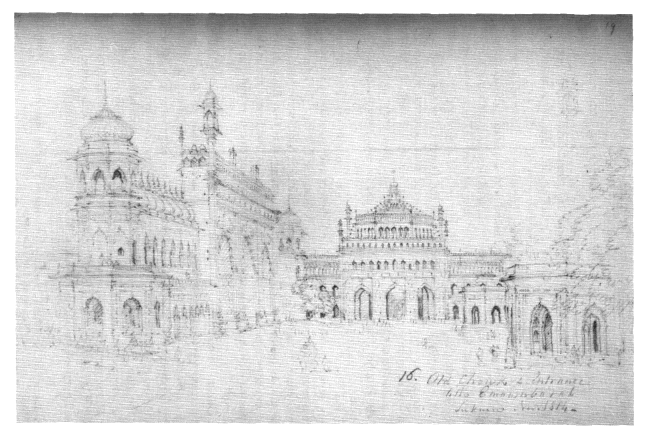
Figure 5
The Great Imambarah. Courtesy of the British Library
he cursed. If he categorized himself as a pir, Nasirabadi bore no blame. But Mawdudi considered himself a law-abiding mystic, insisting that the prerequisite for mystical initiation was to follow the holy Law. He felt that the principles of esoteric knowledge, like those of jurisprudence, were based on the Qur'an, the Sunnah, consensus, and analog.16 He therefore strongly objected to being branded a heretic.
The chief minister perceived no contradiction between the legalism of the Usulis and the mystical approach of his favorite Sufis, still hoping to find a way for the two to coexist. He broached the idea that Sayyid Dildar ‘Ali meet Shah ‘Ali Akbar personally and iron out their differences. Nasirabadi dismissed the man as a fraud, saying that Mawdudi refused to participate in the Shi‘i prayers only because of his many Sunni followers. Sayyid Dildar ‘Ali said he feared that he might confuse the Shi‘i congregation if he now, after having mounted the pulpit and cursed Sufis every Friday, expressed a wish to meet a pir.17
In the early 1790s a final break came. One evening Hasan Riza Khan brought Shah ‘Ali Akbar to the Great Imambarah just before sunset. The new Friday prayers mosque stood next to the Imambarah, and the believers were preparing to say the sunset (maghrib ) prayers. At sunset Nasirabadi normally ordered candles to be lit at that Great Imambarah, out of respect to the cenotaphs stored there. That evening, however, he waited, in hopes that the Sufis would leave. Hasan Riza Khan defused this tense situation, arranging a pro forma (zahiri ) meeting between Usuli and Sufi.
The chief minister wanted Shah ‘Ali Akbar to pray behind the mujtahid. The negotiations broke down, however, and Mawdudi led his Sufis in the sunset prayer at the Imambarah. Hasan Riza Khan went over to the Friday prayers mosque to say the prayers behind Nasirabadi with the Usulis. Sayyid Dildar ‘Ali ardently requested of the chief minister that he be excused from meeting the Sufi. Shah ‘Ali Akbar at that point fell ill and had to leave. Nasirabadi was happy at this development, which allowed him to avoid meeting the man.18
The incident proved decisive for the development of the Shi‘i community in Awadh. The Sufi Shi‘is, excluded from the official congregation, lost opportunities to exercise influence with, and receive patronage from, high notables. Shi‘i Sufism might have acted as an ecumenical force, since pits often had Sunni or even Hindu followers. The Shi‘ism of the Usuli ulama emphasized strident communalism, such militancy ultimately provoking a Sunni backlash.
Usuli-Sufi Polemics
The analysis of texts generated by the Usuli-Sufi conflict helps us understand the mentalities involved and is useful for several reasons. The intellectual disputes between Usulis and Sufi Shi‘is in Awadh well illustrate religious developments. But attitudes toward ritual, as was just demonstrated, could in themselves have an impact on the shape of the community, and so on society. The question arises whether these texts can be read so as to shed some light on the social conflicts that also underlay the enmity between mujtahids and pirs.
Nasirabadi followed his efforts to exclude Sufis from his congregation with an ideological assault on them. He dedicated it to Hasan Riza Khan, whom he called the founder of Friday prayers, but wrote it in Arabic, directing it primarily at the ulama. The book attacked both the metaphysical Sufism of classical upper-class thinkers and the Sufism of the orders, with their rituals. He quoted Imami oral reports, and presented what he said was an original refutation of existential monism (wahdat al-wujud ).19 He refuted the medieval Shi‘i thinker and admirer of the Andalusian mystic Ibn ‘Arabi, Sayyid Haydar Amuli, whose work defended the conception of existential monism in a Shi‘i context.20 This focus suggests Amuli's influence among India's Sufi Shi‘is.
Beyond the metaphysical controversy Nasirabadi concentrated on showing the illegitimacy for Twelver Shi‘is of Sufi beliefs and practices. He began with the doctrine of inspiration (kashf ) which literally means "uncovering." He explained that it consisted of seeing spiritual lights and hearing voices. Sayyid Dildar ‘Ali objected that instances of mystical inspiration cannot be verified, and that the persons who related tales about it or said they experienced it cannot be trusted, since they also told miracle stories about the enemies of ‘Ali, or fell into other doctrinal errors. He said it cannot be told whether such inspiration comes from God or from Satan, since most Sufis engaged in ascetic practices, such as rigorous fasting, that impaired their judgment.21 This section reveals the close connection the prayer leader saw between Sufism and Sunnism, much of his attack on Sufism being originally elaborated against the Sunni Naqshbandis of Delhi.22
Nasirabadi criticized the Sufi practice of inducing a trance state to achieve mystical ecstasy (wajd ), excoriating the mystics for falling on the ground and
asking God for healing, then singing, beating drums, and dancing. He charged that Sunni kings, such as the Umayyad Mucawiyah, promoted these pro-Islamic practices to distract Shi‘is from their political opposition to him. He quoted Sufi works to prove that Sufis from every social class engaged in ecstatic exercises accompanied by music, an art form Shi‘i jurisprudents unanimously condemned.23 The mystics, he said, invented ritual practices such as vegetarianism, the giving up of fine clothes, and retreats into seclusion for meditation, which he stigmatized as monkery (rahbaniyyah ), recalling the oral report from the Prophet that there is no monkery in Islam. He also objected to Sufi criticisms of the wealthy, quoting from oral reports attributed to the Imams on the permissibility of seeking to become rich as a means of avoiding the sorts of sins to which poverty might drive one.24
Sayyid Dildar ‘Ali not only defended the wealthy but accused Sufis of uncontrolled passions, implying that they actually addressed their mystical love poetry, ostensibly for God, to real women or slave-boys. He cited Imami oral reports condemning Sufis. Nasirabadi further disparaged the loud or silent group repetition (dhikr ) of the creed "There is no God but god," marshaling oral reports that forbade the raising of the voice during worship. Usulis forbade the oath of allegiance and obedience (baycat ) that adepts gave to the Sufi master, and the cloak (khirqah ) of initiation they received from him in turn.25 In conclusion, Sayyid Dildar ‘Ali branded Sufis innovators (ahl al-bidcah ), saying the Prophet Muhammad forbade association with heretics. He advocated the shunning of Shi‘i Sufis, urging that whenever an Usuli saw them in the street he should publicly curse them as apostates. Indeed, he saw all sects save the Imamis as unbelievers on grounds of incorrect dogma. At the end of the book he included the formula of repentance after apostasy in an effort to convince Sufi Shi‘is to come over to Usulism.26
Sufis replied vigorously to Nasirabadi, writing in Persian. An anonymous manuscript survives by a Sufi in rebuttal of Lucknow's prayer leader. The treatise contended that the spread of Sufism among Shi‘is was of old standing. Great Imami thinkers had in their biographical dictionaries accepted the division of Shi‘is into legalists (zahiri ) and mystics (batini ). Indeed, the tract's author wrote, all Sufis have a Shi‘i tinge because of their respect for the mystical knowledge of ‘Ali, only the Naqshbandis being truly Sunnis. The mystical knowledge referred to in the Imami oral reports, he argued, is the Sufi path (tariqat ), and many eminent Shi‘i ulama forbade the laity to criticize Sufi leaders. He maintained that mystics (curafa ') are more noble than the ulama because God gives them perfection and their way has transcended a
dependence on books and the intellectual doubts it engenders.27
The nameless Sufi emphasized that many great Imamis were Sufis, including important Safavid-era thinkers. He attacked the practice of publicly insulting Sufis as pure fanaticism, and defended Bayazid Bistami, whose pantheistic-sounding savings included "Praise to me, how great is my glory!" He explained that Bistami did not assert his own divinity, but rather claimed to have become as nothing, so that only God was left. Moreover, he added, some oral reports front the Imams supported the doctrine of existential monism.28
The treatise contended that Usulis erred in trying to distinguish between those Safavid thinkers who actually adhered to Sufism and those who only thought well of it, the figures in question having all been practicing Sufis. The Usulis wished to claim the great thinkers of the Imami heritage as their own, perhaps partially because they believed in consensus as a source of law. But Sufi Shi‘is rightly presented themselves as the true heirs of a major Safavid tradition. The Sufi's rebuttal ended by defending the listening to music and the bestowal of cloaks of initiation. He insisted that Shi‘i law permitted music that inspired a desire for the hereafter. He said that music was originally forbidden among Shi‘is because of the need for pious dissimulation (taqiyyah ) in times when Shi‘i songs put believers in danger.29 In Shi‘i-ruled Awadh, he implied, Shi‘is could sing freely.
Another revealing encounter between the official prayer leader and a mystic occurred in the next decade. In 1803 an Iranian Sufi named Mawlavi Samic came into conflict with Lucknow's Usulis. Sayyid Dildar ‘Ali, fifty years old, had been the capital's prayer leader for seventeen years and had grown firmly attached to the Awadh establishment. Mawlavi Samic attacked him on precisely this point, sending him a list of questions. From the first, he endeavored to put the prayer leader on the defensive. Mawlavi Samic wrote that the truly pious among the learned avoided rulers, thus remaining obscure, while scholars seeking wealth and high position gravitated to the court, becoming prominent. What, then, should laymen do? The Sufi suggested that the mujtahids' position in society derived from compromises they made with the impious rulers, and implied that laymen should emulate less opportunistic jurisprudents.
Nasirabadi attempted to neutralize the issue of social class. He said that if an upright mujtahid and qualified exemplar (marjac ) avoided rulers, he should be consulted. On the other hand, if a jurisprudent sought riches licitly, a layman could not refuse to follow him simply because of Ins wealth. After all, he said, many prophets and great Shi‘i thinkers were wealthy, and the
high class standing of Muhammad Baqir Majlisi and his association with the Safavid court was occasioned by proper motives and resulted in obvious benefits for the faith.30
Mawlavi Samic next quoted scripture condemning tyranny and forbidding Muslims to aid despots. He said that both jurisprudents and mystics knew very well that none among the ruling classes in India observed the limits set by the holy Law. Was it right, he pointedly inquired, to call such rulers tyrants, or not? Nasirabadi agreed that the literal sense of Imami oral reports indicated such a step. But he said the Qur'an denied that it ordained any discomfort for the believers in their religion. Perhaps the Imam meant to forbid anyone to approve in his heart of tyranny, or the word "tyranny" meant only wrongdoing to the House of the Prophet.31 Sayyid Dildar ‘Ali casuistically justified cooperation with the despotic government of Sacadat ‘Ali Khan, which because of its Shi‘ism at least supported the family of the Prophet.
The Sufi asked the prayer leader whether it was right to associate with the notables and to accept grants from them, of cash, goods, or land and villages. Nasirabadi said that one might accept gifts from tyrants as long as one had no sure knowledge that they were usurped property.32 Sayyid Dildar ‘Ali himself took grants of cash and villages, where Hindu peasants labored to support his Shi‘i religious office. Mawlavi Samic then chastised Usulis for cursing Sufis and said that many Safavid thinkers had spoken well of Sufism. Nasirabadi rejected this precedent, since in dogma emulation was forbidden. He allowed that pious continence (zuhd ) like that of ‘Ali's companion Abu Dharr could never be deprecated But Sufis, he said, bore enmity for the Imams, and Safavid thinker Majlisi II's condemnation of them was well known. Nasirabadi dismissed Safavid thinkers who admired Sufism as heretical followers of Ibn ‘Arabi.
Mawlavi Samic rephrased his question, complaining that in those days cursing Sufis had become as common among Shi‘is as cursing the Sunni caliphs. He recalled north Indian Shi‘is, such as Shaykh ‘Ali Hazin and Husayn Khan ‘Azimabadi, who thought well of Sufism, and pointed to the writings of Shah Nicmatu'llah Vali Kirmani (d. 1437), founder of the Ni'matu'llahi order, as examples of Sufi Shi‘ism. Nasirabadi reiterated his objections to Sufi rituals as innovations, attacking Sunni Sufis as opponents of Shi‘ism.33
The Usuli attack on Sufism focused on beliefs and rituals that the jurisprudents branded unscriptural innovations influenced by Sunnism. The
Sufis made the case that they represented an important spiritual tradition within Shi‘ism, including many Safavid exponents, and so were not simply innovating heretics originating in Sunni-dominated northern India. The mujtahids and the pits argued, not just about purely religious issues in dogma and ritual, but about social issues as well. The Usulis extolled the virtues of associating with the ruling classes for the sake of the Shi‘i faith, while some Sufi Shi‘is accused them of moral turpitude in so compromising themselves. In defending the goodness of wealth to Mawlavi Samic, Sayyid Dildar ‘Ali upheld the values of the qasabah- based service elite of which he formed a part, as well as those of his patrons, the high notables.
The Social Context
The struggle of Usulis to displace Sufi leaders from positions of influence took place in society as well as in doctrinal tracts. To look at the conflict on a more concrete level requires a focus on the social-control mechanisms invoked by the Usulis, and on the social interests that underlay the dispute. Mujtahids in Awadh had no Sufi pirs put to death, as happened in Iran. But Usulis verbally abused Sufis in public and shunned them. Nasirabadi declared Shi‘i believers in existential monism ritually unclean (najis ), so that no one should eat with them.34
Usulis should curse even Sayyids and true believers in the Shi‘i creed who held heretical Sufi doctrines and gave allegiance to a Sufi pir, holding that through mystical exercises one could draw near God. Still, Nasirabadi did not put Sufis completely outside the pale. One might accept food from one, and should help out even a Sufi relative in need. An Usuli should not curse a Shi‘i simply for wearing the patched robes of a Sufi, but should ascertain his beliefs first, though wearing such clothing indicated moral corruption at the very least.
Nasirabadi's control over charitable contributions allowed him to attract students with stipends and to train a new generation of anti-Sufi scholars. Sayyid Aczam ‘Ali Bankori. for instance, wrote against Sufis and in favor of marriage, and Sayyid Muhammad Baqir Musavi the preacher (vaciz ) attacked Sufis and Sunnis in his sermons.35 The campaign against the Sufis created an atmosphere of witch-hunting among Awadh's Shi‘is. A man could be publicly disgraced and cursed on mere suspicion of Sufi tendencies. While these practices benefited the ulama in helping to cut off patronage to their Sufi competitors, they made life unpleasant even for respectable persons of slightly unorthodox views.
Sayyid Najaf ‘Ali Kashmiri, arriving in Faizabad in the late 1700s, inclined to the upper-class mysticism of the Isfahan school but had no links to a Sufi order.36 A self-effacing man, once when someone mistook him for an attendant at a public bath, he obligingly helped the fellow bathe. His commentaries on mystical works by Safavid thinkers, coupled with his ascetic bent, led his enemies to accuse him of being a Sufi. To save his reputation he publicly had to abuse the Sufis as heretical innovators guilty of antinomianism and esoteric interpretation of the scriptures. More lay behind such controversies than a high-minded concern with correct doctrine. Aqa Ahmad Bihbahani observed that when any of the ambitious ulama in Faizabad saw that a scholar had gained renown and might become a source for emulation for the laity, they smeared him as a Sufi or an Akhbari.37
In 1816 Nasirabadi's biographer said that Sufi meetings had declined among Awadh's Shi‘is to such an extent that both the high and the low opposed Sufism. Though an exaggeration, the statement probably reflects social trends. In Jaunpur an important family of religious dignitaries traditionally maintained in their neighborhood a Sufi center (khanqah ) that had been built by Mufti Sayyid Mubarak Jaunpuri (d. 1687). In the late 1790s the building fell to ruin. The family had by that time become Shi‘is, and they made an architectural statement of their new faith by building an imambarah on the site. In the Sufi center of Salon, one Sadiq ‘Ali Shah raised an imambarah in 1796.38
Nasirabadi's sons carried on the campaign against Sufism in the 1820s and 1830s, and it clearly remained an issue within the Shi‘i community. The mujtahids ruled that while the Imams and great Shi‘is may have performed miracles, all such acts attributed to Sufis were lies.39 They forbade marriage between a Shi‘i women and a Sufi Shi‘i, even one of sound doctrine, as long as he attended chanting sessions. (Although Sayyid Dildar ‘Ali had earlier felt reluctant to anathematize someone solely on grounds of practice, his sons took a harder line.) Conversions to Shi‘ism from Sunnism also raised questions. Some Sunnis claiming descent from the medieval mystic ‘Abdu'l-Qadir Gilani became Shi‘is in the 1820s, but refused to curse their ancestor. They said cursing him would advertise their Shi‘ism and prevent them from dissimulating with Sunnis. The mujtahid coolly replied that if someone deserved to be cursed, being related to him was no excuse for not doing so. The Usulis' hatred of Sufism extended even to matters of literary usage, and they
forbade the use of the Sufi term cishq , overwhelming love, in describing one's relationship with God, on the grounds that it was unscriptural and implied a reprehensible excess and anthropomorphism.
The issues of asceticism and Sufism to some extent involved matters of social class. Akhund Mulla Muhammad Riza Kashmiri, a celebrated ascetic and Akhbari contempotary of the wealthy prayer leader Sayyid Dildar ‘Ali Nasirabadi, owned a small mill.40 He himself sometimes ground the wheat that people brought him, and sometimes he had his male or female servant do the job. He lived on the proceeds, supported his dependents, and gave away excess profit to the poor.
The story goes that once a high notable from the court of Asafu'd-Dawlah attempted to visit him on an elephant. The pious mulla waved him away from his gate, protesting that, as a poor man, he could only be met by other poor men. Mulla Muhammad Riza's asceticism and God-fearing ways lent him a great deal off popularity. The Akhbaris Taju'd-Din Husayn Khan and Subhan ‘Ali Khan, tax-farmers hired and then dismissed by Nawab Sacadat ‘Ali Khan, pleaded with Mulla Muhammad Riza to pray for them, and at length he acceded to their importuning. Attributing their later reinstatement to his intercession with God, they offered him a ten-thousand-rupee reward, but he refused it.
Whereas small landed proprietors, such as the Nasirabadis, or tax-farmers such as Subhan ‘Ali Khan, depended on the goodwill of the government for their continuing prosperity, a small-time miller like Kashmiri could afford to be more independent. He had sympathy for the peasants who brought him their grain to be ground, and he certainly preferred the company and welfare of the poor to that of the rich. His asceticism made a virtue of the relative poverty of his social class, and he refused to become involved in the unstable life of intrigues that acceptance of ruling-class patronage would have entailed. Though he was not a member of a Sufi order, his lifestyle came closer to the ideal preached by Sufis like Mawlavi Samic than did that of most Usuli ulama. His steadfast Akhbarism marked his independence from the mujtahids, exemplifylng the kind of sectarian Shi‘ism that artisans practiced even after the Usulis created a formal religious establishment and wielded great power at court.
Awadh's notables also continued to give patronage to Sufis. In the early 1830s Roberts reported that a few years earlier a mendicant mystic called Shahji had come into high favor with the ruler of Awadh, and was given permission to levy small contributions for his support from shopkeepers throughout the capital. Although he collected only five cowries a day from each one, a very small sum, the total from all the bazaars amounted to a considerable revenue.41
The Usuli campaign for social closure by excluding Sufi practices from the Shi‘i community derived partially from a desire to monopolize religious authority and resources. By making an argument that the Usuli style of life was more scriptural, and by painting the Sufi Shi‘is as heretics and crypto-Sunnis, the Usulis succeeded in weakening Sufi legitimacy within the Awadh ruling class: Their weapons included social ostracism, public humiliation, and the denial of marriage and inheritance rights. This campaign had the latent usefulness of providing a way of smearing newly immigrant competitors for patronage or authority.
The Usuli-Akhbari Contest
The Akhbari school of jurisprudence offered another ideological alternative to Usulism within the Shi‘i community, though the influence of the originally stronger Akhbaris declined in the first decades of the nineteenth century. The Akhbaris, basing their approach to law on a strict construction of the Imami oral reports and disallowing rationalist interpretations, challenged Usulism in its fundamentals. As with the Usuli-Sufi struggle, the ideological debate reflected social conflicts. Yet no one social group or class among Shi'is could be wholly identified with Akhbarism or Usulism; rather, groups in conflict often adopted one ideology or the other as a weapon, sometimes depending on which system of thought a rival had already chosen. Beyond these factors, it might be asked whether there was an "elective affinity," in Weberian terms, between a religious ideology and the interests of a social group.
Akhbari ulama began by being the great majority among Awadh's Shi‘i clerics. The Akhbari Mulla Muhammad ‘Askari had been brought to Faizabad by Shujacu'd-Dawlah, and his students remained influential. Chief Minister Hasan Riza Khan patronized Akhbari ulama, one of whom, Sayyid Murtaza, in 1788 wrote a book for him on "prayer of the heart." This scholar argued, as an Akhbari, that the Qur'an could not be understood without reference to the oral reports from the Imams.42 While many immigrant ulama from Kashmir who fled Sunni Afghan and then Sikh rule adhered to the Usuli school, some supported Akhbarism. Mulla Muhammad Muqim Kashmiri arrived in Lucknow in 1786 as a refugee, attaining a reputation as an Akhbari and a miracle-worker. In outlying cities like Banaras, Akhbaris such as Sharafu'd-Din Banarasi wrote, though he directed his polemics more at Sunnis than Usulis.43
Sayyid Dildar ‘Ali had to accept Akhbari students at first, in hopes of persuading them to adopt Usulism. Some of his students, however, remained
committed Akhbaris, employing the knowledge of Usuli principles of jurisprudence gained with him to refute their teacher. Thus, Mawlana Sayyid Murtaza Lakhnavi studied with Sayyid Dildar ‘Ali and then wrote against the use of legal analogy (qiyas ), an Usuli principle. He later emigrated to Hyderabad, Deccan, perhaps because of the declining popularity of Akhbari scholars in nineteenth-century Awadh.44
On returning from the Iraqi shrine cities in 1781, Nasirabadi set out to refute the Akhbari school, to which he had himself adhered only two years earlier. The resulting work. entitled Asas al-usul (Foundation for the Principles of Jurisprudence), stated the Usuli position and briefly refuted Astarabadi's seventeenth-century Akhbari manifesto, Al-fawa'id al-madaniyyah . The treatise, rapidly copied out and spread about, produced fierce controversy.45 Nasirabadi's prestige as Lucknow's prayer leader after 1786 enabled him to teach the work as a textbook to many students, having one of them translate it from Arabic to the easier Persian. He discussed the main issues in jurisprudential method between the two major schools, giving both rational and traditional proofs for the stances he took. Here we will treat points dealing with the role of the ulama in interpreting the Law.
Nasirabadi wrote that the most noble of sciences after the study of God's unity (tawhid ) are the principles of jurisprudence, and to forsake them is a sin.46 Beyond the Qur'an and the Imami oral reports, Usulis accepted two other sources of law, consensus and ijtihad . The authority of the ulama to interpret the law lay in these two principles. Opposers of consensus as a proof in law insisted that all the jurists whose opinions made up the consensus would have to be known to be truthful, something impossible to ascertain. Nasirabadi, however, argued that consensus is often an indispensable way of knowing the judgment of the Imam indirectly.47 Akhbaris rejected this principle as arrogant, insisting that if a hundred jurists disagreed with the Imam, his word would still be true, whereas if a hundred jurists agreed with him, their views would be superfluous.
Usulis gave the fourth source of law as reason (caql ).48 Nasirabadi argued that the goodness and badness of voluntary actions can be perceived rationally, a stance that he said Muctazilis, Imamis, and Hindus agreed on, but that Sunni Ashcaris rejected. Usulis counted syllogism (qiyas ) an important rational device for determining the law, but accepted only two kinds as valid. In the first, the scriptural text, by the nature of the prohibition or com-
mand, implied the common term between two cases. Thus, if the Qur'an ordered believers not to abuse someone verbally, they could not go beyond that and beat him up. In the second, legitimate sort of analogy, the scripture actually mentions the common term (cillah ). Where date wine is forbidden explicitly because it causes people to lose their senses, grape wine could be prohibited oh the same grounds. But Usuli mujtahids were forbidden to speculate as to the reason for a law and to create an analogy on the basis of their own judgments.49
Nasirabadi defined ijtihad as the expenditure of effort in seeking a considered opinion concerning the provisions of the holy Law so as to remove any possibility of guilt deriving from a failure to be thorough. Drawing on ‘Allamah al-Hilli, he said that ijtihad is a legal ruling in a case that lies beyond things that can be conclusively proven, such as the need to pray five times a day, and where no certain proof (dalil qalci ) exists. Sayyid Dildar ‘Ali affirmed that before the mujtahid exerted himself, God already had a ruling on any issue, which he merely sought to find. Nasirabadi said that God has always indicated the correct judgment, but that since He does not impose duties on his servants beyond their ability to perform them, the mujtahid is excused if he errs. The Akhbari school insisted that anyone giving a fatwa that went beyond citing scripture was responsible before God should he err.50
Sayyid Dildar ‘Ali described the two sorts of mujtahid, absolute and partial. An absolute mujtahid can derive every theoretical subsidiary legal ruling from the holy text, whereas a partial one can derive some rulings but not all. Some denied the right to practice ijtihad to the partial mujtahid. Sayyid Dildar ‘Ali held that the partial mujtahid could practice ijtihad where he was competent, since he would otherwise have to emulate another jurisprudent, which was forbidden to mujtahids. One might note that since India in the early 1780s had hardly any absolute mujtahids, the Usuli school could spread only by allowing partial mujtahids to derive judgments. He quoted oral reports from the Imams, taking them as a traditional charter for the prerogatives of the mujtahids. He explained that the mujtahid had to practice according to his conclusions, and should he find two possible rulings equally persuasive, he had a duty to choose between them.51 Nasirabadi saw the interpretation of the law as dynamic and as inhering in the person of the jurist, not in his rulings. If a mujtahid gave a ruling without mentioning his reasoning, then forgot how he derived it, he had to exert himself on it all over again.
If his conclusions the second time differed From the first, the second ruling had to be followed.
Lay believers were to emulate a jurist on subsidiary religious matters. Sayyid Dildar ‘Ali defined emulation (taqlid ) as practicing according to the word of someone else without proof. Reference to the sayings of the Prophet and the Imams, he said, was not emulation, because they performed miracles to prove their authority and because Qur'an verses uphold the need to Follow their sayings. Quoting ‘Allamah al-Hilli, he affirmed that laymen could lawfully emulate mujtahids in subsidiary matters of the law. Even educated persons must do so if they are not trained in jurisprudence. Nasirabadi gave several reasons for this emulation. First, not everyone in the community was commanded to learn Islamic law and the principles of jurisprudence. If every member of the community spent years training to become a mujtahid, the social order would disintegrate. Nor could a layman take up studies only when an occasion called for him to know something.52 Sayyid Dildar ‘Ali argued for the existence of a specialized class of clerical professionals to whom all laymen, even the literate notables, owed absolute obedience. Only in matters of dogma could believers investigate for themselves, so long as they arrived at the correct answers.
Sayyid Dildar ‘Ali then discussed the characteristics of the Shi‘i jurisconsuit (mufti ), perhaps in hopes of promoting the office. He said that a mufti must have two characteristics, the ability to perform independent legal reasoning (ijtihad ) and piety (warac ). He should be chosen by the general acclamation of the believers. He said that people could know who was learned enough to fill the post without being themselves experts in the law, just as they were capable of recognizing a great merchant without knowing anything about commerce.
Nasirabadi wrote that once a layman began emulating a mujtahid in a matter, he should not go to another one for a ruling on the same issue. On other questions, however, he was free to seek rulings from another jurist· A layman should not emulate a dead mujtahid, as Imamis sought to attain an ever stronger considered opinion, which only a living mujtahid could do. In conclusion, Nasirabadi quoted oral reports from the Imams in an effort to show that ijtihad did not originate with ‘Allamah al-Hilli (d. 1326), as Akhbaris charged, but went back to companions of the Imams.53 (In fact, ijtihad in the technical sense was not accepted by Imami jurisprudents before the thirteenth century A.D., and the Akhbaris have the stronger case on this point historically.)54
Nasirabadi's Usuli stance met opposition from many Shi‘i notables in
Awadh, and from the Akhbari ulama. The strong support given to him and other prayer leaders by the chief officials of the government, however, protected them from their foes and gave them a platform to spread their own ideas. Since Akhbaris in North India opposed the very holding of Friday congregational prayers, which the nawabi government supported, they could not compete with Usulis for such official posts. State-sponsored Friday prayers acted as an engine to drive the Usuli advance.
Nasirabadi's most colorful enemy from the ranks of the Akhbari ulama, Mirza Muhammad Nishapuri Akbarabadi (1764-1817) of Agra, became involved in politics everywhere he went, in North India, Iraq, and Iran. One of the more brilliant minds India produced in the late eighteenth century, and one of the last great Akhbari scholars, he wrote in numerous fields. His father, Mirza ‘Abdu'n-Nabi of Khurasan, conducted long-distance trade with North India, having had, according to his detractors, a rather limited capital in Iran of only five or six thousand rupees. Doing well in Agra, he married the daughter of Macsum ‘Ali Khan, a revenue official under the Mughal first minister, Najaf ‘Ali Khan. Mirza. ‘Abdu'n-Nabi did some trading in Allahabad, where his son Muhammad spent part of his youth.55
At about the age of twenty, in 1784 or so, Mirza Muhammad Akbarabadi, an Akhbari, went to the Iraqi shrine cities, where he studied with the leading Usulis, finding the same atmosphere there as had Nasirabadi only a few years earlier. He did not reveal that he was an Akhbari while in Iraq. A few years later he returned to Awadh, where his fame reached the ears of Asafu'd-Dawlah and Hasan Riza Khan. Meeting with the nawab, he slowly began cursing all dialectical theologians (mutakallimun ) and mujtahids as the hosts of Satan, creating a suspicion of the Usuli ulama in the minds of Asafu'd-Dawlah and his chief minister.
Sayyid Dildar ‘Ali already had tense relations with Hasan Riza Khan over his attacks on the chief minister's Sufi favorites, and was not in a strong position to reply to Akbarabadi. His biographer claimed that Nasirabadi refrained from responding to the Akhbari's polemics because he was a guest and a traveler. He did, however, send some of Akbarabadi's treatises back to the shrine cities to inform Sayyid ‘Ali Tabataba'i of his Akhbari views.56 It is difficult to believe that Nasirabadi did not move behind the scenes to undermine Akbarabadi's position at court, considering the threat he posed. His biographer simply wrote that Mirza Muhammad's extreme positions repelled most of the believers. At length the Akhbari left the Awadh court,
where he had failed to dislodge Usulis like Sayyid Dildar ‘Ali, and returned to Karbala.
Known in Iraq as an Akhbari, he came into strong conflict with the dominating Usuli elite and emerged as a formidable debater. He constantly moved his opponent into different fields until he found one on which he was more knowledgeable. Only Sayyid ‘Ali Tabataba'i could best him in open debate. He was at length forced, apparently on threat of violence, to flee the shrine cities with his family, for Iran, where he spent time in Fars, Khurasan, and Gilan provinces. In 1792 he wrote a biographical dictionary in Luristan, stressing Akhbaris. In largely Usuli Iran, Mirza Muhammad provoked the ire of powerful local mujtahids, which obliged him to move about constantly.57
In the late 1790s Akbarabadi settled in Tehran, gradually acquiring a reputation for learning and Indian-style divination. From 1797 Fath-‘Ali Shah Qajar ruled, and Akbarabadi increasingly ingratiated himself with the court, just as he had earlier sought to influence Asafu'd-Dawlah in Awadh. His correct prediction of the imminent demise of the Russian military leader Tsitsianov at Baku greatly enhanced his prestige. But his increasing influence over the shah aroused the jealousy of many notables at court, and the apprehension of powerful Usuli ulama Shaykh Jacfar an-Najafi in this period wrote a refutation of Mirza Muhammad's Akhbari ideas, in which he declared him an unbeliever and pronounced his blood and property lawful to whoever wished to take them. With notables and Usuli ulama working against him, Fath-‘Ali Shah came to perceive him as a danger to the state and expelled him.58
He lived subsequently in Baghdad and Kazimayn, where a mob killed him in February 1817. Shirvani, who knew Akbarabadi personally, said that fanatical Usuli ulama instigated the riot against him.59 Mirza Muhammad perhaps thought of returning to Awadh shortly before his death. In early 1814 he dedicated to Nawab Sacadat ‘Ali Khan his refutation of Nasirabadi's work on the principles of jurisprudence, probably in hopes that he would find favor with the ruler and be called to Lucknow.
Akbarabadi originally wrote his attack on Sayyid Dildar ‘Ali's work in 1792 in Iran, when he was smarting from his successive failures in Lucknow and Karbala. He objected that Nasirabadi said the principles of jurisprudence were the greatest science after that of the unity of God, asserting that Qur'an commentary and jurisprudence (fiqh ) itself surely took precedence.60 As an Akhbari basing himself as closely as possible on the oral reports from the Prophet and the Imams and the Qur'an, Akbarabadi felt scripture commentary to be infinitely more important than other sciences. Usulis magnified the importance of the principles of jurisprudence, the ideological basis of the authority of the mujtahids.
Akbarabadi denounced such Usuli principles as appeal to consensus, analogical reasoning, and the ranking of oral reports as sound or weak. Akhbaris, as conservatives, uncritically thought sound all oral reports attributed to the Imams in the four standard collections. He also rejected dependence on considered opinion (zann ) in deriving legal judgments, maintaining that certain knowledge (cilm ) could be gained from the text of the Imami oral reports. Surprisingly, he took Nasirabadi to task for his criticisms of India. Sayyid Dildar ‘Ali complained about the ignorance and unbelief in that country, whereas Akbarabadi insisted that among the Hindus were brilliant scholars and ascetics working in a great non-Islamic intellectual tradition, and that Indian Sunnis and Isma'ilis counted among them men of great erudition. Even the tiny Imami community had extremely learned men. Akbarabadi's intense pride in his Indian heritage provides a clue to why he clung so fiercely to Akhbarism, whereas Nasirabadi deferred to Iraq and Iran.61
In Awadh, as in Iran, Usulism gradually won out as the ideology favored by the high ulama and the state. Many of Nasirabadi's students attempted to rebut Akbarabadi. But into the nineteenth century some ulama favored Akhbarism, and important notable families, such as the Kanbuh Barelavis, including administrators Subhan ‘Ali Khan and Taju'd-Din Husayn Khan, continued to adhere to Akhbarism. Such notables employed Akhbarism as a means of stressing their intellectual independence from the Usuli ulama, whom they saw as sons of petty landholders greedy for power over laymen.62 These Akbharis held high office in the Awadh state and received political support even from notables who attended Friday prayers. In 1823 Chief Minister Agha Mir Muctamadu'd-Dawlah granted patronage to Husayn ‘Ali Khan Barelavi to write a theological work in support of Shi‘ism, wherein he attacked Usulism and blamed the Caliph ‘Umar for introducing the ille-
gal practice of ijithad .63 He may have gotten patronage from so eminent a source because his cousin Subhan ‘Ali Khan was deputy chief minister.
In 1818 Husayn ‘Ali Khan had issued a wide-ranging criticism of Usulism, in which he admitted that Usuli ideas had become widely accepted. He disparaged the division of the Imami community into expert mujtahids and a laity reduced to emulating them blindly, complaining of the rationalist thrust of Usulism, which led scholars to waste their lives studying dialectical theology, logic, and metaphysics and to import this misleading approach into their legal reasoning. He ridiculed Usuli doctrines, saying that since a mujtahid had to be the most perfect and knowledgeable of his contemporaries, there should logically be only one mujtahid in each age. In any case, be remarked drily, such a breadth of knowledge among Usulis was rare indeed in 1818. He rejected Usuli claims that the ulama represented the hidden Twelfth Imam, accusing mujtahids of love of high position and a desire to rule over others, even though only the Imams were worthy of obedience and emulation. Some Usulis, he said, went so far as to declare that even fasting and prayers were invalid except with the permission of the mujtahid of the age. He condemned the practice of putting religious donations (zakal , khums, sadaqal ) under the control of the mujtahids, citing it as another evidence of their greed. Elsewhere, he said that Usulis were seeking leadership through attacking Akhbaris and classing them with Sunnis and Sufis.64
In 1825 Sayyid Muhammad Nasirabadi, Awadh's chief mujtahid, wrote a spirited defense of Usulism against Akhbarism, painting the controversy as one over whether the believer should emulate living or dead authorities. Usulis, he wrote, cmulate the living, while Akhbaris follow the dead Their insistence on deriving legal judgments only from the oral reports left Akhbaris with extremely narrow choices in their rulings Not even the greatest of the ulama could arrive at a decisive judgment on every matter on the basis of a clear scriptural text (nass ).
Sayyid Muhammad pointed out that if trained scholars found such a feat difficult, women and children could not perform it at all. How, he asked, could women and children themselves consult books of oral reports from the Imams such as al-Kulayni's Al-Kafi ? Obviously, he concluded, they would have to consult an Akhbari scholar—and what else was this but emulation (taqlid )? Since both Usulis and Akhbaris held that the laity had to consult religious experts, the dispute between them was purely verbal (lafzi ). Nasirabadi further argued that if Akhbaris truly gave rulings according to sure knowledge and decisive evidence (qalci ), they would not differ with one
another in their legal judgments. But in fact they often did so. lie said he knew an Akhbari who claimed that his judgments were based on positive proof (dalil qalci ), and who heaped abuse on mujtahids when they demurred. Since all judgments given by Shi‘i scholars of both schools were ultimately based on the (Qur'an and oral reports from the Prophet and the Imams, he said, it was not important if some (the Akhbaris) called that basis sure knowledge (cilm ) while others (the Usulis) called it considered opinion (zann ).65
Sayyid Muhammad's opponents rejected his condescending dismissal of the Akhbari position as not all that different from the Usuli one. Husayn ‘Ali Khan Barelavi was asked why, since adherents of the two schools often gave the same judgments, there should be any conflict. In reply he denied the premise that the two schools gave the same rulings. He maintained that the judgments often greatly differed. After all, many of the same rules existed in Shi‘ism as in Sunnism. He thought the method of deriving judgments the crucial issue.66
Another Akhbari thinker from the notable class, Mirza Muhammad Zaki Khan, pointed out that if a layman arrived at certainty about an Islamic legal judgment through an oral report from one of the Imams, Akhbaris allowed him to practice according to it even though he had not attained the level of a mujtahid. Usulis, he scoffed, disallowed this, making it incumbent on him to forsake his own certainty and to emulate the mere considered opinion of a mujtahid.67
Akhbaris and Usulis not only conceived the law differently, they even differed on the idea of property. Shi‘is of both groups held that since Muslims conquered India, its land belonged to the Imam. Usulis thought that believers could nevertheless legally possess the land by buying it. Usulis charged that Indian Akhbaris disallowed human ownership of conquered land, saying it belonged only to God. Sayyid Muhammad sarcastically remarked that if Akhbaris proscribed land ownership, then anyone could legitimately usurp the property of the Akhbaris, warning that this doctrine would subject everyone's household to destruction. Most Akhbaris may have denied that their belief had the communistic implications Sayyid Muhammad suggested, though some artisans may have actually rejected the legitimacy of private property in land.68
While the last years of independent Awadh saw an even closer relationship between the stale and the religious hierarchy, tensions remained between the mujtahids anti believers from a laboring-class background. Little evidence about popular-class Shi‘i sectarian movements survives, but an important manuscript letter draws back the curtain briefly. In 1841 a Shi‘i cleric named Muhammad an-Najafi wrote to Sayyid Muhammad Nasirabadi from the old Bengal center of Murshidabad.69 He complained that he originally came to India to travel, entering the lands of the infidels unwittingly, and being forced to spend most of his time with the ignorant.
After thus ungratefully describing the patrons he found in Murshidabad, an-Najafi reported two challenges to the authority of the Usuli ulama in the city. Mir Asad ‘Ali, the leader of the morticians and gravediggers, himself a washer of bodies, claimed leadership and ordained laws for the people, "forbidding the permissible and allowing the forbidden." An-Najafi said that most of the common people followed his commands, having gone astray. Some friends finally suggested that he appeal to the chief mujtahid in Lucknow to condemn the man, who had clashed with an-Najafi. He therefore sent a description of the body-washer's heresies to the merchant Aqa Ismacil Zand so that he might take it to the Awadh capital.
The other challenge came from an Azerbaijani Turk named Mulla Baqir, who had arrived in Murshidabad a few years earlier. Mulla Baqir adhered to the Akhbari school, vehemently denouncing whoever believed in ijtihad and emulation and endeavoring to attract the weak and common people to his religion. An-Najafi dismissed the Akhbari as a man devoid of erudition, a mulla fit to teach primary school. The Usuli from Iraq answered the Turk's polemics in Arabic, but said that the Akhbari seemed to know little of that tongue. An-Najafi therefore appealed to Sayyid Muhammad to respond to these two movements, for, he wrote, "the judgment of your Excellency is obeyed everywhere. It is incumbent upon you to strengthen religion, as you are the chief of Islam and the Muslims."
These last examples suggest a pattern of popular-class sectarianism that demonstrated opposition to the middle- and upper-class mujtahids and their patrons. The case of Mulla Baqir shows again that Akhbarism as an ideology could be put to various uses, having an appeal both to high notables who refused to accept the leadership of the middle landholding mujtahids and to laborers and artisans who resented the establishment of the nawab and his Usuli intimates. Such resentment can be seen in Awadh in an anecdote from the biography of Sayyid Husayn Nasirabadi. Once he fell ill on a Friday, and in the evening some laboring-class Shi‘is of rough appearance arrived and
asked him to say funeral prayers for their dead friend. He replied that he was ill. They muttered that if their friend had been one of the notables, he would have complied. Sayyid Husayn, stung, agreed to perform the prayers. The story inadvertently reveals that Shi‘i commoners often saw the mujtahids as lackeys of the rich.70
The Usuli scholars, an ambitious and upwardly mobile group, advocated rationalism and a dynamic approach to law and social norms which allowed for new and independent judgments.71 They rejected the emulation of past authorities, insisting that even their notable-class patrons defer to them in matters of legal interpretation. Admittedly, these were the tenets of a centuries-old school of jurisprudence. But they also constituted a flexible ideology with great appeal to a rising status group that wished to influence the shape of society and saw increasing opportunities for doing so. The Usulis justified the need of believers to obey the professional jurisprudents by arguing that the structure of society would be destroyed if authorities allowed children, the bazaar classes, and common people to take legal judgments directly from the scriptural sources.72 Akhbari gentlemen scholars resisted longest the claim by Usuli ulama from the small and middle landholding classes to a monopoly on specialized knowledge of Shi‘i law.
Conclusion: Social Class, Hierarchy, and Authority
The dispute between status groups (mystics, traditional authorities, rationalist jurisprudents) set the intellectual terms of the struggle for control of Awadh's growing religious establishment. But the social dimension of the conflict is obvious from the frequency with which opponents argued over the goodness, badness, and nature of wealth and property. The dispute among Sufis, Akhbaris, and Usulis took place at three social levels. First, some religious figures competed among themselves for spiritual leadership of Awadh's towns and middle landholding families. Second, some struggled to monopolize the patronage of the high notables and to control their religious culture as well. The fusion of the religious idioms promoted by learned men from the intermediate strata with those of the high notables created a dominant ideology (dominant among the Shi‘i propertied classes). Third, religious officials from the landed classes battled with charismatic personalities or traditional authorities from the bazaar classes. The Usuli establishment strove to dominate
Shi‘is at all levels of society; but in preindustrial societies like Awadh the majority of tradespeople maintained their own religious ideologies.
Some conflicts between Sufis and Usulis involved competition among learned men of similar social and economic backgrounds. For men from the small landed classes in the Islamic lineage centers, either Usulism or Sufism could provide bases for religious domination and avenues of influence with the large landholding and ruling classes. They chose their path according to family background, local tradition, and personal inclination or ambition. Where learned men of similar social background competed for notable-class patronage, their disputes seldom centered on whether wealth was good or bad. They took its goodness for granted.
Examples abound of status-group rivalry lacking any dimension of class conflict. The Shi‘i ulama of Nasirabad and the pirs of Salon competed with one another for the benefices and other patronage that the high notables could bestow. The decline of Mughal Delhi and the rise of Shi‘i-ruled Lucknow posed a challenge to Sunni Sufis of middle landholding background used to Mughal patronage. Chishtis like Shah ‘Ali Akbar Mawdudi, himself from Delhi, parlayed their pro-‘Alid sentiments into an asset in attracting the patronage of rising Shi‘i notables. The jurisprudents staffing the emergent religious establishment showed intense hostility to the charismatic Sufis.73 The Imami ulama bested the Sufis by their strong commitment to communalist Shi‘ism and their specialized knowledge of Jacfari law. They could not, however, altogether stop Awadh notables from patronizing the mystics.
The issues of whether wealth was good or not and of the propriety of cooperating with the government more often arose when the competing status groups also derived from different economic classes. Here, a Marxian model, or at least a Weberian model of social closure informed by the Marxian idea of conflict between economic classes, has greater explanatory power. Mystics who stood outside the benefice (madad-i macash ) system of the prebendal state could criticize the government as tyrannical and denounce the official ulama for compromising themselves by cooperating with it. It is possible that critical outsiders like Mawlavi Samic had ties to Iranian long-distance traders or other social classes with minimal dependency on the agrarian bureaucracy in Lucknow.
The artisan and laboring classes practiced yet another kind of mysticism. Even where they were Shi‘i, they often wished to remain aloof from the state and to maintain their independence from the official ulama. Both Akhbarism and Sufism offered alternative sources of legitimation for their leaders. The tensions between Mulla Muhammad Riza Kashmiri and the Usulis derived, not from competition for patronage from the rich, but from the Usuli establishment's desire to dominate the entire body of the faithful. The indepen-
dence of popular-class sectarian movements, such as those in Murshidabad, stood in the way of such hierocratic domination. One basis for elective affinity between Sufism and Akhbarism and popular-class leaders lay in the ease with which these ideologies allowed religious leaders from the bazaar, who had no leisure to pursue complicated rationalist studies, to make charismatic or traditional claims to authority. Moreover, as Usulism became the dominant ideology, groups seeking to maintain their independence of the ulama or of the state often clung even more tightly to alternative ideologies.74
The cultural dominance of the Usuli ulama among Shi‘i notables led to less status at court for traditional Muslim spiritual leaders like Sufis and Akhbaris. The ousting of the pirs proved important, since they often had Shi‘i, Sunni, and Hindu disciples. Their more tolerant, often syncretic Islam had developed in traditional Mughal society, itself a compromise, or collaboration, between Muslims and Hindus. Some Awadh notables continued an open approach to intercommunal relations, but Usuli exclusiveness began markedly to affect government policy from the 1820s.
Three reasons can be adduced for Usulism's victory. The first is the attractions for a new generation of Shi‘i ulama of this ideology, which legitimated lay-clerical differentiation and gave the mujtahids the sole prerogative of interpreting the Law, demanding the obedience of laymen to their rulings. Given the increased opportunities for clerical patronage and posts in the growing Shi‘i state, Usulism made more sense to young north Indian ulama than it had to their fathers. The second reason is the largely successful use of exclusionary closure by Usuli ulama to assert claims to religious posts and resources and to deprive rivals of that patronage. Their strategies included a form of credentialism, in which they recognized only diplomas from Usulis as a proper qualification to fill clerical posts. They also resorted to more violent means of exclusion, such as verbal abuse and public humiliation of rivals, branding them heretics and non-Muslims. This professional closure succeeded better among propertied Shi‘is than among the popular classes, who often retained their own, untrained, religious leadership.75
The third reason is the preference for Usuli ideology by the emergent Awadh state. As a government bureaucracy grew up, with the prayer leaders and muftis as its religious wing, state officials favored more rational-legal bases for authority. Usulism was much more suited, at that place and time, to integration into the Awadh state than either Akhbarism or Shi‘i Sufism. It sanctioned formal religious ceremonies, such as Friday congregational
prayer, which became important to the state as an expression of regional identity and semiautonomy, whereas Akhbaris opposed the institution, and Sufis refused to bow behind the official prayer leader. Moreover, the tension between the Shi‘i state and the clergy was less in Usulism than in Indian-style conservative Akhbarism, which disallowed many state functions during the Occultation. The state's increasing support for Usulis was crucial to their power, since "a class, race, sex, or ethnic group only accomplishes domination to the extent that its exclusionary prerogatives are backed up by the persuasive instruments of the state."76
7
Religion, State, and the Second Usuli Generation
In the first phase of the formation of a clerical elite, the Usuli ulama forged a successful alliance with the increasingly autonomous Shi‘i notable class in Awadh, founding their influence on the Friday congregational prayers. These prayers at once symbolized the regional semiautonomy of the Awadh court from Mughal Delhi and the leading religious role of the Usuli prayer leaders. The Usuli ulama subsequently made successful claims for control over religious resources, such as private Shi‘i religious donations, thus increasing their wealth. They also strove to exclude competitors for religious authority, such as Sufi and Akhbari Shi‘i leaders.
The second phase of clerical elite formation, to which we now turn, coincided with the rise of the second generation of Usuli ulama to positions of influence. They sought to consolidate their position at the Awadh court and to regularize the sort of patronage offered them by the high notables. Challenged by the emergence of a completely independent Shi‘i monarchy, they had to decide whether to participate in ifs legitimation. As the authority of the Shi‘i ulama began to be accepted by commoners, they sought to present their authority as supernatural, as well as rational-juridical. Their clerical competitors for patronage and religious authority in this period included immigrant Iranian ulama and the new Shi‘i school of Shaykhism, promulgated from the Iraqi shrine citics. But a more serious threat came from the development of caesaropapism: the second Awadh king claimed religious as well as secular authority, coming into heated conflict with the Usuli elite.
The Coronation of Ghaziyu'd-Din Haydar
Awadh entered a further stage in the continuing process of state making almost two decades into the nineteenth century. The elevation of Nawab Ghaziyu'd-Din Haydar in 1819 from first minister of the Mughal Empire to autonomous .monarch in his own right posed questions about the role of the Shi‘i ulama in the independent Awadh state. This brief account of the incident, which has already been subjected to a free searching analysis by Michael H. Fisher, seeks to bring out its specifically religious implications.1 Awadh in 1819, militarily weak and surrounded on three sides by the British, nevertheless experienced stability and prosperity. Its rainfall-based cultivation of grains and foodstuffs rendered it the "garden of India." Governor-General Hastings wished to weaken the vestigial structures of the old Mughal Empire, as a means of dividing and ruling India, but his encouragement of princely states, such as the Nizamate of Hyderabad, to declare themselves independent monarchies met with rebuff everywhere except in Awadh. Perhaps because of the Nishapuri family's Shi‘ism, Ghaziyu'd-Din Haydar followed up hints by Lord Hastings that the British would look favorably on an independent Awadh.
Just a few months after his assumption of the rank of the Mughal Empire's first minister, in the summer of 1814, he began showing a willingness to break away. The resident wrote to Calcutta later that year that in view of recent statements of the governor-general, the nawab-vizier wondered about the propriety of his sending gifts marking submission to the king of Delhi on Muslim holy days. He said he had suspended transmission of ceremonial offerings to the king until further notice. Lord Hastings wrote back that the vizier might transmit offerings to Delhi if he wished, but that he was certainly under no obligation to do so. He directed that the resident in Lucknow refrain from sending gifts to the Mughal monarch (whom the British had reduced, in any case, to a powerless figurehead subsisting under British rule).2
Five years later Ghaziyu'd-Din Haydar declared himself an independent Shi‘i king in a coronation ceremony that, as Fisher has shown, drew on many cultural traditions for its symbolism, including Shi‘i, Mughal, Hindu, and British elements. The ninth of October 1819, the day of the coronation, coincided with the Shi‘i festival commemorating the Prophet's alleged verbal
appointment of ‘Ali as his successor at Ghadir Khumm. In the morning Ghaziyu'd-Din Haydar, his heir apparent, Nasiru'd-Din Haydar, and Chief Minister Agha Mir Mutamadu'd-Dawlah, seated on elephants with rich canopies of gold embroidery, led a huge procession of notables from all over Awadh, similarly mounted, to the Shrine of ‘Abbas, where they offered prayers of thanksgiving in private. The humble shrine to a crest founded by a faqir ended by being incorporated into the coronation festivities of a Shi‘i monarch.3
The party proceeded to a nearby ceremonial building, the barahdari , where the coronation occurred. Ghaziyu'd-Din Haydar, the chief minister, the British resident, and Sayyid Muhammad Nasirabadi (1785-1867), all played important parts in the ceremony. Sayyid Muhammad's old and weak father, Sayyid Dildar ‘Ali, would pass away only a few months later. Sayyid Muhammad, age thirty-four, actually filled the offices of the capital's prayer leader and chief Shi‘i religious authority. Just before the ceremony the Awadh ruler retired to a private room for prayers with his close companions, emerging with Muctamadu'd-Dawlah, Sayyid Muhammad Nasirabadi, and an officer of the household bearing the sword of state.
After Ghaziyu'd-Din Haydar ascended the throne, the chief minister passed the crown to the younger Nasirabadi, who placed it on the ruler's head. The new king embraced the British resident, guns were sounded, and Nasirabadi read out the monarch's throne names. The select audience was showered with jewels and money, and inferiors made offerings in hopes that the monarch would return them even more generously.4 The role of the chief mujtahid in the coronation harked back to the Safavid state in Iran. Originally the chief of the Sufis girded the monarch with the sword of state. Both Shah Safi (Sulayman) (1667-94) and Shah Sultan Husayn (1694-1722), however, had the Shaykhu'l-Islam perform this act instead. The Shaykhu'l-Islam girded Sulayman with sword and dagger and placed a crown on his head. In 1694 the renowned Shaykhu'l-Islam Muhammad Baqir Majlisi girded up the last effective Safavid monarch. Just as Awadh kings saw themselves as heirs to Safavid glory and traditions, Sayyid Muhammad Nasirabadi revived Majlisi's role.5
Fisher has shown that the East India Company officials took issue with the mujtahid's prominent part in the coronation, which the court ceremonially reenacted every year, feeling that they, rather than the Shi‘i ulama, provided legitimation to the rule of the Nishapuri dynasty. In 1822 the acting resident reported that the king put on his own crown (also the practice in
Qajar Iran). The next year Mordaunt Ricketts, the new resident, placed the crown and the robe of state on Ghaziyu'd-Din Haydar at the commemorative coronation, and the resident played this role thereafter. The chief mujtahid was not altogether displaced from the ceremony, however. It became the custom for the monarch to perform a ritual prayer of thanks with Sayyid Muhammad Nasirabadi before receiving the crown from the hands of the resident.6 The transformation of the nawabs of Awadh into monarchs involved more form than substance. As Sharar drily remarked, when the Awadh rulers had real power they lacked the status of monarchs, but when they were enfeebled they suddenly became royalty. The other ruling houses in India, particularly the Delhi Mughals, reacted angrily at the new pretensions of the Nishapuris, whose own officials and subjects in the countryside continued to refer to them as nawab-vizier.7
The change, of symbolic and cultural import for the ruling Shi‘i elite, posed problems of reinterpretation for the Imami ulama in their relations to the state. Along with other paraphernalia of independent rule, such as striking coins, the Awadh monarchs began having the Friday congregational prayers read in their own names.8 Classical Shi‘i thinkers, such as Ibn al-Mutahhar al-Hilli, forbade the reading of the Friday sermon (khutbah ) in the name of the secular ruler as a heretical innovation of the Sunnis. During over two centuries of Safavid rule in Iran, however, the Shi‘i ulama always read the Friday sermon in the name of Shi‘i kings, whom they referred to as the Shadow of God.9 Awadh's prayer leaders stepped into the role of even more strongly legitimating Nishapuri rule, at least in their outward actions. The establishment of Shi‘i Friday prayers in 1786 had symbolized the growing autonomy of Awadh, and in 1819 the insertion of the name of the Nishapuri ruler in its closing sermon formally announced the independence of the country.
The original symbols of nawabi legitimacy deriving from Mughal
appointment had emphasized both the power and the authority of the Mughal emperor. Both had long since waned, and these elements of rule became symbolically divided in the new ceremony. The British resident, who insisted on placing the crown on the monarch's head, represented the only real power in North India, and the prayers with the mujtahid bestowed the only sort of authority a Shi‘i ruling class could ultimately recognize, the cachet of the Hidden Imam.
Immanence and Leadership
Sayyid Muhammad Nasirabadi, upon his father's death in 1820 the leader of Awadh's Shi‘is, strove to resolve the tension between the original, sectarian symbols in Imami Shi‘ism and the new trappings of Shi‘ism as an establishment. He also wished, in the Indian context, to reify supernaturally his position of leadership. To this end he related a widely accepted dream he said his father had seen when Sayyid Muhammad was only a small child.10 Sayyid Dildar ‘Ali saw that a multitude of Shi‘is had gathered on a high hill with great joy. Amazed, he asked what was happening. One replied that the Twelfth Imam had appeared on the hill. The Imam then embraced Sayyid Dildar ‘Ali, taking him further up the hill. After inquiring as to which of the collections of the Imam's oral reports were most reliable, the mujtahid implored him to take care of and train up the child in his arms, Sayyid Muhammad. The Imam agreed, calling his maidservant and ordering her to suckle Sayyid Muhammad, thus entering him into his household. Sayyid Muhammad later boasted that from that day he was one of the people of the Imam's household (ahl baytih ).
Sayyid Dildar ‘Ali, given leave to depart, had second thoughts about giving up his eldest son. The Imam reassured him that he would be able to see Sayyid Mahammad in that vast land. In recounting the dream years later Sayyid Muhammad pointed out that an adopted son is nevertheless considered a son, and a foster father is yet a father. He asserted that since the Imam agreed to raise him and teach him, the learning he received from his father actually derived from the Imam himself. His father was already, as a mujtahid, a general representative of the Imam Mahdi. But he was the Imam's special representative in teaching his son.
Sunni figures, of course, often employed dreams to legitimate their religious authority and increase the charisma with which their followers invested them. Bahru'l-‘Ulum of Farangi Mahall and Sayyid Ahmad Rai-Barelavi (discussed in chapter 9) both founded new Sufi orders on the basis of dreams of mystical initiation from the Prophet or his caliphs. Nevertheless, the claims
Sayyid Muhammad put forth to being the adopted son of the Twelfth Imam, to having been reared and taught by the Mahdi, and to membership in the holy household, startle by their enormity. Had such assertions been made in a work of doctrine or law they would have seemed obviously heretical, but their appearance in the context of a dream made them less immediately objectionable.
The Shi‘i expectation of the coming of the Imam and a dissatisfaction with human institutions in the absence of this eschatological figure constituted the sectarian pole within the religion's spiritual symbology. Such beliefs implied a tension between the religious group and the structures and values of the larger, secular society. For Akhbaris this tension tended to remain strong. But for Usulis the alleged designation of the mujtahids as general deputies of the Imam helped remove some of the tension. The mujtahids could, by proxy, bestow a certain legitimation upon the central institutions of Muslim society, as their role in the coronation of Ghaziyu'd-Din Haydar demonstrated. Sayyid Muhammad Nasirabadi's own extravagant claims to a special relationship with the hidden Imam aimed at rendering religious authority immanent and present, no longer in Occultation.
Patronage and the Ulama
The growing authority and social position of the Usuli clergy derived from the patronage and support the Shi‘i ruling class offered them. The ulama built, not only new instituions, but a new economic base for their activities. Patronage as employed here does not indicate a political system, but is used to describe economic support given by Awadh's court and great notables to Muslim learned and holy men. In the eighteenth century this patronage differed little from that of the Mughal period in legal description, being offered within the system of prebendal feudalism. Later, however, the economic form of patronage offered the ulama changed, as capitalism began to make an impact on Awadh. The significant shift in the form of notable support for the religious classes over the period treated here made it necessary to use a general word, like "patronage," rather than a specific one, like "feudalism."
Sociologist Michael Gilsenan acutely raised the general question of the relationship of the ulama to local notables in considering the issue of patrons and clients. His informants in modern northern Lebanon told him that the lord's power was based on force, oppression, and domination, whereas the ulama derived their authority from scriptural learning and (often) descent from the Prophet. They regaled him with stories of how saintly ulama opposed arrogant notables and mediated for the common people with the bey and with God. Gilsenan at first accepted the stories, but then became suspi-
cious, as we shall see below.11 A similar image of the ulama's righteous independence of the notables also emerges in the accounts of some historians of the Shi‘i ulama, who have often taken such stories (told by descendants of the ulama) at face value.12 But just as Gilsenan continued to question, so must we.
The key to interactions between the notables and the ulama lies in their economic relationship. In Awadh, as was noted, the form of economic patronage changed over time. Asafu'd-Dawlah, ruling a strong state with the prospect of expansion, freely bestowed tax-free grants of land on notables and court favorites. The prayer leaders in both Lucknow and Faizabad received land grants. After the British annexed half of Awadh in 1801, however, Nawab Sacadat ‘Ali Khan grew unwilling to alienate state land, and the service elite increasingly depended on stipends and salaries. Ghaziyu'd-Din Haydar sometimes broke his father's rule by granting crown lands to large landholders (tacalluqdars ) and notables, but he also began turning some of his courtiers into rentiers subsisting on the interest from Awadh loans to the East India Company.13
These changes in the way the patrimonial bureaucratic state rewarded its dependents and staff, brought about by the impact of Western capitalism, immediately affected the ulama, who formed a part of the same patronage system. Most Shi‘i ulama, not themselves independently wealthy, subsisted after 1801 on stipends and occasional gifts granted by the notables, as well as on voluntary religious taxes. Ironically, these ulama often accepted money from the government, earned. through charging interest on loans to the British.
Sayyid Dildar ‘Ali Nasirabadi, as the prayer leader in the capital, received both a service grant of nine tax-free (mucafi ) villages and a yearly salary of Rs. 5,000 from the treasury. In a will that he wrote just before his death, Sayyid Dildar ‘Ali appointed his eldest son, Sayyid Muhammad, his successor, the land grant and the yearly stipend devolving upon him.14 The details of these grants survive in British documents drawn up after annexation. The revenue-free villages were undoubtedly the older benefice, most having probably been granted by Asafu'd-Dawlah. Sayyid Muhammad later reported
the villages and the annual yields to him (see table 3).15 It should be noted that Sayyid Muhammad submitted these estimates of his income to the British government at a time when they were considering levying taxes on it, and the British insisted that he consistently underestimated the yields, putting the total closer to Rs. 5,000) per year.
|
Table 3 |
|||
|
Village |
District |
Gross Total |
Tax |
|
1. Maulvi Khera |
Lucknow |
Rs. 180.11 |
None |
|
2. Luksura |
Unao |
587.00 |
" |
|
3. Madarpur |
Unao |
492.00 |
" |
|
4. Munao |
Sultanpur |
524.13 |
" |
|
5. Bathawapur |
Sultanpur |
436.00 |
" |
|
6. Boojhi |
Sultanpur |
167.00 |
" |
|
7. Bholamau |
Sultanpur |
354.20 |
" |
|
8. Bahta |
Sultanpur |
1,011.00 |
" |
|
9. Khaimipur |
Sultanpur |
278.00 |
" |
|
Rs. 4,029.44 |
" |
||
Another set of records shows that upon his accession to the governorship of Awadh, Ghaziyu'd-Din Haydar ordered that Rs. 5,000 be paid annually as a stipend to Mawlavi Dildar ‘Ali and his heirs, without requiring a renewed grant or documentation (sanad ).16 He may have been confirming a stipend bestowed earlier. Sayyid Muhammad Nasirabadi's income exceeded that extracted from the Hindu peasants in his villages and the stipend provided by the Awadh government. Notables gave him grants of money and gifts, especially when they sought his informal legal rulings or commissioned him to write something.
Mrs. Ali gave an example of how the Nasirabadis amassed a fortune in this manner.17 She noted that in the 1820s the widow of the Shi‘i nawab of
Farrukhabad, Vilayati Begam, made a will in which she left Sayyid Muhammad Nasirabadi a handsome sum of money for his own use. At first surprised that such a bequest should have come to him from outside Awadh, he instituted strict inquiries to make sure that the begam did not simply mean for him to distribute the sum to the poor on her behalf. Satisfied on that score, he made sure that she had fulfilled all her religious obligations in life, such as paying the poor tax, and finally accepted the wealth she had left him. Still, no matter how wealthy he became in this way, he had only nine revenue-free villages and a stipend, and by the standards of Awadh's Shi‘i magnates he remained merely a small landholder. Unlike some wealthy ulama from Iranian or local zamindar background, the Nasirabadis did not intermarry with the notable class, preferring to wed their rustic cousins in Nasirabad rather than make alliances with the worldly upper classes of Lucknow.18
The structures of patronage in the 1820s and 1830s became more fluid. Rather than making hereditary grants of villages, the Shi‘i court and notables most often simply appointed stipends and occasional gifts for the ulama they supported. The patrimonial, family-centered nature of many grants is illustrated by the case of Sayyid Hasan Riza Zangipuri (1779-1862), from a small town in Ghazipur, who studied in Faizabad. On becoming a mujtahid, he traveled for five years in Iran, receiving a robe of honor and cash gift from the Qajar ruler Fath-‘Ali Shah. Back in Lucknow, his wife established connections with one of Ghaziyu'd-Din Haydar's wives, Mubarak Mahall, who gave her a substatial stipend and appointed Rs. 160 per month for her learned husband as well.19
Not all ulama felt comfortable in accepting gifts from the rich. Sayyid ‘Ali of Bhikpur, Bihar, insisted on living on his salary, refusing the gifts (nazranah ) of notables. Needless to say, most ulama lived rather less ascetic lives and eagerly accepted gifts from magnates. Sayyid ‘Ali, originally a Sufi, embraced Usuli Shi‘ism and studied in Lucknow with Sayyid Husayn Nasirabadi, receiving Rs. 5 per month as a student stipend.20 In the absence of notable gifts, Sayyid ‘Ali's income remained small. He found work at Rs. 10 per month as a tutor to the children of a notable, then received a raise to Rs. 30 per month. Mihdi Qummi Kashmiri, arriving in Lucknow in the late 1820s or the 1830s, refused to accept patronage from notables in the form of land grants, which he apparently felt would limit his independence. But he did take gifts of cash (nazranah ).21
Nor did all ulama stand in great need of stipends from the high notables.
Many prominent clerics in Lucknow came from a rural landholding background. Sayyid Ahmad ‘Ali Muhammadabadi (d. 1878), from a zamindar family based near Jaunpur, trained in the religious sciences with the Usuli prayer leaders of Faizabad and Lucknow. He received gifts and stipends from the Awadh monarch for his religious writings. Muhammadabadi enjoyed his role in Lucknow as a learned man so much, and proved so successful at it, that, reluctant to return home to direct property affairs, he signed over his zamindari estate to his son and sent the young man out to oversee it.22
Training as one of the Usuli ulama could also provide an entree to the court and a means of social mobility. Mawlavi Imdad ‘Ali Keranavi (d. 1873) came to Lucknow in the early 1830s and parlayed his skills as a reciter of prose mourning works for the Imam Husayn into a fortune. From a medical family in a service qasabah in Muzaffarnagar, he studied in Lucknow at the seminary set up by Hakim Mihdi ‘Ali Khan during his brief tenure as chief minister, 1830-32, receiving a stipend for his support and earning a diploma of Friday prayers leadership from Sayyid Husayn Nasirabadi.23 He gradually made contacts at the court, reciting mourning passages at the salons of the king and his wives. Nasiru'd-Din Haydar so enjoyed his performances that he bestowed upon him a five-piece robe of honor and Rs. 500, fixing him as a permanent reciter for royal mourning sessions. The king gave to him in marriage a girl brought up in his own household, paying all the marriage expenses from the state treasury, and bestowed upon him a black mansion. Keranavi moved into administration, becoming the supervisor of the royal kitchen at Rs. 700 per month, with his wife receiving Rs. 200. The informal educational institutions of the Shi‘i ulama in Lucknow became an important element in elite formation, whereby Shi‘is from service families in the lineage centers could make important contacts in the capital and climb Awadh's social ladder.
The story of a Kashmiri immigrant family demonstrates the extent to which persons from notable families might identify themselves as ulama through a style of life, regardless of their social class. Mirza Sadiq ‘Ali Kashmiri (d. 1873), called to Lucknow in the late 1820s by his uncle, found on arrival that the older man had joined in the uproarious life of Lucknow's notables. Shocked to find his uncle hosting wild parties with singing girls, he moved elsewhere out of piety. Later he took service with the prayer leader for the great notable Hakim Mihdi ‘Ali Khan. Some ulama, on the other hand, surrendered to the values of their patrons. Abu'l-Qasim Sasani, settling in Patna, gave rulings that allowed drinking and gambling. The notables, de-
lighted, made him their cynosure. Sayyid Najaf ‘Ali Naunahravi (1793-1845), a student of Sayyid Dildar ‘Ali, enforced Usuli orthodoxy by refuting Sasani.24
Sociologist Michael Gilsenan was astonished by something one of his informants told him about notables and ulama. The lord and a celebrated cleric, dead some twenty years, "got on famously." What, the startled social scientist inquired, about all those stories of saintly ulama struggling against the lord's tyranny? Gilsenan, upon reflection, saw that the stories were more ideology than reality. "For the Sheikhs [ulama] are, in fact, the dependents of the Beys, their dependence masked by miracles and the supposed triumph of authority over power."25
In the same way, for all their talk of being the general representatives of the Twelfth Imam, and for all the stories crowding the biographical dictionaries of humble mujtahids besting despotic rulers, the Twelver ulama in Awadh depended for their social position largely upon the patronage of the notables. Those who had their own small holdings could be more independent of the court, but their very position as exploiters of the peasantry made it likely that their interests would coincide with those of the big landholding notables. The ulama established their own style of life as an honored status group within the ruling class, and many would not yield on principle even for monetary gain (though some, like Sasani, clearly did). But in Awadh, perhaps even more than in Iran, the ulama formed a subordinate part of the ruling class. In Iran, a few very wealthy merchant-ulama established a relative independence of the government, though too many broad generalizations have been made on the basis of this small group. In Awadh, however, no such merchant-ulama are recorded, and the small-landed or salaried background of most clerics made them dependent on the Shi‘i notables.
Challenges to Indian Usuli Dominance
Three new rivals to the authority of the Indian Usulis arose in the first half of the nineteenth century. These challenges threatened not only their control of religious institutions, but also their income from court and notable patronage. The first threat, ethnic in nature, was competition from Iranian immigrant ulama, who often carried more prestige by virtue of having come from the centers of Shi‘i scholarship and power. Another challenge derived from the gnostic Shaykhi school of Shi‘ism, which achieved prominence in the Iraqi shrine city of Karbala, spreading from there to India. The third menace came from claims to religious authority by the second Awadh king, Nasiru'd-Din Haydar. This caesaropapism threatened to introduce idiosyncratic rituals into Awadh Shi‘ism and to undermine the religious leadership of the Usuli ulama.
The Iranian immigrani ulama, largely of the Usuli school, remained prime competitors for patronage from the notables. They and the Indians fought, despite their adherence to the same school of jurisprudence. Unlike the Usuli conflict with Akhbaris and Sufis, the dispute originated neither in alternative forms of religious legitimation nor in tensions between social classes. Rather, it derived from a different sort of social closure, based on ethnicity. The rivalry between Sayyid Dildar ‘Ali Nasirabadi and Aqa Ahmad Bihbahani earlier in the century left a residue of bitterness between the Indians and the Iranians. Sayyid Dildar ‘Ali's anonymous official biography often criticized Iranian ulama who came to Lucknow as greedy 'individuals who prostituted themselves for money.
The Iranian ‘Abdu'l.-‘Azim Husayni Isfahani wrote a typical rebuttal of these charges, dedicating it to Nawab Ghaziyu'd-Din Haydar.26 Isfahani took Sayyid Dildar ‘Ali to task for saying he lived in hard times for the truth. He pointed out that the Awadh rulers provided ample patronage to Shi‘i religious figures. Nowadays, he remarked, everyone is a Mawlavi Dildar, and religious students who used to sit on the dirt now receive Rs. 500 or Rs. 1,000. He objected that Nasirabadi seemed to warn people that because being a Shi‘i mawlavi had become so lucrative, many wolves in sheep's clothing were arriving from abroad. Isfahani said that in fact Nasirabadi sought to forbid people from giving hospitality to foreign ulama and pilgrims who came to Lucknow. Indeed, he said, matters had reached the point where no one would help even an indigent visitor. He asked who Nasirabadi was, to impugn, as having set up in business, Iranian expatriate ulama who were from learned families and who gave rulings respected by the believers. He accused the prayer leader of calumniating the people of Lucknow, Aqa Ahmad Bihbahani, and other Iranian ulama arriving in Awadh.
Isfahani took issue with Nasirabadi's statement that people had lost their ability to distinguish between truth and falsehood, branding it ungrateful to those dwelling in the capital, who generally held Sayyid Dildar ‘Ali in the high esteem. The nawab certainly could distinguish between truth and falsehood, as could many others. He questioned Sayyid Dildar ‘Ali's credentials as a mujtahid, saying he had studied only briefly with the mujtahids in the shrine cities of Iraq, and that he never received a diploma of ijtihad . He added bitterly that since that time Nasirabadi had revealed himself to be a mere layman in his mentality and that none of his sons or students had turned out to be distinguished.
Such attacks were in turn rebutted by Nasirabadi's students, the Indian ulama carrying the day. The biographical dictionaries mention very few Iranian ulama who settled in Lucknow and attained high religious rank after
1814. Many came as visitors and left after receiving gifts from the nawabs. More Iranians came successfully as physicians, poets, and architects at court, and some of their sons or grandsons went into the religious field.
One exception, Mulla Mihdi Astarabadi (d. 1843), a student of Sayyid ‘Ali Tabataba'i's in Karbala who lived for some time in Kirmanshah, arrived in Lucknow in 1824. He received patronage for his many compositions from members of the ruling circle, such as Ghaziyu'd-Din Haydar's wife, Badshah Begam; from Hakim Mihdi ‘Ali Khan, chief minister in the 1830s; and from Nasiru'd-Din Haydar (r. 1827-37). But even Astarabadi, out of Iranian pride, refused to join in the social circle of the local Indian ulama, living in Lucknow as something of a recluse. Astarabadi died in 1843, leaving an estate worth Rs. 10,000, which the Lucknow mujtahids remitted to Najaf for distribution to his heirs.27
The Indian Shi‘i ulama saw the Iranians arriving in Lucknow and Faizabad as carpetbaggers, unscrupulous mullas attempting to cash in on their Iranian prestige at a provincial court and among a gullible Shi‘i population. But the Iranians felt that the Indian Usulis unfairly (and inhospitably) attempted to exclude them from patronage opportunities. Surprisingly, the Indian ulama succeeded, by and large, in reserving the best posts in Awadh for Indians, despite the greater prestige of the Iranians. They succeeded in doing so largely because of their detailed knowledge of local court protocol, which most Iranian ulama not only refused to learn but also disapproved of as demeaning to the station of Islamic scholars. To Awadh's notables, the Iranian ulama often looked, or were made to look, rude and haughty. A limited number of Indian-born Usuli families thus continued to monopolize religious office. That so acrimonious a struggle could take place among Usulis on the arbitrary grounds of ethnicity points to motives of exclusionary closure and competition for religious patronage, and strengthens the contention in chapter 6 that even disputes with an obvious doctrinal basis had a dimension of social rivalry.
Shaykhism
A minority of post-Occultation Imami religious leaders primarily based their claims to authority on charisma, and such charismatic leaders promoted either Sufi mysticism organized around brotherhoods (turuq ) or gnostic esotericism (batiniyyah ) often organized in secret cells of believers. Usulis opposed both charisma-based sorts of religious leadership by emphasizing technical, rational approaches to understanding scriptural law. Religious leaders of the Sevener, or Ismacili, branch of Shi‘ism more commonly prac-
ticed esoteric interpretation of scriptural texts and made claims to secret knowledge acquired supernaturally, than did Twelvers. But a major charismatic challenge to Usulism based in esoteric approaches to Twelver Shi‘ism emerged in the late eighteenth century in the form of Shaykhism.
The Shaykhi movement made an impact on Awadh in the 1830s and 1840s, demonstrating a reservoir of dissatisfaction with Usuli dominance. Shaykhism was founded by Shaykh Ahmad al-Ahsa'i (1753-1826), a scholar and visionary who in the 1790s trained with Usulis in the shrine cities of Iraq, thereafter establishing himself as a prominent theologian in Fath-‘Ali Shah's Iran. Al-Ahsa'i stirred controversy by saying he had visions of the Imams and that his knowledge was based on inspiration (kashf ), but his dreams were no more unorthodox than those of the Nasirabadis in Lucknow. Toward the end of his life his speculative, philosophical bent aroused the opposition of legalist ulama, some of whom issued rulings saying that he had departed from Islam in believing that only a spiritual, and not the physical, body would arise on resurrection day.
Al-Ahsa'i's chief disciple, Sayyid Kazim Rashti (d. 1844), succeeded him in Karbala upon his death, developing his teacher's doctrines into a new school of Imami Shi‘ism that differed somewhat from Usulism. In 1828 he met twice with a group of Usulis who attempted to clarify Shaykhi doctrine and to force Rashti to renounce some teachings. Shi‘is in Karbala gradually became polarized between the minority Shaykhis and the majority Usulis, led by Sayyid Ibrahim Qazvini. In the 1830s rivals made several attempts on Sayyid Kazim's life, but the school and its leader doggedly survived.28
Since many Shi‘i scholars and notables traveled between Awadh and Iraq, Sayyid Kazim, as the Karbala-based leader of Shaykhism, had an influence on North India. A prominent scholar from Lucknow, Sayyid ‘Ali Nasirabadi (1786-1843), the second son of Sayyid Dildar ‘Ali, studied with Sayyid Kazim Rashti.29 Better known as a preacher and a reciter of the Qur'an than as a mujtahid, he wrote apologetics for Shi‘ism against Sunnis. In 1829 he traveled to Karbala, where the ulama, especially Sayyid Kazim Rashti, treated him with respect despite his Indian background. He studied for a year with the Shaykhi leader and received a complimentary diploma from him
during a period when the schism between Usulism and Shaykhism had intensified. Sayyid ‘Ali could scarcely have been unaware of Rashti's doctrines, and Sayyid Kazim for his part may have been attempting to spread his teachings to India. The year after his arrival in Iraq Sayyid ‘Ali set out once more for Awadh, where he devoted himself to an Urdu Shi‘i commentary on the Qur'an, printed in 1840. He then returned to Karbala for his few remaining years.
The most vigorous advocate of Shaykhism in Awadh, Mirza Hasan ‘Azimabadi (d. 1844), came of a Delhi family settled in Patna.30 He arrived as a young man in Lucknow where he pursued his study of Shi‘i sciences with Sayyid Husayn Nasirabadi, writing in the 1820s a treatise arguing that holding Friday congregational prayers constituted an absolute, individual duty rather than an optional obligation. As the prayers became institutionalized in Awadh the hesitancy about them, visible in their first-generation promoters such as Sayyid Dildar ‘Ali, lessened.
Mirza Hasan went on pilgrimage to Mecca and then on visitation to the shrine cities of Iraq. He elected to reside in Karbala, where he gradually became a close follower of Sayyid Kazim Rashti. In 1836 ‘Azimabadi returned to Lucknow, where he worked as a preacher (vaciz ), promulgating the doctrines of Shaykh Ahmad al-Ahsa'i and Sayyid Kazim Rashti. He translated one of al-Ahsa'i's doctrinal works from Arabic into Persian and wrote an original composition on Shaykhi theology. Hostile Usuli sources say that Mirza Hasan spoke of having visions (manamat ) in his sleep, said he received inspiration (kashf ) from the Imams, and promoted himself as a miracle worker. At first Sayyid Husayn Nasirabadi attempted to ignore Mirza Hasan's behavior, but when he succeeded in gathering some followers among the common people the Usuli mujtahid felt compelled to refute his former pupil. Mulla Mihdi Astarabadi, who may have encountered Shaykhism in Kirmanshah, joined in with an attack on Rashti's student.31
Shaykhi theology postulated that God's attributes were of two kinds, active and essential, and that each of the attributes was represented in both categories. God had two kinds of knowledge, essential (or identical to his essence) and active (whereby he knew contingent things).32 Traditional Shi‘i theology accepted the division of divine attributes into active and essential,
but insisted that each attribute was one or the other. God's knowledge was an essential attribute, his speech an active one33 Usulis charged that al-Ahsa'i fell into heresy by saying that God had two sorts of knowledge.
Another difference of opinion centered on nominalism. Classical Shi‘i thinkers like Ibn Babuyah defined the essential attributes, such as God's knowledge, as identical to the divine essence. The word "knowledge" when applied to God had no referent other than the essence, acting as a denial of ignorance in him. Shi‘is borrowed this stance from the early Muctazili school. Later thinkers, such as Muhammad Baqir Majlisi (d. 1699), felt uncomfortable with so thoroughgoing a nominalism, denying that the negation of attributes in God was the highest stage in understanding his absolute unity.34 Shaykh Ahmad al-Ahsa'i took a view closer to that of Ibn Babuyah and the Muctazilis. In his attack on Shaykhism, Sayyid Husayn Nasirabadi focused on these two seminal doctrines of Shaykhi theology, aiming to reaffirm the positive essential attributes and to refute the postulation of both essential and active divine knowledge.35
‘Azimabadi remained committed to the Shaykhi school, working to build it up even in the face of fierce opposition from his old mentor. In 1844 he once again set out for the shrine cities of Iraq but got only as far as Allahabad, where he fell ill and died. Since Sayyid Kazim died on I January 1844, it seems likely that Mirza Hasan had received word that the old leadership of the movement in Karbala was gone and a struggle for succession had begun. He probably wished to return to Iraq so as to establish direct contact with whatever new leadership might emerge.
Mirza Hasan's death at an early age deprived north Indian Shaykhism of its most active proponent, the increasingly wealthy and powerful Usuli hierarchy in Awadh succeeding in its quest to uproot the new rival. Even so, in 1852 the appearance of the Shaykhi school still pained Sayyid Husayn Nasirabadi Later Usuli refutations of Shaykhism originated in the Deccan, where Shaykhi influence remained much stronger.36 In the early 1870s the Shi‘i notable Mawlavi Ghulam Nabiyu'llah Ahmad Khan Madrasi (d. 1906) came to Lucknow, where Sayyid Bandah Husayn, son and successor of Sayyid Muhammad Nasirabadi, condemned him as an unbeliever because of his Shaykhi leanings. Madrasi's grandfather had been a notable in the court
of the anti-British south Indian Muslim ruler Tipu Sultan, and Nauganavi noted that Shi‘is in the Deccan were much under "Shaykhi, Babi and Nusayri influence."37 Although in Iran millenarian expectations of the coming of the Imam Mahdi in 1844/1260 contributed to the rise of the Babi movement from the matrix of Shaykhism, no evidence survives of any Babi activity in Awadh.
In the 1830s the Usuli ulama of Awadh, despite their lukewarm relations with the court, still had enough authority to stamp out what they perceived to be a heresy. The control mechanisms at their disposal are by now familiar: public denunciation and humiliation, and shunning. The second generation of Usuli ulama mobilized their followers for exclusionary closure even more effectively than had the first generation in the eighteenth century. Most important, one hears of no great notable who lent his patronage to Shaykhis, so that the Usulis appear to have effectively starved the new school of funds in Awadh. The Usuli approach to religion and law won out over the esoteric, charismatic approach of the Shaykhis, perhaps because Awadh bureaucrats and tax-farmers, many of them intellectually formed by the rationalist Nizami method of the Farangi Mahall, could better appreciate the rational-legal techniques of the mujtahids.
The Ulama and the State, 1827-1857
Weber's two ruling organizations, the political and the hierocratic, for the most part exercised legitimate domination over different spheres of society. But the potential for conflict between them always existed. Weber suggested a tripartite typology for state-religion relations. In the first type, hierocracy, the religious leaders legitimate the ruler. In the second, theocracy, the ruler is also the high priest. In the third, caesaropapism, a secular ruler also controls the religious hierarchy, having a legitimacy not dependent on the religious officials.38
Which of these types best describes Awadh is clear. From the establishment of Friday prayers under Asafa'ud-Dawlah in 1786 through the coronation of Ghaziyu'd-Din Haydar in 1819 the Shi‘is of Awadh gradually developed a loose hierocracy, wherein the mujtahids legitimated the Nishapuri ruler. The Nishapuris had little religious charisma of their own, and the Usuli ulama, not themselves holders of political power, developed enough charisma among Shi‘is to bestow legitimacy on the Awadh ruler. As was noted in chapter 5, this legitimation held good within the Shi‘i ruling class, though obviously it had little relevance in the countryside, to the Hindu masses, or to
Sunni rajas and townsmen. Usuli hierocratic legitimation had meaning only in the context of the small, dominant Shi‘i community.
In the 1830s the Awadh king Nasiru'd-Din Haydar experimented with another cultural typology, promoting a system closer to caesaropapism. Weber well recognized the difficulty for a ruler of successfully claiming religious authority, and the danger of the attempt. In Awadh the move toward caesaropapism faced double jeopardy. First, it aroused the hostility of the well-placed Usuli ulama and of many sober members of the Shi‘i ruling class, who had been socialized to Usuli values. Second, for other reasons, some features of the ruler's claim to religious authority also alarmed the British, the real guarantors of political power. The coincidence of some Usuli hierocratic and British utilitarian norms constituted a particularly powerful obstacle in the path of Nasiru'd-Din Haydar's religious policy.
The reign of Nasiru'd-Din Haydar marked a period of very turbulent relations between the monarch and the high ulama. Both his beliefs and his style of life made Ghaziyu'd-Din Haydar's son disliked and distrusted both by the Usuli ulama and by the British residents. He was raised by a stepmother, Badshah Begam, a powerful wife of Ghaziyu'd-Din Haydar, who held a huge land grant (jagir ). A lady with a fertile religious imagination, she invented numerous Shi‘i ritual piactices centering on devotion to the Twelve Imams.39
She held elaborate ceremonies for the births of the Imams, such as would be held by Indian Muslim women for a real birth in the household. She also had pretty Sayyid girls brought from their families and maintained them in her palace as wives of the eleven Imams descended from ‘Ali and Fatimah. The girls were not allowed to marry mortals after having been consecrated to an Imam, though it is said one escaped this restriction by saying that she had seen the Imam in a dream and that he had divorced her. She had mausoleums constructed for each of the Twelve Imams, to which she made offerings and observed mourning ceremonies, not only for Husayn, but for all the Imams. She asserted that she sometimes received inspiration and could foretell the future.
When her stepson Nasiru'd-Din Haydar came to the throne, he continued these innovative practices and even expanded on them. He dressed in women's clothing on the birthdays of the Imams and pretended to give birth to dolls representing them, following all the rituals of bathing that a Muslim woman who had given birth would perform. These practices, eccentric and idiosyncratic, representing solely a preoccupation of the ruler and his intimates, had little effect on the Shi‘i populace. The masses may have welcomed them, however, since the king spent huge sums to feed the poor during the frequent religious holy days.40
Precisely because of the expense of the new rituals, they became a political issue with the British resident. John Low wrote to Calcutta in 1836 that the king spent an enormous sum of sixty-six lakhs of rupees a year, close to six million pounds sterling, exhausting his treasury in spite of the resident's remonstrances:
. . even subsequently to the exhaustion of the old Treasury, he, amongst other acts of extravagance squandered in one day, the sum of a lac of Rupees—50,000 upon two head dresses, of which he has already more than an abundance, and 50,000 in making up dresses for the celebration of the birth of some imaginary prophet;—that he has established some absurd ceremonies . . . (the forms of which most mahomedans think idolatrous) which originated entirely with himself, and which entails a tremendously heavy annual expenditure, as they are held on each of the supposed anniversaries of all the twelve Saints—and each procession including the dresses and dinners and gifts to numerous person—costs on an average not less than a lac of Rupees. . . . The above is a general outline of the mode in which the King of Oude passes his life—with the exception of certain periods devoted to the celebration of Mohurrum—and some new and absurd ceremonies called "achootas," during which times he abstains from drinking, and devotes himself to superstitious ceremonies—a few days in every month are set apart for those ceremonies, which invariably end with a grand procession in which His Majesty takes a part dressed in female clothes—sitting in a richly embroidered covered Palankiin with a doll in his lap—which he supposed to represent some newly born Prophet or Imaum;—The sums of money thrown away monthly on this new freak of the King's are enormous.41
These proceedings dismayed the Shi‘i ulama as much as they did the resident. Once Nasiru'd-Din Haydar Shah gathered a group of notables and Sayyid Muhammad Nasirabadi to commemorate the death of an Imam. The king wanted Sayyid Muhammad to read the prayer for the dead so as to reenact the funeral ceremony. When they got to the palace, some notables pleaded with Sayyid Muhammad to humor the ruler. Nasirabadi responded that he could not take part in such a ritual. When the king came out in his black mourning clothes and called for the funeral prayer, Sayyid Muhammad stiffly informed him that only an Imam could read the prayer for a deceased Imam. The incident passed, leaving a residue of bitterness.42
Both the British resident and the chief mujtahid also agreed in criticizing the monarch for his use of force to usurp the wives of other men, many of them from poor families. The resident learned that the king "had in the most open and despotic manner forcibly separated a husband of respectable station in life from his wife—turned the unhappy man out of the City, and insisted upon marrying the woman (then pregnant) without even waiting for a divorce."43 Nasiru'd-Din Haydar asked Sayyid Muhammad to perform his marriage with the lady, but the mujtahid refused because her divorce from her first husband was not proven to have taken place according to Islamic
law.44 Later the king gave the man a Rs. 500,000 bribe to renounce his wife, and married her legally, arranged an abortion for her, then a short while later abrogated this temporary marriage.
Nasiru'd-Din Haydar felt that he did not need the ulama to legitimate his rule, though he would have been willing to incorporate them into his rituals had they proved more compliant. In a significant step toward caesaropapism he claimed for himself the position the Usuli ulama claimed, of being the representative (na'ib ) of the hidden Twelfth Imam. One of his courtiers, a Hindu convert to Shi‘ism, enunciated this doctrine: "Know that since there is no escape for any era from having a Master of the Age (Sahib-i zaman ), and in relation to the threshold of the Master of the Age, the Caliph of the All-Merciful, the Interceder on the Day of Judgment, the Twelfth Imam, the king upon his throne is worthy of being the representative of that Holy One."45 Nasiru'd-Din Haydar made this claim only in his third regnal year. In 1830 he began issuing coins inscribed: "The Shadow of God, the representative of the Mahdi, Nasiru'd-Din Haydar the King, struck coins in silver and gold by the Grace of God."46 Rather than being a dynastic claim on the part of the Awadh rulers, this seems rather to have been one more aberration of Nasiru'd-Din Haydar's decade in power. The contemporancous Qajar rulers in Iran made no similar claim to being the representative of the Imam.47
The monarch sought out other holy men to replace the rigid Usulis. The 1830s saw a revival of court-sponsored Sufism, coinciding with a similar phenomenon in Iran. Low wrote, "His majesty has of late frequently invited a number of Fakeers to the Palace of an Evening; when he put on clothes somewhat similar to theirs, and after listening to their legends and pretended prophecies for some hours, he has loaded them with presents."48 Some of the faqirs may have had links with rural bandits. When the king asked them what he should do to get a son, they replied that he should release twenty to thirty prisoners from his jail. He did so, to the dismay of the British, who had labored long and hard to apprehend the peasant rebels.49
Conclusion
Nasiru'd-Din Haydar's bid to subjugate the Usuli hierarchy in Awadh to his complete control as royal representative of the Twelfth Imam failed. This caesaropapist ideology was rejected by most of the king's relatives in the
royal family, so that his successors declined to follow through with it. The Usuli ulama themselves steadfastly denied these royal pretensions, and since many ulama served as tutors to the children of notables, they often succeeded in transmitting Usuli clericalist sympathies to the secular ruling class. The Usuli clerics had developed too strong a network of learned men trained in Shi‘i doctrines, and had attracted too widely the allegiance of Shi‘i notables, to be easily displaced or subjugated by Nasiru'd-Din Haydar.50
In the long run the ulama successfully monopolized religious functions in Shi‘i society through their claim of unique professional expertise and their use of mechanisms of social control to exclude ethnic competitors like Iranians and charismatic ones like Shaykhis. They continued to develop their function of legitimating the Awadh state for the Shi‘i community, participating in the coronation ceremonies and delivering their Friday sermons in the Awadh king's name. Although on many issues the ulama disputed the actions of the ruler in the 1830s, they continued to say the Friday prayers in his name, and on some policies they supported the monarch against the British. From 1786 to 1827 the Usuli clerics made successful claims on patronage from Awadh's court and high notables, as well as on the religious donations of Shi‘i tradespeople. The lesser extent of court patronage available in the 1830s had little effect on the patronage system, which remained intact outside the court itself. New political leaders would emerge in the 1840s, who would follow pro-clerical policies, catapulting the ulama into a position of vast wealth and influence in Awadh affairs.
8
Clericalist Monarchy and Shi‘i Institution Building
The 1840s saw the high point of ulama influence and wealth in Awadh as new governments abandoned the anticlerical policies of the 1830s. This Shi‘i influence grew strongest in Lucknow and Faizabad and in the Shi‘i-dominated small towns, such as Sitapur, Nasirabad, and Kintur. The authority of the Awadh mujtahids often extended also to other Shi‘i communities in British-ruled northern and eastern India, who sought legal rulings and spiritual guidance from them. Yet most of rural Awadh remained relatively untouched by developments at the Shi‘i court in Lucknow. Most peasant laborers in the small villages dwelt in a rustic religious world centered on Hindu figures like Ram and Krishna; Sunni Islam and Sufism influenced the culture of the towns. Rural Awadh suffered through difficult times in the late 1830s and early 1840s, with grain shortages. The contrast between the indigence of the exploited peasants and the magnificence of the court's expenditures on Shi‘i institutions may have helped provoke Hindu resentments, which would explode in the 1850s in a dispute over ownership of a religious edifice.
Still, Shi‘i policies and agendas did greatly affect the Awadh government in the 1840s, making a significant impact, especially on urban society. Religious welfare policies made it easier for the Shi‘i poor to receive government help, encouraging adoption of Shi‘ism among the indigent and increasing the authority of the mujtahids among commoners, since the ulama distributed the alms. For the first time an Awadh government took steps toward implementing aspects of Shi‘i law as policy, in the realms of narcotics, the poor-tax, and the judiciary. The government established a powerful instrument for the self-replication and systematic training of the ulama corps in the form of
a Shi‘i seminary. Twenty years after Ghaziyu'd-Din Haydar became an independent Shi‘i monarch, Awadh rulers began to take seriously their autonomy from the Mughals and Sunni Mughal traditions. The import of these policy changes for relations among Awadh's diverse religious communities will be discussed in the next chapter. Here, the question is what significance vastly greater government patronage had for the structure of Shi‘i institutions in Awadh.
Remission of Monies to Iraq through the Ulama
Muhammad ‘Ali Shah (1837-42), placed on the throne by British military action after Nasiru'd-Din Haydar's sudden death, took a keen interest in public works of a religious nature. He began the building of a new edifice for mourning the Imams, and a new cathedral mosque, restating his dynasty's devotion to Shi‘ism and multiplying posts available to ulama. The treasury of Awadh also provided substantial funds to the mujtahids in Najaf and Karbala. In a letter dated 1839 (1255) the north Indian clerics informed the ulama in Iraq that the new Awadh monarch, having a great love for the holy shrines and all who dwelt in their vicinity, had heard that the Asafiyyah canal was dry and wished to have it repaired. He ordered that Rs. 150,000 be sent to each of the two cities through the British resident by means of the political agent in Turkish Arabia. The letter instructed the ulama to let Lucknow know that the money arrived and to ensure that it was spent for the purpose stipulated.1 British records show that in June 1839 the Awadh government remitted Rs. 30,000 to Iraq for the repairs to the canal, and the following summer sent another Rs. 250,000 to complete the work. In November 1841 the king of Awadh sent Rs. 26,000 to Karbala for religious purposes, the total coming to just over Rs. 300,000 split two ways.2 Since the Awadh monarch gave the ulama charge of the transmission of these monies and of overseeing the progress of the Iraq projects, he greatly enhanced their influence in Awadh and the Shi‘i world.
Growing Ulama Political Authority
Of all Awadh's rulers, Amjad ‘Ali Shah (1842-47), who came to the throne on his father's death, took legalist, Usuli Shi‘ism most seriously. His pious admiration for the mujtahids led him to bestow on them increasing responsi-
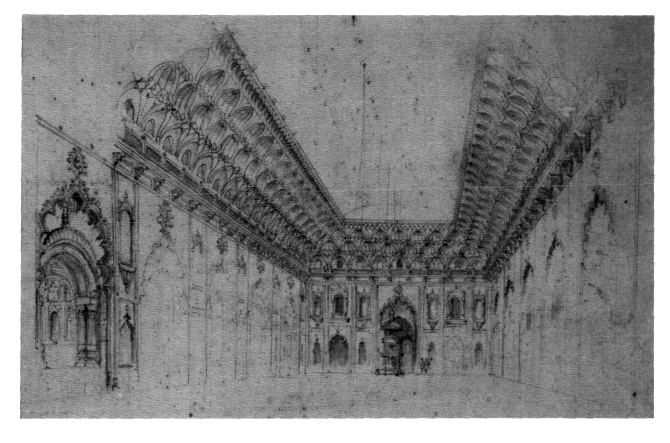
Figure 6
The interior of Husaynabad Imambarah. Courtesy of the British Library.
bilities of a governmental nature, integrating them as never before into the Awadh state. In contrast to the common image of the Shi‘i mujtahids as hostile to secular government, the Awadh ulama accepted offers of government posts and government monies with alacrity. Indeed, few if any major Shi‘i ulama remained outside the structure of government patronage and religious institution building in the 1840s. They appear to have seen the very willingness of a secular government to act in a proclerical manner as evidence of its justness and the rightness of cooperating with it.
The young monarch tempered his own pattern of life, that of an Indo-Muslim king, with Shi‘i piety. He maintained a harem of four hundred concubines and four wives, but avoided the scandals and adultery that echoed in his predecessors' palaces. So scrupulous about the use of state funds that he did not say his daily prayers in clothes bought by the government treasury, he took instead a stipend from his mother with which to purchase his own vestments.3 The tall, corpulent ruler with "a nose of extraordinary size" claimed on his coins to be the Shadow of God on earth.4 Even he, however, did not altogether eschew the life of an Awadh notable, indulging in such forbidden pastimes as listening to songs and music, and spending a great deal of his time in the harem. He entirely lacked the horror the clergy felt at representational art, ordering all the buildings in Lucknow painted white or in colors and covered with scenes of Indian life.5
Amjad ‘Ali Shah demonstrated a legendary deference to the Usuli mujtahids, illustrating the way in which the clergy had been able to influence members of the ruling class. He suggested a seal for Sayyid Muhammad Nasirabadi, whom he called the "sultan of the ulama," which referred to him as the "object of the faith of Amjad ‘Ali Shah." Sayyid Muhammad, feeling that the king had gone too far, demurred and asked that the phrase be altered to "object of the bounties." The monarch used to visit the chief mujtahid's mansion with humility.
At the powerful cleric's instance, the king ordered that the many taverns and hashish shops in Lucknow be closed down and that the narcotics crops be destroyed. He ordained that houses of male prostitution, which had proliferated in the capital, be put out of business. The male prostitutes, most of them transvestites, were arrested and banished from the city, except those who gave up their saris and agreed to have their locks shorn. Some notable patrons of the notorious Pomegranate Seed brothel wrote Sayyid Muhammad asking that he drop by, in a brash attempt to save the establishment. He
stiffly responded that if they read the formula for repentance, gave up taking the place of women, and grew beards, he would be glad to accept the invitation.6
Amjad ‘Ali Shah appointed Sayyid Muhammad Nasirabadi as the head of the excise department, an announcement that the government would no longer seek to profit from the sale of forbidden liquors and would attempt instead to abolish the substances subject to the tax. The all-out assault on the rip-roaring style of life of Lucknow's boisterous denizens met strong resistance and ultimately failed. The wits of the city found endless material for their satirical doggerel, taking revenge for the Usuli establishment's attempt to interfere in their amusements. One wag wrote:
Whoever drinks no wine, believers, he will burn in hell;
The excise to the Heavenly bartender's lover fell.7
The attack on hashish or bhang stores and taverns also had an economic motive, since Sayyid Muhammad resented Hindu dominance of Awadh's commerce. He wished to initiate a state-sponsored Muslim boycott of Hindu shops. Some Muslims founded stores with much effort, but the king's plans in this regard fell short of realization.8
The Government Payment of Alms
Awadh Shi‘is had for long privately paid Islamic poor-taxes. Even in Shujacu'd-Dawlah's Faizabad the Akhbari physician Hakim Mucalij Khan distributed donations by his rich patrons for the poor (paying himself handsomely to do so). In the 1890s Mrs. Ali noted that wealthy Muslims often gave one-fortieth of their annual income to the poor as zakat and one tenth to indigent Sayyids as khums . She reported that Sayyids could not accept other kinds of charitable donations (sadaqah ), as for instance when someone. distributed gifts on escaping from a deadly illness.9
In the 1830s the mujtahids in Awadh began making a major effort to increase official donations of a charitable nature. Since according to Usuli doctrine the mujtahids should be placed in charge of this money as the general representatives of the hidden Imam, any large increase in donations would
also augment their own power and financial resources. Sayyid Muhammad Nasirabadi wrote a work on the subject for Muhammad ‘Ali Khan Nasiru'd-Dawlah, soon to be Muhammad ‘Ali Shah. It is even possible that when he wrote the book Sayyid Muhammad already knew that the British intended to depose Nasiru'd-Din Haydar and replace him with Muhammad ‘Ali. This secret decision leaked from the residency in Lucknow, becoming common knowledge among political operators like Subhan ‘Ali Khan.10 (Nasiru'd-Din Haydar's sudden death in 1837 removed the necessity for such a move.)
Sayyid Muhammad Nasirabadi instructed the prince in the intricacies of the Islamic law of philanthropy. The recipients of the poor-tax (zakat ), he said, included the poor, the indigent, those appointed to distribute the alms, converts to Shi‘ism, slaves, debtors, and public welfare projects (from holy war to building mosques and bridges). In the time of the Occultation, he stressed, the poor-tax must be given to the upright mujtahid. He noted that under the Safavids the mujtahids administered the tax. All recipients, Sayyid Muhammad wrote, had to be Shi‘is, and the contributions of Sayyids had to go to other Sayyids.11
The other major philanthropy, called the "fifth" (al-khums ), originally formed the early Muslim state's portion of war booty. It benefited both the Prophet and his immediate family as well as various categories of the indigent. In Sunni Hanafi law, prevalent in India, it could be given, but would benefit only the poor and not the Sayyids, who said they were heirs of the Prophet. In the absence of the Imam early Akhbaris tended to see the obligation of Shi‘is to render this tax as having lapsed. Later Usulis believed that it should be divided in two basic parts, one for the mujtahids (the share of the Imam [sahm-i Imam ]), and the other for needy Sayyids.12 Sayyid Muhammad Nasirabadi said that consensus had settled on the donation of the fifth as a duty. Believers owed this charitable tax on plunder; on precious metals after costs; on found hidden treasure; on profits from commerce, agriculture, and artisanry; on precious stones from the sea; on lawful money any time it was mixed with ill-gotten wealth of unknown origin; and on land sold by a Shi‘i to a Jew, Christian, or Zoroastrian. The whole amount had to be delivered to the upright jurisprudent, who divided it into six parts in accordance with a literal reading of Qur'an 8:41. The mujtahid himself accepted three portions on behalf of God, the Prophet, and the Imam. He distributed the other three
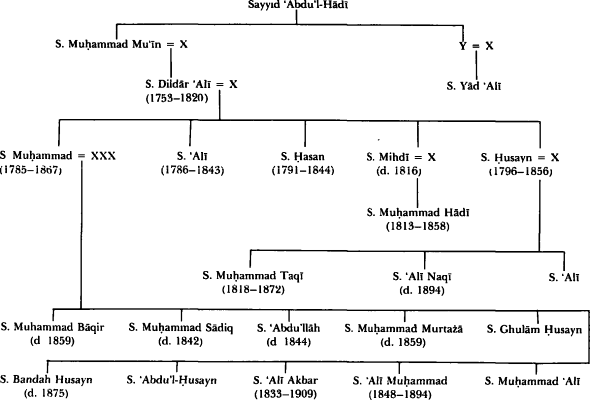
Diagram 3
The Nasirabadi Clerical Family
portions to the poor, orphans, and wayfarers among the Sayyids, excluding other Shi‘is.13
The Lucknow mujtahids upheld this exclusivity to the point that they forbade the use of the sum allotted to the Imam for the funding of Muharram mourning sessions, since non-Sayyids participated in them. The rules for the fifth also encouraged centralization, since few recognized mujtahids dwelt in qasabahs and the charity, when donated, would have to be sent to Lucknow. Moreover, the terms of donation favored the educated Sayyids in the cities, who were more likely to receive the philanthropy. Poor, ignorant Shi‘i Sayyids who did not know the rules for daily prayer were ineligible.14
Whatever poor-tax Muhammad ‘Ali Shah paid was a personal affair, though the largesse of a king could be considerable. But Amjad ‘Ali Shah went considerably beyond any recorded past practice in making charitable funds available to the mujtahids. He took the unprecedented step of having the government of Awadh pay the Shi‘i poor-tax (zakat ) on its annual revenues. At 2.5 percent, the charitable contribution annually came to more than Rs. 300,000 per year, totaling Rs. 1.7 million over the five years Amjad ‘Ali Shah ruled. The fifth was not, apparently, paid on this scale, although large sums were realized from this religious tax as well. The king gave both the poor-tax and the fifth into the care of Sayyids Muhammad and Husayn Nasirabadi.15
The first year the mujtahids distributed the funds they were literally mobbed. The poor, and sudden converts from Sunnism and Hinduism to Shi‘ism, besieged the houses of Sayyids Muhammad and Husayn. A later writer sniffed that "many of the undeserving" received funds.16 Thereafter the mujtahids established a register with the names of those they considered genuinely deserving Shi‘is, to each of whom they appointed a monthly stipend. Then they set up a department to handle the paper work, with Sayyid Husayn's son Sayyid ‘Ali Naqi Zubdatu'l-‘Ulama' (d. 1893) at its head. During this period hundreds of Sunnis and thousands of Hindus embraced Imami Shi‘ism, many of them in order to gain access to alms. Officials gave Hindu converts to Shi‘ism special preference in acquiring government jobs and, if they were tax-farmers, forgave them revenue shortfalls. Mosques and imambarahs proliferated.17
In the 1840s many Shi‘i clerics grew genuinely wealthy through their control of Islamic charities. Sayyid ‘Ali Naqi, who administered the money, paid himself so well that he could build four spacious, lavishly furnished man-
sions, with courtyards anti pools around which he set chairs that could not be matched for elegance in London itself. Each mansion had a name and was kept up by a horde of servants and provided with a stable for elephants. In the afternoon friends and seekers of knowledge would gather for salons around the pool, sitting on the European-style chairs. He also built a magnificent imambarah renowned for its mourning sessions. He was so respected that once when he went to Rampur to pray congregational prayers with the Shi‘is, the Sunni nawab joined in behind him.18
In each neighborhood Sayyid ‘Ali Naqi appointed persons he trusted to distribute the charity. The ulama sometimes employed this privilege as a way of bestowing favors. Mawlavi Sayyid Kamalu'd-Din Mohani, a zamindar who preferred to live in Lucknow, fell into financial difficulties because of his large family. To help him out, Sayyid Husayn Nasirabadi put him in charge of distributing charily. In 1845 he left to become the supervisor of a pious endowment in Calcutta, founded by a relative.19
In a pluralistic society like Awadh where the Shi‘is formed a small minority, the provision of such huge sums to this group struck many as invidious. Even Shi‘is like the historian Kamalu'd-Din Haydar criticized the system, observing that the mujtahids were obliged to put large sums of money in the hands of high state officials—ostensibly for redistribution to the needy—as bribes to ensure the continuing payment of the Rs. 300,000 per year.20 The government payment of the poor-tax emerged as an important issue under Vajid ‘Ali Shah (1847-56) during the residency of Colonel Sleeman. Sleeman faulted the system on several counts, pointing out that no Sunni could partake of the charity. Moreover, he said, since Sayyids could receive poor-tax monies only if they fell in the category of the indebted, the Awadh mujtahids
get over the difficulty by borrowing large sums before the money is given out, and appropriate the greater pait of the money to the liquidation of these debts, though they all hold large sums in our Government securities. To his friends at court he [the chief mujtahid] sends a large share, with a request that they will do him the favour to undertake the distribution among the poor of the neighborhood To prevent popular clamour, a small portion of the money given out is actually distributed among the poor of the Sheea sect at Lucknow, but that portion always remains small.21
Sleeman noted that government stipends were in arrears to the amount of five million rupees, and that the government was bound to pay the poor-tax only when free of debt. But, he said, the chief mujtahid, the chief minister, and the court favorites had too great a stake in it to allow it to be discontinued. Vajid ‘Ali Shah acquiesced in its payment, though the treasury was depleted, and the amount paid into the poor-tax had actually increased. At some point Vajid ‘Ali Shah, either bowing to British pressure or for his own reasons, stopped giving the poor-tax and even defaced coins lest he be obliged to give it. This interruption in their income, which became even more serious when the British annexed Awadh in 1856, caught the mujtahids and their families off guard, leaving them heavily indebted and forcing them to sell off their British stocks. This and other royal actions soured relations between the court and the mosque. Sayyid Muhammad ‘Abbas Shushtari mentioned as one of the sorrows in Sayyid Husayn Nasirabadi's life the "opposition of the notables [umara ']," admitting that Amjad ‘Ali Shah showed him much respect but lamenting that he had hastened to the next world. Vajid ‘Ali Shah demonstrated not nearly so much veneration of the ulama.22
The substantial poor-tax funds quite aside, Amjad ‘Ali Shah showered the clergy with perquisites. He gave Sayyids Muhammad and Husayn Nasirabadi each an extra Rs. 200 per month as the capital's official prayer-leaders and provided extra allowances to other members of the Nasirabadi clan as well. In addition, the king established a special fund for Sayyids totaling, at one point, Rs. 2,000 each month. The senior members of the Nasirabadi family received Rs. 100 per month each, with altogether Rs. 380 per month out of these monies going to the Nasirabadis. They shared the rest of the allowance (probably deriving from khums ) with other Sayyids of their choosing, the total number of recipients reaching forty-seven at one point. Vajid ‘Ali Shah, immediately upon coming to power, cut the Sayyid fund in half. Still, in 1849 his treasury sent Sayyid Muhammad Nasirabadi Rs. 2,180 per month in various perquisites to be shared out.23
The poor-tax and the fifth contributions over which the high ulama exercised control for nearly a decade increased their wealth and power immeasurably. They had, from their point of view, a legal right to half of the khums donations, and the power to decide to whom the other half would go. They employed various devices to gain access, as well, to the poor-tax (zakat ) revenues. Even mere control over the latter, amounting to hundreds of
thousands of rupees per year, would have rendered them important sources of patronage. This money tied them closely to the ruling establishment, drawing them into tight association with the secular state. Most important, by accepting regularized payments of huge amounts of money from government revenues, their position within the ruling class changed from that of small land- and benefice-holders and stipendiaries. They became direct recipients of state-expropriated peasant surpluses. In many ways the prominent ulama joined the class of high notables. Like the Awadh notables, they also became rentiers by investing in East India Company stock.
The Funding of a Shi‘i Seminary
The Usuli Shi‘i ulama already had informal means of passing their status on to their children, of teaching them the technical expertise demanded by many ulama posts, and of controlling entry into the ulama corps. Their teaching sessions in homes produced enough Usuli clerics to meet the notable-class demand for their services in the earlier part of the nineteenth century. But with the accession of great wealth and numbers of government posts for Shi‘i clerics in the 1840s, the ulama could only take advantage of the opportunities to influence society and move upward socially by expanding and more rationally ordering their educational activities. In short, they needed formal seminaries.
After Amjad ‘Ali Shah and his chief minister, Aminu'd-Dawlah, had been in office for nearly a year, the leading mujtahids Sayyids Muhammad and Husayn Nasirabadi decided that they finally had a government with which they could work closely. They suggested that the new government formally subvent an official, expanded Shi‘i seminary (madrasah ). The ruling circles responded with enthusiasm and generosity. In May 1843 a proposed schedule was drawn up wherein the king appointed Rs. 31,200 per year for the school, with fourteen primary teachers, seven intermediate teachers, and five advanced instructors, with three principals.24 For Shi‘i scholars with land around their qasabahs the salaries were more of a perquisite than an income, although for Sayyids that had fallen on hard times even Rs. 240 per year could help to make ends meet.
Amjad ‘Ali Shah neglected to endow the seminary or to appoint lands permanently to generate its income, paying for it instead from the royal treasury every year by personal fiat. The king often visited the premises, at the tomb
of Nawab Sacadat ‘Ali Khan, and distributed sumptuous meals. He also funded a smaller seminary at Faizabad, at least for a time. Many of the families that staffed and attended the royal seminary had already taught Shi‘i sciences on an informal basis for some time. Amjad ‘Ali Shah simply gave permanent form and monetary support to such teaching, allowing numerous salons to coalesce into one institution.25
The top administrative post at the Lucknow school fell to Sayyid Muhammad Taqi Nasirabadi (1818-72), the son of Sayyid Husayn. His emergence into prominence at the age of twenty-five marks the rise in the 1840s of the third generation of Usuli ulama. His heading tip of the school also typified the Nasirabadi family's determination to keep key clerical posts in the family; like the young executive taking over his father's business, Sayyid Muhammad Taqi's qualifications for the post lay in his family name rather than in his scholarly attainments or experience (many of the teachers he hired and fired were much senior to him on both counts). He did not even receive from his father and uncle his diplomas qualifying him to relate the oral reports of the Imams until 1845 (1262), two years after he became principal. He also held an honorary diploma from Shaykh Muhammad Hasan an-Najafi in Iraq, into whose hands the Awadh ulama had placed hundreds of thousands of rupees. In addition to his duties as principal and senior teacher at the royal seminary, he helped his father lead prayers at the Tahsin ‘Ali mosque, sometimes also leading them in his father's presence at the royal mosque. He wrote prolifically, often in Arabic, and must have felt a pressing need to provide textbooks for the new generation of two hundred students coming up through his institution.26
At the school he wielded absolute administrative powers: "It appears from Wajboolarz [wajib al-card ], dated the same year in which the institution was founded, that full and plenary powers were conferred on the principal, to appoint, remove or alter salaries at his pleasure."27 In addition to his salary of Rs. 1,800 per year and his share of income from the family villages, he received from 1848 a complimentary stipend of Rs. 100 per month, in addition to Rs. 540 per year from the rent of shops around the Tahsin ‘Ali mosque.28
But such formal emoluments were no doubt dwarfed by the gifts of notable-class patrons and students.
The assistant principal when the school first came into existence was Sayyid Ahmad ‘Ali Muhammadabadi (d. 1878), a middle landholder (zamindar ) and leader of a small town in British-ruled Azamgarh just south of Awadh. Trained by the Usuli prayer leaders of Faizabad and Lucknow, and by a Farangi-Mahalli, he secured notable-class patronage when he became the tutor for the sons of the sometime chief minister, Imdad Husayn Khan Aminu'd-Dawlah. Muhammadabadi's wealth and erudition and his penetration of ruling-class networks in Lucknow allowed him to marry his son to the daughter of another man who served as chief minister, Ahmad ‘Ali Khan Munawwaru'd-Dawlah.29 The third seminary administrator in 1843, Muhammad b. ‘Ali Fayzabadi, a close student of Chief Mujtahid Sayyid Muhammad Nasirabadi, also served as a preacher (vaciz ), strongly recommending Friday congregational prayers and working sermons from the New Testament and the Imam ‘Ali into his talks.30
Of the five advanced teachers at Rs. 840 per year only a few can be identified from the biographical dictionaries. One, Sayyid Muhammad Siyadat Amrohavi (d. 1849), a Friday prayer leader from a zamindar background, had studied with Sayyid Husayn Nasirabadi.31 Another prominent advanced teacher, Sayyid Muhammad ‘Abbas Shushtari (1809-88), served as Sayyid Husayn Nasirabadi's secretary in his Arabic correspondence with Iraq. From an Iranian clerical family that settled in Awadh as court physicians and intermarried with the Awadh notable class, Sayyid Muhammad ‘Abbas forsook medicine for a religious career. At age seventeen he began studying Shi‘i sciences with Sayyid Husayn Nasirabadi, who encouraged him to become a prayer leader and sermonizer. He tutored the children of the great merchant Mirza Muhammad ‘Ali Dihlavi to earn a living and received his diploma allowing him to relate Shi‘i reports in 1841. For a time without means, he tried his hand at medicine again. He later remarked that although he came of a family renowned for its wealth, he himself at one point fell on hard times.32
Finally, in the spring of 1842 Shushtari obtained a post under Muhammad ‘Ali Shah. When in May of the same year the king died and a new administration came in, he lost that position and had trouble maintaining his service-elite style of life. A year later when the Shi‘i seminary for which
Sayyid Muhammad ‘Abbas himself helped lobby was funded, Sayyid Husayn exercised his influence to have Shushtari made a senior instructor at the age of thirty-four, at Rs. 840 per year in salary. The financial difficulties he experienced underline the strong motivation the ulama had to expand job opportunities in the economically depressed 1840s.
The seminary underwent changes over time. In 1846 the government moved it to the larger facilities at Asafu'd-Dawlah's Great Imambarah in the old part of town. The faculty expanded from twenty-nine to thirty-eight, though the number of students stayed around two hundred. The turnover was large: only eleven faculty members appointed in 1843 remained on the rolls in 1856. Often their own sons replaced instructors who died, and in any case their stipends became inherited family property. Even where teachers died leaving no one in the family capable of succeeding them at the seminary, their heirs continued to receive the stipends. They were, like many service grants in this period in Awadh, a curious mixture of salary and pious endowment, a liquid waqf , an alienated portion of the Government treasury.
Although no list survives of the students who passed through the school, and the extant lists of teachers often give only a first name, the information available indicates that the seminary functioned for upper- and middle-class Shi‘is. Further, it actually became involved in 1843-56 in elite formation in Awadh. Many of the teachers who can be identified were small or middle landholders from the Muslim lineage centers, and others derived from high service families clustered around the court in Lucknow. An example of how the seminary could be used for upward mobility is Mirza Muhammad ‘Ali "Qa'imu'd-Din" (d. 1872), who worked himself up from instructor to master and finally became a jurisconsult at Vajid ‘Ali's court and an intimate of the king.33
Contemporary observers remarked on the patrimonial nature of the school's administration, and younger members of the old elite ulama families received a disproportionate number of appointments to the staff on their completion of studies at the seminary. In 1848 Sayyid Husayn appointed his son Sayyid ‘Ali Naqi Nasirabadi, then twenty-seven, deputy principal at Rs. 600 per year. Sayyid Bandah Husayn Nasirabadi (d. 1875), son of Chief Mujtahid Sayyid Muhammad, became a master teacher in 1852 at Rs. 480 per annum. The late Mufti Sayyid Muhammad Quli Kinturi's youngest son, Sayyid Hamid Husayn, was hired as a teacher when only twenty-two. In 1855 his cousin, Sayyid Ghulam Husayn Kinturi, became the daroghah at Rs. 300 per year, taking charge of the stipends, which came to over Rs. 30,000 per year at that time.34
Despite the dominance of elite Usuli families established in Lucknow and Faizabad, some teachers were drawn from the qasabahs , and some came from beyond Awadh, from nearby places like Bijnor or Farrukha-bad, or even from the Punjab. The school also attracted as students literate Shi‘is from Muslim service towns throughout northern India. The Shi‘is trained at the seminar), took strict Usuli ideas hack to their provincial towns. Sayyid Muharram ‘Ali Nauganavi (d. 1889) of Moradabad left his house as a young mall without telling anyone and went to Lucknow to study at the seminary. The first Shi‘i scholar from Nauganoh to be trained in Lucknow, he taught the others who followed. He established direct contact with the Usuli tradition in Iraq by visiting the shrine cities, settling thereafter in Meerut district and Saharanpur. The Lucknow seminary helped link together widely scattered Shi‘i communitics into a network of personal acquaintance and shared expertise, as well as promoting in the qasabahs the stronger division between the trained cleric and Shi‘i layman which already existed in Usuli Lucknow and Faizabad.35
Just as Farangi Mahall, with its special teaching method and rationalist emphases, had helped train bureaucrats as well as ulama, so the Shi‘i seminary performed both functions. Typical textbooks included an early-Safavid-period Usuli work in the principles of jurisprudence; a standard work on metaphysics in Arabic; Mulla Sadra's commentary on an early philosophical and scientific encyclopaedia; a work by Sayyid Husayn Nasirabadi in law; and a late-eighteenth-century Usuli commentary on law from Karbala. The syllabus mixed works often used with the Nizami method with the central textbooks favored by or produced by the Usuli revival in Iraq and in Lucknow.36
Sons of notables often took classes at the seminary for a while before moving on to administrative positions. Mirza Muhammad Riza "Barq," a student at the seminary, later received an appointment as the court paymaster (bakhshi ). The high notable Mirza Riza Khan ‘Ali-Jah Bahadur pursued religious knowledge at the seminary in Lucknow, then studied in Karbala. He and his brother attained both worldly and religious leadership back in Awadh.37
The seminary established in the 1840s allowed the more systematic socialization of Awadh's Shi‘i ulama to Usuli values and the training of a greater number of ulama to fill the posts rapidly being created by the proclerical government. Young ulama came into the system as sons or clients of the older, established mujtahids who controlled stipends and subsequent clerical appointments. The older ulama could thus offer aspiring young clerics incentives to conform to Usuli orthodoxy. Their intellectual formation included years of studying Arabic, the rational sciences, and Usuli principles of jurisprudence and theology. Some Shi‘i notables also had their sons study at the seminary, both for the rational tools they would learn there and for the sober religious education they would receive. Notable and ulama families looked on a few years at the seminary as a way of building character, and even young students from an affluent background were often forced to live on the small stipends provided by the school. Bonds other than learning and patronage linked the middle-landholding or service-class teachers at the seminary with the high notables. Marriages tied the Muhammadabad- and Shushtari families, both represented on the faculty, to two of the wealthiest notable houses, from which chief ministers had been drawn.
The Establishment of Shi‘i Courts in Awadh
The Usuli ulama, for all their privileged position and new wealth, lacked official control over Awadh law. To move into such judicial posts required a degree of integration into the institutions of the secular government which the Indian Usulis had thus far avoided. It would also give the mujtahids a much more powerful tool for shaping Awadh society in accordance with their interpretations of Islamic law in its Imami form. The coincidence of ambitious Usuli ulama at the head of the religious establishment and cooperative Awadh monarchs guaranteed both the willingness of the government to appoint Shi‘i judges and the willingness of the jurisprudents to plunge into the mire of positive law.
Mughal traditions proved tenacious in Awadh, partially because the Nawabs, for all their Iranian and Safavid symbols, had themselves been integrated into the Mughal heritage. Even when the Nishapuri rulers declared themselves kings, Awadh administration proceeded along Mughal lines. Many Mughal land and service grants continued in force, and what was most remarkable, the judicial system remained in the hands of Hanafi Sunnis. As was shown above, even in the first decade of the nineteenth century Sacadat ‘Ali Khan proposed that a Shi‘i judiciary be established. The Usuli ulama, who did not trust him and did not wish to compromise their integrity any further, rebuffed him.
The Farangi-Mahall family filled most judicial posts. Lucknow and Faizabad had urban criminal and civil courts (divani ‘adalat ), and major govern-
ment offices employed jurisconsults. Hereditary village qazis had jurisdiction over their parganah. Large landholders and government-appointed revenue collectors and governors (fawjdars ) also dispensed justice according to customary law; In Faizabad Hafizu'llah Farangi-Mahalli headed the civil and criminal courts, with his relative Nicmatu'llah serving as a mufti. In Lucknow Muhammad Yusuf Farangi-Mahalli (d. 1870) succeeded his father as mufti on the civil and criminal court at Rs. 200 per month, holding the post until Vajid ‘Ali Shah's deposition. Sunnis from outside Lucknow filled some judicial posts. Mufti Sacdu'llah Moradabadi (1804-77) studied in Rampur and Delhi, arriving in Lucknow in 1827 for further schooling at Farangi Mahall. He taught at the royal seminary, then became mufti for the office of the chief municipal authority (kotwal ) in Lucknow.38
With the accession of wealth, power, and prestige to the Shi‘i high ulama in the 1840s, they now made a bid to control the Islamic-law judicial system, a traditional outlet for the talents of Muslim learned men. Mufti Sayyid Muhammad Quli Kinturi, who retired to Lucknow from a post in the British court at Meerut in 1841, strongly advocated this step. While in Meerut he wrote a work urging the king to institute a Shi‘i legal system. He published it in 1843, dedicating it to Amjad ‘Ali Shah, to whom he referred as "the exemplar of [the phrase] 'the just king'" (misdaq as-sultan al-‘adil ). He said he wrote the work to refute Sunni taunts that Shi'is were incapable of being qazis and muftis, and to encourage the Awadh government to take up the torch of the Buyid, Safavid, and Qutb-Shahi states in promoting Shi‘ism and honoring the Shi‘i ulama. He insisted that it was forbidden for non-Shi‘is to be court judges, admonishing the king to appoint only Imami jurisprudents to such posts. He explained tile difference between a qazi (who makes specific judgments in disputes between parties) and a mufti (who gives general pronouncements in elucidation of the law), arguing that only qualified mujtahids should be appointed to either post.39
Kinturi therefore endeavored to exclude laymen and Akhbaris from judicial posts, as well as Sunnis. He had, however, to answer the charges of those Indian Shi‘is who insisted that only the ulama in Iran and the Arab lands held the status of mujtahid, there being no mujtahids in India. On the
contrary, he asserted, rulings in accordance with Imami Shi‘ism could be implemented in Awadh insofar as the ulama there had met all the classical requirements of independent judicial reasoning (ijtihad ).40
Lay Shi‘is had for long made the leading mujtahids arbitrators in their disputes.41 In establishing a Shi‘i court system Amjad ‘Ali Shah formalized, again, an informal arrangement. He appointed Sayyids Muhammad and Husayn Nasirabadi jointly to head a supreme appeals court that would oversee all Islamic-law courts. Sayyid Muhammad made his eldest surviving son, Sayyid Muhammad Baqir Munsifu'd-Dawlah (d. 1859), chief justice (daroghah ) of the Lucknow civil and criminal court (divani ‘adalat ), retaining the Farangi-Mahall jurisconsults in a subordinate position (a compromise falling short of Kinturi's all-Shi‘i ideal). Sayyid Muhammad Baqir received Rs 500 per month in formal salary, but a British investigation concluded that "the incumbent receives much more than 500 from many sources."42
The government created an entirely new system of Islamic-law courts in the provinces, called the fawjdari ‘adalat . It appointed Twelver Shi‘i jurisconsults, one for each district in Awadh, to be attached to the office of the district's governor and revenue collector. Sayyid Muhammad Baqir likewise headed up this new branch of the judiciary. His younger brother Sayyid Murtaza (d. 1859) presided over a subordinate Sadr as-sudur court that handled cases at the local level. The chief mufti, or jurisconsult (sadr ifla '), over all the provincial courts was Sayyid Hadi Nasirabadi (1813-58), a nephew of Sayyid Muhammad, the chief mujtahid.43 As might be expected, Sayyid Muhammad bestowed the less desirable but still powerful jurisconsular posts in the provinces, not on members of the Nasirabadi family, but on their younger disciples, often themselves from outside Lucknow. They included two clerics from a British-ruled province just north of Awadh, as well as muftis from small towns in Awadh proper.44 A member of the Nasirabadi clan still based in that village became jurisconsult for his area.
The creation of the Shi‘i judicial system, like the seminary, provided employment for the emerging third generation of Usuli ulama, who found job opportunities in traditional fields like prayer leading to be limited. The king considered Sayyid Muhammad ‘Abbas Shushtari for a post as the prayer
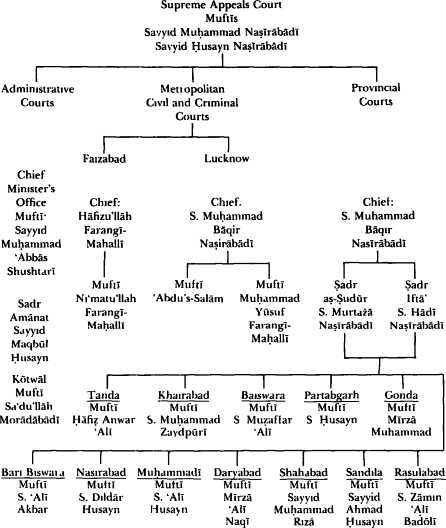
Diagram 4
The Awadh Judiciary (circa 1855)
leader at the new cathedral mosque built in the 1840s, but protocol required him to retain Sayyid Muhammad Nasirabadi. As compensation, he made Shushtari, then teaching at the seminary, jurisconsult of the chief minister's office. He received a substantial increase in income, but said he was reluctant to accept the post because of the interference of government officials, the enmity of those he ruled against, the dishonesty of the attorneys, and the greed of court officials. Once when a plaintiff offered him a bribe, Shushtari re-
portedly broke into tears at this affront to the holy Law.45 Those tears expressed the contradiction between the original sectarian ideology of Imami Shi‘ism on the one hand, hostile to the secular world in the absence of the divinely-guided Imam, and on the other the Usuli ideology of collaboration with any state that was willing, and involvement in positive law and practical administration.
The Usuli clerics advanced in the 1840s on the last major front in their battle for monopoly over important religious posts, that of the Islamic-law judiciary. They vigorously practiced exclusionary closure, hoping to displace the Sunni magistrates completely by arguing that only an Usuli mujtahid could legitimately give legal rulings as magistrate or jurisconsult. They also argued against Iranian competitors that Indian Usulis were perfectly competent to derive legal rulings. A Shi‘i judicial system also allowed the Usuli ulama to impose many of their conceptions of proper behavior, property, and family relations, and relative rights of various social groups and religious communities on sections of Awadh society. The appointment of the provincial jurisconsults even tenuously extended the writ of Usuli law into the interior of Awadh, a new and significant development. Of course, the Shi‘i judges had relatively little influence on Awadh society as a whole, since most persons handled their legal matters informally or, in the countryside, went before tacalluqdar landholders. Still, sometimes Shi‘i judges could play pivotal roles, as will be shown in chapter 10.
Relationship with the Shi‘i Centers of Iraq
The rise of a full-fledged Shi‘i religious establishment in Awadh raises the question of the Indian Usulis' relationship with the great jurisprudents of Najaf and Karbala. Although mujtahids were forbidden to practice emulation (taqlid ) of other jurisprudents. the Usuli emphasis on the greater authority of the most learned (al-aclam ) jurisprudent led to the emergence of a small number of pace-setters whose judicial opinions commanded wide respect and around whom a new consensus often formed. In the 1840s a convention existed that of all the great centers, Najaf was preeminent, so that the head of the religious establishment in that city was considered the leader (ra'is ) of all the Shi‘is. In a biographical notice of Shaykh Muhammad Hasan an-Najafi, one of his students wrote in 1846 (1262), "Upon him devolved the leadership of the Imamis, both Arabs and non-Arabs, in this, our own time."46
The relationship of the high ulama in north India to the mujtahids in the shrine cities remained a complex one. They all addressed each other as the "best of the mujtahids," the "exemplar of the people," the "heir of the
prophets," rendering the superlatives no more than pleasantries. A story from Sayyid Husayn Nasirabadi's biography illuminates the relationship. Shushtari wrote that Sayyid Husayn allowed the deputation of judicial authority (al-istinabah fi'l-qada ), considered a very minority opinion that seemed to contradict Shi‘i consensus. After Muhammad Hasan an-Najafi took the same stance in his Jawahir al-kalam , others in Awadh changed their views, agreeing that such deputation was permissible. Sayyid Husayn, on the other hand, not once changed his mind on a major position.47 The story demonstrates that an-Najafi's authority as a mujtahid and source for emulation (marjac at-taqlid ) carried weight with many north Indian ulama in the 1840s, but that the Nasirabadis maintained their independence. Sayyid Muhammad Nasirabadi, after all, maintained that he was esoterically taught his knowledge by the Twelfth Imam himself.
After an-Najafi's death, Murtaza Ansari, who controlled 200,000 tumans per year in charitable donations, emerged in Najaf as the most widely recognized jurisprudential source for emulation in the Shi‘i world.48 Later in the nineteenth century Muhammad Mihdi Kashmiri of Lucknow wrote of Ansari, "His cause attained renown throughout all horizons, and he was mentioned in the pulpits in a manner unparalleled before him. He was an exemplar to the Shi‘is in their entirety, in their religion and in their worldly affairs."49 Again, although such sentiments in favor of Ansari clearly existed in Awadh, it is unlikely that any of the leading members of the Nasirabadi family acknowledged anyone else as more learned than themselves.
For their part the jurisprudents in the shrine cities did not simply dismiss the Indian mujtahids as rustic bumpkins, at least to their faces. Shaykh Muhammad Hasan an-Najafi continually asked the Lucknow mujtahids to send copies of their compositions to Najaf, where they were read and circulated, early Awadh use of the printing press making Shi‘i authors there accessible to readers in the Middle East. When he read Sayyid Muhammad Nasirabadi's book in defense of temporary marriage, he called it the "crown of Shi‘ism and referred to the author's father, Sayyid Dildar ‘Ali, as "the seal of the mujtahids." Elsewhere he noted that Sayyid Dildar ‘Ali's long work on the principles of religion entitled "Mirrors for Minds" had arrived, upon which he lavished effusive praise, attributing the brilliance of the fami-
ly's compositions to their descent from the Imams.50
The anecdote from the life of Sayyid Husayn about judicial deputation indicates that many Shi‘i ulama in India accepted even controversial rulings as authoritative when issued by the leading mujtahid in the Iraqi shrine cities. The top mujtahids in Awadh, however, never changed their views on another's authority. The lower ranks of mujtahids everywhere may have shown more deference to an-Najafi (and then to Ansari) as the most learned exemplar than did the chief mujtahid in each major city.
State-Ulama Tensions
Paradoxically, the accepting of posts as government judges and jurisconsults brought the Indian ulama into direct involvement with the day-to-day administration of the Awadh government and yet simultaneously increased possibilities for conflict with secular officials. The ulama, as the judiciary branch of the state, naturally at times struggled with the executive over policy and the impact of legal decisions. Such conflicts had nothing of the sectarian about them, but rather expressed differences between secular imperatives and hierocratic ones in judicial policy. The Usuli ulama maintained a distinct set of values and style of life that set them apart even within the ruling class. Sayyid Muhammad Nasirabadi refused the titles bestowed upon other notables, such as khan and bahadur .51 The third generation of Usuli ulama modified this attitude, insofar as they accepted noble court names, such as Munsifu'd-Dawlah (the Just of the State). Still, differences of religious culture separated even the high ulama from other notables.
Letters written by the ulama in the wake of the 1843 Ottoman sack of the holy shrine city of Karbala in Iraq shed light on their conception of the secular notables, whom they called umara ', rulers, as opposed to ‘ulama ', the learned. Rather than blaming the Sunnis for the disaster in the Middle East, which cost perhaps 5,000 Shi‘i lives, Sayyid Husayn Nasirabadi lamented that one seldom found notables (umara ') with hearing ears, excoriating both Sunni and Shi‘i high notables as corrupt. One Iranian cleric who barely survived the Ottoman attack, which aimed at subduing the rebellious city, blamed both the Ottoman sultan for ordering the assault and the Iranian shah for failing to defend the holy city, and wrote to Lucknow a radical letter from Iraq in which he said, "Would that there were no king ruling over us, and none over Iran!"52 Even such a rhetorical expression of premodern re-
publican sentiments by the Shi‘i ulama in Awadh is unrecorded, however, and for all their differences with the Nishapuris, the Usulis in Lucknow knew that without them Shi‘ism in India had little future. Indeed, the Usuli clerics often referred to the Awadh monarch as a just king, implicitly accepting the legitimacy of his state.
A sample of anecdotes told by later ulama in their biographical dictionaries will illustrate the clerics' own interpretation of ulama conflict with the state. Although Muhammad ‘Ali Shah maintained generally good relations with the ulama, his means of acquiring land for a new Shi‘i mourning complex brought him into conflict with the chief mujtahid. When the king called for Holy Day prayers to be held there to commemorate the breaking of the Ramadan fast, Sayyid Muhammad informed the monarch that some of the land on which the building was constructed belonged to Nacim Khan. He refused to lead the prayers at the new site until the monarch paid the original owner a just price for his land according to Islamic law. After an investigation, and with the consent of Nacim Khan, Sayyid Muhammad suggested a fair price. Muhammad ‘Ali Shah paid it, and the ceremony proceeded as planned.53
Amjad ‘Ali Shah bought some mosque furnishings from a merchant for Rs. 1,300,000. Although the ruler gave the whole sum, some courtiers in charge kept back Rs. 100,000. Sayyid Muhammad Nasirabadi intervened to ensure that the merchant received the whole amount.54 In the same period, when prince Vajid ‘Ali took a fancy to another man's slave-girl, usurping her from him, Sayyid Muhammad made an investigation and concluded that according to Islamic law Vajid ‘Ali Mirza would have to surrender the girl to her rightful owner. The king ordered the judgment carried out. When Vajid ‘Ali ascended the throne he sent a message through a notable to suggest that the chief mujtahid review the slave-girl case. Sayyid Muhammad resolutely refused to bow to the monarch's pressure. Later Mirza Muhammad ‘Ali Qa'imu'd-Din rejected the request of some of the king's wives to have their adopted children inherit, in contradiction of Shi‘i law. Vajid ‘Ali at first got other mujtahids to reverse his decision. But the truth eventually came out, forcing Vajid ‘Ali to apologize.55
The message of these anecdotes is that their attention to the imperatives of the law often divided the Muslim learned men from their notable patrons and friends. Yet a close observer can see that the Muslim learned men's fastidiousness constituted an alternative style of life within the Shi‘i upper and middle strata, rather than demarcating a separate class. In matters of property, in attitudes toward non-Shi‘is, in acceptance of the Awadh government
as the best that could be hoped for in the Occultation, the Shi‘i clergy were at one with the high notables.
Still, the division of status groups, as between the notables and the learned, which also tended to involve a class distinction between great tax-farmers or landholders and a less wealthy intermediate stratum, often produced friction and nuances in policy. Vajid ‘Ali Shah, though he resorted to the mujtahids in major legal issues, increasingly grew estranged from them. As was noted, he stopped government payment of the poor-tax, causing a substantial diminution in the wealth passing through their hands. He halved the Sayyid fund. He once again allowed the sale of opium, wine, and bhang, putting Ghulam Riza Khan, a notable, in charge of the excise department. In the 1854-55 and 1855-56 school years he virtually stopped payments for the Shi‘i seminary, threatening the salaries of thirty influential clerics and the stipends of hundreds of students. As the British report noted, it was unclear whether the king withheld payments for financial reasons or whether he intended to abolish the college.56
Although the pendulum swung back in the 1850s away from increasing ulama influence at the Awadh court, the Usuli clerics held on to many of their posts, perquisites, and means of influencing Awadh society. The alliance of secular state and hierocracy produced in the 1840s a formal religious establishment tightly intertwined with the ruling elite, which came to form the judicial branch of the patrimonial-bureaucratic state. The clerics, owning only a handful of villages each or depending on stipends from notable patrons or government posts, maintained a distinct style of life appropriate to their status group, marking them off from the fabulously wealthy high Shi‘i notables and the royal family. Yet the pious stories of stiff-necked mujtahids besting unscrupulous tyrants only masked the degree to which the ulama increasingly collaborated closely with the state in the 1840s, appropriating the sort of wealth that made some of them notables in their own right. The young Vajid ‘Ali Shah's attempts to undermine some of the mujtahids' power only underscores the extent to which they had come to form part of the ruling establishment, since most Awadh rulers upon coming to power moved against the mainstays of their predecessors' administrations.
Conclusion
The 1840s witnessed the peak of mujtahid power, marked by the creation of a whole range of new institutions and the accession of great wealth and political authority. In a patrimonial bureaucracy such as Awadh, however, this high-powered public role depended heavily on the goodwill of the central
officers of state, and so revealed itself to be volatile rather than stable. The 1850s saw a rapid decline in the public influence of the Shi‘i clergy, though some of their achievements of the previous decade continued a curtailed existence.
The Awadh high ulama recognized the government as having a common law (‘urf ) legitimacy, even though it was imperfect and so ultimately unjust (ja'ir ), but they often had policy differences with the secular branch of the state. For some years, even these lessened. Because the Indian ulama lacked the mass base of those in Iran, they depended more on the Shi‘i notables, seldom playing a real oppositional role. Moreover, even in Iran the clergy never received charitable monies directly from state treasuries. No outright statement by the jurisprudents in Lucknow of the complementarity of the secular and religious branches of government, like that produced by Qajar mujtahids Sayyid Jacfar Kashfi and Mulla ‘Ali Kani, has yet been discovered.57 But in practice just such a complementarity emerged in northern India.
Under Amjad ‘Ali Shah, Imami Shi‘ism in Awadh came into its own as a formal religious establishment, with a salaried professional clergy, claims to universal dominion, systematic education in dogma and rites, and a compulsory organization. From the old charisma of Shi‘i mystics and Sayyids, the Usuli ulama had evolved into a hierocracy where charisma was attributed to the office of the mujtahid or the Friday prayer leader, rather than being personal. The clergy of this formal religious establishment enjoyed special privileges bestowed by the government, and in the royal seminary had founded a regular hierocratic educational institution that also allowed them systematically to socialize secular officials to their values.58
The key element in the transformation was the government provision of wealth for religious specialists, at first in the form of benefices or land grants, then stipends often deriving from interest on loans to the British or dividends of British Government securities. Access to material resources was essential for the growth of a formal religious establishment:
The process of routinization of charisma is in very important respects identical with adaptation to the conditions of the economy, since this is the principal continually operating force in everyday life. Economic conditions in this connection play a leading role and do not constitute merely a dependent variable. To a very large extent the transition to hereditary charisma or the charisma of office serves as a means of legitimizing existing or recently acquired powers of control over economic goods.59
The transformation of a sectarian collectivity into a formal religious establishment has been one of the main theoretical concerns of this book. The
modalities of this transformation among Awadh's Shi‘is and some of the economic reasons for it have been discussed in detail. Another consistent question has been the effect of social stratification on religious organization. Social class, one variable in the analysis, cannot itself account for the difference between sect and formal establishment. The Shi‘i notables serving under Awrangzib constituted part of a sectarian group despite their wealth. Only where a religious collectivity's form of religiosity is tolerated or promoted by the state, and where that collectivity itself feels comfortable with the state, can a formal religious establishment emerge.
But given this precondition, sociocconomic class comes in as a secondary variable correlating with membership in a religious establishment. In the modern West, the "middle class and the middle aged arc over-represented in established churches and denominations."60 In Awadh, the intermediate propertied strata and the wealthy notables allied themselves within the structure of an Usuli dominant ideology. This formal religious establishment began to reach out to urban artisans, laborers, and the poor in the 1840s, as well, through its welfare-distribution activities and its power to determine who was orthodox enough to receive Shi‘i religious charities. Still, sectarian movements such as those at Murshidabad, discussed in chapter 6, probably continued among the poorer Shi‘is.
The secular government and the religious establishment worked together, though the real power lay unquestionably with the monarchy. Nor did the government attempt to usurp religious authority in the creation of a caesaropapism once Nasiru'd-Din Haydar's policies in this regard met failure. The Usuli establishment paid for the privileges that the state bestowed upon it, by helping legitimate the Awadh government and upholding its authority.
The religious institution building and Shi‘i proclerical policies of the Awadh government in the 1840s demonstrated the extent to which the Usuli ulama had convinced the Shi‘i notable class of the urgency of their own agenda. The Imami clerics in Lucknow, with their control over religious education and religious monies, and their publications in Persian and Urdu, had effectively indoctrinated both the Shi‘i clerical families from the rural lineage centers and the administrative and tax-farming families in the cosmopolitan centers, creating an Usuli dominant ideology that bound together the Shi‘i propertied classes. The scripturalization of the Shi‘i urban poor also increased in this period, as ulama distribution of welfare money to the indigent gave them greater social control over the propertyless. They encouraged extensive adoption of Shi‘ism by Hindus and Sunnis, especially among government employees and the urban poor. From the impressionistic accounts we have of this period, they succeeded best among urban Hindus, thousands of
whom forsook Ram and Krishna for Hasan and Husayn. Shi‘i scripturalization and the implementation of aspects of Shi‘i law in Awadh helped to establish a communal identity more clearly among Shi‘is in relation to other religious communities, as will be discussed in chapter 9.
Rulers such as Amjad ‘Ali Shah pursued communalist pro-Shi‘i policies, despite the minority status of the state religion, as a means of symbolically demarcating the line between the ruling class and its subjects. The king's religion enjoyed special privileges because it was the king's religion. The Imami clergy were especially dependent upon the government because the proportion of Awadh's inhabitants subject to their own sanctions of excommunication and public cursing remained small. A minority sectarian movement among North India's Muslims had emerged with claims to being a state religion and a universal church solely because of its association with the Shi‘i high notables that controlled the government. But the narrowness of that power base, and the fragility of that state in the face of growing European economic and political power, left Imami Shi‘ism open to being swiftly reduced once more to the status of a small sect.
PART FOUR
SHICIS AND OTHERS
9
Shi‘i, Sunni, Hindu: Communal Relations in Awadh
Introduction
Religious communalism and separatism have dogged the history of modern South Asia. Various schools of thought have sought to explain this phenomenon differently, but three elements appear generally important. The first—the increasing organization of religious communities for political action and competition for resources—began toward the end of the nineteenth century, helped by growing literacy and mass communications. Second, local community leaders mobilized their religious communities as a means of gaining power. The third is the role of the British, sometimes simplistically depicted as manipulating communal divisions so as to rule more easily. A more sophisticated approach sees post-1858 British attempts at an "even-handed" policy toward religious communities as exacerbating tensions by questioning the dominance of the Muslims and initiating shifts in the communities' relative power.
This book looks at the period before the politicization of religious communities under the British. Yet some preindustrial processes occurred in Shi‘i Awadh which laid the groundwork for greater religious communalism. The Usuli rationalization of government judicial policy emphasized religious affiliation as grounds for discrimination, and the Awadh government often pursued policies inimical to the interests of Hindus and Sunnis. Incipient Shi‘i communalism benefited the Usuli ulama, who promoted it. The British residents in Awadh often intervened in Awadh's communal conflicts, sometimes out of less than altruistic motives, and it is important to discover their effect on communal relations.1
The large Hindu and Sunni communities in Awadh posed problems for the Shi‘i ulama and, to a lesser extent, for the Shi‘i state. Both secular and religious ruling institutions have an interest in speading their favored religion.2 Yet despite that interest, Awadh's nawabs and mujtahids failed in promulgating Shi‘ism as a mass religion. Moreover, the coexistence of vastly different mythologies in one culture, the surreal juxtaposition of Krishna's plain of battle, Kurukshetra, with Husayn's Karbala, demanded either a loose syncretism or a powerful delineation of community boundaries in order to avoid cognitive dissonance. The syncretic solution, often adopted in medieval India, clashed with the rationalizing tendencies of the growing Usuli hierocracy.
Imamis and Hindus
Shi‘i clerics exhibited intolerance of Hinduism, although the Awadh government co-opted rural Hindu elites and employed Hindus in the bureaucracy. Indeed, Shujacu'd-Dawlah's powerful eighteenth-century state owed as much to Hindu ascetic warriors as to the Shi‘i Qizilbash cavalry, as Barnett has shown. Awadh's rulers never resolved the contradiction between ulama hostility to Hindus and relative state tolerance of them. As the Shi‘i ulama began to influence state policy in the 1840s, however, their attitudes toward Hindus became important. Hindus constituted 87 percent of Awadh's population (which probably stood around ten million in the 1850s), and the mujtahids strove to keep Shi‘i practices pure and scriptural in this infidel environment. They also wished to bring Hindus into the Shi‘i fold, to offer them conversion or death.
The Shi‘i concern with Hinduism began at home, since Imami clerics had to define the limits of their community so as to exclude Hindus and their practices. In 1803 MawlavÏ Samic posed this sort of problem for Sayyid Dildar ‘Ali Nasirabadi, pointing out that most Muslims in India disregarded the laws of Islam. Some Shi‘i laymen mourned the Imam Husayn in the Indian manner. He noted that many Hindus, including courtesans, spent great amounts of money and energy to observe the rites of Muharram. He wanted to know whether such groups were ritually pure, allowing association with
them. Nasirabadi replied that a born Muslim who could not be proved to reject any essential doctrines had to be judged a Muslim. But until one knew for sure that someone born an unbeliever had accepted all necessary beliefs, he had to be judged an infidel even though he mourned Imam Husayn.3
Mawlavi Samic criticized the behavior of Shi‘i women, saying that most women and even some men, including some from the noble castes, associated with Hindus and followed their ways, believing in astrology and idol worship. Muslim women worshiped the goddess Kali Durga in secret when their children fell ill. Nasirabadi replied that a Muslim woman could only be considered an apostate after investigation had demonstrated her heresy conclusively. He further ruled that a Muslim with right views did not depart from Islam in merely adopting some Sufi or Hindu behavior, short of idol worship. On the other hand, a Hindu of illegitimate birth who converted to Shi‘ism would be saved and considered legitimate because of his love for the Imams. Nasirabadi drew the lines so as to make it hard to exclude a Shi‘i from the community, but possible though difficult to include a Hindu of even doubtful origins. His criteria for membership fell closer to the universality of a formal religious establishment than to the exclusivity of a sect.4
The court eunuchs served as another interface between Hinduism and Shi‘ism. The nawabs and their begams enslaved these boys, most often sons of Hindu Rajput warriors captured in battles with the central government, castrating them and bringing them up in their own households. Owing to the patrimonial nature of the Awadh state, the notables often entrusted their eunuchs with official duties, such as managing their owners' estates or even tax-farming entire provinces, transforming them into a mamluk (slave-ruler) substratum of the government. The slave eunuch officials accumulated vast properties that legally belonged to their masters, although they often could influence the disposition of their property, maintaining close ties to their Hindu relatives. When, for instance, a British subject pressed claims against the great tax-farmer Almas ‘Ali Khan, whom Nawab Sacadat ‘Ali Khan owned, the ruler refused to intervene, on the grounds that if he put too much pressure on him the eunuch might transfer his property to Bahu Begam (the nawab's mother) in Faizabad, resulting in a serious loss to the nawab.5
The Hindu origin of some important Shi‘i notables led to anomalous inheritance situations. Babu Bacchu Singh, Hindu grand-nephew of Darab ‘Ali Khan, owned the mosque and imambarah of Javahir ‘Ali Khan in Faiza-
bad, where Shi‘is held holy day prayers.6 The case of Tahsin ‘Ali's estate further attests the continuing ties between the eunuchs and their Hindu relatives: The supervisor of Asafu'd-Dawlab's old harem in Faizabad, he held a land grant (jagir ) in addition to large amounts of movable property. In 1813 he fell seriously ill and informed the British resident that he wished to dispose of his property in a will and without the interference of the nawab. The resident recognized that the nawab had the right to resume his land grant, but at first supported Tahsin ‘Ali's attempt to pass on his movable property to Hindu nephews. He only later realized that according to Islamic law non-Muslims could not inherit from a Muslim. The nawab repossessed his slave's estate, though, under British pressure, he did give the Hindu nephews a stipend.7
A second issue was the attitude of Shi‘i clerics, government officials, and laypersons toward Hindus. The clerical attitude can be easily summarized. Sayyid Dildar ‘Ali Nasirabadi harbored an almost violent animosity toward Hindus, arguing that the Awadh government should take stern measures against them. He divided unbelievers into three kinds, those (harbi ) against whom Muslims must make war, those (dhimmi ) who have accepted Muslim rule and pay a poll-tax, and those (musta'min ) whom their Muslim rulers have temporarily granted security of life.8 He insisted that Imami Shi‘ism accepted only Jews and Christians as protected minorities (dhimmis ), and even they could only achieve this status if they observed the ordinances governing it. He differed with Sunni schools that considered Hindus a protected minority.
He wrote that Muslims could only grant infidels personal security (aman ) in a country they ruled for one year, lamenting that the government had long treated as grantees of personal security the Hindus of northern India, who openly followed their idolatrous religion, drinking wine, and sometimes even mating with Sayyid women. He complained that the irreligious Sunni Mughal rulers of India neither made war against the Hindus nor forced them to accept Islam. Legally, nonetheless, the lives and property of Hindus could be licitly taken by Muslims. Nasirabadi shared this rather bloodthirsty attitude with other Muslim clerics, of course. The Sunni Naqshbandi thinker Shah Valiyu'llah (1703-62) wanted the Mughals to ban Hinduism.9
The dependence of Muslim rule upon an alliance with Hindu landholders
rendered any such persecution of the majority community wholly impracticable. Short of that, the jurisprudents of the growing Usuli school attempted to throw up communalist barriers between Shi‘is and Hindus. Sayyid Muhammad Quli Kinturi, who worked in the British court at Meerut, wrote a treatise aimed at convincing Shi‘is to treat Hindus as ritually impure.10 Imami ritual law differed from the Sunni in stressing the pollution of many objects and persons, including non-Muslims. Kinturi explained that Shi‘is, many of them immigrants ignorant of their law, had fallen under the influence of more lax Sunni attitudes. Given that the most abased of Hindu guests would refuse to touch food or utensils in a Muslim home until they were ritually purified, he lamented, it ill beseemed Muslims with their millennium of wealth and rule to neglect to reciprocate this humiliating treatment.
In the 1830s one of Sayyid Dildar ‘Ali's sons ruled that a believer should avoid praying while wearing a ring fashioned by a Hindu, for washing it with water could only expunge its outward impurity. Such ideas percolated through the community, the Hindu origins of many Muslims leading them to practice ritual pollution in any case. Parkes's Muslim servant who married a Hindu widow around 1830 insisted that she convert to Islam because otherwise eating with her would defile him.11
The ulama did allow Shi‘is to give food to Hindus. A Shi‘i, citing the qur'anic sentiment that a full believer should help a hungry neighbor, inquired of Sayyid Dildar ‘Ali whether only Muslim neighbors were meant. Lucknow's chief mujtahid replied that apparently the verse meant only Muslims, although he ruled it permissible to share food with an infidel on the verge of starving to death. One of his sons allowed Shi‘is to offer Hindu guests something to drink when they came for a visit during Muharram. Moreover, contact beneficial to Shi‘i ulama was permitted. Sayyid Husayn Nasirabadi (1796-1856), Sayyid Dildar ‘Ali youngest son and a major mujtahid, allowed Shi‘is to take money for teaching infidel children Arabic and Persian.12
Sunni schools did not share the Imami conception of the ritual impurity of non-Muslims, developed originally in eighth-century Iraq. Ironically, the promulgation of a stronger sense of purity among Awadh's Shi‘is by the Usuli ulama helped integrate them more fully into one of the central ideologies of
the Indian social system.13 For Hindus, ritual purity and the elaborate rules for social relations it implied helped underpin the caste system. Awadh's Shi‘is became a sort of caste. Like Brahmins, they would give food to, although not accept food from, outgroups. Ritual purity was only one area in which the Imamis exhibited growing tendencies toward exclusivism and communalism under the impact of nawabi rule and the growth of a Shi‘i hierocracy.
On the other hand, Shi‘is and the Shi‘i government, although they often exploited Hindus, seldom violently persecuted them. Violence most often broke out between the two communities during the Shi‘i mourning month of Muharram, as in Jaunpur in 1776 or Lucknow in 1807.14 Some Awadh governments showed less tolerance of Hindus than others, those of Nasiru'd-Din Haydar (1827-37) and Amjad ‘Ali Shah (1842-47) being the most anti-Hindu. In 1829 the king forced a Brahmin boy to go through with circumcision even after his family changed their minds about having him convert to Shi‘ism. He told the outraged resident that he had a divine right to dispose of his subjects as he wished. Ricketts angrily retorted that the British Government recognized no such right. When, three months later, Hindus provoked violence by defiling a mosque in Rikabganj, the king vindictively sent troops into the area, who plundered, ripped nose-rings off the faces of Hindu women, and destroyed all forty-seven Hindu temples in that quarter, putting to flight its entire population of three thousand. When rioting threatened to spread to other quarters, the British resident intervened with the king, who reluctantly sent criers through the city warning that he would punish anyone found molesting a Hindu or insulting his temples.15
Most Awadh governments considered order more important than keeping Hindus in their places. When, in November 1840, some Hindus defiled a zamindar's mosque with pig's blood, his sons rounded up a crowd of angry Muslims to exact revenge. On 3; December, at the order of the heir apparent, Amjad ‘Ali Mirza, the chief of police took the ringleaders to Sayyid Muhammad Nasirabadi, who ruled that the blasphemer should be apprehended and punished after conviction, but forbade vigilante action. The mob refused to listen to the mujtahid or the police chief. On 4 December two hundred Muslims killed cows, profaned temples, and damaged shops in Yahyaganj and ‘Ayshbagh. British administrator Colonel Sleeman saw such perils of com-
munal violence as an argument for the Indian need of British government, but he exaggerated their frequency and severity.16
The last three Awadh rulers initiated programs that enhanced the prestige and the power of the Usuli ulama in north Indian society. Proclerical Shi‘is remembered the twenty years before British annexation as a golden age. Sunni and Hindu writers, on the other hand, deplored the "sectarian narrow-mindedness and crooked religious policy" of such clericalist rulers as Amjad ‘Ali Shah (1842-47).17 As was seen in chapter 8, Amjad ‘Ali Shah enacted anti-Hindu policies, founding Shi‘i shops to drive Hindu merchants out of business, and rewarding Hindu officials who adopted Imami Shi‘ism. The provision of government welfare monies to only the Shi‘i poor encouraged thousands of Hindus to convert to Shi‘ism in the 1840s, according to clerical sources. Awadh's fiercely Usuli governments showed little understanding of their Hindu subjects, allowing communal resentments to fester, a policy that culminated in a major battle over a religious edifice in Faizabad, discussed later.
Although the Shi‘i ulama may have preached government violence against Hindus, they disapproved of mob action. The growth of a formal Shi‘i establishment and its intermeshing with state institutions like the judiciary · made it possible at times for the mujtahids to enact highly discriminatory policies toward Hindus, whom they viewed as idolaters. The ulama practiced exclusionary closure by urging Shi‘is to treat Hindus as ritually impure (reciprocating Hindu treatment of Muslims), making Shi‘is almost a caste. They used jobs and welfare money to convert Hindu civil servants and urban poor. Since the Usulis had campaigned so hard against Sufism, few Shi‘i pits existed to mediate among Hindu and Shi‘i disciples, and the ulama strove mightily to stop Shi‘is from patronizing Hindu holy men. The Usuli destruction of mediating groups between Muslims and Hindus aided the growth of communalism, of religion-based group identities hostile to one another.
Shi‘i-Sunni Relations in Awadh
The attitude of both the state and the mujtahids to Sunnis differed starkly from their views of Hindus. The Awadh government depended on Sunni troops ever more heavily in the nineteenth century, and Sunnis dominated the middle and lower echelons of many government departments. The Usuli ulama advocated a Shi‘i-Sunni alliance against Hindus and recognized the ritual purity of those Sunnis who loved the family of the Prophet (the major-
ity in Awadh). Still, some Sunni leaders resented Shi‘i dominance, refusing the profferred alliance. Tensions between social classes, and the differential impact of Nishapuri rule. in various parts of Awadh, as well as that of the British in neighboring areas, also helped encourage resentments among some Sunni groups. The triumphalist Usuli insistence on cursing the first caliphs angered many Sunnis and engendered recurring communal riots.
North Indian Muslims showed widespread interest in Imami Shi‘ism during the eighteenth century. The spread of Shi‘ism coincided with a relative decline in the fortunes of the Sunni central Asian and Indian propertied classes centered in Delhi and tied to the fragmenting Mughal Empire. Although some Shi‘is suffered as well, they could often more freely practice their religion under the Europeans than under the Sunni Mughals. Shi‘i Sayyids, Iranians, and Indian notables on the ascendant in Awadh, allied themselves with the British. In fading Delhi, Sufi leader Shah ‘Abdu'l-‘Aziz, who had Shi‘i in-laws, complained that in most households one or two members had adopted Imam Shi‘ism.18 Sayyid Dildar ‘Ali's Shi‘i Sufi nemesis, Mawlavi Samic, said that during his time in India he had noticed great Sunni families gradually adopting Shi‘i ways, first in their prayers, then in marriage ceremonies, burials, and the division of inheritance (some finding Shi‘i law in the last regard more convenient). Mawlavi Samic suggested that Indian Shi‘i clerics, often influenced by their Sunni background, could not be trusted.19 Still, Shi‘is obviously remained a small minority.
Since the Naqshbandi Sufi order maintained close ties with the Turkish and Afghan notables on the wane, its leaders fulminated most loudly against changing social configurations in the eighteenth century, including the rise of the Shi‘is. The partisans of ‘Ali in Awadh responded vigorously to the attacks issuing from Delhi.20 The substance of the polemics, centering on the interpretation of early Islamic history and ritual through a biased and uncritical, traditional scholarly apparatus, holds less significance than the social tensions underlying the debate. In these works the Sunni high culture of faltering Delhi squared off against the Shi‘i ambience of vigorous Lucknow, and the Naqshbandi, central Asian tradition of strict Sunni Sufism grappled with the flourishing Usuli school of Iranian and Iraqi provenance. Sunni notables of Delhi watched the decline of the Mughal Empire, as first the Hindu Marathas and then the British East India Company reduced the Mughal
emperor to a figurehead. Crisis-stricken Sunny ulama asked with anguish if the Deity had visited these calamities upon them as punishment for lapses in the way Sunnis practiced Islam.
Within Awadh itself, disputes over the relative virtues (or vices) of Sunni Caliphs Abu Bakr or ‘Umar may have reflected the competition for wealth and power between Sunni Shaykh landholders, claiming descent from the first three caliphs, and Shi‘i Sayyids who vaunted their ancestry in the line of Imam ‘Ali. The writing of Shi‘i polemics and apologetics became a major industry in Awadh, many scholars receiving patronage from rulers and notables for defending the faith. Both Usulis and Akhbaris united in this enterprise. The Akhbari notable Subhan ‘Ali Khan, a deputy chief minister, wrote against Sunnism, sharing his works with the Usuli mujtahids and warning against Sunni attempts to play on Shi‘i divisions. Subhan ‘Ali Khan and his cousin Husayn ‘Ali held that since Abu Bakr and ‘Umar had not directly fought against Imam ‘Ali, they had not fallen into unbelief (kufr ), although the mujtahid Sayyid Husayn Nasirabadi said that even those who did not outwardly battle Imam ‘Ali could in an esoteric sense be unbelievers. The more ecumenical Akhbari stance offended Awadh's own Sunnis less, whereas Sayyid Husayn's position typified Usuli communalism. Sayyid Dildar ‘Ali and his student Kinturi both defended the practice of publicly cursing the first caliphs.21
Although Sunnis predominated among Awadh Muslims, the anti-Shi‘i Naqshbandi order had little strength there, and many Sunnis living under the nawabs proclaimed their belief in Imam ‘Ali's superiority (tafdil ) over the other claimants to the caliphate while not disputing the legitimacy of the three leaders who preceded ‘Ali in the office. Farangi-Mahallis such as ‘Abdu'l-Acla, son of Bahru'l-‘Ulum, excoriated ‘Ali's enemy, Mucawiyah. Mawlavi Mubin Farangi-Mahalli (d. 1810), who served Asafu'd-Dawlah briefly as judge of the criminal court in the capital, wrote an elegy (Shahadatnamah ) for the Imam Husayn, and also supported ‘Ali's superiority.22
Shi‘is often extended more tolerance to Sunnis than to Hindus. The Nasirabadis lived near the Sunni seminary, the Farangi Mahall, where most Shi‘i scholars studied to master the rational sciences. Sayyid Dildar ‘Ali
argued that in Awadh Sunnis should be legally treated as Muslims and as equals of the Shi‘is, even though non-Shi‘is would burn in hell in the next world. Although he stigmatized Mughal emperors as despotic pharaohs, he called for an acceptance of all Muslims in Awadh as equals under the law. He proposed an analogy for this situation, citing the early Muslim community in Medina, where the Prophet made no distinction between sincere believers and the hypocrites in their legal treatment. Later in his book on land property laws he made a distinction between Sunnis (mukhalifun ) who recognized other caliphs besides ‘Ali but did not oppose the rights of the Prophet's family, and Sunni enemies (nawasib ) of the Imams. He extended legal status as Muslims during the Occultation to the first category, but held that both kinds of Sunni erred spiritually.23
Sayyid Dildar ‘Ali held as ritually pure those Sunnis who bore no enmity toward the Prophet's family, although he urged Shi‘is where possible to patronize Shi‘i artisans. The clerics forbade Shi‘i men to marry Sunni women who expressed enmity toward the Imams, and they had reservations about intermarriage with even ritually pure Sunnis. The Lucknow mujtahids held that although a Shi‘i man could marry a Jewish, Christian, or Sunni' bride, no Shi‘i woman could marry outside her faith. Only if a mujtahid allowed such a marriage could it have any legal status. Sayyid Dildar ‘Ali ruled, however, that a Sunni bride who later adopted Shi‘ism did not have to divorce her husband. The Usulis were not as adamant as fierce Sunnis like Shah ‘Abdu'l-‘Aziz, who, ruled that since by Hanafi law Shi‘is were apostates, a Hanafi man should never marry a Shi‘i woman. He held that such alliances would introduce bad religious ideas into the family. Despite strict communalist attitudes among the ulama, Sunni-Shi‘i marriages remained common.24
Many Sunnis served in the Awadh bureaucracy, and sometimes scored real victories there. In 1815 Ghaziyu'd-Din Haydar dismissed his chief minister, Agha Mir Muctamadu'd-Dawlah, giving charge of public affairs to the proclerical Mirza Hajji, the eunuch Afarin ‘Ali Khan and the latter's agent Mir Khudabakhsh.25 Ardistani wrote that Mir Khudabakhsh went to
excess in cursing the Sunni caliphs, ordering their names carved into rocks at the foot of urinals. He promoted Shi‘is in the military, and forced many Sunnis to adopt Shi‘ism. In the meantime Agha Mir used his contacts near the nawab, Sunni secretaries upset at Mir Khudabakhsh's hard line on cursing the caliphs, who constantly maligned Mir Khudabakhsh and praised Agha Mir. Sunnis within the Awadh bureaucracy who had access to the nawab formed an alliance with the out-of-power former chief minister to ease out a group inimical to Sunni interests.26
Perhaps one of the means employed by Sunni civil servants to combat Mir Khudabakhsh and his masters was to publicize their embezzlement of state funds. A little less than two years after he had been fired, Agha Mir came back to court as chief minister. The nawab dismissed the clique formerly in power, holding them responsible for considerable defalcations in revenue.27 This incident proves, not the especial corruption of the troika in power in 1815-17, but that it alienated an important and powerful group within the Awadh bureaucracy, the Sunnis.
The traditional Akhbari willingness to compromise with Sunnis gave way before Usuli militancy. An important contradiction underlay Usuli policy toward Sunnis, in that the mujtahids condemned Sunni doctrines but aimed for harmonious relations with Sunnis. In one breath they consigned Sunnis to hell and denied them permission to marry their daughters, and yet proposed a practical alliance of Shi‘i and Sunni elites. The political requirements of running a Mughal-derived successor state made acceptance of Sunnis within the polity a necessity. Yet Shi‘i insistence on cursing the Sunni caliphs and disparaging Sunni beliefs guaranteed that the alliance would be riven with conflict.
Sayyid Ahmad Rai-Barelavi and Growing Sunni Militancy
The practice of exclusionary closure by the Usuli elite in Awadh put in Shi‘i hands a great amount of the country's wealth and power. Along with the
prebendal-feudal class structure wherein tax-farmers and rajas expropriated the surplus produced by Hindu peasants and Sunni artisans, a religious stratification emerged that favored Shi‘is over other religious communities. The Shi‘i rich were the wealthiest in the land, while the Shi‘i poor gained access to government-supplied alms denied to Sunnis and Hindus. A few Sunnis reacted with counterclaims to power and wealth, in effect practicing a kind of social closure that Parkin has termed "usurpation," which aims at "biting into the resources and benefits accruing to dominant groups in society."28
The Naqshbandi revivalist movement headed by Sayyid Ahmad of Rai Bareli from 1817 to 1831 illustrates the greater impact during those years of Delhi-style Sunni communalism on Awadh, and offers a prime example of usurpationary closure. Although the movement had more impact on Peshawar than on Awadh, some comments about it are in order here. Sayyid Ahmad, born in 1786, came of a family in the Awadh town of Rai Bareli with a history of seeking outside military careers and of serving locally as Sufi pits.29 The family's Sufi disciples often included Afghans from other nearby towns. In the eighteenth century, Afghan soldiers and settlers came into Awadh, bringing with them anti-Shi‘i sentiments from their homeland. In early-nineteenth-century Peshawar the persecuted Shi‘is dared not admit their faith, and the fierce Sunni majority forbade them to take out processions with cenotaphs to honor the Imam Husayn.30 Afghan military gentry colonizing Awadh integrated themselves into the local culture and formed alliances with settled old Muslim families by joining local Sufi orders.
From the eighteenth century the central Asian Naqshbandi order began to establish itself among some Sayyids in the Rai Bareli district, at the same time as other Sayyids adopted Shi‘ism.31 Naqshbandi Sufism was at the nexus of relations between declining Sunni elites in the qasabahs and newly arrived Afghans, and the exclusivist Sunnism the latter brought with them from central Asia may have influenced their Naqshbandi pirs in Awadh. In North India, where Shi‘i anti Hindu usages much affected local Muslims, the breezes blowing from beyond the Khyber looked like a kind of reformism.
Although Rai Bareli lay in the fertile, wealthy Baiswara area, the Sunni Muslim service gentry based in certain of the district's small towns demon-
strably suffered financial decline in the opening decades of the nineteenth century. Indeed, many service qasabahs in North India suffered the same fate.32 In the 1830s Butter found Rai Bareli to be a decayed town of only 8,000 inhabitants, with only 500 to 600 Muslims. He said the population of this formerly booming textile center had declined sharply from 50,000 since the turn of the century. He saw some new Hindu temples, indicating some wealth in that community, but no new mosques. Part of the town's rapid decline derived from the excessive demands made by big tax-farmers (chakladars ) appointed from Lucknow, whose expropriations forced Mahajan capitalists to leave the place. Large landholders in the area also made the waterways accessible to Rai Bareli unusable for commerce because of the high imposts they charged boats for passing through their territories.33
Politically, as well, the area's Sunni small landholders had suffered. Opportunities for military and bureaucratic service outside the area declined quickly as the East India Company gobbled up North India. In Baiswara the Hindu raja of Tiloi paid unusually low taxes to Lucknow and maintained a good deal of local autonomy as the central government grew weaker. Shi‘i Sayyids in qasabahs such as Nasirabad, from whose ranks Sayyid Dildar ‘Ali had emerged, profited most. Three-fourths of Nasirabad's Sayyids adopted Shi‘ism in the eighteenth century, being rewarded by special land grants from Nawab Asafu'd-Dawlah.34
Sayyid Ahmad, his family in Rai Bareli rendered indigent by the town's decline, left it with some other adolescent companions to seek menial jobs in Lucknow as bearers or hat-seamsters, finally finding work with a notable. Perhaps finding such work demeaning, Sayyid Ahmad left for Delhi, where he employed his family's network of Sufi contacts to become a student of Shah ‘Abdu'i-‘Aziz's, the Naqshbandi leader. In 1812 he enlisted in the mercenary army of Nawab Amir Khan, who fought the British on behalf of the Marathas in central India until 1817, when Sayyid Ahmad found himself once again without gainful employment.35
During the period 1817-21 Sayyid Ahmad traveled about North India as a Sufi pir, organizing on a grass-roots level. Like others in the Mujaddidi Naqshbandi line founded by Shaykh Ahmad Sirhindi in the seventeenth century, Sayyid Ahmad Rai-Barelavi attacked the doctrine of existential monism (wahdat al-wujud ) and the practice of listening to music, and also attempted to
expunge from his Sunni followers what he saw as Shi‘i and Hindu accretions. He called it an error to prefer ‘Ali to the other caliphs, or to honor Imam Husayn more than the earlier companions of the Prophet. Finally, he attacked the practice of making replicas of the Imam Husayn's standard and tomb, which he placed in the same category as constructing idols. As for Hindu usages, he promoted the remarriage of widows and forbade ancestor worship. His movement came to have a social content, since he considered all traditional illicit cesses and imposts on petty traders, peasants, and artisans as anti-Islamic.36
Although he succeeded in attracting as his disciples some younger members of the Shah Valiyu.llah family in Delhi, Sayyid Ahmad never emerged as a mass leader in Awadh, despite his personal popularity among some Sunni groups. The Sunni zamindars around Salon repulsed his missionaries, reaffirming their commitment to Muharram processions with cenotaphs for the Imam Husayn. The Sufi pit of Salon likewise rejected his overtures, and Butter found Awadh's Muslims less attracted to him than those of Rohilkhand to the north or Bengal in the southeast.37
Sayyid Ahmad's activities in the upper Doab were traced by one of Sayyid Dildar ‘Ali's students, Musharraf ‘Ali Khan.38 He said Sayyid Ahmad had the cenotaphs of his Sufi followers in Saharanpur burned. The Shi‘is in the area vigorously protested, and the British therefore expelled him. He went then to Meerut, but the British judge there had already heard about him and also ordered him out. (It may be that Sayyid Muhammad Quli Kinturi, a Shi‘i court official in Meerut, helped to have him expelled.) He next went to the princely state of Rampur, but the Sunni ulama there objected to his teachings, and the nawab, then a Sunni, asked him to leave. He had a similarly brief stay in Bareilly. He then returned to his hometown in Awadh, having failed to find a secure base in British India or to attract the patronage of a Muslim ruler.
In October (Muharram) of 1819 violence very nearly broke out in the district of Rai Bareli between Naqshbandi revivalists and Shi‘is. The dominant Shi‘i Sayyids of Nasirabad informed their Sunni cousins, who held only one of the town's four neighborhoods, that they intended to pronounce imprecations openly on the caliphs in the Sunni quarter. The Sunnis sent to Sayyid Ahmad in Rai Bareli for help, and he replied, promising he would arrive on the evening of the eighth of Muharram when the cursing would take place. He gathered a band of Sunnis from Rai Bareli and Afghans from Jahanabad,
who had been Sufi disciples of his family for generations, and set off for Nasirabad with two hundred men.
The perplexed Shi‘is sent to Lucknow for help from Chief Mujtahid Sayyid Dildar ‘Ali. Meanwhile, a district reporter got news of the disturbance even more quickly to the Awadh ruler, Ghaziyu'd-Din Haydar, who turned it over to his chief minister, Muctamadu'd-Dawlah. The chief minister, aware that Nasirabad lay in the jagir of his political rival Badshah Be-gam, wished to prolong the disturbance so that he could convince the British resident to let him take over the territory and put it in order. He therefore dispatched Awadh troops to the scene of the trouble led by Sunni commanders with sympathies toward Sayyid Ahmad, and ordered Sayyid Dildar ‘Ali not to interfere. The nawab's troops arrived in Nasirabad and forced the Shi‘is to pledge not to curse the caliphs openly, which Sayyid Ahmad's forces interpreted as a victory.39
Thereafter, as a peace offering, the chief minister invited Sayyid Ahmad to Lucknow, where he associated with notables and gave sermons for several weeks. Usuli students of Sayyid Dildar ‘Ali's and Sunni Farangi-Mahallis' opposed him. A popular figure, he nevertheless had little success in spreading his teachings among the masses. Pathans in the Awadh army applauded his militancy, forcing the Shi‘i government to deal with him gently. His advisers kept him from attacking Shi‘ism while in Lucknow, fearing violence. He did, however, praise the Sunni caliphs.40 After further organizing in Bengal, Sayyid Ahmad and seven hundred followers set out on pilgrimage to Mecca in 1821, to stress their orthodoxy. There he may have encountered the strict reformist ideas of the Arabian followers of Ibn ‘Abdu'l-Wahhab, but he had already drawn the main lines of his reformist Sufi doctrine (which owed more, I have argued, to the confluence of Peshawar and Rai Bareli than to Najd).
They returned to Awadh, but in 1826 set out on a holy war against the Sikhs. Ghaziyu'd-Din Haydar reported this development to the British resident, who wrote to Calcutta:
His majesty the King of Oude has been in some alarm from an individual by the name of Syyed Ahmed, a Sectary of the Soonnee Persuasion, having seduced a great many soldiers & etc. from his Service;—and his Majesty informing me that he is a very dangerously factious person, and is about to leave Oude with many followers, and may with them join the enemies of the Government.41
The Awadh ruler said he did not arrest Sayyid Ahmad, out of fear that his
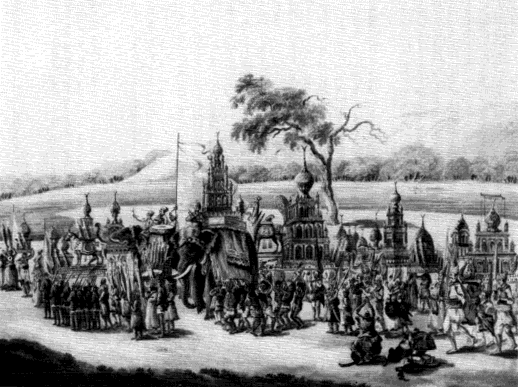
Figure 7
Muharram Festival, Murshidabad. Courtesy of the British Library.
soldiers might either disobey or convert to his cause. He therefore allowed him to leave Awadh quietly, but informed the British government. Sayyid Ahmad's subsequent career in Peshawar, Punjab, and Kashmir falls beyond our purview. After five years of fighting the Sikhs and attempting to organize the suspicious Pukhtuns to their north, he and four hundred fighters were massacred in May 1831 in Kashmir by an army led by Ranjit Singh's son and aided by Hindu zamindars fearful of Sayyid Ahmad's recruitment of 3,000 Muslim peasants to his revolt in the area.42
Sayyid Ahmad Rai-Barelavi's Naqshbandi "Muhammadiyyah" movement represented a religious and social protest against the decline of Sunni political power, the downward mobility of the Sunni intermediate strata, the deterioration of Sunni towns, and the subjugation of Sunni peasants by the British and by Hindu and Sikh rajas. Although an urban man, he threw his lot in with Muslim tribesmen and peasants threatened with Sikh domination, becoming a social bandit and adopting messianic rhetoric.43 He made the Punjab a staging area for a future move against the British and Shi‘i Awadh. Afghan landholders, settled near Delhi, who chafed under British rule and resented Sikh advances, supported him financially.
Although the movement's protests against un-Islamic taxes on tradespeople and its anti-imperialist fervor or lent it a progressive aura, Sayyid Ahmad's statelet in the Peshawar region simply continued in a novel fashion patrimonial and prebendal-feudal forms of government.44 His Naqshbandi state would have oppressed the vast Hindu majority in North India. Despite the genuine discontents to which it appealed, Rai-Barelavi's revivalism had too narrow a base to succeed, and he attracted only a small number of fighters. This lower-middle-class Sunni attempt at usurpationary closure against Shi‘i Awadh failed. The limited effect of the movement on North India has been overblown by later writers, who have paid little attention to its social, economic, and cultural context. Still, Naqshbandi communalism emanating both from Delhi and from Rai-Barelavi's scattered initiates constituted a challenge to Awadh Shi‘is.
Sunni-Shi‘i Issues in Awadh, 1827-1847
Outbreaks of violence between Shi‘is and Sunnis in nineteenth-century Awadh depended partially on policy decisions by ruling and religious elites.
The mujtahids became even more insistent on public cursing of the caliphs, one cause of violence, after the 1819 creation of an independent Shi‘i state. Since many Sunnis revered the Prophet's family and marched at Muharram, only cursing the caliphs established a Shi‘i identity decisively. Requiring such imprecations became a means of social closure. A second cause of disputes, government policy, played an even more central role. Where the government actively persecuted Sunnis with military force, violent incidents increased. Where the government planned Muharram procession routes so as to avoid conflict and used troops to prevent it, the violence decreased.
The third factor, increasing Sunni militance on some issues, involved a stronger Sunni reply to perceived Shi‘i insults. Finally, the British resident influenced episodes of communal violence, and British motives will be explored below. Greater Shi‘i and Sunni militancy contributed in the 1820s to escalating violence among Awadh's religious communities. Mrs. Ali wrote that at Muharram every large city in India witnessed serious quarrels, often ending in bloodshed. While many Sunnis joined in Muharram ceremonies, some increasingly denounced the rites, the likely meaning of Mrs. Ali's cryptic remark that "the Soonees are violently opposed to the celebration" of Muharram.45 This sentiment might have resulted from Naqshbandi propaganda, but may also have simply reflected a natural Sunni reaction to Shi‘i dominance.
The frequent urban disturbances of the late 1820s coincided with an economic downturn in North India, and Awadh's rulers took a hard Shi‘i line, having little interest in mollifying Sunnis and Hindus. Even Farangi-Mahall scholars, who generally maintained proper relations with the government, experienced strains, and one Mawlana Haydar in 1824 had to leave Awadh after a dispute with the king about religion.46 In the 1820s Chief Minister Agha Mir allowed ritual cursing by Shi‘is in the bazaars during Muharram. Shi‘is often accosted Hindus, and people feared to come and go in the markets. When men came to blows, the Shi‘i chief of police arrested Hindus and Sunnis rather than Shi‘is.47 In 1827 Nasiru'd-Din Haydar, an even more extremist Shi‘i, acceded to the throne.
In 1828 Muharram fell in torrid July. The monarch issued a warning "ordering those who could not passively hear the execrations against the Califs, always vented at this season, either to quit the City, or strictly confine themselves to their own homes."48 On the tenth of Muharram a fight broke out at the Karbala of Makarimnagar, where both Sunnis and Shi‘is went to
bury their cenotaphs. A group of Mewatis, low-caste converts to Sunni Islam from a Hindu Meo background, had a grudge with Shi‘is whom they met at the Karbala. A Mewati killed a Shi‘i with a pistol shot, and Shi‘is in turn cut him down. Mewatis, many of them soldiers and so well armed, gathered at the Karbala in great numbers, as did the Shi‘is. The ensuing battle left six killed and nine wounded.49
Nasiru'd-Din Haydar, furious, ordered government troops to the quarter of the Mewatis, who, meanwhile, had fled for British territory. The king commanded Daroghah Muzaffar ‘Ali Khan to bring up artillery and plunder and destroy their dwellings. Mir Fazl ‘Ali, his chief minister, vainly opposed this course of action as invidious, but Nasiru'd-Din Haydar listened to Muzaffar ‘Ali Khan's extremist views. The army indulged in an orgy of looting, razing four hundred structures while white clouds of smoke billowed above the city. The resident feared that Sunnis might rise against the minority government and that the displaced Mewatis would turn to banditry in British territory. He intervened with the king, who defended his actions, saying the Mewatis had committed aggression. Gradually the violence ceased. The resident observed that thinking Shi‘is condemned the king's policy, and that "all other sects have a feeling of fear for what may in future be their own fate."50
Muharram that year lasted for a full forty days by royal decree, as a result of a vow Nasiru'd-Din Haydar said he once took when ill. The resident pressured the king not to carry through this measure, a hardship to Sunnis and Hindus who had to postpone marriages and suffered business losses. He proved intransigent, and Ricketts determined to dissuade the king from enforcing the longer mourning period the next year. The governor-general agreed that the resident was right to intervene in the Mewati affair, expressing concern about the bloodshed in both Lucknow and Faizabad.51 In July 1829 Muharram passed without major incident, but Nasiru'd-Din Haydar once again extended the official mourning period to forty days. Muzaffar ‘Ali Khan convinced the king that he had to defy the resident in order to prove himself an independent sovereign. But pressure from the British (worried that religious violence might involve their troops) and from level-headed members of his own government caused Nasiru'd-Din Haydar to moderate his hard line on Muharram cursing.
Although the king often quarreled with Sayyid Muhammad Nasirabadi, on this issue they agreed. He asked Sayyid Muhammad whether it was permissible to curse the first three caliphs openly during Muharram, in view of
the public disturbances it caused. Nasirabadi replied that Shi‘is could not practice pious dissimulation in a Shi‘i-ruled state (dar ash-Shi‘ah ). The Shi‘i ruler should address any public disturbances by suppressing them rather than by forsaking the ritual prescribed by the faith. He added that in early Islamic times their enemies cursed the Imams and no one went out of his way to stop them.52 Sayyid Muhammad's recognition of Awadh as a Realm of the Shi‘ah contrasts starkly with his father's view of it as a province of the Sunni Mughal Empire.
Colonel Sleeman, later British resident in Awadh, said that Sayyid Muhammad held cursing the caliphs to be as necessary a ritual obligation for Shi‘is as sounding the call to prayer or slaughtering the cows of Hindus. He wrote that although Shi‘is in British-ruled territory said their curses privately and in whispers for fear of the civil government, in Awadh they uttered them aloud at the encouragement of the Shi‘i rulers. Still, Nasirabadi disapproved of meetings held by notable Shi‘is who read obscenities and racy satirical verses about the Sunni Caliph ‘Umar, drawing a distinction between ritual curses and obscenities.53
Some local Sunnis began to reciprocate the hard line of the Shi‘i secular and religious leaders in the 1830s. In 1833 Mirza Ahmad Faruqi, a Sunni scholar from Delhi settled in Lucknow, retold the Karbala tragedy in his sermon after Friday prayers. The sermon, written down and passed about, reached Naqshbandi leader Rashidu'd-Din Dihlavi in Delhi, who wrote Faruqi a letter asserting that the martyrdom of Husayn was not established for Sunnis. On hearing of this, Sayyid Muhammad Nasirabadi asked the Sunni scholars in Lucknow for a ruling on the issue, to which Mufti Zuhuru'llah Farangi-Mahalli, daroghah of the religious court, replied with a ruling that Husayn's martyrdom was in doubt.54
Sayyid Muhammad Nasirabadi penned a long response, noting that in Awadh close contact with Shi‘is had caused Sunnis to pay more than their former respect to the family of the Prophet. He criticized Sunnis who ruled it impermissble to call Husayn a martyr, who held the Umayyad Yazid to be a rightful caliph, and who said that relating the events of Karbala in sermons showed disrespect to some of the companions of the Prophet. In this period, some Sunnis also began praising the very figures the Shi‘is cursed. Mawlavi Turab ‘Ali Lakhnavi (1798-1864), who taught rational sciences to a generation of Sunni and Shi‘i scholars, wrote a treatise on the virtues of the third
Sunni caliph, ‘Uthman.55 On the other hand, some Sunni figures defended mourning the Imam Husayn. ‘Abdu'l-Vajid of Farangi Mahall wrote a book in which he justified Muharram practices for Sunnis. Gharib Shah Shahjahanpuri, a Sufi leader and zamindar with Shi‘i leanings, encouraged his disciples to construct tombs for the Imam even when other Pathans abandoned the practice.56
The increasing communal barriers between Sunnis and Shi‘is can be seen in a dispute that broke out when a Sunni government secretary joined congregational prayers at a Shi‘i mosque. A Shi‘i cleric objected, and the Sunni delivered a note to his house, full of abuse. The cleric asked Sayyid Muhammad ‘Abbas Shushtari to reply. Shushtari wrote that Sunni did not accept the absolute caliphate of ‘Ali, which the Shi‘i call to prayer proclaims, and that a Sunni could only pray hypocritically at a Shi‘i mosque. Moreover, he said, a Shi‘i mosque might be defiled if a non-Shi‘i entered it.57
Amjad ‘Ali Shah (r. 1842-47), a blatant communalist, cut off the stipends of many Sunnis and Hindus, employing Shi‘is as the heads of every government office. Because he thought Sunnis and Hindus ritually impure, he forbade them to write the names of God, the Prophet, his daughter Fatimah, or the Twelve Imams on official letters, and hired Shi‘i secretaries to write the holy names. The heir apparent, Vajid ‘Ali, at one point forced several reluctant Sunni secretaries (munshis ) to embrace Shi‘ism.58
The Awadh government, in the wake of its 1819 declaration of independence, vaunted its Shi‘ism and placed Sunnis under disabilities (such as having to listen to Shi‘i curses on their beloved caliphs). This policy. promoted by the Usuli ulama. provoked several violent incidents in the 1820s and 1830s, alarming the British residents. The British intervened to ensure order, largely out of pragmatic motives. They feared that the minority Shi‘i government might be pulled down and replaced by a more radical Sunni or Hindu state less complaisant toward the British. They also saw the possibility that persecuted Sunnis like the Mewatis would flee to British territories and form bandit gangs.
After 1837 the Awadh government, threatened with annexation by the British, sought to prevent Sunni-Shi‘i violence. In the 1840s Shi‘is expressed their triumphalism through the bestowal of more wealth, jobs, and patronage on Shi‘is than on Sunnis, and the exclusion of Sunnis from lucrative positions (including the office of chief minister). Security measures in the cities pre-
vented such invidious policies from resulting in riots, but they evoked Sunni resentment. visible in the major communal conflict of the 1850s, over a Hindu temple near Faizabad. Awadh's stridently pro-Shi‘i policies also provided the British, ever looking for evidence of Indian rulers' unsuitedness to rule, with an image of the oriental despot arbitrarily oppressing his people.
The Faizabad Temple Dispute and the Shi‘i Ulama
Any exploration of communal relations in Awadh must consider the conflict over a Hindu temple, which some Sunni Muslims claimed as the former site of a mosque, and which nearly exploded into civil war in 1855. The Shi‘i government and the mujtahids had to take a stance on the dispute, so that all three of Awadh's major religious communities became involved. Moreover, the British intervened forcefully, providing insights into their role in Awadh's communal relations in the 1850s. Did they by their intervention unwittingly exacerbate communal tensions? Or did they prevent a major Sunni-Hindu conflagration?
The 1855 dispute began when a Sunni zealot named Shah Ghulam Husayn started a campaign against the Hindu temple establishment in Faizabad dedicated to the Ramayana's monkey-god, Hanuman. The Muslim crusaders claimed that the site had originally supported a mosque subsequently supplanted by the Hanumangarhi. Shah Ghulam Husayn's followers clashed in July 1855 with thousands of Hindus, ending in a massacre of the zealots in a mosque at Ayodhya, a suburb of Faizabad. The news of, this military defeat inflicted on Muslims by Hindu holy men and their supporters (among them large landholders and their peasants from the Hindu countryside) inflamed Sunni and Shi‘i passions throughout North India. Sayyid ‘Ali Deoghatavi, Faizabad's Imami prayer leader, visited the mosque during the investigations ordered by the government. The issue split the Shi‘i population between those very religiously committed and the secular officials; Faizabad Shi‘i administrators like Mirza Acla ‘Ali took measures against Sunni mobs to keep the peace.59
Vajid ‘Ali Shah enjoyed Hindu festivals and plays about Krishna, but as an Usuli he believed in Shi‘i rule and superiority. Furious about the killing of Muslims by Hindus at the mosque, he nevertheless wanted Sunni ringleaders apprehended as troublemakers. His officials in Faizabad sought to defuse the situation. The governor of Sultanpur and Faizabad, Agha ‘Ali Khan,
attempted to pacify the Muslims under his jurisdiction, while the Hindu Raja Man Singh controlled Hindus.60
The governor's conciliatory approach provoked resentment in Lucknow among Muslim militants, including Chief Mujtahid Sayyid Muhammad Nasirabadi. On 24 August 1855 he conducted Holy Day prayers at the Great Imambarah in the presence of the heir apparent, the chief minister, and multitudes of notables close to the court. At the end of the service he denounced the governor, Agha ‘Ali Khan, and all those he said had taken bribes to side with the Hindus. The officers of state greeted this outburst with embarrassed silence. A Sunni delegation then sought a ruling. from him, asking if he accounted the slain Sunnis martyrs, and whether individual Muslims should avenge their deaths. Sayyid Muhammad cautiously replied that the Muslim state had a duty to put an end to the wickedness of the infidels.61 He steadfastly refused to encourage mob action, insisting that the Shi‘i state had a duty to intervene on the Muslim side. The implication, that if the king refused to act, nothing could be done, angered Sunni vigilantes eager to set out independently.
On 30 August, Outram, the resident, met with Chief Minister ‘Ali Naqi Khan. The Awadh government endeavored to avoid taking a decision bound to offend Muslims or Hindus or the British by putting the whole matter in the chief mujtahid's lap. It proposed that the commission of inquiry headed by Agha ‘Ali Khan be disbanded and replaced by Sayyid Muhammad Nasirabadi. The chief minister also insisted that the evidence for the existence of a mosque at the Hanumangarhi was good. The resident took strong exception to both points, blaming Shah Ghulam Husayn and his followers for provoking the violence. He allowed that the chief mujtahid could take part in the investigations, but demanded that the final decision be made by the king. He further objected to Nasirabadi's rulings urging retaliation against the Hindus. ‘Ali Naqi Khan explained that given the way the questioners framed their inquiries, no other answer could have been given.62
On the same day, the government investigative commission announced its conclusion that no mosque existed at the Hanumangarhi, at least in the past twenty-five to thirty years, and most probably never had. Western descriptions of the temple thirty years earlier bear out the first part of this conclusion.63 In Lucknow pandemonium broke loose, with Muslim vigilante groups forming. A certain militant, Mawlavi Amir ‘Ali Amethavi, among the Sunni ulama calling for holy war, had earlier been brought to the capital
from Amethi to meet with Vajid ‘Ali Shah. The king, aware of the appeal for his Sunni military men of the mawlavi's brand of communalist militancy, wished to pacify him, offering him a robe of honor and pledging to send Rs. 15,000 to Mecca on his behalf. He may also have promised him that a mosque would be built at the side of the temple. In a flash of lower-middle-class pride, the mawlavi told, the king that he was not a revenue collector, to accept a robe of honor.64
When news of the commission's findings broke, Mawlavi Amir ‘Ali left for his qasabah base again with two hundred men, in protest. Court emissaries failed to convince him to return to the capital, but he did agree to wait one month to see if the mosque was restored at the Hanumangarhi. Outram, meanwhile, worried that Vajid ‘Ali Shah's Muslim troops, approving of the mawlavi's cause, might well refuse to fight him. Vajid ‘Ali's own proposal for compromise involved building a small mosque onto the side of the temple to the monkey-god, with its own door entering from the side, thus preserving the building's sanctity for Hindus while meeting Muslim demands. But the Hindu Vairagis, or holy men, at the temple rejected the proposal out of hand. In the meantime the king began pressuring prominent ulama to support the government in the face of the challenge posed to it by the holy-war movement.65
The Sunni warriors thought that the king considered Hindus a protected minority (dhimmi ) in Shi‘i law and that he held holy war (jihad ) forbidden during the Occultation. Vajid ‘Ali may have held the first belief, but the Usuli ulama did not. Sayyid Dildar ‘Ali denied protected-minority status to Hindus, as idolaters. Rather, the Mughal, Hanafi tradition sometimes extended protection to Hindus. The Imamis did hold that in the absence of the sinless Imam no one could lead an offensive war. From Buyid times, however, Shi‘is recognized the possibility of defensive holy war, and Usulis in Iraq and Iran emphasized defensive jihad in the nineteenth century in response to the Russian threat to lran. Sayyid Muhammad Nasirabadi permitted holy war in the time of the Occultation whenever the lands of Islam were attacked. No such grave situation existed in Faizabad, however, so that Shi‘is did not phrase their calls for retaliation against the Hindus in the idiom of holy war.66
The Awadh government elicited a more specific ruling from Sayyid Muhammad Nasirabadi, asking:
Q. What is your guidance concerning those who go to Faizabad to fight the Hindus? For they desire to take revenge on them for their uncivilized behavior with the mosque and the Qur'an. According to the Law is it permissible for them to go there and fight, and will this be rewarded? Or is it forbidden?
A. Without the participation and aid of the customary-law ruler or the Islamic-law ruler, such actions are in no wise permissible. God knows best.67
The customary-law (‘urf ) ruler was, clearly, the king, whereas the ruler in Islamic law was the Imam (which in itself provides a clue as to how the Imami clerics really perceived their Shi‘i government).
But in a later ruling Sayyid Muhammad went beyond this terse answer, replying: "Under these circumstances the order for waging the Jehad does not apply; but the sovereign has the right to build the Musjid [mosque]—and the Hindu Ryots ought not to disobey."68 Nasirabadi sympathized with the grievances of the jihad movement, but he wished to obviate such vigilante tactics by putting pressure on the ruler to intervene against the Hindus himself.
The resident had objected to Sayyid Muhammad's call for the king to make Hindus pay blood money for Muslims killed at the Ayodhya mosque. But he attempted to make use of his later rulings by pressuring ‘Ali Naqi Khan, in view of the chief mujtahid's prohibition on a holy war, to declare the mawlavi and his followers traitors deserving death. The chief minister warned that premature military action would cause needless bloodshed. On the other hand, Outram took strong exception to Sayyid Muhammad's call for the government to build the mosque. Vajid ‘Ali Shah denied any intention of forcibly building a mosque at the temple site, but called ridiculous Hindu claims to whatever ground their monkey-god had trod.69
With the arrival of October the resident handed the king a warning that he would be held personally responsible if he attempted to build a mosque next to the temple or if he allowed Muslims to attack Hindus. Dalhousie and Outram were warning him that his kingdom would be annexed unless he crushed the holy-war movement. Vajid ‘Ali Shah received the communication with emotion, pledging to do his duty. Outram speculated that the king had been relying on the British to quell any Hindu uprising. The chief minister had certainly asked for British help in fighting Amir ‘Ali, but was rebuffed. Although the volunteers in the mawlavi's militia tended to be lower
middle class and laborers, he received financial assistance from influential families, so that the movement began to pose a threat to Awadh's stability.70
September, coinciding with the mourning month of Muharram, had brought fresh communal violence. To demonstrate their dissatisfaction, Muslims in Lucknow left fifteen replicas of Imam Husayn's tomb unburied. Sunnis and Shi‘is quarreled over greater Sunni willingness to employ Muharram symbols for protest. In Zaydpur the powerful Shi‘i Sayyids insisted on burying their cenotaphs, clashing with followers of Amethavi, who did not want them interred until the mosque was built at Ayodhya. In Sihala, the campaigners' base, the mawlavi's men attacked Hindus, breaking into temples to destroy their idols. Alarmed, Vajid ‘Ali belatedly agreed to order Hindu troops in Faizabad to guard the Hanumangarhi.71
Mawlavi Amir ‘Ali moved gradually through small towns on the way to Faizabad. Vajid ‘Ali Shah threatened his governors and revenue officials with severe sanctions should they support the mawlavi , with some success. He knew that his Shi‘i troops at Daryabad could be depended upon to fight the campaigners if it came to that.72 Sayyid Muhammad Nasirabadi's commitment to law and order waivered when he saw that the king intended to bow to British pressure in neither punishing the Hindus involved in the massacre at the Ayodhya mosque (which the resident saw as self-defense) nor building a mosque at the temple site. Outram reported that Amir ‘Ali was said to be "urged on by the High Priest, who is reported to have replied insolently to the Minister's remonstrances."73
A turning point came on about 20 October, when a group of Sunni ulama supportive of the government went to Daryabad to debate Mawlavi Amir ‘Ali. They included several employees of the Awadh government, such as Mufti Muhammad Yusuf Farangi-Mahalli and Mufti Sacdu.llah Moradabadi. Independent members of the Farangi-Mahall family adamantly backed the holy war, creating a split in the ranks of the Sunni ulama. The pro-government clerics successfully debated the mawlavi , undermining his support both among lay followers and in the king's army.
The lower-middle-class nature of the holy-war movement contributed to the unfolding tragedy. Many of the mawlavi's followers had given up their shops or service to follow him and now threatened to murder him if he did not proceed to Faizabad soon. When negotiations finally broke down on November 7, the holy warriors met the government's Shi‘i regulars, reinforced reluctantly by the private armies of Shi‘i tacalluqdars such as the Mahmudabads, and were mown down.74
The Hanumangarhi dispute involved several levels of social closure. Social class and religious identity played a part, since the holy-war movement was spearheaded by lower-middle-class Sunni clerics and their followers, who had sold their shops or given up their service to join it and so had a total commitment to its sectarian goals. The resentments of these Sunnis against the wealthy Hindu rajas and merchants who supported the Hanu-mangarhi was fueled by Sunni loss of power in Shi‘i Awadh and by growing Hindu political influence.75 Amethavi's sectarian movement, in addition, attracted the support of Sunni ulama and notables not closely connected with the Awadh court, echoing the appeal thirty years earlier of Sayyid Ahmad Rai-Barelavi to some of the same, out of power, groups.
The conflict caused a split within the ruling Shi‘i establishment. The Usuli ulama and their followers supported Amethavi's demands even while deploring his vigilante tactics. The central officers of the state in Lucknow and Faizabad, on the other hand, sought compromise. Barred from that course by British support for the Hindus, they acquiesced in the resident's demand that they destroy Amethavi's movement. The British showed "evenhandedness" in affirming Hindu rights, partially out of a hard-nosed political calculation of the consequences of a major Hindu-Muslim clash in Awadh. Convinced that the majority Hindus might well win or provoke a major conflict that would draw in British forces, they forced the Muslim government to give up its privileges. Hindus sensed British support for their position, which may have made them more assertive and intransigent.76
Conclusion
Communal relations in Awadh under eighteenth-century nawabs differed greatly from those under the "shahs" of the mid-nineteenth century. Asafu'd-Dawlah gave privileges to Hindu holy men as well as Muslim ones, to Hindu pilgrims to Allahabad as well as Shi‘i pilgrims to Karbala. Communal relations, hardly idyllic, nevertheless depended on Mughal traditions of personal status, which affirmed Muslim superiority but recognized the right of Hindus to exist. Mediators among religious communities, in the form of Sufi pirs and Hindu holy men, abounded and even won influence at court.
The Usuli ulama sought to rationalize communal relations on a different basis. They claimed a special, exclusive relationship with Shi‘i laymen (including notables), who were bound to emulate them in matters of law and ritual, and countenanced no competition from Sufis or Hindu holy men.
They legally excluded Hindus from a legitimate status under the Awadh state, although they had few means until the 1840s to interfere in the actual workings of communal law. Their demand for the social exclusion of Hindus as ritually impure idolaters received scant response from the Shi‘i-ruled state, which depended on Hindu elites to help it rule. In the process of socially excluding Hindus, ironically, Shi‘is adopted an idiom that made them more like a caste.
The contradictory policy advocated by Shi‘i ulama toward Sunnis involved the exclusion of hard-line Sunnis like the Naqshbandis, leniency toward Sunnis who participated in Muharram rituals, and a political alliance with Sunnis against Hindus. Ironically, the challenges to Shi‘i dominance in Awadh came, not from Hindus, but from Sunni sectarian movements, such as those of Sayyid Ahmad Rai-Barelavi and Amir ‘Ali Amethavi. Usuli insistence on cursing the caliphs, more strident after the inception of the Shi‘i kingdom, alienated many Sunnis and helped provoke a backlash. Violently anti-Sunni policies of the Awadh government in the 1820s and 1830s gave way under both external British and internal pressures to more juridical forms of exclusion in the 1840s and 1850s. Both Usuli communalist policies at the center and increasing decentralization in the countryside, implying greater power for Hindu rajas and merchants, help explain Sunni frustrations in the 1850s.
10
The Mujtahids and the West: From Accommodation to Annexation and Revolt
The growth of a Shi‘i state and of a Shi‘i religious establishment in Awadh occurred at a time of European colonial expansion, giving events there a unique twist. The Safavids and the medieval Indian Shi‘i states dealt with mercantilist Europeans, but their main foes were Sunni land-based powers. From late in the eighteenth century, Nishapuri Awadh, like Qajar Iran, moved primarily in a diplomatic, military, and economic world dominated by the British.1 Both Iran and Awadh allied themselves with the British in the face of external threats (the Russians for Iran, the Marathas and Afghans for Awadh), and both saw their British ally become itself a threat to their independence. Awadh, uncomfortably close to Calcutta, felt British influence and pressure more acutely than did Iran. The British residents in Lucknow became far more than ambassadors, gaining influence over Awadh notables, over government monies, and over the Awadh military's hired British troops.2
The British encirclement of Awadh raises the question of how the Shi‘i religious establishment responded to the European presence from the late eighteenth century through annexation and the revolt ("Mutiny") of 1857-59. Some important Shi‘i ulama in Iran took a strong anti-Russian line in the 1820s, although the full story of their complex relations with the Western powers in the first half of the nineteenth century has yet to be told.3 How did
Awadh's Shi‘i ulama view British power, British economic imports, and the impact of mercantile and then industrial capitalism? How did they respond to British interference in Awadh's internal affairs, and how did they react to the 1856 annexation? What role did the Shi‘i ulama play in the Awadh revolt of 1857-59? These crucial questions appear not to have been posed, much less answered.
The British Impact
The strategic decision Awadh's rulers made from 1766 to ally themselves with the Bengal-based British East. India Company proved fateful. Since their treaty with the EIC limited their armed forces, the nawabs had to rely on the British for their own external security. The East India Company remained a highly ambiguous ally, and the nawabs found themselves riding a tiger. The Nishapuris did draw some benefit from the alliance. In 1774 Shujacu'd-Dawlah drew the British into helping him annex the Ruhilkhand. Twenty years later Asafu'd-Dawlah again mounted a joint venture, the invasion of Rampur.4 On the negative side of the ledger, however, Barnett has demonstrated that after 1775 the governor-general's demands on the Awadh treasury for tribute grew insatiable. By 1779 the sums demanded quadrupled, amounting to half the gross income of the nawabi government. Awadh notables responded by hiding revenue locally, resisting further British demands.5
At the same time that the East India Company attempted to extract revenue from the nawabi government, private British traders sought profits through penetrating the region's markets. Early British residents in Lucknow gained a monopoly over Awadh's most lucrative export, saltpeter for the manufacture of gunpowder. Shujacu'd-Dawlah, conscious of the Bengal precedent, strove to keep EIC and private merchants out of his realm, with only mixed success.6 The Commercial Treaty of 1788 disengaged the residents from such enterprises, but opened the way for increased European private trade. Private merchants, excluded from the rich Bengal market by the com-
pany, expanded into Awadh. Merchants trading in textiles or indigo built up alliances with local magnates or actually exercised political power in the towns that produced the commodities in which they traded.
Marshall has shown how imports into Awadh from Bengal doubled in the period 1786-1796, and Awadh's exports to Calcutta increased about five times during the same period to five million rupees. Europeans fostered and carried on much of the trade. The value of cheap Awadh piece goods exported from Calcutta grew six times in 1786-1796, to three million rupees. Raw cotton constituted another important export, and indigo cultivation spread into the Doab region of Awadh in this period.7 High duties and frequent local imposts, in addition to the ever-present fear of arbitrary, expropriation, often made life miserable for the European merchants involved in this rapid trade expansion. They "loudly" complained to the resident of infractions against the Commercial Treaty, and of high duties in Awadh despite their permits from the Commercial Office.8
Awadh's incorporation into the world market proceeded unevenly. In 1801 Governor-General Wellesley annexed nearly half of the region from Nawab Sacadat ‘Ali Khan on the pretext that the nawab's government had fallen hopelessly behind on payment of its tribute to Calcutta and only annexation could ensure revenues for the British. The move left the nawab "reserved territories" surrounded on three sides by the British and on one by Nepal and the Himalayas. Wellesley thereby ended the subsidiary alliance, disencumbering the British of many obligations.9 Thirty-five years earlier, officials of the East India Company felt too weak to absorb Awadh, needing time to consolidate their hold on Bengal. They then found that threats such as the Marathas and the Afghans could be dealt with by British and British-trained arms, and the need for Awadh as a buffer state correspondingly declined. Mukherjee has stressed the futility of attempting to separate economic and imperial motives in the annexation. Wellesley acted to ensure the receipt of huge revenues, as well as for strategic advantages.10 The British probably took too seriously, for example, the threat of an invasion from Afghanistan.
The 1801 annexation left old Awadh not only divided between two states but also partitioned into two economies. Awadh under its Indian rulers remained a stable agrarian state with successful rainfall-based agriculture producing an abundance of grain for local consumption and regional export.
The Ceded Provinces, however, underwent rapid and radical evolution. Within a year of cession raw-cotton exports to China jumped, and finished textile goods slumped as a proportion of the total exports.11 The class structure of the annexed area began to change. British officials insisted that large landholders back up their revenue assignments by bank credit, strengthening immeasurably the hand of the bankers and moneylenders who guaranteed the revenues, and often allowing them to foreclose in bad years. This policy transformed some petty tax-farmers into landholders at the expense of village holders.12
Peasants began cultivating indigo extensively for export through Calcutta. Cheap British broadcloth began to affect the weavers in North India after 1800, though it hardly wiped them out, and it had a larger impact from 1833. In the first decade of the century, increased imports of manufactured cloth, twist, and yarn from an England undergoing the Industrial Revolution hurt spinners and began to depress the local cotton market. But with the end of the Napoleonic wars, European demand for raw cotton rose, and its cultivation in the Ceded Provinces spread rapidly, The British gradually incorporated the annexed half of old Awadh into the world market as a producer mostly of raw materials. Although from 1815 to 1828 such cash-crop agriculture grew lucrative, it also proved subject to cycles of boom and bust. The depressed cotton and indigo markets after 1828 created a crisis that drought years like 1833 exacerbated.13
Although nawabi Awadh did not altogether escape the penetration of European capital and the influx of cheap British manufactures, it remained a far less open market than the Doab. In 1830 the British resident in Lucknow lamented the demise of the 1788 Commercial Treaty. Landholders exacted imposts on goods passing through their estates, and the government taxed British merchandise heavily. Between the British commercial center Kanpur and Lucknow, only fifty miles away, a merchant bearing Manchester's textiles had to pay taxes to twenty different landlords in addition to a duty charged for entering the capital. British goods cost double in Lucknow what they did in Kanpur. Still, the demand for English manufactures remained considerable.14
The Response of the Shi‘i Ulama to the West
European domination in North India provoked a severe crisis of identity for the Muslim notable classes who formerly ruled the area. Sunni landholders and administrators in Delhi watched helplessly as the British extended their rule to the former capital in 1803. Religious spokesmen for these classes in decline, such as the Sunni Sufi Shah ‘Abdu'l-‘Aziz Dihlavi, declared in exasperation that India had become a Realm of War (dar al-harb ) for Muslims. The commands of the Mughal emperor were ignored, Christians controlled taxes and criminal justice, municipal authorities could level mosques, and Muslims like Vilayati Begam of Farrukhabad could come to the capital only with the permission of the Christian British authorities. In Hyderabad, Awadh, and Rampur Muslim rulers had capitulated to the British. Dihlavi admitted that the British allowed Friday congregational and holy day prayers to be held, but said this alone could not make British India a Realm of Peace (dar as-salam ) for Muslims. Shah ‘Abdu'l-‘Aziz, in redefining the political environment, did not call for holy war against the British, something some of his young disciples would later consider.15 Rather, he seems to have aimed primarily at allowing Sunnis to charge interest on loans, which they could do in a Realm of War.
The Shi‘i ulama in what was left of Awadh perceived the situation differently. First, they continued to see the nawabs of Awadh as Muslim rulers (and, until the 1819 declaration of independence, as first ministers of the Mughal Empire). The Imami jurists rejected the notion that they were under de facto British rule. Lucknow's chief Shi‘i ecclesiastic, Sayyid Dildar ‘Ali Nasirabadi, divided the lands of India into three sorts, those under the dominion of the Sunni Mughal emperor (including Awadh), those ruled by unbelievers against whom Muslims must war (e.g., Punjab under the Sikhs), and those ruled by the Christian British. He commended the British for dealing with Muslims according to Muslim, including Shi‘i, laws. Although this paragraph described the actual situation, it might be noted that the three areas mentioned conformed to the traditional Muslim legal categories of the Realm of Peace, where Muslims ruled, the Realm of War, where defiant infidels held sway, and the Realm of Truce (dar as-sulh ), where People of the Book ruled and were in treaty relations with Muslims. Nasirabadi, however, did not explicitly use this last term.16
Since Shi‘is believed contact with non-Shi‘is to be polluting, the Euro-
pean presence in North India presented them with social difficulties. Nasirabadi, asked about the propriety of attending a banquet (sur ) thrown by Christians or Jews, said to avoid it. A believer asked him if one might pray in stockings (muzah ) brought from Europe. He equivocated, saying that the most renowned stance on this issue was that anything received from an unbeliever is ritually impure, but he added that the question was not altogether resolved. But in another case he ruled that one might buy a cloak from foreigners, and might pray in it before washrag it.17
Was it permissible, someone queried, to usurp the belongings of Christians, People of the Book, or unbelievers, through ruse and fraud, causing them financial damage? Sayyid Dildar ‘Ali replied that one could not use the wealth of others without strong grounds. He said he had seen no evidence for such behavior with the People of the Book (Jews and Christians) and other sorts of unbeliever in the time of the Imam's Occultation. The Lucknow prayer leader's conservative attitude toward private property even overruled his conviction of Muslim superiority.
When Nasirabadi's upper-class friends pressed him for a ruling on the legality of working for the British as tax collectors, secretaries, police, attorneys, and physicians, he expressed reservations, though he did not absolutely forbid it. A man asked him whether it was permitted to keep the company of and enter into the employ of Christians. He pointed out that the British surrounded and dominated them, and the notables found it difficult if not impossible to get along without their favor. Sayyid Dildar ‘Ali responded that the employment must not involve the commission of forbidden acts, such as murder or the purchase of liquor or pork. If the work simply consisted of performing a service for a Christian, such as writing a book for him or tailoring his clothes, it was entirely proper. But he found it difficult to sanction full-time salaried employment with a European, owing to the Qur'an verse "And God will not grant the unbelievers any way over the believers" (4:140). Yet he could not pronounce such employment altogether forbidden (haram ).18
This answer, given in the first decade of the nineteenth century, demonstrates the ambivalence Awadh's Shi‘is felt in seeking employment with the East India Company. Economic necessity forced many notables and small landholders into such a career, particularly after the cession of 1801. Some preferred to work for the nawab. The brothers Taju'd-Din Husayn Khan and Subhan ‘Ali Khan collected revenue for the East India Company at Agra in the opening years of the nineteenth century, acquiring a knowledge of British procedures. Nawab Sacadat ‘Ali Khan requested that Taju'd-Din Husayn Khan come to Awadh, where he hired him at Rs. 300 per month.
Subhan ‘Ali Khan, envious, asked some notables at Lucknow to intercede with him for the Nawab, who at length offered him a smaller salary of Rs. 200 per month because he asked for the job.19
The Shi‘i families that were clustered in Banaras division and in the upper Doab, living under British rule, had more incentive than the subjects of the nawabs to establish links with the East India Company. Mawlavi Zakir ‘Ali Jaunpuri (d. 1796) tutored one of the residents in Lucknow. Sayyid Gulshan ‘Ali Jaunpuri (1800-74), trained in Lucknow by Usuli students of Sayyid Dildar ‘Ali, served as a judge in British-ruled Jaunpur, then as a revenue collector in the area. He subsequently took a post with the local government of the Maharaja of Banaras. He visited Iraq twice, in 1844 and 1864-71, the second time serving as the deputy resident for the British in Baghdad. His youngest son, Sayyid Muhammad Hashim, went to England to study mathematics in 1872, serving for a time as a revenue collector (tahsildar ) for the British government in Jalaun and Agra.20
Even religiously committed Shi‘is from within nawabi Awadh often had dealings with the British or emigrated to find employment with them. Mir Hasan ‘Ali (d. 1858) of Lucknow, whose father led prayers in the household of Awadh administrator Almas ‘Ali Khan, taught British officers Arabic in Calcutta, then taught Urdu in the Military College, Addiscombe, in England in 1810-16, where he married an Englishwoman. They lived in Lucknow for a while, then he served as revenue collector for the British in Kanauj. He later took up employment briefly with Hakim Mihdi ‘Ali Khan, an Awadh notable who had indigo interests in Farrukhabad. Mir Hasan ‘Ali's English wife divorced him when she discovered that he had another wife. A pensioner of the British government, he moved back to Lucknow in 1843, where he accepted a post with the Awadh rulers.21
An even more striking example of this phenomenon, S. Muhammad Quli Kinturi (1773-1844), derived from a landed family in the small town of Kintur in Bara Banki. He traveled widely as a youth, in search of knowledge, and trained in Lucknow with Sayyid Dildar ‘Ali as an Usuli mujtahid. In 1806 he hired on with the British government of Delhi in the parganah of Meerut as a court official. Ultimately rising to principal sadr amin (able to judge property disputes up to Rs. 5,000), he gave legal .judgments in criminal cases accord-
ing to Shi‘i law—something he could not have done at that time even in Awadh. At his peak he earned Rs. 400 per month at the post, retiring in 1841.22
Shi‘i clerics expressed few anti-British sentiments as long as the East India Company respected Shi‘i law and maintained all alliance with the Shi‘i nawab of Awadh. In Bengal, ulama teaching at the Hooghly College, in-eluding Shi‘is, actively sought m attend the government's public audiences (darbars ) and m receive robes of honor from the East India Company. In contrast, Sayyid Dildar ‘Ali forbade ulama in Awadh m accept robes of honor from the nawab's government, claiming that this practice befitted soldiers but demeaned the high station of mujtahids, the general representatives of the hidden Twelfth Imam.23
Perhaps because of the increasing number of Shi‘is who worked for the British, one of Lucknow's chief mujtahids gave a ruling in the 1830s that strongly justified taking employment with foreigners. Asked to what extent one might earn one's living through Christians, he replied that as long as one did not become an accomplice m any forbidden act, working on a salaried basis for the British in such fields as revenue collection was permitted. (Note that Sayyid Dildar ‘Ali had not sanctioned taking a salary from Christians.) The mujtahid ruled that although disapproval attaches to performing even permitted acts for unjust rulers (hukkam-i jawr ), the disapproval is lifted if one does so to aid Shi‘is.24 The attitude of the Shi‘i hierarchy on this issue changed over time. They originally questioned its propriety, but allowed it in the 1830s.
The religious scholars also changed their position on loaning money on in-
terest to Christians. Someone asked Sayyid Dildar ‘Ali if he might take interest on loans to idolaters (Hindus) and to the People of the Book (Jews and Christians).25 Nasirabadi replied that Shi‘i scholars had reached a consensus that interest could be taken from idolaters. But they differed over whether it could be charged People of the Book. He offered his own ruling that the most cautious path was therefore not to take interest from Jews and Christians. The influx of British capital into North India, first through private traders in 1785-95, and then through the East India Company as well from 1801, created many opportunities for local bankers and moneylenders. British insistence that bank credit secure revenue assignments likewise strengthened these classes.
Shi‘i merchants and moneylenders also wished to profit from these opportunities, the more scrupulous of them with pangs of conscience. Sayyid Dildar ‘Ali refused to assuage their guilt. Unlike the Shi‘i high ulama in Iraq and Iran, who had increasingly close ties with the bazaar classes, in Awadh the clerical establishment subsisted on the patronage of large landholders, responding mostly to their concerns.
Many Shi‘i long-distance merchants regularly lent and borrowed on interest, but the practice could cause them problems if cases went to Muslim religious courts. An example is the case of Mirza Riza, the son of Hajji Karbala'i Muhammad Tihrani, versus the heirs of Hasan Riza Khan, the former chief minister of Awadh. In the late 1780s Hajji Karbala'i lent Hasan Riza Khan Rs. 228, 436 as part of the Rs. 700,000 Awadh government donation for the building of the canal to Najaf. Mirza Riza presented letters in court, appearing to be from the chief minister, promising to repay the loan in November of 1792. Both debtor and creditor died before any further transaction took place.26 Mirza Riza attempted to recoup the loss from the late chief minister's estate through the government courts of Nawab Sacadat ‘Ali Khan in 1806. He asked the Iranian ruler Fath-‘Ali Shah to intervene with Awadh's nawab on his behalf, and the Qajar monarch wrote to his fellow Shi‘i ruler supporting Mirza Riza's claims27
Nawab Sacadat ‘Ali Khan turned the case over to the mufti of the religious court, probably the Farangi-Mahalli Mawlavi Zuhuru'llah (d. 1840). Mirza Riza claimed the principal of Rs. 228,436, in addition to Rs. 150,010 interest. The mufti of the court rejected the claim on several grounds. First, he said, the dates of the copies of the letters and the replies presented as evi-
dence were confused and therefore they were of suspect authenticity. Second, the precise kind of money loaned was not specified. Third, the taking of interest on loans was prohibited according to Islamic law.28
Especially in the period 1815-30 developments occurred among the propertied Shi‘is that impelled them to accept interest on loans to Europeans, though no Islamic court would have permitted interest charges among Usuli Shi‘is. The changes in the relationship between the British economy and that of India brought about by the Industrial Revolution, creating a world-dominating textile industry, strengthened the hand of the East India Company. The company, formerly merely a government-backed enterprise of circulating merchant capital, evolved into an instrument in the expansion of industrial imperialism. The terms of the game changed radically. Awadh's landed classes, sensitive to this evolution, began to perceive the insecurity of their traditional landholding forms of wealth in the new environment.
At the same time, the East India Company began its costly war in Nepal in 1814-16. Nawab Ghaziyu'd-Din Haydar acquiesced in November of 1814 to the company's request for a loan of Rs. 10 million to help defray the expenses of the war. Ten individuals or families, mostly relations of the nawab, received the Rs. 600,000 in interest payments each year. Four months later Ghaziyu'd-Din Haydar agreed to second loan of Rs. 10 million on similar terms. In 1825 the same ruler responded favorably to the governor-general's request for yet another loan of Rs. 10 million at the low rate of 5 percent interest, again payable by the resident to notables and relatives of the court.29
These arrangements began the creation of a class of rentiers depending on payments from interest to supplement the income from their less stable landed wealth (which took the form of jagirs that could be expropriated at will by later Awadh rulers). The: British government guaranteed the stipends to the recipients and their descendants. The creditors hardly demonstrated much business sense by the low, fixed interest rates they charged. The recipients, transformed into a strange mixture of Mughal-style nobility and new bourgeoisie, passively subsisted on the periphery of the growing world market.
Although Ghaziyu'd-Din Haydar earlier showed no scruples about making the loans, in contravention of Sayyid Dildar ‘Ali's ruling. when Iris treasury got low he suddenly evinced pangs of conscience. In May 1826 Lord Amherst informed the resident in Lucknow that yet another five million rupees would be needed to wind up the Nepal war. Ricketts pledged to open
negotiations, warning that drought and recalcitrant landholders (who for the first time in years did not have to worry about facing British troops in aid of government revenue collectors, owing to a policy change) had impoverished the Awadh treasury. Ricketts's talks proved successful, but Amherst felt he was doing the nawab a favor in any case. Ricketts wrote on 25 July, "Your remark that the money has been drawn from unproductive coffers is strictly correct, and so far His Majesty in point of fact is a gainer by the transaction; but the Sacrifice of his Religious tenets, which forbid interest being received, throws this advantage completely into the Shade in His eyes."30
Later Awadh governments continued the practice of making loans to the East India Company, investing the interest received in religious grants to the Shi‘i shrine cities of Iraq or in public works in Awadh. Muhammad ‘Ali Shah, whom the British resident placed on the throne by armed force in 1837, initiated an ambitious building program. Soon after he acceded to the throne he spent Rs. 200,000 to have the Husaynabad Imambarah built not far from the Great Imambarah. Fearing that his good deed might fall into disrepair after his death, he wished to place the Imambarah and mosque complex under the guarantee of the British government so as to ensure the regular payment of the religious functionaries.31
Finding the British unwilling to give such guarantees gratis, the king proposed to sweeten the deal by putting Rs. 900,000 in a 4.5 percent loan in perpetuity. The resident, Lt. Col. Caulfield, enthusiastically recommended that the governor-general accept the proposition, the interest demanded being so low that it was unlikely to embarrass a powerful state in the future. Moreover, part of the interest would go to Muhammad ‘Ali Shah's sons-in-law, daughters-in-law, and other dependents and relatives. Caulfield reasoned that to have a large number of notables financially dependent on the British Government would assure their loyalty and help insure more information from the interior of Awadh. Of the interest, Rs. 19,200 would pay servants to attend the Imambarah and keep its road in repair, and Rs. 6,000 per month was set aside to maintain the canals. With the sums devoted to relatives and servants, the total came to Rs. 36,000 per annum.32
The deal was finally concluded, with the terms slightly altered in favor of the British. Muhammad ‘Ali Shah invested Rs. 1,200,000 at only 4 percent interest, yielding dividends of Rs. 48,000 per year to be divided between the persons named and the Husaynabad Imambarah, Rs. 24,000 being car-
marked for the edifice. The king did not name Shi‘i ulama as trustees of the Imambarah and its mosque, that honor going to the high notables Sayyid Imam ‘Ali Khan and ‘Azimu'llah Khan, and their descendants after them.33
The new forms of wealth available to members or the Awadh ruling class had the slight disadvantage of being forbidden by their religion. But they apparently felt they had little alternative. The British blocked Awadh's prospects of territorial expansion, and social and economic structures within the country tended to inhibit both commercial agriculture and new industrial enterprises. Most of the soil was unsuited to cash crops like cotton, and tacal-luqdar , landholders imposed high duties on the transport of goods. Awadh notables found making loans at 5 percent interest, however religiously illicit, an attractive way of investing the wealth they extracted from Hindu peasants and rural landholders. Other Muslim governments in this period, such as Egypt, invested state funds in military modernization, state-owned industries, and in the expansion of cash-crop cultivation through irrigation works. Awadh rulers demonstrated no such dynamism, perhaps because they had already been too constricted by the British presence.
Some few Awadh notables, dissatisfied with being rentiers, sought to enter the ranks of the new bourgeoisie. Hakim Mihdi ‘Ali Khan Kashmiri, from a family in Kashmir that came to Delhi early in the eighteenth century and married into a clan of Sufi leaders, joined the circle of the new businessmen. Mihdi's father went to Faizabad from Delhi in the time of Asafu'd-Dawlah, and after his death Mihdi emerged as a renowned physician catering to Lucknow's notables. He saved enough money to begin contracting as a revenue collector, taking on the district of Muhammadi under Nawab Sacadat ‘Ali Khan. Growing wealthy in Muhammadi, Hakim Mihdi began taking on other districts, including Khayrabad, Bahraich, and Gonda. In 1819 he fell out with Ghaziyu'd-Din .Haydar's chief minister, Agha Mir, who ordered him from the capital to Khayrabad. He went, fearful of treachery, buying up land in neighboring British Farrukhabad and remitting Rs. 800,000 over the border. At an opportune time he slipped across, escaping the mulcting he would otherwise have faced had Agha Mir deposed and arrested him.34
In Farrukhabad, the indigo market beckoned:
The prospect of quick profit attracted fortune-hunters. To mention a few names, there was George Mercer who had one or two indigo factories in Aligarh in 1810. By 1826 Mercer and Co. had extended their general trading activities to the districts of
Meerut, Agra, Moradabad, Farrukhabad, Bareilly, and Etawah; the total value of the assets of this firm was estimated at about a crore [ten million] of rupees. In 1820 Harm Mehdi Ali Khan, Nawab of Fatehgarh, formed a partnership in the indigo business with William Morton.35
Morton probably brought Hakim Mihdi in as a means of raising money, an alternative to simply borrowing it. Mihdi ‘Ali Khan also set up a shawl factory employing three hundred workers and brought in wool from Kashmir.36 The transformation of this Kashmiri family, over three generations, from Sufi leader to physician to tax-farmer to agricultural capitalist and textile magnate was so sudden that it left intact many traditional values. The Hakim maintained great respect for Shi‘i ulama, building a congregational prayers mosque in Farrukhabad and giving patronage from 1824 to Shi‘i ulama from a Kashmiri background.37
Both the move of the ruling class into the role of banker for the East India Company and the involvement of some notables in the British-ruled Ceded Provinces in cash-crop agriculture created a new economic atmosphere, presenting difficulties for the Shi‘i ulama who served these classes in transition. Sayyid Dildar ‘Ali, writing before most of these developments, had cautioned against taking interest on loans to Europeans. But in the early 1830s his son Sayyid Muhammad, the chief mujtahid in Lucknow, resolved the issue by reversing his father's ruling. Asked if interest might be taken from Jews, Christians, Hindus, and Sufi Muslims, Sayyid Muhammad replied that interest could be taken from polytheists by consensus and that Sufis could be considered polytheists. As to Jews and Christians, he added, jurists differed, but the clearest view in his opinion was that they could be charged interest.38 Since most Sunnis were Sufis in Awadh, according to this ruling wealthy Shi‘is could loan on interest to almost the entire population of the country, excluding only a small minority of other Shi‘is.
The ideas about society borne by Shi‘i mujtahids were thus neither traditional (Usulism was a new school in Awadh) nor static. Like Christianity in Europe's own age of commercial expansion, Imami Shi‘ism demonstrated an ability to adapt itself to modern capitalism. As the patrons of the jurisprudents became more bourgeois, so too did the social ideology proclaimed by the clerical establishment.39
Shi‘i clerics accommodated themselves to many things Western, but the professional clergy rejected modern science. On the other hand, as we have seen, upper-class Shi‘i intellectuals, such as Tafazzul Husayn Khan Kashmiri or Sayyid Muhammad Hashim Jaunpuri, often took an interest in Western learning. Some scientific works were translated into Persian, one Mazhar ‘Ali receiving a prize from the Asiatic Society of Bengal for his Persian treatise on cosmography, which contained a section on Western, Copernican conceptions. But one of Sayyid Muhammad Nasirabadi's sons, Sayyid ‘Ali Akbar, wrote a tract entitled "The Firm Proof in Refutation of the Motion of the Earth," which typified the attitude of the clerical establishment. Sayyid Muhammad himself felt secular sciences to be secondary, holding the religious sciences the most important of all. The attitude of many in Awadh was summed up by the Moradabad notable who told Colonel Sleeman that telescopes were nonsense if they revealed things contrary to the Qur'an. When in the 1850s rumors of the telegraph swept Awadh, the Shi‘i ulama openly derided the invention as impossible, to their later embarrassment."40
Some Muslim reformers in North India, of course, did accept European science. The Sunni reformist thinker Sayyid Ahmad Khan, who began by rejecting the Copernican revolution, later in life firmly adopted modern scientific views, espousing a thoroughgoing rationalism that opponents stigmatized as "naturism." Another of Sayyid Muhammad Nasirabadi's sons, Sayyid ‘Ali Muhammad "Taju'l-‘Ulama'," vigorously attacked Sayyid Ahmad Khan's rationalist Qur'an commentary.41
Ulama engaged in intellectual contest with the West an another front: polemics against Christian missionaries. Most of these polemics, written in Arabic or Persian in a rationalist, Usuli style, have yet to be rediscovered or analyzed. One incident does shed light on the sorts of encounters Shi‘is had with Christians in Awadh. The missionary Joseph Wolff in 1833 told Awadh king Nasiru'd-Din Haydar that Christ would return in only a few years, and that he knew the date (1847). The sovereign arranged a public debate between the missionary and Sayyid Muhammad Nasirabadi, in which Wolff interpreted the Book of Daniel to show the imminence of Christ's coming. Sayyid Muhammad, who knew the Gospels in Arabic, replied that Christ had said that no man knew the hour or the day of his return. Wolff cleverly retorted that he did not claim to know the hour and the day, only the year. Sayyid Muhammad insisted that the phrase denied all such precise knowledge. This inconclusive encounter prompted the writing of several defenses of Shi‘ism from Christianity from a rationalist Usuli perspective in the late 1830s that influenced the terms of Christian-Muslim debate for the rest of the century.42
In contrast to the fiery anti-British polemics produced by some Muslims, the attitude of the Shi‘i high ulama in Awadh to the Europeans was one of gradual accommodation, Some of those trained in Lucknow as mujtahids worked for the British directly as judges or even revenue officers. Even official clerics of the Awadh government slowly allowed more interaction with the foreigners, legitimizing loans to them and ultimately permitting salaried work for them. The families of the high ulama often acquired stock in the East India Company, or depended for patronage upon notables whose stipends derived from interest on loans to it. They appear to have considered the British honorable treaty allies, a view reflecting the policy of state. They rejected some British ways and nineteenth-century European science, even forbade some kinds of imported manufactures. But the xenophobia of a non-European clerisy did not extend to the political sphere before the 1840s.
The Mujtahids and the British Residents, 1842-1856
As the Shi‘i clerics moved into public office in the 1840s, they became increasingly identified with a regime constantly threatened by the expansionist designs of mid-nineteenth-century British imperialism. As government servants in the judiciary, the ulama came into conflict with British administrators who wished either to annex Awadh or to rule it by proxy. Many of the high ulama had investments in British government securities, and so hardly acted in a consistently anti-British fashion. Their disputes with the British focused on structural matters, such as the shape of the alliance with Calcutta and the degree of influence the Europeans would have over Awadh affairs.
Under Amjad ‘Ali Shah the trend was toward decentralization in the countryside, where great landholders often rebelled, loyal tacalluqdars lending their private armies to fight the recalcitrant ones.43 The British perceived this segmentary political system as anarchy, but the Awadh elites felt their realm to be in good order. Since the British Government of India had set limitations on the Awadh army and in any case would make immediate demands on any revenue realized beyond the normal, no administration had any impetus to attempt to impose more order.
In some ways Amjad ‘Ali Shah surprised the British resident, who had heard of his fierce Shi‘ism. When the resident placed the crown on the new monarch's head, he informed the king that past governors-general had objected when Awadh rulers proposed to entitle themselves ghazi (fighter for the Faith). Low reported that the "King replied, that as he is—and 'he thanked God for it' (that, was the expression he made use of) under the protection of, and entirely dependent upon the British Gov't, he saw the impropriety of his having such a word as Ghazee on his seal."44 The following year the astonished resident, Shakespear, wrote that Muharram had passed without major incident, though most in Lucknow had expected a clash, given the new monarch's unyielding Shi‘ism. On the contrary, Amjad ‘Ali Shah took measures to prevent communal riots.45 Whatever his personal sentiments, he had too often seen governors-general warn the Awadh government that they were prepared to take it over to present them with an excuse like public disorder in his own capital.
Amjad ‘Ali Shah, at first compliant with British wishes, eventually came into strong conflict with the resident over policy. At the beginning of his reign he offered to put Rs. 1,000,000 into another 5 percent loan to help out with the Afghan and Sikh operations. Ironically, the gradual conquest of the Punjab caused a diplomatic tiff. The news of the capture of Lahore reached
Lucknow on the tenth of Muharram, and the British wished to celebrate with an artillery salute. The king objected, but finally gave in.46
The office of the chief minister became a source of contention, with Amjad ‘Ali and the chief mujtahid favoring Aminu'd-Dawlah for the post, and the resident opposing him. In 1843 the resident backed the dismissal of Aminu'd-Dawlah because of revenue shortfalls. He felt that the chief minister had been retained on the advice of the king's courtiers and of Sayyid Muhammad Nasirabadi. Only shortly before the monarch reaffirmed Aminu'd-Dawlah in office, "the High Priest's opinion was applied for as to the selection of a new minister, five names being sent to him, two of which (Moonawaroodawlah and Mooeenoodawlah) were given at length and the other three merely denoted by an initial letter."47 The resident grew so dissatisfied with the faults he perceived in the Awadh administration that he bluntly informed Amjad ‘Ali Shah that he did not intend to be present at the annual coronation ceremony that year. The king reacted with shock and asked for advice. The resident suggested that he reappoint Sharafu'd-Dawlah to the chief ministership, but Amjad ‘Ali Shah declared that this candidate's adherence to the Sunni branch of Islam "was in itself an insuperable bar to his reappointment."48
The British resident, appalled at what he perceived as the disorder in the countryside and the shortfall in revenue, dismissed the Awadh government's innovations in the judicial sphere as a waste of money and a means for the deputy chief minister, Sa'idu'd-Dawlah, to mete out summary justice.49 Ironically, the British would later accuse the government of Awadh of lacking a judicial system. Awadh certainly possessed a functioning judiciary, however colored by communalism, at several levels of its administration. Indeed, the mujtahid judges clashed with the resident on several occasions.50
With Sleeman's arrival in Lucknow as resident, conflict with the Awadh government reached a high point, and the mujtahids were drawn into these disputes. One disagreement concerned the trial of Muhammad Husayn Khan, the governor (nazim ) of Bahraich. He became indebted to Ramdut Pandey, a banker and agricultural capitalist in the district, to the amount of Rs. 80,000.51 What happened thereafter remains murky to this day. The gov-
ernor's detractors charged that he lured the Hindu banker to his camp, pressed him for more money, and when Pandey refused, killed him to escape the previous debt. His defenders said that Pandey himself was in arrears, and when the governor pressed him to settle his accounts he became violent and had to be killed in self-defense. The inescapable fact of the dead banker in the governor's tent, however, forced Muhammad Husayn Khan to surrender himself to Lucknow for trial. Reports reaching Sleeman from eyewitnesses among the banker's retinue stated that the governor's men cut the defenseless Hindu down and that the governor helped finish him off with a sword.52
Any issue impugning the fairness of Awadh's administration immediately became grist for the British mill, aiding their quest for more control over the country. Vajid ‘Ali Shah sought to defuse the matter by having Sayyid Muhammad Nasirabadi, with his reputation among Shi‘is as a paragon of integrity, try the case. Sayyid Muhammad, according to his biographer, "repeatedly refused owing to his farsightedness and his friendship for the English Government."53 Kashmiri wrote that only when Nasirabadi received informal assurances from the governor-general that the British had no objections to his proceeding did he consent to conduct an investigation.54 If true, this indicates that Sayyid Muhammad had his own lines of communication to Calcutta, circumventing the resident, and that he felt confident any judgment he made would be upheld.
Sayyid Muhammad, after hearing many depositions, rejected the testimony of three eyewitnesses from Pandey's retinue that Muhammad Husayn Khan and his attendants murdered the capitalist, on the grounds that they contained minor discrepancies. He did, however, order that Pandey's goods, plundered after the killing, be returned to his family. Sayyid Muhammad's biographer noted that it would have been impermissible to make a believer pay blood money for the murder of an infidel.55
Sleeman, furious at the decision, fired off a letter to Vajid ‘Ali Shah demanding custody of the three men accused of murder, saying persons of influence had shielded them. He then wrote Governor-General Dalhousie in Calcutta, criticizing the acquittal and charging that it had been engineered by the chief minister. He noted that "the Mujtahid himself, his son and brother hold high & lucrative Offices, and almost all the members of his
family enjoy stipends at the pleasure of the Sovereign & his Minister for the time being, & the present Minister has certainly been an accessory to this murder after the fact."56 The resident noted (correctly) that even had the chief mujtahid found Muhammad Husayn Khan guilty of killing a Hindu, he would not have punished him.
The governor-general replied that he agreed with Sleeman's assessment, but since the British Government had itself requested the governor's trial in Awadh courts, it could not very well insist on a retrial in the British judicial system. Moreover, it seems that Dalhousie had in mind a better use for the incident. He instructed Sleeman to protest the acquittal to the king and to add "that such acts as these are rapidly filling up the treasure of the King's misgovernment, which His Majesty has been already warned must end in the entire subversion of his kingly power."57 Sayyid Muhammad's decision assumed a disproportionate importance in that it gave substance to an image, already formed in Calcutta, of corruption in high places and tyrannical government. Vajid ‘Ali Shah defended the integrity of the chief mujtahid, who he said had passed a death sentence on one of the chief minister's servants in a murder case.58 He neglected to say, however, whether that case involved a Hindu as well, or was an inter-Shi‘i affair (a quite different matter). Sleeman clashed with Sayyid Muhammad on several other issues as well while he was resident.59
The Awadh administration in the 1840s and 1850s fought off increasing British demands for control. The Shi‘i ulama, as judges in state employ or clients of notable patrons in government, joined the fray on the side of the Awadh monarchs. They lobbied to have their favorites installed in high posts and attempted to carry out their judicial duties without the resident's interference. The mujtahids' insistence on implementing Shi‘i law, despite its relegation of non-Shi‘is to second-class citizenship, provoked a number of clashes with "even-handed" residents. In the last such major conflict, over the Hanumangarhi, the Shi‘i ulama took the Muslim side against Hindus, but the British overruled their policy recommendations. Yet investment in British bonds and collection of interest on loans to the East India Company gave many Shi‘is, including some of the high ulama, reasons to feel ambivalent toward the British.
Annexation
British interference in Awadh aimed at securing greater control of the country. Some officials of the British Government of India adopted a forward policy, aimed at absorbing Awadh altogether. Some thought (mistakenly) that a great deal of cotton could be grown in a British-controlled Awadh, and others eyed the revenue the province would provide to the indebted Government of India.60 In a letter written on 23 September 1855 Governor-General Dalhousie, a forward-policy advocate, showed disdain for East India Company officials in London who feared Parliament's disapproval should he annex Awadh, pointing out that it had acquiesced in other annexations. In the same letter he worried that Hindu-Muslim violence, such as occurred over the Hanumangarhi, could recur and "spread very wide."61 Dalhousie, knowing he had to retire from his post in favor of Lord Canning late in January 1856, pressured the Council in Calcutta to approve a draft treaty that would finalize the British take-over of Awadh. The resident, Outram, presented the treaty on 30 January to the shocked Awadh government, which later rejected it. Nine days later Dalhousie, having unilaterally annexed the country, wrote, "So our gracious Queen has 5,000,000 more subjects and £l,300,0 more revenue than she had yesterday."62 Nishapuri Awadh became British "Oudh."
The British take-over signaled a new order and heavy reverses for the old Shi‘i elite. On 7 February Vajid ‘Ali Shah ordered his subjects to obey the British, announcing that he would set out for London to press his claims' to the crown before Queen Victoria. He asked Sayyid Muhammad Nasirabadi to engage in divination to determine his chances of success.63 The last official act of the chief mujtahid was not one of learning or moral teaching, but one of soothsaying for a fallen order.
Shi‘is from ulama families reacted differently to the annexation. Sayyid Muhammad ‘Abbas Shushtari resigned abruptly from his judicial post, although the British offered to keep him on. On the other hand, Mawlavi Sayyid Icjaz Husayn Kinturi, head clerk of the chief minister's office, stayed on to help reorganize the bureaucracy under the British Judicial Commissioner.64
In many cases, the British offered ulama families no choice of continuing in their jobs. They dismantled the Shi‘i judiciary system, though the new British rulers continued to employ some local muftis. In August 1856, after months of consultation, they abolished the Shi‘i seminary, on the grounds that it benefited only the Shi‘i community and could not serve as a vehicle of liberal instruction ("its exclusiveness and its worthlessness as a place of education"). Worried about permanently alienating the influential mujtahids, however, they offered the teaching staff and administrators reduced stipends for life, though they excluded some members of the Nasirabadi family with other sources of income.65
The British stopped payment for one year, however, of these government stipends and those deriving from interest on loans, to investigate and reorganize them, and the abolition of many stipends and pensions hit some Shi‘i ulama hard.66 The Nasirabadi family, hurt both by the later policies of Vajid ‘Ali Shah and then of the British, desperately applied to the Oudh chief commissioner for the continuation of its government stipends:
The Moojtahid and the other members of his family were constantly setting forth their great pecuniary distress and complaining of the indignities to which they were subjected from the actions filed against them in the Civil Courts owing to their inability from want of means to pay their debts.67
The chief commissioner, with the governor-general's approval, forwarded Rs. 5,000 to Sayyid Muhammad Nasirabadi to hold him and his family over until stipends could be regularized. He also approved British government continuation of stipends to the mujtahids at Rs. 1,977 per month, and to the Sayyids at Rs. 495 per month, noting, "These men are very influential, and have been deprived of their bread in a great measure owing to our acquisition of the country."68 The British also hurt many Shi‘i families by their settlement policies. They scheduled the Nasirabadis' villages to be resumed within one or two generations, inducing anxiety about how the office of chief mujtahid would continue to be funded.69
Continued stipends could not salve the wounds inflicted by British annexation on the Shi‘i ulama. Once the masters of the judicial system, they now faced the threat that creditors would drag them into British courts. Sayyid Muhammad pleaded with a plaintiff to settle out of court through an informal agent, because "now, going to court means going to a Christian ruler, and a lawyer (wakil ) will be ordered to appear in a European court."70 The loss of prestige, wealth, and power by the Shi‘i ulama at the stroke of Dalhousie's pen could not help but cause great resentments, despite later British attempts at conciliation.
Shi‘is and the Revolt in Awadh, 1857-1859
An attempt to resurrect Nishapuri Awadh, at first within the framework of a resuscitated Mughal Empire, inflamed North India with some of the fiercest battles it has ever known. Because the uprising began among Indian troops of the British army, it has become known in Western historiography as the Sepoy Mutiny—a misnomer, since the revolt drew in the great landholders and peasants of North India, as well as the old Awadh notable class, who reconstituted their kingdom under Shi‘i leadership. The role of Shi‘is and of the Shi‘i ulama in the revolt, although raised, has never been described in detail. The accounts given by Shi‘i historians after the British victory in 1858-59, and followed by some writers in English, say that the Shi‘is participated less vigorously in the revolt because of their conviction that holy war, jihad , was illegitimate in the time of the Imam's Occultation.71 This assertion will be tested in the following account.
It should be said at the outset that the proposition of Shi‘i quietism, however well founded doctrinally, seems unlikely to be true. Stokes characterized 1857 as "secondary resistance," and a post-pacification revolt, a second stage on the way to modern nationalism between the violent primary resistance to colonialism of traditional elites and the organized political parties of a later time. It engaged the totality of society, throwing up new forms of leadership partially rooted in religious ideology. Mukherjee has recently characterized 1857 as both a war of religion and a war of restoration, which called upon Awadh's Muslims and Hindus to rise against Christian hegemony.72 Given the importance of religious ideology in the revolt, and the leading role
played by a revived Awadh nawabate, that most Shi‘is showed apathy seems an extraordinary proposition, since the British annexation of Awadh, the abolition of the seminary, and the abortive 1857 invasion of Iran all affected Shi‘is directly and adversely.
Shi‘i participation in the failed revolution can best be understood if we look at the community according to its social divisions into "orders" (tabaqat ), rather than monolithically. Tradespeople and laborers (cavamm ) in the large villages and urban centers, the Shi‘i large landholders (tacalluqdars and zamindars ) in the countryside, court notables (umara' ) based in the cities of Lucknow and Faizabad, and the Shi‘i learned men, or ulama, all reacted differently to events.
The mutiny of the Indian troops began in Meerut on 10 May 1857. These troops made for Delhi, where the garrison likewise rose up and massacred the British population, placing at the head of their revolt Siraju'd-Din Bahadur Shah II (r. 1837-57), the Mughal king the British had reduced to a puppet. On 14 May the restored emperor demanded that revenue collectors submit their taxes to him. Thereafter the troops downriver along the Ganges began revolting, as word spread of the events in Delhi.73
Let us consider first of all the participation of Shi‘i commoners in the Awadh revolt. The expected conflagration came in Lucknow on 30 May, as Lucknow sepoys mutinied all night. The next day a force of five or six thousand tradesmen and laborers crossed the Gomti to loot the cantonments in coordination with the revolting troops, but, finding that Lawrence's forces had dispersed them, the crowd returned to the Husaynabad quarter and ran riot. The city crowd, drawn from the poor of the old city, must have included both Shi‘is and Sunnis as well as Hindus. A firsthand Persian account suggests that such mobs typically included some notables and Muslim sermonizers who led bands of butchers, weavers, carders, and other tradesmen, and the same source says that Shi‘i commoners participated widely in the revolt. Later, during the siege of the British residency, Gubbins often heard the cry of "Ya ‘Ali" (O ‘Ali) from the besiegers. Shi‘is, the partisans of ‘Ali, were most likely to use this war cry. Therefore, Shi‘i tradesmen, laborers, and soldiers participated in the revolt without any special reservations, and these probably represented the majority of the Shi‘i community.74
Events in June raise the question of the role of Shi‘i rural magnates. The
uprising now began to spread into Awadh's interior, though many waited to see what turn events would take in Lucknow, where the British reasserted control for a few weeks. The troops at Sitapur revolted, and in that and neighboring districts the Shi‘i great landlords of Mahmudabad and Bhatwamau, joined by some Hindu rajas, issued a proclamation including an oath to fight against the British, couched in both the Shi‘i terminology of Karbala and in Hindu symbology.75
On 8 and 9 June the regiments at Faizabad mutinied, forcing Europeans to flee. The troops briefly placed at their head Ahmadu'llah Shah, a Sunni Sufi leader of the Qadiri order, who had been preaching holy war against the British to avenge the martyrdom of Amir ‘Ali Amethavi (whose ill-fated holy-war movement, centered on the Hanumangarhi, had led to his massacre and that of his followers seven months earlier). After two days, however, other leadership emerged in the Faizabad area, including Raja Man Singh, a dispossessed Hindu large landholder, and Muhammad Hasan Khan, a governor under the old monarchy.76
On 29 July a vanguard of revolutionaries from Faizabad and Sitapur arrived at Chinhat near Lucknow, on their way to liberate the capital; they were led by Khan ‘Ali Khan, the deputy of the Shi‘i Raja of Mahmudabad. Lawrence rode out with troops to counterattack, but returned in defeat, and was killed a few days later. Victorious rebel troops entered Lucknow, looting and plundering, and jockeying for leadership began as Ahmadu'llah Shah tried and failed to establish his own police network in Lucknow. The British retreated to the residency, facing an attack on 2 July, which they drove off with heavy fire. Especially after the fall of Lucknow, rural magnates joined the revolution in great numbers. Although Hindu rajas dominated much of the countryside, some Shi‘is played a crucial role. Mihdi Husayn, the governor of Sultanpur, emerged as the "key figure, at least in southern Awadh, for the organizing of rebel forces in the districts."77 Shi‘i rural leaders gave no evidence of holding back because holy war was illegitimate during the Occultation; rather, Shi‘i tacalluqdars , such as Mahmudabad and Bhatwamau, moved in the vanguard of the rural revolt.
Two groups, Shi‘i urban-based notables and the learned men, reacted in a
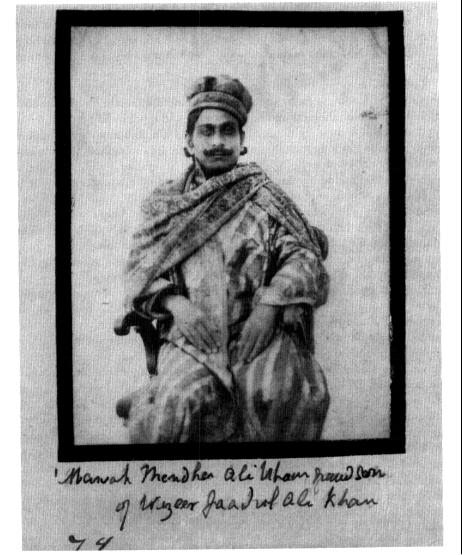
Figure 8
Nawab Mahdi Khan of Awadh, a general. One of the rebel leaders,
Lucknow, c. 1855. Courtesy of the British Library.
more complex manner to the revolt, and their behavior gave rise to the characterization of Shi‘is as quietists. Even they, however, can be shown to have supported the war, by and large. Many Shi‘i notables at first had reservations about a popular revolt, for two reasons: first, they feared for their own (considerable) property should order break down, and second, they still bore allegiance to the ancien régime of Vajid ‘Ali Shah, on his way to appeal to the queen in England.78
The Shi‘i notables did not long enjoy the luxury of equivocation. The liberation of Lucknow faced them with a moment of truth, for the revolutionaries, rural landholders and their peasants and rebel Indian troops, felt a need to establish their legitimacy. They wanted a member of the Nishapuri family installed as king, but the main candidate, Ruknu'd-Dawlah, was imprisoned in the residency, and others refused. Several of Vajid ‘Ali Shah's harem officials, including ‘Ali Muhammad "Mamun" Khan, then put forth Birjis Qadar Mirza, only ten years old. The son of Vajid ‘Ali Shah by a former courtesan who belonged to the second rank of the king's wives, Birjis Qadar had the advantage of being young and malleable. His mother, Hazrat Mahall, appears to have actively sought the position of king for her son, although other wives of the: king opposed the move as disrespectful or endangering to Vajid ‘Ali Shah, interred in British-held Calcutta.79
The revolutionaries wished to restore an Awadh government under Birjis Qadar in a manner consonant with the ideology of the Delhi revolt, which proclaimed a resurrected Mughal Empire. They therefore reverted to the pre-1819 formulas for Awadh rule, proclaiming Birjis Qadar a nawab rather than a shah. Shi‘is found this move easier because of their widespread conviction that Bahadur Shah II had adopted Shi‘ism around 1853. In that year the powerless king of Delhi had sent a letter to Chief Mujtahid Sayyid Muhammad Nasirabadi expressing his love for the family of the Prophet and declaring as non-Muslims all those who did not love them. He had an offering made on his behalf to the shrine of ‘Abbas's standard, Lucknow's holiest Shi‘i shrine. A year later he sent an envoy to Tehran, who informed Iran's Nasiru'd-Din Shah of the Mughal's adoption of Shi‘ism and his request for political support. Shi‘is probably took Bahadur Shah's subsequent denials of his Shi‘ism as pious dissimulation (taqiyyah ), whereas Sunnis believed them, making the last Mughal emperor an ideal rallying point for India's Muslims.80
The child Birjis Qadar was installed as Awadh's ruler on 5 July 1857, with the understanding that he would obey the orders of the Mughal emperor in Delhi and would give the revolutionary military a say in choosing the cabinet and army commanders. The "Zafarnamah" explicitly says that Birjis Qadar was made "nawab," rather than shah, and all sources agree that one of the revolutionary leaders, Shihabu'd-Din Khan, placed a turban on his head (rather than a crown, which had also been brought as a contingency). The new government rapidly appointed its chief officers, mostly former Awadh dignitaries, threatening recalcitrant candidates with execution for British sympathies if they refused to serve. They pressed Sharafu'd-Dawlah into service as chief minister, although some Shi‘i notables objected to his being a Sunni. The Hindu Maharaja Balkishen reluctantly took over the treasury department once again. Mamun Khan became overseer of the royal household, a powerful post in a patrimonial government with a child ruler. The new government rehired displaced bureaucrats and secretaries, and issued orders to revolutionary troops to cease looting, regularizing military salaries, though plundering continued and the troops retained great power. During the next several months, many of the Shi‘i notables in Lucknow recognized the new government and supported it in one manner or another.81
The revolutionary government made major assaults against the British residency on 20 July and 10 August, but never succeeded in reducing the British stronghold, though by August it held most of Awadh. Outside Awadh, the tide began to turn in favor of the British. The help that the Indians expected from Shi‘i Iran never arrived. Mamun Khan sent an emissary to Bahadur Shah, requesting his approval of Birjis Qadar's installation, but he arrived after Delhi fell to the British on 20 September, and returned to Lucknow. Mamun Khan sought to suppress news of the Mughal emperor's arrest, and proclaimed that Bahadur Shah had recognized Birjis Qadar as king, having salutes fired accordingly. His regents later minted a coin with the couplet:
The emperor [badshah ] of every body, every eye, Birjis Qadar
Struck coins in gold and silver, like the sun and the moon.
This verse indicates that after the fall of Delhi the revolutionary government reverted to claims of independent monarchy in Awadh.82
The Birjis Qadar government failed to prevent the "relief" of the residency led by Havelock and Outram in late September, which opened a new front at Alambagh, and the assault of Campbell in the winter of 1857-58, which in March drove the revolutionaries out of the capital. From the autumn of 1857 the Lucknow revolutionaries had split into two camps, with the Shi‘i and Hindu notables supporting Hazrat Mahall and Mamun Khan, the child ruler's regents, whereas the Sunni intermediate strata and laboring classes went over to Ahmadu'llah Shah, who in Sufi style made grandiose claims to divinity. The two camps continued to cooperate in assaulting the British position at Alambagh. From Maich of 1858 when the British reconquered Lucknow, the competing leadership cliques established themselves in different areas of the countryside, still aided by revolting tacalluqdars and their peasants, which the British did not subdue for almost another year.
What was the relationship of the Shi‘i ulama, who once wielded such power under the Nishapuris, to the new regime? The younger Nasirabadis, although they did not regain their control over the judiciary, joined the government in various capacities. Sayyid Muhammad Baqir Nasirabadi Munsifu'd-Dawlah, in constant attendence on revolutionary leader Mamun Khan, sought to regain the post of chief justice for himself; it went instead to Mir Mihdi, the Shi‘i tutor of Birjis Qadar. Mir Mihdi, however, did employ Sayyid Muhammad Baqir as an intelligence analyst obtaining information on the movement of British troops. The revolutionaries also offered him the command of a regiment, the ‘Ali Platoon, which he delegated to his half-brother ‘Ali Muhammad Nasirabadi. Sayyid ‘Abdu'l-Husayn, another son of Sayyid Muhammad Nasirabadi, was listed by the British as a "mutineer." Sayyid Muhammad Taqi, son of the late Sayyid Husayn Nasirabadi (d. 1856), at age forty one of the more prominent Shi‘i ulama in Awadh, constantly attended at the restored court, praying for Birjis Qadar. At the revolutionaries' request he used his knowledge of divination to name the fortunate days for attacking the Lucknow residency.83
What of ulama outside the Nasirabadi family? Of twenty-three major Shi‘i ulama in Lucknow (mostly former teachers, and some students, at the abolished seminary) whom the British later investigated, twelve took salaries
from or actively served with the revolutionary government, two applied unsuccessfully for jobs (one for a command), and nine attended at court and prayed for the government's success. Mirza Muhammad ‘Ali used his influence to get for his brother command of the Fath Jang Platoon under Husamu'd-Dawlah. Sayyid Asghar Husayn and Mir Khadim Husayn were employed in the Najib battalion, and Mawlavi Hakim Hamzah ‘Ali by the assistant to Mamun Khan, as well as by the revenue office. Mawlavi Mihdi Shah served in the News/Intelligence Department.84 Little evidence is available about the activities of Shi‘i ulama outside Lucknow, but we do know that Jacfar ‘Ali Jarchavi (d. 1896), a renowned Qur'an reciter trained as a Shi‘i scholar in Lucknow under the Nasirabadis, was arrested with the Sayyids of his town in Bulandshahr in 1857 for participating in the revolution.85
Some exceptions to Shi‘i ulama support for the revolution can be noted. Sayyid Icjaz Husayn Kinturi, an employee of the British bureaucracy, helped the British despite their tearing down his house near the residency. Sayyid ‘Ali Deoghatavi, Shi‘i prayer leader in Faizabad, denied involvement in the revolt.86
The most celebrated instance of a major Shi‘i scholar keeping his distance from the revolutionary government, that of Chief Mujtahid Sayyid Muhammad Nasirabadi, deserves a closer look. As was noted, one of his sons had a command, another was a "mutineer," and a third served as intelligence analyst. Sayyid Muhammad himself "made constant private visits to the Begam and Brijees Kudr," bringing along his close students to pray for the success of the revolution.87 The government stationed guards at his house to protect him and his great wealth. Yet he refused to call for a holy war, and during the British siege in the winter of 1857-58 he expressed disapproval of the war. This seemingly contradictory behavior puzzled British intelligence agents.
A chronological approach might help. Sayyid Muhammad often attended at court in the summer and autumn of 1857, when his sons took government service. With the British siege of Lucknow that winter, however, and the increasing power of the Sunni zealot Ahmadu'llah Shah, he may have seen the handwriting on the wall. Hindu informers spying on him from November 1857 to March 1858 reported that he
refused to give his sanction to the Rebellion raging around him. He urged when called upon to grant his Futwas that this could not be sanctioned by any passage or warrant of the Koran, that war against the infidels could only be justifiable when waged by an Emam and not otherwise. It was also reported that in his own circle the Moojtahid condemned the war as quite unjustifiable and against the spirit of the Law as contained in the Koran.88
The British report noted, however, that the chief mujtahid "permitted his disciples" to preach jihad , and to enter the revolutionary government's service.
Within the Nasirabadi family, therefore, a generation gap is apparent. Younger members of the family preached holy war and took jobs with Birjis Qadar's administration. Sayyid Muhammad, not given the sort of power and recognition he had in the 1840s, gave less-devoted support to the revolutionaries. Since he had given a ruling in the 1830s allowing defensive holy war when the lands of Islam were attacked, and since many Iranian mujtahids sanctioned Iran's wars against Russia earlier in the century, Sayyid Muhammad took an extremely cautious doctrinal position in 1858. Perhaps he thereby hedged his bets on whether the British would win, or the revolutionaries. Or maybe the "large sums" he held in British Government securities divided his loyalties.89 Finally, in refusing to recognize the struggle as a holy war, Sayyid Muhammad may have attempted to distinguish his style of religious leadership from that of Ahmadu'llah Shah. A similar conflict took place in Allahabad, where Shi‘i ulama refused to call for jihad , although the Sunni radical Mawlavi Liyaqat Husayn did so.90 The important point is that Shi‘is did not need the banner of holy war in order to fight against the British, which they almost universally did.
Given the prominence of Shi‘i commoners, tacalluqdars , and troops of the restored Shi‘i government in Lucknow, and of the Shi‘i ulama in the Awadh revolt of 1857-59, one can only wonder how the story of this community's ambivalence began. The answer lies in the witch-hunting atmosphere of the victorious British raj after March 1858. The British (inaccurately) put primary blame for the revolt on Muslims, and Shi‘is who wished to keep their lives and property had a strong motivation to convince the British of their innocence. British troops vindictively defiled the Great Imambarah and the Shi‘i Friday prayers mosque, turning the complex into a barracks. But the refusal of some older Shi‘i high ulama to call for a holy war served suddenly to differentiate their community from the Sunnis. The British, seeking to rebuild their ties with local elites, swallowed the lie about Shi‘i quietism with alacrity. Although British officials in Lucknow made a rather damaging circumstantial case against Sayyid Muhammad Nasirabadi, the governor-
general awarded the chief mujtahid his full stipend from the British government:
That which seems best supported by evidence is that he opposed the preaching of a religious war: and this, for the High Priest of Lucknow, is a great deal.
I think it not only just to give him the benefit of this, but politic; and I would seize this opportunity of finding a Mahomedan Priest who has practised moderation, and dissuaded from bloodshed & fanaticism to mark our approval of such conduct.91
Sayyid Muhammad also used pro-British Shi‘i friends like Sayyid Icjaz Husayn Kinturi to pull strings for him with them.92 The myth of Shi‘i quietism thus cynically suited both Shi‘i ulama and notables fearful of British punishment and British officials seeking a "politic" rapprochement with local elites.
Younger members of prominent ulama families took advantage of British willingness to make up. Sayyid Ghulam Husayn Kinturi, former treasury official at the Shi‘i seminary, became deputy registrar under the deputy commissioner in Lucknow, in the chowk bazaar area. His brother-in-law and cousin, Sayyid Icjaz Husayn Kinturi, continued to work as a bureaucrat (munsarim ) for the British government of Oudh. One of Sayyid Muhammad Nasirabadi's sons, Sayyid ‘Ali Akbar, became the deputy commissioner for the British in Bahraich. In some ways this move into administration under the colonial masters continued earlier trends of Shi‘i ulama's becoming government judges and officials.
Conclusion
The Shi‘i ulama seldom showed enmity to the British in the period 1775 to 1842, gradually accommodating themselves to the presence of this European ally of their Shi‘i government. At first ambivalent about the ritual purity of British commodities, the propriety of Shi‘is working for Christians, and the legality of lending them money, they slowly came to terms with such manifestations of growing European power in the subcontinent, even investing in British securities.
In the 1840s and 1850s they came into conflict with the British government for two reasons. First, they became more intimately associated with Awadh government policy as they grew more influential and wealthy and as they gained control over the judiciary. British attempts to control or absorb Awadh became of concern to the ulama in a more direct fashion. Second, they opposed British attempts to impose an "even-handed" policy toward
Hindus on the Nishapuri rulers, as in the trial of Bahraich's governor or in the Ayodhya temple conflict.
After annexation the ulama at first sought the patronage of the British and the continuation from Awadh's new masters of the stipends and perquisites granted them by the old. The British attempted to co-opt the ulama by granting them the stipends. But they promised to do so only for a generation, and their settlement policy of taxing or resuming revenue-free grants hurt many Shi‘i learned families. The British abolished the Shi‘i judiciary and the seminary. Worst of all, they consigned the Shi‘i state, the source of the mujtahids' wealth and power, to oblivion, throwing them into heavy debt. A few rupees a month in stipends from the chief commissioner's office could never make up lost glory. Thus, the Shi‘i ulama, along with most other Shi‘is of various social stations, by and large joined in the revolt of 1857-58, though they later attempted to obscure their participation. Without the Nishapuri state the Shi‘is formed just a small minority in northern India, with their traditional privileges and forms of wealth open to being whittled away by the British and by ascendant Sunnis and Hindus.
CONCLUSION
Two major issues have informed this book, both raised by the material itself. One, the growth of a hierocracy, has occasioned a concentration on the lives and works of the Shi‘i clerics. The other, communalism, or social closure on a religious basis, led us to examine relations between Shi‘is and other communities. It is time to discuss the relevance of the two issues to one another and to the wider question of Muslim separatism.
First, some questions about Shi‘ism and about the ulama raised in the introduction can now be answered. Nineteenth-century Imami Shi‘ism, it turns out, was hardly intrinsically hostile to states ruled by kings, notables, or other nonclerics. To the contrary, preindustrial Shi‘is longed for a realm ruled by a Shi‘i potentate, and their clerics adopted different rules of conduct for believers living under a Shi‘i ruler than for those laboring under Sunni or unbelieving governments. The mujtahids in Awadh demanded the public execration of the Sunni caliphs precisely on the grounds that they lived in a Shi‘i-ruled realm (Dar ash-Shi‘ah), where pious dissimulation was impermissible. The ulama may have seen the Nishapuri state as ultimately unjust, but they did not think it illegitimate, though its legitimacy for them derived from customary rather than religious law. They often called the ruler the "just king," and since they themselves proclaimed it wrong to practice pious dissimulation in a Realm of the Shi‘ah, their application to him of this epithet has some meaning.
The question of the Shi‘i state's legal status according to the Imami jurisprudents is secondary, however, to their actual behavior toward it. Here we have abundant evidence that most Shi‘i ulama in North India actively cooperated with the Nishapuri state, taking gifts, stipends, land grants, and posts from it. They served as its prayer leaders, its seminary teachers, its charity administrators, and ultimately its judiciary. In the 1840s the mujtahids administered Rs. 300,000 per year in charitable taxes paid by the state treasury, and received large salaries and perquisites from the shah. No major Usuli mujtahids played an oppositional role toward the Awadh state, though they did sometimes differ with it over policy. Indeed, the most trenchant criticisms of the Nishapuris I found came from the Sufi Shi‘i Mawlavi Samic; the Usuli Sayyid Dildar ‘Ali argued that Shi‘is should support the state, on the grounds that it favored the Imams and their partisans.
The financial dependence of the ulama on the state in Awadh may have
been greater than in Iran. With a Sunni and Hindu-dominated bazaar, Lucknow and Faizabad supported relatively few Shi‘i merchants and artisans who could, through their religious donations, in turn subvent the mujtahids. Moreover, Shi‘i endowments were much more numerous in Iran, so that the ulama there had greater employment opportunities as supervisors. But it should also be remembered that many Shi‘i ulama in Awadh were zamindars , small landholders who could have lived independently in the qasabahs managing their estates. Rather, most of them enjoyed the life of ulama in Lucknow and Faizabad, including their contacts or employment with the Shi‘i court.
The important point here is not that Shi‘i ulama were always adjuncts of the Shi‘i-ruled state, but that ulama ideology exhibited flexibility over time. Ulama in the 1840s were willing to associate themselves with the state in ways their fathers or grandfathers in the eighteenth century had not been. Shi‘ism began as a sectarian movement, and under the Mughals it continued to have sectarian characteristics. Those who argue that the Shi‘i clergy were in great tension even with the Qajar state place them at the sectarian pole, partly on the grounds that Shi‘i theology and abstract political theory have strong sectarian overtones left over from when the primitive movement was one of protest by the dispossessed. But the theoretical framework employed in this work would allow for movement along a continuum. The Shi‘i clergy could become more or less reconciled to the state over time, depending on the type of regime and society that prevailed. Where there has been a Shi‘i, as opposed to a Sunni or non-Muslim, government, the Shi‘i religious establishment has tended to be less sectarian in nature and more integrated into the state. My findings for Nishapuri Awadh give support to Willem Floor's contention that the revolutionary character of the Shi‘i ulama has been exaggerated, and that their view of the social structure differed little from that of the secular elites.
Shi‘i religious organization remained relatively amorphous, though the authority of the chief mujtahid in Lucknow was recognized all over North India. Yet the community's organization increased greatly from the eighteenth to the mid-nineteenth century. On a popular level, mourning sessions, poetry readings, and public processions created extensive social networks among believers. More formally, the prayer leaders, jurisconsults, teachers, and judges formed a body of religious specialists differentiated from the laity by their training and their reception of monetary rewards for religious work. Shi‘i literati from the intermediate strata adopted the Usuli school of jurisprudence, originally imported from Iraq and Iran, as their ideology.
Shi‘is moved from a group in which lay-clerical differences were slight to one in which a vast chasm separated the chief mujtahid from a humble Shi‘i artisan. In short, Shi‘ism underwent the classic transition from sect to formal establishment. I have emphasized the key role of the state in defining the sta-
tus of religious groups and in aiding the transition from sectarian organization to a formal establishment and the reverse. Under the Mughals, Shi‘is were sectarian; under the Nishapuris, mostly because of the wealth and position the state bestowed. on the ulama, they came to have a formal religious establishment.
I found horizontal stratification a useful tool for analyzing even a preindustrial Muslim society and its institutions. Some Shi‘i artisans and laborers saw the mujtahids as lackeys of the rich. They opposed or ignored Friday prayers, and some held to a folk theology that attributed divinity to Imam ‘Ali or joined antinomian movements, such as that led by the head of the body washers in Murshidabad. The Shi‘i poor sometimes gave allegiance to the Akhbari school once the Usulis became strongly associated with the ruling class; some Akhbaris denied the legitimacy of private property in land. A conviction existed that the Twelfth Imam would return in A.H. 1260 (A.D. 1844) to fill the world with justice and unite all men in one faith, though the date appears to have passed without further comment in Awadh. Shi‘i tradespeople set up pictures of the Imams for supplication and indulged in other practices abhorrent to the professional ulama.
Other groups of Shi‘is from different social and economic classes also developed their own religious cultures. Some high notables became literate enough in Shi‘i sciences to be gentlemen ulama, and some of these clung to Akhbarism for a few generations rather than recognize the authority of Usuli clerics from a petty landholding background. Other notables patronized Sufis or studied mystical metaphysics in preference to the books of ritual law and the principles of jurisprudence beloved by the mujtahids. High notables, through their salons and imambarahs , created a religious culture centered on the recitation of martial religious poetry about Imam Husayn at Karbala. Of course, many notables devoted little of their energy to religion of any sort.
The biographical dictionaries seldom mention details like the social background of the ulama. Yet the data I have been able to assemble give a strong and consistent impression that most ulama came from qasabahs where their families owned just a few villages. Others derived from the service classes in cosmopolitan cities, such as Faizabad and Lucknow. Some became genuinely wealthy, especially in the 1840s, but most appear to have come from the intermediate strata of Muslim society. The distinction they often made between the notables (umara ') and the learned (‘ulama ') generally overlapped, with a distinction between the rich and the moderately well-off.
What impact did the growth of a hierocracy have on communal relations in North India? It seems clear that in the preindustrial west and south of Asia two major sorts of religious organization and policy could be adopted. One, the unrationalized, was exemplified by the Sufis and the Akhbaris, who for the most part sought communal coexistence. Sufi pirs even served as in-
termediaries among religious communities, often accepting Hindus or Muslims of other sects as their disciples and producing literature of a syncretic nature.
The major alternative was a rational approach to religious law, such as that of strict Hanafi jurisprudents among the Sunnis, and the Usuli mujtahids among the Shi‘is. Awrangzib and Amjad ‘Ali Shah opted for the rational juridical policy, which was more compatible with state building than were traditional or charismatic forms of religion. Yet the drawback to adopting such a rationalized religious jurisprudence as the basis for state policy lay in its provocation of religious tensions. As cultural intermediators such as Sufi pits were displaced in Usuli Awadh, as cultural syncretism became suspect in the eyes of believers influenced by the scripturalist mujtahids, communalism grew. Religious disputes and riots had long existed, as Bayly has shown. But rational religious jurisprudence helped transform diffuse antagonisms into a more organized form of social closure. The rise of Usuli rationalism predated the impact of modern capitalism, but proved largely compatible with it—differing in this respect from the declining Sufi orders.
The growth of hierocracy, then, promoted social closure on a religious basis. Where Akhbaris or Sufi Shi‘is made compromises with Sunnis, especially in regard to cursing their caliphs, Usulis actively encouraged their public execration, even at the risk of violence. Although Usulis sought a politcal partnership with Sunnis, they insisted on a stronger delineation of religious boundaries. Usulis also advocated that the Shi‘i state destroy Hinduism and strip Hindus of all personal status rights, giving them a choice of conversion or death. The mujtahids urged Shi‘is to avoid the ritual pollution that would come from association with Hindus or some kinds of Sunni. By advocating a religious closure so strong that the community came to resemble a caste, the mujtahids laid the foundation for the emergence of Shi‘ism as a political identity.
The Nishapuri period in North India sheds light in two ways on the tradition of Muslim separatism and political activism that distinguished the United Provinces from southern India. Not only did the Usuli ulama and mourning practices promote social closure among Shi‘is, but a series of Sunni movements arose that sought the restoration of Sunni rule. The Nishapuris' break with Mughal traditions weakened their legitimacy among some Sunni zamindars in the qasabahs , and some regions suffered economically from tax-farming and the auction of offices. Moreover, as Nishapuri rule became weaker in the nineteenth century because of British restrictions, Hindu tacalluqdars , mystical corporations, and merchants grew more powerful. In neighboring British-ruled areas the hand of Hindu moneylenders was strengthened by British requirements that revenue assignments be backed by bank credit. Bayly has demonstrated a pattern in nineteenth-century North India wherein Hindu-dominated commercial cities prospered, whereas Muslim
qasabahs declined.1 Sunni families with a tradition of landholding and religious learning keenly felt the loss of Sunni grandeur and wealth.
Ostensibly, the movements of Sayyid Ahmad Rai-Barelavi in the 1820s, of Amir ‘Ali Amethavi in 1855, and of Ahmadu'llah Shah in 1857-58 were directed against groups other than the Shi‘i rulers in Lucknow. But Sayyid Ahmad dreamed of overthrowing the Nishapuris after he had defeated the Sikhs in the Punjab. Amir ‘Ali's holy war against the Hindus of Ayodhya brought him into a military encounter with Vajid ‘Ali Shah's troops. And Ahmadu'llah Shah ultimately bore as much enmity toward Birjis Qadar as toward the British. All three of these movements, drawing their followers from the Sunni intermediate strata, practiced what Parkin calls dual closure. Just as white unions in South Africa fought both the capitalists above and the black laborers below, so these Sunni revivalists fought both non-Muslims and the Shi‘i ruling class.2
This tradition of dual closure among the Sunni intermediate strata of nineteenth-century North India seems unlikely to be irrelevant to twentieth-century developments. Even the strategic terrain bears resemblances. The minority Muslims of Awadh and surrounding territories who wanted to establish a Sunni state immediately thought of Peshawar, western Punjab, and Bengal as natural demographic bases. The growth of a Shi‘i state and its hierocracy, along with economic dislocations, presented Sunnis of what became the United Provinces with a psychological shock that those living in southern India were largely spared. The shock was increased by the British annexation of Awadh, which, although Shi‘i-ruled, had at least been in Muslim hands. In contrast, committed Sunnis living in southern India had the option of living in the Nizamate of Hyderabad, which maintained Sunni Mughal traditions, right up until 1947. Awadh Sunnis faced both an alien, Shi‘i ruling class of tax-farmers in the metropole and Hindu rajas in the provinces. The longing for a Sunni state among some radicals in the small towns of North India goes back rather further than the early twentieth century.
Bayly has argued that roots of communalism lay in social formations created by religious communities in the eighteenth century, the Hindu merchant class, and the Muslim service gentry based in the qasabahs or in Muslim city quarters. Economic, administrative, and political developments were kinder to the Hindu merchants than to the Muslim service gentry. "While strong, indigenous states retained power, these parallel developments did not necessarily presage conflict. But from the 1830s the disintegration of the old magistracies and notabilities left broader spaces for contention."3 Bayly makes a case for the relative decline of the qasabahs , economically and culturally, which lent urgency to Muslim protestations of increasing "backward-
ness" at the end of the nineteenth century. These were not, as Brass suggested, merely self-serving lies. Under the British from 1859 Muslims probably did not do as badly in the new middle class as their leaders argued. But the deterioration of their qasabahs filled them with alarm. Even where Muslim towns did not decline absolutely, they often witnessed a Hindu influx, as the Muslims lost their edge in the rate of urbanization.
In the British period Sunni activists continued the process of dual closure, the formation of a community identity by conflict with both Hindus and Shi‘is. Freitag has drawn attention to the importance of religious rites and riots to the formation of community identity late in the nineteenth century. For Hindus, cow protection formed a rallying cry for societies and riots, which increased community identity. Among Muslims, Muharram and other rites played a similar role. Social closure was aided in this period by the spread of Islamic education and the founding of Urdu printing presses that published works of the ulama and Muslim scholars. Increasing literacy among Muslims made the ideas of ulama and activists advocating a stronger Muslim (Sunni or Shi‘i) identity more accessible to large numbers of people.4
Shi‘i activists also sought to impose their more austere mourning practices on all Muslims at Muharram processions. Shi‘i preachers insisted on cursing the caliphs and proclaiming that ‘Ali should have succeeded the Prophet without any delay. The compromise position adopted by many Muslims, of giving special honor to ‘Ali among the caliphs, was rejected both by Sunni hard-liners such as the Ahl-i Hadith and by Shi‘i mainstream Usulis. Sunni-Shi‘i conflict broke out in Lucknow in 1906, and Shi‘is and Sunnis as a result stopped taking their cenotaphs to the same Karbala burial grounds outside Lucknow on the tenth of Muharram. This renegotiation of sacred geography emphasized the increasing closure of the Sunni and Shi‘i communities. Thereafter, Sunni-Shi‘i violence broke out frequently, drawing the Hindus in as allies of one side or another.5
Shi‘i ulama and landholders gradually rebuilt some institutions in North
India, founding seminaries and training-institutes for preachers. In the late nineteenth century graduates of the defunct Asafu'd-Dawlah seminary spread over North India and the subcontinent, introducing Shi‘i Friday prayers and Usuli teaching curricula in Lahore and Peshawar in the north and in Hyderabad in the south. Legal rulings for the laity were published in Urdu by Usuli exponents of Shi‘i Islamization.
Shi‘is and Sunnis never threw up complete barriers between their two communities. Many Shi‘i notables supported the Khilafat movement in the 1920s, fueled by the Sunni demand that the Ottoman ruler, which Indian Sunnis began accepting as their caliph late in the nineteenth century, be protected after the Ottoman defeat in World War I. That movement became allied with Mahatma Gandhi's early noncooperation drive, and so was involved in the growth of nationalism in the modern subcontinent. Strict Usuli ulama m Lucknow at first refused to cooperate in a movement for a Sunni caliph, whom they saw as a usurper of rights belonging solely to the family of the Prophet. But rumors of British bombardment of the shrine cities in Iraq led some of them to join in noncooperation against the British.6
Brass wrote, against the primordialist position, that Muslim ulama did not play a leading role in the Muslim League and the movement for Pakistan. Robinson insisted in reply that many more ulama were active in that movement than has been generally realized.7 But the important point is not that ulama were state builders; Muslim politicians were more important. Rather, the religious culture promoted by some schools of ulama laid the groundwork for the emergence of a Muslim political identity once the masses became politicized. The question of north Indian Shi‘i participation in the movement for Pakistan cannot be addressed here, since no quantitative study has been done. Many Shi‘i families emigrated to Karachi, and one can think of important Shi‘i supporters of the Muslim League, such as the Raja of Mahmudabad. Their participation was probably proportionate to that of Sunnis, but their numbers were far less (most Sunnis did not emigrate, either). The large Shi‘i community of nearby eastern Punjab went to Pakistan in its entirety.
Both in promoting Shi‘i closure and in provoking Sunnis to dual closure, the mujtahids of Awadh created structures conducive to Muslim separatism. The compatibility of Usulism with modern Muslim state building is further demonstrated in revolutionary Iran after 1978, where some radical Usuli ulama took their doctrine that they were the representatives of the Twelfth Imam to its logical (though not necessary) conclusion, demanding for the
first time the right to rule. I pointed to the usefulness in understanding these events of Parkin's neo-Weberian conception of social closure, which he elaborated largely in the context of apartheid in South Africa. After all, some of the same social consequences are apparent in religious closure as in racial, and modern states have been built on the basis of both. Both appear so alien from the perspective of the ideals of 1789, which demand equal civil rights for all citizens, that those in that tradition must make a special effort of imagination to understand societies where race or religion define de jure second-class citizens. Fear of reduction to such a status, to which they know they would reduce others, explains much about religious communalists.
GLOSSARY OF ARABIC, PERSIAN, AND URDU TERMS
Language designations refer to usage and transliteration, not to etymology: [A] = Arabic, [P] = Persian, [U] = Urdu.
‘adil : Upright, opposite of morally corrupt. [A]
‘adalat : Muslim court of law; uprightness. [P]
ara'ishvala : One who constructed the bright replicas of the Imam Husayn's tomb for use in Muharram ceremonies. [P]
ashraf : The "noble" castes among the Muslims in India, including Sayyids, Mughals (Iranians and Turks), Pathans (Afghans), and Shaykhs. [A]
ataliq : A guardian, tutor, master. [P]
bharbunja : Grain parcher. [U]
bay‘at : The oath of allegiance and obedience given by a Sufi adept to his master upon his initiation into a Sufi order. [P]
bid‘ah : A heretical innovation in Islamic doctrine. [A]
bihishti : A water carrier. [P]
bi-sharc : A Sufi order of the laboring classes whose members did not observe closely the strictures of Islamic law. [P]
dalil : Evidence for a ruling deriving from the divine Law. [A]
daral-harb : The Realm of War, an area where Muslims are not in political control. [A]
darbar : A royal audience where ceremonial offerings are made by inferiors to superiors and vice versa. [P]
daroghah : Head man or superintendent of any office or department. [U]
dhikr : The Sufi practice of chanting God's name and other religious formulas, often with hyperventilation. [A]
dhimmi : In Islamic law, a Jew or a Christian, protected as a member of a recognized religious community under Muslim rule, who must pay a minority tax but is exempt from military service. [A]
fatwa : A legal ruling given by a Muslim jurisconsult, or mufti. [A]
fawjdar : The chief magistrate of a district, with military responsibilities. [P]
hadith : An oral report transmitted by generations of Muslim scholars going back to the Prophet or the Imams; complements the Qur'an as a source of Islamic law. [A]
hakim : Physician in the tradition of "Greek" medicine going back through Avicenna to Galen and Aristotle. [A]
handasah : Geometry, draughtsmanship. [A]
haram : An action forbidden by Islamic law for the commission of which God will punish the believer. [A]
hay'at : Cosmography. [P]
ihtiyat : Caution, following the most strict of the major positions in any matter of law. [A]
ijazah : A certificate given by a teacher to his student that he has completed a certain book or course of study. These were most often given by Shi‘i ulama permitting the transmission by the student of Imami oral reports. Usuli masters sometimes bestowed ijazahs allowing ijtihad . [A]
ijtihad : The application of reasoned effort to the derivation of a ruling from the scriptural text, sometimes involving a limited sort of syllogism or analogy. A jurisprudential method rejected by early Imami Shi‘is but accepted by Usulis from the fourteenth century. [A]
‘illah : A common term, indicating the reason for which a divine law has been ordained, upon which a legal analogy may be based. [A]
imambarah : In North India, a large building wherein mourning sessions were held by notables to commemorate the martyrdom of Imam Husayn. [U]
imam-jumcah : Leader of the Friday congregational prayers. [A]
ImamiShi‘ism: A branch of Islam believing that after the death of the Prophet his rightful religious and political successors should have been his son-in-law and cousin, ‘Ali, and the latter's eleven descendants through the Prophet's daughter, Fatimah. [A]
‘ishq : Overwhelming, passionate love, used by Sufi mystics to describe their highest feelings for God. [A]
jagir : The assignment of the government share of the produce of a large tract of land to an individual in lieu of salary for services rendered [P]
jahiz : The clothing and furniture that a bride brings to her husband's house. [A]
ja'ir Unjust. In Shi‘i jurisprudential thought any ruler other than the Imam is imperfect and so ultimately unjust. [A]
jat(Urdu zat ) : Roughly, caste. [U]
jihad : War for the sake of God and Islam In Imami Shi‘ism such a war was classically believed to be legitimately led only by an Imam, and after the last Imam disappeared the duty to wage it lapsed, except in self-defense. [A]
julahah : a weaver of coarse cloth. [P]
jumcah : Friday congregational prayers. [A]
kalam : Dialectical theology, cultivated by the rationalist Usulis but forbidden by the Akhbaris. [A]
karamat : Graces or miracles that Muslim holy men claimed to be able to perform. [A]
kashf : Mystical inspiration from God. [A]
khabar al-ahad : An oral report transmitted by only one scholar in each early generation of the Muslims. [A]
khanqah : A building where Sufis gathered for chanting and meditation sessions. [P]
khirqah : The patched cloak bestowed upon a Sufi adept by his master upon his initiation into a Sufi order. [A]
khums : A Muslim religious tax of 20 percent on certain kinds of income, which, among Shi‘is, is distributed to poor Sayyids. Usulis held that half the income from this tax should go to the religious jurisprudents. [A]
khutbah : Formula read at the Friday afternoon congregational prayers, into which the name of the ruler was often inserted. [A]
kotval : A mixture of police chief and urban administrator. [U]
madad-i macash : Grants of land to Muslim religious functionaries, scholars, and mystics for their support. [P]
madrash : Muslim institution of higher learning, seminary. [A]
majlis : A mourning session held for the martyrdom of Imam Husayn. [A]
marjac-itaqlid : A jurisprudent, or mujtahid, who is emulated by laymen in his rulings on the religious law. [P]
marsiyyah-khvan : A reciter of Shi‘i elegiac poetry. [P]
marthiyyah (Persian: marsiyyah ): Elegiac poetry mourning the Shi‘i martyrs, including the Imam Husayn, who died at the seventh-century battle of Karbala. [A]
macsum : Sinless: an attribute in Shi‘ism of the Prophet and the Imams. [A]
ma'tam : In North India, self-flagellation in mourning of the martyred Imam. [A]
mawlavi : A member of the Muslim religious learned class. [P]
minbar : A stairway-like pulpit from which preachers speak in the mosque. [A]
mucafi : A grant of land free of tax in perpetuity. [A]
mufti : A Muslim jurisconsult (English: mufti). [A]
muhaddith : An expert in the orally transmitted reports from the Prophet (and, in Shi‘ism, from the Imams), which, along with the written Qur'an, constitute Islamic scripture. [A]
mujtahid : A jurisprudent who practices ijtihad , or legal reasoning. [A]
munsarim : A manager, administrator, head clerk of a court of settlements. [A]
munshi A writer, secretary. [A]
mutcah : Temporary marriage, allowed in Shi‘i law (Persian: sighah ). [A]
mutakallim A practitioner of dialectical theology, or kalam . [A]
najis : In Shi‘i law, something ritually impure or polluted. [A]
naqqal : Storyteller, jester. [U]
nazim : Governor of a large province. [P]
nazranah : A religious gift or offering to a shrine or a holy man. [P]
qasabah : A small town or large village, averaging a population of 3,000, often with a fort, irrigation works, a water tank, and a tradition of literacy and local pride, acting as a seat for small Muslim landholders. [U]
qatci : A type of scriptural evidence that is conclusive for a particular ruling. [A]
qazi (Arabic: qadi ): Muslim religious-court judge. [P]
qiyas : The use of analogy or syllogism in jurisprudential reasoning, allowed by Usuli Shi‘is but forbidden by Akhbaris. [A]
rawzah-khvan : A reader of prose laments for the Shi‘i martyrs at Karbala. [P]
sadaqat : Voluntary pious contributions to the poor. [A]
sanad : A document certifying the grant of land or a perpetual stipend. [A]
Sayyid : A descendant of the Prophet Muhammad, owed special status among Muslims. [A]
sharicah : The divinely ordained system of laws in Islam. [A]
SunniIslam : The majority branch, which recognizes four orthodox successors to the Prophet, elected by an oligarchic council of the Quraysh tribe, including Abu Bakr, ‘Umar, ‘Uthman, and ‘Ali, and which takes a generally positive view of the Muslim monarchies that thereafter arose. [A]
suz-khvani : The soulful chanting of elegies for the Imam Husayn. [P]
tacalluqdar : A large rural landholder in Awadh. [P]
tabarra ': The Shi‘i practice of publicly cursing the first caliphs, whom they believe to have wrongfully usurped the leadership of the Muslim community from the Imam ‘Ali. [A]
tahsildar : A revenue collector for the government. [P]
taqiyyah : The Shi‘i doctrine that a believer must lie about his branch of Islam should he feel his life to be in danger. [A]
taqlid : Emulation; in Usuli Shi‘ism, the practice of laymen obeying the religious rulings of mujtahids, or expert jurisprudents. [A]
tariqah : An order of Sufi Muslims, which met together for group chanting and meditation, with a vaguely hierarchical structure within which many sorts of social relations existed, not only mystical ones. [A]
tavalla : Praising and blessing the Prophet and the Twelve Imams whom Shi‘is believe to be his legitimate successors. [P]
tava'if : Courtesan or prostitute. [U]
tacziyah-khanah : A small structure where the martyrdom of Imam Husayn was commemorated, as differentiated from the larger imambarah . [P]
‘ulama ': Muslim religious scholars (English: ulama). [A]
umara ': High notables. [A]
‘urf : Customary law, as differentiated from the divinely revealed Islamic law. [A]
vaciz : A preacher of sermons at a mosque. [P]
vujub-icavni : A religious duty incumbent on each believer. [P]
vujub-itakhyiri : An obligation of preference. [P]
wahdatal-wujud : The doctrine, adhered to by Muslim mystics, or Sufis, that existence is ultimately monistic in nature, rather than plural. Opponents of the doctrine branded it pantheistic. [A]
wajd : A state of mystical ecstasy. [A]
waqf : A pious endowment, alienating property for religious purposes in perpetuity. [A]
zakat : A Muslim religious tax for the poor. [A]
zamindar : A small or middle landholder in Awadh. [P]
zann : In jurisprudence, a considered opinion: differentiated from certain knowledge (cilm ) based on conclusive evidence. [A]
zarih : A replica of the tomb of Imam Husayn, also called in northern India a tacziyah . [P]
ziyarat : Religious visitation or pilgrimage. [P]
zuhd : Continence, asceticism. [A]
zuhr : Daily noon prayers. [A]
SELECT BIBLIOGRAPHY
Unpublished Sources
Arabic
Akbarabadi, Mirza ‘Ali. "Sabikat al-lujjayn fi'l-farq bayn al-fariqayn." Rampur. Raza Lib. Usul al-Fiqh, MS 2164.
Akbarabadi, Mirza Muhammad Nishapuri. "Macawil al-cuqul." Lahore. Punjab Univ. Lib., MS 514.
‘Ali Akhbari, Sayyid Fida. "Risalah fi radd hujjat al-ijmac." Lucknow. Nasiriyyah Lib. Usul al-Fiqh Shi‘ah, MS 31.
Ardistani, Sayyid ‘Abbas. "Al-hisn al-matin fi ahwal al-wuzara' wa's-salatin." 2 vols. New Delhi. Nat'l Archives of India, MSS 235a, 235b.
Astarabadi, Muhammad Amin "Al-fawa'id al-Madaniyyah." Lucknow. Nasiriyyah Lib. Usul al-Fiqh Shi‘ah, MS 49.
‘Azimabadi, Hasan. "Majmucat rasa'il." Lucknow. Nasiriyyah Lib. Fiqh Shi‘ah, MS 200.
———. "Risalah fi mashi'at Allah." Lucknow. Nasiriyyah Lib ‘Aqa'id Shi‘ah. Unlocated.
Barelavi, Husayn ‘Ali Khan. "Risalah fi'l-akhbar." Lucknow. Nasiriyyah Lib. Usul al-Fiqh Shi‘ah, MS 33.
Karaki, ‘Ali al-. "Al-Jacfarivyah fi ahkam as-salah." Patna. Khudabakhsh Oriental Public Lib., MS 844.
Kashmiri, Sayyid Najaf ‘Ali Fayzabadi. "Al-caqa'id an-Najafiyyah fi'l-usul ad-Diniyyah." Lucknow· Nasiriyyah Lib. ‘Aqa'id Shi‘ah, MS 63.
Kinturi, Sayyid Icjaz Husayn "Shudhur al-ciqyan fi tarajim al-acyan." 2 vols. Calcutta. Nat'l Lib. Buhar Coll., MSS 278-279.
Mawdudi, Sayyid ‘Ali Akbar. "Al-fawa'id al-Mawdudiyyah." India Office. Delhi Coll., MS 953c.
Nasirabadi, Sayyid Dildar ‘Ali. "‘Imad al-Islam fi cilm al-kalam." 5 vols. Lucknow. Nasiriyyah Lib., MSS 163-167.
———. "Itharat al-ahzan." Patna. Khudabakhsh Oriental Public Lib., MS H.L. 2292.
———. "Risalah fi ahkam al-aradin." Rampur Raza Lib. Fiqh, MS 2842.
———. "Ash-shihab ath-thaqib" India Office, MS 2182.
Nasirabadi, Sayyid Husayn. "Al-hashiyah cala Sadra." Rampur. Raza Lib., MS 2182.
———. "Majmucat al-fawa'id al-Husayniyyah." Lucknow Nasiriyyah Lib. ‘Aqa'id Shi‘ah, MS 101.
Nasirabadi, Sayyid Muhammad. "Ihya'al-ijtihad." Lucknow· Nasiriyyah Lib. Usul al-Fiqh Shi‘ah, MS 1.
———. "Risalah fi ithbat al-bisharat min at-tawrah wa'l-injil." Lucknow. Nasiriyyah Lib. Kalam Shi‘ah. Unlocated.
Nasirabadi, Sayyid Muhammad Taqi. "Hidayat al-mustarshidin." Lucknow Nasiriyyah Lib. Usul al-Fiqh Shi‘ah, MS 68.
Rashti, Sayyid Kazim. "Risalah fi'l-usul." Lucknow. Nasiriyyah Lib. Usul al-Fiqh Shi‘ah. MS 29. The work is actually on dialectical theology.
Shirvani, Abu'l-Fadl ‘Abbas Yamani. "Rawdat as-saha." Allahabad, MS in the private collection of Mr. Jalal Uddin. Correspondence of the editor's father, some with the mujtahids in Lucknow.
Shushtari, Sayyid Muhammad ‘Abbas. "Awraq adh-dhahab," Lucknow. Nasiriyyah Lib. Adab ‘Arabi, MS 4.
———. "Al-macadin adh-dhahabiyyah." Rampur. Raza Lib Adab ‘Arabi, MS 4446
———. "Makatib ‘Arabiyyah" Lucknow. Nasiriyyah Lib Adab ‘Arabi, MS 41.
——— "Nur al-absar." Lucknow. Nasiriyyah Lib Usul al-Fiqh Shi‘ah, MS 65.
———. Edited. "Az-zill al-mamdud." Lucknow, MS in the library of the Raja of Mahmudabad. An important collection of letters among the ulama, including correspondence from the shrine cities in Iraq, compiled in 1849.
Shushtari, Nuru'llah. "Al-lumcah fi tahqiq salat al-jumcah" Lucknow Nasiriyyah Lib. Fiqh Shi‘ah, MS 187
Persian
Collections
Allahabad, Regional Archives; New Delhi, Nat'l Archives of India.
Manuscripts
"A'inah-'i haqq-nama" Lucknow. Nasiriyyah Lib Rijal Shi‘ah, MS 1. The official anonymous biography of Sayyid Dildar ‘Ali Nasirabadi, written in Lucknow around 1816.
‘Ali, Incam. "Awsaf al-Asaf" Aligarh Muslim Univ. Farsi Tarikh, MS 25
‘Ali Akhbari, Sayyid Fida. "Risalah-'i hurmat-i shurb-i dukhan" Lucknow Nasiriyyah Lib. Fiqh Shi‘ah, MS 113.
‘Azimabadi, Hasan, trans. "Tarjamah-'i 'Hayat an-nafs fi khatirat al-quds.'" Calcutta. Asiatic Soc. Lib. Curzon Coll, MS 1057.
Barelavi, Husayn ‘Ali Khan "Madhammat al-ijtihad." Lucknow, MS in the library of the Raja of Mahmudabad.
———. "Muctamad ash-Shi‘ah." Lucknow. Nasiriyyah Lib Kalam Shi‘ah, MS 206.
———. "Risalah dar bayan-i farq bayn-i akhbari va usuli." Lucknow. Nasiriyyah Lib. Kalam Shi‘ah, MS 206.
Barelavi, Subhan ‘Ali Khan. "Rasa'il." Lucknow Nasiriyyah Lib. Kalam Shi‘ah, MS 134
Bihbahani, Aqa Ahmad. "'Iqd al-jawahir al-hisan." Lucknow. Nasiriyyah Lib. Fiqh Shi‘ah, MS 177.
——— "Mir'at al-ahval-i jahan-nama." Calcutta. Nat'l Lib. Buhar Coll., MS 96. Also British Lib. Add 24,052.
———. "Su'al va javab." Lucknow. Nasiriyyah Lib. Fiqh Shi‘ah, MS 154.
———. "Tanbih al-ghafilin." Lucknow. Nasiriyyah. Lib. Usul al-Fiqh Shi‘ah, MS 10.
Bilgrami, Sayyid Muhammad. "Tabsirat an-nazirin." Patna. Khudabakhsh Oriental Public Lib., MS H.L. 58
Das, Harcharan "Chahar gulzar-i shujaci." British Lib, Or. 1732.
Fayzabadi, Haydar ‘Ali. "Risalat al-makatib fi ru'yat ath-thacalib wa'l-gharabib." Calcutta. Asiatic Soc. Lib Curzon Coll., MS 1069.
Fayzbakhsh, Muhammad. "Risalah dar ahval-i zamindaran-i Kakori." Calcutta. Asiatic Soc. Lib Curzon Coll., MS 87.
———. "Tarikh-i farahbakhsh." Aligarh Muslim Univ ‘Abdus Salam Coll., MS 486/7.
Husayn Khan, Ghulam. "Balwand-namah." Ed. Subhan ‘Ali Khan. New Delhi. Nat'l Archives of India MS 2210.
Ilahabadi, Khayru'd-Din Muhammad "‘Ibrat-namah" Volume 2. New Delhi. Nat'l Archives of India, MS 405
———. "Tadhkirat al-‘ulama'" Calcutta. Asiatic Soc Lib, MS 203.
———. "Tuhfah-'i tazah" Iudia Office, MS 483.
In-sha'a'llah Khan, Mir. "Lata'if as-sacadah." British Lib. Or. 2021.
Isfahani, ‘Abdu'l-‘Azim Husayni. "Al-maqami cal-Haydariyyah." India Office. Delhi Coll., MS 1190e.
Lakhnavi, Abu Muhammad "Muhammad Aman" "Vajizah dar salat-i jumcah." Lucknow. Nasiriyyah Lib. Kalam Shi‘ah, MS 206.
Lakhnavi, Musharraf ‘Ali Khan. "Izahat al-ghayy fi radd ‘Abdu'l-Hayy." India Office. Delhi Coll, MS 312b
Lakhnavi, Sayyid Ahmad ‘Ali. "Risalah fi'l-usul wa'l-akhbar" Aligarh Muslim Univ Qutbu'd-Din Coll, MS 43/5.
Lalji. "Sultan al-hikayat-i shahan-i Avadh." India Office, MS 3902
Majlisi, Muhammad Baqir "Risalah-'i sifat-i subutiyyah va salbiyyah." Lucknow Nasiriyyah Lib ‘Aqa'id, MS 41.
Muhtashim Khan, Muhammad "Tarikh-i Muhtashim Khani." Patna. Khudabaksh Oriental Public Lib., MS H L. 156.
Nasirabadi, Sayyid Dildar ‘Ali. "Ajwibat as-sa'ilin." Comp. Abu Muhammad "Muhammad Aman" Calcutta. Asiatic Soc. Lib Curzon Coll., MS 1016.
——— "Fava'id-i Asafiyyah va mavaciz-i Hasaniyyah" Lucknow Nasiriyyah Lib. Hadith Shi‘ah, MS 152.
——— "Najat as-sa'ilin." Lucknow Nasiriyyah Lib. Fiqh Shiah, MS 256.
———. "Risalah dar radd-i mazhab-i sufiyyah" Lucknow. Nasiriyyah Lib. Kalam Shi‘ah, MS 111.
———. "Sharh-i 'Hadiqat al-muttaqin, bab-i sawm.'" Lucknow Univ. Tagore Lib., MS 40.
Nasirabadi, Sayyid Husayn. "Javab-i su'al-i Husayn ‘Ali Khan" Lucknow. Nasiriyyah Lib Kalam Shi‘ah, MS 54.
———"Risalah bih javab-i masa'il-i Subhan ‘Ali Khan" Lucknow. Nasiriyyah Lib Kalam Shi‘ah, MS 106.
———"Su'al va javab" Lucknow Nasiriyyah Lib Fiqh Shi‘ah. Uncatalogued, MS
Nasirabadi, Sayyid Muhammad. "Thamarat al-khilafah." Patna. Khudabaksh Oriental Public Lib., MS H.L. 1325.
Qazvini, ‘Abdu'l-Vahhab. "Siyahat-namah-'i mamalik-i hindustan." MS in the library of Professor Amin Banani, University of California, Los Angeles.
Rabit Ametavi, ‘Abdu'l-Ahad. "Vaqa'ic-i dilpazir." Calcutta. Asiatic Soc. Lib. Curzon Coll., MS 46.
"Radd-i shihab ath-thaqib." India Office. Delhi Coll., MS 1190d.
Rashti, Sayyid Kazim. "Dalil al-mutahayyirin." Calcutta. Asiatic Soc. Lib. Curzon Coll., MS 831.
Rizavi, Hashim ‘Ali. "Mir'at al-bilad." Allahabad. Government Manuscript Lib., MS 2551.
Safavi, Sultan ‘Ali Husayni. "Macdan as-sacadah." Calcutta. Asiatic Soc. Lib. Soc. Coll., MS 181.
Salamatu'llah, "Risalah-'i munazirah." Patna. Khudabakhsh Oriental Public Lib., MS H.L. 1329.
Shushtari, ‘Abdu'l-Latif. "Tuhfat al-calam." British Lib., Add. 23,533.
Bahadur Singh. "Yadgar-i bahaduri." Allahabad. Regional Archives, MS 255.
Singh, Raja Ratan "Zakhmi." "Sultan at-tawarikh." India Office, MS 3961.
"Zafarnamah-'i vaqa'ic-i ghadr." India Office, MS 431.
Zaki Khan, Mirza Muhammad. "Majmucah-'i rasa'il-i tahqiq-i maslak-i akhbariyyin va usuliyyin." Lucknow. Nasiriyyah Lib. Usul al-Fiqh Shi‘ah, MS 28.
Urdu
Collections
Allahabad, Regional Archives; Lucknow, Uttar Pradesh State Archives, New Delhi, Nat'l Archives of India.
Manuscripts
‘Ali, Sayyid Mihdi. "Hada'iq-i isna cashari." Trans. Sayyid Sayfu'd-Din Haydar. India Office, MS 17.
Hasan, ‘Ali. "Mahmudabad ki tarikh." 5 vols. MS in the library of the Raja of Mahmudabad. Treated as a primary source because of the author's access to oral traditions and early family records and memoirs.
Hasan Khan, Mucinu'd-Din. "Khadang-i ghadr." India Office, MS 132.
European Languages
Collections
Lucknow
Uttar Pradesh State Archives.
Board of Revenue.
New Delhi
Nat'l Archives of India (copies under different headings in the India Office Records):
Foreign Department.
Foreign Consultations, 1840-1856.
Political Consultations.
Secret Consultations.
Political Letters from the Court of Directors.
Political Letters to the Court of Directors.
Printed
Sleeman, William. "The History of the Reigning Family of Oude" India Office. Xerograph. R121.
Published Sources and Dissertations
Arabic
Akbarabadi, Mirza Muhammad Nishapuri. Fath al-bab ila'l-haqq wa's-sawab . Najaf: al-Matbacah al-‘Alawiyyah, 1342/1923.
‘Amili, Muhammad al-Hurr al-. Amal al-amil . Ed. Sayyid Ahmad al-Husayni. 2 vols. Baghdad Maktabat al-Andalus, 1966.
Amuli, Sayyid Haydar. Jami ' al-asrar wa manba' al-anwar . Ed. Henry Corbin and Osman Yahya. Tehran: Institut Franco-Iranien de Recherche, 1969.
Bahrani, Shaykh Yusuf al-. Lu'lu'at al-Bahrayn Ed. Sayyid Mahmud Sadiq. Najaf: Matbacat an-Nucman, 1966
Bilgrami, Ghulam ‘Ali Azad. Subhat al-marjan . Bombay. Malik al-Kitab, 1303/1884-85
Dihlavi, Sayyid ‘Ali Akbar Musavi. Sabikat adh-dhahab wa mi'yar al-adab . Lucknow: Matbac Ithna ‘Ashari, 1309/1891.
Khvansari, Muhammad Baqir. Rawdat al-jannat fi ahwal al-'ulama ' wa's-sadat . 8 vols Tehran: Maktabat Ismaciliyan, 1390/1970.
Kinturi, Sayyid Icjaz Husayn an-Naysaburi Kashf al-hujub wa'l-astar 'an al-kutub wa'l-asfar . Ed Muhammad Hidayat Husayn Calcutta: Asiatic Soc., 1330/1912.
Najafi, Muhammad Hasan an-. Al-Ijazah allati katabaha . . . li'l-fadil . . . Muhammad Taqi . Lucknow. Matbacat ‘Abdu'llah, n d.
———. Jawahir al-kalam . 44 vols. Isfahan: n.p, 1270/1853-54
Nasirabadi, Sayyid Dildar ‘Ali. Asas al-usul Lucknow. Matbacah-ci Muhammadi, 1264/1848.
———. Mu'at al-'uqul fi cilm al-usul . 3 vols. Lucknow. Matbac ‘Imad al-Islam, 1320/1902
——— Muntaha al-afkai Lucknow. Matbac Taswir al-‘Alam, 1330/1912.
———. Al-Ijazah allati katabaha . . . li's-Sayyid . . . Muhammad Taqi . Lucknow: Matbacah Muhammadiyyah, n d.
Nasirabadi, Sayyid Muhammad Taqi Tahqiq bacd masa'il al-imamah fi salat al-jum'ah . Lucknow: Matbac ‘Alawi, 1261/1845.
Shushtari, Sayyid Muhammad ‘Abbas. ‘Asharah kamilah . Lucknow: Matbac Husayniyyah Ithna ‘Ashari, 1296/1878
Suwaydi, Sayyid ‘Abdu'llah as- Mu'tamar an-Najaf . Cairo. al-Matbacah as-Salafiyyah, 1393/1973
Suwaydi, Sayyid ‘Abdu'r-Rahman as-. Ta'rikh hawadith Baghdad wa'l-Basrah , 1186-1192/1772-1780 . Ed. ‘Imad A Ra'uf. Baghdad. Wizarat ath-Thaqafah wa'l-Funun, 1978.
Persian
‘Abdu'l-Qadir, Khwajah. Vaqa'ic-i manazil-i Rum Ed. Mohibbul Hasan. London: Asia Publishing House, 1968.
"Afghani,"- Sayyid Jamalu'd-Din Husayni al-. Mazhab-i naychari va bayan-i hal-i naychariyan Hyderabad: n.p., 1298/1880
Ahsa'i, Ahmad al- Hayat an-nafs . Persian trans. Sayyid Kazim Rashti. Kirman. Chapkhanah-'i Sacadat, 1353 s./1975.
‘Ali, Sayyid Muhammad. Makhzan-i Ahmadi . Agra: Matbac-i Mufid-i ‘Amm, 1299/1882.
‘Ali Khan, Sayyid Muhammad Amir. Vazir-namah . Kanpur: Matbac-i Nizami, 1293/1876.
Azfari, ‘Ali Bakht. Vaqi'at-i Azfari Ed. T. Chandrasekharan. Madras Government Oriental Manuscript Series no. 65. Madras: Nuri Press. 1957.
‘Azimabadi, Nisar Husayn. Radd al-ijabah ash-Shaykhiyyah . Hyderabad: Hizar Dastani, 1305/1887.
Bilgrami, Ghulam ‘Ali Azad. Khizanah-'i 'amirah . Kanpur: Naval Kishor, 1871.
———. Ma'athir al-kiram . Vol. 1. Agra: Matbac-i Mufid-i ‘Amm, 1910.
——— Ma'athir al-kiram . Vol. 2. Lahore: Matbac-i Dukhani-yi Rifah-i ‘Amm, 1913.
Bilgrami, Murtaza Husayn, Hadiqat al-aqalim . Lucknow: Naval Kishor, 1879.
Dihlavi, Shah ‘Abdu'l-‘Aziz [Ghulam Halim]. Tuhfah-'i isna 'ashariyyah Calcutta: n.p., 1240/1824.
Farangi-Mahalli, Valiyu'llah. Al-Aghsan al-arbacah li'sh-shajarah at-tayyibah . Lucknow: Matbac-i Karnamah, 1881.
Husayn Khan-i Zaman, Ghulam. Gulzar-i Asafiyyah . Hyderabad: Muhammadi Press, 1260/1844.
Isfahani, Abu Talib Khan. Masir-i Talibi Ed. Husayn Khadiv-ju. Tehran: Kitabha-yi, Jaybi, 1352s./1974.
———. Tafdih al-ghafilin Ed. ‘Abid Reza Bedar. Rampur: Institute of Oriental Studies, 1965.
Ismacil, Sayyid Muhammad Mansab-i imamat Delhi: Matbac-i Faruqi, 1277/1860-61
———. Sirat-i mustaqim Delhi: Matbac-i Mujtaba'i, 1308/1890.
Kashmiri, Muhammad ‘Ali. Nujum as-sama ' fi tarajim al-'ulama ' Lucknow: Matbac-i Jacfari, 1302/1884-85.
Kashmiri, Muhammad Mihdi Lakhnavi. Nujum as-sama '. takmilah . 2 vols. Qumm Maktabat-i Basirati, 1397/1977.
Khvansari, Sayyid Abu'l-Qasim. Manahij al-macarif ya farhang-i 'aqa'id-i Shi'ah . Tehran: Kitabkhanah-'i Haydari, 1392/1973
Kinturi Sayyid Muhammad Quli. Ahkam-i 'adalat-i 'alaviyyah Lucknow. Matbac-i Sultaniyyah, 1259/1843.
———. Nifaq ash-Shaykayn bi hukm as-sahihayn . Lucknow: Matbac-i Sharafiyvah, n.d
———Tathir al-mu'minin can najasat al-mushrikin . Lucknow. Matbac-i Haydar, 1260/1844.
Lakhnavi, Musharraf ‘Ali Khan, ed. Bayaz-i masa'il . 3 vols. Lucknow: n p., 1251/1835-36. Legal rulings, on social as well as religious issues, by Lucknow's chief mujtahids in the early 1830s, especially Sayyids Muhammad and Husayn Nasirabadi.
Mir, Mir Taqi. Zikr-i Mir . Ed. Mawlavi ‘Abdu'l-Haqq. Aurangabad: Anjuman-i Urdu, Press, 1928.
Musavi, Sayyid Husayn Millal, al-akhyar fi radd taharat al-kuffar Lucknow: Matabac-i Mazhar al-‘Aja'ib, 1893.
Nami Isfahani, Muhammad Sadiq Musavi. Tarikh-i giti-gusha dar tarikh-i khandan-i Zand . Tehran: Iqbal, 1317 s./1939.
Naqavi, Ghulam ‘Ali. ‘Imad as-sacadat . Lucknow: Naval Kishor, 1897.
Nasirabadi, Sayyid Dildar. ‘Ali. Dhu'l-Fiqar . Ludhiana: Matbac-i Majmac al-Bahrayn, 1281/1864-65
———. Savarim-i ilahiyyat va Husam al-Islam . Calcutta. n.p, 1218/1803.
Nasirabadi, Sayyid Husayn. Majmucah-'i Irshad al-mu'minin va digar kutub . Lucknow: Matbac-i Muhammadi, 1265/1848-49.
Nasirabadi, Sayyid Muhammad. Risalah-'i taqiyyah Lucknow Matbac-i Sultani, n.d.
Prashad, Kunwar Durga. Bustan-i Awadh . Lucknow: Matbac-i Dabdabah-'i Ahmadi, 1309/1891.
Rai-Barelavi, Sayyid Ahmad Makatib-i Sayyid Ahmad Shahid . Lahore Maktabah-'i, Rashidiyyah, 1975.
Shirazi, Muhammad Macsum ‘Ali Khan. Tara'iq al-haqa'iq . 3 vols. Tehran: Kitabfurushi-yi Baran, 1345 s./1967.
Shirvani, Zaynu'l-‘Abidin. Bustan as-siyahah . Tehran: n.p., 1897.
———. Riyad as-siyahah . 3 vols. Ed Aqa, Mir Aqasi and ‘Ali Quliov. Moscow: Shucbah-'i Adabiyyat-i Khavar, 1974.
Shushtari, Nuru'llah. Majalis al-mu'minin 2 vols. Tehran: Chapkhanah-i Islamiyyah, 1375/1955.
Shushtari, Sayyid Muhammad ‘Abbas. Micraj al-mu'minin . Lucknow: Matbac-i Majmac al-‘Ulum, 1293/1876.
———. Risalah-'i Muhammadiyyah dar radd-i maqalah-'i Yahudiyyah (Nasr al-mu'minin) . Lucknow. Matbac-i Nur al-Matabic, 1918.
———, ed. Murtaziyyat-i Husayniyyah . Ludhiana: Matbac-i Majmac al-Bahrayn, 1277/1860-61.
Sipihr, Muhammad Taqi Lisanul-Mulk. Nasikh at-tawarikh : dawrah-'i kamil-i tarikh-i Qajariyyah . 3 vols. Ed. Jahangir Qa'im-maqami. Tehran: Amir Kabir, 1337 s./1959.
Tabataba'i, Ghulam Husayn. Siyar al-muta'akhkhirin . 2 vols. Calcutta: n.p., 1248/1832-33.
Tunikabuni, Muhammad. Qisas . al-‘ulama '. Tehran: Kitabfurushi ‘Ilmiyyah-'i Islamiyyah, n.d.
Vajid ‘Ali Shah. Bahr-i hidayat . Lucknow: Matbac-i Sultani, 1267/1850-51. Rulings given for the heir apparent by Awadh's chief mujtahid, Sayyid Muhammad Nasirabadi, on licit sexual practices, dowry, temporary marriage, and permitted clothing.
Varid Tihrani, Muhammad Shafic. Tarikh-i Nadir Shahi . Ed Riza Shacbani Tehran: Bunyad-i Farhang-i Iran, 1349 s/1971.
Urdu
‘Ali Khan, Muhammad Imam. Asar-i yadgar . Lucknow: Tasvir-i ‘Alam Press, 1902.
Dihlavi, Shah ‘Abdu'l-‘Aziz Fatava-yi ‘Azizi . Vol 1 Lucknow Fakhru'l-Matabic, 1906.
Jan, Mirza. Hadiqah-'i shuhada '. N.p, 1272/1855.
Kinturi Sayyid Ghulam Husayn. Life (Yacni savanih-i 'umri ). Lahore: Khadim at-taclim Steam Press, n.d.
Mashhadi, Kamalu'd-Din Haydar Husayni. Qaysar at-tawarikh . Lucknow: Naval Kishor, 1896.
———. Savanihat-i salatin-i Avadh . Lucknow: Naval Kishor, 1896.
Nauganavi Sayyid Muhammad Husayn Tazkirah-'i be-baha fi tarikh al-'ulama '. Delhi: Jayyid Barqi Press, n.d.
Shayan, Tota Ram. Tavarikh-i nadir al-'asr . Lucknow: Naval Kishor, 1863.
Tamanna, Ramasahaya. Afdal at tawarikh . Lucknow Matbac-i Tamanna'i. 1879.
———. Ahsan at-tawarikh . Lucknow: Matbac-i Tamanna'i 1293/1876.
English Translations from Asian-Language Sourges
Astarabadi, Muhammad Mihdi Kawkabi. [Tarikh-i Nadiri ] The History of the Life of Nadir Shah . Trans. Sir William Jones. London: J. Richardson, 1773.
Elliott, Henry Myers, and Dowson, John, eds The History of India as Told by Its Own Historians: The Muhammadan Period 8 vols. London: Trubner, 1877. Reprint Allahabad: Kitab Mahall, 1964.
Fayzbakhsh, Muhammad. Memoirs of Delhi and Faizabad, Being a translation of the Tarikh Farahbakhsh . 2 vols. Trans. William Hoey. Allahabad: North-Western Provinces and Ondh Government Press, 1888-89.
Firishtah, Muhammad Qasim. History of the Rise of Mahomedan Power in India . Trans. John Briggs. 4 vols. Calcutta R. Cambray & Co., 1909-10.
Hasan Khan, Mucinu'd-Din, and Lal, Munshi Jivan [Khadang-i ghadr ] Two Natwe Narratwes of the Mutiny . Trans. C. T. Metcalf. London, 1890. Reprint. Lahore: al-Biruni, 1975.
Hazin Gilani, Shaykh Muhammad ‘Ali. The Life of Sheik Mohammed Ali Hazin Written by Himself Trans. F. C. Belfour. London: Oriental Translation Fund, 1830.
Hilli, Hasan ibn al-Mutahhar al-. Al-Bâbu'l-Hâdi ‘Ashar . Translated by William M. Miller. London: Royal Asiatic Society of Great Britain and Ireland, 1958.
Ibn Babuyah. Abu Jacfar. A Shi‘ite Creed (Risalat al-Ictiqadat ). Trans. Asaf A. A. Fyzee. Calcutta: Oxford University Press, 1942.
Ilahabadi, Khayru'd-Din Muhammad. Tazkirat-ul-ulama or A Memoir of the Learned Men of Jaunpur . Ed. and trans. Muhammad Sana Ullah. Calcutta: Abul Faiz & Co., 1934.
Isfahani, Abu Talib. History of Asafu'd Dawlah Nawab Wazir of Oudh Being a Translation of
Tafzthu'l Ghafilin . Trans William Hoey Allahabad: North-Western Provinces and Oudh Government Press· 1885. Reprint. Lucknow. Pustak Kendra, 1971.
——— [Masir-i Talibi ] Travels of Mirza Abu Taleb Khan . 2d ed 3 vols. Trans Charles Stewart. London: Longmau, Hurst, Rees, Orme and Brown, 1814
Khafi Khan, Muhammad Hashim. [Muntakhab al-lubab ] History of ‘Alamgir . Trans. S. Moinul Haq. Karachi: Pakistan Historical Society, 1975.
Lal, Basawun. Memoirs of the Puthan Soldier of Fortune the Nawab Ameer-ood-Doulah Mohummud Ameer Khan . Trans. H Prinsep. Calcutta: Military Orphan Press, 1832.
Nawaz Khan, Shah. Maathir-ul-Umara . Trans. H. Beveridge, rev Beni Pershad. 3 vols. Calcutta: Asiatic Society of Bengal, 1911-14.
Rabit Ametavi, ‘Abdu'l-Ahad. [Vaqa'ic-i dilpazir ] Tarikh Badshah Begam . Trans. Muhammad Taqi Ahmad. Allahabad: Indian Press, 1938. Reprint. Delhi: Idarah-'i Adabiyyat, 1977
Sharif, Jacfar. Islam in India, or the Qanun-i-Islam . Trans. G. A. Herklots. Madras. J Higginbotham, 1863. Reprint. London: Oxford University Press, 1921.
Tabataba'i, Sayyid Ghulam Husayn. [Siyar al-muta 'akhkhirin ] Seir Mutaqherin . Trans. M "Hajji Mustapha" Raymond. 4 vols. Calcutta: T. D Chatterjee/R. Cambray, 1902.
Wajid ‘Ali Shah. Reply to the Charges against the King of Oude . Calcutta: Englishman Press, [1856].
European Languages
Ali, Mrs. Meer Hasan Observations on the Mussulmans of India . London: Parbury Allen, 1832, 2 vols. Reprint. W. Crooke, ed. London: Oxford University Press, 1917.
Archer, Major Edward C. Tours in Upper India 2 vols. London. Richard Bentley. 1833.
Baillie, D. C. Census of India, 1891 . Vols. 26-28: The North-Western Provinces and Oudh . Allahabad: North-Western Provinces and Oudh Government Press, 1894.
Bird, Major R. W. [Samuel Lucas] Dacoitee in Excelsis or the Spoliation of Oude by the East India Company . Reprint. Allahabad: Liverpool Press, 1924.
Butter, Donald. Outlines of the Topography and Statistics of the Southern Districts of Oud'h and the Cantonment of Sultanpur-Oud'h . Calcutta: Bengal Military Orphan Press, 1839.
Chardin, John. Travels in Persia . London: Argonaut Press, 1927.
———. Voyages de monsieur le chevalier Chardin en Perse et autres lieux de l'orient . 3 vols. Amsterdam: Jean Louis de Lorme, 1709.
Elphinstone, Mountstuart. An Account of the Kingdom of Caubul . 2 vols. Reprint. Karachi: Oxford Universiry Press, 1972.
Francklin, William. Observation Made on a Tour from Bengal to Persia in the Years 1786-7 . London: T. Cadell, 1790.
Fryer, John. A New Account of East India and Persia, being Nine Years Travel, 1672-1681 . Ed. William Crooke. 3 vols. London: Hakluyt Society, 1909-1915.
Gubbins, Martin Richard. An Account of the Mutinies in Oudh . London: R. Bentley, 3d ed. 1858.
Heber, Reginald. Narrative of a Journey through the Upper Provinces of India from Calcutta to Bombay, 1824 to 1825 . 2 vols. Philadelphia: Carey, Lea and Carey, 1828.
Hoffmeister, W. Travels in Ceylon and Continental India Edinburgh: William P. Kennedy, 1848.
Knighton, William. The Private Life of an Eastern King . London: G Routledge & Co., 1858.
Laureston, Jean Law de. Mémoire sur quelques affaires de l'empire mogol, 1756-1761 . Paris. Edouard Champion and Emile Larose, 1913.
Manucci, Niccolao. Storia do Mogor or Mogul India, 1653-1708 . Trans. William Irvine. 4 vols. London: John Murray, 1907-8
Masih. Uddin Khan, M. Mohammad. [Oude: Its Princes and Its Government Vindicated ] British Aggression in Avadh . Ed. Safi Ahmad. Meerut: Meenakshi Prakashan, 1969
Niehbur, Carsten. Reisebeschreibung nach Arabien und den umliegenden Landern 3 vols. Reprint ed Graz: Akademische Druck-u. Verlagsanstalt, 1968.
Orlich, Leopold von. Travels in India including Sinde and the Panjab Trans. H. E. Lloyd. 2 vols. London: Lougman, Brown, Green and Longmans, 1845.
Parkes, Fanny. Wanderings of a Pilgrim in Search of the Picturesque 2 vols. London: Pelham Richardson, 1850.
Remarks on the Oude Question . London. W. I. and I. Richardson, 1806.
Roberts, Emma. Scenes and Characteristics of Hindostan . 3 vols. London: Wm. H. Allen and Co., 1835.
Sleeman, W. H. A Journey through the Kingdom of Oude in 1849-1850 . 2 vols. London: Richard Bentley, 1858.
———. Rambles and Recollections of an Indian Official . Reprint. Karachi: Oxford University Press, 1973.
Sprenger, Aloys. A Catalogue of the Arabic, Persian, and Hindu'st'any Manuscripts of the Libraries of the King of Oudh . 2 vols. Calcutta: J. Thomas, 1854.
Tavernier, Jean-Baptiste. Travels in India . 2 vols. Trans. V. Ball. London: Macmillan and Co., 1889.
Tennant, Reverend William. Indian Recreations . 2d ed. 3 vols. London: Longman, Hurst, Rees, and Orme, 1804.
Valentia, George, Viscount. Voyages and Travels to India, Ceylon, the Red Sea, Abyssinia, and Egypt . 4 vols. London: F. C. and J. Rivington, 1811.
White, Edmond. Report on the Census of the North-Western Provinces and Oudh and of the Native States of Rampur and Natwe Garhwal Taken on the 17th February, 1881 . Allahabad: North-Western Provinces and Oudh Government Press, 1882.
Willisms, J. Charles, comp. The Report on the Census of Oudh . 2 vols. Lucknow: Oudh Government Press, 1869.
Wolff, Reverend Joseph. Journal . London: James Burns, 1839.
Secondary Sources
Arabic
‘Azzawi, ‘Abbas al-. Ta'rikh al-‘Iraq bayn ihtilalayn . 8 vols. Baghdad: Shirkat at-Tijarah wa't- Tibacah al-Mahdudah, 1955.
Farangi-Mahalli, Qiyamu'd-Din Muhammad ‘Abdu'l-Bari. Athar al-awwal min ‘ulama Faranji Mahall . Lucknow: al-Matbac al-Mujtaba'i, 1321/1903.
Hasani, ‘Abdu'l-Hayy al-. Nuzhat al-khawatir . 8 vols. Hyderabad: Matbacat Majlis Da'irat al-Macarif al-‘Uthmaniyyah, 1959.
———. ath-Thaquafah al-Islamiyyah fi'l-Hind . Damascus: Matbucat al-Majmac al-‘Ilmi al-‘Arabi bi Dimashq, 1958.
Kazimi, as-Sayyid Muhammad al-Mahdi al-. Ahsan al-wadicah fi tarajim mashahirmujtahidi ash-Shi‘ah . Najaf: al-Haydariyyah, 1969.
Najafi, Jacfar Al-Mahbubah an-. Madi an-Najaf wa hadiruha . Sidon: Matbacat al-‘Irfan, 1353/1934.
Nawras, A.M.K. Hukm al-mamalik fi'l-‘Iraq , 1750-1831 . Baghdad: Wizarat al-Iclam, 1975.
Tihrani, Aqa Buzurg. Musannifi cilm ar-rijal . Tehran: Chapkhanah-'i Dawlati, 1909.
Wardi, ‘Ali al-. Lamahat ijtimaciyyah min ta'rikh al-‘Iraq al-hadith . 3 vols. Baghdad: Matbacat al-Irshad, 1971-.
Persian
‘Ali, Rahman. Tazkirah-'i ‘ulama-yi Hind . Lucknow: Naval Kishor, 1914.
Al-Shaykh, Murtaza al-Ansari, Zindigani va shakhsiyyat-i Shaykh Ansari . Ahvaz [?]: Chapkhanah-'i Ittihad, 1380/1960-61.
Davvani, ‘Ali. Ustad-i kull Aqa Muhammad Baqir b. Muhammad Akmal macruf bih Vahid-i Bihbahani . Qumm: Chapkhanah-'i Dar al-‘Ilm, 1958.
Husayn, Sayyid ‘Abid. Tarikh-i Ja'is . Allahabad. Matbac-i Jalali. 1878.
Lakhnavi, Sayyid Ahmad Naqavi. Warathat al-anbiya '. Lucknow: Matbacah-'i Tasvir-i ‘Alam. 1324/1906.
Mucallim Habibabadi, Muhammad ‘Ali. Makarim al-athar dar ahval-i-rijal-i dawrah-'i Qajar . 3 vols. Isfahan: Matba-ci Muhammadi, Chapkhanah-'i Nishat, 1958-1972.
Mudarris, Muhammad ‘Ali. Rayhanat al-adab fi tarajim al-macrufin bi'l-kunyah wa'l-luqab 7 vols Tabriz: Chapkhanah-'i Shafaq, 1346 s./1967.
Qummi, Aqa ‘Abbas Fawa'id ar-ridawiyyah fi ahwal 'ulama ' al-madhhab al-Jacfariyyah . Tehran Kitabkhanah-'i Markazi. 1327/1909
Safavi, Shah Husayn. Tadhkirat al-muhaqqiqin . Lucknow: Matbac-i Dabdabah-'i Ahmadi, n.d.
Urdu
Azad, Muhammad ‘Ali. Ab-i hayat . Allahabad. Ram Narayan Lal Beni Madhu. 1980.
Farangi-Mahalli, ‘Inayatu'llah. Tazkirah-ci ‘ulama-yi Farangi Mahall . Lucknow: Ishacat al-‘Ulum, 1930
Farangi-Mahalli, Muhammad Riza Ansari. Bani-yi dars-i Nizami . Lucknow: Nami Press, 1973.
Husayn, Mirza Jacfar. Qadim Lakhna'u ki akhiri bahar . New Delhi: Taraqqi Urdu Board, 1981.
Husayn, Sayyid Murtaza. Matlac-i anvar . Karachi: Khurasan Islamic Research Center, 1981.
Husayn, Sayyid Safdar. Lakhna'u ki tahzibi miras . Lahore: Bargah-i Adab, 1975.
Lakhnavi, Muhammad Hadi ‘Aziz. Tajalliyat : Tarikh-i ‘Abbas . Lucknow: Nizami Press, 1344/1925-26.
Lakhnavi, Sayyid Agha Ashhar. Tadhkirat adh-dhakirin . Jhansi: Shamsi Press, 1942.
Lakhnavi, Agha Mihdi, Savanih-i hayat-i hazrat-i Ghufran-macab . Karachi: Jamciyyat-i Khuddam-i ‘Aza', 1982.
———. Tarikh-i Lakhna'u . Karachi: Jamciyyat-i Khuddam-i ‘Aza', 1396/1976.
———. Tarikh-i Sultan al-‘Ulama '. Karachi: Ziya' Barqi Press, 1967.
Muhsin, Sayyid Shapir Hasan. Khandan-i ijtihad-i Lakhna'u . Lucknow: Nur al-Matabic, n.d.
Nanautavi, Sayyid Zafaryab Husayn Husayni. Tarikh-i anvar as-sadat . Lahore: al-Qa'im Art Press, 1972.
Naqavi, Sibt-i Muhammad. Amjad ‘Ali Shah : Avadh ka mutasharric chota badshah . Lucknow: the author, 1976.
Qadar Mirza, Kawkab. ‘Umdat al-hayah . Lucknow: n.p., 1964.
Sarhaddi, Agha Mubin. Tazkirah-'i Shaykh al-awhad Shaykh Ahmad al-Ahsa'i haqa'iq ki raushani men . Faysalabad: Muballigh-i Aczam Akedimi, n.d.
Sharar, ‘Abdu'l-Halim. Guzashtah Lakhna'u:mashriqi tamadun ka akhiri namunah . Lucknow: Nasim Book Depot, 1974.
Sibtu'l-Hasan, Sayyid. Tazkirah-'i majid dar ahval-i Shahid . Agra: Akhbar Press, 1382/1962-63.
Thanesari, Muhammad Jacfar. Savanih-i Ahmadi . Lahore: Sufi Printing and Publishing Co., 1914.
European Languages
Abercrombie, Nicholas, Stephen Hill, and Bryan S. Turner. The Dominant Ideology Thesis . London: George Allen & Unwin, 1980.
Ahmad, Aziz. Studies in Islamic Culture in the Indian Environment . Oxford: Clarendon Press, 1964.
Ahmad, Imtiaz. "The Ashraf-Ajlaf Dichotomy in Muslim Social Structure in India." Indian Economic and Social History Review 3 (1966): 268-78.
———, ed. Caste and Social Stratification among Muslims in India . New Delhi: Manohar, 1978.
———. Ritual and Religion among Muslims in India . New Delhi: Manohar, 1981.
Ahmad, Mohiuddin. Sayyid Abroad Shahid: His Life and Mission . Lucknow: Islamic Research and Publications, 1975.
Ahmad, Safi. Two Kings of Awadh: Muhammad ‘Ali Shah and Amjad ‘Ali Shah (1837-47) . Aligarh: P.C. Dwadash Shreni & Co. (P.), 1971.
Alam, Muzaffar. "Some Aspects of the Changes in Position of Madad-i Maash Holders in Awadh, 1676-1772." Indian History Congress Proceedings 35 (1974): 199-203.
Algar, Hamid. Religion and State in Iran, 1785-1906: The Role of the Ulama in the Qajar Period . Berkeley and Los Angeles: University of California Press, 1969.
Ali, M. Athar. The Mughal Nobility under Aurangzeb . Bombay: Asia Publishing House, 1966.
Alvi, Sajida S. Shi‘ism in India during Jahangir's Reign: Some Reflections." Journal of the Pakistan Historical Society 27 (1979): 39-65.
Amanat, Abbas. "The Early Years of the Babi Movement: Background and Development." Ph.D diss., Oxford University, 1981.
Anderson, Benedict. Imagined Communities: Reflections on the Origin and Spread of Nationalism . London: Verso, 1983.
Arjomand, Said Amir, "The Office of Mulla-Bashi in Shi‘ite Iran." Studia Islamics 57 (1983): 135-46.
———. "Religion, Political Action, and Legitimate Domination in Shi‘ite Iran: Fourteenth to Eighteenth Centuries A.D ." Archives européenes de sociologie 20 (1979): 59-109.
———. "Religious Extremism (Ghuluww ), Sufism and Sunnism in Safavid Iran: 1501-1722." Journal of Asian History 15 (1981): 1-35.
———. The Shadow, of God and the Hidden Imam: Religion, Political Order, and Societal Change in Shi‘ite Iran from the Beginning to 1890 . Chicago: University of Chicago Press, 1984.
———. "Shi‘ite Hierocracy and the State in Pre-modern Iran, 1785-1890." Archives européenes de sociologie 22 (1981) 40-78.
Ashcraft, Richard. "Political Theory and Political Action in Karl Mannheim's Thought: Reflections upon 'Ideology and Utopia' and Its Critics·" Comparative Studies in Society and History 23 (1981): 23-50.
Ashraf, K. M. "Muslim Revivalists and the Revolt of 1857." In Rebellion 1857: A Symposium , edited by P. C. Joshi. New Delhi: People's Publishing House, 1957.
Askari, Syed Hasan. "The Political Significance of Hazin's Career in Eastern India." Bengal Past and Present 63 (1943): 1-10.
Azhar, Mirza Ali. King Wajid Ali Shah of Awadh . Vol. 1. Karachi: Royal Book Company, 1982.
Azmi, Arshad Ali. "Position of Agriculture in the Economy of Awadh during the Nawabi Regime." Indian History Congress 29, no. 2 (1967): 82-90.
Ballhatchet, Kenneth, and John Harrison. The City in South Asia: Pre-Modern and Modern . London: Curzon Press, 1980.
Banani, Amin. "Reflections on the Social and Economic Structure of Safavid Persia at Its Zenith·" Iranian Studies 11 (1978): 83-114.
Barnett, Richard B. North India between Empires: Awadh, the Mughals and the British, 1720-1801 . Berkeley and Los Angeles: University of California Press, 1980.
Basu, Purnendu. Oudh and the East India Company, 1785-1801 . Lucknow: Maxwell Company, 1943.
Bausani, Alessandro. Persia Religiosa . Milan: Saggiatore, 1959.
———. "Sir Sayyid Ahmad Khan (1817-1898) e il moto della terra·" Rivista degli Studi Orientali 54 (1980): 303-18.
Bayat, Mangol, Mysticism and Dissent: Socioreligious Thought in Qajar Iran . Syracuse: Syracuse University Press, 1982.
Bayly, C. A. Rulers, Townsmen, and Bazaars: North Indian Society in the Age of British Expansion, 1770-1870 . Cambridge: Cambridge University Press, 1983.
———. "The Pre-History of 'Communalism'? Religious Conflict in India, 1700-1860." Modem Asian Studies 19 (1985): 177-203.
Benett, W. C. A Report on the Family History of the Chief Clans of the Roy Bareilly District . Lucknow: Oudh Government Press, 1870.
Bhatnagar, Gaurishwar Dayal. Lucknow under Wajid ‘Ali Shah Varanasi: Bharatiya Vidya Prakashan, 1968.
Bosworth, Edmund, and Carole Hillenbrand, eds. Qajar Iran: Political, Social and Cultural Change, 1800-1925 . Edinburgh: Edinburgh University Press, 1983.
Brass, Paul R. Language, Religion, and Politics in North India . London: Cambridge University Press, 1974
Brennan, L. "Social Change in Ruhilkhand, 1801-33." Indian Economic and Social History Review 7 (1970): 443-465.
Brown, C. J. "The Coins of the Kings of Awadh." Journal and Proceedings of the Asiatic Society of Bengal 8, no. 6 (1912): 249-74.
Browne, Edward Granville·Literary History of Persia· 4 vols·Cambridge: Cambridge University Press, 1924.
Buckler, F. W. Legitimacy and Symbols . Ed. M. N. Pearson. Ann Arbor: University of Michigan Center for South and Southeast Asian Studies, 1985.
Calder, Norman. "Khums in Imami Shi‘i Jurisprudence from the Tenth to the Sixteenth Century A.D .," Bulletin of the School of Oriental and African Studies 45 ( 1982): 39-47.
———. "The Structure of Authority in Imami Shi‘i Jurisprudence." Ph.D. diss., School of Oriental and African Studies, 1980.
———. "Zakat in Imami Shi‘i Jurisprudence from the Tenth to the Sixteenth Century A.D ." Bulletin of the School of Oriental and African Studies 44 (1981): 468-80.
Calkins, Philip B. "The Formation of a Regionally Oriented Ruling Group in Bengal, 1700-1740." Journal of Asian Studies 29 (1970): 799-806.
Chandra, Satish. Parties and Politics at the Mughal Court, 1707-1740 . Aligarh: Aligarh Muslim University, 1959.
Chelkowski, Peter J., ed. Tacziyeh : Ritual and Drama in Iran . New York: New York University Press, 1979.
Cohn, Bernard S. "Political Systems in Eighteenth-Century India: The Banaras Region." Journal of the American Oriental Society 82 (1962): 312-19.
———. "Structural Change in Indian Rural Society, 1596-1885?' In Land Control and Social Structure , edited by Robert Frykenberg. Madison: University of Wisconsin Press, 1969.
Cole, J R. I. "Imami Jurisprudence and the Role of the Ulama: Mortaza Ansari on Emulating the Supreme Exemplar." In Religion and Politics in Iran , edited by Nikki R. Keddie. New Haven: Yale University Press, 1983.
———. "'Indian Money' and the Shi‘i Shrine Cities of Iraq, 1786-1850." Middle Eastern Studies 22, no. 4 (1986): 461-80.
———. "Shi‘i Clerics in Iraq and Iran, 1722-1780: The Akhbari-Usuli Controversy Reconsidered" Iranian Studies 18, no. 1 (1985): 3-34.
Cole, J. R. I, and Moojan Momen. "Mafia, Mob and Shiism in Iraq: The Rebellion of Ottoman Karbala, 1824-1843." Past and Present 112 (August 1986): 112-43.
Cole, J. R. I., and Nikki R. Keddie, eds. Shi‘ism and Social Protest· New Haven: Yale University Press, 1986.
Corbin, Henry. En Islam iranien . 4 vols. Paris: Gallimard, 1971-72.
Crooke, W. The Tribes and Castes of the North-Western Provinces and Oudh . 4 vols. Calcutta: Office of the Superintendent of Government Printing, 1896.
Dumont, Louis. Homo Hierarchicus: The Caste System and Its Implications Trans. M. Sainsbury. Chicago: University of Chicago Press, 1970.
Eaton, Richard Maxwell. Sufis of Bijapur, 1300-1700. Social Role of Sufis in Medieval India . Princeton: Princeton University Press, 1978.
Eliash, Joseph. "The Ithna ‘Ashari-Shi‘i Juristic Theory of Political and Legal Authority." Studia Islamica 29 (1969): 17-30.
———. "Misconceptions Regarding the Juridical Status of the Iranian ‘Ulama'" International Journal of Middle East Studies 10 (1979): 9-25.
Elliot, Charles Alfred. Chronicles of Oonao, a District in Oudh . Allahabad: Allahabad Mission Press, 1862.
Encyclopaedia Iranica . Ed. Ehsan Yarshater. 1 vol., 7 pts. London: Routledge & Kegan Paul, 1982-.
Encyclopaedia of Islam . 4 vols. London: Luzac, 1913-24.
———. New ed. 5 vols. Suppl. Leiden: E. J. Brill, 1954-.
Ende, Werner. "The Flagellations of Muharram and the Shi‘ite ‘Ulama'." Der Islam 55 (1978): 19-36.
Fahd, Tawfiq, ed. Le shi‘isme imâmite . Paris Presses Universitaires de France, 1970
Fernea, Elizabeth Warnock. Guests of the Sheikh: An Ethnography of an Iraqi Village . Garden City. N.Y.: Doubleday, Anchor Books, 1969.
Fischer, Michael M. J. Iran from Religious Dispute to Revolution . Cambridge: Harvard University Press, 1980.
Fisher, Michael Herbert. "British Expansion in North India: The Role of the Resident in Awadh." Indian Economic and Social History Review 18 (1981): 69-82.
———."The Imperial Coronation of 1819: Awadh, the British and the Mughals." Modern Asian Studies 19 (1985): 239-77.
———. "The Imperial Court and the Province: A Social and Administrative History of Pre-British Awadh (1775-1856)." Ph.D. diss., University of Chicago, 1978.
———. "Political Marriage Alliances at the Shi‘i Court of Awadh." Comparative Studies in Society and History , 25 (1983): 593-616.
Fox, Richard G Kin, Clan, Raja, and Rule: State-Hinterland Relations in Pre-Industrial India . Berkeley and Los Angeles: University of California Press, 1971
Freitag, Sandria B. "Religious Rites and Riots: From Community Identity to Communalism in North India, 1870-1940." Ph.D. diss., University of California, Berkeley, 1980.
Fusfeld, Warren Edward. "Communal Conflict in Delhi: 1803-1930." The Indian Economic and Social History Review , 19 (1982): 182-200.
———. "The Shaping of Sufi Leadership in Delhi: The Naqshbandiyya Mujaddidiyya, 1750 to 1920." Ph.D diss., University of Pennsylvania, 1981.
Gaborieau, Marc Minorités musulmanes dans le royaume hindou du Nepal Nanterre: Laboratoire d'Ethnologie, 1977.
Garcin de Tassy, M. Histoire de la littérature hindouie el hindoustanie . 3 vols. Reprint. New York: Burt Franklin, 1968.
———. Mémoire sur des particularités de la religion musulmane dans l'inde . Paris: L'Imprimerie Royale, 1831.
Gilmartin, David· "Religious,, Leadership and the Pakistan Movement in the Punjab" Modern Asian Studies 13 (1979): 485-93.
Gramlich, Richard Die schiitischen Dervischorden Persiens 3 vols. Wiesbaden: Franz Steiner GMBH, 1965-81.
Gran, Peter. The Islamic Roots of Capitalism . Austin: University of Texas Press, 1979.
Green, Arnold. The Tunisian Ulama, 1873-1915: Social Structure and Response to Ideological Currents . Leiden: E. J. Brill, 1978.
Grover, B. R. "The Nature of Dehat-i-Taaluqa (Zamindari Villages) and the Evolution of the Taaluqdari System during the Mughal Age." Indian Economic and Social History Review 2 (1965): 166-77, 258-88.
Habib, Irfan. The Agrarian System of Mughal India (1556-1707) . London: Asia Publishing House, 1963.
Hardy, Peter. The Muslims of British India . Cambridge: Cambridge University Press, 1972.
Hertel, Bradley R. "Church, Sect, and Congregation in Hinduism: An Examination of Religious Authority." Journal of the Scientific Study of Religion 16 ( 1977): 15-26.
Hjortshoj, Keith. "Kerbala in Context: A Study of Mohurram in Lucknow, India." Ph.D. diss., Cornell University, 1978.
Hobsbawm, E. J. Bandits . New York: Delacorte, 1969.
———. Primitive Rebels: Studies in Archaic Forms of Social Movement in the 19th and 20th Centuries . New York: W. W. Norton, 1959.
Hodgson, Marshall G. S. The Venture of Islam . 3 vols. Chicago: University of Chicago Press, 1974.
Hoey, William. A Monograph on Trade and Manufactures in Northern India . Lucknow: American Methodist Mission Press, 1880.
Hollister, John Norman. The Shi‘a of India . London: Luzac and Co., 1953.
Husain, Sheikh Abrar. Marriage Customs among Muslims in India: A Sociological Study of the Shia Marriage Customs . New Delhi: Sterling Publishers, 1976.
India. North-Western Provinces and Oudh. Gazetteer of the Piovince of Oudh . 3 vols Allahabad North-Westein Provinces and Oudh Government Press, 1877.
Islam, Riazul. Indo-Persian Relations: A Study of the Political and Diplomatic Relations between the Mughul Empire and Iran . Tehran: Iranian Culture Foundation, 1970.
Israel, Milton, and N. K. Wagle. Islamic Society and Culture: Essays in Honor of Professor Aziz Ahmad . Delhi: Manohar, 1984.
Jafri, S H M The Origins and Early, Development of Shi'a Islam . London: Longmans, 1979.
Johnson, Benton. "Church and Sect Revisited." Journal of the Scientific Study of Religion 10 (1971): 124-37.
———. "On Church and Sect." American Sociological Review 28 (1963): 539-49.
Keddie, Nikki R. Roots of Revolution . An Interpretive History of Modern Iran. With a section by Yann Richard. New Haven. Yale University Press, 1981.
———, ed. Religion and Politics in Iran: Shi'ism from Quietism to Revolution New Haven: Yale University Press. 1983
———. Scholars, Saints. and Sufis: Muslim Religious Institutions since 1500 . 2d ed. Berkeley and Los Angeles. University of California Press, 1978.
Khatak, Sarfaraz Khan. Shaik Muhammad Ali Hazin . His Life, Times, and Works. Lahore: Sh. Mohammad Ashraf, 1944.
Kohlberg, E. "The Development of the Imami Shi‘i Doctrine of jihad ." Zeitschrift der Deutschen Morgenlandischen Gesellschaft 126 (1976): 64-86.
Kozlowski, Gregory Charles. Muslim Endowments and Society in British India Cambridge: Cambridge Univ. Press, 1985.
Lambton, Ann K. S. "A Nineteenth Century View of Jihad." Studia Islamica 32 (1970): 181-92.
———. "Some New Trends in Islamic Political Thought in Late 18th and Early 19th Century Persia." Studia Islamica 39 (1974): 95-128.
———. State and Government in Medieval Islam: An Introduction to the Study of Islamic Political Theory: The Jurists . Oxford: Oxford University Press, 1981.
Laoust, Henri. "La Critique du sunnisme dans la doctrine d'al-Hilli." Revue des études islamiques 34 (1966): 35-60.
Leonard, Karen Isakson. Social History of an Indian Caste: The Kayasths of Hyderabad . Berkeley and Los Angeles University of California Press, 1978.
Lockhart, Laurence. Nadir Shah . Reprint. Lahore: al-Irfan Historical Reprints, 1976.
———. The Fall of the Safavi Dynasty and the Afghan Occupation of Persia . Cambridge: Cambridge University Press, 1958.
Löschner, Harald. Die dogmatischen Grundlagen des sicitischen Rechts . Cologne: Carl Heymanns Verlag KG, 1971.
MacEoin, Denis M. "From Shaykhism to Babism." Ph.D. diss., Cambridge University, 1979.
Madelung, W. "Authority in Twelver Shiism in the Absence of the Imam." In La notion d'autorité au Moyen Age: Islam. Byzance, Occident , edited by George Makdisi, D. Sourdel, and J. Sourdel-Thomme. Paris: Presses Universitaires de France, 1982.
———. "A Treatise of the Sharif al-Murtada on the Legality of Working for the Government." Bulletin of the School of Oriental and African Studies 43 (1980): 18-31.
Mannheim, Karl. Ideology and Utopia: An Introduction to the Sociology of Knowledge . Trans. Louis Wirth and Edward Shils. New York: Harcourt, Brace and Co., n.d. [1936].
Marshall, P. J. "Economic and Political Expansion: The Case of Oudh." Modem Asian Studies 9 (1975): 465-82.
Metcalf, Barbara Daly. Islamic Revival in British India: Deoband, 1860-1900 . Princeton: Princeton University Press, 1982.
Metcalf, Thomas R. Land, Landlords, and the British Raj . Berkeley and Los Angeles: University of California Press, 1979. Reprint. New Delhi. Oxford University Press, 1981.
Miras, Michel de. La Méthode spirituelle d'un maître du soufisme iranien Nur' Ali-Shah circa 1748-1798· Paris: Sirac, 1973.
Momen, Moojan. An Introduction to Shi‘i , Islam . New Haven: Yale University Press, 1985.
Mujeeb, M. The Indian Muslims . London: George Allen & Unwin, 1967.
Mukherjee, Rudrangshu. Awadh in Revolt. 1857-1858: A Study of Popular Resistance . Delhi: Oxford University Press, 1984.
———. "Trade and Empire m Awadh, 1765-1804·" Past and Present 94 (1982): 83-102.
Naff, Thomas, and Roger Owen, eds. Studies in Eighteenth Century Islamic History Carbondale: Southern Illinois University Press. 1977
Naqvi, Hameeda Khatoon. "Progress of Urbanisation in the United Provinces, 1550-1800." Journal of the Economic and Social History of the Orient 10 (1967): 81-99.
———. Urban Centres and Industries in Upper India, 1556-1803 . Bombay. Asia Publishing House, 1968.
Naqvi, Syed Ali Naqi, and Husain Syed Murtaza. Azadari . English translation. Karachi: Peer Mahomed Ebrahim Trust, 1974.
Nevill, H. R., ed. District Gazelleers of the United Provinces of Agra and Oudh . 48 vols. Allahabad: Government Press, 1903-14.
Oldenburg, Veena Talwar. The Making of Colonial Lucknow, 1856-1877 . Princeton: Princeton University Press, 1984.
Parkin, Frank. Marxism and Class Theory: A Bourgeois Critique . New York: Columbia University Press, 1979.
Pearson, Harlan Otto. "Islamic Reform and Revival in Nineteenth Century India: The Tariqah-i Muhammadiyah." Ph.D. diss., Duke University, 1979.
Pemble, John. The Raj, the Indian Mutiny, and the Kingdom of Oudh, 1801-1859 . London: Harvester Press, 1977 Reprint. Delhi: Oxford University Press, 1979.
Perry, John. Karim Khan Zand: A History of Iran, 1747-1779 . Chicago: University of Chicago Press, 1979.
Philips, C. H., and Wainwright, M. D, eds. Indian Society and the Beginnings of Modernisation, c. 1830-1850 . London: School of Oriental and African Studies, 1976.
Pourjavady, Nasrollah, and Peter Lamborn Wilson. Kings of Love: The Poetry and History of the Ni'matu'llahi Sufi Order . Tehran: Imperial Iranian Academy of Philosophy, 1978.
Qureshi, Hamid Afaq "Nawab Wazir ‘Ali Khan: Life and Career (1780-1817)." Ph.D. diss., University of Lucknow, 1981.
Rafati, Vahid. "The Development of Shaykhi Thought in Shi‘i Islam." Ph D. diss., University of California, Los Angeles, 1979.
Raychaudhuri, T., and Irfan Habib, eds. The Cambridge Economic History of India . 2 vols. Cambridge: Cambridge University Press, 1982-83.
Ricks, Thomas M. "Politics and Trade in Southern Iran and the Gulf, 1745-1765." Ph.D. diss., Indiana University, 1974
Risby, H H., and Gait, E A. "Report" In Census of India, 1901 , vol. 1. Calcutta: Office of the Superintendent of Government Printing, 1903.
Rizvi, Saiyid Athar Abbas. Shah ‘Abdu'l-‘Aziz . Puritanism, Sectarian Polemics. and Jihad . Canberra: Macriffat, 1982.
——— Shah Wali-Allah and His Times . Canberra: Macrifat, 1980.
Robertson, Roland. The Sociological Interpretation of Religion . Oxford. Basil Blackwell, 1970.
Robinson, Francis C. R. "Nation Formation: The Brass Thesis and Muslim Separatism." Journal of Commonwealth and Comparative Politics 15 ( 1977): 215-34.
——— "Problems in the History of the Farangi Mahall Family of Learned and Holy Men" In Oxford Papers on South Asia , I, edited by T. Raychaudhuri. New Delhi: Oxford University Press, 1984
——— Separatism among Indian Muslims: The Politics of the United Provinces' Muslims, 1860-1923 . London: Cambridge University Press, 1973.
——— "The 'Ulama ' of Farangi Mahall and Their Adab. " In Moral Conduct and Authority: The Place of Adab in South Asian Islam , edited by Barbara Daly Metcalf. Berkeley and Los Angeles: University of California Press, 1984.
Rodinson, Maxime. Islam and Capitalism . Translated by Brian Pearce. Austin: University of Texas Press, 1978.
Roy, Asim. The Islamic Syncietistic Tradition in Bengal . Princeton. Princeton University Press, 1983.
Royce, William Ronald. "Mir Macsum ‘Ali Shah and the Nicmat Allahi Revival, 1776-77 to 1796-97." Ph.D diss., Princeton University, 1979.
Rudé, George. Ideology and Popular Protest . New York: Pantheon, 1980.
Russell, Ralph; and Khurshidul Islam. Three Mughal Poets: Mir, Sauda, Mir Hasan . Cambridge: Harvard University Press, 1968.
Sachedina, Abdulaziz Abdulhussein Islamic Messianism . The Idea of the Mahdi in Twelver Shi‘ism. Albany: State University of New York Press, 1981.
———. "Al-Khums. The Fifth in the Imami Shi‘i Legal System." Journal of Near East Studies 39 (1980): 276-89.
Sarkar; Jagadish Narayan. A Study of Eighteenth Century India . Vol. 1: Political History, 1707-1761 . Calcutta: Saraswat Library, 1976.
Savory, Roger. Iran under the Safavids . Cambridge: Cambridge University Press, 1980.
Scarcia, Gianroberto. "Intorno alle controversie tra Ahbari e Usuli presso gli Imamiti di Persia." Rivista degli Studi Orientali 33 (1958): 911-50.
Sharar, ‘Abdu'l-Halim. Lucknow: The Last Phase of an Oriental Culture . Trans. and ed. E. S. Harcourt and Fakhir Hussain. Boulder, Colo.: Westview Press, 1976.
Siddiqi, Asiya. Agrarian Change in a North Indian State: Uttar Pradesh, 1819-1833 . Oxford: Clarendon Press, 1973.
Sinha, C. "Personnel of Indian Judges in Bengal Presidency under the East India Company's Administration. 1793-1833." Bengal Past and Present 87 (1968): 204-16.
Sinha, Devi P. British Relations with Oudh, 1801-1856 . A Case Study. Calcutta: K. P. Bagchi, 1983.
Spear, Percival. Twilight of the Mughuls: Studies in Late Mughul Delhi . Reprint. Karachi: Oxford University Press, 1980.
Srivastava, Ashirbadi Lal. The First Two Nawabs of Awadh . 2d ed. Agra: Shiva Lal Agarwala and Co., 1954.
———. Shuja-ud-Daulah . 2 vols. Rev. ed. Agra: Shiva Lal Agarwala and Co., 1961.
Stark, Rodney, and W. S. Bainbridge. "Of Churches, Sects, and Cults Preliminary Concepts for a Theory of Rt ligious Movements." Journal for the Scientific Study of Religion 18 (1979): 122-26.
Storey, C. A. Persian Literature: A Bio-Bibliographical Survey . 2 vols. London: Luzac and Co., 1935-58; London. Royal Asiatic Society of Great Britain and Ireland, 1971-77.
Swatos, William, "Monopolism, Pluralism, Acceptance, and Rejection: An Integrated Model for Church-Sect Theory." Review of Religious Research 16 (1975): 174-85.
Tawney, R. H. Religion and tile Rise of Capitalism Reprint. New York: Penguin Books, 1947.
Taylor, David, and Malcolm Yapp, eds. Political Identity in South Asia . London: Curzon Press, 1979.
Troeltsch, Ernst. The Social Teaching of the Christian Churches . Trans. Olive Wyon. 2 vols. New York: Macmillan Co., 1931.
Troll, Christian W. Sayyid Ahmad Khan: A Reinterpretation of Muslim Theology . Reprint. Karachi: Oxford University Press, 1979.
Turner, Bryan S. For Weber: Essays on the Sociology of Fate Boston. Routledge & Kegan Paul, 1981.
———. Marx and the End of Orientalism . London: George Allen & Unwin, 1978.
———. Weber and Islam: A Critical Study . London. Routledge & Kegan Paul, 1974.
Turner, Victor. Dramas, Fields, and Metaphors . Ithaca, N.Y.: Cornell University Press, 1974.
———. Process, Performance, and Pilgrimage . A Study in Comparative Symbology New Delhi Concept Publishing Company, 1979
——— The Ritual Process: Structure and Anti-Structure 2d ed. Ithaca, N.Y. Cornell University Press, 1977.
von Grunebaum, Gustav E. Muhammadan Festivals New York: Henry Schuman, '1951.
Weber, Max. Economy and Society: An Outline of Interpretive Sociology . Ed Guenther Roth and Claus Wittich. 2 vols. 2d ed. Berkeley and Los Angeles: University of California Press, 1978.
———. From Max Weber . Trans. H. Gerth and C. Wright Mills. Reprint. New York: Oxford University Press, 1979.
———. The Protestant Ethic and the Spirit of Capitalism . Trans. Talcott Parsons. New York: Charles Scribner's Sons, 1958.
Wilson, Bryan R. Magic and the Millennium . London: Heinemann, 1973.
——— Religious Sects: A Sociological Study . London: World University Library, 1970.
———, ed. Patterns of Sectarianism . Organisation and Ideology in Social and Religious Movements. London: Heinemann, 1967.
Yapp, Malcolm E. Strategies of British India: Britain, Iran, and Afghanistan, 1798-1850 . Oxford: Clarendon Press, 1980.
Zaidi, M. H. "Eine Einführung zu der Muharram Feierlichkeiten von Lucknow zur Zeit der Avadh Dynastic, 1722-1856." Zeitschrift der Deutschen Morganländische Gesellschaft . Suppl. 3 (1977): 629-48.
Note: S. A. A. Rizvi, A Socio-cultural History of the Isna ‘Ashari Shi‘is in India , 2; vols. (Canberra: Macrifat, 1986), arrived after this book was completed for press.
INDEX
A
'Abbas, Hazrat, shrine to, 98 -100, 276
'Abdu'l-'Aziz, Shah. See Dihlavi, Shah 'Abdu'l-'Aziz
'Abdu'l-Majid, Mulla, 56 -57
'Adalat . See Courts of law
'Adil-Shahis, 23 -24
Afarin 'Ali Khan, 80 , 232 -33
Afghani, Sayyid Jamalu'd-Din Asadabadi, 264 n
Afghans: invade Iran, 27 , 28 ;
join Nadir Shah's army, 28 ;
conquer Punjab and Kashmir, 38 ;
some, Shi‘is, 84 ;
forbid Muharram processions, 234 ;
followers of Sayyid Ahmad Rai-Barelavi, 236 -37. See also Pathans
Ahmad, Sayyid, 76
Ahmad Khan, Sir Sayyid, 264 , 264 n
Ahmad Shah Timuri, 46
Ahsa'i, Shaykh Ahmad al-, 186 , 188
Akbar, 25
Akbarabadi, Mirza Muhammad Nishapuri, 163 -65
Akbarpur, 75
Akhbari, Mirza Muhammad. See Akbarabadi, Mirza Muhammad
Akhbaris: gentlemen scholars as, 134 -36;
some, supplicate ascetic, 158 ;
polemics of, with Usulis, 159 -69;
excluded as court judges, 210 ;
polemics of, with Sunnis, 231
Akhbarism: conservative school of jurisprudence, 6 ;
syllogism rejected in, 18 ;
emulation by laymen forbidden in, 18 -19;
adoption by Iranian clerical notables, 21 -22;
opposed to Safavid Usulism, 21 ;
Friday prayers forbidden in Indian, 27 , 128 -29;
dominance of, in eighteenth-century Iran questioned, 29 ;
Yusuf al-Bahrani and, 31 -32;
prevalent in North India, 62 ;
S. Dildar 'Ali Nasirabadi supports, in Iraq, 62 -64;
sectarian in North India. 124 -26;
S. Dildar 'Ali Nasirabadi attacks, 134 -36;
supported by notables, 134 -36;
forsaken by Nasirabadi's students, 138 ;
attacked by Awadh Usulis, 159 -69
A'la 'Ali, Mirza, 244
'Alamu'l-Huda, Murtada, 148
'Ali b. Abu Talib, Imam, 4 , 64 , 74 . See Tafdil
'Ali Khan, Agha, 244 -45
Allahabad: governed by Shuja'u'd-Dawlah, 48 ;
Tafazzul Husayn Khan Kashmiri in, 53 ;
S. Dildar 'Ali Nasirabadi in, 60 ;
trade of, with Delhi, 77 ;
Shi'is of, in census, 90 ;
in 1857 Revolt, 280
Almas 'Ali Khan, 62 , 225 , 257
Amethavi, Amir 'Ali, 245 -49
Amherst, Lord, 260
'Amili, al-Hurr al-, 21 -22
Aminu'd-Dawlah, Imdad Husayn Khan, 204 , 206 , 267
Amir Khan, Nawab, 235
Amjad 'Ali Shah: supports Usuli clerics, 195 -98;
closes taverns, brothels, 197 -98;
pays religious taxes on government revenues, 200 -202;
establislhes Shi'i seminary, 204 -9;
described as "the just king," 210 ;
called upon to appoint Shi'i judges, 210 ;
establishes Shi'i judicial system, 211 -213;
discriminates against Sunnis and Hindus, 243 ;
relations with British, 266 -67
Amrohavi, Sayyid 'Ali .Husayn, 137
Amrohavi, Sayyid Muhammad 'Ibadat, 137
Amrohavi, Sayyid Muhammad Siyadat, 206
Ansari, Murtaza, 214 -15
Ara'ishoalas , 87
Arjomand, Said Amir, 3
Artisans: Sayyids, 79 ;
and Shi'ism, 85 -89;
Hindu, adopt Islam, 87 ;
and Friday
Artisans (Contd )
prayers, 134 ;
role in 1857 Revolt, 273
Asadabadi, Sayyid Jamalu'd-Din "Afghani," 264 n
Asad 'Ali, Mir, 168
Asafu'd-Dawlah: and Tafazzul Husayn Khan Kashmiri, 53 ;
religious policy, 57 -59;
interviews S. Dildar 'Ali Nasirabadi, 65 ;
building program in Lucknow, 94 -95;
observances of Muharram by, 102 ;
and Friday prayers, 139 -33;
remits money to Iraq, 139 ;
judiciary under, 140 ;
builds cathedral mosque, 143 ;
endows Sufi convents, 147 ;
and Akhbarism, 163 ;
bestows lands tax-free, 179 ;
rewards Nasirabad's Shi'is, 235 ;
jointly invades Ramput with British, 252
Asasal-usul , 160 -65
Ashraf , 71 -85
'Ashura'. See Muharram rites
Astarabadi, Muhammad Amin, 21 , 62 , 64
Awadh: social history of, 7 ;
climate in eighteenth century, 38 ;
geographical position of, 38 ;
population growth in eighteenth century, 38 ;
post-Mughal successor state, 38 , 40 -50;
invasion of, by Bangash forces, 46 ;
restrictions on military imposed, 48 ;
decentralization and Shi'i scholarship in, 50 ;
envoy to Calcutta of, 53 ;
Shi'i population's composition in, 69 -91;
drought in, 94 ;
syncretism in, 115 -17;
spread of Usuli ideas in, 138 ;
semiautonomy from Mughals of, 173 ;
relations of, with East India Company, 252 -54, 260 -62;
British annexation of, 270 -72;
Revolt ("Mutiny") in, 272 -281
Ayodhya, 244 -49
Azamgarh, 90
'Azimabadi, Hasan, 187 -88
'Azimu'llah Khan, 262
B
Babism, 189
Babur, 24
Baghdad, 74
Bahar 'Ali Khan, 57
Bahrain, 31
Bahrani, Yusuf al-, 31 -32
Banaras, 50 ;
population growth in eighteenth century in, 38 ;
Hazin in, 51 -52;
Shi'is of, in census, 90 ;
Akhbaris in, 159
Banaras, Raja of, 51 , 52 , 257
Banarasi, Sharafu'd-Din, 159
Bankori, Sayyid A'zam 'Ali, 156
Barelavi, Husayn 'Ali Khan, 165 -67, 231
Barelavi, Sayyid Ahmad. See Rai-Barelavi, Sayyid Ahmad
Barhah Sayyids, 41 , 40 , 75 -77, 81
Barq, Muhammad Riza, 208
Belehra, 104
Benares. See Banaras
Bengal: ruled by Shi'i nawabs, 38 ;
Shi'i Iranians immigrate into, 29 -30;
Shi'i patronage, 50 ;
Muslim bureaucrats emigrate from, 82 ;
Muharram in, 114 , Sayyid Ahmad Rai-Barelavi's movement in, 236 -37;
trade with Awadh, 252 -54;
ulama of, seek to attend British darbar , 258
Bhardasa, 147
Bhatwamau, Raja of, 274
Bhikpuri, Sayyid 'Ali, 181
Bihar, 114
Bihbahan, 32
Bihbahani, Ahmad: opposes drums, 113 ;
Friday prayer leader in Patna, 137 ;
controversies with S. Dildar 'Ali 141 -42;
criticizes ulama of Faizabad, 157
Bihbahani, Muhammad Baqir: early career as Akhbari, 32 ;
Usuli revivalist in Karbala, 33 -34;
taught Indian students, 62 -64;
on Friday prayers, 134 ;
accused of extortion, 149
Bijnor, 90
Birjis Qadar, 276 -78
British. See East India Company
Burhanu'l-Mulk, Mir Muhammad Amin Nishapuri: early career, 40 -41;
consolidation of rule over Awadh, 41 -42;
suicide of, 41 ;
betrays Delhi to Nadir Shah, 41 ;
expropriation of Sunni land wants, 42 , 44 ;
bribes Nadir Shah, 45 ;
converts Khwaja Musa Khan, 83
C
Caesaropapism, 189 -91
Caliphs, 96 , 108 , 241 -42. See Tabarra '
Caulfield, Lt. Col., 261
Census statistics, for Oudh, 71
Chaks, 25
Chardin,Jean, 81
Charismatic authority, 145 -46, 168 -71, 185 -86, 218 -20
Chinhat, 274
Chishtis, 8 , 74 , 89 -90, 129 , 149
Church, 3 , 7 , 123 -27, See also Establishment, formal religious; Sect
Classes. See Stratification, social
Clergy. See Ulama
Closure, social: based on religion, 3 -4;
and caste, 71 -73;
professional, among ulama, 142 -44;
among types of religious leader, 169 -72, 173 -74, 192 -93;
ethnic, between Indian and Iranian ulama, 185 ;
Usuli ulama successful in, 192 -93;
Shi'i, against Hindus, 229 ;
usurpationary, 233 -34;
dual, among Sunnis, 287 -89;
and apartheid, 290
Communalism: in South Asian history, 2 -3;
lacking between eighteenth-century Sunnis and Shi'is, 49 ;
origins of, in Awadh, 92 -93;
and Usulism, 151 ;
and communal identity among Shi'is, 219 -20;
explanations for, 223 -24;
Shi'i, toward Hindus, 227 -29;
Sunni-Shi'i, in Awadh, 234 -44;
and Faizabad temple dispute, 244 -50;
relationship to clerical power and authority, 285 -90;
and apartheid, 290
Consensus (Shi'i jurisprudence), 18 , 160 , 165
Courtesans, 87 -88
D
Dafalis, 88
Dalhousie, Marquess of, 247 , 268 -70
Daryabad, 248
Delhi: eighteenth-century drought in, 38 ;
eighteenth-century population loss in environs of, 38 ;
looted by Nadir Shah's troops, 41 ;
Safdar Jang in, 47 ;
enervated by invasions, 50 ;
Hazin in, 51 ;
notable immigrants to Awadh from, 69 , 82 ,
trade with Allahabad, 77 ;
conquered by British, 255 ;
Revolt against British in, 273 ;
falls to British, 277
Deoghata, 137
Deoghatavi, Sayyid 'Abdu'l-'Ali, 61 , 136 -37, 138
Deoghatavi, Sayyid 'Ali, 137 , 244 , 279
Deoghatavi, Sayyid Muhammad, 137 , 138
Dihlavi, Rashidu'd-Din, 242
Dihlavi, Shah 'Abdu'l-'Aziz, 230 , 232 , 235 , 255
Domination, legitimate, 145 -46
Durga, 117
Dyers, 87
E
East India Company (British): jointly attacks Ruhilahs with Shuja'u'd-Dawlah, 48 ;
conflict between, and Shuja'u'd-Dawlah, 47 -46;
role of resident of, in coronation ceremonies, 175 ;
conflict of, with Nasiru'd-Din Haydar, 190 -92, 241 ;
and dispute over Faizabad temple, 244 -49;
relations with Awadh (1764-1830), 252 -54;
Sayyid Dildar 'Ali discourages Shi'is from working for, 256 ;
mujtahids allow Shi'is to work for, 258 ;
and industrial revolution, 260 ;
loans to, by Awadh nawabs, 260 -62;
relations with Amjad 'Ali Shah, 266 -67;
annexes Awadh, 270 -72;
abolishes seminary, 271 ;
Revolt ("Mutiny") against, 272 -81
Emulation (in religious law). See Taqlid
Endowments, religious. See Waqf
Establishment, formal religious: role of state in creating, 3 , 284 -85;
defined, 7 ;
transition to, in Awadh, 123 -27, 142 -44;
material resources in growth of, 218 -20;
F
Faizabad: Shuja'u'd-Dawlah's capital, 48 ;
and Shi'i physicians, 54 -55;
1779 riot,
Faizabad (Contd .)
56 -57;
forsaken by Asafu'd-Dawlah, 59 ;
S. Dildar 'Ali Nasirabadi in, 61 ;
Sayyids in, 74 ;
resumption of land grants in, 80 ;
Mughals in, 82 ;
Shi'is of, in census, 90 ;
competes with Lucknow, 93 ;
Padshah Kashmiri in, 128 ;
Friday prayers in, 136 -37;
Shi'i seminarians in, 138 ;
Hanumangarhi dispute in, 244 -49;
Revolt in, 274
Farangi Mahall: establishment of, 43 -44;
trusted by SafdarJang, 45 ;
conflicts with Shuja'u'd-Dawlah, 49 ;
and S. Dildar 'Ali Nasirabadi, 60 ;
and Awadh judiciary, 139 -40, 209 -13;
moderate relations of, with Shi'is, 231 ;
and Faizabad temple dispute, 248
Farangi-Mahalli, 'Abdu'l-A'la', 231
Farangi-Mahalli, 'Abdul'l-'Ali "Bahru'l-'Ulum," 49 , 60
Farangi-Mahalli, Ghulam Hazrat, 139 , 140
Farangi-Mahalli, Hafizu'llah, 210
Farangi-Mahalli, Hasan, 49 , 53 , 60
Farangi-Mahalli, Haydar, 240
Farangi-Mahalli, Mubin, 98 , 140 , 231
Farangi-Mahalli, Yusuf, 210 , 248
Farrukhabad, 103 , 180 -81, 262 -63
Faruqi, Ahmad, 242
Fath-'Ali Shah, 164 , 181 , 259
Fawa'idal-Madaaiyyah, al- , 62 , 160
Fayazbadi, Muhammad b. 'Ali, 206
G
Gandhi, Mahatma Mohandas K., 289
Ghaziyu'd-Din Haydar: self independent of Mughals, 174 ;
coronation of, 174 -75;
grants crown lands, 179 ;
confirms grants to S. Dildar 'Ali, 180 ;
Sunni-Shi'i rivalry in appointments of, 232 -33;
and Sayyid Ahmad Rai-Barelavi's movement, 237 -38;
loam to British East India Company of, 260 -61
Ghufran-ma'ab. See Nasirabadi, Sayyid Dildar 'Ali
Ghulam Husayn, Shah, 244 , 245
Gonda, 74 .
H
Hafiz Rahmat Khan, 48 , 49 , 60
Hajji, Mirza, 232 -33
Hamdu'llah, Mawlavi, 46 -47
Hasan 'Ali, Mir, 257
Hasan Riza Khan: Awadh chief minister, 61 ;
relationship to S. Dildar 'Ali Nasirabadi, 61 , 65 , 127 ;
supports Sufism, 127 ;
and Friday prayers, 128 -29, 149 -51;
remits money to Iraq, 138 ;
patronizes Akhbaris, 159 ;
accused of defaulting on loans, 259 -60
Hatings, Governor-General, 174
Hay'at , 60
Hazin, Muhammad 'Ali Gilani, 51 -52, 53 , 54
Hazrat Mahall, 276 -78
Hierocracy, 144 , 145 -46, 189 -92, 219 -20, 285 -86
Hilli, Hasan ibn al-Mutahhar al-, 62 , 162 , 176
Hinduism: influence on village Muslims, 86 ;
conversion from, to Islam, 87 ;
sectarianism in, 125 ;
persecution of, urged by Sayyid Dildar 'Ali Nasirabadi, 226 ;
usages of, attacked by Sayyid Ahmad Rai-Barelavi, 236
Hindus: captured, made eunuchs, 57 , 225 ;
receive nawab's patronage, 57 ;
observe Muharram, 115 -17;
shops of, boycotted, 198 ;
encouraged to become Shi'is for alms, favors, 200 ;
relationship with Shi'is, 224 -29;
Nasiru'd-Din Haydar persecutes, 228 ;
landlords among, fight Sayyid Ahmad Rai-Barelavi, 238 ;
accosted during Muharram, 240 ;
Amjad 'Ali Shah discriminates against, 243 ;
and dispute over Faizabad Hanumangarhi, 244 -49;
discriminated against in Shi'i courts of law, 268 -69;
merchants among, benefit in nineteenth century, 287 -88
Holy war. See Jihad
Humayun, 24 -25
Husayn, Imam, 4 . See Muharram rites
Husaynabad Imambarah, 261 -62
Hyderabad, Deccan, 38 , 110 , 147 , 160
Hyderabad, Sindh, 62
I
Ihtiyat , 64
Ijma '. See Consensus
Ijtihad , 18 , 51 , 128 , 160 -62, 165 -66, 211
Ilahabadi, Ghulam Husayn Dakani, 53 , 60
Imam 'Ali Khan, Sayyid, 262 .
Imambarah : in Zaydpur, 76 ;
in Tanda, 86 ;
in Lucknow, 95 -98;
in 1826s, 102 -3;
in Jaunpur, 157 ;
in Salon, 157 ;
of Muhammad 'Ali Shah, 195 ;
of Sayyid 'Ali Naqi Nasirabadi, 202 ;
of Javahir 'Ali Khan, 225 -26;
Husaynabad, 261 -62
Imambarah, Great, 94 -98, 103 , 151 , 207 , 280
In-sha'a'llah Khan, Mir, 80
Interest, on loam, 255 , 259 -63
Iranians: in Mughal India, 25 -26, 69 ;
substantial emigration of, 81 ;
in Awrangzib's service, 81 ;
considered Mughal in caste, 81 -82;
competition with Turks, 82 ;
competition with Indians, 137 , 141 -42, 183 -85;
expected to help Indians in 1857, 277
Iraq: conservative Shi'ism in, 20 ;
invaded by Nadir Shah, 28 , Shi'i shrine cities in, 30 -31;
S. Dildar 'Ali's sojourn in, 62 -64;
remission of charitable funds to, 138 -39, 195 ;
leader of Shi'i world in, 213 ;
building of canal in, 259 ;
British bombard shrine cities in, 289
Isfshan: Shi'i center, 20 -21;
Afghan siege of, 28 ;
center of rationalism, 29 ;
population decline, 29 ;
and Bihbahani, 32 ;
Isfahani, 'Abdu'l-'Azim Husayni, 184
Isma'il Safavi, Shah, 19
J
Ja'is, 77
Jalali Suhravardis, 74 , 89 -90
Jamuna River, 38
Jangali, Mirza, 96 -97
Jarchavi, Ja'far 'Ali, 279
Jarwal, 77
Jat (caste), 71
Jaunpuri, Mufti Sayyid Mubarak, 157
Jaunpuri, Muhammad 'Askari, 128 , 159
Jaunpuri, Sayyid Gulshan 'Ali, 257
Jaunpuri, Sayyid Muhammad Hashim, 257
Jaunpuri, Zakir 'Ali, 257
Javad 'Ali, Mirza, 138
Javahir 'Ali Khan, 56 -57, 136 , 225
Jaza'iri, Ni'matu'llah, 22
Jews, 28
Jihad (holy war), 5 , 246 , 272 , 280
Judiciary. See Courts of law; Qazis
K
Karaki, 'Ali al-, 19 -20
Karamu'llah Khan, 53
Karbala: Imam Husayn slain at, 4 ;
conquered by Ottomans, 20 ;
al-Bahrani in, 31 ;
Bihbahani in, 33 -34;
S. Dildar 'Ali Nasirabadi, in, 64 ;
money remitted to, 139 , 195 ;
S. Kazim Rashti in, 186 ;
Awadh scholars study at, 208 ;
sacked by Ottomans, 215
Kashmir: Shi ism in, 25 ;
Durrani conquest of 38 ;
governed by Safdar Jang, 45 ;
provides Shi'i troops to Awadh, 45 ;
notable emigrants from, 69 , 262 ;
ulama emigrants from, 128 , 159 , 182 , 263 ;
Sayyid Ahmad Rai-Barelavi in, 238
Kashmiri, Abu'l-Hasan, 114
Kashmiri, Hakim Mihdi 'Ali Khan, 182 , 257 , 262 -63
Kashmiri, Mihdi Qummi, 181
Kashmiri, Mirza Sadiq 'Ali, 182
Kashmiri, Muhammad 'Ali "Padshah," 128 , 136
Kashmiri, Muhammad Muqim, 159
Kashmiri, Muhammad Riza, 158
Kashmiri, Sayyid Najaf 'Ali, 157
Kashmiri, Tafazzul Husayn Khan, 52 -54, 60 , 139
Kataria, 76
Kayasthas, 116
Kazim 'Ali, Mirza, 138
Kazimayn, 64
Keranavi, Imdad 'Ali, 182
Khabar al-ahad , 64 .
Khalil, Mirza, 62
Kharaj (land tax), 20
Khilafat, 289
Khudabakhsh, Mir, 232 -33
Khurasan, 64 -65
Kinrut, 76
Kinturi, Sayyid Ghulam Husayn, 207 , 281
Kinturi, Sayyid Hamid Husayn. 207
Kinturi, Sayyid I'jaz Husayn, 270 , 279 , 281
Kinturi, Sayyid Muhammad Quli: student of Sayyid Dildar 'Ali Nasirabadi, 138 ;
treatise on Shi'i court system, 210 -11, urges that Shi'is treat Hindus as ritually impure, 227 ;
defends public cursing of Caliphs, 231 ;
in Meerut when Rai-Barelavi is expelled, 236 ;
employment with British, 257 -58
L
Lahore: qazi of, Shi'i, 25 ;
Muharram observances in, 25 -26;
Hazin in, 51 ;
Tafazzul Husayn Khan in, 52 ;
Shi'i courtesans in, 88 ;
conquered by British, 266 -67
Lakhnavi, Sayyid Murtaza, 160
Laureston, Jean Law de, 48 -49
Lucknow: population growth in eighteenth century, in, 38 ;
Bangash conquest of, 46 ;
Tafazzul Husayn Khan Kashmiri in, 53 ;
made capital by Asafu'd-Dawlah, 59 ;
Shi'i ulama in, 61 ;
S. Dildar 'Ali Nasirabadi's return to, 65 ;
Sayyids in, 74 ;
Mughals in, 82 ;
textile center, 93 ;
nawabi transformation of, 93 -98;
popular ion of, 94 ;
mufti of, 210 ;
Hindu-Shi'i riot in, 228 ;
Rai-Barelavi in, 237 ;
Muslim vigilante groups in, 245 ;
Revolt in, 273 -81
Luristani, Sayyid Ahmad Qattal, 76
M
Madad-i ma'ash (land revenues), 42 , 75
Madariyyah, 89
Madru'd-Dawlah, 83
Madrasah. See Seminary
Madrasi, Ghulam Nabiyu'llah Ahmad Khan, 188 -89
Mahajans, 235
Mahmudabad, Raja of, 82 , 103 -4, 274 , 289
Majlis (mourning session), 105 -10
Majlisi, Muhammad Baqir, 27 -28, 175 , 188
Majlisi, Muhammad Taqi, 26 , 64
Maliku'l-'Ulama', 46
Mamluks, 27 , 30 -31, 36 , 225
Mamun Khan, 'Ali Muhammad, 276 -78
Manikpur, 147
Marathas, 38 ;
ally with Safdar Jang, 47 ;
defeated by Shuja'u'd-Dawlah, 48 , and Shah 'Alam II, 133 ;
Sayyid Ahmad Rai-Barelavi fights, 235
Marriage, temporary, 88
Mawdudi, Shah 'Ali Akbar, 127 , 129 , 149 -51
Mazandarani, Muhammad Sa'id "Ashraf,"26
Mewaris, 240 -41
Middle East, 59
Mihdi 'Ali Khan, .Hakim, 182 , 257 , 262
Millenarianism, 100 -101, 238 , 265
Mohani, Sayyid Kamalu'd-Din, 202
Monism. See Wahdat al-wujud
Moradabad, 90
Moradabadi, Mufti Sa'du'llah, 210 , 248
Mu'afi , 136
Mu'alij Khan, Hakim Muhammad, 55 -57
Mubarak Mahall, 181
Mughal rulers, 13 -14;
promoted Sunnism, 14 , relation to Shi'ism, 24 -28, depreciation of silver currency of, 37 ;
peasant revolts as cause for decline of, 37 ;
effects of decentralization on, 37 -38, Awadh becomes independent of, 174 -77
Muhammad, Prophet, 4
Muhammadabadi, Sayyid Ahmad 'Ali, 182 , 206
Muhammad 'Ali Shah: placed on throne by British, 195 ;
remits money to shrine cities, 195 ;
illegally acquires laud, 216 ;
loan of, to East India Company, 261 , endows Husaynabad Imambarah, 261 -62
Muhammad Husayn Khan 267 -69
Muhammad Zaki Khan, Mirza, 167
Muharram rites: Lahore observance of, 25 -26;
in Delhi, 83 ;
Sunni Shaykhs' approach to, 83 ;
Pathan observance of, 84 ;
Naqshbandi opposition to, 84 ;
in Sunni villages, 88 ;
in Lucknow, 101 -15;
women's observance of, 108 -9;
among non-Shi'is, 115 -17;
forbidden by Sayyid Ahmad Rai-Barelavi, 236 ;
Sunni-Shi'i violence during, 240 -42, 248 ;
and communalism under British, 288
Mu'izzu'd-Din Khan, 45 -46
Mujtahids. See Ijtihad ; Ulama, Shi'i; Usulis
Multan, 51
Munawwaru'd-Dawlah, Ahmad 'Ali Khan, 206
Munir, Mawlavi Muhammad, 56
Musa, Khan, Khwaja, 83
Musavi, Sayyid Muhammad Baqir, 156
Mut'ah (temporary marriage), 88
Mu'tamadu'd-Dawlah, Agha Mir: grants patronage to Akhbaris, 165 ;
at Ghaziyu'd-Din Haydar's coronation, 175 ;
dismissed and reinstated as chief minister, 232 -33;
and Sayyid Ahmad Rai-Barelavi, 237 ;
allows ritual cursing of Caliphs in bazaar, 240 ;
and Hakim Mihdi 'ali Khan Kashmiri, 262
Mysticism, See Sufis
N
Nadir Shah, 28 , 32 , 36 , 41 , 45
Najaf: al-Qatifi in, 20 , Mulla 'Abdu'l-Majid from, 56 ;
Usulism in, 62 -64;
money remitted to, 138 -39, 195 ;
leader of Shi'i world in, 213 ;
building of canal to, 259
Najafi, Muhammad Hasan, 205 , 213 -14
Najafi, Sayyid Muhammad an-, 168
Nanpara. Raja of, 104
Naqqals , 87
Naqshbandis, 8 , 84 , 89 , 226 , 230 -38
Nasirabad, Birhar, 76
Nasirabad, Rai Bareli, 60 , 77 , 137 , 234 -37, 235 -37
Nasirabadi, Sayyid 'Abdu'l-Husayn, 278
Nasirabadi, Sayyid 'Ali, 186 -87
Nasirabadi, Sayyid 'Ali Akbar, 264 , 281
Nasirabadi, Sayyid 'Ali Muhammad Taju'l-'Ulama', 264 , 278
Nasirabadi, Sayyid 'Ali Naqi Zubdatu'l-'Ulama', 200 -202, 207
Nasirabadi, Sayyid Bandah Husayn, 188 , 207
Nasirabadi, Sayyid Dildar 'Ali: and Tafazzul Husayn Khan Kashmiri, 53 ;
early studies in India. 60 -62, in Iraq, 62 -65;
family origins. 77 ;
builds imambarah , 96 ;
opposes drums, 113 ;
and Hasan Riza Khan, 127 ;
and Friday prayers. 128 -36. 149 -51;
constructs mosque, 137 , students of, 138 ;
advises resort to Shi'i judges, 140 ;
controversies with Aqa Ahmad Bihbahani, 141 -42;
refuses judgeship, 142 ;
and polemics against Sufis, 149 -59;
justifies cooperation with nawabs, 155 ;
and polemics with Akhbarism, 159 -65;
dreams Twelfth. Imam adopts son Muhammad, 177 -78;
receives mu'afi villages and stipend, 179 -80;
praised by Shaykh Muhammad Hasan an-Najafi, 214 ;
distinguishes Shi'is from Hindus, 224 -25;
urges persecution of Hinduism, 226 ;
urges public cursing of Caliphs, 231 ;
bestows legal status of Muslim on Sunnis, 232 ;
distinguishes between pure and impure Sunnis, 232 ;
and Rai Bareli riot, 237 ;
views of British, 255 -58;
forbids Shi'is from taking interest on loans to Christians, 259
Nasirabadi, Sayyid Hadi, 211
Nasirabadi, Sayyid Husayn: and laborers, 168 -69;
bestows ijazah for leading Friday prayers, 182 ;
polemics of, against Shaykhism, 187 -88;
administers state zakat money, 200 ;
helps indigent cleric, 202 ;
laments opposition of notables, 203 ;
Shah bestows Sayyid funds on, 203 ;
proposes seminary, 204 ;
jointly heads supreme appeals court, 211 ;
major judicial opinions of, unchanging, 214 ;
criticizes notables as corrupt, 215 ;
on teaching infidel children, 227 ;
criticizes Caliphs, 231
Nasirabadi, Sayyid Muhammad: on non-Shi'i Sayyids, 81 ;
and Muharram, 107 ;
polemics of, with Sufis, 157 ;
polemics of, with Akhbaris, 166 -67;
role in Ghaziyu'd-Din Haydar's coronation ceremonies, 175 -77;
claims to be adopted son of Twelfth Imam, 177 -78;
mu'afi villages owned by, 180 , receives bequest from Vilayati Begam, 180 -81;
conflict of, with Nasiru'd-Din Haydar, 191 -92;
Amjad 'Ali Shah devoted to, 197 ;
orders taverns, brothels dosed, 197 -98;
heads excise tax department, 198 ;
urges boycott of Hindu goods, 198 ;
and zakat and khums , 199 -200;
Shah bestows Sayyid funds on, 203 ;
proposes seminary, 204 ;
jointly heads supreme appeals court, 211 ;
praised by Shaykh Muhammad Hasan an-Najafi, 214 ;
refuses noble titles, 215 ;
criticizes moral conduct of Awadh shahs, 216 ;
forbids Muslim mob action against Hindus, 228 ;
insists on public cursing of caliphs, 242 ;
polemics of, with Sunnis, 242 -43;
and
Nasirabadi: (Contd .)
Faizabad temple dispute, 244 -49;
allows taking of interest on loans to non-Shi'is, 263 ;
debate of, with Joseph Wolff, 265 ;
supports Aminu'd-Dawlah for chief minister, 267 ;
and trial of Muhammad Husayn Khan, nazim of Bahraich, 268 -69;
and divination for shah, 270 , pecuniary distress of, after British annexation, 271 ;
avoids Christian law courts, 272 ;
Bahadur Shah II declares his adoption of Shi'ism to, 276 ;
possible role of, in Birjis Qadar's coronation, 277 -78 n;
refuses. to call for jihad during 1857 Revolt. 279 -80;
rewarded by British, 281
Nasirabadi, Sayyid Muhammad Baqir Munsifu'd-Dawlah, 211 , 267 n, 278
Nasirabadi, Sayyid Muhammad Taqi, 205 -6, 278
Nasirabadi, Sayyid Murtaza, 211
Nasirabadi, Sayyid Yad 'Ali, 138
Nasiriyyah Library, 8
Nasiru'd-Din, Sayyid, 76
Nasiru'd-Din Haydar: at father's coronation, 175 ;
bestows patronage on Keranavi, 182 ;
caesaropapist, 189 -90, 192 -93;
innovates in Shi'i ritual, 190 -91;
claims to represent Twelfth Imam, 192 ;
supports Sufis, 192 ;
persecutes Hindus, 228 ;
persccutes Sunnis during Muharram, 240 -42
Nasiru'd-Din Shah, 276
Nauganavi, Sayyid Muharram 'Ali. 208
Nauganoh, 208
Naunahravi, Sayyid Najaf 'Ali, 183
Niraqi, Muhammad Mihdi, 34 n
Nishapuri, Sayyid Sharafu'd-D'in, 76
Nishapuri, Sayyid Sulayman, 76
Nizami method, 43 -44
Nizam Shahs, 23
North-Western Provinces, 71 , 90
Nurbakhshiyyah, 25
O
Omanis, 31
Ottomans: conquests of, 13 -14, promoted Sunnism, 14 ;
decentralization of. 27 ;
Nadir Shah defeated by, 28 ;
European defeats of, 36 ;
effects of firearms and artillery on, 36 -37;
sack Karbala, 215
P
Pakistan, 289
Panah 'Ali, Sayyid, 62
Pantheism, 147 , 154 . See Wahdat al-wujud
Parkin, Frank, 3
Passion plays, 114
Patronage, 178 -83
Pirpur, 76
Pollution, ritual. See Purity, ritual
Q
Qa'imu'd-Din, Muhammad 'Ali, 207 , 216
Qasabahs : defined, 75 ;
Sayyid or Shaykh headmen of, 78 ;
Shaykhs dwell in, 83 ;
Pathans in, 84 ;
Muslim landlords employ Hindus in, 86 -87;
Naqshbandi Sufism in, 234 ;
economic decline of, 234 -35;
Amethavi's movement and, 246 -49;
decline of, and Muslim communalism, 287 -288
Qatifi, Ibrahim al-, 20
Qazvini, Sayyid Ibrahim, 186
Qumm, 21
Qummi, Muhammad Tahir, 21
Qutbu'd-Din Muhammad Khan, 45
R
Radi, ash-Sharif ar-, 148
Rai-Barelavi, Sayyid Ahmad, 233 -38
Rajasthan, 62
Ramput, 252
Rashti, Sayyid Kazim, 186 -88
Rationalist authority, 145 -46, 169 -71, 189
Rawzah-khvan , 97
Rickerrs, Mordaunt, 176 , 241 , 260 -61
Riza, Imam, 74
Riza Khan 'Ali-Jah Bahadur, 208
Ruhihilahs, 45 -46, 48 , 49 , 60 , 65 , 133
Ruling classes: role of, in spreading Shi'ism, 34 -35;
and formal religious establishment, 126 ;
called tyrannical, 155 ;
Shi'i, sought cachet of Hidden Imam, 177 ;
ulama form subordinate part of, 183
Rumi Darvazah, 94
S
Sa'adat 'Ali Khan: and tutor, 53 ;
put into power by East India Company, 54 ;
cedes half of Awadh, 71 ;
confiscates revenue-free holdings, 76 ;
and Sayyids, 80 ;
marries daughter of Madaru'd-Dawlah, 83 ;
and shrine to Hazrat 'Abbas, 99 ;
observance of Muharram by, 102 ;
appoints Sunni judges, 140 ;
mistakes date of Holy Day, 141 -42;
despotic rule of, supported by S. Dildar 'Ali, 155 ;
bestows stipends instead of land, 179 ;
tomb of, 205 ;
hires Shi'i administrators, 256 -57;
and case of heirs of Hajji Karbala'i Tihrani vs. heirs of Hasan Riza Khan, 259 -58
Sabzavari, Sayyid Najmu'd-Din, 77
Sadiq, Imam, Ja'far as-: legal reasoning of, 16
Safavids: Shi'i state, 5 ;
conquests of, 13 -14;
Afghan defeat of, 27 ;
Shi'ism promoted by, 14 , 22 ;
Usulism accepted by, 19 ;
held up as example to Awadh shahs, 210
Safdar Jang, 45 -47, 51 -52, 82
Saharanpur, 236
Sakm-i sadat , 80
Sa'idu'd-Dawlah, 267
Salamu'llah Khan, 53
Samanpur, 76
Sami', Mawlavi, 154 -56, 224 -25, 230
Sasani, Abu'l-Qasim, 182
Sawda, Rafi'u'd-Din, 97
Sayyids, 71 , 73 -81, 199 -200, 202 -3, 231
Sect, variety of meanings, 3 ;
defined, 7 ;
and Shi'ism in eighteenth-century North India, 123 -27, 142 -44;
and Indian Akhbarism, 178 ;
transition from, to formal establishment, 213 , 284 -85
Seminary (madrasah ), 182 , 204 -9, 217 , 272 , 289
Sermon, Friday. See Khutbah
Shahji, 158
Shahristani, Muhammad Mihdi, 34 n
Shaykhism, 185 -89
Shaykhs (caste), 71 , 77 -78, 83 , 231
Shi'is, Imami or Twelver: riot against Farangi-Mahall, 49 ;
receive stipends from Asafu'd-Dawlah, 57 -58;
social origins of, 69 -91;
undercounted in census, 86 ;
distribution in Awadh, 90 ;
folk practices of, 99 -101;
women of, forbidden to marry Sunnis, 232 ;
and Faizabad temple dispute, 244 -49;
mujtahids forbid, from working for British, 256 ;
mujtahids allow, to work for British, 258 ;
and the taking of interest on loans, 259 -63;
during the 1857 Revolt, 272 -81
Shi'ism, Imami or Twelver: early history, 4 -5, 16 -19;
theocracy in, 5 ;
popular-class support for, 34 -35;
sling-class support for, 34 -35;
Sayyids often sympathetic to, 74 -81;
influence among artisans, 85 -89;
Friday prayers in, 127 -37;
zakat and khums in, 199 -200
Shuja'u'd-Dawlah: reign of, 47 -50;
supports Shi'i rioters, 49 ;
and Tafazzul Husayn Khan Kashmiri, 53 ;
and Shi'i physicians, 54 -55;
tums against Qizilbash, 82 ;
strives to keep EIC out of Awadh, 252
Shustar, 22
Shustari, Nuru'llah, 25
Shustari, Sayyid Muhammad 'Abbas, 206 -7, 211 -13, 243 , 270
Sialkot, 53
Sindh, 62
Sleeman, W. H., 202 -3, 242 , 267 -69
State building, 1 -2, 46 -50, 142 -44, 171 -72, 289
Status groups, 72 -73, 79 , 183 , 216 -17
Stratification, social: relative importance of horizontal and vertical, 3 -4;
remains important during community rites, 117 -18;
significance of, in religious leadership denied, 154 ;
and differing religious ideologies, 158 , 169 -72;
secondary variable
Stratification: (Contd .)
in defining church and sect, 219 -20;
based on religious community, 233 -34;
and Sayyid Ahmad Rai-Barelavi's movement, 234 -38;
and Faizabad temple dispute, 248 -50;
and 1857 Revolt, 273 -81;
and the study of Awadh Shi'ism, 285
Subhan 'Ali Khan, 158 , 165 , 231 , 256 -57
Sufis: persecuted by Safavid ulama, 21 ;
favored by eighteenth-century Awadh nobility, 127 ;
and Shi'ism, 89 -90;
and Friday prayer issue, 129 - 36, 148 -51;
lands endowed for, by Asafu'd-Dawlha, 147 ;
and Shi'ism in Lucknow, 147 -48;
and polemics with Usulism, 152 -59;
cursed and ostracized by Usulis, 156 -59;
levy contributions on bazaar, 158
Sulayman Shah, 21
Sultan Husayn, Shah, 27 -28
Sultanu'l-'Ulama'. See Nasirabadi, Sayyid Muhammad
Sunnis: Safavid persecution of, 28 ;
Burhanu'l-Mulk's expropriation of, 42 ;
insecurity of, under Shuja'u'd-Dawlah, 48 -50;
receive stipends from Asafu'd-Dawlah, 57 ;
observance of Muharram, 115 ;
violence between, and Shi'is, 115 ;
attacked in Shi'i sermons, 156 ;
former, turned Shi'is avoid cursing ancestors, 157 ;
poor, embrace Shi'ism for alms, 200 ;
exclusion of, from being qazis urged, 210 ;
polemics of, with Shi'is, 229 -33;
militant movements among, 234 -38, 244 -49;
communal barriers between, and Shi'is, 238 -44;
and Muharram rites, 240 ;
reaction of, to British conquest of Delhi, 255 ;
militants among, practice dual closure toward Shi'is and Hindus, 287 ;
desire for separate state among, 287 -90
Suz-khvani , 107
Syllogism. See Qiyas
T
Ta'alluqdars , 75 , 103 -4, 266 , 274
Tabataba'i, Sayyid 'Ali, 34 , 62 , 134 , 138 , 163 -64
Tabataba'i, Sayyid Muhammad Mihdi, 34 , 64
Tahsin 'Ali Khan, 226
Tahsin 'Ali Mosque, 205
Tahmasp I, 19
Tahmasp II, 28
Taj, Sayyid, 75 -76
Taju'd-Din Husayn Khan, 158 , 165 , 256 -57
Tanda, 85 -86
Taqiyyah (pious dissimulation): forbidden under Safavids, 20 ;
controversy over, in Awadh, 141 -42;
led to forbidding music, 154 ;
forbidden in post-1819 Awadh, 242
Taxes, religious, See Kharaj ; Khums ; Zakat
Tihrani, Hajji Karbala'-i Muhammad, 139 , 259
Tikaitganj, 94
Tiloi, Raja of (Mohan Singh), 41 Traditional authority, 145 -46. 159 -67, 169 -71
Turanians, 47
U
Ulama, Shi'i (Indian): subordinate to physicians in Faizabad, 55 ;
attracted to Lucknow, 59 ;
scholarship inhibited under Mughals, 59 ;
in Najaf and Karbala, 62 -64;
forbid flagellation, 108 ;
allow flagellation, 114 ;
relations with Sa'adat 'Ali, 140 -42;
bureaucratization of, 142 -44;
and professional closure, 144 ;
legitimate Awadh monarchy in Khutbahs , 176 -77;
sources of patronage for, 178 -83;
controversy among, over drinking and gambling, 182 -83;
and zakat and khums , 198 -204;
become high notables, rentiers, 202 -4;
and seminary, 204 -9;
intermarry with high notables, 206 , 209 ;
maintain distinct style of life, 216 ;
collaborate with state, 216 -17;
intolerant of Hinduism, 224 -29;
attitude to Sunnism, 229 -49;
forbid taking of interest on loans, 258 -59;
allow taking of interest on loans, 263 ;
reject modern science, 264 ;
role of, in 1857 Revolt, 278 -81;
support Shi'i state, 283 -84
Ulama, Shi'i (Iranian): scriptural authority of, 5 -6;
social role of, 5 -6;
ideology of, 6 ;
opposition to Iranian state, 6 , 18 , 21 ;
distrusted by laity,
21 ;
persecute Sufis, 21 ;
displaced by Afghan conquest of Iran, 29 ;
expropriation of, 29 ;
response to Safavid fall, 29 ;
emigration to Awadh, 141 -42, 183 -85
Urdu language, 24 , 97 , 107 , 110 , 187 , 288
'Urf. See Customary law
Usulis: proxies for Imams, 5 -6, 18 ;
early rationalists, 17 -18;
emulation of, by laymen required, 18 -19;
dominant in shrine cities in 1779, 64 ;
promote Friday prayers in Awadh, 127 -37;
S. Dildar 'Ali's students become, 138 ;
polemics of, with Sufism, 152 -59;
curse and ostracize Sufis, 156 -59;
polemics of, with Akhbarism, 159 -69;
incite mob against Mirza Muhammad Akbarabadi, 164 ;
polemics of, with Shaykhism, 185 -89;
polemics of, with Sunnism, 229 -49;
and communalism, 286 -90
'Uyuz, Mulla, 52
V
Vajid 'Ali Shah: criticized by British for paying zakat , 202 ;
ceases paying zakat , 203 ;
less proclerical than father, 203 ;
usurps slave-girl, 216 ;
circumvents inheritance 'law, 216 ;
estrangement from ulama, 217 ;
stops payment for seminary, 217 ;
forces conversion to Shi'ism of munshis , 243 ;
and Faizabad temple dispute, 244 -49;
and trial of Muhammad Husayn Khan, nazim of Bahraich, 268 -69;
deposed by British, 270 ;
interred in Calcutta, 276
Valiyu'llah, Shah, 226
Vilayati Begam, 181