
"Who We Are": The Demography of Creative Initiative
In 1965, when the movement was first presenting itself to the public, a New Sphere paper entitled "Who We Are" sought to describe the group. Although most of the statement addressed philosophical questions, it began with a demographic definition. "First," it said, "we are an emerging group of women of all ages and stages, backgrounds and talents, single women, wives, working women, grandmothers, women of various racial and religious backgrounds."[117] As a group whose ideology was founded on the assumption that all people were brothers and sisters and that God willed the unity of all nations, races, and religions, it was natural that they would try to present themselves as multiracial and ecumenical. The community, their community, was supposed to be a model for the world, and how could it be a model of the unity of humankind unless it contained all kinds of humans?
Except for several years in the mid-1960s, however, when they worked with two black churches in East Palo Alto, Creative Initiative had very little contact with minorities and even fewer minority mem-
bers. From time to time there were a handful of blacks affiliated with the group and a smattering of Chinese and Japanese names appear on the membership lists over the years, but for all practical purposes the group was all-white and overwhelmingly Christian despite an ongoing interest in attracting Jewish members. Just as the group was ethnically homogeneous, so was it similar in terms of members' social, economic, and educational background.
There were several reasons for the remarkable homogeneity of Creative Initiative, some which may have been related to their philosophy and some which were the result of conscious choice on their part, even though such a choice could be interpreted as violating the spirit of their purpose. First, as a movement based on the teachings of Jesus it was inevitable that Jews would be reluctant to associate with Creative Initiative, even though Emilia insisted they were not Christians and they spoke only about Jesus' humanity and never his divinity.[118] Emilia had an ambivalent attitude toward Jews. On the one hand she shared most of the ethnic stereotypes of her generation, viewing them as exclusive, clannish, and paranoid—and others appear to have adopted her attitude. A handwritten note from the 1966 period states, "Jews have a tremendous vitality, aggressive, acquisitive, they are greedy for things, good money makers."[119] Emilia encouraged Jewish members to persevere but thought they had special ethnically linked barriers that they had to overcome before they could move into the third age. "They claim a Godhead and a clan that totally poses an enemy and will fight absolutely to the death for it," she told a seminar. "It is a total mind set. The mind is rigid. It is in the very genes of the Jew to hate, fear and pose the enemy of all 'others.' "[120] Furthermore she blamed Jews in the Stanford power structure for many of Harry's academic problems. On the other hand, the prominence of Jews among the kinds of professionals Creative Initiative sought to attract, and the group's self-professed goal of uniting all religions, made Jews a logical recruiting target. Although some Jews remained in Creative Initiative and rose to prominent leadership positions, most seem to have found the work too alien, too Christian, and did not stay long.
Second, by focusing on the conversion of the individual as a necessary precursor to the coming of the Kingdom of God to earth in the third age, the group did not address the immediate needs and concerns of poor people—and that was how they themselves frequently explained their failure to attract working-class members. From Creative Initiative's own point of view, the explanation was particularly attractive because it ab-
solved them of any responsibility for their failure to attract minorities and the poor, most of whom, they argued, were preoccupied with surviving. They believed that those few poor who had some discretionary time to devote to reform would join movements that addressed the immediate issues of economic discrimination. This explanation appears fairly weak since Creative Initiative, as a millennial movement, might just as easily have attracted poor people who would have much more to gain from a new world and much less to lose in the destruction of the present one than the kind of people who did join Creative Initiative.
The third reason that Creative Initiative failed to attract a more diverse membership, and one which the members felt ambivalent about, was their own elitism. Although Emilia and Harry strayed from the narrow academic focus of Sharman, they adhered to his underlying logic that social change could be most efficiently effected by first changing society's leaders. For Sharman, the leaders were students and professors. For the Rathbuns, the leaders were adults who had achieved positions of prominence and respect. In fact, they believed that they could change the planet if they could motivate a "creative minority" of 8 percent.[121] Both Sharman's and the Rathbuns' models, however, excluded working-class people by default if not by intent. Indeed, the rhetoric about being a heterogeneous movement that accurately reflected the ethnic, religious, and economic spectrum of society was sporadic, and acknowledgments of the middle-class makeup of Creative Initiative began fairly soon after the movement went public. At the end of a statement of self-definition written in 1967, the leaders of New Sphere referred to themselves as "middle-class, affluent Americans, who by virtue of their education and privilege could . . . lead the way."[122]
By making a virtue of their exclusiveness the movement was able to give its members a sense of specialness while at the same time providing them with an opportunity to remake the world for everybody. If we use the traditional model of the volunteer social improvement association, including everything from the Junior League to the Kiwanis, then Creative Initiative can be seen as very much in the mainstream of middle-class reform. The organization itself is exclusive, applying criteria for membership that screen out socially unacceptable people and allow those people who are accepted to feel special. Yet the purpose of the organization is charitable, thus mitigating any guilt caused by the undemocratic selection process. "The people we seek have probably already achieved a certain degree of success: a good job, a nice house, marriage, children—the things we usually associate with the 'good
life,' " explained a recruiting pamphlet, "Yet they know that something important is lacking."[123] Harry told Richard in a letter, "We are becoming increasingly effective in 'turning on' the middle-class grass-roots people . . . and they are the ones who are going to have to 'do it.' " Harry believed that the "frustrated underprivileged" were not ready to abandon their "exciting destructive 'kick,' " and that people of great wealth were too self-centered to care about the fate of the world.[124]
It was precisely this concern with doing good work that the group used to justify itself when outsiders accused it of being exclusive. Responding to a charge that "CIF has shown no interest in recruiting outside the class of the comfortable," Richard Rathbun countered, "We have always believed that it is imperative that those people who have achieved a certain degree of economic freedom take on the responsibility to use their time and resources for something more than just self-satisfaction."[125] The response, of course, did not address the charge. In fact, it tacitly acknowledged it. Richard was in effect saying, yes, we do only recruit among the middle class, but that is OK because we do good things for everybody, even those who are not members of our group.[126]
From its early days as Sequoia Seminar through its most recent incarnation as Beyond War, Creative Initiative has consistently made a point of advertising the high-status employment of its members. This policy became particularly obvious after 1965 when, as the self-proclaimed New Religion of the Third Age, the group risked being dismissed as a cult. A 1972 brochure designed to describe the Creative Initiative Foundation to the outside world, for example, had a list of seventy people on the back cover described as those "whose deep involvement and leadership help guide the Foundation's programs and direction." Of the seventy, only seven were women, and not one of them had a professional affiliation listed after her name. The names of every one of the remaining sixty-three men were followed by a profession and, in the cases of a dozen men, advanced degrees (Ph.D.'s and M.D.'s).[127]
Outsiders always voiced the impression that Creative Initiative was made up of highly educated, well-to-do, white people. All the evidence available confirms this impression. For example, the answers to a brief questionnaire aimed at those members of the leadership who were thinking about moving to Portola Green give us a very good idea of the life style of some of the people who were setting the pattern for the movement. Not counting the Rathbuns, who were retired with a very modest income and assets, four of the six returns reported earning over $22,000,
enough to put them in the top 5 percent of families in the country in 1971.[128] Another batch of data, apparently personal information cards for a seminar in 1964, lists the birthdates, jobs, and education of eleven couples. None of the women worked outside the home. All the men except for one were in business or education, and all but one had degrees and/or jobs in science or engineering. Except for one couple, neither of whom had gone to college, all the other wives and husbands had college degrees. Most of them had graduated from prestigious schools (Stanford, Berkeley, MIT), and three of the men had Ph.D.'s.[129] Neither of these very limited sources of data is conclusive, but they both tend to confirm the impression given by the published lists of people and their jobs. Creative Initiative members were well educated and economically successful.
In order to try to develop a more accurate statistical picture of Creative Initiative as it existed prior to its dramatic expansion as Beyond War, we drew up a questionnaire that included questions about the personal, educational, and economic background of members who had been in the movement prior to 1982. Our sample was biased by several factors. First, of those people who had been active before 1982, we reached only those who were still active in 1986 when the questionnaire was distributed. Second, because the questionnaires were distributed by and through the communication network of Creative Initiative, it is possible that certain people were deliberately excluded—although we have no reason to believe this happened. More significantly, because we did not have control over the distribution process, we are not sure exactly how many questionnaires actually reached members so we do not know the kind of percentage of returns we received. It seems possible, perhaps even likely, that given the high level of achievement of most members, those who thought of themselves as below the norm either refused to or were more likely to forget to return the questionnaires to us.
We nevertheless received responses from more than four hundred long-term adult members (a separate questionnaire was answered by children who had grown up in the movement). They enable us to say with a high degree of assurance that those people who did answer represent the hard core of Creative Initiative members and that their social, economic, and personal situations are typical of people who remained active in the movement for extended periods.[130]
Over the years, numerous observers have commented on the "whiteness" of the Creative Initiative membership, and in fact more than 85 percent of the people who responded to the survey came from northern
European ethnic backgrounds and, concomitantly, more than two-thirds of them were from mainline Protestant backgrounds. In an area where more than a quarter of the people were Catholic, only about 15 percent of Creative Initiative members were Catholic, and about 6 percent were Jewish. Thus, despite their strong commitment to the ideal of unifying the races and religions, the liberal Protestant origins of the movement and the strong informal preference for high-status members biased the group toward a heavy WASP participation. The preponderance of people from white, mainline Protestant backgrounds is particularly notable given their location in the San Francisco Bay Area where there is a large Catholic population and where a focus on highly educated and successful people could have been expected to bring in a higher percentage of Jews.
Even in Sharman's day, of course, it had been a WASP movement. Sharman operated through the YMCA and YWCA and the Student Christian Movement, all mainline Protestant groups. Under the Rathbuns, however, the student focus had been dropped in favor of more mature members. Indeed, if the questionnaire is an accurate reflection, students were virtually eliminated from membership. Fully 70 percent of those who responded first joined Creative Initiative when they were between the ages of twenty-seven and forty. Given the group's strong emphasis on marriage and the family, couples with children at home who were experiencing the stresses of midlife were the prime candidates for membership. This is borne out by the fact that the mean age at joining was thirty-three for women and thirty-seven for men and almost half of those joining had two children. In fact none of the long-term members who answered the questionnaire had been younger than twenty-two when they joined, and only 15 percent had no children.
Although Harry and Emilia did not pursue the Sharman tradition of seeking members only from within the academy, their desire to attract high-status people and their stress on education, both as a method for spreading their idea and as a technique for understanding it, meant that people comfortable with the methodology and terminology of college education would respond to their appeal. Only 18 percent of the women and less than 6 percent of the men did not have a college degree. Not only did virtually all the men have college degrees, but more than half had advanced degrees, and 20 percent had doctorates or medical degrees. Fifteen percent of the women had advanced degrees, and another 10 percent had teaching credentials in addition to their bachelor's degrees. Not only did they have college and graduate degrees, but they
were disproportionately from high-prestige universities. Forty percent of the men had graduated from Stanford, Berkeley, or one of the Ivy League schools, although the corresponding figure for the women was only 15 percent.
Neither Harry Rathbun nor Henry Sharman brought to the study of religion the analytic skills common to the humanities and the social sciences. The systematic application of historical, sociological, and theological analysis was extremely rare in the work of the Rathbuns, and their use of psychology was always psychotherapeutic rather than analytic. When elements of the humanities and social sciences were introduced, it was usually through use of popular rather than scholarly work, and more for the purpose of bolstering previously arrived-at conclusions than to examine any basic assumptions.
It is, therefore, not surprising that rather few people with formal training in the humanities and social sciences were attracted to the movement and that a solid majority of the membership was made up of men whose degrees were in technical fields: the sciences, engineering, and business. Fifty-eight percent of the men had degrees in one of those technical fields. The same was not true for the women who went to school at a time when there were virtually no women in business or engineering. Yet even here, given the constraints of the system, the bias was clearly toward the technical, with almost half the women getting degrees in the social sciences and virtually none in the humanities. The second largest group, 15 percent, majored in education.
From the beginning, Creative Initiative operated on volunteer labor, almost all of which was provided by the women. Almost 60 percent of the women respondents to the questionnaire did not work outside their homes at the time they joined the movement, and only a handful had professional occupations outside of education. They were mothers with young children who could put what free time they had into their Creative Initiative work. Almost 60 percent listed their occupation as full-time volunteer for Beyond War when they responded to the questionnaire in 1986.
As could be predicted by their education, most of the husbands went into technical and scientific occupations, or into the teaching of those skills. Seventeen percent identified themselves as scientists and engineers, and about half were in managerial or sales positions—but almost all in Silicon Valley's high-tech industries. Only about 10 percent were in education (which would undoubtedly have disappointed Sharman), and most of those taught technical subjects on the university level. They were
extremely successful in those occupations. The average family income for respondents in 1986 was around seventy thousand dollars, and there were thirty-two families that made more than a hundred thousand dollars per year; and it should be remembered that these are, for the most part, single-income figures. At the other extreme, only ten families made less than twenty-nine thousand dollars per year. Obviously, the popular impression that members of Creative Initiative were well-educated and well-heeled was completely justified.
Demographically, Creative Initiative was made up of people who should have been members of a country club, or even a yacht club or polo club. Ethnically, educationally, and economically they were on the top rung of American society. Instead of joining with others like themselves in pursuit of pleasure, however, they joined a religious sect that advocated economic moderation, complete commitment to the movement, and living a life purged of the baser emotions. It was, moreover, a life style that incurred social cost because they aggressively rejected the competitive materialistic life of their peers. Although the highly structured community that Creative Initiative created tried not to advertise its unique religious position too blatantly, their many public activities and their instantly recognizable personal style made them the objects of curiosity and some suspicion.
People who became part of the community of believers made their participation in Creative Initiative the central involvement in their lives. The "totality" demanded by the group excluded the possibility of most other pursuits, and the great intimacy required of members meant that they recruited people from a very narrow slice of society. The tightly knit and homogeneous community that emerged in the 1960s and 1970s was a successful religious sect, but one that, in some important ways, contradicted its own principles. Creative Initiative preached the gospel of oneness but lived a life of de facto exclusivity. The overwhelmingly WASP, educated, well-to-do membership rationalized the makeup of their community by explaining that it was a model that would demonstrate how the Kingdom of God would operate and a training ground for leaders who would eventually spread out to bring the word to a broader spectrum of people—something they in fact began to do in 1983 when they became Beyond War.
So long as they functioned as a relatively small and geographically limited community of believers, Creative Initiative could be highly selective about the people it would accept as members. The process of attracting and involving new people required that they walk a very fine
line between education and manipulation. The process in which individuals were freed from their ties to outside authorities and introduced to the group's concept of absolutes may be viewed as "re-education," but it was not brainwashing. Creative Initiative worked as a sect because it provided its members with a sense of community that was compatible with their established places in society. They continued to be the same successful business and professional families that they had always been. Their children went to school with outside children. They lived in their towns and interacted with their neighbors, clients, co-workers, and others without suffering acute conflict between what they were and what they believed. In other words, they were not cult figures who had to withdraw from the greater reality in order to preserve a new inner vision. Their new identity with the community of believers was based on an understanding of themselves and the world that left them free to be in it and of it, while, at the same time, giving them a sense of personal satisfaction and a new sense of purpose in life.
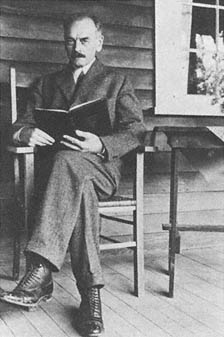
Henry B. Sharman, 1921
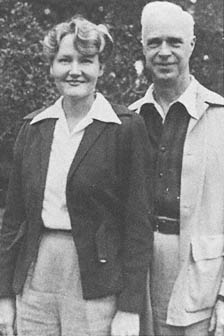
Emilia and Harry Rathbun at
Asilomar, 1948
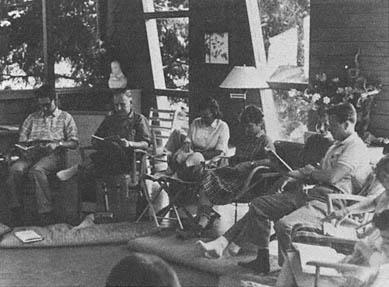
Seminar group, Casa de Luz Lodge, Ben Lomond, 1960
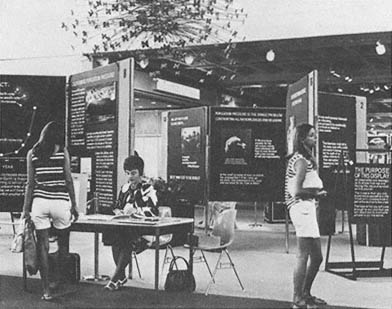
Ecology and Population display, 1969
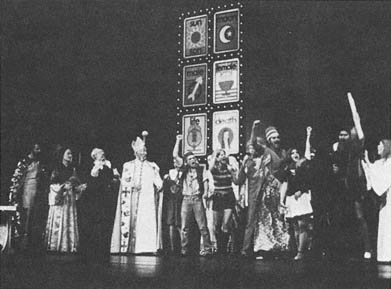
Scene from "Thirteen is a Mystical Number," 1972
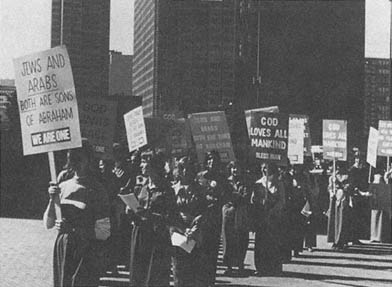
March during Arab-Israeli War, San Francisco, 1973
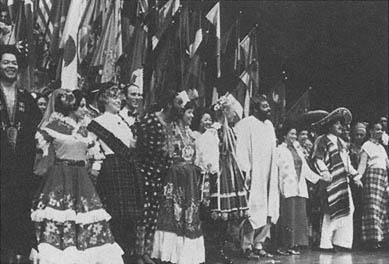
Scene from "Blessman," 1973
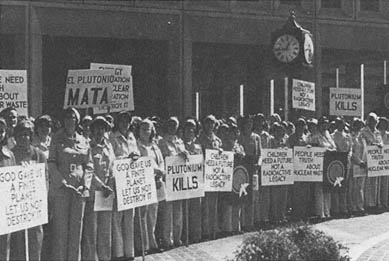
Women's march as part of "Project Survival," Los Angeles, 1975
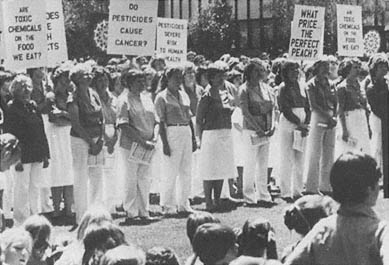
Women's demonstration about pesticides and toxics, San Jose, c. 1976
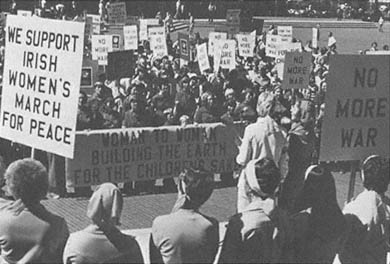
March in support of Irish women's peace movement, 1976
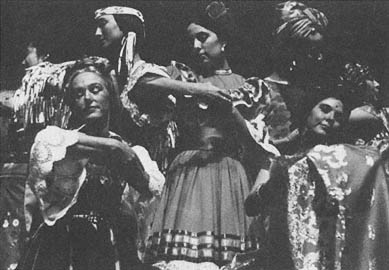
Women representing the races in "Blessman," 1976

"Global 2000" office, Palo Alto, 1980

Project headquarters for "Global 2000," Palo Alto, 1980
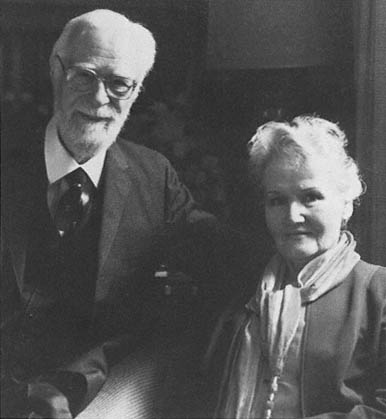
Emilia and Harry Rathbun, c. 1982