
1—
In Snow's visual aesthetics the work of art engages the spectator in a perceptual balancing act, "a balancing of 'illusion' and 'fact,'" as he once put it. Pursuing this line of thought in an interview, Snow explains that Wavelength "attempts to balance out in a way all the so-called realities . . . involved in the issue of making a film." He then compares his own intentions with "the way Cézanne, say, made a balance between the colored goo that he used, which is what you see if you look at it that way, and the forms that you see in their illusory space."[13]
Analogous to Cézanne's "colored goo" is cinema's projected light falling on the flat surface of the screen. From that fact comes the illusion of solid forms in three-dimensional space. Snow's goal is to bring the spectator to the fullest possible recognition of both qualities of the cinematic image: its referential nature as representation of the visual world and its essential nature as, in Snow's words, "projected moving light image."[14] From that recognition on the part of the spectator comes the "dual state," or balance, of "ecstasy and analysis" Snow desires. Nowhere is it more fully realized than in the "demonstration or lesson in perception" provided by Wavelength .[15]
Although Regina Cornwell is right in saying that Wavelength "hinges on the zoom as does all discussion of it," one must not forget the rich visual texture of the film as a whole.[16] Extreme changes in exposure, flares and flash frames, negative footage, flicker effects, superimpositions, ephemeral spots and gleams of light (reflected off gels held in front of the lens), and innumerable shifts in the color and density of the image recur throughout the film like playful improvisations within the stern and unvarying structure, or shape, imposed by the zoom.
Such effects (which one would be inclined to call painterly were they not more characteristic of Snow's photographic works than his actual paintings) are both perceptual and conceptual. With their many brief and unexpected changes in light, color, and texture, they engage the viewer's perception in the moment-by-moment experience of the film (the "perceptual Now" that Michelson ascribes to Brakhage's films but ignores in Snow's). At the same time, they act as "intimations of other ways of seeing," as Snow has put it.[17] They subvert the conventional "illusory space" of the cinematic image by calling attention to the filmmaker's equivalent of the painter's "colored goo." They encourage the viewer to look at the image as well as into it, and they complement the countless small but clearly visible shifts in focal length through which the zoom calls attention to itself and, simultaneously, draws the viewer deeper and deeper into its own unique realm of perception.
That perception is unique because it is only possible through the mechanical eye of the zoom lens. Like any zoom-in, Wavelength's zoom does three different things at the same time. It narrows the camera's angle of vision; it "flattens" the "illusory space" perceived on the screen; and it keeps whatever is in the center of the frame when the zoom begins, exactly in the center for the full duration of the zoom.[18] The third of these characteristics is the least noted in discussions of the zoom, yet it is basic to both the perceptual and conceptual experience evoked by the film.
Snow framed his shot so that the center of the projected image on the screen is occupied by the photograph of waves pinned on the far wall of the room. Throughout the zoom, the photograph holds its central position, and as it expands toward the borders of the projected image, everything around it gradually disappears. By minute increments, the camera's angle of vision narrows until finally the photograph fills all the available space on the screen. In this way the mechanical and optical functions of the zoom lens determine the formal structure and perceptual limits of Wavelength .
It is instructive to compare Wavelength with Albie Thoms's Bolero (1967), a film made in the same year as Wavelength and shown in the same Knokke-le-Zoute festival at which Wavelength won the Grand Prize. Bolero is a single-take, fifteen-minute tracking shot made in a nondescript back street. To the accompaniment of Ravel's music, the camera creeps past buildings, yards, parked cars, garbage cans, and so on until it arrives at an extreme close-up of the eyes of a young women who is sitting at the end of the street. Thoms was specifically interested in "observing the effect of movement on perception."[19] It is true that the visual effect of his tracking camera approximates what one might actually see
while walking through the narrow street and directly up to the seated woman. The principal difference between Thoms's tracking shot and Snow's zoom shot is that the former has equivalents in ordinary perceptions of the visual world; the latter does not.[20]
In Wavelength the mechanical eye of the zoom lens creates a perceptual experience that cannot be duplicated by the human eye. By imposing its narrowing angle of vision on the space of the room, the zoom makes the wall seem to approach the viewer, rather than the viewer approach the wall. The wall seems to come forward exactly as the buildings across the street seem to advance until they look like flat images pressed against the windows of the room. This is the inevitable result of the zoom's flattening effect. At the same time, whatever remains visible on the screen seems to be growing bigger. What becomes biggest and flattest of all is the photograph of waves.
Presumably this is why Snow has said, "From the beginning the end is a factor. In the context of the film the end is not 'arbitrary'; it is fated."[21] It is "fated" because the end—that is, the photograph—is visibly present in the beginning as a gray spot precisely in the center of the projected image, and there is no choice but for it to become increasingly apparent as the photograph increases in size. When the photograph is the only thing left on the screen, the beginning can be said to have become the end. What was present, in miniature, at the beginning is still there, grown large, at the end.
As Wavelength permits us to perceive the interpenetration of beginning and end, so it also makes visible the interpenetration of time and space: the viewing time of the film expressed as a center-to-peripheries expansion in space. With the passage of time, every minuscule change in the lens's focal length marks another expansion of the center toward the borders of the frame. As the film's time gets longer, its space gets flatter and its central image larger. The paradox of a center expanding to its own peripheries and a beginning containing its own ending is potentially present in every zoom shot, but the zoom in Wavelength make that paradox visible and invests it with metaphysical significance.
When the borders of the photograph disappear beyond the borders of the projected image, the perfectly flat, rather dense, and uninteresting photograph suddenly reveals what manufacturers of lenses like to call "infinity." Up to this crucial point, however, the film seems to be leading toward the opposite perception. The deep space of the room has become steadily shallower, until the flatness of the photograph and the flatness of the screen seem to be one and the same. Then the flatness evaporates, and the viewer
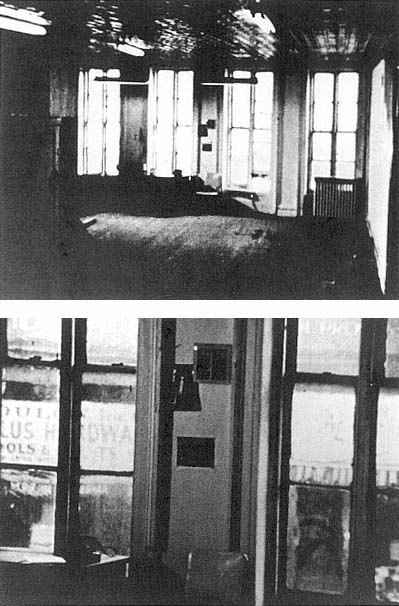
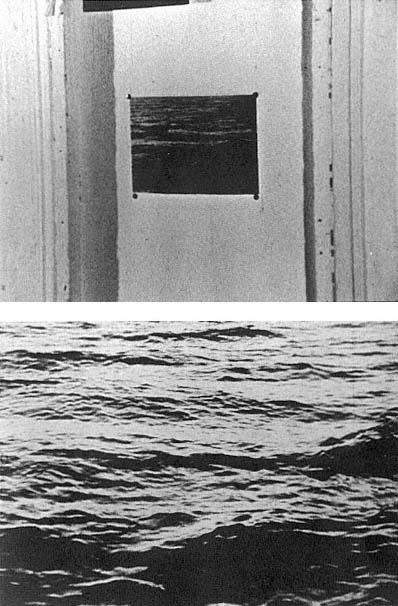
Progressive stages of the zoom in Wavelength bring the
photograph of waves forward until it completely fills the screen.
perceives depth again. But the depth in the photograph is not like the depth in the room. It cannot be "flattened" by the optics of a zoom lens. This explains why the zoom finally gives up. It briefly shifts back to a slightly wider angle, as if it were gesturing toward its beginning. Then the whole image goes out of focus and fades into white: the clean slate of a new beginning.
Although there is nothing more the zoom lens can show us, the film does not end on a dead center of exhausted perception. Its affirmation of the flatness of the photograph/screen produces a new and qualitatively different sense of depth, one that could not be experienced so long as the wall provided a ground for the photograph and prevented our perceiving the photograph's "infinity ." By the same token, the film affirms yet goes beyond the materiality of the image on the screen and the means of putting it there. From the very thoroughness of its "analysis" arises the experience Snow calls "ecstasy": the flattening effect of the zoom (analysis) leads to the viewer's perception of infinite depth (ecstasy). Where the film ends, the imagination carries on, free of material constraints. Or, as Snow remarks, "And past the end it should have ripples."[22]
As Snow envisions the film's development, there is a perceptual change from the camera/eye to the screen/mind: "The space starts at the camera (spectator's) eye, is in the air, then on the screen, then is within the screen (the mind)."[23] It is in the final minutes of the film, as the photograph of waves and the film screen become congruent, that what was on the screen can be said to appear most completely within it, and therefore within the mind.
A different way of conceptualizing the perceptual journey from space to screen to mind is suggested by Snow's remarks on frames and windows. Snow has said that a projected film or anything "put on a wall with a frame around it" encourages the viewer to feel as if he or she is "looking out a window." Snow then goes on to say, "It's amazing how windows are influential. They seem like metaphors for the eyes in the head; when you're in the house you're looking out the eyes and we are the brains. That was one thing I was thinking about in making Wavelength ."[24]
For much of the film, the viewer shares the brain's point of view from within the room/head and can look out the windows/eyes at the end of the room. At the same time, the viewer is sitting in a darkened room watching the projected image on the screen as if it were a window. When the windows of the room are eliminated by the zoom, the photograph serves as another sort of window, revealing a vista quite different from the one visible through the windows that face onto the street. Because of the flattening
and enlarging effects of the zoom, the photograph-as-window and the screen-as-window become one and the same. If both windows are also eyes, then what they show/see is brought right up to the portals of sight, where a new kind of perception converts flatness into "infinite" depth. That conversion occurs "in the house" where "we are the brains." The mind carries on when the materiality of the film medium and the optics of the zoom lens can go no further. This is the beginning of the "ripples" that extend "past the end."