
On Circular Motion
Step 1 . It is Newton's intent to express the displacement DB and the time t in terms of the diameter DE of the circle and the period T of the uniform motion.
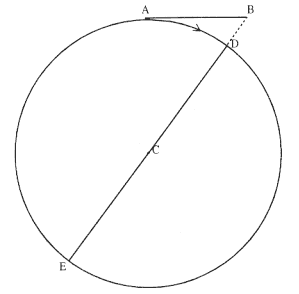
Figure 3.9
A body travels uniformly along the circular path ADE . The
radial displacement DB is the deviation of the circular arc
AD from the tangential line AB .
[1-A] The endeavor of body A, rotating on circle AD toward D, from the center [C] is as great as would carry it away from the circumference to the distance DB in the time AD (which I set to be most minute); inasmuch as it would reach that distance in that time if only it could move freely in tangent AB with no impediment to the endeavor .
See figure 3.9. As noted in chapter 2, two possible readings can be made of this statement. The first identifies the "endeavor from the center" as that which would produce the radial displacement from point D to point B along the extension of the diameter of the circle. In that reading the "impediment to the endeavor" prohibits the outward radial displacement DB and the body travels along the circular arc AD . An alternate reading identifies the "endeavor from the center" as that which produces the linear displacement from point A to point B along the tangent. In that reading the "impediment to the endeavor" prohibits the tangential displacement AB and again the body travels along the circular arc AD . In either case it is the displacement DB that measures the "impediment," be it an outward endeavor or an inward centripetal force. From the full text of this early work, it is clear that Newton intends the first reading (i.e., that expressed by Descartes). In a later version of this solution, produced after 1679, Newton intends the second reading.
[1-B] Now since this endeavor, provided it were acting in a straight line in the manner of gravity, would impel bodies through spaces that would be as the squares of the times ,
In [1-A], the time to travel the arc AD is "set to be most minute." In that limit of vanishingly small time the force is assumed to be constant in both magnitude and direction "in the manner of gravity." As Galileo has demonstrated, the displacement under a constant force is "as the square of the time."
[1-C] In order to find out through how much space in the time of one revolution ADEA they would impel [the bodies], I look for a line [X] that is to BD as is the square of the circumference ADEA to AD2 .
Or, X / BD = T2 / t2 = ADEA2 / AD 2 . The line X is the distance that the body would travel under a constant force in a time T equal to the period of circular motion. Since the period T is proportional to the circumference of the circle ADEA (i.e., equal angles in equal times), then the distance X is proportional to the "square of the circumference ADEA ." From [1-B], we understand that just as the distance X is proportional to the square of the time T2 so the distance BD is proportional to the square of the time t (i.e., the arc AD2 ). Thus, the relationship, as given by Newton, is X / BD = T2 / t 2 = ADEA2 / AD2 .
Step 2 . Newton now calculates the distance X that the body would move in the time T under the influence of the same constant force that produced DB in time t .
[2-A] To be sure there is BE : BA :: BA : BD (by 3 Elem.).
Or, BE / BA = BA / BD . This relationship is demonstrated by reference to Proposition 36 of Book 3 of Euclid's Elements , a particular Euclidian proposition that Newton employs on a number of occasions, often without a specific reference as given here (i.e., "by 3 Elem ."). Figure 3.10 displays the results of Euclid's demonstration: the ratio of the line BE (the diameter plus the deviation) to the line BA (the tangent) equals the ratio of the line BA (the tangent) to the line BD (the deviation). Thus, one has BE : BA :: BA : BD or BE / BA = BA / BD .
[2-B] Or since the difference between BE and DE, as also between BA and DA, is supposed infinitely small, I substitute one for the other in turn and there emerges DE : DA :: DA : DB.
Or, DE / DA = DA / DB . In the limit as the point D approaches A (see fig. 3.11), the extended line BE approaches the diameter DE (i.e., BE®DE ), and the tangent BA approaches the arc DA (i.e., BA ®DA ). From [2-A], BE / BA = BA / BD . Substituting DE for BE and DA for BA , that ratio becomes DE / DA = DA / DB , as required here in [2-B], or in its equivalent form DA2 = (DE ) (DB ), as required next in [2-C].
[2-C] Finally by making DA2 (or DE × DB) : ADEA2 :: DB : ADEA2 / DE,
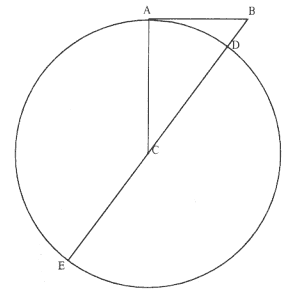
Figure 3.10
Based on Proposition 36 of Book 3 of Euclid's Elements:
BE : BA :: BA : BD or otherwise BE / BA = BA / BD .
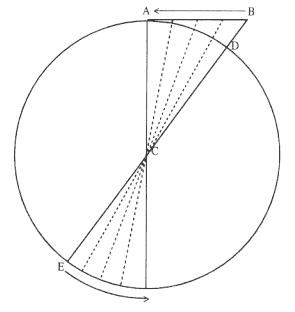
Figure 3.11
As the point D approaches the point A , the line BE
approaches the diameter DE and the tangent BA
approaches the arc DA .
From [2-B], DA2 = (DE ) (DB ). Divide both sides by ADEA2 and obtain DA2 / (ADEA2 ) = (DE ) (DB ) / (ADEA2 ). Divide numerator and denominator of the last term by DE and obtain [DA2 ]/[ADEA2 ] = [DB ]/[(ADEA2 ) / (DE )], as required here in [2-C]. Invert the expressions and obtain [ADEA2 ]/[DA2 ] = [(ADEA2 ) / (DE )]/DB as required in [2-D] next.
[2-D] I obtain the line looked for (namely the third proportional in the ratio of the circumference to the diameter), through which the endeavor of receding from the center would propel a body in the time of one revolution when applied constantly in a straight line .
"The line [X ] looked for" was given in [2-A] by (X ) / (BD ) = ADEA 2 / DA2 . From [2-C], [ADEA2 ]/[DA2 ] = [(ADEA2 ) / (DE )]/DB . Substituting this value of ADEA 2 / DA2 into the expression for (X ) / (BD ), one obtains (X ) / (BD ) = [(ADEA2 ) / (DE )]/[DB ], where DE is the diameter of the circle, and ADEA is the circumference (i.e., ADEA = pDE ). Thus, X = (pDE )2 / DE = p2DE , or X is proportional to DE , the diameter of the circle. Newton uses this result in the corollary that follows to demonstrate that the force, which is proportional to the displacement X , is thus proportional to the diameter of the circle, DE .
Step 3 . Newton now notes that the force is therefore proportional to the diameter and inversely proportional to the square of the period (i.e., F µX /T 2µDE /T2 ) or what is equivalent, F = kv2 / r .
The text then continues with a numerical calculation of the force of gravity at the equator for an object rotating on the surface of the earth and compares that value to the much larger value given for the "virtue of gravity." The difference between the two values explains why objects do not fly off the rotating earth. Following that discussion, Newton's manuscript contains the following corollary, which relates directly to the functional form of the force necessary to maintain uniform circular motion:
Corollary. Hence the endeavors from the centers in diverse circles are as the diameters divided by the squares of the times of revolution
From the parabolic approximation, the force is inversely proportional to the square of the time and directly proportional to the displacement. Recall that X was the linear distance traveled in a time equal to the period of revolution T under a constant inward radial linear force equal in magnitude to the endeavor of receding from the center. Therefore, the magnitude of the force is inversely proportional to the square of the time T and directly proportional to X and, hence, by [2-D] above, to the diameter DE . Thus, as Newton expresses it, the ratios of "endeavors from the centers in diverse circles as" the ratios (DE1 /T12 ) / (DE2 /T22 ).
[Corollary] or as the diameters multiplied by the [squares of the] number of revolutions made in any same time .
The number of revolutions N made in any time is proportional to the frequency and hence inversely proportional to the period T (i.e., T 1 / T2 = N2 /N 1 or X1 / X2 = (DE1N 12 ) / (DE2N 22 ). This proportionality can also be expressed as the square of the tangential speed divided by the diameter (or radius), because the period T is equal to the circumference (and hence p times the diameter D ) divided by the tangential speed v . Thus, D /T2 = D /(D /v )2 = v2 / D or the result obtained independently by the Dutch mathematician Christiaan Huygens for the force required to maintain uniform circular motion.[18]
Newton's later dynamics will continue to employ the parabolic approximation used in this early solution, but he will no longer employ the Cartesian terminology of the outward endeavor nor will he see the displacement as an outward radial element. His shift in perspective is dramatic, but it does not require a change in the parabolic approximation. Newton's demonstration of Kepler's law of equal areas will enable him to extend the technique to noncircular and nonuniform orbits; the number and complexity of the mathematical relationships Newton will use to carry solutions to their conclusion will increase; but the underlying parabolic approximation will remain unchanged.