
Gonds of Adilabad District
While neither Chenchus nor Konda Reddis had ever developed a complex social and political structure of their own and lived basically in small groups which did not represent the constituent elements of a larger whole, the Gonds had attained quite a different level of tribal organization. For centuries they enjoyed the leadership of their own feudal chiefs, some of whom had risen to positions of political power comparable to that wielded by Hindu rajas ruling over minor states of Middle India. The Gond rajas of Chanda and Garha Mandla were not only the hereditary leaders of their Gond subjects, but also held sway over substantial communities of non-tribals who recognized them as their feudal lords. The subjection of these tribal rulers by the Mughal emperors left their position within the tribal social structure largely unaltered, and in The Gonds of Andhra Pradesh I have described the
relations between Mughal emperors and Gond rajas in some detail. In the middle of the eighteenth century, large parts of the Deccan came under Maratha rule, and Chanda was annexed by the Bhonsle kingdom. However, Maratha rule over parts of the present Adilabad District did not last for more than half a century, and in A.D. 1773 the region was ceded to the Nizam of Hyderabad. Even then there was little interference with the feudal system of the Gond rajas, and until the very end of the nineteenth century Gond chiefs remained the effective rulers of those regions where Gonds constituted the dominant population. With the establishment of a district administration modeled on the British system by the Nizam's government, the power of Gond rajas waned, but as late as 1941, when I began my study of the Gonds, and Chanda Raja Akbar Shah was still recognized as the supreme tribal authority, and though resident in British India, he occasionally toured the Gond villages of the Nizam's Dominions and was called upon to adjudicate in disputes which the local tribal heads had failed to settle.
At that time there were in Adilabad thirty-seven chiefly families who maintained in varying degrees the traditions of feudal times and enjoyed the allegiance and respect of the tribesmen within their former estates. Only a few of them bore the title raja, while others were styled mokashi or deshmukh . A reconstruction of the jurisdictions and functions of these tribal chiefs is contained in chapter 5 of my The Gonds of Andhra Pradesh, where I have also shown that in the early 1940s some of them, above all the Utnur raja, still exerted considerable influence, even though their political authority had been replaced by that of the Nizam's district officials.
Rajas and mokashi were then the linchpins of a system of tribal jurisdiction in which the village headmen (patla) played a vital role. Some of them belonged to raja and mokashi families, and all derived their authority partly from their ritual role as village founders or successors of the village founder. In chapter 8 Michael Yorke shows how the authority of these village headmen has declined because under the present system of land allocation they no longer control the acceptance or rejection of potential settlers in their villages. Yorke's observations in the eastern part of the district are confirmed by my own findings in Utnur Taluk. This region had for long remained a bulwark of traditional Gond culture and tradition, but it has recently been subjected to drastic and sudden changes in the population pattern and the Gonds' economic position.
As late as the 1940s most Gond villages were dominated by headmen who provided real leadership and enjoyed a considerable measure of authority. Land holdings and settlements were then still flexible, for only a minority of Gonds had title deeds (patta) to land
and it was still relatively easy to obtain land for cultivation on temporary tenure. Hence, mobility was considerable. A strong and popular village headman would attract new settlers, and with the growth of the village his prestige and influence would increase. Conversely, the village of an inefficient or unfair headman would shrink, as the villagers could move away and find land elsewhere. At that time it was still possible to establish new villages, and the man taking the initiative in the founding of a village automatically became the headman of the group of families which had joined in the venture.
The strength of the institution of village headman was put to the test when in the middle 1940s the Hyderabad government instituted tribal panchayats , each based on a group of villages. The headmen of these villages were nominated as panchayat members, and they met once a month to settle disputes and discuss current events. The panchayats had been invested with judicial powers, as described in detail in chapter 1. Although there was a right of appeal to a government officer dealing with tribal affairs, this right was hardly ever resorted to, for the parties to a dispute usually had confidence in the fairness of the members of the tribal panchayat . These tribal councils replaced in practice the courts of the rajas and mokashi , but where a member of a chiefly house acted as village headman he could serve on the regional panchayat like any other headman. Thus statutory tribal panchayats functioned in almost exactly the same way as in previous days village and neighbourhood panchayats had functioned.[1]
The repeal of the Hyderabad Tribal Areas Regulation in 1963 terminated the functioning of the tribal panchayats , and with their demise ended an institution which had regularly brought together the headmen of groups of villages. The repeal of the regulation also ended any recognition by government of the settlement of disputes according to the rules of tribal customary law. Since then the traditional system of authority of the Gonds has been rapidly declining. A retired headmaster of one of the teacher training centres, intimately acquainted with Gond practices, remarked that since panchayats of the old type are no longer held tribal solidarity has disappeared: "Nowadays Gonds exploit Gonds—the father will exploit his son, and the son will exploit his father."
Today the erstwhile tribal chiefs have no more power, and even the prestige which some of the members of raja families used to enjoy is gradually evaporating. The role of village headman has also changed, for with the enormous increase in the bureaucracy and the number of government employees visiting villages on various errands, the head-
[1] For a detailed description of their procedure, see chapter 10 of my The Gonds of Andhra Pradesh .
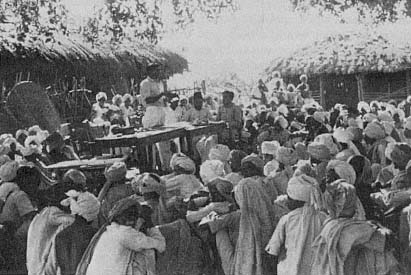
Meeting in the Gond village of Ginnedhari in 1948, when tribal panchayat
exercised jurisdiction in both civil and criminal cases.
man is no longer an essential link between the villagers and the administration. This change in the headman's function seems to have had a deleterious effect on the sense of responsibility of many village heads. No longer are they mainly concerned with the welfare of the entire community, whose growth and contentment guaranteed an access to their own prestige and influence, but they think primarily of their own short-term material advantages. Thus there are many cases of village headmen leasing out some of their own land to non-tribal settlers, even though Gonds living in the village may be short of land or totally landless. The shortsightedness of many of the leading Gonds, who obtain various benefits by secretly or even openly supporting wealthy newcomers, is one of the causes of the alienation of much of the tribal land. The breakup of village cohesion is undoubtedly a direct result of the commercialization of the local economy, which favours individualistic tendencies antagonistic to the traditional esprit de corps of a Gond community.
A good example of such a development is the situation in Netnur, a Gond village in Utnur Taluk. Netnur lies in a part of the central highlands which until thirty years ago was inhabited exclusively by a rather sparse population of Gonds. In 1942 it consisted of twenty Gond homesteads scattered in small groups of three or four houses. At
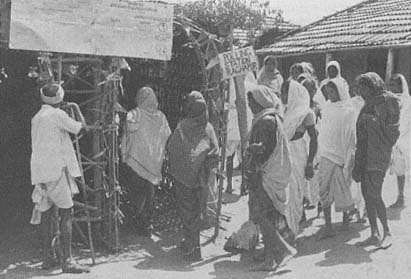
Polling booth in a Gond village of Utnur Taluk during elections
for the Legislative Assembly of Andhra Pradesh.
that time the community was headed by a strong patel who enjoyed the complete confidence of all the villagers. By 1977 Netnur had grown to a compact village of forty-four Gond and Pardhan houses. There were, moreover, two shops run by Muslims and a quarter inhabited by Banjaras. The growth of the village had been made possible by the allotment of previously vacant land to Gonds from other parts of the district during the campaign of resettlement of landless tribals in the 1940s. When I visited the village in 1977, I found not only the total scene transformed but the village deeply divided. Ten villagers, including the police patel , had leased part of their land for periods of one to three years to recently arrived Banjaras, who were paying relatively high rents. At the same time there were eighteen landless Gonds, only six of whom had been able to obtain land for cultivation, either on share or by paying rent to the owners. There was a faction of Gonds who recognized the danger of giving land to Banjaras on lease, suspecting rightly that the Gond owners would never be able to recover their land—a suspicion which was proved fully justified when a year later the Banjaras were notified as a scheduled tribe. The members of this faction proposed that the villagers should club together and repay the Banjaras all the money which they had paid in advances for the leases of Gond land. The village headman, however,
opposed this move, and when the further proposal was made that the panchayat should impose on any Gond giving land to a non-tribal a fine of Rs 50, the headman initially agreed but later sabotaged the plan.
This development contrasts sharply with the action a united village can take to keep unwelcome outsiders at bay. When in Marlavai two non-tribals put up huts to be used as shops and tea stalls, the villagers, on the initiative of Kanaka Hanu, the leading man of the village, dismantled the huts and thereby prevented any non-tribal from settling in the village.
Unfortunately such strong action is nowadays a rare occurrence, and public declarations urging the Gonds to show a united front and prevent the disposal of any land to non-tribals are seldom followed up by deeds. The discrepancy between professed intentions and actual conduct became very clear during a public meeting held at Pithaguda in December 1976 and attended by some 1,200 Gonds, who had gathered to welcome me on my return to Marlavai after an absence of several years. On that occasion several leading men, such as the still highly respected Raja Atram Bhagwant Rao, the ex-president of the Panchayat Samithi Atram Lingu, and Kotnaka Suruji Maharaj, the widely revered protagonist of a religious reform movement, addressed the meeting in lengthy speeches. The following verbatim extracts from these speeches, which I was able to record on tape, reflect the mood of the Gonds at this time, and apart from certain laudatory references to myself, they represent the type of statements Gond leaders are used to make in public.
The most practical speech was that of Atram Lingu, the former Panchayat Samithi president:
Today more than a thousand of us Gonds have assembled in this meeting in order to strengthen our cooperation. Our condition is bad and therefore we should work together from wherever we hail. In past years a number of people came from various taluks, such as Kinwat, and obtained land here. This land will remain ours for ever if we hold on to it. We should not sell land under any circumstances. If we find anyone selling land we should come together, hold a panchayat , and fine him. The very purpose of this meeting is to decide on this. Yet, although I myself and the Gond members of the Legislative Assembly have tried hard to see that patta rights to land are granted to Gonds, thousands of acres are now being cultivated by non-tribals. For this reason we face many difficulties. Agriculture is the only occupation by which we can earn our living, and therefore you should promise in front of Haimendorf Sahib that you will neither sell nor lease any land to non-tribals. Anyone who has sold land has sold his own mother. There is no other land for us—neither in Maharashtra or Madhya Pradesh, nor in any other part of India. Many non-tribal peo-
ple have come from Osmanabad, Nander, and other places with the intention of getting land here. By bribing the patwari they have obtained land for cultivation. We are weak-minded people, but for the sake of our children we should cooperate to avoid being destroyed. Just now Haimendorf Sahib advised you not to permit any non-tribal to keep a shop in a Gond village, yet you don't help your own brothers and community members, but you have helped Marathas and Muslims to establish shops in your villages, and soon they also got some land. By their tricks these outsiders can get land easily, whereas we are not clever enough to match such tricks. I can tell you how in Dhanora and Indraveli non-tribals tricked the Gonds by entertaining them with beer and good food, and when they were drunk made them sign away their land. Thus all the tribals were pushed out by non-tribals who settled in their villages. Thus the Gonds are losing their land due to a lack of foresight. Drink is the main cause of our downfall, which has also led to the downfall of our rajas, mokashi , and other leaders. People who own shops and lorries can afford to drink without ruining themselves, but poor tribals cannot do so. Yet though they may not have sufficient food and eat watery curry, they still drink.
We are Raj Gonds, descended from the original Dravidians of India, but now we are called Girijan, because we are backward.
This plea of Atram Lingu of Sirpur would have been more convincing if at the time of his term of office as sarpanch of Sirpur and subsequently Samithi president numerous non-tribals had not been permitted to settle down and open shops in Sirpur. While in 1942 Sirpur was a pure Gond village of nine houses, it is now a large place with a mixed population, including five Kachi shopkeepers from Gujarat, two Komtis, and ten Muslims from Maharashtra working as tailors and artisans, some of whom have also bought land. Atram Lingu, who was a poor man before he entered politics, now owns the largest stone house in Sirpur, and his critics connect his present wealth with the settlement of so many non-tribal merchants in his village.
Raja Atram Bhagwant Rao, who leads a simple life and has succeeded in keeping his village, Kanchanpalli, free of non-tribals, in his speech also called for more cooperation among Gonds:
In previous days the mokashi, patels , and other leading men were cooperating, but nowadays such cooperation is not to be seen among the tribals—if any Gond is in trouble, no one helps him. When we compare our previous fortunes with our present condition we may say that we have now better clothes, but in order to get fine clothes we fall into the bondage of moneylenders. We did not keep our religion intact, and even at ceremonies for the worship of gods, people drink, and this leads to quarrels. The old honesty and discipline is vanishing. We are trying to educate our children so that they will become intelligent, but when a boy is sent to the bazaar to buy supplies for his
home, he will spend the money on cigarettes and other useless things and will return home without the goods he was told to buy. Such boys should change their ways in order to become helpful to the Gond community, for those who behave in this manner will never be of any use. Years ago Haimendorf Sahib provided schools for Gonds and organized the allocation of land to Gonds, but we have not gone along the path he showed: through lack of cohesion and cooperation we failed to take advantage of all the facilities provided. This gathering has been called to promote cooperation and you should decide to make an effort to stand together.
In a brief address, Suruji Maharaj also emphasized the need for cooperation and hard work, and he warned the assembled Gonds of the danger of drink and extravagant spending on inessential luxuries.
Whenever there is an occasion for public speeches similar sentiments are expressed, but the results of such admonitions seem to be minimal. In a situation of inescapable contacts with numerous outsiders, every Gond tries to look after his own interests, and the old feeling of tribal solidarity goes by the board. A concomitant of this diminishment of cohesion is the now frequent occurrence of rival headmen causing the split of a village community. This happened in Daboli, one of the oldest and most famous Gond villages of Utnur Taluk, whose patel had once held a sanad from the Chanda raja.[2] In the 1940s Mesram Devji of Daboli was one of the most respected village headmen of the hill region, and his son Jangu was also a strong man who kept the village together. Jangu's only son was killed by a tiger, and his kinsmen quarrelled about the succession to the headship. One of them was appointed police patel , but three others set up as leaders of separate groups of households, each performing the ritual functions of the patel at Durari and other ceremonies. Thus the village was practically split into four, very much to the detriment of its ability to ward off the designs of non-tribals on village land.
The imposition of a democratic system designed for the more advanced regions of rural India has had the effect of undermining the old authority structure without replacing it with a practical alternative suitable for Gond society. Whereas previously the village was the basic unit, the smallest element of the system of Panchayat Raj is the gram panchayat ("village council"), and such a gram panchayat must have a predetermined size far exceeding that of an average Gond village. Consequently, several villages, each with its own traditional headman, are grouped together in one new gram panchayat .
The Marlavai gram panchayat , as it was constituted, exemplified this situation. It comprised the villages Marlavai, Ragapur, Pithaguda, Burnur, Sirpur, Dubbaguda, and Suinur; of these, Sirpur contained many
[2] See The Gonds of Andhra Pradesh , p. 125.
non-tribal residents, and in Dubbaguda and Suinur there was a majority of Banjaras. A gram panchayat is divided into a number of blocks, each of which should contain about one hundred households. At the time of panchayat elections the people of each block elect one panchayat member, and according to the original rules, modified in 1978, these members then elect one of their number as sarpanch . In a gram panchayat consisting of a large compact village, such as hardly ever exists in a tribal area, the division into blocks is of little consequence, but in a case such as the Marlavai gram panchayat , the constituting villages extend over a large area, with some of them at distances of as much as six miles from one another. Hence, the elected members seldom meet and have little sense of solidarity, particularly if there are tribals and non-tribals among them. An additional complication is created by the manner in which the blocks of one hundred households are made up. In 1977 the composition of the blocks of the Marlavai gram panchayat was as follows:
Block I: Marlavai, Ragapur
Block II: Pithaguda, Burnur
Block III: Half of Sirpur, one third of Dubbaguda
Block IV: Half of Sirpur, one third of Dubbaguda
Block V: One third of Dubbaguda, one third of Suinur
Block VI: Two thirds of Suinur
The splitting up of villages and the formation of blocks from parts of different villages not even particularly close to each other looks like an almost deliberate attempt to undermine village cohesion, but is probably due to bureaucratic convenience, some clerks in the tahsil office putting together neat units of one hundred houses each without any regard to the divisive social effects.
Although this gram panchayat is registered as Marlavai gram panchayat and a small building was built in Marlavai with panchayat funds, the sarpanch and the paid secretary (karbari ) resided in Burnur, where the records of the panchayat were also kept.
The income of a gram panchayat is derived from a house tax, which is the major item, licenses for shops and tea stalls, fines for cattle trespass, fines for giving short weight, and some minor fees. The Marlavai gram panchayat collected in 1976 Rs 3,569 as house tax and Rs 917 as fees and fines. The expenditure was Rs 2,105 and related to such items as the improvement of local roads and the construction of cattle compounds for animals apprehended for trespass on cultivated land. Sometimes panchayats are burdened by expenditure which the members had neither desired nor authorized. Thus in 1976 government officials dumped on the Marlavai gram panchayat one hundred mango saplings with the order to plant them along roads and later charged the panchayat Rs 545. As no instructions about the care of the saplings
were issued and no one felt responsible for watering them, all the saplings perished in the first hot weather.
In 1977 there were in Utnur Taluk forty gram panchayats , and in twenty-nine of these the sarpanch was a Gond or Pardhan, while in seven gram panchayat s a Banjara held that position. In those days the Banjaras were not yet notified as a scheduled tribe, and hence they could not compete for seats reserved for tribals. The few Hindu or Muslim sarpanch served in gram panchayat s of areas with a predominantly non-tribal population. Even in gram panchayat s with a tribal sarpanch , non-tribal members often exerted a far greater influence if they happened to be economically powerful.
According to rules introduced for the panchayat elections in 1979, the sarpanch is no longer chosen by the members of the panchayat , but is elected by popular vote. The effects of this innovation are not yet known at the time of writing, for local elections have been repeatedly postponed, and are not likely to be held before April or May 1981.
Unlike the old tribal panchayat s consisting of the headmen of an organic group of villages, the gram panchayat s have no judicial function, and it seems that disputes are never referred to the sarpanch and the panchayat members for adjudication. As not only Gonds but also non-tribals may be elected by the people of a block, the panchayat cannot serve as a body deciding cases on the basis of traditional tribal custom. Under these circumstances it is not surprising that the gram panchayat s do not fulfil the function of organizing the Gonds for concerted action and that they play no role in supporting tribals in their struggle against the incursions of non-tribal settlers.
The Gonds are very conscious of their lack of effective leadership. They have seen their traditional leaders, rajas, mokashi , and deshmuk stripped of all privileges and authority, and the headmen deprived even of the power to influence the acceptance of new settlers in their villages. While the gram panchayat s and their chairmen, the sarpanch , have no constitutional power to intervene in any of the conflicts which affect the interests of individuals or communities, the elected president of the Panchayat Samithi could undoubtedly exercise considerable influence if he knew how to utilize his authority to the best effect. In theory, if not in practice, the officials, such as the block development officer, have to carry out the decisions of the president. However, without experience and a high degree of literacy it is impossible to direct a bureaucratic machine in any effective way, and so far there has been no tribal Samithi president who could exert his authority to benefit his tribal constituents. When panchayati raj was first introduced in such areas as Utnur Taluk, the Gonds still formed the majority of the population, and it was only natural that Gonds had a good chance of being elected to the post of Samithi president. The first tribal in-
cumbent was Atram Deo Shah, eldest son of Jagpat Rao, the last Utnur raja who still played a role as tribal chief and who was certainly the most respected Gond in Adilabad District in the 1940s. When faced with the possibility of electing a man to preside over the newly created Panchayat Samithi, the Gonds turned to one of the traditional aristocratic families and elected Raja Deo Shah to the prestigious post of Samithi president. Subsequently, Raja Deo Shah contested one of the two reserved tribal seats in the Legislative Assembly of Andhra Pradesh and was duly elected, defeating another Gond candidate. But in the elections of 1978, when Banjaras could contest seats reserved for tribals, he was narrowly defeated by a Banjara politician who had infinitely greater financial resources and the support of many non-tribals. His defeat in a constituency in which Gonds, Pardhans, and Kolams still had a slight majority over other ethnic groups was undoubtedly also due to his ineffectiveness as a tribal spokesman while he held a seat in the assembly. Being educated only in Urdu, he could not make an impact in a body most of whose business was conducted in English. In Hyderabad he had to adjust to a life-style very different from that of his Gond kinsmen, and his many social and political contacts with non-tribal Congress politicians detached him more and more from the ordinary tribal villagers of Adilabad District. Over-confident in his position as a member of the most prominent chiefly family, he neglected nursing his constituency and gradually lost the confidence of the Gonds, whom he had given scant support in their struggle against the flood of immigrant non-tribal settlers.
Another Gond politician who gained a seat in the Legislative Assembly was Kotnaka Bhim Rao, a member of the prominent and once affluent family of the Bambara mokashi . He was one of the few Gonds holding university degrees, spoke fluent English, and at one time rose to the position of minister of tribal welfare. Owing to the early dissolution of the ministry in which he served, he lost this position and subsequently failed to do much for his constituents. In 1978 he lost his seat because his constituency was transformed to one reserved for Harijans, and in the constituency for which he stood he had no local base. Thus from 1978 onwards the true tribals of Adilabad—in contrast to the Banjaras—have no longer been represented in the Legislative Assembly of Andhra Pradesh.
In chapter 9, Michael Yorke discusses the emergence of Gond and Pardhan school-teachers as a political force, rivalling the village headmen. This is perhaps more noticeable in the relatively more progressive and politically conscious eastern region of the district than in Utnur Taluk, but it is certainly a phenomenon which may gain in importance as the Gonds' struggle against the incursion of outsiders, particularly of Banjaras, intensifies. The panchayat elections originally
scheduled for April or May 1978 were postponed because of the unstable national situation and the dissolution of parliament. But it is significant that among the candidates for the position of Panchayat Samithi president were two school-teachers, one Gond and one Pardhan, while previously no teacher ever stood for political offices. The fact that among seven candidates four were Gonds, one was a Pardhan, and two were Banjaras demonstrates the disunity among Gonds. If they could agree on one candidate they might succeed in capturing the important position of Samithi president, and as early as April 1979 there occurred the first of several tribal meetings which seemed to indicate a political awakening among the Gonds. Marskola Kasiram, a former member of the Legislative Assembly of Andhra Pradesh, organized a meeting of Gonds, Pardhans, Kolams, and Naikpods from twenty-seven villages to discuss the position of tribals created by recent developments and, in particular, the inclusion of the Banjaras among the scheduled tribes. The meeting was held under a banyan tree which was the traditional scene of the clan rites associated with the Keslapur jatra , and it was attended by about six hundred tribals, including several leading men. Kasiram asked the participants to commit themselves to strengthening tribal solidarity and to the retention of their ancient customs. He said that they should swear in front of their god Nagoba that they would neither sell their land nor give it to non-tribals on lease, and that they would desist from incurring debts. He also admonished them to give up drinking, which was the cause of much indebtedness, resulting in the loss of land.
One month later there was a similar meeting at Marlavai to which Gonds, Pardhans, and Kolams of the hill circle (pahar patti ) were invited. Some 150 people turned up, and most of the headmen attending spoke in favour of Kasiram's proposals. Kanaka Hanu cited Marlavai as an example of how a united village could keep out all non-tribals provided it had determined leadership.
On May 26 there was a similar meeting in Khairdatwa, attended by 380 tribals. There were twenty-seven speakers, among them several prominent headmen, who urged that in the next panchayat elections only one Gond candidate should stand for the position of Samithi president. The fourth of these meetings was held on June 7 in Ramjiguda, Asifabad Taluk. Kasiram was not present, but all the Gond teachers of Ginnedhari and several members of the family of the Bambara mokashi attended.
As late as November 1980, when I last visited Marlavai, there was still no agreement on a joint Gond candidate to receive general support at the next election, and it would seem that the repeated postponements of the panchayat elections had deprived the movement towards unity of its impetus.
In the general parliamentary election of January 1980 the Gonds had not presented a united front, and while some had supported the candidate of Indira Gandhi's Congress Party, others had canvassed for the Janata candidate. The former had won the seat with a large majority, but as neither of the candidates had been a tribal the election had not aroused strong feelings. The Gonds had known, moreover, that as a small minority within the general electorate they were unlikely to influence the result. In an election for the state Legislative Assembly with reserved tribal seats, the unity of the Gonds would be of greater importance, and in panchayat elections it is even more vital.
A different political situation prevails in the region of Maharashtra adjoining the eastern part of Adilabad District. There the zamindar of Aheri, a relation of the Gond raja of Chanda, has retained much of his old prestige and influence. Though even in British days not recognized as a ruling prince, he was in possession of a zamindari as large as the states of some rulers, such as the Gond raja of Sarangarh. Like other nobles he lost his zamindari in 1947, but he still has considerable private wealth and political pull. Locally referred to as Maharaja Vishveshwar Rao, he represented the area for several years as member of parliament, even though his constituency was not one reserved for scheduled tribes. He usually stood as an Independent because he believed that he could represent tribal interests more vigourously if he was not hampered by party loyalties. He was defeated, however, in the elections of 1980, when Indira Gandhi's Congress Party attained a landslide victory. Maharaja Vishveshwar Rao's residence in Aheri is a large house furnished at least partly in western style, and far grander than any Gond house I have ever seen in Adilabad District. He has his own party; the symbol of his followers is a black cap of the same style as the white caps of Congress workers, and he and his supporters wear black waistcoats. Though the position of Gonds in Aheri is vastly better than that of their fellow tribesmen in Andhra Pradesh, the Maharaja is not very optimistic about their future prospects. He deplores the infiltration of many non-tribals into Gond country, because he sees them exploiting local tribals and monopolizing business. According to Vishveshwar Rao, it is difficult to organize a united tribal lobby in the Indian parliament because the tribal members come from many different parts of the country and belong to a variety of parties, which have little common ground. Yet touring the tribal villages of what used to be the Aheri zamindari one feels that here the Gonds are more self-confident and less dispirited and harassed than in Andhra Pradesh. Some village headmen have large, well-built houses and huge stores of paddy kept in great bins plastered with mud. It is said that in years of scarcity they use these stores to feed the poorer villagers, who otherwise would have to take loans from merchants or moneylenders.
The spirit of solidarity and mutual help which has declined so drastically in Adilabad is here still fully alive. It is hardly surprising that non-tribal representatives of business interests criticise the Maharaja as old fashioned and as standing in the way of progress.
After this digression into the neighbouring state, we may return to our analysis of social developments among the tribals of Adilabad District. We have seen that in public speeches prominent Gonds deplore the lack of cooperation and solidarity among the people of the present generation. Whatever the reason for this failing, it cannot be denied that Gonds have become self-centred and are not easily aroused to any concerted action in defense of their interests. One of the causes for this change in character is said to be a decrease in the number of large joint families, in which several adults cooperate in cultivating their land under the direction of an older, experienced man. No doubt the atmosphere in such a joint family was conducive to the development of the habit of cooperation and discipline in the interest of the common good. Today young married couples tend to set up their own households as soon as possible, and the children of such nuclear families grow up in an atmosphere very different from that of a large joint family.
It would seem that the early breakup of joint families has also resulted in an increase in inheritance disputes between close kinsmen. A factor contributing to the greater frequency of such disputes is undoubtedly the general shortage of land created by the population increase and the large-scale occupation of Gond land by non-tribals. The fall in the death rate has been dramatic, and there are now many families in which four or more sons all live to adulthood, marry, and have sons of their own. An extreme case is a family in Kanchanpalli in which nine brothers have a share in a modest property and have founded separate families. A scrutiny of old genealogies shows that two generations ago it was quite common that of five brothers two would be killed by tigers and one die in an epidemic before reaching maturity. Today tigers no longer keep the population down, and epidemics have also become rare. Although individual medical attention is not always easily available, preventive medicine is fairly advanced, and the incidence of epidemic diseases is much reduced. With more people surviving it is not surprising that quarrels over the division of property are more likely to occur than previously. One of the reasons for the frequency of such disputes is the absence of clear traditional rules regarding the right of daughters to a share of the paternal property. In the old days, when land was plentiful and mobility great, there was no need to prescribe who should inherit a man's land. There was then no permanent right in land, and Gonds could move freely to any locality where there was vacant land for the taking.
Hence it was the movable property, such as cattle, household goods, ornaments, and other valuables, which was handed on from generation of land. Daughters received substantial gifts from their parents when they married, and sometimes even after marriage, and many myths and legends refer to the generosity of parents towards their daughters. The land actually occupied by a man was usually taken over by his sons, who had shared in its cultivation in their father's life-time, but there was no need to give any shares to married daughters, because their husbands had no difficulty in finding sufficient vacant land if they did not want to continue cultivating land cleared by their own fathers.
Today the situation has totally changed, for land is a Gond's most precious possession; hence, many a father is tempted to leave some to a daughter, particularly a daughter whose husband had moved into his house as a lamsare , i.e. a resident son-in-law. In such cases there may be a dispute between the daughter and her father's kinsmen, who claim that immovable property should be inherited only in the male line. A village panchayat called upon to adjudicate between the claimants finds no clear guidance in traditional customary law, because until two generations ago land was not considered a vital part of a man's estate.
In marriage customs and the whole sphere of relations between men and women, only minor changes have occurred in recent years. Gond women have always been very independent, and it seems that, if anything, they have become more self-reliant. The present market economy enables women to earn small amounts of cash by selling vegetables or even cotton in a weekly market or to non-tribal pedlars who wander from house to house. I have heard it said that "nowadays marriage partners often select each other," while previously more marriages were arranged by the parents, but I have no statistical data to indicate the extent of such a change in customs of courtship. There is, however, a fairly general view that, whereas in the old days marriage by capture (pisi watana ) usually occurred without previous agreement between all the parties concerned, nowadays the capture of the bride is frequently staged as a mere formality in order to avoid the expense of the full wedding ceremonies necessary in a marriage by negotiation. As the economic position of the Gonds declines, expensive weddings become more and more a burden, particularly if the bride arrives with a large party from another village. If both bride and bridegroom are from the same village, costs can be cut, but if a bridal party comes from a village lying at some distance, large numbers of people must be fed for three days, and the total cost of the wedding borne by the groom's parents may amount to Rs 4,000 to 5,000. This
includes the cost of several bags of millet and of a fair quantity of rice, Rs 400–500 for goats to provide meat, Rs 500 for cloth, and perhaps Rs 1,000 for jewelry.
There is now a movement to cut such costs, and the speakers at the Pithaguda meeting pleaded for a simplification of weddings. But there is still much resistance from traditionalists. Thus, in Netnur, the village split by factional dissension, the party opposing the headman proposed to reduce the expenditure on marriages, but the patel opposed this move, and when a pat marriage was celebrated without the sacrifice of a goat, the patel and his kinsmen stayed away in protest.
On the whole, tribal endogamy is being preserved. Marriages between Gonds and Kolams are tolerated, though not approved, but such inter-tribal unions have always occurred, even if only very rarely. But a union between a Gond and a girl considered untouchable is clearly an innovation. Such an event occurred some years ago when an educated Gond of Keslapur, who at the time was a member of the Legislative Assembly, entered into a union with an educated Christian girl of Mala caste, hence regarded as a Harijan. When his liaison became known, he was boycotted by the Gonds and excluded from any marriage celebration or other social occasion. Finally it was decided that his Mala wife could be purified by the performance of a nau handi ("nine pots") rite, and a member of the Mesram patel family of Daboli, traditionally entitled to perform purifications by permission of the Chanda raja, agreed to minister at the rite. Seven model huts of small branches were built, and the Mala girl had to crawl through the middle one. All these huts were burnt. Then a golden ring was heated and the girl's tongue was burnt with it. Finally seven pits were dug near a stream bed, and the Mala woman had to wash in the water collecting in these pits. The husband had also to bathe, and finally both he and his wife were declared purified. In 1977 they had two children, but it was not known whether it would be possible to find Gonds prepared to marry the off-spring of such a mixed union. The couple now leads a normal life among Gonds, but it is believed that the husband's romance with a Mala woman did cost him the votes he would have needed for his re-election. Yet the very fact of his social re-acceptance is proof of a considerable change in the attitude towards unorthodox conduct. Thirty years ago a Gond openly consorting even with a Pardhan woman would have been excommunicated without mercy.
Gond social life has always been closely connected with religious ideas, and in the next chapter we shall see that unmistakable changes in these ideas have inevitable repercussions on the nature of social relations.