
Erwartung, op. 2, no. 1
The more flexible vocal style and the more motivically coherent accompanimental foundation toward which Schoenberg is apparently striving in the May 1899 version of Warnung are fully achieved in Erwartung. With its mastery of largescale ternary form, the control and coordination of melodic and harmonic processes, and the balanced relationship between voice and piano, Erwartung is the gem among the Dehmellieder of 1899. Schoenberg himself must have felt thus, when several years later he placed it at the head of his op. 2. With Erwartung, Schoenberg turned from frenetic texts to a more understated poem:
Aus dem meergrünen Teiche
neben der roten Villa
unter der toten Eiche
scheint der Mond.
Wo ihr dunkles Abbild
durch das Wasser greift,
steht ein Mann und streift
einen Ring von seiner Hand.
Drei Opale blinken;
durch die bleichen Steine
schwimmen rot und grüne
Funken und versinken.
Und er küßt sie, und
seine Augen leuchten
wie der meergrüne Grund:
ein Fenster thut sich auf.
Aus der roten Villa
neben der toten Eiche
winkt ihm eine bleiche
Frauenhand.
Out of the sea green pond, near the red villa, under the dead oak, shines the
moon.
Where her dark image reaches through the water, a man stands and draws a
ring from his hand.
Three opals glimmer; red and green sparks swim through the pale stones
and sink away.
And he kisses them, and his eyes glow like the sea green depths: a window
opens.
Out of the red villa, near the dead oak, the pale hand of a woman beckons
to him.
Dehmel's "Erwartung" is about sexual anticipation, not about unbridled fulfillment. The speaker is an impersonal narrator, not an impatient or threatening lover; emotions are controlled, as he or she describes, not the love encounter itself, but the expectation of it. "Erwartung" is also one of the most visually evocative poems in Weib und Welt, constituting a perfect example of the technique at which Dehmel hints in a diary entry of 1894: "Nowadays we aim to make poetic technique more sensuous by incorporating painterly and musical effects, just as painting and music attempt to learn new means of expression from the sister arts" (Dehmel 1926, 21). Dehmel claims that there are limitations to this kind of technical interchange but suggests, for example, that the poet might "associate a color word with a particularly strong upwelling of a certain emotional state" or might intensify his verse "through the use of sound symbols."
In "Erwartung," color words become more than simply adjectives describing the setting: Dehmel achieves "painterly effects" by treating them in a fashion that is almost abstract, stylized. Each line of the first stanza either states or implies a different color. The pond is "sea green," the villa "red," the oak "dead"—hence black or dark brown—and the moonlight pale white. These colors are then repeated and transformed. In stanza 3 the opals are "pale," the sparks "red and green." In stanza 4 the Grund, apparently referring to the immobile bottom of both the pond and the stones, is again "sea green." The final stanza acts as a return or (in musical terms) a recapitulation. "Red" and "dead" reappear, and the "pale," with its color value of white, is now transferred to the woman's hand.
By introducing the paired juxtapositions in stanza 1, red-green and black-white, Dehmel may consciously have sought to exploit color complementarity.[16] Indeed, he seems to endow the colors with strong psychological associations much like those Wassily Kandinsky was to outline in Concerning the Spiritual in Art of 1911. Kandinsky calls the elements of each such pair "antithetical." Green is passive, "the most restful colour that exists"; its opposite, red, is warm and intense. Black represents a "totally dead silence," white "a silence . . . pregnant with possibilities" (Kandinsky 1977, 36–41).
In Dehmel's poem, the shining moon, the blinking stones, and the waving hand of the woman—the physical images most closely linked to the lovers' anticipation—are pale or white, and thus appropriately "pregnant with possibilities." The villa, presumably the actual scene of the lovemaking to come, is red. The images implying less motion, the dead oak and the tranquil pond, are black and green.[17] "Erwartung," then, is truly a study in poetic color, a fine example of what one Dehmel scholar has called a Farbenspiel (Fritz 1969, 71). The coloristic and painterly qualities of "Erwartung" also suggest an affinity with one of the leading contemporary movements in the visual arts, Jugendstil.[18]
The poem has a symmetrical structure that might also be considered painterly. The two outer stanzas, which are similar in content, frame the poem even more strongly than the beginning and closing couplets in Mannesbangen. There is an elegant inner symmetry as well. The two principal unidirectional actions of the poem, the man pulling the ring from his hand, and the window going up, are presented in the second and fourth stanzas. At the still center of the poem are the most circular or static actions: the opals glimmer, the sparks swim (although they also sink).
Schoenberg was, to the best of my knowledge, the only major composer of the time to set "Erwartung" to music.[19] His musical imagination was clearly kindled by the possibilities of realizing the "painterly" aspects of the poem, especially the Farbenspiel. At the very opening (ex. 4.4a), the words "meergrünen" and "roten" are accompanied by a distinctive five-note harmony built from the tonic note

[16] Red and green are considered psychologically complementary colors, as are black and white. See the useful discussion in Osborne 1970, 258.
[17] Even if the oak is taken to be brown instead of black, similar associations prevail: Kandinsky calls brown "unemotional, disinclined for movement" (1977, 40).
[18] On Dehmel's personal contacts and/or collaborations with Jugendstil artists, see Fritz 1969, 39–43. The best general treatments of Jugendstil in the visual arts can be found in Schmutzler 1962, in Hamann and Hermand 1973, and in the essays collected in Hermand 1971. For further discussion of the affinities or connections between Schoenberg's music and Jugendstil, see Frisch 1990b.
[19] I have found no evidence to support Ernst Hilmar's claim that Zemlinsky also set the poem (Hilmar 1976, 57–58). Zemlinsky published no setting, and no such manuscript exists in his Nachlaß at the Library of Congress. Challier's song catalog does, however, report that a setting of Dehmel's "Erwartung" by a W. Jordan appeared sometime between July 1904 and July 1906 (Challier 1906, 1951), thus shortly after Schoenberg's.
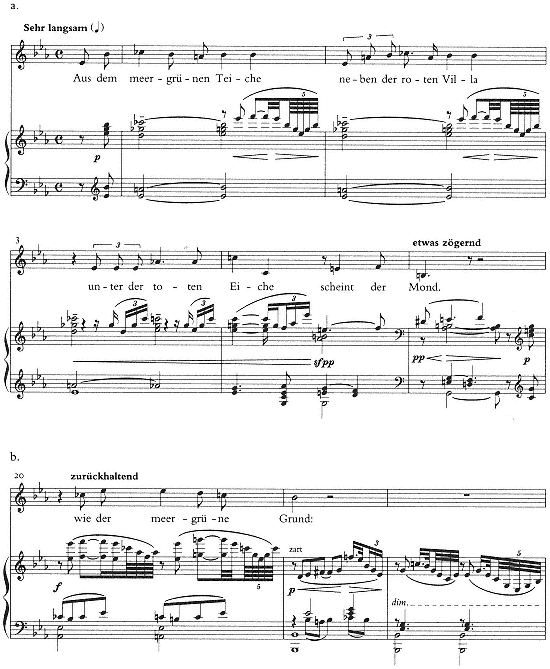
Example 4.4
Erwartung , op. 2, no. 1.
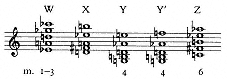
Example 4.5
Erwartung , transformations of color chord.
and four neighbor notes. Schoenberg proceeds to make this "coloristic" chord structural, much as Dehmel does with the color words in the poem. In a manner reminiscent of, but more sophisticated than, Mädchenfrühling of two years earlier, this single Klang, or harmonic configuration, comes to dominate the song.
Edward T. Cone has shown how the color chord is successively transformed in the song.[20] In ex. 4.5 I elaborate on aspects of his sensitive but brief analysis. W represents the chord as it appears in mm. 1–3. Respelling and inverting the chord, placing D in the bass, give X, a dominant thirteenth sonority with the seventh omitted and the ninth flatted.[21] It is in this form transposed down a fifth, Y, that the chord appears on the third and fourth beats of m. 4, at "scheint der Mond." In context, the


At the opening of the second stanza, the entire initial progression is repeated, transposed down a minor third, in the key of C major. This level of transposition assures maximum intersection between the pitches of the original (W) and transposed color chord (Z). A comparison of the chords W and Z in my example will reveal three pitches in the common (

In that it resolves to the tonic twice in mm. 1–2, the color chord in its initial, neighbor-note form (W) may be considered a kind of enhanced or substitute dominant. And, as I have just argued (following Cone), it is transformed into just such a chord at m. 4 (Y and Y') and in the middle section of the song. But
[20] See Cone 1974, 28–29. Other published analyses of Erwartung include Just 1980; Brinkmann 1984, 27–28; and Friedheim 1963, 98–103.
[21] Friedheim (1963, 98) suggests that the five-note chord should be interpreted not as an appoggiatura chord, but as an "altered supertonic ninth without the root." I find this analysis misrepresents the way the chord is actually presented and transformed. At first the chord clearly functions as an appoggiatura to the tonic triad; only later is it reinterpreted as a kind of ninth chord (though not on the second degree and not with an absent root).
Y is the dominant of C major, not of
With "Erwartung," Schoenberg finally settled on a Dehmel poem perfectly suited to a rounded musical structure, to which some of the earlier settings could be fitted only with difficulty. The broad five-part form might be analyzed as:
|
After the delicate, flickering stasis of mm. 1–2, the harmony begins to move toward the dominant via the subdominant sonorities of mm. 3–4 (the voice at "unter der toten Eiche" outlines a sudominant triad). But on the last two beats of m. 4 (at the sfpp), Schoenberg abruptly substitutes a dominant on G (chords Y and Y'), and the vocal part cadences on

This G dominant continues to replace


The moment is indeed "magical," as Cone has said, though I would not agree that the chord "is accorded the status of a true dominant" (Cone 1974, 29). There can, I think, be only one "true" dominant; and Schoenberg's compositional strategy, as I have been describing it, is precisely to avoid articulating the dominant harmony. He continues to do so throughout the transition and the recapitulation (A"). Only in the piano postlude is the entire dominant chord presented; and, as if to make up for its previous absence, it is repeated again and again. The dominant functions here as the final transformation of the color chord, which now appears in its Y' form, transposed to the dominant.
The elegant harmonic process of Erwartung supports an equally elegant vocal part, one that is metrically much more flexible than in Mannesbangen, where the stresses tended to fall on the downbeat with some regularity, or in the original Warnung, where the freer declamation generated a vocal line that bordered on incoherence. In the A section of Erwartung, (ex. 4.4a), each phrase lies slightly differently in relation to bar line. Phrase 1 begins with an upbeat figure ("Aus
dem"), which is then in varied form ("Neben der") squeezed into the downbeat of phrase 2. This rhythmic-metrical migration continues in phrase 3, where the equivalent "upbeat" ("unter der") now falls on the notated second beat of the measure, while the notated downbeat remains empty. This progressive metrical shift of the prepositions ("Aus," "neben," "unter") serves to bring the musical climax of mm. 1–4, the

The large-scale control evident in the harmonic and melodic aspects of Erwartung —specifically the treatment of the color chord, the withholding of the dominant, and the declamatory and metrical fluidity of the vocal part—is not to be found in Schoenberg's earlier works. He instinctively realized that the rather frantic style of Mannesbangen or the surging, Tristanesque harmonic language of Gethsemane would not be appropriate here. "Erwartung" is a poem not of passionate intensity or of Wagnerian-Schopenhauerian Sehnsucht, but of heightened anticipation.
The magisterial breadth and pacing of Erwartung give it a quality that might be justly called symphonic. Indeed, it is probably no coincidence that the composition of the song in August 1899 was followed shortly by work on what was to become Schoenberg's first instrumental piece truly to deserve that label, Verklärte Nacht. There are even certain similarities between the two poems, "Erwartung" and "Verklärte Nacht." Both have as their subject a nocturnal encounter between a pair of lovers. Both are framed by stanzas in which a narrator describes the scene (in "Verklärte Nacht," however, the characters also speak), a feature that inspired Schoenberg to create in both works a broad recapitulatory closing section. I suspect that the achievement represented on a smaller scale by Erwartung may have encouraged Schoenberg to undertake the ambitious sextet.