
North America's Nepal
By the late 1960s, travel by North American and West European youth to the Third World had become a rite of passage for the countercultural generation. Embracing the "underdeveloped world" became not only a sign of one's repudiation of materialist values but proof of one's humanism as well. And for U.S. and Canadian hippies Mexico, it might be said, became the poor person's Nepal. As Carl Franz remembers, "It was the closest warm, exotic place that you could go to—and the cheapest."[53] Or, as another former traveler from the United States succinctly put it, there was "more fantasy per dollar."[54] These comments match an analysis made by Marroquín in La contracultura como protesta: "There was an urge to travel, like the beatniks. But now, the goal is further away: India is paradise. Hippie communities are formed in the Orient. But it is difficult to go all the way over
there. Mexico turns out to be tempting: close, cheap, exotic, savage, and legendarily hallucinogenic."[55] By 1969, "after the Summer of Love turned sour," Carl Franz recalls "a big migration South."[56] Or, as another writer summed it up: "political dissents or draft dodgers, potheads or college flunkouts, born again hippies or red light runners, rebel artists or just curious wanderers—anyone or everyone on the run [headed] for Mexico at some time or other at the turn of a turbulent decade."[57]
What is important for us to understand, however, is that the promotion by the Mexican state of native "color"—the living presence of indigenous cultures, the exotic adventure offered by visits to pre-Columbian ruins, the appeal of semideveloped tropical beaches—all directly contributed to the perception that premodern society was alive and well just south of the border. This folkloric representation of Mexico—an integral flip side of a cosmopolitan discourse linked to the promotion of the Olympics—was directly taken up by the hippies in their pursuit of native cultures, not to mention the quest for hallucinogenic mushrooms and the promise of cheap marijuana. Such a quest took them not to the Ballet Folklórico but directly in search of "the real thing": The reality of Mexico's largely indigenous countryside and the experience of direct contact with native cultures—about which, ironically, most urbanized Mexicans knew little. Carl Franz was particularly revealing about this relationship. "One of the reasons we used to go to the Museum [of Anthropology]," he told me, "was to get clues about the areas we wanted to visit." The Ballet Folklórico was skipped altogether: I thought it was completely hokey."[58]
The stream of countercultural travelers to Mexico increased in tangent with the steady rise of tourist travel generally throughout the 1960s.[59] By the early 1970s, travel to Mexico had become an established tradition among the North American countercultural population. One important indication of this travel relationship was the tremendous popularity of The People's Guide , in the words of its author, "the first underground, counter-cultural travel guide to a foreign country" (see Figure 11).[60] First published in 1972, by 1979 it was in its fourth edition and seventh printing. Throughout the 1970s it sold between 10,000 and 15,000 copies a year, peaking in the late 1970s with sales of more than 20,000 a year.[61] Through The People's Guide and on their own, countercultural tourists developed a repertory of tourist sites to explore, places "off the beaten track," including favorite mountain villages and isolated beaches.
While many Mexican intellectuals regarded the jipis as a "cheap imitation" of the real thing, for at least some jipis it was the foreigners who fell short of the mark. Mexican youth immersed themselves in the reexperi-
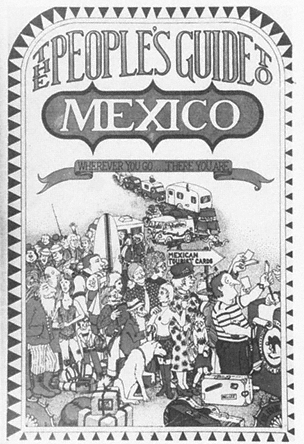
Figure 11.
Cover of The People's Guide to Mexico (1972), a
guidebook for countercultural travelers. Used by permission.
ence of native culture and traditions. Foreign youth, on the other hand, seemed "to come more for the drugs and the sun," as Joaquín López put it; "They weren't really part of our 'rol.' " "Some," he added, "adapted ... and in that sense there was a valorization" of Mexican ways of life. But ultimately understanding Mexican culture was beyond the grasp or even the purpose of most hippies' travel experiences. For Mexicans, that experience was intrinsically different. "You went looking for the countryside," continued López, "and in looking for the country you meet up with campesinos, with Indians. And you're thinking about them, and they're seeing you with long hair. It was great."[62]
Foreigners, on the other hand, mostly used Mexico as a backdrop for their transformative escapes from the metropolis. "The exciting thing for Americans," recalled Carl Franz, "was to go to some Indian village and pretend you were Carlos Castañeda."[63] In fact, the level of actual contact between hippies and jipis often revolved around exchanges of money or food from the former for insider knowledge of local customs and drug connections from the latter. As Steve Rogers recalls, "I remember once thinking, 'oh god, here come those Mexican hippies,' and they'd come and hit you up for food and dope, and they never even had a nickel.... You'd be down camping on the beach, and some Mexican hippies would sometimes come over with a guitar. They were pretty adept at scoring pot, and since the Americans had the money but no connections, the Mexicans would usually find something."[64] But it was the distinctive nature of their respective backgrounds that probably kept Mexican and foreign hippies away from one another. "I felt that usually Mexicans wanted to talk radical politics, whereas Americans were there just to have a good time," Rogers commented.[65] Indeed, this disjuncture between their conflicting worldviews is neatly encapsulated in a comment made by a self-proclaimed "die-hard" U.S. hippie coming to Mexico for the first time: "I love this country," he said. "Everyone lives like hippies down here!"[66] This romanticization of poverty could often reach extremes and, rather than bridge cultural differences, only served to underscore them. As the historian Catherine LeGrande recalls of her experiences as a student in Mexico, "I remember this one blond-haired gringa who went barefoot in Mexico City. Everywhere she went. I remember being angry. at her, not only because it was dangerous but because it was really embarrassing. Once, we went into a market and this vendor cries out, 'Oh look at the poor gringa, she doesn't even have shoes!' It was incredible ethnocentrism on her part."[67] Thus for many foreign travelers, Mexico offered the fantasy of escape from the trappings of bourgeois life, an escape they could literally afford to make and that, by definition, was only transitory.
For U.S. hippies a degree of cynicism toward the Mexican jipiteca also played a role. Carl Franz, for example, remembers Mexican jipis as "a pale imitation of the real thing." He continued: "It's as though they never really got it. Most of them are from the upper class, as opposed to Americans who are from all over. They struck us as more like Weekend Hippies. And a lot of them did it to just to get next to American hippie girls.... You didn't have to scratch a Mexican hippie very deep to find a macho Mexican man [underneath]."[68] For U.S. hippies the ideal was to avoid people, to "dig" the natural landscape, and, when it became unavoidable, to learn
to navigate one's way through local customs and idiosyncrasies. "Your arrival in a remote area will not go unnoticed," cautions The People's Guide: "People—curious, questioning, staring—are everywhere."[69] To its credit, one of the central values of Franz's guidebook is that it strives for what Dean MacCannell refers to in The Tourist as a "utopia of difference": "the possibility of recognizing and attempting to enter into a dialogue, on an equal footing, with forms of intelligence absolutely different from my own."[70] Thus Franz offers a way out of MacCannell's "prison house of signs"[71] sug-gested in the uncomfortable scenario of curious, staring natives:
Once you've accepted the fact that there are going to be people around, you can take advantage of their curiosity to satisfy your own curiosity about them. I've found that there's no better way to get into an area than to select some likely looking person and suggest that I'd like to do something: go fishing, hunting, exploring, collect water or gather firewood. The response is almost automatically enthusiastic and quickly changes the relationship from frustrated curiosity about you to a desire to demonstrate something that they can do, whether it's climb a cocopalm or lead you to an interesting ruin.[72]
This somewhat benign view of intercultural relations, however, is challenged by another reality of abuse and conflict. In an autobiographical short story, the writer Robert Richter captures the development of relationships between locals and foreigners at a seaside hippie haven in Baja California:
Friction in relations developed early and naturally with simple cultural differences and attitudes. The young gringos wanted the isolation and the privacy of their own newly created world. They wanted only to hide out from a far away war and hassles at home—on their own—catching waves, living high, mellow and easy.... So the natives were intrusive and nosey to the gringos. The gringos were rude and crazy to them. Gringos had time and leisure and luxury, and the villagers had poverty and jungle-scrounging labor in a deceptive paradise.[73]
Richter's perception of inequality and unease beneath the allure of harmony is instructive. For even as they often abused and misunderstood their relationship with locals, U.S. hippies still viewed themselves as "the real thing," capable of full communion with Others as they navigated between modern and "pre-modern" worlds. Describing his experiences in Huautla, one hippie thus told a New York Times reporter, "There is a close bond of friendship and spirit of survival between the mushroom eaters and the local people."[74]