
1—
Clans, Territorial Alignment, and Offices
This chapter provides an introduction to settlement and social organization in nineteenth-century Rembau. The mythic and other material presented here indicates that, whereas the reproduction of clans and less-encompassing units of descent presupposed recruitment based ideally on ties of matrifiliation, the alignment of descent units (and territorial domains) was framed instead by principles and idioms of siblingship. Principles of siblingship also informed the system of clan offices and political succession, even though the system of offices simultaneously served to encode a model of "pure matriliny." These data suggest that the interplay of disparate structural principles, especially those of siblingship and descent, provides the key to an understanding of the workings of the precolonial polity and social process.
Settlement and Social Organization:
An Introductory Sketch
In the 1500s, and perhaps even earlier, Minangkabau males engaged in voluntary migration (merantau ) navigated the narrow Straits of Malacca,
sailed up the Linggi and Rembau rivers, and founded settlements in Negeri Sembilan and Malacca, just to the south (Newbold 1839, 2 : 215–223; NSAR 1927, 1; Gullick 1958, 9) (see maps 1 and 2). Some of the first immigrant settlements appear to have sprung up in the lowland valleys of Rembau (Wilkinson [1911] 1971, 291), owing in part to its favorable waterways and hence its accessibility to seafaring and river-born pioneers.
[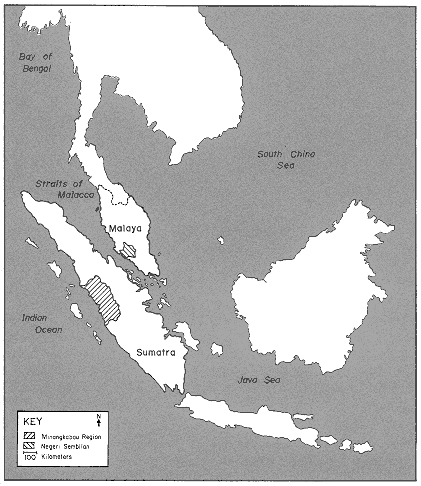
Map 1.
Sumatra and Malaya
[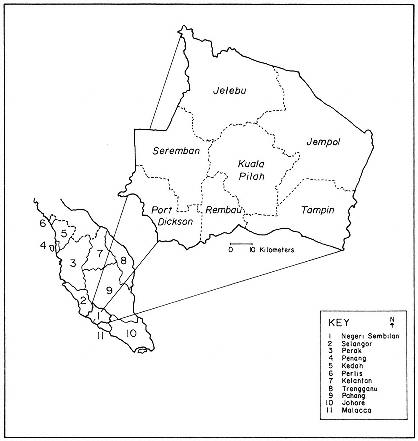
Map 2.
Malaya and Negeri Sembilan, Showing Contemporary State Borders and
the Principal Administrative Districts in Negeri Sembilan
In Rembau and throughout Negeri Sembilan, the Minangkabau settlers encountered aboriginal horticulturalists of Jakun (or related) stock (Newbold 1839, 2 : 76–77), who enjoyed more or less uncontested political rights to the region's territory and resources.[1] Myths told in Bogang about the initial contact between the two groups portray the Jakun women as exceptionally beautiful and of irresistible charm. Indeed, they were so enticing, even from afar, that the Minangkabau quickly sought out the Jakun headmen to discuss the prospects and conditions of arranged marriages
with their daughters. Although the aborigines were extremely reticent at the outset to allow the foreigners even to gaze upon their women, they eventually acquiesced and agreed to sanction a union between one of their daughters—a sylvan "spirit princess," no less—and a Minangkabau leader of considerable renown.
This symbolic betrothal and alliance aside, the precise nature and extent of historical contact between these two groups, whether in the form of intermarriage, trade, or warfare, remains unclear. Various myths and written sources suggest extensive intermarriage between the Jakun and the Minangkabau (Newbold 1839, 1 : 421, 2 : 77, 78, 377, 396; Lister 1887, 38; Parr and Mackray 1910, 3; Lewis 1962, 17), just as village elders of contemporary Bogang cite instances of amicable trade relations with individual Jakun well into the twentieth century (cf. NSAR 1892, 12–13). Undoubtedly, though, many aborigines fled deep into the forest so as to avoid all interaction with the better-armed and expansionist Minangkabau and their descendants (Newbold 1839, 2 : 78, 376–377; Gullick 1958, 7). Whatever the realities may have been, the widely accepted and mythically supported assumption is that many of the aboriginal inhabitants of Rembau and other areas of Negeri Sembilan were soon absorbed into the newly established Minangkabau colonies (Newbold 1839, 1 : 422). In the process, or so myths inform us, they came to be acquainted with wet-rice agriculture and the Sufi-influenced teachings of the Shafi'i branch of Sunni Islam, the knowledge of which the Minangkabau brought with them from Sumatra. More generally, they were introduced to the Minangkabau's social and cultural system, known as adat (adat perpatih ), which was grounded in pre-Islamic (that is, Hindu-Buddhist and pre-Indic) beliefs and practices and codified in a rich corpus of oral tradition consisting largely of customary sayings and sequences of quatrains (perbilangan and pantun , respectively).[2]
In Negeri Sembilan the initial phase of Minangkabau colonization was followed by a period that saw the arrival of successive waves of Indonesians, only some of whom claimed Minangkabau or even Sumatran ancestry (Gullick 1958, 38, 40, 41). The accommodation of these individuals within the framework of Minangkabau institutions thus necessitated certain structural innovations on the part of the immigrants and their descendants (see Newbold 1839, 2 : 217; Gullick 1958, 38–40; and below). Owing to such innovations and to contact with and borrowings from the Jakun, the organization of agricultural communities and political alliances
in Negeri Sembilan has long differed from those of the Minangkabau residing in Sumatra.[3]
By the nineteenth century dispersed matriclans (suku )[4] existed throughout Rembau and all other areas of Negeri Sembilan settled by Minangkabau (Newbold 1839, 2 : 121–123; cf. Gullick 1958, 40). Each of these dispersed units consisted of a variable number of localized clan segments (also known as suku ). In addition, they were divided into residentially aggregated components such as lineages (perut ),[5] lineage branches (pangkal ),[6] and the less-inclusive groupings defined in relation to a married (or formerly wed) woman, her adult daughters, and their household plot(s) (kampung ).[7] Both dispersed and localized clans were named and further differentiated from other units of like order not only by pedigree but also by virtue of their generally exclusive rights to ritual prerogatives, territorial domains, and certain political offices (see Newbold 1839, 2 : 119–123; Parr and Mackray 1910, 25). Individual lineages were also conceptualized as having mutually exclusive (or equivalent) rights to one or more political titles, and they, too, had distinctive names. These features distinguished clans and lineages from smaller genealogical groupings in the form of lineage branches, which embraced only those individuals with whom one could actually specify enatic (that is, matrilineal) linkages, and which probably had horizontal boundaries no broader than the third degree of collaterality (see chapter 2).
Postmarital residence patterns of the nineteenth century were derived from and generally congruent with codes governing the intergenerational transmission of rights over houses and land. To oversimplify, all such rights were vested in women (Lister 1887, 39, 45; Lister 1890, 316; Hale 1898, 48). (These rights were provisional, however, and because a female proprietor's enatic kin retained residual claims to the same property, they could thus exercise liens over it and otherwise help guarantee its conservation within the clan and less inclusive components thereof [Lister 1887, 44–45; Lister 1890, 316; Parr and Mackray 1910, 27, 65].) This favoring of female heirs worked to ensure uxorilocal residence (Lister 1890, 316; Hale 1898, 54), since women's rights to houses, homestead plots, and agricultural acreage flowed from their mothers and centered quite literally on their natal compounds. Men's access to property of this sort usually came through wedlock and the establishment and continued maintenance of a conjugal household in or near their wives' natal compounds, this despite
the fact that a married man retained certain proprietary interests in his sisters' holdings (Parr and Mackray 1910, 70) and might also claim a share of the harvest if he had contributed to its production.
The sexual division of labor was such that women assumed the major responsibility and most of the actual work for the maintenance and productivity of agricultural acreage (Gullick 1951, 47; cf. Hale 1898, 56). Men in bachelorhood, however, frequently worked in the fields held by their mothers and sisters (Parr and Mackray 1910, 70); in exchange, they received compensation in the form of food, clothes, lodging, and the implicit guarantee that the "marriage gold" (mas kawin ) and other capital called for on the occasion of their weddings would be forthcoming when needed (Parr and Mackray 1910, 73, 92, 94). Similarly, married men were expected to aid in the cultivation of—and if possible to add to—their wives' acreage. Men also planted and tended fruit trees,[8] collected and traded jungle produce (with the aim of acquiring commercial items and/or cash), and raised poultry and livestock, the yields of which they shared, depending on their marital status and the source of the capital involved in the investment, with the consanguineally related (but primarily female) members of their natal compounds or with their wives and offspring.
Clan Recruitment and Alignment
Clan membership was a prerequisite for permanent residence among Rembau Malays during the nineteenth century (Newbold 1839, 2 : 123; Parr and Mackray 1910, 5, 26). A widely known saying sums up the issue: "The stranger seeks a place [or clan] as the boat requires anchorage" (dagang bertepatan, perahu bertambatan ) (cf. Hale 1898, 53–54; Parr and Mackray 1910, 99). The notion of anchorage or mooring is especially relevant here, since at the most fundamental level this is what clanship—and kinship more generally—was all about. The same could be said of adat, for just as kin and social relations ordered in accordance with adat presupposed affiliation with a clan, so too did the corpus of symbols and idioms defined in relation to adat provide models for behavior in virtually all domains of existence. This latter theme is expressed succinctly in another customary saying frequently encountered in both the literature (e.g., Parr and Mackray 1910, 146; Caldecott 1918, 24–25) and present-day villages: "The living are moored and guided in all their actions by adat, just as the
dead are surrounded and held in place by the earth of the grave" (hidup di kandung adat, mati di kandung tanah ).
Since we are dealing with clans constructed on a model of matrilineal descent, the principal links implicated in recruitment should have been confined, in theory as well as practice, to those between mothers and their children. Yet in fact, recruitment often proceeded via other kin ties, and occasionally even embraced strangers.
Contemporary elders' delineation of recruitment policies of the precolonial era suggest that residential, defense, and other essentially political considerations could override those based on matrifiliation (even though an all-encompassing matrilineal ideology served in the long run to reorder and contain all such "ground-level noise"). One should bear in mind that the centuries preceding British colonial rule witnessed considerable movement of population throughout Negeri Sembilan, and in other areas of the Malayo-Indonesian world where local groups found themselves affected by the shifting political fortunes of regionally dominant powers, be they Johorese, Buginese, Acehnese, Minangkabau, or European (Newbold 1839, 2 : 32, 36, 117, 165–166; O'Brien 1884, 342; JAR 1892, 1, 9; Wilkinson [1911] 1971, 309; Gullick 1958, 29; Andaya 1971). In the case at hand, then, it was not inconceivable for individuals or entire communities to choose or find themselves forced by feuding or warfare to resettle within another clan's territorial domain. In some such situations, peaceful resettlement hinged on successful negotiations with the leaders of established communities, who might agree to accept the newcomers into a local clan in exchange for pledges of loyalty and support (Parr and Mackray 1910, 5–6). Additionally, it appears to have been necessary for an outsider to find an older woman of the host community willing to stand as his or her adoptive mother, thus maintaining at least the fiction of recruitment via matrifiliation (DeMoubray 1931, 176, 178–179). When a married couple sought to affiliate themselves in this way, one adoptive mother would suffice for the two of them and would likely define only the woman as her adoptee; the man would then be ascribed the status of son-in-law and in-marrying male rather than enate (DeMoubray 1931, 178–179). The basic structure of filiation and descent was thus reproduced inasmuch as the adopted daughter and all children born to her would share the same descent affiliation as the adoptive mother.
Also important is that emigration from the Minangkabau area, as well
as from Aceh, Jambi, and southern Thailand, continued over many centuries, as did overland migration from the neighboring regions of Sungei Ujong, Malacca, and Pahang. Given the military and other advantages of augmenting one's clan through the adoption of new members, together with the absence of unilineal descent reckoning among many of the so-journers, it became necessary, or at least highly advantageous and convenient, to group individuals into Rembau clans on the basis of regional or ethnic origins (Newbold 1839, 2 : 123; Parr and Mackray 1910, 5; Wilkinson [1911] 1971, 315–316; de Josselin de Jong 1951, 138). There is no way of ascertaining dates for the emergence and spread of this classificatory scheme, though village elders in Bogang assert that its appearance coincided with one of the earliest waves of emigration from Sumatra. Be that as it may, persons from the Payah Kumboh region of Minangkabau, for example, whether or not related to one another or in any way associated with the descent group of that name in their homeland, were deemed to be members of Rembau's Payah Kumboh clan. Those claiming other than Minangkabau ancestry were classified in similar fashion; Malaccans, Acehnese, and Buginese, for instance, each tended toward affiliation with particular clans, some of which continue to bear names denoting these settlers' non-Minangkabau origins (such as Anak Melaka, Anak Aceh). It is especially significant in this regard that Hervey's (1884, 259) enumeration of Rembau's principal descent units includes separate entries for the "nationality" of each clan.
The larger issue here is that relationships among clan mates, including persons recognized as having territorially or ethnically diverse origins, were both cloaked in and partially informed by the symbols, idioms, and constraints associated with common matrilineal ancestry (Parr and Mackray 1910, 5–6, 113). This entailed shared responsibilities toward the clan's estate of residential and agricultural acreage, unexploited tracts of forest lands, and, in some cases, political titles, particularly since the bestowal of rights guaranteeing eventual access to these estates typically accompanied most modes of recruitment to the clan. The activation of such shared rights over land served as a critical material referent of matrilineal kinship, and classificatory siblingship more specifically, regardless of whether the bonds in question were biologically grounded or simply imputed on the assumption or fiction of common descent from the same ancestral set of female siblings. Joint claims to an estate vested in a localized clan or lineage
undoubtedly fostered genealogical revision to ensure matrilineal consistency among individuals unable to demonstrate shared descent through the female line. Indeed, even today, if villagers are at a loss to explain the details of kin connections among individuals classed as collateral relatives within the matriline, they frequently invoke shared property rights as evidence, or at least a good indication, of common matrilineal ancestry. This suggests that genealogical connections were not the sole, or even the most important, criteria of relatedness among persons of the same clan.
It remains to consider certain aspects of clan affiliation via formal adoption in order to underscore that the enatic ties so created were conceptualized primarily in terms of siblingship rather than descent. The distinction merits emphasis in light of the more general point that constructs of siblingship seem always to have been hegemonic in defining both relatedness within and links among descent units of various degrees of inclusiveness.
Throughout the nineteenth century, a female of any age could obtain formal affiliation with a clan other than that with which she stood associated by birth.[9] This might occur in the case of a relatively poor individual seeking to attain access to productive acreage vested in a daughterless old woman of another local clan, and would typically involve assuming responsibilities for the adoptive mother's welfare in exchange for rights of proprietorship over her lands and house. (Adoption of this nature bears certain structural similarities to the other instances of formal adoption referred to earlier, but we are dealing here with isolated cases involving individual adopted children rather than entire households or larger groupings seeking acceptance within an established community. All such adoptions are also to be distinguished from informal transfers of children, which at present usually occur among women belonging to the same lineage or lineage branch; see chapter 6.) Reaffiliation presupposed public proceedings in the form of ritual animal slaughter and feasting, symbolizing the severance of the adopted person's links with her original enates on the one hand and the creation of new ties of enation on the other (Parr and Mackray 1910, 27; Taylor [1929] 1970, 139–141; DeMoubray 1931, 182–188). Analogous proceedings could also effect formal reaffiliation at the level of lineage. All such phenomena are designated as kadimkan (or berkadim ), a term denoting the process of becoming siblings—in particular sisters—and clearly suggesting a cultural emphasis on (enatic) siblingship rather than common descent (cf. Lewis 1962, 137–188). This is
wholly consistent with the conceptualization of relations among persons affiliated, by whatever means, with the same descent unit, be it a dispersed or localized clan, a lineage, or some less-inclusive segment, for such individuals think of their relatedness primarily in terms of siblingship.
Constructs of siblingship also provided the dominant idioms in terms of which clans and less-encompassing components thereof were held to be related to units of like order. This can be seen from mythic accounts of the scheme of clan ranking, which is evident in Rembau by the early 1800s (see Newbold 1839, 2 : 121–123; Hervey 1884, 259), although it is probably of much greater antiquity.
Local myths do not mention a Minangkabau clan hierarchy prior to or at the time of the first immigrant settlers' arrival in Rembau, but a system of clan ranking did eventually emerge, presumably during the earliest decades of foreign occupation (see table 1). This scheme of ranking had its mythical origins in the aforementioned union of a Minangkabau chief, To Lela Balang, and a Jakun woman, To Bungkal, which ultimately gave rise to three daughters and a son known as Seri Rama. This son, basing his claims on ties of matrilateral filiation with To Bungkal, whose tribesmen
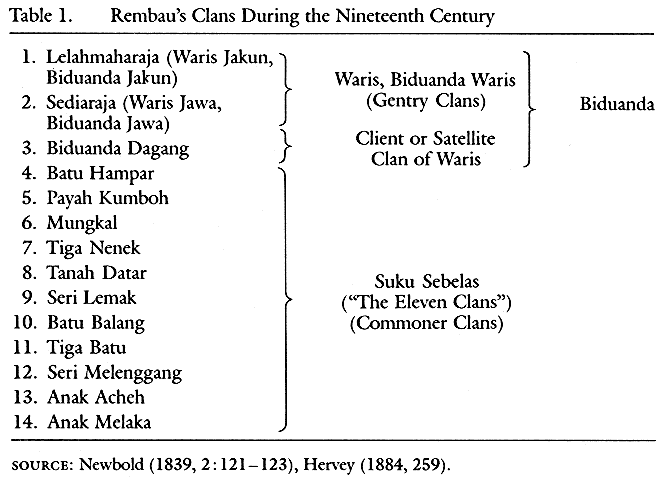
were the original "heirs to the soil" (waris ), emerged as the acknowledged head of a newly constituted gentry clan, thereafter styled Waris Jakun. Some myths suggest as well that Seri Rama became the first territorial chief and Supreme Law Giver, or Undang , of Rembau,[10] and that his candidacy for the office and his title—Dato Lelahmaharaja—were approved by the Sultan of Malacca (Parr and Mackray 1910, 4). Whether or not this is true, the designation Lelahmaharaja has long stood as a common synonym for the clan first known as Waris Jakun (Hervey 1884, 243; Lister 1887, 47).
The only other clan claiming the prerogatives and status of gentry traces its origin to To Laut Dalam, a contemporary and a "chiefly brother" of To Lela Balang, and quite possibly his patrilateral half-brother by virtue of a common father (or other male ancestor) and different mothers (from separate Minangkabau clans).[11] To Laut Dalam had once been married to a woman who bore him four daughters (the eldest of whom, Siti Hawa, married the chief Seri Rama); but as she hailed from Java, none of their children could claim matrilineal ties with the aboriginal Jakun, the group that, through descent, gave the Lelahmaharaja clan the status of "heirs to the soil." Nonetheless, To Laut Dalam's apparent envy over his "chiefly brother"'s success in gaining political recognition and privileges for his son motivated him to persuade the Sultan of Malacca to agree to a provision whereby the office of Undang would rotate between his "chiefly brother"'s descendants and his own. To Laut Dalam and his progeny thus assume prominence as the effective origin of the gentry clan known from that time on as Waris Jawa (the latter being the local term for Java and Javanese) or, alternatively, as Sediaraja, from the title granted to the first Undang chosen from their clan, the son of Siti Hawa and Seri Rama (Parr and Mackray 1910, 4–5; cf. Hervey 1884, 252).
Referred to collectively as Biduanda Waris or simply Waris, the Lelahmaharaja and Sediaraja clans together occupied the highest rung of Rembau's clan hierarchy (Newbold 1839, 2 : 120–123). They are currently held to be related as (or like) siblings (adik-beradik ), and presumably always were, despite the profound ethnic differences between their respective apical ancestresses and their wholly disparate enatic origins. Interestingly, the generalized siblingship linking the two clans is most emphatically maintained in Bogang culture, even though the mythic texts I encountered in the field do not widely recognize the tie of "chiefly siblingship" as the initial genea-
logically framed bond between these two clans. Rather, the construction of this linkage in terms of siblingship testifies to the continuity of a pervasive tendency to define individuals and social units as related like (or as) siblings whenever they share equivalent, parallel, or essentially complementary rights, obligations, or experiences with respect to the same political office, territorial domain, or other mediating element (cf. Kelly 1977; Marshall 1981a; Smith 1983).
The sibling equivalence of these two clans was manifest in the fact that neither of them could exercise any appreciable precedence over the other as regards political authority or other privileges (Parr and Mackray 1910, 5). For instance, rights to the office of Undang rotated in theory between them, with each alternately providing a candidate for the position (Newbold 1839, 2 : 119–120; CRACNS 1874, 12; Hervey 1884, 242; Lister 1887, 47; Parr and Mackray 1910, 48–49). Additionally, the marriage payments due their women were equivalent in value, and higher than those received by women of all other clans (Parr and Mackray 1910, 52); and intermarriage between the two groups seems to have been the ideal, as would be expected in light of analytically distinct, though mutually reinforcing, considerations of status endogamy.
The siblingship that united the two gentry units was also exclusivistic, for it linked only them; other clans were therefore defined as nonsiblings in relation to gentry clans, or in any event "much less like siblings."[12] This disjunction has long been realized in the gentry clans' sanctified monopoly on furnishing candidates for offices whose jural domains were of districtwide significance, as in the four posts comprising the Undang's Privy Council (Orang Besar Undang ) (Parr and Mackray 1910, 29) and of course the position of Undang itself. Members of these two clans also enjoyed the right to demand higher retributions for the murder of their kin (Hale 1898, 59; Parr and Mackray 1910, 52; cf. Newbold 1839, 2 : 123), although most of their other privileges surfaced only in ritual contexts.
In accordance with a rationale phrased largely in terms of historical precedence, or "origin point" (asal-usul ), Rembau's nongentry clans were ascribed commoner status, for according to most mythical explications of clan ranking, their forefathers were not the leaders, and in some cases were not even members, of the original expedition to Rembau. Consequently, permission to clear land, set up villages, and wield legitimate political
power derived neither from the autochthonous aborigines nor from the Sultan of Malacca. Instead, these privileges were granted them—in exchange for token payments, or the promise of such—by the representatives of the Lelahmaharaja and Sediaraja clans, who thus stood, if only on that account, as their benefactors (Hale 1898, 53; Parr and Mackray 1910, 108–109; cf. Lister 1887, 39; Lister 1890, 304). This patronage relationship appears to have been most explicit in the case of the Biduanda Dagang clan, which contemporary villagers regard as the lowest-ranked of all Rembau descent units. Persons affiliated with this clan are held to be descendants of the most recent arrivals in Rembau, many of whom fled their homelands as a result of famine or warfare or were simply itinerants or foreigners (as suggested by the term dagang ; cf. Parr and Mackray 1910, 72). In some instances the ancestors of contemporary Biduanda Dagang were slaves (hamba ),[13] having been purchased in Mecca by Rembau Undang or else acquired through military victories. Whatever their geographic and social origins, those who attained Biduanda Dagang standing in the past purportedly did so thanks to the benevolence of Lelahmaharaja and Sediaraja leaders, who agreed not only to accept their presence in or near their own settlements but also to extend them protection and clan representation, as well as a number of less-prestigious political titles.
For such reasons the Biduanda Dagang clan seems always to have had a unique and structurally ambiguous relationship vis-à-vis the Lelahmaharaja and Sediaraja clans. All three clans, after all, could be referred to by the shorthand gloss Biduanda, and, as noted, all three owed their allegiance to the same clan chief. And yet in terms of manifold expressions of power, status, and genealogical purity, Lelahmaharaja and Sediaraja occupied the uppermost niche of the clan hierarchy, whereas Biduanda Dagang fell at the other extreme of the continuum. Even at present, those identified as Biduanda Dagang continue to bear the burden of an ancestral stigma, as reflected in gentry reluctance to seek them out as potential marriage partners and in occasional references to their tainted pedigrees.
Not much is known about the nineteenth-century construction of linkages among commoner clans. Information collected around the turn of the century, however, reveals that the members of certain of these descent units could not intermarry because of ties of patrilateral half-siblingship between their apical ancestors (Parr and Mackray 1910, 77; see also chap-
ter 2).[14] This suggests a recognition of brotherhood that was altogether separate from enatic calculations of relatedness; it also lends further testimony to the relevance of siblingship as a connective, and potentially disjunctive, principle at the clan level.
Territorial Alignment
Within the domain of territorial alignment, principles of siblingship were accorded far greater centrality than those of descent and clearly provided the dominant idioms underlying both the conceptualization and actual organization of relationships and activities. This is best illustrated by examining various levels of such alignments, proceeding from the most inclusive to the most restricted.
Perhaps the most fundamental territorial distinction ever recognized by Malays in Rembau or other districts of the state was that between their homeland of Negeri Sembilan and all other regions of the Malay Peninsula (DeMoubray 1931, 182–188; cf. Gullick 1958, 135). This distinction symbolized the most basic level of social and cultural variation among Malays anywhere in the Peninsula.
Numerous mythic portrayals of Negeri Sembilan's cultural origins suggest that the relationship between the Malays of Negeri Sembilan and those residing elsewhere in the Peninsula is one of siblingship, inasmuch as the two ancestral figures associated with the genesis of cultural divergence are held to be related as (or like) brothers (see Newbold 1839, 2 : 220–221). It is not clear from any of the accounts with which I am familiar if these two culture heroes, Dato Perpatih Nan Sebatang and Dato Temenggong, were actually full brothers or were instead half-brothers (or, for that matter, classificatory brothers). As their titles indicate, though, the former was responsible for conceptualizing and establishing the framework of adat perpatih institutions, while the latter either founded or simply continued to support that body of tradition known as adat temenggong . Judging from Negeri Sembilan accounts, their divergent opinions concerning the status and rights of women in inheritance and the ideal organization of communities laid the foundations for the earliest cultural distinctions among the Minangkabau. More important, given the Negeri Sembilan perception that most if not all Malays are of Minangkabau ancestry (Newbold 1839, 2 : 215–216), the lack of consensus between these brothers gave rise to the
dominant cultural marker serving throughout history to distinguish Negeri Sembilan Malays from all others. Here, then, the principle of siblingship structures a critically important nexus of relationships embracing mythical culture heroes as well as the origins, history, and contemporary expressions of social and cultural diversity.
Within Negeri Sembilan, moreover, a focus on (classificatory) siblingship rather than on common matrilineal ancestry appears in the reckoning of relationships among the Undang of Rembau and those of the three other regional polities (Sungei Ujong, Jelebu, and Johol), who formed an unprecedented but largely ineffectual politico-military union in the 1770s. Ever since that time, both the four Undang and their respective territories (luak ) have been regarded as related to one another "like brothers"[15] —all of which is consistent with the fact that each of the leaders then stood, and still remains, more or less identically situated vis-à-vis the titular head of the union (the Yang diPertuan Besar ).[16]
Interestingly, just as their politico-military pact contributed to the intensification of strife and warfare throughout the area (Newbold 1839, 2 : 87–92, 149–150; Parr and Mackray 1910, 19–23; Wilkinson [1911] 1971, 296–310), so too did many of the military and other altercations of the next century revolve around confrontations, frequently bloody, between the principal chiefs of Rembau, together with their supporters, and those of Sungei Ujong (Newbold 1839, 2 : 89–92, 97, 105, 111–112; CRCANS 1874, 18–20, 232–236; CRCANS 1875, 8–10; CRCANS 1876, 193–222; Gullick 1958, 16–17). Many of these conflagrations thus involved a variant of fratricide. More generally, whether or not the cloaking of all such potentially bellicose relations in idioms of siblingship endowed them with a modicum of cordiality (to say nothing of amity), the fact remains that competition, petty rivalries, and overt antagonisms among titled males and political aspirants defined as brothers is a pervasive theme throughout Negeri Sembilan's precolonial history (Newbold 1839, 2 : 89–92, 97, 105, 111–112; Parr and Mackray 1910, 19–22, 63; Gullick 1958, 16–17; Hooker 1972, 22–23; Khoo 1972; Andaya 1971).
There also exists strong evidence that siblingship figured in the representation of the earliest known political division within the district of Rembau. To appreciate this we need only consider the mythic genesis of this division, as well as why clan leaders in the first of the two regions settled, "Lowland" Rembau, enjoyed certain ritual and political preroga-
tives not extended to their chiefly compatriots in Rembau's "Upland" territory (Hervey 1884, 250–251; Parr and Mackray 1910, 3).
Stated briefly, To Lela Balang and To Laut Dalam founded Rembau's first two villages, which were in the Lowland district (Rembau Baroh) (Parr and Mackray 1910, 3). Affiliated with the Batu Hampar and Payah Kumboh clans respectively, these chiefs were accompanied in their emigration by other clan members and by members (including leaders) of the allied Mungkal and Tiga Nenek clans. Together, but presumably after the Upland area (Rembau Darat) was settled, these four clans forged the earliest formal politico-military pact within Rembau. Known as the (Lowland) League of Four (Yang Empat or Yang Empat Sebelah Baroh ), this federation stood as the most esteemed and powerful political body in all Rembau's precolonial history (Parr and Mackray 1910, 6–7, 42, 43). Indeed, even after 1831, when the council was expanded to include four leaders from Rembau's Upland district and renamed the League of Eight (Yang Delapan ), the chiefs of the original federation continued to exercise many of their earlier privileges and played a pivotal role in Rembau politics and in Rembau's relations with neighboring and other foreign polities (Parr and Mackray 1910, 20, 42, 49).
The colonization of the Upland district may have taken place shortly after Lowland Rembau was opened up by To Lela Balang and To Laut Dalam. Judging from myths presented by Hervey (1884, 253–255) and Parr and Mackray (1910, 8), it was settled in part by To Laut Dalam and other Payah Kumboh clan members, along with persons affiliated with the three clans of Seri Lemak, Batu Balang, and Seri Melenggang. Each clan staked out a specific locale, over which the individual clan leaders claimed jurisdiction. These chiefs then forged a political counterpart to the Lowland League of Four, designating it the Upland League of Four (Yang Empat Sebelah Darat ). This body also assumed a position of centrality in Rembau's precolonial polity, even though its more recent emergence (hence less prestigious "origin point") resulted in its being accorded lower status and fewer ritual and political prerogatives than its predecessor.
There are also scattered mythical references to a tie of patrilateral half-siblingship between To Laut Dalam and the apical ancestor of the Tiga Nenek clan (Parr and Mackray 1910, 77). Hence, of the original four clans to settle within Rembau, three were linked through a particular variant of siblingship, which also emerges as the earliest—and for some time the
sole—genealogical connection between the Lowland League of Four and the Upland League of Four, and between the entire Lowland and Upland divisions in Rembau.
Although these two federations bore some of the trappings of strictly matrilineally constituted alliances, they were actually territorially based defense organizations whose structure and operations were simply couched in idioms of matriliny and siblingship. This situation obtained as well with respect to subsequently formed political alliances, the most recent of which, comprising five different clan chiefs, emerged during the period 1795–1820, operated in Rembau's Lowland district, and took as its name the League of Five (Parr and Mackray 1910, 7).
The origins and conceptualization of the League of Five are quite instructive. As set out in a myth presented by Hervey (1884, 253), a Biduanda woman was "taken to wife" by a man in the Mungkal clan residing in the Tampin territory, but in a grave breach of adat his people failed to provide her kin with the requisite marriage payment. The head of her clan consulted an allied chief representing the clan of Batu Hampar (Petani). These two then summoned their kin and proceeded with them to Tampin to demand the outstanding payment. After an unsuccessful two-week siege, the chiefs called on the leaders and members of three other, unrelated Lowland clans (Anak Aceh, Anak Melaka, and Tanah Datar) to aid them in their quest for justice. In unison the five chiefs and their supporters attacked and defeated Tampin and finally obtained the marriage payment in question, thus terminating the Biduanda-Mungkal hostilities. But these events also provided the foundation for a politico-military pact among the chiefs who had joined forces for the offensive, for on returning from Tampin they vowed to act together "for as long as the sun and moon endure" and to share in whatever advantages and injuries came the way of any one of them. The solemn oath they registered occurred in the context of a ritual feast (kenduri ) and entailed a blood pact in which each chief put a small amount of blood into a common cup and then sipped a drop of the mixture. Not surprisingly, this ritual pact appears identical in overall design to the traditional symbolization of siblingship between clan mates and those formally adopted into the clan (Taylor [1929] 1970, 139–141; Lewis 1962, 138).
Formal political alliance at the clan level apparently presumed no matrilineal ties or genealogical proximity among the constituent descent units.
Nevertheless, while territorial, demographic, and political factors were the effective prime movers in clan federation, the cultural expression of material realities related to such alliances was commonly framed in the imagery of kinship, especially siblingship.
There are various other levels at which the alignment of territories defined by, or simply identified with, discrete and theoretically exclusivistic social units appear both cloaked in and consistently shaped by idioms of siblingship. To illustrate, we may examine the mythically enshrined structure of relationships among settlements associated with Rembau's gentry clans.
Returning to the mythical account of the origins of the Lelahmaharaja and Sediaraja clans (see figure 1), we see that To Laut Dalam (founder of the Lowland village of Padang Lekoh) had four daughters by his marriage with the unnamed Javanese woman said to be the apical ancestress of the Sediaraja clan. By her marriage with Seri Rama, To Laut Dalam's eldest daughter, Siti Hawah, gave birth to a male child who is considered to have been the first member of the Sediaraja clan and to have eventually resettled and established the Lowland village of Kampung Tengah. Likewise, the descendants of Siti Hawah's three sisters opened up three new communities (also in Lowland Rembau), each tracing its origin to a different sister. In brief, the progeny of To Laut Dalam's four daughters succeeded in founding four distinct villages regarded throughout history as the most senior of the Sediaraja settlements.
At the apex of their mythical genealogy, then, these four villages stand connected by virtue of the fact that they were founded by sisters. Note, however, that since none of the four women actually belonged to the Sediaraja clan founded by the son of Siti Hawah, or to any other descent units, it makes little sense in terms of an exclusively matrilineal transmission of clan membership and status that the descendants and settlements associated with Siti Hawah's sisters stand on a par with those of her son. This parity obtains owing to the sibling bond that not only links the four women in question and renders them more or less structurally equivalent but also dictates a de facto mythical extension of Sediaraja status from Siti Hawah's son to the offspring of his mother's sisters.
A similar pattern of territorial expansion and alignment appears in the case of the Lelahmaharaja clan, which, as discussed earlier, traces its origins to the union of To Bungkal and To Lela Balang, the latter being the founder of the Lowland village of Kota. Although none of the four off-
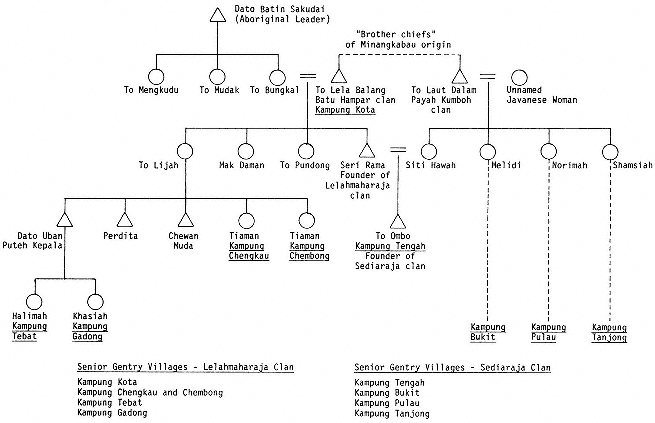
Figure 1.
Mythic Genealogy of Relations Among Founders of Rembau's Gentry Clans and Senior Gentry Settlements
Note: Most of the relationships depicted here can be pieced together from myths presented in Parr and Mackray (1910).
A more complete version, appearing in Abdul Samad Idris (1968, 167–174), serves as the basis for this figure.
spring of these luminary figures are linked in any direct way with the establishment of new settlements, one of the female children, To Lijah, did give birth to two daughters, each known curiously as Tiaman, who appear to have been responsible for the initial occupation of the Lowland areas (later to become villages) of Chengkau and Chembong. In turn, their brother, Dato Uban Puteh Kepala, fathered two daughters, Halimah and Kasiah, who rank as the founders of two additional villages: Tebat in Upland Rembau and Gadong in Lowland Rembau, respectively. During the lifetime of To Lela Balang's great-grandchildren, then, the Lelahmaharaja clan's territorial domain embraced five distinct settlements or senior gentry villages and by that point had also come to include a colony in Upland Rembau.
The structure of genealogical connections among these senior gentry villages is analogous to, though somewhat more complex than, that of the Sediaraja case. Strictly speaking, there are five of these Lelahmaharaja villages, although two of them, Chengkau and Chembong, occupy a single politico-jural status. Thus myths, written sources (e.g., Parr and Mackray 1910, 29), and contemporary elders tend to speak only of Lelahmaharaja's four senior gentry communities, even though they recognize that Chengkau and its apparent offshoot, Chembong, are separate settlements located some distance apart. In any event, the structure of ties among these villages is also patterned on siblingship rather than descent. Here too, then, myths effect an extension of descent unit affiliation from a male clan founder (Seri Rama) to his otherwise unaffiliated sisters. In so doing, the myths emphasize the equivalence of siblings and the connective significance of the siblingship principle. More specifically, they serve to generate a bond of siblingship between Seri Rama's village of Kota and those founded by the descendants of his sisters' daughters, namely, the settlements of Chengkau and Chembong.
The structural relevance of siblingship in village and descent unit alignment is manifest as well in the relationship between these latter three villages and the communities of Tebat and Gadong. Tebat and Gadong were originally connected through bonds of patrilateral siblingship and possibly (though not for certain, since the myth is silent on this point) through common ties of matrifiliation. Interestingly, the founders of these villages, Halimah and Kasiah, share their father's descent group membership. This could indicate an incestuous union on the part of the father, but is more
likely yet another mythical expression of the structural equivalence of siblings (that is, Dato Uban Puteh Kepala and his sisters). In short, the descendants of Halimah, Kasiah, and the two Tiamans do not stand related to one another through an unbroken succession of matrilineal links. Rather, the structural logic connecting these groups and their associated villages derives from the principle of siblingship. I might add here that there is no principle of descent that can accommodate these mythic representations.
The relations of equivalence suggested by the mythic siblingship links among the senior settlements of Rembau's two gentry clans were also realized in the principles governing the devolution of rights to gentry political offices, and were therefore of far greater structural significance than data derived from myth alone might lead one to assume. Moreover, the logic of succession to the title of Undang sheds light on the structure of genealogical relations among the founding settlements of individual commoner clans, for the same principles based on siblingship obtained in the case of commoner titles and territorial alignment.
The System of Offices
An overview of the principal relations of authority in Rembau's precolonial polity can be gleaned from part of a customary saying (perbilangan ) that is widely known at present and commonly encountered in the reports of earlier observers as well (e.g., Lister 1887, 43, 44; Hale 1898, 53–54; Parr and Mackray 1910, 87, 116):
The Undang rules the district,
The clan chief governs the clan,
The clan subchief rules his enates,
And the wife's enates prevail over in-marrying males.
These and intermediate relationships are depicted in figure 2, a schematic representation of Rembau's traditional polity and the territorial domains associated with each political office and council.
The Undang sat at the apex of the political hierarchy and was regarded by his subjects as sacrosanct (berdaulat ) and as Allah's caliph or vice-regent (berkhalifah ) within Rembau (Parr and Mackray 1910, 48, 50, 52, 53). This figure not only symbolized and effected the institutional integration
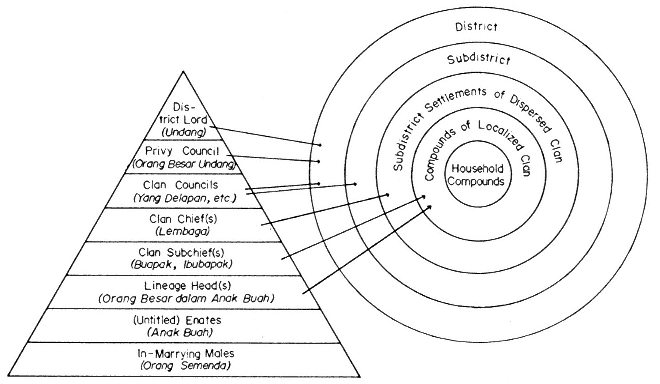
Figure 2.
The Indigenous Political Hierarchy in Nineteenth-Century Rembau, Showing
Territorial Domains of Political Offices and Councils
of adat and Islam, but he also enjoyed rights to conscript male villagers for defense purposes and to make periodic demands on household labor and food resources (Newbold 1839, 2 : 85–86; cf. Lister 1887, 48). The Undang was also entitled to collect annual payments in kind from the proprietors of certain categories of land (see chapter 2), even though he was barred by adat from intervening directly in any clan's affairs unless petitioned to do so by the chiefs of those clans (Parr and Mackray 1910, 48, 58). In a word, adat granted the Undang broad powers and variegated ritual prerogatives but simultaneously imposed quite specific constraints on his authorities. It was in fact as enforcer of such constraints that the four-person Privy Council, or Orang Besar Undang, came into being during the eighteenth century. This body served to check the Undang's comportment vis-à-vis clan chiefs and thus constituted a buffer of sorts between Rembau's highest-ranking leader and the largely autonomous but politically vulnerable heads of dispersed clans (Parr and Mackray 1910, 34).
Succession to any of the foregoing titles presupposed affiliation with one of Rembau's gentry clans, for rights to these offices were vested in the gentry in accordance with mythic alliances and exchanges with aboriginal Jakun, which endowed them with privileged proprietorship over the whole of Rembau and all its inhabitants and resources.
Certain clan councils, for their part, also enjoyed districtwide realms of
jurisdiction. As one example, the council known prior to 1831 as the League of Four, and thereafter as the League of Eight, exercised legitimate powers throughout Rembau, even though the clan chiefs on the council were in most other respects limited in jurisdiction to specific territorial domains, such as Lowland or Upland Rembau (see Parr and Mackray 1910, 25, 26, 40). Succession to the chieftainship of any clan also entailed ascribed status with respect to all clan councils—as a member of certain rank, for example, or as a nonmember. Thus, in most instances rights to an office of clan chief included legitimate claims to a specified role in one or another council, and all such rights not only vested in particular clans (or more precisely, in the Lowland or Upland segments thereof), but also stood as their "ancestral property" (harta pesaka ).
Because there were usually only one or two clan chief titles for any given clan in Lowland or Upland Rembau, responsibilities for regulating a broad range of community affairs typically devolved on the chief's immediate subordinates. I refer here to clan subchiefs (buapak or ibubapak ), each of whom exercised authority over the compounds of a localized clan (Lister 1887, 45–46) and concurrently served to link village residents with extralocal political figures. Clan subchiefs also helped guarantee that the members of their communities received equitable treatment at the hands of clan chiefs, much as the chiefs themselves served to check the activities of the Undang (see Parr and Mackray 1910, 36–39).
Titled individuals occupying the lowest rung of the political hierarchy were also charged with promoting justice in accordance with adat and increasing the likelihood that their immediate superiors did right by their relatives. Deemed to be officials of the clan chief, these lineage heads, or "big men among the kin" (orang besar dalam anak buah ),[17] helped ensure that capricious, partisan, or extortionary behavior on the part of subchiefs either did not occur or resulted in appropriate punishment (Parr and Mackray 1910, 34). If punishment were required, portions of the fine paid by a guilty subchief to the clan head were shared with the lineage heads; apparently these comprised the main income associated with the office (Parr and Mackray 1910, 34). Lineage heads also received direct remuneration in the form of percentages of the fees paid by male clan members in the village who were involved in "irregular marriages"—for example, marriage by abduction (cf. Parr and Mackray 1910, 82–85)—although they were prohibited by adat from levying fines on their own accord.
Of broader concern is that the office system served to encode a model of
"pure matriliny," and yet did so in a larger context of territorial and descent unit alignment where matrilineal idioms provided but one component of the relevant structure (and thus only a partial explanation for its expression "on the ground"). The other nexus of idioms here, and in many other realms of indigenous social theory and practice, was based on notions of siblingship, the behavioral imperatives of which were contextually variable but could be wholly inconsistent with those based on matrilineal descent.
Bear in mind, for example, that rights to each political title were vested in a single dispersed clan, or territorially defined segment thereof, with the partial exceptions of the Undang and two or three other gentry titles. Disregarding these cases, each title was held to be the property of one specific social unit, membership in which was frequently expressed in terms of common matrilineal relatedness and typically ascribed at birth by virtue of ties of matrifiliation with a woman belonging to that same category (or, alternately, by adoption). As in most ethnographic instances of such estates, rights to any given political office were wholly concentrated among the members of a single clan or segment thereof, and could not devolve on persons or collectivities defined as external to the relevant category. Viewed from the other side, an appropriate descent affiliation was a pre-requisite for political succession, even though many other considerations—moral character, verbal skills, charisma, physical well-being, patrilateral connections—also figured.
Further testimony to the prevalence of descent idioms in the system of offices was the convention whereby the term used to designate enatically related kin of junior generational standing, anak buah , was also employed by political leaders in referring to their adherents.[18] Just as a man's sisters' children stood as his anak buah, to take the most relevant example, so too did everyone in Rembau share that designation in relation to the Undang. Conversely, all titled males were defined as mother's brothers in relation to their charges.
We turn now to the logic of succession to political office, in which siblingship serves as a basic ordering, and fundamentally disjunctive, principle. An example drawn from contemporary Bogang provides a useful illustration. Bogang's Lelahmaharaja clan, which comprises three named lineages, holds exclusive rights over four political titles: clan subchief and the three lower-ranking "big men among the kin," or lineage heads. Rights
over these offices pass from one lineage to the next in a set sequence; thus, when any one of these political figures dies, his title will be bestowed on a member of the lineage next in line for that particular title. Stated differently, even though rights to these titles never pass out of the localized clan, neither do they devolve from mother's brother to sister's son, as occurs in many other political systems associated with matrilineal descent. Instead, they pass among structurally equivalent social units held to be related to one another "like sisters."
An analogous logic governed access to the title of Undang, which has been defined as the "ancestral" property of Rembau's two gentry clans ever since its inception during the period 1540–1640. Recall that the mythical genealogies of these clans portray their respective apical ancestresses as unrelated to one another except for the tie of "chiefly brotherhood" between their husbands. That is, although these two men belonged to separate clans and were thus structurally distant in terms of matrilineal calculations, their relationship of "chiefly brotherhood" provided the primary link between both their wives and their wives' enatic descendants. I need only reiterate that rights to the office of Undang have always rotated in theory between Lelahmaharaja and Sediaraja, which implies the same structural equivalence that appears in myth as a particular variant of nonenatic siblingship.
Yet to point out that rights to the office of Undang rotated between Lelahmaharaja and Sediaraja is to oversimplify; it was also the case that rights to provide a candidate for this office passed among each of the senior settlements associated with these clans (Parr and Mackray 1910, 48–49). For example, when an Undang of the Lelahmaharaja clan died or vacated office owing to impeachment or infirmity, the title passed ideally to one of the Sediaraja communities not only endowed with senior standing but also held to be next in line for candidacy in relation to the other three Sediaraja villages of equivalent status. This second circuit of rotation provides additional justification for regarding siblingship as the dominant idiom regulating accession to the office of Undang, for we have already seen that the genealogical bonds among the senior villages of each clan receive mythical expression in terms of sibling ties. So, too, does the existence of a third circuit, which specified that the residentially localized lineages in each of these settlements were to take turns in furnishing nominees whenever their village was eligible for candidacy. Unfortunately, we do not know how such lineages were held to be connected to one another
during the nineteenth century, although present-day residents of Bogang do view them as related like siblings, especially sisters. I suspect that this has always been the case.
This material suggests that all social and territorial units associated with the founding settlements of gentry clans and vested with equivalent, parallel, or essentially complementary rights to the same political title(s) were held to be related as (or like) siblings by virtue of their common relationships to the office(s) in question. The same rules of political succession can be discerned in the case of founding settlements associated with individual commoner clans as well (see Parr and Mackray 1910, 120–141; cf. Lister 1887, 45, 47; Lister 1890, 308–310; Gullick 1958, 77), with an identical logic grounded in siblingship.
It remains to elaborate on my earlier point that principles of siblingship also assumed a disjunctive role in the political system. Consider, for example, that no explicit notion of structural precedence is apparent by which certain adult males within a sibling set, lineage branch, or lineage would merit preferential or exclusive consideration when their lineage was due to provide a candidate for office. That is, while the Rembau schemes of rotation enjoined serial succession at the levels of dispersed and aggregated clans and lineages, they seem not to have ranged beyond these units by specifying a variant of primo- or ultimogeniture, or anything of the sort commonly reported for conical clans (Gullick 1958, 70, 74, 77). This might be interpreted as a mechanism promoting intralineage equality, since distance from a founding line or apical sibling set was not explicitly relevant and candidates could thus be selected instead on grounds of "paternal luster" or some combination of acquired skills or other achievements. The problem, however, was that this might also promote the emergence of invidious intralineage distinctions, based on potential military prowess or some special acquired competence, which could effectively negate the structural equivalence otherwise characteristic of relations among adult male enates (particularly those of the same relative generation). Further, this meant that all males in a particular sibling set, lineage branch, or lineage might well be vying for the same political stakes (Gullick 1958, 70, 74, 77); hence, their competition could well give rise to divisiveness within the very unit they sought to represent.[19] Indeed, in light of the pronounced cultural emphasis on the equivalence of same-sex siblings, one would certainly expect a man to harbor profound resentment toward a
brother who attained political office while he himself simply muddled along as "mere villager." More to the point perhaps is that structurally induced sentiments of this nature continue to provide a context for the expression of myriad variants of fraternal strife.
Other tensions engendered by the structure of the nineteenth-century political system had profound social and cultural significance as well. Many stemmed from the fact that in-marrying males were not only subject to the control of their wives' enates (Lister 1890, 317; Hale 1898, 56–57; Parr and Mackray 1910, 95, 116–117; Caldecott 1918, 36–37) but also owed allegiance to their own enatic relatives, whose interests they were clearly expected to further, especially those of their female kin (see chapter 2). Some of these tensions were realized in the domain of inheritance, in that rights over certain of the proceeds of a deceased man's labor might be divided between his widow and children on the one hand and his sisters and their progeny on the other. The potential for conflict in this situation, where two distinct sets of enatic kin could lodge legitimate claims over the intestate properties of one particular male decedent, is clear.
More important still is the fact that titled males (and subsequent generations of indigenous elite) stood partly outside the system of affinal control that both underlay and made possible the social reproduction of enatic units at all levels of inclusiveness. One reason for this is that they were vested with symbols and bases of authority and prestige generally unknown to their untitled counterparts, and were thus far less vulnerable to the sanctions imposed on them by affines. Elites were therefore ideally situated both to contravene established canons of order and to endow largely unpopular or ambivalently embraced innovations with a modicum of sanctified legitimacy.[20] The implications of these circumstances will be clear after we examine the political elite's critically important role as entrepreneurs during the nineteenth and twentieth centuries (chapters 3 and 4).