
Dadagurudevs
The worship of deceased ascetics of note is a central feature of the religious life of Svetambar Jains associated with the Khartar Gacch. Of these the most important by far are the figures known as Dadagurus or Dadagurudevs.[21] The Dadagurus are past Khartar Gacch acaryas who are singled out from others because of their roles as defenders and reformers of Jainism, and as miracle workers and creators of new Jains. The four are: Jindattsuri (1075-1154 C.E. ), Jincandrasuri "Manidhari" (1140-1166), Jinkusalsuri (1280-1332), and Jincandrasuri II (1541-1613). These figures are the focus of a widespread cult.[22]
Most temples affiliated with the Khartar Gacch contain images of the Dadagurus. There are also many shrines—called dadabaris , "gardens of the Dada"—dedicated specifically to them. The temple complex at Mohan Bari is, in fact, a large dadabari Even in dadabaris , however, images of the Tirthankars are present—as we see in the case of Mohan Bari—and, in theory, are the primary objects of worship. Dadabaris are basically mortuary structures. Although many of them have been enveloped by urban growth, the ideal is for dadabaris to be away from population centers, as would be appropriate for a place where funerary rites take place. The complex at Mohan Bari functions in this way today.
There are several dadabaris in Jaipur, the most important being a temple located on Motidungri Road to the south of the old city. This temple is owned by the Srimals and is a major Jain landmark in Jaipur. The most famous dadabaris of all, however, are located at Ajmer, Mehrauli (near Delhi), and Malpura (some 80 kilometers southeast of Jaipur). Those at Ajmer and Mehrauli are located on the spots where, respectively, Jindattsuri's and Jincandrasuri Manidhari's obsequies took place. The dadabari at Malpura was supposedly founded as a result of a vision that Jinkusalsuri gave just fifteen days after his death (to be discussed later). A directory of dadabaris published in 1962 lists 344 independent shrines and 210 larger temples in which the Dadagurus are represented, mainly in Rajasthan and Madhya Pradesh (Josi 1962). Many more exist now.
The Dadagurus are usually worshiped in the form of foot images, but anthropomorphic images have become more common in recent times (Figures 10, 11).[23] It is clear, however, that footprints are more fundamentally in character for the Dadagurus than anthropomorphic images, because even when there is an anthropomorphic image there are usually footprints too.[24] The structures in which the Dadagurus' im-
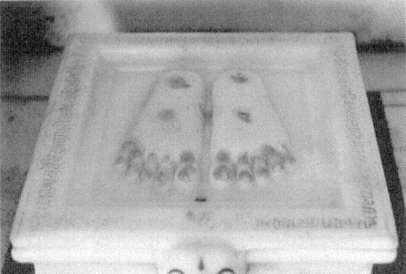
Figure 10.
Footprint image of a Dadaguru at Sanganer, near Jaipur
ages are housed are modeled on the funerary cenotaphs that are so common a feature of Rajasthan. Even where temple-like buildings have been erected for the Dadagurus, their images—whether footprints or anthropomorphic figures—are usually housed in cenotaph-like shrines within.
We may say that deceased ascetics constitute a general class of objects of worship. The Dadagurus are different in degree from other deceased monks, not different in kind. They are the most beloved, respected, and powerful of them all, but—as we have seen in the case of Chagansagar—other ascetics have achieved postmortem recognition. As I have already suggested, the Tirthankars can also be seen as members of this class, but this statement requires qualification. The distinction between the Tirthankars and ordinary deceased ascetics is never in doubt; the Tirthankars have achieved omniscience and liberation, whereas even ascetics as distinguished as the Dadagurus have not. The namaskarmantra establishes a clear hierarchy among ascetics, with the Tirthankars unambiguously at the top. But at the same time, Tirthankars are deceased ascetics too. As noted before, Rsabh is represented at Mohan Bari by feet, not by an anthropomorphic image.[25] Moreover, these footprints are stationed under a chatri -like structure. This is an unusual arrangement, but the fact that it is a plausible arrangement suggests that
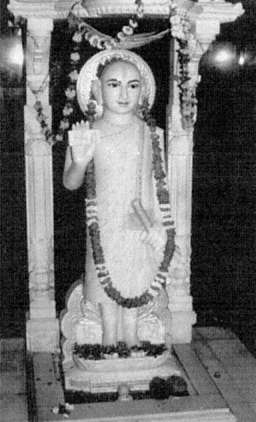
Figure 11.
Image of Jincandrasuri "Manidhari"
at a neighborhood temple in Jaipur
in some respects the Tirthankars are thought of as belonging to the same category as other deceased ascetics. The physical homologies seen in the arrangements at Mohan Bari suggest a common conceptual substratum. Rsabh is a deceased ascetic too, who has left footprints behind.
The Dadagurus are absolutely central to the beliefs and practices of Svetambar Jains associated with the Khartar Gacch. They are objects of worship, and in some ways are ritually more prominent than the Tirthankars themselves. To understand their role we must learn something about their place in history, and this in turn requires that we learn something of the history of the Khartar Gacch.
Reformers
The Khartar Gacch was at first a reform movement among ascetics.[26] In medieval times, possibly as early as the eighth century C.E. , ascetics known as Caityavasis, "temple-dwellers," had become prominent in western India. These were ascetics who, contrary to the Jain ideal of the peripatetic mendicant, lived in permanent establishments. Their leaders were learned, were held in high esteem at court, and in general exercised great influence over the Jain laity. But the Caityavasis had their critics as well, and the Khartar Gacch began as a protest movement against what was viewed by critics as the stagnation and backsliding of these false ascetics.
The story begins with a late tenth- to early eleventh-century ascetic named Vardhmansuri. He was initiated originally as a Caityavasi, but ultimately left the Caityavasis because of his growing disgust at their lax ways. He then became the student of a learned ascetic named Udyotansuri, who taught him "true" Jain doctrine. He later went forth to propagate teachings opposed to those of the Caityavasis, and died in 1031 C.E . His most important disciple was Jinesvarsuri, one of the truly great figures of Svetambar history. Said to have been of Brahman origin, Jinesvarsuri and his brother apparently met Vardhmansuri while still boys and were quickly initiated by him. Both went on to distinguished ascetic careers.
Jinesvarsuri was an able scholar and powerful debater, and his most celebrated deed was the defeat of the Caityavasis in a famous debate. Vardhmansuri had decided to confront the Caityavasis on their own ground and had gone to Pat. an with his disciples. This city, then the capital of Gujarat, was a great center for the Caityavasis. Because of the Caityavasis' influence in the city, Vardhmansuri and his followers had difficulty finding a place to stay. In the end, however, the scholarly Jinesvar so impressed the king's chief (Brahman) priest with his Sanskrit learning that the priest invited the monks to stay with him. The Caityavasis then put it about that they were spies dressed as mendicants. When word of this reached King Durlabhraj, he called his priest, who defended the mendicants. The Caityavasis then decided that the best way to get rid of this threat would be to challenge and defeat them in a debate.
The debate was joined in the presence of King Durlabhraj in a Parsvanath temple in the year 1024 C.E. Suracarya, the leader of the Caityavasis, sat with eighty-three other local Caityavasis. Vardhmansuri
and his followers were summoned.[27] When they arrived, the king offered them betel, which apparently the Caityavasis were quite accustomed to taking. In response, Vardhmansuri produced a couplet from the Sastras that said that for celibates, mendicants, and widows, taking betel is equivalent to the sin of eating beef.
As the debate then unfolded,[28] Jinesvar (who carried the burden of the debate) asked the king whether he—the king—followed new political policies or those of his ancestors. The king replied that he followed the policies of his ancestors. Jinesvar pointed out that the followers of Vardhmansuri were simply trying to do the same thing, namely, to follow the original teachings of the Tirthankars. Jinesvar then reminded the king that he and his fellows had come from far away and noted that they did not have the books they needed to debate properly. He asked the king to have books brought from the Caityavasis' math (monastery). The bundle of books was duly produced, and when it was opened the first thing that came to hand was the Dasavaikalikasutra , and from this book the first thing that met the eye was a stanza that read: "An ascetic (sadhu ) must live in a place that is not specifically for ascetics but which is designed for any other purpose, and in which there are facilities for eating and sleeping, and in which there is a proper designated place to urinate and defecate, and from which women, animals, eunuchs, etc., are forbidden."[29] The king, who was an impartial judge, found this extremely convincing. The king then asked for thrones to be brought for Jinesvar's group to be seated upon. Jinesvar responded that it was improper for monks to sit on thrones and backed up the assertion with a couplet from the Sastras . In the end, Jinesvar's victory was total, and the king took him and his companions under his protection. The Caityavasis left the temples and the kingdom, and were replaced with Brahman temple priests.[30]
This dissident reforming sect, founded by Vardhmansuri and consolidated and propagated by Jinesvarsuri, was at first known as the vidhimarg (the path of [proper] method).[31] However, it is said that at the time of the great debate the admiring king Durlabhraj applied the term khartar ("fierce") to Jinesvar. This sobriquet later became the name of the gacch .
Jindattsuri
Vardhmansuri and Jinesvarsuri had many illustrious successors. Among them, however, the ones who stand out most in the ritual life of Jains
associated with the Khartar Gacch are the four Dadagurus. And of the Dadagurus, none is of greater importance than the first, Jindattsuri.
Jindattsuri was born in 1075 C.E. at a place called Dholka.[32] His clan was Humbad and his given name was Somcandra. When he was a small boy he once accompanied his mother to discourses being given by some Khartar Gacch nuns. They noticed auspicious marks on the boy, became convinced that he was destined for greatness, and sent news of their discovery to a senior monk named Dharmdevji Upadhyay. This monk then came to the village and asked the boy's mother if she would be willing to "give the boy to the sangh " (the conventional expression for allowing a child to be initiated). Parental permission was given, and the boy's initiation occurred in 1084 when he was only nine years old.
Somcandra demonstrated cleverness and great independence of mind from the start. His education was put in the hands of an ascetic named Sarvadevgani. Dharmdevji told Sarvadevgani to educate the boy in every particular of the mendicant's life, and even to take the boy with him to the latrine.[33] Somcandra, however, was very young and ignorant of the rules of ascetic discipline. Knowing no better, he uprooted some plants in the field. In his exasperation, Sarvadev took away the boy's mouth-cloth and broom and told him to go home. The boy responded that if Sarvadev wanted him to go, he'd go, but first he'd like the hair that had been taken from his head (in his initiation ceremony) returned. Sarvadev was highly impressed by this spunky response, as was Dharmdevji when it was reported to him.
After his studies were completed, Somcandra began his wanderings from village to village. He impressed everyone with his learning, meditation, and piety. As time passed his reputation grew to such an extent that, when Jinvallabhsuri—the leader of the Khartar Gacch at that time—passed away, Somcandra was his logical successor. He attained the status of acarya at Cittaur in the year 1112, at which point he acquired the name Jindattsuri and assumed the leadership of the Gacch.
Wishing to know where he should go in his wanderings, the newly elevated Jindattsuri engaged in a program of meditation and fasting. According to the hagiographies, a deceased ascetic named Harisinghacarya came to earth from heaven in response. He told Jindattsuri that he should go to Marwar and places like it. Jindattsuri followed this advice, first going to Marwar and then to Nagpur, and later through countless villages and towns. He taught, he protected the Jain faith, and he converted many non-Jains to Jainism. His rainy season sojourns were sources of inspiration in the communities in which they occurred. He
performed numerous consecrations of images and initiations of ascetics. He was also a great reformer. Under his influence, large numbers of Caityavasi acaryas abandoned their former ways and took initiation with him. He had many admirers among great kings and princes. Arnoraj, the then-ruler of Ajmer, was one of the kings of the period who numbered among his devotees.
He seems to have been tough-minded and earthy, qualities of character that probably served him well in a pattern of life that was surely merciless in its physical and psychological demands. Once in Nagpur a certain rich man presumptuously tried to advise Jindattsuri on how to gain more followers. The monk responded with a verse that reveals a man with a short fuse who did not suffer fools gladly. This verse is translated by Phyllis Granoff (1993: 55) as follows:
Do not think that just because he has many hangers-on a man is honored
in this world
For see how the sow, surrounded by all her young, still eats shit.
He was, above all, a great worker of miracles, as were all the Dadagurus. It is extremely important to emphasize that the hagiographies insist that these miracles always had a higher purpose than merely solving someone's worldly problems. From the standpoint of Jainism's highest ideals, ascetics are not supposed to be magicians. As we have already seen in the case of Chagansagar, the hagiographers must therefore legitimize this power by establishing a Jain context for it. One legitimizing strategy is to accentuate the point that the miraculous power is associated with its possessor's asceticism. Another strategy is to stress that the purpose of the miracles was always to glorify Jain teachings or to help Jainism flourish. The miracle-working ascetic protects Jain laity, defeats Jainism's enemies, and often aids non-Jains, who may become Jains as a result (the subject of the next chapter).
In Jindattsuri's case, however, the hagiographies establish yet another legitimizing frame of reference for magical power. It seems that Vajrasvami, a legendary ascetic from centuries earlier, had written a book of ancient knowledge (presumably magical).[34] Because he lacked any disciple who could make proper use of this knowledge, he secreted the book in a pillar in the fort at Cittaur. Others had tried and failed to obtain this book, but by means of his own yogic power (yogbal ) Jindattsuri was able to acquire it and derive powers from it.[35] This tale makes the point that Jindattsuri's power derives both from sources internal to himself (his own yogic ability) and from an interrupted tradi-
tion of magically potent ascetics. Legitimacy is conferred on this connection, in turn, because it is embedded in the longer line of disciplic succession connecting Jindattsuri to Lord Mahavir.
Many of Jindattsuri's miracles—which cannot all be described here—involved subduing non-Jain powers.[36] An example is his victory over the five adhisthayak pirs of the five rivers of Punjab who once tried to disturb him in meditation.[37] It is said that because of his powers of concentration they found it impossible to budge him, and as a result the five pirs conceded defeat by standing before him with hands joined, after which they became his servants. The fact that these non-Jain powers are depicted as pirs , which refers to Muslim saints, may reflect the fact that Muslim influence was particularly strong in this region. It is also said that he subdued fifty-two bhairav virs (forms of the deity Bhairav), who also became his servants. Bhairav (or Bhairava) is a form of Siva, and this episode may mirror Jain conflict with the Saivas, which was ongoing at the time.
Another example was his defeat of sixty-four yoginis :malicious, non-Jain, female supernaturals.[38] The incident occurred in Ujjain, where Jindattsuri had begun a public discourse. He told his listeners that the sixty-four yoginis were coming in order to create a disturbance,[39] and that they should spread sixty-four mats and seat the yoginis on them. The sixty-four arrived disguised as laywomen, and were duly seated on the mats. Jindattsuri cast a spell on them by means of his special power, and then resumed his discourse. When the other listeners rose at the end, the yoginis were unable to leave their seats. They then were ashamed and said to Jindattsuri that although they had come to deceive him they had in fact been deceived themselves. They begged forgiveness and promised that they would assist him in propagating Jainism. This episode possibly reflects Jain opposition to cults of tantric goddesses and may also echo the theme of the taming of the lineage goddesses, which will be explored in the next chapter.
He also used his miraculous powers against Jainism's human opponents. Once at a place called Badnagar some Brahmans tried to disgrace Jindattsuri and the Jain community by having a dead cow placed in front of a Jain temple. In the morning the temple's pujari discovered the outrage. He told the tale to the chief businessman of the city, who in turn told Jindattsuri. By means of his knowledge of how to enter other bodies Jindattsuri caused the cow to rise, walk, and expire again in front of a Siva temple. Here the opponents are both Brahmans and Sai-
vas. In another version of the same story, the Brahmans put the corpse of a Brahman in front of a Jain temple, and Jindattsuri caused the Brahman corpse to rise and expire again in front of a "Brahman". temple (Granoff 1993: 65).
Jindattsuri even defied the fury of nature on behalf of Jainism. Once, in Ajmer, a fearsome stroke of lightning in the evening threatened a group of laymen performing the rite of pratikraman . Jindattsuri caught the lightning under his alms bowl and the rite was able to proceed.
Jindattsuri is said to have had the title of yugpradhan (spiritual leader of the age) bestowed upon him in a miraculous fashion.[40] It seems that in order to find out who was the yugpradhan , a layman named Nagdev (Ambad in some accounts) went up to the summit of Girnar[41] and fasted for three days. Pleased by his austerities, the goddess Ambika Devi appeared and wrote the yugpradhan's name on his hand, saying, "He who can read these letters, know him to be the yugpradhan . "Nagdev traveled far and wide and showed his hand to many learned acaryas , but nobody could read the letters. In the end he went to Patan, where he showed his hand to Jindattsuri. The monk sprinkled vasksep powder on the letters and they became clear. It was a couplet that read as follows: "He at whose lotus feet all of the gods fall in complete humility, and who is an oasis-like kalptaru (wish-fulfilling tree), may that yugpradhan who is Sri Jindattsuri be ever-victorious."
Jindattsuri's life ended at Ajmer in 1154 C.E. When he realized that the end was near, he ceased taking nourishment and died on the eleventh day of the bright fortnight of the month of Asarh . At the time of his cremation, his clothing and mouth-cloth failed to ignite, and they are said to be preserved to this day in Jaisalmer. His successor, Jincandrasuri" Manidhari," established a memorial on the spot on which his body was burned, and this was later made into a proper temple.
After death Jindattsuri became a god. According to one account (Vidyut Prabha Sri 1980: 11), Simandhar Svami (a Tirthankar currently active and teaching in the continent of Mahavideh) was once asked by his guardian goddess (sasandevi ) where Jindattsuri had been reborn. The omniscient Simandhar replied that at the present time he was in devlok (heaven), and that after a sojourn there he would take birth in Mahavideh and there achieve liberation. Another author (Suryamall 1941: 32 [appendix]) also states that Jindattsuri became a god in the Saudharma Devlok and will ultimately return to the region of Mahavideh, whence he will attain liberation.
Jincandrasuri "Manidhari"
The second Dadaguru is named Jincandrasuri, but he is popularly known as "Manidhari" because there is said to have been a jewel (mani ) in his forehead from which some of his magical power emanated. He was Jindattsuri's successor, but the personality he projects as a Dadaguru is completely distinct from that of his illustrious predecessor.
According to one account (Nahta and Nahta 1971: 26)—a version strongly reminiscent of the Tirthankars' birth narratives—Manidhari's advent was known even before it occurred. It seems that a wealthy merchant named Ramdev once asked Jindattsuri to say which among his disciples was worthy of becoming his successor. The monk replied that such a worthy one had not yet appeared. Ramdev then asked, "If he's not yet here, then is someone coming from heaven?" "Just so," the monk replied. "How?" Ramdev asked. Jindattsuri answered that on a particular day the soul who was qualified to be his successor would, having descended from devlok (devlok se cyav kar ), take birth (avtiranhoga ) in the womb of the wife of Sresthi Rasal of Vikrampur (a village near Jaisalmer). After a few days Ramdev arrived at the house of Sresthi Rasal. When asked why he had come, he told Rasal to call his wife. When she appeared he garlanded her and paid her homage. Ramdev then explained about Jindattsuri's prediction.
Manidhari was born in 1140 in Vikrampur. His birth name was Suryakumar and his clan was Mahatiyan. He came into contact with Jindattsuri early in his childhood. Jindattsuri had spent the rainy season retreat in Vikrampur, and Suryakumar's mother was a daily attendee at his discourses. Jindattsuri saw the boy with his mother and instantly knew (by means of his jnanbal , "knowledge-power") that the boy would be his successor. A slightly different version places this encounter in Ajmer where Suryakumar had been taken by his mother and father.
Suryakumar was initiated at the age of only six by Jindattsuri himself, and because of his brilliance in his studies he gained the status of acarya (also conferred by Jindattsuri) and the name Jincandrasuri at the age of eight. At that time Jindattsuri warned him never to go to Yoginipur-Delhi (Delhi is usually called Yoginipur in these accounts) because he knew that Manidhari would meet his death there. His subsequent career was very similar to that of other great ascetics. His wanderings took him to many towns and villages and his rainy season
visitations were sources of inspiration in the communities blessed with his presence. He propagated Jainism, admonished backsliders, defended the faith, and consecrated numerous temples, including Jindattsuri's memorial in Ajmer. He seems to have done relatively little writing, but is reputed to have been quite learned, and is said to have been victorious in a religious debate (sastrarth ) held at Rudrapalli. He converted large numbers of new Jains, and his teachings inspired many laypersons to take initiation as mendicants.
As did Jindattsuri, Manidhari possessed formidable magical powers, which—as is the case with all the Dadagurus—he employed for the benefit of Jains and Jainism. His most famous miracle occurred when he was traveling in the direction of Delhi with a pilgrimage party. When the group halted near a village named Vorsidan, some bandits came near. The monk told his companions to calm their fears because Jindattsuri (that is, his guru) would protect them. With his stick he drew a line around the whole group, and the bandits could not see them even though they were able to see the bandits.
As Jindattsuri had predicted, Manidhari's life ended at Delhi. When he and his party came near Delhi,[42] King Madanpal arrived at the spot on an elephant to receive darsan . In the age-old pattern of kings falling under the spell of great mendicants, he became influenced (prabhavit ) by Manidhari's teachings and invited him to enter the city. Remembering Jindattsuri's order not to enter Delhi, Manidhari at first remained silent. But the king repeated his invitation, and at last the monk agreed to fulfill the king's wish.[43] As a result, he spent the rainy season of 1166 in Delhi.
One of his more notable achievements during his sojourn in Delhi was his subjugation of a non-Jain goddess.[44] On the ninth day of Navratri[45] while on the way to the latrine he suddenly saw two mithyadrsti goddesses (goddesses holding false views) fighting over some meat, and he was able to bring one of them under his influence. She became pacified (sant-citt ) and declared that she would give up animal sacrifice. He told her to take up residence in a pillar in a particular Parsvanath temple, and later he instructed his leading lay disciples to have an image made for her. They did so, and he performed the consecration rite at which time he bestowed the name Atibal on the goddess. The laymen made arrangements for a fine food offering (bhog ) for her, and afterwards she was always ready to fulfill the wishes of her worshipers.
Manidhari died in Delhi on the fourteenth day of the dark fortnight
of the lunar month of Bhadrapad (August/September) in the year 1166. Before his death he had told his disciples that his funeral procession should not stop on the way to the burning grounds, and he also said that a patra (an ascetic's alms bowl) of milk should be kept ready to receive the gemstone that would emerge from his forehead when the burning began. In addition, he predicted that Delhi's populated area would never grow beyond the point at which his body was burned. When he died his followers forgot the injunction not to set his bier down, and they lowered it to the ground to take rest at a place called Manek Cauk near Delhi. There his bier stuck to the earth, and not even the combined efforts of four elephants could move it. The king ordered the body burned on that spot, and this is where the Mehrauli dadabari is located today. It is said that his followers had also forgotten about the bowl of milk for the gemstone, and that when it emerged it fell into the hands of some other "yogi". According to one account, it was later recovered by his successor, Jinpatisuri (Nahta and Nahta 1971: 17-18). The ultimate destiny of the gem is unclear.[46]
Jinkusalsuri
The third Dadaguru, Jinkusalsuri, was born in 1280 in the Marwari village of Garh Sivana. His name was Karman and his clan was Chajer.[47] As it happens, his paternal uncle was an acarya named Jincandrasuri (not to be confused with Jincandrasuri" Manidhari" ),who at that time was the leader of the Khartar Gacch. The boy fell under his uncle's influence, and in the year 1920 (some sources say 1288) he took initiation in the village of his birth and acquired the name Kusalkirti. He excelled in his studies and got the title vacanacarya (one who interprets texts) in 1319. When Jincandrasuri realized that his end was near, he designated Kusalkirti as his successor. Kusalkirti achieved the status of acarya and acquired the name Jinkusalsuri in 1320 at Patan.
His career consisted of the usual travels, rainy season sojourns, temple consecrations, and initiations with which we have become familiar. As did the other Dadagurus, he performed many miracles on behalf of Jains and Jainism. Most accounts of his life give special emphasis to two great pilgrimage parties (sanghs ) of which he was the spiritual leader.[48] The first was organized by a Srimal businessman of Delhi named Raypati. He had obtained a farman from the emperor Ghiyasuddin Tughluq
saying that all necessary assistance should be given to the pilgrimage party, which would be under the leadership of Jinkusalsuri and would be traveling to Satrunjaya and Girnar. Having obtained the farman , and also Jinkusalsuri's approval, Raypati brought his party from Delhi to Patan. There Jinkusalsuri joined with his group of monks. It is reported that the expedition included seventeen monks, nineteen nuns, 500 carts, and 100 horses (Vinaysagar 1959:154). En route he performed various image consecrations, and when they arrived at Satrunjaya he consecrated images of Jinpatisuri, Jinesvarsuri, and other gurus of the past.[49] After proceeding on to Girnar, the pilgrimage was completed. Jinkusalsuri then returned to Patan, and the pilgrimage party returned to Delhi. Later a rich layman from Bhimpalli obtained a farman from the emperor for a similar pilgrimage party which he took from Bhimpalli to Satrunjaya under Jinkusalsuri's leadership.
There were serious problems of backsliding among the Jains of Sindh at the time of Jinkusalsuri's life. He was invited to go there by local Jains, and apparently succeeded in bringing about a major revival. It is said that because of his extraordinary charisma (prabhav ) he was able to convert 50,000 new Jains. He was also able to bring White and Black Bhairav, two somewhat sinister Hindu deities, under his control. These are often pictured with him—White Bhairav on his right hand, Black Bhairav on his left—each with his mascot dog and each with hands folded in the standard gesture of supplication and homage. This again reflects the theme of competition with Saiva or Sakta traditions.
He died in Sindh in 1332. He had gone to Deraur (Devrajpur) to spend the rains there, and—knowing that his end was near—he stayed on. He named a fifteen-year-old disciple as his successor, and died on the fifth day of the dark fortnight of the lunar month of Phalgun (February/March).[50]
Since then he has been particularly prone to appearances in visions. The most celebrated of these occurred in Sindh when a certain Samaysundarji and some companions tried to cross the "five rivers" in a boat. A great storm blew up and the boat was on the verge of sinking. Samaysundarji meditated on Jinkusalsuri and immediately the monk's devatma (soul in its current deity status) appeared and saved the boat. This episode is a staple of the hagiographies and is frequently portrayed in the illustrations of the Dadagurus' deeds that adorn temples. It reflects an abiding metaphor in South Asian religions, namely that of a devotee's "rescue" from the "ocean of existence" (samsarsagar ). Also,
after his death he is said to have appeared in a vision at Malpura, where an important dadabari was subsequently built, a point to which we shall return later.
Jincandrasuri II
The fourth and last Dadaguru was Jincandrasuri II. Readers will recall that Jincandrasuri was also the name of the second Dadaguru. Just as the earlier Jincandrasuri is distinguished by the appellation manidhari ("gem-bearing"), the later Jincandrasuri is sometimes called akbar pratibodhak ("the influencer of Akbar") to distinguish him from his predecessor. He was born in 1541 in a village called Khetsar (or Khetasar) in the former Jodhpur State. His birth name was Sultan Kumar, and his gotra was Rihad.[51] In 1547 the leader of the Khartar Gacch at that time, Jinmanikyasuri, came to the village. The boy was influenced by his discourses, and was initiated forthwith. He then traveled with Jinmanikyasuri, and shortly after his guru's death in 1555 he was proclaimed Jinmanikyasuri's successor.
He was a great reformer who instituted strict new rules for mendicants and ably defended the Khartar Gacch against its detractors. Among his other achievements was his humbling of a distinguished Tapa Gacch mendicant by the name of Dharmsagarji. In 1560 the latter opined that Abhaydevsuri[52] did not belong to the Khartar Gacch. Jincandrasuri called a debate (sastrarth ) to settle the matter. Dharmsagarji failed to show up, and Jincandrasuri thus proved his point.
Word of his extraordinary qualities eventually reached the court of Akbar the Great. The emperor invited Jincandrasuri into his presence at Lahore, where he arrived in 1591. He impressed the emperor greatly and caused Jainism to grow in his esteem.[53] At one point Akbar's son, Salim, fathered a daughter under inauspicious astrological influences, and the court astrologers urged that the infant be killed. Because of Jincandrasuri's teachings, however, Akbar instead had a special puja (something called the astottrisnatra ) performed in a Jain temple to ameliorate the problem. Because of Jincandrasuri's influence Akbar protected Jain places of pilgrimage and gave orders that the ceremonies and observances of Jains were not to be hindered. He also forbade the slaughter of animals for a period of one week per year. According to Khartar Gacch sources, Akbar even bestowed the title yugpradhan on Jincandrasuri.
There were, of course, many miracles—performed, as always, for the
benefit of Jainism. The most celebrated of his miracles took place at Akbar's court. We have seen that the miracles of the first three Dadagurus were frequently designed to protect Jainism from its enemies, who, as the hagiographers portray them, were preeminently Brahmans, Saivas, and Saktas. Now, in a later and very different historical milieu, the opponents are Muslim clerics.[54] For example, once when Jincandrasuri was entering court he suddenly stopped. When Akbar asked him to proceed he said that he could not because there were jivs (embodied souls) in an underground drain and that he could not walk over them. An envious Kaji (Muslim judge) had in fact concealed a goat there. The Kaji asked "how many jivs ?"and the monk said "three." The Kaji was quite surprised because he had placed only a single goat there, but when the drain was opened there were indeed three. The goat had been pregnant and had given birth. Akbar was duly impressed.
In another, similar incident, a Kaji tried to discredit the monk by using mantra -power to cause his own hat to fly-up into the air and hover there. The monk sent his ascetic's broom flying after the hat; the broom retrieved the hat and set it back on the Kaji's head.[55] And once, when asked the date by some Maulvi (a Muslim scholar), one of Jincandrasuri's disciples had a slip of the tongue and said that it was the full moon day rather than the new moon that it actually was. The Maulvi then went around the city saying mockingly that a Jain monk had said that a full moon would appear in the sky on the new moon date. Even the emperor Akbar heard of this, and so for the sake of Jainism's reputation Jincandrasuri had to do something. That night he obtained a gold platter from a layman's house and threw it into the air where it shone like the moon. Akbar had the light tested, and it was discovered that the "moon" remained full for a distance of twenty-four miles.
The hagiographies also report that he exercised a good influence on Akbar's son and successor, Jahangir. Jahangir had once seen an ascetic in Jain dress engaged in some kind of dubious conduct, and as a result, in 1611, he ordered that all Jain monks should become householders or be expelled from the empire. Hearing of this, Jincandrasuri rushed to Agra to meet with the emperor. In order to prevent a breach of his imperial order, Jahangir forbade the monk to use the imperial road. Jincandrasuri thereupon spread his woolen mat on the Jumna river and floated to his imperial audience. The emperor was surprised and pleased. The monk then made the point that the entire Jain community should not be held accountable for one person's fault, and the emperor, agreeing, rescinded his earlier order.
While staying in the Marwari village of Bilada for the rainy season retreat of 1613, Jincandrasuri realized that his end was near. He called his disciples and lay followers together and informed them of his impending death. He named his successor, asked the pardon of the caturvidh sangh (the fourfold Jain community) and the caurasilakhjiv yonis (the 8.4 million forms of life), fasted, and died on the second day of the dark fortnight of the lunar month of Asvin (September/October).