
PART ONE—
REMBAU IN THE NINETEENTH CENTURY
1—
Clans, Territorial Alignment, and Offices
This chapter provides an introduction to settlement and social organization in nineteenth-century Rembau. The mythic and other material presented here indicates that, whereas the reproduction of clans and less-encompassing units of descent presupposed recruitment based ideally on ties of matrifiliation, the alignment of descent units (and territorial domains) was framed instead by principles and idioms of siblingship. Principles of siblingship also informed the system of clan offices and political succession, even though the system of offices simultaneously served to encode a model of "pure matriliny." These data suggest that the interplay of disparate structural principles, especially those of siblingship and descent, provides the key to an understanding of the workings of the precolonial polity and social process.
Settlement and Social Organization:
An Introductory Sketch
In the 1500s, and perhaps even earlier, Minangkabau males engaged in voluntary migration (merantau ) navigated the narrow Straits of Malacca,
sailed up the Linggi and Rembau rivers, and founded settlements in Negeri Sembilan and Malacca, just to the south (Newbold 1839, 2 : 215–223; NSAR 1927, 1; Gullick 1958, 9) (see maps 1 and 2). Some of the first immigrant settlements appear to have sprung up in the lowland valleys of Rembau (Wilkinson [1911] 1971, 291), owing in part to its favorable waterways and hence its accessibility to seafaring and river-born pioneers.
[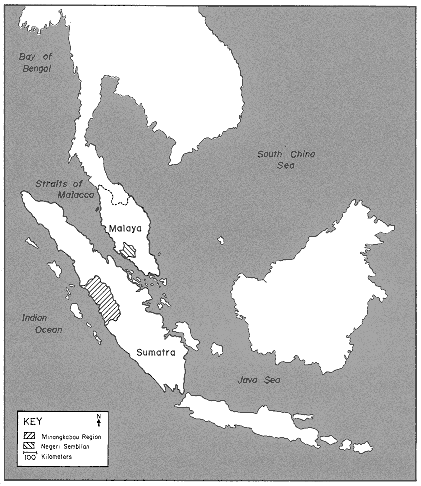
Map 1.
Sumatra and Malaya
[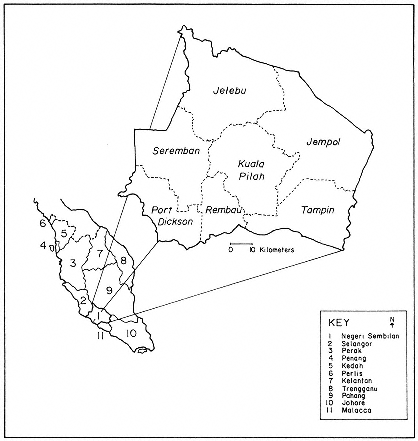
Map 2.
Malaya and Negeri Sembilan, Showing Contemporary State Borders and
the Principal Administrative Districts in Negeri Sembilan
In Rembau and throughout Negeri Sembilan, the Minangkabau settlers encountered aboriginal horticulturalists of Jakun (or related) stock (Newbold 1839, 2 : 76–77), who enjoyed more or less uncontested political rights to the region's territory and resources.[1] Myths told in Bogang about the initial contact between the two groups portray the Jakun women as exceptionally beautiful and of irresistible charm. Indeed, they were so enticing, even from afar, that the Minangkabau quickly sought out the Jakun headmen to discuss the prospects and conditions of arranged marriages
with their daughters. Although the aborigines were extremely reticent at the outset to allow the foreigners even to gaze upon their women, they eventually acquiesced and agreed to sanction a union between one of their daughters—a sylvan "spirit princess," no less—and a Minangkabau leader of considerable renown.
This symbolic betrothal and alliance aside, the precise nature and extent of historical contact between these two groups, whether in the form of intermarriage, trade, or warfare, remains unclear. Various myths and written sources suggest extensive intermarriage between the Jakun and the Minangkabau (Newbold 1839, 1 : 421, 2 : 77, 78, 377, 396; Lister 1887, 38; Parr and Mackray 1910, 3; Lewis 1962, 17), just as village elders of contemporary Bogang cite instances of amicable trade relations with individual Jakun well into the twentieth century (cf. NSAR 1892, 12–13). Undoubtedly, though, many aborigines fled deep into the forest so as to avoid all interaction with the better-armed and expansionist Minangkabau and their descendants (Newbold 1839, 2 : 78, 376–377; Gullick 1958, 7). Whatever the realities may have been, the widely accepted and mythically supported assumption is that many of the aboriginal inhabitants of Rembau and other areas of Negeri Sembilan were soon absorbed into the newly established Minangkabau colonies (Newbold 1839, 1 : 422). In the process, or so myths inform us, they came to be acquainted with wet-rice agriculture and the Sufi-influenced teachings of the Shafi'i branch of Sunni Islam, the knowledge of which the Minangkabau brought with them from Sumatra. More generally, they were introduced to the Minangkabau's social and cultural system, known as adat (adat perpatih ), which was grounded in pre-Islamic (that is, Hindu-Buddhist and pre-Indic) beliefs and practices and codified in a rich corpus of oral tradition consisting largely of customary sayings and sequences of quatrains (perbilangan and pantun , respectively).[2]
In Negeri Sembilan the initial phase of Minangkabau colonization was followed by a period that saw the arrival of successive waves of Indonesians, only some of whom claimed Minangkabau or even Sumatran ancestry (Gullick 1958, 38, 40, 41). The accommodation of these individuals within the framework of Minangkabau institutions thus necessitated certain structural innovations on the part of the immigrants and their descendants (see Newbold 1839, 2 : 217; Gullick 1958, 38–40; and below). Owing to such innovations and to contact with and borrowings from the Jakun, the organization of agricultural communities and political alliances
in Negeri Sembilan has long differed from those of the Minangkabau residing in Sumatra.[3]
By the nineteenth century dispersed matriclans (suku )[4] existed throughout Rembau and all other areas of Negeri Sembilan settled by Minangkabau (Newbold 1839, 2 : 121–123; cf. Gullick 1958, 40). Each of these dispersed units consisted of a variable number of localized clan segments (also known as suku ). In addition, they were divided into residentially aggregated components such as lineages (perut ),[5] lineage branches (pangkal ),[6] and the less-inclusive groupings defined in relation to a married (or formerly wed) woman, her adult daughters, and their household plot(s) (kampung ).[7] Both dispersed and localized clans were named and further differentiated from other units of like order not only by pedigree but also by virtue of their generally exclusive rights to ritual prerogatives, territorial domains, and certain political offices (see Newbold 1839, 2 : 119–123; Parr and Mackray 1910, 25). Individual lineages were also conceptualized as having mutually exclusive (or equivalent) rights to one or more political titles, and they, too, had distinctive names. These features distinguished clans and lineages from smaller genealogical groupings in the form of lineage branches, which embraced only those individuals with whom one could actually specify enatic (that is, matrilineal) linkages, and which probably had horizontal boundaries no broader than the third degree of collaterality (see chapter 2).
Postmarital residence patterns of the nineteenth century were derived from and generally congruent with codes governing the intergenerational transmission of rights over houses and land. To oversimplify, all such rights were vested in women (Lister 1887, 39, 45; Lister 1890, 316; Hale 1898, 48). (These rights were provisional, however, and because a female proprietor's enatic kin retained residual claims to the same property, they could thus exercise liens over it and otherwise help guarantee its conservation within the clan and less inclusive components thereof [Lister 1887, 44–45; Lister 1890, 316; Parr and Mackray 1910, 27, 65].) This favoring of female heirs worked to ensure uxorilocal residence (Lister 1890, 316; Hale 1898, 54), since women's rights to houses, homestead plots, and agricultural acreage flowed from their mothers and centered quite literally on their natal compounds. Men's access to property of this sort usually came through wedlock and the establishment and continued maintenance of a conjugal household in or near their wives' natal compounds, this despite
the fact that a married man retained certain proprietary interests in his sisters' holdings (Parr and Mackray 1910, 70) and might also claim a share of the harvest if he had contributed to its production.
The sexual division of labor was such that women assumed the major responsibility and most of the actual work for the maintenance and productivity of agricultural acreage (Gullick 1951, 47; cf. Hale 1898, 56). Men in bachelorhood, however, frequently worked in the fields held by their mothers and sisters (Parr and Mackray 1910, 70); in exchange, they received compensation in the form of food, clothes, lodging, and the implicit guarantee that the "marriage gold" (mas kawin ) and other capital called for on the occasion of their weddings would be forthcoming when needed (Parr and Mackray 1910, 73, 92, 94). Similarly, married men were expected to aid in the cultivation of—and if possible to add to—their wives' acreage. Men also planted and tended fruit trees,[8] collected and traded jungle produce (with the aim of acquiring commercial items and/or cash), and raised poultry and livestock, the yields of which they shared, depending on their marital status and the source of the capital involved in the investment, with the consanguineally related (but primarily female) members of their natal compounds or with their wives and offspring.
Clan Recruitment and Alignment
Clan membership was a prerequisite for permanent residence among Rembau Malays during the nineteenth century (Newbold 1839, 2 : 123; Parr and Mackray 1910, 5, 26). A widely known saying sums up the issue: "The stranger seeks a place [or clan] as the boat requires anchorage" (dagang bertepatan, perahu bertambatan ) (cf. Hale 1898, 53–54; Parr and Mackray 1910, 99). The notion of anchorage or mooring is especially relevant here, since at the most fundamental level this is what clanship—and kinship more generally—was all about. The same could be said of adat, for just as kin and social relations ordered in accordance with adat presupposed affiliation with a clan, so too did the corpus of symbols and idioms defined in relation to adat provide models for behavior in virtually all domains of existence. This latter theme is expressed succinctly in another customary saying frequently encountered in both the literature (e.g., Parr and Mackray 1910, 146; Caldecott 1918, 24–25) and present-day villages: "The living are moored and guided in all their actions by adat, just as the
dead are surrounded and held in place by the earth of the grave" (hidup di kandung adat, mati di kandung tanah ).
Since we are dealing with clans constructed on a model of matrilineal descent, the principal links implicated in recruitment should have been confined, in theory as well as practice, to those between mothers and their children. Yet in fact, recruitment often proceeded via other kin ties, and occasionally even embraced strangers.
Contemporary elders' delineation of recruitment policies of the precolonial era suggest that residential, defense, and other essentially political considerations could override those based on matrifiliation (even though an all-encompassing matrilineal ideology served in the long run to reorder and contain all such "ground-level noise"). One should bear in mind that the centuries preceding British colonial rule witnessed considerable movement of population throughout Negeri Sembilan, and in other areas of the Malayo-Indonesian world where local groups found themselves affected by the shifting political fortunes of regionally dominant powers, be they Johorese, Buginese, Acehnese, Minangkabau, or European (Newbold 1839, 2 : 32, 36, 117, 165–166; O'Brien 1884, 342; JAR 1892, 1, 9; Wilkinson [1911] 1971, 309; Gullick 1958, 29; Andaya 1971). In the case at hand, then, it was not inconceivable for individuals or entire communities to choose or find themselves forced by feuding or warfare to resettle within another clan's territorial domain. In some such situations, peaceful resettlement hinged on successful negotiations with the leaders of established communities, who might agree to accept the newcomers into a local clan in exchange for pledges of loyalty and support (Parr and Mackray 1910, 5–6). Additionally, it appears to have been necessary for an outsider to find an older woman of the host community willing to stand as his or her adoptive mother, thus maintaining at least the fiction of recruitment via matrifiliation (DeMoubray 1931, 176, 178–179). When a married couple sought to affiliate themselves in this way, one adoptive mother would suffice for the two of them and would likely define only the woman as her adoptee; the man would then be ascribed the status of son-in-law and in-marrying male rather than enate (DeMoubray 1931, 178–179). The basic structure of filiation and descent was thus reproduced inasmuch as the adopted daughter and all children born to her would share the same descent affiliation as the adoptive mother.
Also important is that emigration from the Minangkabau area, as well
as from Aceh, Jambi, and southern Thailand, continued over many centuries, as did overland migration from the neighboring regions of Sungei Ujong, Malacca, and Pahang. Given the military and other advantages of augmenting one's clan through the adoption of new members, together with the absence of unilineal descent reckoning among many of the so-journers, it became necessary, or at least highly advantageous and convenient, to group individuals into Rembau clans on the basis of regional or ethnic origins (Newbold 1839, 2 : 123; Parr and Mackray 1910, 5; Wilkinson [1911] 1971, 315–316; de Josselin de Jong 1951, 138). There is no way of ascertaining dates for the emergence and spread of this classificatory scheme, though village elders in Bogang assert that its appearance coincided with one of the earliest waves of emigration from Sumatra. Be that as it may, persons from the Payah Kumboh region of Minangkabau, for example, whether or not related to one another or in any way associated with the descent group of that name in their homeland, were deemed to be members of Rembau's Payah Kumboh clan. Those claiming other than Minangkabau ancestry were classified in similar fashion; Malaccans, Acehnese, and Buginese, for instance, each tended toward affiliation with particular clans, some of which continue to bear names denoting these settlers' non-Minangkabau origins (such as Anak Melaka, Anak Aceh). It is especially significant in this regard that Hervey's (1884, 259) enumeration of Rembau's principal descent units includes separate entries for the "nationality" of each clan.
The larger issue here is that relationships among clan mates, including persons recognized as having territorially or ethnically diverse origins, were both cloaked in and partially informed by the symbols, idioms, and constraints associated with common matrilineal ancestry (Parr and Mackray 1910, 5–6, 113). This entailed shared responsibilities toward the clan's estate of residential and agricultural acreage, unexploited tracts of forest lands, and, in some cases, political titles, particularly since the bestowal of rights guaranteeing eventual access to these estates typically accompanied most modes of recruitment to the clan. The activation of such shared rights over land served as a critical material referent of matrilineal kinship, and classificatory siblingship more specifically, regardless of whether the bonds in question were biologically grounded or simply imputed on the assumption or fiction of common descent from the same ancestral set of female siblings. Joint claims to an estate vested in a localized clan or lineage
undoubtedly fostered genealogical revision to ensure matrilineal consistency among individuals unable to demonstrate shared descent through the female line. Indeed, even today, if villagers are at a loss to explain the details of kin connections among individuals classed as collateral relatives within the matriline, they frequently invoke shared property rights as evidence, or at least a good indication, of common matrilineal ancestry. This suggests that genealogical connections were not the sole, or even the most important, criteria of relatedness among persons of the same clan.
It remains to consider certain aspects of clan affiliation via formal adoption in order to underscore that the enatic ties so created were conceptualized primarily in terms of siblingship rather than descent. The distinction merits emphasis in light of the more general point that constructs of siblingship seem always to have been hegemonic in defining both relatedness within and links among descent units of various degrees of inclusiveness.
Throughout the nineteenth century, a female of any age could obtain formal affiliation with a clan other than that with which she stood associated by birth.[9] This might occur in the case of a relatively poor individual seeking to attain access to productive acreage vested in a daughterless old woman of another local clan, and would typically involve assuming responsibilities for the adoptive mother's welfare in exchange for rights of proprietorship over her lands and house. (Adoption of this nature bears certain structural similarities to the other instances of formal adoption referred to earlier, but we are dealing here with isolated cases involving individual adopted children rather than entire households or larger groupings seeking acceptance within an established community. All such adoptions are also to be distinguished from informal transfers of children, which at present usually occur among women belonging to the same lineage or lineage branch; see chapter 6.) Reaffiliation presupposed public proceedings in the form of ritual animal slaughter and feasting, symbolizing the severance of the adopted person's links with her original enates on the one hand and the creation of new ties of enation on the other (Parr and Mackray 1910, 27; Taylor [1929] 1970, 139–141; DeMoubray 1931, 182–188). Analogous proceedings could also effect formal reaffiliation at the level of lineage. All such phenomena are designated as kadimkan (or berkadim ), a term denoting the process of becoming siblings—in particular sisters—and clearly suggesting a cultural emphasis on (enatic) siblingship rather than common descent (cf. Lewis 1962, 137–188). This is
wholly consistent with the conceptualization of relations among persons affiliated, by whatever means, with the same descent unit, be it a dispersed or localized clan, a lineage, or some less-inclusive segment, for such individuals think of their relatedness primarily in terms of siblingship.
Constructs of siblingship also provided the dominant idioms in terms of which clans and less-encompassing components thereof were held to be related to units of like order. This can be seen from mythic accounts of the scheme of clan ranking, which is evident in Rembau by the early 1800s (see Newbold 1839, 2 : 121–123; Hervey 1884, 259), although it is probably of much greater antiquity.
Local myths do not mention a Minangkabau clan hierarchy prior to or at the time of the first immigrant settlers' arrival in Rembau, but a system of clan ranking did eventually emerge, presumably during the earliest decades of foreign occupation (see table 1). This scheme of ranking had its mythical origins in the aforementioned union of a Minangkabau chief, To Lela Balang, and a Jakun woman, To Bungkal, which ultimately gave rise to three daughters and a son known as Seri Rama. This son, basing his claims on ties of matrilateral filiation with To Bungkal, whose tribesmen
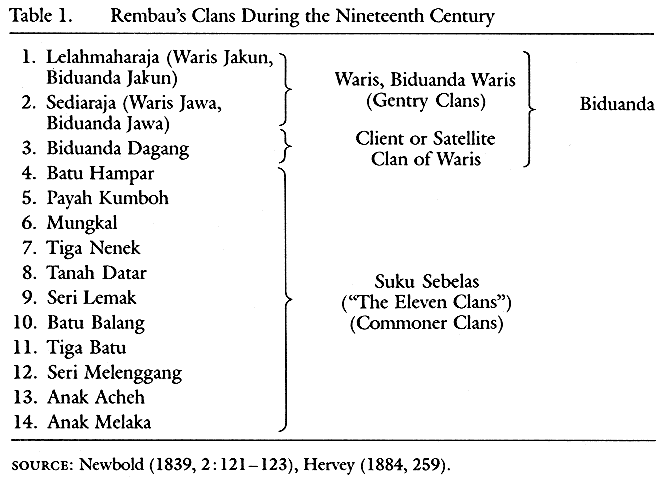
were the original "heirs to the soil" (waris ), emerged as the acknowledged head of a newly constituted gentry clan, thereafter styled Waris Jakun. Some myths suggest as well that Seri Rama became the first territorial chief and Supreme Law Giver, or Undang , of Rembau,[10] and that his candidacy for the office and his title—Dato Lelahmaharaja—were approved by the Sultan of Malacca (Parr and Mackray 1910, 4). Whether or not this is true, the designation Lelahmaharaja has long stood as a common synonym for the clan first known as Waris Jakun (Hervey 1884, 243; Lister 1887, 47).
The only other clan claiming the prerogatives and status of gentry traces its origin to To Laut Dalam, a contemporary and a "chiefly brother" of To Lela Balang, and quite possibly his patrilateral half-brother by virtue of a common father (or other male ancestor) and different mothers (from separate Minangkabau clans).[11] To Laut Dalam had once been married to a woman who bore him four daughters (the eldest of whom, Siti Hawa, married the chief Seri Rama); but as she hailed from Java, none of their children could claim matrilineal ties with the aboriginal Jakun, the group that, through descent, gave the Lelahmaharaja clan the status of "heirs to the soil." Nonetheless, To Laut Dalam's apparent envy over his "chiefly brother"'s success in gaining political recognition and privileges for his son motivated him to persuade the Sultan of Malacca to agree to a provision whereby the office of Undang would rotate between his "chiefly brother"'s descendants and his own. To Laut Dalam and his progeny thus assume prominence as the effective origin of the gentry clan known from that time on as Waris Jawa (the latter being the local term for Java and Javanese) or, alternatively, as Sediaraja, from the title granted to the first Undang chosen from their clan, the son of Siti Hawa and Seri Rama (Parr and Mackray 1910, 4–5; cf. Hervey 1884, 252).
Referred to collectively as Biduanda Waris or simply Waris, the Lelahmaharaja and Sediaraja clans together occupied the highest rung of Rembau's clan hierarchy (Newbold 1839, 2 : 120–123). They are currently held to be related as (or like) siblings (adik-beradik ), and presumably always were, despite the profound ethnic differences between their respective apical ancestresses and their wholly disparate enatic origins. Interestingly, the generalized siblingship linking the two clans is most emphatically maintained in Bogang culture, even though the mythic texts I encountered in the field do not widely recognize the tie of "chiefly siblingship" as the initial genea-
logically framed bond between these two clans. Rather, the construction of this linkage in terms of siblingship testifies to the continuity of a pervasive tendency to define individuals and social units as related like (or as) siblings whenever they share equivalent, parallel, or essentially complementary rights, obligations, or experiences with respect to the same political office, territorial domain, or other mediating element (cf. Kelly 1977; Marshall 1981a; Smith 1983).
The sibling equivalence of these two clans was manifest in the fact that neither of them could exercise any appreciable precedence over the other as regards political authority or other privileges (Parr and Mackray 1910, 5). For instance, rights to the office of Undang rotated in theory between them, with each alternately providing a candidate for the position (Newbold 1839, 2 : 119–120; CRACNS 1874, 12; Hervey 1884, 242; Lister 1887, 47; Parr and Mackray 1910, 48–49). Additionally, the marriage payments due their women were equivalent in value, and higher than those received by women of all other clans (Parr and Mackray 1910, 52); and intermarriage between the two groups seems to have been the ideal, as would be expected in light of analytically distinct, though mutually reinforcing, considerations of status endogamy.
The siblingship that united the two gentry units was also exclusivistic, for it linked only them; other clans were therefore defined as nonsiblings in relation to gentry clans, or in any event "much less like siblings."[12] This disjunction has long been realized in the gentry clans' sanctified monopoly on furnishing candidates for offices whose jural domains were of districtwide significance, as in the four posts comprising the Undang's Privy Council (Orang Besar Undang ) (Parr and Mackray 1910, 29) and of course the position of Undang itself. Members of these two clans also enjoyed the right to demand higher retributions for the murder of their kin (Hale 1898, 59; Parr and Mackray 1910, 52; cf. Newbold 1839, 2 : 123), although most of their other privileges surfaced only in ritual contexts.
In accordance with a rationale phrased largely in terms of historical precedence, or "origin point" (asal-usul ), Rembau's nongentry clans were ascribed commoner status, for according to most mythical explications of clan ranking, their forefathers were not the leaders, and in some cases were not even members, of the original expedition to Rembau. Consequently, permission to clear land, set up villages, and wield legitimate political
power derived neither from the autochthonous aborigines nor from the Sultan of Malacca. Instead, these privileges were granted them—in exchange for token payments, or the promise of such—by the representatives of the Lelahmaharaja and Sediaraja clans, who thus stood, if only on that account, as their benefactors (Hale 1898, 53; Parr and Mackray 1910, 108–109; cf. Lister 1887, 39; Lister 1890, 304). This patronage relationship appears to have been most explicit in the case of the Biduanda Dagang clan, which contemporary villagers regard as the lowest-ranked of all Rembau descent units. Persons affiliated with this clan are held to be descendants of the most recent arrivals in Rembau, many of whom fled their homelands as a result of famine or warfare or were simply itinerants or foreigners (as suggested by the term dagang ; cf. Parr and Mackray 1910, 72). In some instances the ancestors of contemporary Biduanda Dagang were slaves (hamba ),[13] having been purchased in Mecca by Rembau Undang or else acquired through military victories. Whatever their geographic and social origins, those who attained Biduanda Dagang standing in the past purportedly did so thanks to the benevolence of Lelahmaharaja and Sediaraja leaders, who agreed not only to accept their presence in or near their own settlements but also to extend them protection and clan representation, as well as a number of less-prestigious political titles.
For such reasons the Biduanda Dagang clan seems always to have had a unique and structurally ambiguous relationship vis-à-vis the Lelahmaharaja and Sediaraja clans. All three clans, after all, could be referred to by the shorthand gloss Biduanda, and, as noted, all three owed their allegiance to the same clan chief. And yet in terms of manifold expressions of power, status, and genealogical purity, Lelahmaharaja and Sediaraja occupied the uppermost niche of the clan hierarchy, whereas Biduanda Dagang fell at the other extreme of the continuum. Even at present, those identified as Biduanda Dagang continue to bear the burden of an ancestral stigma, as reflected in gentry reluctance to seek them out as potential marriage partners and in occasional references to their tainted pedigrees.
Not much is known about the nineteenth-century construction of linkages among commoner clans. Information collected around the turn of the century, however, reveals that the members of certain of these descent units could not intermarry because of ties of patrilateral half-siblingship between their apical ancestors (Parr and Mackray 1910, 77; see also chap-
ter 2).[14] This suggests a recognition of brotherhood that was altogether separate from enatic calculations of relatedness; it also lends further testimony to the relevance of siblingship as a connective, and potentially disjunctive, principle at the clan level.
Territorial Alignment
Within the domain of territorial alignment, principles of siblingship were accorded far greater centrality than those of descent and clearly provided the dominant idioms underlying both the conceptualization and actual organization of relationships and activities. This is best illustrated by examining various levels of such alignments, proceeding from the most inclusive to the most restricted.
Perhaps the most fundamental territorial distinction ever recognized by Malays in Rembau or other districts of the state was that between their homeland of Negeri Sembilan and all other regions of the Malay Peninsula (DeMoubray 1931, 182–188; cf. Gullick 1958, 135). This distinction symbolized the most basic level of social and cultural variation among Malays anywhere in the Peninsula.
Numerous mythic portrayals of Negeri Sembilan's cultural origins suggest that the relationship between the Malays of Negeri Sembilan and those residing elsewhere in the Peninsula is one of siblingship, inasmuch as the two ancestral figures associated with the genesis of cultural divergence are held to be related as (or like) brothers (see Newbold 1839, 2 : 220–221). It is not clear from any of the accounts with which I am familiar if these two culture heroes, Dato Perpatih Nan Sebatang and Dato Temenggong, were actually full brothers or were instead half-brothers (or, for that matter, classificatory brothers). As their titles indicate, though, the former was responsible for conceptualizing and establishing the framework of adat perpatih institutions, while the latter either founded or simply continued to support that body of tradition known as adat temenggong . Judging from Negeri Sembilan accounts, their divergent opinions concerning the status and rights of women in inheritance and the ideal organization of communities laid the foundations for the earliest cultural distinctions among the Minangkabau. More important, given the Negeri Sembilan perception that most if not all Malays are of Minangkabau ancestry (Newbold 1839, 2 : 215–216), the lack of consensus between these brothers gave rise to the
dominant cultural marker serving throughout history to distinguish Negeri Sembilan Malays from all others. Here, then, the principle of siblingship structures a critically important nexus of relationships embracing mythical culture heroes as well as the origins, history, and contemporary expressions of social and cultural diversity.
Within Negeri Sembilan, moreover, a focus on (classificatory) siblingship rather than on common matrilineal ancestry appears in the reckoning of relationships among the Undang of Rembau and those of the three other regional polities (Sungei Ujong, Jelebu, and Johol), who formed an unprecedented but largely ineffectual politico-military union in the 1770s. Ever since that time, both the four Undang and their respective territories (luak ) have been regarded as related to one another "like brothers"[15] —all of which is consistent with the fact that each of the leaders then stood, and still remains, more or less identically situated vis-à-vis the titular head of the union (the Yang diPertuan Besar ).[16]
Interestingly, just as their politico-military pact contributed to the intensification of strife and warfare throughout the area (Newbold 1839, 2 : 87–92, 149–150; Parr and Mackray 1910, 19–23; Wilkinson [1911] 1971, 296–310), so too did many of the military and other altercations of the next century revolve around confrontations, frequently bloody, between the principal chiefs of Rembau, together with their supporters, and those of Sungei Ujong (Newbold 1839, 2 : 89–92, 97, 105, 111–112; CRCANS 1874, 18–20, 232–236; CRCANS 1875, 8–10; CRCANS 1876, 193–222; Gullick 1958, 16–17). Many of these conflagrations thus involved a variant of fratricide. More generally, whether or not the cloaking of all such potentially bellicose relations in idioms of siblingship endowed them with a modicum of cordiality (to say nothing of amity), the fact remains that competition, petty rivalries, and overt antagonisms among titled males and political aspirants defined as brothers is a pervasive theme throughout Negeri Sembilan's precolonial history (Newbold 1839, 2 : 89–92, 97, 105, 111–112; Parr and Mackray 1910, 19–22, 63; Gullick 1958, 16–17; Hooker 1972, 22–23; Khoo 1972; Andaya 1971).
There also exists strong evidence that siblingship figured in the representation of the earliest known political division within the district of Rembau. To appreciate this we need only consider the mythic genesis of this division, as well as why clan leaders in the first of the two regions settled, "Lowland" Rembau, enjoyed certain ritual and political preroga-
tives not extended to their chiefly compatriots in Rembau's "Upland" territory (Hervey 1884, 250–251; Parr and Mackray 1910, 3).
Stated briefly, To Lela Balang and To Laut Dalam founded Rembau's first two villages, which were in the Lowland district (Rembau Baroh) (Parr and Mackray 1910, 3). Affiliated with the Batu Hampar and Payah Kumboh clans respectively, these chiefs were accompanied in their emigration by other clan members and by members (including leaders) of the allied Mungkal and Tiga Nenek clans. Together, but presumably after the Upland area (Rembau Darat) was settled, these four clans forged the earliest formal politico-military pact within Rembau. Known as the (Lowland) League of Four (Yang Empat or Yang Empat Sebelah Baroh ), this federation stood as the most esteemed and powerful political body in all Rembau's precolonial history (Parr and Mackray 1910, 6–7, 42, 43). Indeed, even after 1831, when the council was expanded to include four leaders from Rembau's Upland district and renamed the League of Eight (Yang Delapan ), the chiefs of the original federation continued to exercise many of their earlier privileges and played a pivotal role in Rembau politics and in Rembau's relations with neighboring and other foreign polities (Parr and Mackray 1910, 20, 42, 49).
The colonization of the Upland district may have taken place shortly after Lowland Rembau was opened up by To Lela Balang and To Laut Dalam. Judging from myths presented by Hervey (1884, 253–255) and Parr and Mackray (1910, 8), it was settled in part by To Laut Dalam and other Payah Kumboh clan members, along with persons affiliated with the three clans of Seri Lemak, Batu Balang, and Seri Melenggang. Each clan staked out a specific locale, over which the individual clan leaders claimed jurisdiction. These chiefs then forged a political counterpart to the Lowland League of Four, designating it the Upland League of Four (Yang Empat Sebelah Darat ). This body also assumed a position of centrality in Rembau's precolonial polity, even though its more recent emergence (hence less prestigious "origin point") resulted in its being accorded lower status and fewer ritual and political prerogatives than its predecessor.
There are also scattered mythical references to a tie of patrilateral half-siblingship between To Laut Dalam and the apical ancestor of the Tiga Nenek clan (Parr and Mackray 1910, 77). Hence, of the original four clans to settle within Rembau, three were linked through a particular variant of siblingship, which also emerges as the earliest—and for some time the
sole—genealogical connection between the Lowland League of Four and the Upland League of Four, and between the entire Lowland and Upland divisions in Rembau.
Although these two federations bore some of the trappings of strictly matrilineally constituted alliances, they were actually territorially based defense organizations whose structure and operations were simply couched in idioms of matriliny and siblingship. This situation obtained as well with respect to subsequently formed political alliances, the most recent of which, comprising five different clan chiefs, emerged during the period 1795–1820, operated in Rembau's Lowland district, and took as its name the League of Five (Parr and Mackray 1910, 7).
The origins and conceptualization of the League of Five are quite instructive. As set out in a myth presented by Hervey (1884, 253), a Biduanda woman was "taken to wife" by a man in the Mungkal clan residing in the Tampin territory, but in a grave breach of adat his people failed to provide her kin with the requisite marriage payment. The head of her clan consulted an allied chief representing the clan of Batu Hampar (Petani). These two then summoned their kin and proceeded with them to Tampin to demand the outstanding payment. After an unsuccessful two-week siege, the chiefs called on the leaders and members of three other, unrelated Lowland clans (Anak Aceh, Anak Melaka, and Tanah Datar) to aid them in their quest for justice. In unison the five chiefs and their supporters attacked and defeated Tampin and finally obtained the marriage payment in question, thus terminating the Biduanda-Mungkal hostilities. But these events also provided the foundation for a politico-military pact among the chiefs who had joined forces for the offensive, for on returning from Tampin they vowed to act together "for as long as the sun and moon endure" and to share in whatever advantages and injuries came the way of any one of them. The solemn oath they registered occurred in the context of a ritual feast (kenduri ) and entailed a blood pact in which each chief put a small amount of blood into a common cup and then sipped a drop of the mixture. Not surprisingly, this ritual pact appears identical in overall design to the traditional symbolization of siblingship between clan mates and those formally adopted into the clan (Taylor [1929] 1970, 139–141; Lewis 1962, 138).
Formal political alliance at the clan level apparently presumed no matrilineal ties or genealogical proximity among the constituent descent units.
Nevertheless, while territorial, demographic, and political factors were the effective prime movers in clan federation, the cultural expression of material realities related to such alliances was commonly framed in the imagery of kinship, especially siblingship.
There are various other levels at which the alignment of territories defined by, or simply identified with, discrete and theoretically exclusivistic social units appear both cloaked in and consistently shaped by idioms of siblingship. To illustrate, we may examine the mythically enshrined structure of relationships among settlements associated with Rembau's gentry clans.
Returning to the mythical account of the origins of the Lelahmaharaja and Sediaraja clans (see figure 1), we see that To Laut Dalam (founder of the Lowland village of Padang Lekoh) had four daughters by his marriage with the unnamed Javanese woman said to be the apical ancestress of the Sediaraja clan. By her marriage with Seri Rama, To Laut Dalam's eldest daughter, Siti Hawah, gave birth to a male child who is considered to have been the first member of the Sediaraja clan and to have eventually resettled and established the Lowland village of Kampung Tengah. Likewise, the descendants of Siti Hawah's three sisters opened up three new communities (also in Lowland Rembau), each tracing its origin to a different sister. In brief, the progeny of To Laut Dalam's four daughters succeeded in founding four distinct villages regarded throughout history as the most senior of the Sediaraja settlements.
At the apex of their mythical genealogy, then, these four villages stand connected by virtue of the fact that they were founded by sisters. Note, however, that since none of the four women actually belonged to the Sediaraja clan founded by the son of Siti Hawah, or to any other descent units, it makes little sense in terms of an exclusively matrilineal transmission of clan membership and status that the descendants and settlements associated with Siti Hawah's sisters stand on a par with those of her son. This parity obtains owing to the sibling bond that not only links the four women in question and renders them more or less structurally equivalent but also dictates a de facto mythical extension of Sediaraja status from Siti Hawah's son to the offspring of his mother's sisters.
A similar pattern of territorial expansion and alignment appears in the case of the Lelahmaharaja clan, which, as discussed earlier, traces its origins to the union of To Bungkal and To Lela Balang, the latter being the founder of the Lowland village of Kota. Although none of the four off-
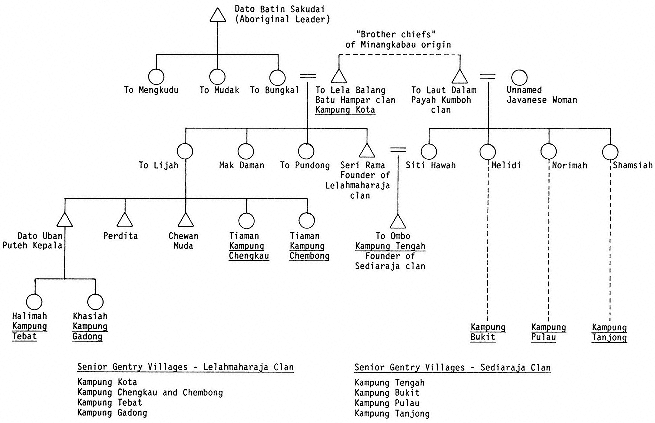
Figure 1.
Mythic Genealogy of Relations Among Founders of Rembau's Gentry Clans and Senior Gentry Settlements
Note: Most of the relationships depicted here can be pieced together from myths presented in Parr and Mackray (1910).
A more complete version, appearing in Abdul Samad Idris (1968, 167–174), serves as the basis for this figure.
spring of these luminary figures are linked in any direct way with the establishment of new settlements, one of the female children, To Lijah, did give birth to two daughters, each known curiously as Tiaman, who appear to have been responsible for the initial occupation of the Lowland areas (later to become villages) of Chengkau and Chembong. In turn, their brother, Dato Uban Puteh Kepala, fathered two daughters, Halimah and Kasiah, who rank as the founders of two additional villages: Tebat in Upland Rembau and Gadong in Lowland Rembau, respectively. During the lifetime of To Lela Balang's great-grandchildren, then, the Lelahmaharaja clan's territorial domain embraced five distinct settlements or senior gentry villages and by that point had also come to include a colony in Upland Rembau.
The structure of genealogical connections among these senior gentry villages is analogous to, though somewhat more complex than, that of the Sediaraja case. Strictly speaking, there are five of these Lelahmaharaja villages, although two of them, Chengkau and Chembong, occupy a single politico-jural status. Thus myths, written sources (e.g., Parr and Mackray 1910, 29), and contemporary elders tend to speak only of Lelahmaharaja's four senior gentry communities, even though they recognize that Chengkau and its apparent offshoot, Chembong, are separate settlements located some distance apart. In any event, the structure of ties among these villages is also patterned on siblingship rather than descent. Here too, then, myths effect an extension of descent unit affiliation from a male clan founder (Seri Rama) to his otherwise unaffiliated sisters. In so doing, the myths emphasize the equivalence of siblings and the connective significance of the siblingship principle. More specifically, they serve to generate a bond of siblingship between Seri Rama's village of Kota and those founded by the descendants of his sisters' daughters, namely, the settlements of Chengkau and Chembong.
The structural relevance of siblingship in village and descent unit alignment is manifest as well in the relationship between these latter three villages and the communities of Tebat and Gadong. Tebat and Gadong were originally connected through bonds of patrilateral siblingship and possibly (though not for certain, since the myth is silent on this point) through common ties of matrifiliation. Interestingly, the founders of these villages, Halimah and Kasiah, share their father's descent group membership. This could indicate an incestuous union on the part of the father, but is more
likely yet another mythical expression of the structural equivalence of siblings (that is, Dato Uban Puteh Kepala and his sisters). In short, the descendants of Halimah, Kasiah, and the two Tiamans do not stand related to one another through an unbroken succession of matrilineal links. Rather, the structural logic connecting these groups and their associated villages derives from the principle of siblingship. I might add here that there is no principle of descent that can accommodate these mythic representations.
The relations of equivalence suggested by the mythic siblingship links among the senior settlements of Rembau's two gentry clans were also realized in the principles governing the devolution of rights to gentry political offices, and were therefore of far greater structural significance than data derived from myth alone might lead one to assume. Moreover, the logic of succession to the title of Undang sheds light on the structure of genealogical relations among the founding settlements of individual commoner clans, for the same principles based on siblingship obtained in the case of commoner titles and territorial alignment.
The System of Offices
An overview of the principal relations of authority in Rembau's precolonial polity can be gleaned from part of a customary saying (perbilangan ) that is widely known at present and commonly encountered in the reports of earlier observers as well (e.g., Lister 1887, 43, 44; Hale 1898, 53–54; Parr and Mackray 1910, 87, 116):
The Undang rules the district,
The clan chief governs the clan,
The clan subchief rules his enates,
And the wife's enates prevail over in-marrying males.
These and intermediate relationships are depicted in figure 2, a schematic representation of Rembau's traditional polity and the territorial domains associated with each political office and council.
The Undang sat at the apex of the political hierarchy and was regarded by his subjects as sacrosanct (berdaulat ) and as Allah's caliph or vice-regent (berkhalifah ) within Rembau (Parr and Mackray 1910, 48, 50, 52, 53). This figure not only symbolized and effected the institutional integration
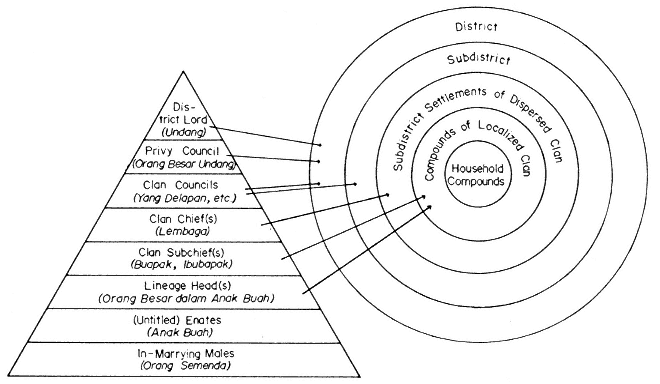
Figure 2.
The Indigenous Political Hierarchy in Nineteenth-Century Rembau, Showing
Territorial Domains of Political Offices and Councils
of adat and Islam, but he also enjoyed rights to conscript male villagers for defense purposes and to make periodic demands on household labor and food resources (Newbold 1839, 2 : 85–86; cf. Lister 1887, 48). The Undang was also entitled to collect annual payments in kind from the proprietors of certain categories of land (see chapter 2), even though he was barred by adat from intervening directly in any clan's affairs unless petitioned to do so by the chiefs of those clans (Parr and Mackray 1910, 48, 58). In a word, adat granted the Undang broad powers and variegated ritual prerogatives but simultaneously imposed quite specific constraints on his authorities. It was in fact as enforcer of such constraints that the four-person Privy Council, or Orang Besar Undang, came into being during the eighteenth century. This body served to check the Undang's comportment vis-à-vis clan chiefs and thus constituted a buffer of sorts between Rembau's highest-ranking leader and the largely autonomous but politically vulnerable heads of dispersed clans (Parr and Mackray 1910, 34).
Succession to any of the foregoing titles presupposed affiliation with one of Rembau's gentry clans, for rights to these offices were vested in the gentry in accordance with mythic alliances and exchanges with aboriginal Jakun, which endowed them with privileged proprietorship over the whole of Rembau and all its inhabitants and resources.
Certain clan councils, for their part, also enjoyed districtwide realms of
jurisdiction. As one example, the council known prior to 1831 as the League of Four, and thereafter as the League of Eight, exercised legitimate powers throughout Rembau, even though the clan chiefs on the council were in most other respects limited in jurisdiction to specific territorial domains, such as Lowland or Upland Rembau (see Parr and Mackray 1910, 25, 26, 40). Succession to the chieftainship of any clan also entailed ascribed status with respect to all clan councils—as a member of certain rank, for example, or as a nonmember. Thus, in most instances rights to an office of clan chief included legitimate claims to a specified role in one or another council, and all such rights not only vested in particular clans (or more precisely, in the Lowland or Upland segments thereof), but also stood as their "ancestral property" (harta pesaka ).
Because there were usually only one or two clan chief titles for any given clan in Lowland or Upland Rembau, responsibilities for regulating a broad range of community affairs typically devolved on the chief's immediate subordinates. I refer here to clan subchiefs (buapak or ibubapak ), each of whom exercised authority over the compounds of a localized clan (Lister 1887, 45–46) and concurrently served to link village residents with extralocal political figures. Clan subchiefs also helped guarantee that the members of their communities received equitable treatment at the hands of clan chiefs, much as the chiefs themselves served to check the activities of the Undang (see Parr and Mackray 1910, 36–39).
Titled individuals occupying the lowest rung of the political hierarchy were also charged with promoting justice in accordance with adat and increasing the likelihood that their immediate superiors did right by their relatives. Deemed to be officials of the clan chief, these lineage heads, or "big men among the kin" (orang besar dalam anak buah ),[17] helped ensure that capricious, partisan, or extortionary behavior on the part of subchiefs either did not occur or resulted in appropriate punishment (Parr and Mackray 1910, 34). If punishment were required, portions of the fine paid by a guilty subchief to the clan head were shared with the lineage heads; apparently these comprised the main income associated with the office (Parr and Mackray 1910, 34). Lineage heads also received direct remuneration in the form of percentages of the fees paid by male clan members in the village who were involved in "irregular marriages"—for example, marriage by abduction (cf. Parr and Mackray 1910, 82–85)—although they were prohibited by adat from levying fines on their own accord.
Of broader concern is that the office system served to encode a model of
"pure matriliny," and yet did so in a larger context of territorial and descent unit alignment where matrilineal idioms provided but one component of the relevant structure (and thus only a partial explanation for its expression "on the ground"). The other nexus of idioms here, and in many other realms of indigenous social theory and practice, was based on notions of siblingship, the behavioral imperatives of which were contextually variable but could be wholly inconsistent with those based on matrilineal descent.
Bear in mind, for example, that rights to each political title were vested in a single dispersed clan, or territorially defined segment thereof, with the partial exceptions of the Undang and two or three other gentry titles. Disregarding these cases, each title was held to be the property of one specific social unit, membership in which was frequently expressed in terms of common matrilineal relatedness and typically ascribed at birth by virtue of ties of matrifiliation with a woman belonging to that same category (or, alternately, by adoption). As in most ethnographic instances of such estates, rights to any given political office were wholly concentrated among the members of a single clan or segment thereof, and could not devolve on persons or collectivities defined as external to the relevant category. Viewed from the other side, an appropriate descent affiliation was a pre-requisite for political succession, even though many other considerations—moral character, verbal skills, charisma, physical well-being, patrilateral connections—also figured.
Further testimony to the prevalence of descent idioms in the system of offices was the convention whereby the term used to designate enatically related kin of junior generational standing, anak buah , was also employed by political leaders in referring to their adherents.[18] Just as a man's sisters' children stood as his anak buah, to take the most relevant example, so too did everyone in Rembau share that designation in relation to the Undang. Conversely, all titled males were defined as mother's brothers in relation to their charges.
We turn now to the logic of succession to political office, in which siblingship serves as a basic ordering, and fundamentally disjunctive, principle. An example drawn from contemporary Bogang provides a useful illustration. Bogang's Lelahmaharaja clan, which comprises three named lineages, holds exclusive rights over four political titles: clan subchief and the three lower-ranking "big men among the kin," or lineage heads. Rights
over these offices pass from one lineage to the next in a set sequence; thus, when any one of these political figures dies, his title will be bestowed on a member of the lineage next in line for that particular title. Stated differently, even though rights to these titles never pass out of the localized clan, neither do they devolve from mother's brother to sister's son, as occurs in many other political systems associated with matrilineal descent. Instead, they pass among structurally equivalent social units held to be related to one another "like sisters."
An analogous logic governed access to the title of Undang, which has been defined as the "ancestral" property of Rembau's two gentry clans ever since its inception during the period 1540–1640. Recall that the mythical genealogies of these clans portray their respective apical ancestresses as unrelated to one another except for the tie of "chiefly brotherhood" between their husbands. That is, although these two men belonged to separate clans and were thus structurally distant in terms of matrilineal calculations, their relationship of "chiefly brotherhood" provided the primary link between both their wives and their wives' enatic descendants. I need only reiterate that rights to the office of Undang have always rotated in theory between Lelahmaharaja and Sediaraja, which implies the same structural equivalence that appears in myth as a particular variant of nonenatic siblingship.
Yet to point out that rights to the office of Undang rotated between Lelahmaharaja and Sediaraja is to oversimplify; it was also the case that rights to provide a candidate for this office passed among each of the senior settlements associated with these clans (Parr and Mackray 1910, 48–49). For example, when an Undang of the Lelahmaharaja clan died or vacated office owing to impeachment or infirmity, the title passed ideally to one of the Sediaraja communities not only endowed with senior standing but also held to be next in line for candidacy in relation to the other three Sediaraja villages of equivalent status. This second circuit of rotation provides additional justification for regarding siblingship as the dominant idiom regulating accession to the office of Undang, for we have already seen that the genealogical bonds among the senior villages of each clan receive mythical expression in terms of sibling ties. So, too, does the existence of a third circuit, which specified that the residentially localized lineages in each of these settlements were to take turns in furnishing nominees whenever their village was eligible for candidacy. Unfortunately, we do not know how such lineages were held to be connected to one another
during the nineteenth century, although present-day residents of Bogang do view them as related like siblings, especially sisters. I suspect that this has always been the case.
This material suggests that all social and territorial units associated with the founding settlements of gentry clans and vested with equivalent, parallel, or essentially complementary rights to the same political title(s) were held to be related as (or like) siblings by virtue of their common relationships to the office(s) in question. The same rules of political succession can be discerned in the case of founding settlements associated with individual commoner clans as well (see Parr and Mackray 1910, 120–141; cf. Lister 1887, 45, 47; Lister 1890, 308–310; Gullick 1958, 77), with an identical logic grounded in siblingship.
It remains to elaborate on my earlier point that principles of siblingship also assumed a disjunctive role in the political system. Consider, for example, that no explicit notion of structural precedence is apparent by which certain adult males within a sibling set, lineage branch, or lineage would merit preferential or exclusive consideration when their lineage was due to provide a candidate for office. That is, while the Rembau schemes of rotation enjoined serial succession at the levels of dispersed and aggregated clans and lineages, they seem not to have ranged beyond these units by specifying a variant of primo- or ultimogeniture, or anything of the sort commonly reported for conical clans (Gullick 1958, 70, 74, 77). This might be interpreted as a mechanism promoting intralineage equality, since distance from a founding line or apical sibling set was not explicitly relevant and candidates could thus be selected instead on grounds of "paternal luster" or some combination of acquired skills or other achievements. The problem, however, was that this might also promote the emergence of invidious intralineage distinctions, based on potential military prowess or some special acquired competence, which could effectively negate the structural equivalence otherwise characteristic of relations among adult male enates (particularly those of the same relative generation). Further, this meant that all males in a particular sibling set, lineage branch, or lineage might well be vying for the same political stakes (Gullick 1958, 70, 74, 77); hence, their competition could well give rise to divisiveness within the very unit they sought to represent.[19] Indeed, in light of the pronounced cultural emphasis on the equivalence of same-sex siblings, one would certainly expect a man to harbor profound resentment toward a
brother who attained political office while he himself simply muddled along as "mere villager." More to the point perhaps is that structurally induced sentiments of this nature continue to provide a context for the expression of myriad variants of fraternal strife.
Other tensions engendered by the structure of the nineteenth-century political system had profound social and cultural significance as well. Many stemmed from the fact that in-marrying males were not only subject to the control of their wives' enates (Lister 1890, 317; Hale 1898, 56–57; Parr and Mackray 1910, 95, 116–117; Caldecott 1918, 36–37) but also owed allegiance to their own enatic relatives, whose interests they were clearly expected to further, especially those of their female kin (see chapter 2). Some of these tensions were realized in the domain of inheritance, in that rights over certain of the proceeds of a deceased man's labor might be divided between his widow and children on the one hand and his sisters and their progeny on the other. The potential for conflict in this situation, where two distinct sets of enatic kin could lodge legitimate claims over the intestate properties of one particular male decedent, is clear.
More important still is the fact that titled males (and subsequent generations of indigenous elite) stood partly outside the system of affinal control that both underlay and made possible the social reproduction of enatic units at all levels of inclusiveness. One reason for this is that they were vested with symbols and bases of authority and prestige generally unknown to their untitled counterparts, and were thus far less vulnerable to the sanctions imposed on them by affines. Elites were therefore ideally situated both to contravene established canons of order and to endow largely unpopular or ambivalently embraced innovations with a modicum of sanctified legitimacy.[20] The implications of these circumstances will be clear after we examine the political elite's critically important role as entrepreneurs during the nineteenth and twentieth centuries (chapters 3 and 4).
2—
Kinship and Property Relations
This chapter begins with a discussion of residence and household composition; it then describes siblingship, incest prohibitions, marriage and exchange, and the roles of in-marrying males, fathers, and mothers. The final section focuses on relations of property, inheritance, and residence, numerous aspects of which helped to produce in the interrelationship of sisters what could well be judged the paramount structural bond within both the domestic sphere and Rembau society as a whole. Yet neither the strength of this bond nor its conceptual significance can be reduced to or derived from the interplay of these factors. Rather, the phenomenon of sisterhood is most profitably viewed against the more encompassing domain of siblingship, which subsumed ties among parallel-sex as well as cross-sex siblings and also informed constructs of gender and incest, and a great many features of property and inheritance codes.
Residence and Household Composition
As we have seen, the population of settlements in nineteenth-century Rembau consisted for the most part of individuals born in the village and
belonging to one or another matriclan, but also of men originating elsewhere who moved into the community upon marriage. Those born in the village were affiliated in turn with one of the local lineages, each of which was represented by residential clusters of households reflecting less inclusive genealogical divisions, the largest being the lineage branch. Given the explicit ideal, and actual predominance, of postmarital residence within the wife's mother's compound, the domestic groups associated with a particular lineage or component thereof comprised a core of women related through the matriline and men who, upon marriage, moved from their natal compounds to those of their wives.
A man's postmarital residence was often in the wife's natal household initially, since the construction and provisioning of a new home for the couple—clearly the duty of the husband,[1] even though the wife's father (or parents) might assume the responsibility—could take some time. In the case of a man joined in wedlock with the youngest daughter of the household, however, residence within the home of his parents-in-law was a permanent rather than temporary arrangement; for upon his wife would fall both the responsibility of attending to her parents throughout their old age and the privilege of inheriting their house as compensation for her troubles (and for the convenience of everyone involved) (Parr and Mackray 1910, 68).
This latter exception aside, postmarital residence eventually resulted in the creation of a new household adjacent to the wife's home but still within the compound or homestead plot controlled by her mother (and maternal aunts). Although I characterize this pattern as uxorilocal, we are dealing with postmarital residence involving settlement in the wife's village and the establishment of a separate household in the wife's mother's compound.
Household composition varied in accordance with the developmental cycles of domestic groups and the availability of homestead acreage and rice land. To illustrate the nature of such cycles, we may consider a hypothetical household containing a woman, her spouse, and two unmarried children of each sex.
Assuming that our ideal household had sufficient land, and bearing in mind as well that females were married off at a much earlier age than males (roughly 12–14 and 17–19, respectively), we find the first change in household composition occurring when the elder daughter attained marriageable age and had a spouse chosen for her (apparently by her mother
or the latter's mother or sisters). The household would then receive a new member in the person of the daughter's husband. Sooner or later—but presumably prior to having any offspring—the couple would move into an adjacent home, constructed ideally by the groom, and establish a household of their own. Within a few years the elder son of the household would marry and establish residence within his mother-in-law's compound, if not her actual household. This pattern would repeat for the other son and daughter. Now both sons would have moved away, returning only for visits, to attend feasts, and to fulfill ritual obligations (unless they divorced and remained divorced for an extended period of time). The two daughters and their husbands, in contrast, would have settled within the ancestral compound. Since the youngest daughter typically lived with her husband and eventually their offspring in her parents' home, the genealogical depth of that household would be extended one generation beyond that of her sister as long as one parent remained alive.
Until the mother's death, the two households within her ancestral compound stood as a single kinship grouping defined largely in relation to the mother's social role and status, which included that of guardian and transmitter of ancestral land. After the mother's death and the formal division of property, her daughters attained a degree of genealogical and social recognition for themselves and their households as well as a behavioral autonomy theretofore unknown to them; for eventually these two women would raise and marry off their own female offspring, all of whom—the availability of suitable homestead land and rice acreage permitting—would establish households in or near (and in the latter instance thereby extending) their own natal compounds. The two sisters would thus emerge as the focal points of two distinct kin and residential units, each defined in relation to one of the sisters and her property. The children of these two women would stand related as saudara sanak ibu ,[2] that is, as cousins whose mothers were sisters (see figure 3). Given sufficient land, the enatically related offspring of saudara sanak ibu, who ranked as saudara sanak dato (cousins whose maternal grandmothers were sisters), would also find themselves living in adjacent compounds. At the next generation, then, the children of female saudara sanak dato stood as saudara sanak moyang (cousins whose great-grandmothers in the matriline were sisters); under favorable circumstances all of the females and unmarried males in this latter category would reside in a single section of the village.
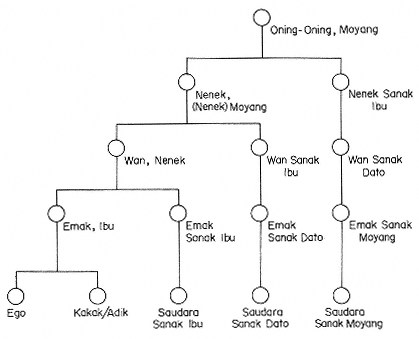
Figure 3.
The Genealogical Structure and Boundaries of a Lineage Branch
Those related as saudara sanak moyang viewed themselves as members of one pangkal ("branch," "root," or "trunk"), this being the most inclusive genealogical grouping within the village below the level of lineage. At the next generation, however, the children of adult female saudara sanak moyang probably did not regard one another as members of a single lineage branch. (This assumes that recent data from Inas [Lewis 1962, 83–84] and my own findings in Bogang are indicative of nineteenth-century villagers' ability to trace unilineal [or any other kin] ties back in time.) This latter classification appears generally restricted to lineage members able to recall a tie of female siblingship in an antecedent generation. Thus, rather than being of the same "branch" or "root," the children of adult female saudara sanak moyang would belong to two or more different categories of that order, each identified with the female offspring of one of the two daughters with whom we began this illustration.
This streamlined, hypothetical case outlines the process whereby lineage branches crystallized from a single household consisting minimally of a
woman and two daughters.[3] In many instances, to be sure, the formation of separate named lineages within a given community occurred in much the same fashion, albeit over a longer period of time.[4] Not surprisingly, this assumption underlies present-day views of the origins of the three lineages comprising each of Bogang's gentry clans (Lelahmaharaja and Sediaraja). These lineages are generally regarded as having developed from a single, long-forgotten set of female siblings, such that in both instances the lineages of a single clan are related "as (or like) sisters."
The Cultural Construction of Siblingship
Various features of proprietorship, inheritance, and residence helped to produce in the interrelationship of sisters what could well be judged the primary structural bond within the domestic realm, as well as in local society as a whole. Yet neither the strength nor the conceptual significance of this bond is derivable from the mutual interaction of these variables. Rather, the conceptual or ideational dimensions of ties among sisters, including their classificatory meanings, are best assessed against the more inclusive category of siblingship relatedness.
To elaborate, I would reiterate that kinship nomenclature—in the form of reference terminology—and the actual reckoning of kin ties among collaterals in the matriline placed considerable emphasis on links among female siblings. More generally, the major subdivisions within localized lineages were essentially projections back in time of ties among sisters (cf. Lewis 1962, 125–127). Thus the children of two sisters stood related as (and were classified together by the term) saudara sanak ibu, which focused more on the fact that their mothers were sisters than on their own descent from the same maternal grandmother. Similarly, the daughters of these women stood as saudara sanak dato, the emphasis here again being on a female sibling tie in an ascending generation (in this case between their maternal grandmothers) rather than on their common descent from the same woman in the +3 generation. The same logic prevailed with regard to more distant collaterals of ego's generation within the lineage branch, just as it underlay the reckoning of reference terminology employed by persons of different generations within the unit. We have seen as well that entire lineages within a single clan and village stood related as (or like) sisters, as did all of the senior (or Waris) settlements associated with the Sediaraja clan.
Ties among natural and classificatory sisters were of crucial significance in numerous domains of cooperation and exchange as well. We have seen that a woman's right to occupy, cultivate, or otherwise make use of ancestral property was vested in the mother (from whom it derived in the first place), frequently until the latter's decease. Usually only well after the mother's death was the land formally and more-or-less equally divided among the female offspring, even though specific sections of the mother's holdings were commonly and informally designated for the use of this or that adult daughter during the mother's lifetime (Parr and Mackray 1910, 74). Prior to adulthood, then, sisters, along with their unmarried brothers, jointly worked the land of their mother and had a common stake in its upkeep and productivity. Upon attaining adulthood, each sister received a comparable portion of the mother's holding for her own use and management. Assumption of this responsibility, however, did not lessen the sisters' obligation to aid their mother either in the cultivation of her now reduced rice plot or in other tasks. For this and other reasons (and in sharp contrast to the situation among brothers), cooperation and frequent interaction among sisters persisted long after they married and established themselves in separate households. Moreover, such relations continued well after the mother's death, for the fact of having adjacent rice fields watered by the same stream and a single network of irrigation canals and brushwood and earthen dams increased the advantages of mutual cooperation (even while it might simultaneously have caused some antagonism).
Labor exchanges and cooperative endeavors associated with rice cultivation also involved many women who were not related as natural sisters but were nonetheless of the same lineage, and lineage branch in particular—hence, classificatory sisters. Such women were ideally situated to assist one another during various stages of the production process, if only on account of the immediate proximity of their plots. Other residentially proximate female kin, as well as unrelated neighbors, could also be counted on during the most labor-intensive stages of production, such as the harvest. The requirements of harvesting presupposed considerable extrahousehold assistance, especially since the principal harvesting implement up until the mid to late 1960s was a small finger knife (tuai ) that was used to cut the stalks of ripened grain one at a time. The details and variants of the institutionalized labor arrangements do not concern us, but it is worth emphasizing that the most common of these social forms appears always to have been subsumed under the rubric tolong-menolong . This term, denoting mu-
tual assistance and reciprocal aid, has long served to symbolize the disinterested willingness to assist others (without calculations of return) that is expected of all villagers but is most frequently realized in the case of female kin.
Additionally, many of the ceremonial duties and everyday chores defined as "women's work" (kerja perempuan ) called for cooperation in the exchange of goods and services among women in the matriline. Here I might cite the importance of santan , a thick liquid made from grated coconut flesh mixed with water. Santan was a central ingredient in many cakes and sweets, and in virtually all of the curry and hot-chili sauces used to flavor and preserve fish, fowl, and other foods served with rice. Even today, the grating of coconut is an extremely labor-intensive endeavor, and women often call on their sisters, nieces, and cousins to aid them in this task, particularly if there are any guests to feed. Many of the preparations for ceremonial feasts also required contributions of labor from one's female kin in the matriline, along with small gifts of foodstuffs (coconuts, uncooked rice, and eggs, for example) to help cover shortages and defray expenses incurred by the sponsors of such events. It seems reasonable to assume, moreover, that small gifts of cooked food, including especially fish, chicken, water buffalo, and cakes, were frequently exchanged among the women of proximate households, as they are today. Thus, however else these women stood connected or linked through exchange, they were also involved in numerous networks of reciprocity based on the sharing of prepared foods.
All such instances of cooperation and exchange undoubtedly enhanced the conceptual significance of ties among natural and classificatory sisters. As noted earlier, however, the ideological or affective import of such bonds cannot be derived from these factors, or from the interplay of norms or sentiments flowing from common residence, socialization, and shared rights to property coupled with a system of reckoning descent through the matriline.
My contention that female siblingship is best analyzed in regard to siblingship more generally receives support from the previously discussed mythical origins of the sibling ties between the Lelahmaharaja and Sediaraja clans on the one hand, and among the senior (waris) settlements linked with these clans on the other. In both cases the structural equivalence of units linked by siblingship—which subsumes but is not limited to "sister
ties" among the constituent units—carried over into the political domain (in the devolution of rights to certain offices, for example, most notably that of the Undang) and simultaneously contributed to the ordering of major political elements and relationships.
Additional support for my argument appears in the form of contemporary kinship terminology, many features of which were documented earlier in the twentieth century (see Winstedt 1920; de Josselin de Jong 1951, 123–125; Lewis 1962, 110–127) and presumably were employed in similar if not identical fashion throughout the nineteenth century as well.[5] We might first note the scope and the varied meanings of the polysemic term saudara . At the most inclusive level, the designation saudara encompasses all of ego's relatives, despite generational differences and regardless of whether connective links are through females or males. At the same time, saudara may refer primarily to individuals of the same generation linked to ego through either parent's same- or cross-sex siblings. Saudara can also be used in a generic sense to embrace natural siblings of either gender. In the second and third instances, alternative terms may be employed as well. In the third case, for example, we encounter sekadim or adik-beradik (siblings) or, referring more specifically to particular individuals, abang (elder brother), kakak (elder sister), and adik (younger sibling of unspecified gender). The most fundamental point, though, is that the designation saudara is neither gender-specific nor applied only to members of the same matriline. It can, of course, be used with qualifying terms to delineate relationships very precisely (to distinguish matrilateral from patrilateral cousins, say, or cross from parallel cousins through a single parent); but even in these cases the designation effectively promotes non-gender-specific siblingship over any of the other categories of siblingship. The same holds true for the partially overlapping term adik-beradik , which denotes siblings and sibling relationships (natural as well as classificatory) without invoking the issue of gender.
More generally, generational and relative age distinctions appear to have received far greater elaboration than distinctions based on collaterality, sex, or enatic versus affinal relatedness (Winstedt 1920). As with teknonymous usages, this elaboration served to promote a classificatory scheme whereby all members of one's social universe were grouped into generationally defined age grades (great-grandparents, grandparents, parents, siblings, children, grandchildren, and so on), each of which com-
prised an extended sibling set. Similarly, conventions of reference and address served to differentiate persons associated with either the same or first ascending generation based on birth order, thus highlighting the relational importance of siblingship by defining individuals with respect to their position vis-à-vis their siblings.
Also fostering the cultural significance of siblingship were the beliefs and ritual activities centering on the placenta, its relationship to the unborn fetus, and the interactions between the afterbirth and the individual born at the time of its expulsion. Throughout the course of a woman's pregnancy, the placenta, or temuni , was viewed as a sort of "elder sibling" to the developing embryo—for, like an elder sibling, the temuni nourished and protected the fetus, guiding its growth and maturation. This potentially beneficent relationship continued throughout the "younger sibling's" life, although it was perhaps most crucial during the first forty-four days of the child's existence. The temuni's guardianship over the newborn during this critical period was partially ensured by a ritual known as "planting (or burying) the afterbirth" (taman temuni ). A brief consideration of the essential components of this ritual as conducted in contemporary Bogang affords valuable insights into certain of the themes mentioned above, particularly since villagers view this complex to be of great antiquity (see also Lewis 1962, 147; McKinley 1975, 220–234).[6]
Local accounts and my own observations indicate that the disposal of the afterbirth required a midwife (bidan ), or some other woman regarded as competent, to cleanse it and to oversee or conduct the other preparations preceding its burial. The hole into which the temuni was to be placed could be dug by either a male or a female; however, both the location of the hole and the gender of the person chosen (typically from among the onlookers) to place the afterbirth within it depended on the gender of the newborn. In the event of a female child, the hole was dug beneath the central, most inaccessible, protected, and private section of the mother's house, where the resident females slept, thus symbolizing female centrality within the household.[7] If the child was male, the temuni was placed underground either in the open garden or below the verandah (serambi ), which was exposed on three sides, unprotected, and quite "public," the part of the house where males slept and guests were received and entertained. The child's gender also determined how villagers reckoned the temuni's gender and what items were selected for placement into the hole along with the
afterbirth (for instance, sewing needles or other "typically female" items in the case of a girl).
Once a hole roughly two feet deep and eight or ten inches across had been prepared, the covered temuni was laid gently at the bottom and covered with loose dirt until not much of a depression remained. Bits of coconut husk and small twigs were then piled atop the depression and ignited with embers from the kitchen hearth, and the midwife or whoever else had filled in the hole recited Koranic incantations over the flames. This recitation marked the end of the burial of the temuni, although the mother's kin generally constructed a rough lean-to over the hole to prevent rain from falling on or otherwise dampening it. Further, if they were conscientious (rajin ), they would rekindle the flame daily throughout the forty-four-day period corresponding to the mother's observance of dietary taboos. This act would guarantee the complete "drying out" of the temuni and thus decrease the probability of the child crying incessantly or falling ill from stomach or abdominal pain (sakit perut ).
This ritual illuminates important issues bearing on cross- and parallel-sex siblingship. On one level we have an unambiguous statement concerning an individual's behavior toward siblings: protective toward younger and respectful toward elder siblings. Yet at the same time, the elder/younger relationship is symbolically confined to parallel-sex siblings; a male child's sibling spirit is an "elder brother," that of a female is an "elder sister." This does not mean that individuals are not encouraged to protect and further the interests of younger siblings of the opposite sex. Nevertheless, parallel-sex siblings are represented as bound together through moral obligations of a greater (or in any event different) sort than those obtaining among cross-sex siblings. For that matter, the convergence of interests and identities among parallel-sex siblings is symbolically realized in the spatial aggregation or segregation of afterbirths according to sex—namely, the clustering of female temuni beneath the house proper and of male temuni in an entirely separate spot underneath the verandah or in the immediate garden area. Here we have a ritual statement that brings into focus not only the shared—though essentially complementary (rather than structurally equivalent)—interests and identities of opposite-sex siblings, but also the marked social distance that should characterize all their interactions.
The fundamentally separate and distinct interests and identities of opposite-sex siblings were also realized in inheritance: women alone in-
herited rights over houses and land, and men monopolized rights to political offices and weapons.[8] This gender-based demarcation in inheritance not only promoted female centrality in the household (and in enatic residential groupings more generally), but it also reinforced the important role male kin played in representing enatic units and ensuring the virginity and moral standing of their unmarried natural and classificatory sisters.
As brothers and other male enates were charged with safeguarding their sisters, it stands to reason that sexual activity between brothers and sisters ranked as among the most heinous of all moral infractions; indeed, it was likened to cannibalism and defined as a treasonous crime (celaka derhaka ) punishable by death (see Lister 1887, 49; Lister 1891, 143–144; and below). Interestingly, such activity was subsumed in a category of offenses that also included harboring vampirelike and potentially murderous spirits-familiar, or pelesit (Parr and Mackray 1910, 79). The origins of pelesit, in fact, have apparently long been attributed to an incestuous union involving a brother and sister, as shown in the following myth, obtained from a woman in contemporary Bogang.
There were once three beautiful siblings, two males and a female, who was the youngest. As both their mother and father had died, there were just the three of them. One day the elder of the brothers said, "Let's leave and find a house, for our mother and father are gone, and who is going to look after us?" Thus they set off in search of a house with no owner, looking everywhere, even in the forest. They came across an empty house and decided to rest. The eldest told the others to stay there, that he was going to search for food. While he was away the other brother did wrong with his sister, and she became pregnant. As her belly grew large, the sister complained of abdominal pains and said that she was going to give birth. She then went below to wash, even though it was raining. She bathed and bathed for forty-four days. It continued to rain, but still the sister bathed. She finally bore a child. Its blood was white—"unlike ours," said the [offending] brother, who went down from the house and began lapping up the discharge. His sister was mortified, as was the elder brother, who demanded an explanation for the other brother's behavior. "What are you doing?" he asked, "eating the blood?" "That's right," the younger brother responded, adding as well that the blood was delicious and that the elder brother should keep quiet. Extremely upset by all that had happened, the elder brother, who was knowledgeable in sorcery and curing, told the younger brother that he no longer deserved a place in the house. He then went off to fetch some thorny reeds, which he placed under the floor [amidst the discharge]. He ordered his brother to continue lapping up the blood, lest their sister die. As the thorns pierced the younger brother's tongue, he grew infuriated and was forced to in-
terrupt his eating. Driven on by pain and anger, however, he continued to feast upon the blood. Eventually, after his anger subsided, he grew remorseful and searched for a curer to tend to his wounds. His condition improved, but he and his brother and sister were subsequently attacked and strangled by a spirit who devoured their blood, and all three of the beautiful siblings became pelesit.
The most explicit moral to be gleaned from this myth is that sexual activities involving a brother and sister are guaranteed both to incur the wrath of elder siblings (and other guardians) and to evoke fatal retribution entailing transformation into dreaded spirits whose sustenance derives from the blood of postpartum women and newborn children. These messages are also congruent with the dominant themes in the ritual burial of the afterbirth: both texts foreground the social distance and the complementarity of interests and identities that should characterize relations among cross-sex siblings. It remains only to add that most prohibitions on mating and marriage concerned persons who were held to be of common stock and interrelated by virtue of sibling ties (enatic or otherwise). This will be clear once we consider the concept of sumbang , which has long been used in Negeri Sembilan to refer to incest.
Incest and Proscribed Unions
Lister (1887, 49, 1891, 143) and Parr and Mackray (1910, 77–79) give the impression that actions designated as sumbang were incestuous in the Western sense of the term—that is, that they involved sexual activity between individuals who could not marry owing to considerations of biological relatedness, culturally defined intimacy, common descent-group membership, and the like. Although the sumbang rubric certainly did cover this class of transgressions, it also denoted a far more inclusive category of offenses, as indicated both by contemporary villagers and by official correspondence written in 1924 by Rembau's then Undang, Dato Abdullah (bin Haji Dahan) (NSSSF [1924] 1881/24). Subsumed under the sumbang gloss were in fact a number of different though related types of moral impropriety, in addition to the more serious crime of illicit sexual contact. In the case of an adolescent or adult male, for example, these improprieties included sitting in a secluded or confined area alongside a woman other than one's wife, particularly a woman with whom adat forbade marriage (sumbang kedudukan , from the root duduk , "to sit"); walk-
ing side by side or conversing with such a woman (sumbang perjalanan , from the root jalan , "to walk or travel"; and sumbang percakapan , from the root cakap , "to talk or speak," respectively); engaging in sexual activity with such a woman (sumbang perbuatan , from the root buat , "to do or make"); and being frequently observed in irregular conduct associated with one or another variant of sumbang (sumbang pemandangan , from the root pandang , "to observe, look, or see") (NSSSF [1924] 1881/24).
A male guilty of any of these improprieties might well be fined and, if married, ordered from his wife's village. (His resistance to an expulsion decree could lead to his being permanently driven out of the community by a hail of sticks, an action known as dikerat kayukan .) If his improper behavior caused a pregnancy, the case necessarily came to the attention of the Undang for adjudication, and the financial retribution would be particularly costly (NSSSF [1924] 1881/24). If the guilty parties belonged to different clans or were members of lineages between which intraclan marriage was permitted, they might be forced to wed, especially in instances of "incestuous sitting" (sumbang kedudukan ) with an unmarried woman. This solution would bestow a measure of respectability on all concerned.
As I have already noted, the vast majority of prohibitions pertaining to specifically sexual relationships involved persons interrelated through siblingship, and sexual contact between a brother and sister of the same parents ranked as the most reprehensible of all such offenses. Villagers today contend that physical intimacy involving matrilateral or patrilateral half-siblings was (and still is) comparably criminal—and in the same league as sexual activity between a mother and son or a father and daughter (cf. de Josselin de Jong 1951, 125–126). One resident of Bogang likened such sexual contact to the purported cannibalism of a local species of fresh-water fish (Ophicephalus striatus ) said to prey on its own offspring (macam haruan makan anak ).
Sexual relations between siblings of the same mother were classed as sumbang sekadim and it seems that any sexual activity between members of the same lineage might fall into this category as well. All of these crimes merited the death penalty (Lister 1887, 49), although the Undang could decide instead to expel offenders from Rembau and confiscate their ancestral property (Parr and Mackray 1910, 78). As with parent-child liaisons, those involving persons of the same lineage strike present-day villagers as immoral to the point of contravening the most basic God-given
designs of nature. Hence the customary saying "Like a chicken eating its own flesh (or meat)" (Macam ayam makan daging sendiri ), which draws an explicit analogy between such liaisons and domesticated chickens picking and consuming the meat from discarded scraps of cooked chicken. Sexual encounters between persons of a single lineage are thus equated with the ultimate horror—and horribly unnatural act—of cannibalism, a view Freud ([1913] 1950) would have found intriguing given his position on cannibalism and the origins of incest taboos.
Ranking as lesser, but nonetheless grave, transgressions were illicit contacts between persons belonging to different lineages within the same exogamous clan or subdivision thereof. Although some early observers (Lister 1887, 49) and contemporary reports claim that these encounters (designated sumbang sewaris in the case of the two gentry or Waris clans) constituted capital offenses, turn-of-the-century sources suggest that retribution involved merely confiscation of ancestral property and banishment from Rembau—and might even be commuted by the Undang to a simple fine, which included fifty measures of unhusked rice and a buffalo (Parr and Mackray 1910, 77).
Conventions of exogamy varied from one clan to another and necessarily involved diverging proscriptions on sexual relations, since these relations were condoned only in the context of marriage. In the case of the two gentry groups the entire clan stood as the exogamous unit, owing to the mythically validated assumption that all clan segments originated from the same apical ancestress (and thus shared in the same matrilineally transmitted daging [flesh or meat]). Among commoners, in contrast, marriages could be contracted between persons belonging to certain of the separate localized components of the same dispersed clan (see Parr and Mackray 1910, 121–141). Unions of this sort, however, attained legitimacy only if the two clan segments in question claimed no common ancestress (hence no shared daging), as for example when one traced its origins to Lowland Rembau and the other arose following later emigration from Sumatra (or anywhere else) to Rembau's Upland region (Parr and Mackray 1910, 77).
Genealogically based restrictions on marriages between members of separate dispersed clans (or segments thereof) did not rest merely on considerations of structural distance within the matriline. In Lowland Rembau, for instance, the Tiga Nenek and Payah Kumboh clans could not intermarry because the pioneer chiefs of these two clans were patrilateral
half-brothers (Parr and Mackray 1910, 77). Clearly this interdiction is not based strictly on matrilineal relatedness, for the matrilineal descendants of the two leaders belonged to different clans. These and similar prohibitions pertaining to unions with a father's brother's child (Parr and Mackray 1910, 92–93) suggest that marriages between individuals linked through demonstrable or even putative ties of patrilateral siblingship were as inappropriate as those involving persons linked through matrilateral siblingship, however remote the original bond.
The explanation for these prohibitions lies with conceptions of shared, biologically transmitted bodily substance, along with notions of substance and "closeness." We know, for example, that the children of sisters are believed to share the same matrilineally transmitted flesh or meat, and on that count alone are viewed as "too close" to enter into sexual relations with each other. We also know that brothers' children, as well as brothers' sons' children, are seen as originating from the same semen or seed (beneh ) and are forbidden to marry—and that this injunction also encompasses all of their patrilateral descendants who recall or acknowledge the existence of the original sibling tie (Lewis 1962, 130). I therefore suggest that the recognition or assumption of shared biological substances conveyed through men has long, if not always, served as the basis for the prohibition on all varieties of patrilateral parallel-cousin marriage. Hence, we need not invoke the existence of exogamous patriclans and a system of double unilineal descent, as de Josselin de Jong (1951, 126 et passim) has done, to account for the prohibition on a man's marriage with his FBD. Indeed, neither acknowledgment of the father's role in the procreative process nor the passage from a father to his children of bodily fluids, personality traits, or property rights has any necessary bearing on the presence or absence of patrilineally constituted descent groups.
My contention that persons presumed to share common biogenetic substance were disqualified from legitimate sexual activity and intermarriage is well supported. The underlying logic of this contention is consistent with, indeed would have promoted, the view that cross cousins (a man's FZD and MBD, for example) do not share common bodily substance; individuals thus related were held to be ideal marriage partners (see below). Also relevant are the prohibitions on sexual contact and marriage between otherwise unrelated persons who were breast-fed by the same woman ("milk siblings" or "siblings of the same milk," adik-beradik/saudara sesusu ).
It seems reasonable to conjecture that individuals thus classified have always been subject to such constraints, given the rationale that the mother's (or another woman's) milk nourishes and sustains an infant in much the same way the mother's womb (rahim ) nourishes and sustains an embryo. Ontogenetic development leading toward the formation of a healthy individual requires both pre- and postnatal transmission of bodily substances. Hence, whoever breast-feeds the child necessarily contributes some of her own growth-inducing essences to it, including in particular those responsible for the development of the child's flesh (and bones). In the event that a child is nursed even temporarily by a woman other than its mother, its flesh, or daging, would be considered the product of the daging of both women. Given the prohibition on sexual contact and marriage between persons of the same daging, then, the child could never enter into any form of sexual or conjugal relationship with the offspring of the woman who nursed it, even if by all other criteria they stood as eligible marriage partners.
I should add that the sumbang rubric simultaneously subsumed polygynous marriages and extramarital affairs involving a man and two or more women of the same clan, the most serious transgressions of this type being sororal polygyny and other forms of intimacy with a current or estranged wife's sister. (Sororatic marriages were possible, however, as apparently were their leviratic counterparts [Parr and Mackray 1910, 78; Lewis 1962, 189].) Polygynous unions with women of a single lineage or clan ranked as "taboos imposed on in-marrying males by their affines" (pantang tempat semenda pada orang semenda ) (NSSSF [1924] 1881/24) and as capital offenses comparable in magnitude to harboring the dreaded, potentially fatal spirit-familiar (pelesit ) (Parr and Mackray 1910, 79). Arrangements of this nature were undoubtedly highly unusual, as suggested by the fact that polygynous unions of all varieties were both discouraged and extremely rare in occurrence (Hale 1898, 45; Parr and Mackray 1910, 78–79).[9]
It merits note, finally, that a divorcé(e) was not allowed to marry into the clan of his or her former spouse (Parr and Mackray 1910, 78). Assuming that divorcé(e)s tended to remarry, as I suspect they (especially the males among them) did, this prohibition would have contributed to the dispersal, rather than the reduplication, of existing alliances,[10] and would thus have helped local groups to maximize formal friendships, trade rela-
tionships, and other bonds characterized by trust, reciprocity, and cooperation. As for the larger issue of parallel marriage, I know only that contemporary villagers feel it is "wasteful" for enatic kin of the same relative generation to reduplicate marriage ties with any particular group.
Marriage and Affinal Exchange
Engagement and Marriage Proceedings
With the notable exception of "irregular marriages" (see Parr and Mackray 1910, 82–85), negotiations as well as reciprocal hosting and small-scale feasting involving the kin of the prospective bride and groom might begin months in advance of the engagement proceedings, let alone the formal wedding.[11] Even the most preliminary inquiries (merisik ) concerning the pedigrees and backgrounds of the spouses-to-be involved visits by the future groom's kin (or their intermediaries) to the enatic relatives of the girl (or their representatives). If these and similarly oriented visits were to proceed smoothly, the guests were required to bear small packets of betel to symbolize their sincerity and honorable intentions, just as the hosts were more or less obligated to provide tea or light snacks (if not a substantive meal) and some of their own betel as well (see Newbold 1839, 2 : 294–295).
Assuming the girl's elder kin responded favorably to the proposed union, a simple gold "asking ring" (cincin tanya ), given to them as a token of the groom-to-be's sincerity in pursuing the match, would further firm up the agreement (Newbold 1839, 1 : 254; Parr and Mackray 1910, 79–80). A second gold ring presented by the suitor's kin then finalized the betrothal (Parr and Mackray 1910, 80). This latter transaction typically occurred in the context of an elaborate engagement feast (kenduri ) sponsored by the girl's side (NSSSF [1911] 252/11) and attended by the clan subchief and lineage heads of her local clan, the majority of her lineage mates (including out-marrying males), more distantly related persons in the community, and a large contingent of her fiancé's kin.
The first day of formal wedding ceremonies[12] revolved around the "marriage contract" (akad nikah ) and focused on a series of ritual transactions known as "fulfilling the adat" (mengisi adat ). The most elaborate of these transactions was the presentation of "marriage gold" (mas kawin )
from the clan subchief of the groom, together with its receipt by the bride's clan subchief and its inspection by other representatives of her clan (Parr and Mackray 1910, 36, 94). This ceremony ranked as the central element of the entire ritual complex with regard to validating the bond between husband and wife, and the link between their respective descent units. The reasons for the significance of this transaction become evident when one considers that the marriage gold encompassed two separate payments: first, the marriage gold proper, which seems to have been regarded as a prestation from the groom to the bride (Newbold 1839, 1 : 254, 2 : 283; Parr and Mackray 1910, 83, 94); and second, the "adat money" (wang adat ), the handing over of which was apparently conceptualized as involving two clans in their entirety (Parr and Mackray 1910, 94). Part of this latter sum was earmarked for officials of the bride's clan. The remainder was claimed by the bride's mother, who distributed some of it to her close enates and used the rest to help defray wedding expenses, the bulk of which were borne by her household.
The marriage gold payments were immediately followed, and effectively reciprocated, by the return to the groom's side of the two engagement rings, which the bride's mother had safeguarded ever since they were first presented to the bride's clan subchief (or other representatives) (Caldecott 1918, 40–41). Additionally, at this stage of the ceremonies, if not before, the property (harta pembawa ) and debts, if any, that the groom brought to the marriage were formally declared, followed by a similar declaration concerning the property (harta dapatan ) that the bride brought to the union.[13]
The first day of formal wedding ceremonies was also the occasion for the specifically Islamic dimension of the marriage ritual, which called for the presence of a local mosque official, the bride's Islamic guardian (wali ), the groom, and, as witnesses, a few male onlookers. This aspect of the wedding focused on the mosque official's recitation of the marriage service (khutbah nikah ) and warrants special remark for two reasons. First, it symbolized—but most definitely did not effect—a transfer of legal responsibility and control over the bride from her Islamic guardian (usually her father, but in any case a male) to her husband.[14] Second, it appears to suggest that the system of affinal alliance was composed of descent units linked through exchanges of rights over women. I argue that the messages conveyed in this component of the marriage ritual were largely irrelevant
to, and contradicted by, the overall design of the transactions in the formation of conjugal bonds and social reproduction. More specifically, the realities of marriage and affinal exchange did not center on a father relinquishing rights and obligations concerning his daughter, and doing so in favor of his daughter's husband; rather, they turned on a mother's transfer of claims and responsibilities over her son to the son's wife and the latter's immediate enates.[15] I shall return to this theme in due course.
After the recitation of the marriage service and the ensuing period of common prayer on behalf of the newly wed couple, the bride's relatives treated the groom's kin and all other guests to a sumptuous feast including oiled rice (nasi minyak ), meat, and other lavishly prepared and ornately garnished foods. At the close of the feast both sets of kin retired to their respective compounds, although the groom might have stayed at his bride's mother's house, sleeping alone on the verandah.
The second day of the wedding festivities, known as "the day of becoming one" (hari bersatu ), also witnessed a series of reciprocal exchanges between the kin of bride and groom. Relatives of the groom, for instance, arrived in procession at the bride's home bearing betel and various items of cooked food including glutinous rice (pulut ) prepared with turmeric. This rice was placed adjacent to the dais where the bride and groom would later sit in state (bersanding ) while being viewed by guests and hosts alike. During this phase of the marriage ritual, women from among the groom's entourage applied a henna mixture to the bride's palms and feet, and in a reciprocal gesture of goodwill their counterparts on the bride's side did the same to the groom.[16] Beforehand, however, a mock struggle between bride and groom was enacted, with assistance from their principal attendants. Focusing on reciprocity, the exchange of food, and relationships mediated and defined by the giving and receiving of food, this ritual feeding (makan suap ) consisted of bride and groom each attempting to force a handful of pulut into the other's mouth while simultaneously endeavoring to resist "receiving the other's gift." If all went well, neither party to the attempted exchange could claim an unqualified success. In short, the attendants saw to it that neither bride nor groom prevailed over the other, for such an outcome would bespeak a marriage marked by the victor's dominance, as opposed to a relationship characterized by balance and complementarity.[17]
Following the ritual feeding, the bridal couple feasted while the groom's kin partook of another sumptuous meal provided by their affinal hosts. Thereafter both sets of relatives retired to their respective compounds and began (or continued) preparations for the third day of the wedding festivities. Later that night, however, the groom returned to his bride's mother's home, bearing gifts of food from his kin along with a bundle of clothes and other personal possessions, symbolizing the severance of residential ties with his mother, sisters, and other close enates. Once inside he was welcomed by his in-laws, offered betel by his wife, and otherwise accepted into her household. The groom slept inside the house that night, joined by his bride.[18]
The third, and typically the final, day of formal wedding ceremonies was known as "the day of introductions" (hari menyalang ), in reference to the ritualized introductions that took place then between the bride and a contingent of her kin (excluding her mother) on the one side and the groom's mother and kin on the other. These introductions were initiated by the bride's relatives, who traveled in a procession, headed by the bridal couple, to the groom's mother's house bearing gifts of betel and food, including packets of glutinous rice and sweet dodol cakes. On its arrival the procession was formally greeted by representatives of the groom's side, who assumed the role of host for the day. Following the presentation of the gifts, the bridal entourage and all other visitors were served a lavish feast sponsored by the mother of the groom. Later in the evening the groom's mother also gave representatives of the bride's group a small sum of money, as a reciprocal gesture acknowledging the glutinous rice and dodol cakes they had given her. Representatives of the other households that had also received food followed suit, or alternatively pledged their intentions to reciprocate these prestations at a future date. (The money thus collected was subsequently turned over to the bride, as were any other gifts that might have been offered up by the groom's kin on this occasion, such as plates or a table setting for two provided by the groom's mother.)
The winding down of the hari menyalang feast marked the close of formal wedding ceremonies, even though other ritualized introductions and exchanges typically continued for another week or two. One such series of events (glossed berbesan ) centered on the ritual meeting of the bride's and groom's parents. The first of these formal introductions took place when
the groom's parents and kin, laden with offerings of betel, glutinous rice, and other food, visited the home of the bride's parents. The gifts were presented by the groom's mother to the bride's mother in the context of a feast hosted by the bride's household. The second round of introductions involved a similar sequence of events and similar gifts (probably with the addition of dodol cakes), but in reverse—that is, the visit and presentation of gifts by the bride's parents and kin, who journeyed to the home of the groom's parents.
A subsequent phase of ritualized visits (menyalang or menyembah ) involved the bridal couple's being formally introduced to the respective enates of bride and groom. In the first series of such introductions ("the small menyalang," or menyalang kecil ), the couple visited various households of the bride's kin. Each household received gifts of betel and other food from the bridal couple, along with glutinous rice and dodol cakes. They then provided the bridal couple with a meal, shared in the food the couple had brought, and presented the bride and groom with a small sum of money as a reciprocal gesture acknowledging the gifts of rice and cake. The duration of this period of visiting depended largely on the size of the bride's local descent group, but a few days at most was probably the norm.
The second series of formal social calls subsumed under the rubric of menyalang was also of short duration, although these visits appear to have been somewhat more elaborate and were designated by a separate term (mengulang jejak ), which, not surprisingly, refers to the groom's retracing his footsteps for the last time. The bridal couple now called on various households inhabited by the groom's kin, each of which was likewise presented with gifts of betel and food and responded as the bride's kin had during menyalang kecil.
This overview of the principal events and transactions associated with engagement and marriage proceedings is by no means exhaustive, but it should suffice for our present purposes.
Before broaching the subject of funerary rituals, I wish to emphasize that, of the items that a newly wed woman presented to her mother-in-law during her initial visits to the latter's home, dodol cakes were the most important. Moreover, a married woman was fully expected to offer dodol to both her mother-in-law and other women of the mother-in-law's lineage branch whenever she visited them. These prestations occur even to-
day, and have always been among the primary symbols both of affinity and of women's crucial role in maintaining affinal bonds.
Funerary Rituals
Women's central role in maintaining affinal ties was even more pronounced in the realm of funerary rituals. For one thing, hosting burial and funerary rituals necessitated that female labor and other resources be mobilized from the entire lineage branch (at the minimum), just as attendance at such events obligated female guests to provide uncooked food to their hosts on entering the latter's compound. More generally, the wife's female relatives and other close kin served as hosts throughout the one-hundred-day-long funerary cycle, regardless of whose death led to the severing of the marriage tie. In the event of the husband's death, for example, the widow was responsible for all expenditures associated with not only the actual burial but also the principal funerary rituals and feasts (Parr and Mackray 1910, 88, 91; Taylor [1929] 1970, 123), all of which took place in her village. Particularly relevant here is the ritual batang tuboh , performed some one hundred days after the husband's death and revolving around symbolic prestations from the widow and her kin to the deceased's mother and other enatic survivors. Ideally at least, such prestations have long consisted of a pair of pants, a coat, a hat or cap, a knife, a sleeping mat, and a pillow (Parr and Mackray 1910, 88; DeMoubray 1931, 149–150)—the very, and highly personal, items the husband brought with him when he first began living among his wife's enates. The passing of these items from the widow to her mother-in-law symbolized both a complete and permanent rupture in the daughter-in-law's relationships with her former husband (but not necessarily his immediate enates) and a return to the mother-in-law of the son that she had in effect "given away" in marriage. Moreover, just as this ritual depicted the principal exchanges in the formation of conjugal bonds and affinal ties as centering on the transfer of rights over males, so too did it portray such exchanges as involving transfers between women, who were thus represented as trafficking in men—or at least in rights over them.
The rituals that occurred on a wife's death conveyed similar messages. At the end of the funerary cycle, for example, the widower's kin formally
invited him back to his natal compound. This ritual gesture, jemput adat , symbolized the peripheral and ambiguous "guest" status of the widower (and of the in-marrying male in general) within his affinal community, for it emphasized that neither he nor his adat rightfully belonged there once his wife had been dead more than one hundred days. The jemput adat also coincided with the assessment and differentiation of rights over the separate estates of survivor and deceased, along with their jointly acquired holdings (Taylor [1929] 1970, 123–124). As with the batang tuboh and the concurrent distribution of property rights on that occasion, the jemput adat underscored the preeminence and permanence of matrilateral filiation, descent, and siblingship, and the qualified, conditional, and temporary nature of rights flowing from a man's marriage and his position as father.
Neither of these funerary rituals necessarily signaled the end of affinal exchange between two sets of enatic kin that had been linked through a single marriage. Even though a widow's remarriage resulted in her assuming a new series of affinal obligations (symbolized in periodic prestations of dodol cakes to her new husband's immediate female enates) and essentially canceled out all preexisting affinal responsibilities, her former obligations might be honored by her daughters from her former marriage, who would thus maintain the exchanges in question. Additionally, just as intermarriage in subsequent generations could serve to reestablish the bonds of affinity between the two groups, so could leviratic and sororatic remarriages; these could even be timed so as to preclude prolonged disruption or structural ambiguity in the relationship between the kin of survivor and deceased. A levirate remarriage, for example, could be contracted more or less immediately following the batang tuboh ritual, such that the mother of the deceased regained her dead son's personal possessions—and by implication his essence or spirit—and then proceeded to "hand over" another of her sons. A sororate remarriage could be similarly timed and would also promote affinal continuity.
Preferred Marriages and the Scope of Affinal Linkages
Data collected in contemporary Bogang suggest that in the nineteenth century there was a preference for local, but not necessarily village-level, endogamy, and for marriage within Rembau and within the same relative
generation (even though a "good match" might join a man with a woman one generation his junior). In addition, a clear favoring of unions with relatives (saudara ), as opposed to nonkin and total strangers (both glossed orang lain , literally, "other people"), emerges from conversations with present-day villagers and from the accounts of earlier observers (e.g., Lewis 1962, 164–165). More precisely, ideal marriage partners were of comparable wealth and status, and stood related as cross cousins of the same generation and thus as classificatory siblings (who did not partake of the same biogenetic substance).
Less clear, however, is whether these ideals pertained specifically to cross cousins of the first degree (mother's brother's daughter or father's sister's daughter, in the case of an eligible male), to those of the second or third degree, or simply to all individuals related as cross cousins. Further, it is difficult to ascertain the extent to which matrilateral (as opposed to patrilateral) cross cousins might have been either favored or viewed as less desirable as potential spouses.
In this regard, de Josselin de Jong's interpretations are of particular interest. In one essay (1951, 174) he refers to the historical absence "of any very pronounced preference for marriages with mo-br-da." In a subsequent article, however ([1956] 1977, 250–251), he contends that contemporary villagers consider a male's marriage with his mother's brother's daughter as ideal. He implies as well that the latter relation was the more common of the two forms of cross-cousin marriage historically, and that consistency in this area would generate a society-wide structure of generalized exchange (or asymmetric connubium), wherein each clan stood allied through marriage with two others, the first of which provided brides while the second took its unmarried women as the wives of its own male members (de Josselin de Jong 1951, 126, 182–183; de Josselin de Jong [1956] 1970, 250–251).
These suppositions represent unsubstantiated historical conjecture that is largely out of keeping with recorded ethnographic facts. De Josselin de Jong's contention that the transactions involved in the formation of conjugal bonds centered on exchanges of women (or rights over them) strikes me as especially problematic, as does the idea that the units linked in affinal exchange were dispersed clans. Similarly, there is little evidence to support de Josselin de Jong's assertion that there is, or was, a bias in favor of a man's marriage with his (actual or classificatory) mother's brother's daugh-
ter. (The data indicate only a general preference for marriage with classificatory cross cousins on either the maternal or the paternal side [Lewis 1962, 164; cf. chapter 7, below].) I would argue that, if any bias did exist, it was probably in favor of a man's marriage with his father's sister's daughter. The basis of this position will be clear once we examine the scope of the units linked in affinal exchange.
Following de Josselin de Jong, it seems reasonable to suggest that marriages in Rembau created links between dispersed clans in their entirety; for villagers may well have perceived such units to be the parties involved in the marital payments and in the transfer of rights and responsibilities over a bachelor-turned-bridegroom. At the same time, though, each of the two clan subchiefs handling the marriage gold and betel prestations at a wedding represented but a single clan chief, who had jurisdiction over kin and territory in either Lowland or Upland Rembau, but not both (see Parr and Mackray 1910, 25, 26, 36, 40). Consequently, one might argue that the descent units linked via marriage were not entire clans with constituents on both sides of Rembau's Lowland/Upland boundary, but rather the most inclusive territorially based political segments thereof (for example, the Lelahmaharaja clan of Lowland Rembau and the Sediaraja clan of Upland Rembau). Each perspective has relevance to the issue at hand, but neither one really clarifies whether the descent units of bride and groom that were actually affected in economic and political terms by the establishment or dissolution of conjugal bonds were the nonaggregated clans referred to above or were instead less inclusive localized clans, lineages, or—as I suspect—lineage branches.
The economic and politico-jural transactions initiated by marriage were unquestionably of paramount concern to the parents and maternal aunts and uncles of the husband and wife, and to their own siblings and sisters' children. I have emphasized as well that engagement and wedding feasts required the labor, food supplies, and capital resources of resident adults affiliated with the lineage branches of husband and wife. Most women within the lineage branch (but not necessarily female enates belonging to more expansive units of this sort) were also involved in exchanges of dodol cakes. These acts of prestation took place at least twice a year and continued throughout the duration of the marriage tie. Indeed, they may even have occurred after the husband's death (at least until his widow remarried, at which point her daughters might assume the responsibility with respect
to their father's mother or sisters). Subsequent to all wedding festivities, and with the partial exception of transactions that followed the death of one spouse, the giving of dodol cakes was in fact the dominant act of exchange linking the kin of husband and wife. Hence—and also because burial and funerary rituals generated financial and other obligations (associated with both hosting and guest status) that fell primarily on members of the lineage branches of deceased and survivor (see Parr and Mackray 1910, 88, 91)—there is good reason to identify descent units of this order as the principal entities involved in and affected by the economic correlates of affinal exchange and alliance.
The situation regarding property and inheritance in the context of marriage, as well as its dissolution, lends further support to this position, even though lineage branches did not constitute the most elementary property-holding units. The marriage payments expected of a groom (the engagement rings and marriage gold, for example) were collected from a very narrow range of his kin, as was the harta pembawa property the groom obtained through channels of premortem inheritance and brought to the union. Just as all such property rights originated in the conjugal or familial fund of the groom's parents or sisters (see Parr and Mackray 1910, 70, 72, 73, 86), so too were most of those rights destined for a very narrow circle of individuals, composed primarily of the bride and groom, their future offspring, the bride's mother, and certain of the latter's close enatic relatives who helped defray expenses associated with the wedding feasts her household sponsored. Similar generalizations apply to the narrow origin and destination of the property rights that a bride brought to her marriage. More generally, the property and financial losses and gains of spouses in the course of their marriage, or as a result of its termination owing to death or divorce, did not usually have any impact on the property holdings or general economic standing of persons belonging to other lineage branches.
The political dimensions of affinal relations do not lend themselves to such straightforward characterization. Apparently, though, political alliances pursued through marriages involving indigenous leaders and their immediate kin were rather limited in both social scope and temporal duration. There is no evidence to suggest that dispersed clans in their entirety were commonly affected by the marriages their leaders contracted. Moreover, the greatest affinal demands on an in-marrying male's political loyalties were undoubtedly those emanating from the male members of his
wife's lineage, and lineage branch especially. Such a man would probably regard other males who had married into the same lineage branch as his greatest potential allies. All this is certainly true at present, as will be apparent when we analyze the widely redounding dynamics and lines of cleavage at issue in Bogang's ongoing "adat crisis" (see chapter 9).
If my historical reconstruction is correct, the groups actually allied through affinal transactions (as opposed to symbolically linked through the transfer of betel and marriage gold) were the lineage branches of husband and wife. Thus, it is the lineage branch and its affinal ties with like units that we should examine when assessing patterns of spouse choice.
Consider, for example, cross-cousin marriage and the positive valuation of perpetuating and solidifying past alliances, which seems to have existed alongside a counterposed concern to create new networks of affinal exchange through the dispersal (rather than reduplication) of alliances effected by marriage. These phenomena neither pertained to nor engendered relationships characterized by alliance or by the exchange of men, labor, and food between or among units defined as clans. However, and regardless of which variant of cross-cousin marriage was the ideal or statistically prevalent form, these phenomena most likely did result in the lineage branches of a single lineage or (local) clan being party to a nexus of affinal bonds and prestations that may have overlapped with but were ultimately quite separate and distinct from those of similarly constituted, lineally connected units. In the case of the Lelahmaharaja clan of Bogang, for instance, in-marrying males belonged not to a single clan (the Sediaraja, for example), but rather to a variety of different clans, and to an even larger number of lineage branches—even in the rather unlikely event that matrilateral cross-cousin marriage had been practiced on a regular basis. (One need only recall the prohibition on a divorcé[e]'s remarriage into the clan of his or her former spouse to appreciate one of the mechanisms by which the system encouraged resident kin to seek mates not only from different lineage branches but also from entirely different clans.) Further, given the counterposed values and institutional supports associated with maintaining relations of affinal exchange and alliance, a divorcé(e)'s legitimate remarriage would necessarily bestow a degree of continuity on the dispersed nature of these relations. Thus a divorcée's remarriage could easily introduce a new set of in-laws into the system and, more importantly, an addi-
tional group of potential spouses (that is, her husband's sisters' children) for her offspring. If the divorcée died while still wed to her second husband and had also produced daughters by him (or if the husband died while the marriage was intact), the exchange relationships centering on gifts of dodol to the husband's kin would persist and would continue to involve other women within the two spouses' lineage branches, who, for their part, were likely to be engaged in dodol exchange networks with the women of still other lineage branches. Sooner or later, however, the dodol exchanges underlying the affinal ties between the divorcée's kin and those of her second husband would come to an end, and the only means of reinstating the relationship (or precluding its termination in the first place) would be to arrange a marriage between someone within her lineage branch and a member of her (second) husband's group. To be more precise, the dodol exchanges would likely be disrupted, if not altogether severed, if the divorcée's second husband (or any woman's husband) died without fathering any daughters by her, and if she subsequently married a man affiliated with a lineage branch other than the decedent's. Additionally, even if the couple had produced daughters who assumed the responsibility for preparing and giving dodol to their dead father's kin after their mother remarried or died, their involvement in such transactions would cease on their own marriages. An identical situation would obtain if their mother predeceased their father.
These facts suggest that any two lineage branches allied through a single marriage could maintain their affinal connections whether or not grooms were exchanged (unilaterally or bilaterally) each and every generation. For the most part, though, and subject of course to the vicissitudes of demography, the gift of a groom from either group to the other in alternate generations would have been necessary, and in many cases sufficient, to ensure continuity within the fabric of affinal relations.
There were, finally, certain advantages to a union involving a man and his father's sister's daughter, advantages that did not pertain to a man's marriage with his mother's brother's daughter. We cannot know if local perceptions of these benefits led to a preference for patrilateral cross-cousin marriage, for there are no data on this matter—but it seems possible.[19]
The specific advantages of such a union derive in part from the property rights that would be consolidated; for if a male ego's son married a woman
related to him as his father's sister's daughter, the property that the son received from his parents—through "paternal provisioning" or otherwise (see below)—would also help sustain ego's sister's daughter as well as her children, who were at one and the same time ego's patrilineal descendants and members of his own matriline.[20] Such arrangements would enable a male ego to surmount the conflicting expectations of conveying property rights to his offspring (his son) and his female enates (his sister's daughters) and, more generally, would facilitate his fulfilling certain of the counterposed obligations embodied in the roles of father and mother's brother. Conceivably too, a commitment by a prospective groom or newly wed male ego to help effect a future marriage between a son born to him and one of his sister's daughters would increase the likelihood that his enatic kin might provide him with economically valuable harta pembawa property. For, assuming that the marriage came to pass, his enates would not likely experience difficulty in resuming control over the property, a portion of which would certainly be utilized to help maintain the household established by one of their female members and ego's son. An appreciable harta pembawa would obviously be attractive to the kin of the prospective or newly wed bride as well, and it would thus be in their material interest to approve such a union.
A man's marriage with his mother's brother's daughter would also help conserve property rights among persons defined as relatives, and on this count alone was undoubtedly accorded value (as it is today). But it lacked the additional advantage of enabling the man's father to convey property rights to his son(s) via "paternal provisioning" and, in the process, to contribute to the domestic maintenance of one or more of the households established by his female kin. Marriages of this sort would thus be less efficacious in resolving the dilemmas men encountered in their roles as fathers and mother's brothers.
Viewed in this light, and in terms of the other advantages that were associated with patrilateral, but not matrilateral, cross-cousin marriage, it seems plausible that patrilateral cross-cousin marriages were considered as valuable as—if not more desirable than—their matrilateral counterparts. I would emphasize that the property and related matters outlined here were undoubtedly of great concern to nineteenth-century villagers and therefore merit analytic priority over the abstract issues that are so prominent in models of generalized (and restricted) exchange, especially since these latter issues were most likely irrelevant to the actors.
In-Marrying Males, Fatherhood, and Motherhood
All married men were regarded by their immediate in-laws as outsiders, certainly at the beginning of their residence among them, but to some extent throughout their settlement within the in-laws' compounds (Hale 1898, 60). These aspects of married men's social and jural standing vis-à-vis their wives' enates are perhaps best summed up by the polysemic gloss orang dagang , a term that refers not only to the males who have married into a particular compound, lineage, or clan but also to traders and itinerants.
A summary overview of the relations of authority linking in-marrying males with their wives' kin can be gleaned from numerous customary sayings (perbilangan ) collected prior to and just after the turn of the century (see, for example, Hale 1898, 57; Parr and Mackray 1910, 87, 116–117). One such perbilangan translates as:
The married man must go, when he is bid,
And halt, when he is forbid.
When we receive a man as a bridegroom,
If he is strong he shall be our champion;
If a fool, he will be ordered about
To invite guests distant and collect guests near;
Clever, and we'll invite his counsel;
Learned, and we'll ask his prayers;
Rich, and we'll use his gold.
If lame, he shall scare chicken;
If blind, he shall pound the mortar;
If deaf, he shall fire our salutes.
If you enter a byre, low;
If you enter a goat's pen, bleat;
Follow the customs of your wife's family.
When you tread the soil of a country and live beneath its sky,
Follow the customs of that country.
A bridegroom among his bride's relations
Is like a cucumber among durian fruit:
If he rolls against them, he is hurt,
And he is hurt, if they roll against him.
(Caldecott 1918, 36–37)
Customary sayings of this sort served to define relations between married men and their in-laws, but partial exemptions and deviations from these standards have probably always existed (as they clearly do today). It may be recalled, for example, that titled males have always been less dependent than untitled males on the resources and goodwill of their affines, owing primarily to the privileges and support that the former derived from their political charges. Titled males' structural subservience to their in-laws was also symbolically deemphasized during wedding festivities, where they were exempt from the obligation to perform ceremonial messengerlike services for their affines, a task their untitled counterparts could not avoid.
These and other qualifications notwithstanding, the foregoing perbilangan suggests that married men came under the day-to-day jural control of their affines, and that their authority over their wives and children was thus necessarily constrained, as were other aspects of their behavior both within and beyond the domestic domain. It also supports my contention that married men were subject to heavy affinal demands on their labor power and productivity (Hale 1898, 56–57). As we shall see, these latter demands have probably always constituted a principal source of tension in marriage and one of the more important factors contributing to divorce.
Throughout the nineteenth century, a married man could address his predicament by distancing himself from his wife's compound for a variable period of time. Neighbors and other villagers would interpret this course of action in various ways, especially in light of the positive cultural valuation of temporary out-migration (merantau ). Nonetheless, I suspect that such action reinforced the view that married men were likely to abandon their wives and children when the going got rough and that males as a whole were both inherently less reliable than females and less inclined to suppress their capricious impulses. Stated more positively, such flight fed into local views that women were far more willing than men to endure hardship and sacrifices.
It is difficult to document the antiquity of cultural perceptions of this sort, but they probably prevailed throughout the 1800s, and long before. Support for their antiquity derives in part from ancient myths recounting the origins of Negeri Sembilan's system of matrilineal clanship and the attendant favoring of female heirs. One such myth (recorded by Newbold 1839, 2 : 221–222, and Lewis 1962, 3, among others) centers on the
resolution of a dilemma confronting Sumatra-born Dato Perpatih (Nan Sebatang)—the quasi-mythical culture hero from which Negeri Sembilan's adat takes its name—as he endeavored to launch a large boat constructed to facilitate his search for an adat appropriate for his followers. The basic problem was that the completed vessel was too large to be moved into the water. Dato Perpatih decided to burn incense in an effort to enlist the support of spirits, and later he dreamt that the successful launching of the boat required a human to serve as a roller. Interestingly, the revelation called for the sacrifice of a female rather than a male; specifically, a young woman pregnant with her first child. Dato Perpatih thus sought the assistance of his own pregnant daughter. When she refused to cooperate, his sister's daughter, who was also pregnant, offered to sacrifice herself (and, in effect, her unborn child) so as to help him realize his objectives. The boat was eventually launched over her body, but, owing to the spirits' protection, she emerged from the incident unharmed.
Accounts of this sort illustrate the mythically enshrined sacrifices that females are supposed to be willing to undertake when called on by their enatic relatives.[21] They are also commonly cited by present-day villagers of both sexes to elaborate on the local perception that females are usually quite responsive in honoring kin ties and social obligations on the whole—certainly far more so than males.
Stereotypic perceptions of married men's inattentiveness to the demands and expectations they confronted in their roles as husbands and sons-in-law also informed local understandings of fatherhood, and gave rise to a sharp cultural differentiation between fatherhood and motherhood. It should be obvious, to take the extreme case, that any man who effectively deserted his wife and children would not only be regarded as a delinquent husband and son-in-law, but would also be condemned as an extremely callous and delinquent father. Men's abandonment of their families (through formal divorce or otherwise) may have been relatively frequent, particularly if mid-twentieth-century divorce rates are any indication of 1800s rates.[22] Far more relevant, though, are local perceptions of the likelihood that such desertion might occur; these perceptions were undoubtedly significant in shaping the normative dimensions of fatherhood as well as children's attitudes and sentiments toward their fathers, and toward males as a whole.
Turn-of-the-century references point to the relative absence in Rembau
"of a sincere filial affection for the father" (Parr and Mackray 1910, 87; cf. Hale 1898, 58, 60). This (admittedly impressionistic) statement is, I think, highly instructive. So, too, is the fact that contemporary residents of Bogang could not recall any tales or myths highlighting the negative effects of a child's temporary denial of (or failure to recognize) its relationship to its father, and yet easily summoned up mythic accounts centering on the dire (indeed, fatal) consequences of such denial of the mother. Actually, this should not surprise us given the rather conditional nature of a man's relationship with his progeny—as reflected, for example, in his mandatory departure from his wife's home subsequent to divorce or his wife's death, and the simultaneous dissolution of ties with his offspring, who remained in the care of their mother or her close enatic kin. His departure could easily lead to an explicit and permanent sociological denial of father-child bonds. The father's divorce or death, by contrast, had no appreciable bearing on the children's relationship to their mother; if anything, these events enhanced the emotional and conceptual significance of that relationship.
Even more important in this connection was the pronounced intimacy characteristic of a young (and, to a lesser extent, an adult) child's interactions with its mother, coupled with the mother's greater tolerance and patience and the simple fact that she spent far more time nurturing, indulging, and instructing her children than did her husband. This is not to deny the father's typically strong emotional attachment to and paternal interest in his offspring, especially during their infant years. Rather, the situation reflects a sexual division of labor that assigned the bulk of child-rearing tasks to women, as well as a process of social distancing initiated largely by the father and leading to progressively formalized relations with his progeny soon after they attained roughly six or seven years of age. These factors also merit serious consideration when assessing the pronounced emotional attachment of mother and child, and the correspondingly weak tie between fathers and their children, particularly the relative absence of "a sincere filial affection for the father." The following comments, transcribed from a tape-recorded conversation with a present-day grandfather in his mid fifties, speak directly to issues of this latter nature; they can also be taken as broadly reflective of villagers' attitudes and sentiments during the nineteenth century.
Children and their fathers aren't all that close because those who raise children from the time they are small are their mothers. . . . And while a mother's affection toward her children is pure and has no other intention or purpose, the affection of a father is temporary and depends on our heeding his words. . . . In fact, if you study the situation carefully, the responsibility to raise and instruct children is really the mother's. Her role is far more demanding than that of the father, who wakes up in the morning, bathes, eats, and goes off to earn money for the household. The mother must also tend to the clothes, cook rice and other food, and sweep the garden area. . . . As a child, then, you must respect your mother even though what she says may not always fit with your view of things. You must respect her because, according to a Malay proverb and the tenets of Islam, "a child's heaven lies at the feet of its mother." This means that heaven is a very special place where all is good, and that if you want to go to heaven you must obey your mother and never, ever upset her. . . . [The mother is special because] she is the one who gives birth to us. We are carried by our mothers for nine months and ten days. During that time the mother endures all sorts of misery and suffering. It is heavy and difficult; she gets ill, you know, when she is pregnant. In the course of giving birth to us, there's so much suffering and difficulty. According to what Malays say, a woman who has given birth to a child is just like someone who has crossed the sea. That's what it is like. Think of a person swimming across a sea—certainly there's suffering. And after the child has been born, it rests comfortably on the mother's lap such that the mother never gets enough sleep. If at two o'clock in the morning the child cries and wants milk, the mother must wake up and nurse it. Sometimes, after one hundred days have come and gone, the mother may want to do some work but must carry the child on her hip or back while working. These are a mother's sacrifices for her children. She doesn't get sufficient sleep or enough to eat and lacks so many other things. Thus, when the child grows up and is able to work, it's fitting that the child repay the mother, right? It is also true that our repayment has no monetary value. That's the meaning of "a child's heaven lies at the feet of its mother."
These comments illustrate some of the ways a child's ties with its mother have long been seen as fundamentally different from those with its father. I might add that the mother's role appears always to have been the subject of far greater cultural elaboration than the role of the father, despite patronymic conventions and the Islamic ritual emphasis on fatherhood and patrifiliation (in circumcision and certain phases of wedding ceremonies, for instance).[23] More specifically, pregnancy, birth, and postnatal rituals focused on and celebrated the mother—her procreative and nurturant role (and the mother-child bond more generally)—not the father. Indeed, no
ritual performances or complexes placed comparable emphasis on fatherhood, either biological or sociological.
Property and Inheritance Codes
Myriad aspects of parent-child bonds and other forms of kinship emerge in sharp relief when viewed against the structure and entailments of property and inheritance codes. A few of the more important features of these codes merit special mention. The first is the taxonomic scheme by which property was differentiated as either "ancestral" (pesaka ) or "acquired" (sepencharian ). The second is the longitudinal or diachronic grading of the taxonomy, by which "acquired" property would be reclassified in consequence of inheritance, thus guaranteeing that it became "ancestral" and, by definition, subject to the residual control of enatic kin. The third feature concerns the labor power and property rights of in-marrying males, much of which came under the immediate or ultimate control of their affinal kin.
The origins and classification of settlement and land rights in nineteenth-century Rembau were keyed significantly to the mythic alliance between the Minangkabau colonists and Rembau's aboriginal Jakun, an alliance created by the marriage of a Minangkabau chief and an aboriginal spirit princess. This mythical event effected the transfer of rights over Rembau's soil from the aborigines to the apical ancestors of the two gentry clans, known collectively as (Biduanda) Waris. These two clans thenceforth stood as the rightful claimants to all of Rembau's land (even though ultimate title was vested in Allah [Lister 1890, 304; Hale 1898, 51], who was represented in this instance and in numerous other contexts by the Undang). All other clans thus derived their rights to settlement, resources, and the like, not from the aborigines, but from the prestigious Waris.
More specifically, cultivable land and the adjacent valleys and hills given over to nongentry clans in exchange for token payments (or the promise of such) ranked as "redeemed lands" (tanah bertebus ) and were, by definition, immune from taxation on the part of the Undang and other clan chiefs (Parr and Mackray 1910, 28–29, 66). All remaining acreage, which had never been so transferred, fell into the class comprising "unredeemed land" (tanah tak bertebus ), certain categories of which were subject to taxation. All unredeemed acreage used for residential or agricultural purposes, for
example, was categorized as "live land" (tanah hidup ) and was taxable. (In the case of rice fields and homestead plots worked or occupied by Waris, this tax or tribute was paid annually with a packet of parched rice and a measure of husked rice from domestic groups or lineage branches to the Undang, who, it will be recalled, was both a Waris himself and the highest ranking person in all of Rembau [Parr and Mackray 1910, 67].) Unredeemed land that was unoccupied or otherwise unutilized, however, was classified as "dead land" (tanah mati ), for which no taxes, tithes, or tribute was due the Undang or other political leaders. Dead land had no real subsistence or other economic value until the foreign-backed development of Negeri Sembilan's tin and other mining industries, which began in earnest after 1830 (see chapters 3 and 4). It is important to bear in mind though that both "dead" and "live" variants of unredeemed acreage were under the direct proprietorship of Rembau's Waris clans.
The distinction between redeemed and unredeemed lands served as a critical symbolic marker of membership in nongentry as opposed to gentry clans; it also denoted an explicit dichotomy in the linkages between the Undang and Rembau's various clans. Of more immediate concern, however, is that all rights and transactions involving property were governed by a separate taxonomic scheme, which regulated all clans' property and inheritance relationships, regardless of whether redeemed or unredeemed lands were at issue.
There were two dominant elements of this taxonomy. The first was an explicit distinction between "ancestral" and "acquired" property (harta pesaka and harta sepencharian , respectively), involving a clear-cut differentiation of rights over property. Stated briefly (and ignoring for the moment those items of property that fell into both categories), there existed far more restrictions on the use and transfer of ancestral property than of acquired property (see Parr and Mackray 1910, 65–76). This situation follows from the fact that all ancestral property came under the residual control of a particular clan and lineage, even though that property might be held provisionally by much smaller social units (for instance, the resident females of a lineage branch compound or individual household). The use and alienation of acquired property, in contrast, was governed by less rigid constraints and a less uniform set of conventions. Individuals and groups could thus exercise greater freedom in their dealings with acquired property than with ancestral. This area of divergence was most pronounced
with respect to acquired property that was jointly obtained by spouses during their marriage (charian laki-bini ).
The nature and implications of these restrictions become clear in the light of the second taxonomic element. This was the longitudinal dimension or diachronic grading of the taxonomic scheme, which effected a property reclassification over time (that is, in consequence of inheritance) and thus guaranteed that all property, however and by whomever acquired, ultimately came under the residual control of one or another clan or segment thereof (Parr and Mackray 1910, 65, 75–76). This feature of the system helped mitigate the consequences of demographic growth and partible inheritance practices; it likewise functioned to preserve and augment clan holdings with the passage of each generation or inheritance transaction.
This process may be illustrated by a stretch of previously uncleared land rendered suitable for wet-rice cultivation through the combined efforts of a woman and her husband. Typically—by virtue of such clearing and cultivation activities—the pair were acknowledged as the legitimate claimants to the land (see Hale 1898, 50–51; Parr and Mackray 1910, 66), which was thus defined as part of their conjugal acquisitions (charian laki-bini). Should the couple so desire (and assuming they were childless or did not thus jeopardize the future resource base of their children), they could sell or otherwise alienate rights over the acreage to persons associated with any clan. If, however, the plot was not sold but passed to the couple's children (that is, their daughters), it would be automatically reclassified as ancestral property (Parr and Mackray 1910, 65) and thus become subject to the clan's jurisdiction. The clan could then place a lien on the property so as to guarantee that in the future no members of any other descent unit could acquire rights over it. Insofar as the lineage held similar authority, the reclassification over time of charian laki-bini as ancestral served to conserve property both within the clan and within a particular lineage, and to solidify ties of siblingship and descent within both these units.
The recategorization of a specific item of property, and the concomitant increase in the restrictions associated with its future transfer, was not a simple one-step process. Rather, the ancestral status of property was enhanced with the passing of each generation or transaction. Even though no linguistic markers differentiated the ancestral category internally with
regard to how long the property had been ancestral,[24] the relative ancestral status of property probably figured into the constraints bearing on the devolution of rights over it (DeMoubray 1931, 126–127, 248–249, et passim). Unfortunately, we do not know how, if at all, different degrees of ancestry on the one hand and varying types of jural rights and obligations on the other correlated. Perhaps jural variation took the form of largely implicit moral imperatives structured so as to foster a stronger sense of descent-group identification with, and reverence for, its more ancient ancestral property. These imperatives, in turn, could have been realized in varying degrees of descent-group tolerance for exceptions to established modes of transfer, depending on the relative ancestral status of the property in question (although the type of ancestral property may have counted for something as well).
Ancestral Property
The ancestral category comprised three analytically distinct types of property, each of which is dividable into several subtypes (see table 2). The first consisted of incorporeal property in the form of rights to office (known as gelar pesaka or gelar adat ); it included political titles as well as those held by such ritual specialists as the shamanic pawang and officials of local mosques (the imam and bilal ). The second was corporeal property of an immovable sort—namely, houses (rumah ) and land (tanah ). The third included movable corporeal property: jewelry, bridal attire, male clothing, weapons (knives, swords, guns, and cannon), livestock, and presumably any household or other items transmitted through the matriline.
Restrictions on the transfer of rights over ancestral property varied according to the nature of the property and its placement within one of the ancestral categories. Rights to political titles and most other offices, for example, passed only to men, but they did not devolve to sisters' sons or to other closely related male enates. Instead, they rotated among descent group segments that were linked as siblings and that might also derive from disparate enatic origins (table 2). In certain instances, to be sure, legitimate marriages between such groups could result in a man's title passing to his own son (or to his sister's husband or wife's brother), assuming of course that the son stood associated by descent with the group next in
| ||||||||||||||||||||||||||||||||
line for the title (see Gullick 1958, 77–79). The point, though, is that siblingship, not descent, provided the hegemonic idioms of political succession, and of this dimension of inheritance more generally, and also seems to have governed access to the wholly separate titles vested in ritual specialists.[25]
Rights over ancestral houses and land, in contrast, passed exclusively to enatically related women, and typically from mothers to their daughters (table 2). Consequently, these rights were conserved within a particular descent group segment rather than transferred as a matter of policy among similarly constituted, structurally equivalent units linked as siblings.
The transmission of rights over movable property was likewise usually confined to inheritance by persons within the natal household or lineage branch of the former proprietor (table 2). Thus, rights to a deceased woman's ancestral jewelry passed to her daughters, just as a male's ancestral weapons and clothing passed on his death to his sisters (or mother) for the
benefit of the sisters' male offspring (see Parr and Mackray 1910, 69, 70, 76, 86–87, 91–92).
These arrangements were not merely the ideal but were in fact prescriptions bearing on all transactions concerning ancestral properties. Barring major crises, in other words, ancestral rights were not to be mortgaged or sold, but rather should be either inherited by one's closest enatic relatives (preferably descendants) or else bestowed on them in life freely and unilaterally (in other words, with no anticipation of personal gain or compensation on the part of the bestower).[26] Contraventions of this basic dictum not only invited gossip and social ostracism but were also seen as likely to incur the disfavor of dead ancestors.
The circumstances minimally necessary to render the mortgage or sale of ancestral property legitimate in the eyes of kin and the community at large were relatively few in number, defined in very specific terms, and mostly classed either as "debts of adat" or as "ancestral debts," that is, as utang adat or utang pesaka (see Parr and Mackray 1910, 70–75; cf. Lister 1887, 44). The mother of a deceased bachelor, widower, or divorcé, for example, was liable for all the personal debts her son owed at the time of his death. Further, in the event that the deceased held political office and had been fined for improper performance of his duties, the mother (or whoever lived off the proceeds of her ancestral land) stood responsible for the final payment of that fine. Only the second type of unfulfilled obligation was considered an "adat debt," but either variety of unfinished business might lead to a successful petition for the temporary or permanent alienation of some plot of ancestral land.
Ancestral debts, in contrast, assumed a more varied character. The more binding of these debts included the marriage expenses of children and the costs associated with the burial of and funerary rituals held for one's parents (Parr and Mackray 1910, 73–74). The financing of annual graveyard rituals (tamat kampung ) aimed at "burying" all of the year's misunderstandings and antagonisms among siblings (as well as parents and their children) could also necessitate the mortgage or sale of ancestral property. Further, the recipients of ancestral land were expected to help subsidize their brothers' and sons' formal religious education in the (unlikely) event that their pursuit of Islamic knowledge took them outside of Rembau, and to assist their closest kin in defraying the costs of making the pilgrimage to Mecca (Parr and Mackray 1910, 74).
The mortgaging or selling of ancestral property had certain important implications.[27] For one thing, the value placed on compensating the creditors of deceased sons and brothers could effectively diminish the funds of ancestral property vested in the decedents' mothers or sisters. Such compensatory actions were undoubtedly motivated in part by concerns to avoid grave breaches of adat. More importantly, however, these concerns were tied to analytically separate imperatives that enjoined all villagers to safeguard, and ideally to enhance, the reputation and prestige of their local descent lines. The importance of ensuring that one's pedigree remained free of "taints" (cacat ) could take precedence over the local group's preservation of all ancestral property, particularly in villages with relatively abundant cultivable land. A blemished pedigree, after all, decreased the likelihood of obtaining promising and potentially productive husbands for the women of the group. By the same token, it restricted the group's options to effect exchange and alliance relationships with highly esteemed or powerful clans, or clan segments. Further, since the quantity of ancestral land and other property available to future members of the matriline depended in part on the productivity of in-marrying males, the group's reputation assumed a long-term importance extending beyond the social standing of existent generations.
Moreover, the honoring of certain debts classed as ancestral could ultimately serve to compromise the broad spirit of siblingship underlying clanship, sometimes in the very name of narrowly conceived variants of sibling relatedness. This could occur as a result of mortgaging or selling ancestral property to finance annual graveyard rituals geared toward smoothing over the preceding year's misunderstandings and antagonisms among natural siblings (as well as parents and their children). It could also occur among proprietors who mortgaged or otherwise alienated their provisional rights over ancestral lands to help underwrite the cost of their brothers' (or sons') religious education or pilgrimage to Mecca. It is in circumstances of this nature that the imperatives of narrowly conceived variants of siblingship can be seen to work against the realization of the broader spirit of siblingship informing clanship. As discussed in subsequent chapters, these systemic features provided a crucial structural precedent that channeled the individualizing and otherwise socialy divisive consequences of colonial-era political and economic developments.
Acquired Property
The linguistically tagged varieties of acquired property were three in number (see table 3), following from the origins of particular items of property—specifically, property brought to the marriage by either the husband (harta pembawa ) or the wife (harta dapatan ), or acquired by the joint efforts of husband and wife (charian laki-bini ). Such distinctions had crucial implications for spouses' rights of possession and disposal over household resources, and also for the distribution of property upon divorce or the death of one of the marriage partners.
Household residents, and spouses in particular, were not vested with equivalent powers of disposal over the various forms of acquired property to which their household had access. Without his wife's consent, for example, a man could not pawn or sell any jewelry or land she inherited (Newbold 1839, 2 : 220; Lister 1887, 44; Parr and Mackray 1910, 87, 92). Similarly, unless her husband gave his approval, a woman was prohibited from disposing of any of his weapons, livestock, or cash savings. A joint decision to offer up for purchase nonancestral items belonging to either of their separate estates was, of course, an altogether different matter (even though upon divorce each was obligated to compensate losses to the other's estate). So too, it seems, were mutual agreements to sell portions of their jointly acquired holdings. Yet in any case, restrictions on the alienation of rights to acquired properties that were obtained individually stemmed from the matriline's interests in retaining all property rights vested in its members within the clan, and among close enates in particular. Marriage, in other words, could—and typically did—result in an extension of use rights over weapons, land, and the like to persons of another clan (to one's spouse, for instance, and, in the case of fathers, to children); but neither marriage nor its dissolution should effect a major redefinition or change in the status of either spouse's personal estate (that is, no compromise in rights grounded in siblingship or descent should occur) (see Parr and Mackray 1910, 76, 87).
The principles regulating the devolution of rights over acquired property are expressed succinctly in a traditional saying that is widely known even at present: Pembawa kembali, dapatan tinggal, charian bagi (Lister 1890, 316; Hale 1898, 55) (see table 3). Each segment of this saying refers
| |||||||||||||||||||||||||||||||||||||||||||||
to one of the major types of acquired property, and to its fate ("where it should go") upon divorce. Thus, (harta) pembawa "returns" to the husband; (harta) dapatan "stays" with the wife; and charian (laki-bini) "is divided" between the two of them. The sole exception to this summary of divorced spouses' rights to the property they shared while married lay in the estranged husband's claim to immovable property technically classed as jointly acquired earnings. At issue here was not only the house a man may have built for his wife with capital and other resources he brought to the marriage, but also the previously uncultivated (or unoccupied) acreage he may have helped his wife clear, drain, and prepare for wet-rice production or residential purposes. Although these property rights were most appropriately categorized as conjugal earnings, their apportionment following divorce was subject to the provisions for harta dapatan transmission—that is, a divorced man could not claim them even if he had been primarily responsible for their creation (Parr and Mackray 1910, 90–91).
These latter stipulations aside, the saying cited above provides an accurate rule of thumb concerning the settlement of property rights following divorce. It is also relevant to the transmission of property after a spouse's death. In the case of the married man's decease, his closest kin in the matriline could, and apparently usually did, exercise their prerogative to claim his harta pembawa, especially if it had ancestral status (Parr and Mackray 1910, 76). Somewhat less predictable, it seems, was their course of action with respect to the decedent's share of the movable property he had amassed with his wife. In theory, his kin could rightfully demand a full half-share of this property—or, more accurately, one-half of what remained after his wife covered all the burial and funerary expenses. Nonetheless, such demands were most likely tempered owing to "extenuating circumstances," in the form of the deceased's children, who might benefit from (and possibly require for their subsistence) continued access to their parents' conjugal earnings (DeMoubray 1931, 150–154, 253). Likewise, repeated marriages between two groups, or even the anticipation of such, might well have contributed to mutually safisfactory compromises in this area. Be that as it may, decisions not to press such claims could easily compromise or dilute rights vested in the bonds of siblingship and descent linking the deceased with his surviving enates (in favor of ties of patrifiliation and affinity, as well as the relations of siblingship and descent obtaining among his affines).
The practice of "paternal provisioning" (tentukan ) could also influence the devolution of a deceased male's rights over conjugal movable properties, thus exacerbating strained relations between his enates and those of his wife. The term tentukan refers most specifically to the process or fact of certification; here, however, it denotes a verbal statement by which a father designated one or more of his children as the rightful heirs to his share of the conjugal acquisitions (or other nonancestral properties) that his matrilineal kin could otherwise claim following his death. The implications of such paternal provisioning are of far-reaching significance, even though many details of the practice remain vague and contradictory (cf. DeMoubray 1931, 155–157, 226–227 et passim; Lister 1887, 45; Lister 1890, 316–317) and even though no data exist by which to assess either its prevalence during the nineteenth century or the property typically at stake in such arrangements. It essentially negated the prerogatives that his lineage mates might exercise (on behalf of his mother, sisters, and sisters' children) with respect to his portion of conjugal earnings. In short, their ability to lodge claims to the property in question was wholly undermined by the tentukan arrangement and his direct bequeathal of rights over the property to his own children.[28]
The practice of paternal provisioning might appear structurally anomalous, but in fact it was highly congruent with, and can be seen as a logical extension of, the narrow provisioning of a man at marriage. To appreciate this fact we need only consider that although paternal provisioning centered on rights over a man's share of jointly acquired earnings, it could also encompass rights over the nonancestral harta pembawa property he brought to the union (Lister 1887, 45) and utilized for purposes of conjugal maintenance and domestic reproduction (see table 3). The harta pembawa property a groom obtained through channels of premortem inheritance originated in the conjugal or familial fund of his parents or sisters and was thus collected from a very narrow range of his kin. Neither his mother's sisters nor her other collateral enates contributed to either his harta pembawa or his other marriage payments; thus, these payments did not draw on or reinforce ties of siblingship or descent. This situation is in keeping with the fact that his own sisters and his other collateral enates might be excluded from inheriting rights to the property he left at his death. Viewed from this perspective, the narrow provisioning of a man at marriage, and the harta pembawa complex in particular, embodied the struc-
tural logic that not only informed all variants of paternal provisioning but also foreshadowed the colonial-era erosion of property rights grounded in the bonds of siblingship and descent linking married or formerly married men with their sisters and other collateral enates.
Acts of tentukan effected transfers of often appreciable amounts of capital savings and other resources from one clan to another. Such transfers assumed critical importance in the face of colonial-era developments in property and inheritance relationships. These developments grew from villagers' involvement in the cash cropping of rubber for the world market as well as the establishment and empowering of Islamic administrative hierarchies and other state bodies charged with overseeing the property and domestic affairs of the Malay populace. Specifically, in emphasizing patrifiliative links and marriage bonds at the expense of siblingship and other ties between married men and their enatic kin, the tentukan option facilitated a linealization and overall transformation of property and inheritance relationships while simultaneously allowing for their containment within the traditional ideological framework embedding them. These issues are addressed in greater detail in chapters 4 and 8.
We have examined the initial transfer of a deceased male's alienable portion of jointly acquired earnings and will now consider the fate of a deceased wife's share of conjugal property. For approximately one hundred days following her death, all such property was vested in her widower for future distribution among their children (hence the saying "upon the wife's death it rests with the husband"—mati bini, tinggal ke laki ). Thereafter, however, and once all of her funerary expenses had been paid for with conjugal acquisitions, her children became the designated heirs, if not the actual proprietors, of all immovable property as well as half of the remaining movables. All such inherited property was ascribed ancestral status, and was therefore automatically held on divided title and subject to various clan restrictions. An identical recategorization of property, moreover, inhered in the posthumous transmission of the husband's portion of the conjugal fund, assuming of course that the property went to his sisters (for the benefit of their children) or others in his matriline. The only exceptions to this automatic reclassification of property through inheritance were in situations where a man's offspring received shares of their father's property owing either to an act of paternal provisioning or to the benevolence of his immediate enates. Rights over property thus be-
queathed were not accorded ancestral status until they passed to the children's enatic kin.
Similar recategorizations of conjugal property over time occurred as a result of divorce insofar as the property apportioned between divorced spouses ranked as their personal estates in subsequent unions. Thus, the cash and other items claimed by a disgruntled husband and eventually taken to another marriage were regarded as his harta pembawa and dealt with accordingly both within that relationship and upon its demise (Parr and Mackray 1910, 76). Likewise, his former wife's share of their joint acquisitions attained harta dapatan standing in her later marriages and in the property and inheritance proceedings following their dissolution (DeMoubray 1931, 227).
Continuities and transformations in the property and inheritance relations outlined thus far are analyzed in subsequent discussions. In chapter 8, for example, I demonstrate that much of what has occurred during the past one hundred years in the domain of property and inheritance can be accommodated within the traditional ideological framework of siblingship and descent, and is generally compatible with long-established notions of origin point and gender. I argue in addition that the major transformations in this sphere impinged more directly on principles and relations of siblingship than on those of descent, even though political, economic, and religious changes did effect numerous compromises, realignments, and reweightings in each of these areas. Because various colonial-era reforms in property and inheritance were phrased in Islamic idioms, a skeletal overview of Islamic inheritance codes is in order here.
Islamic Inheritance
Although Islamic inheritance conventions are theoretically obligatory for all Muslims, knowledge of such conventions was not necessarily widespread in precolonial Rembau, nor were Islamic property concepts appreciably significant in the conceptualization or actual organization of property relations anywhere else in Negeri Sembilan prior to the final decades of the nineteenth century. This situation must be kept in mind lest one conflate the distinction between the codes themselves, as expressed in Islamic texts, and their implications for precolonial property and inheritance concepts and property relations.
Islamic legal theory recognizes three distinct classes of heirs. One of these, designated ashab al-faraid , was established by the Prophet Muhammad and enjoins the inclusion in heirship of various individuals often (if not altogether) barred from inheritance in pre-Islamic Arabia. Referred to by some scholars as "Koranic heirs," these initially included a proprietor's spouse as well as his or her parents, daughters, and sisters, and later came to embrace grandparents in addition to matrilateral and patrilateral half-sisters and son's daughters (Fyzee [1949] 1974, 402–418; von BendaBeckmann 1979, 200). This category is distinguished in Islamic theory from that class of heirs made up entirely of agnates, or asabat (even though fathers, daughters, and certain other individuals might thus share a dual designation). The final category of heirs, dhaw'ul-arham , comprises more distantly related female agnates and cognates of either sex.
It may appear that the range of heirs as defined by Islam is potentially limitless. Such might be the case were it not for an elaborate hierarchy of general principles and context-specific rules that not only give particular heirs priority over others but can also effectively exclude all but a few survivors from rights over a decedent's intestate properties. Perhaps the most fundamental of all such principles is the stipulation that Koranic heirs receive shares of intestate properties in accordance with the portions specified as their due in the Koran, and that the remainder should devolve on those defined as "agnatic heirs." Equally important are various principles of relative exclusion that tend to favor, on the one hand, descendants (and progeny in particular) over ascendants and collaterals and, on the other, males over females. According to these principles, the existence of a decedent's son effectively reduces the shares of various potential heirs, and can essentially cancel out the jural interests of others (a son's daughter, for example, and both full and half-sisters). By the same token, whereas a daughter may be entitled as a Koranic heir to a full half-share of her parents' property, if she has one or more brothers such rights become limited to one-half of a brother's share. In addition, just as a widow's portion of her former husband's intestate property would be cut from one-fourth to one-eighth if she inherited along with a child of either sex (or a son's child), so too would a widower find his share of his wife's estate reduced from one-half to one-fourth in the same circumstances (see Fyzee [1949] 1974, 405–440).
While the material presented here reveals a structural bias in favor of
males and individuals related through males, females are by no means altogether excluded from inheritance. For that matter, Islamic legal theory sanctions certain pathways of devolution that are incompatible with a strict patriliny; for example, it permits inheritance by matrilateral half-siblings, spouses, and mothers, among others.
I argue in subsequent chapters that the decisive factor in the colonial-era impact of Islam on property and inheritance relations in Negeri Sembilan was neither the theoretical favoring of sons and other male heirs over their sisters nor the so-called patrilineal bias in all of this. Instead, Islam's influence during this period derived primarily from its emphasis on the property rights of lineal rather than collateral kin and its nonrecognition of local distinctions between acquired and ancestral properties. More specifically, just as Islam does not recognize the conventions associated with ancestral property, neither does it acknowledge as legitimate the inheritance claims of enates that derive solely from genealogical calculations rooted in matriliny. Islam's position on inter vivos bequests (hiba ), and in particular the doctrinal tolerance of paternal provisioning involving movable and immovable properties (whether or not classed as ancestral), served both to increase the likelihood of competing claims to deceased males' property rights and to effect resolutions in favor of the decedents' wives and children rather than their immediate enates and enatic collaterals more generally.[29] Islam's otherwise largely implicit orientation toward lineality thus provided a powerful rationale for the progressive erosion of divided title and the concomitant, albeit partial, denial of residual rights vested in collateral enates.