
The Lawyer/Father
As the description "lawyer-father" indicates, the role of the father is everywhere inflected by Atticus's function as upholder/performer of the Law. At one point, when asked why he defends a black man, Atticus identifies his integrity as a lawyer as the basis for whatever moral (prohibitive) authority he may have as a parent. He says that if he didn't do his best, "I couldn't hold my head up in town, I couldn't even tell [Scout] or Jem not to do something again."
With their mother dead, Atticus softens the strict precepts of the Law with a maternal compassion. He councils Scout not to torment the eccentric, unseen Boo Radley or to ridicule a young backwoods guest, or to embarrass a
poor man who pays his legal fees with hickory nuts. Although he is a crack shot, he admonishes the children never to kill a mockingbird because mockingbirds only exist to give pleasure. At all times, the father teaches fairness, compromise, and balance. At one point, Scout is dead set against ever returning to school because of a fight with her teacher. "[She] said you were teachin' me to read all wrong and to stop it. . . . If I keep goin' to school we can't ever read anymore." He asks her if she knows what a compromise is. "Bending the law?" "Uh . . . no," he explains, "It's an agreement reached by mutual consent. . . . You concede the necessity of goin' to school, [and] we'll keep right on readin' the same every night, just as we always have." In this case "lawyer talk" substitutes for and demonstrates the best brand of "father talk."
The subject of this altercation shows not only Atticus's paternal/legal technique but what Atticus teaches that Scout values most. He teaches her to read. In the first and most striking "writing out" of the mother (which I shall address in more depth later), Lee echoes a tendency identified across the work of literary women, the "massive disavowal of the tutelary role the mother classically assumes with respect to the child's linguistic education, of her function as language teacher, commentator, storyteller" (Silverman 1988, p. 105, discussing Julia Kristeva's work). In To Kill a Mockingbird, the mother has been dead since before Scout, our storyteller, can remember and, significantly, since before she learned to speak. Atticus is all, and Scout's happiest moments are when she and Atticus read together at night. Literature becomes the focus of a privileged, private time.
Early in the film, Atticus sits at the foot of Scout's bed as she reads Huckleberry Finn aloud. At first it seems as if Scout has escaped socialization into her gender role. Looking like a female Huck Finn, she has short straight brown hair that is always falling in her eyes, an accent you could cut with a knife, and wears overalls most all the time. However, in teaching language, Atticus teaches gender difference. After Scout puts down her book and gets ready for bed, she asks to see Atticus's pocket watch. She snatches it as he dangles it hypnotically in front of her. "Atticus? Jem says this watch is gonna belong to him some day." "That's right." "Why-y-y?" she asks. He answers, "It's customary for the boy to have his father's watch." Scout asks: "What are you gonna give me?" and he replies, "I don't know that I have much else of value that belongs to me ." He mentions her mother's jewelry. Scout stretches and purrs with pleasure as her femininity is inscribed for her by a commanding masculine figure.[12] While his age desexualizes him (he is early on identified as "old"), Scout's calling Atticus by his first name obscures his position as father, making him ripe as a focus for infatuation. As "her father," he is abstract, like the Law. As "Atticus," the incest taboo is obscured, and a mythical equality allows Scout to play at feminine wiles while her father paternally seduces her into femininity.
Just as Atticus's role as father is always measured and balanced by his position as a lawyer, his standing as a lawyer is affected by his fatherhood. Atticus is appointed to defend Tom Robinson, a black man accused of raping Mayella Ewell, a poor white woman. Time accused Peck of playing "Abe Lincoln of Alabama,"[13] and when a lynch mob gathers outside the local jail the night before the trial, the scene is shot in a way strikingly reminiscent of a similar scene in Young Mr. Lincoln . As Marsha Kinder points out, Lincoln, political patriarch and upholder of the law, becomes the phallus, unwinding to intimidating height, and possessing a solidity that (1) cannot be moved and (2) assumes not only the authority but the raw power to symbolically castrate lesser men who seek to act outside the Law.[14]
Atticus/Peck is found sitting casually in a tipped-back chair on the porch of the jailhouse, reading a massive law book. Cars pull up and the lynch mob assembles. Peck uses his friendly, but masculine and authoritative, voice to encourage the men to go home. He invokes the Law. Like Lincoln, "he throws back on the crowd the threat of its own violence,"[15] saying that the local sheriff is nearby, presumably with a gun. This is a bluff. As the editors of Cahiers du cinéma point out in their analysis of Young Mr. Lincoln, "in the ideological discourse, Law must have power insofar as it is legitimised by its own statement, not through physical strength [or violence], which is used as a last resort and often [as here] simply as a verbal threat."[16] The members of the lynch mob tell Atticus the sheriff has been lured away on a phoney emergency. Just then, the children, who have been watching from nearby, break through the crowd and jump onto the jailhouse steps. Atticus, frightened for the children, orders Jem to take Scout and their friend Dill home. Jem, being a brave boy (and knowing his gender role), refuses. He will stand and fight. It is Scout who ingenuously disarms the crowd by saying, "Hey!" to one of the men. Shamefaced at her innocent kindness (shades of Shirley Temple), the men withdraw. It is Scout who completes, but at the same time subtly undermines, the Lincolnesque stature of her father. In the 1939 film, it is Lincoln who "defuses the crowd's anger" by "shifting" to a strategy of "complicity/familiarity with the crowd" and by "addressing one individual amongst the lynchers."[17] Through Scout, a "feminine" and childlike compassion enables the phallus to remain standing and rescues the Father/Law from suffering a direct assault.
The centerpiece of the film and the book is Tom Robinson's trial. Our first introduction to the major participants in the case occurs when the children rush down to the courthouse and, standing on each other's shoulders so they can see in, relate to us the arraignment going on inside. Everything about the trial has resonances of a "primal scene"—in its confusion of sexuality and violence (a misperception typical of children witnessing sexual activity), in the scandalized adults, and particularly in the fact that children are barred
from the proceedings. Jem and Scout are present at the trial because of the kindness of an elderly black minister who lets them sit with him in the balcony reserved for blacks.[18]
Although it is acknowledged that the black defendant cannot win in a case that depends on his word against a white woman's, Atticus is able through cross-examination to establish that Mayella was beaten by someone who was left-handed, that her father Bob Ewell is left-handed, and that, as both principals testify, Tom Robinson was in her house when her father found them together. In traditional rape defense, she says he attacked her, he says she attacked him.
Atticus's summation to the jury establishes his position not only on civil rights, but primarily on the law:
Now gentlemen, in this country our courts are the great levelers, and in our courts all men are created equal. I'm no idealist to believe firmly in the integrity of our courts and of the jury system—that's no ideal to me, that is a living, working reality.
In Atticus's system, the law is not an oppressive, castrating law (John Ford's Lincoln) nor is his humanity dependent on a maternal weakness (Griffith's presentation of Lincoln as the "Great Heart," for instance).[19] Rather than envisioning the law as ubiquitous and oppressive, in this vision, the law wielded by the father is a tool for accomplishing justice. This is what makes Atticus fundamentally a liberal lawyer. If the justice that can be accomplished through the law lies only somewhere in an undefined future, so be it. Atticus is not a radical or a revolutionary. Knowing its flaws, he still maintains the law first and foremost as a safeguard against impulse, darkness, and sexuality.
Woman is made to stand as the negative term against which the Law defines itself. In Atticus's summation, it is explicitly the woman who is guilty, and what she is guilty of is desire. According to Atticus, Mayella committed perjury "in an effort to get rid of her own guilt":
She has committed no crime, she has merely broken a rigid and time-honored code of our society. . . .
What did she do? She tempted a Negro. She was white, and she tempted a Negro. She did something that in our society is unspeakable: she kissed a black man. Not an old Uncle, but a strong young Negro man. No code mattered to her before she broke it, but it came crashing down on her afterwards.
In standing on the "time-honored code" Atticus redirects the trajectory of the legal/moral process of guilt-finding. "The defendant is not guilty, but somebody in this courtroom is."
During the trial scene, Scout and the voice of the narrator are shunted aside as the male characters work to expose Mayella's transgressive desire. Yet vi-
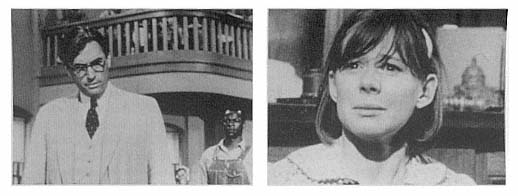
sual, verbal, and structural parallels abound that connect the women in and around the text. Mayella has two feminine first names, as does Jean Louise Finch, who is labeled with this double dose of femininity when she's being socialized for school and can no longer use the androgynous "Scout" (much as Nellie Lee assumed the pseudonym "Harper"). The character of Scout and Harper Lee, writer, were explicitly compared in the press. According to Newsweek, Miss Lee "strongly calls to mind the impish tomboy who narrates her novel," both in her "Italian boy haircut" and "the heavy touch of Alabama in her accent."[20] In Life, Lee is pictured without makeup, wearing a short-sleeved sports shirt, pants, and tennis shoes—what the magazine labels "hometown getup."[21] Collin Wilcox, as Mayella, in turn looks like an ungainly, adolescent Scout. Her hair is straight and unkempt, a hair ribbon pathetically failing to keep scraggly bangs out of her eyes. She also wears no makeup. The nondescript print dress Mayella wears at the trial is strongly reminiscent of Scout's dress on her first day of school. ("I still don't see why I hafta wear a darn ole dress, " Scout declares.) Both child and adolescent wriggle inside their clothes as if trapped by shapeless tributes to an ideal of femininity that just doesn't seem to fit. Mayella, the discredited and exposed "white trash 'victim,'"[22] is the link between the child we see and the woman on the sound track, and the cause of their division.
When Mayella is being cross-examined by Atticus, she quickly reverts to childlike behavior. She perches on the edge of her chair, clutching the seat with her hands. When Atticus asks if the evening of the attack was the first time she ever invited Tom Robinson inside her yard, she nods and barks an emphatic "Yes!" When he asks her if she hadn't asked him in on previous occasions, she shrugs, bites her lip, and puts her arms behind her. "I mighta . . ." The camera lingers on Mayella so that we can see the rapid transitions from childlike confusion to rehearsed certainty. When Atticus asks her about the details of the attack, she squints up at him through her bangs with a quizzical look. Atticus fixes her in a stern authoritative stare; the judgment he
passes upon her as a lawyer replicates his disapproval of her from the position of the father.
The film makes it abundantly clear that Mayella is lying and Tom Robinson is surely innocent. It is part of the liberal grounding of the film, however, that in order for Robinson not to be the racist specter of the black rapist, he be figuratively castrated. Long before we see Robinson, we hear him as a ghostly offscreen voice asking Atticus, "They gone?" after the mob outside the jail has gone. The first time we see Robinson speak is at the trial, when he is made to stand and declare his impotence; he can't have beaten Mayella with his left hand because it was mangled in a shredder when he was young. His entire arm is "useless." Atticus calls him "not an old Uncle but a strong young Negro man, " but the Robinson we see is defined as physically incapable. He only speaks when prompted and cued by Atticus.
John Ellis finds a similar process at work in another film of the period, John Ford's 1960 Sergeant Rutledge . Pam Cook summarizes his argument. "The film produces a commentary on racism by taking the myth of black supersexuality as its central problem, displacing the myth in favour of the proposition that blacks are a-sexual; Rutledge [a black cavalry officer accused of rape] becomes a human being only insofar as he foreswears his sexuality" (quoted in Pam Cook, ed., The Cinema Book [London: BFI 1985], p. 188). This is why ultimately To Kill a Mockingbird is next to useless on the issue of race, except as an artifact of early 1960s liberal sentiment. Cook also points out how "the trial device enables commentary to be carried out at all points of ambiguity. . . . Thus multiple meanings are limited and controlled"—potentially militating against feminist, progressive, or resistant readings (ibid.). However, I would like to propose a feminist reading that resists the film's smooth liberal surface by examining how women are distorted and fragmented (both in their relationships with each other and in relation to their own desires) by the racist and patriarchal system delineated in the film.
When Mayella begins her scathing assault on the system in which she is becoming ensnared, the camera zooms in.
I got somethin' to say and then I ain't gonna say no more. He took advantage of me. And if you fine, fancy gennelmen ain't gonna do nothin' about it, then you're just a bunch of lousy, yella, stinkin' cowards. The whole bunch of ya. And your fancy airs don't come to nothin '. Your "Miss Mayella," it don't come to nothin', Mr. Finch. No—no—
Diving out of the bottom of the frame, she runs off the witness stand and plunges into the crowd.
As regards the case, everything Mayella says is identified as false. Everything about the way she speaks, the hesitancies, the fact that what she says does not bear on the case, and especially her accent, brands her as "incoher-
ent" and "inarticulate." In a point I shall take exception to later, Silverman argues that for women in Hollywood sound films "every corporeal encroachment, from a regional accent or idiosyncratic 'grain' to definitive localization in the image," causes the voice to "lose [its] power and authority" and become, like the body, subject to aging and death. . . . Synchronization marks the final moment in any such localization, the point of full and complete 'embodiment'" (Silverman 1988, p. 49). One could say that Mayella's outburst is obsessively synchronized, her accent and the zoom in to a close-up calling attention to every word as she forms it. The Southern Californian Gregory Peck as Atticus, on the other hand, supplies barely a nod in the direction of an accent. As the embodiment of all-are-created-equal sentiment, his nondescript middle American is appropriate.
Yet I would argue that it is precisely the way Mayella speaks that supplies much of the power of her tirade and is the source of a particular power for all of the women in the film. Scout doesn't hide her accent, saying "Hey!" to everyone. Nor does Harper Lee. Scout's language is as unsocialized as her hair and clothes. For instance, at one point she says that another character "won't take nothin' from nobody." While I shall argue the perverse embodying power of the regional, feminine voice in relation to the narrator, for now, Mayella's accent traps her in her gender and her class, and the fine fancy airs of Atticus, and the court's careful show of concern for her as "victim," "don't mean nothin'."
The effect of the trial on Scout is another matter. In the novel, the trial is seen through the eyes of the children. Scout is sleepy, and it is Jem, a budding lawyer, who appreciates the formality and abstractness of the law, the rules of evidence and the ritual nature of the cross-examination, which, incidentally, humiliates his father's client. In the film, Jem eagerly watches the first two witnesses. When Mayella testifies, Scout is lost in the background of a long shot that favors Jem. As the trial proceeds through the testimony of the police chief, Bob Ewell, Mayella, and Tom Robinson, there are ten reaction shots either isolating or favoring Jem. When the testimony is over and the jury is considering its verdict (and Mayella, for our purposes, has been "convicted"), there is a shot of Scout. She is sitting on the floor looking through the slats of the balcony railing, visually behind bars. The jury returns with a guilty verdict against Robinson, and Jem cries. Scout remains impassive. As the courtroom clears, the black minister who has let them sit with him in the balcony murmurs, "Miss Jean Louise?" Scout looks up from her figurative cage. As Atticus slowly leaves the courtroom, the black population of Maycomb rise in silent tribute. The minister tells her, "Miss Jean Louise, stand up. Your father's passing." It is the first time Scout has to be instructed to pay respect to Atticus.
What comes between Scout and Atticus is the law. Scout does not rebel in
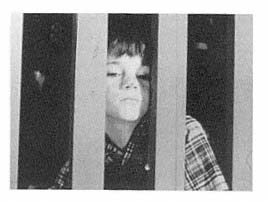
any way against her father, but they are kept apart from this point until the film's climax. (In the scene immediately after the trial, when Atticus is informed that Tom Robinson has been shot down "trying to escape," we forget Scout is even present as Atticus leaves with Jem to inform Robinson's family.) At the trial, Scout confronts the problem of her future. Her desire—a conflation of desire for the father with desire for language—is even more forbidden than Mayella's. Jane Gallop writes that a woman's "desire for the father's desire (for his penis) causes her to submit to the father's law, which denies his desire/penis, [and] operates in its place."[23] I would like to suggest To Kill a Mockingbird as an illustration of the process whereby a young woman learns that to love language as epitomized by the Law, literalized here as her father, is to sanction the terms of her own exclusion. To speak, on these terms, demands such a complete identification with the Father/Law that it obliterates any chance of a woman speaking in her own voice. And yet Scout, as both child-character and adult author, strives to maintain the father as some kind of ideal. The question, then, is how to become a woman—an adult, a wielder of language, a subject—and not be rejected by the father. What is at stake in this process of extricating language from the Law is not just the girl's preservation of an idealized father, but the possibility of creating a position for herself as subject and author—of constructing a voice. However, we eventually have to ask to what extent this voice is ultimately coopted for the Law when the father is held immune from criticism and the mother is radically excluded.