
War and Peace in the Cartoons of Feng Zikai
Unlike many of his fellow cartoonists, Feng Zikai viewed the War of Resistance with mixed feelings. He realized that the war was a matter of survival for his country. A nation under siege and occupation had every right to defend itself and ultimately to defeat the enemy and reestablish peace. But war inevitably led to untold human suffering and death—a direct assault on Feng's own firmly held Buddhist beliefs. His wartime cartoons vividly reveal his ambivalence: even as he appeals to his fellow countrymen to resist the enemy's aggression, at the same time he presents a powerful indictment of the senseless waste of human lives. It is not violent death and the desolation of the survivors alone that make his cartoons memorable and thought-provoking. Underneath them lie more fundamental philosophical questions: Why should there be war? Why can't humans stop killing one another? And why is there so much suffering in life?
Feng Zikai, a multitalented artist and scholar, towers above his contemporaries as a first-rate cartoonist by virtue of his imaginative power and warm touch.[102] A native of Shimenwan (Tongxiang country, Zhejiang province), Feng received his training in Japan and was well informed about both Asian and Western art. He produced some of the most influential works on art theory in China in the 1920s and 1930s.[103] His superb personal essays (xiaopinwen), characterized by a blending of human warmth, poetic beauty, and philosophical touches, won high praise among literary luminaries of his time.[104] Feng was also a musician, calligrapher, and religious artist. Under the influence
of his famous high school mentor, the artist-turned-teacher Li Shutong (who later took the tonsure to become the monk Hongyi), Feng produced several volumes of religious cartoons entitled Paintings on the Preservation of Life (Husheng huaji), dealing with the Buddhist teaching of nonkilling and releasing life.[105] Indeed, Buddhist thought is a constant undercurrent in Feng's cartoons.
Feng's numerous contributions to Chinese art notwithstanding, he is best remembered for his role in the modern Chinese cartoon movement. One of the three most influential cartoonists in the Republican era (the other two being Ye Qianyu and Zhang Guangyu), Feng almost single-handedly established cartoons as a respected art form in China. It was he who first introduced the term manhua from Japan in 1925; and it was he who first contributed cartoons regularly to such esteemed literary journals as Short Story Monthly (Xiaoshuo yuebao) and influential newspapers as Shanghai's Shen bao.[106] Feng, along with such men as Huang Mao and Wang Dunqing, was also one of China's few cartoon theorists. His pioneering book Cartooning Methods (Manhua de miaofa, 1943) outlines the technical aspects of the cartoon and provides a detailed, sophisticated theoretical justification of its importance in Chinese art.
Feng Zikai initially gained acclaim as an artist with his series of cartoons of lovable, mischievous children. Like many of his contemporaries, Feng had a rather romantic view of children.[107] He believed that a child's mind is innocent and sincere, neither constrained by worldly conventions nor driven by evil thoughts. Only children, according to Feng, seem able to comprehend the fundamental Buddhist belief that life should be filled with love and hope rather than prejudice and hypocrisy.[108] Feng spent a large part of his early career drawing children, often using his own offspring as models. His children are always innocent, happy, enchanting, and sometimes mischievous (as in "When Father Is Away," 1926).[109] Feng's drawings of children reveal the unmistakable imprint of the work of Takehisa Yumeji, a noted Japanese painter and poet known for his portrayals of children and women.[110] Like Yumeji, Feng captured charmingly both the movements and feelings of children. Also like Yumeji, he often accompanied his drawings with a song or verse, giving them a distinctly poetic flavor uncommon in his generation. Despite these influences, Feng developed a style and approach all his own by combining traditional Chinese brush strokes with contemporary social settings, often lacing them with humor and religious purport. This original look set Feng
apart from such contemporaries as the political cartoonists Cai Ruohong and Te Wei, whose works are strongly reminiscent of the Western satirical caricature.
Although the cartoon is a modern urban phenomenon, Feng's early work seems curiously traditional, in mood if not in content. Steeped in classical literature, he had a predilection for adorning cartoons with famous poems from the Tang and Song dynasties. Consider, for example, his collection Old Poems in New Paintings (Gushi xinhua).[111] Using a traditional brush and modern cartoon techniques, Feng painted a series of smooth, lyrical pieces, but ones that often convey a melancholic, pathetic mood. Thus "How Wonderful Is the Setting Sun" (fig. 34, from the poem "Mounting Leyouyuan" ["Deng Leyouyuan"] by Li Shangyin of the Tang) is tinged with a sadness at the passing of time, underscoring the Buddhist notion that impermanence is the inexorable law of all existence. Far from being satirical and entertaining—two characteristics of many modern-day cartoons—Feng's works were often thought-provoking and illuminating. His philosophical touch elevated his cartoons to a religious level unique in his generation.
Feng Zikai was no traditionalist, however. He was inspired more by the mood and rich symbolism of classical poetry than by its outmoded ideas or its strict rules of prosody. Feng's artistic outlook was thoroughly modern, inspired by direct observation of the world around him. "My drawings are closely related to my life," he once said. "As in the keeping of accounts, I record only what I feel in my daily life."[112] Feng was also highly critical of traditional-style painters for painting only "recluses and ancient beauties" but not "workers and rickshaw men."[113] True to his words, Feng himself focused on the people he saw and met in the streets and on events happening around him, portraying a kaleidoscope of activities in Chinese society, both urban and rural. His cartoons, as he put it, are like being on a train, for they detail the myriad events that unfold in "compartment society."[114]
Unlike Cai Ruohong or Hu Kao, Feng Zikai was neither a satirist nor an activist who wished to use his cartoons to foster social change. His prewar work had been largely apolitical: he merely recorded what he saw and heard in his life, painting with a gentle, sympathetic touch. The Buddhist ideas of nonaggression and withdrawal that appear in his work also made him seem more like an aloof observer than an active participant. This attitude did not sit well with activists who believed that artists should take a positive, involved role in reforming society and focusing readers' attention on current political problems,
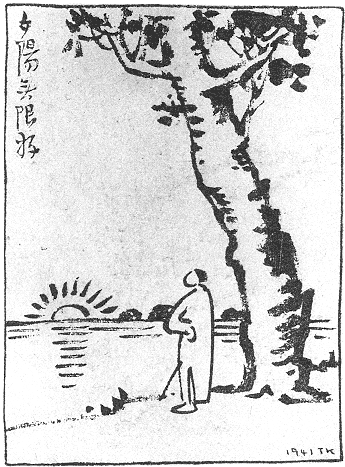
Fig. 34.
Feng Zikai, "How Wonderful Is the Setting Sun." From Feng,
Gushi xinhua (N.p.: Kaiming shudian, 1945), p. 68.
especially at a time of potential outside aggression. For some critics, Feng's subjects were "far removed from China's reality," failing to inform the public about the seriousness of the national crisis.[115] Feng's style, Huang Mao complained, exhibited a detached, elegant mood totally divorced from real life.[116]
The war, however, changed Feng's attitude toward art profoundly. He quickly became active in the resistance movement and began to draw patriotic cartoons, using them to arouse nationalistic passion; yet remarkably, his faith in humanity did not waver—indeed, it may have been strengthened by adversity.
In late November 1937, after his hometown, Shimenwan, had been attacked in Japanese air raids, Feng and his family fled into the interior, starting a long and painful ordeal as refugees. Following brief sojourns in places like Guilin, Liangjiang, and Zunyi and enduring all kinds of hardships, the family finally settled in Chongqing, where they stayed until the end of the war. Feng was never a detached loner; he was foremost a family man, pleased when his children surrounded him and when his wife greeted him at the door as he returned from work. But the war uprooted his family and brought ruin and destruction to his country, causing him to change his artistic focus dramatically. Even before the war erupted, Feng saw the impending catastrophe. Before he fled his hometown, appalled by the rapidly spreading chaos, he decided to recount the turmoil and misery in a series of drawings to be entitled Cartoons on Japan's Invasion of China (Manhua Riben qin Hua shi). Japanese air raids, however, aborted his plan. As the war dragged on, he became more involved. In March 1938 he added his name to the newly founded All-China Resistance Association of Writers and Artists and joined the editorial board of Resistance Literature and Art (Kangzhan wenyi), the official publication of the association. His drawings on war began to appear widely not only in that journal, but also in various magazines and newspapers, condemning Japanese brutality in China.
There is no question that Feng Zikai was bitter about the war. "For eight years," he wrote in 1947, "I have been wandering constantly on the road in Guizhou, Guangxi, Sichuan, and Shaanxi provinces. As I gaze into the distance in the direction of Jiangnan, I am truly heart-broken. I pray to heaven, wishing that China can turn defeat into victory."[117] His family was uprooted, his livelihood threatened, and his beloved Yuanyuan Studio, where he drew his cartoons and stored his precious books and other mementos, including the monk Hongyi's calligraphy, burned down. In a moving article called "Commemorating the Spirit of the Yuanyuan Studio," Feng poured out his anger against the enemy.[118] Feng Zikai now argued that some things were more important than life itself, "not to become a conquered people" being one of them.[119] Although the Chinese people had long been accused of behaving like "a heap of loose sand," lacking the necessary unity to resist outside aggression, Feng contended that the War of Resistance was like a sandbag that bound together all Chinese.[120] As an artist, Feng now believed that art could and should play a major role in saving China.[121] When the survival of a nation is at stake, Feng re-
peatedly argued, every citizen should heed the call to fight—an attitude that won Feng praise within the literary circle.[122]
On the surface, Feng Zikai's wartime cartoons resembled the work of many of his contemporaries. Determined to record the bestialities of aggression and the ensuing human suffering, he portrayed Japanese brutality (see figs. 9, 11), ridiculed traitors, depicted soldiers leaving for the front, showed the ruins of war, and demonstrated the people's determination to defend their nation.[123] In his wartime cartoons, even the innocence of his beloved children had disappeared. Like adults, children are now painted as patriotic and strong-willed in their desire to help defend the country, donating money to the war cause (fig. 35), forming the "Youth National Salvation Army,"[124] and writing patriotic slogans even in occupied territory.[125] Feng's children have "grown up"; they live in a cruel world where killing is common and where survival depends solely on one's determination to fight back. Children are not ill-natured nor aggressive; they are simply self-defensive.
Feng Zikai also had a knack for using symbols in his works. He could create powerful images with a few deft lines, skillfully summing up a complicated situation. Two cats playing havoc with objects on top of a desk implies Japan's repeated tramplings on China's culture.[126] The notion of giving one's life for one's country is symbolized with blood and flowers: "From the Pool of Blood Grows the Flower of Freedom,"[127] and "Let the Blood of the Martyrs Nourish the Flower of Freedom" (fig. 36). The images are familiar and the message simple: without sacrifice there can be no liberation. Feng was confident that his country would eventually prevail. China was like a tall tree, Feng wrote; although it had been chopped down by the enemy, when the spring came, new buds would emerge (fig. 37). A tall tree was an important sign of hope and vitality. "It symbolizes today's China as a single entity," and with constant rejuvenating efforts China would become an even stronger country.[128]
The difference in tone and mood between his prewar drawings and his wartime cartoons is striking. Unlike his lyrical and graceful pieces of the early 1930s, many of which praised common and modest things, Feng's later cartoons were highly passionate and permeated with strong nationalist sentiment as he urged his compatriots to rally behind the government. Feng became an ardent patriot who believed that the best way he could contribute to the war effort was by drawing cartoons and recording faithfully the scenes of destruction and atrocity caused by invading troops.
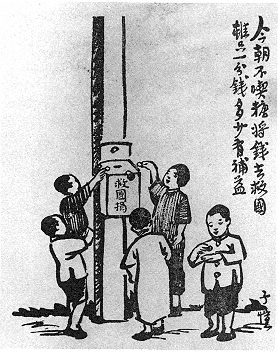
Fig. 35.
Feng Zikai: "Today I am not going to have any
candy, / The money will be donated to our
government. / Although it is a small sum, / Every bit will
certainly help." The collection box is labeled "National
Salvation Fund. " From Feng, Zhandi manhua
(Hong Kong: Yingshang buliedian tushu
gongsi, 1939), n.p.
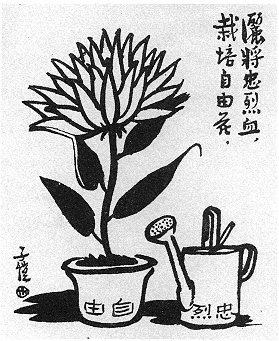
Fig. 36.
Feng Zikai: "Let the Blood of the Martyrs Nourish the
Flower of Freedom." The vase is labeled "Freedom,"
and the watering can, "Martyr." From Feng, Zhandi
manhua, n.p.
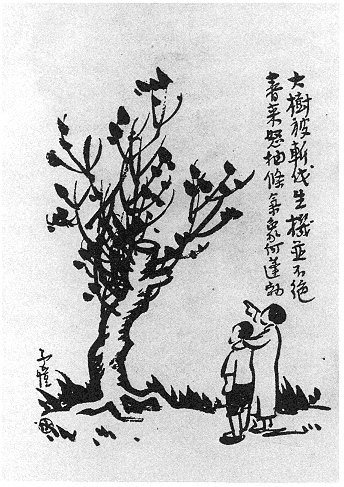
Fig. 37.
Feng Zikai: "A tree has been chopped down, / But its instinct for
life never dies. / When spring comes again, / It will grow and
thrive." From Feng, Zhandi manhua, n.p.
Yet despite his numerous patriotic pieces, Feng Zikai was never fully comfortable with what he had painted. To Feng, wartime cartoons were mostly expedient tools of propaganda; they could hardly be described as genuine art. When the war broke out, some suggested that he should burn his Paintings on the Preservation of Life because of the book's theme. Feng retorted:
The purpose of Paintings on the Preservation of Life is to admonish people to treasure their lives and to refrain from kill-
ing so that we can cultivate benevolence and love and promote peace…. When I ask an urchin not to trample on ants, it is not because I cherish ants, or because I want to provide food to sustain them; it is because I am afraid that this little cruelty [if it remains unchecked] will turn into aggression in the future, using planes to carry heavy bombs to kill innocent people.[129]
Feng Zikai divided cartoons into three categories: reflective, satirical, and propaganda. The first are cartoons that come from the artist's heart. Unlike satirical cartoons, they are not intended to criticize or express an opinion, and unlike propaganda cartoons, they are not calculated to attain results. They are painted to touch a common chord between artist and reader. A good example, according to Feng Zikai, is his "The Instinct for Life" (fig. 38), which depicts a sprout struggling to survive on a brick wall. The ability of a sprout to survive against all odds is, in Feng's words, "an astounding phenomenon."[130] A reflective cartoon, according to Feng, can only be appreciated by a genuinely thoughtful mind. "It is the most artistic type of all cartoons."[131]
In contrast to reflective cartoons, satirical cartoons are designed to raise criticisms against unreasonable social phenomena. They do not point out problems directly; instead, they often resort to analogy. Finally we come to propaganda cartoons, which are used to instigate action. This type of cartoon, according to Feng, thrives in a conflict-ridden society. However, Feng warned,
conflicts are an abnormality of human society. It is not its normal state. The basic ideals and intentions of human beings are for peace and happiness, living harmoniously together. Who would like to live in a world full of conflicts? But when others invade us, I have no choice but to resist and to fight to end the conflict. This is using struggles to end struggles…. It is therefore clear that conflicts are the abnormality of human life, just like propaganda cartoons are the abnormality of the cartoon; … we must be fully aware that they are not the essence of the cartoon. The essence of the cartoon is art.[132]
Feng was preoccupied with the irreconcilability of art and propaganda throughout the war. Intellectually, he was reluctant to create propaganda cartoons; but emotionally he realized that they were effective in galvanizing the people's support for the government. If conflict was inevitable and defensive measures were needed, Feng wanted to remind his readers: "We are using killings to end killings, and using
benevolence to overcome cruelty."[133] The subject of most concern to Feng was not the war, however much it occupied his mind, but the human suffering associated with manmade destruction. This reflective mood sets him apart from his contemporary cartoonists, including Ye Qianyu and Cai Ruohong.
Feng's distinct humanistic style won him wide respect and enormous popularity during the war. His work appeared regularly in major journals, including Cosmic Wind and Resistance Literature and Art; his exhibitions were received with enthusiasm, winning him new fans and providing him with income to support his family during those difficult war years.[134] His cartoons were also widely reprinted, including some that, to the artist's chagrin, were reissued for profit without his permission. One such collection of twenty-five drawings was Battlefield Cartoons (Zhandi manhua), published in Hong Kong in 1939.[135]
Feng Zikai did not join the Cartoon Propaganda Team. In fact, there is little evidence to suggest that he maintained any contact with the group. He was first and foremost a devoted family man. When his family was uprooted by the war, he felt a strong responsibility to bring all of them to safety; this is seen in many of his wartime writings, such as A Teacher's Diary (Jiaoshi riji), which he wrote in 1938 while seeking refuge in Guilin. When war broke out in 1937 he was almost forty, well established in his field, and much older than many other cartoonists (Ye Qianyu was thirty and Hu Kao only twenty-five). It would have been difficult both emotionally and physically for him to join the team. Moreover, Feng frankly admitted that he was not a sociable type.[136] He abhorred the idea of serving in the government, preferring instead to live a simple life like that of Tao Yuanming (365–427), the famous Jin dynasty recluse who resigned from the government to return to his village so that he could be in close touch with nature.[137]
Because of his fundamental aversion to conflict and his dislike of propaganda art, Feng Zikai might not even rate his own wartime cartoons highly, at least as art. Compared to his prewar works, it is true, many of his wartime cartoons were artistically crude. But it would be a mistake to overlook their philosophical value. W.A. Coupe argues that a cartoonist is concerned primarily with the creation and manipulation of public opinion;[138] yet Feng Zikai's works, even those that qualify as propaganda, tend to be highly personal. They are thoughtful statements suggesting deep truths about human existence. Appalled by the sheer magnitude of the tragedy China was experiencing, Feng
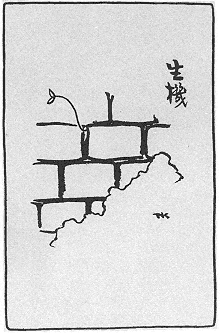
Fig. 38.
Feng Zikai, "The Instinct for Life." From
Feng, Husheng huaji (reprinted Taibei:
Chunwenxue chubanshe, 1981), 1:50.
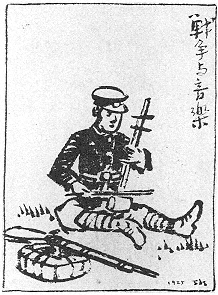
Fig. 39.
Feng Zikai, "War and Music." (The
date "1925" in the cartoon is
incorrect. This is one of the sixty-four
drawings printed in Feng's Zhanshi
xiang, all of which, according to Feng,
were "drawn during the war when I was a
refugee." See Feng, Zhanshi xiang,
preface, p. 2.) From Feng, Zhanshi
xiang, p. 18.
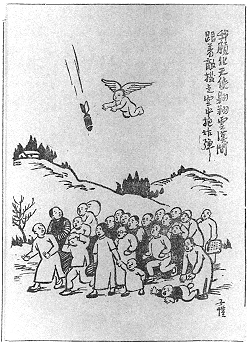
Fig. 40.
Feng Zikai: "I want to become an angel, /
Soaring high in the sky, / Following the
enemy planes, / And grabbing their bombs."
From Jianwen 1 (1 August 1938): 2.
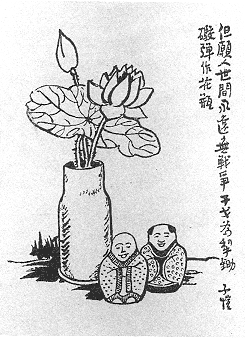
Fig. 41.
Feng Zikai: "In this world, / 1 hope
there will be no more war. / Weapons
turn into ploughs, / And bombshells can
be flower vases." From Feng, Zhandi
manhua, n.p.
sought constantly for an answer to humanity's infinite capacity for blunder and aggression. Perhaps more than any of his fellow cartoonists, he imparts to his wartime work a powerful conviction that mutual hostility must cease, simply because it is against basic human nature. Feng's wartime cartoons are thus not merely extraordinary pictorial documents of their time, epitomizing all the savagery of a bitter conflict; more important, they are condemnations of war as an irremediable crime against humanity.
This forceful humanistic current provides a unified framework for all his work, prewar and wartime alike. In sharp contrast to Goya's graphic scenes of torture and violence in The Disasters of War, Feng's wartime cartoons, with but few exceptions, do not show the ferociousness of Japanese brutality directly; rather, their barbaric acts tend to be implied.[139] Perhaps by focusing on the consequences of Japanese actions rather than on the deeds themselves he made the people's ordeal even more painful and unforgettable. Interestingly enough, while most of his fellow cartoonists concentrated on the grisly aspects of the calamity, Feng attempted to show that there was a humane side to this tragedy as well. A soldier, putting aside his rifle, picks up a musical instrument and plays, enjoying temporary peace of mind in the midst of a bitter war (fig. 39). To Feng Zikai, these peaceful activities were far more meaningful than the battle itself. By emphasizing culture over bloodshed, music over war, he communicated through his drawings a unique sense of peace and tranquillity.
Feng would never have agreed with Gibbon's dictum that history is "little more than the register of the crimes, follies, and misfortunes of mankind." For Feng, history was an unending search for the meaning of life and peace, and his wartime cartoons represent that search in a chaotic world. A major theme in his work is the contrast between war and peace: one is destruction, the other prosperity; one causes death, the other celebrates life; one is ugliness, the other beauty. The juxta-position of guns and music is not to promote war but to elicit peace. Feng argued that unlike an aggressive war, the War of Resistance was fought for neither power nor glory, but simply to repel the enemy and to end all conflicts. He wrote: "In this war, our mission is not only to repel the invasion and to subdue the enemy, but also to spread justice all over the world, to arouse those who love peace and support humanity. Together we will eradicate ruthlessness, inhuman devils, and establish a foundation of everlasting peace and happiness for all mankind."[140]
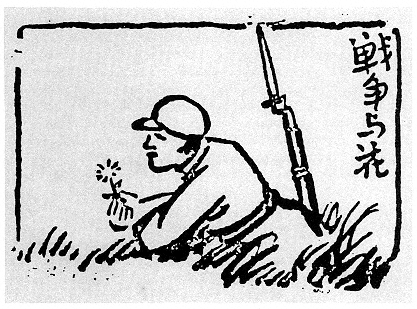
Fig. 42.
Feng Zikai, "War and Flower." From Feng, Manhua de miaofa
(Shanghai: Kaiming shudian, 1948), p. 21.
Feng frequently envisions a world of peace, and he presents his hope earnestly in his works. In Feng's ideal world, angels will stop deadly bombs from falling on civilians (fig. 40) and artillery shells will be used not as implements of war but as flower vases (fig. 41)—echoing Isaiah's hope that warriors would "beat their swords into plowshares, and their spears into pruning-hooks." Feng's peace cartoons may be simple, but their message is profound and sincere.
Behind Feng's quest for peace lies a deep philosophical and religious outlook that emphasizes the sanctity of life. His works, in the end, were motivated more by moral than by artistic concerns. Cartoons to him were not merely a sincere art form; they were an effective means of affirming life. Thus one sees an unflagging optimism permeating his work. This unique attitude toward art makes him one of the most original and philosophical cartoonists of his time. "The Instinct for Life" tells us that every creature in the world, no matter how small, will fight for its existence. Life is indomitable. Perhaps nowhere is the struggle between life and death more evident than in "War and Flower" (fig. 42), in which a soldier gazes at a flower he has picked at the battlefront. This picture, Feng said, "reveals a major contradiction in
life: the contrast between war and the flower demonstrates the mighty contention between ugliness and beauty, cruelty and peace, death and life, and human affairs and heaven's will."[141] Feng was optimistic about the outcome, however. China would prevail in the war, just as the mutilated tree would survive and thrive when spring came. It was not victory on the battlefield but the instinct for life that held the promise of the future. As Feng wrote, "In this world, we might suffer natural disaster and manmade calamity, or experience temporary setbacks, but if the instinct for life has not been extinguished, then someday things will take a turn for the better."[142]