
13
The Man Who Saved Public Television
What is emerging is not public television but government television shaped by politically conscious appointees whose desire to avoid controversy could turn CPB into the Corporation for Public Blandness.
Bill Moyers[1]
The next six months were easily the most crucial in the troubled history of the public medium, threatening to consume forever the hopes of the first Carnegic Commission for an independent voice with "the freedom to create, freedom to innovate, freedom to be heard."[2]
John Macy's resignation from the CPB in August—and Frank Pace's resignation as board chairman a bit earlier—gave the White House the opening it needed to consolidate its control over the public-television system. Although they had sought control earlier, particularly with the appointment in the spring of 1972 of six Nixon loyalists to the Corporation board, the Administration was still shy of its needed majority on the fifteen-member board. Now, with the additional vacancies, the time was ripe for a move. The White House filled one of the vacancies with Thomas B. Curtis, a former Republican congressman from Missouri. In what was a foregone conclusion engineered by the White House, Curtis was elected chairman, succeeding Pace, at the board's first meeting following Macy's resignation. (Whitehead had pushed for the appointment of the politically conservative scholar and author Irving Kristol, but Nixon's friend John Olin had persuaded him to name
Curtis.)[3] That accomplished, Jack Wrather then nominated Henry Loomis to succeed John Macy in the Corporation presidency. Loomis, the deputy director of the Voice of America, was the White House's handpicked candidate for the post. But another director objected: "We can't be voting for a president that this board hasn't even met, for God's sake."[4] Whereupon Wrather rang Loomis at his USIA office, had him rush over to be interviewed briefly by the board, and saw him elected unanimously. Loomis, like his predecessor, had spent most of his career in government service. But unlike Macy, the new president was independently wealthy. He could look upon government service from the comfort of his Virginia estate with an air of noblesse oblige. What he could not look upon, however, was the service he was now hired to head; because his estate was beyond the range of WETA / Washington's UHF signal, he boasted of never having viewed public television ("If innocence is a virtue, I am very virtuous").[5] Moreover, until his appointment he had never heard of the Corporation for Public Broadcasting ("What the hell is it?" he was reported to have asked).[6] But with the appointments of Curtis and Loomis, the White House was now firmly in control of the Corporation. The stage was set for the next move.
Nixon's November landslide victory over George McGovern intensified Nixon's determination to silence his critics. In the inelegant words of Nixon aide John Dean, the goal was "the use of the available machinery of government to screw our enemies."[7] Public television, one of those putative "enemies," was involved in a high-stakes game in which the other player held all the face cards. Worse, we were up against an adversary whose policies were informed by a cynicism that overshadowed reason. The Administration's narrowly targeted objective was to rid the public-television system of the programs they found offensive by the quickest means possible. Whitehead's strategy of neutralizing the system by sharing power with the more conservative stations was abandoned after the presidential veto of the funding bill, giving way to Ehrlichman's strategy of direct action aimed at bringing the system under the Administration's thumb. OTP's attorney Henry Goldberg summed up the Administration's aims: "They
didn't care about structure, didn't care about localism, didn't care about decentralization or insulated funding. They cared about 'them' and 'us.'"[8]
Henry Loomis figured prominently in the White House's plan of action. His announcement immediately after taking office that "CPB intends to exercise control over program judgments" signaled unswerving loyalty to the Administration's aims.[9] The game plan became clear with a telex to the system's producing stations announcing that henceforth all proposals for new programs were to be submitted not to PBS as in previous years, but directly to the Corporation. It was not clear whether Loomis fully understood the limited role that Congress had intended for the Corporation and the crucial fact that it was a nongovernmental entity. His actions gave rise to speculation, both in public-television circles and in the press, that he was embarked on a course to turn public television into a "domestic Voice of America." Less than two months after taking over, he sent Whitehead a 276-page document listing all the staff's program recommendations for the coming season. Attached to the document was a note: "Tom—this is our 'burn before reading document.' No one knows you have it. [signed] HL."[10] His seeming lack of concern for the Corporation's independence, including his frequent contacts with presidential aides and his readiness to consult with them on planning, raised our collective fears and fed our doubts.
One incident in particular fueled those doubts. A month after taking office, Loomis blithely bypassed PBS, the system's established mechanism for distributing programs, and approached the stations directly with a proposal to provide twenty-one hours of live coverage of the Apollo 17 moon flight. The three-day telecast would be funded and produced by the National Aeronautics and Space Administration. PBS reacted with predictable resentment, not only at having its role usurped by the Corporation, but also at what it saw as an ominous precedent, "like letting General Motors underwrite and produce programs for public television on car safety."[11] Luckily, NASA, sensing a system-wide controversy, backed down on its offer to fund the telecast, and consequently the Corporation withdrew its proposal as well. If Loomis imagined that
his offer would have been embraced by the PBS stations, he was given a rude shock by the blunt message from KETC, the St. Louis public station: "Get the hell out of programming and stay out."[12]
The Corporation, of course, had no intention of getting out of programming. On the contrary, it was clearly determined to seize control and to eliminate those programs that the Administration found offensive. Any doubts about its resolve were settled on January 10, 1973. That was the day Loomis was directed by his board to produce "at the earliest possible date" a plan to "establish, solely within the Corporation, the staff and resources necessary" to take over from PBS all responsibility for national programming.[13] PBS was to be relegated to the purely technical function of operating the interconnection, the lines used for delivery of programs to the stations. The crucial decisions about which programs were to be delivered—including their funding and production—would henceforth rest with the Corporation, and specifically with the board's Program Committee headed by Jack Wrather, the Hollywood television producer responsible for such television classics as Lassie, The Lone Ranger , and Strike It Rich .
Reaction to the Corporation's heavy-handed seizure of program control was immediate and harsh. John Macy told a Columbia-Dupont Award audience that "the heat shield [has been] penetrated and video journalism, public style, severely burned."[14] An unidentified public-broadcasting "pioneer" told a Newsweek reporter with bleak finality, "I think public television is washed up."[15] The press joined the baleful chorus. Cecil Smith told his Los Angeles Times readers that "the long-predicted emasculation of public television has begun,"[16] while in the New York Daily News , Kay Gardella led her story on the coup with "the death knell was sounded this week."[17] It was a grim assessment of the present and an even grimmer forecast for the future of a medium that seemed to be perpetually in crisis.
A month after the board resolution that cast the Corporation in the programmer's role, a "partial" list of approved programs was announced. Dropped from consideration—at least for the time
being—were public television's principal public-affairs series: Bill Moyers' Journal, Elizabeth Drew's Thirty Minutes With . . . , WETA's Washington Week in Review , and KQED's World Press Review . Loomis "explained" the loss of the programs with the rationalization that money spent on public-affairs shows was less "efficient" because the shows become outdated so quickly. Curiously, the sweep of topical programs even removed William Buckley's Firing Line , often cited by critics as public television's "token" conservative show. (Rumor had it that Buckley's opposition to Nixon's historic trip to China entitled him to a place on the Administration's "enemies list.")
Only one major public-affairs show was spared, Tony Brown's Black Journal , and then only because Brown, a scrappy veteran of broadcasting politics, saw the handwriting on the wall, mobilized his black constituency, and successfully pressured the Corporation to reverse its earlier decision to drop the show. NPACT (by then merged into Washington's WETA) also made the approved list with its proposed series America '73 . But when the producers learned the conditions of the grant—every program in the series was subject to the Corporation's prior approval—they said "No thanks" and turned the grant down. Of the prime-time topical shows, only WGBH's The Advocates survived the purge. The show featured advocates on opposite sides of a topical issue arguing their cases in a courtroom-like setting. The series was so carefully balanced, quipped Variety , that "viewers are likely to get two sides of the Adolph Hitler stories and the pros and cons of drug abuse."[18]
Seizure of program control by the Corporation sent shock waves through the system, leaving in its wake, said Robert MacNeil, "sadly disillusioned people" watching "their dream being perverted . . . [and] their ideal of independence made a travesty by Mr. Nixon's appointees."[19] MacNeil's show, Washington Week in Review , was a victim of the purge. The pervasive disillusionment left little room for an appreciation of the ironies in the situation: an Administration that said one thing and did another, that preached decentralization and practiced the worst kind of centralized control. When Nixon charged PBS with becoming the "center of power and the focal point of control," as he did in his
veto message, he effectively defined "centralization" as control of programming by 150 independent local stations. In this Alice in Wonderland world, "decentralization" came to mean the monolithic control of programming by the Corporation and its White House minions. But inconsistency was no problem for Tom Whitehead; he brushed it aside explaining that "you have to take power in order to disperse it."[20] His logic would have delighted the Red Queen. However, Henry Greenburg, his own general counsel, warned the OTP head that the inconsistency was so apparent "our motives become suspect and the continued restatement of the localism goal is discounted as simply not being credible."[21]
While the Nixon team clothed its purpose in disarming rhetoric, using such felicitous terms as "decentralization" and "localism," its true aims were deceptively simple. Put bluntly by White House aide Jon Rose, it was "to get the left-wing commentators who are cutting us up off public television at once, indeed yesterday if possible."[22] At the time, we could only guess at their aims by their actions; we were not privy to the White House's internal communications. The truth came to light years later with the release of documents under the Freedom of Information Act. But if a clue were needed, the president's outspoken and garrulous speechwriter Patrick Buchanan could be counted on to supply it. Early in 1973, Buchanan appeared on the Dick Cavett Show . In the course of defending the Administration's heavy-handed policies toward public television, he told Cavett that the Corporation, with its "new hoard," had "a new awareness" of the people's interest in "balance." By way of explaining the Administration's concept of balance, he ran down virtually the entire roster of PBS public-affairs shows—among them, Washington Week in Review, Bill Moyers' Journal , and Black Journal —and charged each one with being "balanced against us."[23] It confirmed what we had guessed. Our differences were not philosophical—Buchanan's remarks had stripped the Administration's policies of any philosophical importance—but tactical, It was simply a matter of "them" against "us."
PBS, powerless to block the co-option of its programming functions by the Corporation, was caught in a power play that con-
signed it to a purely technical function. The New York Times called it "a wholly disowned subsidiary."[24] Tension between the two, always present, grew ugly in early 1973 with the Corporation's move to take over the entire game. Trouble between PBS and the CPB was as predictable as it was inevitable. They were both victims of a byzantine structure that only a committee (in this case, the Carnegie Commission) could have designed: two opposing forces, delicately counterpoised, one with all the money, the other with all the stations, and both with the primal urge to be programmers. Frictions inherent in the structure were compounded by factionalism in the two staffs. Macy and Gunn, in the early days, had been able to maintain a thin veneer of collegiality; many people on their stalls had previously worked together elsewhere. Loomis, however, brought a whole new team to the Corporation, and with each of their positions carved in granite, jealousies raged. The resulting discord exhausted energies and eroded morale; worse, it showed up on the television screen. Variety called 1972-73 a "Floppo Season" for public broadcasting and reported that it was "by far the worst yet in the short, troubled history of the network."[25]
PBS did its best to tough it out. The PBS board reaffirmed by resolution its belief that "the Congress never intended for this country to have a centralized broadcasting system."[26] The resolution, hardly more than a rhetorical flourish, was followed by PBS president Hartford Gunn's effort to rally member stations by reminding them that the issue was "first and foremost . . . how you at the stations want the public television system to operate."[27] But the best cards in the game were held by the Corporation—it had the money as well as the backing of the White House—rather than by the paid professionals who managed the stations and made up the hoard of PBS. Their largely futile efforts to defend themselves were, said one observer, little more than "an elaborate dance of death."[28]
And then, suddenly and miraculously, a shift occurred that in a curious way anticipated the fall of the Nixon Administration. The earliest indications of the shift showed up in the reactions of all audience aroused over the White House maneuvers to control the medium and . . . over the White House declarations and ac-
tions to squelch news and public affairs on the national PTV network."[29] Letters began to pour into public television's mail rooms. In the early months of 1973, after Robert MacNeil told his Washington Week in Review audience that the show was in jeopardy at the hands of the White House, his office was swamped with more than 13,000 responses.[30] Local stations experienced a similar outpouring of viewer support, some even reporting an "unprecedented" response to their fund appeals. Public television, perhaps for the first time, became aware of a loyal constituency large enough to make a difference when the chips were down.
But gratifying as it was, viewer support alone could not face down the powers in the White House. The beleaguered state of the public system cried out for leadership, for a strong and effective leader with the will to take command and the clout to be heard in the Oval Office. It was unlikely to come from the ranks of the system's own leaders; the Public Broadcasting Act of 1967 had diffused the leadership by spreading it among the many constituent elements of the system, the better to ensure against centralized control. Even the PBS presidency, which certainly held a potential for strong leadership, was kept on a short leash by the member stations, which feared that an ambitious occupant might undermine their independence. Leadership of the type and strength needed could only come from outside the ranks of the public-television professionals. Fortunately, it did emerge in the person of Ralph B. Rogers, a blunt-spoken, white-haired, self-made millionaire from Dallas. Although a native New Englander, Rogers had made his modest fortune in the Lone Star State in the concrete construction business. His energies, however, could not be contained by Texas Industries alone; they were turned to a variety of civic responsibilities. After rescuing the Dallas Symphony from early retirement, he was drafted by the moribund KERA \ Dallas public-television station to save it as well. With Rogers as board chairman and his young assistant from Texas Industries, Robert Wilson, as general manager, KERA was transformed into one of the system's brightest and liveliest stations. The Dallas success story led to Rogers's election to the NET board, where the transplanted Bostonian first became involved in public television's
national affairs. Shortly thereafter, when the Children's Television Workshop separated from NET, Rogers was invited to become one of its founding directors. His commonsense counsel and business acumen helped CTW launch its earliest ventures into the commercial world of product licensing.
None of these posts, however, positioned Rogers to become "The Man Who Saved Television," the title conferred upon him by a grateful public-television community when he retired in 1976. That episode began with his participation in the push to win Congressional approval for the Macdonald long-range funding bill. In previous years, public broadcasting's own professional association, the NAEB, had taken the lead in lobbying Congress. While the paid stall had been reasonably effective with Congress, public television was not taking advantage of the most effective voices for selling our cause, namely the volunteer community leaders on our local boards. With Fred Friendly's encouragement, I arranged a meeting of the chairpersons of the seven largest stations with the goal of creating a legislative committee. Rogers was the obvious choice to chair it; in addition to his organizing successes in Dallas, his service as finance chairman of George Bush's first successful campaign in Texas for the U.S. Senate gave him credence with the party in power in Washington. The committee of seven met only once. The smaller stations, fearing a conspiracy of the big stations, pressured Rogers to broaden the committee to include each of PBS's stations, large and small. With NAEB's help, Rogers soon convened the lay-leaders of the system's local stations, formed the Governing Board Chairmen's Group, and was elected its leader. The group's first meeting closed in euphoria with the news that Congress had passed the Macdonald Bill by overwhelming majorities. Unfortunately, the euphoria was short-lived. On the following day, President Nixon vetoed the bill, and, with a stroke of the presidential pen, unwittingly endowed the lay-leaders with a renewed mission. Rogers embraced the mission as his personal cause.
To make certain that he had the support of the fractious stations, Rogers convened a series of regional meetings with the local managers, only to find that some of them resisted the move to
place the system's fate in the hands of board members, "nonprofessionals" with no experience in broadcasting. Rogers, a diplomat, but one with little patience with parochial attitudes, persuaded the more reluctant among them to accept the leadership of the new group. That done, he asked for and was granted a meeting with the Nixon-dominated Corporation board, a meeting for which the station managers had tried earlier but had been denied. Rogers addressed the key issue. "Freedom of the interconnection," he told them, "is the air we breathe."[31] To secure that freedom for PBS, he asked the Corporation board for two concessions: consultation with the stations before funding programs from federal funds; and access to the interconnection for programs funded with private, nongovernmental dollars. He didn't get the concessions immediately, but the directors were impressed with the man from Dallas. He indulged in no name-calling, placed no blame, and made his case with directness, conviction, and passion. Arrangements were made for further meetings.
Meanwhile, Rogers, with the support of the Ford Foundation, pressed for yet another restructuring of the public-television system, one that would rationalize the way the stations voiced their collective concerns to Washington. Two Washington organizations, PBS and the Educational Television Stations division of the NAEB, both made up entirely of professional broadcasters, had represented public television's interests in the capital prior to the formation of the Rogers group. The Corporation board had seized on the divided leadership as an excuse for not meeting with either, asking rhetorically, "Who do we meet with?" The chairpersons' group added a third element, but one that the Corporation's board could ill afford to ignore, with its unified leadership in the hands of well-placed and influential laypeople. By agreeing to meet with Roger's group and not with the other two, the Corporation sent a clear signal to the system: it was prepared to deal only with its lay leaders.
By March 1973, the professionals' resistance to the new "nonprofessional" leadership began to melt away in the face of an increasingly desperate situation. With only a single dissenting vote
they merged their two professional organizations, PBS and ETS/NAEB, into the chairperson's group. They retained the PBS name and restructured the new entity to accommodate two boards, one of elected chairpersons for "policy" and one of elected station chiefs for "management."[32] Rogers, recalling public television's proclivity for infinite subdivision, referred to the three-into-one merger as a miracle."[33] It would be the last major restructuring of the public-television establishment for more than a decade.
With the merger accomplished, Rogers resumed his efforts to resolve the differences between PBS and the Corporation. His early meetings were with the Corporation's three-person negotiating committee—Thomas Moore, Jack Valenti, and James Killian—but as time passed he turned more and more to board chairman Thomas Curtis, with whom he seemed to have a special chemistry. By early April, the two chairmen reached a compromise: the Corporation would have the final say on how federal funds were to be spent, and the stations would gain some measure of control over scheduling and have access to the interconnection for privately funded programs. Valenti and Killian were prepared to recommend acceptance of the compromise to the full board with the hope that it would "extract the thorns of discontent, disaffection and persistent controversy that have infected public and private views of the current public broadcasting arena."[34] The compromise would be presented at the next board meeting, ominously set for Friday, April 13th.
Rogers, preparing to holiday in Portugal and confident that the fracas was finally at an end, left behind a draft memorandum to go to the stations after the Corporation's expected acceptance of the agreement: "At this point it is important to put aside all the animosities of the past. Let's start a clean sheet."[35] But he and Thomas Curtis had grossly misjudged the board's mood. By a 10-4 majority, it voted to "defer action" on the agreement and turned further negotiations over to a new three-person committee, two of whom were considered "hard-liners."[36] Curtis resigned three days later, angry at what he felt was a betrayal by his friends in the Administration. In parting he charged that the White House had "tampered with" the independent board by making
telephone calls to at least four board members on the eve of the board meeting. It was, he said, impossible to defend "the integrity of the board" now that it had been so thoroughly breached.[37]
The Curtis brouhaha gave the White House what it wanted—a defeat of the compromise agreement and the resignation of Curtis (the Administration had soured on him once he showed signs of independence). But Curtis's resignation was also an embarrassment. The press, seizing upon his charges, painted a picture of a White House filled with petty power grabbers whose deeds gave the lie to their pious utterances of support for public television's ideal of localism.
Whether, as Curtis claimed, telephone calls from the White House were actually made is less important than the documented evidence that the White House exerted continual pressure on the board, if not on the eve of the meeting, then at other times. According to memos and notes revealed later, on the day before the crucial April 13 meeting Curtis and Moore were called to Whitehead's office, told of the president's opposition to the compromise agreement, and warned that its adoption could mean another presidential veto of the funding bill. However, the story of the defeat of the agreement is not entirely a tale of furtive White House phone calls and threats of presidential vetoes. Perhaps a more crucial factor was the widespread antipathy toward Curtis among his fellow board members, many of whom felt that he was arrogant and at times insensitive, that he was given to temper tantrums and rigidly autocratic in his conduct of the meetings. The surmise that their hostility played a part in the defeat gained credibility with the board's action at its next meeting. It adopted an agreement almost identical to the one it had rejected four weeks earlier.
Whatever his abrasive qualities had been—he had apparently irritated virtually everyone he worked with except Ralph Rogers—Curtis had shown considerable integrity by staunchly defending the independence of the Corporation board. He was deeply disturbed by the continuing contacts of some of his board members with White House staff, but refused to believe talk about a "Nixon network." Less than two weeks before his stormy resignation, he
told the New York Times that "President Nixon [has] instructed me to so structure CPB that this and no future administration will be able to make a political arm of it."[38] When the truth of the situation was finally revealed to him, he had no choice but to rescue his tattered integrity by resigning.
The shock of recognition that accompanied the Curtis charges proved to be a turning point, like the moment in an illness when the fever breaks and the healing begins. Nothing hastened the healing faster than the board's choice of James R. Killian, Jr., to succeed Curtis as chairman. Killian was the board's only political independent. Presumably above the fray of partisan politics, he represented the Corporation's best hope of shaking the image of White House control. Fortunately, he also had a good working relationship with the Corporation's chief executive. The two men had worked together before. Henry Loomis had been Killian's assistant at MIT and later had served as his staff director while Killian was science adviser to President Eisenhower. Their easy relationship contrasted sharply with the muted hostility that had kept Loomis and Curtis at each other's throats until the day Curtis resigned.
Before he accepted the position, Killian wisely laid down five conditions. Among them was an end to White House interference and a speedy completion of the agreement with PBS. The board accepted the conditions without argument and then, as if to give Killian his due, approved a draft proposal for a partnership agreement with PBS. The compromise, however, was not fully satisfactory to either party. Particularly objectionable was a provision for a committee to decide which shows would go on the interconnection. This committee of seven—three from the Corporation, three from PBS, and one from the outside—was disparaged by Rogers as the "seven-headed monster." The Corporation, however, did show a new willingness to bend on principle by resuming its funding of Buckley's Firing Line and WETA's Washington Week in Review . Both shows had been dropped earlier as "inappropriate" to a federally funded medium.
At this crucial juncture, Congress jumped into the action. Rep. Torbert H. Macdonald, the influential chairman of the House
Subcommittee on Communications and Power, knocked heads together by handing Killian and Rogers an ultimatum: cut out the internal bickering and ensure against the future possibility of Administration control, or face a probable freeze on Congressional funding the following year.[39] Six days later, on May 24, 1973, the two men and their negotiating teams emerged from an all-day meeting with an agreement. The seven-point pact "insured public television licensees a crucial measure of control over their national service" by requiring the Corporation to consult with PBS on the shows it proposed to fund; granted PBS access for its privately funded shows; and left the interconnection's scheduling to be jointly administered: PBS was to propose a draft schedule over which the Corporation had final approval. Any differences were to be resolved by the chief executives of the two organizations. Six months of bickering and internal dispute were at an end—for the moment.[40]
The partial return of programming control to PBS and its stations left the Administration's game plan in disarray. "At this point," wrote Henry Goldberg to Tom Whitehead, his boss at OTP, "we are at or near the bottom of the 'slippery slope' we first set upon a year and half ago."[41] The Curtis resignation and its revelations of White House attempts to seize control of programming left Whitehead's cry for "localism" echoing off the walls with a mocking hollowness. It was time for a new strategy. Goldberg suggested calling together the Corporation, PBS, and other station interests "to work out a legislative restructuring of public broadcasting we can all support," but the odds didn't favor it. The three organizations—PBS, OTP, and the Corporation—differed on most things and nowhere more markedly than in their approaches to Congressional funding.
In early 1973, prior to Curtis's resignation, CPB president Henry Loomis had submitted to Congress a cautious budget that requested no more than the previous year's Congressional commitment of $35 million. The Administration's Office of Management and Budget responded with a recommended increase to $45 million and made clear to Loomis that "the President expects each and every official in the Corporation for Public Broadcasting to
actively support the budget set forth in this letter."[42] The Corporation rebuked the OMB for treating it as another federal agency. "Your letter," Tom Curtis wrote, "assumes a degree of compliance not consistent with the independence of the board of directors of the Corporation acting in pursuit of the aims and objectives of the Public Broadcasting Act of 1967."[43] The Corporation refused to support the Administration's bill and voted instead to support the levels proposed by Congress, a two-year authorization that would provide $60 million for 1974 and $80 million for 1975. By April, when Senator Pastore convened hearings on the legislation, the Congressional bill had gained virtually unanimous support. The one holdout was the White House mouthpiece Tom Whitehead.
The OTP director's testimony to the Pastore committee had a familiar and altogether unconvincing ring: PBS's distribution of programs "amounted to precisely the kind of federally funded 'fourth network' the Congress sought to avoid," to which he added the threadbare argument that it was "inappropriate and potentially dangerous" to use federal funds for public-affairs programming.[44] Pastore, however, was loaded for bear. He had signalled his feelings earlier by opening the hearings with a reading from the transcript of Buchanan's intemperate and embarrassing "them versus us" remarks on the Dick Cavett Show . Now he tore into Whitehead's testimony, accusing the OTP director of praising public broadcasting in one breath and condemning it in the next. "I really think, Mr. Whitehead, that you are against us."[45] Two months later, Whitehead, on firm notice that an "uncooperative" Congress, fed up with tales of Administration interference, would not go along with the White House starve-them-into-submission strategy, suggested that the Administration make a tactical shift. "In exchange for our agreement not to fight a two-year bill," he wrote the president, "I shall seek to have the level of funding reduced to around $100 million for two years." At the same time, by "mildly" opposing the two-year bill, he hoped to create an aura of a false consensus. That, he felt, would increase the Administration's chances of "continuing to have a voice on the future directions of public broadcasting."[46]
But as the Potomac spring slipped into the doldrums of a Washington summer, with it slipped the Administration's chances of influencing the future of public broadcasting. The White House was increasingly on the defensive over what had appeared at first to be a minor burglary in the Watergate office complex. By mid-summer of 1973, its credibility had worn tissue thin. Despite Whitehead's opposition to it, the two-year funding bill, its levels reduced by bipartisan compromise from the original $60 and $80 million to $55 and $65 million, sailed through the lower chamber with a lopsided 363 to 14 vote and, with Whitehead's recommendation, was signed by the president on August 6, 1973.
Clearly, the tide was turning against him, and yet Whitehead could still see "hopeful signs of progress." In October, he wrote to the president to report that the Ford Foundation—which "because of McGeorge Bundy and Fred Friendly" was "the largest force behind public affairs shows on public TV"—was phasing out its support to the medium. The Corporation was also reducing budgets for its public-affairs shows. "We have gone about as far as we can go in getting such programs reduced with our old strategy," he told the president, recommending that the emphasis "shift to getting a solid majority on the CPB Board and taking a positive approach to longer range funding for CPB."[47] Patrick Buchanan, still the brawler, took exception to Whitehead's "soft line" tactic and proposed a strategy of his own. "My view is that we should not quit; we should hold their feet to the fire; the President has the power to veto, and we should not hesitate to employ it on public broadcasting if that institution continues to provide cozy sinecures for our less competent journalistic adversaries. If they are going to have public broadcasting, and they are going to overload it against us, why should we approve of any public funding at all. In that event, I would bite the bullet, and keep them at the present level of funding ad infinitum."[48]
But time was running out for the Nixon Administration. By the winter of 1973, the minor disgrace of spring had, with the tendrils of petty crime, corruption, and cover-up that led out from that event, burgeoned into a major scandal that entwined a number of the president's close associates and threatened to reach into

Frieda Hennock, the first woman to serve on the FCC proved a tough adversary
for her six male colleagues who balked at devoting any part of the television spectrum
to noncommercial use. Her relentless suasion resulted in the reservation of 245 channels
and the start of public television. The FCC commissioners in 1952: Left to right, back
row: Rosel Hyde, E. M. Webster, Robert Jones, George Sterling; front row : Robert T.
Bartley, Paul Walker (chairman), and Frieda Hennock. Courtesy of Broadcast Pioneers Library
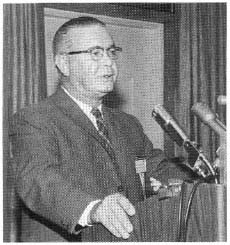
C. Scott Fletcher, who could sell ideas with the same fervor he once used to sell Studebakers
in Australia, did "more than any other person to bring public broadcasting into being and set
its course" during the ten years he headed the Ford Foundation's Fund for Adult Education.
Reprinted from Broadcasting Magazine, September 17, 1973, by Cahners Publishing Company
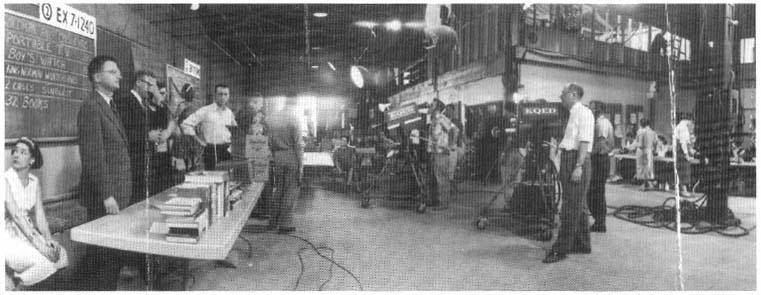
When money ran out after its first year on the air, KQED was kept alive with a televised auction
of donated merchandise. Jonathan Rice (far right, beside camera) inaugurated an annual tradition
by producing the event every spring for more than two decades (1957). Courtesy of KQED
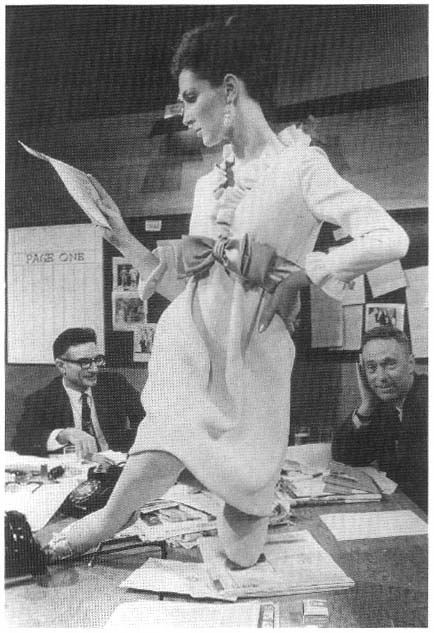
Not even the comics—read By Mimi London to the amused surprise of managing
editor Bill German (left ) and science editor David Perlman—were overlooked when KQED
hastily organized the nightly Newspaper of the Air to fill the gap created by a strike of the
city's two metropolitan dailies in 1968. Courtesy of KQED
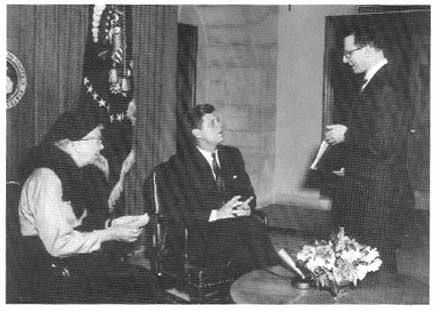
Eleanor Roosevelt was not John F. Kennedy's most enthusiastic fan. But with the
urging of producer Henry Morgenthau III (far right), she invited the president to be a
guest on her NET/WGBH series, Prospects of Mankind . The show and its distinguished
guests gave early and much-needed national attention to the nascent public medium
(1961). Courtesy of Henry Morgenthau III
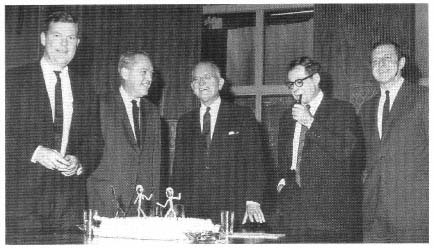
"It takes courage to depart from the safe and sterile . . . If we don't have that courage,
we don't belong in this business." NET president John F. White backed the rhetoric with
series like News in Perspective, in which New York Times Sunday editor Lester Marked
challenged (some say badgered) his colleagues Tom Wicker and Max Frankel on the
significance of the week's events (1965). Left to right: Wicker, White, Markel, Frankel,
and WNDT/New York president John W. Kiermaier. Courtesy of Thirteen/WNET/New York
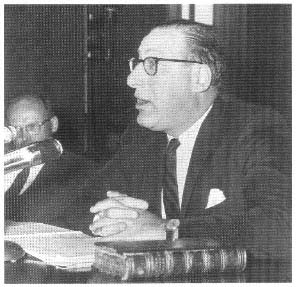
Their plan was praised by the press as "an imaginative proposal to a very vexatious problem,"
but Fred W. Friendly (at microphone ) and Ford Foundation president McGeorge Bundy ( far left )
failed to swing the FCC behind a bold scheme to help fund public TV from the proceeds of a
nonprofit satellite system. Courtesy of Ford Foundation Archives/City New Bureau, Inc.
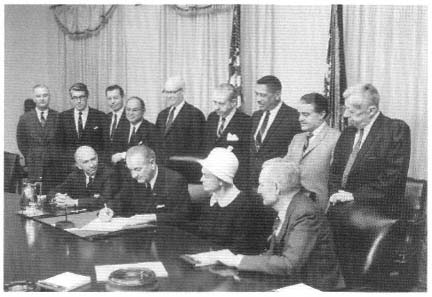
"I believe that educational television has an important future in the United States and throughout the world."
Lyndon B. Johnson, having six months earlier made the government a partner in public television by signing the Public
Broadcasting Act of 1967, gathered his appointees to the Corporation for Public Broadcasting's first board for the signing
of a bill extending its federal funding. Left to right, front row: Frank Pace (chairman), President Lyndon Johnson,
Oveta Culp Hobby, John D. Rockefeller 3d; back row: Joseph Hughes, Michael Gammino, Carl Sanders, Robert Benjamin,
Frank Schooley, James Killian, Roscoe Carroll, Jack Valenti, and Saul Haas (1968). Courtesy of LBJ Library
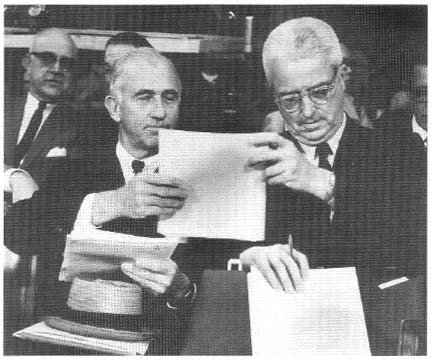
John W. Macy, Jr., the first president of the Corporation for Public Broadcasting (CPB) ( at right ), feared
that his longtime government service contributed to the misperception that CPB was a government agency.
He joined CPB's first chair, Frank Pace, Jr., to urge Congress to increase federal funding for public television.
Courtesy of City News Bureau, Inc.

Before Fred Rogers donned sweater and tennies to star in Mister Rogers' Neighborhood,
he was the behind-the-scenes producer, musician, writer, and puppeteer of The Children's
Corner, hosted by Josie Carey (right ) and produced by WQED / Pittsburgh for NET (c. 1995).
Courtesy of Family Communications, Inc.
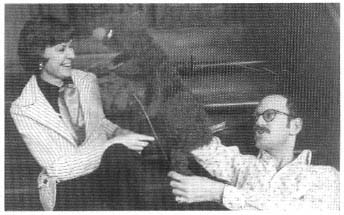
"I have been driven by a sense of obligation since adolescence." John Ganz Cooney changed
the face of children's television when the hugely popular Sesame Street debuted on PBS in 1969.
The founder and president of Children's Television Workshop comes face-to-fur with Grover the Muppet
and the hand and voice behind the Muppet, Frank Oz (c. 1978). Courtesy of Children's Television Workshop
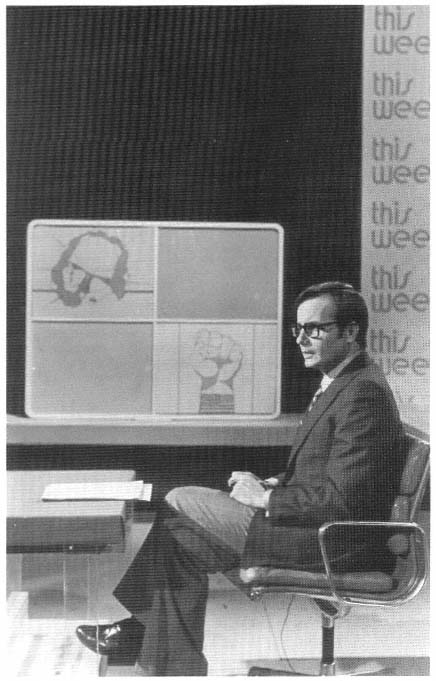
"I am just not cut out to be a television performer." Bill Moyers's unique talents were on his first
series for public television, NET's This Week . But the following season Bill Moyers' Journal established
him as one of the medium's performs (1970). Courtesy of Thirteen / WNET / New York
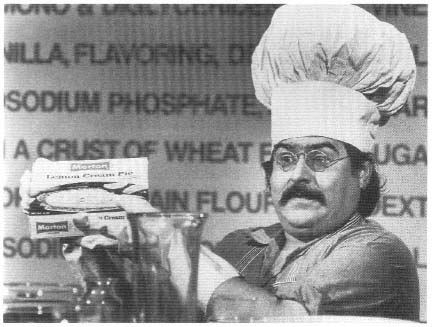
"Morton's Lemon Cream pie. No lemon. No cream." Marshall Efron played serious fun with vulnerable
targets as the consumer's watchful friend on the innovative PBS series The American Dream Machine (1972).
Courtesy of Thirteen / WNET / New York
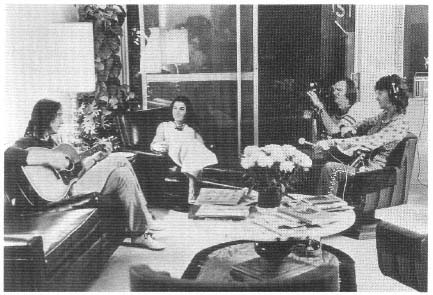
"We weren't deceived, but we were misled." For seven months, Pat Loud (second from left ) shared her life
and her family including her youngest son, Grant ( far left ), with filmmakers Alan and Susan Raymond ( at right )
for the controversial twelve-part PBS series American Family (1973). Photo from WNET Archives
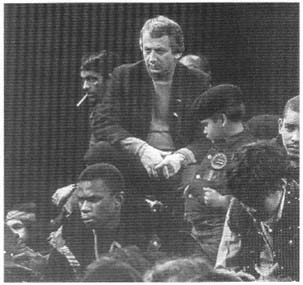
"It seems silly to balance all the possibilities in a given program . . . you don't balance out the
astronauts with the Flat Earth Society." Patrick Watson, rapping with South Bronx street gangs,
rattled sensibilities and enlivened issues as host and editor of WNET's nightly news show,
The 51st State . Courtesy of Thirteen / WNET / New York
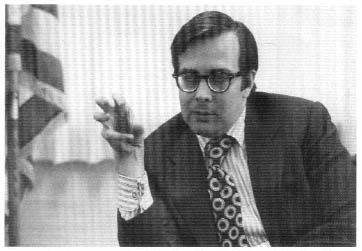
"Do any of you honestly know whether public broadcasting—structured as it is today and moving in the
direction it seems to be headed—can ever fulfill the promise envisioned for it or conform to the policy set for it?"
As director of the Office of Telecommunications Policy, Clay T. Whitehead served as point man for the Nixon White
House assault on public television (1971). Reprinted from Broadcasting Magazine , September 17, 1973,
by Cahners Publishing Company
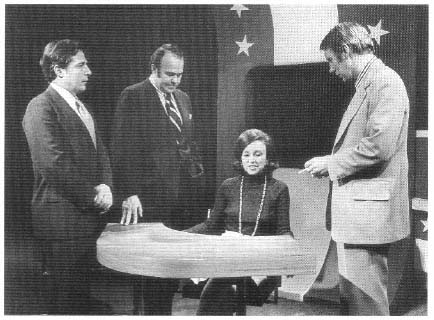
Hiring Sander Vanocur and Robert MacNeil as principal correspondents for NPACT "
greatly disturbed" President Nixon, who saw it as "the last straw" and demanded that all
funds for public television be cut immediately." The NPACT team, left to right: Peter Kaye,
Sander Vanocur, Elizabeth Drew, and Robert MacNeil (1972). Courtesy of James Karayn
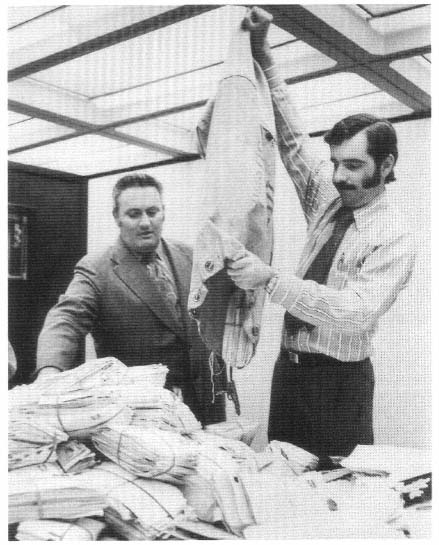
"Nixon vetoed our bill, cut our funding. Now he's given us our best programming." NPACT president Jim Karayn (left )
and executive producer Martin Chancy reveled in the outpouring of favorable responses to NPACT's gavel-to-gavel coverage
of the Watergate hearings, which PBS was at first reluctant to take on (1973). Photo from National Public Television Archives
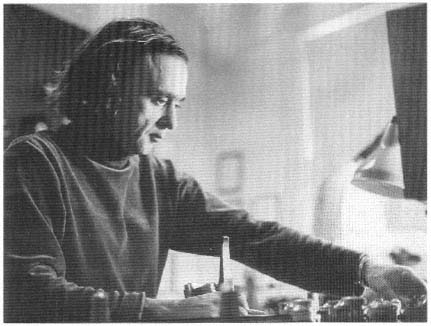
Notwithstanding his conviction that "massive bureaucracies inside the system [are] reversing priorities
by dominating rather than supporting programming," independent filmmaker Frederick Wiseman has managed
to place more than two dozen distinguished cinema-verité documentaries in the system since he made High School
(PBL, 1969) more than twenty-five years ago. Courtesy of Zipporah Productions
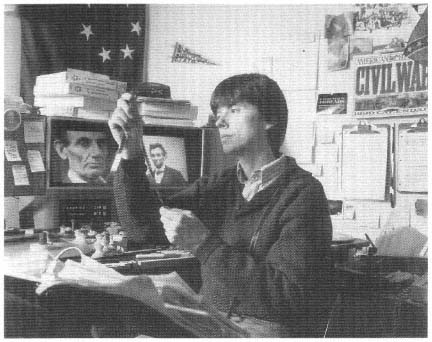
The New York Times called independent filmmaker Ken Burns "the most accomplished documentary
maker of his generation" after his Civil War series made television history of its own with the highest
audience ratings PBS had reached in its twenty-one years (1990). © Cori Wells Braun
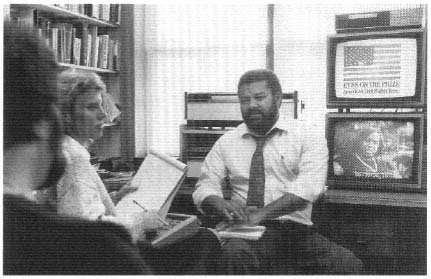
After spending five years raising money from forty-four funders to mount his landmark civil rights series
Eyes on the Prize, independent producer Henry Hampton (shown with members of his staff) concluded that
the structure of the public television system discourages risk-taking (1987). Courtesy of Blackside Inc.
and Lou Jones (photographer)
the Oval Office. Earlier in the year, many months before the Watergate burglary had become a major scandal and when its political ramifications were still hidden behind a cloak of official secrecy, the Senate had announced plans to investigate the break-in to the Democratic National Headquarters. At least one broadcaster in Washington, Jim Karayn, looked upon the Senate hearings as public television's opportunity to recapture its self-respect.
Karayn's organization, NPACT, had been the White House's principal target. His correspondents had been vilified, his budget slashed, and his programs reduced to bland coverage of the previous year's campaign. So whether or not he had foreseen the ominous implications of the hearings, he did have an eye out for the chance to stage a comeback. He urged PBS president Hartford Gunn to announce the public system's intention of covering the Watergate hearings, but Gunn didn't buy it. "I went twelve weeks in a row, every single day, five days a week, to see Gunn," Karayn said, arguing that PBS's announced intention of covering the controversial hearings would be proof that the public medium was not in the president's pocket—even if the hearings never took place.[49] But if they did take place, daily coverage could put PBS on the map and do for the public network what the broadcast of the Army-McCarthy hearings had done for a young ABC network. Gunn felt the times were not propitious for bold programming moves. Karayn's proposal was tabled. It was still winter, the authorization bill had not yet passed Congress, and public television was still cautiously wary, even fearful, of the Administration's undiminished power to destroy the system's hopes for long-range funding.
By spring, however, PBS felt more confident of its future. The pending CPB-PBS agreement promised an end to a long-festering dispute. And the White House threat appeared to be in decline. Gunn agreed to take a second look at Karayn's proposal. The manner of Gunn's "second look" underscores with disturbing clarity the public system's fainthearted approach to effective leadership and its readiness to substitute consensus for conviction. Gunn put the question of whether the public network should cover the Watergate hearings, arguably the most important congressional hear-
ing of the decade, to a vote of the 237 PBS stations. While the majority approved, it was by the thinnest of margins: 52 percent of the stations that responded favored coverage of the hearings. Some feared a negative reaction locally, allowing their parochial concerns to blind them to the obligations of national service that are central to the public medium. "You've finally had it," one station chief told Karayn. "You've decided to commit professional hara-kiri."[50]
In mid-April 1973, PBS acted upon its underwhelming mandate and announced plans to have NPACT cover the Senate Watergate hearings from their opening on May 17, 1973. The daytime live broadcasts were to be encapsulated for the evening audience with excerpts and analysis of the day's events. To anchor the on-air coverage of the event, NPACT paired its veteran correspondent Robert MacNeil with a young journalist from Dallas, Jim Lehrer. Karayn had brought Lehrer to NPACT six months earlier to replace the departed Sander Vanocur. The MacNeil-Lehrer team produced a dynamic synergy that eventually resulted in public television's first nightly news show.
By any measure, PBS's coverage of the unfolding drama was a huge success. Day after day, through May and June and into July, NPACT's cameras focused on a seventy-six-year-old country lawyer from North Carolina, Senator Sam Ervin—crusty, aphoristic, and perfectly suited for the television camera. As he and his seven-member select committee peeled back the layers of chicanery and deceit that underlay the Watergate case, a nation watched in fascinated disbelief. The daily tales of skulduggery in high places brought new viewers to the public medium, set new highs in audience ratings, and triggered a renewed outpouring of audience contributions. "For the first time in its brief history," said MacNeil, "it seemed the entire nation knew what public television was."[51] More important, the nation saw what it was not. Curtis's dramatic resignation a month earlier, with its charges of White House control of the Corporation, had left a bad aftertaste. The Watergate hearings cleansed the image and gave proof that public television was no one's official patsy. MacNeil, hoping that the lesson of the Watergate hearings was not lost on skeptical man-
agers of local stations, cited the coverage as evidence "that public television journalism could be vital, fair, and trenchant when dealing with the most sensitive political material."[52]
The Watergate hearings infused the whole public-television system with a renewed sense of vitality and excitement. Morale, reported the Wall Street Journal , had risen "from sulky to exuberant."[53] Karayn, whose NPACT had been down for the count of nine after the Nixon-Whitehead assault on public affairs, gloried in the poetic justice. "Nixon vetoed the funding bill, cut our funding," he exulted. "Now he's given us our best programming. It's sort of like being reborn."[54] NPACT was not alone in its sense of rebirth. Bill Moyers' Journal , which like NPACT had been an early casualty of the White House's paranoid fear of free expression, was revived in late October with a grant from the Ford Foundation. The timing was propitious. Moyers's first show on his return, "An Essay on Watergate," was arguably the best that he has ever done. With perception and wit, he looked into that dark moment in our political history and found our weakness and our strength—weakness in ethical values that allowed a president to define his own standards of right and wrong, and strength in the indefinable force that blew the whistle on the process before it was too late. "It was close," he said. "It almost worked. But not quite. Something basic in our traditions held." He wondered aloud why it had taken "so great an affront to decency to make us realize how hard-won rights can be lost simply by taking them for granted." After you've put the myths and folk tales behind you, he cautioned, "believing that what is best about this country doesn't need exaggeration. It needs vigilance."[55]
By late 1973, it was apparent that another act in the irresolute drama of the public medium was ending. "As Watergate sluiced through the press," noted one observer, "the Administration's sense of divine omniscience began to crumble."[56] And with the loss of its crudely fashioned majesty went the force of its assault on the media. Whitehead, the Administration's field general, was never himself implicated in the below-stairs dealings of the president's advisers. Nevertheless, his willingness to play the White
House game of saying one thing while meaning another effectively undermined his credibility with Congress and the public. So long as he had championed the doctrine of "localism," of ceding power to the local stations, even with the cynical aim of giving control of the system to its most conservative elements, he had had the support of many of the public broadcasters. But once he joined with the Administration's policy of centralizing power in the hands of the presidentially appointed party faithful on the CPB board, his deeds gave the lie to his pieties and he lost whatever support he had inside public television. The Administration's stratagem of "centralizing in order to decentralize" just didn't wash.
By this time I was no longer a participant in the events that rocked public broadcasting. Early in 1973, I submitted my resignation to the trustees of Channel 13. My departure from the public medium after twenty years, unpremeditated and mildly acrimonious, offered me a blessed relief from the frustrations and frictions of the office. If in joining the chairman of Channel 13 with the president of NET the Corporation and Ford Foundation had hoped for synergy, they miscalculated. Ethan Allan Hitchcock and I were not meant for each other: our temperaments, backgrounds, and management philosophies were worlds apart, as a series of contretemps—including the Woody Allen caper—demonstrated. The proximate cause of my departure, a dispute over a key staff appointment, threatened to divide authority and force employees to ally themselves with one side or the other. The resolution was as obvious as it was inevitable.[57]
In the spring of 1974, Tom Whitehead announced plans to leave government service "as soon as I can gracefully extricate myself."[58] The White House since Watergate, he said, had become "pretty much an armed camp."[59] Before leaving, he wanted to achieve two things: a report on the future of cable and a long-term funding bill for public television. Whitehead had taken a lot of heat as pointman for the Administration's policies on public television and had even surrendered his reputation as a nonpartisan, but he felt "a strong personal commitment" to carry these
policies to their logical conclusion. In early April, he outlined for the president his thoughts on a bill that would authorize funding over a five-year period, starting with $70 million in fiscal 1976 and rising to $100 million in fiscal 1980. A substantial portion of the funds—up to at least half by 1980—would be passed on to the local stations in order "to decentralize program control and minimize the network character of the system."[60] The time was ripe, he reasoned, for capitalizing on the consensus that backed the Administration's plans for restructuring public television. The bill would not preclude the use of federal funds for news and public-affairs programs. "While I share your view," he explained to the president, "that such funds should not be used for this purpose, [the bill] would not pass if we attempted to deal with the problem legislatively." That solution, he suggested, should be left to the CPB board.
The president, however, was not impressed. He did not even heed Whitehead's argument that the long-term bill "would carry the issue of public broadcasting structure and funding through to a new Administration—one that may not be as sympathetic to the role of local stations as we are."[61] Only three weeks away from the House hearings on his impeachment, Richard M. Nixon was far less concerned with future administrations than he was with the survival of his own. He rejected the Whitehead proposal. Incredulous, the OTP director fired off a memo to General Alexander Haig, Haldeman's replacement as Nixon's chief of staff. Voicing strong disagreement with the president's apparent intention either to "end" public television or to submit a "very limited" budget proposal, Whitehead asked for an appeal to the president. "Rightly or wrongly," he argued, "the commitment to Federal funding of public broadcasting has been made. For the President to attempt to back away from that commitment now is unwise, unworkable, and quixotic."[62] Whitehead met with Haig and made his arguments, but to no avail. The president rejected the proposal a second time.
Knowing he was not going to get the president to do what he wanted and feeling deeply that the issue was important, Whitehead decided to "go public." On the day after his meeting with
Haig, the story—"Nixon Said to Reject Public TV Funding"—broke on the front page of the New York Times . Editorials appeared in the Washington Post and the Wall Street Journal . The strategy had its intended effect; the Administration gave in to the pressure. "Ron Ziegler stood up and lied through his teeth," Whitehead recalled later, "and said the President had never made a decision."[63] In any case, Nixon decided a month later to approve the proposal for five-year funding and sent it on to Congress. A month after the president's decision, Whitehead appeared before Senator Pastore's subcommittee with a ringing endorsement of the five-year funding bill. "We have created a system; it is a reality. We must now give it a chance to succeed according to the original vision for a truly independent and financially insulated system of public broadcasting."[64] He had won the fight and in the process had won back a small piece of the integrity he had sacrificed in the White House's partisan wars. But from the moment he decided that he had to go public to win his fight, Whitehead knew that he had to resign. On his way back from testifying on Capitol Hill, he stopped by the White House to drop off his resignation. Two days later, President Nixon resigned.
Another era—turbulent, threatening, and altogether irrational—had come to a sudden and unexpected end. Tom Whitehead summed it up: "The separation we have, by and large, between the press and the government kept [the White House] from doing anything very meaningful with the rest of the media; but that separation blurred with public broadcasting and that gave them some levers, which they proceeded to utilize. You put a hammer in front of a little boy and he'll pick it up and pound something. That's what the funding of public television was to the Nixon political people."[65] It was a lesson that would be too easily forgotten.