
1—
The Mission Registers
The Christian missions which the Roman Catholic Church established among aboriginal peoples in North America under the aegis of the Spanish Crown provide a rich and unusual source of demographic information. At the time of their conversion, the natives entered a written record that, so long as they and their descendants remained within the mission sphere of influence, kept track of them for an indefinite period thereafter, sometimes to the present day. As a result, we can find out a good deal about the aboriginal conditions of the natives as well as their behavior under the stress of European spiritual and material conquest. Despite great variation in time and place, there persists a certain uniformity in the response of the natives and in the clerical record of it which makes possible a study of the entire region on the northern border of colonial Mexico, that region which today is divided between two countries as the Mexican North and the American Southwest. At maximum, such a study can hope to trace the natives after conversion for two or three centuries. There is no need to examine the data on every locality and settlement. A series of samples should be quite adequate to the task.
The missions functioned also as parish churches for the non-Indian population, wherever it appeared, during the long periods that the missionaries were the only priests within the new-won territories. Accordingly, the mission records cover as well the so-called Hispanic population, the gente de razón . They
were all of European culture, but more often than not of varied genetic stock—sometimes pure European, most likely mixed European and Indian, sometimes with an admixture of Negro, occasionally pure Indian from one of the native groups farther south. This melting-pot came into being as garrisons and mining and agricultural communities formed on what was initially a frontier.[1] The data on this population make possible a further set of studies for a group with different responses to what for them was often a remarkably favorable environment.
Selection of sample sets of data must depend upon their survival and availability. Here our own searches quickly disclosed that not all mission records have survived the ravages of time and indifference of man; further, that not all of those that have survived are readily available. The expectation of the Spanish Crown was that after the initial period of conversion and indoctrination, which might last for some generations, the mission population would be ready to enter normal parish life. At that time the missions would be secularized—that is, turned over to the secular clergy—and special endowments of lands and other productive wealth would be turned over to the natives or held in trust for them.[2] Accordingly, in normal course, as missions were secularized, their churches became parish churches and the registers of the missions continued as normal parochial registers. The earlier books of baptisms, marriages, burials, and all others should have remained in the parishes or have been transferred to a diocesan archive of some kind. Missions that were abandoned for lack of parishioners should have had their registers moved to another parish or to a local diocesan archive. Unfortunately, what happened was more complex. Many registers were lost through neglect; others have passed into private possession. There has been relatively little effort to trace mission by mission the fate of such records and the location of registers that do survive. For much of northern Mexico, we were unable to obtain information on the whereabouts of early mission registers or indeed much information of any kind. It is only now, under a widening impulse to cultivate local history and anthropology in new forms, which is being
[1] See the discussion in "Racial Groups in the Mexican Population Since 1519," Cook and Borah, Essays , II, chap. 2, pp. 180–269.
[2] The policy of secularization and the controversies it evoked may be traced in Mariano Cuevas, Historia de la iglesia en México , II–V, passim , and in Hubert Howe Bancroft, History of Mexico , III–IV, passim .
actively fostered by the National Institute of Anthropology and History in Mexico City, that inquiry is beginning into the whereabouts and state of such registers.[3] For Baja California, which long has excited interest on both sides of the international border—an interest that has extended particularly to the mission period—inquiries by a number of scholars indicate that few registers of the Jesuit period are known to survive, that considerably more of the Franciscan and Dominican period survive, and that there has been substantial dispersal of the materials.[4]
On the American side of the frontier, mission and parish registers for the Archdiocese of Santa Fe, covering the bulk of the Franciscan missionary zone of New Mexico, have been brought together in a central church archive, for which Fray Angélico Chávez, O.F.M., has published an excellent guide. From the guide, it is clear that all mission registers for the years prior to the Great Indian Uprising of 1680 have been lost, probably in 1680, and that much subsequent material has also disappeared. There remain, nevertheless, records and even runs of records for many missions and parishes, beginning, in general, at some time after the middle of the eighteenth century.[5] For another great Franciscan missionary province, California, there is still no up-to-date comprehensive guide. The registers are dispersed among the various dioceses, sometimes in a central diocesan archive, sometimes in the parish that succeeded the mission. The registers of Mission San Francisco de Solano are in
[3] For example, Cynthia Radding de Murrieta, "Problemática histórica para estudios de población en la subregión de Álamos, Sonora," and her Cátalogo del Archivo de la Parroquia de la Purísima Concepción which give an inventory of the remaining parish registers of Álamos. Father Lino Gómez Canedo, O.F.M., has found a good many parish records surviving in the regions of Franciscan activity in northeastern Mexico. See his introduction to Ignacio del Río, comp., A Guide to the Archivo Franciscano of the National Library of Mexico , I, pp. xliii–xlviii.
[4] The results of this inquiry are summarized in the discussion and table of Woodrow Borah, "Reflections on the Demographic History of the Peninsula of Baja California, 1534–1910." This paper is based on Hubert Howe Bancroft, History of the North Mexican States and Texas , I–II, passim ; Zephyrin Engelhardt, The Missions and Missionaries of California , I, Lower California, passim ; Peveril Meigs III, The Dominican Mission Frontier of Lower California , p. 181; Homer Aschmann, The Central Desert of Baja California: Demography and Ecology (IA 42), p. 276; Ellen C. Barrett, Baja California, 1535–1956: A Bibliography of Historical, Geographical and Scientific Literature , pp. xix-xx; George P. Hammond, ed. A Guide to the Manuscript Collections of the Bancroft Library , II, passim ; and the filmed card catalogue of the library of the Genealogical Society of Utah, Salt Lake City.
[5] Angélico Chávez, Archives of the Archdiocese of Santa Fe, 1678–1900, passim .
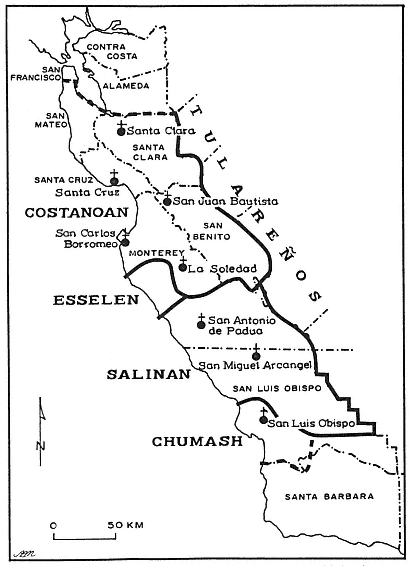
The eight northern California missions discussed in this book and their
approximate territories of conversion.
a civil deposit, the Bancroft Library of the University of California, Berkeley. Nevertheless, for the Alta California of the Hispanic period, survival of records has been extraordinarily, almost miraculously, good; and with the advent of microfilm, consultation of the registers has become increasingly easier. A thoroughly desirable further move to provide facilities for schol-
ars is under way in the concentration of microfilm of mission and parish registers for California, and the world as well, in the remarkable array of demographic materials of all kinds that is being assembled by the library of the Genealogical Society of Utah in Salt Lake City, with a branch library in Oakland, California.[6]
For the present paper, we chose as a sample the registers of eight missions in northern California, those situated in a continuous chain from San Luis Obispo in the south to San ta Clara in the north (see map). Listed in order of date of foundation, they are:[7]
San Carlos Borromeo, 3 June 1770
San Antonio de Padua, 14 July 1770
San Luis Obispo, 1 September 1772
Santa Clara, 12 January 1777
Santa Cruz, 28 August 1791
Nuestra Señora Dolorosísima de la Soledad, 9 October 1791 (We shall shorten this name to La Soledad.)
San Juan Bautista, 24 June 1797
San Miguel Arcángel, 25 July 1797
They fall by date of foundation into two groups, those founded between 1770 and 1777, and those founded between 1791 and 1797. The earlier group initiated the impact upon the aboriginal world of the California Indians from fourteen to twenty-one years before the second group; and to the extent that length of time was involved in the operation of this process, they were
[6] An excellent attempt to give the location and coverage of California mission registers, now unfortunately obsolescent, is J. N. Bowman, "The Parochial Books of the California Missions: 1961." Moving the manuscript originals of some of the registers, consequent on changes in diocesan boundaries, has already rendered much of the article out-of-date, although it is still very useful. The best guide to the present whereabouts of the mission registers, so far as its coverage goes, is probably the card catalogue of the library of the Genealogical Society of Utah in Salt Lake City. We have consulted it in a filmed copy at the Oakland, Calif., branch of the library. That catalogue lists only what the society has been able to film. In 1976 it did not have the registers of the southernmost missions in the jurisdiction of San Diego, nor those in the Archdiocese of San Francisco. The early registers of Mission San Jose, for example, are not available in the filmed copies of the society, which do contain the later registers, because the former are in the care of the Archdiocese of San Francisco. We can only hope that the society ultimately will be able to secure film of all registers, and so for the first time make consultation of them relatively simple. For some idea of the general holdings of the library, see Larry T. Wimmer and Clayne L. Pope, "The Genealogical Society Library of Salt Lake City: A Source of Data for Economic and Social Historians."
[7] Engelhardt, The Missions and Missionaries of California , II, pp. 74–78, 87–88, 103, 206, 216, 454, 494–496.
farther along in it by the time of secularization in 1834.[8] Within the earlier group is San Carlos Borromeo in Carmel, which served as parish church for the presidio and town at Monterey, eventually the capital of Alta California. It was the second mission established by Father Junípero Serra and was one of the major foci of religious and political effort in the later Spanish colonial empire. Its records also cover the longest span of any of the eight missions. All of the missions continued as parish churches after secularization.
Looked at in terms of native groups, the eight missions covered the bulk of the territory occupied by the Costanoan Indians, all of that occupied by the Esselen and Salinan linguistic bands, and at Mission San Luis Obispo incorporated the northernmost villages of the Chumash. Despite linguistic diversity, all of these Indians, with the possible exception of the Chumash, were basically of very similar culture.[9] The Costanoan territory extended considerably northward, so that many Costanoans received religious administration from Mission San Jose and Mission San Francisco de Asís (called alternatively, and more usually, Nuestra Señora de los Dolores). Inclusion of those missions in our sample would not, however, have given us a more uniform group, for they ministered to large numbers of coastal Miwok as well as other nearby groups. As Alfred Kroeber has commented, "Mission Dolores, at San Francisco, must have contained an extraordinary jumble."[10] The fact is that almost no mission dealt with a single linguistic or tribal group; rather, each mission was forced by the Spanish strategic need for a chain of posts along the coast, by slender resources in personnel and supplies, and by the fragmentation of the native population, to incorporate various linguistic groups into its jurisdiction. For many of the missions in the north, the "jumble" was accentuated in the nineteenth century as Indians were brought in from the Central Valley to replace the dying local population. Substantial numbers of Yokuts thus were added to the rolls.[11] Nevertheless, the eight missions do constitute a
[8] Ibid ., III, pp. 473–477 and 501–532, gives a particularly bitter account of secularization in California. Hubert Howe Bancroft, History of California , III, pp. 301–363, covers the plans, decrees, and eventual seizure of the mission lands.
[9] Alfred L. Kroeber, Handbook of the Indians of California , pp. 347–350, 462–473, 544–568, and maps in those pages on approximate boundaries.
[10] Ibid ., pp. 464–465.
[11] Ibid . and pp. 474–543, for a description of the Yokuts.
relatively homogeneous sample in terms of culture of the local native population and of general geographic conditions.
Within the territory of the eight missions, there also came into being a relatively substantial population of European culture. In addition to the garrisons at the missions and ranches, there were three nuclei: the presidio and eventually town of Monterey, founded at the same time as the mission, 3 June 1770; the pueblo of San Jose, founded 29 November 1777, approximately two miles southeast of Mission Santa Clara; and the pueblo of Branciforte, founded in May or June 1797 at the northern end of Monterey Bay near Mission Santa Cruz.[12] The pueblo of San Jose was much closer to Mission Santa Clara than to Mission San Jose, so that it used the religious services of Mission Santa Clara even after the establishment of Mission San Jose. These three nuclei, and especially the two of the presidio at Monterey and the pueblo at San Jose, give a sample of the people of European culture.
We found that the registers needed for our inquiry, namely those of baptisms, marriages, and burials, on the whole, were extant for the eight missions, but with certain losses and certain difficulties of access. The first book of marriages for Mission San Miguel Arcángel, covering the years 1797–1853,[13] was not available, because it was stored in the mission itself rather than the diocesan archive. The first book of burials of Mission La Soledad, beginning about 1791 and continuing to the end of the Hispanic period, officially is lost. It may be in private possession, lie mislaid in some church deposit, or have been destroyed. A happier story is that of the first book of burials of Mission San Antonio de Padua, which at the time of our extraction of data also was considered lost. Somehow it had drifted into private hands, but has now been returned to the diocesan archive in Monterey.[14] Finally, the first book of marriages of Mission San Luis Obispo was destroyed in a fire on 29 Novem-
[12] Bancroft, History of California , I, pp. 170–171, 311–313, and 568–571.
[13] The second book of the register of marriages begins in 1879, but 6 marriage entries, covering the years 1854–1858, occur at the end of the first book of baptisms. For further information, see Bowman, pp. 309–315.
[14] Ibid ., pp. 303–315. At some time before the First World War, Father Zephyrin Engelhardt (Mission Nuestra Señora de la Soledad , pp. 61–67) examined the first book of burials of Mission La Soledad; the book has disappeared since then. We are led to conjecture that it may have been mislaid, as was the first book of marriages of San Miguel Arcángel, or may have drifted into private hands, as happened to the first book of burials of San Antonio de Padua.
ber 1776, according to a notation by Father Junípero Serra in the new book he ordered prepared as replacement. The new book attempts to replace the lost entries from the Status Animarum or padron of the Indians and from popular knowledge. It was not possible to reconstruct the detail of the exact day, the witnesses, and much other information.[15] Thus approximately the first 45 entries lack as full information as the others, and for our purposes turned out to be unusable.
The three sets of mission registers that interest us here were part of a larger series of records kept at each mission under instructions from the parent Colegio de Propaganda Fide de San Fernando de México, which trained and supervised the early Franciscan missionaries in California. In addition to accounts, each mission was supposed to keep, and did keep, the following groups:
1. Register of Baptisms
2. Register of Confirmations
3. Register of Marriages
4. Register of Burials
5. The Status Animarum , or Padron, or census roll, which recorded the names of married adults, their children, widows, and widowers, with detail on date of birth, baptism, and origin or native village.
6. The Libro de Patentes , in which were transcribed documents of importance and circular letters of higher authorities, civil and ecclesiastical.
The books constituting each register were bound in flexible leather with sides that overlapped. The paper within, of good quality to take ink, measured approximately 8 by 11 3/4 inches. During the Hispanic period the books with blank paper were supplied by the Colegio de Propaganda Fide de San Fernando, and usually had from 300 to 350 leaves. The first and last leaves of each volume were usually left blank, the title being written on the obverse of the second folio. Invariably the first book of baptisms has, following the title page, a brief history of the founding of the mission; all volumes may have some leaves devoted to data that especially interested the missionaries and authorities. The entries are written in ink and signed by the priest who officiated at the rite. Usually a margin of perhaps an inch was left for a running number within each register, contin-
[15] Engelhardt, Mission San Luis Obispo in the Valley of the Bears , p. 186.
ued into the following books of the same register. Within the margin the priests might note the names of the people baptized, married, or buried; whether Indian or gente de razón; if Indian, the village or ranchería; and so on.[16]
At best the information in the registers of baptisms, marriages, and burials is extensive. At a maximum, the baptismal entries give information for each individual which includes the date of birth, age when baptized, the Christian and sometimes the heathen name, the native village of the heathen Indian, the parents, their place of birth if known, and the nature of their relation to each other. The marriage entries give the name, the place of origin, the names of the parents, whether or not they were married, and the previous marital history of each of the new spouses. The burial entries list the name of the decedent, his village or tribal origin; sometimes the age and if not that, whether adult or child; the cause of death, if important; and religious information concerning last rites and burial. Clearly, if in every case the officiating clergyman collected and recorded all the data which was possibly pertinent, the vital record would be as voluminous and accurate as any contemporary registration system could devise. Regrettably, he was not always able or willing to do so. The entries as they are in the registers represent usually a transcription or enlargement from notes made at the time of the rite. Transcription permitted the priest to cast the entries in a more nearly common form, but pressure of ministration might delay transcription and, one suspects, in serious emergencies even lead to long delays and loss of notes. Moreover, within the requirements set by the Church, there was no fixed form which had to be adhered to. The individual priest wrote what he wished in the way he wished. In the vast spaces of California it was almost impossible to apply strict supervision, and the occasional visitas , which included inspection of the registers and the form in which they were kept, are invariably commendatory, regardless of what may have been said in private.
As we have already suggested, the mission registers permit us to examine the records of two distinct ethnic categories, although the format of the entries is the same for both. One
[16] The system and format of mission registers are described with care in Engelhardt, Mission San Carlos Borromeo (Carmelo) , p. 224, and San Miguel Arcángel , p. 40. See also Bowman, pp. 303–304.
group is the Indians, both as heathen at the moment of conversion and subsequently as neophytes in the mission. The other consists of what might loosely be called the white men, the gente de razón, predominantly Spaniards and Mexicans, who came with the missionaries and who supplied the manpower for the civil and military establishment. With them came their families. All were forced to rely upon the missionaries for religious services, for until the middle 1830's there were no parishes, and even after the secularization of the missions the former missionaries continued to function as parish priests. It was only in 1836, fifteen years after the independence of Mexico, that the Mexican national government decided to request the Pope to detach the Californias, Alta and Baja, from the Bishopric of Sonora. The formalities took four years and resulted in consecration of a bishop with see in San Diego.[17] Thereafter the American annexation led finally to the creation of a more elaborate arrangement of dioceses and the entrance of substantial numbers of new clergy. The process may be traced in the registers in the 1850's in the appearance of non-Hispanic priests, and a tentative choice of a language other than Spanish for the entries that eventually settled on Latin as the best compromise between Spanish and English. Thus, at first small in numbers, the people of European culture eventually came to outweigh the native element and to fill most of the pages of the mission books. At the end of the mission period and for two decades subsequently, the non-Hispanic people—that is, the Anglo-Americans, the French, the Irish, and other nationalities—began to make their numbers felt, despite the steady growth of the Hispanic population by natural increase and by immigration during the Gold Rush. During the 1850's they came to supersede the Hispanic component as the dominant ethnic group of European culture.
It is theoretically possible to make an analysis of the birth, marriage, and death status of the two fundamental racial groups, Indian and Caucasian, and to study also certain other parameters, such as racial fusion. Furthermore, we should be able to study the mixing of subcomponent groups within each of the dominant racial groups. However, in practice we are
[17] Engelhardt, The Missions and Missionaries of California , IV pp. 90–91 and 195; Bancroft, History of California , IV, pp. 64–65.
restricted to the data which actually can be extracted from the registers. The restrictions are onerous. They vary greatly from mission to mission and within each book as new priests assumed responsibility and imposed their personal preferences and idiosyncracies. Nevertheless, they may be summarized in the following fashion:
To begin with, there are the usual technical difficulties, some of which have already been mentioned: illegible handwriting; poor copy because of the deterioration of the paper (perhaps most of all through overuse)[18] or penetration of ink to the other side of the leaf; all sorts of minor errors; and different formats, depending upon the priest and the exigencies of the moment. The result is that in all too many instances accessory information is lacking, such as identity of parents or birthplace of converts and couples being married. Even ages, where they are stated, are not exact. Usually the missionaries guessed at approximate age, given with the qualification "about" (cerca de ) or as a range, e.g., 10–15 years. Naturally there was a great deal of heaping. Indeed, in the age groups over 40 years, the vast majority of persons were specified as being precisely 50, 60, or 70 years of age. Such imprecision in stating age is characteristic of similar records in the European world of the time.
More serious than inaccuracy in reporting, however, is the frequent and for some missions almost universal lack of any age statement at all. For Mission San Carlos Borromeo, one of the worst offenders in this regard, in both the marriage and burial registers indication of age beyond the categories of child and adult is completely missing. In the registers of other missions, there is a greater range of reporting age, up to very good. In consequence, direct tabulation of age at death is sometimes possible and sometimes impossible; for all deaths recorded in the registers of the eight missions, it is, of course, impossible. Baptismal data are better, for the entries in the baptismal registers of the eight missions do give ages for two groups of people, the heathen Indians at the time of conversion, and the
[18] Virtually all holders of the mission registers now provide microfilm for the use of the public, as a result of the deterioration in the manuscripts brought about by much consultation. Unfortunately, the microfilm usually has been hastily made, without the care needed to make the film truly legible.
children of both Indians and gente de razón who were born under the auspices of the clergy. Since the Church insisted that a newly-born infant be baptized as quickly after birth as possible, we can be reasonably certain that a párvulo of any ethnic origin was, in general, no more than a few days or weeks old at the time of baptism. To be sure, baptism might be delayed even longer for reasons of health, distance from the mission, or long spells of inclement weather, but such instances are a small percentage of the baptisms of párvulos and more likely to be found among those of the children of the gente de razón than among those of the Indians, for the Indian settlements were either at the mission or visited fairly regularly and frequently by the missionaries.
The difficulty in securing adequate data on age at death would be insurmountable were it not for the custom, well developed in some missions but not in others, of writing in the margin of the entry of death in the register of burials the baptismal number of the person if he had been baptized in the same mission. It thus becomes feasible, at considerable labor, to check back to the number in the book of baptisms, where either the birth or the age at conversion ordinarily will be noted. Then the difference in dates permits the estimate of age at death. We have done so by full year rather than to month and day. If we assume that the age at baptism is correctly recorded, this estimate will be correct to within plus or minus one year, surely so in the case of newborn children, but much less so and with increasing error for higher ages in the case of converts. Even for newborn children the error is large by present-day standards; but the procedure is the best that can be obtained, because to calculate according to the month and the day of baptism or death would involve an inordinate additional amount of labor which, in most instances, would be wasted. We therefore, as a practical measure, are forced to rely upon averages by full year.
A number of our eight missions adhered faithfully to the custom of including the baptismal number in each death entry for which it was possible. Mission San Carlos Borromeo did not. Since its registers presented the worst problems for our study, we describe those problems in some detail. The registers of the other missions presented similar problems in varying but lesser degree. In the burial registers of Mission San Carlos Borromeo during the several blocks of years, representing different mission
administrations, the baptismal numbers, with few exceptions, are omitted. In the remaining burial entries, the omissions of baptismal numbers occur frequently. The only sequence which is internally complete is that between 1799 and 1805 (nos. 1,287 to 1,604). The years from the foundation of the mission in 1770 to 1793 have been studied in detail by a previous investigator, almost certainly Monsignor James Culleton, who worked out the burials in detail. He wrote lightly in the margin the appropriate baptismal number beside the entry for each decedent, thus rectifying the omission of the missionary. Since these numbers are legible in the microfilm, which we consulted in lieu of the manuscript register, we were able to use them and here record our gratitude.
With these exceptions, the only way in which one may recover the age of decedents without baptismal number—and they constitute at least half the total at Mission San Carlos Borromeo—is to track them down one by one according to their Christian name. We had therefore to go through the pertinent sections of the burial register and write down the personal name and year of death of each decedent. Then the entire register of baptisms had to be examined within the years covered in our study, and each name checked against the list of those whose deaths were recorded in the mission.
For San Carlos Borromeo, close to 1,500 names were thus checked. Of these, 1,228 were found in the baptismal register. By difference, the age of death could be estimated for these to within one year. The remainder, 277 names, were not found in the baptismal register. The reasons for the deficiency are manifold. Many names were hopeless duplicates; others had undergone changes during the person's lifetime; in some instances the reconciliation was missed by sheer inadvertence. Indeed, the fact that nearly 82% of the missing ages at death were recovered must be counted something of an achievement.
Our final result for San Carlos Borromeo, however, leaves a good deal to be desired, for the aggregate number of ages at death obtained through all methods by no means equalled the number of Indian baptisms. This deficiency is demonstrated by certain totals obtained through examination of all the entries in the baptismal and burial registers of Mission San Carlos Borromeo for the years of our study. A direct count showed that 2,836 Indians were baptized between foundation of the mission
and its secularization at the end of 1834.[19] Of these, 1,541 were converted gentiles and 1,295 were neophytes born in the mission. Of the former, the death entries for 1,117, or 72.5%, can be identified in the register of burials; of the latter, 893, or 69%. Collectively, of the 2,836 Indians baptized at Mission San Carlos Borromeo, 2,010, or 70.9%, have been identified as having died in the mission. Those 277 whose deaths are recorded but whose names have not been found in the baptismal record must be added to the identified dead, making 2,287 in all. There still remain, however, 549, or nearly that number, who were baptized but disappeared without trace from the mission record.
Several reasons for the shortage can be suggested. The first is that in some instances the priest was unable to or neglected to record the death. The latter contingency would have been very rare, but circumstances sometimes threw an almost unbearable load upon the missionaries. The epidemic of 1802 at Mission San Carlos was a case in point, for during several weeks the missionaries were so occupied with the care of the sick and the administration of the last rites to the dying that they were unable to keep the record up-to-date, and easily may have failed to record numerous deaths. A second source of loss derives from the fact that many of those Indians who entered the mission survived past secularization and were buried elsewhere. As is well known, all missions, including San Carlos Borromeo, underwent in the middle 1830's what in some instances amounted to complete disintegration.[20] The neophytes spread out into the surrounding countryside and merged with the civil population or, if they had been brought from a distance, returned to their native territory. When many of these people died, their decease was not recorded in the local mission register. Some may have moved to the jurisdiction of other missions, the registers of which do record their deaths, but such entries are even more difficult to track down.
[19] The total of baptisms differs from any tabulated to date, as stated in Sherburne F. Cook, The Population of the California Indians, 1769–1970 , p. 29. The reason lies in differing cut-off dates and, in part, in somewhat different criteria of selection. The same discrepancies will show up, in general, for all our data on baptisms, marriages, and burials for all eight of the missions. The data we adduce in this study are new assemblies based upon a new reading of the registers.
[20] The plundering of the missions by civil administrators, and the exploitation of the Indians, may be traced in some detail in Bancroft, History of California , III–IV. Bancroft, although sympathetic to the concept of secularization, admits that it was a disaster in California (IV, pp. 43–44).
A third source of loss arises from those Indian neophytes who departed the missions even prior to secularization. They were the fugitives who caused so much trouble to the missionaries. Most of them preferred the old, primitive, free ways, and upon absconding from the mission reverted to their aboriginal mode of living. The burial register of Mission San Carlos Borromeo records several instances as early as 1780–1790 of neophytes who went to die in their old rancherías among the heathen. The volume of this kind of desertion was augmented notably in the last years of the missions, and undoubtedly accounts for a great many of the missing burial entries.
In any event, it is evident that we must deal with a sample of the total Indian population which, at San Carlos Borromeo, is of the order of 70%. With the converted gentiles, fugitivism or absenteeism in some form was the chief cause of loss. Although there may have been appreciable bias in favor of the younger adult age group, the effect probably was not serious, and the sample, therefore, would reflect more or less faithfully the response of the whole. Since very few heathen were admitted to the mission community at San Carlos Borromeo after 1804, the disintegration of mission society upon secularization at that mission would have affected the death records only of those persons older than 30 years. Hence, there might have been a reduction in the apparent number of deaths at the mature or older phases of life. It is impossible to state how severe this curtailment may have been.
The neophytes who were born in Mission San Carlos Borromeo were less likely to have absconded permanently than those who were accustomed to the heathen existence of their youth. Far more important for the participation of the former group in the demographic history of the mission is the fact that they were continuously produced from the earliest years to the end of the mission period. Hence in 1834, the surviving Indians born in the mission would show a spectrum of ages from newly-born to perhaps 60 years old. However, many of these survivors outlived mission supervision, and their deaths might never be recorded or might be recorded elsewhere. Hence, the sample available in the burial register includes only 70% of those who were born in the mission and were itemized in the baptismal entries. This problem is discussed further in the section below on the neophytes who were born in the mission.
In general, what we have stated about the data taken from
the registers of Mission San Carlos Borromeo applies to the data from the other missions. We estimate that we have been able to obtain approximately a 70% sample for each of the other five missions for which we have obtained information on burials. A problem of considerably lesser dimension than for the Mission San Carlos Borromeo registers arose for those burial registers which almost invariably identified baptismal number, in that some of the baptismal numbers turned out to be wrong and we were not always able to locate the correct entry. The effect was to reduce our identifications by something less than 1%. Perhaps the major difference in the data from some of the other missions and those from San Carlos Borromeo lies in the fact that upon exhausting the pool of local Indians within the mission territory—a circumstance that occurred at some time between 1804 and 1815 at different missions—a number of missions turned to the Central Valley for new converts, the so-called Tulareños or Tulares, who were almost all Yokuts, but were given their name in mission records because they came from the great reed swamps of the southern San Joaquin Valley. (The reeds were called tules in Mexican Spanish, from Nahuatl tollin or tullin , a reed; tular is a collective form.) The bringing in of the Tulareños meant a new population of somewhat different age distribution when it entered the mission records. At the time of secularization, the Tulareños still included substantial numbers of neophytes who could remember aboriginal life and were younger than similar groups among the local Indians. Accordingly, we have tried in our tabulations to keep data on the Tulareños or Tulares separate from the series for local gentiles. At the time of secularization, and afterwards for those who remained within the recording of the missions converted to parishes, the disintegration of both local and Tulareño Indians was bringing about a substantial amount of intermarriage, as the search for new marriage partners among widows and widowers broke down linguistic and cultural differences.