
Chapter III—
Mission Registers as Sources of Vital Statistics:
Eight Missions of Northern California
1—
The Mission Registers
The Christian missions which the Roman Catholic Church established among aboriginal peoples in North America under the aegis of the Spanish Crown provide a rich and unusual source of demographic information. At the time of their conversion, the natives entered a written record that, so long as they and their descendants remained within the mission sphere of influence, kept track of them for an indefinite period thereafter, sometimes to the present day. As a result, we can find out a good deal about the aboriginal conditions of the natives as well as their behavior under the stress of European spiritual and material conquest. Despite great variation in time and place, there persists a certain uniformity in the response of the natives and in the clerical record of it which makes possible a study of the entire region on the northern border of colonial Mexico, that region which today is divided between two countries as the Mexican North and the American Southwest. At maximum, such a study can hope to trace the natives after conversion for two or three centuries. There is no need to examine the data on every locality and settlement. A series of samples should be quite adequate to the task.
The missions functioned also as parish churches for the non-Indian population, wherever it appeared, during the long periods that the missionaries were the only priests within the new-won territories. Accordingly, the mission records cover as well the so-called Hispanic population, the gente de razón . They
were all of European culture, but more often than not of varied genetic stock—sometimes pure European, most likely mixed European and Indian, sometimes with an admixture of Negro, occasionally pure Indian from one of the native groups farther south. This melting-pot came into being as garrisons and mining and agricultural communities formed on what was initially a frontier.[1] The data on this population make possible a further set of studies for a group with different responses to what for them was often a remarkably favorable environment.
Selection of sample sets of data must depend upon their survival and availability. Here our own searches quickly disclosed that not all mission records have survived the ravages of time and indifference of man; further, that not all of those that have survived are readily available. The expectation of the Spanish Crown was that after the initial period of conversion and indoctrination, which might last for some generations, the mission population would be ready to enter normal parish life. At that time the missions would be secularized—that is, turned over to the secular clergy—and special endowments of lands and other productive wealth would be turned over to the natives or held in trust for them.[2] Accordingly, in normal course, as missions were secularized, their churches became parish churches and the registers of the missions continued as normal parochial registers. The earlier books of baptisms, marriages, burials, and all others should have remained in the parishes or have been transferred to a diocesan archive of some kind. Missions that were abandoned for lack of parishioners should have had their registers moved to another parish or to a local diocesan archive. Unfortunately, what happened was more complex. Many registers were lost through neglect; others have passed into private possession. There has been relatively little effort to trace mission by mission the fate of such records and the location of registers that do survive. For much of northern Mexico, we were unable to obtain information on the whereabouts of early mission registers or indeed much information of any kind. It is only now, under a widening impulse to cultivate local history and anthropology in new forms, which is being
[1] See the discussion in "Racial Groups in the Mexican Population Since 1519," Cook and Borah, Essays , II, chap. 2, pp. 180–269.
[2] The policy of secularization and the controversies it evoked may be traced in Mariano Cuevas, Historia de la iglesia en México , II–V, passim , and in Hubert Howe Bancroft, History of Mexico , III–IV, passim .
actively fostered by the National Institute of Anthropology and History in Mexico City, that inquiry is beginning into the whereabouts and state of such registers.[3] For Baja California, which long has excited interest on both sides of the international border—an interest that has extended particularly to the mission period—inquiries by a number of scholars indicate that few registers of the Jesuit period are known to survive, that considerably more of the Franciscan and Dominican period survive, and that there has been substantial dispersal of the materials.[4]
On the American side of the frontier, mission and parish registers for the Archdiocese of Santa Fe, covering the bulk of the Franciscan missionary zone of New Mexico, have been brought together in a central church archive, for which Fray Angélico Chávez, O.F.M., has published an excellent guide. From the guide, it is clear that all mission registers for the years prior to the Great Indian Uprising of 1680 have been lost, probably in 1680, and that much subsequent material has also disappeared. There remain, nevertheless, records and even runs of records for many missions and parishes, beginning, in general, at some time after the middle of the eighteenth century.[5] For another great Franciscan missionary province, California, there is still no up-to-date comprehensive guide. The registers are dispersed among the various dioceses, sometimes in a central diocesan archive, sometimes in the parish that succeeded the mission. The registers of Mission San Francisco de Solano are in
[3] For example, Cynthia Radding de Murrieta, "Problemática histórica para estudios de población en la subregión de Álamos, Sonora," and her Cátalogo del Archivo de la Parroquia de la Purísima Concepción which give an inventory of the remaining parish registers of Álamos. Father Lino Gómez Canedo, O.F.M., has found a good many parish records surviving in the regions of Franciscan activity in northeastern Mexico. See his introduction to Ignacio del Río, comp., A Guide to the Archivo Franciscano of the National Library of Mexico , I, pp. xliii–xlviii.
[4] The results of this inquiry are summarized in the discussion and table of Woodrow Borah, "Reflections on the Demographic History of the Peninsula of Baja California, 1534–1910." This paper is based on Hubert Howe Bancroft, History of the North Mexican States and Texas , I–II, passim ; Zephyrin Engelhardt, The Missions and Missionaries of California , I, Lower California, passim ; Peveril Meigs III, The Dominican Mission Frontier of Lower California , p. 181; Homer Aschmann, The Central Desert of Baja California: Demography and Ecology (IA 42), p. 276; Ellen C. Barrett, Baja California, 1535–1956: A Bibliography of Historical, Geographical and Scientific Literature , pp. xix-xx; George P. Hammond, ed. A Guide to the Manuscript Collections of the Bancroft Library , II, passim ; and the filmed card catalogue of the library of the Genealogical Society of Utah, Salt Lake City.
[5] Angélico Chávez, Archives of the Archdiocese of Santa Fe, 1678–1900, passim .
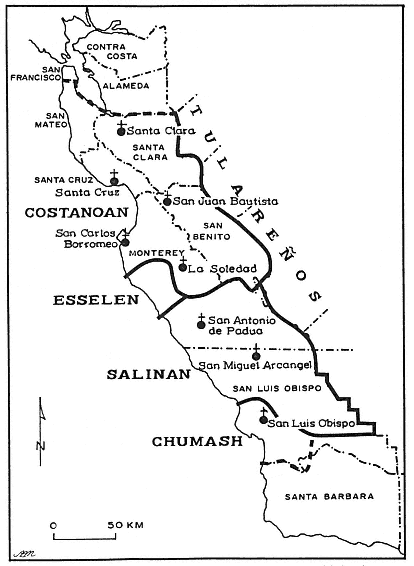
The eight northern California missions discussed in this book and their
approximate territories of conversion.
a civil deposit, the Bancroft Library of the University of California, Berkeley. Nevertheless, for the Alta California of the Hispanic period, survival of records has been extraordinarily, almost miraculously, good; and with the advent of microfilm, consultation of the registers has become increasingly easier. A thoroughly desirable further move to provide facilities for schol-
ars is under way in the concentration of microfilm of mission and parish registers for California, and the world as well, in the remarkable array of demographic materials of all kinds that is being assembled by the library of the Genealogical Society of Utah in Salt Lake City, with a branch library in Oakland, California.[6]
For the present paper, we chose as a sample the registers of eight missions in northern California, those situated in a continuous chain from San Luis Obispo in the south to San ta Clara in the north (see map). Listed in order of date of foundation, they are:[7]
San Carlos Borromeo, 3 June 1770
San Antonio de Padua, 14 July 1770
San Luis Obispo, 1 September 1772
Santa Clara, 12 January 1777
Santa Cruz, 28 August 1791
Nuestra Señora Dolorosísima de la Soledad, 9 October 1791 (We shall shorten this name to La Soledad.)
San Juan Bautista, 24 June 1797
San Miguel Arcángel, 25 July 1797
They fall by date of foundation into two groups, those founded between 1770 and 1777, and those founded between 1791 and 1797. The earlier group initiated the impact upon the aboriginal world of the California Indians from fourteen to twenty-one years before the second group; and to the extent that length of time was involved in the operation of this process, they were
[6] An excellent attempt to give the location and coverage of California mission registers, now unfortunately obsolescent, is J. N. Bowman, "The Parochial Books of the California Missions: 1961." Moving the manuscript originals of some of the registers, consequent on changes in diocesan boundaries, has already rendered much of the article out-of-date, although it is still very useful. The best guide to the present whereabouts of the mission registers, so far as its coverage goes, is probably the card catalogue of the library of the Genealogical Society of Utah in Salt Lake City. We have consulted it in a filmed copy at the Oakland, Calif., branch of the library. That catalogue lists only what the society has been able to film. In 1976 it did not have the registers of the southernmost missions in the jurisdiction of San Diego, nor those in the Archdiocese of San Francisco. The early registers of Mission San Jose, for example, are not available in the filmed copies of the society, which do contain the later registers, because the former are in the care of the Archdiocese of San Francisco. We can only hope that the society ultimately will be able to secure film of all registers, and so for the first time make consultation of them relatively simple. For some idea of the general holdings of the library, see Larry T. Wimmer and Clayne L. Pope, "The Genealogical Society Library of Salt Lake City: A Source of Data for Economic and Social Historians."
[7] Engelhardt, The Missions and Missionaries of California , II, pp. 74–78, 87–88, 103, 206, 216, 454, 494–496.
farther along in it by the time of secularization in 1834.[8] Within the earlier group is San Carlos Borromeo in Carmel, which served as parish church for the presidio and town at Monterey, eventually the capital of Alta California. It was the second mission established by Father Junípero Serra and was one of the major foci of religious and political effort in the later Spanish colonial empire. Its records also cover the longest span of any of the eight missions. All of the missions continued as parish churches after secularization.
Looked at in terms of native groups, the eight missions covered the bulk of the territory occupied by the Costanoan Indians, all of that occupied by the Esselen and Salinan linguistic bands, and at Mission San Luis Obispo incorporated the northernmost villages of the Chumash. Despite linguistic diversity, all of these Indians, with the possible exception of the Chumash, were basically of very similar culture.[9] The Costanoan territory extended considerably northward, so that many Costanoans received religious administration from Mission San Jose and Mission San Francisco de Asís (called alternatively, and more usually, Nuestra Señora de los Dolores). Inclusion of those missions in our sample would not, however, have given us a more uniform group, for they ministered to large numbers of coastal Miwok as well as other nearby groups. As Alfred Kroeber has commented, "Mission Dolores, at San Francisco, must have contained an extraordinary jumble."[10] The fact is that almost no mission dealt with a single linguistic or tribal group; rather, each mission was forced by the Spanish strategic need for a chain of posts along the coast, by slender resources in personnel and supplies, and by the fragmentation of the native population, to incorporate various linguistic groups into its jurisdiction. For many of the missions in the north, the "jumble" was accentuated in the nineteenth century as Indians were brought in from the Central Valley to replace the dying local population. Substantial numbers of Yokuts thus were added to the rolls.[11] Nevertheless, the eight missions do constitute a
[8] Ibid ., III, pp. 473–477 and 501–532, gives a particularly bitter account of secularization in California. Hubert Howe Bancroft, History of California , III, pp. 301–363, covers the plans, decrees, and eventual seizure of the mission lands.
[9] Alfred L. Kroeber, Handbook of the Indians of California , pp. 347–350, 462–473, 544–568, and maps in those pages on approximate boundaries.
[10] Ibid ., pp. 464–465.
[11] Ibid . and pp. 474–543, for a description of the Yokuts.
relatively homogeneous sample in terms of culture of the local native population and of general geographic conditions.
Within the territory of the eight missions, there also came into being a relatively substantial population of European culture. In addition to the garrisons at the missions and ranches, there were three nuclei: the presidio and eventually town of Monterey, founded at the same time as the mission, 3 June 1770; the pueblo of San Jose, founded 29 November 1777, approximately two miles southeast of Mission Santa Clara; and the pueblo of Branciforte, founded in May or June 1797 at the northern end of Monterey Bay near Mission Santa Cruz.[12] The pueblo of San Jose was much closer to Mission Santa Clara than to Mission San Jose, so that it used the religious services of Mission Santa Clara even after the establishment of Mission San Jose. These three nuclei, and especially the two of the presidio at Monterey and the pueblo at San Jose, give a sample of the people of European culture.
We found that the registers needed for our inquiry, namely those of baptisms, marriages, and burials, on the whole, were extant for the eight missions, but with certain losses and certain difficulties of access. The first book of marriages for Mission San Miguel Arcángel, covering the years 1797–1853,[13] was not available, because it was stored in the mission itself rather than the diocesan archive. The first book of burials of Mission La Soledad, beginning about 1791 and continuing to the end of the Hispanic period, officially is lost. It may be in private possession, lie mislaid in some church deposit, or have been destroyed. A happier story is that of the first book of burials of Mission San Antonio de Padua, which at the time of our extraction of data also was considered lost. Somehow it had drifted into private hands, but has now been returned to the diocesan archive in Monterey.[14] Finally, the first book of marriages of Mission San Luis Obispo was destroyed in a fire on 29 Novem-
[12] Bancroft, History of California , I, pp. 170–171, 311–313, and 568–571.
[13] The second book of the register of marriages begins in 1879, but 6 marriage entries, covering the years 1854–1858, occur at the end of the first book of baptisms. For further information, see Bowman, pp. 309–315.
[14] Ibid ., pp. 303–315. At some time before the First World War, Father Zephyrin Engelhardt (Mission Nuestra Señora de la Soledad , pp. 61–67) examined the first book of burials of Mission La Soledad; the book has disappeared since then. We are led to conjecture that it may have been mislaid, as was the first book of marriages of San Miguel Arcángel, or may have drifted into private hands, as happened to the first book of burials of San Antonio de Padua.
ber 1776, according to a notation by Father Junípero Serra in the new book he ordered prepared as replacement. The new book attempts to replace the lost entries from the Status Animarum or padron of the Indians and from popular knowledge. It was not possible to reconstruct the detail of the exact day, the witnesses, and much other information.[15] Thus approximately the first 45 entries lack as full information as the others, and for our purposes turned out to be unusable.
The three sets of mission registers that interest us here were part of a larger series of records kept at each mission under instructions from the parent Colegio de Propaganda Fide de San Fernando de México, which trained and supervised the early Franciscan missionaries in California. In addition to accounts, each mission was supposed to keep, and did keep, the following groups:
1. Register of Baptisms
2. Register of Confirmations
3. Register of Marriages
4. Register of Burials
5. The Status Animarum , or Padron, or census roll, which recorded the names of married adults, their children, widows, and widowers, with detail on date of birth, baptism, and origin or native village.
6. The Libro de Patentes , in which were transcribed documents of importance and circular letters of higher authorities, civil and ecclesiastical.
The books constituting each register were bound in flexible leather with sides that overlapped. The paper within, of good quality to take ink, measured approximately 8 by 11 3/4 inches. During the Hispanic period the books with blank paper were supplied by the Colegio de Propaganda Fide de San Fernando, and usually had from 300 to 350 leaves. The first and last leaves of each volume were usually left blank, the title being written on the obverse of the second folio. Invariably the first book of baptisms has, following the title page, a brief history of the founding of the mission; all volumes may have some leaves devoted to data that especially interested the missionaries and authorities. The entries are written in ink and signed by the priest who officiated at the rite. Usually a margin of perhaps an inch was left for a running number within each register, contin-
[15] Engelhardt, Mission San Luis Obispo in the Valley of the Bears , p. 186.
ued into the following books of the same register. Within the margin the priests might note the names of the people baptized, married, or buried; whether Indian or gente de razón; if Indian, the village or ranchería; and so on.[16]
At best the information in the registers of baptisms, marriages, and burials is extensive. At a maximum, the baptismal entries give information for each individual which includes the date of birth, age when baptized, the Christian and sometimes the heathen name, the native village of the heathen Indian, the parents, their place of birth if known, and the nature of their relation to each other. The marriage entries give the name, the place of origin, the names of the parents, whether or not they were married, and the previous marital history of each of the new spouses. The burial entries list the name of the decedent, his village or tribal origin; sometimes the age and if not that, whether adult or child; the cause of death, if important; and religious information concerning last rites and burial. Clearly, if in every case the officiating clergyman collected and recorded all the data which was possibly pertinent, the vital record would be as voluminous and accurate as any contemporary registration system could devise. Regrettably, he was not always able or willing to do so. The entries as they are in the registers represent usually a transcription or enlargement from notes made at the time of the rite. Transcription permitted the priest to cast the entries in a more nearly common form, but pressure of ministration might delay transcription and, one suspects, in serious emergencies even lead to long delays and loss of notes. Moreover, within the requirements set by the Church, there was no fixed form which had to be adhered to. The individual priest wrote what he wished in the way he wished. In the vast spaces of California it was almost impossible to apply strict supervision, and the occasional visitas , which included inspection of the registers and the form in which they were kept, are invariably commendatory, regardless of what may have been said in private.
As we have already suggested, the mission registers permit us to examine the records of two distinct ethnic categories, although the format of the entries is the same for both. One
[16] The system and format of mission registers are described with care in Engelhardt, Mission San Carlos Borromeo (Carmelo) , p. 224, and San Miguel Arcángel , p. 40. See also Bowman, pp. 303–304.
group is the Indians, both as heathen at the moment of conversion and subsequently as neophytes in the mission. The other consists of what might loosely be called the white men, the gente de razón, predominantly Spaniards and Mexicans, who came with the missionaries and who supplied the manpower for the civil and military establishment. With them came their families. All were forced to rely upon the missionaries for religious services, for until the middle 1830's there were no parishes, and even after the secularization of the missions the former missionaries continued to function as parish priests. It was only in 1836, fifteen years after the independence of Mexico, that the Mexican national government decided to request the Pope to detach the Californias, Alta and Baja, from the Bishopric of Sonora. The formalities took four years and resulted in consecration of a bishop with see in San Diego.[17] Thereafter the American annexation led finally to the creation of a more elaborate arrangement of dioceses and the entrance of substantial numbers of new clergy. The process may be traced in the registers in the 1850's in the appearance of non-Hispanic priests, and a tentative choice of a language other than Spanish for the entries that eventually settled on Latin as the best compromise between Spanish and English. Thus, at first small in numbers, the people of European culture eventually came to outweigh the native element and to fill most of the pages of the mission books. At the end of the mission period and for two decades subsequently, the non-Hispanic people—that is, the Anglo-Americans, the French, the Irish, and other nationalities—began to make their numbers felt, despite the steady growth of the Hispanic population by natural increase and by immigration during the Gold Rush. During the 1850's they came to supersede the Hispanic component as the dominant ethnic group of European culture.
It is theoretically possible to make an analysis of the birth, marriage, and death status of the two fundamental racial groups, Indian and Caucasian, and to study also certain other parameters, such as racial fusion. Furthermore, we should be able to study the mixing of subcomponent groups within each of the dominant racial groups. However, in practice we are
[17] Engelhardt, The Missions and Missionaries of California , IV pp. 90–91 and 195; Bancroft, History of California , IV, pp. 64–65.
restricted to the data which actually can be extracted from the registers. The restrictions are onerous. They vary greatly from mission to mission and within each book as new priests assumed responsibility and imposed their personal preferences and idiosyncracies. Nevertheless, they may be summarized in the following fashion:
To begin with, there are the usual technical difficulties, some of which have already been mentioned: illegible handwriting; poor copy because of the deterioration of the paper (perhaps most of all through overuse)[18] or penetration of ink to the other side of the leaf; all sorts of minor errors; and different formats, depending upon the priest and the exigencies of the moment. The result is that in all too many instances accessory information is lacking, such as identity of parents or birthplace of converts and couples being married. Even ages, where they are stated, are not exact. Usually the missionaries guessed at approximate age, given with the qualification "about" (cerca de ) or as a range, e.g., 10–15 years. Naturally there was a great deal of heaping. Indeed, in the age groups over 40 years, the vast majority of persons were specified as being precisely 50, 60, or 70 years of age. Such imprecision in stating age is characteristic of similar records in the European world of the time.
More serious than inaccuracy in reporting, however, is the frequent and for some missions almost universal lack of any age statement at all. For Mission San Carlos Borromeo, one of the worst offenders in this regard, in both the marriage and burial registers indication of age beyond the categories of child and adult is completely missing. In the registers of other missions, there is a greater range of reporting age, up to very good. In consequence, direct tabulation of age at death is sometimes possible and sometimes impossible; for all deaths recorded in the registers of the eight missions, it is, of course, impossible. Baptismal data are better, for the entries in the baptismal registers of the eight missions do give ages for two groups of people, the heathen Indians at the time of conversion, and the
[18] Virtually all holders of the mission registers now provide microfilm for the use of the public, as a result of the deterioration in the manuscripts brought about by much consultation. Unfortunately, the microfilm usually has been hastily made, without the care needed to make the film truly legible.
children of both Indians and gente de razón who were born under the auspices of the clergy. Since the Church insisted that a newly-born infant be baptized as quickly after birth as possible, we can be reasonably certain that a párvulo of any ethnic origin was, in general, no more than a few days or weeks old at the time of baptism. To be sure, baptism might be delayed even longer for reasons of health, distance from the mission, or long spells of inclement weather, but such instances are a small percentage of the baptisms of párvulos and more likely to be found among those of the children of the gente de razón than among those of the Indians, for the Indian settlements were either at the mission or visited fairly regularly and frequently by the missionaries.
The difficulty in securing adequate data on age at death would be insurmountable were it not for the custom, well developed in some missions but not in others, of writing in the margin of the entry of death in the register of burials the baptismal number of the person if he had been baptized in the same mission. It thus becomes feasible, at considerable labor, to check back to the number in the book of baptisms, where either the birth or the age at conversion ordinarily will be noted. Then the difference in dates permits the estimate of age at death. We have done so by full year rather than to month and day. If we assume that the age at baptism is correctly recorded, this estimate will be correct to within plus or minus one year, surely so in the case of newborn children, but much less so and with increasing error for higher ages in the case of converts. Even for newborn children the error is large by present-day standards; but the procedure is the best that can be obtained, because to calculate according to the month and the day of baptism or death would involve an inordinate additional amount of labor which, in most instances, would be wasted. We therefore, as a practical measure, are forced to rely upon averages by full year.
A number of our eight missions adhered faithfully to the custom of including the baptismal number in each death entry for which it was possible. Mission San Carlos Borromeo did not. Since its registers presented the worst problems for our study, we describe those problems in some detail. The registers of the other missions presented similar problems in varying but lesser degree. In the burial registers of Mission San Carlos Borromeo during the several blocks of years, representing different mission
administrations, the baptismal numbers, with few exceptions, are omitted. In the remaining burial entries, the omissions of baptismal numbers occur frequently. The only sequence which is internally complete is that between 1799 and 1805 (nos. 1,287 to 1,604). The years from the foundation of the mission in 1770 to 1793 have been studied in detail by a previous investigator, almost certainly Monsignor James Culleton, who worked out the burials in detail. He wrote lightly in the margin the appropriate baptismal number beside the entry for each decedent, thus rectifying the omission of the missionary. Since these numbers are legible in the microfilm, which we consulted in lieu of the manuscript register, we were able to use them and here record our gratitude.
With these exceptions, the only way in which one may recover the age of decedents without baptismal number—and they constitute at least half the total at Mission San Carlos Borromeo—is to track them down one by one according to their Christian name. We had therefore to go through the pertinent sections of the burial register and write down the personal name and year of death of each decedent. Then the entire register of baptisms had to be examined within the years covered in our study, and each name checked against the list of those whose deaths were recorded in the mission.
For San Carlos Borromeo, close to 1,500 names were thus checked. Of these, 1,228 were found in the baptismal register. By difference, the age of death could be estimated for these to within one year. The remainder, 277 names, were not found in the baptismal register. The reasons for the deficiency are manifold. Many names were hopeless duplicates; others had undergone changes during the person's lifetime; in some instances the reconciliation was missed by sheer inadvertence. Indeed, the fact that nearly 82% of the missing ages at death were recovered must be counted something of an achievement.
Our final result for San Carlos Borromeo, however, leaves a good deal to be desired, for the aggregate number of ages at death obtained through all methods by no means equalled the number of Indian baptisms. This deficiency is demonstrated by certain totals obtained through examination of all the entries in the baptismal and burial registers of Mission San Carlos Borromeo for the years of our study. A direct count showed that 2,836 Indians were baptized between foundation of the mission
and its secularization at the end of 1834.[19] Of these, 1,541 were converted gentiles and 1,295 were neophytes born in the mission. Of the former, the death entries for 1,117, or 72.5%, can be identified in the register of burials; of the latter, 893, or 69%. Collectively, of the 2,836 Indians baptized at Mission San Carlos Borromeo, 2,010, or 70.9%, have been identified as having died in the mission. Those 277 whose deaths are recorded but whose names have not been found in the baptismal record must be added to the identified dead, making 2,287 in all. There still remain, however, 549, or nearly that number, who were baptized but disappeared without trace from the mission record.
Several reasons for the shortage can be suggested. The first is that in some instances the priest was unable to or neglected to record the death. The latter contingency would have been very rare, but circumstances sometimes threw an almost unbearable load upon the missionaries. The epidemic of 1802 at Mission San Carlos was a case in point, for during several weeks the missionaries were so occupied with the care of the sick and the administration of the last rites to the dying that they were unable to keep the record up-to-date, and easily may have failed to record numerous deaths. A second source of loss derives from the fact that many of those Indians who entered the mission survived past secularization and were buried elsewhere. As is well known, all missions, including San Carlos Borromeo, underwent in the middle 1830's what in some instances amounted to complete disintegration.[20] The neophytes spread out into the surrounding countryside and merged with the civil population or, if they had been brought from a distance, returned to their native territory. When many of these people died, their decease was not recorded in the local mission register. Some may have moved to the jurisdiction of other missions, the registers of which do record their deaths, but such entries are even more difficult to track down.
[19] The total of baptisms differs from any tabulated to date, as stated in Sherburne F. Cook, The Population of the California Indians, 1769–1970 , p. 29. The reason lies in differing cut-off dates and, in part, in somewhat different criteria of selection. The same discrepancies will show up, in general, for all our data on baptisms, marriages, and burials for all eight of the missions. The data we adduce in this study are new assemblies based upon a new reading of the registers.
[20] The plundering of the missions by civil administrators, and the exploitation of the Indians, may be traced in some detail in Bancroft, History of California , III–IV. Bancroft, although sympathetic to the concept of secularization, admits that it was a disaster in California (IV, pp. 43–44).
A third source of loss arises from those Indian neophytes who departed the missions even prior to secularization. They were the fugitives who caused so much trouble to the missionaries. Most of them preferred the old, primitive, free ways, and upon absconding from the mission reverted to their aboriginal mode of living. The burial register of Mission San Carlos Borromeo records several instances as early as 1780–1790 of neophytes who went to die in their old rancherías among the heathen. The volume of this kind of desertion was augmented notably in the last years of the missions, and undoubtedly accounts for a great many of the missing burial entries.
In any event, it is evident that we must deal with a sample of the total Indian population which, at San Carlos Borromeo, is of the order of 70%. With the converted gentiles, fugitivism or absenteeism in some form was the chief cause of loss. Although there may have been appreciable bias in favor of the younger adult age group, the effect probably was not serious, and the sample, therefore, would reflect more or less faithfully the response of the whole. Since very few heathen were admitted to the mission community at San Carlos Borromeo after 1804, the disintegration of mission society upon secularization at that mission would have affected the death records only of those persons older than 30 years. Hence, there might have been a reduction in the apparent number of deaths at the mature or older phases of life. It is impossible to state how severe this curtailment may have been.
The neophytes who were born in Mission San Carlos Borromeo were less likely to have absconded permanently than those who were accustomed to the heathen existence of their youth. Far more important for the participation of the former group in the demographic history of the mission is the fact that they were continuously produced from the earliest years to the end of the mission period. Hence in 1834, the surviving Indians born in the mission would show a spectrum of ages from newly-born to perhaps 60 years old. However, many of these survivors outlived mission supervision, and their deaths might never be recorded or might be recorded elsewhere. Hence, the sample available in the burial register includes only 70% of those who were born in the mission and were itemized in the baptismal entries. This problem is discussed further in the section below on the neophytes who were born in the mission.
In general, what we have stated about the data taken from
the registers of Mission San Carlos Borromeo applies to the data from the other missions. We estimate that we have been able to obtain approximately a 70% sample for each of the other five missions for which we have obtained information on burials. A problem of considerably lesser dimension than for the Mission San Carlos Borromeo registers arose for those burial registers which almost invariably identified baptismal number, in that some of the baptismal numbers turned out to be wrong and we were not always able to locate the correct entry. The effect was to reduce our identifications by something less than 1%. Perhaps the major difference in the data from some of the other missions and those from San Carlos Borromeo lies in the fact that upon exhausting the pool of local Indians within the mission territory—a circumstance that occurred at some time between 1804 and 1815 at different missions—a number of missions turned to the Central Valley for new converts, the so-called Tulareños or Tulares, who were almost all Yokuts, but were given their name in mission records because they came from the great reed swamps of the southern San Joaquin Valley. (The reeds were called tules in Mexican Spanish, from Nahuatl tollin or tullin , a reed; tular is a collective form.) The bringing in of the Tulareños meant a new population of somewhat different age distribution when it entered the mission records. At the time of secularization, the Tulareños still included substantial numbers of neophytes who could remember aboriginal life and were younger than similar groups among the local Indians. Accordingly, we have tried in our tabulations to keep data on the Tulareños or Tulares separate from the series for local gentiles. At the time of secularization, and afterwards for those who remained within the recording of the missions converted to parishes, the disintegration of both local and Tulareño Indians was bringing about a substantial amount of intermarriage, as the search for new marriage partners among widows and widowers broke down linguistic and cultural differences.
2—
The Gentile Component of Mission Indians
We first examine data on the heathen Indians who were brought to Christianity at the missions. Our information for this section comes from the baptism and burial registers. We must segregate our data into the two distinct groups of heathen who were
brought to the missions, the local gentiles (the missionary term), and the Tulares, for they came at different periods and had somewhat different characteristics. For the local gentiles, the process of conversion began as soon as the local mission was founded and lasted for periods ranging from 33 years to as little as 17 years after the foundation of the mission. At San Carlos Borromeo the period of conversion of local gentiles lasted from 1771 to 1804; at Santa Cruz, from 1791 to 1814; at San Juan Bautista, from 1797 to 1814. The changing content of the baptismal registers indicates clearly the ending of the initial period.
During the phase of conversion of the local population, the missionaries went out into the countryside in a continuing series of visits and brought to the mission those heathen who could be persuaded to come. Baptism came some time later, when the missionaries were persuaded that the Indians understood the rudiments of Christianity and were ready. If the selection of converts was entirely random with respect to age, and if the remaining population continued in a state of equilibrium, suffering merely the losses due to withdrawal to the mission, then the age distribution of the converts, regardless of the time involved, should be an accurate reflection of that of the aboriginal pool. Two circumstances render these assumptions untenable.
In the first place, the selection of converts may have been nearly random, but it was not quite so. For example, at Mission San Carlos Borromeo, of the first 50 baptisms, 4 were adults over 20 years of age, 9 were aged from 10 to 19, and the remaining 31 were children under 10 years. Later, groups of middle-aged or elderly adults were brought in. To be sure, these variations cancel out over a period of years, but short-term data are likely to be unreliable. In the second place, the residue of the native population was adversely affected. The social and economic balance, which even in a primitive society is delicate, was upset by the mere withdrawal of numerous individuals. Furthermore, the native community, close to and in contact with the mission, was exposed to the diseases introduced by the gente de razón and communicated with devastating effect to the neophytes.
Since conversion operated continuously upon a population steadily diminishing for other causes, the total conversions recorded by the missions could never equal the aboriginal total,
even though the last native was swept up. How near it came to this total depended upon local circumstances. Cook has estimated elsewhere that the ratio of aboriginal population to conversions would be somewhere between 1.2 and 2.0.[21] For the eight missions here under study, the process of conversion went forward relatively smoothly: there was little physical conflict; there were no unusual epidemics. Hence a factor of 1.5 is possible. If so, and if 13,971 persons were converted, the pre-contact population of the area of our eight missions would have been approximately 21,000 just before 1770.[22]
Conversion of Indians from the Central Valley began only after the pool of local gentiles was exhausted. A series of expeditions to the Central Valley brought in Yokuts who had been persuaded or induced to come to the missions for conversion. Conversion of the Tulareños, a second phase of missionization, began sometime between 1805 and 1816 and was still under way at the time that the secularization of the missions brought it to an end. Three of our eight missions—San Carlos Borromeo, perhaps too far to the west, and San Miguel Arcángel and San Luis Obispo, the southernmost—did not participate in the conversion of the Tulares. San Antonio de Padua entered upon such conversion later than the other missions, since most of its baptisms of Tulares occurred in the years 1834–1838. Since the conversion of the Tulares was under way but far from completed at the end of the mission period, our figure of 4,020 Tulares baptized, which would indicate an aboriginal pool of perhaps 5,000 to 8,000, cannot be taken as an indication of the aboriginal numbers of the Yokuts. Cook has elsewhere estimated that as being of the order of 50,000.[23]
In Table 3.1 we list the percentages of local gentiles and Tulares baptized. For convenience, we give the total of such baptisms for all eight missions as well; the numbers for each mission are given in Table 3.2. The totals of baptisms for each category represent new counts and differ somewhat from those given in earlier work. Some of the difference arises from normal
[21] Cook, The Population of the California Indians, 1769–1970 , pp. 22–27.
[22] With very small discrepancy, this total is in agreement with that in The Population of the California Indians , pp. 20–43. Our total here does not make provision for Mission San Francisco de Asís and Mission San Jose.
[23] Cook, The Aboriginal Population of the San Joaquin Valley, California, passim , but esp. p. 70. The discussion does not separate out the Yokuts clearly, since it proceeds by area and subarea.
| ||||||||||||||||||||||||||||||||||||||||||
human disagreement on the totals of long counts; some because of the discarding of entries not giving the information wanted here; yet others because of differences in years included. In the case of Mission Santa Clara, for example, our figure for local gentiles baptized is 4,139. That is for the years 1777 to 1810 inclusive. We have omitted another 105 baptized in the years 1811 to 1834, since they fell outside the main period. If they are added to our total, we arrive at 4,244 local gentiles baptized, as compared with the figure 4,240 used by Cook in earlier work.[24]
Our purpose in compiling Table 3.1 is to give an idea of the relative weight of each mission in conversions. Mission Santa Clara was the giant, accounting for 29.6% of local gentile and 45.6% of Tulare baptisms. The next most active mission in conversion of local gentiles (San Antonio de Padua) accounted for less than half as many. Mission San Juan Bautista, which was fourth in conversion of local gentiles, was second in conversions of Tulares. One can explain the differences in baptisms of local gentiles in terms of local numbers available, ease of access, and
[24] Cook, The Population of the California Indians, 1769–1970 , pp. 29–30.
the longer existence of some missions, but those terms do not fully explain differences in the conversions of Tulares. One would expect Mission Santa Clara and the easternmost missions to have accounted for most, or all, of the Tulare baptisms, but such an expectation cannot explain why Mission Santa Cruz should be third in number of Tulare baptisms, nor does it fully account for the role of Mission Santa Clara as the most prominent in such baptisms. One suspects that the Franciscan administration of the province, perhaps in consultation with civil officials, made decisions on allocations.
In Table 3.2 we show the distribution of age among converts at the eight missions at the time of baptism. The table is in the format we use for all further tables in this essay: a summary, followed by the data on each mission if available, the missions being arranged not in the order of foundation but in geographical location from north to south. Where pertinent, this table is divided into part A, local gentiles, and part B, Tulares, to test differences that may show up. As we have already indicated, the total usable baptisms of local gentiles come to 13,971, and those of Tulares to 4,020. Ages are arranged by 5-year intervals up to 24 years of age, and by 10-year intervals thereafter. The data do not warrant finer subdivisions. In order to achieve uniformity and to avoid heaping, the mean value of baptisms per year of age is shown for each period of time. Finally, the number of persons found in each age period is expressed as a percentage of total baptisms, and the age periods are grouped in larger units—0– 9, 10–24, 25–64, and 65 plus—to discern broader patterns of age distribution.
The two parts of the table indicate at once that there is considerable variation in the data from the missions for both local gentiles and Tulares. Furthermore, there is considerable difference in the age distributions of local gentiles and Tulares. In general, the local gentiles have high values for infants (but Mission San Luis Obispo is a puzzling exception) and low ones for aged, as one would expect. For the relatively small proportion of local gentiles in the age group 10 to 14, particularly evident at Mission San Carlos Borromeo and Mission San Antonio de Padua, we have no ready explanation; neither do we have one for the lower proportions, on the whole, in the age groups from 10 to 24. Otherwise, the age groups among the local gentiles, if placed on a graph, would show a remarkably
| ||||||||||||||||||||||||||||||||||||||||||||||||||||||||||||||||||||||||||||||||||||||||||||||||||||||||||||||||||||||||||||||||||||||||||||||||
| ||||||||||||||||||||||||||||||||||||||||||||||||||||||||||||||||||||||||||||||||||||||||||||||||||||||||||||||||||||||||||||||||||
| ||||||||||||||||||||||||||||||||||||||||||||||||||||||||||||||||||||||||||||||||||||||||||||||||||||||||||||||||||||||||||||||||||||||
| ||||||||||||||||||||||||||||||||||||||||||||||||||||||||||||||||||||||||||||||||||||||||||||||||||||||||||||||||||||||||||||||||||||||
| |||||||||||||||||||||||||||||||||||||||||||||||||||||||||||||||||||||||||||||||||||||||||||||||||||||||||||||||||||||||||||||||||||||||||||
| |||||||||||||||||||||||||||||||||||||||||||||||||||||||||||||||||||||||||||||||||||||||||||||||||||||||||||||||||||||||||||||||||||||||||||
| |||||||||||||||||||||||||||||||||||||||||||||||||||||||||||||||||||||||||||||||||||||||||||||||||||||||||||||||||||||||||||||||||||||||||||
| ||||||||||||||||||||||||||||||||||||||||||||||||||||||||||||||||||||||||
smooth curve. There is little doubt that it represents the normal aboriginal condition among the native populations of the area—a high birth rate and a high death rate, which together result in a large youthful and a small aged population. The Tulares, in general, show larger values for the age groups 10 to 24, and so come nearer normal expectation in an aboriginal population, but on the other hand have considerably lower percentages than the local gentiles in the age groups 0–9. The deficiency is most marked in age group 0–4. Since they had to be brought considerable distances over rough terrain, the explanation may be that Yokuts with infants were more reluctant to attempt the journey or that, if they did, a substantial proportion of the infants died on the journey.
The next steps in our examination of data require some preceding reflection on the nature of the sample. First, we are dependent on the statement of age in the death entries, made
by the missionaries. We have already commented on the problems in such statements. Second, we have noted that for only about 70% of those baptized is there an identifiable burial record. Any consideration of the mortality displayed by gentile converts in the missions must start with that fact, for one important result is that if we use only the 70% sample, as we must, the older age groups will be spuriously truncated progressively among those baptized during the later years of the mission period, since we cannot trace them past the middle 1830's. It therefore becomes mandatory for certain purposes to exclude the deaths which occurred beyond a relatively early age and to delete those gentiles who were baptized toward the end of the years of active conversion.
Basically we have here what is actually two distinct immigrant populations, a larger one and a smaller one, the entrance of both spread over a span of years. Accordingly, the formulation of ages cannot be considered a census. On the other hand, the deaths, within the limitations mentioned above, can be arranged in the form of a life table, where the age-specific death rates of the populations (qx ) can be shown, as well as the mean expectation of life (ex ) for each 10-year or 5-year age group. We have done so in Table 3.3. In this table the elimination of those gentiles who were baptized toward the end of the mission period has deleted the Tulares of all missions except Santa Clara. Hence the data shown are for local gentiles only, except for the division of the part of the table devoted to Mission Santa Clara into two parts, A for local gentiles and B for Tulares. For that reason, further, we do not repeat the data on the Tulares in the summary. The exact value of e x at birth is very dubious, because there were abnormally few deaths in the first age group, 0–4 years, while the values for the older age groups are probably too high because of fugitivism and survival past 1834. Similarly, the value of ex for the last age group should be regarded as a convention, since we have little evidence on which to calculate the true value. These features are also seen in the distribution of age at death (D x ). The Tulares at Mission Santa Clara show a distribution that is somewhat different from that of the local gentiles at the same mission, but actually nearer that of the local gentiles in general. The greater value of e x for the age group 0–4 may well be due to deficiency of data.
| ||||||||||||||||||||||||||||||||||||||||||||||||||||||||||||||||||||||||||||||||||||||||||||||||||||||||||||||||||||||||||||||||||||||||||||||||||||||||||||||||||||||||||||||||||||||||||||||||||||||||||||||||||||||||||||||||||||||||||||||||||||||||
| ||||||||||||||||||||||||||||||||||||||||||||||||||||||||||||||||||||||||||||||||||||||||||||||||||||||||||||||||||||||||||||||||||||||||||||||||||||||||||||||||||||||||||||||||||||||||||||||||||||||||||||||||||||||||||||||||||||||||||||||||
| ||||||||||||||||||||||||||||||||||||||||||||||||||||||||||||||||||||||||||||||||||||||||||||||||||||||||||||||||||||||||||||||||||||||||||||||||||||||||||||||||||||||||||||||||||||||||||||||||||||||||||||||||||||||||||||||||||||||||||||||||||||||||||||||||||||||||||||||||
| ||||||||||||||||||||||||||||||||||||||||||||||||||||||||||||||||||||||||||||||||||||||||||||||||||||||||||||||||||||||||||||||||||||||||||||||||||||||||||||||||||||||||||||||||||||||||||||||||||||||||||||||||||||||||||||||||||||||||||||||||
There is little value in attempting to set this pseudo-life table alongside the many models available in the literature, for it is established by the peculiar and individual circumstances surrounding the Christianization of these particular Indians. It is, however, of value for the purpose of comparison among the eight missions and with other missions within the same province and elsewhere.
An alternative approach to the problem of mortality among the converted Indians is through an examination of survivorship in the missions. The essential point is that, whereas in constructing a normal or ordinary life table we reckon the age at death from birth of each person, here we take the difference in years between age at death and age at conversion. Thus we deal with the number of years the neophyte lived after entering the new environment, an event which was signalized by the ceremony of baptism. It may be noted that this examination of survivorship under altered conditions can be applied to any segment of a population which has been generated by mass migration so as to form a new demographic entity. Furthermore, since we use the interval of two events recorded as each occurred, and make that calculation of interval ourselves, the data are free from the inaccuracies of missionary knowledge or estimate of age.
Table 3.4A shows the number of years survived, in intervals of five years each, by the gentiles who were baptized in the decades between 1770 and 1809. We have data for six missions. For two missions, San Juan Bautista and San Miguel Arcángel, we have included data to 1815. The main table deals only with local gentiles, but we have included an appendix on the Tulares at Santa Clara with data from 1805 to 1834. The earlier the decade, the more complete the data. Our data, with very few exceptions, have a definite cut-off, manifest for those who lived to the period of secularization. This feature is evident in the lack of data, in general, for survivors in the 1800–1809 group of more than 30 years and in the 1790–1799 group of more than 40 years. We have attempted to minimize the difficulties arising from the cut-off date by calculating the percentages and medians for those who survived less than 30 years in the missions, as well as for those who survived to the full 49 years provided in the categories of the table. The error introduced by our inability to trace survivors after secularization is of an order at which we can only guess. We estimate 2 to 3%—a magnitude which is considerable, especially since it weighs upon the longer terms of years of survival, but in the circumstances is not fatal.
Table 3.4A exhibits certain features easily noticeable. In general, there is a progressive gradation in survival regardless of age at baptism and calendar year of conversion. Even more striking is the degree of variation in the experience at each mission, which is smoothed out in the summary. Mission San
Carlos Borromeo shows a comparatively uniform picture, with little change during the mission period. The median span of years for all local gentiles surviving less than 30 years at the mission was close to 8.9 years, and for the entire group surviving up to 49 years, the median was close to 10.2. The best record in terms of survivorship was that of Mission San Luis Obispo, at which the median span of years for local gentiles surviving less than 30 years after baptism was 12.7, and for the entire group surviving up to 49 years, 15.62 years. The other missions show considerably poorer records, with sharp variation in the experience of those baptized in one decade from that of those baptized in other decades. At Mission Santa Clara, for example, those baptized in the decade 1780–1789 show a median experience of 8.41 years of survival for those who survived less than 30 years after baptism and 9.61 for those who survived up to 49 years after baptism. For those baptized in the decade 1790–1799, the medians fell respectively to 4.22 and 4.35. In terms of survival after baptism, there was very real good or bad fortune according to the mission the local gentile was in. The difference in experience shows up very clearly in the totals for each mission and in the degree of variation among the cohorts. Experience for the Tulares at Mission Santa Clara, incidentally, appears to have been slightly more favorable than for local gentiles, but the differences may be more apparent than real because of greater nearness to the cut-off years of secularization. We are at this time unable to account for the high degree of variation in the experience of most missions and for the great variability from mission to mission. We can only suggest that a reexamination of the history of these missions with this table in mind may well yield new and perhaps unexpected insights.
One question of considerable interest concerns the length of time the same Indians would have survived if they had remained in their aboriginal culture and had not been gathered into missions—even more if they had not had any contact with the Europeans. There is, of course, no basis at this time for an answer. The unavoidable establishment of contact with Europeans would have brought the diseases of the Old World in any event. If the coastal Indians of central California had not experienced the perhaps benign regime of the Franciscan missions, their fate might have been even harsher under a civil regime of some kind, or under another European subculture.
| ||||||||||||||||||||||||||||||||||||||||||||||||||||||||||||||||||||||||||||||||||||||||||||||||||||||||||||||||||||||||||||||||||||||||||||||||||
| ||||||||||||||||||||||||||||||||||||||||||||||||||||||||||||||||||||||||||||||||||||||||||||||||||||||||||||||||||||||||
| ||||||||||||||||||||||||||||||||||||||||||||||||||||||||||||||||||||||||||||||||||||||||||||||||
| ||||||||||||||||||||||||||||||||||||||||||||||||||||||||||||||||||||
| ||||||||||||||||||||||||||||||||||||||||||||||||||||||||||||||||||||||||||||||||||||||||||||||||||||||||||||||||||||||||||||||||||
| ||||||||||||||||||||||||||||||||||||||||||||||||||||||||||||||||||||
| ||||||||||||||||||||||||||||||||||||||||||||||||||||||||||||||||||||||||||||||||||||||||||||||||||||||||||||||||||||||||||||||||||||||||||||||||||||||||||
| ||||||||||||||||||||||||||||||||||||||||||||||||||||||||||||||
In Table 3.4B the data from Table 3.4A for the total number of gentiles of all ages baptized from 1770–1809, for whom we also have death entries, have been recast in the form of a life table. Since we have data on local gentiles for six missions in Table 3.4A, we have data for them for the same missions in Table 3.4B, plus an appendix on the Tulares of Mission Santa Clara. The critical columns are qx and ex . The variability of experience in the six missions in Table 3.4A shows up again in Table 3.4B. Column ex tells us that the expectancy of survival of a gentile upon conversion to Christianity was highest at Mission San Luis Obispo, with 17.4 years; next best at San Miguel Arcángel, with 14.9 years, and third best at Mission San Carlos Borromeo, with 13.3 years. It was poorest at Mission Santa Cruz, with 8.6 years. For all six missions it was 11.6 years. At Santa Clara, it was 9.6 for local gentiles and 7.8 for Tulares, a difference that is to be explained in part by the shorter run of data on the Tulares and our inability to trace many of the longer-lived converts. The differences in values between these figures and the medians shown in Table 3.4A are due to the differences in weighting of the older members of the population.
| ||||||||||||||||||||||||||||||||||||||||||||||||||||||||||||||||||||||||||||||||||||||||||||||||||||||||||||||||||||||||
| ||||||||||||||||||||||||||||||||||||||||||||||||||||||||||||||||||||||||||||||||||||||||||||||||||||||||||||||||||||||||||||||||||||||||||||||||||||||||||||||||||||||||||||||||||||||||||||||||||||||||||||||||||||||||||||||||||||||||||||||||||||||||||||||||||||||||||||||||
| ||||||||||||||||||||||||||||||||||||||||||||||||||||||||||||||||||||||||||||||||||||||||||||||||||||||||||||||||||||||||||||||||||||||||||||||||||||||||||||||||||||||||||||||||||||||||||||||||||||||||||||||||||||||||||||||||||||||||||||||||||||||||||||||||||||||||||||||||||||||||||||||||||||||||
| ||||||||||||||||||||||||||||||||||||||||||||||||||||||||||||||||||||||||
The value of ex for survivorship is, of course, much less than the corresponding expectation of life at birth found in Table 3.3. In general, the values for ex move downward in a smooth curve for the groups showing longer survivorship, except for Mission Santa Clara, where the value for the group surviving 0–4 years is markedly less than that for survivors 5–9 years and slightly inferior to survivors 10–14 years; and Mission San Juan Bautista, where the value for survivors 5–9 years is slightly inferior to that for survivors 10– 14 years. The anomaly at Mission San Juan Bautista may be dismissed as a random variation of small significance, but that at Mission Santa Clara points to heavier mortality in the first years after baptism than at other missions.
If we turn our attention to column qx , we find a numerical expression of the very high death rate, which, with some variation, rises slowly, but is relatively stable for most missions at between 300 and 400 per thousand up to 25 years after baptism. The better chance for survival at Missions San Luis Obispo and San Miguel Arcángel is evident in distinctly lower death rates up to the group of 25–29 years of survival.
It is of further interest to discover whether length of survival in the mission varied with the age at conversion. In order to do this, we re-sort the data by specific age at conversion, in particular of the younger component. The first is 0–1 years. The double year is necessary because only the full year is used for age determination, and baptism did not necessarily coincide with birth. If a child was born on 31 December 1779 and died on 2 January 1780, he would have lived less than one year, or 0 years, but he would be recorded as having been 1 year of age. If
he was born on 2 January 1779 and died on 31 December 1780, he would still be recorded as only 1 year of age. On the other hand, if both baptism and death fell within the same year, the age would be 0 years. The second age group will be 2–4, the third 5–9, and so on.
The numbers are given in Table 3.5, together with the mean and median age of survival for each age group of converts. We have data on the local gentiles for six missions and on the Tulares for Mission Santa Clara, the latter placed in an appendix as in the preceding tables. Table 3.5 also shows the percentage of each age group who survived less than 2 full years. These values are calculated for the converts who survived as long as 29 years, and for those who survived as long as 49 years. Since we use the same data as for Tables 3.4A and 3.4B, there will be, in general, the same variability among missions, even though the data have been arranged in another way.
| ||||||||||||||||||||||||||||||||||||||||||||||||||||||||||||||||||||||||||||||||||||||||||||||||||||||||||||||||||||||||||||||||||||||||||||||||||||||||||||||||||||||||||||||||||||||||||||||||||||||||||||||||||||||||||||||||
| |||||||||||||||||||||||||||||||||||||||||||||||||||||||||||||||||||||||||||||||||||||||||||||||||||||||||||||||||||||||||||||||||||||||||||||||||||||||||||||||||||||||||||||||||||||||||||||||||||||||||||||||||||||||||||||||||||||||||||||||||||||||||||||||||||||||||||||||||||||||||||||||||||||||||||||||||||||||||||||||||||||||||||||||||||||||||||||||||||||||||||||||||||||||||
| |||||||||||||||||||||||||||||||||||||||||||||||||||||||||||||||||||||||||||||||||||||||||||||||||||||||||||||||||||||||||||||||||||||||||||||||||||||||||||||||||||||||||||||||||||||||||||||||||||||||||||||||||||||||||||||||||||||||||||||||||||||||||||||||||||||||||||||||||||||||||||||||||||||||||||||||||||||||||||||||||||||||||||||||||||||||||||||||||||||||||||||||||||||||||
| |||||||||||||||||||||||||||||||||||||||||||||||||||||||||||||||||||||||||||||||||||||||||||||||||||||||||||||||||||||||||||||||||||||||||||||||||||||||||||||||||||||||||||||||||||||||||||||||||||||
| ||||||||||||||||||||||||||||||||||||||||||||||||||||||||||||||||||||||||||||||||||||||||||||||||||||||||||||||||||||||||||||||||||||||||||||||||||||||||||||||||||||||||||||||||||||||||||||||||||||||||||||||||||||||||||||||||||||||||||||||||||||||||||||||||||||||||||||||||||||||||||||||||||||||||||||||||||||||||||||||||||||||||||||||||||||||||||||||||||||||
From Table 3.5 we may draw three conclusions. First, the survival time was very short among the youngest converts, those under 2 years of age. Second, after the age of 2 years, the survival time for the local gentiles in the summary for the six missions shows a consistent mean of 10 to 14 years for those who were from 3 to 44 years of age at the time of baptism. The medians for the same age groups are somewhat lower. This phenomenon is illustrated also in Table 3.4A, where persons of all ages are consolidated. The summary sheet averages out, of course, considerably wider variation in the means for each mission; but, in general, for each mission there is the same pattern, although the exact range of the means and medians varies. Third, the survival time became much shorter in the two groups aged 45–64 and 65 and over at the time of baptism. This finding is, of course, to be expected, for the duration of life under any circumstances is truncated severely in this range of years. In general, then, if we omit from consideration a high infant mortality and the normal curtailment of life at what was then great age, we find the average survival time of converts among local gentiles to be remarkably uniform in a series of ranges varying for each mission, but which for all six missions show a value not far from 10 years if survival is limited to 29 years and 12 years if survival time is extended to 49 years. The Tulares, because of paucity of data and the special circumstances of their entrance into mission life, present a case apart, which nevertheless had somewhat higher values of survival in the aggregate than those for the local gentiles at Mission Santa Cruz. There may have been a weeding out of some of the weaker individuals in the selection of converts and in the long journey from the Central Valley to the coastal missions.
3—
The Neophytes Born in the Missions
The children born to Indian parents who were converts constitute for our purposes the first generation of native-born, corresponding to the children born in the new environment to any group of immigrants. Since they were baptized immediately or almost immediately after birth, their age at baptism may be taken uniformly as 0 years, and indeed can be allocated to categories expressed in days or weeks. Their lives were spent in the missions or under the influence of the missionaries. They
resorted relatively little to fugitivism, and most of their deaths which occurred prior to secularization may be found in the burial register. Our overall sample is excellent, since we have the age at death for approximately 70% of those baptized. The majority of the 30% whose names are not in the burial registers survived the final dissolution of the missions in the middle 1830's.
At each mission, gentile conversions ceased after a span of years, varying from mission to mission, as the pool of local gentiles was exhausted. Births at the mission, on the contrary, continued up to and indeed beyond the final years. Consequently, there is a progressively diminishing age beyond which one would not expect to find the deaths of those born in the mission because of the scattering of the neophytes upon secularization. Our best information on age at death is on the first few cohorts born at the missions, since the life spans of those cohorts were by and large concluded by the end of the mission period. For example, for the cohort born in the years 1775–1779, our first, we have the age at death for 119 of the 135 recorded as baptized, that is, for 88.1%. In general, the proportion of deaths known to baptisms recorded declines as the cohorts move toward 1834. For the cohort born in 1825–1829, our information on age at death covers 63.4%, but for the cohort 1830–1834, the last, we have age at death only for 31.1%. This fact puts a limit on the parameters in vital statistics which may be analyzed for this population. We cannot plot the distribution of age at death; we cannot formulate a proper life table; we cannot determine the survival time of those born in the mission. There are left, however, two possibilities for studying the births which occurred in the missions. One of these is an analysis of the cohorts as they came into being with the passage of the years. The other is through the annual reports of the missionaries at each mission listing the total number of neophytes, since through those we can estimate the approximate crude birth rate. We first discuss the former possibility.
In Table 3.6 we present the data on 5-year cohorts of Indians born in the mission, beginning with the quinquennium 1775–1779. Prior to 1775, only 9 were baptized, 6 at San Carlos Borromeo and 3 at San Luis Obispo; we have omitted them as too small a number to consider. From the quinquennium 1775–1779, increasing numbers of neophytes were born
in the missions, the total for all missions rising from 135 in 1775–1779 to 918 in 1805–1809, when it reached an all-time peak. Thereafter the total fell to 778 in 1810–1814 but rose to 901 in 1820–1824. The total of baptisms for 1825–1829 represents a marked drop, and that of 499 for 1830–1834 an even larger one, but by then the missions were already under pressure from the state and the civil population. The numbers of baptized, essentially those born, in each 5-year period are shown in the table, together with information on age at death arranged by age group from birth to a maximum of 54 years. It is probable that infants and very young children were kept at the mission and that their deaths were quite consistently recorded. Consequently, these groups provide perhaps the only stable basis for a direct estimate of mortality in the missions. If we attempt to include the deaths of those who reached more advanced years, we at once encounter the difficulty that each cohort differs from its predecessors and followers because of the universal cut-off date in the middle 1830's. This condition may be appreciated by considering the recorded deaths of persons over 4 years old as given for the cohorts in Table 3.6. The increase in totals of baptisms by quinquennium and the corresponding increase in deaths of people from 5 on give a rising total of deaths until the quinquennium 1805–1809. They fall thereafter to 12 in 1825–1829 and 1 in 1830–1834. The difficulty is even more apparent by a simple glance at the blanks in the data for the apparent advanced age groups, for beginning in 1790–1794 we have no information on deaths for people over 44, and that gap moves into progressively lower age groups until for the cohort born in 1830–1834 it reaches the age group 5–9, for which we have only 1 recorded death. These deficiencies in our data make suspect the apparent improvement in infant mortality shown for the cohort born in 1830–1834.
The persons in the age group 0–4 years show values for crude mortality which are quite erratic when the recorded deaths are expressed as a percentage of the number baptized. (See Table 3.6.) In the summary for the six missions for which we have burial as well as baptismal data, the values for the cohorts born in 1785–1789 and 1800–1804 are relatively low, that for 1785–1789 very much so. We know that the quinquennium 1800–1804 was marked by a number of epidemics and that in one, at San Carlos Borromeo, the missionary in charge noted in
| ||||||||||||||||||||||||||||||||||||||||||||||||||||||||||||||||||||||||||||||||||||||||||||||||||||||||||||||||||||||||||||||||||||||||||||||||||||||||||||||||||||||||||||||||||||||||||||||||||||||||||||||||||||||||||||||||||||||||||||||||||||||||||||||||||||||||||||||||||||||||
| ||||||||||||||||||||||||||||||||||||||||||||||||||||||||||||||||||||||||||||||||||||||||||||||||||||||||||||||||||||||||||||||||||||||||||||||||||||||||||||||||||||||||||||||||||||||||||||||||||||||||||||||||||||||||||||||||
| |||||||||||||||||||||||||||||||||||||||||||||||||||||||||||||||||||||||||||||||||||||||||||||||||||||||||||||||||||||||||||||||||||||||||||||||
| ||||||||||||||||||||||||||||||||||||||||||||||||||||||||||||||||||||||||||||||||||||||||||||||||||||||||||||||||||||||||||||||||||
| ||||||||||||||||||||||||||||||||||||||||||||||||||||||||||||||||||||||||||||||||||||||||||||||||||||||||||||||||||||||||||||||||||||||||||||||||||||||||||||||||||||||||||||||||||||||||||||||||||||||||||||||||||||||||||||||||||||||||||||||
| ||||||||||||||||||||||||||||||||||||||||||||||||||||||||||||||||||||||||||||||||||||||||||||||||||||||||||||||||||||||||||||||||||||||||||||||||||||||||||||||||||||||||||
| ||||||||||||||||||||||||||||||||||||||||||||||||||||||||||||||||||||||||||||||||||||||||||||||||||||||||||||||||||||||||||||||||||||||||||||||||||||||||||||||||||||||||||||||||||||||||||||||||||||||||||||||||||||||||||||||||||||||||||||||||||||||||||||||||||||||||||
the burial book that he simply did not have the time to keep a proper record. Hence it is likely that the low value of deaths for that period is spurious at San Carlos and also at Santa Clara, which shows an even lower value. For the anomaly of the low values for the cohort of 1785–1789, we have at this time no firm explanation but are inclined to attribute it to underreporting of some kind rather than unusually beneficent conditions of health. We should notice, however, that in the summary for the six missions the value of infant mortality for the cohort born in 1800–1804 is slightly higher than that for the cohort born in 1810–1814.
Whatever the difficulties in our data, it is evident that child mortality, expressed as deaths from 0 to 4 years of age, ran an erratic course at high values throughout the mission period. The range in the summary sheet is approximately from 36 to 66%, or from 360 to 660 deaths per 1,000 births. If we made some adjustment for reporting in our low quinquennia, we should think in terms of 400 to 700 deaths per 1,000 births. In other words, throughout the 60 years of the mission period more than half of the neophytes born in the mission died before they reached their fifth birthday. The mean value, excluding 1830–1834, is 584 deaths per 1,000 births. Adjustment for suspected or known periods of underreporting will raise the proportion.
A further refinement is possible because the missionaries were able to state the exact date of birth and of death for those children who were born in the missions and died there within one or two years. Hence we have the infant mortality when this parameter is defined as the relative number of those born who die before reaching their first birthday. The data are in Table 3.6. The values in the summary for the various cohorts are about as erratic as those for the larger group who lived 0–4 years. They reached a maximum in the decade from 1790–1799; and thereafter, even with some allowance for the adjustment that may be needed for the value in the quinquennium 1800–1804 and perhaps that of 1810–1814, reached a plateau at roughly 270 to 320 deaths per 1,000 births. There is no evidence of improvement beyond that. The values for deaths at ages 0–4, necessarily higher, show a not too dissimilar picture, but with wider variations in the number of deaths per 1,000 births.
It is possible that any improvement in infant mortality is masked by the inclusion, in the summary of the table, of data from missions founded in two groups, with a considerable interval of years between the two sets of foundations. If there were longer-trend factors operating that would bring improvement in infant mortality, they might appear in the older missions, but their appearance would be obscured by inclusion of data from the newer ones. The arrangement of Table 3.6 permits an easy test, since the data for the individual missions are there. Examination of the data for the three oldest missions, San Carlos Borromeo, San Luis Obispo, and Santa Clara, indicates that there may have been the beginnings of improvement at San Carlos Borromeo and at Santa Clara, although the improvement was slight, and that there was none at San Luis Obispo.
If we use the age group under one year as a base, and omit the data for 1830–1834, the mean mortality was 287 deaths per 1,000 births. As a measure of comparison, the death rate for the group under one year in the United States during the decade 1951–1960 was 27.0 per 1,000 live births. In 1960 it was 26.1. The mortality of infants in the first year of life was therefore less than one-tenth its level among those born in the missions. Of course a comparison between mortality in a population living in the much poorer conditions of public health and medical knowledge that prevailed in most areas in earlier generations, and the present one in the United States, with its far better levels of public health and medical care, is not a truly meaningful one for our purpose. Even in the United States in 1840, infant mortality was of the order of 185.6 per 1,000 live births. As late as 1915 and 1916, the rate was 99.9 and 101.0 per 1,000 live births respectively, and in 1918 it rose to 100.9.[25] We turn, then, to populations which may be considered more nearly comparable. French studies of Breton parishes in the eighteenth century indicate a rate of infant mortality to
[25] World Health Organization, "Special Subject: Infant Mortality," p. 788; U. S. Department of Health, Education and Welfare, Vital Statistics of the United States, 1960 , II, part A, table 2–1 (Abridged Life Tables for Total, Male, Female Population: United States, 1960), pp. 2–7; U. S. Department of Commerce, Bureau of the Census, Historical Statistics of the United States, Colonial Times to 1957 , Table B 101–112 (Foetal Death Rates; Neonatal, Infant, and Maternal Mortality Rates), p. 25; Paul H. Jacobson, "Cohort Survival for Generations Since 1840," part 1, pp. 38–43.
births falling in a range from 285 to 237 deaths per 1,000 births. The average would be 255.[26] These rates are not much better than those for the California mission Indians. Brittany was one of the poorest regions of France at the time but, although studies for some other parts of the kingdom show lower rates, those for the Paris basin, in general, do not.[27]
All these comparisons may be objected to on the ground that they deal with the experience of European populations, who lived in considerably different conditions and did not have a substantial Indian genetic component. Our best comparison, accordingly, is Mexico, which has a population with a large proportion of Indian genetic stock and is much more like that of the California mission Indians. Unfortunately, the earliest statistics we have for Mexico are for the Díaz period and to some extent reflect the introduction of advanced medical practices into the larger cities. Nevertheless, the rate of infant mortality in the first year of life, per 1,000 births, as reported in the admittedly defective Porfirian statistics, was high, as follows:
|
The range of annual rates was from 266.4 deaths per 1,000 live births in 1901 to 376.7 in 1897. The mean of the annual rates for the years 1896–1910 was 304.6.[28] Eduardo Arriaga's reworking of the Mexican national census of 1895 would indicate a rate of infant mortality for 1894–1895 of 276.7.[29] These national averages conceal wide variation in which infant mortality was far worse in a rural and Indian state such as Oaxaca.[30] When compared with such data, infant mortality in the California missions studied here, shocking though it is by present-day
[26] Pierre Goubert, "Legitimate Fecundity and Infant Mortality in France During the Eighteenth Century: A Comparison," pp. 598–602, esp. p. 599. A study by A. LeGoff, "Bilan d'une étude de démographie historique," pp. 223–225, shows values in the same range for yet another Breton settlement.
[27] LeGoff, pp. 223–225, and Louis Henry, "Historical Demography," p. 392; Jacques Dupâquier, "Villages et petites villes de la généralité de Paris; Introduction"; Pierre Goubert, Beauvais et le Beauvaisis , pp. 39–40.
[28] El Colegio de México, Centro de Estudios Económicos y Demográficos, Dinamica de la población de Mexico , pp. 24–25; Enrique Cordero, "La subestimación de la mortalidad infantil en México," p. 47.
[29] Eduardo E. Arriaga, New Life Tables for Latin American Populations , pp. 170–171.
[30] Cordero, pp. 56–59 et passim .
standards, was no worse than in comparable societies in the eighteenth and nineteenth centuries.
According to Table 3.6, mortality in the age group 0–4—that is, in the first 5 years of life—averaged 567 per 1,000 births. If we delete the data for 1830–1834, the rate is even worse, 584 deaths per 1,000 births. Mortality in the United States in 1960 for that group was 30.2 deaths per 1,000 births. Again, comparison with a population enjoying present-day levels of public health is not truly meaningful, except perhaps to make us thankful that we live now rather than in former times. In 1840 in the United States the mortality in the age group 0–4 ran 324.7 per 1,000 live births.[31] We therefore adduce data on populations more nearly comparable. In the parishes of Brittany mentioned above, in the eighteenth century roughly half the children died before their tenth year. For the parishes of the Paris basin that have been studied, experience was comparable. That is distinctly better than the experience of the six California missions, even for age groups 0–4. For other parts of eighteenth-century France, studies indicate a somewhat lower mortality.[32] For Porfirian Mexico in the study of Arriaga, the census of 1895 indicates a mortality in the first 5 years of life of 410.6 per 1,000 births, and the census of 1900 one of 406.5.[33] The rates resemble those of eighteenth-century France, and are distinctly more favorable than that of the Indians in the six missions. We conclude, then, that the major difference in the mortality among neophytes born in the six missions relative to comparable populations elsewhere lay less in the first year of life than in the years immediately succeeding.
We may make one further comment on Table 3.6. Examination of the data for individual missions indicates that the experience of the various missions in deaths of neophytes born in the mission showed some variation from mission to mission, but that that variation was considerably less than in life expectancy after conversion for local gentile converts. San Luis
[31] U. S. Department of Health, Education and Welfare, Vital Statistics of the United States, 1960 , II, part A, table 2–1, pp. 2–7; Jacobson, "Cohort Survival," p. 44.
[32] Goubert, "Legitimate Fecundity," pp. 599–600, and Henry, "Historical Demography," p. 392; Goubert, Beauvais et le Beauvaisis , pp. 39–40; Dupâquier, "Villages et petites villes"; and LeGoff, pp. 223–225.
[33] Arriaga, pp. 170–173.
Obispo and San Miguel Arcángel, which were among the most healthful missions for converts, were not so for neophytes born in the mission. San Carlos has a distinctly more favorable set of data, and Santa Clara, the record of which for local gentile converts was relatively poor, emerges as a much more favorable environment for neophytes born in the mission. Mission Santa Cruz continues to figure among the worst mission in terms of mortality and life expectancy. We have no explanation for these variations, but again suggest that these findings indicate the need for new research into the environments provided by the individual missions.
For the mission-born, the life-table approach is not applicable save for one and perhaps two exceptions. The earliest cohorts, those born in 1775–1779 and 1780–1784, had almost run their course by 1834, although there may have been a few survivors at that year. During the ten-year period, only two missions, namely, San Carlos Borromeo and San Luis Obispo, were in operation long enough to provide data. The total of mission-born Indians baptized in them in that period was 304, of whom we are able to trace 263 in the death registers, or 84.6%. Their probability of death and expectation of life may be compared roughly with those of the local Indians who had been converted and who lived side by side with them in the missions. Table 3.7 shows the result of treating these two consolidated cohorts born in the missions according to life-table procedure. We have separated the age group 0–4 into two groups, 0 and 1–4 years, to facilitate comparison. If we include the cohort born in 1785–1789, we secure data from Mission Santa Clara as well as the two older missions and reach 711 baptisms. Unfortunately, we then deal both with the losses due to disappearance of Indians during the mission period and the considerably larger number of survivors in 1834. We are able to trace 479, or 67.4%, a distinctly lower proportion, with corresponding distortion in the higher ages of survival. We nevertheless have included a second life table of the three cohorts in Table 3.7 for purposes of comparison. We have also included life tables for individual missions for the varying spans of years that data permitted. The nearer those spans approach 1834, the more dubious the validity of the life tables.
| ||||||||||||||||||||||||||||||||||||||||||||||||||||||||||||||||||||||||||||||||||||||||||||||||||||||||||||||||||||||||||||||||||||||||||||||||||||||||||||||||||||||||||||||||||||||||||||||||||||||||||||||||||||||||||||||||||||||||||||||||||||||||||||||||||||||||
| ||||||||||||||||||||||||||||||||||||||||||||||||||||||||||||||||||||||||||||||||||||||||||||||||||||||||||||||||||||||||||||||||||||||||||||||||||||||||||||||||||||||||||||||||||||||||||||||||||||||||||||||||
| ||||||||||||||||||||||||||||||||||||||||||||||||||||||||||||||||||||||||||||||||||||||||||||||||||||||||||||||||||||||||||||||||||||||||||||||||||||||||||||||||||||||||||||||||||||||||||||||||||||||||||||||||||||||||
| ||||||||||||||||||||||||||||||||||||||||||||||||||||||||||||||||||||||||||||||||||||||||||||||||||||||||||||||||||||||||||||||||||||||||||||||||||||||||||||||||||||||||||||||||||||||||||||||||||||||||||||||||||||||||||||||||||||||||||||||||||||||||
As is evident from both Tables 3.6 and 3.7, the crude death rate of young children was enormous and the expectation of life exceedingly low. After completion of 5 years of life—i.e., at age 5 by European counting—there was some improvement, but the vital indices of those born in the missions remained lower than, and the probability of a continued existence much inferior to, that of the heathen brought into the missions subsequent to birth. Thus the value of qx for age group 0–4 with the converts is 0.078 (see Table 3.3), while that for the corresponding mission-born may be calculated as 0.536, for the two cohorts of 1775–1779 and 1780–1784, and 0.551 for the three cohorts including that of 1785–1789. The value of ex at birth is 35.43 for the local gentile converts, whereas for the mission-born the corresponding values in the two consolidated life tables are 14.09 and 12.89. Even if we concede that these values are severely distorted by inadequate control of age at death within the group 0–4, the difference is enormous. Our data do not permit a firm judgment whether or not the same condition persisted with the cohorts born after 1789, but little improvement is indicated by the recorded deaths at 0 and 1 – 4 years of age. What we lack most of all for comparison, and probably will never get, is the behavior in terms of mortality and survival of gentile infants and children as they existed in their native habitat prior to the coming of the missionaries and other Europeans.
Our data taken from the mission registers do not permit direct calculations of rates and indices on natality at the missions among the local Indians resident there. We may obtain an idea of the conditions surrounding natality from the reports sent back to Mexico City annually by the resident friars. A centralized set of copies retained by the Franciscan province was destroyed in the great San Francisco fire of 1906, but fortunately not before they had been copied in turn for Hubert Howe Bancroft a century ago. Those transcripts are now in the Bancroft Library at the University of California, Berkeley. Their present form, that in which Cook consulted them in the past, is a series of sheets which may be referred to as the Bancroft Transcripts.[34] For each mission there is shown the total popula-
[34] The catalogue entry in the Bancroft Library is: "California—Statistics, vital [California Mission Statistics, 1769–1834]. Lists of population, births, marriages, deaths, livestock and crops for each mission, the Presidios of San Diego, Monterey, San Francisco, and Santa Barbara, the pueblos of San Jose and Los Angeles, and the Villa Branciforte, with analyses by place and overall statistics."
tion in each year as well as the number of male and female adults together with the children, each category being itemized. With these values, plus the number of births derived from the registers of baptism, we can arrive at some idea of the rate of live births at the missions.
The crude birth rate, or the simple ratio of births to total population, is probably the least desirable index to natality where complete censuses are to be found. In their absence, the gross rate may be determined, even if it lacks complete precision. Additionally, in the present instance, it is possible to compute the ratio of births to adult women. The term here does not mean women of reproductive age, for an adult in the California missions was anyone of either sex above the approximate age of 7 – 8 years, the division being that customary in much of the reporting of the time in the Spanish world. Unfortunately, therefore, we cannot compute the fertility ratio or the ratio of births to women 15 to 45 years of age.
When the rates, or ratios, are determined for each year from 1776 to 1832, the data are best presented in the form of graphs. Figure 3.1 depicts the ratios of births to adult females (in the special California definition), the values for all missions combined being given first and then those for each individual mission. The ratios of births to total population are shown in Figure 3.2, arranged in the same order. A striking feature of these two sets of graphs is the wide dispersion of the points for the individual missions, only those for Mission Santa Clara showing a fair measure of regularity. This dispersion is considerably reduced in the summary parts of the two sets of graphs, for some of the variation, although not all, tends to cancel out. The defect is inherent in the original numbers, particularly those for mission births, which show especially wide variation. There is less wide variation in the populations reported, but even they rose to a maximum at different times in the different missions and then fell fairly steadily until the end of the mission period. The causes for these fluctuations are manifold and cannot be discussed at the present juncture, although some of them have been indicated already in this essay. The basic questions to which answers are now sought are: (1) what were the birth rates? and (2) was there any change?
We can reduce the variability of the data by calculating moving averages for the 5 years surrounding each consecutive calendar year, except for the first and last 5-year periods, for
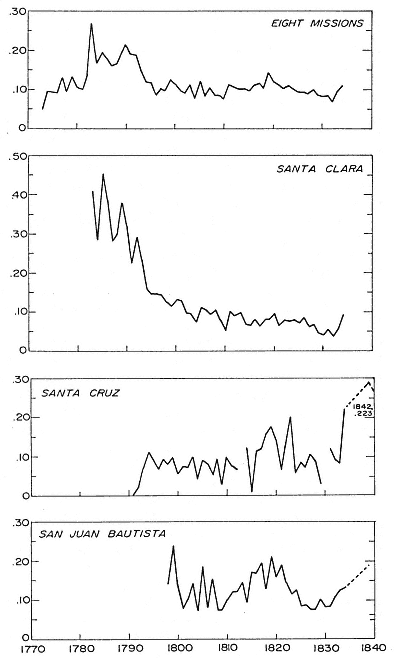
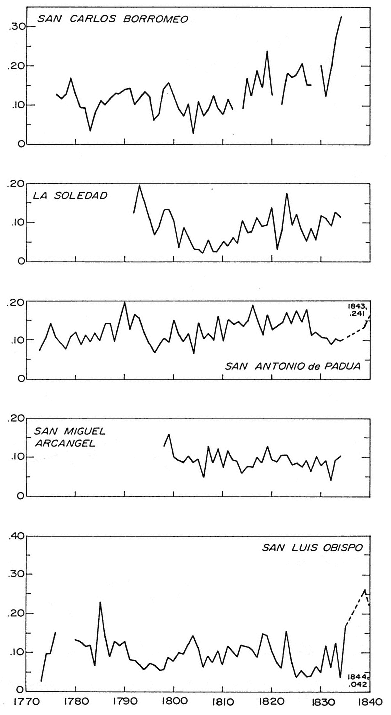
Figure 3.1
Ratio of births to adult female population. The line is based upon
ratios for each calendar year. The ratios are plotted on the ordinate;
the abscissa gives the calendar year.
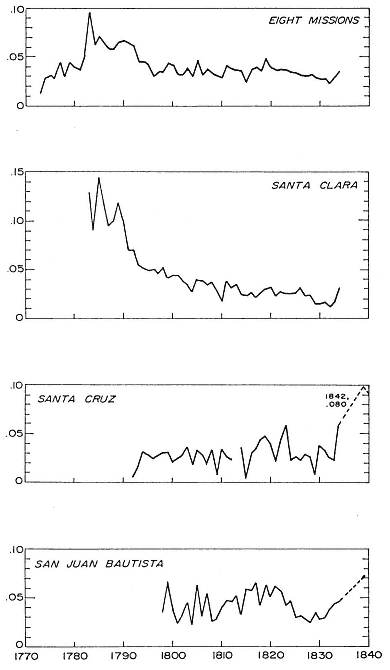
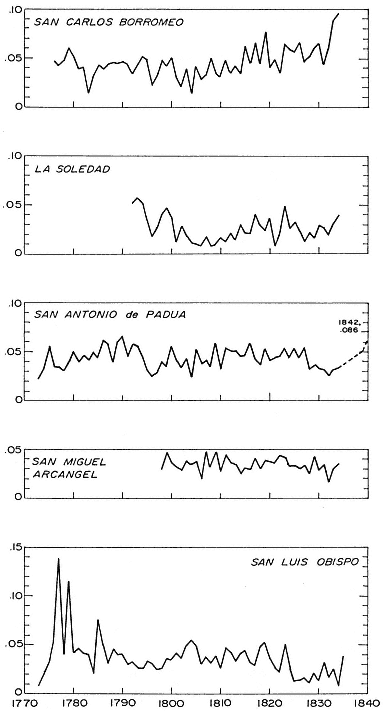
Figure 3.2
Ratio of births to total population. The line is calculated
as in Figure 3.1.
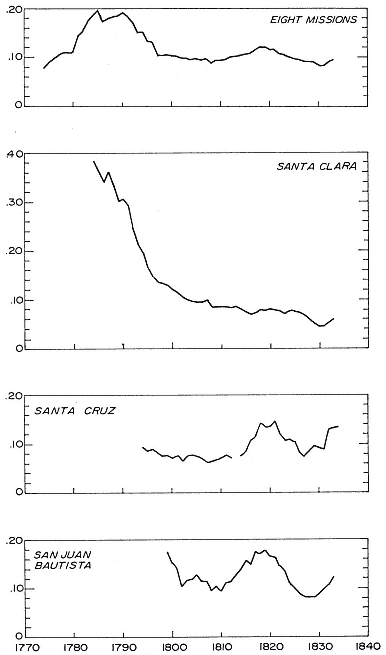
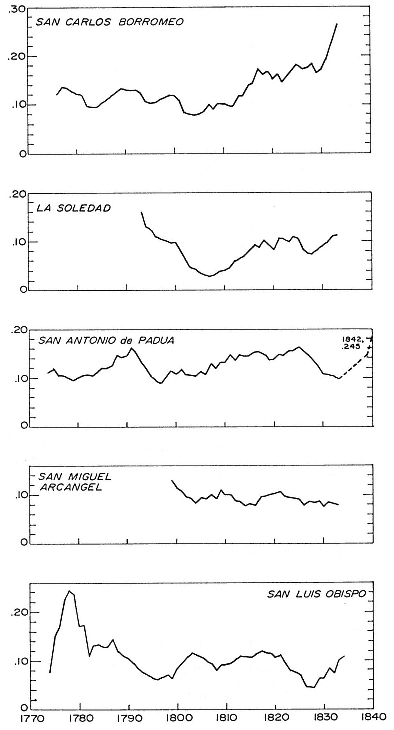
Figure 3.3
Ratio of births to adult female population. The line is based upon
five-year moving averages of the ratios used in Figure 3.1; the
ordinate and abscissa as in that figure.
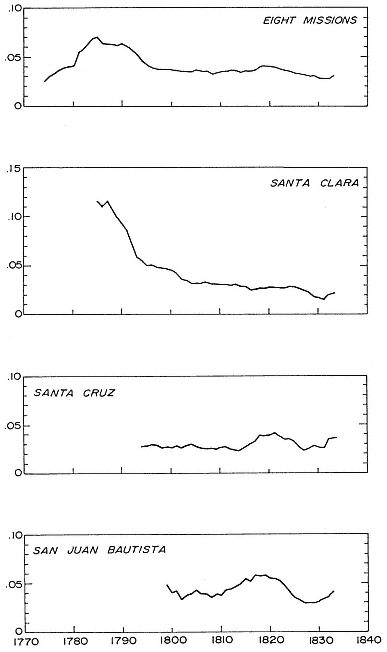
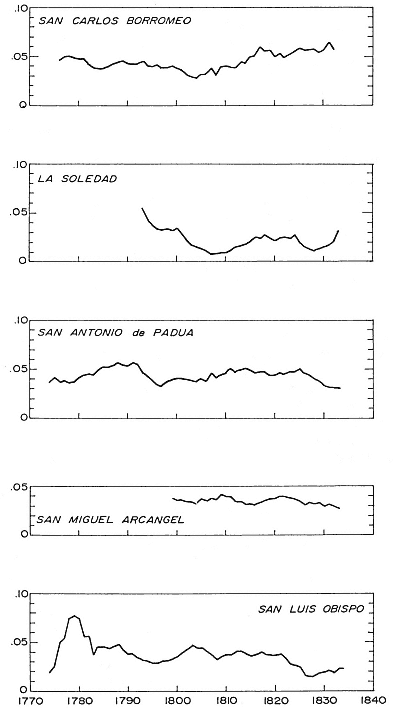
Figure 3.4
Ratio of births to total population. The line is based upon five-year
moving averages of the ratios used in Figure 3.2; the ordinate and
abscissa as in that figure.
which 3-year averages are used. When these averaged points are graphed, a good deal of the scatter is eliminated, as demonstrated in Figures 3.3 and 3.4.
Inspection of the annual figures as adjusted in Figures 3.3 and 3.4 indicates that there remain very great differences from mission to mission. Initially, the individual missions show ranges for the ratio of births to adult women on the order of 0.38–0.37 to 0.05 or less, that is, from 380–370 births per 1,000 adult females down to 50 or less births. At the same time, the ratio of births to population ranged from near 0.130 down to 0.020 and 0.028, or from 130 births per 1,000 persons down to 20 and 28 births. The variation is so great that it is difficult to use the initial values for the individual missions as the basis for a guess at what the ratio was before the Indians entered the missions.
At each mission, except Santa Clara, the course of the ratios during the mission period was so irregular that it is again difficult to make generalizations. The ratios fell, at some missions reaching low points earlier and recovering, at others hovering around a central point, at Santa Clara showing a long downward trend that may have been reaching an end just as the mission period came to a close. At the lowest point for each set of ratios at Mission La Soledad, that for births to adult women was near 0.03 and births to population near 0.008, that is, 30 births per 1.000 adult females and 8 per 1,000 population. If such ratios had continued long and been characteristic of the other missions, as they were not, the neophyte population would have become extinct with rapidity in the face of the high death rate.
The two summary graphs represent a reconciliation of the highly divergent courses at the individual missions. In the summary graph for Figure 3.3, ratios of births to adult females, based on 5-year moving averages, the initial values fell between 0.075 and 0.1, that is, from 75 to 100 births per 1,000 adult females. They moved steadily upward to reach a maximum in the years 1783–1792 at values from 173 to 193 births per 1,000 adult females. Thereafter they dropped fairly rapidly to a range between 83 to 119 births per 1,000 adult females. A fair average for the years 1797–1834 for all missions would be around 100 births per 1,000 adult females. A similar course appears in the summary graph in Figure 3.4 for the ratios of births to total population at the eight missions, based on 5-year
moving averages. The initial values averaged approximately 30 births per 1,000 population. The values rose to a maximum in the years 1781–1793, with an average of approximately 60 births per 1,000 total population, the peak year being 1785 with 70 births. Thereafter the values fell to a plateau, with an average of approximately 35 births per 1,000 population. The lower parts of this range would be considered a fairly high birth rate today; the higher parts approximate the highest values reported for present-day populations.
Let us return to some of the individual missions. The oldest mission was San Carlos Borromeo. The two graphs for it that are based on 5-year moving averages may reflect long-term trends better than at the others, except for San Antonio de Padua and San Luis Obispo, which were almost as old. That is particularly so if we are trying to lay bare the action of factors which might run a long-term course but stop before the Indians became extinct. If the corresponding graphs for San Antonio de Padua and San Luis Obispo tend to confirm the course of those at San Carlos Borromeo, then any conclusion as to longer-term trend would be strengthened. Initially, the ratio of births to adult women at San Carlos was near the level of 120. At the same time, the ratio of births to population was near 47. If a range is desired, we might think of 108 to 132 births per 1,000 adult women, and of 43 to 53 births per 1,000 persons. These are fairly high rates, which may be taken as probably somewhat lower than but close to those characteristic of the pre-mission aboriginal population.
Whether the course was linear or curved at Mission San Carlos is difficult to tell, but the ratios fell until at about 1805 a minimum was reached at values of approximately 100 births to 1,000 adult women and 34 births to 1,000 total population. Then improvement began. The ratios rose continuously until the end of the mission period. At about 1830 the values were 192 and 58 respectively. Those figures should be regarded as the central points of substantial ranges, as should all on the graphs.
The history of the birth rate at Mission San Carlos Borromeo, therefore, is reasonably clear. After a start at quite a high value, approximating the aboriginal one, it fell to a minimum after the rush of conversions in the 1790's and the epidemics of 1802. Thereafter it rose steadily and conclusively as long as the mission lasted. At the end, it was higher than at the beginning.
Experience at Mission San Antonio de Padua was different,
with the trend reversing direction a number of times. Initially the ratios of births to women ranged between 100 and 120 per 1,000 women, and that of births to total population fell in ranges from 37 to 40 per 1,000 population. Thereafter, the ratios increased and decreased over periods of time. The ratio of births to women reached peaks in the early 1790's and early 1820's at levels ranging from 150 to 160, while that for births to total population ranged from 51 to 57 in the years 1785–1792, and in the years from 1817 to 1827 from 42 to 51. In the last years of the mission period both ratios fell steadily, reaching levels approximately as low as previous minima. This decrease after a long period of relative stability may be due to the bringing in of Tulares, whose presence meant that the ratios became a reconciliation of two divergent tendencies.
For Mission San Luis Obispo, the graphs also show a more irregular course than for Mission San Carlos, with a greater initial variation. The ratio of births to adult women initially may be set at an average of close to 170 births per 1,000 adult women, and that of births to population at 55 births per 1,000 population, truly high values that may be the aboriginal ones. The subsequent change in the ratios, although irregular, was one of slow decline until the middle 1820's, when it reached bottom at 45 for births to women and 15 for births to total population. Thereafter the course of both was upward; in the early 1830's, they reached 100 to 150 births per 1,000 women and 40 to 42 births per 1,000 population.
The implications of the graphs are difficult to unravel. Mission San Antonio de Padua received contingents of Tulares; Missions San Carlos de Borromeo and San Luis Obispo did not. Part of the difficulty may lie there. One may hold that the graphs support the view that once the native population had become adapted and adjusted to mission life, the natural procreative activity of the people asserted itself. In spite of disease vectors and social restraints, the Indians were beginning to show signs of demographic recovery, although the signs were still faint at the end of the mission period. If so, the missions were bringing their Indians through the shock of meeting the white man with his new ways and new diseases in something less than the 80 to 100 years that elsewhere in America seem to intervene between first contact and the beginnings of demographic recovery. It is unfortunate that political developments cut short this interesting human and biological experiment.
4—
The Non-Indian Population
Accompanying the missionaries at the beginning of Christianization came numerous military and civilian personnel: the officials of the civil government, the garrisons of the missions and presidios, the artisans who helped the missionaries teach the Indians new crafts, settlers in the new land, and their families. A few of these individuals migrated from Spain, mostly army officers and administrators. The majority were of Mexican origin and already the products of the very considerable mixing of races in central and northern Mexico. They were known collectively as the gente de razón , a term which set them apart from the native Indian population. The process of mestization should be regarded as an ongoing one, for with the Hispanic gente de razón there also arrived a small number of Indians from the missions of Baja California, who might be counted among the Indians or among the gente de razón and increasingly moved into the gente de razón. Later in the nineteenth century there began a new stream of immigration, at first very small in comparison with the continuing one from Mexico, but by the later 1840's becoming a torrent. This new group was, for the area of the eight missions, almost entirely white and predominantly British, Irish, and Anglo-American, but had contingents from France, Germany, Portugal, and Italy. Despite some immigration from Mexico, Latin America, and Spain during the years of the Gold Rush, which tended to reinforce the existing Hispanic population, the new immigration quickly submerged the Indian and the Hispanic components both socially and demographically. After the missions disintegrated, there comes a time when it is difficult if not impossible to follow the fortunes of the Indians in the era of American settlement until the emergence of the Federal reservation system again provides information. The Hispanic population, on the other hand, may be studied to some extent by means of Church records throughout the nineteenth century and until the introduction of the California state registration system.
We make no attempt here to pursue the Mexican Californians through the nineteenth century, except insofar as information concerning them may be obtained from mission registers. Some data are available because all baptisms, burials, and marriages which involved the gente de razón were entered in the mission registers. Until after 1834 there were no secular priests or
parishes in a province that, as far as the gente de razón were concerned, was completely Catholic. Even after 1834 the erection of new parishes came slowly. Two missions of the eight here under study have the bulk of entries on the gente de razón. They are San Carlos Borromeo and Santa Clara. Mission San Carlos has more than half the entries for gente de razón down to 1834, because its priests ministered to the spiritual needs of the military at the presidio of Monterey, the administrative staff at the provincial capital, and the citizens of the growing community that formed around the presidio, the capital, and the port. Mission Santa Clara ministered to the Hispanic population at the pueblo of San Jose, a short distance away. Registers at other missions have few entries; those that there are arose from the presence of the garrisons and artisans, increasingly of Mexican settlers on ranches, and, in the instance of Mission Santa Cruz, the existence of the small Mexican settlement of Branciforte. Begun in 1797 with 9 settlers and their families, 17 persons in all,[35] it remained minute for some decades and generated few entries in the Santa Cruz mission registers.
Entries for the gente de razón in the mission registers resemble those made for the Indians, but tend to be more extensive. For baptisms, in the earlier years, the missionary included, if he knew, the names and places of origin of the parents along with the name and birthplace of the infant. For many individuals a small family history is to be found. Ages frequently are not given, even for deaths and marriages. We must keep in mind that initially deaths and marriages were recorded for all the gente de razón, since all were Catholic, but that baptisms would be only of the newborn, for everyone else among the gente de razón had already been baptized. When Anglo-American and European immigrants began to arrive, there were Protestants among them, to be sure. During the Mexican period, they had to become Catholics in order to secure permission to remain, to become Mexican citizens, or to marry. The baptismal registers record these conversions. With the opening of the American period, the coverage of the Catholic parish registry rapidly became less than universal.
The facts that ages are frequently not given and that some mission registers are deficient in cross-references, such as those
[35] Bancroft, History of California , I, p. 560, esp. n. 44.
of San Carlos Borromeo, in which no baptismal numbers occur in the death notices prior to 1830, make it difficult to evaluate the relationship between births and deaths among the gente de razón. There is also the additional complication that most deaths in the early years were of adults who had migrated to California. On the other hand, almost all the baptisms were of newborn. A schedule may be formulated, but it is very rough, as may be appreciated by examining Table 3.8A. Here the births and deaths of the gente de razón are summarized by decades from 1774 to 1834 for the two missions of San Carlos de Borromeo and Santa Clara. We have also incorporated a tabulation of such data for Mission Santa Cruz, but have not included it in the summary, since the data are too meager for any meaningful analysis. Information on numbers of baptisms for gente de razón at the other missions, but not on numbers of deaths, may be found by 5-year periods in Table 3.8B. The categories for age at death consist only of division into the two broad categories of párvulo and adulto . We cannot go beyond 1834, because thereafter the priests at Mission San Carlos condensed the death records to a mere notation of the name and omitted any reference to age, even the broad categories of párvulo and adulto.
| ||||||||||||||||||||||||||||||||||||||||||||||||||||||||||||||||||||||||
| ||||||||||||||||||||||||||||||||||||||||||||||||||||||||||||||||||||||||||||||||||||||||||||||||||||||||||||||||||||||||||||||||||||||||||||||||
From Table 3.8A we see that in the jurisdiction of the two missions of San Carlos and Santa Clara, during the decades up to 1835, there had been baptized 1,778 members of the gente de razón, almost exclusively of Hispano-Mexican descent. Because of the proximity of the Hispanic population to the mission, the baptisms are likely to be close to the number of actual births, although we cannot be sure that they coincide with that number. The Hispanic population was under somewhat looser control than the Indians, so that the delay between birth and baptism may have been somewhat longer and the chance of death in the intervening period, with its need for hasty baptism by any Christian, somewhat greater. Despite this lack of complete coincidence, we shall consider that baptisms do equal births for the purposes of our discussion. During the years covered in the table, there died 648 members of the gente de razón. The gross ratio of births to deaths is 2.74; that at Santa Clara 2.99, and that at San Carlos 2.54. The ratios by decade are also shown in the table, in the summary sheet and those for each mission. Although there is a good deal of variation, the range is not extreme and the ratios show a steady rise in population through natural increase. Similar data for Mission Santa Cruz show a level of unity but cover only a few individuals (11 baptisms and 11 deaths). We are unable to link the 372 recorded births of gente de razón at the remaining missions with deaths of gente de razón for any meaningful analysis, but suggest that the fairly steady rise in births with passage of time must have come at least in part from natural increase as well as immigration. The values we have for ratios of births to deaths are in marked contrast to the ratios for movement of population among the mission Indians. For the latter, there was a consistent excess of deaths over births.
Of the recorded deaths at the two missions, 281 are designated párvulos. A párvulo was a person up to the age of 7 or 8 years and is the nearest we can approach numerically to an infant in the data as they come to us. We tried to relate the párvulo deaths to the baptisms, but found that a check by name in the records of Mission San Carlos Borromeo indicated that only about 60% of the children who died had been born in the mission jurisdiction. It follows that the closest we can come to establishing an infant death rate is to equate the deaths of
párvulos to the total baptisms of gente de razón. The ratios by decade for the two missions are shown in the summary of Table 3.8A and for the three missions—that is, including the meager data for Santa Cruz—in the individual tabulations that follow. They indicate for the two missions a range of 128 to 176 párvulo deaths per 1,000 baptisms. Those are averages of somewhat greater variation in the two missions, for which the range is from 122 to 208. Mission Santa Clara, which had somewhat higher ratios of baptisms to burials than Mission San Carlos—that is, a more favorable ratio of net increase—also shows lower, i.e., more favorable, ratios of párvulo deaths to 1,000 births. Since it is clear from an examination of individual cases that most, but not all, of the párvulos actually died in the first year of existence, the probability is high that the true infant mortality lay somewhere between 100 to 150 deaths per 1,000 births. That range is far below the range of rates demonstrated by the mission-born Indians. It compares most favorably with the rates calculated for the Mexico of the Diaz regime, already benefitting from some influence of the new medical knowledge. (See the discussion on the neophytes born in the missions, in Part 3 of this essay.)
We may also compare the experience of the Hispanic population as recorded at the two missions with the data afforded by the excellent historical demographic studies for France which show infant mortality rates for localities in southwestern France, western France, and the Beauvaisis ranging from 156 to 288 per 1,000 births. They cover periods of time of variable length from the seventeenth to the end of the eighteenth century. Further, although the Spanish definition of parvulo does not cover years of age 8–9, relatively few deaths usually occur in those years, so that we may compare the rates for párvulo deaths per 1,000 baptisms directly to the rates computed in the French studies for deaths before age 10, that is, for ages 0–9. For the localities studied in Brittany, as we have already mentioned, roughly half of the children did not reach their tenth year. Similarly, for the Beauvaisis, during the period 1656–1735, 47.1% of children died before age 10, a rate of 471 child deaths per 1,000 births. For localities in the southwest of France and in Normandy, French experience was better in that nearly two-thirds of the children reached their tenth year—that
is, slightly more than one-third died.[36] Studies of English parishes show rates of mortality even more favorable than those of eighteenth-century France. For one of the most thoroughly studied towns, Colyton, life-table treatment indicates that in the years from 1538 to 1837, of 1,000 people born, from 175 to 258 would die before their tenth year. The most favorable values are for 1750–1837 (175) and 1700–1749 (203), the least favorable one for 1650–1699 (258).[37] These proportions should be compared with the average rate of 158 párvulo deaths per 1,000 baptisms for the Hispanic population at the two missions during the years 1774–1834. Even with adjustment for deaths in ages 8–9, the average of the rates for the entire period would not reach 170 deaths per 1,000 births, that is, 83% of those born survived to the tenth year of life. Clearly the environment of Alta California was extraordinarily favorable to the Hispanic population.
Let us turn now to interethnic and interracial marriage as it shows up in the mission registers. The aggregate number of non-Indians who were born under mission auspices is found in Table 3.8B. From the foundation of the missions until 1855, some 5,354 infants were baptized. Of these, 4,726 were the children of parents of Spanish or Mexican stock. For varying periods of years it is possible to segregate the infants baptized into three categories, according to the birthplace of the parents. In the first years, all the gente de razón had been born in Mexico or had come through Mexico from Spain; we designate these people M. They gave way statistically to persons born in California (C) as migration attenuated and births increased in the new colony. For periods of years between 1818 and 1834, some missionaries designated the parents as californios . After 1834 the failure of the priests at some missions to include information on locality of origin of the parents—a failure that varies in highly erratic fashion from mission to mission—makes it necessary to indicate only the general Hispanic ancestry, regardless of birthplace; that is, we revert to classification M in Table 3.8B. Accordingly, the classification C in the table covers only a fraction of the Californio parents, so that only the
[36] Goubert, "Legitimate Fecundity," pp. 599–600, and Henry, "Historical Demography," pp. 392–393; Pierre Goubert, Beauvais et le Beauvaisis , pp. 39–41.
[37] E. A. Wrigley, "Mortality in Pre-Industrial England," pp. 552–560.
| |||||||||||||||||||||||||||||||||||||||||||||||||||||||||||||||||||||||||||||||||||||||||||||||||||||||||||||||||||||||||||||||||||||||||||||||||||||||||||||||||||||||||||||||||||||||||||||||||||||||||||||||||||||||||||||||||||||||
| |||||||||||||||||||||||||||||||||||||||||||||||||||||||||||||||||||||||||||||||||||||||||||||||||||||||||||||||||||||||||||||||||||||||||||||||||||||||||||||||||||||||||||||||||||||||||||||||||||||||||||||||||
| |||||||||||||||||||||||||||||||||||||||||||||||||||||||||||||||||||||||||||||||||||||||||||||||||||||||||||||||||||||||||||||||||||||||||||||||||||||||||||||||||||||||||||||||||||||||||||
| |||||||||||||||||||||||||||||||||||||||||||||||||||||||||||||||||||||||||||||||||||||||||||||||||||||||||||||||||||||||||||||||||||||||||||||||||||||||||||||||||||||
| |||||||||||||||||||||||||||||||||||||||||||||||||||||||||||||||||||||||||||||||||||||||||||||||||||||||||||||||||||||||||||||||||||||||||||||||||||||||||||||||||||||||||||||||||||||||||||||||||||||||||||||||||
| ||||||||||||||||||||||||||||||||||||||||||||||||||||||||||||||||||||||||||||||||||||||||||||||||||||||||||||||||||||||||||||||||||||||||||||||||||||||||||||||||||||||||||||||||
| ||||||||||||||||||||||||||||||||||||||||||||||||||||||||||||||||||||||||||||||||||||||||||||||||||||||||||||||||||||||||||||||||||||||||||||||||||||||||||||||||||||||||||||||||||||||||||||||||||||||||||||||||||||||||||||
| |||||||||||||||||||||||||||||||||||||||||||||||||||||||||||||||||||||||||||||||||||||||||||||||||||||||||||||||||||||||||||||||||||||||||||||||||||||||||||||||||||||||||||||||||||||||||||||||||||||||||||||||||
| |||||||||||||||||||||||||||||||||||||||||||||||||||||||||||||||||||||||||||||||||||||||||||||||||||||||||||||||||||||||||||||||||||||||||||||||||||||||||||||||||||||||||||||||||||||||||||||||||||||||||||||||||
subtotal for all infants born to parents of Hispanic culture is accurate. We should also warn that in terms of our classification a parent of Portuguese origin would not count as M, but that a parent of Spanish or Latin American origin would, regardless of the year of migration to California.[38]
In the 1820's the first non-Spanish-speaking immigrants arrived in California. Some were Catholics; all who wished to settle and become Mexican citizens were required to convert to the Catholic form of Christianity. Many, if not most, men coming in the years of the Mexican period married California women. We have designated this group of immigrants A. In the years 1820–1824, 2 children of such couples were baptized; in 1825–1829, 16. In general, in the succeeding 5-year periods the number rose steadily. Up to the end of 1854, the total number was 440. Their weight among the newly-born can be appreciated if we express their number as a percentage of the total children born to all parents who were both of M and C culture, plus those who are listed as AM. (We omit AA, MN, and AN—that is, children of European and Anglo-American parents on both sides, and the product of unions in which one parent was a California Indian.) This value is shown in Table 3.8B and is seen to increase from 0.7% in 1820–1824 to 17.8% in 1850–1854. In other words, by 1854 close to one-fifth of the gente de razón infants baptized at the parish churches directly succeeding the eight missions were derived from mixed Mexican or Californio parentage on one side and non-Hispanic parentage of Caucasian stock on the other. The latter were predominantly Anglo-American, British, and Irish, and almost invariably the fathers. Again, there was wide variation from mission to mission, the highest proportion of such mixing being evident at Santa Cruz and the next highest at San Carlos Borromeo.
At the same time, there was considerable mixing between the Hispanic and the native Indian components, and later between the new migrants and the Indians. Some of the effects can be localized in the mission registers. We have found 83 children of mixed MN parentage and 8 children of AN parentage. These children were the offspring of marriages; invariably the mother was N. They represent 1.7% of the gente de razón births. There
[38] By accident, we are following here the idea of Hispano in the general Latin American usage of Hispanoamericano, which includes only people from Spanish-speaking countries of Latin America but excludes Brazilians.
must have taken place, in addition, a great deal of less formal mixing in which men of Hispanic or other European stock begot children upon native women. Extramarital coupling of native men with women of Hispanic, European, or Anglo-American origin would have been exceedingly rare, as was marriage. The mission registers give us almost no direct data on illegitimate children of such mixed origin, nor are clues easy to find. The mission registers do record a small number of baptisms of illegitimate and abandoned (exposito ) infants among the gente de razón. For San Jose (i.e., registers of Mission Santa Clara), the baptisms are largely associated with certain mothers, who may have been genuinely promiscuous or in the later years may have been living in common-law unions with long-term partners. We have carried such children as M on the assumption that the father was almost certainly M or C. That assumption is fully justified for the earlier years, but less so after 1846–1848.
5—
The Marriage Records
The mission books of marriages carry the entries, for both Indians and gente de razón, of all legal unions in their territories down to 1846. Even secularization did not at once change this situation in the territory of the eight missions. The opening of the Anglo-American period brought clergymen of other denominations and new justices of the peace, who under the new system of law were equally able to perform marriages recognized as legal, but Roman Catholics continued to marry in a religious ceremony performed by a priest and registered in the parish registers. By the 1850's the parish system began to be extended, so that the mission registers no longer contained all entries for Roman Catholic marriages performed in the former territories of the eight missions. Accordingly, we have chosen 1854 as the cut-off date for selection of data on gente de razón—or in the Anglo-American usage, the whites.
In the entries of the marriage registers of the missions may be found at maximum for each couple the ethnic affiliation of bride and groom, the birthplaces of both, in many instances the birthplaces of the parents, and the previous marital status. The most important evidence provided is that on ethnic origin or affiliation, which immediately sets off the Indians from the gente de razón. For the latter, the evidence in the marriage
entries too may serve as a complement to data in the baptismal entries. Comparison is simple if the person had been born in the territory of the same mission in which he was married. It would be more difficult, but possible, if the person had been born elsewhere in California, and increasingly difficult, but not impossible, with greater distance of the parish of birth in Mexico or Spain, if the parish or birthplace is known. This kind of examination, however, lies beyond the scope of our present study.
We shall discuss certain data which are provided in the marriage entries for both the Indians and the gente de razón, and which are not available in the entries of the baptismal and burial registers. One problem which faced the missionaries when they were converting the California Indians was that many of the new converts had been living in what Indian custom and rite recognized as marriage. The problem was not a new one; it appeared almost at the inception of Christianity, and the first rules for dealing with it emanated from St. Paul, including what is called the Pauline Dispensation. A new marriage is necessary between the former partners even if both convert to Christianity. Should one of the former partners remain heathen, the other partner is free, under certain conditions, to marry another person, provided that person is Christian. The rules were further refined in the discussions within the Mexican Church during the sixteenth century and in the regulations adopted by the first three Mexican Church councils. These regulations attempted to specify the conditions in which renewal of the heathen marriage by Christian rite was necessary or obligatory, the conditions in which unions with new partners were to be permitted or required, and the way in which previously polygamous arrangements were to be brought to Christian monogamy. This last led to a great deal of difficulty in Mexico, since the husband, on being faced with a requirement to declare who was his first wife so that he might be united with her in Christian marriage, frequently developed a poor memory in the hope of being allowed to select a younger and more attractive woman from among his previous spouses. There may well have been similar problems in California, for the California Indians were hardly invariably monogamous, but the marriage entries are mute on this point. The rules of the Church, then, as they came to the Franciscans in Alta California, via the Bishopric of Sonora and
the Archbishopric of Mexico, required them to see that Indians who converted married their spouses in Christian ceremony if both became Christian; to permit them, under carefully laid-out conditions, to choose a new Christian partner if the former spouse by Indian rite or custom did not become Christian; and to marry only a Christian if they had not been married previously by heathen rite or custom. The position of the Church then and now is an interesting one of not recognizing Indian custom as providing a proper basis for marriage, but, on the other hand, of agreeing that it has a measure of validity.[39]
It is difficult to judge from the marriage entries in the mission registers the details of policies followed by the missionaries in dealing with the numerous questions that must have arisen, for most decisions would be made in advance of the marriage and would be recorded only if required by Church regulations. Accordingly, we are led to a series of inferences. Basically, the friars appear to have taken the position that baptism wiped out all previous marriage ties as though they had not been, but that if both partners became Christian, there was an obligation for them to marry each other by Christian ceremony. The first part of this policy appears in the entries in the application of the Spanish terms for unmarried man and woman, soltero and soltera , to Indians of seasoned years who were frequently but not invariably marrying former marriage partners. One also encounters solteros and solteras of 40, 50, and 60 years of age marrying partners of ages as low as 13 or 14. The marriages were by no means all of old men with very young women, but often of old women with mere boys. It is difficult to believe that many men or women aged 18 to 25 remained unmarried in aboriginal society. We are obviously
[39] The literature on validity of marriages entered into prior to conversion to Roman Catholic Christianity and the marital obligations and privileges of converts is extensive and complex. An urbane and informed discussion, with particular references to the archdiocese of Mexico, may be found in John T. Noonan, Jr., Power to Dissolve: Lawyers and Marriages in the Courts of the Roman Curia , pp. 263–266, 343–363, 394–399, and the appropriate pages of notes. The prevailing rules, as they were understood in eighteenth- and early nineteenth-century California and Mexico, are laid out in a pamphlet by Tadeo Amat, Bishop of Monterey, in A Treatise on Matrimony . The discussions and resulting rules in sixteenth-century Mexico may be traced in José A. Llaguno, La personalidad jurídica del indio y el III Concilio Provincial Mexicano (1585) , pp. 11, 21–22, 32, 122–123, 127–128, and 281; Joaquín García Icazbalceta, Don Fray Juan de Zumárraga , I, pp. 142–146; Gerónimo de Mendieta, Historia eclesiástica indiana , pp. 301–306; and John T. Noonan, Jr., "Marriage in Michoacan."The specific Mexican Church legislation is in the proceedings of the Primera Junta Apóstolica, 1524–1525; the papal bull in answer, Rome, 10 July 1537; Constituciones de el arzobispado y provincia de la muy insigne, y muy leal ciudad de Temextitlan, México de la Nueva España; Concilio Primero, 1556; and Privilegios de indios, n. d. but ca. 1765, this last forbidding marriages among Indians only to and including the second degree of consanguinity—all in Concilios provinciales primero y segundo , pp. 6–7, 31, 88–89, 98–100, and 391–392; and decrees of the Third Mexican Church Council, 1585, in Concilium mexicanum provinciale III , pp. 269–288. The solutions are essentially those indicated by Father Juan Focher, O.F.M., in his Itinerarium catholicum proficiscentium ad infideles convertendos , 1574, consulted in bilingual text, Itinerario del misionero en América , pp. 161–212.
meeting in the entries a convention resulting from conversion to Christianity.
The second part of the policy stated above appears also in the marriage entries in a substantial number of Indian marriages, through the notation by the recording priest that the couple had been married previously in heathen existence. In a very rare number of entries the priest recorded that the couple had had other spouses by Indian rite but preferred their new partners for Christian marriage. From the scarcity of such entries, we infer that in a very few instances, because of special circumstances not noted, converts whose previous spouses also converted were allowed to choose new marriage partners, but that in general the missionaries did insist that, if both spouses converted, they remarry their old partners by Christian ceremony. The data, in both absolute and relative terms, are presented in Table 3.9. There we show data from seven of our eight missions. Since the comparison of marriages throughout the history of each mission is somewhat misleading, in that the confirmation of Indian-rite marriages by Christian ceremony would happen only during the years of active conversion and would decline as the mission population increasingly consisted of Indians born there, we give for each mission a subtotal of data at the end of the years of active conversion. For Mission Santa Clara and in the summary, no such treatment is possible. At Santa Clara the Tulares arrived soon enough to continue the active conversion of adult gentiles so that there is no break, but rather an increase in the proportion of marriages by Christian rite of partners previously living as man and wife in heathen society. In the summary, the fact that the years of active conversion came at different times makes it impossible to mark off any term of years.
It is evident from the summary sheet that during the peak
years of conversion, 1770 to 1809, more than one-third of the marriages at the missions reunited couples who had been living together according to Indian law and custom. The summary tends to smooth out a great deal of variation from mission to mission. For some 5-year periods and at some missions, the proportion of such unions to total Indian marriages ran more than half, and at San Antonio de Padua for the years 1773–1774 reached the value of 73.7%. In each mission the proportion would trail off unless there was a renewed injection of adult gentile converts through the importation of Tulares from the Central Valley. Their presence may be found in the data presented in Tables 3.1 and 3.2, which should be examined in conjunction with Table 3.9.
| ||||||||||||||||||||||||||||||||||||||||||||||||||||||||||||||||||||||||||||||||
| ||||||||||||||||||||||||||||||||||||||||||||||||||||||||||||||||||||||||||||||||||||||||||||||||||||||||||||||||
| ||||||||||||||||||||||||||||||||||||||||||||||||||||||||||||||||||||||||||||||||||||||||||||||||||||||||||||||||
| ||||||||||||||||||||||||||||||||||||||||||||||||||||||||||||||||||||||||||||||||||||||||||||||||||||||||||||||||||||
| ||||||||||||||||||||||||||||||||||||||||||||||||||||||||||||||||||||||||
Once a Christian ceremony of marriage had taken place, the partners of that ceremony were not free to remarry so long as both lived, except under unusual conditions requiring judgment by an ecclesiastical court such as did not exist within California within the mission years, but some of whose powers were delegated to the provincial President. If one of the partners to the marriage died, the other was free to remarry. The marriage entries carefully specify for each individual to a marriage ceremony whether he or she had been previously married in the Christian Church. For both Indians and gente de razón, therefore, we get some indication through the marriage entries of the severity of mortality. In the case of the Indians, however, it is
necessary to delete from the count those marriages which were, in effect, a repetition of an Indian ceremony, for unions which occurred prior to the first Christian marriage are otherwise never recorded. With this adjustment, if the number of remarried widows and widowers is large, then we must conclude that the death rate was high among young adults in order to free these marriageable persons. The converse must be true if the number is small.
Table 3.10A gives data for seven of the eight missions on remarriage among the Indians down to 1834. For the years after 1834, we have taken off data only for some of the missions. Accordingly, the summary gives the number of missions from which data are made available in each semi-decade. Differences in the earlier years are due to dates of founding. The subtotals for data down to 1834 are the most reliable; subsequent adduction of data should be considered a series of samples of lessening reliability. Two items in Table 3.10A are of significance. The first is that the average for all seven missions down to 1834 is 35.7%—i.e., 35.7% of those men and women entering wedlock had already been married in the Christian faith. Their previous spouses must have died, for there was no divorce nor were they likely to have available to them other avenues of dissolution of marriage ties. The second feature is that the proportion of those remarrying rose steadily until it reached maxima in the years 1805–1814 and 1825–1829. Equally high values are shown for 1840–1844 and 1850–1854, but are based upon data from fewer missions. They also occur in years when many Indians, presumably a larger proportion of the young, had abandoned the missions and left behind older adults. The explanation of the maxima in the years 1805–1814 and 1825–1829 is that in the early years most of the brides and grooms were converted gentiles. These, however, were replaced by mission-born Indians until the latter group, subsequent to about 1810, exclusively constituted the newlyweds at most missions. We have already found from inspection of baptism and burial records that the mission-born component suffered from a very high rate of mortality. The marriage records, which show increased remarriage, substantiate this finding. Further, there was a marked difference between men and women in the proportion of second and later marriages. In the aggregate, over 40% of the marriages involved remarriage by men, whereas only approximately 30% involved remarriages by women.
| |||||||||||||||||||||||||||||||||||||||||||||||||||||||||||||||||||||||||||||||||||||||||||||||||||||||||||||||||||||||||||||||||||||||||||||||||||||||||||||||||||||||||||||||||
| |||||||||||||||||||||||||||||||||||||||||||||||||||||||||||||||||||||
| ||||||||||||||||||||||||||||||||||||||||||||||||||||||||||||||||||||||||||||||||||||||||||||||||||||||||||||||||||||||||||||||
| ||||||||||||||||||||||||||||||||||||||||||||||||||||||
| ||||||||||||||||||||||||||||||||||||||||||||||||||||||||||||||||||||||||||||||||||||||||||||||||||||||||||||||||||||||
| ||||||||||||||||||||||||||||||||||||||||||||||||||||||||||||||||||||||||||||||||||||||||||||||
| ||||||||||||||||||||||||||||||||||||||||||||||||||||||||||||||||||||||||||||||||||||||||||||||||||||||||||||||||||||||||||||||||||||||||||||||||||||||
| ||||||||||||||||||||||||||||||||||||||||||||||||||||||||||||||||||||||||||||||||||||||||||||||||||||||
| ||||||||||||||||||||||||||||||||||||||||||||||||||||||||||||||||||||||||||||||||||||||||||||||||||||||||||||||||||||||||||||||||||||||||||||||||||||||||||||||
| ||||||||||||||||||||||||||||||||||||||||||||||||||||||||||||||||||||||||||||||||||||||||||||||||||||||||||||||||||||||||||||||||||||||||||||||
In Table 3.10B we present data on remarriages among the gente de razón. Our data are from three missions, but they cover the overwhelming bulk of the non-Indians in the territory of the eight missions down to 1834, and a steadily lessening but still considerable proportion of Catholic marriages down to 1854. The data are organized by 10-year periods centered upon the last year of each calendar decade, except for the first period, 1770–1784. For the gente de razón, the rate of remarriage was reasonably constant from 1770 to 1834 at Monterey (Mission San Carlos Borromeo) and much more variable at the two other missions. The rates in the summary reflect the preponderance of the non-Indian population in San Jose, which resorted to Mission Santa Clara. In general, the rates of remarriage fell sharply with the new immigration after 1835. During the mission period the values of all three missions combined held to a mean of 12.7% for both sexes, slightly more than one-third of the mean rate for the Indians of both sexes in the same span of time. This difference further supports the finding, based upon the baptismal and burial records, that mortality among the mission Indians far exceeded that among the neighboring population of European culture. Another difference between Indians and non-Indians that shows up in Table 3.10B is that the proportion of gente de razón widows was slightly higher among people marrying than that of widowers, and so comes closer to present-day experience in the differential survival of the sexes. In sharp contrast, among the Indians, the proportion of widowers remarrying was markedly higher than that of widows. Lastly, the drop in the proportion of widowers as against widows among the gente de razón who married between 1835 and 1854 may be testimony to the presence of a large surplus of bachelors among the new immigrants, and their search for wives.
Yet another aspect of gente de razón marriage that may be studied through the marriage entries is the racial origin and ethnic affiliation of each participant, for these are either explicitly stated for each spouse, or may be inferred from the name and circumstances recorded. It becomes possible, therefore, to construct a chart showing for each decade of mission activity the number of marriages performed and the combinations of racial and ethnic affiliation involved. In Table 3.11 we give the data on 912 marriages celebrated between 1770 and 1834 at the
| ||||||||||||||||||||||||||||||||||||||||||||||||||||||||||||||||||||||||||||||||||||||||||||||||||||||||||||||||||||||||||||||
| ||||||||||||||||||||||||||||||||||||||||||||||||||||||||||||||||||||||||||||||||||||||||||||||||||||||
| ||||||||||||||||||||||||||||||||||||||||||||||||||||||||||||||||||||||||||||||||||||||
| ||||||||||||||||||||||||||||||||||||||||||||||||||||||||||||||||||||||||||||||||||||||||||||||||||||||
|
same three missions covered in Table 3.10B. Marriages in which both partners were Indian are, of course, excluded. The categories are the same as those used in Table 3.8B and the problems of application, in general, the same. The data from the three missions (Santa Clara, San Juan Bautista, and San Carlos Borromeo) cover the overwhelming majority of the non-Indian population. Addition of marriage data from four of the remaining five missions, the only ones for which marriage registers are extant, would add data on 32 marriages down to 1834 to the 423 in the summary table for the same term of years. The proportions would be very different in those 32 marriages, in that 14 fell in our subtotal designated M and 18 in the category of MN, that is, with one partner an Indian.
At the three missions, the early years showed a predictable course in that the first marriages involved adults immigrating from Spain and Mexico. As the children born in California grew to maturity and married, there came into being a Californio component which gradually became dominant. The flaws in the data on exact affiliation within subcomponents of the general category M probably have placed many more marriages in MM in the later years than there should be, for we have counted cases of doubt as MM. The subtotal M, however, is reliable.
Until the period 1815–1824 there were no marriages of non-Hispanic gente de razón. Even the 3 marriages in that 10-year period (2 AM and 1 AA) took place in the 1820's. Thereafter such marriages, particularly those of a non-Hispanic but gente de razón male with a woman of Hispanic affiliation, show up as a steadily rising proportion of combined M and AM marriages. (Proportions based on total marriages would be slightly lower, but follow the same course.) Our value for the last 10-year period for the eight missions is 20.3, somewhat higher than the corresponding value for gente de razón baptisms for the same years. The table does not go farther, and the data after 1846–1848 already are less inclusive, since new elements of Protestant and civil marriages had come into being but lie outside our sources. As far as our data go, we may conclude that by the 1850's ethnic fusion between the Hispanic people of California and the new immigration, despite new migration from Mexico, other countries of Latin America, and Spain, was proceeding at the rate of one-fifth the Hispanic stock per generation. If, as seems likely, some of the marriages took place
| ||||||||||||||||||||||||||||||||||||||||||||||||||||||||||||||||||||||||||||||||||||||||||||||||||||||||||||||||||||||||||||||||||||||||||||||||||||||||||
| |||||||||||||||||||||||||||||||||||||||||||||||||||||||||||||||||||||||||||||||||||||||||||||||||||||||||||||||||||||||||
| |||||||||||||||||||||||||||||||||||||||||||||||||||||||||||||||||||||||||||||||||||||||||||||||||||
| |||||||||||||||||||||||||||||||||||||||||||||||||||||||||||||||||||||||||||||||||||||||||||||||||||||||||||||||||||||||||
| ||||||||||||||||||||||||||||||||||||||||||||||||||||||
by civil or Protestant ceremony, fusion would have been proceeding that much faster.
The data in Table 3.11 also cover marriages of gente de razón with California Indians. They represent a small proportion of total marriages of gente de razón. Even if we add the data for the four other missions, we find that down to 1834, of a total of 455 marriages, only 39, or 8.6%, involved marriage with a California Indian. The proportion of such marriages was far higher among the gente de razón scattered in garrisons and ranches in the territories of the four missions that had no Hispanic pueblo. Only in the territory of Mission San Juan Bautista was the rural Hispanic population sufficiently numerous to provide marriage partners among the gente de razón. We are not entitled, however, to conclude from these data that we here have the true rate of racial fusion between people of Hispanic culture and California Indians, for much of the procreation of children probably proceeded without religious marriage or any formal legal union, just as unión libre is an important form of sexual association in Mexico today. The children of such unions more likely would be counted as Indians, since the mother would be an Indian, and with the collapse of the mission system might never enter the white man's records. Futhermore, in the last years of our study, 1835–1854, a process was taking place that is also characteristic of Hispanic culture. Indian neophytes, who may have been Christian for as many as three generations, were settling among the gente de razon in San Jose and other Hispanic settlements and were winning acceptance, as is shown in the marginal entries for baptisms and marriages, which begin to use the terms vecino and vecina (also employed increasingly for the gente de razon) in place of indigena , that is to say, Indian. How many people were involved in this kind of passing, how far acceptance went, what the end results might have been, we are unable to state. The first years of the American period unleashed a series of new forces of violent impact that changed the demographic history of California even more completely than had the coming of the missionaries.
6—
Some Comments
Our essay basically has attempted to apply the techniques of examination of vital registers as they have been worked out by students of historical demography on two continents. We have,
we think, shed new light upon a series of facts of the experience of Indian and Hispanic populations during the California mission period. Considerably more probably can be done. Much studied as the California missions have been, and voluminous the publications in existence, we have been forced repeatedly to point to questions we cannot answer at this time and suggest that more research is needed with the specific question in mind. Our essay, furthermore, covers only the registers of eight missions. There were twenty-three missions in all in Alta California, every one of them keeping the same kind of registers. Remarkably few of such registers have been mislaid or lost, so that the same kind of techniques, perhaps even in improved form, can be applied to this mass of raw data, with yield that is certain to be rich but whose ultimate dimension one can foresee only dimly. The Indians of Southern California, even after missionization, remained in rancherías. Their type of mission settlement should yield information on yet other kinds of reactions and adaptations.
The Hispanic population, with fuller entries in the mission registers and control over the entire number, can probably be traced through what is at this point the ultimate in satisfactory reconstruction from vital registers, the reconstitution of families. We guess that the mission registers of all California, supplemented by other materials, should permit tracing the Hispanic immigrants and their children for at least a century and a quarter. From the data available in the registers of the eight missions we have studied, we suspect further that the Hispanic population should turn out to be as robust, as long-lived, and as fecund as the habitants of French Canada. Presumably they should show the same rapid multiplication of numbers until they met some check. That might have come either through filling up the vital space available to them or the entrance of a more formidable competing group. We know that the latter occurred. They and their descendants were rapidly absorbed by the newcomers.
To what extent similar studies of American Indians, Hispanos, and others can be carried on for the Southwest of the United States and the North of Mexico, we do not yet know. A series of surveys will have to locate the materials that survive and determine the extent of analysis possible. By and large, they have yet to be made.