
Chapter 4
The New Deal in Electrical Modernization
Public Enframing
We stand on the concrete pad for a new house we are to build. We survey the landscape. We might be in New Jersey, and view the straggling border of a green field against a pine wood. We might be in southern California, and view the golden dust and crackling grass of the heated summer being plotted for a vast tract. Surveyor's flags dance in the breeze, signaling an abstract geometry soon to be scraped and pushed into reality by graders and bulldozers. We enact an American ritual. The empty land and the limitless horizon become a place. Governments plan and enable, industry plans and speculates. Developers name streets and subdivisions. Contractors construct mass housing seriatim, trench and string utilities. Local government will draw ward lines. A school board will devise elementary school districts.
As we stand on the pad, carpenters raise the stick walls of two-by-fours around us and install roof trusses above. Roofers close the space with plywood sheets, asphalt paper, and shingles. Perhaps we chose the floor plan from the developer's models, or sketched it with an architect, or ordered it from a magazine and customized it to fit our special dream. This floor plan marks out the paths we will take from now on, from the baby's room to the kitchen, from the master bedroom to the living room. Now the floor plan materializes: the faint must of curing concrete, the sweet aroma of sawdust, the sharp ping of hammered nails and thup-thup of pneumatic staplers, the rasping of a saw cutting plaster drywall. Cladding blocks old views to the outside. The boxed spaces of windows and doors enframe new views.
Winston Churchill said, borrowing from John Ruskin, "First we shape our buildings, and then our buildings shape us." This is true of so much, not just of buildings. It is true of politics. In the 1930s, the United States built the national politics of housing around itself. Circumstance and politicians' visions shaped this new housing policy on two design axes: publicly regulated or owned electric power and adequate, fully modern homes for all families. Whereas the national political landscape had previously contained no structure of federal power policy or federal housing policy, the New Deal of Franklin Delano Roosevelt built these policies up around the nation's electorate. Americans had previously fought the old politics of electric power regulation and housing regulation largely at the state and local levels. Distinct political and governmental jurisdictions separated political issues as effectively as fencing and entailment divided agricultural fields. Reformers had not connected hydroelectric power regulation and all its issues, from the problem of determining fair residential electric rates to the question of who should own and develop hydroelectric sites to the problem of ensuring potable water and sanitary tenements, of regulating housing density, of the adequate supply of low-density housing, or of zoning industry out of residential neighborhoods. The New Deal brought power regulation and housing reform into national politics and national policy, linking them into a single, complicated issue of American housing. Progressive dreams in an era of economic crisis returned Americans to the new world of state regulation. Roosevelt reshaped those dreams into a unified vision of the planned improvement, support, and regulation of American homes. The New Deal constituted a political enclosure movement; jurisdictional fences dividing issues came down. New political institutions and new bureaucracies rose like the new houses in which the electorate would live.
Within the New Deal national political framework, most American families modernized their homes with electricity. Federal electrical modernization programs publicly enframed their conception and effort. New ideologies and political issues and the new fabric of political history of the 1930s through which Americans wove their lives became the foundations, stick walls, and plaster drywall, as it were, of their new houses. Electrical modernization did not arrive as prophesied in the gospels of corporate capitalism. Technological utopias of the electrically modern house, secreted from the hearts of the individual consumer, did not drive the market of modernization in the 1930s. That scenario lay behind the nation, fragmented and ruined, now almost an archaeological relic, graded over by the New Deal.[1]
Based on his experience as governor, Roosevelt believed that only a fundamentally new social arrangement centered on full utilization of electricity could bring a higher quality of life to American families. Fully matured and bound together by his central belief, Roosevelt's vision had the following major components.
Economic improvement required that the operation of the marketplace be supplemented by vigorous, broad governmental planning.
Governmental planning had to apply to geographic-economic regions, superseding jurisdictional divisions of the states and local government.
Partial redistribution of the American population and industries would be needed, from large cities into regions where planning would address all the needs of farm and village families—employment, health, housing conditions, and social welfare. The notion of resettlement reflected Roosevelt's antiurban bias.
Full electrical modernization of households defined the standard for quality of life, no matter where the households resided.
Electrical modernization of farm productive processes, within the framework of planned production and marketing, would lower farm costs and return farms to prosperity.
Electricity must be affordable to all households in quantities required for electrical modernization. Publicly owned and private utilities, lightened of their false capitalization by public regulation and the breakup of holding companies, would provide inexpensive electricity.
Cheap electricity would make the redistribution of population and industry possible, because it could be transmitted long distances and sold at near cost to rural consumers.
Roosevelt realized his vision most fully in the Tennessee River valley, in the South, and in rural electrification, but he self-consciously applied it to cities elsewhere, large and small. The focus of his political opponents on governmental planning obscured the place of electricity at the center of the vision. Planning arose as an instrument, not an end, during Roosevelt's governorship. His original, enduring, and consistent intent was to improve the everyday lives of individuals through electricity. He had been interested in regional planning for social improvement for over thirty years. In a speech in 1931, FDR spoke of the influence of City Beautiful movement planning for Chicago, which came to him through his uncle, Frederic A. Delano, a Chicago railroad executive and civic leader. The vision defined a goal, not a program. Roosevelt did not present programmatic details of electrical reform to voters in their choice of governor in 1930 or president in 1932. He offered them a social destination and a strategy to guide their travel arrangements.[2]
Roosevelt did not borrow his vision from private industry's notion of better living through electricity. In Roosevelt's vision, electrical modernization transformed lives. The private utilities desired electrical modernization; FDR desired electrical modernization . He wanted the social modernization of the American home. In 1934, Roosevelt used cheap electric power as a major campaign issue in his support of his party's congressional candidates. Following his campaigning in the Northwest in the summer of 1934, Business Week paraphrased the president's vision for its audience: "The supply of cheap power at many points
throughout the nation is intended to underlie new social development." He saw electricity as the best technology to obtain social modernization. Social modernization as transformation of the home was a politically defined vision, the domestic microcosm in the macrocosm of the national body politic. A progressive politician in his heart, Roosevelt believed in the political process as a rational means for collective choice of social policy and in the capability of rationally directed governmental action to improve the lives of the masses. The electrical utilities targeted the few consumers already modernized, whose privileged modernity had sprung from the crippled magic of the marketplace, seeking to shift their energy source, as from coal to electricity, or enhance their experience of being modern. Roosevelt focused on the great majority of households who were not modernized, for whom electrical modernization would bring a qualitative change in lifestyle. The electric utilities looked to the one-fifth of the American homes with some share of electrical modernization and said they had done everything they could. Roosevelt looked to the four-fifths of the homes the utilities claimed were incapable of modernization and said everything remained to be done.[3]
Roosevelt wove the theme of domestic electrical modernization as social modernization into speeches and extemporaneous remarks during his presidency. Little of his public conversation with the American people remains part of today's collective political memory. To understand the full force of FDR's progressive vision, we need more than references to his speeches in footnotes. For this reason, I quote a few addresses at length. He was the author of the speeches, not in the sense of privately penning each word, but by placing them in the public discourse of politics. That his political advisers may have drafted his speeches does not lessen their importance for indicating his vision. The advisers wrote to fit his vision, and he often rewrote to cast phrasing in his own voice.
Progressive social modernization meant more than the material improvement of lives. It meant also the moral improvement of life, as a matter of social justice, through technology. Roosevelt provided no greater personal testimony to this progressive vision than his emotional reaction to the poverty of Tupelo, Mississippi. He visited Tupelo during the 1932 presidential campaign and again the following year. He blanched at the poverty of this village, lacking electricity, sewers, and other urban services. Tupelo was the first town to sign a contract with the Tennessee Valley Authority for cheap electricity. The community's rehabilitation became a New Deal showcase. Roosevelt revisited the hamlet in 1934. His extemporaneous comments at that visit reveal the human dimension of his vision of social progress through technology. (See pl. 5.) In the quotation below, he associates transformation of persons from despair to a higher moral state in words quietly resonating with the salvationist themes of the nation's Christian culture ("hope," "something in people's faces," "determination," "knowledge"), with governmental planning and public ownership of electricity (TVA), with personal technology ("refrigerators," "cooking stove," "dozens of things," "gadgets"), with a new definition of household standard of living ("necessities"). He situated this
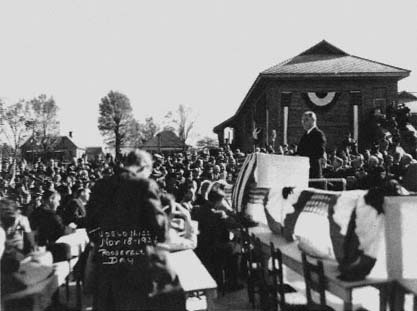
Plate 5.
President Roosevelt Speaks of Hope Through Electrical Technology
in Tupelo, Mississippi, November 18, 1934 . ([Amateur photographer.]
"Tupelo, Miss., Nov. 18, 1934, Roosevelt Day."
Lee County Public Library, Tupelo, Mississippi.)
vision of just technology in a new civitas ("our American life"), which collapsed the conventional distinctions of local village, state, and nation as effectively as when he spoke over the radio directly to voters. He may have calculated the occasion—he was a master politician—but he did not feign his vision.
What I saw on those [earlier] trips, what I saw of human beings, made the tears come to my eyes. The great outstanding thing to me for these past three days has been the change in the looks on people's faces. It has not been only a physical thing. It has not been the contrast between what was actually a scarcity of raiment or a lack of food two years ago and better clothing and more food today. Rather it is something in people's faces. I think you understand what I mean. There was not much hope in those days. And yet today I see not only hope, but I see determination and a knowledge that all is well within the country, and that we are coming back. And there is another side of it [TVA]. I have forgotten the exact figures and I cannot find them here in this voluminous report at this moment, but the number of new refrigerators that have been put in, for example, means something beside just plain dollars and cents. It means a greater human happiness. The introduction of electric cook stoves and all the other dozens of things which, when I was in the Navy, we used to call 'gadgets,' is improving human life. They are things not especially new so far as invention is concerned, but more and more are they considered necessities in our American life in every part of the country.[4]
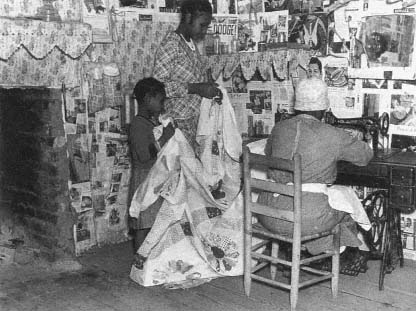
Plate 6.
Treadle Machine: The Unelectrified Life in the Rural South .
([Photographer unknown.] "Woman at sewing machine, Gee's Bend,
Alabama." Farm Security Administration Photograph, c. 1938–1940, from
the Library of Congress. Courtesy of Birmingham Public Library,
Department of Archives and Manuscripts.)
At a press conference in November 1934, Roosevelt again explained the goals of TVA in terms of the transformation of human life. Electrical modernization would change the nature of the citizenship. (See pl. 6.) His conversation with reporters tied social modernization (from "rural" "mountaineer" to a "different type of citizen") to the American ideal of equality of opportunity ("they never had a chance") to better homes ("the houses in which they lived").
[Electric] Power is really a secondary matter. What we are doing there is taking a watershed with about three and a half million people in it, almost all of them rural, and we are trying to make a different type of citizen out of them from what they would be under their present conditions. Now, that applies not only to the mountaineers—we all know about them—but it applies to the people around Muscle Shoals. Do you remember that drive over to Wheeler dam the other day? You went through a county of Alabama where the standards of education are lower than almost any other county in the United States, and yet that is within twenty miles of Muscle Shoals Dam. They have never had a chance. All you had to do was to look at the houses in which they lived.[5]
In an address in fall 1936, Roosevelt described the effect of electricity as a "social revolution," using a phrase Morris Cooke embedded in the progressive
lexicon. As had Gifford Pinchot, Roosevelt compared the dramatic changes due to electricity to those due to the steam engine, a century and a half earlier. He linked the steam engine to a revolution in industry, but he linked electricity to a "social revolution," which "sound and courageous public policy" could accomplish. "It is not irrational to believe that in our command over electrical energy a corresponding industrial and social revolution is potential, and that it may already be underway without our perceiving it."[6]
The Housing Crisis Cometh
Before the New Deal, progressives did not link housing reform to reform of the electric industry or holding company regulation. Housing politics did not have a clear arena at the national level, while the electrical struggles did. Except for a brief episode concerning defense worker housing in World War I, the federal government had no experience with housing. During the New Deal, advocates of housing reform criticized the federal government for lacking a unified housing policy that linked reconstruction of the mortgage financing and banking industry, national regulation of the private housing market, and public housing. Indeed, the New Deal never included housing legislation that unified most aspects of the nation's varied housing problems in the way that the Agricultural Adjustment Act or the National Industrial Recovery Act addressed agriculture and business. The shotgun pattern of housing initiatives did not contradict the idea that the first New Deal saved capitalism without reforming it. Some New Deal housing policies, such as the Federal Housing Administration's racial loaning policies, became the not entirely inadvertent origins of pernicious features of today's problematic American urbanism. The lack of an architectonic national housing policy does not mean, however, that New Deal programs did not address piecemeal many of the social objectives housing reformers desired. Federal housing programs recast the localized housing industry into a highly structured, uniform market, which the U.S. government underwrote. They extended private home ownership to the majority of households. They effectively imposed national standards of building design and shelter quality. They extended the blessings of electrical modernization to the majority of homes. They made public housing a federal responsibility. They made mass tract suburban communities comfortable and healthful for an enlarged middle class. In a word, the programs effectively nationalized housing—even though they did not "nationalize" housing in the sense desired by many housing reformers. Housing legislation and housing programs represented Roosevelt's core philosophical vision of the home. We look to Roosevelt himself for the unification of electrical policy, housing reform, and social modernization. Though the housing programs (except for public and subsidized housing) had a conservative tone, benefiting the middle class and a private housing industry and reinforcing their bourgeois vision of society, this conservatism did not reflect FDR's own vision.[7]
When governor of New York, Roosevelt signed several laws concerning bet-
ter housing and delivered one radio address on the subject, but clearly he did not rank housing as important as electrical modernization. His attitude reflected the national mood before his presidency. Concern over the lack of minimal quality shelter and the costs of home owning erupted and subsided mainly at local levels. The saga of tenement reform in New York City after the exposure of unsanitary and overcrowded immigrant tenements in the 1880s, philanthropic apartment projects in Chicago for black residents in the 1920s, and the fitful efforts of companies to house their workers in company towns, such as Pullman, Illinois, are well-known episodes in American history. Nevertheless, measured against the total housing stock of the nation, they constituted meager and inadequate efforts to increase the number of better dwellings. We understand the erratic behavior of the speculative housing market, which passed through numerous boom and bust cycles—Los Angeles in the 1180s and 1920s, Florida in the 1920s, for instance—as a patchwork of colorful episodes for which there is no single coherent national historic narrative. The situation changed little in the 1920s. In 1926, the Supreme Court decision Euclid v. Ambler Board of Realty upheld residential zoning as a legitimate extension of the police power, not requiring compensation to landowners whose development rights zoning had restricted. The model uniform zoning law for states, written by the U.S. Department of Commerce, prompted some national uniformity to municipal regulation of land use, and, thereby, standards for houses, when the states enacted zoning laws at the end of the decade. In 1932, as a last-ditch effort to stem the onrushing depression, President Herbert Hoover obtained passage of the National Reconstruction Corporation, which provided aid for mortgage lenders. It offered too little, too late. Until the reforms of the 1930s, most of the nation's families lived in minimally regulated dwellings. A vast, private, highly speculative construction industry, composed of small and middle-sized construction companies, decentralized at the local level, guided by minimal building codes, constructed their homes. The story of American housing took place at local communities and in local economies.[8]
Home financing instruments—construction loans, builder mortgages, first and second home owner mortgages—originated locally, regulated only loosely by state usury laws that usually capped interest rates on mortgages. At the end of the 1920s, home owner first mortgages ranged from 5 to 9 percent interest, with the normal being 6 percent. This is a wide range of variation in rates; nine basis points is 80 percent higher than five basis points. Terms of loans similarly varied widely. Insurance companies and building and loan associations occasionally offered first mortgage loans with fifteen-year payback periods. Other insurance companies and deposit banks offered first mortgages with terms as short as one to three years.[9]
Governments regulated home construction less than the lending industry. City and county construction standards primarily concerned building densities and connection to municipal services. Standards seldom included quality-of-life criteria, such as landscape, sunlight, and square footage of floor space. Standards
for electricity, gas, and plumbing seldom reflected the most advanced technology available. Architects, builders, and brokerages operated locally. Speculative construction could embody minimal standards, because the housing shortage ensured sale. Custom-built homes were subject only to agreement between the parties. While some national market constraints existed (for instance, building supplies existed partially within a national market), in the absence of national housing corporations, contracts varied widely for similar dwellings on similarly priced land in different regions of the nation. Housing built on speculation sold at prices determined by local supply and demand.
Finally, property taxes varied considerably across the country. In the absence of income taxes, the property tax carried most of the public tax burden and, consequently, was high. In 1928, in cities of over 30,000 persons, the property tax contributed 64 percent of total revenue receipts. In Arkansas (1923–1925), property taxes took an average of 17.1 percent of net rental income (before taxes). In South Dakota (1922–1926), property taxes took 29.9 percent of net rental income. In Washington State (1924–1926), they took 31.7 percent. Locale to locale, variation could be much greater. In Montrose, Colorado, property taxes on residential properties took 52 percent of net rent, and in sections of central Iowa, they took 41.8 percent of net rental income. Such heavy property taxes naturally led to high rates of delinquent taxes. These rates, too, varied widely. Delinquency rates in North Carolina averaged 9.3 percent of the gross tax levy (1928), but Cook County, Illinois (Chicago, 1927), suffered at 37.1 percent.[10]
The housing market did not encourage home ownership. Ownership took a large share of income. Owning cost more than renting. Regionalization of housing markets frequently meant that home owners lost equity when moving from one region to another. In 1930, two-thirds of American urban households could not afford to buy homes on the market that year. Only 47.8 percent of American households owned their homes. When the market did encourage home owning, it was not always a good deal for the household. Lack of rental housing in many areas of the country meant that families had little choice of whether to rent or buy, so we cannot assume that houses being purchased were of higher quality than rented quarters. Many families unwillingly owned their homes. Landlords forced them to purchase substandard dwellings after government removed World War I rent controls after 1919. Forced ownership of substandard homes scandalized postwar Philadelphia. The numbers point clearly to the fragility of home ownership at the opening of the depression. Indeed, "in 1933, 49 percent of the $20 billion home mortgage debt was in default. The monthly rate of foreclosures was approximately 26,000—an average of 1,000 per day." In its first year of operation, the Home Owners' Loan Corporation received applications for loans on approximately 40 percent of all nonfarm residential properties (appraised at less than $20,000 and having one to four dwelling units).[11]
The lending industry in collapse, nearly half of the nation's urban home owners in foreclosure and facing eviction: now the nation had a housing crisis.
Home Ownership for a "Settled Place of Abode"
At the outset of his presidency, Franklin Roosevelt ranked inadequate home ownership as the leading threat to the social contract between the government and the people and inadequate "security of the home" as the leading social problem of the American people. He linked home quality to home ownership, setting aside renting as a viable means of obtaining security. In 1934, addressing Congress with a review of the first year of his presidency, Roosevelt stated his vision unequivocally: "Among our objectives I place the security of the men, women and children of the Nation first. This security for the individual and for the family concerns itself primarily with three factors. People want decent homes to live in."[12]
He expressed the philosophy behind home ownership in September 1932 in the famous Commonwealth Club speech in San Francisco. Adolf Berle wrote the speech, with the assistance of Rexford Tugwell. In his book, The Democratic Roosevelt, Tugwell recalled that Roosevelt had not seen the speech before delivering it and did not have time to revise—his usual practice. In the speech, Roosevelt argued that industrialization and urbanization changed the economic order of the nation in a way that threatened the social compact between the people and their government. Until the great corporations concentrated economic power in themselves at the turn of the century, an open frontier, abundant cheap farmland, and plentiful industrial work for wage laborers enabled every person to work and to accumulate property. The recent concentration of economic wealth and power into a corporate oligarchy changed that situation; the mass of individuals could no longer accumulate property. In this new situation, the national government had to intervene in the economy to make it possible for individuals to accumulate savings and property on which to live when they could not labor.[13]
The speech previewed the New Deal's massive intervention in the economy. Roosevelt's notion of a new social compact between the people and their government describes the rationale by which he sent the national government into the economy to save American homes and to broaden home ownership. The frontier was no longer available for social modernization. The national government needed to create a new setting and new processes for social modernization. In other addresses, he tied this rationale to home ownership. In the new economic order of great corporations, most persons could not own a small business. The major form of property ownership would therefore have to be home ownership. When underwritten by the national government, home ownership represented asset savings on which everyone could draw when they could no longer work. In the new economic order, Americans had somehow to obtain, or be given, economic security where they lived, in homes they owned in long-term residency. Home ownership would be an asset for social modernization. In the Commonwealth speech, Roosevelt pledged the national government to play a major role in generating this progress.
By making home ownership and the material rehabilitation of American dwellings integral components of social modernization for the mass of Americans, Roosevelt transformed a previously conservative philosophy into a progressive philosophy. Since the mid-nineteenth century, the home ownership ideology had supported social conservatism. Not surprisingly, Herbert Hoover spoke for the conservative vision of home ownership. In a 1923 pamphlet on home ownership, prepared under his direction as head of the Department of Commerce, Hoover saw the conservative vision of the home owning creed in terms of creating sentiment for individualistic capitalism. "A husband and wife who own their home are more apt to save. They have an interest in the advancement of a social system that permits the individual to store up the fruits of his labor." For Hoover, home ownership made less government, not more, possible.[14]
Unfortunately for social conservatives, home ownership had not advanced significantly from 1900 to 1920. It increased only slightly during the 1920s housing boom. By the end of the 1920s, many home owners could not pay property taxes or meet mortgage obligations. Members of the real estate and mortgage banking industries noted these problems, prompting Hoover to call another of his well-known presidential conferences. Failure of the system of home ownership imperiled a major foundation of social conservatism. The President's Conference on Home Building and Home Ownership of 1930 studied every aspect of home ownership in the 1920s. Especially important, the conference recommended putting the nation's mortgage system on the long-term mortgage. Roosevelt's new FHA adopted this recommendation in 1934.
Conference panels also expressed concern about the high rates of residential mobility they perceived around the nation which economists and sociologists believed harmed the body politic. In the tradition of Lockean liberalism, property ownership anchored citizenship and civil order. As America passed from its Jeffersonian republic of rural landowners to an urbanized society of renters, Hooverians feared that civic order would disappear. Eva Whiting White stated the problem clearly: "Those conditions which give every evidence of causing lowered vitality and lack of ambition, which put a premium on vice and crime, and challenge our civic life, [should] be replaced by such a development of city planning, zoning, and housing that the next generation shall have, to the full, opportunities for constructive home influences and normal community life."[15]
FDR's conservative family culture heavily steeped his views in the home owning ideology. In the depression his personal solicitude for desperate American families transformed home owning from a conservative basis of social stability to a progressive basis for social justice. A passionate, anecdotal vision of health, security, and physical comfort in modernized homes empowered Roosevelt's commitment to the ideal of social justice. He preached to the American people that they had a right to health and security in their own home, conceived as a dwelling of long-term residence, meeting minimum standards of physical shelter and hygiene, and fulfilling an electrical standard of living. To speak of home owning as a "right" shifted the meaning of home owning. In the conservative
Jeffersonian philosophy, the rights of local property ownership justified restriction of national governmental power. In the progressive Rooseveltian philosophy, the right of local property ownership justified enlarging national governmental power. That the American people had a right to a secure and materially comfortable standard of living meant that the national government had to guarantee it. In supporting the National Housing Act, the president reviewed the goals of the New Deal, emphasizing the importance of the security of home: "These three great objectives—the security of the home, the security of livelihood, and the security of social insurance—are, it seems to me, a minimum of the promise that we can offer to the American people. They constitute a right which belongs to every individual and every family willing to work. They are the essential fulfillment of measures already taken toward relief, recovery, and reconstruction."[16]
Besides residential security, Roosevelt also spoke about residential stability—the idea that families would remain in their homes for long tenures. The mythos by which Roosevelt understood the historic situation the nation occupied in the 1930s directly implied the need for residential stability. He made permanent residential tenure a policy goal for farmers. He injected residential stability as an implicit element of the quality of life and social justice that the New Deal's urban programs sought. Reviewing the New Deal in June 1934, Roosevelt emphasized that Americans had to obtain better lives where they currently lived. Reconstructing American society involved creating the conditions to make possible residential longevity in the same home. "When land failed, our ancestors moved on to better land. It was always possible to push back the frontier, but the frontier has now disappeared. Our task involves the making of a better living out of the lands that we have." The National Housing Act would stimulate private lending for modernization of homes and building new homes with "the ultimate objective of making it possible for American families to live as Americans should." The Resettlement Program, which Rexford Tugwell promoted, approached residential stability in a roundabout way. Tugwell proposed to resettle poor farm families from submarginal land to better land where they could profitably pursue agriculture and where the future would include generations of farm families making a satisfactory livelihood. Uprooting and resettlement by a regimented society were not the purpose or spirit of the Resettlement Administration; the program sought intergenerational residential stability on productive land. Roosevelt explicitly stated the goal of long-term residential stability on the farm in a message to Congress in 1937 on farm tenancy. Roosevelt worried that "many tenants change farms every two or three years, and apparently one out of three changes farms every year. The agricultural ladder, for these American citizens, has become a treadmill."[17]
When Roosevelt wished to remind his audience of the full horror of the depression, he painted the picture of homeless, unemployed persons, in which he emphasized the supreme importance of a stable home by its loss, as in a campaign speech of 1936: "I need not remind the young people of this country of the black future which lay ahead of them in those days. That was the era of the
wanderer—boys and girls who had grown tired of living on the vanishing savings of their parents, and who had set out on the highways in all directions to look for work which they could not find." In a radio address, commitment to a home of long residency appeared in a discussion of children. Americans had to measure their democracy against the needs of children. A child "should live in a home where he will find warmth and food and shelter." Especially, the government should not let the poverty of parents deprive the children of "a settled place of abode or normal community relationships."[18]
As European nations moved toward war, Roosevelt returned to his Commonwealth Club campaign speech to reiterate the theme that democratic society could not exist without economic security, including home ownership. Historical events turned the barrel of the social kaleidoscope, and the familiar elements of the mosaic at which the president looked fell into a new picture. Now he could see clearly that a stable home provided more than normal community relations that were every American's birthright. The stable, secure home made possible a democratic citizenship. "If by democratic methods people get a government strong enough to protect them from fear and starvation, their democracy succeeds; but if they do not, they grow impatient." Democracy required a government strong enough to provide security, including home ownership.[19]
European war finally erupted in September 1939. Invasions and combat inevitably destroyed homes and displaced vast populations. Roosevelt's fear for the security and stability of the home deepened, and called up his most emotional statement of his social vision. Against the background of a new war in Europe, he urged support of the Community Chest campaign in a radio talk. He placed himself with his audience, sitting around the radio. The comfort of their home should evoke their sympathy for those without such comfort. "It is [for] the survival of the old spirit that the home must be guaranteed. For the family still remains the basis of society as we know it, and it must be preserved as an institution if our democracy is to be perpetuated. If we lose the home we are in grave risk of undermining all those other elements of stability and strength which contribute to the well-being of our national life."[20]
The New Deal in Housing
New Deal housing programs intervened in the housing market through financial intermediaries. The national government did not deal directly with households and did not directly impose national regulations and standardization on the private housing market; the powerful real estate industry opposed nationalization in this sense. Influenced by the bankers, the New Deal sought primarily to save the structure of mortgage banking, that is, housing sector capitalism itself. The New Deal slighted—though it did not ignore—urban housing. The Public Works Administration (PWA), established by Title II of the National Industrial Recovery Act, built 21,800 dwellings in fifty-one public housing projects, under the directorship of Harold Ickes. The PWA acted in the name of unem-
ployment relief. Its housing projects did not significantly meet the national need for low-income housing. The Wagner-Steagall Act of 1937 elevated slum clearance and public housing to the level of national policies, but Congress limited the act's effectiveness before 1942 by refusing to increase appropriations to the Federal Housing Administration. The National Housing Act of 1934, which established the Federal Housing Administration, had the greatest effect on the nation's housing but focused this impact outside central cities onto suburbs. These priorities partly reflected President Roosevelt's own commitment to capitalism and his preference for country over city.[21]
Historians identify eight major programs directly related to housing. Hoover created three of them in the last year of his presidency, in last-ditch efforts to induce recovery. The Reconstruction Finance Corporation (RFC) had the broadest mandate to inject capital into the economy, but its administrators frittered away their opportunity and scandalized the Hoover presidency by saving a few banks whose directors were associates of RFC directors. The New Deal, typically, invigorated these Hooverian programs, transforming them into potent instruments of massive, national relief and recovery. The eight major housing programs were:
1. Federal Home Loan Bank System (1932)—purchased mortgages from banks to stimulate home loans;
2. Reconstruction Finance Corporation (1932)—issued bonds to banks as the basis for banks to make mortgages;
3. Home Owner's Loan Corporation (HOLC) (1932; ceased taking loans in 1936)—refinanced home mortgages;
4. Farm Credit Administration (1934) and Farm Security Administration (1937);
5. National Housing Act (1934)—loans for modernization of existing housing, including appliance purchase, and for construction;
6. Reconstruction Finance Corporation's Mortgage Company (1935)—purchased FHA mortgages on individual homes and on large housing projects;
7. Wagner-Steagall Housing Act (1937)—established United States Housing Authority to loan housing construction funds to states and other governmental subdivisions for publicly owned and rent-subsidized housing projects;
8. Reconstruction Finance Corporation's Federal National Mortgage Association (1938)—bought mortgages on new homes and large housing projects and authorized after World War II to purchase Veterans Administration home loans.[22]
Several programs targeted specific clients for loans: the Electric Home and Farm Authority (1933); the Federal Credit Union Section of the Farm Credit
Administration (1934), which acted within the Federal Credit Union Act of 1934; the Disaster Loan Corporation (1937), administered under the Reconstruction Finance Corporation; and the Rural Rehabilitation Division of the Farm Security Administration of the Department of Agriculture.[23]
By supporting the housing financing structure, the federal government did more than simply "save capitalism." It made the national government the guarantor of local property, thereby establishing a structure that could revolutionize local property relations. FDR did not utilize the new structure. Out of political expediency, he refused to interfere with local custom. He would not jeopardize his political coalition built on Southern Democrats and burgeoning urban Democratic electoral machines by attacking race and class relations—the heart of local custom. Nonetheless, he put in place the nationalized property structure that his successors could use to fulfill his vision of social modernization. This perspective on the ambiguous nature of the New Deal accomplishment in housing parallels other Rooseveltian jousts with reality politics. For instance, Roosevelt's eight appointments to the U.S. Supreme Court provided the progressive shift that led to the civil rights decisions of the 1950s and 1960. When national leaders finally decided to modernize the nation's racial relations, the instruments by which they could modernize those relations in terms of housing were already in place.[24]
Roosevelt signed the National Housing Act on June 27, 1934, nearly a year after the landmark legislation of the "Hundred Days." For many historians, the political path of the statute's enactment implied inadvertency, rather than design. Marriner Eccles, a Utah banker in the Treasury Department who drafted the proposal, recalled that FDR's "decision to initiate a housing program was reached by a back door approach." Since many of the nation's unemployed were construction workers during 1933, Roosevelt's advisers frequently discussed proposals for housing programs to relieve unemployment and stimulate economic growth. To focus the discussion, in 1933, the president established the Emergency Committee on Housing to prepare a housing proposal. The committee included Harry Hopkins, Henry Wallace, Frances Perkins, Rexford Tugwell, and Averell Harriman. Before the committee could make a formal proposal to the president, in December 1933, the Federal Home Loan Bank Board appeared before the National Emergency Council (a coordinating group to advise FDR) and requested a $2 billion loan for the Home Owners Loan Corporation. The request came long after the New Deal programs were already spending billions of dollars and criticisms of government diseconomy pricked Roosevelt's desire for limited federal expenditures (he had spoken conservatively about balancing the federal budget during the 1932 campaign). When informed of the request, Roosevelt supposedly protested more lending. "Some one present suggested that a new housing program was at least a partial answer to the President's question." The royal outburst initiated the train of discussion among the advisers that eventually led to the National Housing Act.[25]
The president's Emergency Committee on Housing moved slowly to develop
ideas. In early 1934, the president appointed Marriner Eccles to the National Emergency Council, representing the Treasury Department. Eccles took discussion of a housing proposal out of the hands of the Emergency Committee on Housing, by persuading the National Emergency Council to appoint a subcommittee on housing, with himself as chair. He gathered a technical advisory group of his own choosing. This group, which included General Motors Company's consumer credit administrator, came up with the idea of FHA insurance. Eccles drafted the National Housing Act.[26]
By mid-August 1934, the new national office of the Federal Housing Administration and its field offices were taking applications. The act provided federal insurance for lenders for two types of loans, home modernization (Title I) and home purchase mortgage (Title II). Only home owners could apply (through a lending institution) for modernization loans. Regulations limited Title I loans to a maximum of $2,000 with a maximum payback period of five years. The law restricted the loans to rehabilitation of the physical dwelling. Congress amended the act in May 1935, to permit the purchase of detachable equipment (such as refrigerators); this amendment was in effect until April 1936. Lending institutions, such as commercial banks, savings and loans, credit unions, and industrial lenders (e.g., the Morris Plan), began to participate in the modernization insurance and offered loans to home owners. The Federal Housing Administration insured participating lenders to a maximum of 20 percent of their dollar volume in modernization loans; that is, the agency would reimburse lenders for defaulted notes to a limit of 20 percent of the gross outstanding loan amount. In exchange for this protection, the agency limited the lender to charging 5 percent interest per year on the loan.[27]
The government did not compel participation in the housing insurance program. By the end of 1934, 11,945 lending institutions, including 10,029 banks, had joined. In the first three years of the program, 6,433 commercial banks made National Housing Act Title I loans. While these are large numbers, most financial institutions initially stayed outside the program. Joseph Coppock, who studied the program for the National Bureau of Economic Research at the end of the decade, thought the major reason was simply that the requirements of the plan limited its desirability. Restriction of loans to home owners disqualified clientele of credit unions and financial companies, most of whom were wage-earning renters. Many financial institutions were already in the consumer loan business, for instance, appliance retailers and electric utilities, and did not want the 5 percent interest cap.[28]
As a result of the requirements for loans and the low initial institutional participation, the total volume of FHA loans (over 1,400,000 loans in the three years 1934–1937) represented only a small percentage of the total mortgage and modernization loans extended by all lending institutions. Conventional wisdom diminishes the importance of the FHA loans in promoting recovery or improving the nation's housing stock prior to 1946. Discounting the plan's impact is easy to do only if one compares the volume of loans and mortgages to the nation's
total. From other perspectives, the plan had a sizable and significant impact. First, not all households could qualify for the loans—only home owners. The program targeted urban (and suburban) dwellings, not farms; farmers had their own farm security and improvement programs. As a consequence, we measure home modernization loans against the 11,413,000 owner-occupied homes, not against the nation's total, farm and nonfarm, housing stock of 34,855,000 dwellings (1940 census statistics). From this point of view, about one in eight eligible households took loans in the first three years of the program. At a rate of one in eight, nearly every urban family would personally know another family who took a federally insured loan, even if they themselves did not. The program had high social visibility.[29]
The National Housing Act's modernization program had a significant impact on the nation's housing in another way. The president, his team, and Congress intended the act to draw commercial banks into making consumer loans. Banks largely avoided the small consumer loan business in the 1920s and 1930s, as other credit agencies sprang up to fuel consumerism. Federal Housing Administrator Steward G. McDonald testified in March 1938 before a congressional subcommittee that "the big thing" about the program was "to educate the banks to do this kind of business." The program met this goal. With the federal government assuming much of the risk in consumer home loans, banks could set up consumer loan departments, learn the nature of the market, establish in-house expertise in judging applicants, and obtain experience in making the loans. How much more enticing could the free market be made? Short-term installment loans made by commercial banks stood at $44 million in 1934 and jumped to $258 million in 1937. In 1934, commercial banks extended only 1 percent of the short-term installment debt to consumers; in 1937, they extended 3 percent; in 1941, 8 percent. For comparison, observe that the percentage of total installment loans extended by small loan companies fell from 6 percent in 1934 to 5 percent in 1941, and the percentage of total installment loans extended as sales credit by retailers rose from 30 percent in 1934 only to 38 percent in 1941. Commercial banks clearly were the dynamic sector of this industry.[30]
How much home improvement did the modernization loans accomplish? The average amount for modernization loans for additions, alterations, and repairs to dwellings was $385. The average amount of a loan spent on buying an appliance was $220. The average amount from a loan spent on rehabilitation would pay, for example, for the installation of heavy wiring and some architectural alteration to a kitchen. The average appliance purchase note barely exceeded the cost of a refrigerator. Nearly half of home owners used Title I loans for kitchen modernization. An analysis in April 1937 of 23,000 claims for Title I insurance by the FHA showed that 40.8 percent of Title I loans were for purchases of refrigerators (and 11.4 percent for washing machines). In Electric Home and Farm Authority contracts, refrigerators represented 49.9 percent of the appliances purchased in the same years. For the Rural Electrification Administration, refrigerators made up 47.3 percent.[31]
Over the long haul, the National Housing Act's impact on housing transcended the home improvement of millions of dwellings spread across the map of the United States. The federal government effectively nationalized housing, even though the FHA strenuously denied that it sought to impose national housing standards or override local conditions. The administration's technical bulletin on the principles of small housing construction stated clearly that the FHA "has consistently sought to avoid the standardization which is threatened by the use of [stock or prepared] plans on a national scale. It has emphasized its disapproval of such standardization through insistence upon the localization of its architectural and other professional service by builders and owners of low-priced dwellings." Despite this avowal, FHA policies created a nationally uniform set of expectations about housing design. They set into place a uniform set of criteria for the appraisal and evaluation of housing. They nationalized the rules for capital investment in housing. Federal reconstruction of housing capitalism and FHA standardization of dwelling appraisal separated housing in the 1930s from housing in the 1920s.[32]
FHA policies deliberately promoted electrical modernization. We see self-consciousness in policy changes in the first few years of FHA activity. Initially, it did not include electrical service or indoor toilets in its minimal property standards. The reason for their omission is unclear, but the agency quickly corrected itself. Both the appraiser's underwriting manual and the agency's publications required electrical and indoor toilet services for FHA insurance. The technical bulletin on planning small houses explained the necessity for electricity in terms of electrical modernization, rather than illumination. "Electric wiring, while not stated in Circular No. 2 as an essential requirement for a minimum house, is nevertheless included, because of its great utility in improving comfort and simplifying household operations, and also because of its availability and economy in most communities." Significantly, the FHA required convenience outlets for portable power appliances, as well as outlets for illumination. "The use of an ample number of double convenience outlets is to be recommended so that movable lamps and appliances may be utilized rather than permanently placed fixtures, permitting a system of great flexibility." The technical bulletin outlined the standards of the National Electrical Code (without mentioning the code by name). The agency required that the smallest, single-family detached dwelling specified under FHA standards should have two circuits rather than a single circuit—one for lights and one for power. Recommendations for outlets included two separate outlets for the kitchen, one for the refrigerator and one for appliances to be used on counters. The FHA underwriting manual enforced the new electrical standards—along with other national standards. The agency detailed minimal standards for new dwellings it insured and referenced the National Electrical Code of the Fire Underwriters of the United States. It required its inspectors to check buildings under construction for four electrical mandates. These requirements include that "the feeders, switches, and panels [are] of sufficient size to fulfill the requirements to which they are put, without the overloading of cir-
cuit or switch capacities, and [that] they conform to the Underwriters' Code and local ordinances"; that "power circuits [are] provided where needed, and [are] separate from light circuits", and that "there [are] a sufficient number of fixtures and outlets to distribute illumination properly and ... fixtures [are] of suitable design and construction." The FHA thereby made the National Electrical Code the national standard and provided it with federal subsidy.[33]
Riverside approved the effect of standardizing endorsed by the FHA early in the agency's history. FHA standards effectively guaranteed the value of property and the security of the lending institutions, not simply by warranting the loans against default, but by enforcing standards of material quality of secured properties. The FHA announced its first building standards at the end of 1937, after three years of federal administrative experience with local building practices. "These new standards ... represent a powerful blow to cheap and shoddy construction and the use of inferior materials, and assure the home seeker full value from his investment and a home that will stand up in future years and represent value commensurate with its cost." The ordinary home seeker knew so little about construction technique, design, and material qualities that she could not protect herself against inferior or fraudulent practices. With the new FHA standards, she did not need to know, "because the FHA will protect." Surely, every prospective property owner got the implication. The invisible hand of the local marketplace and its small capitalist entrepreneurs did not protect the value of locally owned property. The visible hand of the national government did. FHA inspectors visited building sites three times during construction. One visit came after the installation of electrical (and heating and plumbing) systems, to ensure they met FHA standards. By 1945, a popular book on the future of American housing could take federal standardization for granted: "Today, FHA-insured mortgages and their various equivalents have been so standardized as far as technical requirements are concerned that the chances of getting a jerry built house are slim."[34]
Constance Perin obtained strong evidence of the national uniformity that resulted from the FHA and other federal programs in a set of interviews she conducted in the mid-1970s in Philadelphia and Houston, a generation after FHA established standard appraisal guidelines. Philadelphia adopted land use zoning in the late 1920s, while Houston notoriously has none, leaving land use to the marketplace (and real estate covenants associated with deeds). It would be difficult to imagine more dissimilar land use regulatory environments. Nonetheless, Perin discovered the same patterns of residential, commercial, and industrial land separation and the same appraisal standards of housing by all the professionals involved in the housing market, including appraisers, sales agents, and attorneys. Perin writes, "I asked [interviewees] whether the Federal Housing Administration in Houston ever did battle with the national regulations of the F.H.A. in order to preserve some regional distinctions, whatever they might be in the way of neighborhood layout or housing styles: '... I think [one interviewee responded] the F.H.A.'s been instrumental, having been here so many
years that our [federal] patterns and [federal] forms for subdivisions and all were followed by local attorneys.'" FHA national guidelines on building materials, architectural design, and site location for insurable housing were used in Houston by the lending industry even when the specific lender did not intend to apply for FHA mortgage insurance. One Houston appraiser called the FHA guidelines the "Bible."[35]
The FHA implemented standards when the program originated in the mid-1930s. The agency imposed minimum standards for planning, construction, and acceptability of housing on the whole nation. It established twenty-one districts for regional administration of its programs. Central FHA administration did not permit the district offices to suspend national standards, but they did permit them to impose additional standards to meet local needs.[36]
New Deal housing programs cumulatively reshaped the quality and size of the nation's housing stock and the structure of the real estate market. They created the housing patterns that became the national norm after 1945. They placed federal policy behind the geographic shift of the nation's residential communities from the city to the suburb. FHA lending policies effectively locked suburban land use into large subdivision planning. By slighting inner-city urban renewal and favoring large subdivision suburban development, the New Deal programs forced mass housing on to the cheapest land by means that promised efficiencies of scale, thereby significantly lowering the cost of resident owner housing. Together with the long-term self-amortizing mortgage, the cheap price of mass tract housing made possible the democratic diffusion of home ownership, one of Roosevelt's fundamental values and an underlying goal of the New Deal. As corporate home building companies increased their percentage of private housing starts, New Deal agencies effectively came to regulate the nation's housing real estate industry. By providing the basis for democratic home ownership, in large detached suburban dwellings, New Deal programs effectively created the national mass market for electrical modernization of the home. In conclusion, by 1941, New Deal housing programs had established the basis and regulatory arena for the postwar housing boom. In Roosevelt's language, the New Deal had successfully established the basis for the democratic social modernization in the home. When the post-World War II housing boom took off within the New Deal framework, the national construction industry required less than ten years to modernize the material home life of most Americans.[37]
The New Deal in Electrical Modernization
Electrification programs reinforced housing programs. The largest social objective of the housing as well as the electrification programs had been to improve the quality of life for the majority of American households, who lived in dilapidated or substandard dwellings. Roosevelt spoke of the need for new and rehabilitated housing to provide families with the electrical standard of living.
The progressive political tradition envisioned electrical modernization as a major element of the social modernization of the American home. The president wanted the New Deal to break the cycle whereby high private utility rates and high appliance prices prevented mass electrical modernization. Such a policy would create the market that would make lower prices profitable: "The broader the base of consumers of a product that is now classed as a necessity, the lower would be its costs and the greater its stability. A great many years ago Dr. Steinmetz observed that electricity is expensive because it is not widely used, and at the same time it is not widely used because it is expensive.... There is a vicious cycle which must be broken, and a wise public policy will break it." Even the private utilities, against whom Franklin Roosevelt fought his entire political career, recognized the central significance of Roosevelt's vision. Writing about the recently increased residential market for the sale of electricity from privately owned public utilities, Electrical World in 1935 obliquely expressed the new understanding: "The household use of electricity has been so small, however, and the appeal of modern electrical appliances has become so strong and public interest has been so increased as a result of the wide publicity that has grown out of President Roosevelt's enthusiasm for the social benefits that come from electricity in the home that the domestic market has offered immediately possibilities for load building."[38]
Two major electrification programs directly furthered this social objective: the Tennessee Valley Act of 1933 and the Rural Electrification Administration, established by executive order in 1935 (and the subsequent Rural Electrification Act of 1936, which made the REA a permanently and separately funded agency). TVA initially benefited small towns and farms in TVA service areas; eventually, TVA became an instrument of a broader transformation of Southern society. After presentation of the National Emergency Council's Report on Economic Conditions of the South in July 1938, Roosevelt's conception of TVA shifted. Removing Southern poverty required more than just cheap electricity. Low-wage industries and unmechanized agriculture lay behind the low standard of living in the South. The traditional Southern industrialization strategy of attracting industries by low wages and low costs had not transformed Southern society as a whole. The region needed high-skill jobs to bring higher wages. Higher wages would force Southern industries to be efficient and capable of competing with their Northern counterparts. Cheap electricity and electrical modernization of home, farm, and industry could help if they created skilled manufacturing industries and growth of cities.[39]
Rural Electric benefited rural households everywhere in the country. Historians generally represent TVA and Rural Electric as the only major New Deal electrification programs, or simply as programs to provide rural households the electrical benefits already available to city households. TVA and REA accomplished these program objectives, but both also had a significantly larger political objective, which included urban as well as rural households. TVA and REA sought by demonstration, competition, and administrative compulsion to force
private utilities, which provided most Americans with their electricity, to extend electrical modernization to the four-fifths of the nation's households that were still unmodernized.[40]
Roosevelt's vision did not limit electrical modernization to the rural areas of the nation. TVA and Rural Electric achieved stunning successes, but these should not obscure the effort made by other programs to bring electrical modernization to the nation's cities and large towns. These programs are well known:
1. National Housing Act Title I home rehabilitation loans (1934), providing for electric wiring upgrade and retrofit.
2. National Housing Act Title I loans for purchase of major, home electric appliances (1935–1938).[41]
3. Federal Housing Administration electrical wiring standards in the building codes required for homes to qualify for FHA mortgage insurance.
4. TVA as a "yardstick" in forcing neighboring private power utilities to lower domestic rates. Despite criticisms that no one could give the yardstick idea precise legal meaning, TVA did force down rates by Southern utility companies, for instance, the rates of the Commonwealth and Southern, headed by Wendell Willkie.
5. Electric Home and Farm Authority (established by presidential authority, December 1933). The EHFA assisted TVA in marketing electric appliances to the TVA service area and planned cooperative marketing with private appliance manufacturers. Manufacturers would provide their dealers in the TVA service region with special models of their appliances for sale at lower prices. Households would receive special low rates from the Tennessee Valley Authority or private utilities participating in the plan. Banks would finance the appliance purchases with low rate loans that the EHFA would in effect guarantee with a loan from the Reconstruction Finance Corporation. Administrators intended to demonstrate that even poor households would buy appliances if their prices and the cost of electricity were cheap enough. In August 1935, the administration transferred the EHFA to the Rural Electrification Administration, where it could reach more households with its services. "By 1938 the Electric Home and Farm Authority, a subsidiary of the Reconstruction Finance Corporation, had purchased over 100,000 installment contracts from over 2,500 dealers, spending $15.5 million in thirty-three states."[42]
6. Farm Security Administration (1937–1946). Henry A. Wallace, Secretary of Agriculture, under authority of the Bankhead-Jones Farm Tenancy Act of 1937, created the FSA to assist tenant farmers and poor farmers to purchase land, improve farms, and recover from natural disasters. From 1937 to 1946, the FSA made 893,000 rehabilitation
loans, assisted 187,272 cases of debt adjustment between farmers and their creditors, resettled 15,000 farmers in 164 projects, and operated 95 camps for 75,000 migrant laborers.[43]
7. Public Utilities Holding Company Act (1935). This act broke up and regulated holding companies by requiring them to register with the Securities and Exchange Commission (established in 1934) and giving the Federal Power Commission (established in 1920 in the Federal Water Power Act) and the Federal Trade Commission (established in 1914) the authority to regulate interstate shipments of electricity and gas. Although historians generally characterize the PUHCA as a progressive effort at busting corrupt monopolies, the president himself linked the act to the problem of providing lower electric rates and the benefits of electricity to the consumer and to other measures to provide lower electricity rates. According to Ralph De Bedts, a recent historian of the Securities and Exchange Commission, Roosevelt believed "the holding companies ... were directly and indirectly responsible for boosting rates. Their greed made rate reductions impossible."[44]
8. Public Works Administration loans to municipalities for building public electric systems. By 1935, the PWA had financed 274 public power systems to compete with private electric power. The purpose was to enable municipalities to obtain lower rates.[45]
9. "Seven Little TVAs." In June 1937, Roosevelt asked Congress to duplicate the TVA in seven other major rivers around the nation, including drainage basin systems of the Great Lakes and the Ohio River, the Tennessee and Cumberland regions, the Missouri and Red rivers, the Arkansas and Red rivers and the Rio Grande, the Colorado River, the Columbia River, and the drainage basins of the rivers flowing into the Pacific south of the California-Oregon border. Senator Norris, who had introduced the original TVA bill in 1933, introduced a bill to accomplish the president's objectives. Progressives hoped to duplicate the success of the Tennessee Valley Act around the United States. This vision of superfederalism died quickly, but its demise did not end the New Deal effort to replicate the TVA. Scaled-down, multipurpose, flood control and power projects, drawing political support from regional needs, succeeded in accomplishing electrical modernization, even if this was not their primary purpose. These projects included the Bonneville Power Act of 1937 that built Grand Coulee dam on the Columbia River in eastern Washington; the Santee-Cooper Hydro Project in South Carolina, and the Loop River Public Power District in Nebraska. Even shorn of TVA's social objectives, these projects served the progressive principle of providing yardsticks to determine the fairness of private power generation in the regions. The post-New Deal dam building era began with the emergency needs of the Second World
War and the Korean War. After the war, President Truman made a last, unsuccessful, effort to revive FDR's plan for more TVAs.[46]
10. The Electric Home and Farm Authority (1933), the Federal Credit Union Section of the Farm Credit Administration (1934), which acted within the Federal Credit Union Act 1934, the Disaster Loan Corporation (1937), administered under the Reconstruction Finance Corporation, and the Rural Rehabilitation Division of the Farm Security Administration of the Department of Agriculture offered smaller and more specifically targeted loan programs.[47]
Expansion of private consumer credit to low-income households represented a major New Deal commitment. The Roosevelt administration recognized that, short of outright public subsidization of home modernization, enabling households to obtain credit to modernize themselves represented the most effective tool for breaking down the private utilities' segmented market for modernization. Before passage of the National Housing Act, one of the major constraints on appliance sales, according to electrical industry analysis, had been lack of credit to appliance dealers to finance their long-term loans to customers. Title I removed the "bottleneck" that had impeded passage of credit from large capital lenders, such as the utilities and automobile finance companies, to the dealers. Title I shifted the burden of credit risk from the dealers (whose credit ratings the depression hurt) to the ultimate customers. With the federal government insuring the loans to the customer, the dealer merely acted as a conduit for financing paper. With the risk removed, large lenders were willing to lend to the merchandisers. Large industry credit houses, such as General Motors Acceptance Corporation, General Electric Contracts Corporation, and Morris Plan Bank, and the half-dozen largest commercial banks in the country jumped into appliance lending. Some of these lenders took over the billing and collecting of installment payments for the dealers, substantially relieving them of expensive overhead. Once Title I brought these large credit houses into the appliance credit business, they did not leave. Even when the special provision for Title I insurance on major appliances expired in 1938, the large lenders remained in place, preventing the expiration of this Title I program from undermining the national boom in appliance sales.[48]
The federal government also liberalized installment credit terms, lengthening the average payback period for consumer durables loans from twelve months in 1929 to twenty-two months in 1938. Lengthening the payback period permitted persons with lower monthly incomes to purchase on the installment plan and thereby enlarged the market for electrical modernization.[49]
Joseph Coppock wrote in 1940 of the FHA and Electric Home and Farm Authority, "Their importance does not arise from the volume of instalment financing which they have directly facilitated, but from the impetus they have given to a wider use of instalment financing, and the influence they have exerted on
instalment financing practices in general." The National Housing Act's Title I brought commercial banks into consumer installment financing, an area in which they had been unwilling previously to make significant ventures. The federal government forced the liberalization of credit terms, capped interest on loans at a low rate, and generally made consumer loans sufficiently risk-free and enticing that most banks for the first time set up consumer loan departments. Government encouragement of home modernization through guaranteeing bank loans for this purpose represented, in the view of another contemporary observer, "one of the most notable developments in the field of instalment financing during the recovery period." Twenty-five years later, Thomas Juster could write, in his extensive assessment of consumer credit, "The most striking development during this depression decade was the huge expansion of commercial bank participation in the consumer instalment credit market after 1935." Bank holdings of credit paper for automobiles and other consumer durable goods rose 50 percent per year from 1934 to 1941.[50]
The 1935–1936 Works Progress Administration survey of the budgets of 60,000 families revealed how deeply into the nation's lower income groups these programs expanded short-term consumer credit. Among households with less than $500 income for the year (the lower 16 percent of the nation's families), 15 percent carried installment debt (excluding mortgages). This compared to 32 percent of families with incomes above $1,750 a year (who comprised the upper 24 percent of the nation's families) carrying installment debt. In this survey, the average urban family income was about $1,500 for the survey year. That households with less than $500 income for the year could make installment payments showed that in principle households at all income and wealth levels were capable of participating as consumers in a mass consumption economy. The most immediate effect of liberalization of credit was the national adoption of the electric refrigerator. Nearly all households purchased refrigerators on installment plans. By spring 1940, over 44 percent of the nation's households possessed a refrigerator.[51]
The National Housing Act changed the relationship between the home buyer's mortgage and electrical modernization, providing the basis for what became called, after 1944, the "complete home program." Before 1935, contractors did not design or build houses to support the electrical standard of living. They built many houses as starters or shells, into which the home owner would bring amenities, appliances, and utilities, as desired. They could sell such dwellings at a lower price. In other words, the home owner would have to acquire the "electric standard of living" through piecemeal retrofit. This practice constituted a major constraint on private sector electrical modernization during the 1920s. The private sector sought to overcome this restraint by a variety of merchandising experiments in the early 1930s. Eventually, the industry came to the opinion that the only way to electrically modernize dwellings, at a standard of complete electrical service with a full set of electrical utilities and devices, would be to sell all electrical appliances to the home owner as an ensemble
under one contract, including installation. Home buyers could then finance the contract by installment payments over a three- to five-year term, so that monthly payments would be low enough to be affordable. Electrical industry spokesmen proposed that the appliance ensemble be bundled with the home mortgage. The marketing strategy was, as the industry came to understand it, to sell the home, not the appliances.
The electrical industry saw several benefits in the plan to merchandise all electric appliances together with unitary financing through the mortgage. First, the plan reduced the overhead costs of multiple, individual sales of appliances and their installation. Second, utilities could tie appliance ensembles to split rate schedules, since the customer's total electric demand would qualify them for promotional rates. Third, the larger companies in the industry controlled quality of home construction and utility and appliance installation. Earl Whitehorne, assistant vice president of McGraw-Hill Publishing Company, which published Electrical World and Business Week, editorially argued to the electrical industry in 1930 that speculative home contractors, who built 65 percent of the nation's housing, were the root of the problem. They built to sell quickly, which meant selling at an unreasonably low price and required that they keep appliance installation to a minimum. The implication seemed clear. Until the industry brought the speculative home builder under control and under standards, the complete electric home had little future. The electrical industry needed regulations to compel this segment of the construction industry to meet its needs. "The fact that electrical men have always been accustomed to sell appliances one at a time to families in old homes has built up an obstructing tradition. The sound suggestion that a complete equipment of all the economically desirable major appliances might just as well be installed, built into all new houses when they are constructed and financed under the original mortgage, has had to fight this precedent." These arguments eventually persuaded the industry. In 1932, the Commercial Section of the National Electrical Light Association—a trade association of electrical manufacturers—voted to promote the complete electrical home plan. Their timing could not have been worse, of course. Selling appliances by selling homes would hardly save the electrical industry during the depths of the depression.[52]
What the electrical industry could not do, the national government could. The FHA implemented some reforms of the national electrical and home construction industries. Title I of the National Housing Act put the power of federal guarantee behind the strategy of complete electrical modernization of the home, paid off by installment loans of low cost. Ten years later, the FHA and the Veterans Administration housing program tied complete electrical modernization to the amortized mortgage, thereby bringing down the level payment cost of the electrical service, utilities, and appliances. Although Congress did not renew the home appliance provision of the FHA in 1938, the Veteran's Act (G.I. Bill of Rights) in the summer of 1944 built a version of it into the veteran's home loan provisions. Also in 1944, the FHA adopted the policy that, if local custom per-
mitted it, regional FHA offices would approve mortgage loans that extended the mortgage to major appliances, such as ranges, refrigerators, water heaters, and hot air heaters. The "local custom" option gave the impression that the decision really rested on local lending practices or on state law (which defined the parts of a dwelling as real or personal property), but in effect the FHA nationalized policy. Borrowers and lenders seeking FHA-insured loans would lobby state legislatures to revise "fixture laws," which defined what parts of a dwelling were security for a real estate mortgage. The FHA forced liberalization of these fixture laws by permitting the definition of permanent fixtures to a dwelling in terms of the intent covering a fixture or appliance, rather than its physical connection to a house. When seller and buyer agreed that a vacuum cleaner was a permanent fixture of a house, then, for FHA purposes, the vacuum cleaner was fixed to the house, regardless of whether it was physically attached to the dwelling. The standard FHA commitment form (FHA Form 2007), used by all regional offices, provided printed spaces for the inclusion of electrical appliances for purchase through the mortgage. Possibility constituted invitation, and the invitation stimulated political pressure for national conformity. States quickly expanded the list of electric appliances that could be brought under a home mortgage as a part of a dwelling. In 1944, home owners could buy ranges, for instance, under mortgages in forty-two states, refrigerators in forty-one states, dishwashers in forty, garbage disposals in thirty-four, and automatic cycle washers in eighteen.[53]
In 1945, private electrical utilities, commercial banks, and savings and loans associations rapidly adopted FHA and VA style mortgage lending plans. Home buyers would buy long-term mortgages, paying less for a house, on a monthly basis, than they would pay for rent. From the beginning, they would have an electrical standard of living. Consolidated Edison of New York, for instance, adopted a "completed home" plan in 1945. The company projected that 90,000 one- and two-family dwellings would be built in New York City and Westchester County by 1954. "Defining the 'Completed Home,' Mr. Schofield [Consolidated Edison general sales manager] said it must be well built, good looking, well planned and convenient to care for, be easy to operate, economical to maintain and be financed by the lending institutions as one transaction, including all essential operating equipment." Operating equipment included ventilation and exhaust fans, sink with disposal unit and dishwasher, automatic refrigerator, range with oven control, full automatic washer, automatic freezing unit, ironer, bathroom heater, built-in water connection and electric outlets in garage, automatic garage door lock, automatic opening garage doors, clothes dryer, and combination heating, cooling, and water heating. The National Life Insurance Company, of Montpellier, Vermont, adopted a similar program. National Life Insurance was the first insurance company to lend under the FHA program and became the first insurance company to offer the "Packaged House," financing all electrical appliances as well as the real estate itself. FHA policies made single-lender amortized loans for equipment as well as a house of so lit-
tle risk that even conservative lenders, such as an old line life insurance company, would enter the market.[54]
We do not have statistics to indicate what percentage of new housing after 1945 represented the ideal "complete packaged home" and what percentage represented "starter homes." FHA historical statistics from 1945 to 1962 do not include the percentage of FHA-insured homes in which electrical appliances and home "operating equipment" were part of the value of the sale transaction. It is likely that immediately after the war most houses did not come fully loaded with complete electrical devices. The immediate postwar housing shortage and the political call for inexpensive houses for returning veterans probably compelled most contractors to build dwellings with the minimum equipment, so that the selling price could be low. Until housing floor size began to increase in the early 1950s, therefore, new houses probably had attached electric technologies offered among utilities (e.g., ambient heating, water heating, ventilation fans, garbage disposal, range), but not a full range of appliances, built in and included in the value mortgaged under FHA or VA contracts. FHA statistics after 1962 show that sellers included the range (electric or gas), garbage disposal, and ventilator fans in home sales, but not the refrigerator, clothes washer, and clothes dryer. Since households had widely adopted the latter appliances by 1947, when the new housing boom began, builders probably found that buyers intended to bring these appliances, which they already owned, to their new houses; therefore their inclusion in the "completed home" would not offer a marketing advantage.[55]
TVA's Lessons about Electrical Mass Consumerism
The social experiment of the Tennessee Valley Authority had broad meaning for the nation's electrical future. Fulfilling the ideology of the public power movement, the TVA proved that electrical modernization could bring social modernization to the poorest Americans. Specifically referencing the Electric Home and Farm Authority plan that David Lilienthal proposed to the National Electric Light Association in December 1933, Business Week summarized the TVA challenge to its business readers in these words: "TVA believes that the manufacturers and power utilities can afford 'to gamble for volume,' hopes that the financing experiment will encourage private capital to back similar programs in other parts of the country, [and] stimulate the use of electrical appliances everywhere."
The TVA's success proved several points for private industry. It proved that even households with extremely low ability to pay could modernize their homes and their lives. Private utilities could profit from mass social modernization. Social modernization could come for the mass of households, who had low incomes, before they had accumulated the savings needed to buy appliances and modernize their homes by cash purchase. The TVA sought to disprove the assumptions underlying the private electric industry's strategy of domestic electrification in the 1920s, according to which the utilities and manufacturers
segmented the home electrical market by income. The electrical industry targeted the highest income households, constituting about one-fifth of all families, to receive the benefits of appliances. Electricity did not bring social modernization to these well-to-do households, however, because they were already socially modernized.[56]
Years of public-private power debate had well-rehearsed ideological arguments about the first lesson that Lilienthal proposed TVA would prove. Business Week voiced the private business point of view, when it initially objected to TVA on the grounds that its service region already had enough electric power. There was no genuine demand remaining unfilled: "Existing systems already provide more [electric power] than the market can use for years to come." Low, government-subsidized rates would only drive private power out of business; they would not sell more electricity or increase purchase of appliances. The private utilities argued that "low rates and low-priced products will not sell themselves." The industry could not get households to adopt electrical appliances simply by forcing down electric rates and prices for appliances; therefore, no sound economic reason existed for government to lower rates through regulation. Supporting the private utility thesis, a report from the U.S. Chamber of Commerce in 1934 concluded that "electrification is not entirely a matter of rates."[57]
TVA announced the Electric Home and Farm Authority plan for cooperative marketing of electric appliances in December 1933. The agency's directors wanted EHFA to prove that consumers would buy appliances and increase consumption of electricity if both were cheap enough. The experiment intrigued Business Week, but it remained unconvinced. "Are they [private manufacturers and dealers of appliances] facing a new era in electrical appliance buying or just a chance to burn their fingers in pulling T.V.A.'s kilowatts out of the fire?" Electrical appliance purchases could only be produced, as a 1933 editorial in Electrical World put the matter, by "extraordinary efforts to mold public opinion and thus create consumer demand." As free market enterprises, the utilities and electrical manufacturing industry thought they did this best and wanted the government to leave them alone to do it. The economic way of stating this thesis is to say that, according to industry, demand for electricity modernization was inelastic.[58]
Public power advocates denied the industry thesis. David Lilienthal explained the public power philosophy for the readers of Electrical World . Electrical modernization was not simply desirable, but socially necessary. It was the key to social modernization for disadvantaged Americans—to "lightening their burdens, increasing their incomes and making for a richer and better life," in Lilienthal's words. To accomplish electrical modernization, "our entire rate structure must be reexamined and drastically revised" and prices for heavy electric appliances reduced. When the market met these conditions, electrical modernization would occur. The market needed no special advertising, no extraordinarily arduous molding of opinion, to convince households to take advantage of the devices
and the cheap electricity rates. Economically, if rates were low enough and if households could purchase appliances at sufficiently low credit terms, "the bulk of our people literally cannot afford not to own and use such appliances." Electrical modernization was not about consumption of goods and services; it was about capitalizing the household with assets that more than paid for themselves. The utilities had failed to understand this point. They had conceived of the market for electric devices in terms of the one-fifth of American households that were already modernized, for whom the electrical labor-saving devices were conveniences, but not necessities. Companies did not have to stimulate and mold consumer demand for electrical appliances. If prices were low enough, Americans would seek out electrical appliances to accomplish social modernization. For four-fifths of American households, whose need for social modernization private sector capitalism ignored in the 1920s, electrical modernization meant the full realization of the social potential of the household in all its relationships—labor, emotional, child rearing—for producing individuals with the health, intelligence, personality, and family support to fulfill their unique potentialities. For public power advocates, such as Lilienthal, electrical modernization, defined as social modernization, represented the long-sought goal of the industrial revolution and the development of social liberalism that accompanied it.[59]
If Lilienthal was right, demand for electricity was elastic. Even the most impoverished households, with almost no money to buy electricity or installment contracts for appliances, would use more and more electricity. If the industry was right, they would not. Once the national government started TVA, and resisting it any longer was futile, Electrical World welcomed TVA for this reason. It would test the fundamental issue that private and public power advocates had contested for a generation. Within a year, TVA returned an answer. The public power advocates were right. Electrical Merchandising (sister publication to Electrical World ) followed the experiment attentively and in 1935 printed a decisive journalistic review of TVA. The Electrical Merchandising reporter, Laurence Wray, examined particularly the work of the Electric Home and Farm Authority within the TVA service area. "The first question that comes to the mind is whether the EH&FA ... program produced the results that were anticipated. We can answer that definitely: It has produced results already and with the growing interest and impetus that attaches to the movement, it is producing greater results every day." The detractors' "current sneer" had been that the impoverished farmers and rural residents of the TVA service areas had too little purchasing power to buy the subsidized electricity brought to them or to avail themselves even of cheap, governmental credit. "'What are these poor farmers going to use for money when they do have electricity?' has been the current sneer. Rates couldn't be low enough and appliances cheap enough to make buyers out of natives who were burning oil for light, pumping water from a well, washing clothes over a piece of corrugated tin, and frying their razorback over a wood stove." Wray illustrated the dramatic upswelling of consumer demand by the story of Lauderdale, Alabama, near Muscle Shoals. Within sixty days of re-
ceiving electricity, 175 households of Lauderdale bought on cheap government credit 135 radios, 29 refrigerators, 14 ranges, 5 water heaters, 16 washing machines, and 27 water pumps, at a total cost of $39,083. Just as pointedly, an examination of the records of the Tennessee Power Company—an operating subsidiary of the Commonwealth and Southern holding company headed by Wendell Willkie—showed that many of its customers bought TVA model appliances. Sixty-five percent of purchasing households had annual incomes of $1,500 or less. Private lending agencies had turned down loans for 30 percent of them before they got government credit. Wray cited a Commonwealth and Southern spokesman as saying that TVA "had been invaluable in waking utility men generally into some realization of the enormous potentialities of the domestic electrical markets."[60]
Similarly dramatic progress in electrical modernization occurred in Tupelo, Mississippi. Tupelo symbolized TVA's electrical modernization philosophy. Congressman John Rankin, who sponsored Norris's TVA bill in the House, claimed Tupelo as hometown. President Roosevelt had a personal interest in the community. "This little town of less than 10,000 people—if you take in the surrounding countryside—became the guinea pig for one of the most far-reaching experiments in the production, distribution and use of electrical power." Tupelo voted to contract with TVA for power generated at the new Wilson Dam. In response to lower prices (which dropped to one to three cents/kwh within one year), customers added over 500 refrigerators, 150 ranges, and 75 water heaters. In three years, the eight appliance dealers in Tupelo sold over $500,000 worth of appliances. The editors of Electrical Merchandising feared—without a hint of coyness—that in reporting the spectacular TVA success their industry readers might think they were advocating TVA. "Here we'd like to pause a minute and explain that there is no intention in this article of proving that TVA, as a governmental agency, has been responsible for the remarkable showing in appliance distribution and saturation."[61]
Electrical World, also writing in 1935, credited to TVA the lesson they learned, that low rates would lead to mass domestic electric consumerism. Addressing the utility industry's new interest in the residential market, Electrical World admitted:
The goal should not be the complete electric equipment of a few million homes, but the large proportion of [the entire nation]. There was encouraging evidence this year that this new concept of universal use is dawning. The spirit of large scale selling is beginning to be seen. [It] has come, out of the competitive pressure for lower rates, that has sprung from the TVA "yardstick" program. It has taken the form of reducing rates, of making it easier for the customer to purchase appliances and the intensifying of selling appliances.
As the Electric Home and Farm Authority plan had gotten under way, Business Week, unable to hold back its own excitement, anticipated what success might
mean: "A revolution in the appliance and power industries." The resistance of utilities in the 1920s to marketing electric heating to the mass market crumbled in the face of evidence from the TVA that even the poorest household would buy electric ranges and use them with increasing demand for electricity. "The old prejudice against the cooking load is crumbling fast under the urge of necessity. The development of the TVA models was a powerful impulse, but the need for load is the driving force."[62]
In 1934, Business Week took advantage of a small episode to draw the lesson and preach it to the business community. Lilienthal had rejected a manufacturer's proposed "TVA model" of a refrigerator, to be sold under the EHFA program. The price was low, but not low enough. To which Business Week responded: "This industry [the appliance industry], paralleling the development of the automobile industry, has skimmed the top markets, realizes that hereafter volume must be gained in the lower income brackets.... What Lilienthal is asking is not just a good, plain, refrigerator to use in a great social experiment, but a new base price for the industry—and another Ford to break with tradition, and make it possible." General Electric took up the challenge and tried to make itself into the "Ford" of refrigerators. Following TVA specifications, General Electric in 1934 designed a low-price refrigerator for the mass market. At the time, the lowest-priced, nationally available refrigerator was a Sears Roebuck four-cubic-foot model, selling for $94.50. General Electric's model was to sell for the "revolutionary" price of $74.50. G.E.'s competitor, Westinghouse, subsequently followed TVA design specifications to manufacture an electric range to sell for $61.25, less than half its previously cheapest model. Reporting on G.E.'s plunge into the mass market, Business Week editorialized:
What GE has done is to create a Model T for the great mass market which will buy plain refrigeration just as it bought plain transportation. With some 5 million electric refrigerators sold, the Model T approach seems necessary. The easy, luxury market may be approaching saturation, may eventually depend (like automobiles, again) on replacement sales, but the balance of the 20 million wired homes in the country as yet unrefrigerated electrically makes a far bigger market.[63]
T. K. Quinn, vice president of General Electric, acknowledged that TVA had demonstrated that the electrical industry could create a mass market by lowering electric rates and selling appliances in low-cost installment plans. The industry was not locked into an upper-income market composed of a small minority of the nation's households: "The prices of energy and of appliances are not too high from the profit and loss standpoint of the producers. But they are too high in relation to the overwhelming minority of the pocketbooks of the country. Fortunately, there is a way out. The payments per unit of electricity may be lowered easily enough if we can only produce and sell more current. We can sell more current if the payments for current and appliances are lowered." Would this strategy work? No doubt, Quinn said. TVA had demonstrated that it would.
"The plan is not brand new. It has been successfully worked, in somewhat different from, by several companies, with beneficial results. It is an important part of the promotional plans of the Electric Home and Farm Authority in the Tennessee Valley."[64]
TVA's second lesson taught private utilities and manufacturers that they could profit from sponsoring social modernization of the poorest households. Social modernization did not have to be charity. No doubt, high-income households offered the possibility of higher-profit sales than lower-income households calculated on a per unit or per household basis; but TVA proved to the private sector that aggressive marketing of the implements of social modernization to the lowest-income households could be profitable. The lesson applied equally to poorer rural nonfarm households, farmers, and urban homes. The impending competition of TVA forced Wendell Willkie, manager of Commonwealth and Southern Corporation, to implement the "Objective Rate Plan" in 1933, which sought to encourage the private utility's domestic customers to consume more through lower rates. It was a scheme whereby "the company could not lose." First quarter 1935 earnings of electrical appliance manufacturers and other consumer businesses also proved the point; they rose dramatically over earnings the previous year. This increase in earnings reflected the first foray by companies, such as General Electric, into the middle- and lower-income mass market. General Electric's earnings rose to their highest since 1931. By 1939, in spectacular success, the Rural Electrification Administration had brought electricity to 25 percent of the nation's rural residents and transformed rural areas into markets for private manufacturers. Private merchandisers came to the opinion that the nation's rural areas were an electrical market larger, in some comparative ways, than the nation's cities. Because the cost of living was less in rural communities than in cities, rural households had a greater percentage of their income to spend on electrical modernization than urban households of equal income. Rural electric users wanted tools for production, not gadgets. The private sector had difficulty understanding the thesis of public power advocates, such as Lilienthal, that urban households would "produce," not consume, with electric appliances. They had no similar difficulty in understanding the attraction of appliances for rural households. Though it might slow adoption of electrical tools, farm tenancy did not stand in the way of electrical modernization of production for farmers. Tenants needed to increase production as much as owners, though they might not have as much capital to do so. Moreover, the cooperatives did not monopolize selling appliances to rural areas. The REA invigorated the economy of central town merchants and dealers, thereby strengthening the private sector economy, an ironic result of the public power movement.[65]
The federal government similarly created and underwrote a commercial market of low-income urban consumers. Since 1933, one of the major recovery efforts by the New Deal had been to stimulate urban consumer demand. Agreeing with the consensus of private economists on appropriate strategies to counter business cycle depressions, Roosevelt supported large debt-financed public
works as a means of putting idle investment money to work, of increasing and stabilizing employment, and, thereby, of indirectly stimulating consumer demand. The TVA, the REA, and the other New Deal electrical programs separated out and promoted the electrical marketplace as a leading effort to prime the pump of consumerism. The electrical marketplace was more, of course, than simply one sector of consumer demand. It was a part of the progressives' ideology of electricity. It opened the door for private electrical industry to fulfill its part in bringing social modernization to the nation's households whom they had neglected in the 1920s. The electrical industry now looked forward to selling in it. In 1939, households making less than $25 a week in income represented sixty million Americans. The private sector had largely ignored them; yet they constituted, Electrical Merchandising reported, "the greatest untapped market" remaining to the nation's utilities and appliance manufacturers. One study of the "living habits" of lower-income households in a small city showed they could spend up to $63 a year on appliances, which could represent a lot of small appliances, if bought on installment plans. Willkie grudgingly admitted that the TVA proved that a utility could even take a loss on cheap credit, extended to customers for purchasing appliances, and make up the profit on the increased sale of electricity.[66]
An economic success, the TVA became a political success. Having succeeded economically in helping the TVA service region, TVA had the political muscle to compel the private utilities to lower their rates. TVA's yardstick rapped Wendell Willkie's knuckles hard. He acknowledged that private power utilities would lose to the government if they did not reduce rates. The testimony of Roosevelt's future presidential adversary is telling on the importance of TVA:
Recognition is spreading throughout the power industry that a solution of the present economic problem of electric public utilities is to build up domestic load. Political attacks all center on the cost of electricity to the home. The federal "yardstick" experiments and municipal elections are all focused upon the rate for electric service to the householder, and that is what the voter has in mind when he goes to the polls. The fairest answer and the surest defense against competitive government power projects, therefore, are for privately operated power systems to so increase their household use of electricity that domestic rates may be reduced to the point where the differential between the cost of service for private companies and government operations becomes so inconsequential that it will no longer constitute a political factor.[67]
TVA's third lesson concerned consumer credit, modernization, and the production of wealth. If households could get credit, they could buy the technology for electrical modernization before they had saved out of current income the money needed to buy things. Modernization created wealth, rather than wealth being prerequisite for modernization. The New Deal changed the old way of thinking for society as a whole. The old way of thinking about consumption had been "savings-based consumption." The new way of thinking about con-
sumption was "debt-based consumption." In the old way of thinking, a household worked, saved money out of current earnings until it had accumulated enough to buy something, then bought that object, subsequently consuming its services, while beginning a new cycle of savings for its replacement. In the new way of thinking, a household took credit (more if it was working, but at least some even if it was not), used the credit to buy technologies, and paid off the debt through savings or income earned while using them. Industries borrowed money to buy capital assets to make things to sell to earn income, then used the future income to pay off the loans—pay as you go. Households could and would do the same, whether buying a car, a radio, a vacuum cleaner, or a refrigerator. This had been the philosophy behind the New Deal's effort to increase consumer credit by guaranteeing private bank loans to "credit worthy" customers. TVA demonstrated that this principle could be extended even to poor households, which banks would not previously have thought of as "credit worthy."
The changed way of thinking about consumption and credit appeared in industry publications. An appliance merchant explained to Electrical Merchandising 's readers the new meaning of installment credit for consumption purchases. There were two kinds of "consumption" purchases, he wrote: those that "finance themselves" and those that do not. Electric appliances financed themselves, because they generated a stream of savings, out of which households could make their installment payments. This was the financial meaning of electrical modernization. "Automobiles, radios, and many other products create convenience, pleasure and many other use advantages, but are unable to create use savings. Home appliances, on the other hand, provide added comfort while at the same time, create these use savings which make them, wholly or in part, self-financing to the point where they constitute no drain on the family purse." To say that electric home appliances would finance themselves was to say exactly what Lilienthal had said. Consumers would buy appliances, if prices were within reach, simply because they could not afford not to. The technology of electrical modernization was an asset that raised families to a higher plane of economic security. Social modernization through electrical modernization paid for itself, because it enabled the household to realize its full potential to participate in and contribute to society.[68]