
Reencountering the Countryside
The same modern impulse that led North American youth to seek the "primitive" in Mexico, and through such encounters to reconstruct their own postmodern identities, deeply affected Mexican youth in the wake of Tlatelolco. In rejecting their own middle-class lifestyles, Mexican youth were simultaneously embracing its transnational manifestation, literally embodied in the countercultural practices of foreign hippies. This embracement, in turn, stimulated a nationalist gesture reflected in a return to the land and the revalorization of indigenous cultures.[25] It was in this way that Mexican youth adopted the gestures of a postmodern cultural politics guided toward a counterhegemonic strategy of popular (versus "official") nationalism. While foreign hippies certainly did not cause this jipismo movement, they were guilty—as elements of the press claimed in a distorted way—of directly influencing the direction the movement took. Thus at the heart of this "Mexicanization of the hippies"[26] was the ironic double-mirror effect I have already noted: the reabsorption of styles that youth from abroad had already appropriated in their mutual yet quite distinct flights from and expressions of modernity.
Numerous Mexican jipis during this period followed the example set by foreigners and set off to discover the Mexican countryside. During the late 1960s, scores of youth from Mexico's middle classes, many from the provinces and in large majority men, left their homes to crisscross the country. Hitchhiking—pedir aventón or pedir un ride—was popularized throughout the country, also suggesting the direct influence of the hippies. For most who did so, this meant voluntarily leaving one's home and being on one's own for the first time. It became known as andar en el rol and meant, in the words of one male informant, "traveling, getting to know Mexico."[27] For Joaquín López, his travels around the country "hitchhiking with my guitar" brought him the invaluable experience of an "Other" Mexico, an indigenous Mexico he had known about largely through the static discourse of an official nationalism. Traveling was about "discovering music, people [and] other distinctive worlds."[28] The experience of andar en el rol meant the possibility of reclaiming national territory and an official ideology of indigenismo through personal transformation. At the same time, it rebuked a myth of national harmony, in which the contradictions of ethnic, class, and cultural differences were ceremoniously masked by an official discourse that sought to define one's "place" in the progress of the nation. "There was a certain valorization," he recalled in describing his experience. "Maybe it
was your first cup of coffee made by an Indian. I was a middle-class kid, and that was cool. It made you reflect on class and other relationships.... It was something very special that happened to our generation."[29]
At the same time, leaving home also represented an act of defiance against rigid familial and institutional structures. For Jasmín Solís Gómez, who disobeyed her family's wishes and ran away to Huautla, where she stayed for several weeks, the trip was "the first time that I could feel [free]." Indeed, she had made the trip not consciously seeking out an indigenous experience but rather to feel accepted by a group of several "liberated [high school] friends" with whom she had spent time in the Zona Rosa. En route to the sierra of Oaxaca, she recalled finding herself on a bus with Canadians and about thirty people from the UNAM, all "pure jipis" and all men; her "liberated friends" had chickened out. In Huautla she was introduced to mushrooms by a few of the Canadians: "Someone had a radio. I was listening to Janis Joplin, and the musical notes began to dance in front of my eyes.... The forest was full of colors and everything filled with music." The naturalness of listening to rock music while in the Mazatec Sierra tripping on hallucinogenic mushrooms reflected the fusion of modern and indigenous cultural experiences that informed the hippie and jipiteca movements. It was discovering the possibilities of such fusion that opened up new spaces of meaning for a generation of Mexicans raised on a modernizing ideology that separated the "folkloric" from the "cosmopolitan" spheres of everyday life. Choosing to explore this fusion implied making difficult choices about one's identity and outlook on life, choices that in turn directly affected the cultural terrain of hegemony. "The jipi and feminist liberation movements gave me a different possibility for growth," she told me.[30]
Processes of transculturation occurring in what Mary Louise Pratt has described as the "contact zone"[31] incited what I term a nationalist gesture in Mexican youth. This gesture involved the reparticularization of self- and national identity on terms that sought to sever the link between personal identity and the hegemonic project of nationalism inculcated by the political regime.[32] Through the influence of transnational images, music, and actors Mexican youth came to challenge a totalizing discourse of national identity, one that stressed the stasis of an indigenous present and the "correctness" of patriarchally defined hierarchies. Transnationalism introduced the possibility of selecting among multiple reference points in the reconstruction of one's national as well as individual identity. In this way, transnationalism becomes intimately linked with postmodern identity-formation strategies and the forging of a popular nationalism from below.
I use the term postmodern here in the sense of repudiating the ideological constraints imposed by an Enlightenment-based concept of the nation, which assumes fixed and bounded signs of a collective national identity. As Néstor García Canclini writes, "In several cases, cultural modernism, instead of being denationalizing, has given impulse to, and the repertory of symbols for, the construction of national identity."[33]
By pursuing a postmodernist impulse that critiqued modern society, Mexican youth acted out gestures of national and self-reimaginings. Such gestures inevitably involved the casting aside of fixed stereotypes of national identity and conforming to buenas costumbres in the search for new personal freedoms and new collective identities. Enrique Marroquín would later coin the Náhuatl-inspired term xipiteca (also written jipiteca ) as a means of describing this phenomenon of cultural reappropriation and fusion. In his book La contracultura como protesta , perhaps the only serious attempt at the time to explicate the Mexican counterculture on its own terms, Marroquín uses the term xipiteca to denote the "creation of a genuine [Mexican hippie] subculture with original nuances."[34] I would argue that this subculture was in fact part of a broader countercultural movement (La Onda) with widespread impact. Jipismo involved a reimagining of national community that was reflected in the search for what Marroquín called "a lost Mexico."[35] Ironically, this search for indigenous cultural heritage was directly related to the experience of modernity. As one participant describes what took place: "it was a very strange combination [incorporating] selected elements from rock [music culture], but worked on, harvested in a very different context."[36]
Though much of the press and writers on the left and right alike sought to portray the jipi movement as a farcical imitation of the hippies or, worse yet, the direct result of imperialism, Mexican jipismo rapidly evolved into a countercultural force of its own. This possibility, as I have argued, was in large part due to the direct presence of foreign hippies, who served as avantgarde role models for the revalorization of ethnic difference and a recuperation of national histor(ies). Travels by countercultural agents from the metropolis and the imagery associated with the counterculture abroad offered a direct and tangible example of how to rebel: most dramatically, perhaps, by leaving one's home to travel the Mexican countryside. In turn, Mexicans reinscribed national territory with individualized and newly collective histories. By reinventing themselves as xipitecas, Mexican youth thus discovered new ways of being Mexican, ways that ran counter to the dominant ideology of state-sponsored nationalism.
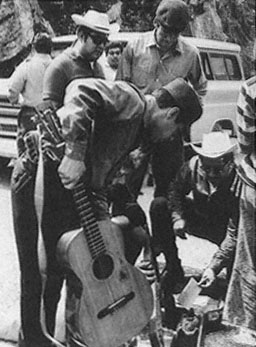
Figure 7.
Military authorities search a guitar case
for hallucinogenic mushrooms and other possible
drugs during a bust in Huautla de Jiménez, Oaxaca,
in July 1969. Source: "Concentrados: sobre 1303,
'Hippies [mugrosos gringos de la época],' July 1969,"
Hermanos Mayo Photo Archive, Archivo General de
la Nación. Used by permission.