
A—
Arrival of Argus and Acastus (317–30)
In the Proemium, Apollonius underscored the ominous appearance of Jason wearing only one shoe by setting it in a central position. Here too Apollonius accentuates the sudden and, as it turns out, significant appearance of Argus and Acastus by placing it between the Argonauts' welcome of Jason (Aa) and Jason's welcome of the unexpected pair (Aa ). In addition to being set off by its central positioning, the description of the two supernumeraries is neatly articulated:
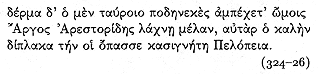
Around his shoulders, Argus, the son of Arestor, wore a bull's hide
black with bristles and stretching to his feet; but Acastus wore
an elegant
double-folded cloak, which his sister, Pelopia, gave him.
The alliteration and line position of




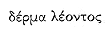
The clothing worn by Acastus and Argus, then, reflects the theme of the heroic antithesis between man of strength and man of skill. Moreover, the unexpected arrival of the pair carries with it yet another implicit significance. In the Proemium, with its structural focus on Jason's ominous appearance, Apollonius was explicit about why the hero's arrival with only one shoe had so powerful an effect on Pelias and why the latter contrived the impossible mission for the former: Apollo's oracle warned the Iolcan king of the danger the man wearing only one sandal brought. In this instance, however, the poet does not explain why the men marvel at the arrival of Argus and Acastus (

[3] Supra, Chapter 2, pp. 32–34.
[4] Fränkel's suggestion ad 1.321–26 that the reason for their manner of dress owes itself to their speed in departing from Iolcus to avoid detection, while plausible, does not account for the vivid difference in the nature of their clothing or the fact that this contrasting form of apparel parallels the dress of Jason and Heracles. For further discussion of this point, see R. Roux, Le problème des Argonautes (Paris 1949) 101; Levin 43–44; and recently, A. Rose, "Clothing Imagery in Apollonius' Argonautica ," QUCC , n.s., 21 (1985) 30–31.
The fact that Argus, the carpenter of the Argo , has agreed to come along should be read as a propitious sign for the journey. It bespeaks the craftsman's trust in his handiwork. Yet his presence is not as striking as that of Acastus. The reader, aware of the dynastic struggle in Iolcus and Pelias's plan to get rid of Jason through the expedition, must find Acastus's willingness to go along surprising; and this same awareness among the Argonauts might well lie behind their amazement at the sight of Pelias's son coming to Pagasae. The surprise the men register, however, must be of the pleasant sort, since, if Acastus is willing to sail together with the group, he too shows his trust in the workmanship of the vessel: in getting on board he reveals his ignorance of any plans on the part of Pelias to sabotage the Argo. In addition to what we can deduce from the text itself, we have the information of the scholiast (ad 1.224–26a), who has recorded a rare version of the Argonautic myth attributed to a certain Demagetus:[5] Pelias, according to this source, had ordered Argus to use slender nails in the construction of the Argo so that the ship would fall apart at sea. Since Argus saw to the seaworthiness of the ship (cf. 369), both he and Acastus could feel secure in sailing on the Argo.[6] For this reason, when Jason sees the two approaching, he need not ask them anything (327–28a). Their desire to sail is an eloquent and auspicious statement in itself, and all the clearer to readers, like the scholiast, who are informed of recondite Argonautic lore.[7]