
Gender and Discovery
Amerigo Vespucci, the voyager, arrives from the sea. A crusader standing erect, his body in armor, he bears the European weapons of meaning. Behind him are the vessels that will bring back to the European West the spoils of paradise. Before him is the Indian "America," a nude woman reclining in her hammock, an unnamed presence of difference, a body which awakens within a space of exotic fauna and flora.... An inaugural scene: after a moment of stupor, on this threshold dotted with colonnades of trees, the conqueror will write the body of the other and trace there his own history. From her he will make a historied body—a blazon—of his labors and phantasms. She will be "Latin" America.[1]
This scene Michel de Certeau has lavishly recreated in words, from a drawing by Jan van der Straet (c. 1575), has become an emblem of the Discovery: the reclining woman, nude in a luxuriant New World landscape, greeting the European man who stands on the shoreline before her, armored and bearing a staff with crucifix in his right hand and an astrolabe in the other (Figure 7). Discreetly hidden under his tunic is a sword. De Certeau's critical assessment of this "inaugural scene" reminds us that it is just one in a long series of graphic and verbal representations of the Discovery as an erotic encounter between a fully clothed European male and a naked Amerindian female, an image that has been firmly established in the Western cultural imagination for quite some time.[2]
In Van der Straet's depiction, the European's hands, as noted, are full. The Indian woman's hands, in contrast, are notably empty, and her right hand is held out toward him in a gesture ambiguously suspended between greeting and invitation. It is indeed difficult to discern with absolute certainty if she is rising in order to embrace him or is in the process of reclining and inviting him to join her in the hammock. In any case, far more than a simple erotic encounter is suggested in this scene, the prelude to an exchange whose character
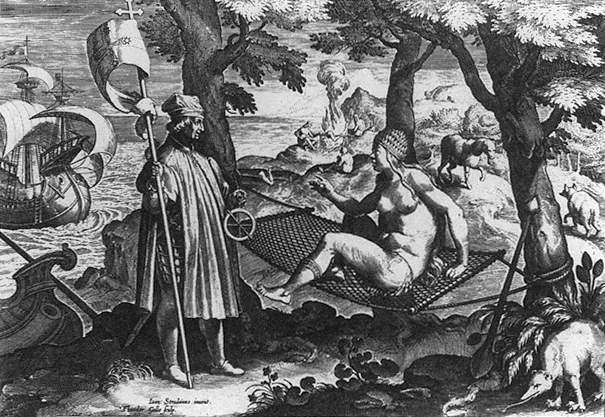
Figure 7.
America. Engraving by Theodor Galle after a drawing by Jan van der Straet [Stradanus], c. 1575.
From Stradanus, Nova Reperta (c. 1580). Courtesy of the Burndy Library, Norwalk, Connecticut.
is hardly ambiguous. "America" offers him her unclothed and recumbent body; her empty hands show she has nothing else to offer. He reciprocates, erect and in full armor, with his knowledge and his faith. The economy allegorized in Van der Straet's erotic encounter is, of course, much more than simply sexual. Embedded in this gendered exchange are cultural values that privilege the European male's posture in contrast to the Indian female's, which is altogether too receptive, open, and empty, despite her undeniably desirable beauty, which is enhanced by the pastoral gardenlike setting. The explicit mark of her denigration resides in the background. Easily missed at first glance, but strategically situated between the two figures, just above her beckoning arm, is a cannibalistic scene. The idyllic, almost sublime, inflection Van der Straet has given to the encounter taking place in the foreground is undercut by the want implied in her gesture (empty hand beckoning), and the curve of her arm seems to cradle the cannibalistic scene situated just above and beyond it. Three other Indians, naked as she, are roasting a human leg.
The one whom de Certeau calls "an unnamed presence of difference," in fact appears to have had a name from the beginning—her name was Woman. The specific textual marks of that name—India, America (it could just as easily have been Columbia)—are not important. The gendered cultural values they all imply equally, their shared semantic valence, are the real ciphers of her significance. De Certeau's seminal erotic interpretation of Van der Straet's drawing seems to have missed the most obvious point of all—when the conqueror arrives on "America's" shores, "the body of the other," her body, has already been inscribed in the feminine mode. Van der Straet's allegory does not invent but translates the signs of a discourse already in existence. It does not represent an "unnamed presence" waiting to be written, but rather inscribes that presence in a woman's body, as object in an exchange already defined by gender difference. To probe the founding terms of that exchange, of that sexual economy, I want to revisit the question of gender in the discourse of the Discovery by considering the source of this mythical scene of the first encounter in the specific discursive context from which it arose—the textual dialogue between the Crown and Columbus regarding the projection of the economic and political will of Castile and Aragon "plus ultra," that is, ever beyond the expanding borders of Spain at the close of the fifteenth century.
In the "Capitulaciones de Santa Fe," the prediscovery contract that set the ideological and practical terms of the enterprise of the Indies, Christopher Columbus's legal rights and obligations on his first westward voyage in the Ocean Sea were carefully spelled out. So was the mercantilistic and imperialistic character of the enterprise. In the "Capitulaciones" Columbus was commissioned by the Catholic Monarchs to discover, take possession, govern , and trade in whatever islands and mainlands he might come across on his westward voyage. For his trouble, the Admiral was guaranteed criminal and civil authority over whatever territories he discovered, as well as a hefty one-third of all maritime cargo, one-third of all income from the fleet's business, and one-third of the "royal fifth" to be gained from future expeditions not under Columbus's own command. The rest belonged to the Crown.[3]
No mention is made, however, of where those lands might be or what manner of people might inhabit them. No direct allusions are made to the Asiatic destination most historians believe to have been the explicit goal of the voyage.[4] The "Capitulaciones" assumed only that the longed-for islands and mainlands would be governable, in other words populated, and that the inhabitants would have objects of value to trade. Yet the pervasive use of the subjunctive mood in the "Capitulaciones" underscores the hypothetical nature of these assumptions, and so of modern assumptions based on them. In its first textualization in the "Capitulaciones," then, "the Indies" (as the New World is always called in the Columbian texts) appears simply as "islands and mainlands," unnamed and undefined. For all practical purposes the islands and mainlands of the "Capitulaciones" were an empty signifier constituting a semantic void.[5]
As I have done in the opening essays of this volume, I want to situate Columbus's writings in the context of the dialogue between the Admiral and the Crown. The contrapuntal structure of petition and response in the contract itself is reinforced by a phrase near the end of the prologue to the Diario . There the inception of the voyage and the act of writing are justified precisely in terms of the mandates contained in the "Capitulaciones":
Y partí del dicho puerto muy abasteçido de muy muchos mantenimientos y de mucha gente de la mar a tres días del mes de agosto del dicho año en un viernes antes de la salida del Sol con media hora, y llevé el camino de las Islas de Canaria de Vuestras Altezas que son en la dicha mar ocçeana para de allí tomar mi derrota y
navegar tanto que yo llegase a las Indias y dar la embaxada de Vuestras Altezas a aquellos prínçipes y cumplir lo que así me avían mandado. Y para esto pensé de escrevir todo este viaje muy puntualmente de día en día todo lo que yo hiziese, viese y passasse.
(Varela, 16–17)
I left the said port, very well provided with supplies and with many seamen, on the third day of August of the said year, on a Friday, half an hour before sunrise; and I took the route to Your Highnesses' Canary Islands, which are in the said Ocean Sea, in order from there to take my course and sail so far that I would reach the Indies and give Your Highnesses' message to those princes and thus carry out that which you had commanded me to do. And for this purpose I thought of writing on this whole voyage, very diligently, all that I would do and see and experience.
(Dunn & Kelley, 19–21; emphasis added)
The significant linking here of the voyage and the act of writing with the "Capitulaciones" is unfortunately obscured by the translation, though it is the most literal one in print. "Carry out" does not adequately render the connotation of the Spanish verb cumplir , which has to do with completing and responding to a command or request. If we substitute the more accurate "comply" for "carry out," we come to understand Columbus's meaning: that for the purpose of complying with the Crown's mandate, he has decided to write a detailed account of everything that happens during the voyage. To comply with the mandate of discovery, as Columbus realized, required not just physical exploration or reconnaissance but also reporting back to the Crown on what was found.
A note on terminology: In this essay, I use the term "discovery" in a sense commonly accepted in the Spanish of Columbus's time. In the Columbian texts descubrir often means to explore or reconnoiter a territory in preparation for an incursion of a commercial or military nature. This sense of the word implies strategic research "in the field," as it were, for the purpose of gaining an advantage—a definition ideologically consistent with the nature and diction of the Columbian enterprise.
Here, then, Columbus acknowledges that his acceptance of the royal commission entails a responsibility to inform the Crown and, more specifically, in my reading, to fill the semantic void created by the reticent treatment in the "Capitulaciones" of the unnamed is-
lands and mainlands that were to be Columbus's destination. Through his discourse, conceived in compliance with the economic and political mandates outlined in the contract, Columbus would respond to questions the "Capitulaciones" implicitly raised, and left unanswered, about the nature of the lands and peoples to be discovered.
Combining the rhetoric of testimony and interpretation, Columbus's writings constitute a powerful act of representation, one whose effect on the development of Western notions of difference is still felt today. The interpretation of Amerindian reality presented in his texts articulates a conceptual model of otherness manifested as a series of metaphors of disparity. When the Columbian texts are read as a unified discourse, instead of as discrete documents, these tropes reveal a coherent hermeneutical strategy of feminization and eroticization that ultimately makes gendered difference the determining characteristic of the sign "Indies."
Saussure defined meaning in language as the product of dissimilarity, suggesting that in the most basic way signs mean in relation to what they do not mean. The Diario poignantly exemplifies this postulate. The entry for 16 October, just four days after landfall, includes the following observations on the flora and fauna of the islands: "Y vide muchos árboles muy disformes de los nuestros.... Aquí son los peçes tan disformes de los nuestros, qu'es maravilla" (Varela, 36–37; And I saw many trees, very different from ours.... Here the fish are so different from ours that it is a marvel, Dunn & Kelley, 89). And on the following day:
y los árboles todos están tan disformes de los nuestros como el día de la noche, y así las frutas y así las yervas y las piedras y todas las cosas. Verdad es que algunos árboles eran de la naturaleza de otros que ay en Castilla; porende avía muy gran diferençia, y los otros árboles de otras maneras eran tantos que no ay persona que lo pueda dezir ni asemejar a otros de Castilla.
(Varela, 38)
And all the trees are as different from ours as day from night; and also the fruits and grasses and stones and everything. It is true that some trees are of the same character as others in Castile; nevertheless, there was a very great difference. And the other trees of other kinds were so many that there is no one who can tell it or compare them with others of Castile.
(Dunn & Kelley, 93)
The insistence on difference from the European norm as the definitive semantic characteristic of the sign "Indies" is so pervasive in Columbus's earliest observations as to become monotonous. Moreover, it persists as an important characteristic of the discourse of the Discovery through the narrative of his fourth and final voyage.
Frequently in the Diario dissimilarity is explained in terms of the marvelous:
y aves y paxaritos de tantas maners y tan diversas de las nuestras que es maravilla. Y después ha árboles de mill maneras y todos dan de su manera fruto, y todos güelen qu'es maravilla, que estoy el más penado del mundo de no los cognosçer.
(Varela, 41)
and birds of so many kinds and sizes, and so different from ours, that it is a marvel. And also there are trees of a thousand kinds and all [with] their own kinds of fruit and all smell so that it is a marvel. I am the most sorrowful man in the world, not being acquainted with them.
(Dunn & Kelley, 105)
The quality of such exclamations is undeniably euphoric. Yet enthusiasm cannot disguise the fact that in the earliest Columbian hermeneutics difference represents the ineffable, that which resists interpretation and assimilation. The qualifier "marvelous" does little to resolve the situation. For Columbus, "marvel" is analogous in the natural realm to "miracle" in the realm of faith—that which cannot be expressed or explained. The exclamation may function as an attempt to disguise the narrator's aphasia in the face of difference, an aphasia that was not the result of some personal shortcoming, but of the essential incapacity of the discourses at his disposal adequately to express such difference.
Alliende de las sobredichas yslas e hallado otras muchas en las Yndias, de que no curo de dezir en la presente carta. Las quales, con estas otras, son en tanta fertilidad, que aunque yo lo supiese dezir, no hera maravilla ponerse dubda en la crehençia; los aires temperatísimos, los árboles y frutos y yervas son en estrema fermosura y mui diversos de los nuestros, los rríos y puertos son tantos y tan estremos en bondad de los de las partidas de christianos ques maravilla.
("Carta a los Reyes" ; Rumeu, 2:437)
Besides the above-mentioned islands, I have found many others in the Indies, of which I have not been able to tell in this letter. They, like these others, are so extremely fertile, that even if I were able to express it, it would not be a marvel were it to be disbelieved. The breezes [are] most temperate, the trees and fruits and grasses are extremely beautiful and very different from ours; the rivers and harbors are so abundant and of such extreme excellence when compared to those of the Christian lands that it is a marvel.
Columbian discourse represents "that" as "not this." The "Indies" are defined in terms of what they are not like—Castile, Africa, the familiar landscapes of the Old World. Some eighty years later the Frenchman Jean de Léry, in his Voyage fait en terre du Bresil, autrement dite Amérique (1578), expressed his inarticulateness even more candidly: "[The natives'] gestures and countenances are so different from ours, that I confess to my difficulty in representing them in words, or even in pictures."[6]
The dissimilarity of the natural landscape is initially articulated as a semantic void, thinly veiled in a discourse of the ineffable. But when the dissimilarity pertains to the Indians, it is expressed in terms of lack or deficiency. In his well-known book on the question of the "Other," Tzvetan Todorov argued that Columbus was unable or unwilling to perceive fundamental differences in Arawak culture.[7] I would suggest that, on the contrary, not only are differences indeed recognized in the Columbian texts, they are in fact an essential component of the process of interpretation. Difference is not only a dissimilarity perceived in passing but the very basis of representation in Columbian discourse. The first contact with the natives of Guanahaní, on 12 October, is described thus:
y creo que ligeramente se harían cristianos, que me pareçió que ninguna secta tenían. Yo plaziendo a Nuestro Señor levaré de aquí al tiempo de mi partida seis a Vuestras Altezas, para que deprendan fablar.
(Varela, 31)
and I believe that they would become Christians very easily, for it seemed to me that they had no religion. Our Lord pleasing, at the time of my departure I will take six of them to Your Highnesses in order that they may learn to speak.
(Dunn & Kelley, 69)
A similar observation, reaffirming his first impressions, is repeated in the carta-relacóon of January 1494 concerning the second voyage:
Yo screví, agora a un año, a Vuestras Altezas de todo lo que me pareçía de todos estos pueblos, de su conversaçión con nuestra fee santa, que paresçía mui ligera, entendiéndo nos ellos, y fuésemos entendidos; yo muy más lo afirmo, porque veo que seta alguna no le ynpide.
(Rumeu, 2:461)
I wrote Your Highnesses, one year ago, concerning my impressions about all these peoples, of their conversion to our holy faith, which seemed very easy if we understood them and were understood by them; I affirm it all the more [now], because I see that no sect impedes it.
In the letter to Santángel, announcing the discovery, another deficiency is observed: "Andovieron tres iornadas y hallaron infinitas poblaciones pequeñas i gente sin número, mas no cosa de regimiento" (Varela, 140; They [two Spaniards] reconnoitered the country for three days and found an infinite number of small settlements and countless people, but without order or government). The rhetoric is ingenious, though the terms of the argument are hardly credible. Arawak difference in three fundamental areas of human behavior—worship, speech, and government—is expressed as a lack, though probably not because Columbus had any reason to believe they did not have a religion (how could he have determined this from such brief contact?), or some form of government (he later acknowledged they had "kings"), or could not speak (are we to believe that the first encounter was totally mute?). In this context the notion of lacking must be understood as a value judgment—the Indians had no religion or language or government worthy of the name, judged by Columbus's European standards of value.
Value is, in fact, the crux of the matter in Columbian hermeneutics. Difference could be represented as an absence, a lack or deficiency, but it absolutely could not be valueless or value-neutral. The mandate in the "Capitulaciones" is expressed in a discourse concerned with issues of power and economic exploitation.[8] Columbus replies in an ideologically complementary discourse of appropriation and domination, but the interpretative character of his re-
sponse advocates terms distinct from those employed by the Crown. For example, instead of the notoriously elusive gold, spices, and precious gems, stipulated as the preferred merchandise in the "Capitulaciones," the land itself—fertile, productive, and beautiful—is the most valuable treasure in the natural economy of the Diario . Passages in praise of the land abound in the Columbian texts; the ones in the Diario are particularly poignant because they are products of the original encounter:
En toda Castilla, no ay tierra que se pueda comparar a ella en hermosura y bondad. Toda esta isla y la de la Tortuga son todas labradas como la campiña de Córdova; tienen sembrado en ellas ajes, que son unos ramillos que plantan, y al pie d'ellos naçen unas raízes como çanahorias, que sirven por pan y rallan y amassan y hazen pan d'ellas, y después tornan a plantar el mismo ramillo en otra parte y torna a dar cuatro y cinco de aquellas raízes que son muy sabrosas: propio gusto de castañas.... Y los árboles de allí diz que eran tan viçiosos que las hojas dexavan de ser verdes y eran prietas de verdura. Era cosa de maravilla ver aquellos valles y los ríos y buenas aguas y las tierras para pan, para ganado de toda suerte, de qu'ellos no tienen alguna, para güertas y para todas las cosas del mundo qu'el hombre sepa pedir.
(Varela, 83)
In all of Castile there is no land that can be compared to it [the island] in beauty and goodness. All of this island and that of Tortuga are cultivated like the plain of Cordova. They have sown yams, which are some little twigs that they plant, and at the foot of the twigs some roots like carrots grow, which serve as bread; and they scrape and knead and make bread of them. And later they plant the same twig elsewhere and it again produces four or five of those roots which are very tasty, having the same flavor as chestnuts.... And the trees there, he says, were so vigorous that the leaves ceased to be green, they were so dark in foliage. It was a wonderful thing to see those valleys and rivers and good water; and the lands [good] for bread and for livestock of all kinds—of which they have none—and for vegetable gardens and everything in the world that man can ask for.
(Dunn & Kelley, 233)
The land thus becomes the substitute merchandise, the desirable object to be possessed. In the letter to Santángel, Cuba is described in these terms: "It is a desirable land, and once seen, is never to be
relinquished" (Morison, 185). The text creates in the reader a longing for the land, through a rhetoric of desire that inscribes "the Indies" in a psychosexual discourse of the feminine whose principal coordinates are initially beauty and fertility and, ultimately, possession and domination.[9]
At issue here are the very questions of political power and economic value expressed in the "Capitulaciones," but an aesthetic dimension has been added to the commercial one. The Columbian texts exhibit a curiously dichotomized discourse whose parts may, at first, even appear contradictory. On the one hand, the idealized and poeticized descriptions of the natural and human landscapes recall the classical locus amoenus and the legends of the Golden Age. These passages invariably emphasize the physical or spiritual beauty of the indigenous element. On the other hand, the mercantilistic and imperialistic discursive mode, an explicit response to the tone and terms of the mandate outlined in the "Capitulaciones," conveys a marked disdain for the Indians. While these two modes may seem at odds with one another, they are, we shall see, complementary parts of a discursive whole.[10]
Although they are radically different in their specific terms, the poeticized-idealized and mercantilistic-imperialistic discursive modalities often appear contiguously in the text. In the way of punctuation, compositional divisions, style, context, or tenor, very little differentiates the two modes.[11] In many of the testimonial passages in the Diario the writing appears to flow seamlessly between one mode and the other, and the effect is awkward and somewhat jarring:
Esta costa toda y la parte de la isla que yo vi es toda cuasi playa, y la isla la más fermosa cosa que yo vi, que si las otras son muy hermosas, esta es más. Es de muchos árboles y muy verdes y muy grandes, y esta tierra es más alta que las otras islas falladas, y en ella algún altillo, no que se le pueda llamar montaña, mas cosa que aformosea lo otro, y pareçe de muchas aguas. Allá, al medio de la isla, d'esta parte al Nordeste haze una grande angla, y a muchos arboledos y muy espessos y muy grandes. Yo quise ir a surgir en ella para salir a tierra y ver tanta fermosura, mas era el fondo baxo y no podía surgir salvo largo de tierra, y el viento era muy bueno para venir a este cabo, adonde yo surgí agora, al cual puse nombre Cabo Fermoso, porque así lo es. Y así no surgí en aquella angla, y aun
porque vide este cabo de allá tan verde y tan fermoso, así como todas las otras cosas y tierras d'estas islas que yo no sé adónde me vaya primero, ni me se cansan los ojos de ver tan fermosas verduras y tan diversas de las nuestras, y aun creo que a en ellas muchas yervas y muchos árboles que valen mucho en España para tinturas y para medicinas de espeçería, mas yo no los cognozco, de que llevo grande pena. Y llegando aquí a este cabo, vino el olor tan bueno y suave de flores o árboles de la tierra, que era la cosa más dulçe del mundo. De mañana, antes de que yo de aquí vaya, iré en tierra a ver qué es; aquí en el cabo no es la poblaçión salvo allá más dentro, adonde dizen estos hombres que yo traigo qu'está el rey y que trae mucho oro. Y yo de mañana quiero ir tanto avante que halle la poblaçión y vea o aya lengua con este rey que, según estos dan las señas, él señorea todas estas islas comaracanas, y va vestido y trae sobre sí mucho oro, aunque no doy mucha fe a sus dezires, así por no los entender yo bien como en cognoscer qu'ellos son tan pobres de oro que cualquiera poco qu'este rey traiga los pareçe a ellos mucho. Este, a qui yo digo Cabo Fermoso, creo que es isla apartada de Samoeto y aun a[y] ya otra entremedias pequeña. Yo no curo así de ver tanto por menudo, porque no lo podría fazer en çincuenta años, porque quiero ver y descubrir lo más que yo pudiere para bolver a Vuestras Altezas, a Nuestro Señor aplaziendo, en Abril. Verdad es que fallando adónde aya oro o espeçería en cantidad, me deterné fasta que yo aya d'ello cuanto pudiere, y por esto no fago sino andar para ver de topar en ello.
(Varela, 39–40)
All of this coast and the part of the island that I saw is almost all beach, and the island the most beautiful thing that I have ever seen. For if the others are very beautiful this one is more so. It is an island of many very green and very large trees. And this land is higher than the other islands found, and there are on it some small heights; not that they can be called mountains, but they are things that beautify the rest; and it seems to have much water. There in the middle of the island, from this part northeast, it forms a great bight and there are many wooded places, very thick and of very large extent. I tried to go there to anchor in it so as to go ashore and see so much beauty; but the bottom was shoal and I could not anchor except far from land, and the wind was very good for going to this cape where I am anchored now, to which I gave the name Cabo Hermoso because such it is. And so I did not anchor in that bight and also because I saw this cape from there, so green and so beautiful; and likewise are all the other things and lands of these islands, so that I do not know where to go first; nor do my eyes grow
tired of seeing such beautiful verdure and so different from ours. And I even believe that there are among them many plants and many trees which in Spain are valued for dyes and for medicinal spices; but I am not acquainted with them, for which I feel great sorrow. And when I arrived here at this cape, the smell of flowers or trees that came from the land was so good and soft that it was the sweetest thing in the world. In the morning, before I leave this place I will go ashore to see what is here on the cape. The town is not here but further inland where these men that I bring say the king is and that he wears much gold. And in the morning I want to go forward so far that I find the town and see or talk with this king of whom these men give the following details: he is the lord of all these nearby islands and he goes about dressed and wearing much gold on his person. Although I do not give much credit to what they say, from not understanding them well and also from recognizing that they are so poor in gold that any little bit that the king may wear seems much to them. This cape here that I call Cabo Hermoso I believe is on an island separate from Samoet and also that there is still another small one in between. I am not taking pains to see so much in detail because I could not do it in 50 years and because I want to see and explore as much as I can so I can return to Your Highnesses in April, Our Lord pleasing. It is true that, finding where there is gold or spices in quantity, I will stay until I get as much of it as I can. And for this reason I do nothing but go forward to see if I come across it.
(Dunn & Kelley, 101–3)
In its sheer exuberance and proliferation of observations on the aesthetic qualities of the land, this passage is typical of the geographical descriptions found in the Columbian texts. But the idealizing or poeticizing mode of diction, intended to provoke aesthetic appreciation (even rapture) in the reader, abruptly gives way to a quite prosaic consideration of the possible economic value and exploit-ability of the land and the wealth of its inhabitants. This conceptual and rhetorical shift may strike the reader as contradictory, but apparently it was not so to the narrator. The expressed motivation to go inexorably forward and without delay in search of gold and spices casually follows the admission that a cape, notable only for its beauty, detains Columbus overnight and into the next morning. The tensionless juxtaposition of the two competing purposes is quite striking when one recalls that the report is addressed to the
Crown, which was footing the costs of the expedition and no doubt anxiously awaiting its returns.
The idealization of the land has its counterpart in the human economy, in the appreciation of the Indians' physical beauty and their complementary suitability for evangelization. Protracted and detailed descriptions of their bodies, as in the entry of 13 October, the day after landfall, abound in the Diario :
Luego que amaneció, vinieron a la playa muchos d'estos hombres, todos mançebos, como dicho tengo, y todos de buena estatura, gente fermosa; los cabellos no crespos, salvo corredíos y gruessos como sedas de cavallo, y todos de la frente y cabeça muy ancha, más que otra generación que fasta aquí aya visto; y los ojos muy fermosos y no pequeños; y ellos ninguno prieto, salvo de la color de los canarios.... Las piernas muy derechas, todos a una mano, y no barriga, salvo muy bien hecha.
(Varela, 31)
As soon as it dawned, many of these people [i.e., men] came to the beach—all young, as I have said, and all of good stature; very handsome people, with hair not curly but straight and coarse like horsehair and all of them very wide in the forehead and head, more so than any other race that I have seen so far. And their eyes are very handsome and not small; and none of them are black, but of the color of Canary Islanders.... All alike have very straight legs and no belly but are very well formed.[12]
The absence of paintbrush or even camera lens is hardly noticed in the presence of Columbus's abilities in verbal portraiture. In the entry for the following day, he observes with equal interest the tumultuous welcome that greeted the Spaniards and the generosity and willingness of the Indians to provide them with food and water, apparently (he thought) because the Indians believed they had come from the heavens. He relates his search for an apt site for a fort, describes his hosts' lack of military skill, and then adds:
Vuestras Altezas cuando mandaren puédenlos todos llevar a Castilla o tenellos en la misma isla captivos, porque con cincuenta hombres los ternán todos sojuzgados, y les harán hazer todo lo que quisieren.
(Varela, 33)
whenever Your Highnesses may command, all of them can be taken to Castile or held captive in this same island; because with 50 men all of them could be held in subjection and can be made to do whatever one might wish.
(Dunn & Kelley, 75)[13]
He concludes the entry with the following observation, "y se hazen guerra, la una a la otra, aunque estos son muy símpliçes y muy lindos cuerpos de hombres" (33; and they make war on one another, even though these men are very simple and very handsome in body, 77). Especially striking in this passage is the notion that somehow the Indians' martial simplicity is related to their physical beauty. Or, to put it another way, that their beauty explains and even justifies their lack of skill in warfare. Such observations reveal how fine the line is between idealization and denigration in these texts. On the one hand, bodily beauty is complemented by a fairness of spirit, a grace of being.[14] But these same charms readily become a degrading of the Indians when articulated to define Indian-Spanish relations so as to justify the projection of European power in the subjugation of the natives.
Desire and disdain cohabit in the Columbian texts, nondisjunctively and noncontradictorily in the same discursive space. In the letter to Santángel, the following observations are made:
La gente d'esta isla y de todas las otras que he fallado y havido ni aya havido noticia, andan todos desnudos, hombres y mugeres, así como sus madres los paren, haunque algunas mugeres se cobijan un solo lugar con una foia de yerva o una cosa de algodón que para ello fazen. Ellos no tienen fierro ni azero ni armas, ni son para ello; no porque no sea gente bien dispuesta y de fermosa estatura, salvo que son muy temerosos a maravilla.... que muchas vezes me ha acaecido embiar a tierra dos o tres hombres a alguna villa para haver fabla, i salir a ellos d'ellos sin número, y después que los veían llegar fuían a no aguardar padre a hijo. Y esto no porque a ninguno se aya hecho mal, antes a todo cabo adonde yo aya estado y podido haver fabla, les he dado de todo lo que tenía ... sin recebir por ello cosa alguna, mas son así temerosos sin remedio.
(Varela, 141–42)
The inhabitants of this island, and of all the others I have seen or of which I have received information, all go naked, the women as well as the men, just as their mothers bore them, with the exception of some women who cover themselves with a leaf or something made
of cotton which they make for that purpose. They do not have any iron or steel or weapons, nor are they capable of using them; not from any deformity of body, but because they are incredible cowards ... for it has sometimes occurred that when I have sent two or three men to some village to speak with the natives, they have been greeted by countless Indians and after they saw them arrive they fled so that even the fathers forsook their children. And it is not the result of any harm that we might have done them, for on the contrary, everywhere I have been and have been able to speak to the natives, I have given them everything that I had ... without receiving anything in return, but they are hopeless cowards.
Here the distinction between physical beauty and moral valor is clearly drawn. The Indians have the former but lack the latter; they are physically well-endowed but morally deficient. Notably, the repeated remarks about nudity typically function to underscore the natives' vulnerability in confronting the Spaniards and not, as one might expect, their physical attractiveness.[15]
In a passage cited earlier, mancebo (male adolescent, youth) is used to describe the Indians who come to the beach to greet Columbus and his crew. While the choice of this term could be interpreted as an idealizing tribute to their youthful physical beauty, mancebo also has the important connotations of incomplete masculine sexual, intellectual, and moral development (Figure 8). In the first dictionary of the Spanish language, published in 1611, Covarrubias defines mancebo as a male-child still under his father's authority. The paternalistic implications evoked by this word choice are unmistakable in a passage from a letter of the second voyage, dated 20 April 1494:
Todos fechos son como de niños ... estos fazen lo que been fazer porque, si alguno furta o faze otro mal, es de la misma manera que entre los niños se haze; ellos son sotiles que luego hazen lo que veen hazer, mas es çierto, y para su govierno y plazer, ningún ayuntamiento hazen al oro ni de otra cosa alguna; salvo por ynvidia, de que son ocupados, cogen oro u otra cosa para que se les dé lo que desean; la cual ynbidia es propia como de niños.
(Rumeu, 2:475–76)
All their deeds are like children's ... these [people] do what they see others do; if one of them steals or does some other ill deed, it is in the same fashion as among children; they are smart in that they do what they see done, but it is also true that for their government
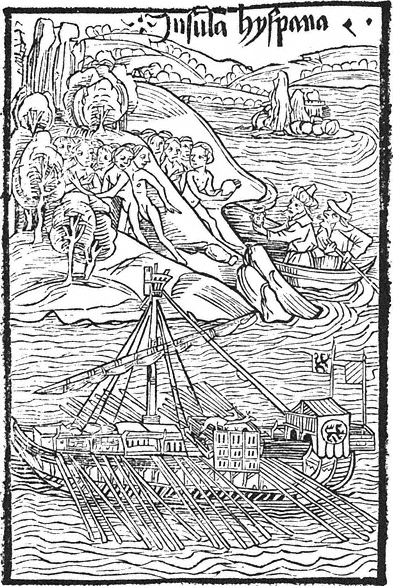
Figure 8.
Ynsula hyspana . Adolescent-like Indians greeting the
Spaniards. Woodcut print from De insulis epistola Cristoferi Colom (Basel,
1493). Courtesy of the John Carter Brown Library, Brown University.
and pleasure they do not collect gold or anything else, except out of envy, which preoccupies them; they gather gold or other things so that one will give them what they desire—which envy is like that proper to children.
Arawak inferiority is defined in relation to Spanish superiority, which initially manifests itself as a benevolent custodianship:
Yo defendí que no se les diesen cosas tan siviles como pedazos de escudillas rotas y pedazos de vidrio roto y cabos de agugetas; haunque cuando ellos esto podían llegar, los parescía haver la mejor ioya del mundo: que se acertó haver un marinero por una agugeta, de oro de peso de dos castellanos y medio.... Fasta los pedazos de los arcos rotos de la pipas tornavan y davan lo que tenían como bestias.
(Varela, 142)
I forbade that they be given such vile things as pieces of broken dishes, glass or latchets, although when they could obtain one, they considered it the best jewel in the world. A sailor managed to get gold worth two and a half castellanos for a latchet.... Even for the broken stems of pipes, they gave anything they possessed, like animals.
The explicit comparison of the Indians to beasts—in order to explain the qualitative differences in intellectual aptitude between them and the Europeans—turns the Arawaks' generosity, initially an aspect of Columbus's spiritual idealization of the Indians, into an inability to discriminate between the priceless and the worthless, an intellectual deficiency typical of animals.[16] This inequality of exchange, Stephen Greenblatt has observed, became a commonplace in the European literature of exploration and conquest, to describe Indian intellectual inferiority:
The European dream ... is of grossly unequal gift exchange: I give you a glass bead and you give me a pearl worth half your tribe. The concept of relative economic value—the notion that a glass bead or hawk's bell would be a precious rarity in the New World—is alien to most Europeans; they think that the savages simply do not understand the natural worth of things and hence can be tricked into exchanging treasure for trifles, full signs for empty signs.[17]
The comparison of the Indians to beasts is not, however, to be read as a denial of their humanity. Quite to the contrary, Columbus
consistently affirms that the newly found peoples can and should be converted to Christianity. But, while the Indians' humanness per se is never doubted, they are judged an inferior class of human being, pusillanimous, martially inept, and lacking in discrimination. Even though the Caribs are described as aggressive in the letter to Santángel, their perceived inferiority in relation to Europeans is evident:
Así que mostruos ne he hallado ni noticia, salvo de una isla que es Carib, la segunda a la entrada de las Indias, que es poblada de una iente que tienen en todas las islas por muy ferozes, los cualles comen carne umana. Estos tienen muchas canuas, con las cuales corren todas las islas de India, roban y toman cuanto pueden. Ellos no son más disformes que los otros, salvo que tienen en costumbre de traer los cabellos largos como mugeres.... Son ferozes entre estos otros pueblos que son en demasiado grado covardes, mas yo no los tengo en nada más que a los otros.
(Varela, 144–45)
Thus, as I have said, I found not a trace of monsters, nor did I hear of any except for a certain island called Carib, the second island as one enters the Indies, which is inhabited by a people considered very fierce throughout these islands, and they eat human flesh. They have many canoes with which they travel to all these islands of India, stealing and taking whatever they can. They are no more different than the others except that they wear their hair long like women.... They are considered fierce among the other peoples who are exceedingly cowardly, but I think no more of them than of the rest.[18]
Beyond the patent contempt expressed in this passage, the allusion to monsters again strikes the fundamental chord of the Columbian representation of New World reality—difference. But deficiency and dissimilarity are inextricably linked in the interpretation of the significance of that reality.
The triad—monsters, Caribs, women—forms a complex metaphor for inferiority whose ideological source can be traced to Aristotelian notions of difference. Aristotle maintained that the male principle governed the workings of the universe. Deviation from the male principle thus constituted a degeneration. Femaleness was a step toward imperfection, which in its most extreme manifestations yielded monstrosity. The triumph of female matter over the
male principle, although necessary for the survival of the species, and therefore not monstrous in itself, opened the door, as it were, to imperfection and consequently to the possibility of monstrosity. In the Politics this ontology of difference acquires a pragmatic socio-political dimension. Aristotle's concept of natural slavery, articulated in book 1, is the centerpiece of a theory of domination and subjugation that pretended to explain the innate inferiority of certain types of human beings in order to justify the exercise of power by elite males in the subjugation of others. According to Aristotle, the natural slave is a physically gifted but intellectually and morally deficient being. From birth all creatures are marked for either subjugation or domination, Aristotle argues, and the rule of those deemed superior over those deemed inferior is both natural and expedient. In this scheme, of course, the female is inferior to the male:
Again, the male is by nature superior, and the female inferior; and the one rules and the other is ruled; this principle of necessity extends to all mankind. Where then there is such a difference as that between the soul and body, or between men and animals (as in the case of those whose business is to use their body, and who can do nothing better), the lower sort are by nature slaves, and it is better for them as for all inferiors that they should be under the rule of a master.[19]
In this context, Columbus's use of "monster" denotes someone who does not conform either in appearance or behavior to the European norm, someone who belongs to the Aristotelian categories of natural servants or slaves—animals, women, and intellectually and morally deficient men. The Caribs' anthropophagy and their long feminine hair—symbols of difference and inferiority—strike Columbus as monstrous. In Columbus's portrait of the Indians, as in Aristotle's description of the natural slave, inferiority is expressed as a lacking , especially in the areas of intellectual and moral capacity, while superiority is conceived as possession of a full complement of the attributes that constitute humanness in its highest form. In the Columbian texts, as in Aristotle's Politics , domination is presented as a philanthropical and paternalistic act: the "haves" (the fully human elite males or citizens) supplement the deficiency of the "have nots," or natural slaves, through paternalistic intervention. By dominating the natural slaves, the elite allows them to lead better
lives. Superiority, then, means to possess or have, but especially to be able to supplement a deficiency in others, to complete, to fill an empty space.
Inferiority is one of the marks of difference in Columbian writing. The other, as we have seen, is ideality. Columbian discourse oscillates continually between these two poles, between disdain and desire:
he fecho ... grande amistad con el Rey de aquella tierra, en tanto grado que se preciava de me lllamar y tener por hermano. E haunque le mudase la voluntad a hoffender esta gente, él ni los suios no saben qué sean armas, y andan desnudos como ya he dicho. Son los más temerosos que ay en el mundo, así que solamente la gente que allá queda es para destroir toda aquella tierra.
(Varela, 144)
I have become ... great friends with the king of that land, to such a degree that he took pride in calling me brother. And even if he should decide to hurt these people [the Spaniards left at La Navidad], neither he nor his subjects know what weapons are, and they go naked, as I have said. They are the most timorous in the world, so that the people who remain there alone are enough to destroy the entire country.
<><><><><><><><><><><><>
Esta gente, como ya dixe, son todos de muy linda estatura, altos de cuerpos e de muy lindos gestos, los cabellos muy largos e llanos y traen las cabeças atadas con unos pañuelos labrados, como ya dixe, hermosos, que pareçen de lexos de seda y almaizares.
(Varela, 210)
These people, as I have said, are all of graceful stature, tall of body and beautiful of countenance; their hair [is] very long and straight, and they wear their heads wrapped in beautifully wrought scarves, as I have said, that from a distance appear to be like turbans made of silk.
At issue in both these passages is the interpretation of the relationship of European domination over the Indians and the establishment of the Spaniards' right of possession. The idealized feminizing descriptions of the Indians, such as in the second passage, ultimately are as much at the service of the interpretation of the power imbalance as the obviously denigrating passages.
In Columbian hermeneutics the dichotomy between Spaniard
and Indian is ideologized in terms of a masculine-feminine contrast and articulated through the rhetorical feminization of the term "Indian." Among the numerous remarks in the Diario that ascribe effeminate characteristics to the Indians are passages concerning the Arawaks' physical attributes, their cowardice, and their apparently spontaneous and natural subservience to the Spaniards.
y alguno de los de mi compa???a salieron en tierra tras ellos, y todos fugeron como gallinas.
(Varela, 34)
and some of the men of my company went ashore after them, and they all fled like hens.
<><><><><><><><><><><><>
se folgavan mucho de nos hazer plazer.
(Varela, 36)
they delighted in giving us pleasure.
<><><><><><><><><><><><>
Esta gente es muy mansa y muy temerosa, desnuda como tengo dicho, sin armas y sin ley.
(Varela, 51)
These people are very gentle and very timid, naked, as I said before, without weapons and without law.
<><><><><><><><><><><><>
certifica el Almirante a los Reyes que diez hombres hagan huir a diez mill, tan cobardes y medrosos son, que ni traen armas, salvo unas varas y en el cabo d'ellas un palillo agudo tostado.
(Varela, 71)
the Admiral assures the Sovereigns that ten men can make ten thousand [Indians] flee, so cowardly and fearful are they that they do not even carry weapons, except for wooden javelins with a fired sharp stick at the tip.[20]
In these and other passages, the Indians are defined through a series of gender-specific oppositions that are hierarchized in Western culture: courage/cowardice, activity/passivity, strength/weakness, intellect/body. In activating these cultural dichotomies, Columbian writing ultimately interprets the difference between Europeans and Indians as a gender difference, not in the sexual or biological sense, but as difference ideologized and inscribed onto a cultural economy
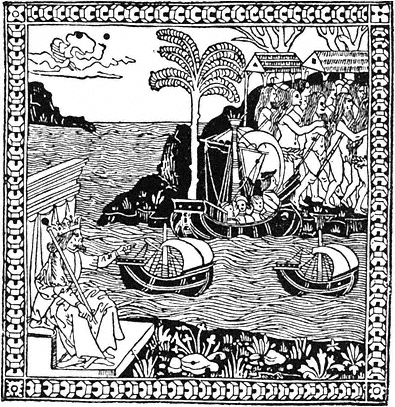
Figure 9.
Long-haired Indians. Woodcut print from La lettera dellisole che
ha trovato nuovamente il Re dispagna (Florence, 1493). Courtesy of the
Alderman Library, University of Virginia.
where gender becomes fundamentally a question of value, power, and dominance (see Figure 9).
In the "Relación" to the Crown recounting his third voyage, Columbus makes a striking and seemingly aberrant observation. He refers to the newly discovered lands as "otro mundo" (other world). Moreover, he affirms that the globe is not round at all, as most of the authorities on the subject believed; rather it is shaped more like a pear, or a woman's breast. As he sailed to this "other world," he claims, he was actually moving upward on the slope of the breast, toward the location of the Earthly Paradise. The Garden, he declares, is situated on the nipple; very appropriately so, he adds,
since it is the spot closest to heaven. This startling interpretation of the shape and location of Paradise, significantly anchored on the term "other world," illustrates the culmination of the process of feminization—in this case, even eroticization—of the sign "Indies" that began in the Diario . The metaphor of the paradisiacal breast is no aberration, but an emblem or avatar, the product of a hermeneutical process that began as early as 12 October 1492.[21]
Paradise, Columbus warns, is not accessible to men except through divine intervention. As in classical and medieval literature, the Garden is symbolic of the ideal, of yearning and nonpossession, of desire and inaccessibility.[22] But through the eroticization in the "Relación" Paradise enters abruptly—as a fruit-breast—into the discursive economies of appropriation and domination: it becomes acquirable. Through metaphor, Columbus "delivers" the Indies-cum-Paradise to Ferdinand and Isabella, according to the terms stipulated in the "Capitulaciones." Divine injunctions against entering Eden notwithstanding, it was now up to the Catholic Monarchs to figure out how to move God to open up the gates. No doubt, Columbus's urging that the Crown use the gold of the Indies to mount a crusade to liberate the Holy Land was motivated by his desire to gain admittance to Paradise, if not in this life then in the next.
Throughout the Middle Ages and into the Renaissance, the correspondence of sexual desire and the paradise image as inaccessible ideal is made explicit; the theme appears in the works of Dante, Ariosto, Spenser, and Shakespeare, among others. But Columbus's articulation of this topic reflects his familiarity not with Dante but with popular treatments of the paradise theme in the context of mercantile and conquest literature. Closer to Columbus's own ambitions and dearer to what we know of his reading tastes was the account of Marco Polo's travels in the Far East, a keystone text for Columbus during the period in which he formulated the nature and goals of the enterprise of the Indies.[23] In the mercantilistic discourse of the Travels , Polo establishes the link between commerce, desire, and paradise in describing the ancient Chinese city of Kin-sai, or Qinsay (Hangzhou): "At the end of three days you reach the noble and magnificent city of Kin-sai, a name that signifies 'the celestial city,' and which it merits from its preeminence to all others in the world, in point of grandeur and beauty, as well as from its abundant delights, which might lead an inhabitant to imagine himself in par-
adise." The erotic element is made more explicit a few pages later, in Polo's description of one of Kin-sai's primary delights—its prostitutes: "Thus intoxicated with sensual pleasures, when they [the merchants] return to their homes they report that they have been in Kin-sai, or the celestial city, and pant for the time, when they may be enabled to revisit paradise." Notably, Kin-sai is precisely the city mentioned by Columbus as his destination in the Diario and in a letter of the second voyage, where he hoped to find the Grand Khan.[24]
For Columbus, the metaphorical linking of eroticized gender difference, the idealization of territory, and the interpretation of otherness had an important contemporary antecedent in the popular ballads associated with the Christian reconquest struggles against the Moors. In the historical ballads of the romanceros , military conflict is frequently related to erotic situations or topics, and the Other (the enemy) may appear as the object of the subject's desire or scorn. For example, the well-known ballad "Abenámar, Abenámar" articulates the Christian siege of the Moorish city of Granada as a seduction. The Christian besieger is presented as a suitor, the city is personified as a reluctant woman, and the territorial appropriation represented by the siege itself is eroticized through a rhetoric of love and betrothal.
In the Columbian texts, the feminization and eroticization of the sign "Indies" is articulated in two seemingly contradictory operations—idealization and denigration. Yet in a cultural economy where the masculine is valued above the feminine, eroticization of the subordinate feminine implies both desire and disdain. As a rhetorical operation, eroticization permits the idealization and denigration of the feminized object to inhabit the same discursive space without disjunction or contradiction.[25] The surface contradiction—the oscillation between the romantic and vilified visions of the Indies—now reveals itself as a complementarity, a pair of attitudes allied to the ideology of discovery proposed by the "Capitulaciones."
In the letter of the fourth voyage, Columbus's denigration of the Indies culminates in an apocalyptic discourse grounded in Christian providentialism. Nature and the Indians turn against Columbus with an ire that threatens the very survival of the expedition. The ships are battered, the crew is tired and sick, and the Indians have suddenly become hostile, when a delirious Columbus hears a
voice in the darkness assuring him that he is God's chosen one and urging him to persevere. The Indies have finally turned Medusa-like, a devourer of men, an untameable shrew. Only through divine intervention are Columbus and his crew saved from her wrath.[26]
The feminine paradigm, in its negative Aristotelian dimension, became a central component in the construction of New World otherness by the Spanish humanists of the sixteenth century, who continued the process of defining the Amerindian in terms of Spanish hegemony.[27] In contrast to these later texts, Columbian discourse is more medieval in its Christian-chivalric idealization of the feminine, but also considerably more subtle and complex. Sixteenth-century interpretations turned a dialectic formulation into a mono-lectic one by eliminating the idealizing element of the Columbian paradigm (as Vitoria and Sepúlveda did) or by suppressing the negative or disdainful dimension (Las Casas's strategy).
In a discussion of phallocentrism and difference in The Newly Born Woman , Hélène Cixous has argued that Western culture defines otherness in relation to sameness, thereby constituting a hierarchized dichotomy where identity is the privileged status. Identity, Cixous explains, can be the product of an inherent sameness or of a process of assimilation or appropriation. It can be triggered by a desire to make something one's own, to possess something considered to be unequal, something understood not just as different but as less than self.[28] Woman, therefore, enters into the cultural economy not only as the opposite of man, but as less than man. She acquires her value as use-value, as merchandise for exchange among men, as Luce Irigaray puts it.[29] A passage in the Diario exemplifies this commodification of women. The phrasing is chillingly blunt and to the point:
Y después enbié a una casa que es de la parte del río del Poniente, y truxeron siete cabeças de mugeres, entre chicas e grandes y tres niños. Esto hize por que mejor se comportan los hombres en España haviendo mugeres de su tierra que sin ellas.
(Varela, 56)
And later I sent [men] to a house that is to the west of the river, and they brought seven head of women, counting young ones and adults, and three boys. This I did because men behave better in Spain having women from their country than without them.[30]
In Spanish as in English, then and now, "cabeças"/head is not applied to people, but to livestock. Nevertheless, Columbus applies it to the Indian females, while the "niños" are counted separately. The livestock imagery is unfortunately appropriate: the seven women were rounded up and brought on board to mollify the Indian men who had earlier been taken captive. These women were not the wives of the men, just samples, as it were, taken from the same island. One suspects they were also expected to satisfy the Spanish crew during the long return voyage, but the text is silent on that matter.
In Columbian writing, Antonello Gerbi has argued, contrast "gives way to a vague but significant awareness of affinities and similarities." According to Gerbi, similitude is the sign of assimilability. Although his case for the role of similitude in these texts seems much overstated—"Haiti is the isla Española , the 'Spanish Island.' It is Spain, it belongs to Spain and resembles Spain in every way"—it is nevertheless an important observation. Columbian discourse not only attempts to define the "Indies" but, above all, strives to absorb it. Affinity and resemblance ultimately are at the service of the articulation of New World inferiority. Nature in the Indies resembles an idealized and poeticized Spanish landscape, but, as Gerbi himself notes, it is a landscape especially suited for Spanish domination.[31] Thus resemblance effected through the feminization and eroticization of the sign "Indies" becomes yet another marker of difference and consequently, yet again, of inferiority.
Columbus's supposed inability to perceive difference can instead be viewed as a desire to appropriate, to assimilate otherness, to obliterate the autonomy that otherness implies within a relationship of equality. The will to appropriate expressed in Columbian discourse is far more complex than that articulated in economic and political terms by the Crown. The strength of Columbian discourse is derived from its interpretative nature—from its successful inscription of New World reality into the Western cultural economy. If the contract between Columbus and Isabella and Ferdinand mandated political and economic domination of whatever lands might be discovered, Columbus's writings responded by interpreting the nature of the newly found territories and their inhabitants in relation to European norms. They articulate the terms of the relation-
ship self-servingly, rendering possession and domination by the Europeans the only correct and most expedient actions.
I have suggested that Columbian discourse ultimately responds, in Cixous's words, to a "political economy of the masculine and feminine." That is, these texts interpret the central issues of power, dominance, and appropriation in terms of the sexual dichotomy.[32] Columbus does not merely describe difference, which is a value-neutral operation; he interprets difference in dialogue and compliance with the political and economic terms set forth in the "Capitulaciones de Santa Fe" and other pre-Discovery documents. The Discovery thus is inscribed in a gendered discourse defined by a contradiction: desire for the Other cohabits with a profound sense of alienation from difference. As in Van der Straet's allegory of the first encounter between Europeans and Amerindians, just beyond the inviting body of the feminine Other lies the body of the self dismembered—a warning of the dangers of contact. Yearning for the ideal continually alternates with denigration of that which is deemed barbarous, in other words, alien and inferior. Columbus's "Indies"—a feminized and ultimately eroticized sign, desired and reviled—was inscribed into the Columbian exchange as a feminine value, intended for consumption in a cultural economy where discovery means gaining an advantage by uncovering a weakness, and femininity is synonymous with exploitability.