
A Model of Japanese Interpersonal Relations
The significance for our purpose of these East-West differences in social expectations can be clarified through the use of a model. We
have noted the relative importance of formal roles as opposed to informal ones in Japan and the relative importance of familial and other long-standing, intimate relationships as opposed to casual or recent ones. These traits, of course, go together: Close, long-stand-ing relationships tend to be functionally diffuse , to provide partners with a variety of choices, and to meet a variety of their needs. Once we get "close" to someone, we can ask him or her for all sorts of things, and vice versa, in contrast to relative strangers or people we have a limited or distant relationship with. For this reason, we are most comfortable with family and old friends, although there may be many important functions they cannot perform for us, such as granting honor or prestige, providing technical services, paying money, or offering the excitement of new experiences.
The formality of Japanese social relations puts a special premium on these long-standing, intimate relationships because it is relatively difficult to contract new relationships, and once they have been contracted, they are relatively demanding. As a result, it is usually impolite, for example, to introduce strangers to one another unless one has been specifically asked to do so for the purpose of beginning an association that is sure to benefit one or both of them.
The result of such rules is that one's social contacts tend to be divided into sharply defined types, each of which is governed by distinct sets of rules. You want to keep casual acquaintances and strangers at a distance in order to avoid heavy obligations, and you want to keep your intimate relations strong in order to be sure of having your needs met.
Consider Figure 2-1. Each sphere represents a different level of social importance for a hypothetical actor, the most important at the center and the least important at the periphery. The first level contains the most socially and psychologically significant others, such as family members, close friends, and long-term colleagues—in a word, confidantes. Level three represents the world of strangers, people with whom one has at most only fleeting, mutually anonymous contacts, such as people on the same train, waiters, casual customers, or shopkeepers. One need not be overly formal or ritualistic in these relationships. Lying in between, level two contains a broader range of people, from those who are almost strangers to the vast number of people with whom one is regularly but not intimately socially engaged. Here one's identity is known, and one's actions may have long-term repercussions. Behavior is accordingly
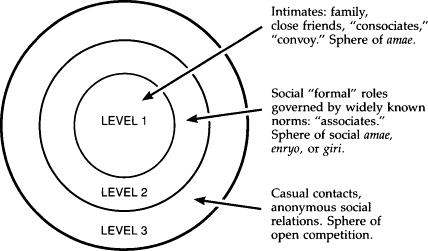
Figure 2-1.
Depth Model of Japanese Interpersonal Relationships
regulated by role-specific norms, which in Japan are comparatively inflexible and well defined.
Any complex society can be conceived in terms of a model of "circles of intimacy" like this. But if you think of the boundaries between the circles as being relatively durable, easy to see, and difficult to cross, you can understand the Japanese difference. If the social spheres in Western cultures are thought of as separated by flower beds, the Japanese spheres might be seen as separated by fences.
There are also some culturally specific ideas that are useful in characterizing interaction at each level. In the first level, for example, one can indulge in one's need to be humored, nurtured, or spoiled—the complex made famous by Takeo Doi as amae (Doi, 1973). The prototype of the amae relationship is the parent-child role set, and such a relationship may be so close as to be symbiotic and unique, almost unfettered by normal social expectations. Intimate friendships can be included here if they are of long standing.
Second-level relationships are those wherein one has to wear one's social clothes. Here the key concept is enryo , restraint or holding back, which is chiefly used as "a negative yardstick in measuring the intimacy of human relationships" (Doi, 1973:38). Because
this is the level in which formal role relationships dominate, one must carefully control one's behavior, continuously assessing the quality of the relationship and keeping an appropriate distance. Amae also comes into play at this level, but in a different sense. The parties continuously "read" each other's needs and reactions to assess the changing quality of the relationship. Relationships that are close enough to avoid the need for enryo are ideal, but such closeness is often impossible. Enryo need not be used in either first-level or third-level relations, both of which are more casual, although for different reasons.
Looking at this model from the standpoint of social support, level one relationships are the strongest. People tend to refrain from seeking help from those at level two. Having received help from second-level people, one will feel giri , or psychosocial indebtedness, a need to repay the favor quickly. Third-level relationships are not part of one's support network, and help can be sought there only in extreme emergency.
This model is not static. Although the basic structure of social relations may be stable, the real value of this model is that it can also be used to clarify the process of life span social development. Relationships can develop in either direction; a stranger can move into the second level, then gradually into the first as time goes on. Likewise, even a parent-child relationship can grow cold and distant, losing the meaningfulness of first-level relations. Relationships must be defined mutually; it is essential that the parties share a similar perception of their quality and depth. The Japanese are socialized beginning in childhood and continuing at school and at work to be skillful at this kind of perceptual bargaining.
This perspective is a theoretical backbone of Plath's work on the life cycle: "Growth then becomes in part a property of others, particularly of those who are one's consociates . The term may be an unfamiliar one, but it is apt here. It derives from the work of Alfred Schutz and the phenomenologists. If 'associates' are persons you happen to encounter somewhere, sometime, 'consociates' are people you relate with across time and in some degree of intimacy. They are friends, lovers, kinsmen, colleagues, classmates" (Plath, 1980:8). Consociates, then, are essentially the people in the first (and occasionally second) level of our model; associates are most of those in the second level and a few in the third.
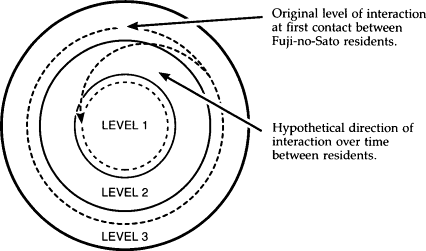
Figure 2-2.
Analytical Model of This Study
Plath's use of the term "convoys" to describe groups of consociates, whose personalities, life circumstances, and relationships evolve slowly over many years, can also be understood with the help of this model. First-level relationships are extremely durable; and when they grow out of second- and third-level ones, their evolution usually takes many years as well (Plath, 1980:224-226).