
V—
THE ANALOGICAL TRADITION OF LITERARY ARCHITECTURE
We cannot articulate our feelings without a language that tradition and civilization offers to us for the selection of symbols.
E. H. Gombrich
In The Seven Lamps of Architecture (1849), John Ruskin makes, I think, one of the most eloquent statements on behalf of architecture that we find in nineteenth-century English writing. His tribute has special importance with respect to the concerns of this book. Ruskin not only brings together in one passage themes and theories shared and expressed by the writers we have been discussing; he also does so in such a way as to suggest and I hope affirm the motives that have impelled me, and values I have held by in my critical and appreciative pursuits. Speaking of "The Lamp of Memory," Ruskin writes:
It is as the centralisation and protectress of this sacred influence, that Architecture is to be regarded by us with the most serious thought. We may live without her and worship without her, but we cannot remember without her. How cold is all history how lifeless all imagery, compared to that which the living nation writes, and the uncorrupted marble bears! how many pages of doubtful record might we not often spare, for a few stones left one upon another! The ambition of the old Babel builders was well directed for this world: there are but two strong conquerors of the forgetfulness of men, Poetry and Architecture; and the latter in some sort includes the former, and is mightier in its reality; it is well to have, not only what men have thought and felt, but what their hands have handled, and their strength wrought, and their eyes beheld, all the days of their life.[1]
Ruskin distinguishes for us, before he reintegrates, the two arts we have been discussing: literature (Poetry) and architecture; he adds, then, that these two arts, independently and interdependently, "conquer forgetfulness," or to restate positively, enable us to remember the past.
Literary Architecture has been about the two arts which Ruskin distinguishes and compares as they find expression in the writings of Walter Pater, Gerard Manley Hopkins, Marcel Proust, and Henry James; it has also been about that special service to memory which literature and architecture, separately and as analogues, perform and which Ruskin celebrates. If we wish to speak of influences, we can scarcely do Ruskin justice enough: not
I
Space-Time
only does he announce to the nineteenth and twentieth centuries the importance of architecture, but he enables those writers after him to discover and proclaim for themselves the richness of architecture for their lives and their art.
Architectural places—literary and physical—echo and resonate in the life of our mind. Literature and architecture are separate art forms; and we must qualify their relationships with care, in the same manner Ruskin qualifies them when he says "the latter [Architecture] in some sort includes the former [Poetry]" (italics mine). Their separate existence is a consequence of material form
II
Space - Time
and time-life within contexts of separate traditions; and, if we wish to speak on the level of form, we must say that the two arts hold no intrinsic or necessary similarity: the one is an art of stone or concrete, the other of letters and words. This proposition is insufficient, however: it does not raise the cloak of form (express materials) to see basic and elemental underpinnings: both literature and architecture are composed of space, time, matter, energy, this last being a holding-tension, the stress-release bond which constrains matter into form, assigning it place and
preventing its explosion into random disconnectedness. Literature and architecture are compositions; they require artist-doers. We persist, of course, in thinking of each art as outward, existing in the solidity it discovers in this final form; but each has an inward motive—

III
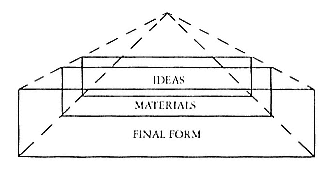
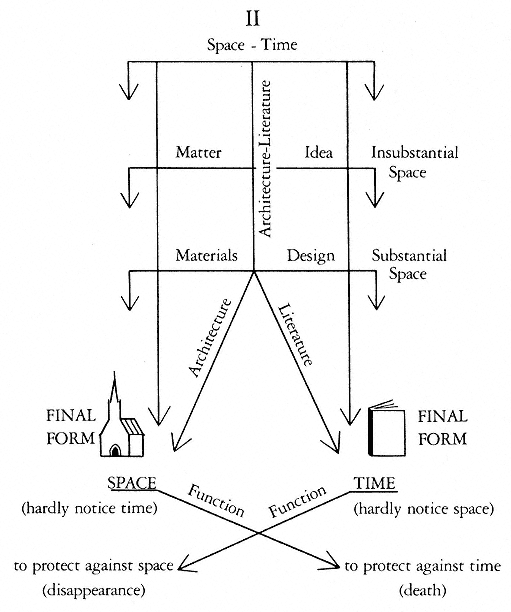
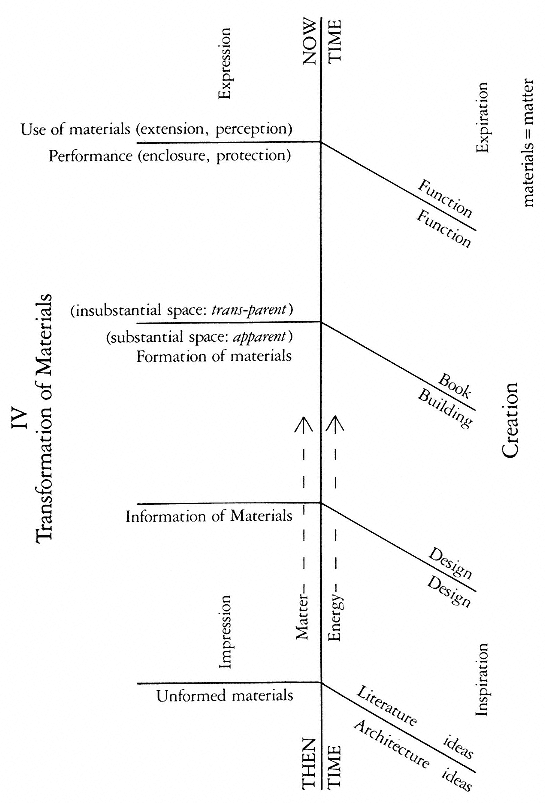
Hopkins's and Proust's "essence," James's "germ"–such that outwardness represents conversion from idea—immatter—into matter. This is embodiment . I have drawn some diagrams to show the relationships between space-time, idea, matter (material), and form. The first diagram (I) indicates that space-time is common to all three stages of the art activity; in this representation, we may think of space-time as a sea in which artistic creativity occurs, but I think it important to see that sea also as the possibility and power of connection. Diagram II represents where-when architecture and literature di-
IV
Transformation of Materials
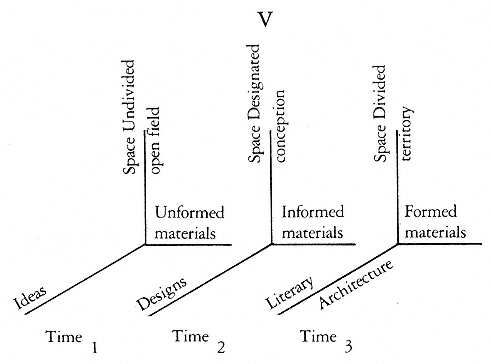
verge in form and then again in function. Diagram III shows idea as constant, from inception to perception ; IV shows energy-matter as constant throughout the transform act; and V shows literary architecture in three space-time intervals. What distinguishes literary from architectural art, then, is not elements (particularity) but the proportion-combination of elements: architecture
V
Literary Architecture
celebrates space through enclosure, converting an open field into territory (this is the marking of boundaries); literature celebrates time through expansion, quickening the open field with imagines (this is the opening of dream). But even here we must not be deceived by particularity of proportion or emphasis—either space or time—for the distinction is false: we cannot have the one without the other. Despite differences in form, architecture and literature each partake of the other's dom-
inant element. Pater, Hopkins, Proust, and James choose the architectural analogue for literature so that they may emphasize the spaciousness of literary art despite the insubstantiality of that space. They extend literature, but its where , unlike architecture's, becomes air unbounded. Space—we may think void —is important: it is the area through and the vehicle by which the alive or the quick is realized. As such, it is positive. Space is where time is. In literary art (language), syntax is the most apparent space-place and place-force; in architecture space is the hollow center (Proust's hermetically sealed silence of past or Hopkins's "womb-of-all, home-of-all, hearse-of-all night"). It resonates and records past or potential activity and is necessary for the life of the art. It is also necessary for life: there cannot be movement, life, which we may make analogous to or see as time, without space. The functions of literature and architecture respect the space-time conditions of the arts themselves, of insubstantiality or substantiality: literary art sets in motion (time) our activities of conceiving and perceiving (our transparent dreams or thoughts); architecture moves the other way, representing a conversion from no-thing into something, an activity human, but more importantly natural, in the manner of the universe. It provides space as shelter and space as interior scape or environment. When we think of space in art-life as hollow, this space is death-in-life, the life a field without the center figure, self. Death-in-life is the necessary converse for life, which actually is life-in-death, being-in-field (universe) or being-in-void. (For being we may also read architecture, literature, thought.) Solidity or permanence, in this sense, is illusion. Solidity depends, for its illusion, on its time-life. Architecture wears its time
slowly (in an analogous system, physics, it undergoes slow configurational change); once we see its time—we go to Rome to see decay and ruin, to Milan to see ghost-admitting frescoes—it assumes a (fertile) trans-parency much like our fugitive thoughts. So, too, once our thoughts (fast configurational change) are embodied in written language, their time-life slows, such that they relinquish their quick transparency-as-thought and seem to endure, as if they were like architecture, substantial.
Substance is, in our senses, our security or refuge from time-death; but architecture as substance is protection of another sort, from uncontrollable (since not self-generated) weather. Weather is kinetic energy, what we should also think of as encounter or experience, while architecture is potential energy. Being-out-of-doors is being without shelter, without either thought structure protection (filters) or physical protection. Being-in-weather requires the nakedness of exposure. Hopkins, of the four writers I discuss, ventures outside the most, into weather—the charged void—and death—the hollow center; Proust follows Hopkins in order of daring but clings for security to a reconstructed past rather than the immediate; Pater, we feel, once risked exposure, but frightened, he too returns to sentimentality, to reconstructed and fortressed enclosures; James, no less fearful than Pater, ventures out into the near-loss of control of his late novels, but, like Pater, returns to safety, wanting to construct against death, not like Hopkins, through or with it. James's novels slow into museums or stiffen into mausoleums, whereas Proust's and Hopkins's quicken to building-as-activity, Hopkins's actually working as breaths of being, making and unmaking. I do not wish to say that Proust and Hopkins are therefore the better;
but I have thought that they are braver and in some way larger. Their literature spans more, exposes more, and re-creates more of the extended world we live in, Pater and James more of the intended world we live in. In the end, no matter the scale: each writer is a visionary, each a life-builder.
Pater coins the term literary architecture ; Hopkins uses architectural terms and concepts to describe and make his poetry; Proust constructs A la recherche du temps perdu as a Gothic cathedral; and James writes inside and about a house (-space) of fiction. The architecture of these writers is not just an analogue taken-up but a process for generating a whole range of analogues. It is now an actual creative and a transform-memory process, literary architecture. The close study of literary architecture provides an unanticipated model of the mind in activity, expressing in act, as vital structure, how it fuses space-time and recovers buried memories in and for the construction of art. We should not tease ourselves into believing that literary architecture depends upon or presumes a common spirit of the age which marries the two arts, whether we name that spirit a Hegelian Zeitgeist or an "air de famille ."[2] Rather, literary architecture says something about the way Pater, Hopkins, Proust, and James view and work their literary creations. This book has been concerned with architecture as art-model and procedure for literary art and with the implications for creativity and perception architecture provides.[3] What, I have asked, may be accomplished at certain times in history or in certain literary works by architecture when painting, sculpture, and music are available as alternative identities.[4]
Tradition and civilization offer to the nineteenth and
twentieth centuries four sets of parallels or analogues. Architecture figures in each: architecture [and the] human body; architecture [and the] mind; architecture [and] memory; architecture [and] literature. What occurs in the nineteenth century and onwards is a blurring of sorts: these once discrete parallels—used not only by writers but by architects and philosophers—feed into one another so that literature, architecture, and memory share and assume new and complicated meanings as the indistinguishable fusion literary architecture. While two sets of these parallels have been formalized into what we have already called traditions (ars memoria and what a few scholars have called ut architectura poesis ), the other two have been ignored: the relation between architecture and the body and architecture and the mind. Taken altogether, the four represent something in many ways less special but never less important than the formal traditions: the continual search to explain what we mean by metaphor, or, said more simply, how we mean. Classical rhetoricians needed to describe structure in periods and could turn to architecture, while architects who needed to describe character and style in architecture could turn to rhetoric. Terms and concepts are borrowed naturally; and the language of comparison becomes a rich metaphorica governing all our expression, sometimes in such a way as to lead us to think that all language is metaphorical. I have said that these particular sets of metaphors have something in common—architecture. One possible consequence can be this: when we read, we look for specific effects attained in the use of the architectural analogy for writing and recalling. I hope that my observations have some value in heightening the pleasure we can take in our readings.
One—
Architecture and the Human Body
The comparison between architecture and the human body crops up first in the works of Vitruvius, The Ten Books on Architecture ,[5] written in the time of Augustus. The analogue helps Vitruvius to speak of structure in architecture and to advocate, if not justify, his belief in symmetry. We find a cryptic but paradigmatic use of the analogue in Book I, "The Fundamental Principles of Architecture"; the more elaborate uses of the analogue appear in subsequent books, an example being Book III, "On Symmetry: In Temples and in the Human Body." In the passage from "Fundamental Principles," Vitruvius writes:
Symmetry is a proper agreement between the members of the work itself, and relation between the different parts and the whole general scheme, in accordance with a certain part selected as standard. Thus in the human body there is a kind of symmetrical harmony between forearm, foot, palm, finger, and other small parts; and so it is with perfect buildings. In the case of temples, symmetry may be calculated from the thickness of a column, from a triglyph, or even from a module; in the ballista, from the hole or from what the Greeks call the
in a ship, from the space between the tholepins (); and in other things, from various members.[6]


We can document the persistence of the architecture-body analogue in architectural treatises from Vitruvius' time to the present day. Among the seminal reassertions of the analogue is that of Leone Battista Alberti in Ten
Books on Architecture (1485):[7] Alberti restates and thereby preserves Vitruvius' analogue; he also expands his predecessor's approach to include mathematics. Alberti states that "an Edifice is a Kind of Body consisting, like all other Bodies, of Design and of Matter";[8] he also breaks from Vitruvian tradition, as we can observe in his title description of Book IX, Chapter VI: "Of the Proportions of Numbers in the Measuring of Areas, and the Rules for some other Proportions drawn neither from natural Bodies, nor from Harmony."[9] What we notice in seventeenth- and eighteenth-century treatises is that terms for parts of buildings are in fact taken from the names of body parts. In The Builder's Magazine , 1774, we find, among other terms, eye, eye-brow, face, elbow, dentells, nose, nude, buttocks , and bust , let alone the more polite terms such as joint and limb .[10] In the nineteenth century, we find the analogue again: in "The Principles and Practice of Architectural Design," (Essay 7, 1850) from Detached Essays of the Architectural Publication Society (London, 1853), the author-architect Wightwick writes:
A building is a body or a "carcass," lettered over "with beauty of diction, with poetic illustration, and with the charms of rhetoric. . . . What the skin is to the body, the hair to the head, the eye-brows and lashes to the eyes, and the lips to the mouth—such is the marble casing to the walls, the cornice to the façade, the pediment and the architrave to the windows, and the porch to the door."[11]
What is important to notice here is that the analogue has begun to blur, that is, to include a literary analogue as well ("lettered over 'with beauty of diction, with poetic illustration'"). By now this blurring does not surprise
us, especially when we discover it in nineteenth-century writings; but it is important to know also that as early as Vitruvius, architectural terms and concepts were borrowed from existing disciplines, specifically from rhetorical treatises;[12] and that in succeeding centuries the borrowing could be made the other way round, from architecture to literature, as is the case with Ben Jonson's Timber, or Discoveries , where Jonson applies concepts and terms from Vitruvius and Alberti to the masque, poetry, and drama.[13]
In devotional writing, the analogue seesaws: while architecture may be described by its analogy to body, so, too, is the body described architecturally, most often as church, temple, or house. In English poetry, perhaps a locus classicus for such reciprocal uses of the architecture-body analogue is George Herbert's The Temple : sometimes the Church is body-like, with veins of human sin, just as at other times the body is house-like, "all symmetrie,/Full of proportions."[14] Herbert's last stanza in "The Church-floore" beautifully bows to one side of the analogue:
Hither sometimes Sinne steals, and stains
The marbles neat and curious veins:
But all is cleansed when the marble weeps.
Sometimes Death, puffing at the doore,
Blows all the dust about the floore:
But while he thinks to spoil the room, he sweeps.
Blest be the Architect , whose art
Could build so strong in a weak heart.[15]
"Man" bows to the other:
My God, I heard this day,
That none doth build a stately habitation,
But he that means to dwell therein.
What house more stately hath there been,
Or can be, then is Man? to whose creation
All things are in decay.[16]
We need hardly remark that Walter Pater and Gerard Manley Hopkins—Pater's architecture of "old builders," Hopkins's "Harry Ploughman" or "The Wreck of the Deutschland"—must have known this analogue as it was used by Herbert. But it is important to notice once again the words build and dwell . If we once again take the words back, as Hopkins might have done, to their Indo-European roots, the lines read this way: "That none doth be a stately habitation,/But he that means to be seen." The body is the building, that is, the being, of the soul, its temporary place of residence, actually its embodied or seeable form. (Dwell , as I have stated earlier, means "to go up as in a cloud," the cloud making the spirit, which rides on the breath, seeable.) Dwell also meant "to go astray"; this suggests that our temporary abode—the body, our life on earth—is a departure from that other, correct life, the life of the spirit, which does not know (human) birth and (human) death. We should also be aware that the analogue, while useful for descriptions of structure—proportion (part to whole), symmetry, arrangement—is useful in other ways also: when writers compare architecture with the body, they get the chance to consider architecture "organic," having to do with growth, generation, life-death cycles. We therefore may find that certain writers we might call Romantic use the analogue even when they are intent
upon dismissing proportion and symmetry as the more bloodless values of a classical sensibility.[17] Perhaps, then, we may begin to see how Pater could remake the analogue into something altogether new, by, as it were, collapsing the parallelism into a point where lines converge: architectural walls are actually composed of "minute dead bodies."[18] In this way, then, the analogue is serviceable for those who wish to speak of structure, as well as for those who seek to use it to describe organic growth, or, simply, human existence.
Two—
Architecture and the Mind
The important relationship between architecture and mind, whether explicit or submerged, has been noticed and proclaimed throughout the history of Western thought, so much so that it seems commonplace when in fact it is profound. Prior to the eighteenth century, however, the comparison seems to have been used less by architects searching for analogues to architecture than by philosophers and poets who wished to describe mind by an analogue which included notions of place, depth, structure, interior, exterior, light, dark, image, access, barrier. We could chronicle endlessly the occurrence of the analogue: it surfaces in Aristotle (topos eidon ),[19] while it seems submerged in Ovid and Apuleius ("Palace of the Sun"; "Palace of Psyche");[20] it comes explicit in Augustine and Aquinas, again in Locke and Hegel; the comparison, although carefully qualified, persists through Freud's writings (Roman buildings image mind and memory in Civilization and Its Discontents ) and is used even now by such writers as Samuel Beckett and Donald Davie, such psychiatrists as W. R. Bion, and such philosophers as Richard Wollheim.[21] We persist, it seems, in feeling that the mind has no extension—to use Descartes' term—and when we seek to describe it, we translate it into metaphors which, of necessity, do have extension. In other words, "mind" without the analogue is shaky, threatening on the one hand to disappear into a puff of abstraction or, on the other, to so reduce itself to essen-
tials as to be matter no longer, but only energy (a chemical, electrical brain). The comparison of mind with architecture suggests that the mind either has extension or at least has functions or characteristics similar to those things which do have extension. In this way, perhaps, we can appreciate Plato's care in his allegory of the cave: while he does not seek to describe the mind of man as a parthenon or temple, as a finished architectural monument, he more importantly chooses to describe the condition of being (we might read building ) or mode of existence (we might read dwelling ) in which the mind functions; and for purposes of description and clarification, he creates the cave metaphor, which, if we wish, we may think of as rudimentarily architectural.[22] Certainly, long after Plato, we can find descriptions—embodiments or extensions in metaphor—of the mind in architectural terms. We might look back in literary history or to the present. The opening of Andrew Marvell's poem "Upon Appleton House, to my Lord Fairfax" may be a locus classicus for this occasion: while Marvell establishes an analogous relationship between mind—or sometimes "brain"—and architecture, he also enlarges the analogue to include a literary or poetic significance. The poem begins:
Within this sober Frame expect
Work of no Forrain Architect ;
That unto Caves the Quarries drew,
And Forrests did to Pastures hew;
Who of his great Design in pain
Did for a Model vault his Brain,
Whose Columnes should so high be rais'd
To arch the Brows that on them gaz'd.
"Did for a Model vault his Brain"—the poem extends the complex metaphor beautifully: poet-architect and Fairfax come together in almost every stanza-room.
V
And surely when the after Age
Shall hither come in Pilgrimage ,
These sacred Places to adore,
By Vere and Fairfax trod before,
Men will dispute how their Extent
Within such dwarfish Confines went
And some will smile at this, as well
As Romulus his Bee-like Cell.
VI
Humility alone designs
Those short but admirable Lines,
By which, ungirt and unconstrain'd,
Things greater are in less contain'd.
Let others vainly strive t'immure
The Circle in the Quadrature !
These holy Mathematicks can
In ev'ry Figure equal Man.[23]
If we jump centuries, we find an equivalent of sorts in Samuel Beckett's Murphy . Chapter VI of the novel is devoted to a description of Murphy's mind. This character, the "seedy solipsist" Murphy, holds by a radical Cartesian dualism. The chapter uses the language of abstraction: Murphy's mind has "an actual" and "a virtual," and "three zones, light, half light, dark, each with its speciality." The speciality of the first is "forms with parallel," of the second, "forms without parallel," of the third, "a flux of forms."[24] But Beckett never lets an abstraction "exist" without a concrete, literal parallel or equivalent: thus, although wonderfully delayed until
Chapter IX, the padded cell for schizoids in Magdalen Mental Mercyseat becomes the extended equivalent, the architectural analogue, to Murphy's mind. Murphy feels that
the pads surpassed by far all he had ever been able to imagine in the way of indoor bowers of bliss. The three dimensions, slightly concave, were so exquisitely proportioned that the absence of the fourth was scarcely felt. The tender luminous oyster-grey of the pneumatic upholstery, cushioning every square inch of ceiling, walls, floor and door, lent colour to the truth, that one was a prisoner of air. The temperature was such that only total nudity could do it justice. No system of ventilation appeared to dispel the illusion of respirable vacuum. The compartment was windowless, like a monad, except for the shuttered judas in the door, at which a sane eye appeared, or was employed to appear, at frequent and regular intervals throughout the twenty-four hours. Within the narrow limits of domestic architecture he had never been able to imagine a more creditable representation of what he kept on calling, indefatigably, the little world.[25]
The passage, with some subtlety, contains Beckett's critique of solipsism and of all closed or monistic systems: like James, Beckett opens his closed structure to a watcher-intruder, the "sane eye" which appears at the "shuttered judas." Is there a pun on "judas," betrayer of belief systems, outsider, or disbeliever in monotheism? When in his more recent fiction Beckett seems to be imaging being and death, and to be doing so without the biting (but also hopeful) ironic humor of Murphy , he still uses architectural metaphors, but composes them of elements (sky, earth, and air) as well as rudimentary structures; and he importantly describes them over and over again as being "issueless."[26] The composing and
constructing analogue, mind and architecture, dances in counterpoint to Beckett's de-composing of literary and epistemological conventions.
We can also find the opposite or reverse of the analogue, when architects use it to compare their buildings with mind. This comparison is far more recent than we would suppose: in an essay from July 1839, "On Character and Style in Architecture" from The Civil Engineer and Architect's Journal , the architect-writer draws a parallel between matter and mind:
A style is a method of conveying a character, and is as distinct from that character as the human form, the soul of which it is the external representative; it is the means of explaining to the senses some (insensible) idea; in short is the matter , some moral quality being its analogous mind .[27]
We also find the analogue used by the architect Wightwick:
It [The Triumphal Gate] symbolizes MUSEUM. It is a prologue spoken by Retrospection. Like the brain of Touchstone [he means Jaques], it is "cramed with observation, the which it vents in mingled forms." It is the "returned traveller," "the picked man of countries. . . ." Having studiously followed the windings of the templed walks to which it leads, you will return, competent to read the significant details of what, now, only vaguely addresses your understanding.[28]
Wightwick's belief that buildings symbolize ideas (or even other buildings), and that they may actively address an observer, reveals what is beginning to happen to the relationship between architecture and mind in nineteenth-century architectural theory. Parallelism—Wightwick still uses a simile construction "like"—gives way to what E. H. Gombrich simply calls expression-
ism:[29] rather than merely parallel, buildings in the nineteenth century come to express actively and outwardly, in concrete form, the mind of their builder-architects. Ruskin writes of this expressiveness:
Exactly in the same manner, we shall find that Gothic architecture has external forms and internal elements . Its elements are certain mental tendencies of the builders, legibly expressed in it; as fancifulness, love of variety, love of richness, and such others. Its external forms are pointed arches, vaulted roofs, etc. And unless both the elements and the forms are there, we have no right to call the style Gothic. (italics mine)[30]
Expressionism has two sides to it: not only may buildings express the mind of their builders, but buildings may also impress that expression on an observer's mind. Architects are concerned to make explicit the power of architecture:
Architecture produces its effect upon the mind quite as much as upon the eye. Its forms are understood by the intellect, not merely painted upon the retina. The pleasures which it excites arise from complicated sources; they spring from the thoughts which we bestow upon the object [after receiving thoughts from it] and not merely from the contemplation of the form.[31]
Ruskin in fact uses the expressiveness of a building as a criterion of its beauty and majesty:
If we consider how much less the beauty and majesty of a building depend upon its pleasing certain prejudices of the eye, than upon its rousing certain trains of meditation in the mind.[32]
What Ruskin presents should be familiar: we most often speak of it as associationism. Architects, like writers and
philosophers, begin to use their art form as a device to direct specific trains of association. There occurs, thus, a kind of dynamic charge or exchange among builder, building, and observer, of mind expressed to mind impressed.
The literary implications of expressionism and associationism are important. There is the possibility, for viewers, of discovering something about the private vision, even the private life, of the architect-artist from his public monument, whether that monument is an actual edifice or a literary structure. Ruskin had said that "mental tendencies" are "legibly expressed," meaning that an observer may—to use Ruskin's exact term and a term used by other architectural theorists—"read" architecture. One may read backwards from art object to artist, and this is of course what we have seen in this century as psychoanalytic criticism. While in the nineteenth century we find some artists happy about these possibilities, we also find others who feel that such "readings" constitute an invasion of their privacy and an abuse of the artifact. Browning, for instance, is angry that critics read Shakespeare's sonnets, not to mention Browning's own, as the artist's mind-house (like Rossetti's "House of Life" sonnet sequence), which could be entered and understood. When he protests against such an approach, he strikingly chooses to express his objection in poems which themselves exploit the analogue of mind/building/poem. The first three stanzas of "House" (1876) express this clearly.
Shall I sonnet-sing you about myself?
Do I live in a house you would like to see?
Is it scant of gear, has it store of pelf?
"Unlock my heart with a sonnet-key?"
Invite the world, as my betters have done?
"Take notice: this building remains on view,
Its suites of reception every one,
Its private apartment and bedroom too;
"For a ticket, apply to the Publisher."
No: thanking the public, I must decline.
A peep through my window, if folk prefer;
But, please you, no foot over threshold of mine![33]
He ends the poem with the idea that entrance testifies to an "earthquake" or to a weakness of poetic structure. One who wishes to "penetrate" "must dive by the spirit-sense," not force an intrusive visit.
"Hoity toity! A street to explore,
Your house the exception! ' With this same key
Shakespeare unlocked his heart ,' once more!"
Did Shakespeare? If so, the less Shakespeare he![34]
Pater and Proust, unlike Browning, wish, it seems, to validate their private worlds and to invite readers inside, much as James, towards the end of his life, attempted to do in the prefaces to his novels. Clearly, architecture offers itself as an analogue to these writers and others who wish to take a stand on the relationship between themselves, their art works, and their viewing public.
Three—
Architecture and Memory
The ars memoria tradition has been documented and analyzed by Frances Yates in her seminal work, The Art of Memory ;[35] insofar as much of my study has been concerned with vestiges of this tradition, I am indebted to Miss Yates.[36] For our purposes, it is important to recognize that this tradition does not propose an explicitly analogous relationship between architecture and memory: architecture and memory function primarily as devices , each in the service of the other. The philosophers and religious thinkers who advanced the ars memoria tradition used architecture as a structure or model to facilitate remembering; architects and architectural theorists enjoyed the possibility that architecture, actual edifices, could conquer forgetfulness by embodying the past or by stimulating its recall through architectural style, character, or detail. Quintilian, in his Institutio oratoria , describes architecture as memory device:
Places are chosen, and marked with the utmost possible variety, as a spacious house divided into a number of rooms. Everything of note therein is diligently imprinted on the mind, in order that thought may be able to run through all the parts without let or hindrance. The first task is to secure that there shall be no difficulty in running through these, for that memory must be most firmly fixed which helps another memory. Then what has been written down, or thought of, is noted by a sign to remind of it. This sign may be drawn from a whole "thing," as navigation or warfare, or from some "word"; for what is slipping from the memory is recovered by the admonition of a single word. . . . These signs are then arranged as
follows. The first notion is placed, as it were, in the forecourt; the second, let us say in the atrium; the remainder are placed in order all round the impluvium, and committed not only to bedrooms and parlours, but even to statues and the like. This done, when it is required to revive the memory, one begins from the first place to run through all, demanding what it is required to remember, all are linked one to another as in a chorus nor can what follows wander from what has gone before to which it is joined, only the preliminary labour of learning being required. . . . We require therefore places, either real or imaginary, and images or simulacra which must be invented.[37]
Quintilian's description of architecture as a memory model is careful and precise; I am not certain whether we shall again encounter it in such clarity. We have already seen that Augustine, in his meditation on memory, demonstrates familiarity with the ars memoria tradition; unlike Quintilian, however, Augustine translates the architectural device into metaphor. Memory is the grand "storehouse for countless images" (X, viii, 12) or the "great treasure-house" (X, viii, 14) which holds the permanent collection of the mind's recorded activities; apparently, as Augustine tells us, this storage house for mental events easily adds its own rooms to maintain records of newly acquired mental collectibles, so that in this "inner hiding place" (X, viii, 12) there is a "vast cache" (X, viii, 14) and "vast cloister" (X, viii, 14) which contains a "wonderful system of compartments" (X, ix, 16) and "innumerable caverns and hollows" (X, viii, 26).[38]
As metaphor, architecture remains serviceable to subsequent philosophers who wish to discuss memory but who either do not know or choose not to employ the ars memoria techniques. When Locke speaks of memory, he describes structures architectural and tomb-like,
where though the brass and marble remain, yet the inscriptions are effaced by time, and the imagery moulders away. The pictures drawn in our minds are laid in fading colours; and if not sometimes refreshed, vanish and disappear.[39]
Freud, too, uses architecture when he seeks to describe conservation, minds which cannot forget experience or sensation. Freud chooses not one building but a city of buildings, Rome, beautifully wearing its history in successive architectural monuments. After describing in some detail the cycles of construction and destruction of specific buildings, Freud asks that we make
the fantastic supposition that Rome were not a human dwelling-place, but a mental entity with just as long and varied a past history: that is, in which nothing once constructed had perished, and all the earlier stages of development had survived alongside the latest.[40]
The spatial analogue offers Freud relief from viewing the mind or memory as temporal and sequential such that he can explain how a remembered experience, even if distant in time, may be experienced as immediate.
Whether we discuss Freud or the ars memoria tradition, architecture as analogue, metaphor, or device, we need to ask if the use of the analogue and of the device involves conceiving that memory shares some of the qualities of its analogue.[41] Richard Wollheim, in an essay "The Mind and the Mind's Image of Itself,"[42] presents an architectural image of mind as room or interior space into which thoughts may enter from the outside or in which they may arise, already inside. However much the image is respectful of Freud's, and offered in homage to Wollheim's more immediate teacher, Melanie Klein, Wollheim nonetheless feels that he must
defend himself; and his defense has much to do with literary architecture. Wollheim writes:
I foresee two immediate objections. The first would be that I have taken what is no more than a sustained metaphor as though it were, or were intended as, a literal description. We may speak of thoughts entering the mind or breaking in upon the mind or just being in the mind, but when we do so, the phrases that we use do not reflect what we actually believe. They are mere turns of speech. Now whatever sympathy we may have with the general impulse of this argument—which I shall return to later-the argument as it stands is tendentious. For it assumes that we have a clear distinction between what is metaphorical and what is not: which we do not have. As a minimum someone who uses this argument must show that there is an alternative way of describing the facts in question—here it would be, of reporting the relevant mental states—which could make a good claim to be literal description. And I do not see that in the present case this condition can be fulfilled. There is no more reason for holding that the assertion that, say, thoughts are in the mind is a metaphor, than there would be for making the corresponding claim about the assertion that fictional characters are in a novel: a parallel we might remember.[43]
What Wollheim notices here is the language (model) of spatial extension; and he raises the issue of whether our mental experience (act) cannot not be spatial—are not dreams like holograms?—even though the space we experience is not substantial and cannot be recovered on a plane surface. Wollheim also makes explicit another parallel, one we have temporarily neglected but the one this entire book has been about: architecture/memory and literature. That this analogue appears when a philosopher discusses memory and the mind should not sur-
prise us: even Quintilian, preserving and representing Cicero, comments:
We require therefore places, either real or imaginary, and images or simulacra which must be invented. Images are as words by which we note the things we have to learn, so that as Cicero says, "we use places as wax and images as letters." It will be as well to quote his actual words:—"One must employ a large number of places which must be well-lighted, clearly set out in order, at moderate intervals apart, and images which are active, which are sharply defined, unusual, and which have the power of speedily encountering and penetrating the mind ."[44] (italics mine)
Architecture, like literature, may as a device facilitate recall of the past and as an analogue may represent or stand for memory. This leads us, quite naturally, to an idea expressed not by philosophers but by architects: architecture may conquer forgetfulness by embodying the past, by recording the past, or by stimulating recall of the past. It may embody the past by being old; it may record the past by its inscriptions and engravings; it may stimulate recall of the past by its style or character. And as a record, it may be read much as literature is.
We might say, most generally, that revival movements in architecture demonstrate with a kind of explicitness the interest, on the part of architects, in reviving and preserving the past, whether an historical period (Greek Revival),[45] an age of belief (High Gothic),[46] or a past social order (vernacular).[47] Although all architecture in some way influences, morally and aesthetically, its inhabitants, it is not until modern cities—with new buildings, new building materials, industry, mass housing, not to mention slums-threatened to destroy
the past that we find architects and writers directing more and more attention to this specific attribute of architecture, its "Lamp of Memory." Crucial, however, to the attempt to preserve the past, or newly recreate it, is the possibility that such re-creation can be done, that if one wishes, one may discover what materials were used, how construction was accomplished, in what tasks workers were employed.[48] In this way, the tools for what we commonly call Victorian historicism were available to architects should they choose to have their buildings recall the past. And I think that we can discover what Sir Nikolaus Pevsner calls a clue to Victorian historicism: associationism, that is the power of buildings to evoke associations in the mind of the reader/observer/inhabitant. Once architects could assume that their monuments communicated, they were able to direct evocation to historical, memorial, ends. Hence one architect might choose various styles, much as Barry made King Edward's School in Birmingham Gothic in order to evoke the learning of the cloister, while his Edinburgh High School (Hamilton) was Grecian, evoking the wisdom of the academe .[49] Barry's clubs, those in the "guise of" Quattrocento palaces, evoke the "highly cultured merchant, say Lorenzo the Magnificent," while the impressive Houses of Parliament had to be either Gothic or Elizabethan in order that they might represent and enable recall of the "venerable English parliamentary past."[50] Some architects, dismayed by modern architecture, wrote that buildings should not try to teach "new things" but should aid one in "recollecting" the past. In The Civil Engineer and Architect's Journal (1839), we find such an admonition to architects:
Texts or inscriptions may be so managed as to become very ornamental and impressive. But the letters should be large and deep, and cut in the hard stone, as a part of the original conception of the building. . . . The architect should also avoid the most vulgar error, so often committed in printed books, of adding chapter and verse at the end of the line. Whenever a quotation is addressed to the imagination of the reader we must assume that we are merely bringing to his recollection the words of an author whose works are already known to him. We should not appear to teach something new.[51]
The writer continues:
The total want of inscriptions upon our modern buildings is a further proof of the vagueness of modern architecture. It was not thus among the ancients. They built for the people who saw their chronicles upon the marble. The lines were read by the fathers, the children, the grandchildren, and after the lapse of ages, the moss-grown characters add the most powerful charms to the majestic ruin. These means of giving interest to architecture are now always neglected. The Waterloo Bridge, unquestionably the finest in the world, might for anything which appears upon the granite, have been erected by a people ignorant of the art of writing. It does not even bear a date.[52]
Some writers went so far as to supply "mnemotechnic rules" to accompany their architectural treatises.[53] But it is at this point, when it seems so clear that architecture and memory constantly evoke allusion to literature, that we need to turn to our fourth analogue, architecture and literature.
Four—
Architecture and Literature
Of all the analogues, this one concerns us most. Not only has it been the central subject of this entire study; the architecture-literature analogue also in some way subsumes the other three while preserving an independence and history all its own. The analogue—I sometimes call it ut architectura poesis —is prerequisite to literary architecture and is in evidence whenever writers choose to compare their literary art to architecture. The term literature in fact is too modern for the analogue as it first appeared; for the comparison was used initially by orators, and its primary function then was not to describe the structure of an entire work of rhetorical art but to describe the composition of periods, the diction, style, and structure of those smaller units. Cicero, in De oratore , solicits architecture as one of many analogues for oratory, demonstrating that "the things possessing most utility also have the greatest amount of dignity, and indeed frequently of beauty also":
In temples and colonnades, the pillars are to support the structure, yet they are as dignified in appearance as they are useful. Yonder pediment of the Capitol and those of the other temples are the product not of beauty but of actual necessity; for it was in calculating how to make the rain-water fall off the two sides of the roof that the dignified design of the gables resulted as a by-product of the needs of the structure—with the consequence that even if one were erecting a citadel in heaven, where no rain could fall, it would be thought certain to be entirely lacking in dignity without a pediment.
The same is the case in regard to all the divisions of speech—virtually unavoidable practical requirements produce charm of style as a result. It was a failure or scantiness of breath that originated periodic structure and pauses between words, but now that this has once been discovered, it is so attractive, that even if a person were endowed with breath that never failed, we should still not wish him to deliver an unbroken flow of words.[54]
Like Cicero, Dionysius of Halicarnassus uses the architectural analogue in his treatise On Literary Composition to "illustrate" broadly his general conception of "the science of composition."[55] He solicits the analogue subsequently for more particular purposes, to aid him in describing types of composition. It is applied most extensively to describe what Dionysius calls Austere Composition:
The characteristic feature of austere arrangement is this:—It requires that the words should be like columns firmly planted and placed in strong positions, so that each word should be seen on every side, and that the parts should be appreciable distances from one another, being separated by perceptible intervals. It does not in the least shrink from using frequently harsh sound-clashings which jar on the ear; like blocks of building stone that are laid together unworked, blocks that are not square and smooth, but preserve their natural roughness and irregularity. It is prone for the most part to expansion by means of great, spacious words. It objects to being confined to short syllables, except under occasional stress of necessity.[56]
The passage should bring to mind Pater's, Hopkins's, and Proust's space-word concepts, Hopkins's percussive-word concept, and James's space-literature concept. Both Cicero and Dionysius use the analogue for its structural richness. Quintilian also chooses to describe aspects of
rhetoric by analogy to architecture. Of order, Quintilian writes:
For words are not cut to suit metrical feet, and are therefore transferred from place to place to form the most suitable combinations, just as in the case of unhewn stones their very irregularity is the means of suggesting what other stones they will best fit and what will supply them with the surest resting-place. On the other hand, the happiest effects of language are produced when it is found possible to employ the natural order, apt connexion and appropriate rhythm.[57]
In a similar fashion, Quintilian embarks upon the comparison with architecture after he has been speaking about invention, as if he wishes to make sure that an appeal to emotions and to the inventiveness of a speaker will not be at the expense of order and structure.
I think that enough has been said on the subject of invention. For I have dealt not merely with the methods by which we may instruct the judge, but also with the means of appealing to his emotions. But just as it is not sufficient for those who are erecting a building merely to collect stone and timber and other building materials, but skilled masons are required to arrange and place them, so in speaking, however abundant the matter may be, it will merely form a confused heap unless arrangement be employed to reduce it to order and to give it connexion and firmness of structure.[58]
Classical rhetorical tradition establishes, to some extent then, the conditions for subsequent use of the architectural analogue, especially when it aids writers in describing matters of composition and structure. We can document the persistence of the analogue through the Renaissance and well into the nineteenth century, discovering it in such temperamentally different writers
as David Hume, William Hazlitt, Arthur Schopenhauer;[59] even Ruskin, in his Elements of English Prosody , solicits the analogue when he discusses the stanza, which he describes as "the chamber of a house," properly signifying a "piece of a song enclosed or partitioned by itself."[60]
The analogue is also used by writers who wish to describe larger structures, to suggest, perhaps, how separate poems might relate to each other and so constitute a different sort of corpus, or how discrete chapters in a novel work together. "The Temple" is one such example, as is Wordsworth's planned organization of poems: Wordsworth thought of The Prelude as "a sort of Portico to The Recluse , part of the same building," much as he thought all his "minor Pieces," when "properly arranged," would be equivalent to "little cells, oratories, and with sepulchral recesses, ordinarily included in those edifices."[61] Up to a point it can be said that Pater and Hopkins were more interested in using the architectural analogy to describe smaller units of structure such as sentences or lines (and thus they were closer to classical writers), whereas Proust and James used the analogy to describe entire novel structures, Proust in this way being very like Wordsworth.
The use of the analogue by architects and architectural theorists originates with Vitruvius who, as we have seen, borrowed rhetorical terms and concepts of style to aid him in his treatise on architecture. The analogue remained useful in this fashion as long as levels of literary style, determined by or else generating concepts of genre and decorum, corresponded to the classical orders in architecture. (We might even say that non-Classical architecture, or specifically, that Gothic architecture also
had a literary analogue in the medieval, Christian Summa, for so Erwin Panofsky maintains in Gothic Architecture and Scholasticism .)[62] Even in the nineteenth century, despite the fracturing and collapsing of levels of literary style, and also the shifts in architectural values, we find the analogue still used to describe style and character in architecture:
As the poet seeks that every phrase and word which he employs be poetical and analogous to the style and character of his poem, so should the architect try to keep every member and portion of his building concordant to its intent.[63]
One architect writes of statues in architecture:
If we may so express ourselves, he [the architect] should sculpture in a style analogous to blank verse, avoiding the prose of conversation, and the rhyme of French tragedy.[64]
And he elsewhere comments on character in architecture:
The author too combines narrative with conversation, and the poet song with epic verse. The architect composes a design of Ionic and Corinthian, or of the Doric and Ionic. The true taste of both consists in maintaining one character through the whole, and so combining as to produce harmony without monotony, and so contrasting as to produce variety without confusion.[65]
Even Sir John Summerson in 1963 writes a book entitled The Classical Language of Architecture in which his individual chapter titles include "The Grammar of Antiquity" (which might remind us of Raphael Brandon's nineteenth-century work The Grammar of Ornament ), "Sixteenth Century Linguistics," and "The Rhetoric of the Baroque."[66]
The analogy reaches still further: architects conceive of buildings as books which can be read.
A public monument is a book opened for the perusal of the multitude; unless it declares its meaning fully, plainly, and sensibly, the main use is lost.[67]
Ruskin, in fact, uses the idea of reading a building to help him demonstrate his preference for the Gothic over the classical in architecture: of symmetrical, correct buildings, he comments:
The idea of reading a building as we would read Milton or Dante, and getting the same kind of delight out of the stones as out of the stanzas, never enters our mind for a moment. And for good reason;—There is indeed rhythm in the verses, quite as strict as the symmetries or rhythm of the architecture, and a thousand times more beautiful, but there is something else than rhythm. The verses were neither made to order, nor to match, as the capitals were; and we have therefore a kind of pleasure in them other than a sense of propriety. But it requires a strong effort of common sense to shake ourselves quit of all that we have been taught for the last two centuries, and wake to the perception of a truth . . . that great art, whether expressing itself in words, colours, or stones, does not say the same thing over and over again; that the merit of architectural, as of every other art, consists in its saying new and different things; that to repeat itself is no more a characteristic of genius in marble than it is of genius in print; and that we may, without offending any laws of good taste, require of an architect, as we do of a novelist, that he should be not only correct, but entertaining.[68]
The notion of reading architecture presumes that architecture has a language of sorts. And architects do describe their language; in fact, they believe that they have the equivalent of an alphabet:
\
Symbolic representations were employed by the ancients, who always understood their work with a thorough propriety of invention and of conception. Symbolic figures form as definite a mode of conveying ideas as the letters of the alphabet: when combined they form a word and impart a notion. But the symbols of the classical age are grounded upon a creed wholly foreign to us, and which has reached us only in disjointed fragments. The alphabet has gone out of use, and the language is a dead language; and in its place we mock the ancients by substituting allegorical representations, that is to say, by hewing metaphors in stone, vague, strained, and bombastical, affording no satisfaction to the vulgar.[69]
The analogue is even used towards the turn of the century when English architects were abandoning revival modes for English vernacular architecture: consequently, "design" is distinguished from "building," the one having to do with region and appropriateness of materials, the other with those "universal" qualities common to all buildings.
Architecture, while native to each Country, has a Classic tongue. Design has its dialects, but the Art of Building is a Universal Language.[70]
Ironically, while building might be universal, there is "writing" which only architects read:
Now , each house is but a monument recording an idea, maintained against overwhelming odds; a monument on which is often plainly written the memory of many small defeats. There is other writing too, but only Architects will read it.[71]
And so we seem to find that architecture comes to be more and more esoteric, that the layman, especially in the United States, has lost the art of reading monuments, and
that even in Europe, to some the art of reading old buildings has given way to commercial interests in the new. For writers in the nineteenth century, however, the notion that one could read a building perhaps suggested that one could architect a book, but more importantly, that readers could read those architectural monuments which comprise the settings of fiction, nonfiction, or poetry.
We thus have four sets of comparisons in which we may observe architecture to be a common "half." I have tried to suggest throughout this book that Pater, Hopkins, Proust, and James each use architecture as an analogue for body, for mind, for memory, and for literature. And I have named the fusion literary architecture. Of course with none of these writers is architecture the only art analogue they appeal to: music is an important analogue for Pater, Hopkins, and Proust, but less so for James, while painting is very important to Pater, Proust, and James, but less so to Hopkins. And it has been made clear to us that architecture as an analogue can coexist with other art analogues. Hopkins and Proust each translate music into architecture and architecture back into music; and Pater and James decorate their literary monuments—either their carefully architected sentences or their broadly but no less carefully articulated fictions—with the colorations and images of paintings, frescoes, or tapestries.
Once we know that in the nineteenth century there was a mode of perceiving architecture as a kind of communications device which was meant to teach or evoke, we may proceed to read literary architecture in a special way: perhaps readers/viewers are supposed to
conjure history as they conjure up the Venetian palaces of James or the Poynton spoils; to understand philosophy as they understand the villas in Pater's Marius the Epicurean or Hopkins's "Duns Scotus's Oxford"; or to understand an aesthetic statement as they understand Proust's Gothic cathedral which spans time and space. It must be recognized, moreover, and remembered that architectural analogues were not conscripted by writers into performing services never intended; on the contrary, architects explicitly intended buildings to be symbolic, to stimulate trains of association, to be read; it was assumed that buildings would influence the people living in them; and choice of style—whether Gothic, Palladian, Venetian, Norman, Doric, or whatever—was meant to indicate a political or national preference as well as to suggest something about the nature or state of industry, civilization, moral or religious values. It cannot seem trivial, then, that Pater, Hopkins, and Proust each prefer the Gothic to other styles, while James prefers the Palladian, varying his other architectural styles because of national setting, political sentiment, or the particular psychology of his characters.
We also know that architects themselves were becoming, in the nineteenth century, more and more interested in the function of buildings, the use of materials, as well as in inventing or changing aesthetic values concerning space, light, views. In this way, then, when architecture is selected as a model for literary art, it comes ready with its own expressive qualities given it by architectural theorists or architects themselves; and we might well understand how the description of a country house such as Gardencourt in James's Portrait of a Lady is meant to evoke in a reader who knows how to read "real"
houses all those things which nineteenth-century readers knew about politics, wealth, city and country, and so on.
I have tried to suggest some other uses of the analogue. If we consider the independent history of philosophy, we know that questions of how and what we know, of subjective perception, of the unconscious, were all of concern to nineteenth and early twentieth-century writers. Since architecture also serves as an image for the mind, it could offer to writers an image to describe private perception (being inside), the unconscious (basements), egos and superegos (attics); it could prove or verify that an outside ("objective"?) perception could correspond to or differ from an interior or private ("subjective"?) perspective; that one could talk about the growth and movement of self-awareness by speaking of walking through the house of one's childhood, or for that matter, about frozen awareness, a sort of temperamental determinism or stasis; and that one could talk about unwanted thoughts or feelings as if they were intruders. Language itself may then represent a translation outward of inner thoughts and feelings, just as literature may be viewed as being not only temporal but spatial as well. In still other ways, if poetry and prose late in the century were thought to be reflecting a loss of control, as if a degenerate Wordsworthian spontaneity were still spawning irresponsible writing, then architecture as analogue could represent an alternative: literary structures could be constructed and superintended just as a "finer edge" could be restored to a dulled language. Likewise, writers could use the analogue to suggest that literature and ideas need not strike root and bloom simultaneously but could be built slowly, with foresight and precision, as literary architecture.
For Pater and Hopkins, architecture helps them to describe controls which would resuscitate language; for James, it helps him to reveal, retrospectively, his craftsmanship, how he trained and restructured organic, germ growth into constructed fictions; for Proust it suggests that he could build with an old language, as with aged stones, but build so that readers would respect and acknowledge the past and his care in reconstructing it. Architecture is the only art object we actually live in. However, we live in another construction—we do not commonly call it art—also of our own making: consciousness. Literary architecture is a gesture toward that.