
Decrepitude in Body and Soul
"So, then people do come here in order to live," begin the Notebooks , the creation of Rainer Maria Rilke. "I would have sooner thought one died here." The speaker, Malte, is shocked by the fact that in the most vital city of the world life has been all but extinguished:
I have been out. I saw: hospitals. I saw a man who swayed and sank to the ground. People gathered round him, so I was spared the rest. I saw a pregnant woman. She was pushing herself cumbrously along a high, warm wall,
groping for it now and again as if to convince herself it was still there. . . . The street began to smell from all sides. A smell, so far as one could distinguish, of iodoform, of the grease of pommes frites, of fear. . . . And what else? A child in a standing baby-carriage. It was fat, greenish, and had a distinct eruption on its forehead. This was evidently peeling as it healed and did not hurt. The child slept, its mouth was open, breathing iodoform, pommes frites and fear. It was simply like that. The main thing was, being alive. That was the main thing. (Rilke 1910: 13)
The last two statements clinch the distasteful irony of the situation, or the deadly effects of the will to survival. Precisely in Paris, notes Rilke in his personal letters, in the city where "the drive to live is stronger than elsewhere," one senses the innumerable populations of the dead. After Michelstaedter's and Lukács's remarks on the deadliness of the unmediated will to live (or dissonant and insatiable self-interest) and the deleterious effects of the rational, metropolitan forms into which this will has been organized, is it any wonder that these armies of the dying proliferate precisely where the forms and the will are mutually corrupting? Is this "will to live" really life, asks Rilke? "No,—life is something quiet, broad, simple. The drive to live is hurry and pursuit. Drive to have life, at once, whole, in an hour. Of that Paris is so full and therefore so near to death. It is an alien, alien city" (letter to his wife, Clara, of August 31, 1902, in Rilke 1910: 219).
Where walls grow warm and babies turn green, the corrosive inversions of human vitality are already foretold: "One arrives, one finds a life, ready made, one has only to put it on" (Rilke 1910: 17). The institutionalized mortality of the metropolis suffuses itself throughout the city's inhabitants, destroying them with its gangrenous effect.[19]
[19] In 1910, and out of feelings similar to Malte's, Egon Schiele decides to move away from Vienna, where "the city is black and all is formula," to the forest (Schiele 1921: 97, and Nebehay 1980: 71; letter to Anton Peschka, dated Spring, 1910). The perspective is pervasive at the beginning of the century: "O the madness of the great city," cries Trakl, "where stunted trees / Stiffen at evening along the black wall; I The spirit of evil peers from a silver mask" (Trakl 1969: 124). "For the city," writes Martin Bube'"for the crowd, for the wretched millions my heart swells and revolts. The unreal, the wretched. . . . The city, we say, but we do not, in fact, mean its houses and its factories, it wares and its refuse; we mean, in fact, these millions of men . . . all these individual men, naked underneath their clothes, bleeding under their skin, all these whose uncovered heartbeat united would drown out the united voice of their machines. These men are wronged, . . . wronged in the right of rights, the gracious right of reality" (Buber 1913a: 76 and 75).
For depictions of the metropolis in this era see Burton Pike, The Image of the City in Modern Literature (Princeton: Princeton University Press, 1981); Reinhold Heller, "'The City is Dark': Conceptions of Urban Landscape and Life in Expressionist Painting and Architecture," in Pickar and Webb 1979: 42–57; Cacciari 1993: 3–96; Simmel 1903.
Good studies of Rilke's Notebooks or his general aesthetic include Claude David, "Rilke et l'expressionisme," Études Germaniques 17, no. 2 (April–June 1962): 144–157; Hartmut Engelhardt, ed., Materialen zu Rainer Maria Rilkes "Die Aufzeichnungen des Malte Laurids Brigge " (Frankfurt am Main: Suhrkamp, 1984); Walter FaIk, Leid und Verwandlung: Rilke , Kafka , Trakl und der Epochenstil des Impressionismus und Expressionismus (Salzburg: O. Müller, 1961); Ulrich Fülleborn, "Form und Sinn der Aufzeichnungen des Malte Laurids Brigge ," in Deutsche Romantheorien , ed. Reinhold Grimm (Frankfurt am Main: Athenäum, 1968), 251–273; Erich Heller 1975, 1981; Ernst Fëdor Hoffmann, "Zum dichterischen Verfahren in Rilkes 'Aufzeichnungen des Malte Laurids Brigge,"' in Deutsche Vierteljahrsschrift für Literaturwissenschaft und Geistesgeschichte 42 (1968): 202–230; Wilhelm Loock, Rainer Maria Rilke: "Die Aufzeichnungen des Malte Laurids Brigge " (Munich: Oldenbourg, 1971); Frances Mary Scholz, "Rilke, Rodin and the Fragmented Man," in Baron 1982: 27–44; William Small, Rilke: Kommentar zu den "Au fzeichnungen des Malte Laurids Brigge " (Chapel Hill: University of North Carolina Press, 1983); Sokel 1980.
Malte's notebooks reflect on this process as he wanders through Paris and the rooms of his memory in an effort to exorcise his own fear of death. He calls it the "Big Thing," the name he gave it when he first experienced the terrors of childhood illness:
Yes, that was what I had always called it, when they all stood around my bed and felt my pulse and asked me what had frightened me: the Big Thing. And when they got the doctor and he came and spoke to me, I begged him only to make the Big Thing go away, nothing else mattered. But he was like the rest. He could not take it away. . . . And now it was there again. (Rilke 1910: 58–59)
As Malte grew older, the phobia receded from his consciousness. But in Paris it was suddenly returning, swelling up from within him.
It grew out of me like a tumor, like a second head, and was a part of me. . . . It was there like a huge, dead beast, that had once, when it was still alive, been my hand or my arm. And my blood flowed both through me and through it, as if through one and the same body. (Rilke 1910: 59)
As the anxiety of this menace recurs, each of Malte's days becomes like "a dial without hands." His most repressed fears become magnifled by hallucination—the fear, for example,
that this little button on my night-shirt may be bigger than my head, big and heavy . . . the fear that if I fell asleep I might swallow the piece of coal lying in front of the stove . . . the fear that I may betray myself and tell all that I dread; and the fear that I might not be able to say anything, because everything is beyond utterance. (Rilke 1910: 60–61)
Finally the Big Thing turns into dread pure and simple, a faceless anxiety provoked not by anything in particular but by something "unheard-of," something which can impinge on the soul whenever it
chooses (Rilke 1910: 62). It is that new twentieth-century emotion called angst—as ancient, no doubt, as existence itself, but collectively perceptible only in the new cultural conditions. It is the shadow of nihilism, the ailment of an age that feels stripped of the purposes in which it once was clothed, left to stare at the nudity of each of its acts. A sickness with "no particular characteristics," it takes on those of the person it attacks [and I drags out of each his deepest danger and sets it before him again, quite neat; imminent" (Rilke 1910: 60).
It is a feeling or mood that arises when one grapples with that recurring problem of the Notebooks which are walls: severing one person from another, fragmenting both inner and outer experience, disconnecting lives that are motivated neither from within nor from without. One of the most remarkable pages of the Notebooks dramatizes the conflict between such lives and the pressures attempting to efface them.[20] As Malte stops on a street to observe the remnants of houses that are partially demolished, he notes that their walls, their nails, and their floorings have been unable to shake off these lives, and now show them as fossils still alive in their death:
But most unforgettable of all were the walls themselves. The stubborn life of these rooms had not let itself be trampled out. It was still there; it clung to the nails that had been left, it stood on the remaining handsbreadth of flooring, it crouched under the corner joints where there was still a little bit of interior. One could see that it was in the paint, which, year by year, it had slowly altered: blue into moldy green, green into grey, and yellow into an old, stale rotting white. But it was also in the spots that had kept fresher, behind mirrors, pictures, and wardrobes; for it had drawn and redrawn their contours, and had been with spiders and dust even in these hidden places that now lay bared. . . . And from these walls once blue and green and yellow . . . the breath of these lives stood out-the clammy, sluggish, musty breath which no wind had scattered. There stood the middays and the sicknesses and the exhaled breath and the smoke of years, and the sweat that breaks out under armpits and makes clothes heavy. . . . (Rilke 1910: 47–48)
[20] Interestingly enough it is the same page of the Notebooks that so impressed Martin Heidegger that he cited the passage in its entirety in The Basic Problems of Phenomenology , trans. Albert Hofstadter (Bloomington: Indiana University Press, 1982): 172–173. "What the exciting years between 1910 and 1914 meant for me," writes Heidegger, "cannot be adequately expressed; I can only indicate it by a selective enumeration: the second, significantly enlarged edition of Nietzsche's The Will to Power , the works of Kierkegaard and Dostoevsky in translation, the awakening of interest in Hegel and Schelling. Rilke's works and Trakl's poems, Dilthey's Collected Writings " (Heidegget 1957: 22).
And it is this life that artists like Rilke feel called on to salvage, precisely in these imaginative visions; it is the life that Michelstaedter was not able to salvage, at least not in his prose, overwhelmed as he was by the thought of its absence. His Persuasion and Rhetoric dramatizes the battle that life is losing more than the expanse of just what is lost.
"Is it possible," asks Malte, that "all realities are nothing" to the people who surround him in Paris? Is it possible that "their life is running down, unconnected with anything, like a clock in an empty room—?" "Yes," he answers, "it is possible." Is it possible that they still bandy about words like "community," "women," "children," and "boys," while it is so evident that "these words have long since had no plural, but only countless singulars? Yes, it is possible" (Rilke 1910: 29).
The animus of the contemporary metropolis destroys not only the Gemeinschaft of social relations, it also obliterates its symbols, its nourishment, and its places of dwelling. Museums, once intended as houses of tradition and communicated experience, are now structures where people go merely to "warm themselves." Malte tries to avoid these places, walking without aim: "I kept on the move incessantly. Heaven knows through how many towns, districts, cemeteries, bridges, and passage-ways" (Rilke 1910: 46). Rather than a center of habitation, the modern city is composed of cemeteries, bridges, and passage-ways: places of death and transition. The social abode has become the necropolis of what could have been. The place and the symbol with which Malte identifies the vitality of his childhood is his grandfather's house. When he tries to call it to mind he finds it "all broken up inside me . . . all dispersed within me." Even the spiral staircase, the very emblem of fluid continuity, in whose obscurity he used to move as effortlessly "as blood does in the veins," has not been spared (Rilke 1910: 30).
The syndrome is not changed by noting that Rilke's descriptions of the city are not accurate or "objective" assessments, but ghastly, distorted, and imaginative ones, saying more about Malte's frame of mind than about any truly external state of affairs. It changes nothing, for the distortion of the vision itself is already proof of the broken continuity of subjective and objective worlds. True, the subject of Malte's meditation on his grandfather's house is the disjunctiveness of subjective memory; but it is presented as the internal effect of a fragmented outer reality, the result of a contagion. The entire first part of the Notebooks is about this detachment of selves from a living, objec-
tive order. The "Big Thing" has assumed institutional power, running both cities and the organisms inhabiting them, producing a zombification that spreads from green, sick babies to speechless, clairvoyant phantoms, eternally on the lookout for characters who share their knowledge.
Malte encounters them periodically. At one moment he notices a tall, emaciated man in a dark overcoat who stumbles over something invisible. When Malte observes the situation more carefully, he sees that there is nothing there at all. This man was stumbling over nothing. "There was nothing there, absolutely nothing" (Rilke 1910: 63). And yet, this nothing has an undeniably palpable effect. The "horrible, bisyllabic hopping" with which the man walks climbs up from his legs to his neck. "From that moment," Malte thinks, "I was bound to him. I understood that this hopping impulse was wandering about his body, trying to break out here and there" (Rilke 1910: 65). It was an over-whelming, irrepressible anxiety, on the verge of taking his life.
Hard as it is to imagine grislier images of human degradation than these, they exist in great concentration at the very moment that Rilke is writing (in the visual art of Käthe Kollwitz, Alfred Kubin, the early Paul Klee, and Kokoschka). But the most striking examples may lie in the portraits of Egon Schiele, which do not belong on the cover of paperback editions of Robert Musil's The Man Without Qualities so much as on The Notebooks of Malte Laurids Brigge .
The progression in Schiele's own representations of death almost replicates his own biographical itinerary. First he shows death as creeping out of the body, later he allegorizes it as a powerful outside force. By 1918 he himself has died of the European epidemic of Spanish fevet; at age twenty-eight. Early in his career, when Schiele is still under the spell of Gustave Klimt, his human figures are coextensive with an outside space, even if this space is projected by the figure rather than existing on its own. By 1910 he places the subjects of his portraits against the background of a stark and empty void. Dramatically organic and psychosomatic, human figures have been cut off from all contexts to suffer their intrinsic decay.
In portraits of this year—of Erwin von Graff, Karl Zakovsek, Max Oppenheimer, Arthur Roessler, Eduard Kosmack, and Herbert Rainer—one is struck above all by the portrayal of the hands, the members of the body through which the subject makes contact with the external world, fastening onto things solid, grasping and taking possession of
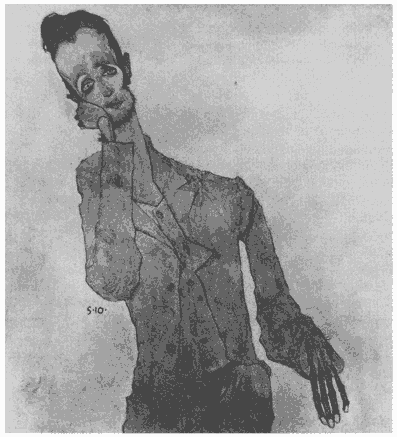
Fig. 9.
Egon Schiele, Portrait of the Painter Karl Zakovsek , 1910, oil and charcoal. Courtesy Galerie St. Etienne, New York.
objects of desire. These hands are emaciated to the bone. The flesh that clings to them has withdrawn to the point of showing the skeleton. If there is any "will to live" in these clinging instruments it is a dying proposition. With their knuckles and nails protruding, long and thin, these hands of the living are the hands of death. They are attached, in turn, to unnaturally extended arms, protruding in paralytic gestures as though the sitters were subjected to arcane rituals of punishment. The left arm of Karl Zakovsek is extended in a crablike bend, resting upon nothing. One of his shoulders is three times as broad as the other, suggesting the pressure of an invisible weight. The remain-
ing, peglike arm props up the head. More dramatic than the arms are the colors and shapes of the eyes and heads. These organs of vision are bulging, puffy, shut tight or transfixed—defiant, dejected, or forlorn. They glare at something distant, perhaps something even beyond the realm of the visible. They peer forth from bodies reclaimed by an "end" they have not yet reached, from faces cognizant of the oppression they cannot stop. The flesh is excessively pale or excessively dark, lacking blood in one case, life-moisture in another. Max Oppenheimer's face is green-yellow, like the children of Rilke's Notebooks , expanding in patches. Each of these subjects is an object, prey to an imponderably malicious, anonymous will.
In other portraits of this year, including many self-portraits, Schiele denudes the body altogether. Gesticulating, grimacing, writhing, or screaming, it seems to be acted upon by foreign and dehumanizing laws (fig. 24). Its veins and muscles burst the skin that contains them, in a manner first developed by Kokoschka. Later paintings personify the culprit, sometimes standing across or behind the main subject. In the self-portraits it tends to peer over Schiele's shoulder, claiming responsibility for the anxiety that haunts him (fig. 25). Elsewhere it embraces mothers and nuns. The children born from such unions have hollow and pallid features, with dark holes for eyes, like stillborns or puppets.
As with Rilke, Lukács, and Michelstaedter, it is difficult to sort out the difference between the psychological, metaphysical, and socio-political determinants of these depictions. Schiele focuses his art on the subjective experience of a psychosomatic deficiency abstracted from its surrounding objects and actions. As is clear, however, from his impulse to allegorize his subjects, something strangely universal is at work in this subjective experience, so universal that it cannot be separated from the objective conditions in which it is clothed. The body as it appears in Schiele is always an image of the historical res , if not of its incoherence, the image of a life riddled with forces it admits that it cannot control. Such an image is possible only after the spirit is reinscribed in the body, or subjects in objectivity, by modern philosophy, psychology, and anthropology. "Behind your thoughts and feelings, my brother, there stands a mighty ruler, an unknown sage—whose name is self. In your body he dwells; he is your body" (Nietzsche 1883–85: 146). By the beginning of the twentieth century, the spirit had been cast as libido, the instincts, or sheer will to power, bearing witness to a buried, impersonal, and autonomous self more sensitive to the creative and destructive forces of organic life than to rational purposes. By 1910
even the ostensible will to live was hardly to be separated from the body's own will to death. (The twenty-five-year-old Sabina Spielrein seems to have been the first to articulate the paradox in the context of professional psychology. Her findings, published under the title "Destruction as a Cause of Coming into Being" [1912], were presented to Freud in 1911 and shaped as early as 1910: "Secretly," she notes on October 19, 1910, "my new study, '2On the Death Instinct' is taking shape within me" [Spielrein 1909–12: 29].)[21]
The paintings of Schiele and other prewar expressionists reveal as much anxiety in the face of the deficiencies of physical reality as the writings of Michelstaedter, Simmel, Lukács, and Worringer. Schiele, too, makes occasional attempts to relate this deficiency to socioeconomics, as in the autobiographical poem "I, Eternal Child," which distinguishes the potential vitality of innermost subjectivity from the living death of commodified, institutional relations:
Some say: money is bread. Others affirm: money is a commodity. Still others: money is life.—Who, however, dares say: Money, are you?—A product? . . . Oh, the lively living thing! (Schiele 1921: 49; Nebehay 1979: 163–164)[22]
Thus philosophical speculations on the deficiencies of everyday life in 1910 find support in pictorial depictions of the sufferings, confusions,
[21] The theories of Spielrein might even help illuminate the suicides of the three women discussed at the beginning of this chapter. "A woman who abandons herself to passion," she claims "experiences all too soon its destructive aspect." There may be something in the way that women love that reveals this love to be inherently at odds with its surface interest. "One must imagine oneself as being somewhat outside bourgeois customs to understand the feeling of enormous insecurity which overtakes a person who entrusts himself or herself unconditionally to fate. To be fruitful means to destroy oneself" (Spielrein 1912: 466).
On Spielrein's anticipation of Freud's theory of the death instinct see Carotenuto 1982: 192, and Marthe Robert, The Psychoanalytic Revolution, trans. Kenneth Morgan (New York: Harcourt, Brace, and World, 1966): 330–331. On the reactions of Freud's Psychoanalytic Society to Spielrein's thesis, see Minutes of the Vienna Psychoanalytical Society , vol. 3: 1911–1918, ed. Herman Nunberg and Ernst Federn, trans. M. Nunberg (New York: International Universities Press, 1967): 330 n. 4; Sigmund Freud, Beyond the Pleasure Principle , in The Standard Edition of the Complete Psychological Works of Sigmund Freud , trans. and ed. James Strachey (London: Hogarth Press and the Institute of Psycho-Analysis, 1953–1974), vol. 18: 55; and The Freud/Jung Letters: The Correspondence Between Sigmund Freud and C. G. Jung , ed. William McGuire, trans. Ralph Manheim and R. E C. Hull. Bollingen Series XCIV (Princeton: Princeton University Press, 1974): 447.
[22] This and other selections of Schiele in English (rendered differently) are included in Egon Schiele, I, Eternal Child: Paintings and Poems , trans. Anselm Hollo (New York: Grove Press, 1985): 6–8.
and anxieties of the body, the most obvious token for the historical determination of the spirit.