
The Congruece of Authority Patterns
The Universality of Authority
To solve this problem, a theory is required that, up to a point, is also a general theory of governmental stability. Since democracy is a special kind of government, it seems plain logic that a theory of stable democracy should consist of two parts, one stating the general conditions that make
governmental stability probable, the other stating the particular conditions required to make democracies stable. These particular conditions should of course be special instances of the more general conditions that produce governmental stability. It may be that no general theory of governmental stability can really be developed, that every kind of government is sui generis in this regard; but at this stage of inquiry we have no reason whatever to think that this is the case. Hence the first proposition of the present theory is in fact a proposition about the stability or instability of any governmental order, whatever its special character. This proposition concerns the nature of, and the relations among, the different authority patterns in a society.
In every society we can discover numerous authority patterns, both attitudes regarding authority and, to use Lasswell's terminology, authority "practices." Certainly this is so if we use the term "authority" in its broadest and most conventional sense, to denote relationships of superordination and subordination among individuals in social formations, relationships in which some members of the formation take decisions and others treat the decisions as binding. In this simple sense of a hierarchy of wills, the state certainly has no monopoly upon authority. It may be quite possible, and even useful, to distinguish between the authority of the state and other kinds of authority; and it is easy enough to define authority in a way that will confine it arbitrarily to the state. But as the term is used here, authority in some form is a characteristic of practically any persistent social aggregate, at least in that certain actual practices of subordination and superordination will be found in such aggregates, and probably also in that there will exist in the society as a whole and in its subunits certain dominant notions as to how such practices should be conducted. Authority exists not only in the state itself, but also in parties and pressure groups, in economic organizations, in various kinds of associations, in schools and families, even in friendships, bands, clubs, and gangs. We can discover it in any set of social relations which, in the not too happy jargon of social psychology, is "cooperatively interdependent"[7] —that is, very simply, not competitive. The only persistent social relations in which we are pretty certain not to find it are "competitively interdependent" relations, like the bargaining relations that take place in a free economic market or in international politics—granted that a certain amount of bargaining can be an aspect of authority relations as well, and a certain amount of authority sets limits to the scope and content of bargaining.
I assert this universality of authority patterns in noncompetitive social relations, not because it is absolutely necessary to my theory to assert it, but because it is a palpable fact. All that is necessary to the present theory, however, is that authority should exist in some social relations other than those of formal government, particularly in those social relations, like the
family or economic organizations, which one finds in any society; and this assertion will surely not be disputed by anyone without some sort of redefinition of authority.
The Idea of Congruence
Stated very briefly, the first proposition of the theory I would suggest is that a government will tend to be stable if its authority pattern is congruent with the other authority patterns of the society of which it is a part . The crucial term in this proposition is of course "congruence," and it needs to be defined, particularly since, as used here, the term is not at all self-explanatory.
Authority patterns are congruent, in the first place (but only in the first place), if they are identical (that is to say, since we are dealing not with an abstract geometric universe but real life, if they very closely resemble each other). An example of congruence in this sense is furnished by the authority patterns in British government and British political parties, at any rate if we accept the standard analyses of the latter by Beer and McKenzie.[8] Both patterns consist of a curious and very similar mixture of democratic, authoritarian, and, so to speak, constitutional elements; this despite the fact that British government can be traced back to the eras of medieval constitutionalism and royal absolutism, while political parties are, in almost every respect, creatures of a much later period, the era of the mandate; and this also despite the fact that the formal constitution of the Labour party makes it seem very different from both the Conservative party and the British governmental structure.[9] In both government and parties, the idea of the mandate is formalized and paid considerably more than lip service, in one case in the House of Commons, in the other in the Annual Conferences. In both cases, however, the leaders actually enjoy long tenure in office and a great deal of autonomy, even though the autonomy of the Conservative Leader rests on formal rules and that of the Labour Leader "merely" on actual practice; in both cases, moreover, the idea of the mandate is contravened by the fact that the leaders are widely expected to govern, in the sense of taking personal policy initiatives and sometimes even acting contrary to opinion in the rank and file. In both cases, too, this autonomy of leadership is mitigated by the expectation—on the part, incidentally, of both elites and masses—that authority will be exercised "constitutionally"; that is to say, that it will be exercised, if not in conformity with written documents, then at least within a framework of widely accepted and well-understood limits and rules, including, for example, the rule that authority inheres always in a collective structure, whether this structure is provided for in a formal constitution, as in the Labour party, or not, as in the Conservative party and the governmental machinery. In addition to these absolutely fundamental resemblances, there are also many less basic, although no less striking, similarities between
British government and parties. For example, both Parliament and the parliamentary organizations of the parties have largely an advisory and exhortatory role in decision-making processes; in both Parliament and the party conferences, the leaders are given certain traditional privileges in debates (they speak longer, for example, and more frequently); in both government and parties, bureaucracy plays an indispensable but subordinate and unusually self-effacing role, even in this age of massive government and massive parties; and, of course, government and party leaders entirely coincide, a fact that the Weimar parties show to be by no means inevitable in a parliamentary system.
The essential patterns of cabinet government, and the essential attitudes on which it is based, thus all have their counterparts in the major British parties. In fact, it has been argued, cogently I think, that cabinet government on the British model compels a certain correspondence between party structure and governmental structure, certainly while a party is in power, and therefore also perhaps while it is in opposition and presumably aspiring to power. Cabinet government could not otherwise work at all on a party basis; hence the anxieties of many English citizens when the Labour party strays, as it infrequently does, from the model of the cabinet system and acts as if it really believed in its formal constitution. But this argument should not be taken to mean that British parties cannot help but have a structure similar to that of British government. "Compel" does not in this case mean "cause." The argument means merely that British government can work smoothly only if such a congruence of governmental and party structures exists, not that things could not actually be otherwise. There are plenty of parliamentary systems in which the same logic holds, but few in which the same congruence can be found.
The most extreme and plainest form of congruence, then, is identity. Mixing metaphors, we might speak in this case of isomorphic authority patterns. But identity cannot exhaust the meaning of congruence when applied to social phenomena, for it is difficult even to imagine a society in which all authority patterns closely resemble each other. Certainly such a state of affairs is impossible in a democracy. Some social relations simply cannot be conducted in a democratic manner, or can be so conducted only with the gravest dysfunctional consequences. Take, for example, those social units which link different generations—families and schools. An infant cannot be cared for democratically, or a child brought up and schooled democratically. Families and schools can be permissive, but this is merely to say that they can be authoritarian in a lax and lenient manner. Families and schools can also carry on a certain amount of democratic pretense, and indeed more than pretense, and when they do so on a large scale, that fact is not without significance; but by and large they cannot carry such simulation and imitation of democracy to very great lengths, if they
are not to produce warped and ineffectual human beings. One of the most basic and indispensable functions in any social system, the socialization function, must therefore always be to some extent out of tune with democratic patterns and potentially at odds with them. The same point applies, almost as obviously, to certain relations among adults. We have every reason to think that economic organizations cannot be organized in a truly democratic manner, at any rate not without consequences that no one wants; and we certainly know that capitalist economic organization and even certain kinds of public ownership (like the nationalization in Britain of industries absolutely vital to the health of the whole economy) militate against a democratization of economic relations. The case of military organizations is even plainer in this regard, and the case of public bureaucracy just as clear. Again, there can be some simulation and imitation of democracy in firms, or public offices, or military units, but only within rather narrow limits. Precisely those social relations in which most individuals are engaged most of the time—family life, schools, and jobs (most kinds of jobs)—are the least capable of being democratically organized. To expect all authority relations in a democracy to be identical would therefore be unreasonable, and we could probably demonstrate the same thing, in other ways, for other kinds of governmental structures. In any complex society, but above all in democracies, we must expect some heterogeneity in authority patterns, even if we deal only with fundamental patterns and not circumstantial details.
In that case, however, one can still speak meaningfully of a congruence of authority patterns if the patterns have a certain "fit" with one another—if they dovetail with, or support, the governmental pattern, however indirectly. One way in which they can do this is by the partial imitation of the governmental authority patterns in other social structures. Democratic (or other) pretenses, if taken seriously and carried far, may have important consequences for the operation of the governmental structure, even though they are pretenses. Furthermore, structures like economic or military organizations may, in some cases, willingly incur certain functional disadvantages for the sake of acting out norms associated with governments in their substantive decision-making processes. For instance, capitalistic economic organizations, which play a great deal at democracy and permit certain deviations from the logic of the double-entry ledger in order actually to carry on certain democratic practices, may be said to be more congruent with democratic government than those that stick closely, both in ritual and process, to the economically most rational practices.
In view of this, we might be tempted to say that authority patterns are congruent if they have, not everything, but something in common. But if the equation of congruence with identity makes demands that are too great, its equation with mere resemblance, however slight, does not demand
enough. On the first basis, we shall almost never find a society in which authority patterns are really congruent; on the second, we shall assuredly not find any in which authority patterns are incongruent. However, by congruence I do not mean any resemblance at all among authority patterns. Where authority relations are not all highly similar, the term refers rather to a particular pattern of resemblance among them, one that makes stringent requirements, but not requirements impossible to fulfill—a pattern of graduated resemblances , so to speak.
To grasp the concept of graduated resemblances, one must think of societies as being composed of segments that are more or less distant from government. Governments themselves are adult structures, and for this reason families, for example, are more "vertically" distant from them, in terms of age levels, than schools, and schools more distant from them than purely adult structures. In the same way, adult structures may be "horizontally" segmented, so that some appear close to, others distant from, government. Parties, for example, ordinarily are situated closer to government than pressure groups; among pressure groups certain types may be particularly closely involved in government or parties; and all pressure groups are located more closely to government than nonpolitical organizations. These are very rough breakdowns; in some concrete cases, moreover, it may be difficult to make unambiguous distinctions, and the same social structures will not always fall into the same positions in every society. But none of this affects the definition: that social authority patterns are congruent, either if they are very similar, or if similarity to the governmental pattern increases significantly as one approaches the governmental segment itself.
On the basis of these explications of the term "congruence," we can now restate the first proposition of the theory. Government will be stable , (1) if social authority patterns are identical with the governmental pattern , or (2) if they constitute a graduated pattern in a proper segmentation of society , or (3) if a high degree of resemblance exists in patterns adjacent to government and one finds throughout the more distant segments a marked departure from functionally appropriate patterns for the sake of imitating the governmental pattern or extensive imitation of the governmental pattern in ritual practices . Conditions (2) and (3) are both, of course, looser and less demanding versions of condition (1); all refer to a basic need for considerable resemblance in authority patterns if government is to be stable, particularly in those segments of society which impinge directly on government. Condition (3) may be regarded, in this way, as the minimum required for governmental stability (and the minimum meaning of congruence), but perhaps the most that can be realized in relation to some particular pattern of government. By the same token, governments will be unstable (and the authority patterns of a society incongruent) if the governmental authority pattern is isolated (that
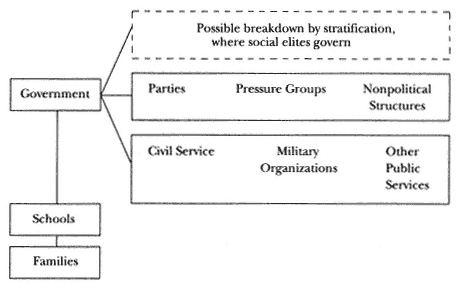
is, substantially different) from those of other social segments, or if a very abrupt change in authority pattern occurs in any adjacent segments of society, or if several different authority patterns exist in social strata furnishing a large proportion of the political elite (in the sense of active political participants). In the last case, congruence with the authority patterns of a particular part of the elite—say, a particular social class—may be quite possible, but congruence with the overall authority patterns of a society is logically out of the question.
Two Examples:
Great Britain and Germany
To make these propositions less abstract, let us look at two concrete cases that illustrate them: contemporary Britain and Weimar Germany.
We have already seen how closely the authority patterns of government and political parties resemble one another in Great Britain and that this resemblance helps to make effective the processes of cabinet government. One can similarly find great resemblances in authority patterns between British government and other aspects of British social life. As one moves away from the governmental segment these resemblances do decline, but never markedly or in a very abrupt manner.
For example, there is a quite striking resemblance in the authority structures of government and pressure groups, a resemblance also required for effective cabinet government, at least in this age of the social service state (as I have pointed out in another work).[10] This resemblance is perhaps greatest in the case of groups constituted almost exclusively for political purposes (that is, in "attitude groups"),[11] but it also exists to a surprising
extent in functional organizations, like professional and economic organizations, which go in for politics only as a more or less important sideline. Among such functional organizations, moreover, the resemblance to government is particularly great in groups most directly involved in governmental and party affairs, for example, trade unions, large-scale employers' organizations, cooperative societies, and the like. It is true that, on the whole, involvement by the group in nonpolitical affairs, such as economic bargaining, tends to decrease resemblance to the governmental pattern. Also, certain nonpolitical activities (for example, economic activities as against those of professional associations) act as inhibitions on too great an imitation of the governmental pattern. But throughout the whole universe of British pressure groups, resemblance to the governmental pattern is quite surprisingly great, even in organizations where, for functional reasons, one would least expect this.
British pressure groups tend to follow more or less closely, but ordinarily very closely, a certain ideal-typical authority pattern, which will immediately ring familiar to anyone acquainted with British government and parties. At the apex of this authority pattern, one usually finds a ceremonial figure who symbolically represents the group, perhaps presides over important meetings, and makes solemn speeches, but occupies a largely ritualistic and honorific position—although in a few cases ceremony and "efficiency" may be combined, as it is also in the leadership of the Conservative party. Under this figure, there generally is a council or executive committee, a collective body that usually exercises the real decision-making power, at least so far as higher decisions are concerned; more often than not this body is dominated, despite pretenses of collective decision making, by its chairman and a small handful of especially powerful members. Under the council, one generally finds a large number of other collective bodies—functional committees—with overlapping memberships; the dominant roles on these committees are played by the more powerful figures on the council. The functional committees and council are formally considered "responsible" to large annual conventions (a conference, or representative meeting, or whatever it may be called), which are always supposed to exercise the ultimate decision-making power, but generally act only as bodies acclaiming the leaders, occasionally criticizing them, and very infrequently making substantive contributions to policy; nevertheless, the leaders take care not to deviate too far from the public opinion of the convention and at the very least put up a show of responsiveness to the rank and file. Finally, there are a number of paid, full-time officials, a secretary and the assistants, who administer the organization's activities, play an extremely important role in regard to all affairs and an all-important role in regard to routine business, work closely and unobtrusively with the chairman and other important council members, generally get their way,
but know when to stay in the background and when not to press their views. Throughout this structure operate norms typical of all public authority in Great Britain: that decision making must be carried out by some sort of collective leadership, which is both responsive to the mass of the organization and, to a large extent, autonomous of it, which is expected to behave according to some sort of code well-understood in the group but normally not explicitly defined, and which, although resting to some extent on an elective basis, enjoys great tenure of office, often for as long as the leaders want to keep their positions.
In short, in the typical British pressure group we find the same mixture of basic authority forms that characterizes British government and parties, as well as imitations of less basic British authority practices, from the ubiquity of committees to ceremonial headship. This resemblance of the pressure-group pattern to the governmental pattern even extends to very minor matters, such as styles of debate at the annual conventions (directing remarks at the presiding officer, referring to other speakers in a florid and impersonal fashion, rarely delivering set speeches), or ways in which motions are introduced and processed, or ways in which orders of speakers are determined. We find this pattern, in almost every aspect, in a professional association like the British Medical Association,[12] in a trade union like the National Union of Teachers, and in an employers' organization like the Federation of British Industries.[13] Names may differ—the B.M.A. has an Annual Representative Meeting and a Council, the N.U.T. a Conference and an Executive, the F.B.I. an Annual General Meeting and a Grand Council—but the substance is the same, in structural forms and in actual practices.
In nonpolitical adult organizations, from friendly societies and clubs to business organizations, smallness of scale and functional considerations generally lead to significant departures from these forms and practices, but in the vast majority of cases one finds in these organizations at least a great deal of imitation, if only as ritual, of the governmental pattern. Even small-scale neighborhood clubs, like the many lawn tennis and social clubs that dot the landscape of middle-class England, generally have their committees and secretaries, their relatively inconsequential elections and stable oligarchies, their formalities, petty constitutionalisms, and ritualistic annual meetings; and still more is this true of larger clubs and friendly societies, like the famous snob clubs of Pall Mall and that holiest of holies, the Marylebone Cricket Club. It may be easier in such small organizations for elites to maintain themselves in authority, and also for members to participate in decision making, if they wish, but the essential forms and actual patterns of authority do not differ very much from the great political associations.
In business organizations, greater departures from the typical pattern
occur, but even in such organizations there is usually some acting out of the governmental forms (most conspicuously, much reliance on committees, both on the level of management and among workers). In business organizations, however, congruence with the authority patterns of the political organizations may be found mainly in seemingly inconsequential patterns of behavior, some of which have driven countless American efficiency teams, taking as their frame of reference behavior strictly "rational" in economic terms, to uncomprehending distraction—such as the tendency of British executives to keep civil service hours, and above all their tendency to carry on endless consultations instead of reaching quick and independent decisions. The general tone of relations among bosses and workers is also relevant here, although this is a matter difficult to deal with very explicitly. The typical British boss, like any other boss, is an authoritarian figure, but he is rarely an overbearing tyrant or a stern taskmaster. More often than not, he is a paternalistic authoritarian, in the general style of the British upper classes in relation to the British lower classes. It would not occur to him to be on intimate terms with his workers. Neither would it occur to him that his position might entitle him to treat his workers in an insulting manner, or to claim special privileges over them outside of the business organization, or that his functionally specific authority might extend to other aspects of his workers' lives,
Business organizations depart to a rather great extent from the governmental pattern, not only for obvious functional reasons, but also because of a fact just touched upon: they bring into close relation members of the upper and lower social classes. Wherever this occurs in British life, the authoritarian elements of the authority pattern tend to become enlarged and the democratic elements diminished. This is so not only in relations between economic bosses and their workers, but also between domestic servants and masters, enlisted men and officers, and members of the Administrative Class and other classes in the civil service. While all of these relations are governed by a high sense of propriety and functional limitation (by constitutionalist norms), those among members of the higher levels tend to be quite surprisingly democratic, or at least consultative and comradely; here again we might note the ubiquity of committees at every conceivable level in the higher civil service, the unusual use of staff committees in the military services, and the easy relations among officers of all ranks in military regiments, especially in elitist regiments like the Guards. But between members of the Administrative Class and their underlings, officers and their men, managers and their hired help, relations are highly nonconsultative and certainly not comradely; the observance of propriety and functional limitations in these cases is complemented by a considerable separation of individuals from each other, a general lack of contact among them for purposes other than functional ones.
All this is quite in keeping with a governmental pattern that is as markedly elitist as the British. In general, the governmental authority pattern is conformed to most in Britain in relations among members of the upper classes; it is conformed to less in relations among members of the lower classes and least in interclass relations. In other words, the more important the role in government that members of a social stratum are likely to play, the more their relations tend to be molded in the governmental pattern; and this is just what one would expect in a system like the British.
British schools and family life are at least partly responsible for this state of affairs. Family life in the lower strata is much more authoritarian than in the upper strata; there is less reasonableness, less consultation, less courtesy, less formality, more punishment, and more arbitrariness. Although even in the lower classes we can find no counterpart of the menacing paterfamilias of certain continental European families, the matriarchs whom Young and Willmott found in Bethnal Green or the arbitrarily despotic fathers depicted in working-class novels,[14] like those of Lawrence and Sillitoe, have no upper-class counterparts. The same thing applies to schools. A marked change of atmosphere occurs as one moves from the secondary modern and technical schools to the grammar schools and public schools, especially the latter. Of course, even on the upper levels, British schools, like British government itself, tend to be rather authoritarian—more so, certainly, than schools in the United States—but relations among masters and pupils involve also a great deal of rather formalized good fellowship (in school games, for example) and a strict adherence to well-defined codes of conduct, while behavior among pupils is modeled to a remarkable extent on the political system. A case in point is described in Duff Cooper's book of memoirs, Old Men Forget . In Cooper's days at Eton, and possibly still today, debates were conducted in a manner obviously a carbon copy of House of Commons procedure, even though political questions were never discussed. A motion would be introduced, and any one of the students attending ("the House"!) might be called upon to captain the discussion; prior to "business," questions would be asked as in the Commons, and boys referred to one another as "honorable members" rather than by name. Not always do we find quite such faithful copies of governmental patterns in the higher educational institutions, but the governmental style is noticeable in almost every case; indeed, British politics has a readily recognizable style precisely because politicians are brought up to it practically from the time they wear rompers. Again, this is not to imply that relations among public school boys or grammar school boys are remarkably democratic or egalitarian; it would be absurd to call the prefect systems of British schools egalitarian. But then neither is British government remarkably egalitarian. And British schoolboys do enjoy an unusual degree of freedom from the direct supervision of their elders, a
great amount of self-government, even though it is self-government modified by relatively well-defined authoritarian relations among themselves.
British life thus illustrates the congruence of social authority patterns in all its aspects and degrees. There is a great resemblance between the authority pattern of government and those most closely adjacent to it, parties and pressure groups. Between government and those authority patterns that least resemble it intervene authority structures that are to a fairly large extent like the governmental structure. At no point in the segmentation of British society is there any abrupt and large change in authority patterns, and throughout one finds at least some imitation of governmental forms. And resemblance to the governmental pattern is greater in elite structures than in those of the nonelite. This does not validate the present theory, but it does support it in the case of perhaps the most stable of all modern political systems.
For support from the opposite end of the spectrum, we might look at one of the least stable of all modern governments, the Weimar Republic. How did the authority patterns of interwar Germany differ from modern Britain? Basically, in two ways. On the one hand, the German governmental pattern was much more one-sidedly democratic, at any rate if we confine analysis to the level of parliamentary representation and decision making and do not take into account the instrumental adjuncts of government, bureaucracy, the military, and the judiciary. On the other hand, social life, including life in parties and political interest groups, was highly authoritarian and relatively little "constitutionalized" compared with Britain. Not only were society and polity to some degree incongruent; they existed in unprecedented contradiction with one another. And on the basis of the theory of congruence, in consequence, the Weimar Republic could only have been what indeed it was: nasty, brutish, and short-lived—unless, like the Third Republic, it had been more lucky than any political order can expect to be.
Democracy, in interwar Germany, was, for all practical purposes, isolated at the level of parliamentary government, but at that level it was organized in an almost absurdly pure and exaggerated manner. Weimar Germany was governed by a Reichstag chosen on the basis of universal suffrage and by means of one of the purest systems of proportional representation ever devised. The chief of state was a plebiscitary president, and an effort was made, through run-off provisions, to assure that he would have the support of an absolute, not merely a relative, majority. Ministers were easily removable both by the popularly elected Reichstag and popularly elected president, and government was conducted on the basis of a very lengthy and detailed bill of rights. The Weimar constitution was proclaimed in its day as the most perfect of all democratic constitutions, and for good reasons.
This unalleviated democracy was superimposed upon a society pervaded by authoritarian relationships and obsessed with authoritarianism. In his study of interwar German films, From Caligari to Hitler , Siegfried Kracauer has pointed out that a morbid concern with despotism, with raw power and arbitrary will, was a characteristic alike of reactionary and revolutionary German films, most obviously in films like Caligari, Waxworks, Dr. Mabuse , and Mädchen in Uniform . That the Germans should have been deeply preoccupied with naked power, large and petty, is hardly surprising in a society democratized on its parliamentary surface, but shot through with large and petty tyrants in every other segment of life. Compared with their British counterparts, German family life, German schools, and German business firms were all exceedingly authoritarian. German families were dominated, more often than not, by tyrannical husbands and fathers, German schools by tyrannical teachers, German firms by tyrannical bosses. Insolence, gruffness, pettiness, arbitrariness, even violence were so widespread that one could certainly not consider them mere deviations from normal patterns. In a sense, throughout the whole of German interwar society one finds authority patterns that in Britain are confined to the nonelite strata, but even among the lower classes in Britain authority relations are not quite so arbitrary or so unrelenting as they were in Weimar Germany, nor afflicted by such omnipresent intimations of violence.
Families, schools, and occupational contexts are the most basic (that is, the most absorbing and demanding) segments of life, and the patterns existing in them are bound to affect all other social relations. But perhaps a high degree of authoritarianism in these patterns would not matter from the standpoint of democratic government if there were interposed between them and government certain institutions having mixed authority relations—institutions that might mediate between the pervasive despotism of the primary segments and the pure democracy of government, so that individuals would not be tossed abruptly from stark domination in one segment of life to stark liberty in another. But nothing remotely like this was the case in Weimar Germany. Political parties in imperial Germany had served as the principal model for Michels's iron law of oligarchy, and their internal political characteristics persisted in the Weimar period; at a later date, German political parties served as the chief illustration for Hermens's argument that proportional representation with the straight list system inevitably makes for a highly centralized and oligarchical party structure. Associational life in Weimar Germany presents, if anything, an even sharper contrast with Great Britain. Quite apart from the fact that the great interest groups were intimately involved in the party system—every major interest, economic, religious, or sectional, had a party of its own—the main associations offering men opportunities for escape from loneliness or from the primary social relations were extraordinarily au-
thoritarian in structure. Germany was not a country of hushed snob clubs and demure whist drives, of jolly good fellowship and darts in the public bar, but a country of paramilitary organizations, trade union militants, beer hall conspirators, grimly serious Turnvereine and systematically joyful Gesangvereine . This, of course, is something of an exaggeration. Not all German associations were highly authoritarian in structure, and we have reason to think that there were important differences among the various regions of Germany in this regard—southern Germany, for example, being on the whole less monotonously authoritarian than northern Germany. But while any simple picture of any complex society will exaggerate and overemphasize to some extent, the essential picture of pervasive authoritarianism in German secondary associations given here probably does so relatively little. At the very least, we can say that life in German associations was much more authoritarian than it is in the great majority of democracies. Associations thus formed no bridge between government and the primary and occupational groups; if anything, they formed a barrier to their reconciliation. Certainly it is in organizations like the Stahlhelm , or the Freikorps , or the SA and SS, that we find the greatest contrast to the pattern of plebiscitary government.[15]
The same argument applies to the instrumental appendages of the parliamentary system, the civil and military service. Just as the imperial German parties had inspired Michels's theory of universal oligarchy, so the Prussian civil service, which persisted in form and to a large extent even in personnel under Weimar, had served as the chief model for Weber's ideal type of bureaucracy, with its emphasis upon "hierarchical subordination" and "the distinct social esteem" of the official. To these characteristics, which are by no means found in anything like pure form in other modern countries (e.g., Britain), we might add another that innumerable works on German bureaucracy have remarked upon: its recruitment from the more authoritarian elements in German society and its open sympathy, throughout the Weimar period, for reactionary and authoritarian movements.[16] As for the military, so frequently has the antagonism of its patterns and attitudes to the Weimar system been pointed out that nothing more need be said on this subject.
We have in the case of the Weimar Republic a government violently contradictory to all nongovernmental aspects of life. However, it would not be strictly accurate to say, as so many have said, that the Germans were simply thoroughgoing authoritarians who just had no use for political democracy, that in Germany governmental democracy was imposed upon a country that provided no basis at all for it, so that the first talented and lucky authoritarian to come along could easily demolish the whole structure. There is every reason to think that the great majority of Germans were convinced democrats during the Weimar period and even before—
in their attitudes toward government. Imperial Germany was one of the first countries to have universal suffrage, and the fact that prodemocratic, liberal, center, and socialist parties consistently won somewhere between 80 and 90 percent of the vote in elections before World War I is therefore a matter of some importance. This voting pattern, furthermore, continued under the Weimar Republic right up to the ill-starred elections of the early 1930s; the right-wing Nationalists (the DNVP), the party that best fits the stereotype of the unmitigatedly authoritarian German, rarely polled more than 10 percent of the vote. Consequently, when one says that there was no basis for democracy in interwar Germany, one says something much more complicated than that Germans did not really want a governmental democracy. One says that Weimar Germany could provide no proper basis even for a governmental system that the great majority indeed wanted, while imperial Germany, ironically, did furnish a proper basis for a type of government the great majority did not seem to want. Had the German taste for authoritarianism been absolute, the Germans would probably have constructed after World War I a much more stable, though not a purely democratic, government. The trouble was not that the Germans were so one-sidedly authoritarian; the trouble was rather that they were—and perhaps had always been[17] —so remarkably two-sided (i.e., incongruent) in their political beliefs and social practices. Profound ideological commitment to governmental democracy is not a sufficient basis for stable democracy; in fact, it can be worse, in the long run, than a more qualified commitment to democracy.
One more point regarding the incongruities in Weimar authority patterns may be worth mentioning. Although the constitution of the Weimar Republic was democratic to an unprecedented degree, it did contain some authoritarian elements. The executive, as in Britain, was given an unlimited power of dissolution; and under Article 48, the article that played such a villainous role in the legal destruction of German democracy, the president, with the cooperation of a chancellor appointed by himself, could wield enormous emergency powers, including the virtually absolute suspension of civil rights and a nearly unlimited power to govern by decrees. But these authoritarian elements of the constitution were reserved for particular periods when regular parliamentary processes no longer operated; contrary to the British case, they were not built into the everyday management of government. They were no part of the normal pattern of governmental authority. The constitution really left nothing to choose between absolute democracy in "normal" times—rare enough in the Weimar period—and an absolute lack of it in times of crisis. As a result, government was carried on not only in contradiction with society, but even in a son of contradiction with itself; periods of pure parliamentary democracy alternated at a rapid rate with periods of practically unchecked
executive dictatorship, much as in the last years of pre-Fascist Italian democracy and during the 1930s in France.
Motivational Basis of the Theory
In addition to the fact that it seems to fit the most unambiguous cases of stability and instability, the theory of congruence has, prior to any concerted testing, one other important point to recommend it: it leads one immediately to the motivational (or psychological) links between the variables it relates. This is important. Any generalization about human behavior obviously lacks an important element of plausibility if it makes no sense in terms of what we know about human motivations. Conceivably societies may involve certain purely mechanical relations that require no motivational explanation at all, but follow simply from the fact of interaction, whatever may underlie it; but even theories about competitive interdependence seem always to proceed from particular views of probable human conduct. In any event, to ask why certain relations exist in social life is always to ask what there is about one state of society that induces behavior leading to another.
Such motivational connections between different aspects of social life are by no means easy to see whenever one finds a positive correlation between social variables. Take the correlation between democracy and economic development. A positive relation of some sort seems to exist between the two, but why exactly should it? The only link which readily suggests itself is that a high degree of economic development leads to a high degree of economic satisfaction and thus reconciles people to their condition of life, including their government. But this does not tell us why it should reconcile them particularly to democracy, and, what is more, militates against the obvious fact that economic satisfaction is always relative to economic expectations—expectations that might conceivably outstrip any rate of economic growth and any level of economic development. This is not to say that there is no link between democracy and economic development at all, but only that the motivational link between them is not readily apparent from the correlation itself and probably very indirect, if indeed it does exist.
The motivational basis of the theory of congruence, however, is quite readily apparent. This is due to the fact that the conditions described by the term "incongruity" are very similar to the conditions denoted by two other concepts of social science that, appropriately enough, denote both certain social conditions and certain psychological states or propensities to act: the closely related concepts of anomie and strain.
Anomie exists, in its purest form, whenever there is a complete breakdown of a normative order governing action, when individuals lack clear and commanding guidelines to behavior, do not know what is expected
of them, and are thus compelled to rely solely upon their egos, their "rational" calculations, to inform their conduct. Anomie, in this sense, may be more or less acute and more or less widespread in a society; it may extend to few or many, important or unimportant, phases of life, and it may be found in society generally or only in certain of its members. It is always disturbing, but becomes, in its more acute form, unbearable; the actual responses to it depend, however, not only upon its acuteness but also upon the extent of its diffusion throughout a society. At its less acute levels, it manifests itself in merely annoying, possibly even constructive, anxieties, and the resort to perfectly innocuous means of relieving them. But in its more intense forms it has been linked, on the individual level, with serious functional disorders (even suicide), and, on the social level, with mass movements in general, particularly movements of religious fanaticism and political movements of a chiliastic and highly ideological character—in general, with movements that provide people with a sense of orientation, a sense of belonging to a bearable social order, or merely with the opportunity for escaping from the dilemmas of everyday life or submerging themselves in some comforting collectivity.
Anomie may result from many conditions. In individuals, it may be the result of inadequate socialization, or rapid mobility from one stratum of society to another, or transplantation from one culture to another, or indeed any important change in one's condition in life. In societies it may result from any social change (especially rapid change) requiring important adjustments in conduct, or from a widely successful attack upon traditional norms, or from large-scale mobility.
Among these many conditions that can give rise to anomie, the condition of "strain" is perhaps the most common in any complex society. "Strain" is used here in a technical sense; it refers, not to the utter lack of settled guides to behavior, or to ambiguous norms, but to ambivalent expectations—that is, the coexistence of different, perhaps even contradictory, norms of conduct in regard to a particular set of actions or an individual's actions in general.[18] We may speak of strain whenever people are expected to conform to different, but equally legitimate, norms of conduct—as, for example, when an individual simultaneously performs some roles involving universalistic norms and others involving particularistic norms, or some roles permitting affective responses and others demanding affective neutrality; and strains are of course particularly acute if a single role makes contradictory normative demands. Strain thus exists for a doctor who is sexually attracted to a patient.
Incongruity between the authority patterns of a society, like any other incongruity among social patterns, is an obvious source of strain, and through strain of anomie, and through anomie of behavior potentially destructive to the stability of any pattern of government. This seems ob-
vious; yet one cannot let the argument go at that. Conflicting expectations inevitably exist in any highly differentiated society, and are perhaps given in the very nature of the human condition, for human beings are inherently multifaceted. One can no more imagine a bearable existence that is utterly devoid of affect than one that consists only of emotional responses; pure and complete universalism is unattainable, people being what they are, and pure and complete particularism leads to chaos and gross inefficiency in any kind of social life. It is not, therefore, the simple absence of strains that distinguishes an integrated and stable society from one that is unintegrated and unstable, but rather the successful reduction and management of strains that can never be eliminated. How then can strains be "managed," in order to prevent them from leading to acute anomie?
Perhaps the only reliable way is through the institutionalized segregation of roles—through preventing one role as much as possible from impinging upon, or even being mentally associated with, another, if the other makes conflicting normative demands. Such segregation of roles is in fact a feature of any society that is functionally differentiated to a high degree; it may be physical (note, for example, the fact that the doctor's office and domicile are generally separate) or psychological—that is, achieved only through the widespread mental disjunction of particular roles. Why then should not incongruities in authority patterns be similarly manageable through segregation? Why should it matter, for example, that authority is strong in one context and weak in another?
A number of things need to be said about this issue. First, the theory here sketched does not assert that any disparity among authority patterns is disastrous; it only asserts that disparities of a particular kind and degree have fatal consequences; I have already argued that the very notion of congruence encompasses certain kinds of disparities. Some disparate authority patterns can be tolerated well enough—anyway, without serious anomic consequences; the argument here is that incongruent patterns cannot be tolerated, partly because they are, by definition, patterns in which disparities are particularly stark and great, and partly because strains arising from incongruent authority patterns are not alleviated by "intermediate" patterns that help to reconcile the starkly disparate patterns in relatively distant segments of society. In any case, no one would argue that all strains can be managed equally well; and, obviously, the greater the strain, the more unlikely it is to be successfully managed.
Another point to bear in mind is that managing a strain is not the same thing as abolishing it; when we manage strains, we merely reduce them to a tolerable level, or, without reducing them, in some way accommodate ourselves to their existence. The strains, however, persist, and may at any time lead to behavior modifying the social relations that give rise to them. What is more, certain kinds of strains are hard to reduce or tolerate, and
strains among authority patterns, in my view, are of this type. The reason is precisely that authority relations are nearly universal in social relations, aspects of almost every social role, a fact that makes it inherently difficult to segregate authority patterns from one another. Whether a person is acting the role of parent, teacher, boss, or politician, that individual is almost always in some context involving authority; the operation of authority is one of the more inescapable facets of life. Not so for an individual playing both the affective spouse and affectively neutral professional, or both the particularistic parent and universalistic boss. In these cases, not only the structures but the functions also are different. There is, in other words, a crucial difference between performing different functions in different ways and performing the same function in different ways; conflicts of the latter son obviously impose incomparably the greater psychological burden. Imagine, on the one hand, doctors who are expected to take a coldly scientific attitude toward their patients and a warmly unscientific attitude toward their spouse; imagine, on the other, doctors who are expected to administer only to their wealthy patients but wash their hands of others, or who are supposed to help friends and kin but let strangers suffer, or to alleviate the pains of adults but not those of children. In the latter cases strain is bound to be the more severe, whatever grotesque value system might be used to legitimate such behavior—and functioning in incongruent authority relations is like the latter cases rather than the former.
This is not to say that an individual cannot rule in one context and be ruled in another. Although such a duality of positions does create strains which, apparently, are unmanageable by some people, most of us do just that most of the time. The question here is one of operating in conflicting authority patterns, not of occupying different positions in similar authority patterns. When one is subordinated in one pattern of authority, one may in fact learn very well how properly to be dominant in a similar pattern of authority, but being tossed back and forth among radically different authority patterns is another matter.
To some extent, however, it may be possible to segregate even very disparate patterns in the performance of the same or similar roles through highly rigid institutionalization. The likelihood of this is small, but not absolutely zero. Human ingenuity in ridding life of strains, or in creating the delusion that strains do not really exist, is very great. Political science itself furnishes a striking example of how far such delusions may go, in the long-held, and still carefully nurtured, belief that authority is characteristic only of the state, not of anything outside the state. This belief is quite modern in origin and has been dominant mainly in the liberal West. Why has it been dominant there? Has it become established only because of the development of political science departments in search of
some subject matter entirely their own? Or because of the effects of the theory of sovereignty? Or because of the gradual development of functionally differentiated, specialized structures of government? Or is it really a delusion that keeps liberal democrats from having to face up to the inevitable lack of real democracy in nongovernmental phases of social life? On the face of it, the notion that authority is a property solely of the state is so absurdly untenable that the compulsions making for it among eminently sensible people must be very great indeed. And that lends credence to the view that the notion performs neither an academic, nor a legal, but a psychological function: that it helps preserve the myth of democracy by keeping people from having to face up to, and incorporate in their political theories, uncomfortable disparities between governmental and nongovernmental life. In this connection, note that it has been mainly those out of sympathy with classical democratic ideas who have maintained a different position: pluralists, like Laski and Cole; Marxists, most obviously; and power theorists, like Lasswell and Michels.
Undoubtedly, individuals are able—and must be able—to make bearable, by all sorts of devices, even the most crushing strains. Under one condition, however, we can be sure that the chances of successful role segregation are not merely small, but practically zero: if nongovernmental social relations are themselves highly politicalized—that is to say, if they are greatly concerned with governmental politics. One of the characteristics of life under the Weimar Republic was that social formations, in addition to being extraordinarily authoritarian, were concerned, to an extraordinary extent and with extraordinary fervor, with matters of government; many voluntary societies—even some of the least of gymnastic or choral groups—seemed to have some sort of governmental ideology, or even some affiliation with political parties or movements. Where this is the case, it is obviously much more difficult, indeed impossible, to segregate discrepancies in expected behavior, for the simple reason that government itself cannot then appear as a segregated social context. And in a democracy some politicalization of nongovernmental life is always unavoidable, even necessary; how otherwise could there be any political competition? Democracy presupposes, at the very least, some organized party life, and party life tends to draw into politics all sorts of other social units; it diffuses governmental politics throughout society, now more, now less, but always to some extent, and thus makes the management of strains by role segregation particularly unlikely.
My purpose here is not to show that strains arising from incongruent authority patterns cannot be managed or tolerated under any circumstances. Rather it is to show that, among the manifold strains of life in a complex society, such strains are unusually, perhaps incomparably, difficult to manage, so that it seems logical for people to try and cope with them
by reducing them at the source, that is, ordinarily, by changing the governmental patterns under which they live. Even if this is not granted, however, one fact is surely beyond doubt: societies possessing congruent authority patterns possess an enormous "economic" advantage over those that do not. In the more extreme cases, like Great Britain, individuals are in effect socialized into almost all authority patterns simultaneously (even if they belong to the nonelite strata), while in highly incongruent societies people must repeatedly be resocialized for participation in various parts of social life. For society, then, congruence in regard to authority patterns, at the very least, saves much effort; for individuals, it saves much psychological wear and tear resulting from uncertainty and ambivalence. In that basic and indisputable sense, the congruent society starts with a great advantage over the incongruent society; and we have many reasons to think that it enjoys greater advantages still.
If it is true that incongruities among authority patterns can be reduced only at the source (in democracies, and perhaps other systems of government as well), and if it is true that such incongruities are particularly hard to bear, then all sorts of things that are otherwise mysterious become more comprehensible. To cite only one example: perhaps these points explain why in totalitarian systems such massive efforts are made to accomplish seemingly trivial, even self-destructive, ends, particularly efforts to reshape all social relations, from the family up, in the totalitarian image—or else to destroy them. "What rational balance sheet," asks Inkeles, speaking of early Soviet attacks on family and church, "would have led a group of leaders who were concerned first and foremost with preserving their power to attempt that particular diversion of energy with its obvious consequences of social resentment and popular hostility"?[19] His own solution is that the Soviet leaders' actions can be explained only by their messianic visions of an utterly transformed society; the theory of congruence, however, provides a still more logical explanation, even if it was only felt in some intuitive way, not grasped in the sense in which it is stated here, by Soviet leaders.
But the subject here is democracy, not totalitarianism; and for the analysis of democratic government another important deduction can be made from the proposition that strains due to ambivalences in authority patterns can be relieved only by reducing the ambivalences themselves: there must always be some strains among authority patterns in a democracy. Such strains will be nonexistent only if a society's authority patterns are identical, a condition quite unrealizable in a democracy, as we have seen. Obviously, however, they can be kept at a relatively low level if the society provides sufficient opportunities for learning patterns of action appropriate to democracy (if, that is, a good many of the authority patterns in a democracy are significantly democratized); and this will be all the more the case if the
more congruent patterns are directly associated with government or involve mainly interactions among the political elite. And there is also a second possibility: strains might be kept within tolerable limits in democratic governments which have certain characteristics rather than others—there are, after all, many varieties of democracy.
This is a subject better dealt with under the second theory we require, a theory that specifies the particular conditions which must exist if democracy, rather than government in general, is to be stable.