
PART III
INTERPRETATION
Chapter 7
Relations of Interpretation
Whoever hath absolute authority to interpret any written or spoken laws is he who is the lawgiver to all intents and purposes and not the person who first wrote or spoke them.
Bishop Hoadley[1]
The Mufti of Ibb
Men begin assembling in the semipublic upstairs sitting room in the Ibb mufti's house shortly after lunch. Some plan to settle in for an afternoon of qat chewing, others intend only to see the mufti briefly and then leave. They sit on mats or mattresses at floor level and lean on individual armrests with their backs supported by cushions lined up along the wall. Light enters the room through two large windows set low in one of the whitewashed walls. A simple wooden chest placed before sitting cushions marks the space to be occupied by the mufti.
Descending from private top-floor rooms, the mufti enters the sitting room, carrying his own bundle of qat and wearing indoor attire consisting of a white skullcap and herringbone vest over a long, pure-white gown buttoned up to his neck. His dagger, in its elaborate metal sheath and embroidered dagger belt, his scholar's turban, and his long outer coat and shawl are left hanging on a hook upstairs. He is a tall and physically strong man in his sixties, but both his sight and his hearing are weak, and he wears thick glasses and a hearing aid. Without ceremony he steps over the wooden chest on his way to his accustomed sitting place. Adjusting his spittoon and thermos of water, he begins to select leaves to chew; the shared hose of the water pipe is passed to him to smoke. The scene is much the same as in many other afternoon qat sessions in progress around the town, including those at judges' houses.
Aside from breaks associated with the two main ritual breaks of the lunar calendar and with the fasting month of Ramadan, the level of activity in the mufti's sitting room is geared to the annual agrarian
cycle. As is true at the courts, harvesttime in late autumn is a slack period for the mufti. Many of the ten or so men who gather on a given afternoon are from rural districts, cultivators of the small curved terraces that rise in steps up the steep mountainsides of the southern highlands. This is indicated by their loosely wrapped cloth turbans, soiled and open shirts, rough cracked hands, and bare feet. When one of these "tribesmen" enters after the mufti has taken his place, he will utter an initial greeting at the door and then advance across the room to where the mufti is sitting. Unlike most townsmen, who are apt to shake hands, he stoops abruptly and endeavors to kiss the mufti's hand and knee.
Some men come to the mufti for his assistance in settling disputes out of court. In acting as an arbitrator the mufti steps out of his official role as mufti. "We are in your hands, decide between us," is the formula of this sort of request. Other uses of his legal expertise also are outside of his official work. For some he acts as a notary (katib ) who prepares written legal instruments. Although he would never appear for a client in court as a legal representative (wakil ), he does write claims, responses to claims, and appeals of decisions for his clients to present in court. In addition to his primary work of delivering opinions known as fatwas , there are other categories of legal activity in which he engages in his capacity as mufti. Both rural and town people come to him for legal evaluations of physical injuries (arsh ) (see fig. 8). Occasionally, he adds his signature to attestations of poverty or of incapacity presented by individuals seeking entry onto the public charity rolls, or he is asked to countersign a legal instrument.
But the main activity of the mufti is the writing of fatwas. A fatwa is the mufti's response to a question. Questions are posed in writing, by those who can write for those unable to, and usually by men for women, using such simple formulas as "what is your opinion about . . ." and the matter is stated, or in conclusion, simply, "give us a fatwa" concerning the matter. On the same piece of paper, usually in the space left above the question, the mufti writes his jawab , his answer, which is the fatwa, concluding with the formula "God knows best" and his signature.
For a mufti's questioner, obtaining a fatwa is an information step, taken either to regulate the individual's personal affairs or with litigation or some other form of settlement in mind. Questioners appear as individuals, not in adversarial pairs; posing a question to a mufti and receiving his response is not a judicial procedure like that in a judge's
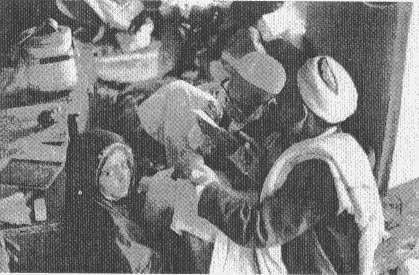
Figure 8.
The Ibb mufti writes an evaluation of a cut on a young girl's face, 1976.
court. Also, in Yemen, fatwas are not presented in court cases.[2] Without being binding a fatwa authoritatively provides the fatwa seeker with a legal rule relevant to the matter in question. Fatwa in hand, the questioner is free to arrange his or her affairs accordingly or to seek redress if wronged.
While virtually all Yemenis these days use fountain or ballpoint pens, this mufti continues to use an old-fashioned carved reed pen (shizza ), which he dips repeatedly in an inkwell. His fingers are long and smooth, accustomed to the discipline of this instrument. Papers are held not against a desk but between the base of his writing hand and that of his left hand; as he writes two fingers of his left hand glide along the back of the paper to meet the pressure of his pen. When he is finished writing, he gives the paper back to the questioner. No record is made, and the mufti has no secretary. While the mufti is paid as a matter of course for writing legal instruments and in dispute settlement, he does not always accept money for fatwas, or if he does, it is a very small sum, considered a gift rather than a fee. In his capacity as mufti of Ibb Province,[3] a title he has held since shortly after the Revolution of 1962, he receives a government salary through the local branch office of the Ministry of Justice.
When a question is posed, the mufti's response is always immediate. Far from pausing to refer to a legal manual or, seemingly, even to reflect, he answers all questions without hesitation. This is remarkable in view of the range and complexity of the questions he receives. In general terms, the fatwas he issues may be classified into marriage and divorce matters, inheritance and pious-endowment questions, other property issues, and miscellaneous. This last category includes the occasional fatwa sought about a-ritual detail. The prayer leader from the mosque next door, for example, once came to the mufti's sitting while I was present to ask about the fine points of timing for the first call to prayer of the day. Fatwas concerned with support payments connected with divorce and estate divisions require calculation (as do wound evaluations). Part of this mufti's academic formation, however, is in the subjects of arithmetic (hisab ) and the law of inheritance, both of which he taught at the Great Mosque in Ibb before the Revolution.
Questions connected with marriage conflicts are the most common type currently (1975–1980) asked. Aside from common questions about such matters as the validity of the threefold statement of divorce, the mufti received many questioners whose lives were influenced by the large-scale migration of Yemeni men to Saudi Arabia for work. Many marital legal problems are connected with the absence of husbands. In estate-related questions, many individuals want to know which relatives are heirs of a deceased person and what share each should receive. A significant subset of these fatwas deals with problems concerning endowments, especially of the type associated with descent groups. There are fatwas on such issues as the exclusion from endowment-revenue distributions of an out-marrying woman's descendants, in favor of descendants in the direct male line. Others deal with attempts to sell inalienable endowment property or problems with their supervision. There are also fatwas dealing with the invasion of property rights, or with whether an individual is allowed to retract a sale or exercise a right of preemption. For preemption matters this mufti now refers his questioners to a rule established by the Ministry of Justice.
Three queries and their associated fatwa-responses will serve to illustrate the Ibb genre. Concerned respectively with marriage, inheritance, and property rights, these texts appear concise and implicit in translation. Queries are often poorly phrased or confused, and fatwas often must be explained to their recipients. Sometimes the formulation of the question represents a simple description of circumstances as best they are understood; other times it embeds a stratagem the questioner wants
to have evaluated. Further explication, which I do not attempt here, would require background on the particular conflicts and an excursus into such matters as doctrinal rules and customary practices concerning marriage, guardianship, and the structure of male-female relations; inheritance and patterns of kinship; and property relations connected with the contract of sale.
Question 1: What is your opinion (qawl ), scholar of Islam, may God be pleased with you, about a woman who has a young virgin daughter and, following upon the absence of the full brother of this daughter, the mother undertakes to marry the girl without the consent of her brother, despite the fact that the brother wrote weekly? The contract was entered into under the auspices of the judge, and she had no guardian except him. He [the brother] was only in absence one month. Give us a fatwa.
Fatwa: The answer: the judge does not have the right to make a contract given the existence of her legal guardian, her brother, as long as he had not abstained from the contract. God knows best. Mufti of Ibb Province (signature).
Question 2: What is your opinion, scholar of Islam, about a woman who died leaving her daughter and her full sister. She also has a husband and a half-sister by her mother and a son of her father's brother. Give us a fatwa concerning the number of shares in this matter, and also who is legally entitled to inheritance and who is excluded, in detail. Prayers upon our master Muhammad and his people and his followers, and peace. February 4, 1976. Presented by (name and village).
Fatwa: The answer: to the husband a quarter, and to the daughter a half, and the remainder to the full sister, and nothing to the half sister by the mother, and nothing to the father's brother's son. God knows best. 4 Safar 1396 (1976). Mufti of Ibb Province (signature).
Question 3: What is your opinion, scholar of Islam, about a man who sold a piece of land, without knowing it and without knowing its value, to a buyer in whose possession the land was for cultivation, when it later became clear that the land was valuable and that he received less than half of its value. Does the seller have a right to reclaim his land? March 22, 1980.
Fatwa: The answer: there is no fraud when the seller is legally capable, except if a legal condition was placed upon the purchaser. God knows best. Mufti of Ibb Province (signature).
While most Ibb fatwas are brief and straightforward, lacking any explicit reasoning or citation of authorities, a few are more expansive
and make reference to differences among the schools of law or among individual jurists. In one fatwa (concerning the triple-repudiation type of divorce) the mufti cites the uniform view of the four Sunni schools, notes that it is the same as the Hadawiyya (Zaidi) school with one condition, and then goes on to refer to a consensus of authoritative Yemeni jurists such as al-Shawkani and Muhammad Isma'il al-Amir, representing a different view.
His fatwas also make occasional reference to customary law ('urf ). When he is specifying the level of support payments owed to divorced wives, for example, he details amounts of grain, money, rent per month, and clothes per annum "according to custom" (bi-hasab al-ma'ruf ). Another type of question asks the mufti to evaluate a customary settlement from the perspective of the shari'a . In one such instance, a dispute arose over whether a woman was or was not a virgin at the time of marriage. The conflict was resolved by rural leaders in the form of a sulh , or customary compromise, rather than in court and according to the shari'a. In his fatwa, the mufti found several of the money payments included in the terms of the settlement to be without basis. This opinion was implicit, however, as he merely stated what the legal money payment should be.
The Muftiship
A mufti is a type of Muslim jurist who delivers a nonbinding legal opinion known as a fatwa, exercising in the process the form of legal interpretation called ijtihad . Across the Middle East and North Africa for many centuries, muftis great and small, official and unofficial have worked at the interface of shari'a text and practice. Analogues for the muftiship have been identified in both Roman and medieval Jewish legal institutions.[4] According to Weber (1978: 798–99, 821) and Schacht (1964: 74), the muftiship was originally a "private" institution that later became "public." Schacht correctly adds, however, that the later official muftis "had no monopoly of giving fatwas, and the practice of consulting private scholars of high reputation never ceased." As a consequence, a significant dimension of authoritative interpretation consistently eluded the purview of Muslim states.
Yemen had only indirect experiences of such early public institutional elaborations of the office as occurred in Mamluk Egypt (Tyan 1960:224) and in the central provinces of the old Ottoman Empire (Gibb and Bowen 1957:133–35; EI 2 art. "Fatwa"). An official mufti-
ship was established in Ibb during the second Ottoman occupation, but its public quality was not pronounced. Three generations in the al-Haddad family (grandfather, two sons, and a grandson) held the town mufti post during the Ottoman period and into the following imamic period up to 1950.[5] Ahmad b. Muhammad b. 'Ali al-Haddad, the grandson, described his activities in the 1940s:
The place of issuing fatwas was in the sitting room of my house, since there was no formal office place for any judicial or executive organ in the old days. Most of our time in those days was unoccupied and we spent it reading Subul al-Salam [by al-Amir (d. 1753) on Hadith] and other books during the afternoons. As for the mornings, we used to walk down into the valley, and if anyone came up to us with a matter, we used to answer him in any place he found us, in the street or in any other place. (Taped discussion, 1980)
Currently, there is a Mufti of the Republic in the capital city,[6] and questioners from around the country now also have media access to a "Fatwa Show" on the radio, and on Yemeni television bearded old scholars in robes and turbans answer viewers' questions in a similar format. But these new manifestations of the muftiship and the continuing efforts of old-style muftis in a few places such as Ibb exist in a changed interpretive environment.
Muftis served in Yemen both under the terms of official appointments and as private scholars, and they ranged in stature from the most noted jurists of an era, such as al-Shawkani in the early nineteenth century, to modest men practicing in the provinces.[7] Prior to the Ottoman occupation, the giving of fatwas was an informal activity of leading scholars. A scholar occupied himself in "studying, teaching, and giving fatwas" (al-Akwa' 1980:234). A common formula that identified a prominent scholar was intahat ilayhi riyasat al-'ilm , with the sense being that the scholar in question was the final authority—literally, "the leadership of knowledge ended up with him." The separate strands of the composite identity of one local scholar are detailed in the same terms: he was the leading scholar in "legal knowledge, fatwa-giving and instruction" (intahat ilayhi riyasat al-fiqh wa al-fatwa wa al-tadris [al-Akwa' 1980:661]). This old idiom of scholarly preeminence (cf. Makdisi 1981:129–33) occurs in biographical history accounts mentioning local muftis going back to the twelfth century.[8] A scholar without peer in the locality was by definition, and simultaneously, the individual sought out for instruction and prevailed upon to issue fatwas.
Muftis are intermediate figures. In relation to the wider institutional scheme for the interpretive transmission of knowledge, muftis occupy a niche between the jurist as teacher and the jurist as judge, mediating in identity and function between the opposed spheres of the madrasa (school) and the mahkama (court)—between the cloistered, theoretical transmission of shari'a jurisprudence in lesson circles and the public, practical application of it in judicial proceedings. Many muftis were also teachers, but unlike the retiring purists among their professorial colleagues, muftis were jurists who projected their knowledge beyond the confines of the lesson circle to address the affairs of the community. A mufti's involvement with the mundane world was more restricted, however, than that of a judge. As jurists and as moral beings, muftis typically distanced themselves from the considerable ambivalence surrounding the judgeship itself, and the court, which many considered an arena of corruption, coercion, and error.
With regard to its institutional form, the muftiship has been the subject of systematic reflection by Muslim scholars. According to Ibn Khaldun (d. 1406), both the muftiship and the judgeship are classified among the "religious-legal" (diniyya shar'iyya ) functions that fall under the authority of the (great) imam, the leader of the Muslim community (1958:448 sqq.). For al-Qarafi (d. 1301), "every (great) imam is [also] a judge and a mufti" (1967:32), while the reverse is not true. Although they were Shi'is (rather than the Sunni type specifically referred to by Ibn Khaldun and al-Qarafi), Zaidi imams fit this characterization. In addition to his responsibilites for the affairs of the "world," a Zaidi imam was both a mufti and a judge in identity and capacity, in addition to being in a position of authority over appointed muftis and judges. As muftis writ large, Zaidi imams issued their own fatwa-like interpretive opinions (ijtihadat or ikhtiyarat ); as judges writ large, they represented the final source of appeal in shari'a procedure while occasionally engaging directly in formal judgment giving.
Muftis and Judges
In the shari'a manuals, the muftiship (al-ifta' ) and the judgeship (al-qada' ) are distinguished. An initial contrast concerns the locus and extent of the coverage. In the methodological literature, the "roots" (usul ) manuals (e.g., al-Juwayni), the muftiship alone is discussed, while in the applied "branches" (furu' ) manuals (Abu Shuja' or al-Nawawi) a chapter on the judgeship is standard, but there is no equiva-
lent chapter on the muftiship. This separate and unequal treatment of the two offices in the methodological and applied literatures is consonant with a divergence in the kind of interpretation engaged in by muftis as opposed to judges. Differences between the two offices are also expressed in the types of conditions set for candidates. In general, these are not so highly elaborated for potential muftis as for those who would become judges (Tyan 1960:223–28). Requirements that a judge be male, free instead of being a slave, and sound in sight and hearing, for example, are not explicit requirements for muftis. Moral uprightness and intellectual attainment alone are the determinants of suitability for the muftiship. But while these attributes of 'adala (justness or probity) and advanced scholarly status enabling interpretation are absolute requirements for muftis, for the judgeship both admission to the office of an individual lacking in moral standards (a fasiq ) and one relatively ignorant has been conceived of, if by no means desired.[9]
Further evidence of the conceptual contrast between the muftiship and the judgeship is found in an ambivalence that surrounded the judgeship from early times (Gottheil 1908; Amedroz 1910; Wensinck 1922; Coulson 1956). The honor conventionally attached to the post and its incumbents was disturbed by a number of "ominous" hadiths: for example, "Of three judges, two are in Hell" and "He who undertakes the judgeship slits his own throat without a knife."[10] These and other hadiths quoted to me in Ibb, colloquial proverbs ("If the disputants settle among themselves, the judge is angry")[11] and lines of poetry ("Half the people are enemies of the judge, and that is if he is just")[12] portray judges and their social reception unfavorably. In addition, biographical histories from across the Muslim world contain many examples either of reluctance to serve or of declined judicial appointments. These include such celebrated cases as that of Abu Hanifa (the eighth-century founding figure of the Hanafi school), who is reputed to have repeatedly refused offers and as a result was subjected to corporal punishment and imprisonment, leading to his death. Yemeni biographical histories also document the incidence of such refusals.[13] An Ibb judge of the thirteenth century left a legacy that his eldest son should not undertake the judgeship, and it is reported of a fifteenth-century jurist that "he was invested with the judgeship of the town of Ibb after vehement refusal."
The stigma attached to the judgeship even found expression in manual discussions. Opening his chapter on the office, al-Nawawi first notes that filling it is a duty incumbent on the community (fard kifaya ). He
then treats the sensitive issue of whether an individual should seek the position or accept it if offered. Al-Nawawi writes that uniquely qualified individuals alone must engage in active solicitation. There are opposed views, however, about whether an individual should accept appointment when a better candidate is known to exist. For ordinarily qualified individuals, al-Nawawi mentions opinions holding that "it is reprehensible (makruh ) to seek it, or some say forbidden (haram )."[14] Accepting an appointment is permissible if one is as qualified as any other potential candidate, and it is positively recommended to accept if one is an "unknown" jurist whose appointment would serve to "disseminate knowledge" (nashr al-'ilm ) or to provide a qualified man with a licit income. Al-Nawawi's own summary opinion is that active seeking of the office is makruh , reprehensible. Generations later, in what amounts to one of many small theoretical skirmishes in his larger effort to reinstate active interpretation, al-Shawkani argues against the received notion that the judgeship is in any way makruh .[15] In the numerous biographical entries on the men who served as judges, there are de rigueur formulaic expressions of social approval and integrity in office.
Judges have generally been held responsible for historical divergences of the ideal and the real, for the advent of procedures and rulings not solidly anchored in the shari'a. In contrast to the visions of Hell visited upon wayward judges, however, even the commission of error in the course of a mufti's interpretive work is positively rewarded. According to a well-known hadith from the Prophet, "If an interpreter is right he receives two rewards; if he is mistaken he receives one reward."[16] One trace of the sort of opprobrium heaped upon judges being extended to muftis is found in a hadith quoted by Ibn Khaldun, but not known in Ibb, concerning the active seeking of public office: "Those of you who most boldly approach the task of giving fatwas are most directly heading toward Hell."[17]
Muftis and judges also practice in differently constituted settings. While the mufti is sought out by single questioners for nonenforceable fatwas, a judge rules in contexts of two-party adversarial conflict, and his judgments are enforceable. Ibn Khaldun blends his discussion of the muftiship with the role of scholar-teacher, whose forum is the madrasa , the place of instruction. In Ibb this meant the main mosque. Muftis were associated with the world of teachers and with students, who led more or less sequestered lives. The judge's mahkama , or court, by contrast, is the quintessential public forum, a locus for the coercive
exercise of state power. Judges were explicitly forbidden to hold court in mosques.[18] Differences in source of income reinforced the institutional separation. Like their earlier Ottoman colleagues,[19] Ibb muftis were supported by a specially earmarked pious endowment.[20] This form of support once again associated muftis with the madrasa and the mosque, which were exclusively funded by such endowments, and further distinguished them from judges and their profane income, whether derived licitly from state monies[21] or illicitly from corruption.[22]
If, in ideal terms, the mufti is an intermediate figure, retaining the purity of the madrasa while approaching the rough and tumble of the mahkama, actual muftis have varied in their approximation of the norm. The present mufti of Ibb retains an association with the madrasa (as a former teacher), and he has the retiring pious nature of a private scholar desiring to keep some distance from the boisterous arenas of public life. There are other exemplars of this posture. One was 'Ali Naji al-Haddad, the apical ancestor of the Ibb al-Haddads. In the late nineteenth century he was a teacher and a mufti, both activities based in the town madrasa, the Great Mosque. Another example is al-Shawkani. In his autobiography (A.H. 1348, 2:214–25), he describes his isolation from the world (al-dunya ) during the time he was a mufti and prior to being, as he put it, "afflicted" with the judgeship. Speaking of himself in the third person, al-Shawkani says, "He did not stop at the door of a governor or judge, and he did not befriend any of the 'people of the world' (ahl al-dunya )."[23] Of his work as mufti he proudly states that he issued fatwas for free: "I acquired knowledge without a price and I wanted to give it thus."
Muftis who were so inclined, however, could be important actors in "the world." For the Middle East generally, there is in this century the notorious example of the mufti of Jerusalem, and there is evidence that at least some Ottoman muftis became wealthy in their posts (Gibb and Bowen 1957:137). Two Yemeni examples, again provincial and prominent, also demonstrate that the muftiship was no institutional straitjacket. As was mentioned earlier, 'Ali Naji al-Haddad's son 'Abd al-Rahman was a scholar-politician. While in the post of town mufti, he led the successful resistance to the 1904 siege by Imam Yahya's forces. In the capital, San'a', the official Mufti of the Ottoman Province of Yemen was a public official who sat on the High Administrative Council. Accounts of the political exploits of one of the holders of this office concern a man deeply involved in political intrigue, an individual who was anything but a retiring scholar.[24]
Worldly Interpretation
The worldly activities of muftis and judges are distinct in subject matter and yet similar in structure to scriptural interpretation, the madrasa-based activity that includes Quranic exegesis and other forms of commentary upon texts. Before making connections to related madrasa techniques, the two genres of worldly interpretation, fatwas and judgments, must be distinguished.
Asked in writing to explain the difference between a fatwa and a judgment, the Ibb mufti responded, fatwa-style:
The answer: the fatwa is a legal clarification (bayan ) for the judgment, and the mufti is the ascertainer of the legal reference (dalala ) and the clarifier in his response of (that which is) legal and illegal in the shari'a, but in it there is no enforcement. The judgment requires enforcement. God knows best.
In the same work in which he distinguishes the categories great imam, mufti, and judge, al-Qarafi (1967:30–31, 41) also offers a typology for the fatwa and the judgment. He contrasts the conceptual bases of fatwa-giving and judgment-giving in a manner similar to the mufti of Ibb. A mufti refers to adilla (from the same root as dalala , used by the mufti of Ibb), while judges refer to hijaj . Adilla are such sources of law as the Quran and the Sunna, while the hijaj include information about the world, such as evidence, testimony, a disputant's acknowledgment of an act, oaths, and refusals to swear an oath (cf. al-Qarafi A.H. 1344:129).
If both fatwa-giving and judgment-giving embody an interpretive bringing together of doctrine and practice—of jurisprudence and actual occurrences—they do so with different emphases. Their interpretive thrusts are diametrically opposed. What is "constructed" in a fatwa is an element of doctrine: a fatwa is concerned with and based upon doctrinal texts (adilla ), although it requires the specifics of an actual case as a point of departure. What is "constructed" in a judgment is a segment of practice: a judgment is concerned with and based upon practical information (hijaj ), although it requires a framework of doctrine as its point of reference. Fatwas use uncontested concrete descriptions as given instances necessitating interpretation in doctrine; judgments address the contested facts of cases as problematic instances that are themselves in need of interpretation. Fatwas and judgments are thus interpretive reciprocals: they come to rest at opposed points on the same hermeneutical circle.
While the construction of the practical world by means of judgments is a crucial activity in any society, equally fundamental is the interpretive augmentation of the basic corpus of legal rules. In the Anglo-American system, both are accomplished in judges' rulings. But in the absence of a formal precedent-recording system, Muslim judges' rulings were not built into a corpus of case law. The closest approximation in the shari'a to the weight of precedent cases in common law is to be found in the collections of nonbinding fatwa opinions rather than in court decisions. It has been argued that a "legislative" capacity is lacking in Islamic law and that this function has been filled by the institution of fatwa-giving (Tyan 1960:219; Schacht 1964:745). In the Muslim tradition, extending the body of the shari'a has been accomplished both through the activity of jurists, usually associated with madrasas, who engaged in the purely scholarly extension and elaboration of the "text" through original works or commentaries, and by some of the same jurists and others outside the academy, acting as muftis, who took as their ground of interpretive departure not earlier texts but the facts of the world.
The method of ijtihad that evolved is anchored in analogy. A Greek logical method (Peters 1968) was wedded to the methods and constraints of interpreting a body of sacredly constituted text (Quran and Sunna). As the basic tool, analogy (qiyas )[25] is used dialectically to interpret new facts with reference to existing text and, conversely, new text with reference to existing fact. In the "roots" manual of jurisprudential method studied in Ibb (al-Juwayni n.d.: 67–71), analogy is first defined in terms of relating "branch" to "root," that is, a question of positive law to a source of law (Quran or Sunna). Analogy is of three types: one that works through a "middle" term ('illa ); one that operates through a direct "indication" (dalala —cf. usage by the Ibb mufti); and one involving a relation of "similarity" (shabah ). In this form of interpretation the underlying analogy is of the text and the world, allowing the systematic handling of a double-edged problem—creating new text and regulating new cases.
Analogically based ijtihad emerged as the accepted interpretive method only against the staunch opposition of strict or literal interpretationists, who rejected it outright, comparing it in one instance to "carrion, to be eaten only when no other food is available."[26] Ijtihad was developed by jurists from a loose application of personal opinion to a comparatively strictly defined method based on several modes of reasoning. No matter how rigorously defined, however, ijtihad was still
an exercise of a single individual's interpretive capacity, and therefore, by definition, as human, potentially flawed. Muhammad al-Shafi'i, the jurist credited with both the initial elaboration of the "roots" methodology and the grounding of ijtihad in strict analogy, recognized that divergent views were the necessary concomitant of the use of ijtihad (Schacht 1950:97, 128).
Interpretations individual in origin could be accepted as accretions to the corpus of the shari'a through a mechanism placed third among the fundamentals (usul ) of jurisprudence (the first two being the Quran and Sunna as source texts, and the fourth being qiyas ). This is the principle of "consensus" (ijma' ),[27] which is exemplified and justified by a Prophetic hadith: "My community will never agree in error." Consensus, the means by which individual interpretations became integrated into the law, was also subject to a narrowing of definition until it became associated, not with the opinion of all members of the community, but rather with that of the scholars alone, those deemed capable of evaluating an interpretation, either rejecting it as wrong or accepting it as authoritative. Consensus has been characterized as "the foundation of the foundation of the law" (Hurgronje 1957:57; cf. Goldziher 1981:50f.). Seen in relation to interpretation, consensus is the mechanism through which the parole of the individual interpreter could become part of the collective, consensual langue of the shari'a.
According to the disputed view that the "gate of ijtihad" was closed, however, the successes of the advocates of active interpretation eventually came to naught. This supposed watershed (c. A.D. 900) in the development of the shari'a corpus is characterized by Weber as marking both a "crystallization" of the four great Sunni schools of law and, simultaneously, an end to further interpretive additions to the set corpus: "The crystallization was officially achieved through the belief that the charismatic, juridical prophetic power of legal interpretation (ijtihad ) had been extinguished" (1978:819). To the extent that ijtihad was condoned at all, according to this doctrine, it could only address formulations set within the existing frameworks of the four schools, but could not directly address the Quran and Sunna. There were jurists in subsequent centuries, however, including such formidable legal minds as Ibn Taymiyya (d. 1328) and al-Shawkani in early-nineteenth-century Yemen, who rejected this doctrine and brushed aside the boundaries and ossified dogmas of the schools to advocate ijtihad and rethink their positions from first principles, that is, the Quran and Sunna. Aside from such prominent intellectual figures, however, it was the ordinary muftis of Islam, continuously and unobtrusively,
across region and time, who provided the shari'a with an interpretive dynamism through the exercise of ijtihad in their fatwas.[28]
Fatwas Great and Small
But how can the mundane content of the Ibb mufti's fatwas—"to the husband a quarter . . ."; "the judge does not have the right . . ."; "there is no fraud . . ."; and so forth—be reconciled with the claim that ijtihad entails the creation of new doctrine? Does the ordinary mufti merely re-cite relevant text rather than interpret it? This question can be approached with reference to a pair of madrasa-based interpretive techniques, one recitational, one hermeneutical. The first involves a comparatively simple one-to-one association of fact and principle; the second a complex, systematic use of analogic reasoning. Despite the fact that they are written, fatwas given by jurists such as the mufti of Ibb have a pronounced recitational quality. Rather than engaging in a reflective pause to "construct" (or consult references) that might mark the novel interpretation of a mujtahid , the mufti responds immediately. "Difficult matters were referred to him," the biographical historian al-Burayhi (1983:100) writes of an Ibb mufti who died in 1430, "and he would embark on answers to them without hesitation." Having identified the issue (itself an interpretive act based, in turn, on an initial construction on the part of the questioner), such a mufti essentially recites relevant text. Although every recitation is an interpretation, when neither fact nor rule is taken to be new, a simple or associative type of reasoning is employed. Such worldly fatwa-giving is an activity equivalent to riwaya , the oral transmission of a text by a scholar qualified to do so by virtue of his own prior oral acquisition of the text in question. Involving the creative matching of comprehended practice with an identified and then transmitted segment of existing text, such fatwas are recitations.
A more complex hermeneutical technique, involving ijtihad proper, is also related to an equivalent madrasa method. If the ordinary mufti may be said to engage in an activity equivalent to madrasa recitation, great muftis such as al-Shawkani interpret in a manner analogous to the procedures of scriptural hermeneutics. Whereas the ordinary mufti transmits text, one such as al-Shawkani creates it. The fatwas of qualified jurists were liable to be treated as authoritative because they offered either an innovative formulation of the sense of a text or an analogical extension—a "filling in of the gaps"—of the textual body. More complicated than a simple association of known fact to known
text, the interpretive use of analogy spans a previously uncharted conceptual distance, from existing text to created text, departing from a new configuration on the level of fact.
Within the specialized sphere of the muftiship, where real-world questions are addressed, interpretation through fatwas is modeled on, or is a model for, madrasa-based hermeneutics. According to a now familiar hermeneutical model (Ricoeur 1971), it might be assumed that an analogic mode of interpretation originally applied to scripture was extended, in the hands of muftis, to the interpretation of the world. But the reverse—namely, that a style of interpretation applied to the world was adapted to address text—is not only equally plausible but is suggested, in part, by the oral-recitational qualities of the "text" in question.
Different categories of fatwas may be associated with this recitational versus hermeneutic dichotomy in interpretive method. While the doctrinal impact of fatwas delivered in Ibb has been negligible, that of those collected by al-Wansharisi for North Africa and issued by Muhammad 'Abduh for Egypt, Ibn Hajar for Hadramawt,[29] and al-Shawkani for Yemen has been substantial. Ibb fatwas retain the genre's characteristic structural orientation toward adilla , but they are relatively unself-conscious about any import they might have regarding new doctrine. Despite their pedigree, these local fatwas have no greater ambition than to contribute to the regulation of the practical affairs of people in Ibb and its hinterland.[30] It was perhaps such muftis, their fatwas devoid of expressed reasoning, that Weber (1978:797) considered comparable to oracles.
The case of al-Shawkani is different. It should be noted, however, that he distinguished between his "shorter," presumably ordinary fatwas, which "could never be counted," and those he calls "epistles" and "investigations" (rasa'il and abhath ), which were collected as fatwas with the title Al-fath al-rabbani fi fatawi al-Shawkani .[31] He also tells us that requests for fatwas came to him from both the elite, presumably mainly scholars, and the common people. This breakdown according to source of query may parallel his distinction between his fatwa-treatises, preserved in book form, and the uncounted ordinary fatwas that were dispersed without leaving a documentary trace. The latter may resemble the fatwas delivered in Ibb, with the important caveat that al-Shawkani was not a scholar of modest standing, but an "absolute" interpreter, a mujtahid mutlaq , a jurist of interregional calibre exhibiting the highest realization of interpretive ability.
Al-Shawkani's fatwa-treatises retain the question-and-answer format, but (as in al-Qarafi 1967) the questions tend to be, if not purely hypothetical, at least abstractions of practice rather than the rough-and-ready statements of circumstance found in the ordinary query. Formulated by other scholars, or adapted for didactic purposes, the questions address both important social problems of the era—such as tobacco usage, the status of saintly miracles, disregard for the shari'a among country people—and theoretical problems in jurisprudence. Al-Shawkani acts as the scholar's scholar, the mufti's mufti. At this level of discourse, such jurists could provide both a decisive interpretation of the sources and, to the extent that such opinions had a bearing on practice, an impact as well upon the conduct of individuals.
For al-Shawkani (as for al-Juwayni, studied in Ibb) a mufti was by definition a qualified interpreter, a mujtahid (A.H. 1349:234; 1394: 43–45). For this reason the muftiship is integral to the central thrust of al-Shawkani's work: the assertion of the obligation of ijtihad and the refutation of its opposite, the intellectual posture of unquestioning acceptance (taqlid ) of established doctrine—the posture associated with the assumption that the "gate of ijtihad" was "closed." Al-Shawkani brooks no exception to his argument that not only muftis but also judges must be mujtahids (1969:35). He musters theoretical-doctrinal justifications (the adilla ) for his position; he provides biographical examples of earlier Yemeni "absolute" mujtahids (A.H. 1348, 2:133; 1:360); and he presents a model program of essential study for a would-be interpreter (A.H. 1348, 2:81ff.). Articulated in highland Yemen, it was an advocacy of ijtihad that would be noted some decades later as Muslim reformers elsewhere began to revitalize the concept as a tool for reform.[32]
Schacht (1964:74) suggests that the continuing importance of muftis was linked to the essential character of the knowledge, resulting in a "constant need of specialist guidance." But the muftiship was not only an institution through which rarified scholarly disputes and the received wisdom of the jurists were brought down to earth in communicable form as "guidance" for the common people. It was also the channel through which mundane, earth-hugging realities, including new factual developments, were formally noticed by and reflected upon by qualified scholarly minds, leading to analogical extensions of the body of legal knowledge. In a dialectical manner, locally generated questions were related to locally interpreted jurisprudence. Muftis were the creative mediators of the ideal and the real of the shari'a.
Chapter 8
Shari'a Society
The scholars are the heirs of the prophets.
Hadith
It is impossible for knowledge not to engender power.
M. Foucault
Shari'a texts lived in social relations, in human embodiers and interpretive articulations. As a general requirement of their attainments, scholars were meant to give of acquired knowledge. A commonly cited hadith says, "He who learns knowledge and conceals it is bridled by God on Judgment Day with a bit of fire."[1] In Ibb, the specific justification for the muftiship was identified as the Quranic injunction (16:43) to ask the knowledgeable, literally to ask "those who remember" (ahl al-dhikr ). The obligation to give of acquired knowledge, satisfied in teaching or when a man of learning acted as a mufti, was matched by its inverse, the requirement placed upon the uninformed to question the learned. According to the classic "roots" manual by al-Juwayni (d. 1086), the mufti and his questioner have opposed statuses in relation to interpretation: the mufti must be a qualified interpreter and cannot be an accepting follower of doctrine, while the questioner cannot be an interpreter (i.e., must not attempt to interpret) and must be among the "doctrinal followers" (ahl al-taqlid ) who follow a mufti, through his fatwas (n.d.:38).
Some seven and a half centuries later, al-Shawkani wrote:
He who is deficient in the requisite knowledges is required to ask an individual whom he trusts with respect to his religion and his knowledge about texts in the Book and the Sunna to ascertain what is required of him in ritual and transaction matters and in connection with all other things confronting him. He should say to the one he is asking, "Inform me on the best established indications (adilla )[2] so that I may act in accordance with them." (A.H. 1348, 2:89)
To combat a practice of taqlid that in his view had become degenerate, al-Shawkani advocates a revised version of the interpretive interchange. "This is not taqlid at all," al-Shawkani asserts of his revision, "because he [the questioner] does not ask him [the scholar] about his opinion but rather for his riwaya ." As was noted in the preceding chapter, riwaya , oral transmission, the simple form of reporting from acquired authoritative knowledge, involves interpretation, but on a level of matching rule to instance rather than full-blown ijtihad . "Inasmuch as, because of his ignorance, he [the questioner] does not comprehend the formulations of the Book and the Sunna, he must ask one who comprehends them." The questioner is able to understand and then go on to apply the requirements of the Quran and the Sunna "by means of the intermediacy of (bi-wasita ) the asked." Opposed in status is the interpreter himself, who acts in applying his knowledge "without intermediacy in understanding." In summary, according to al-Shawkani, the ordinary individual who "relies upon questioning is neither a muqallid [one who practices taqlid ] nor a mujtahid [one who practices ijtihad ] but rather one who proceeds according to an authoritative indication (dalil ) using the intermediacy of a mujtahid ." Ideally, al-Shawkani would have this practice of interpretive "intermediacy" replace relations based on unquestioning taqlid , which entail "the acceptance of an opinion of another without binding evidence."[3]
An intractable social fact underpinned the interpretive relation. From earliest times, as al-Shawkani observes, the number of scholars in relation to nonscholars was always small. As an Ibb intellectual put it, "scholars used to be as rare as shooting stars." From the scholarly perspective society was divisible into two general categories of individuals, the 'alim (pl. 'ulama '), the scholar or individual who has knowledge ('ilm ), and the jahil (pl. juhhal ), the individual without knowledge, an "ignorant person." The opposed social categories of 'alim and jahil and their defining characteristics, knowledge and ignorance, are elaborated in the "roots" literature (al-Juwayni n.d.). Related collective social categories frequently used in scholarly discourse are "the special people" (al-khawass ) versus "the ordinary people" (al-'awamm , sing. 'ammi , an "ordinary person"), or "the scholarly people" (ahl al-'ilm ) versus "the people of the mundane world" (ahl al-dunya ).
At the base of the wider shari'a image of the social world, however, is a valued egalitarian ideal, contained in such frequently encountered constructs as the notion of the umma , the community of Muslims; the
'ibad , the believers; and al-muslimin , the Muslims, as well as in the institution of the mosque, locus of collective gathering for prayers led by a layperson (known as an imam ). As its basic social feature, Islam launched a form of egalitarian community of the faithful, which stood opposed to the "tribal" and town-centered hierarchies of seventh-century Arabia. This egalitarianism, an "insistence that all men [are] on the same level before God,"[4] is a fundamental presupposition running through shari'a discourse and is conventionally considered a hallmark of Islam itself.
Increasingly specialized and unequally distributed knowledge was one of many problems posed for this egalitarian ethos. Specifically, there was the potential conclusion that, as Rosenthal (1970:2) bluntly put it, "'ilm [knowledge] is Islam." Rosenthal observes that scholars "have been hesitant to accept the technical correctness of this equation." Their hesitancy is based on more than philosophical grounds, however, for the equation of knowledge and Islam, and thus of 'alim with Muslim, would entail exclusive and divisive hierarchical implications in a society where knowledge was neither universally accessible nor evenly distributed.
The acquisition of knowledge, with jurisprudence as its centerpiece, was an activity vested with honor. Committing the Minhaj of al-Nawawi to memory, the Ibb student encountered the statement that working to gain knowledge "is among the finest of pious deeds," while the opening words of the text are that an individual who becomes knowledgeable in shari'a jurisprudence is one whom God "has shown favor to and chosen among the believers." Numerous hadiths, studiously memorized and repeated by generations of jurists, articulate related ideas: that seeking knowledge opens a road to Paradise; that knowledge accrues to individuals as a sign of divine favor, and so forth.[5] In the Quran there are related statements: "God raises up by degrees (darajat ) those among you who believe, and those who are given knowledge" (58:11; cf. 39:9, 20:114).
An important articulation of the scholar-commoner relationship is contained in the principle of "collective duty" (fard kifaya ) elaborated by early jurists. According to this doctrine, the Muslim community as a whole is kept on a legitimate and observing basis so long as a sufficient number of individuals perform the necessary collective duties imposed on the community by God. Some of these duties, including knowledge of the law, are enumerated in a definition by al-Shafi'i:
Only a few men must know the law, attend the funeral service, perform the Jihad, and respond to greeting, while the others are exempt. So those
who know the law, perform the Jihad, attend the funeral service, and respond to greeting will be rewarded, while the others do not fall into error, since a sufficient number fulfill the collective duty.[6]
While legitimizing a form of social difference in passing, al-Shafi'i nevertheless seeks to place a higher value in the foreground: the identity, responsibility, and cohesiveness of the collectivity. But the mechanism of unequally distributed ultimate reward entails the gain or anticipation of special status.
Al-Shawkani sought to refine the 'alim/jahil distinction itself. In his discussion of the "two statuses" (1969:2) he speaks of their respective "responsibilities." Despite the fact that the 'alim, because of knowledge acquired, carries additional societal burdens that set him apart from the jahil, al-Shawkani argues forcefully that in many important respects there are no differences between the two categories of individuals. "The 'alim," al-Shawkani writes, "is equivalent to the jahil as concerns legal and devotional responsibilities." In this manner, he endeavors to reassert fundamental equality, especially in regard to basic Muslim obligations, while at the same time recognizing and differentiating the "two statuses."
At the base of the scholarly treatment of the category of jahil and the condition of "ignorance" is an old understanding of human nature. "A human is an essentially ignorant being (jahil ) who acquires knowledge," Ibn Khaldun (1958, 2:424) wrote in the fourteenth century, summarizing an earlier Muslim (and Greek) philosophical tradition. In Ibb, children before the age of maturity and discernment are known as juhhal (pl. of jahil ), literally "ignorant ones."[7] For the scholarly, the achievement of maturity and discernment do not in and of themselves produce a change in jahil status. Rural people such as those who appear in the Ibb mufti's sitting room, townsmen of low status (the 'amma ), and women,[8] all of whom did not usually receive instruction, therefore remained, in the technical view of scholars, in a quasi-childlike condition of ignorance. All were conceived of and are occasionally still referred to as juhhal by older-generation scholars.
Addressing the problem of rural people who, it was said, did not carry out such key ritual "pillars" of the faith as prayer and fasting, al-Shawkani (1969:39–40) states that they have the legal-moral status of people of the pre-Islamic age of ignorance, known as al-jahiliyya (from the same root as jahil ). They were beyond the reach of both the state and the faith, and thus of the shari'a as well. Townspeople, residents
of state-controlled centers, represented a more problematic category. While a negative conclusion concerning the imagined or actual conduct of populations entirely beyond the pale came easily to scholars, a more troubling assessment was required in connection with the intimately known, uneducated urban 'amma , the ordinary populace. In Yemeni historical writing, which is explicitly devoted to the lives of the "honorable ones," the 'amma figure only rarely as the faceless mob that rises up at junctures of political disarray.[9] According to al-Shawkani, urban people are mostly juhhal, and yet he notes that they are frequently observant and willing to receive instruction.
Conceptions about language further model the knowledge and power relationship of 'alim and jahil . Arabic is subdivided by scholars into a classical or literary language, called al-fusha , or simply "the language" (al-lugha ), and a purely spoken language known variously as al-'ammiyya ("ordinary" language, i.e., pertaining to the 'ammi , the "ordinary person"), al-darija (a word related to the d–r–j root, which also gives the word for a "degree" of status difference), or lahaja (spoken dialect, a word carrying a literal association with the tongue). Scholars are associated with the classical written language; uneducated ordinary people, with spoken dialects (although, by definition, scholars know dialects as well). The most perfect example of "the language" is the Quran, "an Arabic Quran," as it describes itself. Grammar and the other language sciences pertain only to the written language. It is not that dialects have no grammar, of course, but that "grammar," the recognized formal discipline, is associated exclusively with what is defined as "the language." Beginning in Quranic school and continuing in the madrasa , the acquisition of adab entailed both a learning of appropriate behavior and an acquisition of the literate skills. Al-Akwa' (1980:11) remarks that the former Yemeni instructional method was beneficial for students in that it "helped them train their tongues with syntax so that they would not be ungrammatical in their speech." Although the prayer leader (imam ) could be an ordinary member of the mosque congregation, developed language skills and textual knowledge were preferred. In the absence of anyone possessing recitational knowledge, it is legal for an illiterate individual to lead others in prayer.[10] But when an 'ammi prayer leader's incorrect knowledge of voweling patterns alters the meaning of the recitation, the prayer session can be invalid. Al-Nawawi cites al-Shafi'i's opinion to the effect that "it is not lawful for one who can recite to pray under the direction of an illiterate person."[11]
Common Knowledge
Although "simple" and "complex" forms were identified, ignorance was mainly defined with respect to two sorts of knowledge, the "necessary" and the "acquired." Acquired knowledge, the type marking the scholar, is based on the learned skill of rational deduction. Necessary knowledge, by contrast, characterized by the absence of any capacity for, or intervention of, deduction, is based on understanding derived from the five senses, supplemented by what is known as tawatur , the knowledge of received wisdom.[12]
Conveyed as "uninterrupted tradition," tawatur knowledge can be understood as an integral part of the commonsense level of culture (cf. Geertz 1983c). According to jurists, common wisdom is by no means always misguided, especially inasmuch as it contains an authoritative, if rudimentary, acknowledgment of a given world. Jurists give examples of the soundness of such wisdom: "the knowledge of the existence of Mecca," site of the Muslim pilgrimage and scene of the earliest historical events of the Islamic era, and also the recognition that there was a Prophet named Muhammad.[13] As a type of "necessary" knowledge, the received wisdom that is collectively held as tawatur is classified with the knowledge derived from sensory perceptions, which directly imposes itself on the intellect without having been arrived at through reflection or deduction. Like sensory perceptions in its immediacy, tawatur knowledge is not subject to doubt about its accuracy, but is simply taken as given in the order of things. Jurists were especially concerned with a narrow area of common sense that carried kernels of historically significant received wisdom or widely held ordinary knowledge of legitimizing relevance. Tawatur knowledge may be understood as a collective and popular version of transmitted knowledge, broadly communitarian rather than narrowly genealogical in character. It might also be related to an informal, commonsense form of consensus. Consensus, the decisive methodological tool, refers in al-Juwayni to the view of "the scholars of an era,"[14] but others considered it grounded in the collective understandings of the Muslim community as a whole.
Al-Shafi'i distinguishes specialist knowledge and general knowledge ('ilm 'amma ). The latter, a distinct dimension of authoritative legal knowledge, includes such things as awareness of the existence of the five daily prayers, the duty of fasting during the month of Ramadan, the obligation to give alms, and that adultery, murder, theft, and drinking wine are forbidden. "This kind of knowledge," al-Shafi'i said, "may be
found textually in the Book of God, and may be found generally among the people of Islam." As with tawatur knowledge, "the public relates it from the preceding public and ascribes it to the Prophet of God, nobody ever questioning its ascription or its binding force upon them. It is the kind of knowledge which admits of error neither in its narrative nor in its interpretation; it is not permissible to question it."[15]
Creativity is at issue in the differentiation of necessary and acquired types of knowledge: from the point of view of scholars, ordinary people are equipped, in a passive sense, for following or affirming known and established ways, but they are not properly prepared for actively ascertaining correct courses of action in novel circumstances. Such is the recitational or analogical reasoning-based interpretive task of the trained scholar. Al-Juwayni's definitions of knowledge and ignorance contrast disciplined thought and undisciplined "imagination": "Knowledge is the understanding of that which is known as it is in reality; ignorance is the imagining of a thing other than as it is in reality" (al-Juwayni, n.d.:28). At stake is an accurate and developed knowledge of "reality" (al-waqi' ). The link of this "reality" with Islam is indicated by the scholarly efforts to pin down its precise nature. As one commentator notes, "some say it [reality] is what God Almighty knows," while for others it is what is inscribed on the celestial "Hidden Tablets."[16] To acquire knowledge, then, is not only to realize human potential more completely but also to gain active access to an understanding of Creation.
Such authoritative social-classificatory thought had powerful consequences. The position of scholars vis-à-vis the uninformed was implicitly fused to the whole dialectic of the God to human relation, especially as this relation was replicated within the social order and through history. A necessarily passive commonsensical wisdom of the untutored is definitively represented by scholars as composing the characteristic mentality of ordinary people (although it must in some sense be shared by scholars as well). The condition of having this sort of simple wisdom alone is juxtaposed with a more complex, active, and analytic wisdom of the scholarly, which is portrayed as providing its practitioners with a more secure and far-reaching knowledge of "reality." Denigrated for its potential irrationality and vulgarity of expression, common knowledge is nevertheless constituted by jurists as a valued bedrock of legal authority. The combination exhibits a double-edged hegemonic efficacy: social difference is firmly constituted while subordinate knowledge is at the same time legitimated and appropri-
ated. In his studies of hegemony, Gramsci was generally concerned with how an elite-developed "conception of the world" came to constitute the quietly constraining received wisdom of ordinary people. One facet of the complex workings of hegemony concerns scholarly efforts to anchor "ruling ideas" systematically in the thought of those who, as Marx put it, "lack the means of mental production."
Hierarchy
A Quranic text (43:32) employs a general conception of darajat , or "degrees" of ranked difference (a notion also used with reference to differences in knowledge [58: 11] and gender [2: 228]): "We have apportioned among them their livelihood in the world, and we have raised some of them above others by degrees, so that they may take others in service." This recognition of the social fact of hierarchy based on worldly circumstances and of God as its author is immediately followed, however, by a powerful crosscutting qualification, which reaffirms a countervailing ultimate principle: "(But) the mercy of your Lord is better than that which they amass." Aside from the general, and constant, reiteration of such potent egalitarian categories as the "believers," "Muslims," and the "community," not only in the first sections of the manuals devoted to ritual but throughout the other chapters as well, there are particular doctrinal areas where egalitarian themes are further developed.
In the extensive chapters on "transactions" (mu'amalat ), for example, the capacity to contract is a key issue. In this dimension of the jurisprudence there is a strong egalitarian emphasis based on the central but largely implicit construct of the individual. "Contractualism," according to Hodgson, through which "ascriptive status was minimized, at least in principle,"[17] is considered a characteristic thrust of the shari'a , and of Islamic society in general.[18] Being an adult and of sound mind are all that are required of an individual to enter into a binding shari'a contract. The "mind" that enabled the ordinary, sane adult, male or female, to contract may not be fully rational in the developed, reasoning sense defining the status of the educated, but it was taken to be rational enough for the routine conduct of affairs. As a form of "necessary" knowledge, common sense may be an imperfect rendering of "reality," but for purposes of legal undertakings it is considered sufficient. This may be understood in another way, of course, which is that far from serving to reduce or counteract hierarchical tendencies
found elsewhere in the jurisprudence, the egalitarian-individualistic principles underpinning contractual capacity worked to mask, and indirectly support, actual inequalities between the parties engaging in the contract, in much the same manner, for example, as similar assumptions in the capitalist wage-labor contract (Engels 1972: 136). The same sort of individualism is also behind unilateral dispositions in the shar'a. Thus making a will is supposed to be an act radically open to all, including non-Muslims (but not slaves). It is a capacity, al-Nawawi states, "accorded by the shari'a to everyone, whether Muslim or not, without distinction of sex, [inasmuch as the person is] adult, sane, free." Unstated here is the fact that making a testamentary disposition implies having an estate to dispose of: the circumstances that are assumed and addressed are those of the wealthy.
Knowledge and ignorance, and scholar and commoner distinctions were part of a wider social world of status ranking in the Muslim community according to honor, descent, occupation, and wealth. In addition to this legally imaged mainstream population, still wider social categorizations of "free" as opposed to "slave" and "Muslim" as opposed to "non-Muslim" entailed further hierarchical implications. As is characteristic of all status systems, a detailed consciousness existed of the interrelated hierarchical strands.[19] As some individuals were "raised up" by "degrees," a layered quality of social levels, known as tabaqat (e.g., in Ibn Khaldun, but also in Yemeni conceptions) was understood to be the social product. While recognizing the thoroughly Muslim, and at times and places egalitarian, character of Yemeni society, Western students of Yemeni social structure (e.g., Bujra 1971; Gerholm 1977; Stevenson 1985) have debated whether "caste" might be the appropriate designation for some of the sorts of hierarchical relations found in the highlands. Yemenis themselves have understood their own social order with communitarian, genealogical, and a diversity of "layer cake" type of conception, the last replete with elaborated social categories and associated strata terminology (Serjeant 1977; Dresch 1989: 117–57). A modicum of social mobility was always part of the system, however. Status could be achieved through the acquisition of either knowledge or wealth. Limited possibilities of advancement along both avenues served, in practice, to defuse some of the outward rigidity of the social ranks. The social order was, in any case, far more flexible and complex than the indigenous layer-cake theory would have it. While descent groups of scholars, descendants of the Prophet, and tribal elites seemed uniform and enduring, there was always considerable
variation among individuals, a sloughing off of unsuccessful segments, and long-term processes of rise and fall among leading families.
From the perspective of substantive doctrine, contractual orientations are frequently crosscut by the concerns of status. Homo equalis is confronted by homo hierarchicus . Witnessing is an example. In this doctrine, a predominant egalitarian formula, namely, that all Muslims are by definition persons whose legal testimony is admissible (al-muslimun 'udul ), is subject to qualifications that open the door to the preoccupations of a hierarchical society. Al-Nawawi gives five general conditions for a witness: he (or she) must be a Muslim, free (not slave), discerning, of "irreproachable character" ('adl ), and serious.[20] In the concision of Abu Shuja' these separate conditions become a single requirement of 'adala (same root as 'adl ), that is, "justness" or "probity," based on irreproachable character.[21] The absence of any requirement bearing on knowledge or instruction is notable: the technically ignorant appear to be as good as any other witnesses. For a potential judge, to be sure, there are knowledge requirements, but in witnessing, the linchpin institution of legal processes, all (free, sane) Muslims, regardless of intellectual attainments, are equally eligible to give testimony. Even the normative concern for what is to constitute "irreproachable character" is tempered by a sensitivity to acceptable differences of person, time, and locale. Grave sins aside, respectable character is considered contextually relative, being exhibited in "one who models his conduct upon the respectable among his contemporaries and fellow countrymen."
In this Muslim version of the doctrine of the "credible witness," the concern is not so much with absolutes as with deviations from local societal or even personal norms, which are taken as indicative of an instability of character thought to bear on one's capacity as a truthful witness. Discussing concrete behaviors that can put a reputation in question, al-Nawawi gives a number of examples. While most of these pertain to the "common" people, in one instance there is a specific reference to jurists. This is the hypothetical case of a jurist (faqih ) who wears a particular type of gown and raised turban, in a place where these are not customary for jurists. Al-Nawawi's other, equally culturally specific examples of an individual lacking in the requisite "seriousness" are one "who eats in public and walks there bare-headed"; "who embraces his wife or his slave in the presence of other persons"; "who is always telling funny stories"; or "who habitually plays chess or sings or listens to singing, or who dances for an excessively long time." These apparently puritanical examples are concluded, however, with
the cautionary statement that "it is well to take into consideration that these matters differ according to individuals, circumstances, and places."
Following the relatively egalitarian orientation of this initial discussion of the qualifications of witnesses, al-Nawawi briefly raises a further issue and in doing so touches on concerns of a hierarchical nature.[22] The issue in question is the occupation of the potential witness. "Base occupations, such as blood-letting, sweeping, and tanning," al-Nawawi writes, "practiced by one of high social position for whom it is unseemly," disqualify the individual as a witness. Although social levels and conceptions of honor and dishonor are certainly involved here, there is no crude assertion that those involved in the "base" occupations are for that reason alone simply unqualified as witnesses. It is rather the mismatch of social position and occupation, the lack of conformity of background with work activity that cause a question to be posed about an individual's character. This is clear from al-Nawawi's next statement, which is that "if [such an occupation] is customary for the person, and it had been the craft of his father, then there is no disqualification." That truthfulness is thought to pertain to individuals of differing statuses, insofar as they are engaged in "suitable" activities and do not deviate from appropriate and established personal norms, is part of a larger, distinctive conception of justice as consisting of a balanced equilibrium of diversity. Injustice (zulm ), Mottahedeh observes (1980:179), citing early Arabic dictionaries, is not so much oppression as "putting a thing in a place not its own" or "transgressing the proper limit."
Occupational difference also figures in textually established rules about suitable marriage partners. Within the extensive discussion of marriage rules, a subset is concerned with kafa'a , or "equivalence."[23] Rules about the status or honor equivalence of marriage partners can entail as their active consequence forms of stratum endogamy. Al-Nawawi's statement on marriage equivalence according to profession provides a concrete image of an entire stepped hierarchy structured in occupational terms alone:
A man exercising a lowly profession is not a suitable match for the daughter of a man in a more distinguished profession. Thus a sweeper, a bloodletter, a watchman, a shepherd, or a bathhouse operator is not a suitable match for the daughter of a tailor; and the tailor is not suited for the daughter of a merchant or a cloth seller; nor they, likewise, for the daughter of a scholar or judge.[24]
Marriage mismatches here involve a man of lower rank seeking the hand of a woman whose father's occupation places her on a higher rung. The distinction between commoner and 'alim is embedded in a series of fine-grained distinctions as the resultant social hierarchy runs from the lowest occupational level (sweeper, bloodletter, watchman, shepherd, bathhouse operator), through intermediate levels of tailors and merchants or cloth sellers, and finally to the highest level, that of scholars and judges. The concern with mismatches of status and occupation also figures in defining the "poor." "One may be legally called poor," al-Nawawi states, referring specially to scholarly endeavors, "even though [one is] able to gain a living by some work not suitable for one. Thus a learned man may be called poor though able, strictly speaking, to provide for his own needs by exercising some trade that would prevent him from continuing his studies."[25]
Hierarchical mismatches in court drew particular attention from the jurists. Manual sections on legal procedures before the shari'a court judge represent both an acknowledgment of the existence of social differences and a determined effort to reduce their impact, at least in this specific institutional setting.[26] The key principle articulated by both Shafi'i and Zaidi manuals is that in this forum the judge must treat pairs of disputants equally. Within the same phrase articulating the principle of "equality" (taswiya ), however, a qualification is stated. Unequal, preferential treatment by the judge is appropriate if the two disputants are a Muslim and a dhimmi , a "protected" person of the Book, that is, a Jew or a Christian. The Muslim can be legitimately "raised" above the dhimmi in the attentions of the judge. Abu Shuja' says that the required egalitarian treatment of disputants is to be embodied in three things: space, word, and regard. The disputants should be seated together, in the same row before the judge; they should be addressed in an equivalent manner and be given the same opportunity to speak and be heard; and the judge should not look at one of the parties and not at the other. Al-Nawawi adds that the judge should treat the two parties equally in such detailed matters as standing up (or not) when one of them enters the court and in returning greetings. Judges are specifically forbidden to favor one side by suggesting how to make a claim or to word testimony, or to formally hear one party without the other's being present.
A further, recommended practice for the judge is couched in the language of "weak" (da'if ) and "strong" (qawi ), a social vocabulary used in Yemen and elsewhere to characterize, not physical, but rather
status or honor differences between claimants. It is thus suggested in the Zaidi manual that the judge "advance" or give precedence to the claim of the "weaker" of two individuals each seeking to be the initiator of an adversarial proceeding. Directives sent to a judge in the early centuries of Islam advocate similar measures. Both equal treatment and advancing the cause of the weaker party are summarized in one version: "Act impartially between people in your audience-room and before you, so that the man of noble status (sharif ) be not greedy for your partiality and the man of inferior status (da'if [lit. "weak"]) despair of justice from you" (Serjeant 1984:66). Another, probably earlier letter says, "Admit the man of inferior status (da'if ) so that his tongue may be loosened and his heart emboldened" (Serjeant 1984:69).
This idiom of "weak" and "strong" also figures in al-Ghazzi's commentary on a discussion of the physical place where a judge ought to hold court. This place should be in the center of the town and well known, the jurist writes, so that both "the local person and the outsider, and the strong and the weak" will have access. To facilitate this open access, the judge should post no guards at the outside door to block or regulate entrance. To counterbalance the gender-specific inequalities that might constrain the behavior of women seeking access to the judge, special rules are established. Al-Nawawi says the judge should give priority to hearing women's cases, while the Zaidi Azhar manual recommends that the judge set aside a separate session for women's claims.
All such measures to reduce hierarchical influences focus on the relationship between the parties to a dispute. It is in this relation that a mismatch of status is considered especially problematic and where formal equality helps create the aura of judicial impartiality that legitimizes judgments. Some of the apparent clarity of the strategies to bring about the desired "equality" begins to dissolve, however, as one reads further in the more expansive commentary literature. Al-Ghazzi comments, "The judge should seat the two parties before him (lit. "in his hands"), if they are equivalent in honor (sharaf )." This ambiguous statement is only partially resolved as the commentator goes on to give as an important exception the case of a Muslim and a dhimmi (a Jew or Christian) appearing together as adversaries. A commentator on the Azhar follows the rule of "equivalence between the two parties," with this qualifying note:
aside from the difference between the "high" (rafi' , lit. "raised up") and the "low" (wadi' ), or between the believer and the sinner (fasiq ), due to his [the judge's] respect for Islam. The privileging of the believer over
the [Muslim] sinner is not what is at issue in the principle of equivalence in the judicial session.[27]
Issues of high and low status are reinserted in the discourse, while in separating the righteous from the sinners, difficult problems, similar to those previously discussed in connection with identifying "just" witnesses, are raised.
If hierarchy in the relationship between the claimants seems to slip subtly back in despite the strong egalitarian principle advanced to control it, another form of hierarchical relation in the courtroom remains unexamined, unquestioned. This is the relationship between the judge and the claimant, which is likely to be one of 'alim and jahil . The Azhar recommends that the judge have other local scholars present at his court, and al-Nawawi that he consult with them before arriving at a decision. While the forum is to proceed on the basis of an egalitarian attitude regarding the claimants, a necessary but understated form of hierarchy based on knowledge is nevertheless essential to its overall organization.
On the level of interpersonal relations in Yemen, status differences are initially played out in greeting postures. In his private sitting room an Ibb town judge receives a man who approaches him with taqbil ,[28] a kissing of hand and knee. In a nearly simultaneous gesture, the judge brushes off the kisses and raises the man up to a seated position before him. Sitting back on his haunches, the man says to the judge, "I am a weak country person, I am in your hands." The term haiba , meaning "awe," "fear," "respect," refers to the sensations aroused in one individual by another, and to the social atmosphere that obtains in interactions between superiors and inferiors (cf. Mottahedeh 1980: 184f.). Kissing the hand and knee is the correct gesture of status behavior when a subordinate confronts the haiba not only of scholarly jurists, but also the differently constituted haibas of teachers, imams, Sufi shaykhs, descendants of the Prophet, tribal shaykhs, powerful landlords, and fathers. There are structural analogies linking these several haibas, but in another sense each represents a separate strand of hierarchical identity and a distinct type of encounter. A scholar's haiba is specific to his knowledge: it is a haiba related to the text the scholar embodies and interprets. Haibas are also contextually and historically specific, so that a judge's haiba also depended on that of the state.
Scholars such as judges consciously strove to cultivate their haiba by such means as their attire and demeanor, both of which receive comment in the legal literature. A proverb, "A tribesman's brain is in his
eyes," was cited to me by an Ibb judge to explain why he had to present himself in public as an imposingly attired figure.[29] Speaking critically of abuses in the early nineteenth century, al-Shawkani (1969:29) mentions the type of judge who wears a "turban like a tower." But he nevertheless refers in admiration to one of the noted judges of his era, saying, "His haiba was great in [people's] hearts" (A.H. 1348, 2:333).[30] Sternness in comportment, learned as part of a scholar's formative disciplining, was required, as the haiba of a judge served positively to create the properly serious atmosphere of the tribunal. But the haiba imbalances between opposing claimants had to be counteracted to ensure that the "truth" would emerge. The "equalizing" procedures functioned, in part, to reduce haiba effects. Thus the "weak" man's claim should be given preferential treatment so that "his tongue may be loosened and his heart emboldened."
A South Arabian proverb speaks, however, to the other side of the haiba behavior of respectful kissing: "A kiss on the hand means hatred of it."[31] The basic gesture of respect comprises a silent hostility. For those of subordinate status who live the ambiguity of inclusion and exclusion, of equality as members of the community of Muslims and inequality with respect to the relations of hierarchy among the same Muslims, an unvoiced resistance is embedded in the very recognition of stature. While haiba behaviors underline the conscious, calculated, and constructed quality of status interaction in the view of the elite, they also illustrate the ambivalent combination of rejection couched in acquiescence on the part of the subordinate.
The relations of power surrounding authoritative texts centered on the connection between interpretation and hierarchy. Shifting and ambiguous in the social image it conveys, and taking on the diversity of the individuals who embodied and transmitted it, shari'a discourse is characterized by a textual and lived heteroglossia (Bakhtin 1981). Despite strong egalitarian counter-currents, the shari'a understanding of the social order was anchored in the distinction between knowledge and ignorance, a distinction that concerned, not differences of intelligence, but rather control of the cultural capital acquired in advanced instruction. Associated with the relation of interpretation and hierarchy was a state and wider polity of the question and response, in which, like muftis, imams, governors, and judges made themselves available to answer petitions and claims.
Chapter 9
Judicial Presence
Islamic law still envisages the primordial method of starting an action, which consists of the plaintiff seizing the defendant and hauling him before the judge.
Joseph Schacht
Muwajaha
As his retainers leaned on their rifles and his secretary squatted nearby, men gathered around the judge in the open-air entranceway to his house. He sat on one of the little plaster benches built into the curved buttresses that direct rainwater away from the grain stores below Ibb houses. Framed by a grey stone facade, he was attired in a billowy white ankle-length gown, with his dagger in its inlaid silver sheath positioned at a distinctive slanted angle to one side of a wide belt decorated with brocade calligraphy. His scholar's 'imama , a multicolored raised headpiece wound around with turns of sheer white cloth, rested on his head like a little crown. In coat and skullcap, the secretary was comparatively drab; the soldier-retainers wore knee-length men's skirts, crossed cartridge belts, heavy upright daggers sheathed in wood and leather, and wrapped dark turbans with a significant tail marking their profession left dangling down the back. The walled entranceway was open to the passing alley, and anyone could enter to join the semicircle that formed around the judge.
Such was the simple physical format of the shari'a court in session, held in the mornings and outdoors, in front of the judge's personal residence.[1] In some well-known disparaging comments Western jurists have made the Muslim judge, or qadi , sitting in this sort of court setting, stand for the absence of principled justice: for example, "The court . . . is really put very much in the position of a Cadi under the palm tree" (Lord Justice Goddard), and "We do not sit like a kadi under a tree dispensing justice according to considerations of individual expedi-
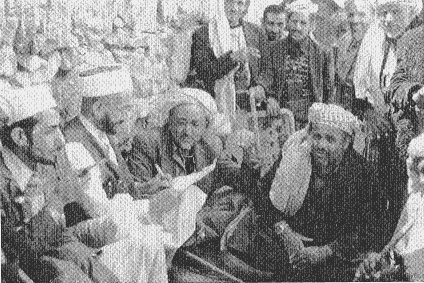
Figure 9.
A judge receiving men outside his residence in San'a', 1980.
ency" (Justice Felix Frankfurter).[2] For Schacht (1964: 197), a leading student of Islamic law, the procedure involved is portraryed as something of an evolutionary survival: a "still" practiced "primordial" method.
To Yemenis, judges in this type of open setting, accessible to the public, appeared in a posture known as muwajaha , from wajh meaning "face," the quintessential face-to-face encounter of official public life (see fig. 9). Muwajaha was also the format in which the mufti received afternoon fatwa seekers, and the same sort of generic activity was characteristic as well of both ruling imams and local governors. Direct accessibility, based on a public presence that enabled personal encounters and personal solutions to problems, was a fundamental value of the old administrative style.
Hakim , the standard term for "judge" (qadi was also used), as in hakim shar'i or "shari'a judge," had another sense, which meant "ruler," as in the identification of Imam Yahya as hakim al-yaman , "ruler of Yemen."[3] In this domain of overlapping terminology a verb from the same h–k–m root, followed by bainahum (lit. "between them") can mean "he governed" when used of an imam or, beyond the sphere of the state, of an important rural shaykh, and "he adjudicated their case"
when used in reference to a judge. One is reminded of a similar double resonance of the English word "court," held by both kings and judges. While the categories judge and imam are not to be confused, it is also true that the activity of governing in Yemen was in general very much devoted to settling disputes, with only a specialized part of this activity being handled by the shari'a court variety of hakim.
Like Saint Louis under his oak at Vincennes, Imam Yahya was well known for his daily practice of making himself available to his subjects. The tradition went back more than a millennium to the conduct of the first Zaidi imam in Yemen, al-Hadi,[4] and the scene was nearly identical to that enacted on the local level by judges in twentieth-century Ibb. "Every morning," the historian al-Wasi'i (1928: 295–96) writes, "the Imam himself sat in the courtyard of his palace, Dar al-Sa'ada, to hear for himself people's petitions." "Himself" is repeated to emphasize the physical presence of the imam. "The decrepit, the weak (da'if ), women, children, the long-suffering came to him [and he met them with] a warm, sympathetic, solicitous and unpretentious countenance. This [activity] was the centerpiece of his desire to extend justice and equity."[5] Attentiveness to the needs and problems of the down-trodden and the people of lower status was a sign of just government in general[6] and a value in judicial procedure in particular, as expressed in the manual principle of giving precedence to the claim of the "weak."
Wajh , the "face," was also a man's "honor,"[7] however, and the face-to-face muwajaha was rarely an encounter of equivalent personas. The haiba behavior of kissing hands and knees that occurred as the "weak" related to the judge reached its zenith in relating to the apical figure of the imam, whose haiba was immense. The behavior of those received in public audience does not figure in the historian's account, however, which is only concerned with identifying the presence and generosity of the imam's countenance. Needless to say, it was easier for an imam or a judge to step down in demeanor and discourse than it was for an ordinary person to step up.
At noon, followed by a few soldier-retainers and a crowd of people, the imam would walk to the mosque, continuing to hear petitions even as he washed in preparation for prayer. After lunch, like the local mufti, judges, and governor in Ibb, the imam would appear in his diwan , the semipublic sitting room in his own palace-residence. There his secretaries would gather around him to engage in reading and responding to petitions that had arrived from around the country. Again, in a manner characterized by personal involvement with each and every
case, he would "attend to the papers one by one, [including] the simple and the momentous."
In Ibb, the mufti of Imam Yahya's era was in the habit of taking long strolls in the morning, and he too would answer the people who came up to him. This casual availability in the morning complemented that of the more structured, principal time and place of giving fatwas, during afternoon qat-chewing sessions in his diwan. A daily morning walk around the town, during which he received requests and petitions, was also standard for Isma'il Basalama, the Ibb governor during the first part of Imam Yahya's reign, as was noted by the Syrian traveler al-'Azm (1937: 291–92). The official routine of al-Qadi Ahmad al-Sayaghi, governor in the 1950s under Imam Ahmad, provides an example of some further modalities and also points in the direction of an eventual transformation of this administrative style.
Al-Sayaghi's daily schedule began indoors with a four-hour block of time devoted mainly to the general reception (muwajaha 'amma ) of people who had come to see him, and also to replies to submitted petitions with the assistance of his secretaries. In his capital, Ta'izz, Imam Ahmad too had discontinued the regular morning open-air encounters of his father, taking this activity inside to a diwan.[8] Later in the morning, al-Sayaghi customarily went out to tour the town but mostly for the purpose of inspecting the work on the construction projects that were his real passion. During the afternoon qat session, he met with selected individuals (muwajaha khassa ). On Friday afternoons, however, he conducted himself in the old manner. This one afternoon a week anyone could approach the Ibb governor, the deputy of the imam, who sat out under a tree next to the government offices for the reception (muwajaha ) of those who otherwise might not have been able to reach him.
Central to the muwajaha format was the notion of responsiveness. An "official," al-mas'ul , was literally "the one asked." What was sought from an imam or a governor, a mufti or a judge, was an "answer" (a jawab ). In the case of the mufti, a query was posed and the answer was the fatwa. For the other three dispute-handling public officials, the imam in the capital and the governor and the judge on the provincial level, the approach was made in the form of a complaint or petition, known as a shakwa . Historically, shakwas were the general means by which individuals initiated actions in which they wanted to involve the state.[9] Whether these were individual-state matters (employment, state credit, charity disbursement, tax matters) or individual-individual ones
(disputes of all sorts) pursued through the state, the shakwa always represented the opening move.[10]
Shakwa
It is absolutely necessary that on two days in the week the king should sit for the redress of wrongs, to exact recompense from the oppressor, to give justice and to listen to the words of his subjects with his own ears, without any intermediary. It is fitting that some written petitions should also be submitted if they are comparatively important, and he should give a ruling on each one.
Nizam al-Mulk (11th century A.D. )[11]
The basic procedure for obtaining justice, for finding relief from injustice (zulm ), through the state, was thus a direct appeal to an official, one of whom was the shari'a judge. In his well-known Hadith commentary al-Nawawi summarizes the pattern as follows: "The wronged person can seek relief from the sultan and the judge, and other appointed officials, asking for redress from the offending person, saying 'So and so has wronged me,' or 'So and so did this or that to me'" (quoted in al-Shawkani A.H. 1394: 14). The vocabulary of zulm —the mazlum (wronged person), zalim (offending person), zalama (to wrong), tazallum (to complain or seek relief)—is precisely that utilized in shakwas.
In many Muslim states, from an early date, mazalim jurisdictions, as they became known (from the same z–l–m root), amounted to alternate or superior forums for handling disputes.[12] The existence of such competing forums partly contradicted the supposedly universal jurisdictional sweep of the shari'a court, especially if matters contained within the purview of the shari'a were as a consequence not dealt with by the shari'a judge. In imamic Yemen, this contradiction worked a bit differently than in the typical Sunni state, headed by a sultan or a king. Condensed in the identity of the imam were both a sultan's temporal capacity to handle grievances such as salary arrears, petitions for transfer of position, or complaints about an official's conduct, and the full shari'a capacity of the ultimate judge (and mufti) in the land. While there was for this reason no open contradiction or separation of powers at the apex of the imamic system of rule, at the local level of the governorates there opened up two distinct positions: the shari'a judge (hakim ) and the governor (na'ib, 'amil ). These separate delegations (wilaya ) of capacity, undivided in the identity of the imam, meant that dispute settlement on the level of the provincial town involved a division of labor between the hakim's capacity to handle shari'a matters
and the governor's capacity to handle problems defined as being of another sort—roughly, the mazalim jurisidiction formula.
In ideal terms, as in the description of Imam Yahya by the quasi-official historian, the shakwa is oral, conveyed verbally by the petitioner and "heard" by the ruler—thus (al-Wasi'i): "to hear for himself people's petitions [shakwas]," "he walked and continued to hear shakwas," "and while washing and afterwards before the prayer he continued in this fashion hearing shakwas." An extreme and desperate version of the auditory connection was public shouting. It used to be possible to literally "gain the ear" of the Yemeni head of state by persistent shouting at his front door, and it is a strategy still occasionally employed from street level to get the attention of a local governor upstairs in the official residence. Interchange based on speaking (or shouting) and hearing might be initially understood as the only possible method for the presentation of the concerns of the illiterate downtrodden, and women and children. In another sense, however, the emphasis upon "hearing" is stylized and overstated. It is part of a system of representations centering on the value of "presence" situated at the heart of the face-to-face intimacy of the muwajaha formula. While a speaking-hearing mode for the communication of shakwas was valued as an ideal, a writing-reading mode was frequently the practical norm. The ideally oral quality of the shakwa fit the ideal character of the muwajaha, but underpinning such structures of apparent presence were practices of distancing and absence implemented through writing.
There was a further status twist to this. Petitions from the mass of lower-status individuals, which were supposedly "heard" in the public muwajaha, had in actuality to be transformed from their imprecise dialectial articulation into the discourse of the text in order to be dealt with. Elite petitions, those of the few, the individuals most accomplished in the literate skills, could be communicated in speech, but this occurred, not in the open public format, but rather in the relatively private afternoon diwan settings of the "special muwajaha" (muwajaha khassa ).
Proper conduct of the muwajaha style of government depended on the elimination and avoidance of barriers between ruler and ruled. The barriers at issue were both physical—walls, closed doors, guards—and of the insubstantial, haiba sort, which caused ordinary petitioners to tremble and lose their words. To provide what he refers to in a section heading as a "Description of the Imams of Yemen," al-Wasi'i (1928: 297) quotes an account that makes repeated use of verbs and
nouns derived from the h–j–b root, which means to "hide," "conceal," "make a separation," and "to veil." In its various forms the h–j–b root expresses circumstances opposite to muwajaha, which depends on an unobstructed meeting of faces. According to the quoted text, the ideal imam is like one of his subjects in his simple style of life, and he "speaks to them and governs them, without regard to whether [the individual] before him is a noble or a commoner, strong or weak, without creating a barrier (hijjab ). He does not delegate matters to ministers or chamberlains (hujjab ). . . . [Such rulers] neither keep [others] out (yahjibun ) nor seclude themselves (yahtajibun )."
An important connotation of the h–j–b root is feminine seclusion and veiling: in the public domain, proper and just "masculine" conduct is enacted through the regular presentation of one's face and through the secure medium of speech; improper and unjust ("feminine" for men) conduct, by contrast, relies on the concealment of the face and works through the dangerous medium of writing. An ordinary form of muwajaha wisdom similarly dictates that men come out of their houses every day, show their faces, and circulate in the town streets, or risk criticism and suspicion.
A negative assessment of a ruler, within the muwajaha idiom of statecraft, typically pointed to the practice of official distancing. Thus a republican historian criticizes the conduct of Imam Yahya's sons as provincial governors, including al-Hasan in Ibb, as follows: "They withdrew [a h–j–b verb] themselves from the people and distanced themselves from hearing their shakwas" (al-Akwa' 1980:295, emphasis added). By extension, Imam Yahya's general policy is critically characterized as one of "total isolation; he shut himself, and Yemen, off from contact with the outside world."
In practice, shakwas were virtually always written,[13] as were the responses, which were usually added in the form of a note atop the original piece of paper containing the shakwa (as is the case with the query and its fatwa-answer). To engage the official machinery even shouted claims had to be reduced to a concrete statement of the problem in the form of a written shakwa. To get around the soldiers who might block delivery, Governor al-Sayaghi placed a barrel with a slot in the top to collect hand-submitted shakwas at street level. The mail system, which functioned rather well in the post-Ottoman imamic period, served principally to carry shakwas, either to provincial governors or to the imam himself.[14] For those private individuals who could afford it, the telegraph system served the same end. Public writ-
ers, who continue to set up their boxtop offices outside the governorate offices in Ibb, specialize in writing shakwas for petitioners who cannot write for themselves.
On the receiving end, in the imam's diwan for example, shakwas were first screened and summarized by secretaries.[15] The secretary wrote a brief memo at the top indicating the subject matter and the action sought. The shakwa was then passed before the imam, who would add a quick note of refusal or permission, such as "nothing forbids this," or return the paper to the secretary to draft a brief order (amr ) or a note of transfer to an appropriate official or other person. Transfers often carried a request for investigation or clarification of the complaint, and, if warranted, an order for implementation (tanfidh ) or dabt , which entailed some form of arrest, seizure, enforcement, or restraint. One of the possible officials to whom a shakwa initially presented to an imam or a local governor might be transferred was the shari'a judge of the appropriate jurisdiction. The hakim too received shakwas directly, and also transferred them to others. The ideal administrator was one who not only was accessible, in the sense of receiving people's shakwas, but who responded to them quickly and decisively. For officials of all levels, reading and responding to the shakwa traffic was one of the principal tasks of day-to-day government.
Finally, the original shakwa document, now bearing a response, was returned to the petitioner. It was the petitioner who was responsible for effecting the physical transfer to another official or person if such was called for in the response. To have an order carried out, the petitioner had to take the shakwa with the order written on it to the official addressed in the response, such as, "to the governor of Ibb, for enforcement," or "to the shari'a judge, carry out the necessary shari'a procedures." The system depended on the initiative of petitioning individuals to keep their matters alive.
For the judge, the shari'a court itself, the mahkama shari'a , entailed a specialized form of muwajaha. The required openness of this event was defined in manual chapters on procedure. Court should be held in a well-known and central public place, while the rule against posting a doorman (hajib , from the h–j–b root) addressed a concern for unimpeded direct access. Reacting to the tumult of bodies crowding a contemporary (mid-1970s) Ibb courtroom and pressing forward to gain the attention of an old judge, his teenage son suggested that it would be desirable to create order by placing guards at the door to let disputants in one at a time, or in pairs. His father retorted sharply that
a guard at the door led inexorably to people's being denied access and, as a consequence, being denied justice. Years after the opening of official courtrooms, older judges could still be encountered listening to disputants sitting outside at curbside or at the doorsteps of their residences before or after lunch. But the direction of new legislation concerned with judicial procedure is toward more "ordered" sessions, with access to the judge regulated by a doorman,[16] and also—diametrically opposite to the open-door format—private interviews, conducted under newly instituted prosecutorial auspices (Messick 1983b),[17] and closed sessions in certain circumstances. A final separation of house and court was mandated by the "Judicial Authority" legislation of 1979 (Art. 17): "Sessions are to be held in the court building, in specially designated rooms."
A shakwa presented to a judge, or transferred to him, is a way of bringing a matter to his attention for the first time. In giving attention to a shakwa, however, a judge is not engaging the process of adjudication. The shakwa represents only a petition by a single party, and this is different from a claim (da'wa ) with which a formal proceeding opens. A da'wa involves two parties, one who makes the da'wa and a second who is also present and hears the da'wa and then responds to it, in an ijaba . The presentation of a shakwa is intended only to get the judge to issue a summons to the second party. If the shakwa is minimally plausible and the subject matter relevant to his jurisdiction, the judge will dispatch one of his soldier-retainers, a step known as infadh .[18] This occurs by means of a note written atop the shakwa by the judge, which says, "Bring so and so to give justice (li-insaf ) to the petitioner." In addition to the task of maintaining order before the judge, the work of delivering summonses is the primary activity of the judge's soldier-retainers.
There were thus two distinct types of muwajaha that occurred as the judge sat before his house. The simple and far more numerous first type is the approach by the single party for the purpose of presenting a shakwa; it is the petitioner and the judge who come face-to-face in this instance. The second, more complex type, occurs "between" (bain ) two parties and in the presence of the judge. It requires a claimant (mudda'i ), who states the da'wa, and a defendant (mudda' 'alih ), who first hears the da'wa and then makes an answer, an ijaba. In this instance the parties confront each other and together confront the judge. From the beginning, then, as a matter becomes a case and is adjudicated, a petition is answered by the judge, a claim is answered by the defendant,
and a claim and a response (followed by evidence or oaths) are together answered by the judge in his ruling (hukm ).
Judicial Knowledge
A judge's personal knowledge of particular people and their affairs constituted an important and recognized basis for judicial action. Specifically, according to both Shafi'i and Zaidi manuals, except in hudud cases,[19] where evidence must be presented, a judge can give judgment based on his own knowledge ('ilm ) of events; and, when the evidence of witnesses is presented, he can accept or reject it on the basis of his own knowledge ('ilm ) of the justness or unjustness of the persons in question, without requiring further verification of their character.[20] Pragmatic and contextual, this circumstantial 'ilm was derived from worldly contact and experience rather than from teachers and set the practicing judge off from the more retiring among his fellow scholars. While 'ilm in the sense of knowledge acquired in the madrasa receives prominent mention among the fundamental conditions for assuming the judgeship—Abu Shuja', for example, enumerates six detailed subpoints—that of 'ilm in the informal, local sense is not developed. Without such contextual knowledge, however, that obtained in the madrasa could not be effectively implemented.[21]
Dealing as he does in worldly hijaj , that is, in evidence, testimony, acknowledgments, and oaths, the judge requires a down-to-earth understanding of people and their ways in his jurisdiction. And yet there was a constraint, at least in the perspective of the manuals, that restricted his purview to the surface of outward fact and verbalized intention, to the exclusion of deeper but unexpressed purpose or concealed motive. Shari'a court proceedings are meant to operate on the basis of al-zahir , a level of outward appearances and manifest meanings. Confronted, for example, by an oath confusing in its implications, a judge is instructed to follow the outward sense of the articulated statement.[22] Likewise, the import of an oath is never to be determined by the potential existence of a "mental reservation, or an interpretation contrary to the meaning of the words, nor a reservation made in an undertone which the judge cannot hear,"[23] and of which might be alleged subsequently by the oath-taker. In making the key initial decision about which of the two parties in a case is to be the plaintiff (and thereby assume the burden of proof), the judge is to apply the following rule of thumb: "The plaintiff is the individual whose claim conflicts
with the appearance of things (al-zahir )."[24] Interpretation of a final ruling in a case is similarly restricted: the judge's decision is to be "implemented manifestly (zahiran ) not implicitly (batinan )."[25] Fittingly for an encounter of "faces" (muwajaha ), the proceedings are intended to function zahiran , or as we would say, "on the face of," issues, words, and rulings. Among the relevant specialists in appearances was the physiognomist, the student of faces and physical indications, who could be called upon by the judge to give evidence.[26]
Al-Nawawi offers some notes on how a judge should conduct himself in order to acquire information upon being appointed to a new and unknown jurisdiction. Before departure for the new post, he should make preliminary investigations "about the circumstances of scholars and persons of good repute in the district." He may expect to ask and receive advice from local scholars on matters of jurisprudence and also, from those with practical experience, information about locally accepted custom ('urf ). Al-Nawawi recommends that the judge consult such local jurists before rendering his decisions. Persons of good repute could be relied upon to guide the new judge in discriminating the just and the unjust in the population and, together with the local scholars, provided prospects for staffing his court. The Zaidi manual likewise counsels the judge to have both scholars and other reputable people present at court sessions.
The new judge, al-Nawawi writes, should "enter on a Monday and proceed to the center of the town." He is then to carry out a series of initial inquiries to acquire necessary information concerning two main areas of judicial responsibility that extend beyond his duties as a trial judge. "First of all, he should look into the situation of individuals in jail. Those who say 'I was jailed justly' should remain so. If 'wrongly,' then his adversary must produce proof, and if the latter is absent he should be written to, to present himself." Then the judge should interview the local trustees of the several types: "He who claims a trusteeship should be questioned about it, and about himself and his administration. He who is found lacking in the requisite justness should have the funds taken away from him, and the less than fully competent should be supported with counsel."
Next the judge should see about appointing court functionaries to assist him, including both a secretary and an individual known as a muzakki , whose task it is to pronounce officially on the justness, or not, of individuals who appear before the court as witnesses. Known to both the Shafi'i and the Zaidi manual, the procedure of verification of
witnesses, or tazkiyya , does not require the existence of a specific court official to be implemented. To the extent that court evidence is given as oral testimony by witnesses, however, a judge new to a place is largely dependent on trusted witness verifiers, official or not, to establish the necessary evidential basis for his rulings. As an institution, the muzakki represents a specialized form, and in the case of the existence of an actual court official, an important delegation, of one of the essential capacities pertaining to the judge himself. A judge who has come to know the local people, by contrast, is often able to engage this dimension of his official identity directly and verify the character of witnesses by means of his own information. A witness stands between the judge and unknown facts concerning persons and events, and a muzakki is a further intervening link in the human transmission of evidence, standing between the judge and an unknown witness. To eliminate the further mediation in the chain of evidence transmission, the judge may cultivate a personal knowledge of his constituents.
Intended for the circumstances of various times and places, including, for example, those that obtained in his native Syria, al-Nawawi's manual takes into consideration still another possible communicative intervention, a translator.[27] Judges in very large cities of the Middle East and elsewhere doubtless could never come to know the population of their jurisdictions well enough to forgo major reliance on the mediations of muzakkis, translators, neighborhood notaries, quarter heads, market and craft officials, experts of various types, sectarian representatives, and so forth. But in Ibb, and perhaps most if not all Yemeni towns, the population was, until recent years, small (e.g., for Ibb, ca. 5,000 in 1900), and the character of the interaction was "face-to-face"; people all "knew" one another in terms of names and social identity, if not on an intimate basis (i.e., zahiran , if not batinan ). It was such knowledge, within the community and, potentially, between the judge and the community, that ideally structured a local muwajaha encounter. In recent decades, however, Ibb has expanded rapidly in surface area and population (ca. 17,000 in 1975), and town society is now marked by a rapidly declining degree of mutual "knowledge." Associated with the spatial and demographic changes, a shift is occurring to a pattern of interaction in which people interact for the first time in the presence of large numbers of townspeople they do not "know." Associated with this social change is a new state presence, represented by numerous new functionaries, including university graduate judges, who not only are different in formation and administrative style but who
remain strangers to the town to the end of their often brief tenures in office.
Prior to the late 1950s, when the first expansion outside the old walls occurred, the "public" informational space had an immediacy indicated by such important auditory institutions as voiced calls to prayer (now loudspeaker assisted), public criers in the marketplace, and the sounding of horns by night guards on their rounds. The main alleys were informational channels, not only as the principal locale of everyday male interaction, but also for societal announcements: a convert to Islam was taken through the streets on muleback; wedding processions were accompanied by gunfire, fireworks, music, and ululation; a criminal act was publicized by drumming (or, in extreme cases, dragging) the culprit around the town. Town life was, in addition, a series of types of communication-rich assemblies of men. The paradigm of gathering was in the "place of gathering," the mosque (jam' ), both at the neighborhood level during the week and at the community-gathering level on Friday. The marketplace, especially the morning meat market and the afternoon qat market, was the main everyday public arena. By midafternoon, gatherings shifted indoors, for business in officials' sitting rooms and for pleasure or for special occasions in friends' reception rooms.
The circuitry of interpersonal knowledge in a small community such as Ibb carried information about reputation. Originally constituted "before the people" (quddam al-nas ), reports concerning reputations circulated thereafter through dense word-of-mouth channels. A collectivity of informal (and potentially formal) witnesses for one another's conduct, the community was acutely sensitive to deviation from established personal norms. Conduct was evaluated with reference to a frame of known differences of social identity, occupation, personality, and so forth. As with the "mismatches" discussed earlier, it was mainly the nontypical for the type that was remarked upon. Feeding with special enthusiasm upon the novel, gossip nevertheless also confirmed in passing the already known.
That men's and women's networks intersect in the family and otherwise diverge is routinely recognized in Ibb. As part of a comprehensive separation of the sexes, women have their own neighborhood links, public bath days, visiting patterns, and an entire parallel world of afternoon qat-chewing sessions.[28] The existence of a social division of experience and related specialized knowledges that pertain especially to men or to women is acknowledged in the manual sections devoted to
legal testimony.[29] There are, on the one hand, matters that "mainly males have to do with (lit. 'see')." These include legal undertakings from contracts to such public events as conversion, witness evaluation, and death. Al-Nawawi's sample list is "marriage, repudiation, remarriage with a repudiated wife, [conversion to] Islam, apostacy, challenging and certifying [witnesses], death, insolvency, agency, testaments, and secondary witnessing." In connection with such matters two men must give testimony, rather than the ordinary case possibility of one man and two women. "That which is restricted to the knowledge (ma'arifa ) of women and which is not normally regarded by men," al-Nawawi writes, includes such matters as "female virginity, childbirth, menstruation, breast feeding, and [female] physical defects under clothes." Four female witnesses, without any males, can speak to such matters. From the position of (a male-constituted) jurisprudence, men ideally represent the zahir society of the streets, markets, and mosques; women represent that of the batin , ideally located in the house, concealed, and veiled.
Like "social honor" (ihtiram, sharaf ) and "justness" ('adala ), the inverse, established notoriety and, more technically, the status of "sinner"/"unjust" (fasiq ), are products of collective attribution and somewhat relative in content. While the first two guarantee that one's word as a witness will be relied upon, the latter have the opposite effect. According to al-Nawawi, when a muzakki is asked by the judge to report on a witness and the report is positive (i.e., the witness is just), the muzakki need not go into his reasons. But if he concludes that the witness is among the unjust and therefore challenges him or her, the grounds must be specified. These grounds can be either what the muzakki has personally observed or information gained through "istifada ."
A word from the same root used in reference to water means to "overflow" and "flood"; the legal term means "spread widely" or "saturated" in reference to information. Another usage of the same term by al-Nawawi concerns how a local population comes to know of the appointment of a new judge. A written imamic order, accompanied by traveling witnesses, is one possibility, and istifada —whereby the appointment simply, but decisively, becomes widely known—is the other. Al-Ghazzi also uses the term in his summarizing comment on a list of the types of facts for which the testimony of a blind witness is acceptable.[30] The list includes knowledge of such things as deaths, kinship, and property rights, all of which al-Ghazzi says may be "established by istifada ."[31] Al-Nawawi makes a similar argument in con-
nection with testimony based on public repute (tasamu' ). The term involved is derived from a root meaning "to hear," as is the general expression for "reputation," or "good reputation" (sum'a ). In a nondirect manner, public-repute testimony can be used to establish descent (nasab ), tribe (qabila ) affiliation, or death, as well as such legal facts as marriage and the existence of an endowment or property rights.[32]
Al-Nawawi gives an instructive condition for the acceptance of this public-repute type of information: he says it must be "heard from a sufficient number of individuals to guarantee against collusion in a lie." Similar reasoning provides the foundation for another variety of information discussed earlier, the received wisdom known to jurists as tawatur .[33] What tawatur is to formal knowledge of important general historical matters (the existence of Mecca, etc.) and more technically to the science of hadith, istifada and tasamu' are to practical local knowledge about particular people and events.[34]
A microsocial and historical catalogue of particular actors and specific occurrences, the ever-shifting "known" of a place was tapped into by a judge in a special manner. In one respect his knowledge inevitably became deeper and wider than the ordinary person's as he became privy to otherwise guarded secrets exposed in situations of conflict. In another sense, however, he was barred by his position from some of the most routine but informative interactions of everyday life. Al-Nawawi says it is appropriate for the more narrowly specialized muzakki to evaluate justness based on personal knowledge derived from relations of friendship, neighborliness, or transactional dealings, but a judge is counseled not only to avoid buying and selling on his own behalf—interactions that would necessitate diverse ordinary contacts—but also to avoid doing so even through a known agent. For a judge friendship could also be problematic: he must be wary of gifts given him, and he is forbidden to give judgment in cases involving not only his own relatives but also individuals with whom he had any sort of formal association.[35] The stylized intimacy of the muwajaha encounter thus involved, on the part of the judge, a man at once unusually knowledgeable about the hidden aspects of people's affairs, yet also structurally distanced from many aspects of mundane social life. Although a judge could (and did) rely on the human resources of his household, including his wife, children, personal retainers, and secretaries for help in knowing about the community, he also had to exert himself to overcome the isolation of his position.
The Yemeni practice of not appointing judges to their home districts
is not based on an explicit manual principle, but al-Nawawi's advice to a new appointee to make inquiries about scholars and reputable people implies a posting to an unknown place. The Yemeni appointment rule served the purpose of causing a new judge to start fresh, in a context free, at least initially, of both the demands of extensive family ties and the constraints of prior obligations and events. The paradox here is that while too much intimacy—such as would occur in a native district posting or if a judge attempted to conduct himself like an ordinary citizen—was to be avoided, a substantial degree of close contact was nonetheless essential for acquiring the local knowledge basic to judging.
Custom
The requisite circumstantial knowledge of a judge was not just of persons and happenings, however, but also, in a more structural sense, of pattern and custom. The key summary term involved is 'urf , which is often translated as "customary law." From the root '–r–f meaning "to know," 'urf refers to known usage, both substantive and procedural.
In the most general sense, the 'urf of a place ('urf al-balad ) refers to the established usages in all the domains of social life. An initial issue is the level of locale (balad ) referred to. It might be possible to speak, for example, of the 'urf of Yemen, but what is usually highlighted by the term is regional difference, variation. The 'urf of a place could be said to be similar to (or even include) special linguistic usage, with 'urf differing from locale to locale in much the same way regional dialects shade one into the other. Measures are a good example: each highland region had its own terminology of particular linear and volume units. A judge posted to Ibb from somewhere in Upper Yemen had to learn the local terms and the measures indicated. It was not a difference of yards and meters, however; to the extent that the judge knew something of units of land and quantities of grain in his home district he would find similar types of measurement categories used in Ibb.
A judge had to concern himself mainly with 'urf that was relevant to the applied shari'a. Inasmuch as the shari'a is general or summary in its provisions, there are two basic ways it could be extended or given necessary detail. One is through the activities of interpretation, which "fill in gaps" in the shari'a's conceptual structure as needed. The other is by reliance on the existing detailed structures of local usage, or 'urf, a patchwork backdrop of practices that showed through the gaps in the shari'a fabric. Although "custom" as an integrated and elaborated
category of law was never elevated to a position of theoretical prominence by jurists, a widely accepted judicial attitude toward such usage is summarized in a simple formula cited by Ibb judge al-Haddad: "If no relevant [shari'a] text is found, then that which is known customarily is taken to be a binding condition" (idh lam yujad nassan fa-l-ma'ruf 'urfan ka-l-mashrut shartan ).[36] This view speaks not to situations of conflict between shari'a and 'urf, which are not tolerated by jurists, but to areas of substantive concern about which the shari'a is silent.
There are numerous substantive areas in the manuals where the judge is specifically directed to supply necessary detail by reference to prevailing custom.[37] Often this is by means of the expressions "'urf" or "'urf al-balad" but the same sense obtains in a number of alternative terms, used in the manuals and in Ibb practice, such as al-ma'ruf ("the known"), al-mashhur ("the known"), al-'ada ("custom"—as in "Adat Law" in Southeast Asia), al-mu'tad ("the customary"). Still other terms reveal an openness to contextual grounding in the specifics of many shari'a provisions. Mithl , meaning "like" or "similar," is often used to this end. The amount of money that must be paid to the wife by the husband as mahr is not set in the manuals; instead the amount is characterized as mahr al-mithl , that is, a sum to be determined according to what is locally appropriate for women of equivalent status. Another example, mentioned earlier, concerns the "seriousness" (muru'a ) of a potential witness, which is to be evaluated relative to the standard of seriousness current in the local community, that is, muru'at al-mithl .[38] Many monetary and other questions are to be determined by reference to similar local circumstances of "time and place," a frequently encountered manual formula that rhymes in Arabic (zaman wa makan ).
Two specific and relatively bounded varieties of 'urf that an Ibb judge usually knew something about and occasionally dealt with officially were the custom of the merchants ('urf al-tujjar ) and "tribal" custom ('urf al-qabili ). The first is a body of detailed local practices opened up around the core transactional forms of the applied jurisprudence (sale, lease, credit, partnership, agency, etc.). Ibb merchants always tended to handle their disputes informally among themselves rather than appearing in shari'a tribunals. With advancing commercialization in recent years, this separation was formalized with the appearance of chambers of commerce (with arbitration functions) and, a few years later, commercial courts (established in the three largest towns).[39] The second type of custom concerns rules elaborated mostly
beyond the physical and conceptual bounds of the shari'a, although "tribal" practices such as the hajar , an animal sacrifice used to appease abused honor and preceded by a public procession, occurs fairly frequently in Ibb town.[40] In some regions, a judge was expected to be conversant with two discourses, to "provide shari'a rulings in shari'a matters and customary rulings for customary issues."[41]
'Urf is also procedural. Formal and official shari'a courts are paralleled in Ibb by an important alternative resolution format of an unofficial and customary nature. While shari'a court adjudication procedures result in winners and losers, the customary formula is compromise (sulh ). Customary compromise represents a foil for the court in a sense that goes beyond the alternative that it represents to a state forum, substantive shari'a jurisprudence, and formal adjudication. Men gather in the sitting rooms of private houses for this compromise type of settling, and the meeting of faces involved is quite different from that in a public muwajaha. Whereas court procedure is based on extended and frequently damaging verbal confrontations between the adversaries, compromises work through separation and avoidance. Each of the parties is talked to alone; views are aired, and potential solutions are suggested. Mediators motivated by goodwill can cut through the posturing and lying that plague the tribunal. Unlike the cool and narrow effort to focus upon manifest facts (al-zahir ) in the judge's court, mediators freely explore issues in breadth and in depth, "studying hearts," as one put it. It is only when a compromise has been reached that the parties are brought together to seal the agreement. At the session, usually over an afternoon of qat chewing, the matter at hand is not overtly mentioned. The final settlement is effected through writing. If there are last-minute hitches, mediators step out of the room briefly for further words. As the conversation in the room is steered in other directions, final documents are prepared and then unobtrusively passed along to the parties for their signatures. Others present—relatives, friends, and neighbors—add their names as witnesses. In this manner two "faces" meet each other in the presence of assembled men: the genius of sitting-room compromises is that they permit the intact honor of each man to confront the other, without either being put into question.
As venue types, courtroom adjudication and sitting-room compromise represent polar opposites: shari'a versus 'urf in substance, official and public versus unofficial and private in format. There are, in addition, intermediate types, the customary[42] but official dispute-handling
activity of the governor (the mazalim , discussed earlier) and the shari'a-based but unofficial activities of consensual ruling and judicial arbitration (hukm taradi and tahkim ).[43] Compromise itself is not an exclusive property of custom and the sitting room, however. The Azhar manual says a judge ought to "urge compromise (sulh )" upon the parties to a dispute.[44] A caveat is attached: the urging should occur especially when the correct solution is not apparent to the judge, whereas if the truth is clear, he should encourage a still simpler and, in Yemen, unlikely outcome, forgiveness.[45] In the perspective of jurists, compromise is generally permitted insofar as it does not, in the words of a famous hadith, render "legal the illegal, or illegal the legal."[46]
In a hukm al-taradi , the delegation of authority (wilaya ) comes not from the state but from the parties themselves and depends on their prior agreement for enforcement. Al-Akwa' (1980:306) says of one twentieth-century jurist that "he undertook judging (al-qada' ) by mutual consent (taradi ) between disputing parties who came to him." In 1908, prior to the Treaty of Da"an and before Imam Yahya had won the right to appoint regular judges, he took advantage of a period of friendly relations with the Ottoman governor to dispatch a number of unofficial taradi judges to San'a'.[47]
In other than hudud and criminal cases, a judge who sees a possible solution can also ask the parties to empower[48] him to arbitrate (verb, hakkama ; verbal noun, tahkim ). Arbitration is recognized in the manuals, but al-Nawawi is anxious to give the procedure a formal shari'a footing by adding, "with the condition [that the arbitrator] has full judicial qualification."[49] Arbitration appears to have been very common in Ibb under the Ottomans, being both formally sanctioned and enforceable by the government,[50] and local examples also exist for the Zaidi imamic period.[51] An official shari'a court judge who also engages both in taradi judging (with individuals outside his regular jurisdiction) and in tahkim is specifically envisioned in an imamic appointment letter.[52] From the point of view of shari'a jurisprudence, however, all of these possibilities—compromise, consensual rulings, and arbitration—are delicate matters. All lead into the competing terrain of out-of-court settlement, which Muslim states, including the Y.A.R., sought to bring under the umbrella of official legitimacy and control.[53]
Finally, the formal court judgeship itself may be thought of as involving its own customary practices. Manual chapters on formal shari'a procedure list general procedural requirements, recommendations for judicial conduct (adab al-qadi ), and actions that are forbidden. Al-
though not mentioned in the manuals, experience (mumarasa ) is understood to be vital. The transition from madrasa-trained scholar to trial judge was predicated on a learning of the professional ropes. Together with the varieties of local knowledge, including current 'urf, and the possibilities of extracourtroom procedure, experience was a further ingredient for successful in-court judging.
Many judges learned this aspect of their profession by beginning their careers as court secretaries, others by frequenting court sessions conducted by their fathers or relatives. Al-Shawkani had had neither sort of preliminary exposure when he was abruptly called and persuaded to take on the judgeship in early-nineteenth-century San'a'. He writes (A.H. 1348, 1:464) that he was immediately deluged by cases and that "the intellect worked hard, the mind troubled greatly." This was especially so, he says, because "I did not know the procedural usages (umur al-istilahiyya ) in these matters. I had not ever been present with a judge in a lawsuit, and I had not even attended the litigation sessions of my father." The leading scholar of the era considered himself a novice when faced with the demands of the judgeship. His life of studying, teaching, and issuing fatwas, and his deliberate avoidance of public life, had left him uninformed about the world of the court. He felt a strong contrast between his predicament and the record of his predecessor in the post, the noted scholar and judge of the late eighteenth century, Yahya b. Salih al-Sahuli.[54] Al-Shawkani admires the exceptional precision of al-Sahuli's opinions, which he attributes not to his predecessor's excellent scholarly credentials but rather to his lengthy and comprehensive practical experience (ikhtibar, mumarasa ).
For judges as for ruling imams, the basic public muwajaha, the open court encounter, implicitly required the acquisition of a spectrum of informal knowledges. As indicated in this chapter, there were both significant twentieth-century modifications of this system, from shifts in the administrative styles of imamic officials to the introduction of prosecution institutions and commercial courts under the republic, and important continuities, including some persistence of claimant receptions at private residences even after courtrooms were built and the guarantee of the right of complaint by shakwa in the republican constitution. A further assessment of changes and continuities in the shari'a courts, however, must take account of innovations introduced in the Ottoman period.
Chapter 10
Court Order
| ||||||||||||||||||||||||||||||
The twentieth century opened in Yemen with a judgeship recently modified in accord with Ottoman reforms. Behind the simple character of the 1916 Ottoman personnel list lies a template for a new way of thinking about the nature of the shari'a court. Although the more sweeping changes represented by the new Nizamiyya courts established in the central provinces of the empire were not instituted in the highlands, there were some significant innovations.[2] A modicum of "order" (nizam ), on a scale reduced and adapted for the special circumstances of Ottoman rule in Yemen, was introduced into local judicial affairs, as it had been in the closely associated sphere of instruction. Like Ottoman schools, much of this new system would apparently be undone by Imam Yahya,[3] only to reappear in the institutional reforms of the republic.
Undramatic though they may now appear, the innovations signaled in the personnel list were elements of a comprehensive reformulation of the judicial process, and beyond, as in the case of instruction, of the state itself. The list embodies selected bits and pieces of a much larger Ottoman bureacratic scheme for a justice system, one roughly analo-
gous in scope and detail to the legislation for judicial organization enacted in Yemen in 1979.[4] The 1916 Ibb court staff were implementing a style of bureaucratic behavior radically different from that of the patrimonial imamic state, one that would only begin to be fully elaborated conceptually and enacted in practice with the wave of legislation and accompanying generation of complex new state organs in the 1970s.
The most revolutionary qualities of the list are the routine elements and orderly features that make it, now for us, so mundanely cognizable as a segment of a typical bureaucracy. State employees are deployed in categories and grades of positions, each with specific duties and salaries. This last feature, fixed state salaries, had only been successfully instituted for the Ottoman judiciary in the latter half of the nineteenth century. Salaries replaced a much-abused practice of court fees, collected by judges directly from those who appeared before them.[5] The theoretical reorientation of the source of judicial income, away from individuals and to the state, is an important measure of an intended shift in the definition of state control and responsibility. In contrast to an old mode of income generation and expenditure entirely within the loop of particular organizational segments, through fees and other sorts of revenues collected and then disbursed internally, the state would come to mediate in these transactions. Under the Republic, this would occur by means of budgets, accounts, and salary disbursement managed by the Central Bank.[6]
Like Ottoman students separated into classes, and soldiers mobilized in their units,[7] local court functionaries were organized in ranked grades—head secretary, second, third, and so forth—in accord with a preexisting bureaucratic plan laid out in rationalized and abstract detail. Yemeni legislation would eventually conceive of bureaucratic employment in similar terms, according not only to set salary levels but also to requirements concerning age, educational attainment (with associated examinations and attestations), procedures for appointment, trial periods and inspections by superiors, rules about time in service and seniority, eligibility for promotion, transfer and retirement, and an array of position-specific duties. Bureaucratic work would become internally differentiated and specialized, increasingly organized and routinized.
With the transition, accelerated since the Revolution, from an agrarian to a commercially oriented state, the peak and slack annual work rhythms of the remaining old harvest-focused administrations (Endow-
ments, Government Properties, and Tithe offices) now stand in sharp contrast to the regular, year-round activity pattern of the new offices such as the Central Bank and the Tax Office. Sons following fathers in their positions, and dense linkages of kinship and marriage characteristic of the old offices[8] are beginning to give way to a more achievement-oriented division of administrative labor. This, in turn, dovetails with the increasingly specialized advanced instruction of the contemporary educational system. Government of the household diwan , with men seated together on floor cushions before slant-topped writing desks, has been transformed into government of the public office building, with its separating walls, doors, and desks, and windows raised up to match the move from the floor to chairs. The all-purpose craftsman secretary (katib , lit. "writer") has given way to a panoply of titled functionaries with specific job descriptions. In the shift from a patrimonial to a bureaucratic state, initiated in Yemen by the Ottomans and then recommenced under the Republic, the old haiba of the person is dissolving into the alienated haiba of form.
The head judge for the district in 1916 was Muhammad Nuri, an Ottoman Syrian, while all the subordinate (and lesser paid) court positions were filled by men from the town and region.[9] At least two of the local men, one of the al-'Ansis and a man named Muhammad al-Yunis, received instruction in the Ottoman Majalla , the codified version of the official Hanafi school of jurisprudence discussed in chapter 3. It was the Majalla , its substantive provisions little different from the Shafi'i school, that was applied in the Ibb court. As one product of the struggle between the Ottomans and Imam Yahya, the court configuration in Ibb was distinctly different from that which obtained in the Upper Yemen of the era. As Point Six of the Treaty of Da"an, signed with the imam in 1911,[10] the "government," as it is referred to, had confirmed its right to "appoint non-Yemeni shari'a judges in regions [such as Ibb] where the population follows the Shafi'i or Hanafi school (madhhab )."
In his original negotiating position of 1906, however, the imam had not only demanded that "judgments be in conformity with the shari'a," but also sought complete control of all judicial appointments.[11] At Da"an, which was intended, as al-Wasi'i says, to settle the affairs of those districts under the administration of the state (i.e., the Ottoman province of Yemen) but resided in by Zaidis, the first point agreed to is that "the imam will nominate judges of the Zaidi school, [then] inform the provincial administration, which will [in turn] inform Istanbul for
the confirmation of this nomination by the Judicial Office."[12] In addition to dividing up the appointment of judges according to spheres of influence, the treaty provides (Point Seven) for the creation of "mixed courts" with "Shafi'i and Zaidi judges" to handle claims of "mixed schools."[13]
The 1916 court personnel list reveals a further distinguishing characteristic of Ottoman judicial organization: the position of the "judgment witness." According to the old shari'a manuals, both Shafi'i and Zaidi, the judgeship is conceived of as a single position,[14] while Ottoman courts in Yemen typically comprised a presiding judge and court "members" or "judgment witnesses."[15] This innovation was eliminated in Ibb with the return of Zaidi rule in 1919, but reappeared after 1962 under the Republic. In the judicial reorganization of 1972, judge Ahmad al-Haddad was moved from the Ibb district judgeship to become presiding judge of the new Second Court of Ibb Province, constituted in the Ottoman style with four court "members" and three secretaries.[16] When this sort of institution of a panel of judges "giving judgment by agreement or a majority view" was introduced in the nearby Sultanate of Lahj (by means of a 1949 Code adapted from the Egyptian Code of 1931), it proved very controversial.[17]
Within the Ibb district in the Ottoman period there was also a hierarchy of judges, represented by the two subordinate "deputy judges" (na'ibs ) responsible for the subdistricts of Jibla and al-Makhadir. This judicial scheme was paralleled by that of the general Ottoman district administration, which was headed by a district officer (qa'immaqam ) with subordinate subdistrict officers (mudirs ) for Jibla and al-Makhadir. Earlier in the nineteenth century, al-Shawkani, like his late-eighteenth-century predecessor al-Sahuli, had been designated qadi al-qudat , literally "judge of the judges," but this was more an honorific than it was an expression of an elaborated judicial hierarchy. Noted scholars of the early twentieth century, such as 'Abd Allah al-Yamani (d. 1931) and Husayn al-'Amri (d. 1942), were referred to as Qadi al-Qudat and Shaykh al-Islam.[18]
The Ottomans also introduced the concept of appeal (ta'n ), which is also unknown to the manuals.[19] Above the district level there was an Ottoman appeals court (known as majlis al-tadqiqat ) located in the capital, San'a'. It originally had an Ottoman presiding judge and Yemeni associate judges, replicating the local pattern in Ibb. From San'a' appeals could be taken to the Sublime Porte in Istanbul. Appeal became deeply grafted onto Yemeni practice as a direct consequence of Points
Two and Three of the Treaty of Da"an. These provide for an appeals court (mahkama isti'nafiyya ), to be located in San'a' and staffed by a head judge and associate judges—all to be nominated by the imam and confirmed by the government.[20] The imamic appeals courts have a somewhat complicated subsequent history, involving a Ta'izz-based and sometimes more Shafi'i-oriented second branch. Soon after he took control of Lower Yemen from the Ottomans, Imam Yahya appointed 'Abd al-Rahman al-Haddad, the noted Shafi'i scholar from Ibb, to head the appeals court in Ta'izz.[21] Imam Yahya's son Ahmad, whose governorate seat and then capital as imam was in Ta'izz, operated with a branch (shu'ba ) there and another in San'a'.[22]
Prior to the Ottoman period, however, there were neither multiple judges (in a single court) nor formal possibilities for appeal. The first of these innovations—like the Christian Trinity when viewed from the Muslim theological perspective—violated the essential oneness of the judicial presence, fracturing the unitary quality of the judge's face and voice in the muwajaha encounter. The second, the possibility of appeal, undercut the sanctity and finality of the judge's word, opening the door to continuing reinterpretation of decisions.
Problematic changes also occurred in the area of judicial writing. In Ottoman courts, judgment documents (hukm , pl. ahkam ) were radically shortened.[23] The typical Yemeni style of judgment, spoken of as being "long and wide" (tawil wa 'arid ), is apt to be a very lengthy (but quite narrow) rolled scroll made by joining together pieces of document paper. The separate parts in a judgment document are, from top to bottom, the claim and response (da'wa wa ijaba ), the evidence section (bayyinat ), the summary (khulasa ), and the ruling (jazm ). One feature of the preparation of such documents is distinctive: the first three sections usually were copied out by a court secretary, but the final ruling section, usually amounting to only a few lines, had to be in the hand-writing of the judge himself, followed by his signature. Before copies of judgments are handed over to the two sides in a case, or before a judgment such as an execution is carried out, the text is "dictated" to the parties by the judge.
In such documents it was the evidence section that could balloon out of proportion in an effort to record all the verbatim testimony and quote from all the relevant documents. The Ottoman strategy was to shorten claims and counterclaims, often through rewording and condensing, and to record only a summary of the relevant evidence in the final document. It was a strategy, however, that violated the essential
purity of original words. The resistance to it might be understood as a very minor version of the sort of outrage felt (in the 1940s) at the rumor that adversaries had shortened the Quran (al-Maqbali 1986:67–68). During my residence in Ibb in 1980, an Egyptian advisor attached to the local courts was once again endeavoring to introduce a similar reform: to reduce judgments "long and wide" to fit the single-page format of new court registers.
Imamic Judges
According to the earliest Muslim sources, the Prophet's initial representatives to Yemen were sent as "judges." Thus 'Ali, later the fourth caliph, is reported to have said, "The Prophet of God, May God's Peace be upon Him, dispatched me to Yemen as a judge." At the departure of Mu'adh bin Jabal, an exchange is supposed to have occurred in which the Prophet asked his emissary the famous question "On what basis will you judge?"[24] Although the judgeship of the time had yet to be differentiated and elaborated in the manner of the later manuals of jurisprudence, the appointment of judges in the provinces was a continuing theme in the exercise of authority.[25]
After the departure of the Ottomans, Ibb judges of the twentieth-century imamate, appointed by Imams Yahya and Ahmad in the period 1919 to 1962, were predominately Zaidis from Upper Yemen. That this aspect of control of Lower Yemen was a political issue during Zaidi rule is indicated by the line of questions posed to Ibb governor Isma'il Basalama by the Syrian traveler al-'Azm.[26] Judges were appointed to district and subdistrict posts until 1946, when Ibb was made a full province, formed from districts taken from the older provinces of Ta'izz and Dhamar, at which time a judgeship of the province was added. There was also a fourth local judgeship (known as hakim almaqam , lit. "judge of the seat") attached to the district officer and, later, the governor.
The major exception to postings of northerners was a series of judges appointed from the important al-Iryani "qadi" family, whose ancestral home, Iryan, was located precisely at the meeting point of Shafi'i and Zaidi regions near the Sumara Pass. One contemporary member of the family described the family's posture as a composite: Shafi'i in ritual matters and Zaidi in jurisprudence. Yahya b. Muhammad al-Iryani was a distinguished scholar and Ibb district judge from 1919 [1337] to 1927 [1345].[27] To this extent Governor Basalama was accurate in his
response to his questioner that there were local men in the judgeships. After the Ibb post, Iryani retired briefly to his native Iryan to teach and give fatwas, but in 1930 he was appointed an associate judge of the appeal court in San'a', and later became the presiding judge of the first branch. He was a "second generation" student of al-Shawkani, since one of his teachers was the very distinguished al-'Amri, the first Yemeni presiding judge of the appeal court. Iryani was, in turn, the teacher of a number of men in Ibb during his tenure in the local judgeship, including the future mufti and Ibb judge Ahmad b. Muhammad al-Haddad. In addition to his accomplishments as a jurist, al-Iryani was a hafiz , one of those in his era who had memorized the entire Quran, and he is also noted for his poetry, some of which al-Akwa' (1980:300) characterizes as "nationalist." An independent and at times critical posture enabled the Iryanis to be among those intellectuals who were able to hold important positions under the imams and still make a smooth transition into leadership in the republican period. Two of Yahya b. Muhammad's sons, 'Abd al-Rahman b. Yahya[28] and Muhammad b. Yahya, both of whom had been judges in the greater Ibb region in the imamic period, were to become, respectively, president of the Republic (1967–1974) and presiding judge of the appeal court. Other Iryanis also served in Ibb both before and after 1962.[29]
According to the old administrative philosophy in Yemen, neither judges nor governors should be posted in their native districts. While it was normal for Zaidis to be sent anywhere in the imam's domain, Shafi'is under imamic rule could, at most, expect positions in Lower Yemen. Ahmad Muhammad al-Haddad's posting to the rural subdistrict of al-Mudhaykhira west of Ibb town fit this pattern. His post-Revolution appointment to the judgeship of the Ibb district, however, went directly against the old imamic practice. The only significant local exception to the rule during the imamic period involved the special case of the Ibb governor, Isma'il Basalama, who became district officer in the waning Ottoman years and retained the position under Imam Yahya.[30] Following this single exception, however, all subsequent Zaidiperiod governors were northerners.
Lengthy postings could lead to permanent settling in the place of jurisdiction. Some judges, like others posted to Ibb during the earlier centuries of Zaidi rule, contracted local marriages for themselves and members of their family and acquired property, both of which entailed a continuing local rootedness. Others, however, remained somewhat aloof from Ibb society, living, for example, in rented houses for the
duration of their tenures. Among the governors, al-'Abbas and Sayf al-Islam al-Hasan resided in the government seat, whereas al-Sayaghi married a number of local women and built a four-house compound as part of his wholesale transfer of residence to Ibb.
Despite some important exceptions in practice, there was in the imamic period a decided value placed upon the nonremoval of appointed officials who conducted themselves properly, which often led to lengthy tenures in the principal judicial posts. A number of Ibb judges actually died in office or shortly after retirement. According to the manuals, an imam's recognized capacity to remove or retire ('azl ) judges is in fact meant to be limited. "The imam can remove a judge," al-Nawawi writes, "who has manifested a fault, or in the absence [of a fault], one who is better than he is, or is equivalent to him when his removal serves the general interest, such as in quieting sedition (fitna )."[31] After making this association between judges and fitna , al-Nawawi concludes with the sort of extremely concise, and weighty, turnaround phrases common in the manuals: wa-illa fa-la , literally "otherwise no." That is, the imam can remove a judge for the stated reasons, but otherwise must not. Proper or not, an order for removal should be implemented in any case, al-Nawawi continues. But a judge is not automatically retired or removed upon the death of the appointing imam.
In Yemen the preference for long postings is perhaps clearer with respect to Zaidi governors: the four who served in Ibb all remained in office about ten years.[32] The Zaidi ideal was in marked contrast to the rule under the Ottomans, who (prior to Isma'il Basalama in the final years) changed Ibb qa'immaqams every two years. Under the Republic, the turnover of local governors has been even more rapid than under the Ottomans. The (twentieth-century) Zaidi value placed on the nonremoval of officials as a hallmark of sound government is reflected in the treatment by the historian al-Wasi'i of two contrasting imams of an earlier era, one considered exemplary, the other disastrous.[33] Thus Imam al-Mutawakkil Ahmad (d. 1815 [1231]) and "those before him" were noted for their practice of "appointing ministers of state (wazirs ) and not retiring them until they were overtaken by death." As a result, "a minister attended to the affairs of state and the benefit of the people instead of looking to his own interests." The opposite was true of the succeeding imam, al-Mahdi 'Abd Allah (d. 1850 [1267]), under whose chaotic rule (the "days of corruption" in Ibb) there were constant changes of officials. Each as a consequence "looked to his own interests
rather than to those of the state" and "sought to amass wealth by any means possible." In the process, the state "got weaker every day." In the Ottoman Empire, the issue of the length of judicial tenure had once been viewed in a similar light. Originally held in perpetuity, judgeships in the empire were reduced to one-year tenures by the beginning of the eighteenth century. For Ottoman critics of that era such "frequent changings of office were seen to be the prime factor in the deterioration of the Ottoman judicial system and a cause of widespread corruption."[34] In Yemen, the long tenures valued by the imams would become, for the nationalist opposition, one of the policies indicative of corrupt rule. What had been appreciated as integral to a constancy and effectiveness of administration came to be seen as leading inevitably to the compromising of judges allowed to stay too long in one place.
It has been suggested that in contrast to an "impersonal" style of justice found in the West, Muslim justice was characterized by its "intimacy."[35] In patrimonially organized imamic Yemen, the local variety of judicial intimacy was just one expression of a highly personalized style of official life. The judiciary was not specialized: judges simply had more of the same training that governors and other educated individuals had received. Under the imams, the courts showed only the earliest signs of a specialization that would lead to such jurisdictions as a traffic court under the Republic. Intimacy was augmented by lengthy tenures: substantial time in a locale made it possible to acquire the sort of detailed background and awareness for knowing interchanges.
This sort of judicial identity was based on other related features: the unitary quality of the judicial presence, the open accessibility of the muwajaha encounter, the personal-residence setting for court, and the immediacy and (ideal) responsiveness of the process. By contrast, the sorts of changes introduced, first under the Ottomans and later under the Republic, all pointed in an "impersonal" direction: short tenures in office, limited dependence on local knowledge, plural judgeships and multivoiced majority rulings, a physical shift from open-air entranceways and residence sitting rooms to specialized public courtroom spaces, strict controls on access to the judge, and the elaboration of time-consuming procedural steps. More narrowly specialized in their training, competencies, and assigned jurisdictions, judicial personnel also became more interchangeable. In an emergent new perspective, the goal of impartiality was associated with impersonality, which was based on the primacy of the role rather than on the old primacy of the person.
Critical Texts
Despite several administrative reshufflings, court reform did not get firmly under way in the Republic until the important legislation of 1979 (see chapter 3). In the 1960s, while the civil war raged in the northern highlands, unresolved legal disputes were piling up in Ibb. The response, as the appointment letter translated below demonstrates, was both old and new: the appointment of highly respected, shari'a-educated men to constitute a special "committee," or joint court, to handle difficult cases. In the absence of the requisite legislation, which was more than a decade away, the substance and tone of the letter are distinctly reminiscent of appointment letters for judges in the imamic era.[36] Mentions of ministry authority, legislated (qanun ) law, and the republican government intertwine with a litany of older concerns about abuse and injustice.
Yemen Arab Republic
Ministry of Justice
Office of Judicial Inspection
Date: 16-6-[19]67 A.D.
Equiv.: 7-3-[13]87 A.H.
In the Name of God, Merciful and Compassionate
In view of the heavy work load of the Court of Ibb Province, and the stalling of cases in it, and the numerous complaints (shakwas ) received from the citizens at the Ministry of Justice, it has been decided to appoint the learned qadis 'Abd al-Hafiz al-Ghazzali, Muhammad bin Yahya al-Haddad and Muhammad Naji al-Wahhabi [to establish themselves in the provincial governorate] with their joint task being to settle cases concerning property, homicide, honor, and the "rights of God," and to protect ordinary people from losses and tyranny, and to treat disputants equally, and relieve the oppressed from his oppressor by means of the truth, and give succor to the troubled, and protect the lofty position occupied by adjudication, with consciousness of the great responsibility pertaining to it. And to avoid corruption, and apply that which is set down in the Book of God Almighty, and that which is found in the correct and clear Sunna—and that which has been decided by the Ministry of Justice as rulings of legislated shari'a and qanun law based on the Book of God and on the Sunna of the Prophet of God. And to order that which is right and to prohibit dangerous wrongs. And strengthen the community, and guide the ordinary people, and instruct all the people in their responsibilities to God and to the government of the Yemen Arab Republic, as concerns obedience and compliance. And
promote relations of goodwill and brotherliness and concord among the citizenry, and generalize justice and ease for the population. And provide for the Shari'a of Muhammad its rightful place, as established by God Almighty (may the Prophet be blessed). And avoid any obstruction of access for the weak and the oppressed and the troubled, and forbid those who would profit, and unscrupulous legal representatives, and those of corrupt motives from gathering at the court to prey upon people.
The ministry has confidence that the aforementioned men will carry out their responsibilities with fidelity and good faith as is in accord with their characters.
It is understood that the provincial government has its own administrative responsibilities. The appointees are required to observe these and work within them. As it sees fit, the Ministry will transfer cases that have proved difficult to settle for the judges of the subdistricts and districts. The hope is that the court will undertake its duties in the most resolute way, and God is responsible for causing all to undertake what is required toward the shari'a of God and toward the community. Please accept our wishes for good luck and success.
'Ali Nu'man
[signature and seal]
Deputy Minister, Ministry of Justice
An entirely different register of critique is represented by publicly performed skits, such as "Education in the Old Days," which opens chapter 5. The following translation is of a skit written by the local master of the art, a primary-school principal named Muhammad Zain al-'Awdi, who was mentioned earlier as the Ibb orphan who studied Zaidi jurisprudence on an imamic government stipend. An active and imaginative man, al-'Awdi has written numerous skits that go back to the early days of the Revolution. As a teacher he was instrumental in introducing curriculum reforms into new post-Revolution Ibb schools.
Skits are always newly created for particular events, which become the occasions for their only performance. The event for this skit was the first anniversary of the 1974 Correction Movement initiated by Ibrahim al-Hamdi, then the Yemeni head of state. Just as the skit presented earlier is reminiscent of the famous account of the Quranic schoolmaster in the memoirs of Egyptian writer Taha Hussein (1981), so this skit recalls Tawfiq al-Hakim's novel The Maze of Justice (1989), which concerns a prosecutor in a rural district. As in the novel, the skit's critique is biting but humorous, referring to specific and well-known corrupt practices in Yemeni shari'a courts. Although the title refers to
pre-1974 circumstances, the Jewish characters of Scene Two place the objectionable behaviors (by Muslims) farther back in time. A blunt concluding narration, however, assures that the contemporary relevance of the message is not lost.
The Courts Before the Correction Movement
Scene One: The judge seated on floor cushions with qat before him and his mouth full. The water pipe mouthpiece is in his left hand as he smokes; his right hand rests on his upright knee. Soldiers are to his right and left.
[Two men enter.]
—[one of them]: Greetings sir, my brother here and I each have half of a piece of land and between us there is a boundary marker. Yesterday my brother here displaced the boundary marker from its rightful position and moved it a foot into my property.
—[the other]: Don't believe him, sir, the only one who moved anything was him, he took a foot of my property.
—We can pledge, me and you, fifty-fifty, to have the Judge come out to measure what's mine and what's yours and find the extra foot.
—Perfect, that's it, the Judge will come out and God's will be done. When will you come, sir?
—[Judge]: Tomorrow, God willing.
—God willing. [They leave, and soon they encounter a mutual friend from the village.]
—Hey, what have you two been doing?
—[one of them]: We have asked the Judge to come between us and measure and give a judgment, with his expenses divided equally between us.
—Get hold of yourselves, the way (to your place) is by the foot, and each foot is two riyals. You're going to waste two thousand. You're crazy and that's all.
—It doesn't matter if we waste money. Better than being wronged.
—Hey, listen, you would be much happier if you agreed to settle between yourselves for nothing and avoid the expenses.
—How's that?
—I'll go out and take a look at the original place of the boundary marker and its place now, and we'll divide the foot in half. You should act as brothers, whereas shari'a [proceedings] only create among you enemies and killing.
—That's good advice, and God is our advisor.
—So, okay, go back to the Judge and tell him, "We have settled, so there is no reason any more for your coming."
—Let's go, brother!
[Before the Judge]
—[one of them]: Sir, we have agreed and settled, so you don't have to come out.
—Who settled the matter for you?
—Someone from our village.
—Who is this evil one, son of an evil one, who would involve himself in the Shari'a of God?!
—Ah . . ., ah . . ., we settled for ourselves, sir. So you won't have to come.
—It's not so easy. They say don't come—but the heart has already traveled. Muhammad, saddle the mule!
—There is no power and no strength save in God! [They leave, forlorn.]
—[Their friend]: So what happened, did you convince the Judge or not?
—No.
—Why not?
—Because he said "the heart" had already traveled.
—Go back to him and give him fifty riyals, and tell him this is the fee for the heart.
—[returning to the Judge] Sir, here's fifty riyals fee for the heart, so you won't come.
—[Judge]: And fifty riyals fee of the soldiers.
—Here's fifty riyals for the soldiers.
—And fifty riyals for the fee of the mule.
—What, even the mule's heart traveled?
—Yes, and fifty riyals fee for the assistants.
—Why, this is too much, how do the functionaries get dragged in? Only cursed ones would have to pay into government hands just for the adjusting of turban coils.
—Pay, and I don't ever want to see you again.
Scene Two
—[Advocate]: Sir, yesterday Salim Hayyim died.
—[Judge]: Who's that, the one who works in silver?
—Yes.
—Hmm . . . wealthy by God. Hey, get up, you and the soldier go and bring his two sons in and I'll divide his estate.
—They've already divided it, sir.
—Impossible, according to what religion did they do the division. Come on, get up, bring them in now.
[A short time later]
—[Sons of the Jew]: Yes sir, what can we do for you?
—Nothing, except that we asked you to come so we can divide for you the estate of your father.
—We have divided it, sir, may God protect you.
—How's that? According to what community and what religion. Don't you know that the government that governs you is an Islamic government?
—Yes, sir, we divided according to the Islamic shari'a, riyal by riyal, rug by rug, water pipe by water pipe, and acre by acre.
—That's not the way it is. The shari'a of Muhammad requires appearance, and that appearance is before the courts where I will divide for you justly.
—You are welcome to do so, sir.
[The second day they appear in court and with them they brought their money.]
—Divide the money into three parts.
—But we are only two, sir, why should it be divided into three?
—The third is the fee of the Judge, Jew, understand or not?
—That's not permitted to you by God, sir.
—It's required according to an imamic order.
—Have fear of God, sir, that's oppressive.
—[the second son]: Shut up my brother, we should consider that the deceased left three.
[narrator]: This is how the shari'a was in former times, but up to the present we don't see a great difference, except for some of the judges. As for the others, they disgrace the reputation of the Republic, but the People are watching them.