
10
Greening the City
We are forced, for the sake of accumulating our power and knowledge, to live in cities: but such advantage as we have in association with each other is in great part counter-balanced by our loss of fellowship with Nature.
John Ruskin, Stones of Venice, 1853

As the countryside became more "countrified," the cities became more densely citified. Here and there a village green or a country path managed to survive when cities spread out and swallowed communities on their edges, but these relics from the past were always in danger of being "assaulted" by brick walls and paving stones. Eventually Victorian cities responded to the retreat of natural sights and sounds by constructing green places and incorporating them into the urban fabric. One kind of artifice—parks, street plantings, ornamental flower beds, mown lawns, window boxes—was introduced to balance the advance of another kind of artifice—"chartered streets," densely packed housing developments, enclosed shops, markets, and recreational facilities. The commons around the edges were preserved but gradually made tidy, more parklike. To claim that the greening of cities compensated for increasing density and pollution would be going too far. Yet what the Victorians did to provide some sort of equilibrium altered and humanized the urban landscape in important ways.
Steam power was one of the prime movers in making cities thoroughly urban. It brought foundries and mills. from the sides of rural streams and rivers into city centers, adding to the other factors that were causing cities to expand and change shape—prominent among them the quicken-
ing of domestic and international trade, the concentration of industry, huge increases in land values, and unprecedented population growth. Banks, offices, exchanges, and warehouses squeezed out residential populations in the central areas; dockers, warehousemen, street and fixed-market sellers, and others who needed to live near their places of work packed into congested inner rings around and just outside. The well-off moved farther out onto higher, brighter building sites upwind. Developers paved and built on what open spaces remained inside.
The introduction of railways carried on this process. Rarely did their intrusion into the peripheries and then closer to the center do more than accelerate these trends. But if railways were not determinants, they did affect traffic volumes and patterns, land uses, and residential densities. On entering, they slashed and arched their way through commons and market gardening areas where property values were low. A longtime resident of London's Blackheath recalled in 1865 having watched as railways "entirely altered the suburban open spaces" and "the whole entourage of London."[1]
Closer to the center, railway engineers deliberately cut rights-of-way through congested working-class housing areas. Since slum properties were owned by a few great landlords, negotiations for purchase were relatively uncomplicated. Unfortunately, this crude instrument of slum clearance only produced greater overcrowding since the people it displaced (probably around 120,000 in central London over the second half of the nineteenth century) were forced to huddle together more closely next to the railway cuts. There were hopes that cheap fares might relieve the problem by allowing the working poor to move farther out where rents were lower; but it was not until after the turn of the century that these expectations were, to any significant extent, realized. Thus the centrifugal push of suburban rail service failed to compensate for its centripetal pull. In the city center and the inner districts around it, railway building added greatly to the snarl of people and vehicles by appropriating space for termini, viaducts, rail linkages, and shunting yards and by attracting to these facilities storage buildings, cab stands, omnibus stables, and loading areas for carts and wagons.[2]
As the city was covering over the remaining patches of nature and setting goods and people into motion along the ever more congested streets, it seemed in the eyes of many to have become a great pump that, in the morning, drew in people, goods, nutrients, and, in the evening and after dark, expelled wastes of every kind. Engineers from the beginning of the Victorian period became fascinated with the mechanism of this complex
artifact, especially its circulatory patterns and its hydrological systems. Contributors to journals like the Engineer , the Proceedings of the Institution of Civil Engineers , or Engineering carried on debates about how to deal with the increased runoff from roofed and paved surfaces; and, as time went on, they accumulated data about the effects of this runoff on downriver sedimentation and flooding and about the effects of water imports on water distribution. Engineers became aware that extensive pumping as well as decreased infiltration of rain, dew, and snow acted to lower local water tables. From early in the century, measurements of temperature, humidity, and wind velocity had indicated that cities generated large amounts of artificial heat, that they tended to reduce wind speeds and acted to increase precipitation. Specialists experimented with the best and most economical ways of filling in marshes, embanking or completely enclosing rivers and streams, flattening relief features, building up depressions, and disposing of the vast amounts of dust, ground-up stone, organic refuse, and muck that were, as their experience as well as their senses indicated, accumulating at alarming rates.
Being optimists by profession, civil engineers took pride in their contribution to this transformation. The resulting environmental problems they regarded as challenges to be met with further technical ingenuity. In their nonprofessional lives, engineers might share with other urban dwellers anxieties about the social or psychological effects of the artificial mechanism they were trying to understand and redesign, but in their roles as builders and fixers they were impressed by and proud of technology's ability to command nature.
Occupied as most engineers, urban investigators, and reformers were with practical matters like drainage, water supply, sanitation, street traffic, and slum clearance, they seemed to lack sufficient perspective to write about urban geomorphology—one branch of what Lewis Mumford called "the natural history of urbanization."[3]
In the 1920s Robert Sherlock did, at least, make a start. He showed how London constructed the ground it stood on out of its own debris and subsoil as well as out of the rock and baked clay it imported. He noted how the metropolis redirected the water flowing through or under it, how it radically augmented the natural denudation of its site, how it deposited its wastes in every bit of low ground it could find, and how it then piled on top of this reconstructed surface millions upon millions of bricks.[4]
Sherlock's Man as a Geological Agent had mainly to do with nonorganic matter—its displacement and piling up—and not with ecological
processes. However, his research broke new ground, even though it did not produce an immediate crop of follow-up investigations. In the 1950s, thirty years after Sherlock had led the way, Mumford could still comment that only the preliminary work on the subject had been done.[5]
Although short on relevant statistics, Victorians were aware of the capacity of cities to level, fill, drain, erode, heap up, and set in motion. Some of them were deeply troubled by accumulating evidence that masons, bricklayers, and railway contractors were choking out all things natural. Writing in 1875, the journalist W. J. Loftie thought he knew what had become of the fen in Finsbury, the conduit in Conduit Street, or the mount on Mount Street: they had been swallowed by an artificial monster: "It spreads north and south, east and west, creeping onward like the tide of the sea, slowly but surely, year by year, and obliterating as it goes, all the original features of the country."[6]
Artists, poets, essayists, and novelists drew public attention to this phenomenon; dozens of parliamentary and private investigations made recommendations about how to cope with the consequences. Carlyle, Ruskin, Edward Carpenter, and their many followers called for a return to life's simplicities, away from the smoke and anonymity of the city. H. G. Wells foresaw the whole of lowland Britain transformed into one leafy garden suburb. William Morris imagined a deurbanized London, "small, and white, and clean." Paternalistic employers like Titus Salt, W. H. Lever, and George Cadbury sought to recapture for their workers the community and natural amenities of village life by building Saltaire, Port Sunlight, and Bournville. In the early years of the twentieth century, the Barnetts, Raymond Unwin, Barry Parker, and Edwin Lutyens realized their dreams of integrating town and "country" at Hampstead Garden Suburb, and Ebenezer Howard saw his image of a garden city come to life at Letchworth in Hertfordshire. The idea was to improve the city by importing what Michael Hough has called the "pedigree" landscape, not the vernacular or working countryside, but the planned spaces of gardening design convention.[7] These green communities would be places of escape from an otherwise synthetic environment.
This negative view of the city, especially the metropolis, became more pronounced as the population lost its ties with the country and with country ways.[8] It was usually in the interest of reformers, even those who had an appreciation of urban values, to emphasize what was destructive and dangerous about allowing cities to grow at such an alarming rate. They spoke of the cluttered streets and lives; the fetid turnings and foul air; the tense, noisy atmosphere; the "sick hurry"; the "divided
aims." A familiar refrain runs through all forms of criticism and re-portage: the city exacts for the freedom and creativity it enjoys the penalty of physical and spiritual debility. "We find," wrote Ruskin in 1853, "all men of true feeling delighting to escape out of modern cities into natural scenery."[9] Health as well as feelings, it was generally agreed, deteriorated when deprived of greenery and freshness. The compiler of the Metropolitan Public Garden Association's report for 1887 spoke of the dangers of remaining constantly inside a place devoid of anything natural:
The ever-widening girdle of bricks and mortar—the ever-increasing height of dwellings and warehouses—the tendency . . . for the current of human life from all directions to flow towards the metropolis as a centre [will] render London less and less the place where bodily functions can have full and natural play, where bone and muscle may be developed, and where constitutions are able to ward off disease and decay.[10]
Sentiments and pronouncements of this kind being so abundant, it is easy to understand why Victorian environmental reform should be described as essentially antiurban.
Not surprisingly, architects who specialized in large-scale urban projects or engineers hired by municipalities to plan and supervise sanitation improvements and carry out public works rejected this way of thinking. They were drawn to the notion of the city as an organism that operates according to intelligible systems. They were confident that such symptoms as lethargy or antisocial behavior could be diagnosed and treated. That involved identifying the problem, locating the inflammation or malfunction, and then radically curtailing the range of factors operating on the particular organ, artery, or gland in question. The object was to select from the many factors acting on the affected part the ones that were capable of being remedied or surgically corrected and then concentrating attention on this small set of variables. If, for example, this process identified the withdrawal of nature from the daily experience of slum dwellers as the treatable factor among the various causes of some particular symptom of ill health, then the specialist on civic spaces and structures would set about devising remedies, prominent among them strategies for bringing "the country" back into the city. The availability of a practical remedy set the reform agenda.
Victoria Park, London's first "people's park," materialized in 1846 as a consequence of this problem-solving method. Sir John Pennethorne, the park's designer, was architect to the chief commissioner of woods and forests. He was convinced that he could rejuvenate the overbuilt, un-
sanitary, generally run-down areas of Hackney, Bethnal Green, Stepney, and Bow. He would do so by giving its people an East End equivalent of the West End's Hyde Park and by connecting it to the Thames by means of a splendid, tree-lined, landscaped boulevard. Believing that much of the area's blight and unrest resulted from its abandonment by wealthy respectables who had moved westward to more salubrious districts, he proposed to line both park and boulevard with fashionable homes. He thought that by giving surroundings the same picturesque treatment his mentor, John Nash, had used in designing Regent's Park, he could entice upper-middle-class families back, closer to the center. Land values would rise and with them rates. Increased revenues could then be used for improvements of every kind.
Pennethorne assumed that, once set in motion, this engine of renewal would become self-perpetuating. In addition, slum dwellers who formerly had no choice but to use the streets or the public houses for leisure activities would have a fine park with rolling lawns and shaded copses where they could walk in family groups and fill their lungs with nature's sweet breath—and closer at hand, a leafy promenade, a corridor of freshness and brightness.[11]
When confronted with human complexity and unpredictable circumstances, technological planning frequently produces some unexpected results—a truism that city planners and engineers, in particular, continually rediscover. Pennethorne's experience was no exception. In only one important respect did he create what he intended: a replication of the landscape values of Regent's Park. On a large tract of market gardens punctuated with houses and outbuildings, he was able to superimpose the picturesque features associated with, not the fields and pastures of the country, but the country estate and the landowning aristocracy: meandering lanes, artificial hills, carefully positioned clumps of trees, expanses of mown lawn sloping down to ornamental lakes. The effect was pleasing and much admired. Yet the rich were not seduced into forsaking Kensington or Bayswater. As for his ambition to transform the whole area, that foundered from the start. Cutting a broad swath through the East End was beyond the means and imagination of local authorities. No leafy boulevard ever brought greenery close to the doorsteps of Bethnal Green and Stepney.
Pennethorne did succeed in constructing, within the walls of his "people's park," an environment that East Enders found attractive. Victoria Park was hugely popular from the start. But users proved unwilling to receive passively what had been bestowed. They enjoyed strolling and
admiring lawn and foliage but wanted, in addition, opportunities for more active leisure pursuits. Groups petitioned for sporting fields, gymnasia, docks for boats, swimming areas, centers for the study of natural history, places for public celebration and debate. Park authorities, having lost some of their apprehensions about the possibility of social disorder, responded positively. As concern about riot and revolution receded, interest in "improving" the tastes and habits of the poor advanced. The "gardenesque" style—herbaceous borders, elaborate and vividly colored bedding arrangements, specimen trees and shrubs—seemed to express this moral purpose. Besides, the many amateur horticulturalists among the park users seemed eager for such displays. Therefore the ornamental had to be fitted into Pennethorne's naturalistic setting.
What happened to Pennethorne's vision tended to be repeated whenever architects and engineers attempted to treat urban ills by providing "lungs" and green oases. Designers would begin with a coherent, rationally conceived answer to a clearly defined problem, only to see their designs evolve through practice into parks that expressed eclecticism and confusion of purpose in their structures and ornaments.
Intended to be refuges from artifice, parks were in themselves highly artificial and increasingly ornamental. Moreover they quickly adapted themselves to the urban fabric. Lawns, carefully placed trees and shrubs, mounds, curving drives and walks had to be modified to accommodate more and more artifacts: fenced tennis courts and fields for games, gymnasia, bathing facilities, swings, sandboxes, refreshment stands, statues, clocks, box-edged beds, galvanized-wire floral vases, Moorish-Gothic drinking fountains. Commenting on this process by which "fragile enclaves of countryside" grew more crowded, manicured, segmented, and architectural, David Nicholson-Lord writes: "Parks thus became entertainment, placing the municipal marigolds firmly in an urbanized tradition stretching back to the panem et circenses of imperial Rome."[12]
Green oases gradually assumed more and more the features of the built environment, but at the same time they turned away from the cityscape and erected barriers against the surrounding streets. Designed by architects to give city dwellers relief from urban constraints, spaces turned into highly structured, biologically and botanically simplified areas of greenery, requiring sophisticated technology, heavy expenditures of energy, maintenance, and strict surveillance.
Some Victorians noticed these contradictions—although mainly the aesthetic and social ones—and searched for more effective antidotes to congestion and the loss of fellowship with nature. They all agreed that
nature was a balm to urban sores but had reservations about the ways the remedy was being applied. They were also troubled by the thought that in concentrating on building parks and sporting grounds, opening private squares to public use, converting disused graveyards into gardens, and putting effort into saving commons and footpaths, reformers were treating symptoms rather than confronting real issues: poverty, cruel exploitation of labor, and miserable housing.
One of the most systematic of these critics was George Godwin, a longtime resident of central London, architect, expert on the properties of concrete, champion, in the 1830s, of railway building, social investigator, lobbyist for sanitary improvements, art and architectural theorist and patron, playwright, designer of model agricultural buildings, and editor, from 1844 to 1883, of a highly influential journal, the Builder .[13] Indeed, it would be hard to imagine a figure out of the nineteenth century better equipped by temperament and experience to act as a commentator on urban questions and values. Although acutely sensitive to aesthetic issues and intensely engaged with social ones, he was at heart an engineer and master builder, not a romantic naturalist. He loved urban spaces, particularly London's. Nevertheless, he conceived of the city as a problem for which architectural arrangements were the solution. In his vision, the gardener was there to assist the architect in making the city not only more livable but more urbane.
A central theme informs the Builder's editorial line and all of Godwin's writings. "It cannot be too often repeated," he wrote in 1854, "that the health and morals of the people are regulated by their dwellings."[14] At a time when that cause-and-effect relationship was often understood differently, this proposition seemed more challenging than it does to us. Crime, epidemics, shortened life, drunkenness, child neglect, indifference to religion, sexual exploitation, low self-esteem, slovenly habits, lack of self-discipline, negligent citizenship, and all the other evils so commonly believed to be especially urban were not, in Godwin's view, the results of increasing segregation of classes inside cities, or the influx of Irish immigration, or sin, whether original or learned, or absence of nature's remedies. Neither did those evils arise out of bad drains, polluted water, inadequate provision for education, capitalist exploitation, exposure to excessive stimulus, or fragmentation of traditional cultural and communal ties. Antecedent to all these symptoms of ill health was overcrowding.
He believed the afflictions commonly associated with city living were directly attributable in the first instance to the fact that poverty-stricken people were crowded in upon each other "like pilchards in a box." Chil-
dren creep out of "close courts and alleys" to escape into "confined streets," passing from one kind of contamination to another. Given any chance at reaching fresh air and sunshine, they respond readily, with "the instincts of nature."[15] Children do not need to be taught to prefer light to "shadowy corners" any more than poor people in general need to be taught to dislike dirt and disorder. On the contrary: "Dirty, dilapidated, and unwholesome dwellings destroy orderly and decent habits, degrade the character, and conduce to immorality. Bad air produces feelings of exhaustion and lowness of spirits, and these tempt to the use of stimulants—the fruitful parents of all crime."[16]
It followed that the provision of decent housing should, ideally, precede or at least coincide with other reform agendas: temperance drives, provision of ragged schools for street children, supply of parks, commons, and playgrounds, as well as attempts at moral elevation. If these worthy causes were to have any lasting impact, architects must first design housing, and politicians must make it possible for the poorest classes to live at affordable rents in what they constructed. "When the house ceases to be a sty, and possesses the conditions which render it capable of being made into a home, then, but not till then, may it receive, with some hope of benefit, the schoolmaster and the minister of religion."[17]
This ordering of priorities did not prevent Godwin or the Builder from giving fervent support to other environmental causes; what it did do was to supply the journal and its editor with a critical edge. Every campaign to save, convert, open, or construct green spaces could count on encouragement from that quarter. Godwin even indulged himself with the occasional panegyric about "the cradle of nature" and the "mysterious bond between man and animals."[18] But always there was this reservation: exhortation, example, influence—even the influence of nature—will prove "useless against a damp, dilapidated, ill-drained, miserable dwelling, where decency is not possible, and immorality inevitable."[19] Success for the gardener, in other words, depended upon the close cooperation of the architect: the park could never, itself, be an effective antidote to the slum. If, on the other hand, poor slum dwellers could be decently housed, then manifold were the possibilities for enriching the urban experience. It followed that since they were occasional spaces and incapable of being incorporated into the design of domestic living space, large parks or commons were not of first importance as instruments for urban renewal.
This interest in suiting recreational spaces to housing and neighborhood conditions made the Builder a strong and early champion of the
small local park. Anything that extended domestic living spaces should have highest priority. Attempts to bring trees and flowers to the people least able or least motivated to seek them out were sure to be fully reported and commented on. Several leading articles Godwin wrote in the 1870s began with praise for the success of the London civic park builders and commons preservers but then went on to show how their efforts had contributed little to the lives of the poor majority. One editorial noted that a "grand chain of parks" now reaches from Regent's Park in the north to Kensington Gardens, Hyde Park, Green Park, and St. James's Park in the west to Battersea and Southwark Parks in the south, to Victoria Park in the east, some 2,000 acres in all. Yet parents from green-sounding places like Hatton Garden, Hughes's Fields, or Whetstone Park lack the time or energy to take their young children to true greenery.
Godwin agreed that users were doubtless improved by reading Latin tags on trees and shrubs. But what, he asked, does all this contrivance mean to the neglected child who has never seen a lawn; whose world is ruled into squalid streets, alleys, courts, and rows; and whose sky is "a few square yards of smoky canopy"? You can see, the editorial continued, these slum children peering through the fences of Lincoln's-Inn-Fields or Russell, Bedford, Bloomsbury, Euston, Soho, Red-Lion, and Golden Squares, where from one day to another, the only sound to be heard is made by a gardener's foot. Between the links in that great chain from Regent's Park to Victoria Park there is no natural thing, only a "wilderness of bricks." The same can be said, an editorialist noted on another occasion, about the stretch from Battersea to the open market gardens at Peckham or the eight miles from Clapham Common to Finsbury Park. What a boon it would be to those who need the influence of nature most if broad, tree-lined highways connected those points and brought green things close to the doorsteps of the poor.[20]
Whether or not reform-minded readers of the Builder agreed with its editor's emphasis on congested housing as the root cause of urban ills, most agreed that greenery should be introduced directly into the homes and neighborhoods of poor people. Visitors returning from the 1867 International Exhibition in Paris spoke enthusiastically about how the trees on Baron Haussmann's new boulevards were already attracting promenaders. One of these commentators, William Robinson, curator of Kew Gardens, reported that as soon as a new avenue is laid out in the French capital, "in go the trees," lovingly protected with cast-iron gratings.[21]
Suggestions that London do likewise received only a lukewarm response from the Metropolitan Board of Works. It authorized a double
line of plane trees for the Thames Embankment, opened to the public on both banks by 1872. A correspondent to the Builder noted in 1862 that stretches of trees on Piccadilly, Cheyne Walk in Chelsea, Brompton Road (where Godwin lived for many years), parts of Highgate, Hampstead, and Hackney had been spared "the ignorant vandalism of modern builders" and had grown to form "pleasant oases in a wilderness of slovenly abominations in brick and cement."[22] Why the city seemed so unwilling to spend money on trees puzzled the writer, especially since concern about damp had diminished once people came to recognize that trees absorb moisture as well as give it off and that deciduous varieties shade only in the seasons when shade is appreciated. Also he believed there had been a general rejection of "sterile Georgian" taste, everywhere, that is, except in the minds of parish officials. Therefore prejudice against trees was not "deep-rooted" but merely a "vestry tradition," one that "took its rise in the modern English dark age of the last great war." The article ended by asking that the "tedious highways" of the central city be transformed into "gay and pleasant boulevards. "[23]
Voluntary organizations appeared from the 1870s to achieve similar purposes. Societies formed to bring flowers to workhouses, hospitals, and slum dwellings and to organize rural outings. Convinced, like Godwin, that little permanent good could be expected from "monotonous lives punctuated with sprees," Octavia Hill campaigned vigorously for including small gardens and playgrounds in slum renewal projects and raised money to save plots of open land near slum areas.[24] She was assisted in these efforts by similarly motivated individuals: Robert Hunter, George John Shaw-Lefevre, Lord Robert Grosvenor, Samuel and Henrietta Barnett, Hardwick Rownsley, Lord and Lady Brabazon, Henry Fawcett, various members of the Buxton family, Lord Mount-Temple, and James Bryce. This circle appeared on committees together and worked cooperatively to get legislation passed facilitating the conveyance of neglected squares and graveyards into the hands of public bodies, saving this or that field or common from the developer, sponsoring programs for teaching gardening principles, taking slum children on weekend picnics in parks or commons, and requiring builders to make provisions for gardens and small parks in their housing developments.
One specific recommendation was that estate planners be required to make their window ledges wide enough to hold window boxes. This advice appeared frequently in the Builder . "Window Horticulture" was a greening program Godwin's journal took credit for initiating.[25] An article in 1849 described how Belgian ladies used double-glazed windows to
grow flowers all year round on their balconies.[26] But it was in 1857 that the journal set out in earnest to interest Londoners of all social classes in bringing nature really close to home. Before then, as a leading article explained, the "infernal fogs" of the capital and provincial cities had discouraged central city gardening. Only when Parliament passed a measure in 1853 to reduce smoke in London had it become possible again, the writer thought, to grow roses and other delicate plants. In the last year or so, the article continued,
We see in very many mean streets and lanes, narrow window openings adorned in the prettiest manner with such floral vegetation as the scant means of the industrial tenant can supply: a ledge board extends across; it is fenced with ivy palisades, repeated to every window, with miniature five-bar gates to complete the hanging garden—all that can be realized of examples seen at the Crystal Palace, or in the floral balconies of other roomkeepers, an interest in those germs of nature which have arisen from their own care and attention. [27]
Several years later, the Builder sent an artist to a spot near Cripplegate Church to sketch "A Poor Woman's Garden in the City." The accompanying article reminded readers that Milton had once lived in this now "dark and smoky region" when it was full of pleasant homes and gardens. Since then, drabness had descended. But standing out as one bright spot was the roof of a small washhouse, covered with jars, boxes, butter tubs, and cracked tea pots filled with mignonette, wallflowers, hollyhocks, and stocks. Ivy climbed the abutting wall and a cage for a blackbird hung in the midst of the flowers. The contrast appealed to the staff artist. While he was sketching, said the writer, a little boy pointed at the bird and said that it sang so well in the mornings that "it was almost as good as being in Highgate Woods."[28] (See Figure 10.)
The tone here was not patronizing. The Builder was not above moralizing about the "humanizing effect" of home gardening but seems to have assumed that, given a little space and a supply of cheap seeds and bedding plants (nurseries like Anderson's, Bull's, or Whimsett's sold a one-shilling packet of variegated seeds, enough for eight window boxes),[29] poor Londoners would respond with enthusiasm. Over the years, the journal printed letters and excerpts from speeches that adopted the language of what used to be called "social control" before the term went out of favor. The architect Sydney Smirke was of the opinion that working-class horticulturalists stayed out of pubs and were never lazy. He cited the testimony of Samuel Broome, gardener at the Inner Temple and the leading enthusiast for chrysanthemums—"essentially a working man's plant," and "ideally suited to London's climate."[30] One of the first
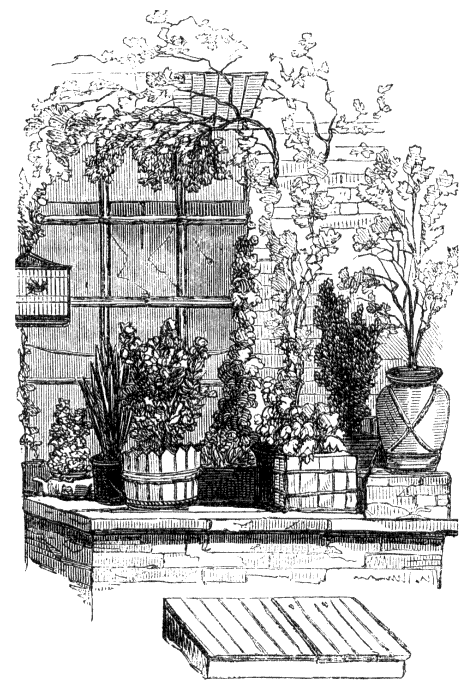
Figure 10.
Poor woman's roof garden (1862). To promote flower growing in slums, the Builder sent an
artist to show what one woman had managed to create with a few plants and a collection
of old pots. (Builder 20, 1862. Reproduced by permission of the Guildhall Library,
Corporation of London)
to organize flower-growing contests for slum children, Broome testified in the Builder's pages that on occasions when he had been invited by eager Cockneys to show them how to grow plants on backyard "dust-holes," talk of strikes was never to be heard.[31] In a similar vein, a speaker at a meeting of the British Association said "it was a well-established fact that whenever a pink, or a carnation, or a rose was seen outside a cottage, there was a potato or a cabbage for the pot within." He also favored his audience with these lines:
Yes, in a poor man's garden grow,
Far more than herbs or flowers,
Kind thought, contentment, peace of mind,
And joy for weary hours. [32]
No doubt Godwin did share the assumption that the personal contentment gardening bestowed had a calming effect on society; at least he never bothered to question on his editorial page that commonsense but untested proposition. However, his real interest was in the capacity of home gardening to make high density into a positive feature of city life. He recognized that bare façades and turnings seem to constrict spaces; patches of bright color, on the other hand, seem to have the opposite effect. In this respect, if in no other, he believed living conditions to have improved in his lifetime. Ten years ago, he noted in 1866, one rarely came across houses, even in the West End, embellished With window boxes, balcony gardens, or ivy-covered walls. By contrast, he said, the pedestrian could now pass by splendid displays of flower baskets on balconies, tendrils of Virginia creeper on trellises and railings, and, on the window ledges of Piccadilly and Cavendish Square, glass herbaria, warmed by boilers. Godwin was also glad to report that in far less fashionable areas—Aldersgate, Bermondsey, Hackney, and Islington—there was hardly a street without flowers.[33] He believed that this love of flowers was building bridges across the class divides.
Godwin returned often to the theme that London and the other major British cities were importing green nature at an ever-increasing rate over the course of the nineteenth century but that speculative builders with their doctrine of "bald utility" were, at the same time and also at an increasing rate, pinching it out.[34] Depending on perspective, either side could be said to be gaining.
Anyone capable of looking down on London, Manchester, Liverpool, Birmingham, or Nottingham (with its 10,000 allotment gardens)[35] at the end of Queen Victoria's reign would probably have been struck by the
amount of greenery there was below, not just in the suburbs but also in the central parts of the cities, especially if a particular balloonist had made the same assent nearer the beginning of the long reign. At the end of the nineteenth century, some Londoners were claiming that in no other city, not even in Paris, was flower cultivation, "in every available nook, and in the windows, alike of rich and poor, carried so far."[36] In the central part of London there were 2,000 or so acres of large public parks. Of these, Victoria Park, Battersea Park, and Primrose Hill had been constructed in mid-Victorian times, and the older Kensington Gardens and Hyde, Green, St. James's, and Regent's parks had been extensively replanted in the 1850s and 1860s. To the already-existing private squares had been added a variety of green "open spaces" maintained by the Metropolitan Board of Works and then by the London County Council.[37]
Added together, the various smaller recreation grounds—converted graveyards, public squares, playgrounds, shrubberies, road triangles, and enclosures—made up about 350 acres before the outbreak of the First World War.[38] Outside that central area, campaigns by horticulturalists and advocates of "rational recreation" for the multitude had made impressive contributions: publicly owned and administered commons like Wimbledon or Hampstead Heath, Epping Forest, Kew Gardens, Blackheath, and Bushey and Greenwich parks, to name only some of those larger open spaces that had been preserved or embellished. Although not visible from the air, there would have been patches of color in the lines and bends of terraced houses put up by speculative builders, little roof, window, balcony, and backyard gardens that would not have been there before midcentury. Greenery had returned to the heart of the Victorian city in profusion, gathered from the most remote corners of the world. As Godwin had hoped, these importations had been adopted and refashioned to form part of the urban fabric.
At the same time Godwin shared with the more romantically inclined the belief that uncultivated landscapes had a particular therapeutic value for a closely contained populace. He was inclined to agree that planned and contrived green spaces could not provide strong contrasts to the surrounding streets, brick walls, back alleys, and factories. In 1847 the Builder gave space to a letter expressing regrets about the imminent development of Copenhagen Fields. The correspondent noted that to lose this bit of wasteland would be to destroy a "play-ground of the northern part of the metropolis," where residents of Holloway and Camden Town come to pick daisies, buttercups, and wild hyacinths—in a setting more beautiful than any park. That same year, a letter from "A Faithful
Observer" described a visit to the site being prepared for Victoria Park and complained that "none of the advantages of the locality have been understood or turned in to account." The area being smoothed and re-configured had been, the observer noted, "a favorite, a beautiful spot, rather wild, varied, and luxuriant: it is now comparatively dreary, tame, and of course insipid."[39]
Other journals sounded this same note. Parks, commented the Lancet , a leading medical journal, were "cages of a larger kind."[40] Might it not be a good idea, asked the Morning Advertiser in 1874, to fence off at least one park and leave it more or less to nature's devices? "There is absolutely no poetry," the article continued, "in the modern garden, which at best but apes a Kaleidoscopic combination, and appeals to our most prosaic attributes." Thus a healthy dose of neglect might allow our "good old fashioned" flora to return.[41]
The founders of the Commons Preservation Society made a similar claim about the value of luxuriant wildness in their campaigns, begun in 1865, to save the commons on London's periphery from manor lords who wanted to enclose them or dig down in them for sand and gravel, from railway builders looking for inexpensive rights-of-way, and from speculative builders eager to lay out housing tracts. One society member observed that railways had annihilated space only to cramp the space available to the poor. That being so, he thought it would be unjust for the rich landowners who profited from suburban sprawl to deny others "the privilege of roaming far and wide, without hindrance or interruption."[42] The "smoke dried citizen," wrote the society's attorney Robert Hunter, wants "to rest himself," not in some place of "artificial beauty," but "on the green sward of untutored nature." "Free and well-regulated usage" of some "rural haunt" must be, he thought, a far better restorative than a sedate walk along graveled lanes, past neatly planted groves and flower beddings.[43] Presumably Hunter noticed no contradiction between free usage and well-regulated usage or between the related idea of preserving commons exclusively for recreation and presumed longing of pent-up city dwellers for things bucolic.
This ambivalence about what constituted the best restorative for urban workers and dwellers could be noticed in the landscape of suburban development. Especially after the 1870s, builders and designers of suburban enclaves for the numerous new recruits to the middle class incorporated landscape design aimed at suggesting rural values of community and organic growth: curving, tree-lined streets and carpets of lawn—features intended to provide transition between the public street and the
private realm, to knit suburban developments together, and to shield them from the harsher realities outside.
Technology had something to do with this trend. Until the last quarter of the century lawns had been maintained by gardeners using scythes and brooms, an expense only the rich could afford. The introduction of cheap, efficient lawn mowers bridged that suburban social division. As early as 1830 a textile engineer named Edwin Budding had adapted a machine for shearing nap from cloth and rugs to the task of mowing grass, but it was not until the lighter and much cheaper Follows and Bates lawn mower appeared in 1869 that the average homeowner could afford to display what came to be the symbol of suburbia—"a kind of verdant moat," an orderly green barrier against the central city's hard-edged jumble.[44]
Expanses of manicured turf were meant to suggest those country estate parks where lawn, clumps of trees, and shrubbery extend themselves without obvious transition into copses and meadows grazed by livestock. The well-manicured green carpet conveyed a different message. When the estate park was miniaturized into a suburban lawn, a playing field, or a golf course green, these immaculate stretches or patches of green tended to symbolize detachment from the immediate environment, not continuity with it. Grazing animals were not present to suggest harmony between two different but related meanings of "cultivation." By contrast, the suburban lawn suggested discontinuity with its surroundings.
Especially with the advent of the lawn mower, expanses of grass became simple, high-maintenance monocultures, environments that actively discouraged variety. "As a high-cost, high-energy floor covering," writes Michael Hough, the lawn "produces the least diversity for the most effort."[45] It follows that the cult of the manicured lawn, a Victorian legacy, acts as a formidable barrier to habitat complexity and less energy intensive forms of horticulture.
In the urban environment, the rural meadow, like the estate park, underwent a transformation. By midcentury, city dwellers began to notice other signs that the country was retreating from the city. This perception forms a major theme in Henry Mayhew's four-volume London Labour and the London Poor , published in 1861 and 1862. A section devoted to "Street Sellers of Green Stuff" contains transcripts of interviews with people who made their livings gathering turfs and plants from commons, the few remaining wastelands, and "eligible sites for villas"—areas cleared by developers but allowed to run wild until building commenced. Mayhew interviewed a partly paralyzed former brace maker who had
been reduced to selling chickweed and grunsell as feed for larks. He also had a sideline in turfs to line cage bottoms. Each morning at seven he took his stick and limped to Chalk Farm, where there was an abundance of chickweed. That done, he made his way to a private garden near Holloway, where he was allowed to gather grunsell. He bought the turfs from a boy who dug them at Kilburn Wells and Notting Hill. If there were a special order, he would add nettles to his basket so that lady customers could make a blood-purifying tea.[46] Here was an example of old-fashioned rural pursuits being carried on in the city, although they were hardly the kind Hunter probably had in mind.
Testimony given by another turf gatherer shows both that the city environment was still being "farmed" and that this kind of activity was steadily diminishing. He said that the small rings of sod he peddled had to contain shamrocks, or "small Dutch clover," otherwise keepers of skylarks, who used the turfs to line the cages, would refuse to buy. The best "harvest field" for specialty turfs used to be Chalk Farm, but it was now "fairly flayed." Parts of Camden Town, once prime sources, had been built over. As for Hampstead Heath, a place where shamrocks flourished, turf purveyors were now prevented from "so much as sticking a knife."[47]
Ironically, the manor lord who probably did the forbidding, Sir Thomas Maryon Wilson, was engaged at the time in a fierce and protracted struggle with irate commoners and concerned citizens over his right to dig gravel from the heath to sell to developers of a railway line and over his announced intention to appropriate parts of the common for speculative housing. Sir Thomas's death in 1868 opened the way for negotiations between his heir and the City of London, which ended in the heath's being set aside as a public recreation area. From then on "untutored" nature was there to be enjoyed but not to be gleaned or dug into. The heath remained a common, but its functions narrowed. Refashioned with Corot and Constable in mind, it became almost parklike.[48]
Mayhew does not comment directly on the disappearance of country ways from the experience of urbanites, but his fascination with "survivals" shows how aware he was that an era had past. We find, for example, an analysis of why there had been a steady decline in the street sale of live poultry. Geese, he writes, used to be brought to London's Leaden-hall Market where they would be purchased by vendors and driven through the streets, often in flocks as large as five hundred, to the suburbs where purchasers kept them until it was time to wring their necks or chop off their heads and prepare their corpses for the dinner table. In the same way, live ducks and chickens would also be transported from
Surrey, Sussex, or as far away as Ireland into the city center and then driven or carried out again through the public throughways to suburban backyards. Mayhew interviewed a middle-aged man, engaged in this trade since childhood, who reminisced about serving one young bride who ordered six couples, three hens and three cocks, in order to procure a supply of fresh eggs. When he explained that a ratio of one to five would be more productive and far more peaceful, she appeared less than pleased. But of late, he said, suburban wives prefer to buy their eggs so as to keep their gardens "nice"; as a result, orders had fallen off sharply. Obviously, squeamishness and the cult of tidiness and gentility must be included, along with the shrinkage of open spaces, among the explanations for why rus and urbe lost so many points of contact.
Mayhew noted these developments but looked to the advent of the railways for an explanation. He saw that this new technology tended to centralize both retail and wholesale marketing. "Resource blindness" was one of the results.[49] Increasingly, shoppers bought their ducks, chickens, and rabbits already butchered. Customers for live hedgehogs fell off radically when stores began offering packaged powders to control black beetle infestations.[50] For a similar complex of reasons, street vendors of seeds began to complain that people of all classes seemed to prefer buying flowers in pots.[51]
We have progressed so far along that road that Mayhew's London seems to us, by comparison, redolent with the sights, smells, and sounds of rural life. In 1855 the live meat market moved from Smithfield in the City to the Caledonian Market, reachable by rail lines. However, lack of refrigeration meant that well into the third quarter of the century, during the hot months, cattle and sheep would be driven through street traffic in London and other cities, on their way to inner-city basement slaughter houses. Because milk soured quickly, a few dairies remained near the city center well after the notorious swine herds of the Kensington Potteries had been banished. Until late in the century, cows were kept under license in St. James Park. When taken there as a boy in the 1880s, Thomas Burke recalled always being given a penny glass, "fresh from the cow." At the end of that decade, more than twenty percent of London's milk supply still came from urban cowsheds.[52] It should also be kept in mind that so long as most street traffic moved, literally, by horsepower, all city dwellers shared, to some extent at least, the farmer's intimate relationship with animals.
Yet there could be no question that a separation of realms did take place during the nineteenth century, although a full account of that pro-
cess would need to begin much earlier. Those born when the century was new recognized as adults how detached their lives had become from country lore and pastimes. It may be that bemoaning the loss of contact with elemental things is a perennial sign of advancing years, but this kind of lament seems to have had a special poignancy in the 1860s and 1870s. In 1871, a middle-aged resident of North London sent the Builder a letter recalling the pleasure of swimming as a boy in spring-fed ponds on summer mornings at Hornsey-Wood House. Since then, he noted ruefully, the forces of "improvement" had intervened. Wishing to provide and at the same time control recreation, the Metropolitan Board of Works had absorbed the house property and spring system into its new Finsbury Park. So he knew what had happened to the original fen in Fins-bury: it had either become part of London's reservoir system or had been fashioned first into a bucolic tea house retreat and then into a park with an "ornamental water." "No Swimming" signs were soon posted.[53]
There was a sad irony in all this, the correspondent thought. Having displaced people to build the park, thereby increasing congestion in the surroundings, officialdom had proceeded to cut off access to fields and bathing places, and doing so after having increased by their actions the desire and need for informal recreation. He recognized that, in this case, it had been park planners and municipal engineers, not housing speculators, railway builders, or industrialists, who had been the agency by which a semirural environment came to be blotted out and refashioned into a carefully designed artifact. He would probably not have been cheered had he known that the informal playground of his youth would eventually be turned into, among other things, a concentration of sporting facilities. He thought that parks and playgrounds were certain to be "less enjoyable than the old fields."
We are now more conscious than was this Victorian Londoner of the subjective nature of enjoyment: choice between active and passive recreation seems to most of us a matter of age and lifestyle. Still alive but much weaker is the feeling that the city represents corruption and the country, virtue. And even the most nostalgic recognize that North London suburbs and their equivalents elsewhere are unlikely ever to be linked to the countryside by a vernacular landscape of fields, ponds, and hedges. Yet the ecologically minded do feel a bond with those in the past who saw value in what has been called the "unofficial countryside"—the marshes and fens, the unmown and untrimmed verges and edges of the urban environment where nonhuman life often flourishes.[54]