
6—
Yang Hsüan-chih (fl. ca 528–547)
Little is known of Yang Hsüan-chih. Some scholars have conjectured that he was born into a noted literary family in Pei-p'ing (modern Tsun-hua, Ho-pei). In 528, he was serving the Northern Wei dynasty as an audience attendant and was able to observe the splendor of the capital of Lo-yang before its abandonment in 534. The Northern Wei dynasty had been established by the non-Chinese T'o-pa clan, descended from the nomadic Hsien-pei tribe. Originally based in what is today Inner Mongolia, they had moved into Shan-hsi and established their first capital in P'ing-ch'eng in 398. By 490, the rulers had become considerably assimilated to Chinese culture and harbored ambitions of conquest to unify the entire country. On one such expedition, the Emperor Hsiao-wen (r. 471–499) forced his nobles to move the capital to Lo-yang. Once the political and economic center of the Yellow River area, it was by then largely deserted; however, the emperor felt it was more suitable as a new political center from which he hoped to rule all of China. The Northern Wei aristocracy revived the life of the city by importing artisans, permitting the rise of a wealthy merchant class, and actively supporting Buddhism. During the four decades that it served as the capital, over thirteen hundred temples were built, and the population grew to about five hundred thousand. As a result of power struggles involving local military commanders and members of the imperial family, the Northern Wei dynasty finally split apart. Emperor Hsiao-wu (r. 532–534) ordered Lo-yang abandoned on short notice in 534 and fled to the protection of a military commander in Ch'ang-an, which later became the capital of the Western Wei dynasty. Another commander established Emperor Hsiao-ching (r. 534–550) in the
2.
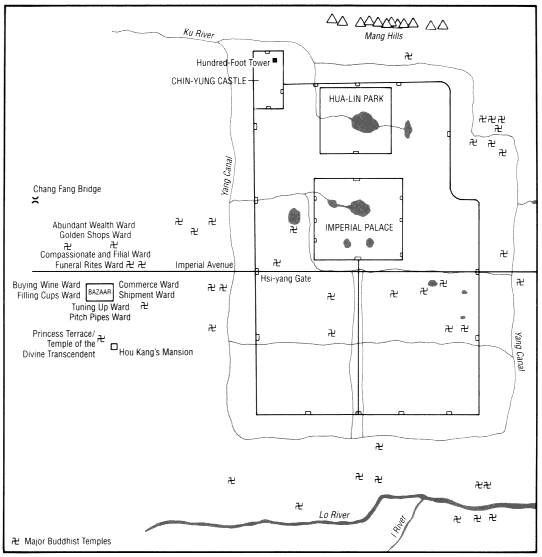
Lo-yang During the Wei Dynasty, ca. 528, based on Chou Tsu-mo, ed., Lo-yang
ch'iehlan chi chiao-shih (Peking: Chung-hua shu-chii, 1963)
Eastern Wei dynasty at Yeh-ch'eng near modern An-yang, Ho-pei. Loyang became a contested battlefield subjected to repeated pillaging and destruction. When Yang Hsüan-chih wrote his account, less than five hundred of its temples survived.
In 547, Yang Hsüan-chih was serving as an assistant under a commandery governor of the Eastern Wei and passed through Lo-yang again. The striking contrast between the abandoned capital and its previous magnificence so affected Yang that he decided to write a record of its glorious past. His melancholy reactions upon viewing the fallen capital were expressed in his preface:
Both the city and its suburbs lay in ruins; the palace halls and chambers had crumbled; temples had been burned to the ground, while monasteries and stupas were but mounds of earth. Walls were covered with vines; alleys were a web of brambles and thorns. Wild animals made their homes beneath deserted stairs; mountain birds nested in courtyard trees.... Inside and outside the walls of the capital there had been more than one thousand temples. Now, in these desolate environs, the sounds of bells are seldom heard. I fear that these places will be lost to future generations, so I have decided to compile this record.
The Temples of Lo-yang was written in parallel prose style and is regarded as one of the two monuments of prose writing surviving from the Northern Dynasties, along with The Guide to Waterways with Commentary . The earliest record of a Chinese city, it became the prototype of many later works by travelers recording urban scenes, past and present. It is organized into five parts, covering the inner city and its four suburbs to the north, east, south, and west. Yang had access to official and private archives and probably interviewed eyewitnesses; he used his own memories of the former capital to supplement these resources. Interspersed between descriptions of the architecture and history of more than seventy temples, therefore, are broader historical and political events, local legends, and social and economic conditions. The account of the monks Sung Yün and Huisheng, who traveled from Lo-yang to Udyana and Ghandara to fetch sutras from 5 18 to 522, was also included and regarded as a valuable source of information about Central Asia and foreign relations. In addition, the many anecdotes containing fantastic or highly fictional content have evoked comparisons with the chih-kuai genre of supernatural tales that flourished during this period, largely in the
south. The subject of a bazaar was unusual for a traditional Chinese writer. Yang's description offers a rare view of this important focus of urban life.
From The Temples of Lo-yang: The Bazaar of Lo-yang 88  (ca.547)
More than a mile outside the Gate of Western Light south of the Imperial Avenue was the bazaar of Lo-yang. It was surrounded by eight wards.[1] South of the bazaar was the Princess Terrace, built by the Han dynasty general-in-chief Liang Chi.[2] It still stood over fifty feet high. During the Ching-ming era [500–503], the Buddhist monk Tao-heng established the Temple of the Divine Transcendent on top of it. West of the terrace was the seat of Ho-yang District.[3] East of the terrace was the mansion of the palace attendant Hou Kang.[4] Northwest of the bazaar were an earthen hill and a fish pond, also built by Liang Chi, which are referred to in the History of the Latter Hah Dynasty : "He gathered earth and constructed a mountain three miles around with nine slopes to resemble the two peaks of Mount Hsiao."[5]
To the east of the bazaar were the two wards named "Commerce" and "Shipment." The inhabitants here were all engaged in manufacturing, meat-cutting, and trading. Their wealth was enormous. There was a man, Liu Pao, who was the wealthiest. He established a house in every city throughout the regions and commanderies; in each one he maintained ten horses. Despite the fluctuating cost of salt and grain and the changing prices at the market, his enterprises maintained a uniform rate. He conducted business anyplace where boats or carriages could travel and wherever those on foot could tread. Thus, all the goods to be found in the world were stored in his warehouses. His wealth was comparable to the Copper Mountain; his home was another Cave of Gold.[6] His mansion's dimensions exceeded those permitted for merchants; his towers and pavilions pierced the clouds. His carriages, horses, raiments, and ornaments resembled those of princes.
To the south of the bazaar were the two wards "Tuning Up" and "Pitch Pipes." The inhabitants of these streets were musicians and singers. The most skillful performers in the empire came from here. There was T'ien Seng-ch'ao, who was adept at playing the hu-chia flute. He could perform the "Warrior's Song" and "Hsiang Yü's Lament"[7]
and was much favored by the General of Western Conquests, Ts'ui Yen-po.[8]
At the end of the Cheng-kuang era [520–524], Kao-p'ing[9] was lost to rebels, and tyrannical officials abounded. The rebel leader Mo-ch'i Ch'ou-nu preyed on the Ching-Ch'i area.[10] The court was so preoccupied with these matters that the meals were delayed. Ts'ui Yen-po was put in command of an army of fifty thousand infantry and cavalry to destroy him. Ts'ui led his army forth from Chang Fang Bridge in the western suburb of Lo-yang, which was by the former Sunset Pavilion of the Han.[11] On that occasion, nobles and officials assembled to bid him farewell; chariots and mounted horsemen formed a procession. Ts'ui, in a tall hat and long sword, displayed his martial demeanor at the head, while T'ien Seng-ch'ao played the "Warrior's Song" on the flute in the rear. Among the listeners, cowards became brave and swordsmen yearned to do battle. Ts'ui's courage was extraordinary, and he had achieved an awesome reputation while young. For more than twenty years, he had exerted himself in the service of the nation. No city wall remained undamaged after he attacked; no enemy lines held when he did battle. Therefore, the court sent him off with great fanfare.
Whenever Ts'ui faced battle, he would always order T'ien Sengch'ao to play the "Warrior's Song." Every armored soldier was stirred to a frenzied pitch. Ts'ui would charge into the enemy alone on his horse as if no one were near him. His courage was superior to anyone's in the entire army; his might kept the barbarians under control. For two years, reports of his victories arrived one after the other. But Moch'i Ch'ou-nu employed a skillful archer to shoot T'ien Seng-ch'ao and kill him. Ts'ui was so despondent and filled with grief that those around him said that Yü Po-ya's loss of Chung Tzu-ch'i[12] could not have been worse. Later, Ts'ui Yen-po was struck by a stray arrow and died in battle.[13] After this, his army of fifty thousand quickly disintegrated.
To the west of the bazaar were the two wards "Buying Wine" and "Filling Cups." The inhabitants of these wards mostly fermented wine for a living. Liu Pai-to of Ho-tung[14] was an expert at wine-making. In the sixth lunar month, the height of summer when it is scorching hot, he would fill vats with wine and expose them to the sun for ten days, by which time it had fermented. It had a fine bouquet when drunk, and one could feel intoxicated for an entire month. When high-ranking officials of the court traveled out to the commanderies and frontier territories, they often brought this wine over a distance of more than one thousand li as gifts. Because it came from afar, it was known as "Crane
Cup Wine" and as "Donkey Riding Wine." During the Yung-hsi era [532–534], the Inspector of South Ch'ing Region, Mao Hung-pin,[15] brought this wine with him on his way to the frontier. Along the road he encountered bandits, who immediately became intoxicated after they drank it: all of them were caught. Thus, the wine was given the additional name of "Bandit-Catcher." A saying among the wandering swordsmen went,
Fear not drawn bows or unsheathed swords.
Fear only Pai-to's spring wine.
To the north of the bazaar are the two wards "Compassionate and Filial" and "Funeral Rites." The inhabitants of these wards sell coffins for a living and engage in renting out hearses. Sun Yen, a professional mourner, took a wife who slept with her clothes on for three years. Sun considered this strange, so he waited until she was asleep and secretly removed her clothes to find that she had hair three feet long resembling the tail of a wild fox. Sun was terrified and threw her out. As his wife was about to leave, she took a knife and cut off Sun's hair, then fled. The neighbors chased after her, but she turned into a fox and they could not catch her. Later, there were more than 130 men in the area of the capital who had their hair cut off. At first, she would change into a woman wearing makeup and clothes. As she walked along the street, men would see her and gladly try to become familiar with her: all of them ended up with their hair cut off. At that time. If a woman wore a colorful dress, people would point to her as a fox demon. These occurrences lasted from the fourth month of the second year of the Hsip'ing era [May—June 517] until the autumn.
There were, in addition, the two wards "Abundant Wealth" and "Golden Shops," where the rich dwelled.
In all these ten wards were mostly artisans, merchants, and those who possessed wealth. Families worth a thousand gold pieces lived close together; their storied mansions rose face to face; their double gates opened toward each other; covered passageways connected them so that they could visit or see one another. Their household maids wore gold and silver ornaments, embroidery and brocade; their servants and slaves gorged themselves on the five flavors and eight delicacies. During the Shen-kuei era [518–519], it was announced that artisans and merchants had violated the restrictions on these things and were not permitted to wear gold and silver ornaments, embroidery, and brocades. But although this was promulgated as law, it was not enforced.[16]