
5
Families of Peasants
In the census of 1767, when Antonio Correa de Lemos Leite headed the lists as the captain major of Parnaíba, Bento Cardozo Correa's household appeared in the third militia company. The same age as Antonio (42), Bento lived with his wife, Maria, (39), and five children, ranging in age from eighteen to four. The census transcriber noted that Antonio lived "by farming and mining" and that he "owned 400,000 reis," while Bento who also lived from farming "owned nothing."[1] Apart from the fact that Antonio and his wife had eight children and Bento and his wife had only five, the two families appear to be very similar. Both were large nuclear families that lived predominantly from farming.
Yet the 1767 census did not record information on slave ownership. Because it did not, it obscures the fundamental class difference between the families of Antonio and Bento. From the 1775 census, however, we learn that Antonio owned fifteen slaves, while Bento owned none. Antonio thus was assured of a sizable labor force that he could use to produce not only the food that his family needed to survive but cash crops such as sugar. Bento and Mafia relied only on the members of their own family for labor. Changes in the composition of their family, therefore, would affect how much food they needed and how much they could produce. Thus, while the structure of Bento's and Antonio's families seemed similar in the 1767 census, in fact their lives were very different. Families of slaveless farmers, like Bento's, were part of a rural peasantry, while families of slave owners, like Antonio's, formed the wealthy planter class. This distinction became ever more pronounced as commercial agriculture became the mainstay of São Paulo's economy in the second half of the eighteenth century.
When commercial agriculture began to spread into the older
towns of São Paulo, this new economic orientation, reinforced by new royal policies, transfigured the traditional life-style of the peasantry.[2] In Parnaíba, peasants found themselves under increasing pressure to yield their farmlands to the sugar planters. Simultaneously, the competition for nearby frontier lands increased, forcing them to seek lands ever farther west. A crisis was at hand by the end of the eighteenth century which had dramatic effects on family life. Caught between the vice of an expanding commercial agricultural economy and a receding frontier, families of peasants found it increasingly difficult to survive in the town.
The population of the peasantry, moreover, continued to grow in Parnaíba, fueled by natural increase and in-migration. Faced with limited opportunities for maintaining their traditional lifestyle, many moved away, to the frontier far to the west where they reestablished themselves in the wilderness and to the growing town centers, especially the city of São Paulo. Those who remained in the town traded their traditional life-style for a new and more sedentary way of life. Some became artisans, laborers, or muleteers and gradually left the rural areas for the town center. Those who continued to farm planted on smaller, finite plots of land that supported reduced households. Thus, as the once wilderness town of Santana de Parnaíba became more tied to the kingdom in the second half of the eighteenth century, families of the elite embraced and profited from these economic changes, but peasants did not. Far from benefiting from the economic growth that took place around them, peasant families found themselves increasingly at risk and vulnerable in the town.
The traditional life-style of the peasantry in the eighteenth century relied on the presence of the wilderness and the availability of free land. Their lives reflected the synthesis of Indian and Portuguese lifeways, characteristic of the early years of colonization in São Vicente. Even during the eighteenth century, the lives of peasants still resembled those of the original settlers of São Vicente one hundred years before. They lived on small family farms, dispersed through the forest, and owned little besides the tools they needed to farm, produce food, and provide shelter.
The yearly agricultural cycle that dictated the lives of the peasants revolved around the work required to clear and burn fields,
to plant and harvest crops, and to process food. The most difficult and dangerous work was clearing land. The Morgado de Mateus described the technique used throughout São Paulo:
The fields are prepared very easily; it is no more than just cutting all the trees on a hillside on one side and first felling the trees on the top of the hill. These, falling, take before them the nearby trees one after another until everything is leveled. Dry in a few days, they burn it and later plant in the ashes.[3]
Nothing more is needed, the Morgado wrote, until the harvest, an easy time, when the farmers "pick what they need and nothing is left over."[4]
Peasants had learned this method, known as "slash-burn" or "swidden" farming, from Indians. It took advantage of the fertility of forest soils, rich in organic matter, and the carbon from the burned wood. After a few years, however, rains had washed the organic matter away, and the land produced less. Again, peasants learned from the Indians: they moved on to new places in the forest where they cleared new fields. This practice was known as "moving farms" (sitios volantes ) because farmers moved their fields every few years, rather than continually cultivating and rotating the same plots of land in the European way.[5]
In São Paulo, as in all Brazil, farmers cultivated almost entirely by hand, unlike peasant farmers in Europe who used domesticated farm animals and the plow to increase their yields.[6] Yet Brazilian peasant farmers did not farm solely according to native American ways, for they devised their own hybrid techniques that combined European and native American methods. Tools, made from iron,[7] such as axes, machetes, hoes, billhooks, and knives, were of European origin, while the use of forest hillsides and fire and the abandoning of fields were of American origin.
The temperate climate of the Piratininga plateau, the abundant forest, and the farming techniques devised by peasants all allowed a variety of crops to be cultivated with a minimal amount of work. Families planted corn, the staple of their diet, in the spring—in August, September, and October—and harvested it six to seven months later. Other crops such as rice, manioc, cotton, and peanuts were also planted from August to October and harvested from February to May. Beans could be planted and picked twice yearly;
the first planting occurred from January to March, with a harvest in April, May, or June; the second planting in August, with a harvest in November and January. Sugarcane, usually planted from November to April, could be cut a year and a half after planting.[8]
The staples of the family diet came from American crops: corn, beans, and manioc. The Tupi Indians had cultivated these basic foodstuffs in Silo Paulo long before the Europeans arrived and taught the first settlers how to raise and prepare these foods unknown in Europe. Each of these staples yielded a high ratio of food per hectare planted. A nineteenth-century statistician, Daniel Pedro Müller, estimated that the ratio of seed to harvest was 1 to 100 for corn, 1 to 20 for beans, and 1 to 50 for rice in Silo Paulo in the early nineteenth century.[9] In Parnaíba, references to yields in the 1798 census suggest that they were considerably lower than those calculated by Müller. Corn gave a ratio of 2 to 39, beans 1 to 11, and rice 1 to 18.[10] Still, considering that the highest average yields in Europe for cereals (wheat, rye, barley, and oats) at the same period of time were 1 to 10.6, farmers in Silo Paulo harvested more per seed planted than their European counterparts.[11] The farmers of Silo Paulo may not have been as sophisticated, but the foods they subsisted on, all native to the Americas, were far more easily and efficiently grown than those of Europe.[12] Ironically, peasants in Silo Paulo did not have to work nearly as hard to feed their families as Portuguese farmers did. Perhaps this is one reason that the "laziness" of farmers in Silo Paulo constantly amazed the Morgado de Mateus.[13]
Once a crop had been planted and harvested, families devised simple methods to process and store their basic staples. Simple hand-hewn mills and presses adorned the terraces of beaten earth that surrounded their small wattle and daub huts. Here they made flour from corn and manioc. To make cornmeal, women used a wooden mortar and pestle or a water-powered corn pounder (monjolo ). Of the two, the wooden mortar and pestle required the most work, for the dried corn kernels had to be beaten by hand until they became a coarse meal. The monjolo, a European innovation, used simple mechanics to replace the back-breaking work of pounding corn.[14] Resembling an enormous seesaw, the monjolo consisted of a huge wooden beam, hollowed out at one end to form a trough, with a wooden head on the bottom of the beam at the
other end. Balanced on a fulcrum, the head was heavier than the trough and rested in a bin of corn. But when water filled the trough, making that end heavier, the head rose until the trough hit the ground. Then the water spilled out and caused the head to crash down into the wooden bin filled with corn kernels. Over and over again, the head rose and fell as water filled the trough and spilled out on the ground. Creaking, groaning, and thudding all the while, the monjolo eventually produced cornmeal with a minimum amount of human effort.
Manioc had an extremely high caloric yield per hectare and kept for long periods.[15] Because it was inexpensive and resilient, families relied on it as one of their major sources of carbohydrates. Tupi Indians taught early settlers how to cultivate and prepare manioc. Jesuit Father Anchieta described how the Indians fixed manioc in several of his letters. "[I]f eaten raw, roasted, or cooked, it kills," he wrote, "it is necessary to soak it in water until almost rotten; then rotten as it is, they convert it into flour which can be eaten by toasting it in large pottery vessels."[16] Families of peasants modified the original Indian technique with European additions, such that the transformation of the raw poisonous manioc into edible and long-lasting flour became an easier process. Like yams or potatoes, manioc grew as a tuber in the ground. It required minimal cultivation until ripe, when women simply dug it up. Then they took it to their terrace or to that of a neighbor who owned a manioc wheel and a press. There women peeled the manioc, while men grated it using a hand-turned wheel. One person cranked a large wheel, attached by a belt to a smaller wheel, while another fed the peeled manioc into a series of rapidly turning teeth that chipped away at the white tubers. The grated manioc fell into wooden basins, and when enough had collected, they placed it into a press attached to a heavy beam, which pushed the poisonous milk down to the bottom of a basin and out holes in the bottom. Finally, they toasted the manioc over an open hearth to produce manioc flour.
Corn, beans, and manioc occupied most of the time and acreage planted by peasant farmers, but other crops, such as rice, cotton, and sugarcane, were also grown. The rice cultivated by peasants was dry, grown without irrigation. After it had been harvested, women removed the outer shell by pounding it in a mortar and
pestle. Then they winnowed the rice by throwing it up and down in a wide flat basket until the wind had blown away the lighter chaff.
A few families planted sugarcane and distilled their own cane brandy using primitive methods characteristic of the early years of sugar production in Brazil. Small amounts of cane brandy, for household consumption, work parties, exchange, and sale, could be produced without extensive capital investment. After men cut the cane with long knives or machetes, they took it to be crushed in a small mill. Then they boiled the juice in large copper vats. When the juice was poured from these vats into molds to crystallize, molasses dripped out of the bottom of the molds. From the molasses, they distilled cane brandy using a copper still.
In addition to cultivating these foods, the peasantry supplemented their diet with hunting and fishing in the forests near the town. They kept domestic animals, especially pigs, as a source of meat and fat. Cotton, which many families grew, was spun into thread by women and then woven into cloth or used to make hammocks to sleep in. Men and women collected clay from the streambeds which they fashioned into ceramic pots, plates, jars, and jugs.
Peasant families depended on free land from the wilderness for their survival. Most exercised squatters' rights by virtue of unchallenged occupation. In a sense, their views of landownership were closer to the Indian practice of owning the fruits of the land but not the land itself.[17] Those who wished to own land as private property in the European sense had to secure a legal land title, which required receiving land through an inheritance conducted by the local judge, or purchasing land and registering the land sale with the town notary, or receiving a royal land grant from the crown. All of these processes discriminated against the families of peasants, who lived on the fringes of colonial society. Few had the contacts or the resources needed to obtain legal titles to land. Not surprisingly, peasants only sporadically held legal title to their land.
In the seventeenth and even eighteenth centuries, the presence of the wilderness, however, meant that land was not yet a scarce resource in São Paulo. Not having legal title did not prevent families from farming unclaimed land. The laws of Portugal inadvertently protected their rights. Lands granted as sesmarias, for
example, were given "without loss to a third party or to the rights which someone may have to them."[18] This provision extended to those who "owned" land by virtue of their "occupation" of it. When Anna Maria Xavier Pinto da Silva requested a land grant for a region of thick forest between Parnaíba and the neighboring town of Jundiaí, her petition was at first denied because nine families were living on the lands. These families, although very poor, still paid the tithe to the church each year. When the crown finally did award her the land grant, it upheld the rights of these nine families to their plots.[19] Thus, as long as land was plentiful, peasant families had little trouble finding room to plant their fields.
In the traditional peasant life-style, individuals could not survive without their families. Together, members of a family worked to grow the food that all needed to survive. Whereas the ownership and allocation of property played a major role in binding the families of the elite together, a never-ending cycle of work tied the families of peasants together. Each member of a household contributed to the household economy, and the labor of all made it possible for the family to survive as a group.
Unlike the families of the planters, equality among individuals characterized the family lives of peasants. They lived in households rarely differentiated by race, since members of the household generally came from the same family. Both men and women worked in the fields and in the preparation of food, such that husbands and wives and brothers and sisters performed similar tasks and held equivalent responsibilities.[20] Since few learned to read and write, both males and females were illiterate, and none served in community institutions.
Even children played important roles in these families. They worked with their parents from a young age and greatly increased the labor capacity of the household.[21] For this reason, women bore many children, and families had little incentive to limit the size of their families. For the same reason, families discouraged their children from marrying at an early age. Children remained at home, working for their parents until they married, usually in their twenties. Only then did they form their own households.
Peasant families extended their work force by taking in servants or retainers. Families, especially the better off, often had dependents (agregados ) living with them. These might be kin, orphans,
or poor people who worked in the fields, in the preparation of food, and as domestic servants in exchange for food and lodging. Families might seek servants at specific times in their lives, such as when their children were young or after they had left home. In this way, they could expand the productive base of the household.[22]
At times of harvest, or during the preparation of the fields, peasants relied on their neighbors. Work parties, or ajuntamentos , were an important means of expanding a family's labor force. José Arouche de Toledo Rendon described this practice in 1788:
He who wishes to establish his farm or clearing in the woods calls all his neighbors for a certain day in which, after eating a lot and drinking more, they take up their axes and billhooks, more animated by the spirits than by the love of work. When that event is over, they get together for others, and this becomes the only time when they work.[23]
These work parties were reciprocal, in that those who benefited from the parties were expected to return the favor at a later date.[24]
The ajuntamentos themselves may have been of Indian origin. The Jesuit, José de Anchieta, observed the custom in sixteenth-century São Vicente:
Whenever he [an Indian man] decided that his roa [field] required attention, his wives made a great quantity of wine .... With a fresh supply of brew on hand, neighbors were invited to bring their sticks and to work on the land, sometimes all day and occasionally into the night. As compensation, they gathered at the hut of the owner of the roça and finished the wine made from manioc roots.[25] ç
This account holds much in common not only with José Arouche de Toledo Rendon's description but with a portrait drawn by Lia Freitas Garcia Fukui of a workday in 1964:
At a prayer day at the chapel, the head of the family invited all the residents of the neighborhood to his farm to work. On the set day, ten people—family, neighbors, and friends—responded to his request. They began the work in the morning, breaking only for lunch, and, at the end of the day when dinner was served, the walls of the house were finished. Drink was served abundantly throughout the day.[26]
The family life of peasants left even less room for privacy or for individual self-expression than among planter families. These
families lived in small huts, constructed from woven sticks and mud or simply straw. Everyone slept in close proximity, in hammocks, on mats on the floor, or in cots made from woven vines. What few possessions families owned, such as cooking utensils, furniture, clothes, and tools, were usually of such limited value that combined, they did not reach the minimum amount of property needed to justify a property inventory when someone died. Thus, formal inheritance, a crucial event to families of planters because of the property transfers involved, concerned peasants less. Since families had little to divide among their children, they did not devise elaborate strategies to modify the impact of inheritance law.
The censuses initiated by the Morgado de Mateus provide historians with an excellent source for reconstructing the lives of peasant families at the end of the eighteenth century. By comparing the first census, undertaken in 1775, to record information on slave ownership and landownership to one forty-five years later, in 1820, it is possible to see peasants at two distinct moments in time. In 1775, a sugar economy had taken root in Parnaíba, but the traditional life-style of peasants was still in evidence even as sugar was beginning to change the lives of all farmers, both those who began to plant cane and those who continued as subsistence farmers. By 1820, the sugar economy had radically altered the agrarian spaces of the town and the lives of the peasant farmers.
To live in Parnaíba in 1775 meant to accept the world of the captain major, to serve in the local militia, to have one's house enumerated in the census, and to be subject to provincial levies for men and food. Each of the households in Parnaíba in 1775 had its agricultural production, as well as its agricultural property, calculated for the year. Bento Cardozo Correa, for example, "owned a small farm, six horses, and one sow, and harvested 25 alqueires (907 liters) of corn and 2 (73 liters) of beans." His health and the general fitness of his sons also merited evaluation. Bento, the census taker noted, "had been sick with a serious illness for seven months," his son Antonio "was overcome with plague,"[27] and his son Francisco "had a thickness in his neck."[28] The censuses gave royal governors important information on every household in the town, information that could be used to call up recruits, requisi-
tion food and supplies, recruit families for settlement projects, and estimate tax revenues.
Despite these changes, the 1775 census portrays many of the traditional strategies used by peasant families for survival. Families continued to live as they always had, as subsistence farmers. The majority of them lived in the outlying areas of the town, beyond the reach of local institutions. These were the moving farms (sitios volantes) so disliked by the Morgado de Mateus. For these men, women, and children, survival depended on planting freely on unclaimed lands. They relied on their families for labor in their fields, and they avoided the agents and institutions of social control as much as possible. But the census also portrays a second group of peasant farmers who lived more sedentary lives. These peasant farmers owned small farms and saw their survival differently. They integrated themselves into the community and linked themselves to the more powerful families of the town. They sought to limit the division of their lands between their heirs.
According to the 1775 census, 39 percent of the slaveless farmers in Parnaíba planted "by favor" (a favor) (see table 12).[29] Planting "by favor" appears to have meant planting freely wherever families found available land. The few references to the term suggest that these farmers planted either on vacant or unclaimed lands or with the permission of the actual owner. When families had permission to plant on the lands of others, such permission may have involved an exchange of some kind, either in rent or harvest. But the meaning of "by favor" suggests that these families received land freely, because it was abundant, and because no one minded their presence. While evidence is scant, such an interpretation is confirmed by a document left by João Ribeiro Fernandes, Paulo Pereira, Antonia Pais de Oliveira, and Matheus Rodrigues with the town council in 1784. On April 17, the four appeared at the town council to register their relationship. João stated to the notary that "it was his wish... that Paulo Pereira remain situated on his fields and that he retain a grove of trees... without the obligation of paying anything, which was accepted by Paulo Pereira."[30] João continued that it was also his wish that Matheus Rodrigues remain with his fields "without paying anything" and that, likewise, Antonia Pais de Oliveira stay without obligation, except that she con-
Table 12. Land Use Patterns of the Peasantry, 1775 | ||
Households | N | % |
By favor | 194 | 39 |
Landowners | 163 | 32 |
Tenant farmers | 60 | 12 |
Landless | 86 | 17 |
Total | 503 | 100 |
Source : 1775 census, Parnaía. | ||
struct a fence. This agreement, signed "to avoid any contention" between the four families, on the surface seems to reflect a favor relationships between João and the three others. Searching for these households in the 1775 census, we find that João Ribeiro Fernandes lived in the parish of Silo Roque where he owned a farm, planted corn, and raised cattle, pigs, and horses. Matheus Rodrigues and his wife and five children lived in the same neighborhood and planted by favor.[31] The households of Antonia and Paulo do not appear in the census, but from the households of João and Matheus, the relationship described in the document signed at the town council becomes clear. Matheus planted by favor, on lands that João claimed as his own.
From the point of view of the peasant farmer, undisputed cultivation of land implied ownership, irrespective of legal claim. Thus, the family that planted the same lands by favor over many years came to view those lands as their own. For example, the census of 1775 noted that João Leite de Lima, his wife, and four children planted by favor. Fifteen years later, a bill of sale appeared in the town's notary books. In the bill of sale, the farm consisted of almost half a league of land, two fields of corn, a field of cotton, fruit and pine trees, a wattle and daub house thatched with straw, and a pen for pigs. João and his wife claimed that the farm had belonged to their parents and grandparents and that they had been in "possession" of it for over sixty years. Over time, then, unchallenged occupation became the grounds for legal ownership of land.[32]
Because the meaning of the term "by favor" is impossible to define clearly in the 1775 census, it is difficult to know exactly what kinds of relationships the majority of peasant families had to land.
Given the clarity of other relationships, however, it is possible to say what by favor was not. Since the census clearly stated when farmers owned land, it did not refer to actual ownership. Nor did it mean renting land, for those families were known as renters (foreiros ). By the same token, by favor did not mean tenancy, since those who lived as tenants in the European sense were called retainers (agregados) or Indian wards (administrados). Nor did it mean that the households did not farm, since nearly all who lived by favor produced agricultural crops. Thus, based on the few clues gleaned from other sources and from what by favor was clearly not, by favor appears to have meant planting freely on unclaimed lands or on private lands, with the permission of the owner.
A second meaning of by favor that appears in documents suggests a different kind of land tenure. Families who owned land sometimes granted permission to others, usually their immediate kin, to plant on their land. According to the census, João Rodrigues, his wife, and two children lived "by favor of his parents." Unlike families who lived simply by favor, João and his family depended on their family for land. Rather than searching for free frontier land, they planted on lands that had already been claimed.[33] This meaning of "by favor" depicted a very different kind of land use—one where families shared land. Thus, I have included it in the category of landownership in table 12.
The 163 households of peasant farmers who owned land in 1775, or lived by favor on the lands of immediate kin, or planted on lands owned jointly with others, or rented land had the most stable access to land. While they may have obtained land through squatters' rights, when they bequeathed those lands to their children by a legally recognized will or property inventory, they established a legal claim to the lands that would be accepted by the local judges.[34] This served as an important strategy used by the more established of the peasantry to legalize their land claims.
Families used a variety of strategies to create and maintain small farms. Some joined parcels of land to form one viable farm. Francisco Xavier de Oliveira and his wife, for example, created their farm by combining a piece of land they inherited with some land they bought from a nephew.[35] Another strategy worked to prevent the division of land through inheritance. Rather than dividing the family lands, the eight children of Anna Leme do Prado decided
to live together and share the property.[36] Some families rented land from local institutions, such as the church, the town council, or the Indian community of Baruerí. Rented lands often remained in the family for several generations and represented stable access to land. The local institutions that owned the lands collected a nominal rent each year, and tenants could sell their rights to the land and bequeath them to their heirs.[37]
In 1775, sixty families lived as tenant farmers on the religious estates of the town. These peasants did have obligations to their landlords. The confiscated Jesuit property of Araariguama had thirty-nine households attached to it in 1775, the people of which the census takers labeled as "freed" (forros e libertos ). These were former Indian wards and free slaves. Traditionally, they had worked three days a week for the Jesuits in return for their land and cottages.[38] ç Those who rented the Jesuit estate from the crown after 1759 may have also expected the same from the tenants on the estate. The Monastery of São Bento, a small Benedictine estate in Parnaíba, had eight tenant households labeled as agregados in 1775. According to the census, these tenants were both mulattoes and Indians. On the estate of the Chapel of St. Antonio in the parish of São Roque, the census listed thirteen tenant households and called them "Indian wards" (administrados), even though the relationship of administração had been formally abolished in 1750. On each of these estates, it is likely that the tenants, who were formerly Indian wards, continued to live on these estates after the abolition of administração and exchanged their labor or part of their harvest for the fight to plant.[39]
The majority of the peasants lived in nuclear families in 1775. Nuclear families, composed of a married couple and their children, proved to be critical to the survival of peasant farms, for they provided peasants with the best ratio of laborers to land. By plotting the ages of heads of households in the census with the types of households they headed, it is possible to see a common peasant family cycle in which the nuclear family dominated.[40] That cycle began when a couple married and set up their own household. It continued as the couple had children and formed a nuclear family. This household structure endured until heads of households reached middle age, when single-parent and complex households began to appear as spouses died or as families became extended,
such as with dependent kin. Widows headed many of the single-parent households, while married men and widowers tended to head the complex households. As children married, the cycle began again.
The contours of this common family cycle can be seen in the family of Bento Cardozo Correa. In 1767, at the age of 42, he lived with his wife and five children in a nuclear family. The census of 1775 reveals that the household was still a nuclear family, the only difference being the birth of two more children, Joze and Bento. In 1798, twenty-three years later, the household had changed. Maria had died, and Bento, now an old man of 77 years, lived with three of his children: Francisco, 35, Joanna, 40, and Roza, 37.[41]
The census of 1775 provides a snapshot of this cycle for the whole population, and as figure 3 illustrates, the majority of the heads of households in their twenties, thirties, and forties presided over nuclear families. Single-parent and complex households, however, appear increasingly in the older age groups as nuclear families evolved into single-parent households or extended families. Land was still plentiful in the town in 1775. Thus, the complex family structures often found among European peasants to regulate the use and transfer of land among family members did not emerge in Parnaíba. In Europe, these complex family structures included households created by the co-residence of married children with their parents, households formed by married brothers and sisters, and extended families composed of nuclear families with the addition of grandchildren, grandparents, or other kin. Complex households of this kind often formed in Europe because of scarcity of land. Such households rarely appeared in Parnaíba because it was easier for the younger generations to find land of their own in the wilderness.[42]
The census of 1775 shows how crucial children were to the survival of the families of peasants. Nuclear families had, on the average, 3.3 children living at home in 1775. Women gave birth to many children, not all of whom, however, lived at home at the same time. High birthrates ensured the household of a constant source of labor. For example, in 1767, Antonio Leal das Neves and his wife, Luzia Pinta, had five children living with them. In 1775, they also had five children living with them but not the same ones. Anna, eight years old in 1767, did not appear in the 1775 census,
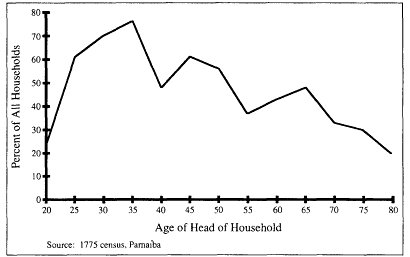
Figure 3.
Nuclear Families as a Percent of All Peasant
Households Across the Family Cycle, 1775
when she would have been fourteen years old. Perhaps she had married or left home to work as a servant for another family. Meanwhile, young Ignacio had been born. In 1798, Antonio and Luzia lived with three children, two of whom did not appear in the earlier census. Thus, while Antonio and Luzia had at least eight children, the census of any given year would never list all of them. Similarly, Domingos de Souza and his wife, Maria de Conceião, had at least eleven children, though the censuses of 1767, 1775, and 1798 listed only six, five, and three children, respectively.[43] ç
The nuclear family provided peasants with a stable family structure over time, but the members of a nuclear family always changed. From the parents' point of view, this proved advantageous, for it meant that as older children married or left home, younger children could take their places in the fields. A woman's childbearing years were long ones, which accounted for the endurance of the nuclear family in the family cycle. The constant replenishment of the pool of children who served as workers for the family provided long-term stability for peasant families.
Nuclear families persisted not just for demographic reasons but because they provided peasants with a viable household structure capable of meeting the needs of the family. They were successful
working units and yielded a larger surplus than households composed of one adult and children, extended families, or families with no children (see fig. 4). Not surprisingly, children are positively associated with the total value of household agricultural production (Pearson's correlation coefficient: r = 0.24). Not only did nuclear families produce more than other household structures but production rose and fell during the life cycle of a nuclear family. The value of agricultural production increased from an average of 6,700 reis when heads of households were in their early twenties to 7,700 reis when they were in their early thirties and peaked at 11,000 reis when they reached their late forties. Then the average value of agricultural production per household began to decline slowly (see fig. 5).
As the 1775 census makes clear, families compensated for changes in family structure that might affect agricultural production by taking in extra laborers or retainers. Their presence expanded the labor pool of the family. In 1775, 104 households had live-in retainers. In Antonio Joze da Silva's household lived his wife, Izabel, five children ranging in age from fifteen years to six months, and a young mulatta named Antonia, listed by the census taker as an agregada. Antonia's role in the family can only be inferred, but it seems likely that she worked for them as a live-in servant. Since the household had cattle, pigs, and horses in addition to planting corn and rice, her labor, whether in the fields or in the house, greatly extended its productive capacity.[44] Like children, agregados also have a positive association with the total value of agricultural production of nuclear families in 1775 (Pearson's correlation coefficient: r = 0.29).
The 1775 census portrays the mobility of peasant families and the ease with which they packed up their belongings and left town. Moving to the frontier was as common as it was easy. Peasants crossed the boundaries between parishes and towns looking for available land. Sometimes they simply moved their fields; at other times, they picked up everything and left. In 1775, the captain major of Parnaíba noted that fifty-four families, 8 percent, had left the town that year. Most of those who left were peasant families such as Salvador Ricardo, his wife, and their six children who moved to the neighboring town of Jundiaí Estevão Pais, his wife, and their seven children moved farther west to Piracicaba. Other
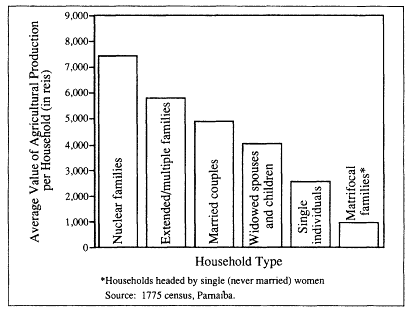
Figure 4.
Peasant Agricultural Production by Household Type, 1775
families likewise moved west to the towns of Itú, Sorocaba, Mogi Mirim, and Lages. Some families simply moved from the more developed parish of Santana to the less settled parishes of Araa-riguama and São Roque. Single men migrated to the city of São Paulo, to Minas Gerais, or to western towns. One hundred one men left in 1775, 6 percent of all men in the town. Quite a few peasants simply vanished, the captain major remarking, "No one knows where."[45] ç
Peasants moved for a variety of reasons, one of the most important being to find land. But peasant families also moved to avoid military conscription and forced labor obligations. According to militia captain João Martins da Cruz, Fernando de Morais and his family left Parnaíba in 1775 to avoid being sent to Iguatemí, a colonization project of the Morgado de Mateus on the far western frontier.[46] Ignacio Rodrigues and Luis Gomes and their respective families left Parnaíba for the same reason. Those that remained in Parnaíba were liable for induction into the regular forces stationed in Santos; in 1775, for example, seventy-seven men were sent to Santos from the town.[47] Families in Parnaíba were requisitioned
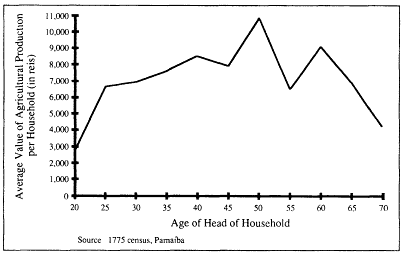
Figure 5.
Agricultural Production of Peasant Nuclear
Families Across the Family Cycle, 1775
for food and supplies used to support the Santos garrison or the troops and colonists stationed on frontier outposts.[48] Sons might also be sent to work on rebuilding the road between Santos and the city of São Paulo. For many peasant families, then, moving was an effective strategy that freed them from numerous obligations and allowed them to continue a frontier existence that was increasingly under fire in the older towns such as Parnaíba.
Peasant families who left Parnaíba took with them their traditional strategies for survival. They searched out unclaimed lands on the edges of towns or in the wilderness. There they continued to live in nuclear families and paid little attention to the agents and institutions of local government.
The families who remained in Parnaíba, however, perceived the changes there. Because the wilderness had virtually disappeared from the town, families could no longer count on free land for their children. The handful of wills and property inventories that describe the property of the eighteenth-century peasant families show that when peasants did own land, they sought to limit its division among their heirs. Francisco de Oliveira Gago owned a small farm, one slave, livestock, and farm tools. When he died in 1755, his property remained relatively intact (except for the slave,
who died or was sold), under the administration of his wife. After she died in 1771, the children decided not to undergo a formal process of inheritance, which would had divided the property equally among them. They argued that an inventory and division of property conducted by the orphan's judge would consume too much of the property. Instead, they wished to live together and use the family property to their mutual benefit. The seven heirs appeared in the 1775 census living together in the same household. None had married, even though the eldest, Anna, was already fifty years old. Together, they farmed the land and grew corn, rice, and peanuts.[49] By sharing the land, then, this family avoided dividing it as mandated by law. But by doing so, the heirs gave up their rights as individuals and thus would find it difficult to marry and form their own families.
In other cases, the orphan's judge himself declined to divide the property, citing the fact that the value of the property in question was less than the cost of a legal division of that property. Indeed, almost half of the estates of peasants brought to the orphan's judge (so of 26) were never completed. Whether by petition by heirs, or the desire of the judge not to let the entire estate disappear in court costs, or excessive outstanding debts, these estates were never divided as required by law. This fact reinforces the point that peasants owned little property and allocated it to their heirs outside of the formal process of inheritance.
The families that remained in Parnaíba sought the patronage and protection of the propertied class. These ties gave families powerful patrons who might defend them before community institutions. While such ties implicitly recognized a dependence on or a subordination to planter families, they did confer on poor families certain advantages. The most common way of nurturing such ties worked through godparentage. At birth, parents selected a godfather and godmother for their infant. If parents selected godparents from among the planters, they linked their children to the ruling class. Between 1774 and 1776, the priest baptized seventy babies in the parish church of Santana. Nearly all of the babies for whom it is possible to identify the social status of parents and godparents had godparents who were planters. Only 17 percent of the babies had peasant godparents compared to 83 percent who had planter godparents (see table 13). Moreover, it was quite common
Table 13. Godparents of Peasant Children | |||||
1774-1776 | 1819-1821 | ||||
N | % | N | % | ||
Wealthy planters | 37 | 53 | 18 | 20 | |
Poor planters | 21 | 30 | 33 | 38 | |
Peasants | 12 | 17 | 37 | 42 | |
Total | 70 | 100 | 88 | 100 | |
Source : Baptismal Records, Parish of Santana. | |||||
to reinforce the godparent bond by asking members from the same family (a husband and wife, or a brother and sister) to serve as godparents. In this way, peasants doubly bonded their child to a powerful planter family.[50]
Godparents served as powerful patrons for poor families in the community. Sometimes this extended to defending their godchildren before local institutions. For example, when Mauricio da Rocha Campos filed suit against Francisco Joze de Paula, a mulatto soldier accused of kidnapping his daughter Roza from his house, Roza's godfather came to her aid. Mauricio accused Francisco of entering his house and forcing Roza to accompany him to the city of São Paulo, where he kept her against her will. Roza's godfather, an established sugar planter, testified before the local judge that Mauricio's house had always been "respectable" and "upright." Roza's godfather's brother-in-law also testified that Francisco was a person of low status, not Roza's social equal. Such statements undoubtedly strengthened Mauricio's case, but the judge decided that it had not been proven that Francisco had taken the girl against her will.[51]
The gradual growth of a cash-crop economy based on sugar spelled the end to the independent existence of peasant families in São Paulo. When the mining regions began to decline at midcentury, planters began to recapitalize their farms in Parnaíba to produce a cash crop for export. As the sugar economy became profitable and spread, peasant families who did not have legal title to land began to find themselves expelled from the lands on which they had traditionally planted. Others who did have papers that proved their ownership of land found themselves under increasing pressure to sell their lands to sugar planters.
Royal policy reinforced the expansion of cash-crop agriculture in a number of ways, all of which worked against peasants. In the latter half of the eighteenth century, officials such as the Morgado de Mateus challenged the traditional life-style of peasants because they saw it as a hindrance to the development of a commercial agricultural economy in São Paulo. The Morgado de Mateus feared that farmers who lived in the nebulous zone between the towns and the wilderness would revert to Indian ways. "Men behind the virgin forest," he wrote, "gradually distance themselves from civil society, and those who were already civilized slowly forget the doctrines which they have learned and begin to assimilate again the savage ways which they had left behind."[52] To the Morgado, such men and women were an undesirable element because of their "laziness" and potential for reversion to "savage" ways and because they did not participate in the market economy. They produced little beyond the needs of their households and did not contribute to the economic development of the province.
As part of his plan to develop São Paulo, the Morgado de Mateus took steps to reinforce the power of local planter elites in order to obtain more rigorous social and political control over the peasantry. Central to this was the creation of militia companies under the command of men from planter families.[53] Peasants served in these militias as soldiers under officers, all of whom were drawn from the families of the planters. While the planters of Parnaíba initially resisted the growing influence of the crown in the province, as commercial agriculture became firmly established, they embraced the new royal presence and used it to bolster their local hegemony and to limit the rights of peasants to land. The policies of the royal governors benefited the population of Silo Paulo unequally, for they worked to the advantage of the planters who planted crops for export.
One of the first steps taken by the Morgado was to bring frontiersmen under the authority of the local militia captains. The Morgado ordered the militia captains to prepare a detailed list of those in their district with "the names of the heads of each household, their age, the names of their wives, the value of their property, and each of their children distinguished by their names and ages."[54] Such lists gave both the captain major and the governor important information on the population and wealth of each town
which could be used for military recruitment and taxation. Later that same year (1765), the Morgado ordered all residents of the province to register their titles to land with the governor's office. He did this because, in his view, "The inhabitants of this captaincy are situated in many places cultivating tracts which by no title belong to them ... from which originates continuous discord, lawsuits, and sometimes homicides."[55]
One year later, in 1766, the king, in response to requests sent to him by the Morgado, decreed an end to the practice of moving farms and planting in the virgin forest. He ordered that
all men who can be found in the wilderness as vagabonds or on moving farms, are now obliged to select appropriate places to live together in civil settlements which have at least 50 households or more, with a judge, aldermen, and a procurator, dividing among themselves with just division the adjacent lands.[56]
The king went on to state that those who refused to appear and submit themselves to a permanent residence in civil society "should be treated like highway robbers and public enemies, and as such punished with the severity of the law."[57] This law, like the recently ordered censuses, reflected a new ideal projected for São Paulo: that of a settled, sedentary province where families lived in recognized towns under the authority of the planter elite, who, in turn, served the royal governor.
These royal policies did not immediately affect the life-style of peasants in São Paulo. As is dear in the 1775 census, families continued to live by favor and freely moved into and out of towns like Parnaíba. Yet gradually, the policies inaugurated by the Morgado de Mateus and reinforced by his successors did alter the character of rural life in Santana de Parnaíba.
Between 1775 and 1820, economic and political change in Parnaíba dramatically modified the space in which peasants lived, as well as the character of their lives. In 1775, the entire town of Parnaíba produced only 676 liters of cane brandy worth 352,806 reis. By 1798, the town produced twice the amount of brandy, as well as 70,000 kilos of sugar and other sugar products. Combined, the total income from sugar cultivation amounted to 7,247,981 reis.
Peasants were not unaware of the larger changes taking place. They perceived their increasing vulnerability in the face of those who, allied with the royal governor, had increased their power and
authority in the community. To peasants, one individual symbolized their growing powerlessness: Colonel Policarpo Joaquim de Oliveira. Policarpo became an officer in the militia created by the Morgado de Mateus and used his newfound authority to increase his personal power and wealth. He imprisoned the mothers and sisters of those who refused enlistment in the new militia.[58] He forced the poor of Parnaíba to build a terrace on his farm and a road from his canefields to his mill. Those who did the work, often in chains, received no pay and labored under the guard of soldiers. João Leite Pais, one of these men, recounted, "With absolute power the Lieutenant Colonel imprisoned me in his house, in irons and stocks, making me work as if I were his slave or one of those, who because of their crimes, are sentenced by Your Majesty's judges to the galleys; I went on this way for four months."[59] Moreover, João's wife was also imprisoned, forced to work and to suffer hunger and cruel punishments, as was his daughter, whom Policarpo forced to spin cotton day and night. João exclaimed how, with tears in his eyes, he cried to God for justice but that "in that time, during the governorship of Dom Luis [Antonio de Souza, the Morgado de Mateus] there was no justice for this man."[60]
As the sugar economy spread, the rate of conflict over land surged. The books kept by the notary reveal that the peasantry began to sell their lands for small sums to expanding sugar planters.[61] Policarpo Joaquim de Oliveira acquired many of these farms. Antonio Ribeiro de Barros sold his farm to Policarpo for 38,000 reis in 1789. While this may have seemed like an enormous sum to Antonio, to Policarpo, it was not. Property inventories provide a rough measure of the relative worth of 38,000 reis to planters and to peasants: 38,000 reis represented 6 percent of the assets of Antonio Correa de Lemos Leite and his wife, who were planters and contemporaries of Policarpo Joaquim de Oliveira, but this sum represented 99.9 percent of the assets of Bernardo Pereira de Azevedo and his wife, peasants like Antonio Ribeiro de Barros.[62]
Many peasants lost their lands through intimidation. The town council of Parnaíba reported in 1801 that by "absolute power" Policarpo had taken over farms and lands of people "who because of the fear they had for him, gave him the lands which they owned."[63] Some peasants became his tenants, paying rent to farm
what had once been theirs. Those who resisted, Policarpo accused of wrongdoing and threatened with imprisonment. In one district, thirty or forty residents lost their lands when Policarpo had the area declared unclaimed and then petitioned the crown for it in a royal land grant, which the crown duly awarded. "By these means," the town council wrote, "he has taken over not only the lands of the residents but whole rural neighborhoods."[64]
By 1820, Parnaíba was a different town, and the lives of peasants had taken on a very different character. Forty-five years had brought many changes. The population had expanded from 4,676 persons in 1775 to 7,090 in 1820. The peasantry had increased by 57 percent, from 2,444 individuals in 1775 to 3,842 in 1820. The town center had grown and now supported a much larger group of artisans, laborers, muledrivers, and domestic servants. Thirty-three percent of all households without slaves lived in the town center or in the centers of the rapidly growing parishes of São Roque and Araariguama. Rural households of peasants, down from 84 percent of all slaveless households in 1775 to 67 percent in 1820, continued to produce sugar, cotton, corn, beans, manioc, rice, beef, and pork.
The expansion of the sugar economy between 1775 and 1820 had pushed many families off of the land and into the town center. This movement accounts for the declining percentage of households in the rural areas and the increasing number of artisans and day laborers in the town center. Guilherme Luis Pais, for example, appeared in the 1775 census as a farmer who harvested corn, beans, and peanuts and raised horses, cows, and pigs. Soon thereafter, he sold his land and moved into the town, where he worked as a weaver.[65]
Many families made the transition from farming to artisan trades. Bento Cardozo Correa, who in 1775 had owned a small farm with horses and pigs, had lost or given up his farm by 1798. The 1798 census, taken when he was 77 years old, showed that he lived in the town center with his two daughters and son. His daughters supported the family "by spinning and weaving cotton cloth" from which "they earn 8,000 reis per year."[66] Antonio Joze da Silva underwent a similar transition. A farmer with cattle in 1775, he had become an artisan, cutting and tanning hides, by 1798.
One of the few households that spanned the years between the 1775 census and the 1820 census, that of Alexandre Joze and Anna Maria da Trinidade, illustrates many of the changes that came into the lives of peasants in this forty-five-year period. In 1775, Alexandre and Anna Maria had three children and lived on rented lands where they planted corn and beans. In 1798, with four children living at home, they planted corn and hired out their canoe to ferry passengers across the river. In 1820, the family had five children and one grandchild at home, but they no longer farmed. Instead, the census stated that they "lived by their wits" (vivem de suas agencias ), a ubiquitous term in the census which meant that they lived from a variety of jobs, as best they could.[67]
As peasants moved from the rural districts to the town center, their lives changed correspondingly. The majority of the inhabitants of the town worked as artisans. These households, headed by men and women, worked as tailors, shoemakers, spinners, seamstresses, tilemakers, carpenters, blacksmiths, and potters. They produced simple items for local patrons or services for local families. Most worked out of their homes and kept gardens behind their makeshift huts where they grew corn and beans. Others who lived in the town owned small stores and taverns or worked as muleteers. The members of households that supported themselves by "living by their wits" may have been servants, laborers, or odd jobbers who worked from job to job as best they could. The poor, mostly women, children, the sick, and the infirm, pleaded for alms outside the parish churches and walked from house to house, begging for food.
Women headed the majority of the households that supported themselves from nonagricultural trades. Seventy-five percent of the households of artisans and 69 percent of the poor households were headed by women. In most of these households, women made a living by spinning and weaving cotton cloth. They, with their children, worked as part of a local cottage textile industry.[68] Many were "single mothers," and, judging from the census, they raised their children with little or no support from the children's fathers. Thus, in the town center of Parnaíba, and to a lesser extent in the budding town centers in the parishes of Araçariguama and São Roque, poor women could be found in house after house spin-
ning thread, weaving cloth, and making clothing. This gave the town center a different character than the surrounding rural areas where households tended to be nuclear families (see table 14).
Families who continued to farm in 1820 found conditions remarkably different from those in 1775. Families that had survived for generations as squatters, tenant farmers, and small landowners saw their traditional rights erode. Their tenuous position became clear when they tried to defend their rights to land. In 1820, three tenants on a religious estate attempted to use the legal process to regain control over their lands. They claimed that they had worked their lands for over forty years and that in 1816, they had let João Rodrigues Fam open a small farm (rancho ) on these lands. Then João, in turn, had let Captain Joze Manoel Tavares plant large fields and graze his cattle on the same land. In 1819, the plaintiffs stated that the captain had farmed all of the woodlands, leaving "not a foot of room" for them to plant their corn. Since the captain was a rich man while they were poor, the plaintiffs asked the crown magistrate of São Paulo to "ensure that the Captain renounce his power over their lands and remove his animals ... and obligate João Rodrigues Fam to leave as well."[69] When asked to investigate the situation, a local official in Parnaíba replied that the lands in question actually belonged to the Monserate religious estate and that the plaintiffs had no claim to the land other than that they had been born there and had been tenants of the estate.[70] While we do not know the eventual outcome of this suit, it would seem, based on the local official's opinion, that the tenants would have a difficult time regaining their lands since they had never formally owned them.
As families lost their lands, significant changes in family life took place. Households became smaller. The average size decreased from 4.8 persons in 1775 to 4.3 persons in 1820. Fewer households had retainers who supplied extra farm labor. Households headed by women increased from 24 percent of all households in 1775 to 28 percent in 1820. The number of single women with children also grew from 3 percent in 1775 to 7 percent in 1820. Not surprisingly, the number of babies born to women and "unknown fathers" increased dramatically. The priest baptized five babies in the parish of Santana in 1775 for whom he listed the father as "unknown";
Table 14. Households Headed by Men and Women, Peasant Population, 1820 | |||||
Male | Female | ||||
Households | N | % | N | % | |
Rural | 512 | 81 | 75 | 31 | |
Urban | 118 | 19 | 170 | 69 | |
Total | 630 | 100 | 245 | 100 | |
Source : 1820 census, Parnaíba. | |||||
Chi-square = 205.00; DF = 1; probability = 0.000. | |||||
these babies accounted for 10 percent of all baptisms in that year. In 1820, one-third of all babies baptized by the parish priest had unknown fathers.[71]
Most of these changes in family structure occurred in the households found in the town center. There households headed by women were more common, households were smaller, and women outnumbered men. In the rural districts of the town, however, the nuclear family remained the cornerstone of agricultural life (see table 15).
These changes in the families of peasants between 1775 and 1820 illustrate the degree to which the expanding sugar economy had affected their lives. The rise in the number of households headed by single women is a compelling example. As competition for land reduced the size of farms, families began to slough off dependent members. Concomitantly, demand for labor on the frontier, as well as the availability of land there, caused many men to migrate west. This left numerous women behind. These women moved into the towns, where they were poor more often than not. Many never married but still gave birth to several children. Their daughters often remained in Parnaíba, too, and repeated the pattern set by their mothers. The sons of these women tended to leave home, either for the city of São Paulo or for the frontier. Thus, the households headed by women had a high ratio of women to men, which further limited their ability to survive. Deprived of the protection and labor normally provided by men, these female-headed households were among the most marginal in the town.[72]
Women moved into the town centers not because they could
Table 15. Urban and Rural Family Structure, Peasant Population, 1820 | ||||
Rural | Urban | |||
Average household size | 4.8 | 3.6 | ||
Sex ratioa | 88 | 56 | ||
Households of nuclear families | 363 | (62%) | 56 | (21%) |
Households with agregados | 81 | (14%) | 30 | (11%) |
Households headed by women | 75 | (13%) | 168 | (62%) |
Source : 1820 census, Parnaíba. | ||||
a Men per 100 women | ||||
not manage farms but because they owned little or no property. Women had managed ninety-seven farms in 1775, while thirty-four women headed households that supported themselves by spinning, weaving, or begging for alms in the town center. By 1820, women ran seventy-three farms, but the vast majority of households headed by women appeared in the town center, where the women and children worked as spinners, servants, or were simply "poor" (see table 16). The growing number of women who headed households in the town center suggests that either families could no longer support single and widowed women and, as a consequence, women flocked to the town centers and made do as best they could or that as families lost their lands, men moved on to the frontiers while women remained behind.
The life story of Paula Soares illustrates how these changes occurred. In 1775, Paula's father, Felis Soares, appeared in the census with his wife, Thomazia, and children, Joze and Izabel, living by favor and cultivating corn. By 1798, twenty-three years later, Paula had been born, and the family continued to live as subsistence farmers, harvesting and selling corn and beans. Joze had married and lived nearby with his wife and two children as subsistence farmers. In 1820, twenty-two years later, Felis, now an old man of 70 years, was a widower. He lived with Paula and her two children. Paula, it seems, had never married, for she appears in the census as a solteira , a single woman. The household supported itself by spinning cotton, a task probably done by Paula and her daughter, Roza. Her brother, Joze, now 50, lived next door with his wife and children. They still farmed, planting and harvesting a small amount of corn. While we do not know exactly what hap-
Table 16. Female-headed Households, Peasant Population, 1775 and 1820 | |||||
1775 | 1820 | ||||
Households | N | % | N | % | |
Farmers | 97 | 74 | 73 | 30 | |
Laborers/artisans/poor | 34 | 26 | 169 | 70 | |
Total | 131 | 100 | 242 | 100 | |
Source : 1775 and 1820 censuses, Parnaíba. | |||||
pened in this family, it seems likely that Felis had lost his farmland or had given at least part of it to his son, Joze, who continued to farm. In his old age, he lived with his daughter who with her brother supported him as best they could Paula by spinning thread and Joze with food from the farm. After Felis died, Paula would undoubtedly continue to work as a spinner, most probably in the town center. Joze and his family would continue to farm.[73]
As the population of Parnaíba grew and as land became scarce, the traditional ways in which families had survived became increasingly difficult. Moreover, the strategies that many families had used in 1775 to cope with the changes taking place in Parnaíba had only temporarily solved their problems. Those families who had moved from Parnaíba in 1775, for example, seeking to preserve a traditional way of life farther west, had simply delayed, not eliminated, the moment of reckoning. To move west from Parnaíba to the town of Itú, or from the parish of Santana into the western parish of São Roque, resolved only fleetingly the problem of access to land and freedom from social control. Since the sugar economy moved in waves, gaining momentum as it pushed west, it affected newer frontier communities even more profoundly than the older sugar centers. Itú became a more important sugar center than Parnaíba had been a generation before, just as the parishes of Araariguama and São Roque eventually outproduced the older parish of Santana. Those who elected to move to these areas in search of land bought themselves time—but not for long. Families would have to move again and again to maintain access to free frontier lands.[74] ç
Similarly, the strategy of fostering ties to planters also had its limitations. Such ties depended on the benevolence of planters.
While traditionally planters may have seen it in their interests to defend the fights of peasants, as the sugar economy spread, it was increasingly not in their interests to do so. Peasants occupied lands, sometimes valuable lands, that sugar planters could use for planting cane. Increasingly, planters saw themselves as different from peasants, and the bonds between them weakened. In 1820, 48 percent of the heads of peasant households were recorded in the census as "browns" (pardos) or as "blacks" (pretos ); whereas, in the census of 1775, 73 percent of the heads of peasant households were presumed to be "white." Some peasants who were presumed white in the 1798 census had become brown in the 1820 census.[75] These categorizations suggest that the individuals who collected the census information had changed the way they viewed color. More clearly defined class barriers had emerged by 1820. Planters no longer saw peasants as their poor white kin. Increasingly, they saw them as belonging to a different class, set apart from themselves by color.
Thus, peasants articulated very different strategies for survival in the Parnaíba of 1820 than in that of 1775. By 1820, it was next to impossible to live by favor in Parnaíba. Land boundaries were clearly drawn, and valuable lands were coveted by sugar planters. Neither could peasants live "behind the forest" as they had once done during the days of the Morgado de Mateus. By 1820, their place in agrarian society was a tenuous one, constantly encroached on by the expanding sugar planters. The more intimate and patriarchal world in which peasants had once sought the benevolence of planters had given way. Peasants began to live within their own world, a world defined by their class. They saw other peasant families as their closest allies and selected them as the godparents for their children. But they also saw other peasant families as their immediate competitors.[76]
Whereas the peasantry once depended on ties to planters as an important means of maintaining their position in the town, by 1820, peasants had practically abandoned such strategies. Many fewer families selected godparents for their children from the ranks of the rich and powerful. Rather, godparents tended to be chosen from within the same economic stratum. Most of the peasant children baptized between 1819 and 1821 had one or both godparents from the same social class as their parents. Thirty-eight percent
had godparents drawn from the poor planters, and only 20 percent had godparents who owned more than ten slaves (see table 13, above).
As the numbers of peasant families grew and as the lands around them filled in, families lived in greater proximity to one another. Whereas in 1775, peasants still lived relatively dispersed in the town, by 1820, well-defined neighborhoods had taken shape. In these neighborhoods (bairros ), inhabited mostly by peasants, families lived close to one another. They found little privacy. It was "public knowledge" in 1806 that João Duarte de Moura beat his wife.[77] Tongues wagged in 1805 when Izabel Leme "vented her anger" on Floriana Maria and clobbered her with a piece of wood.[78] Anna Maria de Oliveira complained to anyone who would listen of the poor treatment she received from her husband, Joze Rodrigues, who had abandoned her for two years.[79]
Peasants fought among themselves for land and space, often resolving their differences through the intervention of local officials. Few families had used local institutions to pursue their interests in 1775, but by 1820, families had become quite skilled at manipulating the local judicial courts. Many of these cases focused on disputes over land or harvests, beatings, robberies, or family problems. Peasants sought out the justices of the town council or sometimes militia officers and priests to mediate such disputes. Usually, the local justices were able to come to a settlement. Izabel Leme, guilty of hitting Floriana Mafia over the head with a piece of wood, was sent to the town jail. João Duarte de Moura, who beat his wife and then poisoned her, was sent there as well. When local officials could not resolve local disputes, families pursued higher authorities. João Francisco Pais and Antonio Teles, neighbors in São Roque, first asked the military district captain of São Roque to mediate a disagreement between them. When he was unable to settle the dispute, the case was forwarded to the general magistrate in São Paulo.[80]
The independent, roving farmers who "lived in laziness and liberty" behind the curtain of the forest had virtually disappeared in Parnaíba by 1820. Many were pushed out to the frontier as the sugar economy rolled through the town. Others moved into the town center or even to the larger towns and cities. Those who
remained behind farmed smaller plots of land that supported reduced households. When the sugar economy began to decline as the virgin forests were cut and the lands were rapidly stripped of their organic compounds, sugar planters moved on. A few planters remained in Parnaíba and planted coffee, but by and large, by 1850, the agricultural focus of the town was subsistence farming. Those who continued to survive as farmers turned their attention to producing for a new market, that of the growing city of São Paulo.[81]
By the middle of the nineteenth century, then, peasants had devised new strategies to survive in Santana de Parnaíba. They tried to limit the division of their lands among their children in order to maintain their farms intact. Since land had become a valuable resource, they no longer claimed and abandoned lands. Instead, they farmed the same lands and, like the small slaveholders, waged a constant battle against the dispersal of productive family property among too many heirs. More of the peasants began to write wills, grant dowries to their daughters, and have their property inventoried by the local orphan's judge. They encouraged heirs to share land and forced others to migrate to the city or to the frontier, all to reduce pressure on finite resources.[82]
The transformation of Parnaíba's peasantry from roving swidden farmers to sedentary market-garden producers occurred slowly from the end of the eighteenth century to the middle of the nineteenth century. This process was not unique to Parnaíba. It represented the common experience of communities throughout São Paulo as the spread of sugar and coffee cultivation subjected them to a boom and bust economic cycle. For families who had little public influence, each stage of that cycle placed them at risk, for they could not defend their land.[83] When the free resources of the frontier on which the traditional life-style of peasants depended ran out in Santana de Parnaíba, those who remained in the town became more like the peasant class of Europe than the American frontiersmen. Peasants had to change many aspects of their lives to survive. These adjustments can be seen in family, community, and farm life. But even as the wilderness disappeared in Parnaíba, it still beckoned poor men and women from the town, who, like the sons of planters, followed the frontier west in search of cheap or free lands. There, on new land claimed from the wil-
derness, they reproduced a lifeway their parents and grandparents had once practiced in the town of Parnaíba.
By the early nineteenth century, the traditional life-style of peasants had become a memory in Parnaíba. Families such as Bento Cardozo Correa's found themselves pulled in different directions: to the town, the city, or the frontier. Some of Bento's children probably did continue to live much as he and his wife, Maria, had, either in Parnaíba or farther west. A Bento Joze Cardozo appeared in the census of 1798 in the parish of São Roque as a subsistence farmer; he was married and had one daughter. This Bento could have been Bento Cardozo Correa's son, two years old in 1775. Similarly, a Joze Alves Cardozo, forty-seven years old in 1820 and a subsistence farmer, may have been Bento Cardozo Correa's son, six years old in 1775. At least three of Bento Cardozo Correa's children, however, lived very different lives from their parents. In the last two years of the century, Bento's two daughters, Joanna and Roza, still had not married. Given their ages (40 and 37), they probably never would. After their father died, they would continue to live in Parnaíba's town center, eking out a living as spinners and weavers. Their brother Francisco (35) also had not married in 1798. Unless he moved out to the frontier, he would probably remain in Parnaíba's town center "living by his wits." If he married, he might move with his wife to the frontier and reestablish the life he had known as a boy on his father's small farm in Parnaíba. The rest of Bento's children are buried in the census lists as wives or servants or had left Parnaíba altogether. By 1822, the year that Brazil's independence was declared in Silo Paulo, Bento's children were, most probably, spread throughout the province. Some still lived in Parnaíba, in the town center, or on the outskirts of the town as subsistence farmers. Others moved on, to the receding frontier, now well beyond Parnaíba. A few may have moved to the city of Silo Paulo. Thus, the dispersal of Bento's family is itself perhaps the best indication of how the families of the peasantry adapted to the changes afoot in Silo Paulo at the end of the eighteenth century.