
The Mature Figure Compositions
Although Corinth exhibited several of his portraits—and some, such as the portrait of Peter Hille, elicited much favorable comment—he solidified his reputation in Berlin on the basis of his figure compositions, the works with which he asserted his independence among the leaders of the Berlin Secession. For Liebermann, by comparison, who had long abandoned his earlier aspirations of becoming a history painter, subject matter in painting mattered little or mattered only insofar as it related to purely artistic matters. To him "a well-painted turnip," as he put it, was "as good as a well-painted Madonna."[19] Corinth, in contrast, owed his real recognition to such weighty themes as the Pietà and the Deposition and to his provocative Salome and thus had every reason to believe that other paintings like these would continue to attract wide public attention.
The figure compositions from Corinth's early years in Berlin are for the most part large in scale and feature many characters in complicated foreshortened postures. Because the pictures, like the Tragicomedies cycle, explore parodistic elements, they often created something of a spectacle at the exhibitions of the Berlin Secession. The general public greeted them enthusiastically, but critical reaction was usually mixed. Gustav Pauli called Corinth's figure compositions "fatal aberrations of a brilliant technician."[20] Meier-Graefe found in them a gap, difficult to bridge, between content and form. "From many a painting by Lovis Corinth," he observed caustically, "emanates the physical potency of animals in heat. Sometimes one is tempted not to look for fear of having to smell what one sees. Tender souls recoil horror-struck. Painters rejoice."[21] Both Pauli and Meier-Graefe judged Corinth's figure compositions from a pro-Impressionist bias, and in the context of the painter's late works these pictures indeed appear not only superficial but often in bad taste as well. Nonetheless they are important for a full understanding of Corinth's development, for only in relation to them can his final achievement as an artist be appropriately measured.
Naturally, Corinth himself thought highly of these pictures. Summing up his activity during his early years in Berlin, he singled out several of them, convinced that in time they would be counted among his best works.[22] Critical perception and the high quality of Corinth's later output have contradicted his own assessment; yet the original success of his figure compositions affected even the most unsuspecting of his fellow Secessionists. Several melodramatic compositions by Slevogt, such as Samson Blinded (1906; private collection), The Massacre of the Innocents (1907), Rape (1905), Battle of Titans (1907) (all in the Niedersächsische Landesgalerie, Hannover), and Knight and Women (1902; Staatliche Kunstsammlungen Dresden, Gemäldegalerie Neue Meister), as well as Liebermann's Samson and Delilah (1902; Städelsches Kunstinstitut, Städtische Galerie, Frankfurt), their subjects by then so at odds with those of other mature works by both these painters, illustrate how persuasive the popularity of Corinth's figure compositions could be. The effect of Corinth's figure compositions on younger artists like Max Beckmann was more lasting. Indeed, Corinth to a large extent passed on to Beckmann the nineteenth-century tradition of the grand theme.[23] It is difficult, if not impossible, to look at the dynamic figure groupings and rugged brushwork of such early paintings by Beckmann as Drama (1906; destroyed in World War II), Crucifixion (1909; Collection Georg Schäfer, Schweinfurt), or Battle of Amazons (1911; The Robert Gore Rifkind Collection, Beverly Hills) without thinking of the example set by Corinth. Subsequently the younger painter developed out of this tradition new symbols for the visions, aspirations, and suffering of modern man.
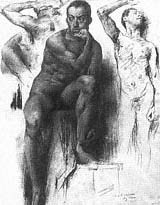
Figure 92
Lovis Corinth, Male Nude ,
1904. Pencil and crayon
heightened with white;
dimensions unknown. Formerly
Collection Johannes Guthmann,
Ebenhausen; present
whereabouts unknown.
Photo courtesy
Hans-Jürgen Imiela.
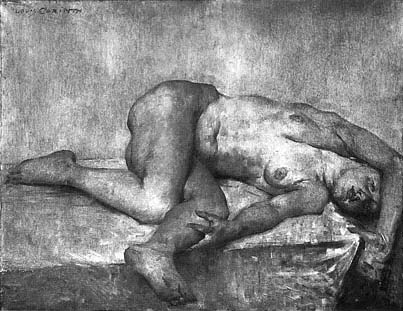
Figure 93
Lovis Corinth, Reclining Female Nude , 1907. Oil on canvas, 96 × 120 cm,
B.-C. 345. Kunsthistorisches Museum, Vienna (MG 55/ÖG 3809).
Not surprisingly, Corinth's academically most ambitious figure compositions date from the years during which he was actively involved in teaching. The centerpiece of Corinth's teaching program remained the study of the live model, and the drawing of a male nude (Fig. 92) from December 1904 may well have been done while he worked alongside his students, as he sometimes did. The same concept of form, epitomized in the complicated posture and plasticity of the naked body, is seen in the painting from 1907 of a reclining female nude (Fig. 93). Sprawled awkwardly across a firm support, the
figure was most certainly painted as a demonstration piece, and Corinth published the picture as such in his teaching manual—logically enough, in the chapter on foreshortening.[24] The same illustration further served to support his view, stated several brief chapters later in the book, that "the model is the most important aid the painter has at his disposal. He studies it during his years of training and relies on it when in his paintings he wants to translate the figures of his imagination into reality."[25]
Several of Corinth's figure compositions are actually no more than expanded studies of the nude model, a number of figures having been grouped together in some fashion. These paintings usually bear rather perfunctory titles that more or less describe what is shown. They include The Graces (B.-C. 233), a depiction of three standing female nudes in almost sequential and complementary front, back, and side views, and Girl Friends (B.-C. 297, 298), two pictures in which four nude models in a variety of postures crowd around a chaise lounge. In Harem (Fig. 94) Corinth modified this subject only slightly by adding the figure of a black eunuch. The delightful little cat in the foreground gazes attentively out of the picture and by its prim composure accentuates the languid sensuality of the four women. No wonder pictures like this helped to establish Corinth as one of the great modern painters of the female nude and gained him the reputation of a man himself possessed of a robust libido. It is impossible to say to what extent this reputation was justified. Apparently, however, Corinth believed that the sensual life of artists was intimately bound up with their creative activity, and he is said to have insisted that artists not deprive themselves of sexual gratification, since erotic experiences are wont to increase their creative energy.[26] In his autobiography Corinth expressed a similar opinion when he spoke of his belief that sexual contact enhances an individual's emotional life.[27]
The generally large scale of Corinth's figure compositions more than once tested his skills to the limit. The fate of the ambitious Perseus and Andromeda (B.-C. 208) has already been mentioned (see p. 124). Samuel Cursing Saul (B.-C. 225), a picture with ten life-size figures painted in 1902, was cut apart two years later for similar reasons, leaving only three fragments (B.-C. 226–228). The same misfortune befell the right half of The Ages of Man (B.-C. 273, 275), two pictures from 1904 that were originally joined in a monumental frieze. Corinth is said to have often referred jokingly to this composition as his "matriculation" picture on account of the thirteen life-size figures—twelve of them nude, including a woman, five men, and an assortment of children of all ages—included in it.[28]
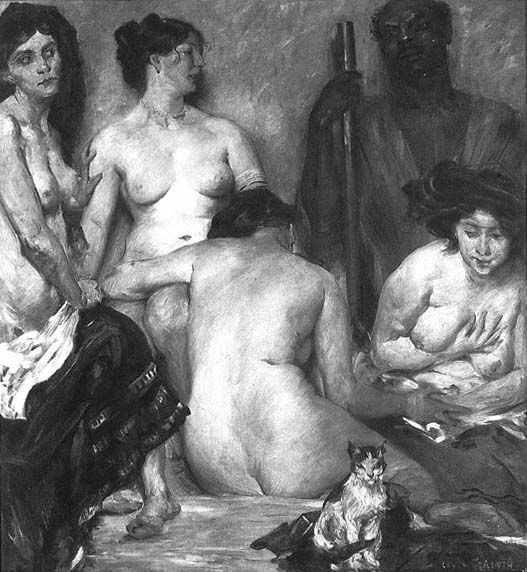
Figure 94
Lovis Corinth, Harem , 1904. Oil on canvas, 155 × 140 cm, B.-C. 299.
Hessisches Landesmuseum Darmstadt.
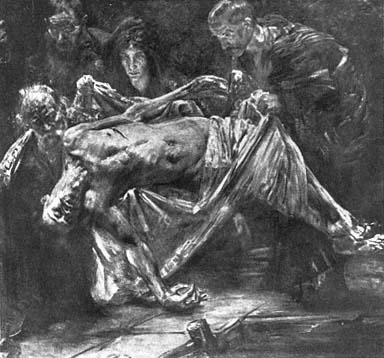
Figure 95
Lovis Corinth, Entombment , 1904. Oil on canvas, 172 × 185 cm, B.-C. 272.
Formerly City Hall, Tapiau; destroyed 1915.
Photo: after Bruckmann.
The effort Corinth put into his figure compositions can still be traced in several surviving preliminary studies. This process is especially well documented for the Entombment (Fig. 95), a large work from 1904 that the painter subsequently donated to his hometown of Tapiau, although the painting itself was destroyed when the town was invaded by Russian troops in 1915. The preparatory drawings for the painting include sketches for the composition and individual figure studies done to determine the distribution of the figures and to clarify specific postures and gestures. These drawings were followed by a tempera sketch and an elaborate charcoal drawing on canvas, both approximating the scale of the painting. This was the working method Corinth had learned at the Académie Julian, and, not surprisingly, the original com-
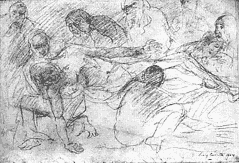
Figure 96
Lovis Corinth, Entombment , 1904. Pencil,
33.6 × 49.2 cm. Staatliche Graphische
Sammlung, Munich (1919:120).
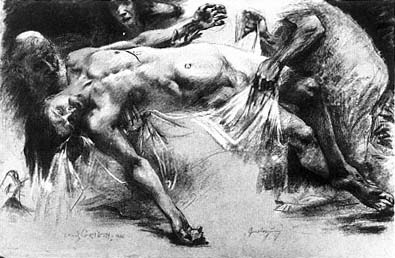
Figure 97
Lovis Corinth, Entombment , 1904. Charcoal heightened with white,
119.5 × 180.0 cm. Sammlung Georg Schäfer, Schweinfurt (271474).
position study for the painting (Fig. 96) has close affinities with one of his Lamentation drawings from 1884. As mentioned previously, Corinth had kept that Paris drawing and eventually published it in his teaching manual to illustrate the "mental gymnastics" an artist must do to visualize the emotions appropriate to various participants in a given action. The gestures and expressions of the figures in the later drawing are intensified, in keeping with Corinth's mature conception.
Although he transferred both the stage-like composition and excessive pathos without major change to a nearly life-size tempera sketch (B.-C. 271), he ultimately chose a simpler solution for both content and form. In the large charcoal drawing on canvas (Fig. 97), which bears the incorrect date 1903, the
nine figures of the original composition have been reduced to four, and the expressions and gestures have been subjected to greater restraint. The figure of Christ, carefully modeled and heightened with white chalk and circumscribed by smooth, reinforced contours, is possibly Corinth's most idealized and heroic nude. Except for the reversal of the pose, the figure recalls the youthful, Adonis-like Jesus in Botticelli's famous Pietà in the Alte Pinakothek. Indeed, Botticelli's shallow space and balanced, frieze-like composition may well have been in Corinth's mind from the beginning. Although he did not sustain the idealized conception of the charcoal drawing in the painting, nonetheless—again like Botticelli—he maintained a precarious balance between overt pathos and introspection.
This borrowing from Botticelli was not an isolated instance. Repeatedly during these years Corinth turned his attention to artists of the fifteenth and sixteenth centuries. The vertical space and expressive figure types in Golgatha (B.-C. 306) from 1905 have their antecedents in a Crucifixion by Mair von Landshut and in the central panel of the Schöppingen Altarpiece, both then in the Kaiser-Friedrich-Museum in Berlin.[29] In 1909 Corinth also made several color drawings after woodcarvings by the Master of Rabenden in the same collection and derived a number of details for the large Carrying of the Cross in Frankfurt (B.-C. 410) from the well-known prints of this subject by the Housebook Master and Martin Schongauer as well as from the corresponding panel of Hans Multscher's Wurzach Altarpiece, now in West Berlin.[30]
Unlike Max Liebermann, who as late as 1905 reproached Matthias Grünewald for having indulged in "painted poetry,"[31] Corinth shared this interest in late medieval German art with several painters of the younger generation. Ernst Ludwig Kirchner, for example, acknowledged in his chronicle of Die Brücke the immense debt he and his friends owed to Cranach, Beham, and other German old masters.[32] Max Beckmann first learned to admire Grünewald in 1903, when he saw the Isenheim Altarpiece in Colmar, and he eventually counted such painters as Gabriel Mälesskircher, Jörg Ratgeb, and Hans Baldung Grien among those who had given his own art a decisive direction.[33]
But unlike his younger contemporaries, Corinth was not induced by the arbitrary color and form of late medieval German art to move away from nature. Aside from borrowing a compositional device now and then and a few isolated motifs, and no doubt appreciating the grotesque exaggerations of gesture and expression in these earlier paintings, he remained resolutely committed to visual truth. A large preliminary figure drawing of Christ for the Deposition (B.-C. 331) from 1906, which vaguely recalls the same scene in a Lower Rhenish altarpiece from the early sixteenth century in the old Kaiser-Friedrich-Museum,[34] illustrates just how closely he observed the live model.
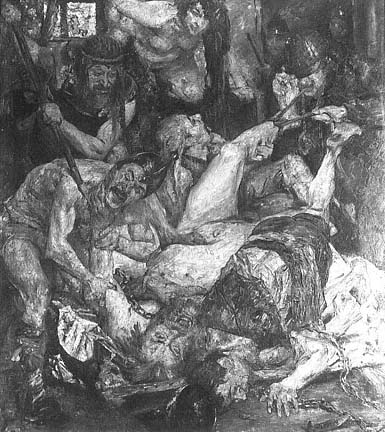
Figure 98
Lovis Corinth, Samson Taken Captive , 1907. Oil on canvas,
200 × 175 cm, B.-C. 343. Landesmuseum Mainz.
Details such as the joints of the painfully extended arms are studied right down to the diagrammatical rendering of the skeletal structure. Corinth's concern for the veracity of the action in this painting is confirmed by Charlotte Berend, who reports his asking her whether one can really tell exactly how the nails that still hold Christ's feet fastened to the cross are being removed.[35]
Corinth relied on early German sources only for his Passion scenes; some of his other figure compositions were derived from the great masters of the baroque. The Rape of Woman (B.-C. 302, 303) from 1904 closely follows Rubens's Rape of the Daughters of Leucippus in the Alte Pinakothek. Samson Taken Captive (Fig. 98) from 1907 is dependent on Rembrandt's gruesome treatment of the
subject in Frankfurt. In each case, however, Corinth intensified the expressive elements of the prototypes with a more pointed naturalism as well as gestural and facial exaggerations. In the picture of Samson's capture, moreover, he assured himself of the greatest possible empathic response by restaging the event so that the figures occupy a space that seemingly extends the viewer's own. The viewer looks downward at the herculean giant whose figure forms a diagonal that leads the eye further back into the scene. Like Rembrandt, Corinth selected the climactic moment of the story when Samson is over-powered by the Philistines. One of them has already fastened a rope to Samson's ankle, two others seek to tie him in chains, and yet another approaches from the upper left, ready to plunge a spear into his eyes. Delilah, kneeling on the bed in the background, leans forward and looks down on the struggle with an expression that combines detached curiosity and cruel satisfaction. The savagery is oddly burlesque because of the crude figure types and the soldier in the lower right, who in the heat of the struggle has been thrown off balance and reacts with humorous consternation to the unexpected loss of his helmet. "Tender souls," as Meier-Graefe observed, might indeed "recoil" from this melee of wildly screaming and kicking figures, but the technical qualities that make "painters rejoice" are evident as well. The subdued earth colors underscore the primeval character of the subject, and the vigorous brushstrokes, reinforced by scrapings with the palette knife, further enliven the violent scene. Corinth ultimately stabilized the centrifugal energy of the composition by arranging the figures, as Rembrandt had done, along two diagonals that converge on Samson's head. He countered these with repeated vertical accents, the most pronounced of which juxtaposes the heads of Samson and Delilah at either end of the painting's central axis, underscoring structurally the consequences of their fateful encounter.
The Bathsheba (B.-C. 349) from 1908 can also be traced to Rembrandt. Once again Corinth modified the prototype by adopting a more provocative frontal view of the subject and by subordinating the Dutchman's poignantly melancholy mood to a coarse and even vulgar naturalism. The motif of milking the goat in The Childhood of Zeus (Fig. 99) is found in both Poussin and Jordaens. Jordaens also anticipated the humorous subplot of the story when instead of painting the nurturing of the infant god, as told by Ovid, he depicted the boy hollering for food because his bowl of milk has been overturned by the goat. Corinth elaborated Jordaens's conception by dwelling on the commotion necessary to keep the boy's cries from being overheard by his father Saturn, who had the nasty habit of devouring his children at birth because it was prophesied that one of them would usurp him. Jupiter's mother Rhea had managed to
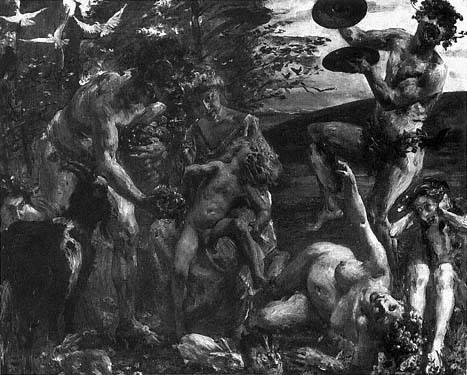
Figure 99
Lovis Corinth, The Childhood of Zeus , 1905. Oil on canvas,
120 × 150 cm, B.-C. 305. Kunsthalle Bremen.
save the child by feeding the unsuspecting Saturn a stone wrapped in swaddling clothes and spiriting the newborn off to the slopes of Mount Ida, where nymphs raised him on wild honey and the milk of the goat Amalthea. In Corinth's painting nymphs and satyrs join forces in cheering up the bawling child while his food is being readied, making enough noise in the process to ensure that the boy's cries are not heard. The nymph Adastreia, with the unruly young god in her lap, is distinguished from her bucolic sisters by her decorous gown and restrained demeanor. Seeking to calm the boy, she behaves more like a gentle nursemaid than a wild inhabitant of mountains and
grottoes. For the figure of the young god Corinth drew on his sleeping son, Thomas, whom he had watched one evening sprawled naked in his bed.[36] In the course of the preliminary studies for the painting the motif underwent considerable change, but its final state still testifies to Corinth's practice of developing even his imaginary subjects from life. Similarly, the goat and the rabbits in the picture were painted from the "models" that Corinth habitually assembled for such purposes in his studio.
The episode with the sleeping Thomas that helped to inspire the painting accords with Corinth's advice to his students to paint themes whose "universal human" significance can be understood from one's own life experience.[37] His early tendency to see literary subjects as paradigmatic of human situations (see the discussions of Figs. 35 and 36, pp. 61–64) increased markedly with his move to Berlin and his marriage to Charlotte Berend, informing, as already noted, such pictures as the double portrait of 1902 (see Fig. 83) and the 1906 painting of Charlotte and Thomas (see Fig. 87). The list of figure compositions with both an autobiographic and a universal dimension is indeed long and includes paintings like the Judgment of Paris (B.-C. 301, 338), Rape of Woman (B.-C. 303), and Faun and Nymph (B.-C. 325), a subject with which Corinth also decorated his nuptial bed.[38] Similarly, the archetypal episodes he selected in 1904 to signify the various ages of man (B.-C. 273, 275) apparently took on a personal meaning for Corinth during this year when his son was born. Moreover, although there is no evidence that Corinth was religious in the conventional sense, he felt attuned to the feast days of the Christian calendar. Both the Deposition from 1906 (B.-C. 331) and The Carrying of the Cross from 1909 (B.-C. 410) were painted at Easter time and are specifically so inscribed. And Corinth celebrated his fiftieth birthday in 1908 by painting a melodramatic Lament of the Dead (B.-C. 352), transposing the traditional theme of the Pietà into a generalized memento mori . These paintings, however, are not necessarily a measure of Corinth's inner commitment to these themes. In 1908, for instance, he painted a second "birthday picture," a surrogate self-portrait in the form of a fettered bull in a stable (B.-C. 360).[39]
The eclecticism for which contemporary critics censored Corinth was also his way of teaching by example, as can be seen from the comments he made in his teaching manual on the subject of personal creativity. Unusually well read himself, he considered the study of the history of art fundamental to an artist's education because it introduced young painters to the famous subjects of the Bible and mythology and helped them to understand the great masters of the past.[40] For him an artist's inventiveness manifested itself less in new subjects than in the manner of conceiving an old subject. And he cited as an
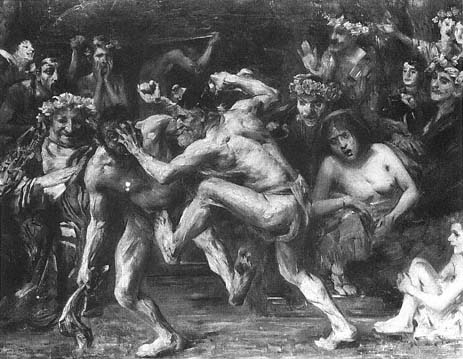
Figure 100
Lovis Corinth, Odysseus's Fight with the Beggar , 1903. Oil on canvas, 83 × 108 cm,
B.-C. 253. National Gallery, Prague (0-9238).
example the generations of artists from Giotto to Raphael who drew on the same subjects from the Bible and legends but achieved fame and immortality for their individuality.[41] Corinth's crude naturalism and his sensual and often bawdy interpretations of borrowed motifs were for him thus clearly a mark of originality and a means to self-expression.
Not surprisingly, Corinth often pursued his aggressively naturalistic conception as an end in itself. Such compositions as Samuel Cursing Saul (B.-C. 225), Ages of Man (B.-C. 273, 275), and Lament of the Dead (B.-C. 352) are independent of any prototypes, and in each the pictorial world of the painter's imagination takes on a vividly tangible presence. Another eloquent example is the boisterous composition Odysseus's Fight with the Beggar (Fig. 100) of
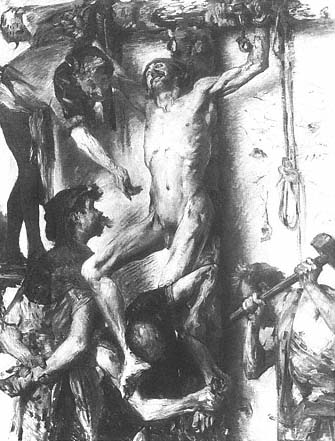
Figure 101
Lovis Corinth, The Large Martyrdom , 1907.
Oil on canvas, 250 × 190 cm, B.-C. 332.
Museum Ostdeutsche Galerie Regensburg.
1903, whose genesis is well documented, right down to the selection of the costumes.[42] What makes this particular work especially interesting is that in it Corinth simultaneously eschewed the academic decorum traditional for such a subject and followed Homer's story almost to the letter. Homer describes the events surrounding the long-delayed return of Odysseus to Ithaca in elaborate detail, including the episode in which the hero, disguised as an old beggar, finds himself insulted by Irus, a common tramp, who threatens to
drive him from the gate of his own home. A fight between the two soon ensues, to the great amusement of the suitors who for years had been wooing Penelope, feasting in Odysseus's palace, and lording it over his people. To their astonishment, Odysseus "made his shirt a belt and roped his rags around his loins, baring his hurdler's thighs," and quickly dispatched his opponent by striking Irus a blow to "his jawbone, so that bright red blood came bubbling forth from his mouth" (Odyssey 18.1–109). As in The Childhood of Zeus , Corinth rendered the commotion in Odysseus's house almost audible in his effort to make the ancient tale come alive.
Similarly remote from convention yet historically justified is the conception underlying The Large Martyrdom , which Corinth painted in 1907 (Fig. 101). To visualize the scene as clearly as possible, he had a cross made for the occasion and periodically hoisted the naked model onto it, keeping the unfortunate fellow strapped there as long as he could possibly bear it. This allowed Corinth to paint the executioners and their victim at the same time.[43] The proximity of the figures to the picture surface and the way they are cut by the frame, especially at the lower margin, almost force the viewer to participate directly in the cruel action. The man at the lower left, seen obliquely from the back, reinforces this response by drawing attention to the figure of Christ. The painting is a far cry from Corinth's earlier Crucifixion (see Fig. 65) and from the exegetic exposition of the subject he was to attempt in the Golgatha Triptych in 1910 (B.-C. 411); both depict Christ's ordeal as a divinely ordained redemptive sacrifice. There is no such promise of redemption in the unmitigated atrocity of this Crucifixion. The clinical emphasis on the executioners' matter-of-fact attitude underscores that these are men punishing a fellow human being.