
Learning from Islam
The fairs that provided architects with an unprecedented freedom to experiment were also, with their hundreds of thousands of visitors, active dissemi-
nators of ideas, spread even more widely by the popular and professional journals that dedicated long sections to the architecture of the pavilions. Expositions thus created rare opportunities to extend the discussion of architecture beyond professional circles to the general public; and fairgoers' responses to architectural experiments could indicate future success or failure.
Among the epoch-making exposition buildings, a few stand out for their resourceful interpretation of Islamic forms. Although many pavilions drew inspiration from Islamic buildings, the case studies included here distinguish themselves as significant theoretical and aesthetic statements.
Owen Jones at the 1851 London Exposition
The 1851 Universal Exposition precedes the period covered in this study. Because of the impact of Owen Jones's ideas on many leading architects, however, his contribution to the Crystal Palace must be discussed along with his theoretical stand. Joseph Paxton's Great Exhibition Building, known as the Crystal Palace, was decorated by Owen Jones according to principles he had drawn from Islamic architecture and particularly from the Alhambra, the palace of Muslim governors in Granada (Fig. 109). Jones's goal was to create a "new style" that would evolve from modern technology and would create forms capable of accepting color. Earlier, he had proposed to use new materials (iron and glass) in a grammar derived from Islamic buildings. But, as these proposals were never realized, the exposition provided a much-cherished opportunity for Jones to test his ideas.[18]
Jones claimed to have based the interior decoration of the Crystal Palace on the following principles:
1. The Construction is decorated; decoration is never purposely constructed.
2. Beauty of form is produced by lines growing out from one another in gradual undulations; there are no excrescences; nothing could be removed and leave the design equally good or better.
3. The general form is first cared for; this is subdivided and ornamented by general lines; the interstices are then filled with ornament, which is again subdivided and enriched for closer inspection.
4. Color is used to assist in the development of form, and to distinguish objects, or parts of objects, one from another.
5. And to assist light and shade, helping the undulations of form by the proper distribution of the several colors; no artificial shadows are ever used.
6. That these objects were best obtained by the use of the primaries on small surfaces, or in small amounts, supported and balanced by the secondary and tertiary colors on the larger masses.[19]
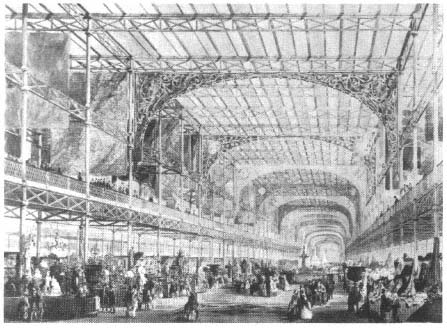
Figure 109.
Owen Jones, interior of the Crystal Palace (Victoria and Abort Museum, London,
printed in Damp. The Islamic Perspective ).
Jones developed these principles into the "general laws" of his Grammar of Ornament, published in 1856. The "general laws" of decoration, he argued, were common to historical styles but were independent of their particularities.[20] He presented various Islamic styles as valuable "guides" for a new architecture, especially in their use of decoration and color, and argued that the Alhambra was the "culminating point" of Islamic architecture.[21]
In the Crystal Palace Jones put into practice a color theory he had formulated based on archaeological (Greek, Egyptian, and Moorish) sources: blue, a relieving color, should be used on concave surfaces; yellow, an advancing (projecting) color, should be applied to convex ones; and red, "the color of the middle ground," was appropriate for horizontal surfaces. White helped to divide the primary colors, as in antiquity. Because the Alhambra was Jones's authority for the "proportions of color and methods of application," his "new style" had an "Oriental" feel. Furthermore, his design called for large hangings to separate the sections of the upper level, accentuating the barrel-vault effect of the interior and giving it the look of a bazaar—another touch of the East.[22]
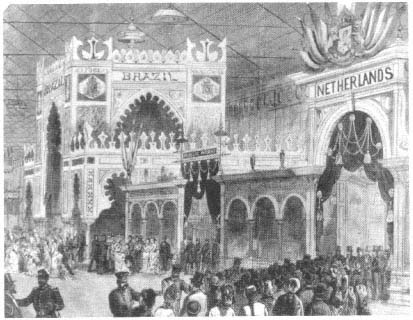
Figure 110.
Furness, Brazilian pavilion, Philadelphia, 1876 (O'Gorman, The Architecture
of Frank Furness ).
Jones created this atmosphere not by replicating Islamic forms but by interpreting them according to theoretical premises. Later his persistent search for the "science" of architecture and his incorporation of Islamic principles into this "science" would be pursued from another angle by French rationalists under the leadership of Viollet-le-Duc.[23]
Frank Furness at the 1876 Centennial Exposition in Philadelphia
Frank Furness, the controversial Philadelphia architect, designed the Brazilian section in the main building of the 1876 Centennial Exposition in a neo-Islamic style (Fig. 110). Although the choice of style may seem peculiar for a Brazilian pavilion, it makes sense in terms of Furness's work, which was inspired by Islamic architecture. Furness had never been abroad, so he had seen neither Islamic monuments themselves nor the Ottoman, Egyptian, and North African exposition pavilions in Europe. Buildings erected in America in Islamic styles earlier in the nineteenth century were whimsical imitations, recalling European "follies,"[24] and as such they differed from Furness's highly interpreted use of Islamic forms.
A more direct influence on Furness may have been his mentor, Richard Morris Hunt. Hunt's cast-iron building for the Tweedy and Company Store (1871–72) in New York had a facade with lobed horseshoe arches of different scale on different levels and entrances inspired by mihrabs , or niches indicating the orientation of Mecca in mosques.[25] Hunt's comprehensive library, which included works on Islamic architecture, was available to his apprentices.[26] Furness might also have benefited from discussions with Henry Van Brunt, another of Hunt's protégés. In iron buildings Van Brunt advocated the "incised" (rather than the "applied") ornamentation and contrasts of color characteristic of Islamic architecture.[27]
Publications, however—especially those of Owen Jones—appear to have been the main source of Islamic influence on Furness. James O'Gorman has shown Jones's direct influence, for example, in some of Furness's floral patterns.[28] But, more significant, Furness adopted Jones's theoretical position on the integrity of form and decoration. In interpreting Islamic motifs, Furness went back and forth from literal borrowings to unconventional adaptations, from the Rodef Shalom synagogue (Fig. 111) of 1869, with its horseshoe-arch windows and its choir a Moorish maqsura (enclosure near the mihrab ) topped by an octagonal pavilion reminiscent of garden kiosks and fountains, to the Pennsylvania Academy of the Arts of 1871, with its three-story-high portal inspired by mosque portals and mihrabs (Fig. 112), and the Guarantee Trust and Safe Deposit Company Building of 1873, with its playful pointed arches and its fenestration serialized and superposed in an Islamic manner.
Furness employed his favorite Islamic themes in the Brazilian pavilion: the horseshoe arch and the pointed arch (both scalloped), crenellations, the superposition of square-sectioned columns over circular ones to create height and an elongated effect, clusters of circular columns to mark entrances, and brightly colored glass tiles and floral ornament. The screen-like walls defining the enclosure combined all these borrowed "Moorish" elements. Although Brazil was far from the Orient, it had a labyrinthine link to Islam through Portuguese colonization and the Moorish architectural heritage of the Iberian peninsula; Furness evidently associated Brazil directly with an Islamic style, for he neither experimented nor interpreted in designing the Brazilian section, as he did in other buildings designed for Philadelphia.
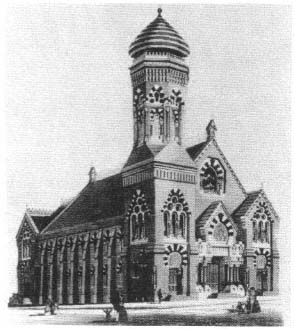
Figure 111.
Furness, Rodef Shalom synagogue, Philadelphia
(O'Gorman, The Architecture of Frank Furness ).
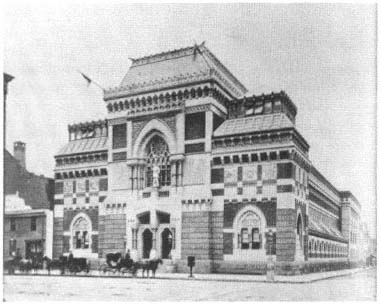
Figure 112.
Furness, Pennsylvania Academy of Arts, Philadelphia
(O'Gorman, The Architecture of Frank Furness ).
Gabriel Davioud at the 1878 Paris Exposition
Gabriel Davioud, one of Baron Haussmann's leading architects in the rebuilding of Paris, designed the imposing Trocadéro Palace for the 1878 Paris exposition in cooperation with an engineer named J. D. Bourdais (Fig. 113; see also Fig. 34).[29] It became a landmark and the focus of expositions that followed, with its fountains and the Place de Trocadéro, a large open space between the palace and the Seine.
The palace was novel not in its organizational principles but in its architectural vocabulary. It was sited conventionally, on an axis with the Ecole Militaire across the Seine. Its domed central section (a theater that could hold six thousand persons) was symmetrically framed by curving lateral galleries. The style was viewed skeptically by some contemporaries, endorsed by others. According to one observer, the dome and towers were Byzantine.[30] Others defined the structure as "a mixture of many styles—Greek, Roman, Byzantine, Arabian, and Renaissance,"[31] or as "Romano-Spanish-Moorish." Yet another associated it with modernism: "It is neither this nor that, but it is modern."[32] Viollet-le-Duc applauded Davioud for his "judicious employment of materials."[33]
Perhaps the most striking Islamic elements in the Trocadéro Palace were the two square towers, modeled after the minarets of North African mosques—with elaborately ornamented facades and domed pavilions. The pavilions at either end of the building, used as entrances, each with large arches, a single dome, crenellations on the roofline below the dome, and large rosettes ornamenting the facades, recalled the portals of Islamic monuments. The portal motif was repeated in four secondary entrances on the curving colonnade; these were simpler variations on the same theme. The Islamic vocabulary was further expressed in the fenestration as well as in the bands of red stone and the polychromatic exterior decoration of tiles and mosaics.
The palace overpowered everything else on the fairgrounds. Its scale is understood best in the context of other exposition buildings, for example, the Algerian, Tunisian, and Moroccan quarters, situated in front of the Palace. The architectural references in these quarters were similar to those in the palace, but the scale in the colonial village was much smaller, the entire North African section being about the size of the central part of the Palace.
The majesty of the Trocadéro Palace helped to focus interest on Islamic architecture in Paris perhaps even more than the Islamic pavilions themselves. As the main building of the exposition, it was designed by an eminent Parisian archi-
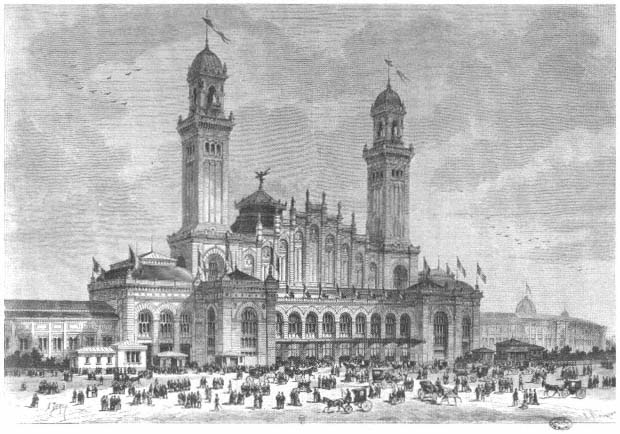
Figure 113.
Davioud and Bourdais, Trocadéro Palace, back facade, Paris, 1878
(Bibliothèque Nationale, Département des Estampes et de la Photographie).
tect, yet it marked a divergence from the norms of Western architecture in its vocabulary, its incorporation of Islamic forms into a Western syntax in a major structure. A contemporary critic called it "one of the greatest, naivest, most amusing feats in architecture ever achieved." The same critic found it graceful and playful, but "not a style to imitate."[34] And in fact it set no precedent; neo-Islamic forms appeared only sporadically afterward in French architecture.
Adler and Sullivan at the 1893 World's Columbian Exposition in Chicago
Louis Sullivan and Dankmar Adler's Transportation Building was one of the most memorable structures at the 1893 Columbian Exposition in Chicago (Figs. 114–115). As an "architectural exhibit"[35] in itself, it served one of the main goals of world's
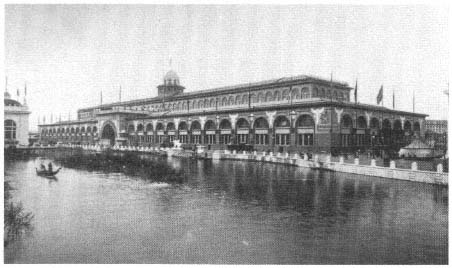
Figure 114.
Adler and Sullivan, Transportation Building, Chicago, 1893 ( World's
Columbian Exposition ).
fairs: education. Its location off the Court of Honor, where the main buildings of the exposition were erected in a uniform neoclassical style on an axial and symmetrical plan, enabled Adler and Sullivan to break some of the rules spelled out by the organizing committee and experiment with exterior ornamental forms. Nevertheless, they had to adjust their structure to its context and conform to exposition guidelines.
With its cornice line and the rhythm of its openings determined by other buildings in the main section, the Transportation Building fit snugly into the Beaux-Arts site plan. Its design also followed the conventions of the time: a central hall with an arcaded clerestory and a dome. But in the treatment of its surface and the color of its facades it contrasted with the other buildings in the White City. The exterior walls were light red at the lower level; the elaborate spandrels above were characterized by their "high pitch intensity in color." Winged figures on the spandrels were metaphors for transportation against a gold-leaf background. The main feature of the pavilion was the hundred-foot-wide and seventy-foot-high Golden Gateway, formed by concentric arches painted in gold.[36]
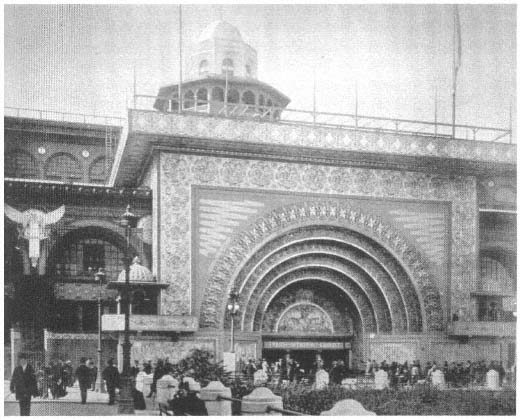
Figure 115.
Adler and Sullivan, Transportation Building, the Golden Gateway. Chicago, 1893
(The Great White City: A Picture Gallery of the World's Fair and Midway
Plaisance, Chicago, 1893).
The architects emphasized the external polychromy as the basis of their design:
The architecture of the building . . . has been carefully prepared throughout with reference to the ultimate application of color, and many large plain surfaces have been left to receive the final polychrome treatment. The ornamental designs for this work in color are of great and intricate delicacy; the patterns, interweaving with each other, produce an effect almost as fine as that of embroidery. As regards the colors themselves, they comprise nearly the whole galaxy, there being not less than thirty different shades of color employed.[37]
Sullivan did not refer to Islamic precedents in this explanation of the Transportation Building (though others did).[38] In a letter to Daniel Burnham on 16 October 1893, he argued that he had designed the Transportation Building in a "natural" manner, expressed by "elementary masses carrying elaborate decoration." He achieved geometric simplicity by using straight lines and semicircles. In contrast to this simplicity was the structure's richly colored decoration, created by "systematic subdivisions." In his use of color, Sullivan intended to reflect "the true nature of polychromy," combining and repeating "a great many colors" in sequence.[39]
In Kindergarten Chats, he further clarified his point:
A decorated structure, harmoniously conceived, well-considered, cannot be stripped of its system of ornament without destroying its individuality. . . .
It must be manifest that an ornamental design will be more beautiful if it seems a part of the surface or substance that receives it than if it looks "stuck on," so to speak. . . . Both structure and ornament obviously benefit by this sympathy, each enhancing the value of the other. And this, I take it, is the preparatory basis of what may be called an organic system of ornamentation.[40]
Among the critics of the Transportation Building was Montgomery Schuyler, who, arguing that Adler and Sullivan had turned Islamic architecture inside out, repeated the common misperception that all Islamic architecture is interiorized:[41]
The Saracens, indeed, attained an interior architecture of plaster, and this architecture comprises all the precedents that were available for the architects of the Transportation Building. The outsides of those Saracenic buildings of which the interiors are most admired are little more than dead walls. One cannot fail to respect the courage and sincerity with which the architects . . . tackled their task.[42]
Another contemporary critic, Charles Mulford Robinson, the acknowledged theorist of the City Beautiful movement, called this building "the bride of the Orient." Uneasy with its "strange" details, Robinson emphasized its otherness among the structures of the White City: it had a "voluptuous Orientalism," which caused it to stand out among the more masculine structures.[43]
Arguing that Sullivan's building synthesized ancient, medieval, and Islamic elements, the architectural historian Dmitri Tselos notes analogies to Islamic monuments of North Africa and India—among them the twelfth-century Aguenaou Gate in Marrakesh.[44] In fact, Sullivan's references to both the interior and exterior elements of Islamic monuments are broader than Tselos suggests. The hierarchical treatment of surface elaboration from planar to complex ornamentation is common in the architecture of many Islamic regions; for example, in Morocco, on the minaret of the Mosque of Sultan Hasan in Rabat from the Almohad period (late twelfth century). The curvilinear vine-and-scroll motif occurs in Syria on both Byzantine and early Islamic buildings of the Umayyad period; in later centuries it is found on the mihrab of the Great Mosque of Cordoba and in the surface decoration of many Mamluk buildings in Cairo. The Golden Gateway of the Transportation Building recalls the Rabat Gate in Oudna's fortifications (late twelfth century) as well as tombs in Bukhara, such as the Tomb of the Samanids, with its receding arched portal. The multiplication of receding arches is also seen in the mihrabs of Mamluk mosques in Cairo. The small domed "porch" evokes sixteenth-century fountains in the center of mosque courtyards in Istanbul (e.g., Sokullu Mehmed Pasa mosque).
The list of precedents could be extended, but archaeological detective work is beside the point here. Even a quick study of the Transportation Building facade shows that the structure embodied not Islamic revivalism but, in Sullivan's words, a rejection of "historical styles."[45] Although such a statement reiterates the ahistorical quality ascribed to Islamic cultures in general, for Sullivan this was not a negative trait but a redemption. Here was the potential to create a new architecture.
Sullivan's search was a philosophical one. He saw himself as a creator of culture for the New World whose architecture would express intellectual, emotional, and spiritual realities, satisfying the "real needs of the people."[46] To Sullivan, function meant "the whole life" that would be lived in a building. In his self-assigned role as prophet, he would interpret American life and idealize its egalitarian dimension, which he believed was best expressed by forms drawn from distant sources. His "exoticism" and his references to other cultures voiced his dissatisfaction with the dominance of classical forms. Nevertheless, Sullivan's "Orientalism" was purely formal: he referred to Islamic architecture
not because he was inspired by the civilization of Islam but only because the source was formally a novel and refreshing one.
Eugène Hénard at the 1900 Paris Exposition
Eugène Hénard is best known for his future-oriented urban design projects of the 1910s, which consolidated the technological developments of his time and focused on the problems of motor traffic. Like many architects of his era, Hénard apprenticed at the world's fairs, as both an architect and an urban designer. The Avenue Nicolas II and the Pont Alexandre III are his surviving achievements in Paris from the 1900 exposition. Hénard, to honor the "fire of the century," also designed one of the most spectacular structures of this exposition, the Palace of Electricity—a rectangular structure, 150 by 80 meters, near the Eiffel Tower. Its main room, called the Palace of Illusions, was a large hexagonal hall lined with mirrors for light and sound shows. It was here that Hénard appealed to Islamic architecture: to create a building "in air," he relied on an "intensive and original decoration," but only on the upper levels of the structure (Fig. 116).[47]
The dome of the Palace of Electricity was its most striking feature. Trilobed horseshoe arches carried its load down to six sets of supports—each a cluster of three columns on high pedestals. The elaborate detail of the structure, built entirely of iron, glass, and zinc, produced the effect of "metallic lacework,"[48] but because the materials belonged to the new age of industry, the structure seemed to one contemporary observer to resemble "an extravagantly sumptuous factory rather than an exposition palace."[49]
The Great Mosque of Cordoba provided Hénard's inspiration for both the architectural elements and the spatial qualities of the palace, particularly the sense of infinity created by the repetition of elaborately detailed arches in two directions. Although the Palace of Electricity had neither the space nor the programmatic justification for duplicating the Great Mosque, Hénard, to glorify the power of electricity, used mirrors to create multiple reflections of the illuminated arches, their complex supports, and their embroidered details.[50]
The exterior of the Palace of Electricity reflected the turn-of-the-century art nouveau style.[51] Hénard was undoubtedly searching for an architectural vocabulary for the new century, one without historicist references. Islamic architecture was different enough to help him formulate a new vocabulary. More-
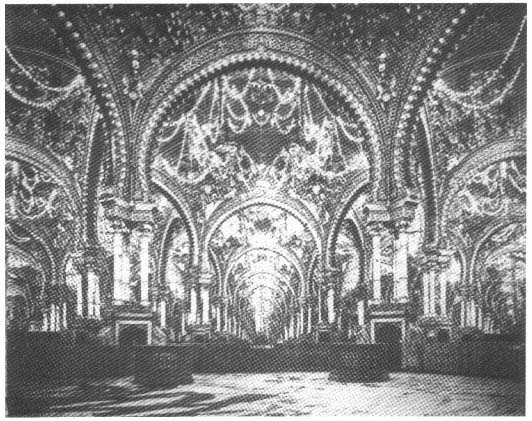
Figure 116.
Hénard, Palace of Electricity, Palace of Illusions, Paris, 1900
(Exposition universelle internationale de 1900, vues photographiques, Paris, 1979).
over, the features Hénard used in the palace created a fantastic aura consistent with that of nineteenth-century world's fairs. For Hénard, fantasy was not a thing of the past but an element of the industrial age, embodied in the magic of electricity.