
Chapter 7—
David Fogel and Moyshe Leyb Halpern:
Liminal Moments in Hebrew and Yiddish Literary History
David Fogel and Moyshe Leyb Halpern—what could these two radically different poets possibly have in common?[1] Even a cursory familiarity with their poetry is sufficient to establish the divergence of their poetic styles: the minimalist, introverted, and deceptively plain Hebrew free verse of Ayefim anachnu, / nelkha-na li-shon (“Weary are we, / let us go to sleep”) (Fogel, [1966] 1975:253) versus the raucous, flagrantly rebellious, rhythmically and figuratively rich Yiddish poetry of Mayn umru fun a volf un fun a ber mayn ru / Di vildkayt shrayt in mir, di langvayl hert zikh tzu (“My restlessness is of a wolf, and of a bear my rest, / Riot shouts in me, and boredom listens”) (Halpern, [1919] 1954:152; translation in Harshav and Harshav, 1986:401). However Fogel and Halpern are perhaps more alike than they initially appear; their respective rhetorical impressions may prove subversively misleading. (While the once symbiotic literary systems of Hebrew and Yiddish did, indeed, continue to maintain complex contacts during the modernist era,[2] my inquiry focuses on the roles of these two poets within the dynamics of modernism in their respective literary systems. The point of comparison, therefore, is intra- rather than intersystemic.)
Within the model of marginal prototypes outlined in Part 1, Fogel is portrayed both as a retrospective paragon for the third trend of Hebrew modernism, the Statehood Generation neoimagist poets, and also as one of the few acknowledged representatives of a repressed prototype of marginal modernism, the antiformulaic first wave of Hebrew modernism comprised primarily of non-Zionist male and
Zionist female Hebrew poets. Halpern was construed as a proleptic paragon for the introspectivists in New York, the generation of modernist Yiddish poets that followed his own; and, from a synchronic perspective, within his own group, the aestheticist/impressionist poets who made up di yunge (“the young ones”), Halpern was seen as a deviant paragon. He was the “odd man out,” “the mischievous rebel within this movement of self-declared rebels” (Wisse, 1980:36). Both poets offer dramatic illustrations of the importance of limit cases and transitional prototypes for the formation and crystallization of literary trends in general and modernism in particular.
There is, however, a more concrete point to be made about the relationship between the poets' marginal prototypicality and the periodization of modernism in Hebrew and Yiddish poetry. Both Fogel and Halpern published their first books of poetry at the time of the beginnings of modernism within their “indigenous” poetic systems.[3] Yet this time period is already considered the height of modernism within the mainstream of the central and eastern European literary systems to which each poet maintains strong links.[4] The “international time lag,” so characteristic of the intercultural dimensions of modernism in general, places Fogel and Halpern, particularly in their early poetry, at a crucial literary-historical conjuncture: on the fuzzy boundaries between pre- or protomodernism and modernism proper, or, more specifically, in a self-conscious oscillation between impressionist and expressionist literary prototypes. Their poetry and poetics elaborate and thematize this oscillation in incompatible, even contradictory, ways. Yet the salience of glissements between premodernism and modernism in their work is itself a decidedly modernist tendency within their specific literary and cultural contexts.
In order to understand the social and cultural background for Fogel's and Halpern's modernist hesitation on the threshold of modernism, some light needs to be shed on the manner in which each poet either resisted the allure of or was excluded from the dominant trends of contemporary literary systems. For Fogel, a famished, uprooted perpetual wanderer through Europe's modernist centers, the very decision to become a Hebrew poet was an act of self-marginalization and self-modernization.[5] Unlike his near contemporaries, the moderna Hebrew poets, who participated in shifting the center of Hebrew literature from Europe to prestatehood Palestine and were actively involved in the politics and praxis of labor Zionism, Fogel was never truly committed to or actively involved in any branch of Zionism.
Throughout his life he remained ideologically, though not aesthetically, alienated from the linguistic-national Hebrew revival. Robert Alter has argued persuasively in The Invention of Hebrew Prose (1988:72) that Hebrew was to become for Fogel, as for other antiformulaic writers, a road into international modernism, “a calling card that gave them entry to the great polyglot salon of European culture, as if to say: We belong here as equals, and we are proud to display our original address.”[6] Yet Hebrew, as well as Yiddish, poets would always remain in a remote corner of this great polyglot salon; they would hardly have been able to engage in very much modernist mingling, given that while they could understand the language of the other guests, no one could comprehend theirs. The examples of Fogel and Halpern, the great neglected paupers of Jewish literature, call into question the possibility of transgressing socially and economically determined marginality and achieving equality even within those prototypes of international modernism which purport to privilege exile, periphery, and multilingualism.
Fogel's Hebrew diary,[7] which spans roughly ten years in the young poet's life (1912–22) and breaks off significantly just before the publication of his first book of poetry, expresses his total alienation from any of the collective settings that cultivated Hebrew letters during that period, be they traditional/religious or modern/Zionist. On the day after Yom Kippur in 1912, feeling like an exile in his hometown of Satanov (having been deported back there from Vilna, where he had been studying Hebrew), Fogel writes: “Yesterday I was in the synagogue but nothing at all from the prayers left an impression on me” (1990:272). A couple of weeks later, having stolen across the border to Lemberg [Lvov], the Galician capital of Hasidic Jewry, he describes his anguish in the form of hatred for the community to whose children he must teach Hebrew in order to survive: “I hate Lemberg and its Jews with their sidecurls down to their shoulders” (1990:275). In Vienna in 1913, on the eve of the Zionist Congress, he expresses an acerbic optimism, couched in language that blatantly precludes identification with Zionism as the possible source of that optimism: the Zionist Congress is a source of joy simply because it provides temporary employment to the starving young poet. Able to work for a living (as a porter or doing odd jobs for the Jewish National Fund), Fogel receives a short-lived break from his usual hunger: “[The Congress] has removed to some extent the philosophy of hunger from me. And I'm hoping to be rid of it [the philosophy of hunger]
at least for this month: Days of the Zionist Congress, days of profit…. Yes, the last period has been so terrible in its famine, I've been so hungry that my hair started falling out…. Just as in the novel by Knut Hamsun. Yes, those were the days” (1990:299). The sarcastic reference that elevates hunger to a philosophy and its “aestheticization” in Hamsun's influential novel Hunger[8] are very much in the spirit of traditional Yiddish humor. They also suggest a self-conscious critique of the romantic stereotype of the tormented poet-philosopher who needs to suffer and starve in order to attain a higher level of spiritual creativity.
Interestingly, around this time Fogel contemplated emigration to Eretz Israel but in a context that could not be less enthusiastic: “[S]ometimes when my patience dwindles, I would like to run away from here even to the bottom of hell (she'ol tachtiya ) or to the end of the world (le-afsey tevel ): to America, to Argentina, to Brazil, to Eretz Israel, it makes no difference where, just to run away, not to be here” (1990:291). It is not accidental that Fogel lists Eretz Israel here as the last item in a catalogue of escape routes metaphorically located in hell or at the end (literally: zeros, nullity) of the world. Indeed, sixteen years later his attempt to escape poverty and isolation by emigrating to Palestine would fail miserably. Feeling like a refugee in Tel Aviv even more than in any of the European capitals he had wandered through, Fogel would leave Palestine merely one year after his emigration, more isolated and despondent than when he came, never to return.
Yet the same diary also evinces the extraordinary single-mindedness and zeal with which Fogel carried out his plan to mold himself into an unaffiliated modernist Hebrew poet: he starts from his systematic study of Hebrew in Vilna (what he nostalgically refers to as his “Vilnaese metamorphosis,” ha-gilgul ha-vilna'i[9] ) through his selfstyled apprenticeship in German and western European literature, all the while struggling with hunger, unemployment, homelessness, and the early stages of tuberculosis. As Alter (1988:75) points out, even the geography of his wanderings almost seems part of this literary self-education: “He sojourns briefly in Vilna, then Odessa, Lemburg, and beginning in 1912, in Vienna, as if on an inadvertent pilgrimage of the major way stations of Hebrew literature in Europe.” Yet it would be critically naive to portray Fogel's social and ideological isolation, and his lifelong indigence, as poetic choices, calculated steps in a plan for self-modernization. Ultimately, Fogel's death at the hands of the
Nazis in 1944 underscores how involuntary his “victimhood” was throughout his life.
Similar dangers need to be avoided in characterizing Halpern's inability to find a well-paying job or to cooperate with the Yiddish literary and political establishment of New York—and the horrible destitution this entailed for him and his family—as a willful modernist retreat to the margins.[10] The sustained ambivalence and sarcastic tone of Halpern's poetry, as well as his journalistic and personal writing, have perpetuated the critics' tendency to equate his poetics of rebellion with a biographical refusal “to settle down.” Furthermore, the blurring of the borders between self-directed criticism and social protest, a central thematic tension in Halpern's work, tends to be interpreted reductively within a critical tradition that is highly biographical: the poet, unable to care for his wife and child, tries to blame his inadequacies on the general social and political condition only to realize in the end that he himself is to blame. This is a gross oversimplification of the social and poetic critique so inexorably intertwined in Halpern's work and expressed with vivid rhetorical ambivalence even in his early personal correspondence.
In a letter dated July 23, 1917, to Royzele Baron, who was later to become his wife, Halpern describes his social and economic hardships through a series of metapoetic images that oscillate typically between ruthless self-irony and biting social protest:
Perhaps it is only the lyrical poet who coquettishly shows off his suffering like a clown toying with the bells on his cap, or like a pauper who jingles the few coins in his pocket so others would believe he has golden riches?
For, after all, there still exists the light of day, not only night. And I'm not yet old enough to say that everything is nothing. But the truth is that the lighter the day, the darker my hope becomes. And not because everything is nothing, but rather because everything is a lot! And if there is something which is nothing—then I am it, I alone who have been wandering around for ten years already, together with ten million other people, like one huge hunk of raw meat, in the lumbering garbage can: New York. (Quoted in Greenberg, 1942:67; translation mine; italics in the original).[11]
The first simile of poet and clown pitilessly questions the poet's transformation of his suffering into aesthetic material by exposing the poem as manipulative exhibitionism. The deflating image of the bells on his clown's (jester) cap (vi a payats mit di gleklekh fun zayn mitsl )
renounces any pretense to lasting aesthetic value. This theme recurs throughout Halpern's poetry: a fierce self-critique of the poet's social helplessness and inevitable complicity in an oppressive structure by aestheticizing his own suffering and that of the oppressed working classes.[12] Yet the second simile in the letter, which is presented in typically disjunctive-interrogative syntax as a hypothetical alternative to the first, is already much more ambiguous with respect to the poet's responsibility: oder vi a kabtzn vos klingt mit di etlekhe groshn in keshene kedey mentchen zoln gloybn az er iz raykh in gold? (“or like a pauper [beggar] who jingles the few coins in his pocket so others would believe he has golden riches?”—literally, “that he is rich in gold?”). The first part of the image appears to reiterate the first simile and still depict the poet as a beggar who uses his destitution to increase his appeal. Once we get to the end of the sentence, however, the meaning seems, almost imperceptibly, to have been reversed: the poet now describes himself as a proud pauper who hides his poverty by jingling the few coins in his pocket as if they were a golden treasure. Characteristic also of Halpern's later poetry, these two contradictory readings are made possible by the lexical ambiguity of kabtzn, meaning both “beggar” and “pauper,” and by the “associative concatenation” of syntax, which shifts the situation mid-sentence.[13] The result is a simultaneous condemnation and exoneration of the poet's marginality.
The second paragraph evokes a similar tension between two opposing views of the poet at the social and economic periphery of his community. The first view is expressed through a sardonic allusion to old Solomon's proclamation: “Vanity of vanities; all is vanity” (Ecclesiastes 1:2). The young poet cannot hide behind the nihilism of “everything is nothing”[14] precisely because, within the social context of the immigrants' struggle to survive in an urban consumer society, “everything is a lot.” At this point Halpern appears to conclude, as expected, that “if there is something which is nothing—then I am it,” internalizing the blame as well as the value system which treats people as commodities and a lack of assets as evidence of personal worthlessness. But within the apposite sentence which expands on this personal nothingness, the relative clause completely reverses the direction of the argument: the poet who starts out saying “I alone [am nothing]” ends up describing his lonely (aleyn, oscillating here between an adjectival and an adverbial use) wandering—and that of millions of others—in the lumbering garbage can (the Yiddish is bru-
tally expressive and quite untranslatable here: umgelumpertn mistkastn ) called New York. The final simile also sustains two different readings, and again this duality is made possible through a combination of syntactic ambiguity and lexical polysemy. In one sense the poet is saying: I have been wandering all alone, like a big lump of live flesh or raw meat (lebedike fleysh ) in this dirty (garbage-can-like) metropolis, and there are millions of others just like me. In another sense he is also saying: together with (as one with) (in eynem ) millions of others who share my destitution and isolation from mainstream society, we form one huge hunk (eyn groys shtik ) of raw meat, discarded by the affluent culture and thrown into the lumbering urban garbage can, New York City. Not only does this final twist place the responsibility for poverty and marginality away from its victims, it also suggests, in the image of the unified human mass of raw/live meat/ flesh, the potential for insurgent power which is latent within it.
Halpern: Deviant Paragon, Proleptic Paragon
In his mature poetry, especially in the genre that Benjamin Harshav (1990:107) has aptly named “political talk-verse,” Halpern achieves a systematic blurring of the borderline between the poetic speaker's critical introspection into his personal marginality and “an existentialist-anarchist slashing at life in general and at American capitalism in particular” (1990:107). This self-styled genre, and the peculiar thematic ambivalence associated with it, is already dominant in his first volume of poetry, In New York. This book established Halpern as the deviant paragon among his contemporaries, di yunge, and as a proleptic paragon for the introspectivists, who reacted against them. As Kathryn Hellerstein points out in the introduction to her volume of translations from Halpern, In New York: A Selection (Halpern, 1982:xiii), “[T]he struggle between the poet's responsibility to self and to community culminates in the final and most ambitious poem of the book, ‘A Night,’ where the protagonist dreams himself into a collective, historical voice, with which he tells simultaneously the stories of the poet and of his people.” An early version of “A Nakht” appeared in 1916, in the yunge anthology Halpern coedited with Menachem Boreysho, East Broadway (1916:20–60). Four years
later a new group of introspectivist poets published their own poetic credo in the journal In Zikh, blasting Halpern—as one of the leaders of di yunge —but at the same time formulating artistic principles for which “A Nakht”—as well as many of Halpern's earlier and later poems—serves as a latent but rather obvious example.
Halpern's poem provides a particularly intriguing reworking of the materials and techniques first introduced in his letter to Baron. The poem takes significant steps to subvert the aestheticist harmonies of di yunge and to offer an overtly expressionist, apocalyptic alternative to their poetry of “quietude.”[15] “A Nakht” is often taken to be an antiwar epic, in which the pacifist Halpern declares the impending ruin of Europe. Ruth Wisse writes that the poem was “[s]et equally against both sides of the war [World War I],… [and] concentrated on the destruction itself. The result was a fevered work of apocalyptic doom in which all of European civilization disintegrates with the Jews in its midst” (Wisse, 1988:95). Wisse's remark most likely captures the circumstances of the poem's composition; however, as a reading of the poem, it presupposes the very distinctiveness of the personal and the collective that Halpern's work disrupts. Wisse's reading therefore remains an essentially premodernist interpretation of the articulation of the relationship between personal fate and historical condition: the death of the speaker is seen as a microcosmic reflection of the macrocosmic destruction of an entire civilization. David Roskies offers a different, and more appropriate, description of the poem as “the conflation of two nightmares, one personal the other historical” (1984:95, emphasis added). If the poem's figurative language, syntax, and manipulation of point of view are taken seriously and if the location of “A Nakht” at the end of an architectonically structured book whose title is In New York is systematically explored, then the poem emerges as an “experimental verse narrative” (Hellerstein in Halpern, 1982: xiv) which—much like Eliot's “The Waste Land”—forms a new modernist poetic prototype. As in “The Waste Land” and other radically modernist long poems, the poetic world view of Halpern's “A Nakht” emanates from the structure of the text.
In an important but often neglected article, Seth Wolitz (1977) has argued that in its conception and organization, Halpern's first book, In New York, projects this type of modernist world view. The book's organization brings together three distinct levels of meaning within each poem. Thus, as the book moves from beginning to end, each poem acts within all three separate continua, creating a rather com-
plex systematic structure that multiplies levels of meaning within any particular poem along several different paths throughout the book as a whole. These three levels, while related in that they can be seen within each poem, are actually quite distinct:
1. natural time—one day in the life of a foreigner, from morning to night,
2. the life of the Poète Maudit from childhood to death,
3. the generational epic repetition of the ejection from the Garden of Eden into the exile of Israel. (Wolitz, 1977:62)
These three architectonic levels are articulated through the arrangements of poems in the book. The book is divided into five sections, starting with morning/childhood/the Garden of Eden (in the first section called “In Our Garden”) and ending with night/ death/exilic apocalypse (the last section of the book, comprising the twenty-five part poem, “A Nakht”).[16]
Contrary to Wolitz's claim, however, this three-tiered organization hardly effects a harmony of symbolist “correspondences,” of the kind di yunge would have appreciated. Instead, the mixed-up simultaneity of all three levels, the mélange of voices and masks, and the fragmented iterability of all points of view create the cumulative, “jagged, episodic narrative” (Hellerstein, in Halpern 1982:xiv). While individual early poems incorporated by Halpern into this new book in 1919 may preserve some of the aestheticist, impressionist, and symbolist norms of the yunge model, the later poems, such as “A Nakht,” and the overarching structure of the book as a sustained composite narrative introduce into Yiddish poetry new expressionist and postsymbolist prototypes.
When “A Nakht” is read as the culmination of the book-length portrait that Wolitz aptly calls a neshome-landshaft (soulscape) of In New York, it can no longer be construed according to premodernist, realist norms as a vision of the destruction of Europe and its Jews (although this theme is certainly an important part of the work). Rather, the poem is both a projection and an interiorization of that vision, an expressionist montage of the war theme on top of other fragments of personal and collective existence. The vision is split spatially between eastern Europe, the speaker's bedroom in New York, and a mythopoetic Middle East; it takes place simultaneously in the present, in an undetermined series of historical-mythical pasts, and in a mock-apocalyptic future. Nonlinear space and time are all
refracted within the speaker, who is both asleep and wide awake, and whose identity is divided between the detached third-person narrator, the elegiac first-person participant in individual and historical destruction, and the discordant mentshele, the humunculus as “brilliant master of ceremonies,” whose nihilistic hokum is “more chilling than the barbarism he describes” (Wisse, 1988:96–97). Halpern transforms typical Yiddish discourse strategies into a highly intricate art form: the dialogic monologue, the question as indirect speech act, the ironic quotation, and the digressive, associative concatenation of syntax (Harshav, 1990:98–116). All of this takes place within a decadently rich prosodic framework, which for di yunge was part of a serious attempt to turn literary Yiddish into a refined instrument of high-brow culture, but which in the context of “A Nakht” has a chilling, morbid effect.[17] Section XX offers an untranslatable thematization of this contrast between prosodic and semantic structure in the danses macabres of fragmented victims and the disembodied acts and tools of victimizers.[18]
The early letter to Baron expressed the inseparability of a personal sense of responsibility for the poet/pauper's nothingness and a collective protest against the system that discards its human resources as so much raw meat in the garbage can called New York. Now, in “A Nakht” the kaleidoscopic objectification of the personal and social perspectives is refracted in a series of harrowing narrative elaborations that systematically erase distinctions among all the realms involved in the narrative.
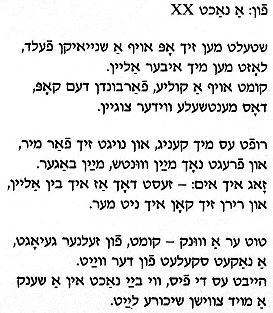
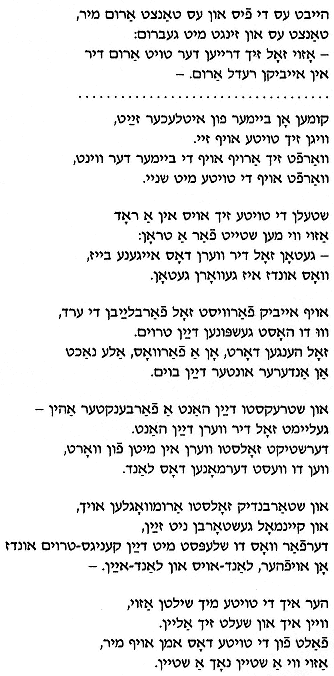
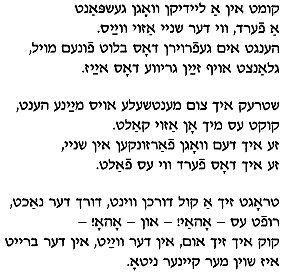
From: A Night, XX
So they stop on a snowy field,
and leave me behind alone.
Along comes on a crutch, head bandaged,
that Little Man again.
It calls me king, it bows low,
asks my every wish and desire.
I tell him:—you see I'm alone,
and can't move anymore.
He winks—and along comes, chased by soldiers,
a naked skeleton from afar.
Lifts its legs, like a woman at night
in a bar among drunken men.
Lifts its legs and dances around me,
dances and sings in a growl:
—Death should go around you like this
with its eternal wheel.—
Trees come closing in from every side,
cradling corpses in their limbs.
The wind turns against the trees,
charges at the corpses with snow.
The corpses line up in a circle
as if standing before a throne:
—may the same evil be done to you,
that has been done to us.
Forever barren may the earth remain,
upon which you have spun your dream.
May there hang every night, without a reason why,
another man from your tree.
And if you should stretch out a longing hand over there—
may your hand be struck numb.
May you choke to death in the middle of your word,
when you mention the name of this land.
And dying you'll go on wandering,
and never be dead and done,
for you drag us along with your royal dream
without end, land in, land out.—
As I hear the dead cursing me so,
I cry and curse myself.
The corpses' last Amen drops on me,
like stone after stone.
Hitched to an empty wagon
a horse comes along, white as snow.
From its mouth the blood hangs frozen,
on its mane gleams the ice.
I stretch my hand out to the little man,
it stares back at me so cold.
I see the wagon sinking in snow,
I see the horse as it falls.
A voice carries through the wind, through the night,
it calls—Ahoy!—and—O ho!—
I look around me, far and wide,
and there is no one there anymore.
—Halpern (1919, 1954 ed.:215-17; translation mine)
As the metapoetic dimension of this section suggests, “[T]he dead cannot forgive the survivor the rhetorical web of deceit that has been spun around them, and they curse their would-be elegist” (Wisse, 1988:96). But it is the gallows humor, the wink of the naked skeleton, the sarcasm of the mentshele that ties the critique of the poet's aestheticization of horror to its brutally unadorned depiction:
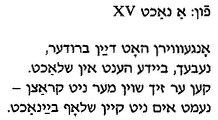
From: A Night, XV
Your own brother, poor thing
lost both his hands at war.
Now he doesn't sleep at night
since he can't scratch himself anymore
—Halpern (1919, 1954 ed.:
200; translated by Wisse, 1988:96)
The Yiddish poet Malka Heifetz Tussman, herself an important liminal figure whose career spans several modernist trends, in referring to Halpern's ironic multiple voices and the unique role humor fulfilled for him, described this rhetorical strategy as “laughing on the wrong side of the mouth” (literally: “laughing with lizards,” in the wonderful Yiddish idiom, lakhn mit yashtsherkes ), “a tortured, automatic laughter” in which Halpern “[a]t once ridicules both the world and himself, for he is the world” (quoted by Hellerstein in Halpern, 1982:xiii).
This connection between self-ridicule and “world-ridicule” and the thoroughly expressionist motivation given to it (“for he is the world”) may help explain the significance Halpern's poetic and rhetorical innovations had for his supposed rivals, the younger poets of the introspectivist group, of which Heifetz Tussman was an important member. One of the introspectivists' major principles, formulated in their first manifesto of 1919 (In Zikh, [1919] 1920; translated in Harshav and Harshav, 1986:774) reads: “The world exists and we are part of it.[19] But for us, the world exists only as it is mirrored in us, as it touches us. The world is a non-existent category, a lie, if it is not related to us. It becomes an actuality only in and through us. This general philosophical principle is the foundation of our trend. We will try to develop it in the language of poetry.” As Yankev Glatshteyn ([1919] 1920), the leading introspectivist poet, was later to acknowledge, this general philosophical principle had already reached significant development in the poetry of their predecessor, the odd man out among di yunge:
Halpern. In other words, from Halpern's implicit poetics, from the poetic principles embedded in and inferred from his actual literary practice, the introspectivists derive an important tenet of their explicit poetics, even before they had published any poetry as a group.[20]
Halpern's closeness to the introspectivists can also be seen in the social, political, and anti-aestheticist elaboration of this principle in the introspectivists' theoretical and critical writings. Later on in the same introspectivist manifesto the poets declare the inseparability of the personal and the collective, the emotional and the social:
For us, then, the senseless and unproductive question of whether a poet should write on national or social topics or merely on personal ones does not arise. For us, everything is “personal.” Wars and revolutions, Jewish pogroms and the workers' movement, Protestantism and Buddha, the Yiddish school and the Cross, the mayoral elections and a ban on our language;… we write about ourselves because all these exist only insofar as they are in us, insofar as they are perceived introspectively. (Translated in Harshav and Harshav, 1986:779)
As Harshav correctly observes, “This is not an escapist, ivory tower poetry” (1990:178). The introspectivists' ideas echo precisely the kaleidoscopic refraction of levels of history and personal experience in the neshome-landshaft (soulscape) of Halpern's speaker. Yet when the composers of the first introspectivist manifesto single out paragons from among their precursors, Halpern is not one of them. Instead, they mention Halpern as a run-of-the-mill member of di yunge, whose poetry has lost its relevance and vitality.
In rejecting the aestheticist ossification of their immediate predecessors,[21] the introspectivists turn, in keeping with the formalist model, to the avuncular path, to a contemporary of di yunge who was associated with a faction one critic has called the “sober” poets: “As with the older writers, here too there is an exception—namely, H. Leyvik. Leyvik is only in part one of the Young Generation. From the first, he introduced so much that is individual—and even profound—that there can be no talk of his stopping, of his having already completed his poetic mission [like the rest of di yunge ]. We regard him, too, as being close to us” (in Harshav and Harshav, 1986:783). Only in Glatshteyn's series of essays in the first two numbers of the introspectivist journal In Zikh ([1919] 1920) is Halpern mentioned explicitly alongside Leyvik as an exception to the destructive and deadening influence of di yunge, epitomized by Mani Leyb's aestheticist
poetics of “quietude” (see Wisse, 1988:21–44ff): “Among his [Mani Leyb's] small, helpless imitators, linguistic “Mani Leybism” has spawned a dead language without the slightest breath of the spoken word. Except for two—[Leyvik] with his simplicity and Halpern with his vulgarity, vitality, and mobility—the language of all other Yunge is colorless and lifeless, despite the plaudits so many have heaped on them for having given us a finer linguistic tool.”[22]
These attempts to find an appropriate paragon within the rejected paradigm point to a perception of heterogeneity within the poetic voices and styles of this earlier paradigm. In part this situation results from the unusually sophisticated theoretical (and not only programmatic) orientation of two of the main introspectivists: Avrom Glantz-Leyeles and Glatshteyn; it is also a function of the anomalous proximity of one “generation” of Yiddish modernist writers to the other and their intimate knowledge of each others' internal struggles and rifts.
Wisse (1988:ch. 3) offers a fascinating description of the tensions within di yunge and the ways Mani Leyb, Halpern, and Leyvik represented different aestheticist/symbolist prototypes. She reveals a three way split within di yunge: the core of the group centered on Mani Leyb and his poetics of quietude; the “sober faction,” eventually led by Leyvik, who criticized Mani Leyb's and David Ignatoff's “slippered smugness, their dustiness, their spitting into the alien cold” (Leyvik, 1919:33); and the “ironic faction” of Halpern and Moyshe Nadir, whose work for the humor magazines and whose German (rather than Russian) influences made them “[s]keptical of both the efficacy of art and the possibilities of a refined literature in an immigrant vernacular” (Wisse, 1988:52–55). In terms of the prototype model, it seems that this struggle was inevitable among the various strands. From the start this heterogeneous group maintained only a tenuous family resemblance among its members: the competing contemporaneous prototypes of (Germanic) poetic impressionism, aestheticism (or art for art's sake), symbolism (of a Russian model), and decadence. By 1918 Halpern, the poet most closely associated with the German rather than the Russian models, was already shifting into a dominantly expressionist prototype which made him a proleptic paragon for the introspectivists. Halpern's newly found salience as an artistically unaffiliated and politically committed poète maudit at the very time—indeed during the same years—that the introspectivists were trying to establish themselves may explain why his status as a paragon was never fully recognized until after his death.
Because of the poetic closeness between Halpern and the introspectivists, it may be possible to conclude that the proximity of the publication of Halpern's first book to the appearance of the innovative in zikh manifestoes was not a mere coincidence. This is not to say that the individual introspectivist poets owe all their inventiveness to Halpern nor that the publication of In New York is directly responsible for the introspectivist credo. Clearly, as the in zikh group itself always declared, these new modernist poets saw themselves as part of the broad range of movements that made up international Euro-American modernism. They themselves constituted a heterogeneous cluster—like their predecessors who acted as “high-modernist” prototypes—each poet working to reverse major strands within di yunge poetics. The generational tension was construed primarily as a struggle between expressionism and the earlier poets' impressionism; as Anglo-American modernisms (imagism, vorticism, and objectivism) reacting against di yunge' s aestheticism; and, to a lesser extent, as futurists rejecting their predecessors' symbolism and decadence. It is, therefore, understandable why Glatshteyn, the introspectivist who was much closer to the expressionist/futurist prototypes than the Eliotesque Glantz-Leyeles, would be among the first to acknowledge Halpern's role.
Halpern's poetry and poetics do not fit well into the framework of di yunge, not simply because of the growing pessimism and complexity of his work, as Wisse suggests (1980:40), nor because he was always the outsider and rebel, as standard critical anthologies describe his marginalization from the group. Rather, Halpern's poetry stands between impressionism (one of the yunge prototypes) and expressionism (one of the introspectivists' prototypes), using expressionism to criticize impressionism. Like Fogel, Halpern straddled the jagged spaces between premodernism and modernism “proper,” a straddling which in its transitional, intercategorical status becomes itself prototypically modernist.[23]
While this transitional status applies primarily to what philosophers of science have termed “the context of justification,” namely what can be descriptively surmised from the poetic works and programmatic discourse, I think it pertains to “the context of discovery” as well, the circumstances under which these works were produced and received. Halpern's early published work in Shriftn, East Broadway, and especially In New York may indeed have helped the young introspectivists form their poetic principles as well as supplied them
with “ammunition” for their later struggle against the dominance of di yunge. The tremendous impact of In New York is widely acknowledged. As Wolitz points out (1977:56), the book was considered “a major landmark in [Yiddish] literature.” Wolitz goes on to cite A. Tabachnik's statement that In New York “is one of the few epochmaking books in Yiddish literature” and Itzik Manger's exclamation that this is “one of the greatest poetry books of modern poetry in general.” Glatshteyn's own homage to In New York is characteristically expressed in silence, in the way he chose “to structure his inaugural volume of poems” (Novershtern, 1986:138).
When the general labels “impressionism” and “expressionism” are applied to modernist groupings in marginal literatures such as di yunge and the introspectivists, the problematical nature of determining trend affiliation is underscored. As I have suggested, di yunge also aligned themselves with symbolism (especially through the imported Russian paragon of Alexander Blok) (Boaz, 1971:160-74), while the introspectivists explicitly pledge allegiance also to Anglo-American imagism (In Zikh, [1919] 1920:25).[24] This blurring of affiliations at the international margins of a trend is symptomatic of the center of the category as well. Numerous general critical discussions of impressionism in mainstream literatures associate it with symbolism (Mains, 1978; Paulk, 1979) as well as with decadence and naturalism (Scott, 1976). Similarly, the term expressionism has been used imperialistically, referring at times to all the modernist trends in the first quarter of this century (Furness, 1973). It is possible nevertheless to use these labels, however tentatively, within the particular conjuncture of modernist and premodernist tendencies in Yiddish poetry in North America from the 1910s to the 1930s. Specifically, we need to explore the extent to which the vacillation of the literary system on the threshold of modernism can be illuminated through the perspective of the contrasting prototypes of impressionism and expressionism. Only within this specific conjuncture can Halpern's special role as deviant and proleptic paragon be understood.
Irving Howe and Eliezer Greenberg ([1969] 1976:39–40) have argued for a clear distinction between the first modern Yiddish group in North America, di yunge, and the first modernist one, the introspectivists:
While Die Yunge validated the idea of the poem as autonomous creation and brought into the narrow precincts of Yiddish poetry some awareness of modern European literature, they cannot be said to have been “modernists” in any strict sense of the term. For self-conscious
experimentation with form and theme, we must turn to a new group of Yiddish poets who began to make their presence felt shortly after the First World War, … the In Zich or introspectivist group.
The question of whether literary impressionism (or any of the other trends associated with di yunge, such as symbolism, aestheticism, and decadence) can be excluded categorically from modernism depends on how precisely the category is delimited. The single criterion offered by Howe and Greenberg, that modernism involves “self-conscious experimentation with form and theme,” remains too vague and latently evaluative to be useful. Undoubtedly, Mani Leyb, Ignatoff, not to mention Leyvik, and most certainly Halpern conceived of their poetic coterie as experimenting with styles and materials that had never before been used in Yiddish poetry. That their poetry was perceived as such in the initial stages of its critical reception can be seen from reviews that refer to di yunge' s poems as formless, sloppy, and ridiculously “beautiful”;[25] perhaps, most amusingly, this self-evaluation can be surmised from di yunge' s own metapoetic self-parody published in their satirical review, Der Kibitser (April 15, 1908, p. 4; translation by Wisse, 1988:18).
Call us Yunge
Call us Goyim
As you will.
Write reviews, write criticism
To your fill.
No! We'll not perform
Tradition's dance.
Our two-step is the modern
Decadence!
From the void
From airy nothing
From the abyss
Lacking form, without much grace
Or artifice,
Our verse, too proud perhaps,
And happenstance
Will tunefully accompany our
Decadence!
Clearly, when contrasted with the high-modernist, free-verse models of the introspectivists, di yunge poetry seems quite traditional. But, typical of the dynamics of literary movements in general, when
compared with the rhetoric and thematics of their predecessors, the sweatshop poets of the turn of the century, they emerge as modernist experimenters. Furthermore, neither impressionism nor aestheticism, symbolism nor decadence, was wholly and unambivalently embraced by any of these poets, not even by Mani Leyb. Hence, in a way Halpern's stormy and ambivalent affiliation with di yunge makes him a marginal prototype of the group as a whole.
As this kind of marginal prototype, Halpern has a role within the Yiddish literary system similar in significant ways to Fogel's within Hebrew poetry. From their (different) marginal vantage points, Halpern and Fogel launched poetic/critical explorations of the limits of impressionism. In the process, they pushed the impressionist prototype to its outer boundaries, to the place where, turning back on itself, impressionism becomes expressionism. Although interartistic analogies are quite politically and methodologically problematic, especially where examples of “great artists” are concerned, such a “larger-than-life” example leaps out at us from the center of the mainstream artistic canon: the postimpressionist painting style of Paul Cézanne, who took impressionism so seriously he made it reach beyond itself, and in the process became the great deviant paragon whose work is now taken to be one giant prolepsis of all the high-modernist trends that were to follow. That the margins of peripheral literatures may be filled with small Cézannes is one of the most ironic—and ultimately encouraging—quirks of literary dynamics.
Focusing as it does on the competing models of impressionism and expressionism, Maria Kronegger's (1973:14) common characterization of impressionism in its poetic manifestations becomes particularly useful for our purposes:
Impressionism is born from the fundamental insight that our consciousness is sensitive and passive; … consciousness faces this world as pure passivity, a mirror in which the world inscribes or reflects itself. As detached spectator, the individual considers the world without having a standpoint in it. Reality is a synthesis of sense-impressions…. What we actually see is a vibration of light on matter in dissolution.
Literary impressionism, especially in its German models, which are most relevant for both Halpern and Fogel, is often associated with the creation of a mood (the notorious Shtimung of di yunge ). This description refers to a mental state which forms the organizing principle of the text rather than the dynamic act of an interpretative narrator/
speaker. Yoseph Ha-Ephrati (1976:144-75) developed a theory of literary impressionism which shows how these three principles cohere: the passive nature of consciousness, reality as a synthesis of sense impressions, and the mood as organizing principle of the text.[26] According to Ha-Ephrati, literary impressionism consists of the attempt to create the illusion that the world is rendered as it is perceived by an observer who is part of that world at a certain moment, without any conceptualizing or editorializing mediation between the reader and the fictional observer (who may or may not be the lyrical “I” of the poem). In other words, the impressionist text, in order to create the illusion of immediate sense perception, cannot afford to be perceived as self-conscious, to draw attention to its fictionality, or to create an ironic distance between the observer/perceiver and the implied author or reader. It is on this technical, perceptual basis that di yunge's much criticized flight from political engagement is to be understood, as well as the gallery of passive observers who populate the poetry of Fogel and his antiformulaic generation.
The prototype of an expressionism which also informs the work of these Yiddish and Hebrew poets can be traced back to the programmatic assertion first made in the German expressionist manifesto of Kazimir Edschmidt during a lecture in Berlin in 1917 and adopted two years later by the Yiddish introspectivists in North America.[27] Edschmidt's statement reads: “The world is there. There is no sense in repeating it.” Instead, reality needs to be created anew within the soulscape of the artist; the artist then becomes the new human who is no longer a character but a real human being, a human being “entangled in the cosmos.”[28] The in zikh credo contains an analogous passage: “The world exists (iz do ) and we are part of it. But for us the world exists only insofar as it is reflected in us (es shpiglt zikh op in undz ), as it touches (moves) us” (In Zikh, [1919] 1920:5).
We can see from these descriptions that expressionism differs from impressionism precisely in its ambition to give purely “internal” or “subjective” events the effect or status of “objective” or “factual” reality. Of greatest importance for the political and ideological dimensions of the two credos—those dimensions which define the ambivalence of these poets' marginality—is the proliferation of mimetic, even ethical, motivations for the introspective, expressionist practices. Thus, for example, in their manifestoes, the introspectivists, like expressionists elsewhere, continuously insist that their kind of poetry, their kind of rhythms, and their kind of subject matter are more
“realistic,” more “true” and “authentic,” than any premodernist, nonexperimental rendering of external reality. Di yunge' s impressionism has to be replaced because it is “unreal” and “untrue.” The first introspectivist manifesto argues for the truth of the “introspective manner” (in Harshav and Harshav, 1986:774), while declaiming the mendacity of the yunge method:
[T]he poet must really listen to his inner voice, observe his internal panorama—kaleidoscopic, contradictory, unclear or confused as it may be. From these sources, he must create poetry which is the result of both the fusion of the poet's soul with the phenomenon he expresses and the individual image, or cluster of images, that he sees within himself at that moment.
What does take place in the poet's psyche under the impression or impact of any phenomenon?
In the language of our local poets, the “Young Generation” (Di Yunge ), this creates a mood. According to them, it is the poet's task to express or convey this mood. How? In a concentrated and well-rounded form. Concentration and well-roundedness are seen as the necessary conditions, or presuppositions, that allow the poet's mood to attain universal or, in more traditional terms, eternal, value.
But this method, though sufficient to create poetic vignettes or artful arabesques, is essentially neither sufficient nor true. From our point of view, this method is a lie.
Why?
Because the mood and the poem that emerge from this conception and this method must inevitably result in something cut-off, isolated, something which does not really correspond to life and truth. (In Harshav and Harshav, 1986:775)
This attempt to reject a competing poetic paradigm by scientifically refuting its truth claims points to a curiously antimodernist element within this prototypically modernist literary program: both Yiddish introspectivism and German expressionism evince a return to mimetic, representational criteria as a justification for a radically nonrepresentational poetic technique.
Halpern's expressionist critique of impressionism, while evident already in his first book, reaches its fullest development in his later poetry, no doubt because of the influence of the new introspectivist model which he inadvertently may have helped launch. In his later poetry, with its radical disruptions of the traditional strophic and
prosodic structures that were irresistible for him as a younger poet, Halpern's intergenerational role becomes most complex.
The first section of Halpern's “Zunfargang oyf Beymer” (“Sunset on Trees”) offers an interesting ars-poetic thematization of the introspectivist critique of impressionism and its particularly aestheticist di yunge interpretation. Published posthumously in 1934, the poem is divided into two sections, with the same repeating refrain. The second section of the poem (stanza 2 and the refrain) calls into question the whole poetic project—be it impressionist, realist, or modernist—by describing the poet's work as an impossible mystification of “the real thing,” a harmful, aestheticizing mimesis of human emotions. In what seems half oath, half curse, the speaker forbids the poet in him to “stretch out his hands/ to that which people call happiness,” implying that he can only wreck its wholeness. By severing the pain of real people from its concrete social setting and framing it aesthetically within the formal relations of the poetic image, the poet puts their already precarious existence in jeopardy: “sorrow that dances on a golden tightrope—over a river that copies the sky.” The point of departure for this total reassessment of “the crying [that] people call song” is a more localized, almost technical critique—in the first section of the poem—of one of the most conventional scenes of poetic and artistic impressionism: “sunset on trees.”
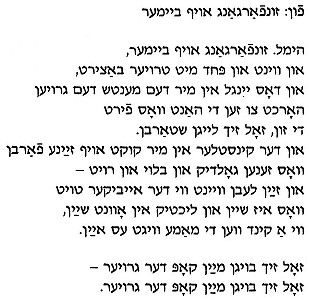
From: Sunset on Trees
Sky. Sunset on trees,
and wind and dread decked out with grief,
and the little boy in me to the man the gray one
listens to see the hand that leads
the sun, to lie down and die.
And the artist in me looks at his paints
which are golden and blue and red—
and his life weeps like the eternal death
that is beautiful and bright in the evening shine
like a child when his mother rocks it to sleep.
Let my gray head bend down—
let my gray head bend down.
—Halpern (1934, vol. 2:130-31; translation mine)
The poem's title and first two lines, with their strictly nominal elliptical syntax and omission of articles, invoke a stock subject for impressionist poems and paintings: a static visual “freezing” of a sunset. The process of sunset in nature is rendered as a “synthesized sense impression” of a moment of “retinal contact” between sky, sunset, and trees, seemingly without the mediation of an interpretive consciousness. The injection of dread and grief into the scene in line 2 could still be considered impressionist, in its impersonal objectification of a Stimmung. But the equivalence of emotional and meteorological entities in the zeugma “and wind and dread … with grief,” especially the near-oxymoronic personification of batsirt (“decked out,” “adorned”) when combined with “grief” or “sadness” (troyer ), begins to call into question the possibility of being a detached spectator of a natural scene. In the third line, the poem turns inward to a self-conscious contemplation of the lyrical “I” and with it to a total rejection of impressionism. Abandoning an impressionist rendition of a sunset, Halpern makes the possibility of such an artistic rendering the topic of his introspection. Through this thematization of poetic technique and artistic affiliation, the mind of the dramatized observer, rather than being a passive, reflective medium, becomes the only measure of reality.
Significantly, at this point the syntax turns radically expressionistic, and the interplay of visual perspective and poetic point of view becomes more and more intricate. Translated literally, the second sentence (lines 3–5 in the Yiddish) reads:
And the little boy in me the man the gray one
listens to see the hand that leads
the sun, (should) lie down to die.
While the deferral of the predicate horkht (“listen to,” “hear”) is slightly more grammatical in Yiddish than it would be in English, the effect of the enjambed lines with no punctuation marks is still remarkably jarring. Read according to lineation, the text creates a series of equivalences between subject and object, the little boy and the gray old man, listening and seeing, cause and effect, sunset and death. Halpern, a talented painter in real life, is not content to editorialize about the contrast between the static, impressionist premodernism of the first two lines and the dynamic, figurative expressionism of the painter's/poet's hand leading the sun. Instead, the perspective is internalized and multiplied, quite literally, by focusing on the little boy inside the speaker (in mir ) listening to the aging adult. The little boy fails to recognize the old man as himself because the older persona is an outer, objectified self. That outer self is perhaps the impressionist-di yunge artist/poet who comes to the sunset with the ready-made symbolic “reading” of death and old age, and imposes it on the natural sunset scene under the illusion of capturing the moment “as it is.” It is not the sense impression synthesized by the passive, nonreflective artist but his very hand “that is leading (leads) / the sun, to lie down to die” because—as in the most traditional versions of the pathetic fallacy—his own head is old and gray and about to “set.” This ironic critique of impressionism as veiled romanticism concerns poetry as much as painting, as the synaesthesia created by the irregular Yiddish word order shows: horkht tsu zen (“listening to see”).
Halpern rejects the premodernist symbolic senses of sunset and the impressionist mood which pretend to be passively recorded by the artist as “retinal” imprints of the natural sunset on his unreflective consciousness. Yet he does so only to arrive at those same senses and mood again through the circuitous route of introspection. An intriguing parallel to the first section of this poem is found in the same introspectivist manifesto quoted above, in the very section that criticizes impressionist renditions of sunsets:
[The premodernist poet] uses too many ready-made images and materials pre-prepared for him ahead of time. When the poet, or even the ordinary person [azoy a mentch ] looks at a sunset, he can see the
strangest things, which appear on the surface perhaps to be completely removed from the sunset. The image which is reflected in his soul is removed by a whole chain of fast-flying associations from that which his eye sees. (In Zikh, [1919] 1920:9; translation in Harshav & Harshav, 1986:776)
Halpern engages precisely this type of fast-flying chain of associations, depicted in rapid centrifugal motion, during the second half of this section of the poem. Here the expressionist mode is laid bare quite explicitly: the “cognitive reference point” (Lakoff, 1987:41, 45, 89) for the scene is no longer the realist sky or the aestheticist painting of the sky, but the expressionist gauge of reality, “the artist in me”; the objects for self-conscious introspective examination cease to be the ready-made clichés (imposing death on the sunset) but are instead the beautiful raw materials of expression: not structured color strokes capturing the golden, red, and blue hues of the natural scene, but blotches of paint on the artist's palette. Halpern no longer uses a literal sunset “standing in” for a metaphorical death but an inextricable combination of traditional poetic oppositions: life and death, childhood and old age, metaphor and literal meaning, external and internal reality. Only once the poem completes this kaleidoscopic view of the artistic subject (as both persona and theme) from all its contradictory inner and outer angles can the (little boy within the) speaker come to terms with his external, adult self and accept with stark simplicity the analogy between his graying head and the setting sun: “Let my gray head bend down—let my gray head bend down.”
Fogel: Retrospective Paragon, Repressed Paragon
In the case of Fogel, even more than Halpern, the critique of impressionism and the ambivalent affiliation with expressionism are crucial to the poet's special role as marginal prototype within the literary system. Yet since only one of Fogel's roles—as retroactive paragon for the Statehood Generation poets—has received any degree of recognition, and only in the context of late modernist
affiliations, the issue of Fogel's struggle between impressionist and expressionist models retreats into the background; there is little discussion or even awareness of the issue in the critical literature. Fogel's poetry was retroactively construed according to the needs of Hebrew poetry in the 1950s and 1960s, at a conjuncture of the new acceptance of imported Anglo-American, neoimagistic poetics and the rejection of the old dominance of futurist-inspired, maximalist poetics of pre-Statehood moderna.
Moreover, the two Statehood Poets who have had the greatest stake in turning Fogel into a retrospective paragon, Dan Pagis and Nathan Zach, were also engaged in a struggle to extricate themselves from the dominant modernist prototypes of their native German and shift to the Anglo-American models, which offered them, politically and aesthetically, greater freedom and more room for innovation. It is therefore not surprising that Pagis, in his erudite critical edition of Fogel's poetry, argues with uncharacteristic zealousness against those critics who “have found in the open-ended structure of Fogel's poetry and in their radical images traces of German expressionism” (Fogel, [1966] 1975:42). Interestingly, Zach, in his influential book-length manifesto-cum-literary-criticism, Zman ve-ritmus etsel Bergson u-va-shira ha-modernit (Time and Rhythm in Bergson and in Modern Poetry ) (1966b), argues with Pagis on this point and clearly outlines Fogel's connections to German expressionism:
Dan Pagis' argument … that Fogel never heard of German Expressionism, and therefore was not influenced by it in his early poetry, an argument based mainly on the fact that “in the poet's diary there is no trace of any impression made upon him by the new trends in poetry, or that he was at all familiar with them,” is not very convincing…. The influence of German poetry on Fogel's poetry is, in my opinion, crucial. This is a general stylistic influence and therefore there is no sense in listing specific lines or images which are common to him and to the German poets, even though this could have been done as well. (1966b:56)
Zach's own tendentiousness is revealed, however, when in the same book, as in other of his essays of the 1960s, he self-consciously dehistoricizes Fogel even though, as the quotation above attests, he is keenly aware of the historicity of Fogel's modernism.
In this discussion, Zach uses a mélange of Fogel's poetry and T. S. Eliot's criticism in order to lend legitimacy to the cause of free verse
in the poetry of Zach's own generation and to reject the rich meters of Nathan Alterman and Avraham Shlonsky's moderna: “A poem by Fogel which is written in such [free] rhythm, proves how right is T. S. Eliot when he asserts that ‘there is no freedom in art,’ and that the artist who expresses himself through the rhythms of free verse must be no less, even at times more sensitive than those who employ the ‘mechanism of repetition,’ or at least of the more mechanical ones among them” (1966b:50).
But when Zach reads a Fogel poem, the poem functions only as an exemplary text for the poetics of Zach's own generation rather than as an ambivalently expressionist poem maintaining a dialogical relation with other German and Hebrew modernist models of its time, such as impressionism, decadence, and symbolism. The poem Zach reads, “Le'at olim susay” (“Slowly My Horses Climb”), is the first poem in Fogel's first book (and the only collection of poems published during his lifetime, Lifney ha-sha'ar ha-afel [Before the Dark Gate ], 1923):
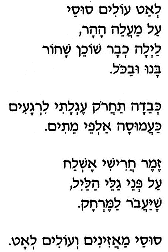
[Slowly My Horses Climb]
Slowly my horses climb
up the mountain slope,
night already dwells black
in us and in all.
Heavy my wagon will squeak at times
as if laden with thousands of dead.
A silent song I'll send
upon the waves of night
that will pass into the distance.
My horses listen and climb slowly.
—Fogel ([1923] 1966, 1975 ed.:73;
translation mine)
Zach, who treats the reader to a stunning analysis of the prosodic, syntactic, and musical aspects of rhythm in this poem, prefaces his analysis with a six-point “summary” of the general characteristics of Fogel's style evident in this poem. Predictably, these six points echo several included in his own fifteen points (1966a), the manifesto of his own Statehood Generations's poetry published in the same year as his book:
1. laconic, selective diction,
2. open-ended structure, composed of image-stanzas whose narrative links are fairly loose,
3. the poet's avoidance of innovative or overstylized figurative language (his metaphors are more natural and evocative than those of Shlonsky and Alterman thanks to their more concretized sensual import, the natural appearance of his landscapes, the astute distribution of the figures over the entire poem and the avoidance of cerebral or excessively wordy-artificial constructions),
4. traditional diction which stays away from neologisms, linguistic acrobatics, and purely phonetic decorativeness,
5. renunciation of originality as a value unto itself,…
6. despite what appears here as simplicity and naturalness of language (and indeed such “naturalness” does exist here too!), the careful eye detects in Fogel's poetry a remarkable inventiveness and maneuverability. (Zach 1966:52b)
These points—all astute observations and evaluations of Fogel's poetics—exclude most of the stylistic and thematic features that are salient within the particular historical prototypes of the first trend of Hebrew modernism. But these are precisely the characteristics that make Fogel a representative of a repressed trend of Hebrew poetic modernism, a trend whose recovery has only just begun. Ironically, then, the Statehood Poets who “have kept discovering” Fogel since the late 1960s, in a selective modeling of his poetics aimed to serve their own historical needs, have also helped suppress some of the
most radical aspects of Fogel's type of modernism. Furthermore, by turning him into an individual paragon, the Statehood Generation poets ignore the fact that a rather large number of individuals, many of them women, developed similar antiformulaic versions of modernism at roughly the same time as Fogel, even though they never formed a self-conscious coterie.
What Halpern's “A Nakht” achieves within the expanded structures of an experimental narrative poem—of an entire book of poetry, in fact—Fogel accomplishes in the confines of what Greenberg has aptly called a kamer-lid, a chamber-music poem.[29] “Slowly My Horses Climb” establishes, with lexical and rhythmic economy, the concrete situation: horses slowly climbing up the mountain slope as night descends, as if the mimetic rhythm of the horses' slow trot also punctuates the imperceptible stages of the process of nightfall. This is the sparse functionalism that Zach finds so remarkable. However, what happens next is typical of almost all of Fogel's poems that start out with the impressionist impetus of capturing the nuances of an external scene or act at the instant of its becoming, without any projection of the observer's consciousness. The poem subverts the concreteness of the situation—indeed, the very ability to discern concrete and abstract, literal and figurative—at the moment that the situation is established; this subversion occurs in Halpern's sunset and night poems as well. The color black, an apparently redundant, unadorned epithet of night, actually becomes a radical, ungrammatical, but functional adverb, a move Zach describes as the “salvation of the color black by turning it from adjective to adverb” (1966b:52). Zach argues that this shift creates a syntactic analogy among the first three stanzas (1966b:52). But this shift is not just syntactic; the grammatical transformation of black into an adverb is the first step in the movement of the night inward, into the undefined, systematically blurred plural consciousness of speaker, horses, and “all,” : layla kvar shokhen shachor/banu u-vakol (“night already dwells black / in us and in all”). This one simple step, defining the locus of the night's “black dwelling” inside the poetic “us” as well as the surrounding “all,” transforms the passive and flat impressionist Stimmung into an expressionist “entanglement in the cosmos,”[30] where it is no longer possible to tell where subject ends and object begins. Michael Gluzman (1993a:138) has astutely observed:
As a “substance” that dwells within the speaker, the night is not only an external temporal marker but also an inner quality. Moreover, the
opposition between foreground and background is also destabilized as a result of the complex relationship between subject and object, since it is unclear whether the night foregrounds the speaker or whether the speaker foregrounds the night.
Just as the structure of Halpern's long poem revealed night as an internal property, a mental state of being “in New York,” Fogel's poem transforms within its texture—through the enjambed last line of the first stanza—the descriptive element into an expressive one.
Typically, the framing stanzas (one and four) employ a present tense, beynoni (which in Hebrew can mark a present progressive or habitual action or state as well as an adjectival form): olim, shokhen, ma'azinim, ve-olim (“climb/ing,” “dwell/ing,” “listen/ing,” “and climbing”). The adverbial use of kvar (“already”), therefore, enhances the sense of a change, a perfected, albeit stative action. Moreover, the chiastic structure of the beginning and end of the poem—le'at olim and olim le'at (“slowly climbing” and “climbing slowly”)—emphasizes the difference within the sameness in the poem's concrete situation. After the expropriation of the night from the domain of external reality, the act of listening (ma'azinim ) to the imperceptible objectified song (poem?) is added to the scene. The reader is reduced to the aural perspective of the horses, who, pulling the wagon along uphill, are deprived of seeing their load. Thus, the simile “as if laden with thousands of dead”—its hyperbole seemingly so out of line with Fogel's poetics of understatement—can be construed as a literal hypothesis (though surreal) rather than a figurative comparison. Neither the horses nor the reader may ever know what is really in the wagon since the poem seriously questions the very possibility of knowing what is actually there in any described moment of reality.
This “epistemological ambivalence” (Gluzman, 1993a) is maintained through one of Fogel's major linguistic achievements (described in detail in Chapter 4): the development of late biblical fluctuations between grammatical tense and aspect into a refined stylistic merging of impressionism and expressionism. Fogel's verbs produce a consistent hesitation between the factual and the hypothetical, “realis” and “irrealis,” action and stasis. Remarkably, these innovations, important within both the intrinsic and the international literary/ linguistic systems, are hardly ever mentioned in discussions of Fogel by poets and critics of the Statehood Generation. The reason is quite clear: both the internal function of perfecting the defective polysystem of literary Hebrew and the general poetic function of providing a
glissement between two crucial periodological and typological models are important only when the system is conceived in its historicity. By the time Zach, Pagis, and their colleagues arrive on the scene, the problems addressed by Fogel's poetics have been solved or displaced by others. Yet only by acknowledging this linguistic achievement can we understand the specific ways in which Fogel and the other antiformulaic poets allowed Hebrew poetry a way out of the nusach and into modernism.
In the second and third stanzas of “Slowly My Horses Climb” the verbs appear in the ambiguous future/imperfect form which allows them to be construed either as an uncompleted action (captured impressionistically in the process of its becoming) or, quite the reverse, as an “irrealis,” fantastic, or surreal situation. The image of thousands of dead becomes an expressionist projection of the speaker(s)'—or listener(s)'—state of mind. Ironically, the one “realis” grammatical tense in this stanza appears only in the surrealist image of the thousands of dead on one wagon, as if the emotional reality of the wagon's macabre load—and its analogue, the introverted version of the night—were the only sure thing left in the scene. It is precisely this kind of a reversal of mimetic norms of representation and romantic norms of poetic self-expression that Halpern's critique of impressionism also achieves.
The third stanza thematizes the very impossibility of separating the (ir)reality of the scene from the poet's expression. It is typical, as Eric Zakim has argued convincingly (1996),[31] that a metapoetic musical resolution supplants the visual concreteness of the discrete images: “A silent song I'll send / upon the waves of night / that will pass into the distance.” Since we already know that the night is “in us and in all,” the song that the speaker sends out into the distance is simultaneously also introjected, sent inside himself and his listeners. That this song is silent both disrupts its reality claims and matters not at all since the entire process of perception has been turned inward. Thus, it says little about Fogel to assert, as the few critics who have bothered to read his poems closely are prone to do, that most of Fogel's early poetry “is a poetry of night and darkness, or a poetry of evening and sunset: the night ‘dwelling dark’ is analogous to the wagon of dead bodies, … to the very stance ‘Before the Dark Gate.’—This is the central motif of this poetry, and its various images are meant only to create one multi-faceted poetic situation: standing face to face with death.” (Luz, 1964:189-90, 214). The expressionist critique of impressionism is meant, among other things, to make just such a static motif
hunt completely meaningless because no night, evening, or sunset in Fogel—as in Halpern—can have any stable, general meaning outside of the particular disruptions which constitute it uniquely in each text.
This point is made even more emphatically in Fogel's seminal poem “Be-leylot ha-stav” (“On Autumn Nights”), a salient example of the transition from impressionism to expressionism in the first modernist Hebrew trend of antiformulaic poetry.[32]
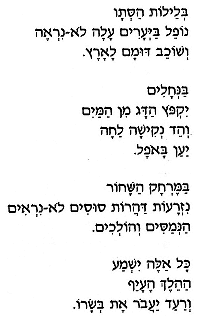
[On Autumn Nights]
On autumn nights
there falls in the forests an unseen leaf
and lies still to the ground.
In the streams
the fish will jump from the water
and an echo of a moist thump
will answer in the darkness.
In the black distance
gallops are sown of unseen horses
that are melting away.
All these
the tired wanderer will hear
and a quiver will pass through his flesh.
—Fogel ([1923] 1966, 1975 ed.:113; translated by
Chana Kronfeld and Eric Zakim)
On first reading, the poem seems to be a paradigmatic example of impressionistic static observation. Three discrete images each occupy a stanza (leaf, fish, horses) and present the verbal equivalent of a series of “retinal imprints,” each of which freezes one fleeting and nuanced moment in nature. The final stanza observes, in detached and precise fashion, the physical effect made by these “synthesized sense data” on the human observer.
However, when readers pay careful attention to the linguistic texture of each stanza, as the impressionist technique demands, and when they take seriously the implicit invitation—which this poetic prototype carries with it—to focus on the most fleeting and delicate of movements, they realize that the text, in typical expressionistic fashion, presents the most subjective, imperceptible internal qualities as if they were objective sense data. In fact, none of the finely detailed scenes can be concretized by any of the perceptual means privileged by an impressionist mode of writing or painting.
In the first stanza, the leaf is not only unseen but also invisible (lo nir'eh ) and cannot in principle be visually perceived; this single, invisible leaf falls on many fall nights (simultaneity of time) and in many forests (simultaneity of place). The omnipresent, invisible leaf then lies down to the ground dumam —not only without sound but also without motion. The possibility that any observer might actually have sense impressions of an objective, external scene is negated at the same time that it seems to be asserted and with respect to every one of the senses and reality principles involved: sight, sound, motion, time, and place.
The possibility of impressionist concretization is further problematized in the second and third stanzas. As Zakim has shrewdly suggested (1995), each image forms only a sense trace around which the scene “fills out.” Thus, the first half of the second stanza is impossible to perceive since it depicts a single, specific fish jumping out of the water in many different streams. The second half of the stanza, which can be perceived in terms of singular identity, is only a synaesthetic echo (hed … ba-ofel, “an echo … in the darkness”) of another synaesthetic trace of an action (nekisha lacha, “a moist thump”). As the
images recede into the horizon (from the illusion of a close-up view of a leaf to the explicit remoteness of “In the black distance”), their “impossibility,” by any premodernist standards, becomes pronounced on all levels of the text: the predicate nizra'ot (“are sown”) stands in ironic, almost grotesque, contrast to the haunting insubstantiality of its subject (daharot, “gallops”), and its self-erasing, syntactically and semantically misleading modifiers. The metaphorical “seeds” are the auditory traces of horses which, like the leaf of the first stanza, are both unseen and invisible (lo nirim ); and these invisible horses, not the sound of their hoofs, are melting away, or—as Zakim has cogently observed—surrealistically, literally, melting and walking (ha-nemasim ve-holkhim ).[33]
The sustained negation of all realist and impressionist concretizations of the three scenes places their referents in the soulscape of the weary traveler of the last stanza: his weariness, his experiences on the road—of which we can see and hear nothing—and, ultimately, his very mode of existence as a helekh (literally, “a walker”) mark him as the poem's shifting, transitional center of consciousness. These are the conditions that not only affect our perception of the scenes but actually give them their identity.
When the Israeli poets of the fifties and sixties rediscovered Fogel in their own poetic image, they were only doing what poets—and critics—always do when they struggle for hegemony over a dominant literary regime: they made him their own. In a similar if less selfconscious way the introspectivists tacitly adopted Halpern's implied poetics as a model in their own battle with di yunge. Both Halpern and Fogel pointed to a future even as they wrestled with the burdens of the poetic past within their respective literary traditions. From their displaced or decentered vantage they could begin to create a modernist poetic expression that in its richness—both as individual voice and as paragon for later generations—played cruelly on the irony of each poet's personal and physical destitution.
Remapping modernism in Yiddish poetry to include marginal prototypes and deviant paragons like Halpern is important for a critical examination of the paths taken in the literary history—fast becoming the archaeology—of Yiddish culture. But within Hebrew poetry, a more rigorous understanding of the role played by marginal prototypes like David Fogel is vital for the future of the literary system, not just for excavating its past.