
The Absence of the Vowel
In examining earlier a phrase from Husayn al-Marsafi's Eight Words , I have already suggested that the so-called literary use of language, in which 'words stand out as words, even as sounds' was not an exception to ordinary writing but the only kind of writing there could be. There was no 'white mythology', as Derrida calls it, according to which the play of differences between words would be something additional to the ordinary way in which words evoke a meaning. Or rather, so as not simply to invert the white man's mythology and make Arabic the example of its absence, the questions of meaning and the play of difference remained problematised in the writing of a work such as Eight Words . Rather than representing an author's univocal meaning, the words produced their force from the play of differences between them, differences which cannot be resolved into a distinction between the conceptual and the material. But this argument about the nature of Arabic writing can be made from several other features.
First of all there were its inscriptional features. Saussure argued that the material form of words was something arbitrary, attached to their meaning only by phonetic convention. Derrida points out that this separation between material form and meaning ignores all the non-phonetic aspects of writing, which are 'material' and yet create effects of meaning — such as punctuation, spacing and the juxtaposition of different texts. In Arabic, writing proceeded generally without recourse to punctuation or even spaces between words, often juxtaposed several texts on a single page in various significant relations to one another, made careful and meaningful distinc-
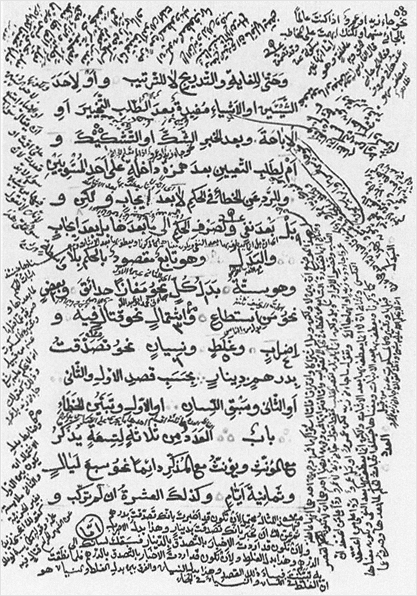
11 Page from a Commentary on the hundred grammatical regents of al-Jurjani by
Sa'd Allah, known as al-Saghir, copied in 1808 by Ahmad Abd-Rabbih, with
marginal and interlinear notes and glosses; Naskhi script.
tions between different styles of script, and in general extended the art of inscription into the most elaborate and deliberate forms.
A second set of features problematised by Derrida are those that make a book or other piece of writing seem an 'interior', an internal place of meaning separated from the 'real world' outside. The title page, the preface, and the table of contents are examples of such features, which seem to stand apart from the text and, like the map of a city, provide it with a form and exterior frame. Arabic writing, again, in general did not employ these devices, and instead began every work with a lengthy invocation (khitab ) and indeed made the method of transition from the khitab into the rest of the text (fasl al-khitab ) a subject of important theoretical debate. There are many other features one might mention: the significance of the verb 'to be', which in Arabic occurs only in the 'past' (Derrida, following Heidegger, has to use the present tense of the verb 'to be' 'under erasure', writing it and crossing it out at the same time, because the empty device of the verb 'to be' makes us forget how problematic is the notion of 'being'); the conception of language as a code, existing apart from the words themselves as a grammatical structure (the Arab grammarians did not study the rules of a code, but the modes of sameness (nahw ) and difference (sarf ) in language, terms that are now translated as 'syntax' and 'morphology'); and finally, what Orientalists have called 'the absence of the vowel' in Arabic. I will look briefly at this last idea.
In the Arabic script, it is said, the vowels are not normally marked. An English transcription of an Arabic phrase, such as mine of Marsafi's earlier in this chapter, has to insert the missing vowels. But this way of putting it is misleading. The vowel is a peculiar European invention, and is not some-thing 'missing' from Arabic. Arabic words are formed by what Arab grammarians call the 'movement' of a sequence of letters. Each letter is pronounced with a particular movement (of the mouth and vocal cords), referred to as 'opening', 'fracturing' and 'contracting', and different movements of the same letters produce differences in meaning. The letters k-t-b , for example, can mean 'he wrote', 'it was written', 'books', and so on, according to the different ways in which each letter is moved. It is the different kinds of movement that the Orientalists translate into vowels.
The movement, however, is not the equivalent of a vowel. As the Tunisian linguist Monçef Chelli has pointed out, the movement cannot be produced independently of the letter and a letter cannot be produced without a movement, whereas vowels and consonants seem to exist independently of each other.[49] This independence, Chelli suggests, gives words in European languages a peculiar appearance of fixedness, as opposed to the movement of Arabic words. In treating words as moving combinations of letters, Arabic writing remains closer to the play of differences that produces
meaning. Seen in this way, the vowel is not something missing in Arabic. It is a strange artifice, whose presence in European writing masks the relations of difference between words, giving the individual word the apparent independence of a sign. Chelli goes on to argue that this apparent independence endows words with an object-quality. As sign-objects they seem to exist independently of their being said. Their existence appears as something apart from the material repetition of the word, and seems to precede such repetition. The realm of this prior and separate existence is labelled the 'conceptual', the independent realm of meaning.
The purpose of this discussion of Arabic writing has been to suggest that in diverse ways Arabic is much closer than European languages to the play of difference that produces meaning, and correspondingly much further than European languages from producing the metaphysical effect of a conceptual realm, a realm of 'meaning' that is believed to exist quite apart from words themselves under the theological name of 'language' or 'truth' or 'mind' or 'culture'. Derrida's work is usually employed to demonstrate, in the reading of a particular text, how this effect of meaning can be made to collapse. That is not my interest. Despite the ease with which such feats of deconstruction seem to be accomplished, what needs explaining is not why meaning collapses but why it does not. Politically, what seems important is not just to show that outside the text, or outside the exhibition, there is only a further text or a further exhibition, but to consider why, in that case, we have come to live more and more as though the world were a real exhibition, an exhibition of reality. My study of nineteenth-century Egypt is intended as a study of how a world comes to be ordered and experienced as though it were an exhibition, divided in this way into two realms, the realm of things and the separate realm of their meaning or truth.
In earlier chapters of this book I have described some of the ways in which Egypt was organised in the nineteenth century to produce the effect of a conceptual realm. One example was the rebuilding of cities, with a regular plan to the streets and exterior façades; another was the geographical hierarchy of schools, arranged to represent the structure of a nation-state. More generally, the technique of order I called enframing, in military manoeuvres, in timetables, in the layout of classrooms and hospitals, in the rebuilding of villages as well as cities, in each case tended to produce the effect of a structure, which seemed to stand apart as something conceptual and prior.
Meaning is an effect not only of conceptuality, however, but also of intention. 'To mean' implies at the same time both to signify and to have intention or purpose. If a piece of writing or other process of representation produces meaning, in doing so it produces the impression of an authorial intention or will. The more effectively this meaning is made to stand apart as its own realm, the more effective will be the impression of such intentionality. In
order to return to the questions about modern political certainty that I raised at the beginning of this chapter, I want to show how the methods of effecting the existence of a separate conceptual realm were at the same time a new method of effecting intention, certainty, authorial will, or more generally authority itself.