
Wealth
The importance of crying in precontact spiritual life is dramatically illustrated by the style of songs that were used for money medicine, as the "sobbing" quality in these songs is even more pronounced than that heard in ritual singing. The song in example 35 is relatively unstructured from a melodic perspective, and indeed the "song" could be regarded as little more than a vehicle for crying at (five) different pitch levels. In examples such as this we sense a very unclear borderline between music and expressions that are actually nonmusical in nature.
A money medicine song sung by Tom Hill (Chilula) in 1904 gives virtually the same impression (example 36). Here again the singer seems to be "sobbing" as much as singing, and there is much nasality and heavy tremolo throughout. This song has an irregular and (apparently) improvised character, as if it might be sung somewhat differently from time to time. It is not repeated on the recording and the sequence of motives might be analyzed A B C B A C1 B.
Other money songs by Julius Marshall (Hupa), Jim of Pekwan (Yurok), and Johnny Cooper (Yurok) give a similar impression, though the audio quality of these recordings is very poor (appendix 2, D-2, D-15, and D-18). In each case the singer's voice is tense, nasal, and glottalized, much as if the singer were actually crying instead of singing.
Since the anthropological literature describes Yurok civilization mainly from a male perspective (see chapter 4), it is very interesting to note that three of these money medicine songs were also collected from a Yurok woman identified as Weitchpec Susie in 1902
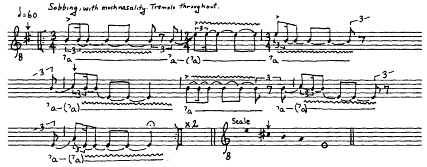
Example 35.
Sweathouse wood gathering song. Sung by Umiits of Kepel Creek
(Yurok) and recorded by A. L. Kroeber in 1906 (appendix 2, D-16).
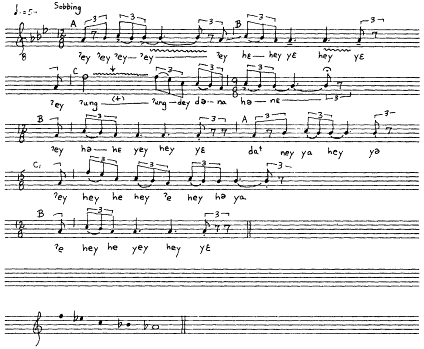
Example 36.
Money medicine song. Sung by Torn Hill (Chilula) and recorded
by Goddard in 1904 (appendix 2, D-8).
(appendix 2, D-3, D-4, and D-5). One was labeled "Wetsqaaq Song" (example 37). Kroeber's notes (n. d.: Carton 6; Notebook 42, p. 48) do not provide a translation for the title, and the song appears to be sung only in vocables.
In this early recording, a single phrase is repeated seventeen times, with slight variations each time. Here again, the musical organization per se is very weak: the singer's intonation is inconsistent, so that some of the scale tones indicated here might more correctly be thought of as "scale tone areas." Relatedly, the meter is not at all clear, and this is why the 3/4 indication has been parenthesized. The song is sung with a heavy "sobbing" vocal delivery, and Kroeber's notes indicate that this and the other two songs were used much like the men's sweathouse songs.
The song in example 38 appears to be sung entirely in vocables, but Kroeber's notes mention a text and give the translation, "south along the coast, I am going there" (Kroeber n.d.: Carton 6; Notebook 42, p. 48). There was no explanation or translation of the title. The song is sung six times on the cylinder and has the same "sobbing" quality as other sweathouse songs considered previously. As in most Yurok songs, the melodic ambitus is rather wide, and the melody has a descending contour.
Another recording identified as "Maoxpir Song" was also collected from Weitchpec Susie and had a similar style (appendix 2, D-5), but Kroeber's notes reveal this was Susie's rendition of a man's sweathouse song rather than one that a woman would actually use.
Besides being prominent in the context of sweathouse practices generally (see chapter 4), crying was a recurrent theme in spoken formulas for wealth. In some examples, a spirit-person's crying produced some distinctive feature of the natural landscape, which then became a place where humans could make medicine (also by crying). Thus for example there is a rock formation at Trinidad Head which is identified by the Yurok name "He Sits Forever." This marks the spot where a spirit-person went to cry and ask for money. Gradually, he began to see dentalium shells swimming in the tidepools as if they were fish. He was mesmerized by this vision and sat there watching the money swim around until he turned into stone himself. This became a mythic event that humans could reenact while making medicine at that spot (Waterman 1920:270). A
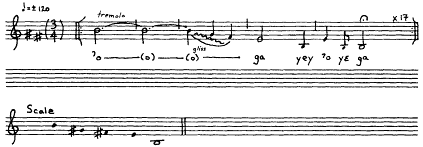
Example 37.
Wetsqaaq Song sung by Weitchpec Susie (Yurok) and collected
by A. L. Kroeber in 1902 (appendix 2, D-3).
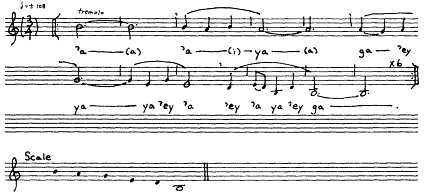
Example 38.
Meroctan Song performed by Weitchpec Susie and collected
by A. L. Kroeber in 1902 (appendix 2, D-4).
similar formula involving Wohpekemeu was described at length in chapter 1 (appendix 2, D-11).
Crying was also an important element in other formulas that were not based on features of the landscape. A formula spoken by Henry Hostler (Hupa) in 1901 described the travels of a young man who always cried and gathered sweathouse wood (appendix 2, D-1). Be was looking for water, but none existed in the prehuman world. Finally he went traveling in the upper world and found an old man without eyes. The old man showed him a basket of water, which he drank, but then the old man told him that it wasn't water at all. Instead, the basket contained all the tears that the young
man shed in his life while praying. The old man also warned him against drinking water while training for wealth. "Many may pray, and even sweat themselves," he said, "but they will always remain poor if they drink water." The formulist would speak both parts of the dialogue in using this medicine.
The fact that crying itself could compel a change in luck is illustrated by a formula told by John Shoemaker (Hupa) in 1927 (appendix 2, D-22). The story involves two brothers (spirit-persons) who lived in Chimariko territory. The older one had set several fishtraps in which he could catch dentalium shell money. He would lie by his traps, singing as the money collected there, then take it and store it in one of his luck-basins. Every day, these would be filled with money by break of dawn. One day, the younger brother asked if he could tend the traps, and so he did. However, he began eating the meat of the dentalia that he caught. This caused the traps to drift away downstream. The older brother recovered them once, but they repeatedly floated away, finally going all the way down-river and out across the ocean. The older brother was broken up when he realized this, and he began to cry as he walked back from Rekwoi (at the mouth of the Klamath) to Hoopa Valley. Then, while crying, he found a piece of special quartz. He rubbed it against another rock and saw that it turned into money. He put this into the water at his old fishing hole, and his fishing traps became as they were before.
This medicine was to be used at a special "luck basin" that Shoemaker knew about. This term refers to a basinlike depression in a rock formation, and the Hupa word for it is translated into English as "rock bowl" or "rock basket" (Golla, in press [MS p. 214]). The use of a luck basin for success in gambling is described as follows:
When you find such a place you must "smoke" it with incense root and speak to it. You smoke it for ten days and talk to it about the people you're going to gamble with, and how many points you want to make in a stretch, and so on. Then you clap your hands to it, and leave some incense root in it. When you are ready to gamble, you go up to it and rub your hands with the incense root. (Golla, in press [MS p. 213])
The preceding discussion has focused mainly on the prominence of crying as a central theme in spoken formulas for wealth, but other
subjects were also important, as for example the story of the under-dog who manages to come out ahead because of some miracle. Tom Hill (Chilula) described two such formulas when interviewed in 1908. One involved a boy with nine brothers who was completely covered with scabs and despised by all the rest of the boys in his family. His younger sister fed him without their knowing. He used to go fishing every night, until he had a good string of dentalia shell money. Then, he presented it to his brothers and left home (appendix 2, D-19). The theme of "the scabby boy" is found in formulas from various tribes of the region, and a Yurok version is published in Kroeber (1976:292).
The other formula explained by Tom Hill (Chilula) involved a spirit-person who was a bastard but nonetheless obtained money from every direction because of a song that he used (appendix 2, D-20). Formulas such as these reveal the "democratic" character of medicine making among these tribes, expressing the (idealized) belief that even the most wretched of persons could overcome his fate through medicine making.