
Case 20:
Industry and Technology
On the left are artifacts from the sculptor's workshop. Three terracotta molds are displayed: TC 60, for the shoulder of a statue at the neck; TC 59 for an arm; and TC 57 for the drapery on a relatively flat part of the upper body. The statue was made in pieces (legs, arms, feet, head, etc.) by the lost-wax process; fragments of such pieces are in cases 6 and 7. A core was made of clay with a skeleton of iron armatures such as IL 39, 42 a-b, and 49 here. Wax was applied to this core and shaped as desired. Details were worked out with tools like the
pointed stone inscriber (ST 342). Damp clay, perhaps after an initial working in a lekanis like TC 192, was applied over the wax, forming a negative impression of it. The whole was then set into its own pit, where a fire around the mold baked the clay and melted the wax, which flowed out of a hole left for the purpose. The molten bronze poured into the space left by the wax cooled and hardened in the shape originally formed by the wax. The molds were broken and the bronze pieces removed to be soldered together with lead from ingots such as IL 31. The bronze was then worked over with tools such as the chisels, drills, and hammer found in the workshop (IL 11, 12, 14, 15, 60, 476) and smoothed and polished with stone grinders such as ST 341. After the finished statue was leaded into a base (like those previously seen on the north wall near case 7), it was dedicated to Zeus.
Photographs on the SOUTH WALL of the room show the complex of kilns along the north wall of the Xenon and east of the Basilica (see the aerial photograph on the first panel above). The first photograph is a general view of the kilns from the west. The north wall of the Xenon is marked B at the right; the nearest of the kilns is a circular example marked K . In the distance is the settling tank for clay, marked S . Between K and S are two more kilns, both rectilinear, with the southern one (L ) the better preserved. The next photograph shows the rectilinear kilns from the north with the settling tank (S ) at the left. Note the steps which lead down into it. Kiln L , with the firing-chamber floor preserved, is in the middle ground; the north wall of the Xenon cuts through it. The third photograph in the series, in color, shows the entrances to the stoking chamber of kiln L . Both this kiln and the less well preserved one to the north had stoking chambers entered by a common sunken area where fuel was stored. The next two photographs show kiln L from the south and from above (west). Finally, a drawing by C. K. Williams (Fig. 20) shows kiln L as discovered (upper left) and with the firing chamber partially restored (upper right).
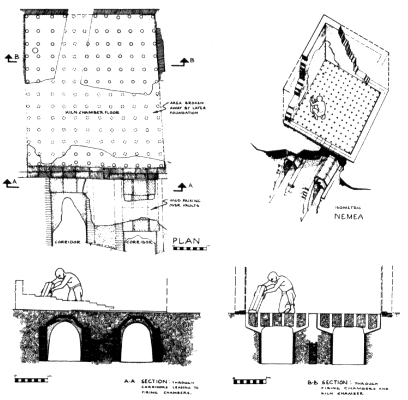
Fig. 20.
Kiln, by C. K. Williams.
All these kilns belong to the last thirty years of the 4th century B.C. and were used exclusively, so far as the materials found in them allow us to say, for the manufacture of roof tiles. In case 20 (center) are examples of the tripod stacking dividers (TC 14 and 22) which allowed the hot air of the firing chamber to circulate between the stacked tiles, baking them evenly. The fragment of another such divider made in the form of a finger (TC 13) reveals a certain humor, perhaps born of the tedium of making hundreds of such dividers. Beside this are examples of wedge separators (TC 15, 21, 23) used to keep the stacks of tiles separate from one another. These kilns
were used to make the tiles of the 4th-century Temple of Zeus, the Bath, the Xenon, the houses south of the Xenon, and (we may assume) other buildings still to be discovered. They seem to have been laid out slightly in error, since the Xenon cuts through the one kiln (L ), and the circular kiln west of it was apparently built after the construction of the Xenon was under way—to finish the job. This extensive complex shows, first, that there was a massive construction program in the final decades of the 4th century at Nemea—the time when the games returned to Nemea and such a program would have been necessary. The massiveness of the program speaks vividly to the funding poured into the effort; the suggestion (see p. 23) that the Macedonians were responsible seems inevitable. Who else at that time could have mustered such funding? The construction complex shows, second, that roof tiles were made on the spot for construction projects, not ordered ready-made from a central supplier. This situation, though it differs from the modern one, is logical in view of the problems of transport and breakage. It would have been much easier to import clay to Nemea than to have brought in ready-made tiles.
In case 20, right (east), is a series of tools from another workshop, which, like the kilns, was between the Xenon and the oikoi , but further west, just north of (and partly covered over by) the narthex of the Basilica. Here were informal pits filled with chips from the working of Pentelic marble which was used, so far as is known today, only on the sima of the 4th-century Temple of Zeus. It may well have been here that the sima was carved (see the courtyard, northeastern corner). Bronze tweezers (BR 49 and 908) found here would have been useful in such an operation, nor is the ivory stylus (BI 13) out of place. That the work which took place here was specifically sacred is attested by the lead sheet (IL 279) once nailed to the end of a wooden beam or something similar. It bears the inscription IEPO(Y), "of the sanctuary." The black-glaze
plate with stamped decoration and rouletting on its floor (P 370), the bowl with similar decoration (P 369), and the two lamps (L 39 and 40) which were found with the marble chips date from the period between 350 and 325 B.C. , an appropriate date for the major construction program the centerpiece of which was the Temple of Zeus.
The remaining objects in the right side of case 20 are from the 4th-century Temple of Zeus itself. IL 236 is an iron dowel with some of the lead which held it in place still adhering to it. Blocks in the wall and the superstructure of the Temple were fastened to the block immediately below by means of these dowels. The tools (chisel, point, etc.) were discovered in the layers of limestone chips from the construction of the Temple (IL 308, 377, 505), as were the lead ingots, IL 335 and 242, the second with the enigmatic inscription L AKT.
On the wall to the right between case 20 and the DOOR TO THE COURTYARD is a large terracotta akroterion (AT 42). It features a crowning palmette above intricate volutes in the center of which is a siren. Dating from the first half, and probably the second quarter, of the 5th century B.C. , this akroterion was the central roof decoration of Oikos 9 (a small model of this oikos is beneath the siren).