
PART II—
THEORIES AND EXPLANATION
Seven—
Constructivism, Realism, and Philosophical Method
Richard Boyd
1—
Introduction
1.1—
Constructivism and Realism
Post-positivist philosophy of science has gone in three directions: toward more sophisticated versions of empiricism (e.g., van Fraassen 1980), toward social constructivism (e.g., Kuhn 1970), and toward scientific realism (Boyd 1983, 1990a; Putnam 1972, 1975a, 1975b). Defenders of the latter positions affirm, while sophisticated empiricists continue the tradition of positivists by denying, that the typical product of successful scientific research embodies knowledge of unobservable phenomena—that scientists routinely do "metaphysics" in the positivists' pejorative sense of the term. Realists and constructivists differ in that the former hold, while the latter deny, that the phenomena studied by scientists exist and have the properties they do independently of our adoption of theories, conceptual frameworks, or paradigms. Thus, while realism and constructivism are both antiempiricist positions, constructivism shares with later positivism a tendency largely absent from realism of treating large-scale theoretical claims in science as in some important sense conventional. In the present essay I will be concerned with the dispute between constructivism and realism. I have three aims: to articulate the best arguments for realism against sophisticated versions of constructivism, to explore the implications of those arguments for our understanding of the issue of conventionality generally, and to explore some broader issues of philosophical method which are raised by the dispute between realists and constructivists.
1.2—
Versions of Constructivism
The target of my arguments will be constructivist conceptions of science of the sort whose influence was guaranteed by Kuhn's The Structure of Scientific
Revolutions (1970). The general slogan "Science is the social construction of reality" and similar expressions of constructivist sentiment have a variety of interpretations, more than one of them suggested by Kuhn's own insights into scientific practice, and I will be concerned here with just one among them. Sometimes when students of science portray science as the social construction of reality, they mean to emphasize the extent to which the actual production of scientific texts, instruments, institutions, and so on is a social enterprise subject to the same sorts of analyses—political, sociological, literary, anthropological, and so on—as any other social enterprise whose output includes texts or other cultural artifacts (let us call this doctrine science-as-social-practice constructivism, SSP constructivism). Sometimes they mean to offer a debunking critique as well: perhaps that the content of scientific theories is determined almost exclusively by facts about power both within the scientific community itself and within the broader society (let us call this debunking constructivism).
The constructivism with which I will be concerned here (let us call it "Neo-Kantian constructivism," "N-K constructivism," by way of indicating something of its motivation but without prejudice regarding questions of Kant scholarship) is different. According to Neo-Kantian constructivism, consideration of, for example, the theory-dependence of scientific observation and methods, or the existence of mutually irreducible conceptual schemes or of mutually incommensurable paradigms in the sciences, indicates that there is something misleading, but not literally false, about the claim that in scientific work scientists discover what the world is like. The implicatures of that way of describing science reflect a conception according to which the structures which scientists discover are, independently of any scientific activity, "out there" in "the world" available for "discovery." This conception the Neo-Kantian constructivist denies: in some deep sense the structures studied by scientists are imposed on the world, in the sense of being reflections of the conceptual schemes they employ.
But according to N-K constructivists, it would be misleading (indeed, a straight-out error) to say, with a certain debunking tradition, that the internal politics of the scientific community or external pressures and not the world determine the content of scientific theories. While the phenomena of political determination identified by debunking constructivists sometimes determine the content of scientific theories, the sort of social construction which N-K constructivists emphasize is supposed to be a universal feature of scientific investigation, and it is not appropriately described by denying that "the way the world is" can determine the content of scientific theories. Two considerations indicate to N-K constructivists that scientific theories are often brought into approximate conformity with "the way the world is." First, the successful establishment of a scientific research tradition (or "paradigm") requires the cooperation of nature: research traditions are viable only if they allow their participants to succeed in actual experimental practice by, for example,
predicting unexpected results or predicting expected ones with increasing numerical precision.
Just as important is the N-K constructivists' more general (and "Kantian") epistemological conception according to which social construction of reality is a necessary condition for systematic investigation. It is a consequence of the alleged ubiquity of social construction that the socially constructed reality which scientists study is as real as studiable things can get. There is no more real set of things in themselves for us to study, and thus no debunking of scientific investigation is entailed by the insistence that the reality scientists study is socially constructed.
Each of the three (or more) conceptions of science as a matter of social construction is worthy of serious elaboration and criticism. I focus here on N-K constructivism for two reasons. In the first place, it seems right to think of logical empiricism, scientific realism, and social constructivism as competing conceptions of the nature and of the limits of scientific knowledge, corresponding to broader empiricist, realist, and "Kantian" traditions in epistemology and metaphysics. If logical empiricism and scientific realism are thought of as theses about genuine knowledge in science (and not, for example, about how frequently such knowledge is produced by actual institutionalized scientific practice), then each is compatible with SSP constructivism and each is compatible with all but the most extreme version of debunking constructivism. That is, each is compatible with any versions of debunking constructivism which do not deny that some genuine scientific knowledge—in the sense of beliefs controlled in a suitable way by the way things actually are—is possible , however rarely (if at all) it is produced by institutionalized scientific practice. By contrast, both logical empiricism and scientific realism are incompatible with N-K constructivism, and it is reasonable to see N-K constructivism as the manifestation of a "Kantian" epistemological and metaphysical conception in contemporary philosophy of science. It is the version of social constructivism we want to look at if we are to see how significant general philosophical tendencies are played out in the philosophy of science.
There is another reason for focusing on N-K constructivism. One feature of the literature, both within professional analytic philosophy of science and in related areas of history, sociology, and literary theory, has been a tendency to conflate the three conceptions of social construction. For example, especially in the literature outside professional philosophy of science, it is often taken for granted that a demonstration of SSP constructivism precludes a realist or empiricist interpretation in favor of debunking constructivism or N-K constructivism.
There is likewise a tendency, in the professional philosophical literature as well as in the literature in other intellectual disciplines concerned with science as an object of study, to fail to distinguish clearly between debunking and N-K constructivism. Each of these tendencies, it seems to me, makes it harder for
researchers to assess the merits of the three different doctrines. One of the consequences, I believe, is that a central problem facing debunking constructivists has been inadequately examined. It is, moreover, a problem whose solution at least arguably depends on an assessment of the philosophical merits of N-K constructivism.
Here is the problem: For all but the most extreme debunking constructivist it will seem important to distinguish between those cases in which the actual structure of the world plays some important role in determining the content of scientific doctrines, so that some genuine knowledge is achieved, and those cases in which it does not. If a realist (or, for that matter, an empiricist) conception of scientific knowledge is appropriate, the intended contrast can be straightforwardly defined. If, in contrast, an N-K constructivist conception of genuine scientific knowledge is correct, the moderate debunking constructivist will need to provide some formulation of the distinction between those episodes of "social construction of reality" in which the relevant social processes of consensus formation in science are to be thought of as really constructing reality and those episodes in which the establishment of consensus is to be debunked.
This problem is an especially acute one for the many thinkers who seem to have adopted both debunking and N-K constructivism in response to a recognition of the ideological role frequently played by scientific doctrines and the associated ideological determination of their content. If episodes of consensus formation in science cannot be so nicely categorized, then such thinkers run the serious risk of having, in consequence of their N-K constructivism, to treat as true the findings of just those episodes of theory construction which they otherwise seek to debunk.
I am inclined to doubt that a principled solution to this problem is available to the N-K constructivist. I am thus concerned to provide an adequate justification for the adoption of a realist rather than an N-K constructivist conception of genuine scientific knowledge, not merely to advance our understanding of foundational issues in the epistemology of science but to provide a basis for drawing the required distinction between genuine scientific knowledge and the sort of social construction worthy of debunking. It seems to me that the insights of many debunking constructivists are too important—politically and morally as well as intellectually—to be muddled by N-K constructivism. In "socially constructing" racial differences, nineteenth-century biologists did not construct a world in which those of African descent are biologically suited to a subordinate role, however much they constructed theories to that effect, nor have their latter-day followers done so—any more than those same biologists (or we) have socially constructed a world in which the place of women is determined by biological necessity.
1.3—
The Need for a New Realist Critique of Constructivism
It might seem that mounting a defense of realism against N-K constructivism is not timely. After all, the articulation of distinctly realistic and naturalistic conceptions of reference and of kind definitions (e.g., Kripke 1972, Putnam 1975a) has significantly undermined the N-K constructivist arguments of Kuhn and Hanson, as has the articulation of distinctly realistic accounts of the appropriateness of theory-dependent methods (e.g., Putnam 1972, Boyd 1983). Arguably the realist's concern should now be with SSP and debunking constructivism and her task should be to show that the plausible versions of each of these positions are compatible with (and perhaps even entail) a realist conception of genuine knowledge.
I agree about the importance of the latter task, but it seems to me that there are reasons to believe that the available realist critiques of N-K constructivism are inadequate. In recent years "pluralist" or "relativist" conceptions closely related to the social constructivism of Kuhn and Hanson (e.g., Goodman 1978) have grown in influence, and I am inclined to think that these conceptions and other sophisticated versions of N-K constructivism are not adequately addressed by the extant realist critiques of views like those of Hanson and Kuhn. In brief, what I will argue is that there are plausible versions of constructivism which are not committed to the semantic or methodological conceptions to which anticonstructivist arguments grounded in naturalistic theories of definition and reference provide an adequate rebuttal, and whose epistemological and metaphysical claims are not fully rebutted by realist accounts of theory-dependent methods. What these versions of constructivism have in common is that they reflect ways of understanding conventionality which are more complex—and more plausible—than those which underlie earlier debates about constructivism. I will put forward here what I think to be the strongest arguments against the more plausible versions of constructivism. While these arguments have not, so far as I know, been made so fully explicit as I intend to make them, they do, I hope, capture the considerations that incline many philosophers of science to reject constructivism without fully exploring its more sophisticated variants.
The arguments in question are methodologically interesting—at least I find them interesting—because, while not in any obvious way entailing a naturalistic conception of philosophical method, they involve a certain kind of a posteriori scientific assessment of constructivist claims. I will explicate the relevant sort of scientific assessment and compare its operation with that reflected in the traditional logical-empiricist concern to hold philosophical accounts subject to the requirement that they offer a "rational reconstruction" of actual science. One outcome of this investigation is the articulation of a conception of the dialectics of philosophical argumentation which indicates how distinctly philosophical considerations properly interact with considerations arising from other disciplines.
2—
Classical Neo-Kantian Constructivism
2.1—
Two and a Half Traditional Arguments for Constructivism
In this and succeeding sections of part 2, I propose to lay out and evaluate the classical arguments for and against N-K constructivism—those arguments which have commanded the interest of philosophers from the first articulation of contemporary N-K approaches by Hanson and Kuhn. Although I will cite the work of many of the key figures, I do not intend to be providing a historical survey of arguments for and against constructivism. Instead, I will try to identify the best and most plausible features of the arguments and considerations, explicit or tacit, that have influenced philosophers' views on these matters. I turn first to the classical arguments for constructivism.
All of the traditional arguments for (N-K) constructivism rest on the important observation that all of the fundamental methods of science, from the most basic observational procedures to the most elaborate standards for the assessment of evidence, are deeply and irretrievably theory-dependent. They differ in the extent to which they depend as well on special alleged historical consequences of theory-dependence. The following typology sorts the traditional arguments into two and a half basic categories.
The Basic Epistemological Argument from Theory-dependence
Into this category fall the various arguments that justify an N-K constructivist conception of scientific knowledge by appealing to the fact of deep theory-dependence of scientific methods and exploring its epistemological implications. These are the key Neo-Kantian epistemological arguments for constructivism. They reason that the methods of actual science are so deeply theory-dependent that the only sort of reality for whose discovery they would be appropriate would be a reality partly constituted by the theoretical tradition within which scientific research takes place. Since, in my view, it is important not to underestimate the force of such arguments, I want to indicate something of the origins of their persuasive force.
In the first place, it is important to see that the methods of scientific research are not merely deeply theory-dependent, they appear to be such that their application would not be rationally justifiable except on the assumption of the truth or the approximate truth of the theories upon which they depend. Thus, insofar as we take (some) scientific research to be a basically rational activity, we, like the scientists who engage in that research, must be taking for granted the (perhaps approximate) truth of the theories that underwrite their methods.
Second, the theory-dependence of scientific methods is not somehow restricted to derived rather than fundamental methodological principles. It is, of course, no surprise that in developed sciences some (or most) of the methods scientists employ are justified by appeal to features of previously established
theories. It might seem, however, that if the development and confirmation of theories in the relevant scientific traditions are fully explored, then it will turn out to be true, either in fact or in an appropriate rational reconstruction, that the traditions can be seen as having been first established by the application of theory-independent fundamental methods to theory-independent observations and as subsequently developing by the application at any given time of only those theory-dependent methods ratified by earlier theoretical discoveries. Were such a story true, then "in principle" we could take inductive inferences in sciences as governed by the underlying theory-independent methodological principles, treating theory-dependent methods somewhat on the model of derived inference rules in deductive logic.
What Hanson, (especially) Kuhn, and others have shown is that this picture cannot be sustained. When recognizably scientific methods emerge within a discipline, they emerge as part of a package that includes theoretical conceptions necessary to ratify them, rather than as initially theory-independent principles that ground the initial adoption of theoretical conceptions.
Moreover, not only are methodological principles deeply dependent on theories, the theories they depend on are often deep. I mean by that that the theoretical presuppositions of scientific methods are not, generally, almost unproblematical, if still a posteriori, propositions like "like causes have like effects," "every event has a cause," or "there is order in nature." Instead, the methods within a scientific discipline are typically grounded in foundational theoretical principles peculiar to that discipline's special concerns. As Kuhn suggests, scientists' judgments about the nature of the problems to be solved and the forms of acceptable solutions (that is, their judgments of projectibility) are typically determined by a metaphysical picture of what the world they study is ultimately like.
In consequence, the methodology of science will seem, with respect to the testing of fundamental assumptions at least, disturbingly circular . We may make precise both the nature and depth of the circularity, and the seriousness of the disturbance it creates, by examining with some care the recent fate of foundationalist conceptions of knowledge. Modern epistemology has been largely dominated by positions that can be characterized as "foundationalist": all knowledge is seen as ultimately grounded in certain foundational beliefs that have an epistemically privileged position—they are a priori, or self-warranting, or incorrigible, or something of the sort. Other true beliefs are instances of knowledge only if they can be justified by appeals to foundational knowledge. Similarly, the basic inferential principles that are legitimate for justifying nonfoundational knowledge claims can themselves be shown a priori to be rational.
We may fruitfully think of foundationalism as consisting of two parts, premise foundationalism , which holds that all knowledge is justifiable from a core of
epistemically privileged foundational beliefs, and inference-rule foundationalism , which holds that the principles of justifiable inference are ultimately reducible to inferential principles that are a priori justifiable.
Recent works in naturalistic epistemology (see, e.g., Armstrong 1973; Goldman 1967, 1976; Quine 1969a, 1969b) indicate that foundationalism cannot be entirely correct. For the crucial case of perceptual knowledge, there seem to be (in typical cases at least) neither premises (foundational or otherwise) nor inferences; instead perceptual knowledge obtains when perceptual beliefs are produced by epistemically reliable mechanisms. Even if this analysis is challenged and it is insisted that justification of some sort is crucial in cases of perceptual knowledge, it is clear that there will be nothing like the traditional foundationalist's vision of knowledge of the external world grounded in premises as secure as, for example, those about sense data, and justified by appeal to a priori defensible inference principles.
Even where premises and inferences are unproblematically relevant, the notion of justification does not appear to be as epistemically central as traditional foundationalists thought: it seems to be the reliable production of belief that distinguishes cases of knowledge from other cases of true belief. Justification appears to be relevant because of the causal role which the seeking and giving of justifications play in reliable belief production (or regulation; see Boyd 1982).
Despite these setbacks, it might seem that some appropriate version of foundationalism provides us with an approximately correct picture of knowledge. If we think of ordinary perceptual beliefs, obtained under appropriate conditions, as suitably privileged, for example, and if we tolerate inference rules whose presuppositions only "the skeptic" would challenge, then a modest foundationalism might seem to capture pretty well the intuitive notion that knowledge claims must be noncircularly or non-question-beggingly defensible, however poorly it underwrites the refutation of skepticism.
We are now in a position to see just how and why the "circularity" with respect to fundamental principles unearthed by constructivists is so disturbing. What it suggests is that even modest foundationalism fails, even as a good first approximation to a theory of knowledge, not because the most basic available premises are insufficiently privileged but because inference-rule foundationalism appears to be profoundly mistaken. The basic inferential principles that are reflected in scientific methodology rest on deep and sometimes controversial theoretical principles which someone could reject—and which some have rejected—without the slightest hint of philosophical skepticism.
Now foundationalism is an especially plausible philosophical position, especially if it is understood in the proposed modest way and as an analysis of the notion of non-question-begging justification rather than as part of a scheme for refuting the skeptic. Thus the discovery of the deep theory-dependence of
methods appears to threaten an especially plausible and central part of our conception of knowledge.
It poses a closely related problem as well. We are used to thinking of the establishment of the first successful research traditions within the various scientific disciplines as, in the first instance, insofar as internal factors are concerned, the result of the adoption of appropriate scientific methods. It is the reliability of those methods which we expect will explain the successes of researchers in obtaining an approximately correct theoretical picture of the relevant phenomena. This explanation is apparently precluded by a recognition of the deep theory-dependence of scientific methods. Indeed, it seems to get things more or less backward. Since methods possessing the reliability characteristic of those of recent successful science rest upon approximate theoretical knowledge rather than on a priori or commonsensical principles, the emergence of epistemically successful scientific methods must have depended upon the logically, epistemically, and historically contingent emergence of a relevantly approximately true theoretical tradition rather than vice versa. It is not possible to understand the initial emergence of such a tradition as the consequence of some more abstractly conceived scientific or rational methodology which itself is theory-independent. There is no such methodology.
Thus the theory-dependence of methods poses the start-up problem —how are we to explain the first emergence of approximately true theories within a research tradition, and thus the emergence of the reliable methods they determine, if not by reference to the prior establishment of noncontingently reliable methods? What seems to be indicated is a sort of radical contingency in the epistemology of science: not only does the reliability of scientific methods rest on highly contingent presuppositions but it is, in a philosophically important (and nonskeptical ) sense, an accident that in the early stages of a successful scientific tradition relevantly approximately true theories and the associated reliable methods emerge at all (for further discussion see Boyd 1982, 1990a).
Modest foundationalism is extremely plausible, and solving the start-up problem by appealing largely to accident or luck seems implausible. No doubt these facts explain part of the attractiveness of debunking constructivism: if scientific methods are circular in such a way that scientific knowledge claims cannot be accepted without rejecting modest foundationalism, and without treating the first systematic successes of scientific research as accidents, then so much the worse for scientific knowledge claims.
What is important for our purposes is that the N-K constructivist interpretation of scientific knowledge to a significant extent ameliorates these difficulties and restores the possibility of a modest foundationalism. If basic laws of nature are to be seen as, in some deep sense, imposed on nature by our social conventions and practices, then the most basic theory-dependent methods may well be justified, if not a priori, then at any rate by appeal to principles that
have a distinctly privileged epistemic standing. Other more specific methods that depend on plainly a posteriori theoretical considerations might then be treated as reflecting derived inference rules just as the foundationalist project requires. Similarly, the start-up problem will seem somewhat more tractable: at least part of the explanation of how the first successfully established paradigmatic theories came to approximate the truth about natural phenomena will lie in the fact that the acceptance of those theories constitutes the reality of the phenomena in question.
It is these considerations which, I suggest, make it plausible that the theory-dependence of scientific methods is such that if they are to be understood as discovery procedures, the reality they are used to discover must be thought of as constituted by the adoption of the relevant theories and methods. Only such an interpretation preserves a modest foundationalism in the philosophy of science and (thereby) permits an epistemically satisfying solution to the start-up problem.
One final point about the basic argument from theory-dependence is important here. I have suggested that the thrust of the argument should be understood as an attempt to preserve an eminently plausible version of foundationalism in the light of potentially embarrassing facts about the actual history of science. Of course this argument for constructivism would be unconvincing if it were possible by other more modest means to avoid the rejection of modest foundationalism. I believe that it is not. I have argued (Boyd 1989, 1990a, 1991) that scientific realism entails—given overwhelmingly plausible scientific and philosophical assumptions—just the sort of antifoundationalism from which N-K constructivism saves us.
It might seem that an empiricist conception of scientific theories would fare better in this regard, given the centrality of foundationalist assumptions in empiricist epistemology. I have argued elsewhere (Boyd 1990a, 1991) that this is not the case. So deeply theory-dependent are the actual methods of science that the most plausible empiricist treatment of them will treat their reliability as an empirical matter and their justification as consequently a posteriori. Instead of portraying theory-dependent methods as presuming the approximate truth of the background theories upon which they depend, the plausible empiricist position will treat them as grounded in a second-order induction about the reliability of inductive methods in science of the sort suggested by Quine (1969a). Since the conclusions of such inductions about induction are just about as unobvious and subject-matter-specific as the background theories whose methodological import they reconstruct, the plausible empiricist will reach as pessimistic a conclusion about inference-rule foundationalism as will the realist. Only the N-K constructivist saves modest foundationalism.
I conclude, therefore, about the basic argument from theory-dependence that, when properly formulated, it rests on the correct assessment that only N-K constructivism can reconcile the recognition of such genuine scientific
knowledge as we appear to have with the acceptance of a modest and independently plausible version of foundationalism.
One and a Half Arguments from Incommensurability
In this category I place the arguments, anticipated in Hanson 1958 and developed in Kuhn 1970 and elsewhere, which seek to establish that the methodological and conceptual distance between successive stages in certain central scientific traditions is so great as to preclude any interpretation according to which they have a common subject matter. If the traditions are historically central enough (and Kuhn's candidates certainly are), the demonstration of such incommensurability would make impossible any defense of scientific realism along any currently developed lines and would almost certainly compromise the position of any empiricist who adopted the response to theory-dependent methods suggested above.
It is useful to distinguish between two components of the alleged incommensurability between such stages, semantic incommensurability (the doctrine that the conceptual gap between the relevant stages precludes a common reference for the terms they employ in common) and methodological incommensurability (the doctrine that no rational methods acceptable within each of the two relevant stages are sufficient for the resolution of the dispute between them). Central to the defense of the first of these doctrines has been the conception that the most fundamental laws containing a theoretical term, and perhaps the most central methodological principles governing its use, should be thought of as providing its definition so that changes in such laws and such principles represent a change in subject matter.
The arguments for methodological incommensurability have been more complex, but they all revolve around demonstrations that certain changes in theoretical conceptions (or "paradigms") have departed from plausible models of scientific rationality in important ways: There are never "crucial experiments" whose relevance is accepted by proponents of the earlier and later paradigms and whose outcome is decisive by the standards of each group. Instead, the results of individual experiments are always subject to significantly differing interpretations. Decisions of scientists to adopt the new paradigm have the character of changes in allegiance or outlook or career commitment more than that of a measured response to decisive evidence. Equally rational and distinguished scientists make different judgments about which allegiance to adopt. Full acceptance of the new paradigm often waits until the holdouts (who are often older scientists) have largely died or retired rather than being occasioned by some especially convincing body of experiments. The "textbook" picture according to which the new paradigm is decisively confirmed by the available data emerges only after the victors write new textbooks; it does not describe the process of transition between paradigms.
All of these (and similar) features of revolutionary transformation in sci-
ence, the constructivist argues, fail to fit the picture of progress leading to increased knowledge of a theory-independent world. We might ask, "What must the world be like if the procedures of normal science are to be discovery procedures?" Since, according to the constructivist, scientific revolutions cannot be construed as episodes of discovery, we must think of the periods of normal science which they delimit as involving the investigation of quite different sets of socially constructed phenomena. A constructivist interpretation is necessary if we are to understand each of the episodes of normal science which precede and succeed a scientific revolution as involving the establishment of genuine knowledge: N-K constructivism emerges as the only alternative to debunking constructivism.
It seems to me that these two arguments are not best understood as providing independent considerations favoring N-K constructivism; each, by itself, makes at best a rather weak case for constructivism. Consider the case of the argument from semantic incommensurability. Even without the development of sophisticated realist (or empiricist) alternatives to the underlying theory of the definitions of theoretical terms, a number of considerations cast doubt on the conclusion that changes in fundamental laws must be taken as indicating a shift in reference or in subject matter. In the first place, the range of examples of apparent reference by (or in the face of) misdescription outside science is considerable so that one's confidence that fundamental laws must fix reference by exact and essentially analytic description should be limited.
There are, moreover, numerous examples within science in which changes in the most fundamental laws involving less "fundamental" entities or magnitudes do not seem to have involved a change in subject matter. We are not, for example, inclined to think that an apparent discovery that a disease has a dietary rather than a bacterial cause must be diagnosed as a change in subject matter, nor are we at all inclined to think that apparent disputes about the mechanisms of speciation must always reflect instead changes in the extension of the term "species." Such examples suggest that even in scientific cases fundamental laws are not always to be thought of as providing analytic or otherwise unrevisable definitions of their constituent terms. These considerations do not entail that the semantic theory underlying the argument from semantic incommensurability is mistaken for the sorts of cases involved in scientific revolutions, but they do cast doubt on its plausibility.
There are likewise reasons to doubt that the argument from methodological incommensurability is sound. There are a number of models of the ways in which the rationality of the scientific community supervenes on the rationality of individual scientists, and of dialectics of rational assessment of experimental evidence, which can accommodate the troubling facts about the epistemology and politics of scientific revolutions to a realist or empiricist conception of scientific progress. Such models can easily portray both the idiosyncratic and programmatic features of scientists' shifts in allegiance during "revolutions"
and the dialectical complexity of the assessment of novel data as generally contributory to the epistemic success of scientists in studying the (theory-independent) world. Thus any successful deployment of the argument from methodological incommensurability would require rebuttals to these alternative models of revolutionary episodes.
Despite these weaknesses, the arguments from incommensurability have played a very serious role in recent philosophy of science. In part, that is so because they indicate fundamental weaknesses or difficulties in the deeply influential empiricist conceptions of scientific knowledge and of the semantics of scientific terms. But it would be a mistake to see their impact as exclusively negative. Instead, I suggest, while neither argument is by itself especially convincing, taken together they spell out in a mutually reinforcing way the details of an important nondebunking alternative to realist and empiricist conceptions of progress in science (hence: one and a half arguments from incommensurability).
2.2—
Two and a Half Classical Rebuttals
Realist rebuttals to the classical arguments for N-K constructivism can likewise be classified into two broad categories embodying responses to the basic epistemic argument and to the arguments from incommensurability.
Realist Treatments of the Epistemology of Theory-dependent Methods
In seeking to identify classical realist rebuttals to the basic epistemic argument from the theory-dependence of methods it is important to remember that both N-K constructivism and contemporary scientific realism arose largely as commentaries on the inability of traditional empiricist conceptions of science to take adequate account of the theory-dependence of actual scientific methods. Far from defending realism against difficulties raised by theory-dependence, realist philosophers of science are probably better understood as embracing the fact of theory-dependence as the basis of an argument for realism.
Against the epistemological argument for constructivism, I suggest, the classical realist rebuttal (I have in mind here the lines of argument represented in, for example, Putnam 1962, 1975a) is best thought of as involving a strategy for seeing theory-dependent methods, realistically interpreted, as guarantors of , rather than obstacles to , knowledge of a theory-independent reality. Here the crucial idea is that such methods should be seen as establishing the basis for scientists' epistemically relevant causal contact with their subject matter. The clearest illustration of this conception is that provided by a realist treatment of the theory-dependence of measurement procedures (see, e.g., Byerly and Lazara 1973) according to which scientists employ available approximate knowledge of "theoretical entities" in order to devise procedures for measuring or detecting them and their properties, thereby providing the basis for improvements in theoretical knowledge and in subsequent measuring procedures.
In general an account of the epistemology of science developed so as to sustain the realist conception of the positive contribution of theory-dependent methods in this way will portray theory-dependent methods (which is to say, in fact, all the methods of science) as reflecting a theory-dependent theory-modification strategy in which, if things go well (partial and approximate) theoretical knowledge is exploited to develop methods for the acquisition of new (partial and approximate) knowledge, in turn leading to better methods, and so on. Such an account then envisions a dialectical interaction between theoretical and methodological developments producing, under favorable circumstances, mutually reinforcing progress in both arenas (Boyd 1982, 1990a).
It is important to understand the strengths and weaknesses of this classical rebuttal. It answers the puzzling question "How might methods as theory-dependent as those of science provide knowledge of a theory-independent world?" by offering an epistemically favorable but realist account of the operation of those methods, one according to which their operation systematically guides researchers toward (approximate) truth. Insofar as the epistemic challenge to realism is seen as arising from the threat of radically contingent conception of the epistemology of science, the situation is different. The classical rebuttal in no way avoids the radical contingency that seems to plague (or at any rate to accompany) a realist or empiricist treatment of deeply theory-dependent methods. The theory-dependent theory-modification strategy embodied in scientific methods is portrayed as a theory-improvement strategy only when the method-determining background theories are relevantly approximately true, so that inference-rule foundationalism is abandoned and a radically contingent solution to the start-up problem is entailed. The realist who, like the constructivist, asks, "What must the world be like if the procedures of normal science are to be discovery procedures?" must answer, "A world in which, as a highly contingent matter of fact, suitably approximately true theories arose whose acceptance established reliable methods rather than being a consequence of their operation." (For an alternative diagnosis of the situation of the realist with respect to this issue see the challenging analysis in Miller 1987.)
Insofar as the classical realist rebuttal responds to the challenge of radical contingency (rather than just to the question of how theory-dependent methods can be seen as contributing to knowledge of a theory-independent world), it is almost certainly best understood as justifying radical contingency in the epistemology of science by assimilating it to a broader naturalistic anti-foundationalism justified independently by appeal to naturalistic conceptions of perceptual knowledge, everyday natural knowledge, "folk" psychological knowledge, moral knowledge, and so on. Thus, to a far greater extent than has been widely recognized, scientific realism must be thought of as a component of a general naturalistic and antifoundationalist epistemology. (I develop this theme in part 5.)
The Classical Rebuttals to Incommensurability Arguments
Against the arguments from incommensurability, the classical realist rebuttals to constructivism can be seen, with certain important qualifications, as resting on two conceptions: (a) causal or naturalistic theories of reference and of kind definitions (Putnam 1975a, Kripke 1972, Boyd 1979) which provide the resources necessary to defend, in a fashion appropriate to the actual history of science, the denial that conceptual changes during "scientific revolutions" entail changes in subject matter, and (b) arguments to the effect that, for the actual episodes in the history of science identified as revolutionary by defenders of incommensurability, there obtained, to a relevantly good approximation, pairwise theory-neutrality of methods . According to arguments in this second class, although there are no general and theory-independent methods adequate to resolve the differences between pre- and postrevolutionary theoretical conceptions (or to do anything else interesting for that matter), there have always been methods whose justification is neutral between the conflicting claims of the pre- and postrevolutionary conceptions which rationally dictate the choice of the latter conception in most or all of its relevant details. (I have it in mind that an appeal to approximate pairwise theory neutrality of methods captures central argumentative strategies of, e.g., Putnam 1962, Shapere 1964, and Scheffler 1967.)
Now for the qualifications. In the first place, the theories of reference and of kind definitions which have classically been advanced against arguments from semantic incommensurability have displayed a mix of naturalistic or causal elements on the one hand and descriptivist or conventional elements on the other. What almost all such conceptions share with the positions of, for example, Kripke (1972) and Putnam (1975a) is that they acknowledge the important role, in fixing the reference of scientific terms and in defining scientific kinds (properties, magnitudes, etc.), of nonconventional (non-"nominalist") features of linguistic and scientific practice—features that reflect a strategy of deferring to the actual causal structure of the world in classificatory, inductive, and explanatory practice (for a general account of the relation between such deference and scientific practice see, e.g., Putnam 1975a, 1975b; Boyd 1979, 1990a, 1990b). Even among philosophers who are critical of "pure" causal theories of reference, there is near consensus in favor of "mixed" theories recognizing such deference and near consensus about the appropriateness of such theories for rebutting (many) claims of semantic incommensurability.
Qualifications are also required with respect to the claim that classical realist rebuttals to arguments from methodological incommensurability posit pairwise theory neutrality of methods. As I suggested earlier, the ways in which rationality of the scientific community supervenes on the rationality of individual scientists is complex, and one of the complexities is that, without compromising either individual or collective rationality, scientists within a tradition may differ significantly in their methodological standards and con-
ceptions. Indeed it is arguable (from almost any philosophical perspective) that such divergence of methodological perspectives and the similar divergence on theoretical matters which sustains and follows from it are essential to collective scientific rationality. In consequence, it would be mistaken to think of a plausible realist rebuttal as resting, for example, on the claim that all of the principal methods that underwrite the acceptance of a new theoretical perspective or paradigm are acceptable to all of the serious or rational defenders of its predecessors. What realists are best understood as claiming is that all or most of the evidential considerations which persuade those who adopt the new conception are certified as evidentially relevant by theoretical and methodological considerations rationally accepted by a substantial fraction of the opposition and that, over time, the evidence which has accumulated becomes persuasive by all or almost all of the evidential standards which the earlier conception underwrites. This pattern of overlapping methodologies stretching over "revolutionary" episodes, the realist argues, makes a realist historical explanation of such episodes as reflections of the growth of knowledge about a common world preferable to any explanation that invokes wholesale semantic and methodological discontinuity.
It is almost certainly also essential to this classical realist rebuttal to claim that the pattern of overlapping methodologies reflects a convincing pattern of mutual ratification between consecutive stages in the development of the relevant scientific disciplines. It is routine in the case of theoretical innovations that (a) the new and innovative theoretical proposal is such that the only justification scientists have for accepting it, given the relevant evidence, is that it resolves some scientific problem or question while preserving certain key features of the earlier theoretical conceptions and (b) the new proposal ratifies the earlier conceptions as approximately true in just those respects which justify their role in its own acceptance. Moreover the patterns of mutual ratification are characteristically seen to be retrospectively sustained : although later theoretical innovations typically require a revision in scientists' estimates of the degrees and respects of approximation of both the earlier innovative proposals and their predecessors, the initially discernible relation of mutual ratification is typically sustained as a very good first approximation to the evidentially and methodologically important relations between the innovation and its predecessor theories. It is the ubiquity of this sort of retrospectively sustained mutual ratification , even in cases of "scientific revolutions," which, the realist will argue, justifies our accepting the realist conception of justification reflected in (a) and (b) (see Boyd 1988, 1990a); it will also be important for the realist's case to insist that the qualified methodological commensurability which the historical record exhibits is all the commensurability that a realist should expect (see Boyd 1988, part 5).
Importantly, the classical rebuttals to semantic and to methodological in-
commensurability are closely related. On the one hand, the sorts of referential continuity endorsed by the former are just those required to sustain the latter. On the other hand, the reference-sustaining mechanisms—causal or descriptive—and the conceptions of kind definitions for particular cases posited by naturalistic semantic conceptions are just those which are apparently indicated by the picture of the growth of knowledge offered in rebuttal to the argument from methodological incommensurability. They, like antirealist arguments from incommensurability, should be thought of as mutually supporting components of single philosophical conception offered as an alternative to the constructivists' conception of scientific revolutions, rather than as independent criticisms of it (hence, one and a half rebuttals to constructivism on the issue of incommensurability).
One more point about the classical rebuttals to constructivism will prove to be important to our consideration of the second-generation options open to sophisticated constructivists and their realist critics. The details of the classical realist rebuttal to incommensurability, I suggest, are important for a full articulation and development of scientific realism but not for establishing a prima facie case against the incommensurability arguments . Instead the largely example-rather-than-theory-driven considerations that so much reduced philosophers' confidence in the analytic-synthetic distinction, especially with respect to scientific propositions, operated in the case of semantic and methodological incommensurability as well, so that, even in the absence of definitive and fully articulated realist semantic and methodological conceptions underwriting an appropriately qualified finding of pairwise theory neutrality of methods, there still existed good, if not entirely compelling, reasons to suppose that such conceptions would be forthcoming. Indeed, the number of plausible semantic and epistemological conceptions that underwrite an appropriate finding of commensurability is so large, and the arguments from incommensurability are so dependent on rigid positivist caricatures of the semantics and epistemology of theoretical inquiry, that it has been for a long time reasonable to doubt the cogency of those arguments.
By contrast, I suggest, the case for realism against the basic epistemological argument for constructivism does really require something like the articulation of an alternative realist theory of confirmation and of the foundations of the epistemology of science. This is so because accepting a realist conception of scientific knowledge over either an empiricist or a constructivist conception requires the rejection of extremely plausible epistemological principles. In order to reject key empiricist arguments against the possibility of knowledge of "unobservables," the realist must abandon even the most plausible versions of the extremely plausible position that empirically equivalent theories are always equally well supported or refuted by any given body of experimental evidence (see Boyd 1983, 1989). Rebutting the constructivist conception of
scientific knowledge requires the realist to abandon not only the evidential indistinguishability thesis just mentioned but an extremely plausible version of modest foundationalism as well.
In consequence, an adequate defense of scientific realism against the basic epistemological argument really requires the articulation of a distinctly realist (and naturalistic) epistemological theory adequate to justify the abandonment of these two plausible epistemological theses. I have argued elsewhere (Boyd 1982, 1989, 1990a) that an appropriate epistemological theory is available. Nevertheless, neither the theory I propose nor any other version of epistemological naturalism is uncontroversial, and—as I have indicated earlier—a naturalistic epistemology adequate to underwrite scientific realism will need to reject modest foundationalism in a way in which, for example, a naturalistic conception of everyday knowledge might well not. I conclude therefore that the basic epistemological argument for N-K constructivism is considerably more powerful than the arguments from incommensurability and hence that versions of N-K constructivism which do not posit the sorts of incommensurability anticipated by those latter arguments would pose a serious and interesting challenge to scientific realism.
3—
Sophisticated Neo-Kantian Constructivism
3.1—
Three and a Half Arguments for Sophisticated Constructivism
A sophisticated N-K constructivism that avoids positing semantic and methodological incommensurability across scientific revolutions is, I shall presently argue, certainly possible and is thus certainly a potential rival to empiricist and realist conceptions of scientific knowledge. The defender of such a constructivism will have available the argumentative resources of the basic epistemological argument without the burden of defending apparently refuted claims of incommensurability. In assessing sophisticated constructivism it will, of course, be important to examine realist rebuttals to the basic epistemological argument—that is, to assess the relative merits of realist naturalism and constructivism as epistemological theories. It will also be important, however, to take account of the less technical considerations which philosophers and others have thought of as favoring constructivism and to see to what extent these considerations may favor or compromise sophisticated constructivism or its realist alternatives.
I have claimed that the arguments from incommensurability for N-K constructivism are weak and that the variety of plausible rebuttals to them is great. Still it remains true that the primary arguments for constructivism discussed in the literature are the arguments from incommensurability and that constructivist conceptions of science, and closely related relativist conceptions, continue to exercise considerable (and perhaps growing) influence. It is rea-
sonable to ask what explains this continued influence. Several explanations suggest themselves. In the first place, the distinction between N-K constructivism and other doctrines affirming the "social construction of reality" has not always been sharply drawn, and N-K constructivism has no doubt gained some support that properly belongs to the more plausible versions of those other doctrines.
I am inclined, however, to think that there is another important reason for the continued influence of constructivism. Many people, I believe, are convinced that, however well or badly the technical arguments from incommensurability may fare, broader philosophical considerations favor constructivism. The more general considerations favoring constructivism, I believe, are those which suggest that constructivism is required in order to account adequately for a variety of important features of science and of the relations between scientific inquiry and other human activities, even when recognition of those features may be logically compatible with the affirmation of an alternative conception of scientific knowledge.
One especially clear case of the latter sort of consideration is almost certainly the tacit recognition of the force of the basic epistemological argument discussed earlier. The revolutionary episodes in the history of science which underwrite claims of incommensurability do indicate quite clearly the profound theory-dependence of scientific methods, so it is reasonable to suppose that those who advance, or are persuaded by, arguments from incommensurability are also tacitly influenced by the more persuasive basic epistemological argument from theory-dependence.
In addition to the considerations captured by the basic epistemological argument there are, I believe, considerations of two other sorts which are widely thought to support constructivism.
Consideration of Unobvious Conventionality or Historicity in Representation
Here I have in mind the suspicion (linked to concerns about ontological pluralism discussed below) that there may well be, and probably are, features of our scientific picture of the world which appear to reflect fundamental features of nature but which are, in fact, artifacts of conventional or otherwise merely historically determined features of our conceptual schemes. I have in mind the sort of thing that is true of most of our conception of taxa above the species level if cladists are right. Such possibilities raise questions in general about the cogency of the distinction between features of our representational apparatus and genuine features of a representation-independent reality.
Consideration of Two Sorts of Pluralism
Ontological Pluralism. Here I have in mind the (justly) influential idea that the conceptual scheme necessary for adequately describing the world is underdetermined by the task of matching theory to causal structure so that there will be several different ways of "carv-
ing up" the world which are equally scientifically legitimate. This point can be amplified by indicating two dimensions to the pluralism thus identified.
In the first place it is true that between different scientific disciplines there will be different ways of carving up the world answering to the different interests and concerns of the various disciplines. It is also true that even within a single discipline there will be a plurality of adequate conceptual schemes. Especially in a dialectical situation in which it is widely held that realism entails both the interest-independence of natural kinds and categories, and the existence of a single true theory (with a single appropriate conceptual scheme), these considerations of ontological pluralism make constructivism seem an attractive option.
Since, where the phenomenon of ontological pluralism obtains within disciplines, it will be in some sense a conventional or merely historical matter which conceptual scheme scientists employ, such pluralism is perhaps best seen as a particularly striking and philosophically provocative case of unobvious conventionality in scientific representation. Similarly, the interest-and-discipline-dependence of kind definitions makes kind definitions determined in part by historical factors, so that this phenomenon too may be viewed as an important special case of unobvious historicality.
Cultural Pluralism. Here I have in mind the analogous, but in a way deeper, point that the theories and practices of cultures different from one's own are likely to embody strikingly different conceptual schemes and apparent ontological commitments without thereby being shown to be irrational. In taking considerations of this sort to tell in favor of constructivism, philosophers and others are participants in what is by now a long and deeply influential tradition of relativism in the name of tolerance.
The most important fact about these latter considerations favoring constructivism is that, like the basic epistemological argument from theory-dependence and unlike the arguments from incommensurability, none of them has been decisively rebutted by arguments which all or almost all realists would now accept. At least arguably an adequate realist response to the concerns about unexpected conventionality and ontological pluralism would require the adoption of a distinctly realist and non-Humean conception of causation, of reduction, and of supervenience which would not be fully acceptable to many scientific realists (see Boyd 1985b, 1989). Similarly, a cogent realist response to the concerns about cultural pluralism may well ultimately depend on the naturalistic and anti-(modest) foundationalist realist rebuttal to the basic epistemological argument (Boyd 1989, 1990a, 1991). I conclude that in assessing the relative merits of realism and sophisticated N-K constructivism we need to take seriously three and a half arguments for constructivism: the basic epistemological argument from theory-dependence and two and a half less-technical arguments—the argument from cultural pluralism and the (one and
a half) closely related arguments from considerations of unexpected conventionality and historicality and of ontological pluralism.
3.2—
Constructivism without Analyticity:
How to Be a Sophisticated Constructivist
Insofar as the available rebuttals to the arguments from incommensurability rest on recent developments in philosophical theory, they rest primarily on the articulation of alternatives to the traditional empiricist conception that the definitions of general terms should be provided by analytic sentences or "L-truths." It is the ease with which one can articulate and defend alternatives to this conception that explains the ease with which such rebuttals can be developed.
It might seem that any version of N-K constructivism, however little committed to incommensurability, would be vulnerable to the refutation in the light of recent critiques of analyticity. After all, we are by now used to thinking of social conventions regarding cognitive matters as being reflected in the analyticity or truth by convention of some body of sentences. The constructivist, in treating certain features of reality as matters of social convention, must, it would seem, treat certain theoretical claims or other scientific principles as analytic or otherwise true by convention. The burden of proof would then lie with her to show that the relevant claims of conventionality are not as vulnerable as others have so often been.
It is important to recognize that what really matters to the thesis of conventionality or social construction in science is not analyticity or linguistic conventionality but rather a sort of historicality . What matters is whether fundamental factual descriptions in science represent structures whose existence and properties are in the relevant sense independent of the historical development of the research or practical traditions in which they are studied, or whether instead what is true about the world scientists study is determined in relevant ways by features of the conceptual structure which, as a matter of historical fact, has developed within those traditions. Is truth a matter of being faithful to the world "out there" or is it instead a matter of being faithful to certain traditions and thus to the only studiable world there is?
If constructivism is understood as the affirmation of the latter answer, then the commitment to anything like analyticity of some set of theoretical statements or other principles is, I suggest, entirely dispensable. Consider what sort of conventionality the constructivist must posit as operating within a tradition of inquiry if she is to retain the ontological thrust of N-K constructivism with respect to that tradition while avoiding implausible commitment to the unrevisability of any particular theoretical principles or other doctrines. What she requires is that the metaphysical picture represented in the relevant theories or other doctrines within the tradition be in broad outline a matter of convention but that the conventionality involved be such that the rules of
rational inference internal to the tradition itself permit quite radical revisions in laws or other principles as a result of new data, theoretical innovations, or other developments acknowledged as epistemically relevant within the tradition itself.
Let us call the required sort of conventionality or historicality dialectically complex conventionality . It is all but certain that dialectically complex conventionality is not only possible but actual. Consider for example the wide range of traditions of theological inquiry which we would now describe as mythological (I think that all theological traditions should be so classified, but nothing in my use of this example depends on such an assumption). It is profoundly unlikely that all such traditions possess a tradition-independent subject matter. Almost equally unlikely is the historical thesis that each such tradition is founded on a set of analytic or otherwise unrevisable principles. Indeed, given the extent to which such traditions are known to be influenced by changing cultural, philosophical, scientific, political, and diplomatic factors, it would be an unlikely historical thesis that any such tradition is so founded. Thus it is reasonable to suppose that our understanding of the semantics of any such tradition involves the recognition of just the sort of conventionality which the N-K constructivist requires. Of course, the question will remain whether or not the constructivist can defend the thesis that relevant instances of this sort of conventionality are world-constituting in the relevant metaphysical sense, but—given the actual history of intellectual and practical inquiry—it seems that dialectically complex conventionality is a better candidate for this role than conventionality grounded in anything like analyticity.
It might be objected that the judgment that the required sort of dialectically complex conventionality is possible is philosophically premature since we do not have a secure theory of univocity for terms governed by such conventionality. Perhaps no account of univocity for complex traditions of the sort in question will underwrite the required judgments of continuity of subject matter, and we will be forced to recognize that only dialectically simple conceptions of conventionality grounded in notions like that of analyticity will support diachronic judgments of univocity.
It is true, of course, that there is no single theory of univocity for (as a realist would put it) nonreferring terms. But here, as in the case of the search for semantic theories to ground a rebuttal to arguments from semantic incommensurability, we suffer from an embarrassment of riches. Almost any theory one can think of, from a "property cluster" account to an account that mimics causal theories of reference by emphasizing continuities in referential intent, will ground a quite plausible first approximation to the required theory of univocity. We have every reason then to expect that an appropriate theory is possible.
Dialectically complex conventionality is almost certainly a real phenomenon, and it is not theoretically intractable. It follows that a sophisticated
constructivist conception of science may be understood as asserting that such conventionality characterizes the ontological commitments of even the most mature sciences and that such conventionality has metaphysical import. Such a constructivism need not be burdened with the assumptions regarding analyticity and semantic and methodological incommensurability which make classical constructivism vulnerable to decisive refutation.
3.3—
Sophisticated Constructivism and Commensurability
If sophisticated N-K constructivism can avoid just the conclusions about incommensurability which embarrass the classical version, it is reasonable to ask just what conclusions about commensurability and incommensurability sophisticated constructivism can accommodate. Two conclusions seem clear from the considerations rehearsed above.
With respect to the question of semantic commensurability the sophisticated constructivist can certainly accept any philosophically and historically plausible diagnosis to which a realist might be attracted. Indeed , and this is the important point, the constructivist can appropriate the causal theory of reference as an account of the ground of judgments of coreferentiality made within any given research tradition, so that she can say and defend anything about the referential semantics of actual scientific theories which a realist can say and defend . Of course she will hold that the reference-determining causal relations are themselves social constructs, but since that is something she says about all causal relations, no special problems need infect her conception of semantic commensurability.
Moreover, precisely because the sophisticated constructivist need not be burdened with implausible judgments of semantic incommensurability, she may similarly make and defend any judgment about methodological incommensurability which a realist could make and defend.
One qualification to theses conclusions may be necessary if we focus our attention on a special notion of long-range commensurability . Consider the situation of two different theoretical or practical traditions which, rather than enjoying the relation of predecessor to successor, have developed in relative independence but which have to some extent overlapping subject matters. Neither realism nor constructivism, nor sophisticated empiricism for that matter, predicts methodological commensurability between two such traditions. The mixes of insight and error which they embody may be so mismatched that there are no common methodological principles adequate to resolve the differences between them. Nevertheless there may be the prospect of long-range methodological commensurability: subsequent theoretical developments within the two traditions, perhaps in response to their interaction, may lead to a situation in which methodological commensurability obtains. There are reasons to believe that realism makes a certain extremely qualified prediction of long-term commensurability in circumstances in which sophisticated constructivism need not. After all, if both traditions study the same (socially
unconstructed) world, then the world itself can be seen as a causal factor enhancing the likelihood of sufficient theoretical convergence to underwrite methodological commensurability. The difference here is, I believe, important both to the constructivists' treatment of issues of ontological and cultural pluralism (see section 3.4) and to corresponding realist rebuttals (see sections 5.4, 5.6), but it does not diminish the sophisticated constructivist's capacity to mimic plausible realist treatments of more standard questions of commensurability between successive stages in a single research tradition or between components of closely interacting traditions.
3.4—
The Virtues of Sophisticated Constructivism
I now propose to indicate those virtues of sophisticated constructivism which, in my view, make it the version of constructivism to have if you are going to be a constructivist and (thus) the version of constructivism to refute if you are going to defend realism. Of course the obvious virtue of sophisticated constructivism is that it does not entail semantic or methodological incommensurability for those key historical cases upon which the most successful features of the classical rebuttal to traditional constructivism rest.
Just as important is the fact that sophisticated constructivism is just as well supported by (an appropriate version of) the basic epistemological argument as traditional constructivism is. Recall that the argument in question portrays constructivism as superior to realism (or sophisticated empiricism) because constructivism alone among these positions allows for the preservation of a modest foundationalism in the light of the actual historical facts about scientific knowledge. The standard constructivist's response to the irremediable theory-dependence of scientific methods should be understood, I have already suggested, as a proposal that the theory-dependent methods of science be seen as falling into two categories. The most basic rules are to be seen as grounded in theoretical principles that are true by social construction and thus a priori or otherwise epistemically privileged. Other theory-dependent inference rules are to be seen as "derived" rules justifiable ultimately by appeal to observational data interpreted according to the epistemically privileged basic rules. Modest inference-rule foundationalism is thus sustained.
Plainly this picture cannot be taken over unchanged by the sophisticated constructivist since where dialectically complex conventionality operates, any one theoretical principle could be rejected in the light of empirical evidence and any potentially basic inference rule thus undermined.
Nevertheless, sophisticated constructivism does seem to restore a modest version of inference-rule foundationalism. While no single theoretical principle and thus no single principle of inductive inference is portrayed as a priori justifiable, we are provided with an a priori or otherwise epistemically elevated justification for the broad theoretical and metaphysical picture that underwrites scientific methods, and thus for the broad methodological strategy of
employing theory-dependent methods in the expectation of their general reliability and with the expectation that their subsequent refinement with the development of new knowledge will enhance their reliability. Two considerations suggest that inference-rule foundationalism this modest is appropriate as a component in a general modest foundationalism. In the first place, for most if not all scientific findings there are available converging confirmation strategies that reach the same conclusion on the basis of a variety of different methodology-determining theoretical presuppositions, and for most if not all findings the relevant methods presuppose only the approximate truth of the theoretical principles that underwrite them. Thus the epistemic warrant which sophisticated constructivism envisions for particular scientific findings will be even stronger than the epistemic warrant for the theoretical principles that underwrite the methods employed in any particular experimental or observational confirmation of it.
Moreover, that warrant is, at least arguably, as strong as any modest foundationalist should want. It seems reasonable—especially in a post-Humean world—to be suspicious of any philosophical theory of the ground of inductive inferences which makes the methods employed in making such inferences out to be more secure than they are seen to be by philosophically uncritical scientists and other inductive-inference makers. But even scientists who have forgotten their Hume in their enthusiasm for scientific methodology recognize that particular "fundamental" methods, and the theories they are based on, are revisable.
Sophisticated constructivism positing a dialectically complex conventionality in the ontological commitments of scientific theorizing has excellent prospects as well for availing itself of the other two and a half promising arguments for constructivism. Consider first the argument from the possibility of unobvious conventionality. The argument gets its force from the judgment about certain actual cases in the history of science that they involve(d) undiagnosed conventionality and from the conception that the difficulty in diagnosing such conventionality is in fact explained by its unexpected ubiquity. Whatever the merits of this argumentative strategy, it clearly will not work unless the initial diagnoses of unexpected conventionality can be sustained. If we understand conventionality as grounded in analyticity, then familiar arguments of a Quinean sort will profoundly undermine any such diagnoses. Only a conception positing dialectically complex conventionality could provide the basis for the required historical judgments.
Consider for example the very important claims of cladists that many of the features of traditional taxonomy above the species level are arbitrary or conventional. What is important to cladists' claims is that the sorting of species into higher taxa displays a large measure of historicality—that it is largely the history of classificatory practices and not the fitting of taxonomic categories to actual causal structure which determines the boundaries of higher taxa.
Analyticity of the definitions of higher taxa is not entailed, and it would be entirely inappropriate to offer in rebuttal to cladism a demonstration that no proposed definition of a higher taxon is in principle immune from empirical refutation; even cladists acknowledge that such refutation is possible since they hold proposed taxa to a posteriori standards like strict monophyly. The whole scientific and methodological point of cladism is lost if conventionality is understood as entailing analyticity and so is the pro-constructivist philosophical force of cladists' claims.
Similar conclusions follow with respect to the very similar argument from ontological pluralism. The philosopher who offers Quinean arguments to the effect that more than one scheme of ontological commitments can equally well fit the data and all of our justifiable methodological norms will be most ill-advised to hold that whatever choices a particular scientific community adopts are irrefutable in principle or otherwise rest on analytic foundations.
In the case of the argument from cultural pluralism the superiority of sophisticated constructivism has an additional dimension. Of course the philosopher concerned to advance an N-K constructivist conception of knowledge in order to combat cultural chauvinism will not want to have to hold about her own culture or others that their fundamental conceptions are so rigid as to render basic principles unrevisable in principle. She will, however, want to be able to diagnose semantic and (consequent) methodological incommensurability in those cases in which chauvinism is a serious possibility. We need to see whether the sophisticated constructivist strategy contemplated here will afford her that opportunity.
I have argued that the sophisticated constructivist, employing a dialectically complex notion of conventionality, can mimic the realist with respect to issues of commensurability in the history of science and can thus avoid the prima facie refutation of her position by the actual history of science which threatens the traditional constructivist. With respect to issues of commensurability between divergent cultural traditions, however, she is free to reach diagnoses of semantic incommensurability which a realist, especially a realist who is also a materialist, might reject. Recall that the sophisticated constructivist will posit conventionality within a tradition with respect to just those broad features of its conception of the world which seem so central as to define its epistemology: its basic methods and standards of evidence. In consequence she will treat two traditions as reflecting distinct episodes of the construction of reality—and as manifesting semantic incommensurability—just in those cases in which the case for methodological incommensurability is strongest: in those cases in which there seems to be no prospect for resolving the apparent disagreements between the traditions by appeal to "fair" (that is, traditionneutral) methods. But, of course, these are just the circumstances in which a concern to preclude the possibility of cultural chauvinism will seem most press-
ing, and in which a diagnosis of unobvious conventionality and the social construction of reality will be most plausible.
I conclude therefore that sophisticated constructivism avoids decisive refutation by extant realist arguments while optimally satisfying the motives that often underwrite constructivist analyses.
4—
Diagnosing the Challenge to Realism
4.1—
Hidden Conventionality and a Kind of Supervenience
It is an obvious truism that social constructivists and logical empiricists posit unobvious conventionality or historicality in their analyses of scientific theories and research traditions more often than do scientific realists. It is just as obvious why this is: Let us call a methodological practice strongly theory-dependent just in case that practice is dictated by previously accepted claims about unobservable phenomena in such a way that its justification would require treating such claims as embodying approximate knowledge of "unobservables." There are lots of cases of sound methodological practices in the sciences which appear to be strongly theory-dependent. While empiricists and constructivists differ systematically in their response to apparently strongly theory-dependent methods, a common thread of appealing to the conventional characterizes each approach.
Empiricists have traditionally denied that apparent theory-dependence of scientific methods survives "rational reconstruction." They have typically subscribed to some version of inference-rule foundationalism and thus they have often denied (or failed to consider) even the weaker form of theory-dependence which would obtain if some rational methods in science depended irreducibly on a posteriori premises about observables. Of course empiricists have necessarily rejected strong theory-dependence, and one especially attractive strategy for providing the required empiricist reconstruction of cases in which rational methods seem irreducibly to depend on theoretical premises is to grant the dependence but to portray as conventional (as L-truths in Carnap's sense) some of the theoretical principles upon which the rationalization of methodological practices depends, so that no unreduced appearance of strongly theory-dependent methods survives reconstruction. In no case will the posited conventionality be in any sense obvious.
Similarly, but for different reasons, social constructivists respond to apparent strong theory-dependence of methods by treating fundamental theoretical assumptions as reflections of conventionality (or "social construction"). They treat many cases of apparent strong theory-dependence as genuine—as involving methods with deep and irreducible metaphysical presuppositions—but, for the sorts of reasons indicated in the preceding sections, they see the
metaphysical reality that is the real subject of those presuppositions as socially constructed. Like empiricists whose response to apparent strong theory-dependence theirs resembles, they typically portray the most basic theoretical principles as conventional or socially constructed, treating less fundamental principles as empirically justified, given the methods justified by the deeper social construction. Thus for constructivists too, in no case will the posited conventionality be in any sense obvious.
Realists, by contrast, typically embrace apparent strong theory-dependence at approximate face value without conventionalist reconstruction. They are thus much less inclined to posit unobvious conventionality than either empiricists or N-K constructivists. What is important for our purposes is that, although conventionalists diagnose hidden conventionality more often than realists, it is denied neither by realists nor by those empiricists who reject the strategy of rational reconstruction just discussed that there are possible (indeed actual) episodes in the history of science in which features of well-confirmed theories which were rationally taken to reflect real features of the world turned out instead to reflect historically contingent (and in that sense conventional) features of the conceptual scheme of the relevant community. Indeed, cases abound in which such a diagnosis would be plausible for any realist or empiricist. If the theoretical justification which Guyot (1987) provides for cladism is convincing, then the cladist diagnosis of a high level of conventionality in the definitions of higher taxa provides a spectacular example. So do some other less inspiring examples from the history of biology. Certainly many nineteenth-and early-twentieth-century discussions of the biology of race and nationality rest on schemes of classification of human populations which turn out to be, from the point of view of biology, conventional, historically contingent, or "socially constructed" in ways that were unexpected by those who employed them, and it would be wildly optimistic to hold that there are no similar cases of undiagnosed conventionality in current biological work on, for example, human social structures.
Thus the difference between realists, empiricists, and constructivists is not over whether hidden conventionality is possible or actual but over, among other things, when (and hence how often) it should be diagnosed. But there is another important question about hidden conventionality, one with respect to which realists and (as I shall presently argue) empiricists find themselves in agreement against N-K constructivists. I have in mind the question of whether or not unexpectedly conventional features of well-confirmed theories should be thought of as—in the relevant sense—reflections of the reality which scientists study.
The agreement between the three major conceptions of scientific knowledge that hidden conventionality is a real phenomenon is a reflection of general agreement on two points: first, the unproblematical claim that in every case in which a statement in a language is true (or false) its truth (or falsity) super-
venes to some extent on the social practices and conventions of the relevant linguistic community, and, second, the almost equally unproblematical claim that the semantics of actual languages is complex enough that the extent and nature of that partial supervenience will not typically be entirely obvious. The disagreements between the three conceptions are much subtler. In particular if we focus, as we should in the present case, on the disagreement between realists and empiricists, on the one hand, and constructivists on the other, over whether unexpectedly conventional features of good scientific theories should be thought of as, in the relevant sense, corresponding to reality , then what emerges is an abstruse metaphysical issue about the nature of the partial supervenience relation between the truth of the statements those theories embody and the social practices within the communities that accept and employ them. It is with this issue that we must deal if we are to assess the relative merits of realism and sophisticated constructivism.
4.2—
Philosophical Packages
If sophisticated constructivism can mimic realism in its treatment of episodes in the history of science even to the extent of availing itself of causal theories of reference, and if the disagreements between these positions revolve around relatively speculative issues regarding long-term commensurability and relatively esoteric issues about supervenience relations, it is reasonable to wonder what philosophical methods are appropriate for evaluating the relative merits of the two approaches. In this section I address this question, developing the notion of a philosophical package , which I have introduced in several earlier papers (Boyd 1988, 1990a, 1990b).
We are all familiar with detailed and specific arguments advanced in defense of or against philosophical conceptions: realism is epistemologically unsound because theoretical conceptions are underdetermined even by all possible observations, phenomenalism fails because the proposed definitions of physical objects in the sense-datum language must in fact incorporate a posteriori claims about the causal operation of the senses, we must accept a noncognitivist account of moral statements because there is a logical gap between statements of fact and conclusions about duty or obligation . . . (where each of these arguments is to be thought of as spelled out and elaborated). Much of what we do—and ought to do—in philosophy takes the form of the articulation and criticism of such arguments.
It is nevertheless no surprise that single arguments of this sort are rarely (or never) thought to be decisive. Philosophical theses get modified in the light of criticisms, and their defenders may offer revisions in our understanding of related philosophical (or other) matters in order to rebut a criticism or articulate a positive argument. Thus, for example, phenomenalism can be given a respite from the argument just sketched by a defender who adopts an entirely different conception of the semantics of the imagined sense-datum language
according to which its terms might be thought of as referring causally to naturally occurring regularities in patterns of sensation. Since there is no real sense-datum language, this approach would have to be spelled out in terms of a suitable thesis about the semantics of thought, together with a suitable conception of the connection between thought and actual languages. The phenomenalist who makes the required modification in her account and accepts the associated semantic theses will have a version of phenomenalism which requires no analytic definitions at all.
Here we have a Duhem-Quine phenomenon in philosophical methodology. Scientific theories face the results of observation in bunches; philosophical theories face whatever-it-is-that-philosophical-theories-face in bunches, too. I have argued elsewhere (Boyd 1988, 1990a, 1990b) that, in response to this complication, there is a methodological conception tacitly at work in all of the philosophy of science (and in the rest of philosophy for that matter) according to which the case for any given philosophical position, like scientific realism, logical empiricism, or constructivism, consists not just in the arguments explicitly advanced on its behalf but also in the broader range of conceptions about epistemological, metaphysical, semantic, and other matters that are either necessary to its defense or plausible developments of it. Rational choices between competing philosophical conceptions are in turn based on assessments of the relative merits of the "philosophical packages" thus associated with them.
Thus, for example, the case for an empiricist conception of scientific knowledge rests not only on the primary verificationist arguments in its favor but also on the success of related empiricist treatments of issues of the semantics of theoretical terms, the nature of explanations, the analysis of materialism, and so forth. Similarly the case for realism rests not only on arguments designed to establish realism as the appropriate account of theory-dependent scientific methods but also on the development of distinctly realist conceptions in semantic theory and metaphysics. A rational assessment of the relative merits of these conceptions requires an evaluation of the relative merits of the associated philosophical packages.
What I propose is to employ this explicit formulation of commonsense philosophical methodology in analyzing the relative merits of realist and constructivist conceptions of scientific knowledge.
4.3—
Two and a Half Constraints on Conventionalism(s)
In a certain sense all philosophical analyses of science, even realist ones, aim at what positivists called "rational reconstruction": they aim at identifying and highlighting as central those features of science which are most fully rationally justified and at distinguishing these from less rational features that are diagnosed as inessential. In this section I formulate some rational constraints on theories of conventionality in science, thinking of such theories as components in rational reconstructions of scientific knowledge, and thinking of those recon-
structions in turn as components in broader philosophical packages. I suggest that we can glean from sound practice in the philosophy of science two and a half constraints on rational reconstructions which have a special bearing on accounts of conventionality in science. In each case what is crucial is that acceptable rational reconstructions must, in a sense to be explained, reconstruct actual science. I propose that any adequate rational reconstruction must meet two conditions, one of which has, as a special case, an important constraint on the supervenience relation between truth and (among other things) social practices discussed in section 4.1. Here they are:
Coherence with Actual Science
I have in mind here two closely related constraints on proposed reconstructions. The first requires that, prima facie, the reconstructed versions of scientific theories must be consistent with the apparently best-supported findings arising from actual scientific practice, where the standards of evidence are those prevailing in the apparently best examples of such practice. This requirement is not absolute both because it is permissible for philosophers to make philosophical or scientific criticisms of prevailing methodology and prevailing theories and because philosophical or other cogent reasons may dictate rejecting an apparently well-supported part of current science. Nevertheless, it has been an important and rational feature of practice in the philosophy of science and elsewhere to impose a burden of proof on philosophers whose reconstructions require abandoning apparently sound scientific findings. One example of the operation of this constraint has been the universal acknowledgment among empiricist philosophers that their denial of the possibility of knowledge of unobservables is in greater need of philosophical defense given the apparent success of chemists, using the best available chemical methods, in discovering features of the (unobservable) microstructure of matter.
The closely related constraint is that the specifically philosophical claims that are components of a proposed reconstruction (or are central to its defense) must prima facie also be coherent with (suitably reconstructed) findings of actual science. The most obvious example of the application of this constraint is probably the challenge to early logical empiricists' phenomenalism which arose from the difficulty in assimilating causal theories of perceptual experience, understood as empirical theories, to the phenomenalist conception that physical objects themselves are to be thought of as constructs out of sense data.
This example also illustrates a special case of the two constraints just discussed which is especially important for our present purposes: the constraint of supervenience relation 'reduction' . Whenever a theory, philosophical or otherwise, has the consequence that phenomena of one sort supervene on phenomena in some other class, rational methodology requires that, prima facie, the theory should be acceptable only if it is possible, given the best available theories of the relevant sorts of phenomena, to understand how phenomena of the first
sort and their causal powers could be appropriately related to phenomena in the proposed supervenience base. What is required is that, in some weak sense of the term "reduction," it be possible to establish an appropriate reduction of the allegedly supervenient phenomena and their properties to the properties and interactions of the phenomena in the alleged supervenience base.
This requirement has two aspects. The first, illustrated in the case of critiques of phenomenalism, is that when it is maintained that phenomena in one class supervene only on phenomena in some second class, it should be possible to explain how the causal powers and properties of phenomena in the first class can be fully accounted for by the powers and properties of phenomena in the second class. The second aspect is more important for our present investigation. Suppose that it is proposed that phenomena in one class are essential components of any supervenience base for phenomena in some second class. Then it must be possible to make scientific sense of the posited necessity. It must be possible to understand why, were phenomena of the first sort relevantly absent or different, phenomena of the second sort would be absent or different. It is this aspect of the supervenience reduction requirement which is tacitly invoked when it is objected to a particular version of behaviorism that some psychological state or other could exist even if the behaviors said to be from a necessary component of any supervenience base are absent. Note that we can recognize a plausible appeal to the supervenience reduction constraint—or any other similar constraint—even if we hold that the resulting challenge to a supervenience claim is ultimately unsuccessful.
Of course this 'reductionistic' requirement applies in the special case in which the supervenience in question is an alleged eliminative or constructivist supervenience of the truth of various factual claims on features of linguistic or conceptual conventions or other aspects of social practice or mental life. When it is claimed that truths about some sort of phenomena supervene largely or exclusively on such matters of linguistic or other convention, and when, according to the best available science, the supervening phenomena have certain causal powers or effects, it must prima facie be possible to offer a scientifically acceptable account of how those powers and effects are realized by the causal capacities of the phenomena in the alleged supervenience base in such a way as to sustain the intended metaphysical (or antimetaphysical) conclusions. It is precisely this requirement which the phenomenalist eliminativist analysis of truths in the "physical object language" was apparently unable to meet.
Closely related to these constraints is another, the requirement of ratification of reconstructed methods which has been central in disputes in the philosophy of science. Scientific methods are (often if not always) theory-dependent and we prima facie require of a proposed reconstruction of well-established scientific theories that the reconstructed theories ratify (suitably reconstructed versions of) the actual methods of science. Of course this requirement significantly constrains the acceptance of conceptions of conventionality in science. Thus,
for example, the operationalist doctrine that theoretical terms should be thought of as conventionally defined in terms of fixed laboratory procedures failed as a reconstruction precisely because there proved to be no plausible way of accommodating within an operationalist reconstruction the ways in which rational methods in science permit the relevant sorts of laboratory procedures to be revised and improved in the light of new theoretical developments.
It is important to see that these requirements are both stronger and weaker than a requirement that philosophical theories and the methods they would rationalize be consistent with the apparent findings and methods of the best science. On the one hand the requirements set weaker standards than consistency since sufficiently strong philosophical considerations might well justify abandoning apparently well-established findings or methods. Thus logical empiricism is not immediately refuted by the observation that it requires us to abandon the apparently scientifically appropriate methodological judgments that countenance the confirmation of propositions about the unobservable.
On the other hand, more than consistency with the ordinary findings of science is sometimes required. Where, for example, philosophical theses involve supervenience claims of a sort not contemplated in any of the (other?—see below) sciences, the "reductionist" requirement requires that we assess the coherence with the best science of claims which no scientist would ordinarily consider. If we reach an adverse verdict regarding a proposed supervenience claim, the reason will be that it does not make good scientific sense, all things considered, rather than that it is inconsistent with a finding of some scientific discipline or other.
A Naturalistic Note on Method
The methodological role played by these constraints illustrates an important methodological point about the "philosophical packages" that represent contending positions in the philosophy of science. One way to formulate this point is to say that such packages are not to be thought of as subject only to purely philosophical criticism: they are subject to additional requirements of appropriate coherence with the findings and methods of the various sciences. An alternative formulation is that philosophical packages should be thought of as including, in addition to distinctly philosophical doctrines, suitable versions of the findings of the various other disciplines with which philosophical inquiry overlaps. The latter formulation is almost certainly better: it is, after all, appropriate relations to suitably reconstructed scientific findings and methods which philosophical doctrines are required to achieve, and the suitability of a reconstruction of scientific findings is partly determined by the philosophical project in whose aid the reconstruction is proposed—that is, by the rest of the philosophical package with respect to which it is formulated. It will thus be more fruitful to think of philosophical packages as incorporating proposed reconstructions of the relevant findings from other disciplines. On this formulation, the two and a half constraints just
discussed are to be thought of as reflections of broader requirements of coherence applicable to philosophical packages generally.
However the issue is formulated, what is important is that, quite independently of any general commitment to philosophical naturalism, we must recognize that good philosophical methodology requires of proposals in the philosophy of science an appropriate coherence with the empirical investigation of the natural and social world. Methods in the philosophy of science must be at least to that extent naturalistic.
It remains to see how these naturalistic considerations and other standards for assessing philosophical packages apply to the choice between realist and N-K constructivist packages when the latter packages reflect a dialectically complex conception of conventionality. It is to that question that we now turn our attention.
4.4—
Diagnosing the Differences:
How to Tell Carnap from Kuhn and Other Interesting Questions
N-K constructivists agree with realists that scientists routinely obtain and employ knowledge of unobservables, "metaphysical" knowledge of the sort logical empiricists thought impossible. They agree as well that the truth of the statements that articulate this knowledge supervenes to some extent on linguistic conventions and other social practices, but they disagree with realists in subtle but nonetheless crucial ways about the nature of that supervenience relation: they differ about the philosophical import of (at least some) conventions. If we are to examine the relative merits of constructivist and realist philosophical packages, we need to have a deeper understanding of the difference in their conceptions of conventionality. One possible approach is suggested by the dispute between realists and traditional constructivists like Kuhn. Traditional constructivists hold that fundamental scientific laws are sometimes (exactly) true by convention whereas it is unlikely that any scientific realist would treat any fundamental law as unrevisably conventional, and this seems to be a deep fact about realism: the realist's naturalistic and Quinean commitments will make her doubt that terms used in any dialectically complex inquiry will possess analytic definitions. We might hope, therefore, to distinguish realists' from constructivists' conceptions of conventionality in terms of the sorts of features of conceptual systems which they think can in principle be conventional: the kinds of things which rationally acceptable conventions can dictate that we accept or do.
Sadly this approach is unlikely to be helpful in the present case. The reason is that the defender of sophisticated constructivism is equipped with a dialectically complex notion of conventionality. Such a conception has two features. In the first place, of course, it avoids the commitment to analyticity and can in fact be incorporated into a semantic theory which very closely mirrors that of
the realist with respect to actual cases in the history of science. More importantly, the sorts of features of conceptual systems which sophisticated constructivism treats as conventional in science (roughly: broad features of a metaphysical picture) are the sorts of features which the realist must hold can be (indeed are) matters of convention in some cases of dialectically complex inquiry. Thus, while the almost complete rejection by realists of analyticity may provide a clue to the difference between realist and constructivist conceptions of conventionality, a simple extrapolation of that rejection will not help us to distinguish realists from sophisticated constructivists.
What would be nice to examine would be a case in which realists and sophisticated constructivists agreed exactly about what the conventional features of a tradition of inquiry were but regarding which they differed about the philosophical import of the conventionality they both accepted. Such a case would be provided, for example, if realists and sophisticated constructivists agreed—as they well might—about the conventional elements in, say, ancient Greek theology but differed in that constructivists took the relevant conventionality to be world-constructing , in the philosophically relevant sense of that notion. Of course we have no such example to examine: sophisticated constructivism is a position that has yet to be fully articulated, and thus we are not yet in a position to see just what instances of conventionality the sophisticated constructivist would have to take as world-constructing. Instead of using examples of the sort in question to clarify the differences between realists and sophisticated constructivists regarding conventionality, we need to do something like the opposite: to use an understanding of the different conceptions of conventionality to clarify differences in the conceptions of the philosophical applications of that notion.
In consequence I propose to approach the problem of characterizing constructivist-realist differences over conventionality indirectly, by examining a case in which a traditional constructivist and a traditional empiricist do agree almost exactly about what the conventional elements are in a scientific research tradition while differing about the philosophical import of the conventionality they both acknowledge. I propose to ask how to tell Carnap from Kuhn. The question arises because, on the one hand, the later Carnap (of, say, "Empiricism, Semantics, and Ontology," 1950) accepts, in a certain sense, the constructivists' and realists' claim that scientific knowledge extends to knowledge of, for example, electrons, and, on the other hand, Kuhn in The Structure of Scientific Revolutions (1970) avoids the apparent realist implications of this conclusion by adopting a conventionalist conception of the semantics of scientific language which is almost exactly that advanced by Carnap in order to avoid the same realist conclusions. Each takes the fundamental laws involving a theoretical term to constitute that term's conventional definition. How, then, is Carnap different from Kuhn? If we understand the basis of the deep
differences in philosophical import of two conceptions of conventionality as similar as Carnap's and Kuhn's, I suggest, it will help in diagnosing other deep but subtle differences regarding conventionality.
Insofar as they are taken to be describing (rather than philosophically analyzing) scientific practice, Kuhn may be seen as in large measure persuasively working out the historical, social, and psychological details of the adoption, in a natural-language context, of the sorts of theoretical conventions mirrored by the "L-truths" of the formalized languages appealed to by Carnap. Pretty plainly this conception of the descriptive content of Kuhn's work leaves unaddressed the philosophical features of Kuhn's analysis which result in its distinctive challenge to empiricist (and realist) conceptions of scientific knowledge. What we need to know is what features of Carnap's and Kuhn's positions make the first distinctly empiricist and the latter distinctly (antiempiricist and) social constructivist.
An obvious candidate (and perhaps a point of difference in their descriptions of scientific practice) lies in Kuhn's emphasis on the theory-dependence of observations. There must be something right in focusing on this issue, but recognizing their differences over the theory-dependence of observations by itself is not likely to allow us to fully understand the difference between Carnap and Kuhn or—since this is our ultimate aim—the difference between the treatments of conventionality appropriate to realist, empiricist, and constructivist philosophical packages. The reason is this: There is a variety of ways in which the empiricist can acknowledge the theory-dependence of observations in scientific practice without abandoning hope of a suitably empiricist rational reconstruction of observational practice in science. We have already seen that an appeal to the pairwise theory-neutrality of methods generally (and of observation in particular) may play a role in such a reconstruction. In fact, all that would be needed for an empiricist or a realist reconstruction would be an account according to which the theory-dependence of the methods and vocabulary of observation in science does not preclude our understanding observations and observation reports as providing for science epistemic access to its theory-independent subject matter. What is important is that somehow the N-K conception of scientific conventionality is supposed to obviate the need for such a reconstruction: epistemic access to theory-dependent reality is what scientists are to be seen as achieving.
If we move to the consideration of the structure of philosophical packages, what we see then is that the constructivist philosophical package à la Kuhn is to be equipped so that it treats socially constructed observation of, for example, a socially constructed planet as playing roughly the same role which an empiricist (or realist) package assigns to the (unconstructed) epistemic access to an (unconstructed) planet which it attributes to astronomical observation. Plainly more is going on than just the recognition of the theory-dependence of observation. Whatever else is going on must provide the answer to the question
of how, given that both Kuhn and Carnap hold that fundamental laws are true by convention, their conceptions of conventionality differ in such a way that Carnap's position is empiricist while Kuhn's is antiempiricist and N-K constructivist.
Pretty obviously the difference lies in whatever is expressed by Kuhn's claim that scientists who work within different and competing paradigms study "different worlds": the constructivist conception of (certain) conventions in science treats them as world-constituting or something of the sort whereas the empiricist conception does not. Of course N-K constructivists' talk about "different worlds" or the "social construction of reality" is plainly metaphorical. If such talk is without genuine metaphysical and epistemological import—if it is just a vivid way of indicating some of the sociological and psychological consequences of the theory-dependent and socially organized character of scientific practice—then constructivists turn out to be empiricists, or to be realists, albeit realists with an inadequate semantic theory for theoretical terms. So we need an interpretation of "different worlds" and related metaphors which gives them metaphysical and epistemological import and which distinguishes Kuhn's conception of conventionality, for example, from that of the later Carnap.
One idea might be to say that Kuhn's and Carnap's conceptions of conventionality differ in that Kuhn affirms whereas Carnap denies that conventional truths can have ontological import. For Kuhn and for Carnap the question of, for example, the existence of free electrons is to be understood within a context determined by certain fundamental laws about electrons which are themselves to be understood as constituting the conventional definition of "electron." But, it might be argued, for Kuhn the content of those conventional laws has ontological import, which the question of the existence of free electrons inherits, whereas for Carnap ontological import is absent. Something like this must be right, but the notion of ontological import does not do the right job: after all, the point of "Empiricism, Semantics, and Ontology" is precisely that it is the "internal" existential questions about theoretical entities like electrons which capture all the ontological import there really is. Still, we can certainly say that, according to Kuhn, but not according to Carnap, the theoretical conventions that fix the meanings of theoretical terms have metaphysical import. Carnap's position is empiricist rather then realist (or constructivist) in large part because his drawing the distinction between internal and external questions is designed to permit him to treat the former as nonmetaphysical components of scientific inquiry and the latter as nonmetaphysical pragmatic questions.
As the differences between empiricist and constructivist treatments of the theory-dependence of observations indicates, "different worlds" and related metaphors are supposed to have epistemological as well as metaphysical implications. One thing that seems clear about Kuhn's position is that the fun-
damental tenants of a paradigm are supposed to be research-guiding in an epistemically central way. Paradigm articulation consists in developing and testing problem solutions suggested by the previous achievements of the paradigm, and this pattern of reasoning defines scientific rationality.
It is important to seeing the relation between paradigm articulation and rationality that we recognize that, in exploring those problem solutions suggested by the paradigm, the scientist is to be understood as exploiting previously acquired knowledge of the world. Solutions to new problems are explored just in case they fit the metaphysical picture represented by the paradigm in its current stage of development, and this research strategy is rational (indeed defines rationality) precisely because that metaphysical picture represents knowledge of the world the scientist studies. A proposed problem solution that "fits" existing paradigmatic achievements is appropriate for scientific investigation precisely because it is supported by a kind of inductive inference at the theoretical level: from previously acquired theoretical knowledge the scientist infers a nontrivial likelihood that the proposed solution is correct, and that is what justifies her experimental investigation of it. It is precisely this that is the import of Kuhn's (and the realist's) claim that rational scientific investigation is guided by a metaphysical conception of the phenomena studied.
Here, I think, is the clue to the epistemological difference between the constructivist's and the empiricist's conception of conventionality in science. Although Carnap, for example, must agree that scientists know the theoretical claims that constitute the definitions of their theoretical terms, the nonmetaphysical empiricist interpretation of the relevant conventions precludes a rational research-guiding role for that knowledge. Inductive reasoning from conventionally adopted theoretical principles to (nonconventional) theoretical conclusions ("All hitherto posited charged particles have unit charge [where this is a matter of conventional definition], therefore we are inductively justified in believing that all fundamental charged particles have unit charge [where this is nonconventional]") is not acceptable on the empiricist conception. I do not mean that the empiricist need deny that such reasoning plays a pragmatic role in theory-invention, but merely that acknowledging the epistemic legitimacy of this sort of theoretical-level induction is precisely the mark of a metaphysical understanding of the relevant theoretical premises. It amounts to acknowledging them as reflections of the way in which (unobservable aspects of) the world, rather than mere convention, constrains rational scientific description at the theoretical level. There is, after all, no logical contradiction or semantic anomaly in positing a new particle with charge 1/2 even though all those previously posited have had unit charge; there is only an inductive risk, and that only if one sees the earlier posits as corresponding to a reality which scientists attempt to discover.
We have been examining two special cases of empiricism and constructivism which share a common (and nondialectical) conception of the conventions
that govern scientific investigation, but nothing in the considerations we have employed to diagnose the differences between them depends on the details of that conception. I conclude that if we are to understand the distinction between empiricist and constructivist conceptions of conventionality in science, then we should should look for conceptions of the metaphysics and epistemology of conventionality which—even when they agree about what the conceptual truths are—differ about the import of conventionality in the way suggested by the following chart:
|
(I qualify "yes" with "sometimes" for the constructivist since presumably she will hold that not all conventions are world-constituting.)
What then of realism, whose position on the philosophical map we are trying to locate? Once we have sorted out empiricism and constructivism, there are very good reasons for holding that the realist's conception of conventionality, if it differs from the empiricist's at all, must agree with the empiricist's on these matters. Recall that the realist holds that neither the empiricist's nor the constructivist's conventionalistic treatments of theory-dependent methods in science is adequate because, according to the realist, neither approach adequately reconstructs the metaphysical import of the way in which inductive appeals to past theoretical achievements rationally regulate scientific practice (Boyd 1985a, 1989, 1990a). So the map we are looking for situates empiricism, constructivism, and realism as follows with respect to the import of conventionality:
|
Realism and empiricism thus agree against constructivism in affirming the metaphysical innocence of conventionality , which they treat as entailing a corresponding epistemic infertility . It is to the implications for philosophical packages of these competing conceptions of conventionality that we now turn our attention.
4.5—
Metaphysical Innocence and Philosophical Packages
A Quasi-naturalistic Constraint
An N-K constructivist philosophical package must reject, while a realist package must honor, the metaphysical-innocence and epistemic-infertility principles. Our understanding of the relative merits of the two sorts of packages would be enhanced by a clearer understanding of the implications of those constraints for the packages that must meet them. Fortu-
nately developments in the history and philosophy of science which we have already explored in understanding the case for constructivism permit us to identify an additional quasi-naturalistic constraint which any plausible philosophical package must meet. If we restrict our attention to philosophical packages that meet the quasi-naturalistic constraint, I will argue, there emerges a simple, elegant even, characterization of the difference between packages that honor innocence and infertility and those that do not.
We have already seen that realist, constructivist, and sophisticated empiricist accounts of scientific knowledge represent three quite different responses to an initially surprising discovery—that the theory-dependence of scientific methods cannot be made to go away. All of the rational inductive methods of the sciences are theory-dependent in the sense that their scientific justification rests on an appeal to established background theories. Theory-dependent methods resist rational reconstruction; they cannot be portrayed as "derived rules" obtained in the first instance through the application of theory-independent methods. Nor do they honor the traditional empiricist's distinction between the scientific and the "metaphysical": the methodological dictates of the prevailing background theories depend on the theoretical structure of those theories and not just on their observational consequences. If we use positivist terminology and describe as "surplus meaning" those features of theories which go beyond their empirical content, then what has been discovered is that the methodological dictates of background theories depend on their surplus meaning.
What is important for our present purposes is that each of the quite different responses to ineliminable theory-dependence is appropriately seen as a response to the requirement discussed earlier that, prima facie, a philosophical package in the philosophy of science must accommodate the well-confirmed findings of the various special sciences. We can see this by understanding more clearly the nature of the theory-dependent rationales which background theories provide for methodological practices.
Recall that the standard arguments for scientific realism (Putnam 1962, 1972; Boyd 1983, 1990a) are abductive: they portray realism as a component of the best explanation for the success of scientific methods. Whether or not such arguments are successful in defending realism as a philosophical thesis (for critical discussions see Fine 1984, van Fraassen 1980), they rest on important facts about the nature of the theoretical rationale for scientific methods: For any scientifically justifiable theory-dependent method M, the theoretical rationale for M will take the form of a well-confirmed explanation of its reliability in terms of the (typically unobservable) causal mechanisms and processes posited in the relevant background theories. The explanation for the reliability of M will characteristically invoke the prevailing theories of those mechanisms and processes to explicate the ways in which the employment of M establishes reliable epistemic contact between scientists' practices and the causal mecha-
nisms or processes that determine the relevant properties of their subject matter. Thus an apparently naturalistic explanation for the reliability of M—one that presupposes the (approximate) truth of the relevant background theories—provides the scientific rationale for M. The science's "own story" of the reliability of its methods seems to presuppose knowledge of "unobservables." It is this fact, together with the impossibility of reconstructing all such methods as derived rules, which creates the challenge to empiricism and provides a case for realism or constructivism: it appears that empiricist's anti-metaphysical commitments will prove incompatible with her articulation of a philosophical package that accommodates highly well-conformed naturalistic accounts of the reliability of rational scientific methods themselves.
Of course realists and constructivists must also prima facie accommodate the same apparently naturalistic theories and, of course, they do, realists by accepting the naturalistic explanations "at face value," constructivists by accepting the explanations while reconstructing their metaphysical content along Neo-Kantian lines (thereby attenuating their philosophical naturalism and preserving modest foundationalism). It will be important for our purposes to have a more abstract and metaphysical formulation of the conception of the epistemology of scientific methods which realists and constructivists thus come to have in common. Each of the particular naturalistic explanations for the reliability of a theory-dependent feature of scientific practice portrays that feature as reliable (and thereby justifies it) by indicating that the method in question is appropriate to the underlying causal structures of the relevant phenomena. For each such justified methodological feature, the role of the relevant background theories in providing its justification is to provide an (approximately) accurate account of those causal structures. Since both realists and constructivists accept this conception of the reliability and the justification of inductive methods in science generally, they should be thought of as accepting a quasi-naturalistic two-part accommodation thesis : (i) inductive methods are reliable to the extent that they are accommodated to the causal structures of the phenomena under study and of the systems (including humans) used to study them, and (ii) background theories reliably govern methodology to the extent that they provide a relevantly approximately accurate account of those structures. Good scientific method is a matter of theory-determined accommodation of practice to the actual causal structures of the relevant phenomena.
I have argued (Boyd 1990a, 1991) that the appropriate empiricist response to the challenge of theory-dependence, "sophisticated empiricism," should be thought of as accepting the conclusion that theory-dependent methods are justified by, and their reliability explained by, knowledge reflected in the "surplus meaning" in the relevant background theories while rejecting a metaphysical understanding of that knowledge. Instead of metaphysical knowledge, the relevant surplus knowledge is knowledge of inductive methods of the
sort suggested in Quine's "Natural Kinds" (1969a). The theoretical structure of our background theories represents the accumulated results of second-order induction about induction. (I argue in Boyd 1990a that the consistent empiricist must portray such structures as reflecting the results of n-th order induction about induction, for all n, but that point need not concern us here.)
What we have just learned about the way in which theory-dependent methods are theoretically justified permits us to describe this sophisticated empiricist position more precisely. When background theories T justify a method M, they do so by entailing that M is reliable. Thus, in accepting well-confirmed background theories as repositories of knowledge about the reliability of inductive methods, the empiricist is simply accepting a somewhat broader conception of their empirical content: one that counts as part of the empirical content of a body of scientific theories their (conjoint) predictions about the instrumental reliability of methodological procedures. Thus, for example, theories in biochemistry would be seen as having—together with other well-confirmed scientific theories—implications not only about the observable behavior of chemical, cellular, and ecological systems but also about the reliability of methods in chemistry, cell biology, and ecology. Since the implications about the instrumental reliability of such methods represent predictions about observable phenomena, the traditional empiricist stricture against acknowledging metaphysical knowledge is maintained: all scientific knowledge is instrumental knowledge. The sophisticated empiricist accepts the apparently naturalistic scientific explanations for the reliability of particular methods and interprets them in just the same instrumentalist way she interprets any other scientific findings. What is untraditional about the sophisticated empiricist position is just its naturalistic and antifoundationalist treatment of scientific knowledge.
What, we may now ask, is the sophisticated empiricist assessment of the accommodation thesis? The sophisticated empiricist agrees with realists and constructivists in taking the apparently (on the empiricist's interpretation actually ) naturalistic explanations for the reliability of scientific methods to constitute the full story of their reliability and their justification. Thus she accepts it that (i) inductive methods are reliable to the extent that they are accommodated appropriately to lawlike patterns in the relations between observable features of scientists, the objects of their study, and the equipment they employ, and that (ii) background theories reliably govern methodology to the extent that they provide a relevantly approximately accurate account of those patterns. But, of course, on the empiricist analysis causal structures just are lawlike structures in the relations between observables, so the sophisticated empiricist accepts precisely the (appropriate empiricist rationally reconstructed version of) the accommodation thesis. Thus, we have seen that an appropriate response to the depth of theory-dependence of scientific methods requires of empiricist as well as of realist and constructivist philosophical packages that
they incorporate an appropriate version of the accommodation thesis. Since realism, empiricism, and constructivism represent the serious contenders in the philosophy of science, we may conclude that, in the current dialectical setting, any plausible philosophical package must include a version of the accommodation thesis. This is the quasi-naturalistic constraint on philosophical packages which permits us to formulate the metaphysical-innocence thesis with greater precision.
Recall that we are looking for an understanding of the metaphysical-innocence thesis which, when we attribute it to empiricists and to realists but not to constructivists, will ratify the convictions of realists and empiricists that conventional truths lack metaphysical import and that for that reason they lack inductive import. If we restrict our attention to philosophical packages incorporating the accommodation thesis, then in the packages we consider, it will be held that a feature of scientists' theoretical conception of their subject matter properly has inductive import if and only if it represents knowledge of the causal structures of the relevant phenomena. Realist and empiricist philosophical packages satisfying the quasi-naturalistic constraint must, therefore, incorporate the claim that when (or to the extent that) such features of scientific theories are true by convention, they fail to describe causal structures, whereas constructivists must hold that some conventional features (those implicated in the social construction of reality) do represent knowledge of causal structures.
Here then is the insight necessary to an understanding of the metaphysical-innocence thesis: the sense in which realists and empiricists hold, while constructivists deny, the metaphysical import of conventionality in science is that constructivists affirm whereas realists and empiricists deny that in the relevant sense social conventions in science determine the causal structure of the phenomena scientists study. I add "in the relevant sense" because, of course, scientific (and other) conventions are a matter of human social practice and human social practices themselves have causal effects including causal effects on the causal structures scientists study . Since this claim is philosophically uncontroversial, we should understand realists and empiricists as affirming and constructivists as denying the No Noncausal Contribution thesis (2N2C): the thesis that human social practices make no noncausal contribution to the causal structures of the phenomena scientists study. If the accommodation thesis is accepted, then 2N2C exactly expresses the metaphysical-innocence doctrine whose acceptance differentiates realists and empiricists from constructivists.
A point about this interpretation of N-K social constructivism is in order here. I am of course about to go on to argue against constructivism in part by arguing for 2N2C, so it will be important to my argument that that thesis is what distinguishes plausible realist and empiricist philosophical packages from plausible constructivist ones. My experience has been that philosophers' reactions to 2N2C and the analysis of constructivism in terms of it are quite varied.
Some have thought that a demonstration that constructivists must deny 2N2C would amount to a reductio ad absurdum of constructivism while others have thought the interpretation of constructivism offered here entirely fair to the philosophical intentions of constructivists. I want to emphasize that I am not offering the denial of 2N2C as an analysis of the authorial intentions of defenders of N-K constructivism nor as an analysis of the meaning of any of the various claims that express N-K constructivist theses. Instead I am arguing that philosophical insights regarding theory-dependence of scientific methods, insights which constructivists helped to establish, dictate acceptance of the accommodation thesis and that it is this thesis in turn which dictates that metaphysical innocence be diagnosed in terms of 2N2C. Thus those who find 2N2C obvious should take what has been said here so far as a reductio rather than as an uncharitable interpretation of authorial intent or of meaning.
That said, it is worth remarking that the denial of 2N2C has considerable independent merit as an interpretation of the meaning or the intent of N-K constructivism. Neo-Kantian constructivism is, after all, supposed to be Neo-Kantian , and it is hard to think of an interpretation more in keeping with that understanding. Moreover it is by no means impossible to offer arguments in favor of the denial of 2N2C besides the general arguments for N-K constructivism. For example, Putnam (1983) argues against a realist conception of the "total cause" of an event that no such notion of cause is available because the notion of explanation is prior to that of cause (and presumably because there is no explanatory context in which an appeal to an event's total cause is appropriate). I do not mean to speculate here about how Putnam understands the relation between the concepts of causation and explanation nor about the relation between his pragmatism and N-K constructivism. What is important is that his claim of the conceptual priority of the notion of explanation is philosophically plausible and that it could be easily articulated along lines that would entail the denial of 2N2C.
5—
Defending Realism
5.1—
Defending Innocence,
Part 1—
Innocence as a Scientific Hypothesis
Let C be any statement whose truth or falsity is determined by certain causal structures and let S be any set of human social practices. If the members of S contribute to the truth or falsity of C, then we may think of their contribution as factorable into two components: the contribution which elements of S make to determining the relevant causal structures and the contribution the members of S make to establishing the semantics of the language in which C is expressed. We have seen that the dispute between realists (and empiricists) and constructivists is over the possible extent of the first component. Prima facie philosophical packages must accommodate well-confirmed scientific
theories, so one approach to assessing the relative merits of realism and constructivism is to assess 2N2C as a scientific hypothesis. A number of considerations suggest that we should take it to be extremely well confirmed and to conclude, in consequence, that the plausibility of constructivism is seriously compromised.
In examining the status of 2N2C as a scientific hypothesis, we face an interesting problem. If either scientific realism or a naturalistic version of empiricism is accepted, then one should probably think of philosophy itself (or at least the philosophy of science) as a scientific discipline, whereas no similar conclusion follows from constructivism. Moreover, in any science philosophical considerations operate in determining answers to questions about confirmation. How then are we to understand the question of how well confirmed 2N2C is as a scientific hypothesis? To what extent should philosophical considerations enter into that judgment?
I have no general solution to the problem of philosophical method raised here, but I propose for present purposes to ask how well confirmed 2N2C is by scientific standards not directly affected by philosophical considerations regarding N-K constructivism and closely related issues. If 2N2C fares well by those standards, I will take that to be a prima facie problem for constructivist philosophical packages but one that could be overcome (from the points of view of both science and philosophy) if the distinctly philosophical arguments for constructivism prove sufficiently powerful.
If we approach the issue in that way, then the scientific case for 2N2C seems quite strong, if a bit hard to state. Suppose that we first ask whether anything in our current understanding of human beings or their social practices suggests that 2N2C could be false. Is such a possibility suggested by what we know of the biology, psychology, sociology, anthropology, or history of human social practices, or by what we know from linguistic theory? Different N-K constructivist packages will portray different features of the scientific picture of the world as social constructions, but, for example, do the findings of any of these disciplines provide us with any reason to suppose that there are features of human social practice which necessarily lie in any supervenience base of the causal structures that reflect the atomic composition of matter? I take it that if we exclude from consideration findings of sociologists and anthropologists whose work is quite directly influenced by—or part of—the philosophical case for N-K constructivism, the answer is plainly "no." In particular, if we examine the best available empirical theories of how social practices determine the truth or falsity of statements in natural languages, they provide every reason to accept the picture of the factorization of that determination suggested by 2N2C.
Similarly we may ask whether findings in any of the other sciences provide any reason to suppose that 2N2C is false. Do the findings of chemistry and physics, for example, give us reason to suppose that social practices of, for
example, chemists and physicists are necessary components of any supervenience base of the causal structures they study? Here again of course the answer is "no." But, someone might object, the fact that none of our scientific theories give us any reason to believe that a hypothesis is false provides us with no reason to suppose that it is well confirmed, thus the failure of our background theories to endorse the denial of 2N2C is irrelevant to the issue at hand.
Complex general issues are raised here about the relation between theoretical considerations and confirmation, but three things are important in the present case. In the first place, there is positive evidence for 2N2C, since it underwrites our best current conceptions of how human social practices determine the truth values of statements. Moreover, the fact that violations of 2N2C are not contemplated in our best theories of human social practices itself has evidential significance, if the scientific practice that gives rise to those theories is taken to be even approximately sound. The reason is this: if people live in worlds whose causal structure is determined noncausally by their beliefs and practices in the ways contemplated by N-K constructivism, then the laws governing the relations between social practices and other conditions of human life are quite different from what they would be were 2N2C true. A research methodology that does not even countenance the possibility of failures of 2N2C would be as inadequate under such conditions as one that failed to acknowledge the important ways in which theoretical practices and concepts causally determine causal structures—self-fulfilling prophecies for example, or the social effects of ideologically determined theories. Thus, 2N2C may be appropriately viewed as a presupposition of methodology in social inquiry (cases directly influenced by social constructivism aside), so the philosopher who accepts the methods of social scientific inquiry as in this regard sound has reason to accept 2N2C with respect to the noncausal influences contemplated in social constructivism.
Still one might not be sufficiently confident about methods in the relevant social sciences to find the case just outlined convincing, so it is important to realize that the claim that certain practices necessarily lie in any supervenience base of certain causal structures entails that were the practices relevantly different, the causal structures would be too. Whatever the final word on the analysis of counterfactuals, they are the sorts of propositions which we can often evaluate by scientific standards. We may reasonably ask, in the light of the best available scientific theories, whether or not, for example, the general causal structures of matter would be different if chemists and physicists engaged in different social practices. The answer is "no," and the answer would be "no" for any of the alleged cases of social construction appropriate to N-K constructivist philosophical packages. That is evidence for 2N2C, or at least (what is enough) against those denials of 2N2C essential to the constructivist's project.
Finally it must be noted that it is in general difficult to say precisely why
loopy proposals are scientifically unacceptable. Consider for example the hypothesis that social practices in gem-cutting noncausally contribute to the determination of crop yields in Missouri. That is scientifically silly, but it is hard to say exactly why. I suggest that constructivist denials of 2N2C are, scientifically speaking, equally silly, so that the distinctly philosophical arguments for constructivism must be quite strong indeed if the constructivist's philosophical package is not to prove less plausible than the realist's.
A somewhat different sort of objection might at this point be offered against the strategy of scientifically assessing the constructivist's denial of 2N2C. It might be argued that both 2N2C and its denial are philosophical rather than scientific hypotheses and that treating them as scientific hypotheses begs the question against the philosophical arguments in their favor. In support of this contention it might be argued that the dependence of causal structures on social practices posited by constructivists is supposed to be noncausal and that, therefore, scientific considerations of supervenience relations are irrelevant to its assessment.
Against the second and more specific of these objections it must be replied that whatever the nature of the presumed determination, to say of some processes that they are necessarily part of any supervenience base for some structures entails that those structures would not obtain, or would be relevantly different, if the processes did not themselves go on. The counterfactuals of this sort which would follow from plausible N-K constructivist accounts of science do certainly seem to be the sorts of counterfactuals that are assessable scientifically, and they seem deeply disconfirmed. I conclude that there is a strong burden of proof on the constructivist to deny that her position entails such counterfactuals or to provide for them an interpretation that makes them immune from scientific criticism.
Against the more general objection it must be insisted that the special cases of the accommodation thesis relevant to any particular N-K constructivist account of actual episodes in the history of science are scientific hypotheses, as are the scientifically dubious counterfactuals entailed by that account in the light of those special cases. Thus it appears that the details of any particular constructivist package will be vulnerable to the charge of inconsistency with well-established science whatever the status of the most general formulations of constructivism.
It might be thought that even particular cases of 2N2C are too philosophical to be well confirmed as scientific theses and that the embarrassing counterfactuals are likewise too philosophical to be evaluated by scientific standards. Even so, the prima facie requirement that philosophical packages be articulated so as to cohere with well-confirmed science is a central methodological standard in the philosophy of science, and the supervenience reduction constraint is an unproblematical special case of that requirement. What our investigation of the relation between 2N2C and well-established science indicates is
that—although it is easy to see how the truth of causal claims depends in part on social practices—we have, scientifically speaking, not the foggiest idea of how causal structures themselves could depend on social practices except in mundane causal ways. Precisely because of the scientific inexplicability of the violations of 2N2C which it entails, the constructivist's account of the role of scientific conventionality in determining the truth or falsity of scientific statements fails to meet this constraint, which is clearly met by competing realist (and empiricist) accounts. Thus principles of the unity of philosophical and scientific knowledge which seem central to methodology in the philosophy of science are violated by the details of any N-K constructivist account of actual scientific episodes.
Indeed, there are a number of other considerations which suggest that N-K constructivism may cohere poorly with scientific findings. For example, we have scientific reasons grounded in evolutionary theory to suppose that our capacities are continuous with those of nonhuman animals. Do they socially (or otherwise) construct the causal structures of the things they know about? If not, then do we construct those structures, and how are our constructs related to their perceptual abilities? If their causal world is unconstructed, how is it that ours requires construction? . . . (You get the idea.)
Similar concerns arise about the coherence of N-K constructivism with the best-established findings of historians of science. There is a long tradition of holding that Kuhn's acknowledgment of the historical phenomenon of ineliminable anomalies within paradigms compromises any metaphysical understanding of his metaphorical claim that scientists who accept different paradigms study different worlds. We are now in a position to make that criticism precise and to show that it is applicable to dialectically complex versions of N-K constructivism as well as to less complex versions.
What seems evident historically is that not every effort at world construction can succeed. Certain conceptual frameworks, metaphysical conceptions, and methodological approaches will not result in the successful establishment of a tradition of inquiry because, in some sense or other, the world fails to cooperate: problem solutions of the anticipated sort are not found which are experimentally successful, anticipated success in developing predictive laws is not forthcoming, the results of efforts to articulate explanations for relevant phenomena do not result in a coherent picture of how they work, . . . Similarly, as anomalies show, apparently successful world construction can hit snags: new discoveries can pose challenges insoluble within an established paradigm.
Now, different degrees of dialectical flexibility in one's account of world-constituting conventionality will affect just which cases of world construction one would have to diagnose as failing in one or the other of these two ways, but no one thinks that scientists or others can impose just any metaphysical picture (however dialectically flexible) on the world. Feyerabend (1989) has termed the constraints which the world imposes on paradigms "resistance."
Now resistances have interesting properties. They seem to be independent of human social practices at least in this sense: that such practices seem to make no noncausal contribution to them. They appear to underwrite counterfactuals: it is not just true that some episodes of attempted world construction have met with resistance, others would meet resistance if they were attempted. Finally, successful theory construction and successful methodology require accommodation to the structure of resistances. Resistances, that is, are a lot like the theory-independent causal structures posited by realists and empiricists: the only obvious difference seems to be that N-K constructivists believe in them.
Resistances are an apparently well-confirmed feature of the history of science, and they pose a challenge to any N-K constructivist package that acknowledges them. Why, given that human social practices can construct, in broad outline, the causal relations scientists study, do they leave unaffected resistances, which look so much like causal structures? Indeed, what is the justification for denying that resistances are theory-independent causal structures, and for denying that, in accepting it that scientific theories and methods must be accommodated to resistances, a philosopher has already accepted a realist (or empiricist) interpretation of the accommodation thesis?
I am inclined to hold that causal structures—or at any rate the causal structures accessible in scientific investigation—just are the resistances which history teaches us to acknowledge; or perhaps that the causal structures scientists study are the substrate of such theory-independent resistances. Whether or not this particular analysis can be sustained, the fact remains that anomalies and other resistances represent apparent features of scientific practice which are enough like unconstructed causal structures and which play a role enough like that assigned by realists and empiricists to such structures as to pose the question of whether or not N-K constructivism coheres with the results of empirical inquiry in the history of science. It is worth remarking that one reservation which someone might have with the identification of causal structures with resistances (or their substrate) is that there would remain the question of how to distinguish between those features of established scientific theories which reflect the structure of resistances and those which are reflections of conventionality in the broad dialectical sense. N-K constructivism might be seen as gaining some support from a recognition of the difficulty of detecting such conventionality. I discuss the connection between constructivism and the problem of hidden conventionality below (see section 5.4).
I conclude that there are good reasons to hold that N-K constructivism fails to meet adequately the criterion of coherence (or perhaps even consistency) with the findings of the various special sciences and of the history of science and that the philosophical arguments in its favor would have to be very strong indeed in order to overcome the resulting philosophical implausibility. I suggested at the beginning of this paper that N-K social constructivism is often
conflated with debunking constructivism. Here is an additional reason to suspect such a conflation: it seems possible to maintain, even from a realist (albeit not a scientific realist) perspective, the debunking conclusion that scientific "truth" is merely a social construction; it is much harder indeed to maintain, with the N-K constructivist, that scientific truth is a social construction. I suspect that one reason why the depth of the difficulties facing the latter position have not always been recognized has been a failure to distinguish clearly enough between the claims of debunking and N-K constructivism.
5.2—
Defending Innocence,
Part 2—
Conventionality and the Equifertility of Methods
I have argued that constructivism fails to meet the constraint of coherence with well-established science. Turning now to the other fundamental constraint identified in section 4.3, I propose to argue that the rejection of 2N2C undermines the possibility of rationalizing a central and ubiquitously applicable methodological principle having to do with the methodological import of conventional or arbitrary features of scientific description. Recall that it is uncontroversial that there can be instances of unobvious conventionality in scientific practice and that the accommodation thesis dictates that theoretical considerations properly govern inductive practice only to the extent that they reflect knowledge of relevant causal structures. It will be useful therefore to ask what good scientific method dictates when features of well-established scientific theories are shown to be unexpectedly conventional or otherwise arbitrary.
Let us say that the choice between two theoretical conceptions is arbitrary, or conventional in the broad sense , just in case what would count for the appropriateness of choosing one over the other would be facts about the history and current practice of the relevant scientific community rather than anything that obtains independently of that history or practice. Simple or dialectically complex conventionality in science, whether obvious or not and whether "world-constituting" or not, will be reflected in there being a possible alternative to the actually accepted conception such that the choice between them is conventional in this sense. What is the methodology appropriate to the discovery of unexpected conventionality in a body of scientific research? I suggest that the principle that is actually central to scientific practice is the following:
The Methodological Equifertility Principle
Suppose that the choice between two conceptions is conventional in the broad sense. Then the only methodological practices which will be properly justified by the acceptance of one of these conceptions will be those practices which would also be justified by the acceptance of the other.
Corollary
Suppose that two conceptions are sufficiently different that they appear to provide competing accounts of some phenomena and to have, in
consequence, different methodological import. Suppose further that the choice between them is in fact conventional in the broad sense and that this fact comes to be known. Then, the methodological import of those conceptions must be reevaluated according to the principle that the only methodological practices that will be properly justified by the acceptance of either will be those practices which they dictate in common. Practices which, prior to the discovery of the unexpected conventionality, were taken to be justified by one of the conceptions and not the other must be understood to be justified by neither.
Two examples will illustrate the application of the equifertility principle. According to Lewontin (1976), Jensen (1968) presents as evidence for the genetic determination of individual differences in intelligence the fact that the distribution of IQ scores in typical human populations is a normal distribution. Since a normal distribtion is characteristic of certain polygenically determined traits, the normality of score distributions for IQ is taken as evidence that intelligence is such a trait. A number of criticisms can be made of this line of reasoning; one is that the normality of IQ score distributions is an artifact of practice of test designers: they design batteries of test questions in order to obtain normal score distributions. Once this fact is recognized, the normality of such score distributions ceases to have evidential bearing no matter what relations normal distributions may ordinarily have to underlying genetic facts. Operative here is the equifertility principle: the standard conception of how to measure intelligence is shown to be one of several conceptions between which the choice is conventional in the broad sense, but the proposed strategy for establishing evidence about genetic determination of intelligence differences is ratified by only some of these conceptions.
Consider now the case of alleged unobvious conventionality mentioned earlier in this paper. According to cladists, there is a deep level of conventionality in the definitions of higher taxa of which traditional systematists were unaware. Some cladists put this claim in an especially strong way by maintaining that the only nonarbitrary constraint on the erection of higher taxa is that the taxa themselves be monophyletic. Consider now research strategies in the study of macroevolution. Researchers interested in how the pace of evolutionary change has varied between different intervals in geological time have often proposed to assess such variation by estimating, for such intervals, the number of higher taxa at various levels which have either emerged or have become extinct during them.
Suppose now for the sake of argument that the strong cladist claim about the arbitrariness of higher taxa is true. In that case, of course, calculations of the rates of emergence and extinction would produce entirely arbitrary results and would thus be irrelevant to the study of evolutionary forces. Again the operative methodological principle is equifertility: different classificatory conceptions between which the choice is conventional in the broad sense would
dictate entirely different numerical measures of the rates of evolutionary change.
Equifertility seems to be a fundamental methodological principle regarding conventionality or arbitrariness in scientific descriptions. Indeed, we can use it to provide a kind of methodologically relevant "measure" of the extent to which features of such descriptions are arbitrary. By the methodological spectrum of a theory let us mean the class of methodological judgments which (given prevailing background theories) it properly underwrites. The equifertility doctrine entails that two theories between which the choice is conventional in the broad sense will have the same methodological spectrum. In consequence, the claim that a theory is unexpectedly arbitrary in particular respects entails that its methodological spectrum is narrower than prevailing methods would suggest; competing claims regarding respects of arbitrariness will thus entail different conceptions of a theory's methodological spectrum, and these differences provide a measure of sorts of the methodological import of the differing estimates of arbitrariness (see Boyd 1990b).
Moreover, there do not seem to be any limitations to the applicability of the equifertility principle: good scientific method seems to dictate that we reject methods that are artifacts of social convention or other idiosyncratic features of our community's history. Nevertheless, if the accommodation thesis is accepted, then it follows that the acceptability of any instance of equifertility is equivalent to the acceptability of the corresponding special case of 2N2C. Thus the constructivist appears to be in the position of being unable to provide an account of scientific knowledge which ratifies a central principle of scientific methodology. She must acknowledge exceptions to 2N2C and thus corresponding exceptions to equifertility.
On no plausible account can all social conventions in science be world-constituting, and thus the constructivist will have to distinguish between cases in which 2N2C holds and cases in which it fails. Given the scientific inexplicability of any such failures, the prospects are dim that she will be able to offer a satisfactory account of the difference between the two sorts of cases. The fact that the constructivist must also rationalize a corresponding distinction between applications of equifertility makes the prospects for her success even fainter.
I conclude, therefore, that N-K constructivism fails pretty spectacularly to satisfy the requirement of coherence with the findings and methods of the best science. One additional concern about authorial intent is raised by the arguments I have offered for this conclusion. Some philosophers have objected to those arguments on the grounds that the authors of Neo-Kantian conceptions of social construction clearly intended to appeal to a kind of social construction that is prior to scientific theorizing about causation or about method in a way that would make scientific critiques inappropriate.
I agree that authorial intent has been correctly assessed here, but the ques-
tion we have been addressing is whether or not there is a sort of social construction with the features N-K constructivists require. After all, phenomenalists intended to appeal to a conception of the reducibility of physical objects to sense data which would not compromise our ordinary conception of the causal relations involved in perception nor compromise methodological commitments that rest on a notion of independent observation of the same object by several researchers. Recognition of that intent does not, by itself, give us any reason to reject the arguments that suggest that no such reduction exists. A similar situation exists with respect to N-K constructivism. Constructivists make claims about the metaphysical import of human practices that—when taken together with other claims about science with which they agree—appear to contradict 2N2C. That gives us a good reason to doubt that the sort of social construction they posit happens. The burden of proof lies with the constructivist either to indicate a flaw in the arguments about 2N2C or to provide other philosophical (or scientific) reasons why we should find its rejection acceptable.
5.3—
Assessing N-K Constructivism as Epistemology:
Philosophical Integration and Species Chauvinism
Pretty plainly the denials of 2N2C entailed by N-K constructivism deeply compromise its capacity to meet well-established requirements of unification with the findings of the sciences; so serious is the shortfall, in fact, that the N-K constructivist's position has much in common with debunking constructivism. Still, coherence with established science and its methods is not the only standard by which philosophical packages are properly assessed, and there is a nontrivial epistemological argument for constructivism: that it permits the preservation of a plausible version of inference-rule foundationalism. We need to know whether or not this advantage outweighs the apparent epistemological failings of constructivism, so that it would be appropriate to rethink our understanding of the epistemology of science so as somehow to accommodate (nondebunkingly) the oddities of constructivism.
That the answer is "no" is suggested by three considerations. In the first place, of course, the depth of the failure of N-K constructivism to reconstruct actual science is profound, and this strongly suggests that it is on the wrong track epistemologically.
Moreover, the failures of foundationalism implied by the rejection of inference-rule foundationalism are independently suggested by other naturalistic developments in epistemology. The whole thrust of reliabilist accounts of more commonplace cases of knowledge is that what is decisive in distinguishing cases of knowledge from other cases of true belief is not the operation of some privileged principles of justification but the reliability of the operative mechanisms of belief regulation. While such an account of, for example, perceptual knowledge does not entail the falsity of modest inference-rule foundationalism,
it does enhance the plausibility of its rejection, especially since the naturalistic account of inductive reasoning in the sciences which is apparently provided by the sciences themselves assigns to theory-dependent justificatory methods and procedures a crucial causal role in ensuring that reliability, thus corroborating the traditional intuition that justification is somehow essential in most cases of inductive knowledge. I conclude that a philosophical package that includes a realist and naturalistic account of scientific knowledge has the virtue that its rejection of inference-rule foundationalism coheres well with the results of independently developed naturalistic research in epistemology and the further advantage that it affords us a naturalistic account of the important role of justificatory arguments in induction.
These advantages are supplemented by another that is suggested by our earlier consideration of the peculiar relation of constructivism to evolutionary theory. It has proved very fruitful in contemporary epistemology and philosophy of mind to consider the ways in which psychological and epistemic descriptions can be appropriately applied, either literally or metaphorically, to nonhuman animals or to nonliving information-processing systems. Two things seem clear. First, there is almost no doubt that we should literally attribute knowledge to a variety of different nonhuman animals, not all of them intelligent primates. Second, when we attribute knowledge metaphorically to much simpler animals and simple nonanimal information-processing systems, our extension of epistemic concepts is well motivated: there is much in common between the "knowledge" of such systems and knowledge in humans and more complex animals. Now for none of these nonhuman systems is it plausible to suppose that their knowledge (or "knowledge") rests on their being able to deploy the resources of a priori justifiable inductive methods or anything of the sort. We thus have philosophical as well as evolutionary reasons to be concerned about a kind of species chauvinism in our epistemological thinking: what reason have we to think that for us alone knowledge is to be understood in terms of epistemically privileged principles of induction? I suggest that the answer is "none."
I do not mean to suggest that if apparently adequate inductive rules of this sort were discovered—or if their existence were strongly suggested by examinations of scientific practice—then we should reject the proposal that they should set epistemic standards for creatures like us capable of understanding them. Nor do I suggest that we should leave unexplored the hypothesis that approximate adherence to those rules explains the special inductive successes of the sciences. What I do suggest is that, in the absence of any evidence that such rules exist, we should favor philosophical packages that incorporate a scientifically grounded naturalistic and anti-(inference-rule)-foundationalist treatment of scientific knowledge over packages that salvage foundationalism at the expense of scientific plausibility. I conclude that when we weigh the case for N-K constructivism provided by the basic epistemological argument
against the contrary case arising from considerations of the quasi-naturalistic constraint and the plausibility of 2N2C, the case against constructivism is quite strong. I suggested in section 3.1 that there were three and a half arguments for constructivism of which the fundamental epistemological argument was the first. It is time to turn our attention to the other two.
5.4—
Hidden Conventionality and the Case for Constructivism
It is unproblematic that there could be—and all but unproblematic that there are—features of our current scientific conception of the world that are conventional in the broad sense but that appear to us to represent discoveries about causal structures. We lack altogether certain methods for ferreting out such hidden conventionalities, and this fact seems to underwrite N-K constructivist convictions for at least some students of the philosophy and social studies of science. In a way this might seem strange since fallibilism regarding questions of social construction hardly justifies social constructivism, especially of the Neo-Kantian variety. Still, there is a point to the concern: scientific realism is, characteristically, a position of those who are inclined to accept the findings of the various sciences "at face value," and the arguments for it turn on accepting for the most part the naturalistic accounts of the reliability of scientific methods which are confirmed by the application of those very methods. A serious enough skepticism about our ability to uncover hidden conventionality would cast doubt on the realist's case. We need more than mere fallibilism, however—all the more so because realist approaches provide some resources for distinguishing mere conventions from real "maps" of causal structures (for example, count as probably nonconventional those features of received background theories which clearly seem implicated in reliable methodology: see Boyd 1990b). We need some special reason to suppose that philosophers generally, or at any rate realist philosophers, will tend to make significant mistakes about what is conventional or merely historical and what is not. I believe that those who worry about hidden conventionality typically have one or both of two different special concerns of this sort in mind. One is a matter of assessing the prospects for experimental metaphysics , the other a matter of concern over hidden politics .
Experimental metaphysics first. Positivists called "metaphysics" any theorizing about the unobservable, and they held that experimental knowledge of "metaphysics" is impossible. If realism is true, then scientists routinely do experimental "metaphysics," and they often do it successfully. What about experimental metaphysics (without the quotation marks)? Plainly it has been an influential view among realists that scientists do successful experimental metaphysics as well: witness the widespread view among realist philosophers of science that materialism has been confirmed as a scientific hypothesis. One plausible concern with this enthusiasm for experimental (no quotes) metaphysics might plausibly be that we run the risk of treating as metaphysically
informative features of scientific theories which are in fact merely artifacts of the conceptual history of the relevant scientific communities. If we hold, with the realist, that physical scientists—biochemists, molecular geneticists, and pharmacologists, let us say—have discovered something(s) unobservable and important about the biological and even the mental world, and if we agree that they have done so by employing a materialist research strategy, one that could be and is defended by claiming that all phenomena—mental as well as biological—are physical, still need we conclude that it is the materialist theoretical formulation of their perspective which captures their insights about the relevant causal structures? Could not the materialistic thesis that these scientists, or our rational reconstructions of them, affirm be conventional? Could there not be a rationalization of the same methods for studying (admittedly partly unobservable) causal structures which had no materialist philosophical implications? Might a sort of scientism not blind scientific realists regarding this question?
I think that questions such as these pose interesting problems for the defender of experimental metaphysics but that N-K constructivism is the inappropriate position for the philosopher who has the concerns in question. The worry, after all, is that we may not be able to determine reliably just which elements of our best-confirmed scientific theories are really conventional in the broad sense. But the proposed solution is to adopt a general solution to that difficulty: to hold that it is always the features of our theories which define the basic metaphysical picture which are conventional (that is, after all, what N-K constructivists hold). Moreover, this solution seems to have the opposite of the desired methodological import with respect to experimental metaphysics. If we are always justified in taking the basic metaphysical picture presented by the sciences as reflecting socially constructed reality (which is supposed to be, of course, as real as things get), then we are justified in, for example, taking materialism to be a well-established scientific finding. What the critic of experimental metaphysics raises is the possibility that the metaphysical-looking doctrines reflected in scientific theorizing are merely conventional, where that status deprives them of real metaphysical import. Since the defining feature of N-K constructivism is that it attributes metaphysical import to just the sorts of conventions at issue, we have again a case in which N-K constructivist doctrine is invoked where a limited sort of debunking—of just the sort precluded by N-K constructivism—is needed instead. As we shall see, this pattern continues.
On to politics. A central concern of many scholars (not just professional philosophers) who are attracted to N-K constructivism is to elucidate the often hidden role of ideology in science. When scientific ideology is effective, it is invisible: a hidden political element determining the content of scientific theorizing. It is effective, that is to say, because there are features of social practice whose influence on the content of scientific theories is unobvious. Struck by the overwhelming evidence that such hidden politics is a standard
feature of much of scientific life, many scholars have been led to adopt an N-K constructivist conception of scientific knowledge. Once again, the oddity of the position is evident when it is recognized that their aim is a critical one.
Consider a case of ideological factors in science, say the "social construction of gender." It was an all but uniform feature of nineteenth-century biological thinking to affirm the intellectual inferiority of women; that is ideology in science. How will adopting an N-K constructivist view of nineteenth-century biology help us criticize this ideology? Well, first, it is clear that the principal explanation for the uniformity with which this doctrine was accepted involves the operation in science of historically determined social practices toward which the critic has an unfavorable attitude. The influence of these practices is hard to detect—just like the influence of world-constituting conventions in science. Are the social practices that determined the doctrine of the inferiority of women themselves to be thought of as world-constituting? If not, then it is hard to see why an N-K constructivist conception should be especially important to their criticism, since the standards for the epistemic and political criticism of non-world-constituting social practices are presumably the same for the realist and the N-K constructivist.
Suppose, then, instead that the social practices are to be understood as world-constituting. In that case, the critic will be obliged to hold that it was true (by social construction—but that is as true as things can be) that nineteenth-century women were intellectually inferior in the way indicated by the relevant biological theories. Now, this is a conclusion which someone independently committed to N-K constructivism might be obliged to accept, but it could hardly be taken to indicate that N-K constructivism facilitates the criticism of ideology. Here again, thinkers who have adopted an N-K constructivist conception seem to have been looking instead for a conception of the relevant conventions which denies them metaphysical import. It is a debunking constructivist treatment, if not of nineteenth-century biology in general, then of nineteenth-century biology of sex differences, which is recommended here, not N-K constructivism.
One remaining political application of N-K constructivism needs to be discussed here. In some cases of the ideological role of science—the social construction of gender is an example—the subject matter of the relevant sciences is us , and it is important to understand the extent to which scientific practices in such areas may determine what we are like. Theories of sex differences frame social and educational expectations, self-images, legal and economic possibilities, and so on, so that the nature of men and women is in a deep sense socially constructed . Some thinkers, struck by this fact, and concerned to emphasize its importance, understand the social construction of gender, for example, on the N-K model of the social construction of reality. Two considerations suggest that this is a mistake.
In the first place, of course, the social construction of gender roles facilitated
by, among other things, sexist ideology in science, is causal : social practices in science are among the factors that cause other social patterns that cause men and women to exhibit certain psychological dispositions more often than others which they would exhibit under different circumstances. In the absence of an entirely independent argument, there is no reason to assimilate these causal relations to the model of noncausal determination of causal structure by theoretical practices.
Moreover, noncausal social construction—even of the dialectically complex sort—cannot fail : the whole idea is that certain social practices impose , in something like a logical or conceptual way, a certain general causal structure on the world. But social constructions of the causal sort often fail spectacularly at particular historical junctures. The social construction of the inferiority of colonial subjects (which was, of course, accomplished more with troops, guns, whips, and courts than with scientific theories) eventually produced rebels, not persons genetically suited to be ruled. Although no one doubts this, thinking of causal social construction on the model of Neo-Kantian noncausal construction focuses attention on its successes rather than on the conditions of resistance. It is hard to see how that would enhance the prospects for a critique of ideology.
I conclude that general considerations of the unobviousness of the influence of (some) social practices in science, although important, do not tend to support N-K constructivism.
5.5—
Scientific Pluralism and Nonreductionist Materialism
Two quite specific forms of the social determination of the structure of scientific theories are often cited as providing reasons for N-K constructivism. In the first place, it seems certainly true that for any given scientific discipline, there will be more than one conceptual scheme that could be employed to capture adequately the knowledge reflected in its theories. There is thus a significant measure of conventionality in the broad sense involved in the acceptance of whatever conceptual framework scientists in a given discipline employ.
Moreover, between scientific disciplines there are variations in the schemes of classification and description which are appropriate even when—in some sense—the same phenomena are under study: economists and sociologists must employ different explanatory categories even if they are both studying consumers. The naturalness of concepts and the appropriateness of methods seem to be interest-dependent—to depend on the interests of the investigators.
Each of these instances of pluralism in science has been taken to provide evidence for N-K constructivism or related positions. In the first case, the conventionality involved in choices of conceptual schemes is assimilated to world-constituting conventionality on the N-K constructivist model; in the second, the interest-dependence of kinds and methods is taken to indicate the
sort of mind-dependence of reality congenial to constructivists but not to realists.
I have discussed these cases at some length elsewhere (Boyd 1980, 1985a, 1989). What is important here is that the plurality of conceptual schemes exemplified in the two sorts of cases, far from representing a challenge to realism, is predicted and fully explained by a realist conception of scientific knowledge. Consider first the plurality of conceptual schemes within a single discipline. It is a truism that when we employ a relatively small finite vocabulary to formulate descriptions of complex systems, the respects of similarity and difference which ground the definitions of the primitive terms we use will not exhaust the explanatorily or predictively important respects of similarity and difference. The remaining explanatorily important distinctions must be captured by more complex descriptions generated from the basic vocabulary. Thus there will always be some arbitrariness—some conventionality in the broad sense—in the choice of conceptual frameworks in any complex inquiry.
This truism is uncontroversial and it certainly poses no problem for the realist who holds that the respects of similarity and difference involved are reflections of socially unconstructed causal structures. (Perhaps it poses a problem for the constructivist—Why don't we just socially construct a simpler world?—but that's not the issue here.) Thus the conventionality of choice of conceptual schemes is apparently something which the realist can cheerfully acknowledge. It is true, of course, that such conventionality raises methodological problems for realist friends of experimental metaphysics: one must somehow be sure that one's metaphysical lessons are not drawn from features of scientific theories which are conventional in this way. But that is a problem for realists in their experimental-metaphysician moods, not a problem for defenders of 2N2C.
Consider now the interest-dependence of conceptual schemes. In a causally complex world the respects of similarity and difference in causal powers which are predictive or explanatory of one sort of phenomenon (or of certain aspects of a given sort of phenomenon) will not typically be those which are important for phenomena of different sorts or for different aspects of the same phenomena. Thus it is unsurprising that the vocabulary and conceptual schemes suited to one sort of inquiry will usually be unsuited to inquiry with different explanatory or predictive aims. Here again there is nothing to trouble the realist. The appropriateness of a scheme of classification depends on the purposes or interests in the service of which it is to be used, but there is nothing here to indicate that the causal structures which the various conceptual schemes map out depend noncausally on human interests and desires or on social practices. That conceptual schemes are "mind-dependent" in the way indicated suggests nothing Kantian or Neo-Kantian. There is no threat to 2N2C.
There remains one additional route to N-K constructivism along similar
lines. Scientific realism does open up the possibility of scientific metaphysics, and most scientific realists are materialists—either materialists generally, or at least materialists about the subject matters of the various special sciences including psychology. It may be reasonably argued that in the present dialectical situation plausible realist philosophical packages will embody a commitment to materialism. If this is conceded, then it follows that the realist will be obliged to offer a materialist interpretation of each of the plurality of conceptual schemes appropriate to scientific inquiry. This requirement, it might be argued, fatally compromises the realist's endorsement of conceptual pluralism—a materialist interpretation of a theory or conceptual scheme must be reductive, so the realist must hold that the conceptual resources of any scientific discourse are ultimately reducible to those of some standard version of physical theory.
The objection is cogent just in case it is impossible for the realist to defend a nonreductionist understanding of materialism. There is a certain irony here. A nonreductionist understanding of materialism is available to the realist but not to the empiricist or to the constructivist . Here is why: Materialism asserts that all phenomena (or all phenomena in the relevant domain) are composed of physical phenomena. In particular it asserts that all causal powers and mechanisms are composite from physical causal powers and mechanisms. For the empiricist such causal talk must reduce to talk about the deductive subsumption of the relevant laws and lawlike generalizations under the laws of physics, and that in turn requires (in consequence of Craig's theorem) that the vocabulary of those laws and generalizations be reducible to that of the laws of physics.
Similarly, for the constructivist, physical (biological, psychological, historical . . . ) causation is socially constructed in the practices of physicists (biologists, psychologists, historians . . . ), so to say that the causal powers or mechanisms operating in some other discipline are composite from physical powers or mechanism is to say that there is a reductive relation of some sort between the concepts and practices of the other discipline and those of physics.
On a realist understanding, by contrast, causal powers, mechanisms, and the like are phenomena conceptually and metaphysically independent of our conceptual schemes, and the ways in which powers, mechanisms, particles, and so on aggregate to form composite phenomena is not a conceptual matter but a matter of the theory-independent causal structures of the relevant phenomena. Thus on a realist analysis materialism is not in need of, and does not possess, a reductionist analysis of the sort at issue (I develop this and related themes in Boyd 1985b, 1989).
Thus if realists should be materialists (despite the methodological difficulties with experimental metaphysics discussed earlier, I think they should), they are entitled to formulate and defend philosophical packages that provide a nonreductionist understanding of materialism, one compatible with a plurality of mutually irreducible scientific conceptual schemes. Incidentally, since both
materialism and the mutual irreducibility of theoretical conceptions in science are independently attractive positions, the capacity of realism to accommodate them both when empiricism and constructivism cannot is an additional point in its favor.
5.6—
Cultural Pluralism:
Alternative Conceptions of Tolerance
Sophisticated constructivism reflecting a dialectically complex conception of conventionality will mirror realism in its treatment of semantic and methodological commensurability for standard cases in the history of science, but the sophisticated constructivist has an option not open to the realist. Whenever two traditions of inquiry are sufficiently different that there are no compelling arguments for methodological or semantic commensurability, the constructivist is free to diagnose a particularly deep form of methodological and semantic incommensurability: that which obtains between traditions involved in different episodes of world making. The availability of this option has often been taken as providing a justification for constructivism on the grounds that its exercise, in some or all cases of the sort in question, provides the appropriate remedy to cultural chauvinism. Where the "Western scientific outlook," say, conflicts with that reflected in the tradition of some preindustrial tribal culture, an analysis according to which the two traditions represent different episodes of world making precludes on our part any sort of condescension based on the conviction that participants in the other tradition are irrational or fundamentally wrong. Both rationality and truth are differently constructed in our two traditions.
It is important to see what is not at issue here. In the first place, it is not at issue that sometimes, when there is a translation scheme that appears to establish semantic commensurability between two traditions of inquiry, there will be a better semantic conception that diminishes the apparent disagreement between the traditions perhaps at the expense of semantic commensurability. It is fully compatible with realism to hold for example, about an apparent disagreement between a Western physician and a tribal medical practitioner, that the tribal terms initially translated as "disease" and "cure" really have different meanings and different extensions than the English terms offered as their translation, that their meanings and extensions are not expressible in English, and that when properly understood the tribal practitioner's views are more accurate than they appear to be on the initial translation.
Where the realist's and the constructivist's options differ here is that their accounts of the semantics of the relevant languages and of the accuracy of the different theories are subject to different constraints. The constructivist may cheerfully hold that some tribal term "d" means "conditions caused by demons," has as its extension the set of conditions that are so caused, and has a non-null extension—all of this in the world socially constructed by the relevant tribal practice. The realist could say the same things only if she could
defend a philosophical package in which the existence of demons is somehow reconciled with the apparent scientific evidence against their existence—all this, of course, in the single world which she and both practitioners study. Thus while the strategy of attenuating apparent disagreements between traditions of inquiry by diagnosing appropriate failures of semantic commensurability is available to both realists and constructivists, its applications are considerably more constrained for the realist.
More importantly, there is no issue about the cultural relativity of rational justification nor any issue about the extent of its applicability . Here is why: Both realists and constructivists accept the accommodation thesis and the associated critique of the hope for theory-independent methods of empirical investigation. They must agree that, insofar as rationality is a matter of epistemic responsibility, rationality is exhibited by the conscientious application of culturally transmitted standards of reasoning and of epistemic practice. At least for a person with significant exposure to only one cultural tradition, there are no other possible standards for the assessment of her epistemic responsibility. Moreover, and this too is dictated by any rejection of the existence of theory-independent methods, even cosmopolitan agents with experience of more than one culture are obliged to assess conflict in cultural standards from a perspective somehow derived from their primary theoretical and practical commitments. There just are no other rational standards to apply.
Thus neither the realist nor the constructivist lacks the resources for explaining, in any case of conflicting cultural standards of rationality, why it would be inappropriate to take such a conflict as indicative of a failure of rationality—or of intelligence, or of any other cognitive or moral virtue—on the part of participants in the other culture. Only the empiricist who believes in a priori justifiable theory-neutral standards of rationality lacks such resources—and perhaps only a caricature of an empiricist, since any philosopher who believes that such standards exist will surely hold that their discovery would require developments in statistical theory of sufficient complexity that it is to no one's discredit as a rational agent not to have lived in a culture in which they have been achieved. Almost certainly the main antidotes to chauvinist diagnoses of the irrationality of other cultures are political rather than philosophical, but insofar as philosophical remedies are sought, they are as readily available to the realist as to the constructivist.
What the realist cannot do—as the constructivist can—is to offer an account of the relation between traditions of inquiry which guarantees that neither could be better than the other at mapping causal structures or metaphysical reality because they represent independent instances of world construction. Thus a certain sort of guarantee of tolerance is available only to the constructivist. Should this count in favor of the constructivist perspective?
Of course, if the availability of this sort of ontological tolerance is seen as advantageous, its advantages will have to be weighed against the numerous
philosophical disadvantages of N-K constructivism already diagnosed. But it is not in any event obvious that there is an advantage at all. If being a constructivist is never having to say they're wrong, it is never having to say we're wrong either. If the basic metaphysical presuppositions of any framework of inquiry are taken to be basically correct by convention, then this is true of one's own framework, and a certain conception of open-mindedness—being willing to consider the possibility that others' conceptions are in some ways superior to one's own—is compromised.
The latter claim may be made precise. The following principle—call it the insight thesis —is a consequence of the accommodation thesis:
Suppose that a body of research practice within a research tradition has proved systematically successful in achieving some sort of knowledge. Then its success provides good evidence that the theoretical principles and methodological practices that have governed that research reflect an insight into the causal structures of the phenomena under study .
This thesis is common to constructivists, realists, and sophisticated empiricists, but its interpretation depends crucially on the philosophical perspective from which it is advanced. For either a realist or a sophisticated empiricist, the causal structures referred to are features of the unique actual world, whereas for the constructivist the reference to causal structures in the formulation of the insight thesis is reference to causal structures in the world socially constructed by the research tradition within which the successes in question occurred. In the light of these differences consider the following:
An Antichauvinist Principle for Projectibility Judgments within a Research Tradition T
Suppose that it is discovered about a tradition T' other than T that (a) T and T' share to some extent a common subject matter and (b) inquirers (or practitioners) in T' possess skill or sophistication about some theoretical or practical issues concerning that common subject matter roughly comparable to that of inquirers and practitioners in T. Then, prima facie, the doctrine that the theories employed by workers in T' in their successful endeavors embody an approximation to the truth about the causal structures of the phenomena that make up that common subject matter must be counted as projectible in T.
Corollary
The discovery of the relevant sort of commonality of subject matter with a sophisticated tradition makes relevant features of that tradition internal to the tradition within which the discovery of commonality takes place. The recognition of relevantly sophisticated traditions alternative to T sharing a common subject matter dictates a corresponding "open-mindedness" within T even when the two traditions are such that methodological commensurability between them fails to hold .
Each of these principles is entailed by the insight principle, but for constructivists—and not for realists or sophisticated empiricists—their application is restricted to those cases in which the traditions T and T' are part of a common episode of the social construction of reality. In precisely those cases in which constructivism is supposed to provide an antidote to chauvinism—those in which the constructivist portrays the apparently competing traditions as embodying different episodes of world construction—the force of the open-mindedness principle is lost. The cost of metaphysical insurance against treating other traditions as mistaken is immunity from the requirement that one take them seriously. Even if it were not for the deep technical difficulties with N-K constructivism, it is not clear that this would be the version of cultural tolerance to endorse.
5.7—
Realism and Unity of Knowledge:
Concluding Scientific Postscript
One line of argument in metaphilosophy has it that a generally naturalistic conception of the subject matter and methods of philosophy is appropriate. Naturalistic conceptions are correct in epistemology, semantic theory, metaphysics, and ethics, and the reason they are correct is that philosophy is one of, or at any rate is continuous with, the empirical sciences. (It usually goes with this position to remind the reader that the empirical sciences are not what empiricists thought they were.) I am inclined to think that something like this is right, but the interesting task is to say just what it is. The results of our inquiry into the relative merits of realism and N-K constructivism provide some indications of an answer.
In the first place, if inference-rule foundationalism is seriously mistaken, as it appears to be, then the accommodation thesis or its analogue will hold about all or almost all branches of knowledge. Whether this entails naturalism in epistemology or not, it certainly entails that the epistemology of inquiry in any field must be grounded to a significant extent either in the findings of that field or in a substantive critique of its findings and methods. (The epistemology of morals must be grounded to a significant extent in moral theory, or in a critique of moral theory and its methods, and similarly for social sciences, theology, aesthetics, etc.) Insofar as the various areas of human inquiry are interconnected, epistemological theories must satisfy a requirement of integration with the best-substantiated results of all of the various areas of inquiry.
Similarly, once the possibility of experimental metaphysics is acknowledged, any sort of human inquiry must be seen as potentially relevant to metaphysics, and thus metaphysical theories too must face the requirement of integration with the rest of our knowledge. What seems dictated is that philosophy—along with all other disciplines—is properly governed by a principle of unity of inquiry analogous to the principle of unity of science proposed by empiricist philosophers of science: the results of inquiry in any area are potentially relevant to the assessment of the results in any other.
This principle of unity of inquiry seems philosophically attractive; indeed, it seems to capture much of the motivation for philosophical activity. It has, however, the consequence that—even when the relations between disciplines are understood nonreductively—there is some limit to disciplinary autonomy. This fact has provided for some a motivation for a particular kind of N-K constructivism which portrays various contemporary disciplines as reflecting independent episodes of world construction. Often the aim is to save, for example, the social sciences, the arts, literature, history, morals, or religion from the threat of scientific criticism ("the imperialism of physics"). Reflection on the nonreductionist character of (realist) materialism will indicate, I believe, that neither the social sciences, nor the arts, nor literature, nor history, nor morals are in any way challenged by the sciences. (For the crucial case of morals see Sturgeon 1984a, 1984b; Miller 1984; Boyd 1988; Railton 1986.) In the case of most orthodox religion, by contrast, there does appear to be a conflict with apparently well-confirmed materialism.
Should N-K constructivism be accepted in order to save religion from scientific critique? The myriad metaphysical and epistemological difficulties facing the articulation of constructivist philosophical packages suggest that the answer must be "no." So too does the fact that constructivism seems in general ill-suited for the defense of open-mindedness. Finally, the denial of the full applicability of the principle of unity of inquiry seems especially inappropriate for the defense of traditions of inquiry with aims as synoptic as those of traditional theology. I conclude that a respect for the integrity of the aims of theology as well as other deep philosophical considerations precludes such a move. The scientific challenge to religion cannot be made to go away.
References
Armstrong, D. M.
1973
Belief, Truth and Knowledge . Cambridge: Cambridge University Press.
Boyd, R.
1971
"Realism and Scientific Epistemology." Unpublished.
1972
"Determinism, Laws, and Predictability in Principle." Philosophy of Science 39:431–450.
1973
"Realism, Underdetermination, and a Causal Theory of Evidence." Nous 8:1–12.
1979
"Metaphor and Theory Change." In Metaphor and Thought , ed. A. Ortony. Cambridge: Cambridge University Press.
1980
"Materialism without Reductionism: What Physicalism Does Not Entail." In Readings in Philosophy of Psychology , ed. N. Block, vol. 1. Cambridge, Mass.: Harvard University Press.
1982
"Scientific Realism and Naturalistic Epistemology." In PSA 1980 , ed. P. D. Asquith and R. N. Giere, vol. 2. East Lansing, Mich.: Philosophy of Science Association.
1983
"On the Current Status of the Issue of Scientific Realism." Erkenntnis 19:45–90.
1985a
"Lex Orandi est Lex Credendi." In Images of Science: Essays on Realism and Empiricism , ed. P. M. Churchland and C. A. Hooker. Chicago: University of Chicago Press.
1985b
"Observations, Explanatory Power, and Simplicity." In Observation, Experiment, and Hypothesis in Modern Physical Science , ed. P. Achinstein and O. Hannaway. Cambridge, Mass.: MIT Press.
1985c
"The Logician's Dilemma." Erkenntnis 22:197–252.
1987
"Realism and the Moral Sciences." Unpublished.
1988
"How to Be a Moral Realist." In Moral Realism , ed. G. Sayre McCord. Ithaca, N.Y.: Cornell University Press.
1989
"What Realism Implies and What It Does Not." Dialectica
1990a
"Realism, Approximate Truth, and Philosophical Method." In Scientific Theories , ed. Wade Savage. Minnesota Studies in the Philosophy of Science, vol. 14. Minneapolis: University of Minnesota Press.
1990b
"Realism, Conventionality, and 'Realism About.'" In Meaning and Method , ed. George Boolos. Cambridge: Cambridge University Press.
1991
"Realism, Anti-foundationalism, and the Enthusiasm for Natural Kinds." Philosophical Studies 61:127–148.
Brink, D.
1984
"Moral Realism and the Skeptical Arguments from Disagreement and Queerness." Australian Journal of Philosophy 62(2):111–125.
1989
Moral Realism and the Foundations of Ethics . Cambridge: Cambridge University Press.
Byerly, H., and V. Lazara
1973.
"Realist Foundations of Measurement." Philosophy of Science 40:10–28.
Carnap, R.
1928
Der Logische Aufbau der Welt . Berlin.
1934
The Unity of Science . Trans. M. Black. London: Kegan Paul.
1950
"Empiricism, Semantics, and Ontology." Revue internationale de philosophie 4:20–40.
Feyerabend, P.
1989
"Realism and the Historicity of Knowledge." Journal of Philosophy 87:393–406.
Fine A.
1984
"The Natural Ontological Attitude." In Scientific Realism , ed. J. Leplin. Berkeley, Los Angeles, London: University of California Press.
Goldman, A.
1967
"A Causal Theory of Knowing." Journal of Philosophy 64:357–372.
1976
"Discrimination and Perceptual Knowledge." Journal of Philosophy 73:771–791.
Goodman, N.
1973
Fact, Fiction, and Forecast . 3d ed. Indianapolis and New York: Bobbs-Merrill.
1978
Ways of Worldmaking . Indianapolis: Hackett.
Guyot, K.
1987
"What, If Anything, Is a Higher Taxon?" Ph.D. diss., Cornell University.
Hanson, N. R.
1958
Patterns of Discovery . Cambridge: Cambridge University Press.
Jensen, A.
1968
"How Much Can We Boost I.Q. and Scholastic Achievement? Harvard Educational Review .
Kripke, S. A.
1971
"Identity and Necessity." In Identity and Individuation , ed. M. K. Munitz. New York: New York University Press.
1972
"Naming and Necessity." In The Semantics of Natural Language , ed. D. Davidson and G. Harman. Dordrecht: D. Reidel.
Kuhn, T.
1970
The Structure of Scientific Revolutions . 2d ed. Chicago: University of Chicago Press.
Laudan, L.
1981
"A Confutation of Convergent Realism." Philosophy of Science 48:218–249.
Lewontin, R.
1976
"Race and Intelligence." In The I.Q. Controversy , ed. N. Bolck and G. Dworkin. New York: Pantheon.
Miller, R.
1984
"Ways of Moral Learning." Philosophical Review 94:507–556.
1987
Fact and Method . Princeton: Princeton University Press.
Putnam, H.
1962
"The Analytic and the Synthetic." In Scientific Explanation, Space, and Time , ed. H. Feigl and G. Maxwell. Minnesota Studies in the Philosophy of Science, vol. 3. Minneapolis; University of Minnesota Press.
1972
"Explanation and Reference." In Conceptual Change , ed. G. Pearce and P. Maynard. Dordrecht: Reidel.
1975a
"The Meaning of 'Meaning.'" In Mind, Language, and Reality , by H. Putnam. Cambridge: Cambridge University Press.
1975b
"Language and Reality." In Mind, Language, and Reality , by H. Putnam. Cambridge: Cambridge University Press.
1979
Meaning and the Moral Sciences . London: Routledge and Kegan Paul.
1981
Reason, Truth, and History . Cambridge: Cambridge University Press.
1983
"Vagueness and Alternative Logic." In Realism and Reason , by H. Putnam. Cambridge: Cambridge University Press.
Quine, W. V. O.
1961a
"On What There Is." In From a Logical Point of View , by W. V. O. Quine. Cambridge, Mass.: Harvard University Press.
1961b
"Two Dogmas of Empiricism." In From a Logical Point of View , by W. V. O. Quine. Cambridge, Mass.: Harvard University Press.
1969a
"Natural Kinds." In Ontological Relativity and Other Essays , by W. V. O. Quine. New York: Columbia University Press.
1969b
"Epistemology Naturalized." In Ontological Relativity and Other Essays , by W. V. O. Quine. New York: Columbia University Press.
Railton, P.
1986
"Moral Realism." Philosophical Review 95:163–207.
Scheffler, I.
1967
Science and Subjectivity . Indianapolis: Bobbs-Merrill.
Shapere, D.
1964
"The Structure of Scientific Revolutions." Philosophical Review 73:383–394.
Sturgeon, N.
1984a
"Moral Explanations." In Morality, Reason, and Truth , ed. D. Copp and D. Zimmerman. Totowa, N.J.: Rowman and Allanheld.
1984b
Review of Moral Relativism and Virtues and Vices , by P. Foot. Journal of philosophy 81:326–333.
van Fraassen, B.
1980
The Scientific Image . Oxford: Oxford University Press.
Eight—
Do We Need a Hierarchical Model of Science?
Diderik Batens
According to hierarchical models of science, our scientific knowledge in the broadest sense, including descriptive as well as methodological and evaluative statements, forms a knowledge system or is embedded in a larger knowledge system that has two properties: (i) it is stratified, and (ii) the items of some layer are or should be justified in terms of items of a higher layer. Hierarchical models are deeply rooted in Western culture in general. They are both viewed as describing the natural order in a variety of domains and as outstanding problem-solving environments.[1] Most past philosophers explicitly or implicitly favored hierarchical models. The vast majority of those who view science as a rational enterprise will, if pressed, opt for a hierarchical model. Even those who reject hierarchical models often retain many of their aspects.
I hope to show, first, that hierarchical models are affected by a number of difficulties—I shall be brief on this well-known point—and, next, that we need not try to repair them because there is a much more attractive alternative which I shall try to spell out and argue for. The alternative is the "contextual" approach to meaning and knowledge, embedded in a relative-rationality view. I deal with only a few aspects of this approach here and refer to other publications where necessary, but I have tried to make the present text as self-contained as possible.[2]
I begin with a historical remark. In section 2, I indicate some major difficulties of the hierarchical (and the holistic) model with respect to justification. The third and fourth sections are devoted to two central features of the contextual model. For the sake of expository clarity, I postpone the discussion of some more fundamental problems to the final section.
1—
Historical Note
With respect to the kinds of certainty that scientists and philosophers of science are considered to have available, one may distinguish three periods since the seventeenth century. In the first period, the general conviction was that certainty may be attained in at least three different domains: scientific method, observations, and scientific theories. In the second period, starting around 1820–1830, a fallibilistic view on theories is gaining ground, but people stay convinced that certainty is available in the two other domains. They have changed their view on the scientific method[3] but are convinced that the new view is the correct one. They became more critical about observation, as may be seen from the attention paid to the relation between observation and so-called sensations, but sensations became fashionable precisely because they were seen as absolutely reliable. At present we are in a third period: absolute certainty is given up in all three domains. Theory-ladenness has been decisive for the rejection of observational certainty, and many philosophers of science became convinced that methodological rules and methodological values may change and indeed have been changing in the past. More importantly, they are convinced that it is, and always will be, impossible to articulate the correct methodology of science. Some think this is so because this methodology is too complex to be known and to be spelled out. Marcello Pera (1988) is one of them. But most philosophers of science simply gave up the idea of a timelessly correct scientific methodology.[4]
In the first period, and even in the second, to adopt a hierarchical model of science was a most plausible move. The standard hierarchical model locates descriptive statements about the world, statements about facts and laws, at the lowest level, and methodological rules at the second level.
The force of hierarchical models lies essentially in the fact that decisions at the lower level derive directly from the items at the higher level. If we are certain about methods, we are able to understand the way in which we attain certainty about facts and theories, the reasons for our mistakes at these levels, and the ways in which we may correct them. Once direct certainty at the methodological level is given up, the hierarchical model requires us to find a higher level at which certainty is available and from which certainty about methods may be derived. When this failed, some moved to a meanwhile available alternative: the holistic model.
At least since the end of the nineteenth century a holistic view about science has been taking shape. We find it to some extent with Pierre Duhem, for whom it mainly concerns observations and theories. In the early writings of Quine it takes a quasi-universal form, applying also to logic and methodology. With Kuhn, a form of the holistic model is claimed to be historically accurate, and the model gains respect from there. According to that model there are two loci for justification: within the knowledge system (resulting in extensions of it) and
about the choice between overall systems. In justificatory activities of the first type, the system as it stands is taken for granted, and extensions, perhaps even small modifications, are judged in terms of their consistency (in a weak sense) or coherence. In choices between overall systems, the only possible criterion seems again to be consistency or coherence; I return to this in the next section.
Both models may be combined, and in Kuhn 1962 they are in a specific sense; roughly, normal science follows a hierarchical model, paradigm shifts are holistic in nature.
2—
Problems with the Traditional Models
Both the hierarchical and holistic model lead to a number of well-known difficulties. Larry Laudan argues that both models are actually problematic from a descriptive as well as from an explanatory point of view. He mentions that influential proponents of hierarchical models arrived at the conclusion that disagreements on the level of cognitive values or aims—the apparently highest level—cannot be settled in a rational way. Notice that the holistic view leads to the same conclusion. Combining this with the global character of paradigm changes, "we are forced to say that the various shifts in the predominant goals in science are just part of the history of taste and fashion" (Laudan 1984, 50). Laudan offers substantial arguments to show, first, that cognitive aims are not in principle beyond the reach of cognitive decision and have indeed been changing in rational ways, and, next, that scientific change need not and did not proceed according to Kuhn's holistic model.
Apart from these difficulties, both models are deeply problematic as justificatory mechanisms. The hierarchical model is bound to lead either (i) to an infinite regress, or (ii) to a stable highest level at which absolute certainties are available, or finally (iii) to a merely instrumental justification that stops at the highest level. If the hierarchical model is to lead to justifications, then (i) is unacceptable even in principle, apart from epistemological difficulties, (ii) is unacceptable if the historical remark of the previous section is even roughly correct, and (iii) is unacceptable in view of the fact that, for any statement, one does actually find human beings that disagree about it. More importantly, we actually find disagreements about very "high-level" items, such as aims and values, among sensible people who are being serious and not in extreme situations (not enraged, drunk, etc.).
If absolute certainty fails at some level, the certainty available at lower levels is difficult to ascertain, however stringent the justification of the lower-level items in terms of the higher-level items. I think this is one of the main reasons for the recent discontent with hierarchical models. As soon as one accepts the fallibility of methodological rules, the justificatory chain is broken and the force of hierarchical models reduces to nil. As a result, some recurred to holistic models that had been developed by a minority. They have the advan-
tage of not requiring that higher levels be always more stable than lower ones, and of admitting that the justification of the full systems is different in nature from justification within the system.
Nevertheless, the force of a justification deriving from a holistic model depends directly on the justification of the choice between overall systems. If this is not to be a matter of taste, we need a criterion or value superseding all possible overall systems and independent of each of them, and we again stumble upon the difficulty of resolving disagreements about this criterion or value. Many seem convinced that consistency or coherence is a sensible candidate, but this derives from a mistaken view on logic. There are different notions of consistency and coherence; they have to function as elements of overall systems and will take a different form and especially different weights in such systems. Other people recurred to pragmatic arguments, but these clearly cannot resolve all disagreements in a final way.
This is not the place to discuss the proposals by which adherents of hierarchical and holistic models have tried to overcome these difficulties.[5] I merely wanted to point out that the difficulties are there, both with respect to explanation and with respect to justification, and that they cannot be overcome unless by reaching absolute justification and rock-bottom certainty. In my view, we do not have to continue this unending quest, both because of the historical reasons sketched before and because of epistemological reasons (see Batens 1974, 1978).
Before leaving the matter, let me point out two things that are perhaps indications rather than arguments but nevertheless seem relevant. Hierarchical as well as holistic models presuppose that knowing subjects are able to deal with overall systems of knowledge, hierarchically ordered or not, that they are able to relate specific choices to such systems, and, at least for the holistic model, that they are able to arrive at a justified choice between them. It seems to me that humans do not have these capabilities. No human fully overviews even one substantiated overall system. No human disposes of a complete and detailed system of norms and values. We count ourselves happy to dispose of a few realistic alternatives now and then, and to have some arguments to choose one rather than the other. And even then we realize that other alternatives may be discovered in the future, and that new arguments may come up. Moreover, neither of the two models takes into account (i) that human beings necessarily perform a number of activities that are beyond their conscious control, and (ii) that human beings are subject to mechanisms belonging to the domain of the social sciences.[6] In other words, both types of models presuppose a model of man according to which knowledge acquisition, if not all human activity, is a matter of conscious deliberation—a model known to be false.
My conclusion is that we need a model of science which is both less pretentious and more realistic. The model we need should (i) be closer to actual
justificatory processes, (ii) not require absolute certainties in any domain, (iii) allow in principle for changes in any part of our knowledge system, and (iv) not require that we ever move "above" our knowledge system and its known alternatives in order to choose between them.
3—
Contextual Problem-solving
In order to clarify the alternative approach, I shall consider two of its features. The present section concerns problem solving, the next deals with the structure of the knowledge system.
The basic idea is that problems are not solved with respect to the full knowledge system but within specific problem-solving situations , which I shall call contexts for short. A context consists of a number of elements which I briefly enumerate:
(i) The problem one tries to solve.
(ii) The participants. There may be one, but also more, for example if people cooperate to solve a problem or have an intellectual fight about something. In general the context will be different for each participant. To stipulate otherwise would lead to an unrealistic and simplistic approach and would result in sweeping a lot of important difficulties under the carpet.
(iii) The contextual certainties. These are statements that are relevant to the problem and are considered as contextually beyond discussion. They define the possible answers to the problem as well as the contextual meanings of the terms. Examples of contextual certainties are easily provided: a set of physical laws for an engineer designing a bridge; properties of the employed instruments for laboratory experiments; some properties of paper and pencils for me writing this text. I will argue later that no contextual certainty is common to all contexts.
(iv) The statements that are considered relevant to the problem and true or given within the context. By "relevant" I mean two different things. First, it matters with respect to the solution of the problem whether we include such a statement or not; for example, the position of the moon is irrelevant to a chemical experiment. Moreover, the truth of these statements should not be determined by the contextual certainties. In other words, they should be logically contingent; keep in mind that logical truth is a contextual notion, determined by the contextual certainties.
(v) The methodological rules or, in general, normative rules and evaluative statements that are judged appropriate for the solution of the problem. "Methodological rules" should be taken in the broad sense, including rules to handle measuring instruments as well as, for example, a specific inductive method in the sense of Carnap. Some or all of these rules may be heuristic.
The problem is defined by (ii), (iii), and (v). If a solution is possible within the context as it stands (and is a matter of reasoning, not, e.g., of observation or action), the solution is "derived" from (iv). It follows that the elements of a context are not independent of one another. We only know what the problem is if we have specified the constraints on its solution, and these are determined by the other elements of the context. Also, I already mentioned the dependence between (iii) and (iv).
One of the main advantages of the contextual approach is that problems are not solved "in the open" and not even with respect to some knowledge system, but with respect to something much more specific, which I called a context. It is important to point out at once that the certainties, truths, and methodological rules are all contextual. The fact that the properties of some instrument are considered beyond discussion within a given context does not prevent one from questioning and investigating these properties in another context. The fact that an engineer considers some physical law as certain in a given context does not even entail that it is a law of contemporary physics (it may actually be rejected).
Another point which I should stress is that contexts are very small and specific.[7] It may turn out that some piece of information necessary to solve the problem is missing; or that the setup of the context is incomplete and hence that the problem is not well-defined; or that the constraints contained in the context, whether certainties or methods, are inconsistent or incoherent. In all such cases new, derived problems are generated, the solution of which belongs to other contexts. These problems may include such questions as "What was wrong with the original context?" or "How likely is it that the derived problem may be solved?" or "How important was the original problem?" After the derived problems are solved—sometimes we decide to give up—one may return to the original problem. This does not mean, however, that one returns to the original context. The very fact that the derived problem has been solved will entail that the new context is different from the old.
A further proliferation of contexts will occur if more than one participant is involved. Disagreements of all kinds may lead to new problems that have to be solved before the original problem may be tackled. This obtains for disagreements about relevant truths, contextual certainties, and so on. Remember in this connection that contextual certainties are directly related to the meanings people attach to words.
I hope all this makes it clear that problem solutions may require considering a great number of related problems and moving through a great number of contexts.
I skip the discussion on the way in which problems may be generated. Let me just mention that the proliferation of problems is cut down by at least two mechanisms. First, one may choose between problems on the basis of their importance and the prospects for their solution. Next, one should not generate
problems unless there is a good reason to do so. It is perfectly all right to reflect upon one's knowledge system, because this usually leads to quite good reasons to consider new problems, but it is not sensible in general to generate problems for their own sake. By all means, we are not short of urgent and important problems.
Let me summarize some further materials on contextual problem-solving by listing some theses. They are all specified and defended at length in Batens 1985, with the exception of thesis 8, which is dealt with in Batens 1983, and of thesis 9, to which I return in section 5.
1. There is no highest context. In general, one context cannot be said to be higher (in a transitive sense of the term) than another; see also section 5.
2. A contextual certainty, a relevant truth, or a methodological rule of a context C1 may be the problem of a context C2.
3. A may be certain or relevantly true in C1 whereas not-A is certain or relevantly true in C2.
4. No statement is contextually certain with respect to all problems. The idea of a corpus of accepted statements, as defended by Isaac Levi (1980), should be rejected.
5. All contextual certainties are logical certainties, and all logical certainties are contextual. This is related to thesis 1 and entails thesis 6.
6. Meanings vary from one context to another, and not only from one language to another or from one person to another.
7. Communication does not require that people assign the same meanings to words. Notwithstanding 6, communication may be defined in an adequate way: people that have completely different "worldviews" may nevertheless communicate perfectly on a number of problems.
8. This notion of communication enables us to solve a number of problems connected with incommensurability.
9. Some problems are solved in an unconscious way. This fact is not a difficulty for the present approach. Incidentally, if one were to deny it, one would have to define basic problems. The trouble with these is quite analogous to the one pointed out in connection with basic actions by Annette Baier (1979).
Here are some materials from the literature by which the present approach may be substantiated in a direct way:
(1) Philosophy of science: in the first place a large part of Larry Laudan's work; on more specific topics, work by Tom Nickles and others on scientific discovery and problem solving in general; remarks on question dynamics and question dialectics by Nicholas Rescher.
(2) Logic: a treasure of results may be found in Jaakko Hintikka's work on dialogues and questions; also relevant are results on the same topics by Lennart
Åqvist, Ruth Manor, and by Risto Hilpinen and other people from the "Hintikka school."
(3) Artificial intelligence: a lot of fascinating results on problem solving and heuristics are found in the work of Herbert Simon, the MIT group, and the Stanford group. The idea of heuristic programs that transform themselves is central for the contextual alternative.
Also, this approach fits in quite well with results evolving from cognitive science,[8] action theory, and other recent developments in the social sciences in general.
Although it is obvious that the view propounded in this section runs counter to hierarchical models of science, the reader may wonder how the information needed to set up contexts and resulting from problem solving is organized and stored. Do hierarchical models crop up in this connection? In the next section I will argue that the answer to this question is negative.
4—
The Knowledge System
The knowledge system contains elements of many kinds: factual, nomological, normative, evaluative, and so on. From this system we take the items we need to set up contexts, and to the system we add results of problem solving and attempted problem solving. The elements of the knowledge system are accompanied by indices that point to the function of these elements with respect to the solution of problems or types of problems. Unlike what one might expect, the elements of the knowledge system may not in general be classified as certainties, truths, or methodological rules. Rather, an element may occur in the knowledge system with different indices that point to different functions with respect to different problems.
How do we set up a context for a particular problem? First of all, it is important to realize that a problem never comes "completely open" but is always specified to some extent. If the specification is insufficient, we first have to consider a derived problem. When we start solving a problem, we further supplement the incomplete context with elements of the knowledge system that are related by their indices to this problem or to problems of this type. If someone performs an experiment to obtain an answer to a specific question, he or she will take from his or her knowledge system the relevant data concerning the experimental setup, the actions to be performed, the measuring instruments, the rules governing these instruments, the number of measurements that warrant a reliable average result, and so on. Most of these data will pertain to a connected set of contexts rather than to a single context. If one is in doubt about the setup of the context, or if the context turns out to be incoherent or incomplete in some other way, one first moves to a derived problem.
Once a (derived or "primitive") problem is solved, we may add its solution
to our knowledge system. Incidentally, if we decide to stop attempting to solve a problem—for example, because its solution seems beyond reach or not worth the trouble—this decision is itself a solution to a derived problem and may in that capacity be added to our knowledge system. Whether or not some solution will be added, and whether it will later be removed or replaced (or will be forgotten), depends to some extent on unconscious mechanisms.
Philosophers might worry about the origin of our very first knowledge system. Quite obviously, it is the result of a complex process that takes place during our youth. The process is to a large extent determined by mechanisms that remain beyond (our and others') conscious control. We can only hope our original system is sufficiently open to allow for justified improvements.[9] Apart from this, I think, there is nothing particular here that a philosopher should worry about. But remark that the answer suits the contextual model, whereas hierarchical models have a much harder problem here.
Hoping that the general picture is clear, I turn to the way in which the items of our knowledge system are ordered with respect to contexts. I maintain that we need (and actually introduce) only two kinds of order here. The first consists in the fact that some elements are linked to types of problems rather than to specific problems. For example, statements and rules about measuring instruments concern whole sets of problems. The same obtains for inductive methods and for deductive systems. The second kind of order derives from the fact that elements of our knowledge system may be joined into connected and coherent wholes. The two forms of order are related in that the latter appears to be a more elaborated and substantiated version of the former.
We appear to have a need for coherent subsystems, the reasons being now intellectual, then practical. I mention some examples that presumably occur in most people's knowledge systems.
Most of us have a general view of the world, which we try to make compatible with present-day scientific theories, and which should enable us to understand our environment. This general view should be more coherent than our knowledge system in general. To its statements we apply criteria for truth , at least if we are intentional realists, and to the connected methodological rules we apply criteria for correctness that are stronger than the correctness criteria applied to most other rules. This general view contains the solution to a number of problems and should form a suitable basis for the solution of a large set of potential problems. If we have to extend or modify our knowledge system in order to solve some explanatory problem, we shall try to extend or modify specifically this subsystem. Philosophers of science have concentrated too exclusively on this general explanatory theory and have erroneously identified it with the set of contemporary accepted scientific theories.[10] Sometimes they even identify it with the full knowledge system. For this reason, I stress that scientific theories form, separately and by sets, subsystems of the knowledge system which are mutually different as well as different from the general ex-
planatory theory, and I at once give some other examples of connected and coherent subsystems.
We all handle a subsystem pertaining to the objects of everyday life: doors, typewriters, buses, hammers, and so on. We want it to contain more than just data about the usual functions of these objects. For example, we want not only data about hammers that guide us in hammering nails in a plank but also data that enable us to use a hammer for, say, lifting some object or keeping something from being blown away. Although these data clearly presuppose a lot of nomological order in the world, we do not need detailed scientific explanations for them. If you want other examples, consider the so-called context of pursuit: a relatively new theory may be doing a lot worse than one of its established competitors but may nevertheless be promising enough to be worked out further. Or think about the set of norms and values that are applied by a person who composes a piece of music.
Connected and coherent subsystems are, fortunately, not fully independent of one another. Some are contained in (form subsystems of) others. It is tempting to extend the inclusion to contexts. However, it rarely occurs that all certainties or all relevant statements of one context also belong to some other context, and hence inclusion seems not very helpful to systematize contexts. If I am right, the unification of the knowledge system will improve our capacity to set up contexts successfully, but contexts themselves are only indirectly related.
Sometimes, one subsystem is not included in another but is within certain limits supplemented with items from the other. For example, all statements derivable from the general explanatory theory will, insofar as they are relevant there, and unless there are explicit reasons not to do so, be added to the subsystem related to everyday objects. Another nice example is the subsystem formed while reading a novel. Specific statements from the novel are supplemented with items from other subsystems insofar as consistency allows. Among the other subsystems may be the one concerning everyday objects, but also the general explanatory system, some scientific theories (especially for science fiction novels), or subsystems of values. In one typical and interesting case, the subsystem under construction has to be restructured several times—a "trick" frequently used by Marquez; in another, the construction of the subsystem for the novel leads to changes in the subsystems from which supplementary information is taken—for example, if the reader's value judgments appear untenable with respect to the constructed system.
Other relations between subsystems play a role in increasing the order of our knowledge system. A connected methodological system M may be associated with a subsystem S . The elements of M will play a role in setting up contexts for problems the solution of which should be derivable from S , but usually M will be too poor to set up the fifth element of the contexts. The elements of M will rather pertain to the overall evaluation or extension of S .
Next, instructions about setting up derived contexts may be associated with a subsystem; for example, specific instructions for measurements are associated with most scientific theories. Moreover, the knowledge system may contain statements about the mutual relevance of the knowledge items of a subsystem; we have a large number of vague theories about the kinds of mechanisms that might obtain in reality, and such theories function, practically speaking, as theories about relevance.[11] An analogous but weaker mechanism may apply if knowledge items of one subsystem do not occur in another, or if their negation occurs in the other. If there is a discrepancy between the subsystem related to everyday objects and the scientific theories, a well-forged knowledge system should contain information about the reasons for it, and for the reliability of the scientific theory with respect to everyday objects.
The order in our knowledge systems is arrived at by rather simple means. If we are unable to set up an adequate context for a given problem, we will check whether the problem is of a specific type and will inquire whether elements of our knowledge system that are linked to other problems of the same type may be linked to all problems of this type. Or else we will check whether the problem belongs to the type for which some subsystem is relevant. If a solution was not derivable from the relevant statements of its (suitably constructed) context, the subsystem from which these derive is clearly incomplete. We will move on to derived problems, introducing the contextual requirement that the solution of the original problem should be compatible, and even in some stricter sense coherent, with the relevant subsystem. If this restriction has to be given up in order to arrive at a solution, we shall have to restructure the subsystem.
In the aforementioned cases, the order of our knowledge system is increased as a side effect of specific problem solutions. We may also purposefully introduce problems directed at increasing the order in our knowledge system. If we discover that our problem-solving capabilities are low for a given type of problem, we may start looking for knowledge elements that may be linked to all problems of this type, or we may try to subsume the problems under a subsystem or build a new subsystem for them. Conversely, if we discover a new knowledge element or subsystem that proves effective for the solution of some problem, we may look for types of problems to which this element may be linked. Finally, we may rely on relations between subsystems in order to extend or modify some of them.
Let me end this section with some remarks on unification. Without any doubt, the ideal state of our knowledge system would be that it form a single consistent and complete, perfectly connected system to which all subsystems are deductively linked. However, this ideal is clearly beyond the reach of ordinary mortals; whence we need a more realistic model for the justified change of our knowledge system, for solving specific problems, and for evaluating specific methods. Next, one should not exaggerate the importance of unification.
Many times it is better to dispose of relatively disconnected knowledge in many domains, rather than of unified knowledge about fewer domains. Finally, it is crucial that one is extremely careful about the point at which unification is desirable. The attempts to copy (presumed) methods from the so-called exact sciences in the social sciences is a well-known example where it went wrong. Given the differences between domains, unification should proceed in view of the general aims and take the differences into account. The contextual model quite naturally leads to such an approach.
Needless to say, we should strive to unify our knowledge system. Even if we are far away from the ideal state, we may have an idea about the extent to which certain theories and other subsystems will be unifiable after being extended or corrected. This will guide us in phrasing problems and evaluating solutions concerning the change of those subsystems.
5—
Concluding Remarks
There are four points left that I need to touch upon: (i) relative justification, (ii) the fact that the present model avoids the difficulties that affect the hierarchical model, (iii) unconscious mechanisms, and (iv) the openness of the present model.
Unlike the hierarchical model, the present model does not require any absolute certainties or absolute justifications to which all decisions may in the end be "reduced." Justification is relative to the state of the knowledge system at a given moment, but one may improve this state and in this way arrive at more reliable justifications (both the improvement and the increase in reliability are themselves relative to the knowledge system and its history). I cannot defend the notion of relative justification within the confines of the present paper. Some of my older papers (Batens 1974, 1978) deal with this topic, including the relative improvement of our knowledge system. The relative justification defended there agrees with Nicholas Rescher's statement: "The issue of legitimation is thus settled in terms of a cyclic interdependence and self-supportiveness" (1984, 13–14). Traditionally this feature is regarded as undermining the claim on justification. The ultimate reply to the objection is that (i) indeed, relative rationality does not lead to any absolute warrant and clearly is not the optimal logically possible form of rationality, but (ii) it appears the best thing actually available, and (iii) it offers a true form of justification in that one relies upon the knowledge system to which one is committed and which one considers the most reliable, if not the only available, alternative.[12]
The contextual model avoids the difficulties that affect the hierarchical model. The main difficulty for the latter derives from the fact that, in order to escape infinite regress, there should be some highest level, and the items at this level should be absolute certainties. So let me show that we cannot sensibly
introduce levels, let alone a highest level, and that we do not have such levels in the contextual approach.
Of course the certainties of a context are, in a sense and with respect to the context, at a higher level than the problem or the relevant truths. Given this, the following reasoning might be tempting: let the problem of C1 be at the lowest level; the certainties of C1 are at the second level; consider a context C2 in which a certainty of C1 is the problem; the certainties of C2 are then at the third level; and so on. This reasoning, however, is defective because it is quite possible that an item which, according to this reasoning, is at the first level functions as a relevant truth or even as a certainty in a context of which the problem belongs, always according to that reasoning, to a higher level. For the sake of example, consider a statement that functions as a methodological rule with respect to a set of descriptive problems. The justification of this statement may very well rely essentially on all kinds of descriptive statements, among others: (i) historical data about the methods actually used, (ii) considerations about the process that would have occurred if some other method had been used, (iii) descriptive statements about human beings—for example, about our senses, the complexity of the decision procedures we are able to apply,[13] or the kinds of knowledge at our disposal.[14] To see that this list is far from complete, remember that our observational methods should in part depend on the nature of the observed objects,[15] that the use of instruments involves all kinds of factual presuppositions, and that our ability to construct measuring instruments for some property, as well as the correctness, reliability, and precision of these instruments, depends among other things upon our knowledge about the world.[16] The reader may easily apply the same reasoning to contextual certainties.
My conclusions are that there are no levels in general, and no highest level in particular, and that there is no sense in which the methodological rules of all contexts form a set that is higher than, say, the set of descriptive statements.[17]
Incidentally, part of my objections also hold against Laudan's (1984) reticulated model. This model rejects the idea of a "privileged or primary or more fundamental" level and views the levels as mutually dependent. But I doubt that there are levels or even coherent sets of, respectively, theories, methods, and aims. On the one hand, these sets seem rather incoherent—compare the theories of physics with those of medicine, and do not be too optimistic about a clear-cut distinction between theoretical and applied sciences. On the other hand, the distinction between a methodological instruction and a descriptive statement reduces many times to a matter of grammatical form.
Unconscious mechanisms may play a role in the selection of problems, in their solution, in setting up contexts, in ordering our knowledge system, and so on. Some are psychological in nature, others sociological, neurological, and so on. If we compare humans to computers, we may say that unconscious mechanisms play a role in at least the three following respects. First, the hardware is
beyond the reach of conscious mechanisms. We may study it and take the results into account, and we may try to externalize knowledge and decisions—for example, by putting things on paper and by computer simulation—but the hardware will never be modeled in full, and to change it is by definition impossible. Next, unconscious mechanisms play a role as defaults . There are activities that we may (learn to) perform in a conscious way, but that will be regulated by unconscious mechanisms whenever we do not make a special effort. Finally, unconscious mechanisms may deform or even direct conscious processes, and in extreme cases the latter may be mere rationalizations. To show the import of unconscious mechanisms acting as defaults, let me expand on an example. We may set up the context for some problem p in a conscious and controlled way by first considering the derived problem "Which elements form an appropriate context for p ?" We may even bring the setup of the context for this derived problem under such control by moving on to a further derived problem, but we cannot do so indefinitely . At least some contexts will be set up by an unconscious mechanism.
I take it to be an essential advantage of the present model that unconscious mechanisms need not be in the way of sound justifications. Indeed, we may rely on the general argument deriving from evolutionary epistemology to consider at least our hardware as minimally adapted to our need for knowledge. We run into trouble if we try to apply evolutionary models to all knowledge acquisition, and we should even be careful not to exaggerate the import of the general argument. Nevertheless, the general argument does show that our hardware cannot be all that bad. Other unconscious mechanisms are easier to handle within the present model. Many of them are the result of learning, and a lot more may be studied, reflected upon, and changed, if this appears desirable. To see the impact of this remark, consider an example. A person who learned to observe through a microscope will most probably leave out conscious control from some point on. This does not preclude that the person is performing the act in a (locally) justified way and that he or she may change his or her habits if they prove erroneous. In more extreme cases the justification of some result will be considered dubious because of the lack of conscious control. No doubt this constitutes a difficulty; it undermines the justification of the solutions to a set of problems. But the difficulty is only a local one, not, as for other models, an insurmountable disaster.
I now come to the final point: the question whether the present model is not too open, whether it rules out at least some knowledge systems as unscientific and irrational. In one sense the model is very open: no element of the knowledge system is in principle excluded from critical examination and change. I suppose all will agree that this is a positive property. A second form of openness is equally desirable: a justificatory model (and its underlying rationality view) should not specify the knowledge elements themselves nor any methods, logics, or values. I may illustrate the point as follows. Some people try to demonstrate by general philosophical arguments that science is better off than, say, as-
trology or fortune-telling. I think this is a mistake. There is nothing wrong in principle with those "disciplines"; they are just no good for a hundred reasons that derive from the contents of our knowledge system. So, many things we want to reject are not and should not be excluded by the present model itself.
Precisely because of the absence of absolute justifications, the present model forces us to substantiate and confront our knowledge system with relevant information, to study sensible alternatives to parts of our knowledge system, and to enter into debate with adherents of such alternatives.[18] In view of the fact that the hierarchical structure of knowledge systems is rejected, methodological and epistemological questions, and philosophical questions in general, are rephrased as questions to which scientific results are relevant. In this way, the model enables us to view ourselves both as knowing and acting beings and as integral parts of the world.
References
Åqvist, Lennart
1965
A New Approach to the Logical Theory of Interrogatives . Uppsala: Filosofiska Föreningen.
Baier, Annette
1979
"The Search for Basic Actions." American Philosophical Quarterly 8: 161–170.
Bar-Hillel, Yehosua
1968
"The Acceptance Syndrome." In The Problem of Inductive Logic , ed. I. Lakatos, 150–161. Amsterdam: North-Holland.
Batens, Diderik
1974
"Rationality and Justification." Philosophica 14:83–103.
1978
"Rationality and Ethical Rationality." Philosophica 22:23–45.
1983
"Incommensurability Is Not a Threat to the Rationality of Science or to the Anti-dogmatic Tradition." Philosophica 32:117–132.
1985
"Meaning, Acceptance, and Dialectics." In Change and Progress in Modern Science , ed. J. C. Pitt, 333–360. Dordrecht: Reidel.
1987
"Action Science and the Reunification of the Social Sciences and Epistemology." Philosophica 40:109–134.
Carnap, Rudolf
1968
"On Rules of Acceptance." In The Problem of Inductive Logic , ed. I. Lakatos, 146–150. Amsterdam: North-Holland.
Goes, Patrick
1984
"Maten voor Informatie." M.A. thesis, Rijksuniversiteit, Ghent.
Hilpinen, Risto
1988
"On Experimental Questions." In Theory and Experiment , ed. D. Batens and J. P. van Bendegem, 15–29. Dordrecht: Reidel.
Hintikka, J., and F. Vandamme, eds.
1985
The Logic of Discovery and the Logic of Discourse . New York: Plenum Press.
Johnson-Laird, Philip N.
1988
The Computer and the Mind: An Introduction to Cognitive Science . Cambridge, Mass.: Harvard University Press.
Kuhn, Thomas S.
1962
The Structure of Scientific Revolutions . Chicago: University of Chicago Press. 2d enl. ed., 1970.
Laudan, Larry
1977
Progress and Its Problems . Berkeley, Los Angeles, London: University of California Press.
1980
"Why Was the Logic of Discovery Abandoned?" In Scientific Discovery, Logic, and Rationality , ed. Thomas Nickles, 173–183. Dordrecht: Reidel.
1984
Science and Values . Berkeley, Los Angeles, London: University of California Press.
Levi, Isaac
1980
The Enterprise of Knowledge . Cambridge, Mass.: MIT Press.
Manor, Ruth
1982
"Pragmatics and the Logic of Questions and Assertions." Philosophica 29:45–95.
Nickles, Thomas
1988
"Reconstructing Science: Discovery and Experiment." In Theory and Experiment , ed. D. Batens and J. P. van Bendegem, 33–54. Dordrecht: Reidel.
Nickles, Thomas, ed.
1980a
Scientific Discovery, Logic, and Rationality . Dordrecht: Reidel.
1980b
Scientific Discovery: Case Studies . Dordrecht: Reidel.
Pera, Marcello
1988
"Breaking the Link between Methodology and Rationality: A Plea for Rhetoric in Scientific Inquiry." In Theory and Experiment , ed. D. Batens and J. P. van Bendegem, 259–276. Dordrecht: Reidel.
Rescher, Nicholas
1984
The Limits of Science . Berkeley, Los Angeles, London: University of California Press.
Nine—
Theories of Theories:
A View from Cognitive Science
Richard E. Grandy
Logical positivism is interred. And with it a conception of scientific theories that once dominated the philosophy of science scene (at least the English-, German-, and Polish-speaking portions). In its place we have a growing family of views of scientific theories. Whether the positivist view died of its own internal problems, of historicist criticisms, or of selective disadvantage with respect to the new, I leave to the historians of the philosophy of science. It was certainly not without problems, but any ongoing research program has problems; the question I want to address, with the advantage of some (probably not enough) hindsight, is: What was seriously wrong with the view?
Although this "Standard View" is now (almost) totally rejected, I want to delineate it explicitly, because in comparing new views with the old, it is important to be precise about what the differences are. Some of the essential characteristics of the Standard View of theories are said to be:
1) Theories are to be represented in first-order logic.
The expositors vary in the degree of their care on this. For example, Hempel says, "Formally, a scientific theory may be considered as a set of sentences expressed in terms of a specific vocabulary . . . Henceforth, we will assume that theories are given in the form of axiomatized systems" (1958, 46). Notice the phrase "may be considered"—he does not say "is." Of course one often loses sight of the difference between the representation and the thing.
2) There is a fundamental distinction between observational and theoretical vocabulary.
Carnap for example begins his paper on the methodological character of theoretical concepts by saying, "In discussions on the methodology of science it is customary to divide the language of science into two parts, observational and theoretical" (1956, 38). He goes on to say, "The terms of Vo are predi-
cates designating observable properties of events or things (e.g., 'blue,' 'hot,' 'large,' etc.) or observable relations between them (e.g., 'x is warmer than y,' 'x is contiguous to y,' etc.)" (p.40).
3) Bridge principles or correspondence rules.
4) Theoretical postulates.
The theoretical postulates define the internal relations among the purely theoretical terms, and the bridge principles or correspondence rules relate the theoretical vocabulary to the observational. Much of this structure, especially the emphasis on and distinction between the last two components, is often traced back to N. R. Campbell (1920).
This view of theories grew up in the 1930s, went through various refinements as problems became obvious to its adherents, and came under external attack question in the 1950s. By the late 1950s and early 1960s it was criticized by a new group of more historically and holistically minded philosophers and historians of science, notably N. R. Hanson (1958), who was the first to have much influence, Thomas Kuhn (1962), who was the most influential in terms of the impact of his book, Paul Feyerabend (1965), and others.
I will not discuss this cluster of views at length. One of the main points of this approach, though, was to oppose or question the observational/theoretical distinction, and that is a point to which I will turn later. The view of theories, if there was one embedded here, is much less articulated than the Standard View. One analysis of the newly emerging Cognitive View of science (Giere 1988) is that it combines the significant insights of the historically oriented approach with the more elaborated view of theories of a third approach.
The proponents of this third approach differ, and, of course, their terminology varies. In some cases it is called the "Semantic View" of theories. In other cases it is called the "Model-theoretic View" of theories, the "Structuralist View" of theories, or the "Set-theoretic View" of theories. There are important differences, but they are irrelevant here, because I wish to contrast the Non-statement View with the Standard View and to articulate why in general terms the Non-statement View seems to be preferable. Thus I have chosen for now the rather obscure term, which is less specific than "Structuralist" and certainly much less specific than "Set-theoretic" or "Model-theoretic."
Under this general heading I include one of the founders, Evert Beth (1961); one of its proponents, Bas van Fraassen (1980); and, in a somewhat different but related form, Fred Suppe (1977) and Dudley Shapere (1984). Another genesis is Patrick Suppes (1967, 1969), and this leads to its most prolific form, Joseph Sneed (1971), whose work was taken up by Stegmuller (1976) and more recently by a host of workers, Balzer (1986), Moulines (1976), and Balzer, Moulines, and Sneed (1987). To a considerable extent, I am lumping
together people who would not be happy about being lumped, but I believe a more global perspective has its value. Very roughly, then, the Non-statement View says that a theory should be thought of not as a set of statements describing the world but as a class of structures that are approximately isomorphic, under suitable interpretations, to parts of the world.
What Is Wrong with the Standard View
It is often useful to know not only that a view is wrong but also why. If we are unclear about why a view is wrong, there is a considerable danger that later we will either incorporate some of the bad features or overlook some of the good ones. Thus I begin by discussing what is wrong with the Standard View and, for a start, taking a look at some of the more unconvincing criticisms.
One group of criticisms, some of them suggested by Stegmuller's own terminology, is that the Standard View's first-order presentation of theories makes a theory a set of sentences, and therefore makes the theory linguistic, rather than a more abstract language-independent object. That is not a very deep problem, because associated with each set of first-order sentences is a class of models. And those models are abstract and language-independent.
There is a potential problem if one confuses the representations of the theories with the theories, but as long as one makes that distinction, there seems to be no problem with giving linguistic formulations of theories. And in fact in many of these approaches, for example Sneed's (1971), one of the concepts that play an important role is a theory formulation . And a theory formulation is a set of sentences which picks out a class of structures.
For historical purposes, theory formulations are especially important. Two different formulations of a theory ex hypothesi have the same models, but they may have very different heuristic properties and may appear very different to scientists. For example, it would seem peculiar to say that Newton showed that in all models of planetary systems with inverse-square forces, all planetary orbits are ellipses. Rather he derived the elliptic orbit law from the inverse-square law.
Another objection that some people have raised against the Standard View is that it is merely first-order logic, that the logic is not rich enough. Brent Mundy (1987, 1988) has argued for reviving the Standard View using a second- or higher-order logic. If that were all that is wrong with Standard View, then only a stronger formal language would be required, whereas the terminology of the new approach contrasts it with the linguistic character of the Standard View. The objection seems not to be that the Standard View used the wrong language but that it was too language-oriented.
Another objection that is sometimes made is that the Standard View is based on the observational/theoretical distinction. While that may be why the historically orientated philosophers of science reject it, it cannot be why the
Sneed group rejects it because one of the developments coming out of that version of the Non-statement View is a more precise theoretical/nontheoretical distinction. So if such a distinction exists, the problem with the Standard View cannot be that it assumes one, although it can be that it assumes the wrong one or misdescribes its importance.
Let me make a first pass at articulating a deeper problem. I will then outline in more detail a particular version of the Non-statement View and then say a little more exactly what the differences are. What the apparatus of bridge principles / correspondence rules / dictionary is supposed to do is to provide a partial interpretation of the theory. The problem is set by the assumption that the theoretical postulates are taken as uninterpreted; with them is associated a class of models which would model that part of the language, but that class is highly unconstrained. Thus the dictionary principles are to provide more specification of the theory than was originally given by the theoretical postulates. They "hook it to the world," a phrase that is often used. Only partially, of course, because they by no means uniquely determine the interpretation of the theoretical postulates; if they did, the theoretical terms would be definable and would be eliminable. But the idea is that they are supposed to narrow it down. The question remains as to what is the empirical content of the theory?
One response, which was suggested in the 1920s by Frank Ramsey (1960), amounts to saying that the content of a theory T is the statement that there is some way of interpreting the theoretical postulates to produce a model of the theory. That turns out to be extremely weak: any consistent theory is going to have such a model—if nowhere else, at least in the natural numbers and in set-theoretic structures. If that is what it meant to say that a theory was true or described the world, then any consistent theory would be true and that is far too weak. What we want to say is that among the class of models of that theory is the Real World. But of course the Real World is not carved up into a nice structural set of relations, and there seems not to be any good way of picking out the Real World. A lot of the discussions that Hilary Putnam (1977) produced on metaphysical realism and its inarticulateness are really discussions about ways of picking out the real world in this spirit. That is a rather vague statement of what is wrong with the Standard View, that in the notion of partial interpretation the theory is trying to latch onto the world, and the problem is to get the latches to hold tighter.
What is the alternative in the Non-statement View? I will start with a little more background, and a little more technical terminology. One of the basic ideas comes from Patrick Suppes, who was very interested in axiomatization—semiformal axiomatization, not in first-order logic, but in a set-theoretic notation—of various physical theories. To be concrete, let me give an example: McKinsey, Sugar, and Suppes (1953). What they define is a set-theoretic predicate of quintuples of being a system of particle mechanics.
A system of particle mechanics is a quintuple: <p,m,T,s,f>. The first com-
ponent is a nonempty finite set—the particles. The second component is a function, which for any object in the set of particles assigns a positive real number—that is the mass of the particle. 'T' is an interval of real numbers. That serves as the background time for the interpretation. The function 's', applied to any of the particles and any time out of the relevant set, specifies a triple of real numbers. And that gives the spatial location, by specifying the coordinates. And finally, the 'f' is the force function, and f applied to a particle, a time, and an index (1, 2, 3, . . . ) gives the first force, the second force, the third force. . . . Each force is specified as a triple of reals giving the components of the force vector in each dimension.
Intuitively f(l,x,t) specifies the effect of the first force acting upon x at time t. The one further stipulation is that the second derivatives of the space location in time (the second derivatives with respect to time) always exist. That is to say that we can always speak sensibly about the acceleration of the particle. Such a quintuple is a Particle Mechanics. It is a set of things that have roughly the role of particles, of assigning them masses, of giving them background time, of assigning them location, and of specifying the forces acting upon them.
We have characterized an entirely set-theoretic predicate. Some of the things that have this structure will include physical objects. Some of them will include natural numbers. This is a totally abstract description of a structure. There are many different interpretations of it, many ways of realizing this structure.
We can go a bit further if we wish and add a restriction if we want this not to be any old particle mechanics but one that is essentially Newtonian. If we write the second derivative of the spatial location as Axt for the acceleration of x at t, then the further condition we require is that for each particle its mass times its acceleration at a given time is equal to the sum of the forces acting on it. This will determine that the change in motion is the result of the forces.
Suppes was interested in this conception of the structures related to theories. It separates the roles of different assumptions to tease out the mathematics underlying the theory in different ways. He was not particularly interested in questions of observational/theoretical vocabulary, theoretical content, or reduction.
One issue that was of interest to him was the relation between theory and applications. If one looks at classical applications of particle mechanics, objects on an inclined plane, pendulums, objects in the situation of any traditional physics problems, these can be seen as specific instances of the general class of set-theoretic structures. The difference between Suppes's view of what a theory does and the Standard View is that Suppes saw a theory as providing a class of mathematical models which has many applications, not as a single description of the world which is specified by deducing new consequences from extra conditions.
Sneed, a student of Suppes, asked a question to which the Standard View had not been able to give a very good answer: what is the empirical content of a theory? Part of the empirical content of a theory, for example, a theory of particle mechanics, can be given by saying that pendulums are a type of instance of classical particle mechanics. That is, if one considers the set consisting of the particle, the restraints on it, its mass, its motion through time, the forces acting on it, one finds that it is an instance of this kind of structure. That is part of the content, but of course classical particle mechanics says more than that; it does not apply just to a few particular cases but should apply to many instances.
What Sneed added to the basic Suppes framework is the notion of intended applications. So the new conception of a theory—and now we are getting somewhat closer to a version of the Non-statement View—is that a theory consists of a Suppes-like structure, together with a specification of intended applications. In the intended applications, one has a much less formal object, in the sense that what you want to give for any live scientific theory is not simply a finite list (because you expect to extend that) but a more intentional characterization of where the applications are going to come from.
This part of the Non-statement View consists in wedding the Suppes-like structures to the somewhat amorphous notion of intended applications. To make two other connections with other approaches, I think that much of Shapere's work on scientific domains can be usefully seen, maybe appropriated, as a way of specifying the intended applications. In fact Shapere's notion of domain may be better for this purpose than Sneed's own characterization of intended application. It also has affinities with Kuhn's notion of an exemplar. There is an interesting relation between Sneed and Kuhn which I do not have time to explore (see Sneed 1977, Kuhn 1977). This approach gives you a different view of the relation between the theory and the world from what we have on the Standard View. On the new view, instead of a linguistically given theory statement we have a class of structures and a class of applications; the problems are to use the structures to make predictions, to give explanations about structures in the world, and to extend the class of applications.
Another element must be added before this will be at all satisfactory: so far, there is no constraint that relates the applications—one of the applications might be to explain the motion of the earth around the sun. To do that we need to assign a mass to the earth in the problem. Suppose we do that. Then later we want to make a different application, for example, to explain the motion of the moon and the earth, or perhaps the tides, and one assigns a mass to the earth for that problem. In a third case we want to calculate the escape velocity of a rocket, and you assign a mass to the earth for that problem. From what I have said so far, there is no reason why these assignments of a value to the mass of the earth have to bear any relation to one another, which clearly seems wrong. So
Sneed also added what he called "constraints," which require in this instance that whenever a particle appears in different applications, it has to be assigned the same mass.
That may seem too strict an assumption. We of course can use approximations, so that if we are doing a problem that involves me hanging from one side of a pulley, and a weight on an inclined plane on the other side of the pulley, and you want to know what is going to happen to me in the next two seconds, you can regard me as a particle because my mass does not change in the relevant amount of time even if I am on a very strict diet. Thus part of what Sneed has captured is that for particular applications approximations may be close enough. This is not all that Sneed added to Suppes: he also made a distinction between theories and theory cores that enabled him to talk about the same theory going through changes over time as a part of the relation by which he was trying to model some of the aspects of theory dynamics and the relation between theories that Kuhn was concerned about. The extent to which he succeeded is an interesting and controversial subject but is well beyond the scope of this paper.
I want to turn now to Norman Campbell's view of theories, which is usually said to be largely responsible for inspiring the Standard View. I do not want to question that as a causal historical claim, but I do wish to argue briefly that he should instead be thought of as one of the founders of the Non-statement View. I will say more about this shortly.
In presenting the molecular theory of gases he says:
The hypothesis of the theory may be stated as follows:
(1) There is a single independent variable t.
(2) There are three constants, m, v, and l, independent of t.
(3) There are 3n independent variables (xs ,ys ,zs ) (s = 1 to n) which are continuous functions of t. They form a continuous three-dimensional series and are such that
is invariant for all linear transformations of the type x' = ax + by + cz. (This last sentence is merely a way of saying that (x,y,z) are related like rectangular coordinates; but since any definitely spatial notions might give the idea that the properties of the (x,y,z) were somehow determined by experiment, they have been avoided.)

(4)
is constant, except when (xyz) is 0 or 1; when it attains either of these values it changes sign.

(5)
, and similar propositions for y and z [Campbell 1920, 126–127]

This presentation of the theory is not in first-order logic, and to put it into such a formalism would require considerable background development to define 'continuous function', 'invariance', and the differential and summation notations. However, a Suppes type of reformulation would be straightforward
—a molecular gas model would be a quintuple <t,m,v,l,n> where t is a real valued variable, and m, v, and l are positive real constants and n a positive integer, and where the quintuple meets the conditions (1) through (5).
Consider now his description of the dictionary:
The dictionary contains the following propositions:
(1) l is the length of the side of a cubical vessel in which a "perfect" gas is contained.
(2) nm is the mass of the gas, M .
(3)
is T , the absolute temperature of the gas, where a is some number which will vary with the arbitrary choice of the degree of temperature1 .

(4) Let Dm
be the change in mwhich occurs when xa attains the value l ; let S , Dmbe the sum of all values of Dmfor which t lies between t and t + g ; let



then pa , pb , pc are the pressures Pa , P b , Pc on three mutually perpendicular walls of the cubical containing vessel.
Again first-order logic is not at all in evidence, and furthermore the concepts to which the theoretical variables are related are hardly observational in the Carnap/Hempel sense. The mass of the gas is hardly a simple perceptual qualitative property. The dictionary also relates the theory to temperature as one of the antecedently understood items—clearly a very theoretical concept compared to 'warm'. Thus if one goes back and rereads Campbell with fresh eyes, he appears to be working toward a semantic view.
There is still an element missing, of course; he does not emphasize the class of structures satisfying the theory, so his presentation is still a step short of Suppes's. Thus a more appropriate historical name for the view might be the Campbell-Suppes View of theories. And the Standard View was a distraction from Campbell's in that it emphasized formalizability and introduced a strong observational/theoretical distinction, in place of Campbell's distinction between concepts proper to the theory and those already extant. "Whatever the nature of the dictionary, all theories have this in common that no proposition based on experimental evidence can be asserted concerning the hypothetical ideas except on the assumption that the propositions of the theory are true" (Campbell 1920, 125).
In making these historical points, it is also important to add that another aspect of theories that Campbell regarded as indispensable is the analogical. This aspect has been almost totally ignored by both the Standard View and
the Campbell-Suppes, although it has been developed at length by Hesse (1966) and others.
Let me return to my title. A difference between the Standard View and the Campbell-Suppes View as I have been describing it is that the Campbell-Suppes View provides models, and the problem is to find ways of applying those models in the world, to find approximate isomorphisms between physical systems and the abstract systems described by the theory (Moulines 1976). That may make it sound as though scientists are not really making statements about the world, that they are doing something rather different from what we do in our ordinary talk when we say things that are straightforwardly true or false. And this impression probably has some relevance as to why some structuralists have drawn antirealist conclusions from their views of theories, although one of the least realist structuralists, van Fraassen (1987), has observed that the view is compatible with all shades of realism and antirealism.
I want now to discuss some concepts that have been important to cognitive science. This is mostly in work in artificial intelligence and cognitive psychology when people are discussing memory, text processing, question answering, and other natural cognitive processes. The fundamental notion is that of a schema. The general accounts of schemas are unsatisfying. They usually say something like "a schema is a mental data structure for the generic properties of concepts." Thus Rumelhart explains:
A schema, then, is a data structure representing the generic concepts stored in memory. . . . A schema contains, as part of its specification, the network of interrelationships that is believed to normally hold among the constituents of the concept in question. . . . That is, inasmuch as a schema underlying a concept stored in memory corresponds to the meaning of that concept, meanings are encoded in terms of the typical or normal situations or events that instantiate that concept. [1980, 34]
What does that mean more specifically?
For example, the schema associated with a concept like table will specify what are the parts of a table. The obligatory parts of a table are legs and a top. Optional parts of a table may be drawers, leaves to insert, and so on. That is one aspect of the schema. Another is the specification of some default values and ranges for some of the parts. Part of the information in the schema for a table is that the typical number of legs for a table is four. If you are reading a story that mentions a table and you know nothing else about the table, it is a reasonable assumption that it has four legs. You will also know that the actual number can be anywhere from one to some largish number. Another part of the schema will be the typical functions of a table.
Schemas can also characterize kinds of events. Young children in certain socioeconomic strata quickly acquire the schema for a birthday party. It is a series of events involving guests, an honoree, cake, candles, presents from the
guests, party favors for the guests, and games. The schema prescribes relations among the various elements, as well as indicating additional optional items (ice cream!).
Schemas are related to actual episodes of reasoning, thinking, and getting around in the world, by providing a structure on which to base predictions, explanations, reasoning, and actions about the world more or less successfully. This suggests there are similarities—not identities, but similarities—between this notion of schema, which many cognitive scientists regard as ubiquitous and fundamental in our cognitive processing, and scientific theories. Of course, typically scientific theories are formulated much more explicitly, they are adopted more consciously, their applicability is tested more systematically. I do not want to overstate the relations between theories and schemas, I simply want to point out the significant similarities.
A second point is that in giving an account of reading, recall, or other phenomena involving schemas, cognitive scientists have come to distinguish "declarative" from "procedural" knowledge. That is more or less a relabeling of the old philosophical distinction between "knowing that" and "knowing how," so that knowledge which is in the schema amounts to knowing that, and knowing which schema to apply in a particular situation, knowing when to call in another schema, knowing when a schema is inappropriate, is procedural knowledge, or knowing how. Similarly, in the Campbell-Suppes View the theory formulates a certain kind of knowledge, but the application of it to particular cases is not something that is fully formalized and articulated as a part of the theory.
I see two important similarites between this view of theories and schemas as discussed by cognitive scientists. First, they are general descriptions of kinds of relational structures that are not immutably anchored to the world; applications must be found and evaluated. Second, the choice of an appropriate theory/schema is at least as much a matter of knowing how as knowing that. This suggests the not surprising thesis that scientific theories develop historically and psychologically out of familiar patterns of reasoning and are distinguished by the degree of the mathematization, explicitness, precision, and testing, but that they are not totally foreign cognitive creatures. Theories are to schemas as microscopes and telescopes are to the eye.
Let me turn now to a more specific range of topics beginning with a new version of the observational/theoretical distinction. Sneed, in his own account of theories, distinguished, not between absolutely observational and theoretical, but for a given theory, which of the terms appearing in it are T-theoretical, that is, are dependent upon the theory for meaning, as opposed to which are not. For example, Sneed would say that a function or a magnitude is CPM (classical particle mechanics) theoretical if and only if every assignment of a value to that function assumes the correctness of the theory. What Sneed had in mind is that one of these functions is CPM theoretical if and only if every
determination of a value presupposes the theory. If there is any way of determining a value independently of this theory, then it is not CPM determined. So it turns out, at least on his account, that force is CPM theoretical. Another way of formulating the distinction is that it depends on whether one must presuppose that theory in every determination of the magnitude.
More recent work by others very consciously in the Sneed tradition, for example by Wolfgang Balzer (1986), differs. Balzer likes the general Sneed approach, but he dislikes Sneed's theoretical/nontheoretical distinction because, he says, it is a pragmatic one. It can vary from time to time depending on whether we have other means of determining the value, so he wants one that is more purely formal. He gives one; what it amounts to roughly is that a magnitude is theoretical with respect to a given theory if fixing the other values of the theory parameters determines the remaining ones. If you fix all the other quantitative magnitudes, and if that determines the remaining function, then that determined function is going to be theoretical within that framework. There are some details about change of scale which complicate the definition but need not concern us.
Balzer's is an absolute, nonpragmatic distinction, entirely a formal matter of theory, so it meets his goal for having a nonpragmatic criterion. The trouble is that if there is anything like an intuitive notion, then this is the wrong one. For example, one can formulate what I will call a system of planetary mechanics. <P, q , D, T> is a system of planetary mechanics if and only if
P is a nonempty finite set,
T a real interval,
q a function (continuous in T) from pairs of members of T and P to angles,
D a continuous function from P and T to nonnegative reals.
Heuristically, P is the set of planets, q (i, t) gives the angle of the i-th planet at time t, and D(i, t) is the distance of the i-th planet from the sun at time t. The requirement of continuity on the functions q and D represents the assumption that the planetlike objects move smoothly through space.
We can formulate a Suppes-like characterization of a Keplerian planetary theory. The constraints would be that the combination of angles and distances would produce elliptical planetary orbits that sweep out equal areas in equal times, and

where Ri is the average of D(i, t) and Ti is the period of planet i, that is, the smallest number x such that q (i, t + nx) = q (i, t) for all integers n. This seems to me a , if not the , natural formulation of Keplerian theory. But in that formu-
lation, unless I misunderstand Balzer's criteria, since the rates of change of the angles determine the periods, and the average distances are determined by the periods, the distances d of the planets are theoretical in Balzer's sense. They are determined by fixing the other parameter q , so on Balzer's criterion the distance from the sun to the planets is theoretical.
But from the historical point of view, that is backward. Kepler arrived at his laws by having painstakingly accumulated evidence on the periods and distances and figured out, as far as anyone knows purely by trial and error, that the regularity fits. "The Third Law did not, in itself, change the theory of the planets, and it did not permit astronomers to compute any quantities that were previously unknown. The sizes and the periods associated with each planetary orbit were available in advance" (Kuhn 1957, 217). Although Balzer's may be an interesting formal distinction, it does not at all capture what interests us.
What has gone wrong here? I think that what went wrong with Balzer and also with Sneed and also long ago with the Standard View, was the attempt to draw a theoretical/nontheoretical distinction with respect to terms. I am not quite sure what the right unit is; it seems to me that it is something more like statements or assertions.
Why? Consider the question whether distance is theoretical or nontheoretical. After all, we can measure distances without much difficulty, at least some distances. Other distances have proved very elusive. To push the example to an extreme, one of the standard objections to the Copernican theory was that there is no observed annual parallax with respect to the fixed stars.
That is, where a and b are the positions of the earth six months apart and c is Sirius, the angles abc and bac are indistinguishable from 90°. Every Copernican knew the answer was that the fixed stars are too far to detect parallax. That answer was repeated even as the telescope was invented and ever finer measurements of parallax were made, with no observation of the parallax of the fixed stars. It became a matter of concern to at least some Copernicans to provide a more articulate answer than "Well, they're further out than we thought" and actually to give an estimate of the approximate distance of the fixed stars, to provide some degree of empirical commitment.
Huygens attempted to provide an estimate via optics. Utilizing a device that could restrict his view of the sun to a very small near-point, he judged the
light seen through a small aperture to be approximately that of Sirius, which he took to be one of the nearest fixed stars. Making the large assumption that Sirius is about as bright as the sun, he calculated the distance to the nearest star. He did not come very close, but the process involves a difficult perceptual judgment. You have to observe the sun and remember what Sirius looked like the night before or vice versa, so a considerable memory component enters the comparison. It is surprising, and perhaps accidental, that he came as close as he did (van Helden 1985, 158).
Newton noted the difficulty for Huygens's method and saw that there was, in theory, a solution. If you could put an adjustable mirror in space, so that at night you could simultaneously observe Sirius directly and the sun in the mirror, and adjust the mirror so that the reflected brightness of the sun equaled that of Sirius, then, if you knew the size of the mirror and its distance from the sun, you could calculate an estimate of the distance to Sirius. Of course you could not—at least not then—put a mirror in space. So he used the next best thing to a mirror, a planet.
. . . the disk of Saturn, which is only 17" or 18" in diameter, receives only about 1/2100000000 of the sun's light; for so much less is that disk than the whole spherical surface of the orb of Saturn. Now if we suppose Saturn to reflect about 1/4 of this light, the whole light reflected from its illuminated hemisphere will be about 1/4200000000 [?—R.E.G.] of the whole light emitted from the sun's hemisphere, and, therefore since light is rarefied inversely as the square of the distance from the luminous body, if the sun was 10000/42 times more distant than Saturn, it would yet appear as lucid as Saturn now does. [Newton 1728, 596]
This argument assumes that the nearest stars are the brightest, that the albedo of Saturn is 1/4, that the inverse-square law for brightness holds at astronomical distances, and that no significant amount of light is absorbed as it passes through space (an assumption he goes on to defend explicitly).
His result is fairly accurate, and it would probably have brought some minor fame to many other astronomers. The point of belaboring this example is that here we have a measurement of distance, and I think that measurement is highly theoretical.
The point I want to emphasize is that we should not ask whether the statement that a distance is 2.14 × 10n meters is theoretical or not without qualification, for it seems clearly theoretical if n is + 10 or – 10. And the theories involved are, of course, quite different at the two ends of the scale.
What about middling distances? These judgments may seem nontheoretical, but only because the theory is transparent or familiar. For example, Descartes was apparently the first to note that our visual judgments of length depend not only on relative size and occlusion, which are available to monocular vision, but also on binocular cues. If in the diagram above on page 227 one takes a and b to be the two retinas, then information about the angles bac and
abc provided by muscles controlling eye movements is computed by the visual system and provides a judgment about the distance to c. This is not a theory that is held by the viewer who is totally unaware of the process, but can be considered to be a theory assumed by the natural wiring of the visual system. If, for example, space were not locally Euclidean, then a different theory would presumably be wired into us. (The assumption that visual space is Euclidean is not beyond dispute; see Heelan 1983.)
Another way of regarding length is through the lens of foundational studies in measurement, according to which a magnitude is given an abstract characterization in terms of combinatory operations on a domain and mappings from that domain to some appropriate number system. Actual physical domains and operations can be investigated as approximate instances of the abstract characterization. The theory of length as measured by collinear concatenation of rigid bodies depends on applied geometry (to judge collinearity) as well as a theory rigidity.
Moreover the choice of collinear concatenation, rather than perpendicular concatenation (or any of an infinite family of others), is a choice that requires justification. Ellis (1966), who originally raised this point, believed the choice to be arbitrary since perpendicular concatenation satisfies all of the axioms of extensive measurement (as do infinitely many other choices). Practical convenience would probably dictate the use of collinear concatenation by itself, but there are stronger, more general theoretical grounds. Use of perpendicular concatenation as the basis of length measurement would lead to a system of physics in which the laws are not invariant under Galilean transformations of coordinate systems and in which Newton's first law does not hold unless we postulate Reichenbachian universal forces (Bozin 1989).
Conclusion
What was wrong with the Standard View?
I have argued that the root problems with the Standard View of theories stem more from the epistemology that its adherents brought to the study of theories than from their view of theories itself. They regarded science as starting from a set of true qualitative observation statements and moving through theory development and some version of confirmation to finding more theoretical true descriptions of the world. An alternative description is that they were concerned with giving a linguistic formulation that would anchor the meaning of theoretical terms in the observational (Hempel 1973). The presumption of first-order logic contributed to the distortion by making it much more difficult to formulate theories that related to quantitative data, thus reinforcing the conception of a qualitative foundation.
On the alternative Campbell-Suppes View, theories provide schematic descriptions of kinds of structures. These structures can be applied to provide
approximate descriptions of processes, events, and quantities in the world via approximate isomorphisms. This approach emphasizes the procedural component of the application process, and the theoretical aspects of the descriptions of the processes, events, and quantities. The underlying conception of the Standard View was a Cartesian one of scientists following a godlike process from observed certainty toward higher truths. The alternative is a view of scientists moving from approximate descriptions using simple or implicit theories to more explicit schematic characterizations of underlying processes and variables which often lead to refinement or replacement of the original theories about the "data" themselves.
The image is one of proceeding from pretty good schemas to somewhat better ones, a more modest and perhaps more realistic goal. The epistemology of the new view is not yet a matter of consensus. Indeed there is a question how much epistemology is wanted, but it will be at most a naturalized epistemology of muddling through to better approximations of data that are themselves revisable (Giere 1988, Hull 1988).
What is not (yet?) right with the Campbell-Suppes View?
I have argued that more attention needs to be paid to the questions of which statements are theoretical and with regard to which theory. Here, as with some of the claims about theory reduction and succession, at least some versions of the new view seem to suffer from an inclination to prefer formal problems and definitions to historically realistic ones (Kuhn 1977).
Truesdell (1981) has argued vehemently that the new view is more concerned with mathematics than with mathematical physics, let alone with physics. He also has criticized the almost exclusive attention to particle mechanics as opposed to the large area of continuum mechanics, and has also criticized the McKinsey, Sugar, and Suppes formalization. These last complaints could presumably be remedied, while the first demands that more attention be paid to observation and measurement, as I too have argued.
A more serious open issue is whether justification can be given for the significant shift from Sneed's title The Logical Structure of Mathematical Physics to Stegmuller's sweeping The Structure and Dynamics of Theories . In the most mathematical of physical theories—relativity theory—physicists themselves formulate their theories in set-theoretic terms, for example, Hawking and Ellis's (1973) definition of a manifold. And many other physical theories can readily be cast in those terms. But whether such an account fits geology, biology, or psychology without serious distortion remains to be determined.
Note
Nader Chokr, Timothy Deibler, Richard Duschl, John Earman, and Patrick Suppes provided helpful comments on earlier versions.
References
Balzer, W.
1986
"Theoretical Terms: A New Perspective." Journal of Philosophy 83 : 71–90.
Balzer, W., C. U. Moulines, and J. D. Sneed
1987
An Architectonic for Science . Boston: Reidel.
Beth, Evert
1961
"Semantics of Physical Theories." In The Concept and the Role of the Model in Mathematics and Social Sciences , 48–51. Dordrecht: Reidel.
Bozin, Dragana
1989
"An Inquiry into Fundamental Measurement." M.A. thesis, Rice University.
Campbell, N. R.
1920
Physics: The Elements . Reprinted as Foundations of Science . New York: Dover, 1957.
Carnap, Rudolf
1956
"The Methodological Character of Theoretical Concepts." In The Foundations of Science and the Concepts of Psychology and Psychoanalysis , ed. H. Feigl and M. Scriven, 38–76. Minnesota Studies in the Philosophy of Science, vol. 1. Minneapolis: University of Minnesota Press.
Descartes, René
1984–5
"Optics." In The Philosophical Writings of Descartes , trans. John Cottingham et al. Cambridge: Cambridge University Press.
Ellis, Brian
1966
Basic Concepts of Measurement . Cambridge: Cambridge University Press.
Feyerabend, Paul
1965
"Problems of Empiricism." In Beyond the Edge of Certainty , ed. R. Colodny, 145–260. Pittsburgh: University of Pittsburgh Press.
Giere, Ronald N.
1988
Explaining Science . Chicago: University of Chicago Press.
Hanson, N. R.
1958
Patterns of Discovery . Cambridge: Cambridge University Press.
Hawking, S. F., and G. F. R. Ellis
1973
The Large Scale Structure of Space-Time . Cambridge: Cambridge University Press.
Heelan, Patrick
1983
Space-Perception and the Philosophy of Science . Berkeley, Los Angeles, London. University of California Press.
Hempel, C. G.
1958
"The Theoretician's Dilemma." In Concepts, Theories and the Mind-Body Problem , ed. H. Feigl, M. Scriven, and G. Maxwell, 37–98. Minnesota Studies in the Philosophy of Science, vol. 2. Minneapolis: University of Minnesota Press.
1973
"The Meaning of Theoretical Terms: A Critique of the Standard Empiricist Construal." In Logic, Methodology and Philosophy of Science IV ,
ed. P. Suppes, L. Henkin, A. Joja, and G. Moisil. Amsterdam: North Holland.
Hesse, Mary
1966
Models and Analogies in Science . Notre Dame, Ind.: University of Notre Dame Press.
Hull, David L.
1988
Science as a Process: An Evolutionary Account of the Social and Conceptual Development of Science . Chicago: University of Chicago Press.
Kuhn, T. S.
1957
The Copernican Revolution . Cambridge, Mass.: Harvard University Press.
1962
The Structure of Scientific Revolutions . Chicago: University of Chicago Press.
1977
"Theory-Change as Structure-Change: Comments on the Sneed Formalism." In Historical and Philosophical Dimensions of Logic, Methodology, and Philosophy of Science , ed. R. E. Butts and J. Hintikka, 289–309. Dordrecht: Reidel.
McKinsey, J. C. C., A. C. Sugar, and P. C. Suppes
1953
"Axiomatic Foundations of Classical Particle Mechanics." Journal of Rational Mechanics and Analysis 2:253–272.
Moulines, C. U.
1976
"Approximate Application of Empirical Theories: A General Explication." Erkenntnis 10:201–227.
Mundy, Brent
1987
"Scientific Theory as Partially Interpreted Calculus." Erkenntnis 27: 173–196.
1988
"Scientific Theory as Partially Interpreted Calculus II." Erkenntnis 28: 165–183.
Newton, Sir Isaac
1728
System of the World . In Sir Isaac Newton's Mathematical Principles of Natural Philosophy and His System of the World , ed. F. Cajori. Berkeley: University of California Press, 1934.
Putnam, Hilary
1977
"Models and Reality." Reprinted in Realism and Reason , by Hilary Putnam, 1–25. Cambridge: Cambridge University Press, 1983.
Ramsey, Frank
1960
"Theories." In The Foundations of Mathematics , by Frank Ramsey. Paterson, N.J.: Littlefield, Adams and Co.
Rumelhart, David
1980
"Schemata: The Building Blocks of Cognition." In Theoretical Issues in Reading Comprehension , ed. R. Spiro, B. Bruce, and B. Brewer. Hillsdale, N.J.: Erlbaum.
Shapere, Dudley
1984
Reason and the Search for Knowledge . Dordrecht: Reidel.
Sneed, Joseph
1971
The Logical Structure of Mathematical Physics . Dordrecht: Reidel.
1977
"Describing Revolutionary Scientific Change: A Formal Approach." In Historical and Philosophical Dimensions of Logic, Methodology, and Philoso -
phy of Science , ed. R. E. Butts and J. Hintikka, 245–268. Dordrecht: Reidel.
Stegmuller, Wolfgang
1976
The Structure and Dynamics of Theories . New York: Springer-Verlag.
1979
The Structuralist View of Theories . New York: Springer-Verlag.
Suppe, Frederick
1977
The Structure of Scientific Theories . Urbana: University of Illinois Press.
Suppes, Patrick
1967
"What Is a Scientific Theory?" In Philosophy of Science Today , ed. S. Morgenbesser, 55–67. New York: Basic Books.
1969
"Models of Data." In Studies in the Methodology and Foundations of Science , by Patrick Suppes, 24–35. Dordrecht: Reidel.
Truesdell, C.
1980/81
"Suppesian Stews." In An Idiot's Fugitive Essays on Science , by C. Truesdell, 504–572. New York: Springer-Verlag, 1984.
van Fraassen, Bas
1980
The Scientific Image . Oxford: Oxford University Press.
1987
"The Semantic Approach to Scientific Theories. In The Process of Science , ed. Nancy Nersessian. Dordrecht: Nijhoff.
van Helden, Albert
1985
Measuring the Universe: Cosmic Dimensions from Aristarchus to Halley . Chicago: University of Chicago Press.
Ten—
Procedural Syntax for Theory Elements
Joseph D. Sneed
I—
Introduction
I.1. The Keystone of the traditional logical empiricist account of empirical science is that scientific theories may plausibly be represented by sets of sentences in a formal language—usually some variant of first-order predicate logic. Over the last twenty years an alternative to this view—commonly called "the semantic view" [24] or "structuralism" [1], [17]—has developed. There are significant differences among common variants of this view. But what these variants all have in common is the view that identifying scientific theories with their semantic "models," rather than with the syntactic entities that characterize these models, provides a more fruitful starting point to address a number of traditional philosophical issues about the nature of scientific activity.
I.2. For one convinced of the fruitfulness of the semantic approach, it is tempting to conclude that "syntax" has become irrelevant to philosophy of science. But this would be rash, for several reasons. First, it is obvious that "model theory" cannot be totally separated from "syntax" for the simple reason that we must use some language (though perhaps not a formal one) to talk about models. Second, it has been recognized for some time that some traditional questions like eliminability and definability of theoretical concepts elude a purely semantic approach ([17], 196–197). Finally, the recent reappearance of "the context of discovery" ([6], [10], [13], [14], [19]) in the mainstream of philosophical discussion, together with the appearance of computer models of scientific discovery and problem solving, forces us to focus our attention on the "syntactic representation" of scientific theories.
I.3. One may be convinced that the syntactic aspects of scientific theories remain essential to the discussion of important problems without believing that first-order logic (or some of its common emendations—higher-order
logics, many-sorted logics, modal logics) provides the most useful syntactic apparatus. Beginning with the view that model classes are the "essential" features of scientific theories, one may then look around for a "suitable" syntactic apparatus to characterize these model classes. 'Suitable' means here simply 'adequate to dealing with the philosophical questions of interest'. One might even countenance the possibility that there are a variety of approaches to syntax—each "suitable" for addressing different questions. Roughly, if model classes are the essence of scientific theories, then we may be pragmatic and even eclectic about the syntax used to describe these model classes.
I.4. The purpose of this paper is to sketch an approach to providing a syntax for structuralist reconstructions of scientific theories. This syntax is offered as an alternative to syntax based on first-order logic and its relatives. The motivation for this alternative approach to syntax is diverse. First, it is intended to provide an "intuitively natural" picture of how people (and machines) might represent model classes. Second, it is intended to provide a syntax adequate to expressing the structuralist conception of the "empirical claim" of a scientific theory. Finally, it is suggested as a means to deal with some specific philosophical issues. Among these are:
· the epistemological status of "theoretical concepts" and questions of their eliminability and definability;
· the concepts of "problem," "problem solution," and "problem solver" relative to a specific empirical theory;
· the role of the structuralist concept of "constraints" in problem solving;
· the concept of "conceptual innovation" as the discovery of theoretical concepts and the empirical laws containing them;
· criteria of success for automatic problem solving and theory discovery.
This paper is a report of "work in progress," not a sustained defense of a well-formulated view. It sketches an alternative approach to syntax and indicates how it might be expected to serve the purposes just mentioned. In no way are these claims supported by sustained argument or detailed examples. More explicitly, the apparatus sketched is illustrated by application to a very restricted class of theories—simple relational theories—and even here, important theoretical questions about the expressive power of the syntax are ignored.
I.5. The fundamental idea developed here is this. Classes of models appearing in structuralist reconstructions of empirical theories may be characterized syntactically by pairs of procedures <P, P'>. Procedures are expressions in a formally specified language that describe functions on set-theoretic entities. The class of models characterized by <P, P'> is simply those models in which the value of P is a subset of the value of P'. It will be suggested that using procedural syntax allows us to denote and manipulate model-theoretic entities in a more explicit and transparent way than first-order logic. This makes it
easier to provide syntactic descriptions of intuitively significant features of model-theoretic reconstructions.
I.6. In section II, I characterize a restricted class of set-theoretic structures—simple relational theories—that is the initial focus of the investigation. The semantic concept of "query"—a formal analogue of a kind of experiment—for these structures is introduced in section III. That the concept of "query"—drawn from the realm of data-base theory—has many features intuitively analogous to "experiments" is the basis for the claim that the syntactic apparatus sketched here is "intuitively natural." Roughly, it provides us with a way of viewing empirical laws as describing relations among the results of experiments. Arguably, this is much closer to the representation of laws actually used in the practice of empirical science than that provided by sentences in first-order logic. Procedure languages and their interpretation as queries are described in section IV. The languages are characterized rather abstractly in only enough detail to make plausible the intuitive idea that procedures interpreted as queries may be viewed as experiments on "empirical systems."
I.7. In section V, I sketch how the syntactic apparatus of section IV can capture the essential ideas of structuralist reconstructions. The main result of this discussion is to argue that procedural syntax can represent the structuralist conception of the "empirical claim" of a scientific theory. To arrive at this result, both empirical laws and constraints are represented as relations among the results of procedures—interpreted as queries, or more intuitively "experiments." The claim of theories involving theoretical concepts requires for its representation the use of a "generator procedure" that plays the role of query for theoretical concepts. In this way the quantification over predicates in a Ramsey sentence formulation of the empirical claim is replaced with a "generate and test" procedure that searches for instantiations of theoretical concepts that "work." In connection with this discussion, section V.3.3 indicates how the syntactic apparatus may be applied to traditional questions of eliminability and definability of theoretical concepts.
I.8. In sections VI and VII, I sketch how procedural syntax might be used to extend structuralist accounts of empirical science to areas of problem solving and theory discovery. Section VII sketches a general account of "search" for empirical laws, extending the work of Langley et al. ([10]) to discovery of laws containing theoretical concepts in models where these concepts are not explicitly definable.
II—
Potential Models as M[sub(p)][U,r]-Relational StructuresII—
Potential Models as Mp [U,r]-Relational Structures
II.1. I begin by considering procedural syntax in a special case. The structuralist notion of theory element will be restricted in three ways. First, I consider only finite structures. Second, I consider structures in which only sets of tuples
(relations) over a single domain appear, rather than more general set-theoretic constructions obtained from Bourbaki's echelon constructions ([1], sec. I.2). Finally, I do not consider structures containing auxiliary mathematical apparatus like the real numbers.
II.2. The basic semantic entities I will use are set-theoretic structures like the usual "models" for first-order logic. Consider a countably infinite set of "urelemente" U. For all


Members of the set Mp [U, r]—Mp [U, r ]-relational structures —are all the finite relational structures of the same set-theoretic type r = <r1 , . . . , ri , . . . , rn > whose individuals are drawn from U. They are examples of what we have called potential models of an empirical theory ([1], [17]). For mp = <D, R1 , . . . , Rn > Î Mp [U, r], the notation D(mp ) = D and Ri (mp ) = Ri will be used.
III—
M[sub(p)][U, r]-QueriesIII—
Mp [U, r]-Queries
III.1. One may regard each member of Mp [U, r] as a "data base" containing information about situations or systems treated by empirical science. Intuitively, "experiments" are viewed as queries and "empirical data" as the results of queries. To make this metaphor more precise, we introduce the concept of an Mp [U, r]-query.
III.2. An Mp [U, r ]-query is simply a function:
|
for all mp Î Mp [U, r]. Intuitively, a query Q is a kind of experiment that may be done on members of Mp [U, r], while Q(mp ) is the result of doing an experiment of kind Q on the specific "system" mp .
III.3. For Mp [U, r]'s representing empirical theories only Q's invariant under set-theoretic isomorphism are of interest. Also, we want to represent queries syntactically so that the syntactic representation is a description of an algorithm for computing their values. Thus, we may restrict our attention to partial recursive Q's. Such Q's we call computable . The set of all computable Mp [U, r]-queries I denote by 'Q[U, r]' ([3], [5]). Queries whose values are the domain and relations in mp Î Mp [U, r] are of special interest. I use the notation QD and QRi for queries so that, for all mpÎ Mp [U, r], QD(mp ) = D(mp ) and QRi (mp ) = Ri (mp ). For example, see Appendix A.1.
IV—
Procedure Languages and Their Interpretations
IV.1. Procedure Languages . The fundamental intuitive idea here is that Mp [U, r]-queries provide interpretations for (some) expressions in a formal
language |L(G). The programming languages LISP ([11], [12]) and PROLOG ([16], [20]) may be viewed as examples of the kind of formal languages I have in mind. Other examples have been devised more specifically for expressing queries and addressing theoretical questions ([3]). I will sketch, very generally, how I propose to exploit this idea without being committed to any specific formal language.
IV.1.2. A procedure language is a formal language |L(G) generated by a context-free grammar G over some alphabet. |L(G) consists (in part) of a set of expressions |E to which interpretations will be assigned. |E will consist of two types of expressions—|E = |P È |D—which, for present purposes, we may take to be disjoint. We think of the |P-expressions in |L(G) as "processes" or "programs" whose inputs and outputs are |D-expressions in |L(G) (partial recursive functions on |D). That is, for all P Î |P, we assume:
P: |D ® |D È {^ },
where ^ is the value assigned to P for members of |D for which it is undefined. Intuitively, members of |P are "query" or "procedure" expressions, while members of |D are "data" expressions.
IV.1.3. I assume the grammar G works in such a way that the procedure expressions may be analyzed into component parts that are also procedure expressions. The notation
{P1 , . . . , Pn } |G| – P
is used to indicate that procedure P is generable from procedures {P1 , . . . , Pn }, together with "logical primitives" of |L, via the formation rules of G. The members of {P1 , . . . , Pn } need not be "primitive." Thus, P may be generable from more than one set of subprocedures.
IV.2. Interpretations for Procedure Languages . Members of |E will be assigned interpretations recursively using the production rules of |G. For the moment, we may abstract from the details of how members of |E are constructed and interpreted and simply think of an interpretation for a procedure language |L (G ) as an ordered pair:
I = <ID, IP>
so that ID assigns m-tuples of relations in R[U] to (some) data expressions in |D and IP assigns functions from these m-tuples to R[U] to (some) procedure expressions in |P. This works in such a way that P is always assigned a procedure that is "restricted to" a specific member of Mp [U, r] and P (as a function on |D) "commutes" with I and the values of I. More precisely, ID and IP are functions such that
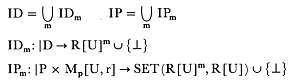
so that, for all mpÎ Mp [U, r]; D, D' Î |D; P Î |P,
IPm (P, mp ) Î SET (R[U, D(mp )]m , R[U, D(mp )])
and, whenever
| ||||||||
The notation 'SET (A, B)' means the set of all functions from A to B.
IV.2.2. Some procedures |P may be interpreted as queries—members of Q[U, r]. Recall that members of Mp [U, r] are simply certain kinds of n + 1 tuples of relations from R[U]. Thus, IPn+1 (P, mp ) will be a (perhaps improper) superset of a member of Q[U, r], provided only that it has a non-^ values (is defined) in Mp [U, r] and isomorphism invariant. Here, we restrict our attention interpretations and P's so that, for all mpÎ Mp [U, r],
IPn+1 (P, mp ) Î Q[U, r].
Where no confusion results, I will occasionally abbreviate 'IPn+1 (P, mp ) (mp )' by 'P(mp )'. Note that there may remain P Î |P that are not interpreted as queries.
IV.2.3. I assume that the interpretation I works in such a way that when
{P1 , . . . , Pn } |G| – P
the value of P is determined by the values of {P1 , . . . , Pn }. Roughly, this means that P may be analyzed (perhaps in several ways) into subprocedures whose values suffice to determine the value of P. When P is interpreted as a query, it is possible that all members of {P1, . . . , Pn} are also interpreted as queries, but we do not require this.
IV.2.4. Intuitively, IPn+1 (P, mp ) is the query that procedure expression P computes in the potential model mp . The same procedure expression P will generally compute different queries in different mp 's. That is, when mp¹ mp ',
IPn+1 (P, mp ) ¹ IPn+1 (P, mp ').
For example, see Appendix A.1.
IV.2.5. In the contex of empirical science, we may think of a procedure expression P as something like an experimental procedure that has a limited range of applicability. The semantic entities in Q[U, r] characterize kinds of things experiments might measure or determine. The syntactic entities in |P characterize concrete experimental methods. The interpretation function tells us what specific experimental procedures do in fact determine in a given situation (potential model).
IV.2.6. These considerations motivate the following. Call pairs <|L(G), I> of procedure languages and their interpretations interpreted procedure languages for Mp [U, r]. For interpreted procedure language <|L(G), I> for Mp [U, r],
P Î |P, mpÎ Mp [U, r], M Í Mp [U, r] and Mp [U, r]-query Q Î Q[U, r], we say that:
1) P expresses Q in mp iff IPn+1 (P, mp ) (mp ) = Q(mp );
2) P expresses Q in M iff, for all mpÎ M, P expresses Q in mp ;
3) P universally expresses Q iff P expresses Q in Mp [U, r].
For P Î |P and Q Î Q[U, r], we may define
M (P, Q) = {mpÎ Mp [U, r] |P expresses Q in mp }.
Intuitively, M (P, Q) is all the members of Mp [U, r] in which procedure P "works" for computing query Q.
IV.2.7. Viewing procedures expressing queries as experimental methods motivates us to to restrict our attention to procedures that are generable from procedures universally expressing queries for the relations appearing in members of Mp [U, r] (relative to <|L(G), I>). That is, we are interested in P so that
|
where PD and PRi universally express QD and QRi respectively. I call P an empirical procedure expression and the set B an empirical base for P. This corresponds to the customary distinction between "intensional" and "extensional" data-base relations ([23], 100).
V—
Theory Elements
V.1. Introduction . In this section I will sketch how procedure languages may be used to provide syntactical expression for the essential model-theoretic entities appearing in structuralist reconstructions of empirical theories ([1], [17]). These include potential models and models (sec. V.2), partial potential models (sec. V.3), and constraints (sec. V.4). I will indicate how questions of eliminability and definability that elude precise semantic formulation might be handled with this syntax. I do not consider the structuralist concept of intertheoretical link here, but I believe one might extend procedural syntax to this as well.
V.2. Empirical Laws . Clearly, M (P, Q) could be used to characterize empirically interesting classes of models. However, Q is a semantic entity. More appropriate, for our purposes, is a purely syntactic characterization. Consider pairs of empirical procedure expressions <P, P'> Î |P × |P so that, relative to <|L(G), I>, both P and P' universally express queries Q and Q'. The pair <P, P'> characterizes a class of models M (P, P')—a subset of Mp [U, r]—in the following way:
M (P, P') = {mpÎ Mp [U, r] |IPn+1 (P, mp ) (mp ) Í IPn+1 (P', mp ) (mp )}.
For empirical theories, M (P, P') is just the class of potential models in which
results of the experimental procedure P are a subset of the results of P'. Intuitively, we may say that, in M(P, P'), P "partially determines" the same observable of systems of kind Mp [U, r] that P' determines. For example, see Appendix A.2.
V.2.2. Generally, the "laws" for a theory T for Mp [U, r] may be viewed as a finite set of procedure expression pairs
L = {<L1 , L1 '>, . . . , <Ln , Ln '>}.
where all Li , Li ' Î |P. The models for the theory are
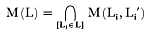
Generally,
|
determined by the set of expression-query pairs L is an attenuated example of what we have called a theory element ([1]).
V.3. Theoretical Concepts
V.3.1. Theoretical Structures . Consider
Mp [U, r1 , . . . , rk , rk+1 , . . . , r1 ] = Mp [U, n, t];
Mpp [U, r1 , . . . , rk ] = Mpp [U, n]
where
|
Members of Mpp [U, n] are k + 1, . . . , k1 "reducts" of members of Mp [U, n, t]. We call members of Mpp [U, n] partial potential models . Intuitively, the relations in the places k + 1, . . . , 1 are theoretical relations and those in places 1, . . . , k are nontheoretical relations . Mp [U, n, t] is the class of theoretical structures while Mpp [U, n] is the class of nontheoretical structures .
V.3.1.2. Denote the "Ramsey functor" ([1], sec. II.4) from Mp onto Mpp by
Ram: Mp [U, n, t] ® Mpp [U, n]
so that, for all mp = <D, R1 , . . . , Rk , Rk+1 , . . . R1 > in Mp ,
Ram (mp ) = <D, R1 , . . . , Rk >.
Queries for Mp [U, n, t] and Mpp [U, n] we will denote respectively by
|
V.3.1.3. Expression pairs <Lp , Lp '> for Mp determine sets of Mp -models in the manner described above. Via the Ramsey functor, they also determine sets
of Mpp -models:
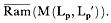
Similarly, a theory L for Mp determines a set of Mpp -models which we have called the nontheoretical content of the theory element <Mpp , Mp , M(L)> ([1]). That is,

V.3.1.4. The motivation for calling Mpp 's nontheoretical structures is this. In the situations where the theories represented by these structures are actually used, all data to which we have "direct" empirical access is definable in terms of the Mpp -relations. By "direct" we mean roughly access that does not depend on assuming that we are dealing with a member of Cn(Mpp , Mp , M(L)). Thus, supposing we are "given" some mpp Î Mpp , all the data we can obtain for mpp is of the form <Qpp , R> where QppÎ Qpp [U, n] and R = Qpp (mpp ) Î R[U].
V.3.2. Theoretical Laws . This intuitive understanding of the data available to the process Lp suggests that it must operate in a somewhat unusual way. Suppose Lp has an empirical base consisting of expressions for all relations in Mp [U, n, t]'s. In operating on a data expression D whose interpretation is mp , Lp requires as intermediary steps the results of the queries expressed by PD, PR1 , . . . , PRn , . . . , PRt . However, Lp may have only the results of the nontheoretical queries PR1 , . . . , PRn available. The results of the theoretical queries PRn+1 , . . . , PRt may be totally unavailable. In effect, we are invited to consider a procedure expressing an Mp [U, t]-query operating on a data expression for a member of Mpp [U, n]. How could this work?
V.3.2.2. We may imagine Lp working with "generators" in place of expressions of theoretical queries. Lp marches along calling and evaluating nontheoretical subprocesses PR1 , . . . , PRn until it reaches a call for PRj , J Î {n + 1, . . . , t}. At this point, instead of calculating PRj from the given data expression (which cannot be done), Lp systematically generates (out of nothing) a "candidate" for the output of PRj of the appropriate set-theoretic type and uses this output to complete its calculation. To make this precise, we need some concept of a generator procedure. A generator should take as input expressions for the domain of an mpp and deliver as output a sequence of members of R[U, D(mpp )] of a specific set-theoretic type. An Lp involving theoretical concepts is simply one that has generators, rather than query expressions at certain places.
V.3.2.3. This means that determining whether a given mpp is in
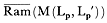
V.3.3. Eliminability and Definability . Procedural syntax permits us to raise questions of eliminability and definability of theoretical concepts in a precise way. More important, it may prove possible, using this apparatus, to address these questions for theories that are not readily formalizable in first-order logic.
V.3.3.2. Given interpreted procedure language <|L(G), I> and the theory element <Mpp [U, n], Mp [U, n, t], M(Lp )> with the members of Lp in |P, we say that the theory
Lpp = <<Lpp1 , Lpp1 '>, . . . , <Lppk , Lppk '>>
for Mpp with all Lppi Î |P is Ramsey equivalent to L iff

We then ask, Is the following true? RAMSEY ELIMINABILITY THESIS: For all theory elements <Mpp , Mp , M(Lp )>, there is a theory Lpp for Mpp so that Lpp is Ramsey equivalent to L.
V.3.3.3. The question of definability of theoretical terms and its relation to model-theoretic eliminability may be raised in this way. Suppose
{P1 , . . . , Pn }|G| – P
and relative to the interpreted procedure language <|L(G), I>,
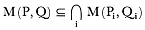
then we say, relative to <|L(G), I>, Q is definable in terms of {Q1 , . . . , Qn } in M(P, Q). Note that 'definability' applies to queries rather than to expressions for them. In the special case of queries QRi we say that Rk is definable in terms of {Ri1 , . . . , R in} in M Í Mp [U, r] when there exist Pk and {Pij }
{Pij }|G| – Pk
and

Thus, for theory element <Mpp [U, n], Mp [U, n, t], M(Lp )> we may ask whether Rk , k Î t, is definable in terms of {Rij }, i, j Î n, in M(Lp ). Clearly, the answer to both eliminability and definability questions depends on |L.
V.4. Constraints
V.4.1. Constraints and n-ary Queries . Model-theoretically, a constraint is just a subset of Po(Mp )—the set of all subsets of Mp that satisfy the "constraint." A simple example of a constraint is the requirement that identical particles in different models of classical particle mechanics have the same mass values. This example is trivial in that it is equivalent to a requirement on the union of the constrained mp 's. However, examples of nontrivial constraints such as the "extensivity constraint" on mass in particle mechanics abound in empirical
science. That representing nontrivial constraints is essential to representing empirical theories has been argued in detail in [1], section II.2.
V.4.1.2. Can procedural syntax be used to represent constraints? First, let us restrict our attention to constraints that are sets of two-member subsets of Mp [U, r]. We might think of a binary queries as functions:
Q: Mp [U, r] × Mp [U, r] ® R[U]
so that, for all <mp , mp '> Î Mp × Mp , Q(mp , mp ') Î R[U, (D(mp ) È D(mp '))]. That is, Q maps pairs of potential models into relations on the union of their domains. A computable query of this type is (partial) recursive and consistent in a natural extension of the sense of section III above.
V.4.1.3. We may consider a binary interpretation for procedures in language |L as a function:
IPm : |P × Mp [U, r] × Mp [U, r] ® SET (R[U]m , R[U]) È {^ }.
Relative to a binary interpretation, P expresses the binary query Q in <mp , mp '> iff IPn+1 (P, mp , mp ') (mp , mp ') = Q(mp , mp '). For P in |P and binary query Q we may define
K(P,Q) = {<mp , mp '> |P expresses Q in <mp , mp '>}.
Thus, an expression-binary query pair may be used to characterize a subset of Mp [U, r] × Mp [U, r], and this characterization may be rendered fully syntactic by replacing Q with P' in the manner of section V.1. Clearly, we can generalize these ideas to n-ary queries without losing the capability of representing computable n-ary queries in a formal language.
V.4.1.4. Some additional conditions are needed to make the sets of n-tuples determined by procedure-n-ary-query pairs have the properties that constraints for real empirical theories usually have. This has been worked out in an unpublished manuscript ([18]). Whether all "interesting" constraints can be represented by sets of n-tuples is less clear. But the answer seems to be "yes," provided we restrict our attention to finite sets of potential models.
V.4.2. Theories with Constraints . As with the laws of a theory, we may regard the constraints C associated with a theory for Mp as a set of procedure pairs where the procedures will express multi-argument queries of the sort exemplified above. Let
K = {<K1 , K1 '>, . . . , <Kk , Kk '>}
where Ki , Ki ' Î |P and, for some
Qi : Mp [U, r]n® R[U].
ci (Ki , Qi ') = {s Î Mp [U, r]n |IPn+1 (Ki , s) Í IPn+1 (Ki ', s)}
Ci (Ki , Qi ) = {S Î Po(Mp [U, r]|SnÍ ci (Ki , Qi )}
The intuitive idea is that subsets of Mp satisfy Ci (Ki , Qi ) iff all n-tuples from them satisfy ci (Ki , Qi ). It is argued (inductively) in [18] that this is enough to represent all "interesting" constraints. The set of sets of models determined by K is:
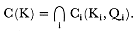
V.4.2.2. We may now consider what we have called a theory element ([1]):
T = <Mpp , Mp , M(L), C(K)>
where the L and K provide syntactic representations for the model and constraints M(L) and C(K). The nontheoretical content of T is

The issue of eliminability of the theoretical components of the models can be raised for this more general concept of theory element in the same way as outlined above for the theory element without constraints.
VI—
M[sub(p)][U, r]-Problem SolvingVI—
Mp [U, r]-Problem Solving
VI.1. Mp [U, r ]-Problems and Their Solutions . Problem solving in empirical science may be described in the vocabulary of queries to a data base. A "problem" is then: given the results of a series of queries to the same data base, predict the result of a further query. Viewed syntactically, a problem solution is a procedure constructed from procedures expressing the "data" queries which expresses the "unknown" query. Problem solving is then viewed as search in the graph of |P for a problem-solution process. It appears that conception of "problem solving" may provide a formally precise model of actual practice. Such a formal model might serve as the theoretical basis for computer-assisted instruction in empirical sciences analogous to that for theorem proving in first-order logic and set theory ([22]).
VI.1.2. Generally, an Mp [U, r ]-problem type is a pair


VI.1.3. Assuming that we are dealing only with M Í Mp [U, r] in which the queries in the problem type are expressed by empirical procedures


that is, S is generable from

S(mp ) = P(mp ).
What makes S a "useful" solution is that S(mp ) may be obtained only from the given results of
VI.1.4. With this concept of solution, the process of "problem solving" may be viewed syntactically as attempting to construct S from
VI.2. Problem Solving with Empirical Laws . Empirical laws conceived as pairs of procedures <L, L'> may be used in problem solving essentially as extensions to the formation rules G. They provide additional "substantive" principles for constructing new procedures from given procedures.
VI.2.2. The basic idea of using <L, L'> to construct new procedures is to exploit the fact that, for mpÎ M(L, L'), L(mp ) Í L(mp '). Clearly, if we may assume that the data for our problem comes from a model for a theory containing <L, L'>, we may exploit this fact as a kind of "substitution principle" to construct new procedures from those providing the data for the problem. More precisely,
SUBSTITUTION PRINCIPLE: From
<L1 , L2 > | and | {P1 , . . . , L2 , . . . } |G| – P |
construct
{P1, . . . , L1, . . . } |G| – P'.
This construction has the desirable property that, for mpÎ M(L1 , L2 ),
P' (mp ) Í P(mp ).
VI.2.3. Substitution alone is not a very powerful inference principle. However, together with some principles for generating new laws from old it appears more interesting. First, note an obvious transitivity property of law-pairs:
From <L1 , L2 >, <L2 , L3 > construct <L1 , L3 >
in appropriate model classes. Other principles depend heavily on the specific nature of |L(G). We can get some idea of how this might work by supposing that |L(G) contains as logical primitives the usual Boolean operations on sets. For example, suppose ',' and ';' are among the primitive symbols of |L(G) and
work in the following way:
(P1 , P1 ) (mp ) = P1 (mp ) Ç P2 (mp )
(P1 ; P2 ) (mp ) = P1 (mp ) È P2 (mp )
With this apparatus available, we have such principles as:
From <L1 , L>, <L2 , L> construct <(L1 , L2 ), L>.
From <L, L1 >, <L, L2 > construct <(L, (L1 ; L2 )>.
VI.2.4. This suggests that, in appropriately chosen |L(G), something like the symbolic manipulations associated with problem solving in physics and other empirical sciences may be modeled in a formally rigorous way. Further, it appears that semantically equivalent laws may perhaps be distinguished by relative "ease" with which they admit of these syntactic manipulations ([8], 380). Were this so, it would provide a new approach to some aspects of the traditional problem of "lawlikeness."
VI.3. Problem Solving with Theoretical Laws and Constraints . We may extend these ideas to theories with theoretical concepts and theoretical laws in the following way. Most generally, we may think of problems as any combination of theoretical and nontheoretical queries. First, consider completely nontheoretical problems—queries on the nontheoretical structures



Theoretical laws are pairs of procedure expressions <Lp , Lp '> that operate on the full theoretical structures. We view these procedures as constructed, in part, from "generators" rather than query procedures for theoretical concepts (sec. V.3.2). Generally, problem solving here is more complex just because there may be multiple values generated for theoretical concepts that make Lp (mp ) Í Lp ' (mp ). The process of problem solving using the formation rules and laws in the manner sketched above will be essentially the same. However, we should expect the S arrived at to yield arrays of solutions corresponding to the multiple possible values of the theoretical concepts.
VI.3.2. Consider next the case in which the "data" queries are just those for the nontheoretical concepts

VI.3.2. Up to this point we have viewed problems and problem solving as having to do with a single member of Mp [U, r]. It has been argued at length in
[17], chapters 4 and 5, and in [1], section II.2, that this is an incomplete and seriously inadequate picture of the way empirical science is practiced. Problem solving essentially involves the "import and export" of information across different models of the same theory. A procedural version of this view is roughly this. The generators for values of theoretical concepts are replaced (supplemented) by procedures for "importing" these values from other members of Mp [U, r]—those in which the laws of the theory suffice to determine them uniquely. This suggests that, in practice, in "real-life" situations, the role of generators may be relatively insignificant. The procedures that effect the "importing" are essentially constraints on n-tuples of mp 's (sec. V.4). This suggests that a fully adequate account of problem solving will require n-ary queries and constraints.
VII—
Theory Discovery
VII.1. Introduction . The conception of theory discovery as search is well known ([10]). Procedural syntax provides a precise, general method for bringing this conception to bear on empirical theories represented as model-theoretic structures. In addition it provides a characterization of conceptual innovation—the discovery of theories employing theoretical concepts—and suggests a way that "search" might be expected to yield conceptual innovation. This reformulates and extends the work of Langley et al. in [10]. The formulation sketched here opens the way to precisely addressing the question of whether there are computational limits on automatic (algorithmic) conceptual innovation. In what follows, I restrict the discussion to discovery of single laws in theories.
VII.2. Mpp [U, n ]-Data Presentations . The conception of law discovery under consideration is "data-driven" in the sense that the discovery process is viewed roughly as a function from "data presentations " to "laws." The simplest (though not the only interesting) conception of "data" for Mpp [U, n]-structures (relative to an interpreted procedure language <L(G), I>) is a sequence of data expressions interpreted as Mpp [U, n]-structures:

so that
ID (S(i)) Î Mpp [U, n].
Our purposes require that we are able to speak partitions of a presentation S into n nonoverlapping parts. I do this with the formal device of a data partition p :

so that, for i,

<p (i) Ç <p (j) = Ù .
VII.2.2. We may think of a law <Lpp , Lpp '> as "capturing" a part of a data presentation S when all mpp 's in the part of the initial segment are in the model class determined by the law. Thus, relative to partition p , we say <Lpp , Lpp '> <m, n>-captures S iff, for all

ID (S(i) Î M(Lpp , Lpp '>.
VII.3. Nontheoretical Law Discovery . Intuitively, the objective in law discovery is to find the "strongest" law that captures all the data known at any point in time and continues to do this as more data are obtained. In our formalism, for data presentation S, we seek a procedure pair <Lpp , Lpp '> so that, relative to partition p , both:
A) for all m,
B) for all <Ppp , Ppp '> so that A), M(Lpp , Lpp '> Í M(Ppp , Ppp ').
A) requires that all parts of all initial segments of S be captured by <Lpp , Lpp '>, while B) says <Lpp , Lpp '> is the strongest procedure pair that does A), in the sense that it determines the smallest model class.
VII.3.2. Search for procedure pairs satisfying A) and B) might simply be conceived as search through a graph ||P2 which is the cross product of the graph of ||P = <|P, < > of procedure expressions in |L(G) with itself. The partial ordering of pairs <P, P'> in this graph will be determined by the formation rules G and may not have much intuitive relation to our objective. More useful to our enterprise would be a partial ordering <m having the property that
|
VII.3.3. Intuitively, search in <|P2 , <m > may be viewed in this way. At some point i, as we march through our data presentation S, we are sitting at procedure pair Li Î in |P2 knowing that Li <i, m>-captures S, for all m. Before examining S(i + 1), we move down <m to see if we find a stronger pair that still captures all our data. (How we choose the order of exploring downward paths remains unspecified.) We stop when we hit a pair that fails to capture the data and back up to the last successful pair—Li *. Then we examine S(i + 1). If Li * <i + 1, m> captures S, we examine S(i + 2). If not, we back further up <m until we reach a pair that captures all the data. Then we repeat the whole process. Here the <m -ordering provides an "incremental" search in the sense of [15], [16]. It does not, of course, fully specify a search procedure. Rather, it appears to be a necessary condition on any reasonable search through proce-
dure pairs. How one defines an <m ordering is clearly dependent on specific properties of |L(G). At this point, I do not know how to construct it for a specific example. However, there is work for clauses in first-order logic that suggests how one might start ([13], [14]).
VII.4. Theoretical Law Discovery . The preceding discussion ties model-theoretic representations of empirical theories to previous work in automated law discovery via procedural syntax. It does not suggest any essentially new ideas about discovery. However, Hempel ([6]) and others have maintained that a crucial question about the adequacy of this work as a model for scientific practice is whether it can be extended to automated discovery of "new vocabulary" or "new concepts" and laws containing them. Model-theoretic representations of theories with theoretical concepts do suggest what appears to be new insights into this question. Model-theoretic reconstructions of "real-life" examples ([17], chap. 3) reveal that theoretical concepts—while not definable in terms of nontheoretical concepts in all models of the theory—are so definable in some models. Automated methods have been developed for identifying theoretical concepts and laws containing them in those models where they are definable. Further, the "same" theoretical concept appearing in different laws may be identified ([10], 156; [19]). Procedural syntax for model-theoretic representation appears to afford the apparatus to reformulate and extend this work to situations where definability is not present in all models. Within this somewhat more abstract formulation it should become possible to formulate precisely (and settle) the question of whether discovery as search can yield genuine conceptual innovation.
VII.4.2. How can we recognize in a data presentation S that we are dealing with a phenomenon requiring a new theoretical concept? I suggest roughly the following. We "discover," by methods sketched above, a data partition p and k different nontheoretical laws
<Lpp1 , Lpp1 '>, . . . , <Lpp k , Lppk '>
so that, relative to p :
1) <Lppk , Lppk '> <m, k>-captures S;
2) at some level, Lppk, s (Lpp k', s) have isomorphic parse trees;
3) Lpp k, s (Lppk', s) differ only in Pk * at isomorphic positions in their parse trees.
Property 1) is simply that different nontheoretical laws capture different parts of the initial segment m of the data. However, these different laws have the same form above a certain level; that is, they use data processed at a lower level in the same way—2). They differ only in the way presentation data is processed Pk * at lower levels—3).
VII.4.3. Intuitively, the different Pk *'s correspond to different ways of measuring the value of the value of the same theoretical concept in different
models of the theory. We recognize this as the same concept just in that the output of all Pk *'s is used in the same way by the laws. In fact, there is really just one law—once we have "identified" the different Pk *'s as outputting values of the same concept. Very roughly, what I am suggesting here is a way of turning old-fashioned "operationalism" around. Instead of identifying concepts by their methods of determination, I suggest we identify them by the further use we make of the results of (different) determination methods. Note that it is the procedural syntax that makes it possible to identify precisely the "uses" of results.
VII.4.4. I sketch here a process that might be turned into an algorithm for discovering the simplest kind of theoretical law—that containing only one theoretical concept. Assuming one thinks that such discoveries count as "interesting" conceptual innovation in empirical science, two kinds of things might be done with such a sketch. First, one might try to implement the sketch in some working procedural language and see how it fared on some nontrivial examples (e.g., momentum mechanics). Second, one might try to characterize the process in some more abstract way and investigate its computational properties. Success with the first would show that interesting conceptual innovation can be automated. Failing this, one might pursue the second line in the hope of showing that the kind of algorithm needed for conceptual innovation is computationally "hard" ([9], chap. 13), thus providing a kind of "impossibility" result. It is the need to represent and search (intelligently) through data partitions that suggests this might be the case.
VIII—
Appendix
A.1. In the case of binary relational structures Mp [U, <2>], the "converse" function:

so that, for all mp in Mp [U, <2>],

is in Q[U, <2>]. A procedure P that simply computes QR1 , that is,
IPn+1 (P, mp ) (<D (mp ), R1 (mp )>) = R1 (mp )
will also compute

A.2. We may represent each mpÎ Mp [U, <2>] as PROLOG data base where "facts" of the form:
dom (a).
rel (a, b).
respectively describe D (mp ) and R1 (mp ). Taking PROLOG as our procedure language |L(G), the queries "dom(X)" and "rel(X, Y)" form the empirical basis for theories about binary relational structures. Consider the PROLOG rules:
1_1(X):- rel(X, X).
1_2(X, Y):- dom(X), dom(Y).
1_3(X, Y):- rel(X,_), rel(_, Y).
Via the PROLOG analog of set-theoretic abstraction (the "findall" function) each of these may be viewed as procedure that computes a function defined on Mp [U, <2>] whose value is a set. Procedure pairs formed from these and the basic queries correspond to properties of binary relation structures in the following way:
<rel(X, Y), 1_2(X, Y)> R1Í D × D
<1_1(X), dom(X)> reflexivity
<rel(X, Y), rel(Y, X)> symmetry
<1_3(X, Y), rel(X, Y)> transitivity
Note that since PROLOG expressions have both a denotational and a procedural interpretation, the class of models determined by the pair <L, L'> is the same as the class of models in which, in addition to the clauses defining L and L', the clause L:- L' is true.
References
[1] Balzer, W., C. U. Moulines, and J. D. Sneed
1987
An Architectonic for Science: The Structuralist Program . Dordrecht: Reidel.
[2] Bauer, K.
1989
"Das strukturalistische Theorienkonzept: Ein Computermodell zu den intendierten Anwendungen einer Theorie der Geometrie." Master's thesis, University of Munich.
[3] Chasndra, A. K., and D. Harel
1980
"Computable Queries for Relational Data Bases." Journal of Computer and System Sciences 21:156–178.
[4] Gaifman, H.
1983
"Why Language?" In Reduction in Science , ed. W. Balzer, D. Pearce, and H.-J. Schmidt, 319–330. Dordrecht: Reidel.
[5] Gurevich, Y.
1988
"Logic and the Challenge of Computer Science." In Trends in Theoretical Computer Science , ed. E. Borger, 1–57. Rockville, Md.: Computer Science Press.
[6] Hempel, C. G.
1985
"Thoughts on the Limitations of Discovery by Computer." In Logic of Discovery and Diagnosis in Medicine , ed. K. F. Schaffner, 115–122. Berkeley, Los Angeles, London: University of California Press.
[7] Hindley, J. R., and J. P. Seldin
1986
Introduction to Combinatorics and Lambda Calculus . Cambridge: Cambridge University Press.
[8] Hogger, C. J.
1981
"Derivation of Logic Programs." Journal of the Association for Computing Machinery 28(2):372–392.
[9] Hopcroft, J. E., and J. D. Ullman
1979
Introduction to Automata Theory, Languages, and Computation . Reading, Mass.: Addison-Wesley.
[10] Langley, P., H. A. Simon, G. L. Bradshaw, and J. M. Zytkow.
1987
Scientific Discovery: Computational Explorations of the Creative Process . Cambridge, Mass.: MIT Press.
[11] McCarthy, J.
1960
"Recursive Functions of Symbolic Expressions and Their Computation by Machine, Part I." Communications of the ACM 3:184–195.
[12]
1963
"A Basis for a Mathematical Theory of Computation." In Computer Programming and Formal Systems , ed. P. Braffort and D. Hirshberg. Amsterdam: North-Holland.
[13] Plotkin, G. D.
1970
"A Note on Inductive Generalization." In Machine Intelligence 5 , ed. B. Meltzer and D. Michie, 153–161. Edinburgh: University of Edinburgh Press.
[14]
1971
"A Further Note on Inductive Generalization." In Machine Intelligence 6 , ed. B. Meltzer and D. Michie, 101–124. Edinburgh: University of Edinburgh Press.
[15] Shapiro, E. Y.
1981
Inductive Inference of Theories from Facts . Research Report 192, February. New Haven: Yale University, Department of Computer Science.
[16]
1982
Algorithmic Program Debugging . Cambridge, Mass.: MIT Press.
[17] Sneed, J. D.
1979
The Logical Structure of Mathematical Physics . 2d ed. Dordrecht: Reidel.
[18]
1983
"Constraints as Intertheoretic Relations." Unpublished manuscript.
[19]
1987
Review of Scientific Discovery , by Langley et al. Science 236: 1357–1358.
[20] Sterling, L., and E. Y. Shapiro
1987
The Art of Prolog: Advanced Programming Techniques . Cambridge, Mass.: MIT Press.
[21] Stoy, J.
1977
Denotational Semantics: The Scott-Strachey Approach to Programming Language Theory . Cambridge, Mass.: MIT Press.
[22] Suppes, P.
1981
"Future Educational Uses of Automatic Theorem Proving." In University-Level Computer-Assisted Instruction at Stanford, 1968–1980 , ed.
P. Suppes, 165–182. Stanford, Calif.: Institute for Mathematical Studies in the Social Sciences, Stanford University.
[23] Ullman, J. D.
1988
Principles of Database and Knowledge-Base Systems . Vol. 1. Rockville, Md.: Computer Science Press.
[24] van Fraassen, B. C.
1976
"To Save the Phenomena." Journal of Philosophy 73:623–632.
Eleven—
Why Functionalism Didn't Work
Hilary Putnam
Starting around 1960, I developed a view in the philosophy of mind based on the analogy between a mind and a digital computer. I gave my view the name "functionalism," and under this name it has become the dominant view—some say the orthodoxy—in contemporary philosophy of mind.
In my book entitled Representation and Reality[1] I argue that the computer analogy, call it the "computational view of the mind," or "functionalism," or what you will, does not after all answer the question we philosophers (along with many cognitive scientists) want to answer, the question "What is the nature of mental states?" That book was conceived as a single argument, and I obviously cannot give the entire argument in a brief discussion. But what I hope to do is to explain some of the leading ideas of the argument that led me to abandon my former position.[2]
The computational analogy was itself a reaction against the idea that our matter is more important than our function, that our what is more important than our how . My "functionalism" insisted that, in principle, a machine (say, one of Isaac Asimov's wonderful robots), a human being, a creature with a silicon chemistry, and, if there be disembodied spirits, a disembodied spirit, could all work much the same way when described at the relevant level of abstraction, and that it is just wrong to think that the essence of our minds is our "hardware." This much—and it was central to my former view—I do not give up in my new book, and indeed it still seems to me to be as true and as important as it ever did. What I try to do in the book is the trick attributed to adepts in jujitsu of turning an opponent's strength against himself: I try to show that the arguments for the computational view, in fact, the very arguments I formerly used to show that a simple-minded identification of mental states with physical-chemical states cannot be right, can be generalized
and extended to show that a straightforward identification of mental states with functional states, that is, with computationally characterized states, also cannot be right. Functionalism argued that mental states cannot simply be physical-chemical states, although they are emergent from and supervenient on physical-chemical states; I now argue that mental states also cannot be computational states, or computational-cum-physical states (states defined using a mixed vocabulary referring both to physical and to computational parameters), although they are emergent from and may be supervenient upon our computational states.
Although this is not a historical essay, I would like to begin with a historical remark. I think that what we would really like to believe, if we could only square such a belief with our scientific consciences, is just what the ancients believed. Ancient philosophers held that things in the world have Forms —these are a kind of Reason-in-the-World—and that we have a mental faculty, the active intellect, which is precisely suited to figuring out the Forms of things. The beauty of Greek metaphysics was that nous (the Reason in us) and the Forms were made for each other. Since the appearance of modern science and philosophy in the seventeenth century, the notion of a Form and the notion of a special faculty for knowing Forms have ceased to meet our standards of clarity and explanatory value. We are no longer able to believe that Reason-in-the-World and Reason-in-Us fit together like the pieces of a jigsaw puzzle.
Instead, what many philosophers believe is that we have minds (with a small "m"—the "mind" no longer has a distinguished part, the "active intellect" or nous , which can be identified with Reason) and that what looks like Reason-in-the-World is produced by our minds by an act of "projection." This was Hume's line (and he has many contemporary successors). Hume, however, assumed that one mental power—the power of referring —was relatively unproblematical. In the simplest case, an idea refers to another idea or to an impression by resembling it. This "resemblance theory" of the semantic powers of the mind is long dead, and thus Hume's present-day successors have a more difficult task than Hume; if our ascription of Forms (i.e., of "natures," or "causal powers," or even of dispositions) to things is "projection," then they owe us an account of the faculty of Projection. Other philosophers say, in effect, that there is Reason "out there" (an objective relation of "bringing about" in the world, or objective "dispositions" or objective counterfactuals), and our minds simply have evolved with a propensity to "track" these sorts of facts. The problem is that neither intentional powers in us nor Reason out in the world fit into the world picture of reductive physicalism. Explaining how we can have the ability to refer and to think if there is a primitive and objective notion of Explanation built into external reality is of no real interest. Explaining how we can "project" a relation of Explanation into external reality if we
assume a primitive and objective relation of reference is of no real interest. The circle connecting Explanation and Reference is too short. The task of the reductive physicalist is to show that it is possible to account for both Explanation and Reference starting from what he takes to be the ultimate "building blocks" of reality—the distribution of fundamental magnitudes over space-time points, or something of that kind. And this is what I contend he cannot do.
But enough for historical background; now for an account of the difficulties with functionalism.
The first difficulty I encountered with my functionalist views was that they were incompatible with the account of meaning that I myself put forward in "The Meaning of 'Meaning.'" According to the arguments of that essay, the content of our beliefs and desires is not determined by individualistic properties of the speaker but depends on social facts about the linguistic community of which the speaker is a member and on facts about the physical environment of the speaker and of the linguistic community. For example, I pointed out that the fact that experts (or other speakers on whom we rely) are prepared to count certain things as "real gold," certain things as "elm trees," certain things as "aluminum," and so on, helps to fix the extension of these terms. The fixing of extension depends on cooperation and linguistic deference. Reference is not fixed by what is "in the heads" of speakers.
Even experts need not have criteria (in the sense of necessary and sufficient conditions) that determine the extensions of our terms. Given a tradition of investigation into nature, a tradition of theory construction and experimentation that gives sense to such questions as "Is this the same metal as that?," "Is this the same liquid as that?," one can fix the referent of a term (perhaps with some vagueness, but vagueness need not be fatal) by deciding that it will apply to whatever is of the same nature as certain paradigms. (In the "Twin Earth" example that I used in "The Meaning of 'Meaning,'" the word 'water' on two different planets turned out to refer to two different liquids even though there was nothing "in the heads" of the individual speakers which was different.) What the nature of something is (not in the metaphysician's sense of "the nature," but in the scientist's or the artisan's) can determine the reference of a term even before that nature is discovered. What chrysos (gold) was in ancient Greece was not simply determined by the properties ancient Greeks believed gold to have (although many philosophers still make the mistake of thinking that a community's notion of a substance is the definition of the substance for that community). If the beliefs ancient Greeks had about chrysos defined what it is to be gold (or "chrysos") at that time, then it would have made no sense for an ancient Greek to ask himself, "Is there perhaps a way of telling that something isn't really gold, even when it appears by all the standard tests to be gold?" Remember that this is precisely the question Archimedes did put to
himself! with a celebrated result. Archimedes' inquiry would have made no sense if Archimedes did not have the idea that something might appear to be gold (might pass the current tests for "chrysos") while not really having the same nature as paradigm examples of gold. Reference (and "meaning") depend upon the nonhuman environment as well as upon society.
The upshot of this new theory of reference for the philosophy of mind is that "propositional attitudes," as philosophers call them, that is, such things as believing that snow is white, feeling certain that the cat is on the mat , and so on, are not "states" of the human brain and nervous system considered in isolation from the social and nonhuman environment. A fortiori , they are not "functional states"—that is, states definable in terms of parameters that would enter into a software description of the organism. Functionalism, construed as the thesis that propositional attitudes are just computational states of the brain, cannot be correct .
One way of meeting this objection has been defended by Jerry Fodor and more recently by Ned Block.[3] This is to divide meaning into an individualistic component (often called "narrow content") and an external component (reference, or reference in possible worlds). The individualistic component is a computational state of the brain in the case of each "meaning" and each "propositional attitude," Block would argue. Against this I would argue (in company with Tyler Burge)[4] that there is no one physical state or one computational state that one must be in to believe that there is a cat on the mat. Speaking at the level of spontaneous phenomenology, it is undeniable that we preceive one another as "thinking that the cat is on the mat," or whatever. If we understand a foreign language—say, Thai—we may have such "perceptions" even when the person in question speaks a language very different from ours and comes from a very different culture. For example, I may know that a certain Thai peasant thinks that his cat is on a mat. But it does not follow that the Thai peasant who believes that his "meew"[5] is on a mat is in the same "psychological state" as an English speaker who believes a "cat" is on a mat in any sense of "psychological state" that can be explained without reference to what the Thai peasant and the English speaker mean . After all, the Thai peasant does not have the same perceptual prototype of a cat as the English speaker (the paradigmatic Thai cat is what we would call a "Siamese" cat, and the English speaker is unlikely to regard a Siamese cat as a stereotypical cat, even if she happens to have seen Siamese cats); the Thai speaker might have to rely on others to be sure that the English speaker's cat was really a "meew"; Thai beliefs about meews (especially in a village) could be quite different from English speakers' beliefs about "cats"; and so on. Block specifies that "narrow content" is to be a matter of speakers' beliefs and/or inferences that speakers make; yet, as this example illustrates, it seems impossible to specify which beliefs and inferences must be the same in order for the "narrow content" of a word to be that of the word 'cat'. Block and Fodor recognize that the enterprise of trying to produce necessary truths about what a speaker must think in order to
mean a given thing by a given word is hopeless; yet they provide no alternative way of fixing the "narrow content" of a word.
Global Functionalism
A different way of trying to reconcile functionalism with the non-individualistic theory of reference defended in "The Meaning of 'Meaning'" might be to extend the computer analogy to a larger system. Why not think of the entire language community together with an appropriate part of its environment as analogous to a computer rather than just the individual mind? (This was suggested to me by Richard Boyd.) If the content of a word depends on relations to other speakers, why not try to describe those relations computationally? If the content also depends on the nature of the objects the word refers to, why not try to characterize the relation of reference , which links the word to those objects, computationally? Perhaps one would have to use both computational notions and physical/chemical notions in the definition of reference; but the point is that one might, in some way, accept the chain of arguments that link meaning to reference and reference to entities (experts and paradigms) "outside the head" of the individual speaker without conceding that the intentional cannot be reduced to the nonintentional. One can be a reductionist without being a methodological solipsist, after all . Functionalism may have to become more complicated. We may have to speak of functional (and partly functional) properties of organisms-cum-environments and not just of functional properties of individual brains. But functionalism is not yet refuted.
Of course, the question is whether this can be done in principle, not whether it can really be done in practice. It is widely recognized that the interpretation of someone's language must always proceed simultaneously with the ascription of beliefs and desires to the person being interpreted. As the example of the Thai peasant illustrated, such an ascription will rarely, in practice, make the other's beliefs and desires come out exactly the same as ours. We construe one word as meaning plant , another word as meaning water , still another word as meaning gold , in spite of the fact that the beliefs of the speakers we are interpreting, as discovered by this very interpretation (by the "translation manual," as Quine calls it), disagree with ours—perhaps disagree over the nature of plants, the nature of water, the nature of gold. When we ought to count two words as having the same meaning in spite of the difference between their beliefs and our beliefs which the very interpretation we are constructing requires us to posit, and when the beliefs we are attributing as the result of our translation are so bizarre as to require revision of the translation, is a question of "reasonableness." A functionalist definition of synonymy and coreferentiality would "rationally reconstruct" these intuitive judgments of reasonableness . And there is no reason to think that it would be easier to do this than rationally to reconstruct inductive logic, or, indeed, human informal rationality itself.
Few philosophers are afraid of being Utopian, however. A philosopher might well insist that all this could be done in principle . The philosophical problem, such a philosopher will insist, is to evaluate the claim that a certain type of reduction is "possible in principle."
Appraising Reduction Claims
Appraising reduction claims is something that analytic philosophers have a great deal of experience at doing. Thus, after Carnap's Der Logische Aufbau der Welt was published, a great deal of philosophical work went into examining (and, in the end, rejecting) the philosophical claim that "thing language is reducible to phenomenalistic language." Likewise, attempted reductions of mathematical to "nominalistic" language have been and continue to be studied (e.g., Hartry Field's Science without Numbers ). Appraising the claim that the notion of reference can be reduced to computational or computational-plus-physical notions is a very similar enterprise to appraising these other reducibility claims.[6]
If this is not quite self-evident, it is because these other claims were claims about the conceptual or necessary relations between concepts, and my own functionalism was explicitly put forward as an empirical hypothesis (although Armstrong and David Lewis appear to regard some version of functionalism as conceptually necessary). But if one examines the famous arguments against the claim that thing language is reducible to sense-datum language given by Hans Reichenbach or by Wilfrid Sellars, one observes that what those arguments really showed was that there is no nomological relationship between such typical statements in thing language as 'There is a chair in the room' and any statement in phenomenalistic language. That is to say, the refutation of phenomenalism would have been exactly the same if phenomenalism had been put forward as an "empirical hypothesis" and not as a piece of "conceptual analysis"!
Thus, what we need to examine is the question that is perfectly analogous to the question Reichenbach considered in Experience and Prediction : Is there any strict nomological relation between arbitrary statements in the class to be reduced (in the present case, statements of the form X refers to Y) and statements in the reducing class (in the present case, statements in the computational-cum-physical vocabulary)?
From familiar considerations applicable to all reduction claims, we know that we must not say that reference has been reduced to some physical-cum-computational relation R (defined over organisms-cum-environments) unless: (I) reference is coextensive with R in all physically possible systems—coextensive for all physically possible organisms and environments such that those organisms are capable of using language, referring, and so on, in those environments: (II) R obeys (approximately) the "laws" that reference is sup-
posed to obey in intuitive (or anthropological) belief about reference; and (III) the presence of R explains the effects (to the extent that they really exist) that the intuitive or anthropological notion of reference was supposed to explain. Merely finding a functional relation R that is coextensive with referring for those organisms which happen to refer (perhaps, by chance, there aren't any other than human beings) would not be enough.
The requirements (II) and (III) assume that the "definiens" in a reduction must be a property or relation which we can define in the vocabulary of the reducing discipline (allowing as parts of that vocabulary constants for appropriate mathematical objects, e.g., tensor or scalar constants, mathematical functions, etc.) where 'define' has the normal sense of define in finitely many words . (If such a requirement is not imposed, then the question of reducibility becomes trivial, since—if we happened to be blessed with omniscience—we could "define" any term that refers to any property or relation that is supervenient on physical facts by just listing all the infinitely many physically possible cases in which the property term applies or the relation obtains.)[7]
Analogues of these considerations were involved in the debate about the reducibility of thing language to sense-datum language. At first the phenomenalists were content to claim that material-thing sentences could be "translated" into infinitely long sense-datum sentences; however, it was very quickly pointed out that unless the translation were finite (or the infinitely long translation could be constructed according to a rule that was itself statable in finitely many words), then the issues over whether the translation exists, whether it is correct, whether it is philosophically illuminating, and so on, would be essentially undiscussible. The antiphenomenalists said, in effect, "Put up or shut up."
In the same way, I am saying to the functionalists (including my former self), "Put up or shut up." However, the antiphenomenalists did not put all the burden of proof on the phenomenalists. Reichenbach, Carnap, Hempel, and Sellars gave reasons why a finite translation of material-thing language into sense-datum language was impossible. Even if these reasons fall short of a strict mathematical-impossibility proof, they are highly convincing, and this is the reason why there is hardly a single phenomenalist left in the world today.[8] In the same spirit, I am going to give principled reasons why a finite reduction of intentional relations and properties in terms of physical/computational relations and properties is impossible—reasons which fall short of a strict proof, but which are, I believe, convincing.
The Single-computational-state Version of Functionalism
I am going to begin by considering an oversimplified version of functionalism. This is the theory that each state of believing something, desiring something,
perceiving something, having a particular emotion, and so on, corresponds to one definite computational state. The identification is to be species-independent: believing that snow is white is to be the same computational state for all physically possible organisms capable of having that belief. While it is true that so simple a functionalism has never been defended by anyone, as far as I know, the theory that each propositional attitude, emotion, and so on, corresponds to one particular computational (or computational/physical) state in the case of each particular organism is a feature of all the familiar varieties of functionalism. For all of the familiar versions of functionalism—my own and David Lewis's[9] in particular—assume that a propositional-attitude term applies to an organism just in case that system is a model for an appropriate psychological theory, where something is defined to be a "model" of a psychological theory only if it has nonpsychological —physical or computational—states that are related as the psychological theory says the mental states are related. This clearly assumes that one can find one physical or computational state per propositional attitude in the case of a single organism. Where more sophisticated versions of functionalism differ from our oversimplified version is in allowing that the physical or computational states that serve as the "realizers" of a given mental state may be different (although "functionally isomorphic") in the case of different organisms and/or different species.
Consider the following model for a speaker-hearer of a natural language: the "organism" is an information-processing system (it could be a robot) that possesses a way of assigning "degrees of confirmation" to the sentences in its "language of thought," and a "rational preference function" that (together with the degrees of confirmation) determines how it will act in any given situation. Certain semantic distinctions must be marked in any such model: for example, we can tell when a word is acquired by the fact that the "c -function" of the organism (the function that calculates the degrees of confirmation) and the rational-preference function are extended to a new range of sentences. We can tell when a word is ambiguous by the fact that (in the underlying "language of thought") the word is marked by subscripts, or functionally equivalent devices, as, for example, 'nap1 ' (short sleep) and 'nap2 ' (nap of a rug). But if all we are given to go on is the current subjective probability metric (the current degrees of confirmation), the current desires (the current "utilities"), and the underlying prior-probability function by which the current subjective probability metric was formed by conditionalizing on the observations of the organism, then at least the first two of these will be different even in the case of speakers whose meanings we are prepared to count as the same. In short (this was the point of a paper I published a number of years ago),[10] there will be no discernible synonymy relation extractable from the model itself, nothing to mark the fact that when I say 'bureaucrat' and you say 'bureaucrat' we are uttering words with the same meaning.
The problem does not disappear even if we suppose (as Carnap did) that we
should include information to the effect that certain sentences are marked analytic in the very description of a formal language. Even if certain sentences are marked analytic by the model, say 'bureaucrats are officials in large institutions', unless I have a criterion of synonymy to tell me that when I say 'official' and you say 'official' we mean the same thing, and that when I say 'institution' and you say 'institution' we mean the same thing, I cannot conclude that 'bureaucrat' has the same meaning for both of us from the fact that this sentence is analytic for both of us. (Moreover, the word may have the same meaning even if we have a different stock of "analytic" sentences. For example, someone who lives in a monarchy may have the sentence 'People appointed to high positions by the king are officials' in his stock of "analytic" sentences, while someone who doesn't know what a king is but who is acquainted with presidents will have different "analytic" sentences about officials in his language, but this is not what we count as a difference in the meaning of 'official'.)
Finally, Quine's celebrated "gavagai" example shows that problems of synonymy can arise even at the level of observation terms. Here is a little bit of evidence in support of Quine's claim. I recall that when I visited China in 1984 I lectured on Quine's views at Fudan University in Shanghai, and sophisticated Chinese told me that they did not think that the Chinese word 'mao' (cat) could be determinately translated into English as 'cat'/'cathood'. What they claimed was that "Are you saying there is a cat or that there is cathood exemplifying itself?" is the wrong question to put to a Chinese speaker. There is no special suffix in Chinese to distinguish "mao" from "maohood" ('mao' is used both in contexts in which we would translate it as 'cat' and in contexts in which we would translate it as 'cathood'), nor are there articles in Chinese. 'Cat there' and 'Cathood there' would go into the same sentence in Chinese. If my informants were right, then there may be no "fact of the matter" as to whether a certain Chinese character means 'rabbit' or 'rabbithood' or neither-of-the-foregoing. In fact, sameness of "stimulus meaning" is not even a necessary condition for synonymy, even in the case of observational terms. A Thai speaker may not associate the same stimulus meaning with 'meew' that I do with 'cat', but it is still reasonable to translate 'meew' as 'cat'. ('Elm' in English and 'Ulme' in German would still be synonyms even if 'Ulme' were an observation term for Germans—they all learned to distinguish elms—and not an observation term for English speakers.)
So far I have argued that, in the sort of model of linguistic capacity that seems reasonable given the insights of Quine's meaning holism, there is no way to identify a computational state that is the same whenever any two people believe that there are a lot of cats in the world (or whatever). Even if the two people happen to speak the same language, they may have different stereotypes of a 'cat', different beliefs about the nature of cats, and so on (imagine two ancient Egyptians, one of whom believes cats are divine while the other
does not). The problems that arise "in principle" become much worse if the two "people" may be members of different "physically possible species."
Even in the case of a single species, the "functional organization" may not be exactly the same for all members. The number of neurons in your brain is not exactly the same as the number of neurons in anyone else's brain, and neurologists tell us that no two brains are literally "wired" the same way. The "wiring" depends on the maturational history and environmental stimulation of the individual brain.
Still, many thinkers would suppose, with Noam Chomsky, that there is some "competence model" of the human brain to which all actual human brains can be regarded as approximating. This model would determine the "space" of possible computational states that can be ascribed to humans. The problem in the case of two different species is that in this case there is no reason to assume that the space of possible computational states is the same or that either space can be "embedded" in the other.
Consider, for example, the crucial "belief fixation" component of the model. Even if we assume the species are ideally rational, this leaves an enormous amount of leeway for different inductive logics (as Carnap pointed out).[11] Carnap introduced the concept of a "caution parameter"—a parameter that determines how rapidly or slowly the logic "learns from experience," as measured by how large a sample size the logic typically requires before it begins to give significant weight to an observed sample mean. Different inductive logics can assign different caution parameters. Different inductive logics can also assign different weights to analogy and count different respects as respects of "similarity." In short, different inductive logics can impose different "prior probabilities." Granting that the need for survival potential will reduce the variability, we must remember that we are talking about all physically possible species in all physically possible environments—that is to say, about all the ways evolution (or whatever—some of these "species" will be artifacts, e.g., robots) might work to produce intelligent life, compatibly with physical law, not just about the way evolution actually happened to work in the one physically possible environment that actually exists.
For example, if the species is one whose members are very hard to damage, then they can afford to wait a long time before making an inductive generalization. Such a species might use an inductive logic with a very large "caution parameter." What properties it will be useful to count as "similarities" or respects of analogy will obviously depend upon the contingencies of the particular physical environment. Perhaps in a sufficiently peculiar physical environment a species that projected "funny" predicates (e.g., Nelson Goodman's famous predicate 'grue') would do better than a species with our inductive prejudices. Computers that have to compute very different "analogies" or employ very different caution parameters (caution parameters that can themselves be different mathematical functions of the particular evidence e , not just
different scalars) may have totally different descriptions either in the Turing-machine formalism or in any other formalism. The number of states may be different, the state rules may be different, and there is no reason why either machine should have a table that can be mapped homomorphically into the machine table of the other machine.
For all of these reasons, members of different possible species (physically possible organisms with minds and language) who are sufficiently similar in their linguistic behavior in a range of environments to permit us to translate some of their utterances may nevertheless have computational states that lie in quite different machine tables—lie in, so to speak, different "spaces" of computational states. The fact that their way of reasoning is similar to ours in some situations (when we interpret that way of reasoning using a "translation manual" that we have succeeded in constructing) does not imply that their states or the algorithms in their brains are literally the same. The idea that there is one computational state that every physically possible being who believes a given proposition p must be in is false.
What about physical states? The reason for introducing functionalism in the first place was precisely the realization that we are not going to find any physical state (other than one defined by the sort of "infinite list" that we ruled out as "cheating") that all physically possible believers have to be in to have a given belief, or whatever. But now it emerges that the same thing is true of computational states. And (finite) conjunctions, disjunctions, and so on, of physical and computational states will not help either. Physically possible sentient beings just come in too many "designs," physically and computationally speaking, for anything like "one computational state per propositional attitude" functionalism to be true.
Equivalence
I already said that the one-computational-state version of functionalism is oversimplified and that it is a version that no one has ever actually held. Let me now describe a version which I have seriously entertained. This version still makes the assumption (which is made by all forms of functionalism) that each mental state corresponds to one computational (or computational/physical) state in the case of each single organism (or, in the case of "global functionalism," in the case of each language community of organisms), but it does not assume that different organisms (or different language communities) must be in the identical computational state when they have a given belief, desire, and so on. Rather, it assumes that they must be in computational states that are equivalent under some computationally definable equivalence relation. Let me explain what I mean by this.
Imagine some definite formalism for computational theory to be fixed—say, for definiteness, the Turing-machine formalism. Although each Turing
machine has its own "space" of machine states, still one can mathematically describe the totality of these machines—indeed, this is just what Turing and his successors did. One can define predicates that relate the states of different machines in different ways, and the notion of computability has been defined for such predicates. What is true in this respect of Turing machines is equally true of any other kind of machine that might be taken as a model in computational theory. Thus, given an equivalence relation (or, indeed, any relation) that is defined on computational states of different machines, the question whether that relation is itself "computable" is well defined. (One can also define classes of predicates which, though not computable, are definable starting from the computable predicates—these form the so-called "arithmetic," "hyper-arithmetic," etc. hierarchies.) But why should one believe that there is a computable equivalence relation that connects the propositional attitudes of a person in one language community and the propositional attitudes of an arbitrary person in a different language community?
Here is an argument of a kind that convinces many people (such arguments are quite common in present-day linguistic theorizing): Suppose Mary Jones is an English speaker, and suppose we wish to ascertain that her word 'cat' is synonymous with the Thai word 'meew' (or with the word 'meew' as used on a particular occasion by a particular Thai speaker). We have to know that the extension of the two terms is (at least vaguely) the same to even consider accepting the synonymy of the two terms, and this requires some knowledge of the actual nature of the animals in Mary's environment that she (or experts upon whom she relies in doubtful cases) calls 'cats' and some knowledge of the actual nature of the animals that the Thai speaker (or experts upon whom she relies) call 'meew'. Granted that this decision can involve enormously many factors, not only Mary's speech dispositions and those of her Thai counterpart but also the speech dispositions of other members of the linguistic communities to which they belong, and information about the microstructure and evolutionary history of paradigm "cats" and paradigm "meew"; still, if we can make this decision and we are Turing machines, then the predicate 'word W1 as used in situation X1 is synonymous with word W2 as used in situation X2 ' must be a predicate that a Turing machine can employ—a recursive predicate or at worst a "trial and error predicate."[12]
This argument makes the basic empirical assumption on which functionalism depends, namely that there is some class of computers (e.g., Turing machines or finite automata) in terms of which human beings can be "modeled." If we are willing to make this assumption, then the attractive feature of the argument is that it does not presuppose that the two situations being compared involve identical "machines." All that is necessary is that the entire situation—the speaker-cum-environment—be describable in some standardized language. In short, the problem we faced in the preceding section, that it makes no sense to speak of the "same computational state" when the speakers
(or the speakers-cum-environments) are not machines of the same type, does not arise if what we are asking is, "Does a certain definable equivalence relation R (the relation of coreferentiality) hold between an element of the one situation and an element of the other?" States of different "machines" can lie in the same equivalence class under an arithmetical relation, and so can situations defined in terms of such states. In short, moving from the requirement that the "states" of speakers with the same reference (or believers with the same belief) be identical to the requirement that they be equivalent under same equivalence relation that is itself computable, or at least definable in the language of computational theory plus physical science , gives us enormous additional leeway. What we have to see is whether this leeway will help.
Suppose (returning to the example of Mary Jones and her Thai counterpart) that our biology assures us that the animals that Mary takes to be paradigm "cats" are indeed various sorts of domestic felines (Felis catus ) and that the same thing is true of the animals her Thai counterpart takes to be paradigm "meew." This does not show that the extension of 'cat' is the same as the extension of 'meew', for several reasons. First—to be somewhat fanciful—it might be that Thai has an ontology of temporal slices rather than things. 'Meew' might mean 'cat slice'. Second, even if we assume that English and Thai both cut the world up into 'things', 'animals', and so on, the classification used by scientific biologists might not be one either Mary or her Thai counter-part employs. 'Meew' might mean 'Siamese cat', for example. We have to know a good deal about the Thai speaker's speech dispositions (or those of others to whom she defers linguistically) to know that she would count non-Siamese cats as "meew." What is at stake, as Quine and Davidson have emphasized (not to mention European hermeneuticists such as Gadamer) is the interpretation of the two discourses as wholes.
To interpret a language one must, in general, have some idea of the theories and inference patterns common in the community that speaks that language. No one could determine what 'spin' refers to in quantum mechanics, for example, without learning quantum mechanics, or what 'negative charge' refers to without learning a certain amount of electrical theory or what 'inner product' refers to without learning a certain amount of mathematics. This creates a serious problem for the idea that coreferentiality and "synonymy" are theoretically identical with computable (or at least computationally definable) relations over properly parametrized situations.
The problem is that any theory that "defines" coreferentiality and synonymy must, in some way, survey all possible theories. A theory that figures out what people (or physically possible extraterrestials, robots, or whatever) are referring to when they speak of "spin" and that decides whether the notion of "spin" in Terrestial quantum mechanics is or is not the same notion as the notion of "grophth" in Sirian Mootrux mechanics, or an algorithm that would enable a Turing machine to make such a decision (or to reach it "in the limit")
given a description of the "situations" on Earth and on Sirius, must, in some way, anticipate the processes of belief fixation on which the understanding of quantum mechanics (including the mathematics presupposed by quantum mechanics) and "Mootrux mechanics" (including the "mathematics" presupposed by Mootrux mechanics) depends. Certainly such an algorithm would have to do more than "simulate" an ability that human beings actually have. For no human being can follow all possible mathematics, all possible empirical science, and so on. This point deserves further discussion, however.
Surveying Rationality
The fact that one cannot interpret a discourse unless one can follow it suggests that an algorithm that could interpret an arbitrary discourse would have to be "smart" enough to survey all the possible rational and semirational and not-too-far-from-rational-to-still-be-somehow-intelligible discourses that physically possible creatures could physically possibly construct. How likely is it that there is such an algorithm?
First of all, the restriction to physical possibility is not really helpful. As far as we know, physics does not rule out the possibility of an intelligent being that survives for N years for any finite N whatsoever. For example, some astronomers have suggested that a physically possible intelligent being might have a body that was a gas cloud of galactic size—the being would move with an incredible slowness, so that its time scale would be almost inconceivably slowed down by our standards, but such systems might have arbitrary complexity. The fact that such a being survives N years, for some large N, does not mean that it is "long-lived" by its (slowed-down) standards, of course, but it could also be incredibly long-lived by its standards. The point I mean this example to illustrate is that we do not know of any laws of physics that exclude any finite automation whatsoever from being physically realized and from surviving for any finite number N of machine stages.
Let us begin by considering a somewhat less mind-boggling question. Can we hope to survey (and write down rules for interpreting, perhaps by "successive approximation") the reasoning and belief of all possible human beings and societies?
Let us recall that there is no one form in which all human beliefs are cast. The predicate calculus is often treated by philosophers as if it were the universal language, but to put beliefs expressed in a natural language into the predicate-calculus format, one must first interpret them—that is, one must deal with the very problem we wish to solve. A theory of interpretation which works only after the beliefs to be interpreted have been translated into some "regimented notation" begs the question.
Moreover, the predicate-calculus format itself has problems. What should the variables range over? Analytic philosophers have a preference for material
objects and sense data; but there is no guarantee that every human language and sublanguage, including the specialized sublanguages of various professions (psychoanalysis, theology, sociology, cognitive science, mathematics . . . ) will employ one of these standard ontologies; in fact, we know that the sublanguages just mentioned, at least, do not. Space-time points are another choice popular with philosophers; but to tell whether someone is quantifying over points in Newtonian space, or in space-time, or in Hilbert space, or in the space of supergravitation theory . . . , one again has to interpret his or her discourse. And it is not at all clear how to represent quantum-mechanical discourse in the format of standard predicate calculus. I am not thinking of the possibility that quantum mechanics may best be understood in terms of a nonstandard logic (although that illustrates the point in a different way) but of the problem of interpreting quantum mechanics in its standard ("Copenhagen") presentation. Copenhagen theorists claim that quantum mechanics does not treat the world as consisting of objects and observer-independent properties but rather as consisting of two realms: a realm of "measuring apparatus," described by one ontology and one theory (classical physics), and a realm of "statistical states," described by vectors in Hilbert space and projection operators on Hilbert space. The "cut" between these two realms is not fixed but is itself observer-dependent—something the predicate-calculus format has no way of representing. Even if it turns out that quantum mechanics is being presented in the wrong way by its own practitioners, as many philosophers have thought (though without coming up with an agreed-upon better way), to interpret a discourse in existing quantum mechanics one must first realize that the language of those practitioners is of this "nonclassical" kind. What other languages that science (or history, or literary criticism, or . . . ) might use of a "nonclassical kind" are waiting to be invented?
Experience tells us that no human society is unsurpassable. For any human society, there is a possible other society that is more sophisticated, that has modes of conceptualizing and describing things which members of the first society cannot understand without years of specialized study. What is often said is true, that all human languages are intertranslatable: but that does not mean that one can translate a current book in philosophy or a paper in clinical psychology or a lecture on quantum mechanics into the language of a primitive tribe without first coining a host of new technical terms in that language. It does not mean that we could tell any "smart" native what the book in philosophy, or the paper in clinical psychology, or the lecture on quantum mechanics "says" and have him understand (without years of study). Often enough we cannot even tell members of our linguistic community what these discourses "say" so that they will understand them well enough to explain them to others.
It would seem, then, that if there is a theory of all human discourse (and what else could a definition of synonymy be based upon?), only a god—or, at any rate, a being so much smarter than all human beings in all possible human
societies that he could survey the totality of possible human modes of reasoning and conceptualization as we can survey the "modes of behavioral arousal and sensitization" in a lower organism—could possibly write it down. To ask a human being in a time-bound human culture to survey all modes of human linguistic existence—including those that will transcend his own—is to ask for an impossible "Archimedean point."
The conclusion that I take from these reflections is that we do not know what we mean when we speak of such a theory. A theory which we could not possibly recognize as doing what the Master Theory of Discourse (or Master Definition of Reference and Synonymy in Computational Terms) is supposed to do is a "we know not what." The notion of "correctness" for such a theory is less clear than the notion of reference itself, and certainly much less clear than the propositional attitudes in their everyday use.
Twelve—
Physicalism
Hartry Field
I take it as beyond serious doubt that there is an important sense in which all facts depend on physical facts and all good causal explanations depend on good physical explanations. Some such doctrine has played an important methodological role in guiding the development of science. It would be nice, however, if we could formulate the doctrine more precisely, and in this paper I will provide a rough sketch of what I think the more precise formulation should be like, and also indicate the lines along which I would defend the proposed characterization of physicalism against other characterizations. I take it to be a condition of adequacy on any proposal for a more precise version of the doctrine of physicalism that the proposal be such as to make physicalism weak enough to be believable but strong enough to explain how it can guide the development of science.
The methodological role of the doctrine of physicalism is double-edged. On the positive side, the doctrine tells us that when we have a putative body of facts and causal explanations that we are quite convinced are basically correct, we need to find a physical foundation for them. (If the facts and explanations are sufficiently "high-level," we will not look directly for a physical foundation: we will simply look for a foundation in terms of "lower-level" facts and explanations that we think are clearly unproblematic in that their having a physical foundation is relatively uncontroversial.) For instance, the implicit acceptance of the doctrine of physicalism on the part of most scientists has led to the successful search for the molecular foundations of genetics and the quantum-mechanical foundations of chemical bonding. The other, negative, aspect of the doctrine of physicalism is that when faced with a body of doctrine (or a body of purported causal explanations) that we are convinced can have no physical foundation, we tend to reject that body of doctrine (or of purported causal explanations). I think this is the attitude that most of us take
toward astrology or telepathy: even if there were positive evidence for telepathy that we did not know how to refute, most of us would tend to disbelieve the telepathic claims (and presumably suspect the evidence) simply because it seems so difficult to conceive how such claims could fit in with a physicalistic worldview. Of course, give sufficient evidence for telepathy, we would look harder for its physical foundations; or we would contemplate giving up the doctrine of physicalism and replacing it by a broader "unity of science" type doctrine (much as we gave up the doctrine of mechanism late in the nineteenth century). But this last move is not one we take at all lightly, and that is what gives the doctrine of physicalism its methodological bite.
I think that most attempts to formulate the doctrine of physicalism either make the doctrine seem totally unbelievable or make it so weak that it is hard to see how it could ever have the sort of double-edged methodological importance just described. One of the goals of the project on which this paper is based is to do better. Once we have formulated the doctrine more clearly, the other main goal of the project is to say something about why the methodology of adhering to physicalism (so formulated) as a working hypothesis is a reasonable methodology. Of course, there are limits on what can be said in justification of any methodology: one cannot take a person that is unwilling to enumeratively induce or to reason by any form of inference to the best explanation and argue that person into acceptance of those forms of inductive inference. Still, I think that something can be said in favor of physicalist methodology beyond the fact that it has worked well in guiding science, even if not enough can be said to quell all possible skepticism.
The version of physicalism I want to defend is not so very different from classical reductionism; but it involves several differences designed to make it more believable. Before mentioning the main differences, I want to say a few things about what I understand classical reductionism to be.
Classical reductionism as I understand it consists of two interrelated parts. The first part is designed to capture the idea that all facts ultimately depend entirely on physical facts. The classical reductionist proposes that this idea be put by saying that for each sentence in the language of a successful special science like chemistry or genetics or psychology, there is a sentence in the language of a lower-level science—and ultimately, in the language of physics[1] —that in some intuitive sense "expresses the same facts." (It is this aspect of classical reductionism which seems to me too stringent, and which I shall discuss weakening shortly.)
The second part of classical reductionism is designed to capture the idea that all good explanations ultimately depend entirely on physical explanations. A minimal version of this idea already can be argued to follow from the first part of the reductionist thesis. For take any explanation in the language of a special science. By the first part of reductionism, there will be associated with
each sentence Si of that explanation a physical transcription f (Si ). Now, it is plausible to suppose that if the mapping f is to associate with each special-science sentence a sentence in the language of physics that "expresses the same facts," then f must preserve deductive relationships; also, that it must preserve truth and falsity. So if the special-science explanans logically implies the special-science explanandum, then the physical transcription of the explanans will imply the physical transcription of the explanandum; and if the special-science explanation is true, so must be its physical transcription. So if an explanation of something is just any old body of truths from which the thing to be explained follows, then the physical transcription of the special-science explanation is bound to be a physical explanation. (For simplicity I have expressed the argument so as to apply only to deductive special-science explanations, but it generalizes without much loss of plausibility to probabilistic explanations.)[2]
The main trouble with this is that what counts as a special-science law may have as its physical transcription a physical-language sentence with no motivation independent of its role in special-science explanations. It would not seem like much of a physical explanation of the bonding of sodium and chlorine to say that the initial conditions in physics happen to be such that the physical transcription of the chemical-bonding laws come out true. Some sort of explanation of those laws is needed. So the second part of the reductionist position is simply that the higher-level laws and generalizations should themselves, when physically transcribed, admit physical explanation. This requirement is intended to be somewhat vague. I would not want to make it precise by demanding that the transcribed special-science law (even if suitably qualified and/or probabilified) be derivable from laws of physics alone, without background conditions: such a demand would rarely if ever be met in practice. (One does occasionally hear this demand, but I suspect that that is because of an unthinking extrapolation from the reduction of mathematics to set theory.) But it would be equally bad (though in the opposite direction) to put the demand as a demand that the physically transcribed special-science law be deduced from physical laws together with background conditions: that would be vacuous, since we could simply use as the background conditions the physically transcribed law we wanted to deduce, and avoid any appeal to physical law altogether. I doubt very much that an attempt at more precision here would be useful. The explanatory component of reductionism is vague, but despite the vagueness I think we often know when it has been satisfied and when it has not.
As I have said, I think that the reductionist thesis—especially the first part of it—needs weakening. But it is important to begin by making sure that we understand it sympathetically and that we appreciate some of its virtues. On the matter of understanding it sympathetically, I have two points to make. The first is that the requirement that a physicalist transcription of a sentence
"in some intuitive sense express the same facts as" the original sentence should be taken to allow that the physical transcription has a precision that the higher-level sentence lacks: we do not want the reductionist committed to supposing that the vagueness or other semantic indeterminacy in the higher-level sentences can be exactly matched at the physical level. A reductionist will likely hold, in fact, that the vagueness or indeterminacy of terms and sentences from secondary sciences is less a matter of their having vague or indeterminate reductions than a matter of their being reducible to (more or less determinate) physical terms in different and incompatible ways.
The second point is that a classical reductionist can distinguish between providing a classical reduction in full detail and sketching one, and can hold that although full reductions are possible in principle, they would generally be so complex (even in thermodynamics and chemistry, and certainly in biology and psychology) that sketches are all we can reasonably expect to find. Physicalism gets its main methodological bite in cases where it is initially unobvious even in broad sketch how a reduction would go, and indeed where there seem to be obstacles to providing such a reduction. A classical reductionist is likely to hold that the reasons for believing in reductionism, and the reasons for believing in the explanatory importance of certain terms, are strong enough that if we can provide sketches that overcome the obstacles apparently standing in the way of reductions for those terms, then it is reasonable to believe that the reductions could in principle be filled in. In my view this is over-sanguine; but I also think that if the ideal of reduction is weakened in the ways soon to be discussed, then it becomes reasonable.
Before turning to the ways in which classical reductionism must be revised, I would like to turn to one apparent defect in it that is not genuine. Doing so will in fact reveal one of the virtues of reductionism: a virtue that is conspicuously lacking in certain alternatives to reductionism, most notably supervenience theses.
The apparent defect in reductionism emerges when we try to fill out the requirement I have vaguely expressed by saying that the physical transcription of a higher-level claim must "in some intuitive sense express the same facts." In the case where the higher-level sentences are built up using only predicates and first-order logical operators,[3] part of what this presumably involves is that the physical transcriptions are determined in the obvious way by a mapping g that takes predicates in the higher-level language into formulas of the physical language. This mapping g should correlate with each predicate of the higher-level language a formula in the language of physics with the same extension (or more accurately, a formula that does not definitely disagree in extension with the higher-level predicate—its extension may be more definite, as previously noted). But, one is inclined to say, extensional adequacy is not enough: the physical formula must be lawfully coextensive with the higher-level predicate.
It is here that the apparent defect in reductionism emerges. It would I think be most unfortunate if we had to appeal to an unexplicated notion of "lawfulness" in this context. The idea of a law of physics is (for many purposes anyway) tolerably clear; similarly for the idea of a law of one of the special sciences like chemistry or genetics or psychology. But it is not one of those relatively clear applications of the notion of lawfulness that we are concerned with here: rather, we are contemplating as a requirement for reduction that a statement of the form "" x[Px º Ax]" be lawful, where 'P' is a predicate of a special science like chemistry or genetics and 'A ' is some candidate for a reduction into physicalist language. In this context, appeal to a notion of lawfulness seems to me of no help at all: it simply labels the problem to be solved, namely the problem of saying which true statements of the form above count as real reductions and which do not.
Fortunately, the classical reductionist does not actually need to rely on an unexplicated concept of lawfulness. Rather, the full version of the classical reductionist thesis explicates the sense in which classical reductions must be "lawful." The explication of the sense in which they must be lawful turns on the fact I emphasized before, that classical reductionism consists in a doctrine about explanations being ultimately physical as well as a doctrine about facts being ultimately physical. Indeed, the doctrine about explanations and the doctrine about facts are not really separable doctrines: the reductionist view is that a large part of what makes an assignment of physical formulas to higher-level formulas be one that preserves facthood is that it preserves explanations. In the case of the reduction of predicates, this means that in a sense no lawfulness requirement is needed: a function g that assigns extensionally correct formulas of physics to higher-level predicates will be adequate if it leads to physical transcriptions of higher-level laws that admit of physical explanation. Talk of lawfulness is needed only when we try to formulate the requirement that the facts be reduced independently of the requirement that the explanations be reduced.[4]
So classical reductionism does not, despite initial appearances, need to rely on an unexplicated notion of cross-discipline claims holding lawfully: and that is good since, as remarked before, such a use of the notion of lawfulness would simply label a problem, not solve it. This virtue of classical reductionism will be preserved on the weakening of it that I will next suggest. However, it is not preserved on supervenience theses: there, there is an essential use made of notions of necessity or lawfulness, applied to cross-discipline sentences (e.g., it is necessary or lawful that there be no mental difference without a physical difference). And it is essential to the use of supervenience by antireductionists that there is no attempt to explain this cross-discipline lawfulness—since the only obvious way to explain it would be in terms of a reduction . Advocates of supervenience do not rely on that explanation but do not want to put anything else
in its place. (I do not think that this is the only problem with supervenience theses—I also think that they are far too weak to be interesting, even if one forgets the unilluminatingness of their appeal to necessity or lawfulness.)
Now for a rather quick discussion of some ways in which we need to weaken the classical-reductionist claim that for each sentence in the language of a successful special science there must be a claim in the language of physics that in some intuitive sense "expresses the same facts." It is rather easy to argue that this is implausible: indeed, one can argue that even some claims about shape that clearly ought to count as physicalistically kosher will be ruled out by this requirement. Basically, the argument is that since physical language is countable, only countably many facts about shape will be representable in it, but there are uncountably many facts about shape that ought to be represented. It turns out, though, that a very simple modification of classical reductionism will handle this cardinality problem: instead of insisting on straight-out expressibility in the language of physics, we insist on definability in the language of physics from physical parameters . The physical parameters can include arbitrary regions of space; this multiplies the number of physical facts we have to work with enormously and avoids the sort of worry just raised.
A second worry about classical reductionism is that it seems to be incompatible with functionalism, that is, with the fact that the same special-science predicate can be physically realized in a wide variety of very different ways. It has seemed to many (i) that if the aims of reductionism are to be achieved, then we need a single formula in physical language applicable to all occurrences of the special-science predicate; but (ii) that the possibility of extremely different physical realizations precludes this. Let us assume (i) for the moment, and focus on (ii). I think it can be made highly plausible that if one takes "the physical language" to be a purely first-order language—no predicate quantifiers, even substitutional—then it is indeed impossible to find formulas in that language that can capture the fairly abstract similarities between different possible realizations of the same special-science predicates ('pain', 'monetary transaction', or whatever). And there is some reason to construe classical reductionism as implicitly making this restriction to first-order language. But if so, then the main moral of functionalism is just that we should relax this: we should allow the physical language to contain the logical resources required for functional definition. A typical functional definition proceeds by defining something to be y just in case it has some property or other P that meets such and such a condition. ("Being y " is called the "higher-level" or "functional" property, whereas P is the "lower-level" property that realizes y .) So to allow for functional definition, we need to allow quantification over properties of individuals (or at any rate, predicate quantification, perhaps construed substitutionally). However, the second-order language in question is to be a predicative (or ramified) one: the only properties we quantify over are those that are predicatively construable (perhaps in multiple steps) from basic physical pred-
icates.[5] The point of this restriction is to guarantee that the properties quantified over are independently certified to be physically kosher. (A slightly less severe restriction would also guarantee this,[6] but there is no need to go into this here.) If we liberalize classical reductionism so as to allow functional or second-order "reductions," as I think we should, then we must also demand an account, in each instance where the functional property holds, of what lower-level physical properties realize it and why they realize it. Indeed, it is in the demand for such an account of the realizations that much of the spirit of reductionism is focused.
There is a possible alternative to admitting higher-order physical language in one's "reductions": one can restrict the application of the reductions one gives, thereby denying (i); indeed, one can argue that such a restriction is not a liberalization of classical reductionism, it is what classical reductionists intended. My own view is that it is indeed fairly plausible that a classical reductionist could be satisfied with a physical account of pain in humans and a separate physical account of pain in octopuses and a third for pain in Martians: here the need for a common physical account is not all that compelling. However, the best arguments for functionalism show the possibility that the physical realization of a property like pain can vary not only from species to species but between different members of a species and even within the same member at different times.[7] This means that if one is to avoid the recourse to higher-order physical language, one must restrict the application of one's reductions not just to a given species but to a given interval of time in the life of a given individual organism. I doubt that such a way of avoiding the appeal to higher-order physical language would be satisfactory.[8] But there is no need to argue this here: the differences between this nonfunctionalist physicalism and the functionalist physicalism I prefer are not really terribly important. I see functionalist physicalism as only a slight generalization of nonfunctionalist physicalism; the differences between these two doctrines have been greatly overemphasized.
(One occasionally hears the view that psychology is fundamentally different from other sciences because its terms can only be functionally explicated. But I think in fact that to the extent that functional explication is required for psychological terms it is also required for terms much closer to fundamental physics: consider 'acidic' or 'harmonic oscillator' or 'is hotter than'.[9]
A connected view that likewise seems incorrect is that the fact that psychological theory is appropriately construed in a functionalist vein shows that a "top-down" methodology that ignores neurophysiological underpinnings is appropriate in psychology and that a "bottom-up" methodology is inappropriate. This is doubly wrong: first, a functionalist needs to be concerned with getting a theory of human psychology that can be physically realized, so that attention to neurophysiological underpinnings is quite appropriate; second, even when one has nonfunctional reductions, the complexity of the system
often makes it practically indispensable to ignore the physical underpinnings in certain contexts and proceed in a relatively autonomous or top-down fashion. The fact is that in any special science, a complex interaction of "top-down" and "bottom-up" research is essential to progress: this is true whether or not the science in question is construed in a functionalist fashion.)
A third worry about classical reductionism—probably the most important worry—is that it does not seem to accommodate the fact that theories in the special sciences are not exceptionless.[10] Here I do not have in mind simply the fact that in reducing a special science we typically discover various ways in which the laws hitherto accepted in that science need to be corrected: that fact has been emphasized in the reductionist literature and is no threat to classical reductionism. Rather, what I have in mind is that there need not be any way to provide corrected laws while remaining in the special science in question: one can only correct the laws by shifting to a more fundamental discipline such as physics.[11] Laws in the special sciences typically work only in highly idealized circumstances, and even there, they work only approximately; and there may simply be no way to remove the idealization and/or the approximation while remaining in the vocabulary of the special science. These "defects" in "higher-level" laws and "higher-level" types of explanation are simply the price one has to pay for the manageability and added generality that one gets by shifting from the level of physics to the level of the special science. Now, given that laws in the special science work only in idealized circumstances and only approximately, there is little point in looking for a reduction that works outside the idealized circumstances of applicability and that is required to be more than approximately correct. I think it is clear that even the classic cases of "reduction" (e.g., of genes in terms of DNA, or valence in terms of atomic structure) provide reductions only subject to this limitation.[12] And I think that it would be silly to expect or demand any more than this in other special sciences such as psychology. In general, then, one must adjust the precision and range of applicability required of a reduction of a given term to the precision and range of applicability of the laws and explanations in which that term functions.
That's all I can say here on how classical reductionism must be weakened; I hope it is clear, though, that the weakenings I have suggested do not undercut anything very central to the spirit of classical reductionist demands. In particular, they do not undercut what I think is the central feature of classical reductionism : loosely formulated, it is that if we are to accept a special-science explanation of something, we are committed to the possibility in principle of finding a physical explanation of that thing in which the structure of the special-science explanation of it is preserved .
There are several currently popular surrogates for physicalism that do not preserve this central feature of classical reductionism. Among these weak
surrogates for physicalism are:
1. "Weak sentential physicalism" or "token physicalism": the view that each true singular statement in the language of the special sciences is in some sense equivalent to ("reports the same event as") some true singular statement in the language of physics.
2. Purely ontological physicalism (the thesis that all entities are physical, with no requirement that all explanatorily useful ideology be reducible to physical ideology—indeed, with no requirements whatever about explanatorily useful ideology).[13]
3. Various supervenience theses.
It seems quite clear, though, that none of these weaker "physicalist" doctrines, either singly or in combination, is of any help in accounting for the important methodological role that physicalism has played in the development of science. Indeed, I think that each of (1)–(3) is very nearly vacuous.
The near-vacuity of "token physicalism" can be seen by contrasting it with functionalist physicalism. The latter requires that for the events Jones is now in pain and Jones's C-fibers are now firing to be identical, then Jones's C-fibers firing must now be part of a realization of pain theory in Jones. This places a strong constraint on what physical events can count as identical with the pain event. One of the problems with replacing functionalism by token physicalism is that it would then be unclear what if any constraints there are on what physical events are taken as identical with mental events (or other events reported in special-science language). For instance, it appears to be possible to maintain token physicalism by simply finding, on any given occasion when Jones is in pain, some arbitrary event taking place in Jones (say, an electron shifting energy levels in her toenail) and claiming that that is identical with Jones's current pain. What seems intuitively wrong with such an identification is that the event picked does not have the causal role in producing behavior, beliefs, desires, and so on that pain theory requires. The moral seems to be that unless an event realizes a certain pain theory, it cannot be a pain event. Functionalism has just this desired consequence.
The near-vacuity of purely ontological physicalism can be argued by arguing that explanations in terms of entities that are not obviously physical can usually be reformulated in a way that dispenses with the as-yet-unreduced ontology and replaces it with as-yet-unreduced ideology. Intuitively, the reformulated explanations are just verbal variants of the original, but the thesis of ontological reductionism has no application to the reformulations. I will give two examples of this. The first example is the search for the physical basis of genetics. An ontological physicalist might say that here is an example where ontological reductionism had bite: we had an entity, the gene, whose physicalistic status was unobvious; but because the scientific community accepted
ontological physicalism, they were led to establish that genes were physical things after all. The problem is that it is possible to reformulate genetics trivially so that it does not quantify over genes but simply uses special predicates: for instance, 'has a haemophilic gene' (predicated of people, or ova); or failing that, 'serves as a haemophilic gene', predicated of hunks of matter. With genetics so reformulated, it is trivial in advance of scientific research that the only postulated entities are physical: ontological physicalism could play no role in motivating the search for the chemical foundations of genetics.
The second example concerns the mind-body problem. Consider a modified Cartesianism, which insists that even disembodied minds have spatial location—not that they occupy space, perhaps, but that their perceptions and thoughts are always from the perspective of some point or small region of space. (Suppose also that the modified Cartesianism has it that no two minds can in this sense be located at the same place at the same time.) This surely should count as an antiphysicalist doctrine. It becomes no less antiphysicalist if we redescribe it so that instead of claiming the existence of special nonphysical entities, minds, it says that the only entities are regions of space-time, but that such regions, in addition to satisfying predicates like 'is fully occupied by a body', also satisfy predicates like 'is the point of view of a mind'. If this counts as physicalism, physicalism is trivial to attain: given the natural one-to-one correspondence between regions and minds on the entity version of modified Cartesianism, the elimination of entities in favor of regions is a logical triviality.
So much for purely ontological physicalism. Turning finally to supervenience, I will argue first that nonmodal supervenience theses are incredibly weak. Then I will argue that there is a natural way to strengthen them, one that may conceivably lead to an interesting further weakening of classical reductionism than the one I have proposed, but that the usual attempts to strengthen nonmodal supervenience, in terms of modality, have little or no more real content than the nonmodal theses that underlie them.
Let's look at nonmodal supervenience theses first. If such a supervenience thesis is put as
Any two objects that differ in any respect differ in a physical respect
it is completely vacuous: on even the most radically unphysicalistic views, any two entities in the same possible world differ in some physical respect or other. We can do a bit better by restricting to "qualitative" differences—very roughtly, differences statable without use of names or demonstratives or indexicals:
Any two objects that differ in any qualitative respect differ in a qualitative physical respect.
(S1)
This is not quite vacuous: it says that if there is a perfect physical symmetry in the universe, as in one of Max Black's duplicating universes,[14] then the physi-
cal doppelgängers are doppelgängers in all nonphysical respects too. But in application to any nonduplicating universe it is contentless: again, there will always be qualitative respects in which two entities differ (e.g., barring such perfect symmetry, any two entities will differ in their spatial relations to other entities, qualitatively described). We could eliminate this problem by restricting to physical differences that are "intrinsic" in addition to qualitative, where intrinsic physical properties of an object are those the object has "independent of anything external to it." But if the proposal is
Any two objects that differ in any qualitative respect differ in an intrinsic qualitative physical respect,
then it is obviously false: objects that were identical in all intrinsic physical properties could differ in nonintrinsic properties like being a planet, being legally married, being near a light source, and so forth. Presumably then the proposal has to be
Any two objects that differ in any intrinsic qualitative respect differ in an intrinsic qualitative physical respect.
(S2)
This is undeniably better. However, it is still very weak: quite independent of physicalism, it is obvious that virtually any two objects differ in some intrinsic qualitative physical respect. Moreover, even given a science-fiction situation in which there were two women who were atom for atom duplicates, but where one had the biological property of having-a-gene-for-haemophilia whereas the other had the property of having-no-gene-for-haemophilia, one could still save the supervenience of the biological on the physical simply by declaring the property of having a haemophilic gene to be nonintrinsic.[15]
There is a natural idea for how to improve these supervenience theses without introducting modality:
For any two objects that differ in any not-obviously-physical respect y , there is a physical difference between them that explains their difference with respect to y .
(WEP)
("WEP" stands for "weak explanational physicalism.") The relevant sense of explanation requires some specification: obviously causal explanation is not what is in question here; rather, the idea is that the objects differ in respect y "by virtue of" a certain physical difference. (It is not enough to explain the evidence that leads us to assert that one object satisfies y and the other does not.) The strength of (WEP) depends on one's view of the sort of explanation involved. The most obvious ways to elucidate (WEP) require that one provide for each not-obviously-physical condition y a collection of conditions, each sufficient for y or its negation, with each actual object satisfying at least one of the conditions. The gap between this and the localized necessary and sufficient condition required by functionalist versions of reductive physicalism is not all
that great, especially when it is remembered that reductive physicalism allows (p. 273 above) that there be indeterminacy as to which necessary and sufficient condition is the right one. Where there appears to be a bigger gap between (WEP) and reductive physicalism is in what must be explained: the goal of explaining the individual differences looks weaker than the goal of explaining the physical transcription of the laws. I suspect that the added strength of a reductive physicalism of the sort I have advocated over the "weak explanational physicalism" (WEP) is a virtue—I suspect that (WEP) is too weak to capture the methodological doctrine that actually guides the development of science—but I will not directly pursue that here. For (WEP) is not what people mean when they speak of a supervenience thesis (though it may well be that the failure to distinguish it from supervenience is what has led to the popularity of the idea that supervenience is the key component of a reasonable physicalism). Supervenience theses are supposed to strengthen S1 and S2 not by appealing to explanation but instead by appealing to modality. And the point I want to make is that supervenience theses are far too weak because they fall way short even of (WEP).
There are two obvious ways to add modality to S1 and S2. The weak way is to simply add a modal operator to the outside, as in
Necessarily any two objects that differ in an intrinsic qualitative respect differ in an intrinsic qualitative physical respect;
(S2*)
the strong way is to quantify over possibilia, as in
Any two possible objects that differ in an intrinsic qualitative respect differ in an intrinsic qualitative physical respect.
(S2**)
(S1* and S1** would be analogous.) But the excessive weakness of even the double-starred versions should be clear: one could in full accordance with S2** apply a predicate like 'has cast spells' quite freely, as long as one never applied it differently to two actual or possible entities that were alike in all intrinsic physical qualitites. (Indeed, even this restriction would not be needed if one declares 'has cast spells' to be itself nonintrinsic. In that case the only restriction would be the one imposed by S1**, which precludes only the differential application of the term to actual or possible people alike in all qualitative respects including spatial relations to other qualitatively described things.) One could apply the term freely subject only to this very weak restriction, even if one had strong reason to believe that there is no physical difference that could explain the difference between people that have cast spells and people who have not or cannot. Once this is appreciated, it is hard to see how supervenience theses can be given much respect: the advantage of modal supervenience over nonmodal is minimal.
(Of course, one could also add modality to (WEP), thereby slightly strengthening it: for instance, one could alter the beginning of (WEP) to "for any two
possible objects." I do not mean to argue that this would be no improvement: my point is not to oppose the invocation of modality but to insist that physicalism have an explanatory component that the invocation of modality itself does not provide.)
This completes my discussion of (1)–(3). In general, the inability of (1)–(3) to account for the important methodological role that physicalism has played in the development of science seems due to the fact that (1)–(3) say nothing whatever about the physical explanation of the facts stated in special-science vocabulary.
I do not want to assert dogmatically that no physicalism weaker than the more or less reductive physicalism I have advocated here could possibly capture the doctrine that has guided the development of science: such a conclusion seems to me premature, for the focus on such nonstarters as token physicalism and supervenience has tended to prevent the investigation of whether there are serious candidates for weakenings of the reductivist position. Presumably a reasonable physicalism would have to entail token physicalism and probably ontological physicalism. It would also have to entail the "weak explanational physicalism" (WEP) discussed above (which in turn entails supervenience). Finally, it would have to entail the self-containedness of physics: roughly,
if A is any singular statement ("event statement") of fundamental physics, and F consists of all true laws of fundamental physics plus all true singular statements involving only times earlier than those mentioned in A, and S is any collection of true laws, and true singular statements about earlier times, that are not part of F, then the probability of A given F & S is identical with the probability of A given F alone.
(SC)
I think that these things are all entailed by the slightly weakened form of classical reductionism I have advocated—or more accurately, that a rigorous formulation of them would be a consequence of a rigorous formulation of the weakened reductionism.[16] But perhaps something weaker—maybe even substantially weaker—would be enough to entail all of these things and be otherwise satisfactory.
However, there is a serious challenge that must be overcome by anyone who thinks that the kind of quasi-reductionism I have advocated is substantially too strong. The problem is that it is not clear that anything short of such quasi-reductionism will be capable of explaining why the special sciences work as well as they do.
Actually this formulation does not clearly distinguish between at least two closely related explanatory tasks. Consider any special-science theory that is approximately true. (If it is not approximately true, then not even the most staunch reductionist would expect anything like a reduction of it to physics: it would be a candidate for elimination, not reduction.) Then the first explanatory task is simply to explain in terms of an underlying science like physics why
the generalizations of this theory should hold. It is hard to see how any such explanation is possible short of a quasi-reductionistic one—that is, short of specifying in the vocabulary of a lower-level science certain properties, and showing that if the concepts in the generalizations are viewed either as standing for those lower-level properties directly, or as standing for functional properties that are physically realized by those lower-level properties, then the generalizations approximately hold.
But presumably anyone wanting a substantial weakening of the kind of quasi-reductionism I have advocated is going to say that the goal of explaining higher-level laws in lower-level terms is an unreasonable goal: the inability to achieve it should not be counted against the nonreductionist. So let us shift to the second explanatory task. Here the goal is not to explain the laws of the special sciences themselves but simply to explain why the application of the special-science laws never comes into conflict with the application of the underlying laws.
Suppose that we have a psychological theory of some sort designed to explain a variety of phenomena, such as the reluctance of babies to crawl across a visual cliff. Let us say that it follows from this theory (together with suitable auxiliary hypotheses) that the probability of an infant crossing the visual cliff in the appropriate experimental conditions is extremely small. Now, if this consequence of the theory is in fact true, then were we given a complete neurophysiological description of a randomly chosen class of infants and were we able to apply the correct laws of neurophysiology to predict their movements, we would in nearly every case get a very low probability that they would cross the cliff. (This assumes that neurophysiology is sufficiently "complete" that no supplementation at the lower level of physics is required. If you like, you can substitute physics for neurophysiology; in this case the completeness assumption is given (SC).)[17] Presumably there has to be something about the general neurophysiological (or physical) structure of infants that explains why a neurophysiological (or physical) prediction, were it feasible, would nearly always yield a low probability of crossing the cliff. I do not say that this is logically required; one could say that the statistical fact about the behavior of infants has no general neurophysiological or physical basis: any neurophysiological or physical explanation of why one infant failed to cross the cliff would have nothing in common, at any level of abstraction, with a neurophysiological or physical description of why another infant failed to cross the cliff. But such a position would be very hard to take seriously; and given the assumption (SC), it would be tantamount to saying that the psychological laws governing the infants' behavior are completely fortuitous accidents.
So the demand is that we neurophysiologically explain, if not the psychological laws themselves (the laws in the theory that we are imagining explains the infants' behavior), then at least the statistical regularities that are describable nonpsychologically and which the psychological theory implies (of which the
regularity in the infants' cliff-avoiding behavior is just one). This is in effect a demand that we explain why our neurophysiological laws and our psychological laws never come into conflict. Or, to introduce a convenient phrase, it is a demand that we show that our neurophysiology and our psychology "mesh." It seems to me that whenever we employ laws at different levels, there is a prima facie possibility of their coming into conflict, and it is eminently reasonable to want an explanation of why such conflict does not arise. Of course, we need not know the explanation to employ both levels of laws; but we ought to expect that a philosophical account of the relations between the different sciences would give us some idea as to the general outlines that such an explanation might be expected to take. This demand is weaker than the demand that we explain the laws of one science from the laws of another, and should be acceptable even to someone who rejects the latter demand.
I take it that a main advantage of reducing psychology to lower-level science, or of giving the kind of quasi-reduction I have been advocating, is that in doing so one would be able to explain the mesh between psychology and the lower-level sciences. For instance, given a reduction to neurophysiology of a psychological theory that explains the avoidance of visual cliffs, one would be able to explain neurophysiologically what it is about infants that generally leads them to avoid visual cliffs: the neurophysiology and the psychology would yield the same results. The reason one could neurophysiologically explain this is that according to reductionist and quasi-reductionist views, the structure of special-science explanations is preserved. So to get a neurophysiological explanation of why infants avoid the cliff, you basically just take the psychological explanation and "transcribe it" to the neurophysiological level, in the manner specified in the quasi-reduction. (According to the quasi-reductionist, the physical transcription may involve higher-order physical properties that can be multiply realized; it may require correcting the idealizations that are made in the special science; and so forth. But the special-science law gives at least rough directions for finding the detailed lower-level explanation.) I pointed out early in the paper that a physical transcription of a special-science explanation does not automatically count as a physical explanation; but when the laws and generalizations of the special science themselves admit physical explanation, it does, and it is part of the supposition of there being a quasi-reduction that this requirement is met.
I should remark that a quasi-reductionist explanation of the mesh between a psychological theory and neurophysiology does not actually require a quasi-reduction of psychology to neurophysiology: it would suffice to quasi-reduce both to physics. For doing this would give us an explanation of why psychology meshes with physics and of why neurophysiology meshes with physics; and two theories that mesh with physics mesh with each other.[18]
So much for the quasi-reductionist explanation of the mesh. The next question is, what should someone hostile to anything like reductionism say about
how to explain the mesh between psychology and neurophysiology? I think it is very hard to come up with an answer to this question. And this, I think, is a large part of what underlies the hold that quasi-reductionism has on many of us.
My point then is that unless our theories at different levels mesh in the statistical regularities they imply, they conflict and should not be simultaneously accepted. When theories at different levels do mesh in the regularities they imply, we need an explanation of their interrelations that explains how they do this; and a quasi-reductive explanation is the only obvious form for such an explanation to take. Without a quasi-reductive explanation of the mesh in explanations between sciences, it looks as if this mesh is a total mystery. To a large extent, it is because we ought to avoid believing in total mysteries that we ought to assume that if a special scientific theory is to be accepted, then a quasi-reduction to lower-level sciences is possible.
It might perhaps be argued that we know on the basis of examples that a fundamentally nonreductive account of the mesh between two theories of different levels can be given. Consider, for instance, phlogiston theory. Within a limited domain anyway, the statistical laws about combustion based on phlogiston theory proved correct and consequently meshed with those statistical laws about combustion events that would have been forthcoming from the correct physics, even though phlogiston theory was not reducible to physics (nor were both reducible to some true theory at a deeper level). So no directly reductive account of the (partial) mesh between phlogiston theory and physics is possible. The example works, though, only because the statistical laws about combustion given by phlogiston theory are somewhat similar to those given by a competing theory at the same level—oxygen theory—which we know to be a better theory . I grant that it is not quite true that the only known kind of explanation of the mesh between a nonfundamental theory S and physics is a reduction (or quasi-reduction) of that theory to physics; sometimes the reduction of an improved theory to physics will explain the mesh. But this fact is of little help to the antireductionist: if we explain the mesh between some controversial theory in psychology and physics by means of the reduction of an improved psychology to physics, then we are granting the reductionist about psychology everything he or she ever wanted.
Actually I do not want to rule out dogmatically the possibility that there might be an explanation of a close mesh between a special science and physics which is not fundamentally reductive. What I do want to say is that the antireductionist, if he or she is to be taken seriously, owes an account of how such an alternative style of explanation of the mesh is to proceed. We need an explanation of the close mesh between special sciences and physics; without even a sketch of what a nonreductionist explanation is like, it is hard to take views that are simultaneously antireductionist and antieliminativist seriously. Certainly alternatives to broadly reductionist explanations of the mesh be-
tween on the one hand higher-level sciences like psychology and on the other hand physics are not at all easy to come by: if they were, such alternative explanations of mesh would doubtless have been proposed for special sciences like chemistry and genetics, so that broadly reductionist strategies would not have seemed so inevitable there. In any case, no such alternative explanation of the mesh is forthcoming simply from a supervenience thesis, or a token-token identity thesis, or the like: any physicalist who opposes a broadly reductionist thesis ought to go beyond espousing supervenience and/or token-token identity or whatever, and do the hard work of explaining how the mesh between psychology and physics is to be explained in a way that is not broadly reductionist.[19]