
Location and Linkage Structures in Southern California's High-technology Industrial Districts:
A Preliminary View
Figure 3.5 displays the locational pattern of large high-technology manufacturing establishments in Southern California in 1990. For ease of drafting the figure, only the ninety-three high-technology establishments in the region with employment of 1,000 or more workers are shown. Many of these establishments have head offices in Southern California, but perhaps the majority (e.g., Ampex, General Dynamics, Interstate Electronics, Kyocera, McDonnell Douglas, etc.) have head offices elsewhere, including other countries. Also indicated in figure 3.5 are isolines denoting levels of accessibility to all aerospace-electronics establishments (986 of them) in the region for which addresses could be readily obtained. Most of the latter establishments consist of small and disintegrated production units. Accessibility at any given location to the set of 986 aerospace-electronics establishments is defined as

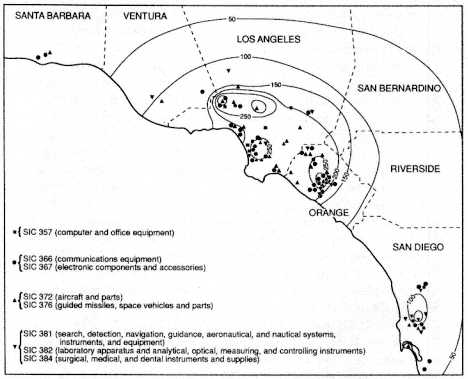
Figure 3.5
Southern California high-technology industrial establishments with 1,000 or more workers.
SIC codes conform to the 1987 Standard Industrial Classification. Isolines designating
accessibility levels to all aerospace-electronics producers in the region are shown.
(Data from California Manufacturers' Association, California Manufacturers' Register ,
Newport Beach, Database Publishing Co., 1990.)
figure 3.5 sharply delineate four of the major high-technology industrial districts of Southern California, i.e., (a) the San Fernando Valley area to the northwest of central Los Angeles, (b) the El Segundo-Hawthorne-Inglewood area to the southwest of central Los Angeles, (c) northern Orange County, and (d) the San Diego area.
The striking feature of figure 3.5 is the fact that large establishments concentrate for the most part in and around the major high-technology industrial districts. Contrary to what we might expect on the basis of presuppositions about the location of land-intensive economic activities, large establishments are for the most part not to be found on the cheapest land toward the far periphery of the entire
urban system; nor, certainly, are they to be found at the center of the entire metropolitan system; rather, they cluster to a significant degree at intermediate locations where local levels of accessibility to suppliers are comparatively high. The locational association between large establishments and the main high-technology industrial districts suggests that there is a spatial and functional symbiosis between these establishments and the rest of the production system. Despite the internal economies of scope that characterize large systems houses, they typically have massive and multifaceted demands for externally supplied material inputs and subcontract services. We know that some of these inputs come from far beyond the confines of Southern California. We also know that there is a remarkable intraregional network of economic transactions in the region focused on large producers.
The latter point can be dramatically exemplified with data on subcontracting patterns for NASA prime contractors. In fiscal year 1989, there were five major NASA prime contractors in Southern California who individually awarded more than $1 million in subcontracts to first-tier subcontractors (NASA 1989). The five prime contractors were the California Institute of Technology, General Dynamics, McDonnell Douglas, Rockwell International, and TRW. These five institutions held twenty different NASA prime-contract awards at eight different locations in Southern California in 1989. In total, they gave out 4,787 first-tier subcontracts worth $10,000 or more each. Of these, 2,698 (56.4 percent) were awarded to Southern Californian producers, and they constituted 38 percent of the aggregate $1,540 million given out. The fact that significantly more than half of the contracts awarded went to local firms, and that these contracts also represented much less than half of the total dollar amount subcontracted out, signifies that intraregional short-distance linkages are biased towards smaller transactions. Out of the total of 4,787 first-tier subcontracts nationwide, 648 second-tier subcontracts worth more than $10,000 each were awarded in turn. In this second subcontracting tier, 208 contracts (31.1 percent) were given out to Southern Californian producers and they represented 49.2 percent of the aggregate value of all second-tier subcontracts. Many of the 208 second-tier subcontracts awarded to Southern Californian producers originated from outside the region and thus they comprise a blend of long-distance and short-distance linkages.
Large aerospace-electronics establishments in Southern California thus have major impacts through their procurement practices on local
economic growth and development. These impacts eventually filter down through the region's transactional networks to the very smallest subcontractors and service suppliers. Unlike mass-production industries, which have often had an inimical effect on industrial districts by initiating a dynamic of horizontal and vertical integration combined with decentralization of routinized branch plants, the systems houses of Southern California have consistently played a very positive role in helping to sustain the wider local industrial base. The fact that they are gradually shrinking in size and importance over the course of time suggests that they may be continuing to play an important role through the spinoff and externalization of particular functions. However, since the late 1980s, they have been much affected by severe cutbacks in federal defense expenditures that have resulted in significant layoffs and plant closures, with disastrous consequences for lower tiers of subcontractors in the region.