
Mak Shamsiah and her Demons
Mak Shamsiah was born in Bogang in about 1935 and was thus about forty-three when I first met her in 1978. The youngest of six children,
she belongs to one of the village's gentry clans (Lelahmaharaja), and is, like Maimunah, a member of the clan's wealthiest and most prestigious and powerful lineage (perut darat , the "upland lineage"). Unlike Maimunah, however, Mak Shamsiah's immediate kin include the former governor of a neighboring state (her mother's brother, now deceased) as well as a highly placed national-level politician (her older brother). Another of Mak Shamsiah's brothers holds the title of clan subchief (buapak ), and is thus the highest ranking adat figure in the village. Mak Shamsiah's sisters, I might add, are also quite wealthy, and both of them have made the pilgrimage to Mecca (one went twice). Mak Shamsiah and her husband, who are very well off as well, were scheduled to make the pilgrimage in 1980, but due to the severity of Mak Shamsiah's illness, her husband felt it best to postpone the trip. They finally went to Mecca in 1985.
During my first fieldwork I saw Mak Shamsiah on many occasions since she lived in the house next door, but I didn't get to know her all that well because she was severely depressed and often seemed extremely disoriented and altogether incapable of any form of verbal communication. One of my main recollections of her from the first fieldwork was seeing her sitting in the corner of her sister's kitchen, looking anxiously about, while a group of lineage sisters and other women prepared food for a feast. I remember, too, being warned by women and others present not to walk or stand behind her lest she get startled and "have an attack." I did get to know her husband, however, who discussed many of his domestic and other concerns with me, including his wife's illness. And I had a number of conversations with Mak Shamsiah's widowed mother (Wan), who lived with Mak Shamsiah and her husband and young son. I also spent a fair amount of time with Mak Shamsiah's nine-year-old son, Hassan, who was my companion and buddy until I got married (at which point he became "too shy" to hang around the house) and her nineteen-year-old son, Kadir (described briefly in the discussion of pondan in chap. 3), who had moved to Kuala Lumpur but frequently visited Bogang on weekends. I did, moreover, spend a good deal of time with Mak Shamsiah's brother and two sisters (and their families). During the first fieldwork, then, most of what I knew of Mak Shamsiah came from her relatives and neighbors, and not from Mak Shamsiah herself.
In 1952, when Mak Shamsiah was about seventeen years old, she married a cross-cousin (Pakcik Hamid) from a neighboring village, who was chosen for her by her relatives. Pakcik Hamid worked as a policeman in the predominantly Chinese city of Singapore, and shortly after the marriage Mak Shamsiah joined him there, where they took up residence in
the local police barracks. In the years that followed her move to Singapore, Mak Shamsiah gave birth to six children (three boys, three girls), one of whom (a boy) was severely deformed and died shortly after being born. She knew during her pregnancy with this child that something was wrong, for she felt unusually sick, not just dizzy or tired, and her belly quickly grew very large. When the baby was born it made one small noise and just stopped breathing. It had no cranium and its arms and legs were curved inwards at strange angles and could not be straightened out. When the imam came to read prayers (baca doa ) and prepare for the funeral, he told Mak Shamsiah and her husband that they were fortunate that the baby was taken back by God so quickly. Otherwise, he said, life for the family would have been very difficult, as the child never would have had a normal life. He comforted them with words to this effect, reassuring them it was better this way.
After moving to Singapore, Mak Shamsiah became quite ill, though it is not clear when her illness began. By her own account, the onset of her illness dated from shortly after her move to Singapore, though before she had any children, hence sometime around 1953. This was before her husband settled down to the idea of marriage and stopped staying out late at night. He had been very handsome as a young man, Mak Shamsiah told me, and was "dark and good looking, like a Hindustani." He had a roving eye, however, and before their marriage he had seriously considered marrying a Chinese woman, a plan which was foiled by the latter's relatives, who refused to entertain the idea of her converting to Islam. In any event, during my first period of research from 1978 to 1980, Mak Shamsiah was still debilitated, though living back in Bogang with her husband and children. In 1987 she seemed much better, though I was informed that she still experienced bouts of severe illness.
Mak Shamsiah's illness and misfortune have manifested themselves in various ways: the previously noted birth of a deformed child who died immediately after being born; a lack of interest in caring for one of her other children when it was born; her refusal to greet people and perform basic chores and responsibilities seen as central to her role as a married woman (such as cooking rice and washing clothes); and her dancing at night by herself. During the first period of fieldwork, Mak Shamsiah seemed to spend much of the time sleeping, and her husband and mother took over many of her chores. When she did appear outside the house, she seemed extremely disoriented and depressed.
The first and seemingly most widespread account of Mak Shamsiah's problems (the "official" household and lineage version) refers back to the
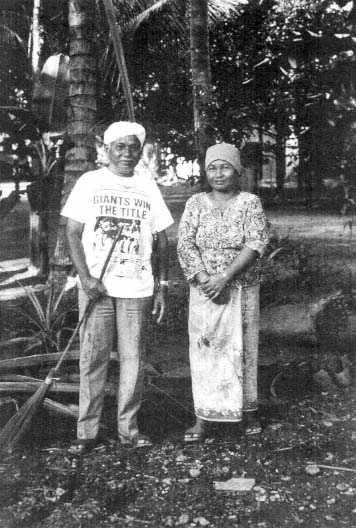
Figure 15.
Mak Shamsiah with Pakcik Hamid
time when she and her husband lived in Singapore. One day while Mak Shamsiah's husband was away at work, a Malay dukun from Negeri Sembilan who Mak Shamsiah or her husband had sought out on a previous occasion came to the house and proclaimed his romantic interest in her. Mak Shamsiah reportedly attacked him with a broom and/or slammed the door in his face. The amorous dukun was gravely incensed by this rejec-
tion, and he cast a spell on her, which affects her to this day: Whenever he thinks of her, for example, she thinks of him; she also hears voices (including the dukun 's?) that tell her to dance, not to work or cook rice, and so on.
The second explanation of Mak Shamsiah's personal misfortune comes from Mak Rahmah, a relatively wealthy cousin who belongs to Mak Shamsiah's "lineage branch" (pangkal ), and who is also one of her immediate neighbors. Though Mak Rahmah knows and apparently believes the story of Mak Shamsiah's encounter with the amorous dukun in Singapore, she also holds that Mak Shamsiah's illness is at least partly a result of Mak Shamsiah's throwing her trash over her fence into the vacant lot next door. This disturbs and insults the spirits (jinn ) residing there, and they have taken their vengeance on her either by helping bring about her illness in the first place or by prolonging it. Mak Rahmah also told me that because Mak Shamsiah does not pray much, she has not gotten better, although she (Mak Rahmah) also realizes that the illness is responsible for her lack of prayer.
The third explanation of Mak Shamsiah's illness comes from Mak Zaini, a relatively poor clan sister who lives on the other side of the village and who belongs to a lineage with which Mak Shamsiah's lineage has been at odds for quite some time. Interestingly, two of the principal actors in the feud involving the two lineages are Mak Shamsiah's older brother—the highest ranked adat figure in the village—and Mak Zaini's older brother, who has also held clan titles in the past and is, independently of his titles, a local "big man" with a reputation for "getting things done" and for using ilmu to attract followers and supporters and enhance his prestige. The details of the feud need not concern us. What is important here is that Mak Zaini's explanation of Mak Shamsiah's illness focuses on a grave offense against "ancestral property" (harta pesaka ) and the traditions of the ancestors that was committed, she says, by Mak Shamsiah's mother's brother, Datuk Abdul Ghani. The offense involved a gold keris and other gold jewelry or ornaments that one of Mak Zaini's relatives had asked Datuk Abdul Ghani to store in his house for safekeeping. Mak Zaini's ancestors owned this ancestral property, but they were poor and lived in a dilapidated, bamboo-slat house, and they thought it wise to have someone else keep it for them. Datuk Abdul Ghani's crime is that he later turned around and sold it, and kept the proceeds. And this offense is what caused Mak Shamsiah's illness. It was wrong (and dangerous) because the property did not belong to Datuk Abdul Ghani (he had no right to sell it) and because ancestral property like this should
not be sold (or mortgaged) since it is sacred and reminds villagers of their parents, grandparents, and great-grandparents. Mak Zaini reassured me that she would never have the courage to sell any such property, even if adat allowed her to. She added that those who sell ancestral property are likely to become gila (crazy, insane) and even die. It is thus "natural," "only to be expected," Mak Zaini told me in 1980, that Mak Shamsiah cannot get out of bed, sleeps much of the day, and is otherwise unable to function. If Datuk Abdul Ghani escaped unharmed or somehow avoided the repercussions of his actions, his children and other descendants would surely suffer one way or the other.
The fourth explanation of Mak Shamsiah's illness comes from her son, Kadir, who works and lives in the largely Chinese city of Kuala Lumpur, where he has spent most of his time since leaving school. Kadir and I spoke about his mother's situation in 1979, when Kadir was about nineteen years old. He told me that he did not accept the conventional wisdom concerning his mother's disorders, which holds that her problems stem from the amorous dukun casting a spell on her. He believes that his mother is simply a very anxious person; she worries too much about her children, Kadir explained, and she fears they will consort with drug addicts and other types of "bad people" (orang jehat ) in the city. She probably worries that he has a girlfriend, Kadir added, and that the girlfriend is not the "right type." (On this count some of her fears seem well grounded, for as Kadir pointed out, he does have a girlfriend, and she is half-Indian and half-Chinese; the girlfriend enjoys going to discos, as does Kadir, spending money, and having a good time; on top of all this, she doesn't have any interest in cooking and other household chores.) Putting his comments in a larger context, Kadir went on to say that he doesn't believe in ghosts and spirits, and that he views the village's sacred shrines (keramat ) and the various rituals associated with them—along with ritual feasts at the graveyard—as against the teachings of Islam. All such things are tied up with "superstition," and reflect a lack of formal education and a relatively shallow understanding of Islam.
These, then, are the four different interpretations of Mak Shamsiah's illness that I encountered in Bogang. Despite the underlying structural similarities in these accounts (about which more in a moment) there are important differences. Contrasting features of the four accounts include, most obviously, the types of relationships held to be at the heart of the problem (which involve suitors, spirits, clansmen, and children); the types of emotions assumed to have engendered Mak Shamsiah's illness (unrequited love, feelings of rejection, loss of face); proprietary anger and be-
trayal (on the part of local spirits and clansmen alike); and parental anxiety.
Other contrasts involve the issue of mystical agency. In the first account, mystical agency manipulated through the ilmu of a rejected suitor cum dukun is responsible for Mak Shamsiah's afflictions. In the second account, mystical agency is realized in the actions of spirits, who are held to be at least partly responsible for these afflictions. The third account makes reference to mystical agency as well, but does not specify the medium or channel through which this agency comes into play. And in the fourth account there is no reference to mystical agency.
The fourth account, it will be recalled, comes from Mak Shamsiah's son, Kadir, who works and lives in Kuala Lumpur, and is in many ways far less "traditional" than the majority of Bogang's full-time residents. We could perhaps generalize here and conclude that Kadir's disinclination to invoke mystical agency and any type of human malevolence in his account of his mother's illness reflects the experiences and perspectives of Malays in urban areas, and of "modern" Malays in general. There are no solid grounds for this conclusion, however, even though some of Kadir's experiences and comments obviously resonate with the more cosmopolitan orientations found among many urban and "modern" Malays. In fact, as Provencher (1979:48) discovered on the basis of his research among Malays in the Kuala Lumpur area, "most urban Malays who become ill suspect that they have been poisoned"; more importantly, as I discuss below, "the fear of [poisoning and] sorcery is greater ... in urban communities than in rural villages" (emphasis added).
As for the underlying structural similarities, all four accounts interpret Mak Shamsiah's illness both relationally (in terms of Mak Shamsiah's social relations with others) and in a moral framework. These generalizations hold even for Kadir's interpretation of Mak Shamsiah's illness, which focuses on her anxiety concerning her children, the urban, primarily non-Malay, social fields in which they find themselves, and their prospective spouses and mates. In addition, all four accounts speak to social relations that are strained, alienated, or otherwise disordered, and that are fraught with ambivalent and/or contradictory sentiments and behavior (e.g., the suitor who turns on and harms the object of his affection, the normally quiescent spirit who attacks). Other similarities include actual or potential breakdown or failure in reciprocity, reproduction, or both; and loss of autonomy and social control due to actions of people (suitors, relatives, or others) or spirits (or both) who (mis)appropriate power for their own individualistic and otherwise socially divisive ends.
Seven Years Later
During my second period of fieldwork I spent a great deal of time with Mak Shamsiah, for by this time her illness had abated somewhat and she was quite outgoing and communicative, though still very moody and given to episodes of screaming and occasional frenzy. The house we lived in during the second fieldwork was next door to Mak Shamsiah's (as the first had been), and its location was highly conducive to our interaction with her since, unlike our first house, it was not separated from Mak Shamsiah's by a small ravine and wire fences. It wasn't simply the location of our house, however, that led us to seek out Mak Shamsiah (and vice versa); for she was extremely friendly and warm to us (e.g., she took an instant liking to Zachary, and was forever treating him to sweet cakes, fruits, and other local delicacies), and we thoroughly enjoyed her company. Because Mak Shamsiah and Kak Suzaini (the woman who cooked for us and became one of our dearest friends) were so close, we had additional reason to spend time with her.
Though she now was "much better," both she and her husband told me (as did others) that she was not altogether cured. As she put it on one occasion when I asked her if we could discuss various aspects of gender, "Why do you want to ask me all sorts of questions when my mind [still] isn't right?" I do not have any detailed information about the timing of Mak Shamsiah's partial recovery; the only explanation I heard was that the amorous dukun in Singapore had died, and that, being dead, he could no longer exert any control over Mak Shamsiah. (I would have liked to know more about the timing of the onset of Mak Shamsiah's mother's senility; e.g., if it helped "jar" her into good health, or, alternatively, served to prolong her illness, but I have no accurate information on this.)
I never asked Mak Shamsiah about the cause(s) of her misfortune(s), for it seemed too delicate a subject, especially since she still experienced bouts of severe illness, and I feared that questions on the topic might conjure up unpleasant and painful associations and thus "set her off." She brought up the subject on a few occasions, however, remarking, for example, that the onset of her illness began before her husband had settled down to the idea of marriage. She mentioned as well that during the early part of her marriage he frequently berated (and sometimes struck) her, and that there were many pantang (taboos) that she failed to observe. She also recounted that earlier in her marriage she "worried a lot" about Pakcik Hamid and Kak Suzaini. Kak Suzaini had a habit of coming to the house in the evening with her children, ostensibly to watch television, but
she was frequently wearing makeup, along with sleeveless and rather low-cut, revealing blouses. Pakcik Hamid and Kak Suzaini would laugh and laugh until late in the evening—long after Mak Shamsiah had gone to bed—and though she brought her children with her, they often fell asleep on the verandah and thus could not serve as chaperones or obstacles to any form of intimate behavior. Mak Shamsiah informed Pakcik Hamid she didn't like this type of behavior, and he stopped. She also told him, half-jokingly, that while she wouldn't mind if he took another wife after she died (she was convinced that he would outlive her), she would "slit his throat" if he did so while she was still alive.
In other conversations, which focused largely on gender, Mak Shamsiah told me that women are more susceptible to spirit possession than men because, compared to men, women have "less" or "weaker" semangat . Similarly, women are more prone to latah because they "worry" (susah hati ) more than men and are more easily "startled" (runsing ). More generally, whereas women and men have the same "rationality" (akal ), women's "passion" (nafsu ) is stronger than men's. God made them this way; and this is why they have a stronger sense of "shame" (malu ). If they didn't have stronger "shame," their "passion" would be even more obvious than it already is, and they would be more "ferocious" and "wild" (ganas ) than men are. She mentioned, too, that women are often more "fierce" (garang ) than their husbands.
While in previous years Mak Shamsiah had obviously been quite anxious about her relationship with her husband—and perhaps especially concerned that difficulties in their marriage could lead to its dissolution and thus call into question her own relevance to the ongoing reproduction of her household and lineage—she was no longer. In fact, one of the more unusual things about her during the second period of fieldwork was how communicative she was about her husband, her positive feelings for him, and her apparent security in the relationship. I remember seeing her wearing her husband's sarong on various occasions, and when I asked her if it was his she replied yes and then explained that she "missed him" when he spent much of the day out of the village at his garden (kebun ), and that wearing the sarong helped remind her of him. Such admissions of positive affection and intimacy between husband and wife are, in my experience, relatively unusual. Moreover, she sometimes commented on what a "good man" he was, how kind he had been to her during all the years that she was ill, and that he could have abandoned her, as many of his friends and relatives apparently told him to do, especially since he had
a salary/pension, an automobile, and was otherwise highly desirable and thus could have easily found another wife.
Mak Shamsiah's relationship with her husband was no longer a major source of anxiety or concern, but she was very much preoccupied with the circumstances and relational dilemmas of other members of her household, such as her son Kadir, who, as noted earlier, had a non-Malay, "mixed-race" and (by local standards) otherwise extremely inappropriate girlfriend, and expressed no interest in getting married. Her main problem, though, was her eighty-six-year-old mother, Wan, who had become quite senile, and was subject to recurring hallucinations and nightmares. Wan, who was exceedingly thin and commonly refused to eat, spent much of her time hunched over in the compound, picking weeds (and occasionally eating rotten fruit that had fallen from rambutan and other fruit trees), but she was also given to wandering around the village in a daze, especially in the late afternoon and early evening hours. During these forays Wan often invited relatives and neighbors to imagined feasts, thus recalling both the grandeur of her healthier days and the time when her husband was still alive. These invitations were received good-naturedly, and Wan was in fact humored in many situations. For the most part, however, Wan was regarded as a terrible nuisance, and was the object of much ridicule and scorn. Some of her closest relatives locked their doors and the gates surrounding their wells when she appeared in their compounds, drove her away, and otherwise treated her "like dirt." This upset Mak Shamsiah tremendously, particularly since, as Mak Shamsiah pointed out to me on numerous occasions, many of these same people had frequently partaken of Wan's generosity when she was still healthy. In some ways more distressing, though, was Mak Shamsiah's fear/premonition that Wan would get run over and killed by the train which passed through the village. Mak Shamsiah had forbade Wan to cross the railroad tracks, but Wan didn't listen—or simply forgot—particularly since she needed to cross the tracks to get to the kedai one of her daughters operated, and to attend the mosque.
Wan's behavior created problems in Mak Shamsiah's relationship with her husband. Her hallucinations and nightmares made it extremely difficult for Mak Shamsiah and her husband to get a good night's sleep. And Wan claimed that Pakcik Hamid was "always hitting her" and "wanted to kill her." This was most likely an exaggeration, though on one occasion, when Wan was tearing down clean laundry that had just been hung out to dry, I did see him strike her with a long bamboo pole. More generally,
both Mak Shamsiah and her husband mentioned that their lives were not at all "their own" since they had to watch Wan all of the time. They couldn't even go to Singapore to visit their daughter and grandchildren, particularly since doing so would require taking Wan with them (an impossibility) or leaving her behind (also impossible, because "there was no one to care for her" [even though three of her other children lived in the village]).
Wan's behavior also exacerbated tensions in Mak Shamsiah's relations with her brothers and sisters (though the fact that Wan was alive also kept some of these tensions in check [see below]). This was because Mak Shamsiah shouldered virtually all of the responsibility for looking after Wan, even though she was one of six children. When Wan could still cook and work, everyone used to welcome and love her; now that she had "lost her mind" and "reverted to childhood," she couldn't do any of these things anymore, and no one wanted to look after her. To make matters worse, Wan wouldn't let anyone else take care of (even bathe) her, even though she spoke fondly of her son Haji H., claiming (falsely) that he gave her money and other presents, and was otherwise very good to her. But Haji H. wouldn't even come to "look at her face" or visit her, even though he came to this part of the village (e.g., to talk with the anthropologist) now and then. Mak Shamsiah's two sisters (Wan's other daughters), for that matter, didn't do anything except help give her a bath once in a while. Mak Shamsiah went on to say that she didn't want to speak ill of her brothers and sisters (literally: cause them to stink or rot [busukkan saudara ]), but they just didn't do anything for Wan, even though she was mother to all of them.
Mak Shamsiah frequently told me—and anyone else who cared to listen—that she didn't know what she was going to do if Wan "lives to be one hundred." The problems would only get worse, she lamented, with much frustration—and desperation—in her voice.
Wan's advanced senility, which in many respects (e.g., its debilitating effects) paralleled the earlier (more severe) forms of Mak Shamsiah's illness, brought into painfully sharp focus what many villagers saw as the uncertainties and dangers inherent in aging and social reproduction. To wit, that once they ceased to be (re)productive and thus of value to their kin and society at large, they would be cast aside and otherwise mistreated and abused, and would thus experience rather severe (if not complete) loss of autonomy and social control. Such treatment entailed the most heinous violation of norms informing relationships between children and their parents, yet it was a common theme in the everyday discourse of villagers,
particularly women. So, too, was the theme of ambivalence, alienation, and tension among siblings, which also figured into Mak Shamsiah's account of her dilemmas with Wan. Interestingly, however, while Mak Shamsiah cited the problems Wan's behavior created with her (Mak Shamsiah's) siblings, she made no reference to the fact that the problems would most likely become far more pronounced after Wan's death. Such a scenario was highly probable since Wan would no longer be around to mediate petty disputes and everyday tensions and antagonisms—and otherwise articulate social relations—among her children. Nor would she be able to serve as a palpable symbol of their common interests and identities. There was, moreover, the issue of the land and other property owned by Wan that would have to be divided among her children after she died. This was potentially a source of great tension and strain, even though the land (especially residential and rice land) has relatively little monetary value in today's economy.
The concerns—with articulating social relations, preserving peace and order within the family, and looking after reproduction in both the social and biological senses of the term—that surface in Mak Shamsiah's account of her problems with Wan resonate deeply with the common themes underlying the various interpretations of Mak Shamsiah's illness that I discussed earlier. Such concerns are, to reiterate my earlier point, quintessentially (though by no means exclusively) female. Men's concerns with the articulation of social relations, peace, order, and reproduction are in many respects both parallel and complementary to those of women, though they tend to be cast in terms of more expansive social units (lineage, clan, village, religious community, and ethnic/racial grouping) and in different idioms (political, religious, ethnic/racial). They are, moreover, frequently expressed in different, more public arenas (village councils, local political party organizations and activities, prayer houses and mosques) that have long been associated with maleness.
It would be a mistake to overvalorize these contrasts, however. For men no less than women are susceptible to, and victimized by, mystical attack (though this is commonly glossed over in the literature). And while the forms of mystical attack vary (with women being more subject to dramatic episodes of possession by spirits, and men more likely to be afflicted by slow wasting away), the attacks on men and women alike are experienced—and interpreted by others—as testimony to the dilemmas inherent in reciprocity and reproduction. The following case study will serve to illustrate the point.