
Nelson Mandela:
Liberation Not Power
"I have fought against white domination, and I have fought against black domination. I have cherished the ideal of a democratic and free society in which all persons live together in harmony and with equal opportunities.
It is an ideal which I hope to live for, and to see realised. . . If needs be, it is an ideal for which I am prepared to die."
Famous words. Words spoken by Nelson Mandela from the dock before being sentenced to life imprisonment in June 1964. Having already been in prison since November 1962, he would have a total of more than twenty-seven years imprisonment behind him when again he addressed the nation. A huge crowd gathered on the Grand Parade in Cape Town to celebrate his release on 11 February 1990. He used these same words, saying that they are as applicable today as they were in 1964.
His enemies robbed him of the best years of his life. They also failed in their mission. Mandela became the world's best known and most respected prisoner. Now free (although still without a vote in the land of his birth) he is devoid of all bitterness, introversion and despair.
Religion
Mandela's imprisonment is a kind of religious symbol; it is a summary of his 'bottom-line' values, the things that he considers worth dying for. I am keen to discover what sustained him during those long years, enabling him to emerge from isolation with the gentleness, strength and continuing resolve that characterise his person. Having spoken for some time, the question of religion emerges. "The relationship between a person and his or her God is a deeply intimate and private matter. It is not a matter I usually regard as open for public discussion. . . There is a sense in which, for me, it is a matter beyond articulation. It is an experience I do not fully comprehend." Does he regard it as important to endeavour to comprehend this reality? "I think it is more important to live in accordance with one's deepest values and convictions, whether religious or otherwise, rather than to fully understand them. But yes, I suppose all of us try to some extent to make sense of what drives us."
As he is not ready to say much more about this understanding, I ask whether he thinks religious belief is an important ingredient of life. Is it important for his life? Does it contribute to the well-being of society?
Yes, I certainly recognise the importance of the religious dimension of my own life. More important for me, however, is the significance of religion for countless numbers of people I meet both in South Africa and around the world. Religion is important because at the centre of the great religious traditions is the pursuit of peace. South Africa needs peace, the world needs peace and I
am convinced that if we were to put into practice the central tenets of Christianity, Judaism, African traditional religions, Buddhism, Hinduism, Islam and other faiths—all of which have a lot in common—there would be peace in the world. . . I have no problem with religious belief. My problem is that all too often people fail to act on what they claim to believe.
Religion is about mutual love and respect for one another and for life itself. It is about the dignity and equality of humankind made in the image of God. This is a God who, if I understand the Bible correctly, requires us to be engaged in the actual fight against evil, poverty, disease, illiteracy, the lack of housing and other social ills in society. I have enormous respect for religious people in our country who have been at the forefront of our struggle. They live their faith and I deeply respect the faith which they proclaim. I think of people like Michael Scott, Trevor Huddleston, Archbishop Tutu, Frank Chikane and many others.
Having spoken of the contribution of religious people to the history of the African National Congress—people like the Rev John Dube (first president of the ANC), Chief Albert Luthuli, Canon Calata, Z. K. Matthews and others—Mandela speaks of the ministry of chaplains he met on Robben Island. "Most of these men understood my convictions; some of them shared my values." He mentions Father Alan Hughes of the Anglican Church: "He was always willing to share pieces of information denied to us on the island. He helped us keep in touch with the wider community, locating his religious message within the broader context of life. His religion was an impressive spiritual understanding of life—never something separate from it." He remembers Rev André Schäfer of the NG Kerk in Afrika, "as being hostile towards us at first, but later becoming one of the best liked chaplains". Mandela was particularly intrigued with the historical and scientific information which Schäfer wove into his sermons. "I remember him telling us of astronomy confirming the appearance of a particularly bright star or cluster of stars in the heavens at the time of Christ's birth. . . The way in which he integrated natural phenomena and historical events with religious stories and ideas provoked numerous discussions among the prisoners in our block." Mandela speaks too of Theo Kotze, who was a Methodist chaplain for a while. "The government regarded him as being too political, and he was prevented from visiting the island." Mandela emphasises the ecumenical approach of the chaplains who came from different denominations of the Christian Church and ministered to all "without ever asking who belonged to what Church
or religion. I never missed a service and often read the scripture lessons. . . Come to think of it, I was quite religious". Equally important for him were the religious services provided by other faiths: "I particularly enjoyed the visits of Imam Abdurahman Bassier with whom I had long conversations, remembering that it was Maulvi Cachalia who first outlined to me the basic tenets of Islam many years earlier. It was an enriching experience for me to gain a deeper knowledge of a religion other than my own." He knew of the existence of a kramat on the island, said to be that of Tuan (or Sheikh) Mantura. "The religious convictions of people like the Sheikh move me quite deeply. It was his faith that drove him to resist Dutch imperialist designs in South-East Asia, for which he was exiled and imprisoned on Robben Island in the mid-1700s. That kind of religion must be taken seriously." Mandela wrote to Sheikh Omar Gabier in March 1985 of his visit to Sheikh Mantura's tomb: "I literally harassed the commanding officer of the prison for permission to visit the kramat. Permission was finally granted only in 1977. That was a day which I will not easily forget. Symbols and monuments, especially those which represent great movements or national heroes, can move one beyond words. My fellow prisoners and I spent more than an hour at the shrine and came away feeling proud and happy that we were able to pay our respects to so great a fighter for justice."
After being moved to Pollsmoor Prison Mandela missed the variety of worship to which he had become accustomed. At Pollsmoor, prisoners were only allowed visits by representatives of the specific Church or religion to which they belonged. "This was a source of great disappointment to me. It turned out, however, that it was also an occasion for me to develop a friendship of great importance with Rev Dudley Moore, the Methodist chaplain. He visited me on a frequent basis and I received Holy Communion from him regularly. To share the sacrament as part of the tradition of my Church was important for me. It gave me a sense of inner quiet and calm. I used to come away from these services feeling a new man."
Would he then regard himself as a religious person? "No, I am not particularly religious or spiritual. Let's say I am interested in all attempts to discover the meaning and purpose of life. Religion is an important part of this exercise." Does he believe in a God? "As I have said, the relationship between a person and God is personal. The question concerning the existence of God is something I reflect on in solitude."
I am about to change the subject when Mandela quotes a verse from
the same poem (written by Tennyson) which Govan Mbeki quoted in an earlier interview. He too tells me that Alexander Kerr, the rector of Fort Hare University during their student days, often quoted these words:
Strong Son of God, immortal love,
Who we, who have not seen thy face
By faith and faith alone embrace,
Believing what we cannot prove.
I tell him that Govan Mbeki recalled these words in the same way, insisting that he is an atheist. "Oh, no!" he volunteers, "I am not an atheist. Definitely not."
Prison
A lot happens at a personal level during twenty-seven years: there was the death of his aged mother Fanny Mandela in 1968; the death of his son Tembi a year later, the detention and torture of Winnie Mandela; her banning and banishment to Brandfort; news of an attempt on her life; the burning of his Soweto home and much more. There were decisions to be made and moments of joy in which he could not share directly: the education of children, the birth of grandchildren. "These are the things that made me most aware of isolation," he observes. "One of the greatest joys after my release was the privilege of closing the front door and sharing privately in the decisions which any family person is required to make. In some ways the violation of this right was the most painful part of my years in prison."
Mandela talks about prison: "Work on the island was very demanding, but it had its own sense of joy. The rock formations, the sea, the wind, the fresh air, and the bird life; that were part of the island, kept us going."
You know, just to look at the sea and to consider its width and sometimes to test its depth along the edges of the island, insofar as we were allowed, was for me more than a physical experience. Isolated from society, I was able to become one with nature. I watched the tides come in and go out. There was the movement of ships. I considered the rock formations. I enjoyed the elements even when they were harsh, and I looked forward to the changing seasons. Nature came to be very important for me. It sustained, invigorated and inspired me.
Nature was important but so were people. He speaks of the deep
personal bonds which he forged with others in prison, especially with other Rivonia trialists. He has a special appreciation for the discussions he had with Fikile Bam and Neville Alexander, who were members of the National Liberation Committee at the time. "Politically we differed but intellectually those fellows enriched me," he notes. He remembers working in the quarries and elsewhere on the island with fellow prisoners with whom he had no opportunity to meet in other circumstances. "We talked as we worked—those were tough but formative years which we spent together. Sometimes we became so engrossed in conversation that the guards regarded us as neglecting our work."
How does he feel about the guards and other prison authorities? "Of course there were some unpleasant characters, but also some essentially good people. . . I still keep in touch with some of the warders." It was on Robben Island that he first met Lieutenant James Gregory, of whom he speaks with respect, and Warrant Officer Swart, who was then an ordinary warder. Mandela again met up with Swart at Pollsmoor Prison and, when later he was sent to Victor Verster Prison, Swart was appointed to cook for him. "I enjoyed a most pleasant relationship with that fellow. He was without any racial or other prejudices. Just a good human being."
"We have got to learn to live together, to transcend our prejudices, to resolve our differences amicably, to respect one another and together to reach towards co-operation and attainable common goals. Those are some of the things that I learned in prison. I think religion, when it is taken seriously, can help us attain these goals."
Leadership
Mandela speaks of his understanding of political leadership: "Leaders are important but history is ultimately not made by kings and generals. It is made by the masses—workers, peasants, doctors, professional people and the youth. If a leader ignores the masses he or she is ultimately compelled to resort to tyranny to remain in power. Leaders at the same time have an obligation to lead; they are required to move their people forward, from where they are at a given time, to where they are required to be. This what makes the relationship between leaders and the people so complex."
Mandela is a man of the people. His popularity as a leader is self-evident. He is also his own person. He refuses to reduce his vision and insights to those of his constituency—even if this would
produce certain short-term political gains. We saw this in the United States when he refused to condemn the Arafat-Castro-Gadhafi trio, even when the liberal establishment courted and tried to seduce him into doing so. He has defended the Palestinian Liberation Organisation in the face of Zionist attacks, both at home and abroad. Having lured and courted the Muslim community in the historic Bo-Kaap during a visit to Cape Town in 1992, he shocked his audience by insisting that he recognised the right of the State of Israel to exist.
It is precisely this ability to withstand the manipulation of others that enabled Mandela to walk out of Victor Verster Prison with his head held high. He refused to succumb to the threats and rancour of the state. He is equally impervious to the charm of some of the most seductive lobbies.
The School of Life
How does Mandela account for these values? "My values and my life have been shaped by the circumstances and the history that I have lived through. Like anyone else, I am a consequence of the rough and tumble of my context." Mandela's life has been an eventful, demanding and fearful one. And yet, he insists, "I consider myself extremely privileged to have lived through these times. Given the realities of history which cannot be wished away, I have few regrets. . . Although, I wish there had been less suffering and death for our people."
Mandela was born in the small village of Qunu in Transkei, into the Tembu royal family, on 18 July 1918, to Chief Henry Mgadla Mandela (chief councillor to the Paramount Chief of the Tembu) and his fourth wife, Nonqaphi Nosekeni. Although groomed to become a chief, he recalls his household chores, which included herding cattle and helping to plough his parents' fields. Above all he recalls with fascination the stories about the great leaders of his people. He told the court during his treason trial:
In my youth in the Transkei, I listened to the elders of my tribe telling stories of the old days. Amongst the tales they related to me were those of wars fought by our ancestors in defence of the fatherland. The names of Dingane and Bambatha, Hintsa and Makana, Squngathi and Dalasile, Moshoeshoe and Sekukhuni, were praised as the pride and the glory of the entire African nation. I hoped then that life might offer me the opportunity to serve my people and make my own humble contribution to their
freedom struggle. This is what has motivated me in all that I have done in relation to the charges made against me in this case.
Whilst attending the local mission school, Mandela had been given history books which told different stories. These were the stories of white heroes and black people who were seen to be cattle thieves and trouble-makers. While questioning these stories at school, he had continued to hear stories of more recent events at home. He was told how in 1921 the police massacred 163 men, women and children who had gathered under the prophet Enoch Mgijima, refusing to leave the village of Ntabelanga near Bulhoek. He had further learned of planes being used to bomb the Bondelswarts people in the mandated territory of South West Africa (now Namibia) because they refused to pay a dog tax. These were events lodged in the memory of the young Mandela whose political awareness was beginning to be formed. By 1930 his father was an ill man. Realising he was dying, Mandela's father presented him to David Dalindyebo, the acting Paramount Chief of the Tembu, who took responsibility for the twelve year old boy's education and upbringing.
Having matriculated at the Healdtown Institute in Butterworth, Mandela studied at the University of Fort Hare but, after leading a student boycott of the SRC election in his third year, he was suspended. Returning home to Dalindyebo's Great Place, Mqekezweni, Mandela was told by the Paramount Chief to accept the college ultimatum and abandon the boycott so that he could complete his studies. Almost ready to obey and hoping to avoid an arranged tribal marriage, he fled to Johannesburg where he was employed as a mine policeman. He was traced by relatives, but he eventually managed to persuade his guardian that it would be better for him to remain in Johannesburg to study Law. He found a room in Alexandria (a sprawling black township on the north-east edge of Johannesburg), completed his BA degree through the University of South Africa and studied Law at the University of the Witwatersrand. He met and established a life-long friendship with Walter and Albertina Sisulu, and eventually opened the first black legal partnership in South Africa with Oliver Tambo.
Mandela became National Secretary of the ANC Youth League. In 1949 it took control of the ANC; which resulted in Dr A. B. Xuma being replaced as President by Dr James Moroka. Mandela was elected to the National Executive, became Youth League President in 1950 and in 1952 he became President of the ANC in the Transvaal and Volunteer-in-Chief in the Defiance Campaign. In the same year
he was charged under the Suppression of Communism Act and given a nine-month suspended sentence, while being banned for six months from leaving the Johannesburg area. Thereafter a series of banning orders was imposed on him for the next nine years. Elected Deputy President of the ANC, he was prevented from attending gatherings. This resulted in most of his work being done with small groups of. people and in a secret manner. He was involved in the planning of the 1955 Congress of the people in Kliptown and he attended the event in disguise. In 1956 he was arrested with 156 other political activists and charged with high treason. All were eventually found not guilty. In the wake of the Sharpeville massacre, on 21 March 1960, the ANC and the PAC were banned and on 16 December 1961 Umkhonto we Sizwe was formally launched, with Mandela as Commander-in-Chief. He illegally left the country to address the Pan African Freedom Conference in Addis Ababa, seeking to rally international support. Having returned to the country, he was dubbed the Black Pimpernel by the media as the police tried to hunt him down. Disguised as a chauffeur, driving his white 'boss' (in reality the dramatist Cecil Williams) from Durban to Johannesburg, he was arrested on Sunday 5 August 1962. On 7 November of the same year he was sentenced to five years imprisonment, for incitement to strike and leaving the country without a passport, and sent to Robben Island. In January 1963 the police raided Lilliesleaf in Rivonia, outside of Johannesburg, arresting the nucleus of the Umkhonto we Sizwe high command. In October Mandela was brought to trial together with Walter Sisulu, Govan Mbeki, Ahmed Kathrada, Rusty Bernstein, Dennis Goldberg, James Kantor, Andrew Mlangeni, Elias Motsoaledi and Raymond Mhlaba. They were charged with sabotage and attempting to violently overthrow the state.
Admitting to involvement in sabotage and making plans for guerilla activity, Mandela told the court:
I admit immediately that I was one of the persons who helped to form Umkhonto we Sizwe, and that I played a prominent role in its affairs until I was arrested in August 1962 . . .
We felt that without sabotage there would be no way open to the African people to succeed in their struggle against the principle of white supremacy. All lawful modes of expressing opposition to this principle had been closed by legislation and we were placed in a position in which we had either to accept a permanent state of inferiority, or defy the government. We chose to defy the law. We first broke the law in a way which avoided any recourse to
violence; when this form was legislated against, and when the government restorted to a show of force to crush opposition to its policies, only then did we decide to answer violence with violence.
In June 1964 Mandela and the other accused (with the exception of Rusty Bernstein who was discharged) were found guilty of sabotage and sentenced to life imprisonment. Dennis Goldberg (the only white among them) was held in Pretoria and the others were flown to Robben Island. Mandela was eventually moved to Pollsmoor Prison and then to Victor Verster Prison after being treated for tuberculosis in the Tygerberg Hospital and the Constantia Clinic in 1988. He was released from prison on 11 February 1992.
Armed Struggle
"The time comes in the life of any nation when there remain only two choices—submit or fight." Words included in a statement released on 16 December 1961 when the first explosions were detonated by Umkhonto we Sizwe. "The decision was extremely painful to me," Mandela recalls. "I had realised for some time that the need to resort to arms may well be forced on us. I was particularly fearful that events which ultimately led to the Sharpeville massacre could be the turning point. We had planned an anti-pass campaign which we wanted to be as non-violent as possible. I was at the same time fearful that some people were courting martyrdom. The PAC did not support our plans. Be that as it may, the events that followed revealed the government for what it was in all its naked brutality."
The acts of sabotage and terror that followed, disturbed Mandela. The first sabotage explosion occurred on 18 October 1961; it was the work of the National Liberation Committee, which later called itself the Armed Resistance Movement, made up largely of radical whites drawn from the Liberal Party. The PAC's Poqo, which adopted a strategy explicitly designed to kill whites and collaborators, was inspired by a vision of a spontaneous mass uprising—believing this could be sparked by the heroic actions of a few cadres. Mandela was extremely critical of their activities. "I believed Poqo lacked organisation and discipline. Its reckless promotion of violence, if it succeeded, could have engulfed the country in flames." A further group, the Yu Chi Chan, with roots in the Non-European Unity Movement, also focused on sabotage.
In this contect Umkhonto we Sizwe's first explosions were set off simultaneously in Port Elizabeth, Johannesburg and Durban.
We planned our focused acts of sabotage in the hope that they would force the government to face the gravity of the situation and negotiate a settlement. It was an attempt to prevent civil war.
We were concerned to control and discipline the armed rebellion in the country. We wanted to minimise the loss of life. We wanted to limit the possibility of blacks and whites killing one another in a bitter racially-based civil war. That would have further violated the racial harmony that stands central to ANC policy.
Well, it did not work. The government resorted to a 'gloves-off' policy to crush the ANC. Our restort to armed struggle beyond sabotage was forced on us. This was a defensive strategy and it continues to be such. That is why after thirty years we suspended the armed struggle. The possibility emerged to sit down with government representatives and to negotiate; something which the ANC consistently asked for since its founding in 1912.
I hope it will never be necessary for us to resort to an armed struggle again, but if there is complete deadlock in negotiations and we are convinced that we can make no further progress at the negotiation table, we will return to armed struggle. There should be no doubt about that. . . It will, however, occur only if every other method has failed.
Our commitment to liberation is without qualification. We will do what needs to be done. We are determined to break the monopoly of power by a minority of less than 15% of the nation. Those days are gone. We will settle for nothing short of true democracy.
We discussed the ongoing violence in black townships. "The primary cause of this violence is clear," he observes. "It is the consequence of decades of apartheid. I am at the same time on record in Natal as having told the people to throw their weapons into the sea, and have repeatedly appealed to ANC members not to respond to agent provocateurs . . ." Referring to the Boipatong massacre, he says: "The government needs to understand that it cannot continue to murder our people and expect no response from us. We refuse to negotiate with a government that murders our people. The full story of a so-called 'third force' as well as security force action against innocent people needs to be disclosed and sooner or later that will happen . . ."
Insisting that the ANC continues to be committed to a negotiated settlement, Mandela stresses that the behaviour of the government within the negotiation process will determine how the ANC is to respond in the future. "Mass action is a powerful weapon and we are ready to use it where and when necessary. If need be we will use it to bring the country to a standstill."
Does he see the threatened violence of the extreme right wing as a matter of concern? "Yes, I am concerned. I don't, however, have any sleepless nights over their threat of military action. They can ultimately be of no more danger than the Ossewa Brandwag was during the war years. Once we have a democratic government in place, the size of the right-wing groups will be seen for what it is. I, at the same time hope and believe that at least some within their ranks will face reality and share in the building of a new nation."
The South African Communist Party
Asked whether he regards the alliance of the ANC with the SACP as a problem among potential voters, Mandela is quick to reply: "No, not at all. I am prepared to defend the alliance to anyone. During World War II Roosevelt, Churchill and De Gaulle established an alliance with Stalin in order to fight fascism. That alliance changed the course of history. On the same basis the ANC made an alliance with the SACP to fight racism and white domination. The calibre of the leadership and members of the SACP is at the same time such that more and more people, who are not communists, understand why there is a relationship between us. The ANC and the SACP share a common commitment to rid this country of all vestiges of apartheid and to see the emergence of a just and democratic non-racial and non-sexist society."
Responding to the accusation that the SACP controls the ANC, Mandela tells of an encounter he had with members of the government: "I like to humour them a little. They were obliged to concede that they had failed to dominate us at Codesa and elsewhere. In fact they had been obliged to submit to our proposals on a number of issues. 'If you have not succeeded in manipulating us what makes you suggest the SACP is able to do so? Are your powers of persuasion that inferior to theirs?' They didn't like the point. The ANC shares the views of the SACP on a number of issues. We differ on some issues. Ultimately we are each in control of our own organisations."
Will the ANC go into an election with the alliance intact? "Absolutely. I would defend that to the hilt. Despite the propoganda of the state, we will win an election with the alliance intact."
His Regrets
Asked about his present anxieties and sorrows, Mandela speaks of the ongoing violence in black townships and rural areas. He also mentions the political divisions among black people. "My vision is
that all the freedom fighters in this country, no matter what their political persuasion, work together for a greater South Africa. I have done my best to bring this about and regret having failed in my task. I will, however, continue to strive for that unity and hope that one day the PAC, AZAPO and other such organisations will work together. That will be a fulfilment of a life-long dream."
I recall the visits I made, as a Methodist minister, to Robert Sobukwe when he was in Groote Schuur Hospital in 1977, mentioning an occasion when Sobukwe said to me: "If Nelson Mandela and I could spend only a few hours together the divisions between us would be resolved." Mandela comments: "I am sure. I fully support that statement. He was a remarkable man. . . I regret deeply that he died before I was released from prison." Does he think that historic divisions between the two organisations could be transcended? "That's more difficult to answer. I like to think that this too will one day be possible."
I enquire about his separation from his wife and he refers me to the press statement he made at the time when the separation was announced. Expressing an understanding that some within the religious communities would be concerned about the breakdown of his marriage, he adds: "Comrade Winnie is a very strong, intelligent and resourceful person. I very much regret that our marriage has broken down, because she gave me so much support during the years I was in prison. For reasons that I do not want to go into, it is absolutely imperative that we should separate, but I still have my respect for her."
The Future
Although the most prominent of ANC leaders since long before his imprisonment, Mandela was not elected President of the organisation until 1991, when he succeeded the ailing Oliver Tambo.[*] Suggesting that he is commonly regarded as State President in waiting, I ask about his hope for the future. "I am a politician and politics is about power. Obviously I would like to see an ANC government. My primary hope and commitment is, however, that the people of South Africa will be victorious in their quest for justice, freedom and self-dignity. My principal concern is, therefore, not victory at the polls. It is the political and economic freedom of our people. That is more important than who wins the first or any later election. My final commitment is to liberation, not power."
Oliver Tambo died on Saturday, 24 April 1993.
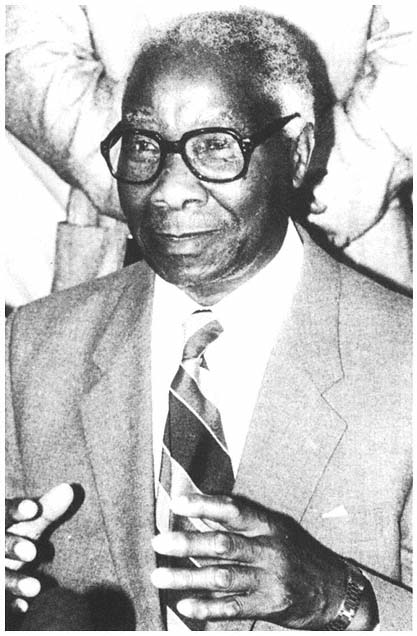
PHOTO ACKNOWLEDGEMENT: Mayibuye Centre, UWC