
The Speculum Editions Compared
The types used in the editions of the Speculum have been described in BMC IX and in the work of the Dutch scholars Wytze and Lotte Hellinga.[11] The measurement of the characters is based on millimeters required for twenty lines of text from the base of the first to the base of the twenty-first line. The letter G, in the following descriptions, refers to Gothic, a blackletter form of type.
Four editions were produced, two in Latin with verses in rhymed couplets, and two in Dutch prose translations. The order of their production was debated for several centuries, but the accepted sequence today is as follows. The dates given for the editions are those deduced by Allan H. Stevenson from his study of the watermarks of the various papers used.[12]
I. First Latin edition (c.1468), with blocks in good state and Hellinga Type 1: 110 G (figs. V-4, 6, 7, 8).
II. First Dutch edition (c.1471), with block borders occasionally broken, in Hellinga Type 1:110 G, but with two pages printed in another type, Hellinga Type 2:103 G (figs. V-5 and 10). The Latin captions in the woodcuts are translated into Dutch at the head of each column.
III. Second Latin edition (c.1474), with the blocks showing further deterioration, in Hellinga Type 1, still in good state. Twenty pages of this edition have text in xylographic imitation of the first Latin edition (fig. V-9).
IV. Second Dutch edition (c.1479), with the blocks even more damaged, and the text in Hellinga Type 1, but cast on a smaller body. The characters are badly worn, poorly printed in a sooty black ink, and unevenly aligned (fig. V-11). This led some writers to think that this was the first edition.
Unlike the complete manuscripts, the blockbook editions do not contain a Prologue, and the Prohemium precedes the illustrated section. The Prohemium occupies four or six leaves (the latter including a blank leaf), according to the edition. The rest of the book is made up in three gatherings of fourteen leaves and one of sixteen.
[11] Wytze and Lotte Hellinga, The Fifteenth-century Printing Types of the Low Countries , (Amsterdam, 1966), I, pp. 4 ff.
[12] C. M. Briquet, Les Filigranes , edited by Allan H. Stevenson (Amsterdam, 1968), p. 95.
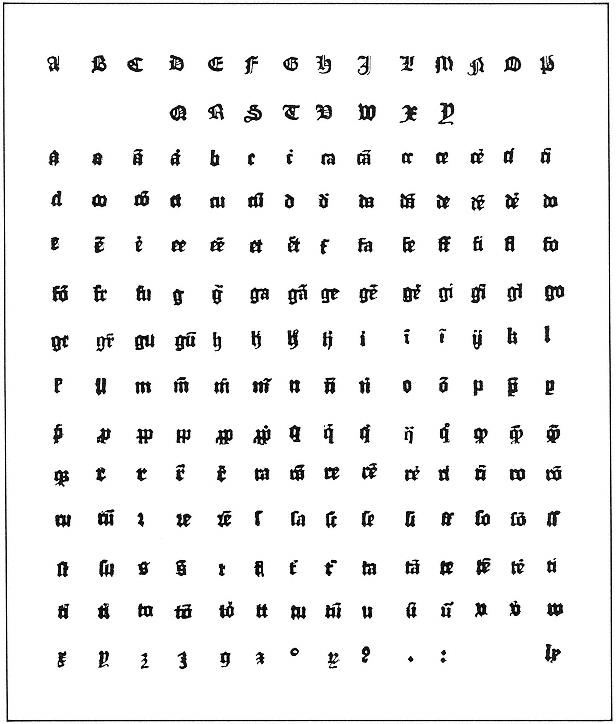
V-4.
Characters in Speculum Type I,
Hellinga 1: 110 G.
From Gottfried Zedler, Von Coster zu Gutenberg (Leipzig, 1921).
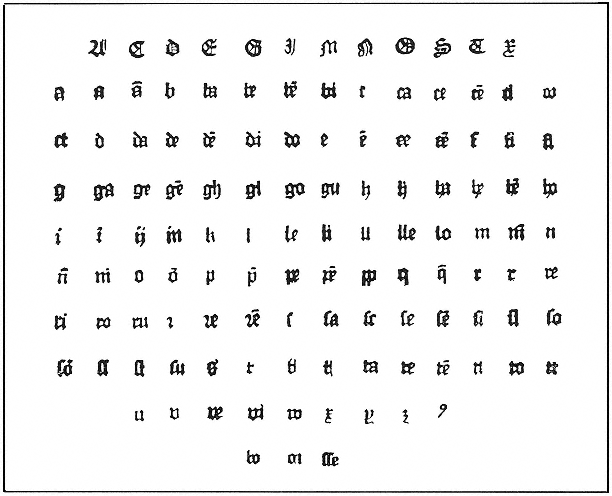
V-5.
Characters in Speculum Type II,
Hellinga 2: 103 G.
From Gottfried Zedler, Von Coster zu Gutenberg (Leipzig, 1921).
Only twenty-nine of the forty-five manuscript chapters are printed in the blockbooks although the blocks were made for many more. The text follows the sequence of the manuscripts for the first twenty-four chapters. Then only five are added, possibly to sell the shorter editions more rapidly at a lower price, or perhaps because of the limits of available paper. Some idiosyncracies in each of the four editions shed light on early printing, and these are examined below.[13]
[13] The blockbooks studied were as follows:
Edition I : Munich, Bayerische Staatsbibliothek, Xyl. 37 and Universitätsbibliothek, Cim. 52 (Xyl. 10); Brussels, Bibliothèque Royale, B 1596 L.P.; Haarlem Stadsbibliotheek, Inv. II, No. 16; The Hague, Museum Meermanno-Westreenianum, 36A-1; New York Public Library, *KB + 1471.
Edition II : The Hague, Museum Meermanno-Westreenianum, 36A-2; British Library, IB. 47000.
Edition III : British Library, IB. 47001; Bibliothèque Nationale, Xyl. 44 and Xyl. 45; The Hague, Museum Meermanno-Westreenianum, 35A-4; Library of Congress, Inc. X. S 72; The Pierpont Morgan Library, Ch.L. f 1614; E 11 B.
Edition IV : Haarlem Stadsbibliotheek, Inv. II, No. 14 and No. 15; The Henry E. Huntington Library, Xyl. H-C 14924.
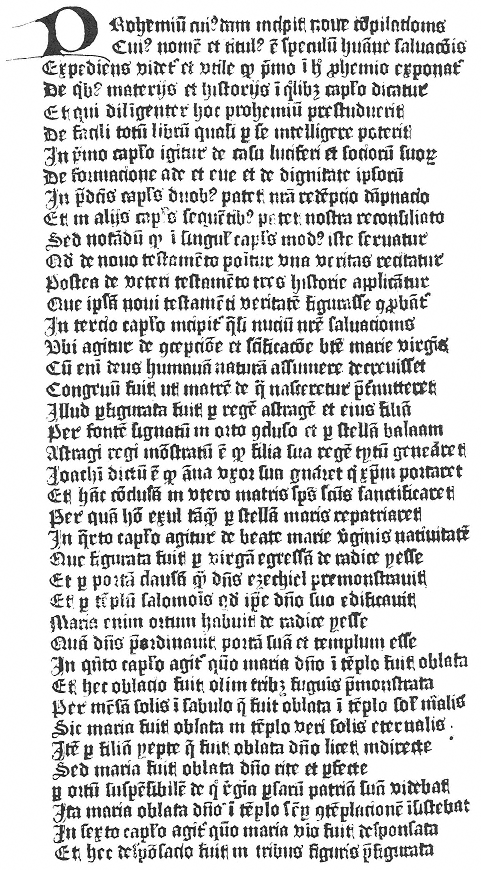
V-6.
Speculum humanæ salvationis blockbook, Edition I, Latin unmixed.
First page of the Prohemium. Hellinga Type 1: 110 G.
Edition I : In this edition the first five pages are devoted to a Prohemium or summary, in rhymed prose, of the contents of each chapter (fig. V-6). This ends with a statement about the usefulness of the Prohemium for poor preachers who cannot afford the entire book. Presumably the Prohemium was distributed separately (it is a single gathering of the book), but no examples of it have been preserved as an entity. At the end there are two lines about the Second Joy of the Virgin Mary, the Visitation from her cousin Elisabeth, the queen of Assyria, which, since it occurs in Chapter XLV of the manuscripts, does not appear anywhere in the blockbook editions (fig. V-7). Perhaps the manuscript from which the printer worked, which would have had all forty-five chapters, accidentally lacked these lines, and the scribe wrote the necessary insertion at the bottom of the page. The compositor may not have noticed the place which had been marked for insertion in the manuscript and simply added the lines to the last column. This error appears also in the second Latin edition but was rectified in the Dutch prose translations.
Another curious printer's error appears in the first Latin edition as compared to Latin manuscript Clm 146 in Munich. It is the addition in Chapter II, at the head of the third column, of a line which should be line 51 of Chapter VI: Maria autem viro in desponsatione jungeretur . The correct line 51, Chapter II, is: In omni enim re semper debitus modus est tenendus , which appears as line 52. How could such a mistake happen unless the printer were tipsy, or, starting work before dawn on a winter morning by the light of a single flickering candle, he accidentally opened his manuscript to the wrong page, and was too drunk with sleep to notice his error? He has also omitted the word autem and made arbitrary contractions of the Latin words. Furthermore, in order to make up for the extra line and still retain the standard twenty-five line column, he took the liberty of condensing two lines into one, using most of line 61 with the last two words of line 62, the rest of which is omitted, thereby breaking the rhyme scheme. In Chapter VI, where line 51 is missing, in order to fill the twenty-five-line column, the typesetter ended it with the line which should begin the next column. Then to bring that one up to proper length, he introduced an unrhymed line, which does not appear in the manuscript at all, after the first couplet. In fact the width of the column is too narrow for the type, which causes excessive contractions and lines broken over to the ends of succeeding lines. A "poor preacher" would have had trouble deciphering the text but might have relied more on the pictures to inspire his sermons.
The woodblock titles cut beneath the pictures are transposed in Chapter XXII c and d. The caption for the Spies Carrying the Grapes appears beneath the scene of the Killing of the Heir to the Vineyard, and vice versa . This seems to show that the letter-cutter was not the cutter of the pictures.
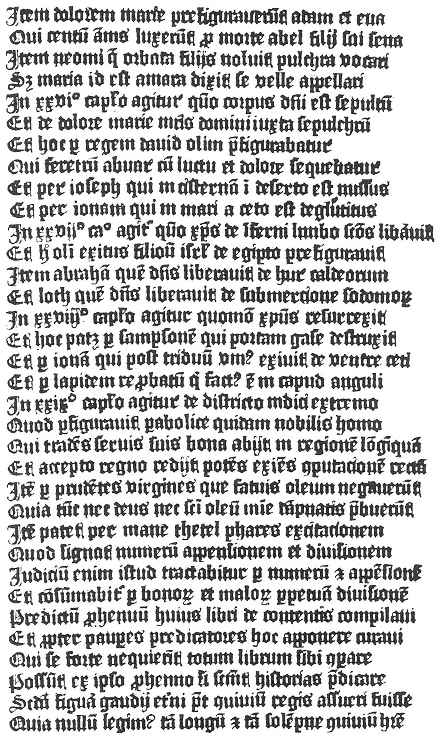
V-7.
Speculum humanæ salvationis blockbook, Edition I, Latin unmixed.
End of the Prohemium, Hellinga Type 1: 110 G.
The last two lines were added in error.
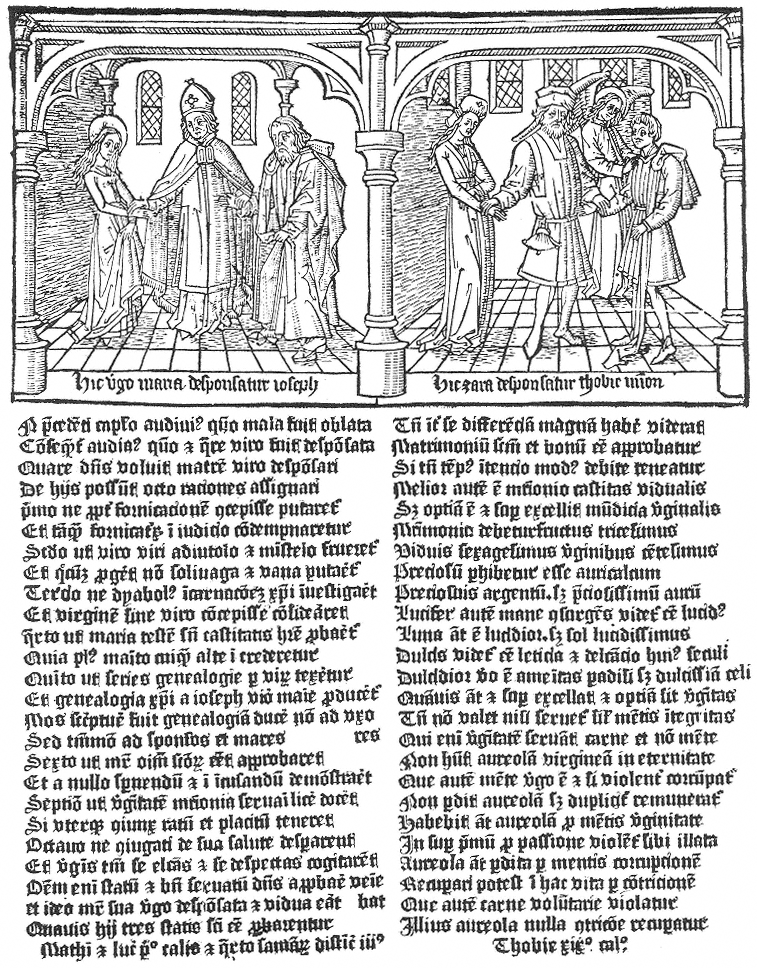
V-8.
Speculum humanæ salvationis blockbook, Edition I, Latin unmixed.
Chapter VI a and b. Hellinga Type 1: 110 G.
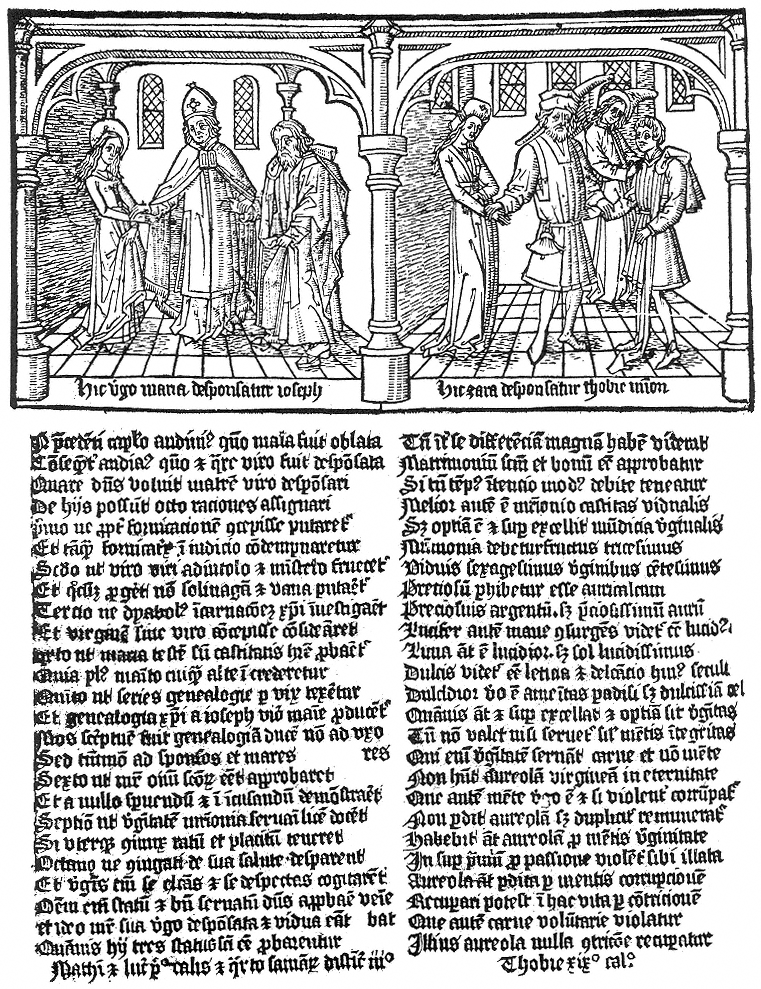
V-9.
Speculum humanæ salvationis blockbook, Edition III, Latin mixed.
Text traced from Edition I and cut in wood.
Edition II : The second edition was produced by rubbing the same blocks, but with the printed text translated into Dutch prose. This edition contains a different oddity. The text is printed in the same characters as the preceding Latin edition, Hellinga Type 1 : 110 G, except for the two conjugate leaves, Chapter XXIII columns a and b (fig. V-11), and Chapter XXVIII columns c and d. This leaf is printed in a smaller, battered type known as Hellinga Type 2 : 103 G. Did Type 1 become unavailable, or tied up in another book, thus forcing the printer to use a worn-out face to complete the edition? Or did he accidentally start setting from a wrong case, and continue when, or if, he discovered his mistake, because the types were similar?
Edition III : This is a reprint of the Latin text of the first edition, but the type has been re-set. It is certainly the most baffling of all four. It contains twenty pages of text cut in wood from tracings of the printed pages of the earlier edition (fig. V-9). These are printed by rubbing on the back of the paper, with the text blocks coated by the same watery ink and rubbed at the same time as the illustration blocks. To us, the most logical explanation for the twenty xylographic text pages is that the making and rubbing of the illustration blocks was done first, and in another location than the printing of the text.[14]
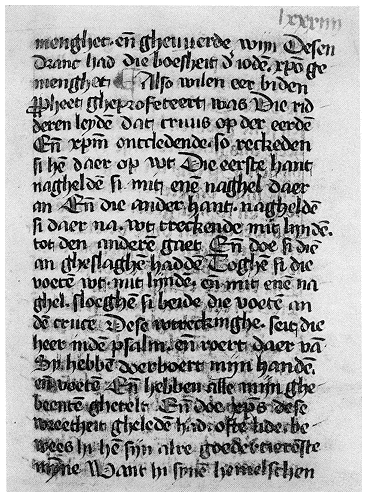
V-10.
Text of the nailing of Jesus to the Cross.
From the fourth line on, the translation
corresponds to the blockbook.
Spieghel onser behoudenisse manuscript, 1464.
Haarlem Stadsbibliotheek, Ms. II 17,
Chapter XXIII.
[14] Zedler, in Von Coster zu Gutenberg (Leipzig, 1921), p. 81, assumes that the text was printed first. If this had been the case there would have been no reason for the printer to use one side of the paper only, and thereby double the cost.
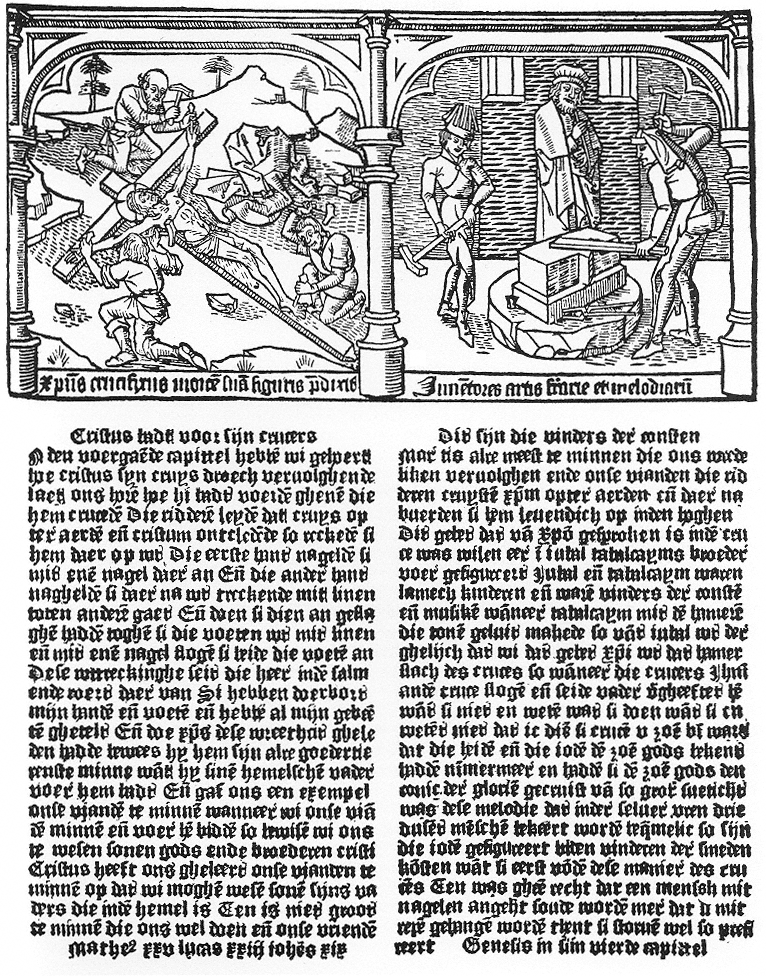
V-11.
Spieghel der menscheliker behoudenisse , Edition II, Dutch mixed.
Chapter XXIII a and b. Hellinga Type 2: 103 G.
Our hypothesis is that the blocks were rubbed onto the blank sheets, which were then delivered to the text printer (who may never have seen the blocks themselves). When the printing of the text was completed, they were returned to the original workshop for gathering, binding, and distribution. In the case of the second Latin edition twenty of the sheets may have been damaged or lost in transit between the text printer and the house where the books were put together. Instead of preparing a new set of woodcut sheets of illustrations to be sent to the text printer to complete the edition, the missing texts were cut in wood and both the blocks and the texts were printed together by rubbing, an economical solution in time and expense. Since no black type-printing ink was available there, both woodcuts and text blocks were rubbed in the watery yellow-brown ink which had been used for the pictures. There must have been a copy of the Latin first edition on hand, for the text was traced on a transparent sheet, or the actual printed sheet was made transparent with oil, so that it could be flopped and fastened to an uncut block for cutting the characters in reverse. The cutting corresponds exactly in size and spacing to the printed pages.
Edition IV : The printer must still have had the matrices for the missing type for the twenty pages, for he evidently recast the characters on a different body size, and used the font heavily, possibly for the schoolbooks of which so many fragments have been found. It appears, much worn, in the second Dutch edition. The smaller body of Type 1 (fig. V-12), which we examined in the Huntington Library in California (formerly the Pembroke copy),[15] measured 106 mm. instead of 110 mm. for twenty lines. Could it simply be exposure to the dry Southern California climate which caused the paper to shrink? Alas, such an airy explanation is contradicted by the fact that most pages of one of the copies, Haarlem Inv. II, No. 14, which we measured in 1979, required only 104 mm. for twenty lines. This edition is usually referred to as the "unmixed" Dutch issue, but in Haarlem, Inv. II, No. 15, there are actually four pages in 110 mm. type. Pages sixteen through nineteen are missing. We assume that pages twenty through twentythree were taken from the first Dutch edition and bound into this copy, but evidently pages sixteen through nineteen were not available. The other Haarlem copy, Inv. II, No. 14, had also been taken apart some time in the past, and the pages were mounted on larger sheets.[16]
There is another oddity in this fourth and last edition of the Speculum blockbook. In Chapter XIX, column two, the biblical reference line "Genesis IX capitel" is printed upside-down in all known copies (fig. V-12). This might indicate that the characters within the line were attached to the text by some method too difficult to correct. The question will be dealt with further in the section on the printing, below.
[15] Spieghel der menscheliker behoudenisse . Henry E. Huntington Library and Art Gallery, San Marino, California. Xyl. H-C 14924.
[16] Haarlem Stadsbibliotheek, Inv. II, No. 14 and Inv. II, No. 15, deposited in the Frans Hals Museum, Haarlem.
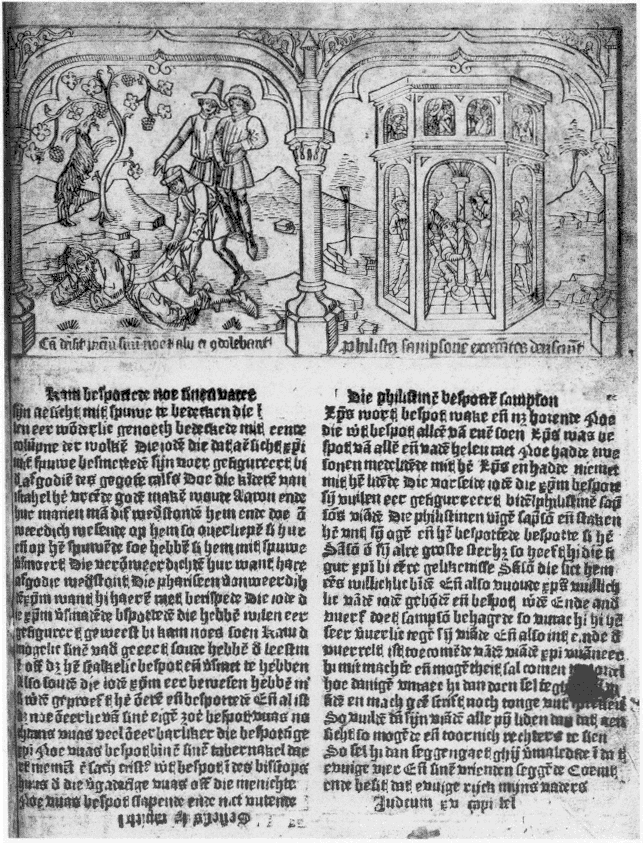
V-12.
Spieghel der menscheliker behoudenisse , Edition IV, Dutch unmixed.
Chapter XIX c and d. Note upside-down reference at the foot of column.
Henry E. Huntington Library and Art Gallery, San Marino, California, 104685.