
Charlotte Berend as Mother and Other Family Portraits
The months just before the birth of their two children were for Corinth and his wife a period of particularly close communion. In the charcoal and pastel drawing of July 31, 1904 (Fig. 85) Charlotte is six months pregnant. Her intent look no doubt reflects Corinth's own anxiety as much as it expresses her need for affection and security. Though contemporary with the painting In a Deck Chair (B.-C. 285), the drawing is not a preliminary study for the picture but, like the earlier pencil sketch from Tutzing (see Fig. 82), another autonomous document of the spiritual bond between artist and model.
Corinth was spellbound by the processes of new life as they were revealed to him in the course of his wife's pregnancies. In addition to the picture from July 1904, he painted Charlotte five days before the birth of Thomas (B.-C. 281) and twice in 1909 as she awaited the birth of Wilhelmine. In conception each of these paintings is personal, but the 1909 paintings also speak of Corinth's need to universalize the experience of Charlotte's motherhood. One shows her nude (B.-C. 401); the other (see Plate 14) depicts her seated in Corinth's studio, her breasts partly exposed. Only her posture alludes to her pregnancy. The general disposition of the figure is anticipated in both a canvas (B.-C. 354) and a drypoint (Schw. 27) from 1908 depicting Charlotte seated by a window. But now no environmental allusions interfere with the subject. The subdued colorism reinforces the simple pictorial structure. As in the drawing from July 1904, Charlotte's expression mirrors both trust and devotion. While the painting has rightly been compared to Wilhelm Leibl's portrait of Mina Gedon when she was expecting a child,[16] Corinth himself invited another challenging comparison when he borrowed the title of the picture, Donna gravida , from Raphael's panel in the Pitti Palace.
Corinth brought the same empathy with which he had observed his wife during her months of pregnancy to the theme of mother and child. Except for the rather conventional double portrait from 1901 of Gertrud Mainzer and her daughter Lucy (B.-C. 223), the subject does not occur in his earlier work. Only with the birth of his own children did he begin to fathom the bond of parental affection. Whereas Frau Mainzer poses proudly with her daughter in the comfort of her well-appointed Berlin home, the real subject of Corinth's first painting of Charlotte and Thomas (Fig. 86), completed between April and May 1905, is the loving interaction of mother and son. Charlotte holds the boy on her lap, gently directing his attention to the painter, who is thus allowed to share in the spirit that unites the two. Though barefoot, Charlotte wears a splendid dress that lends the painting a festive air reminiscent of Rubens's double portrait in the Alte Pinakothek of Helena Fourment and her son Frans, a picture that may well have influenced Corinth's conception. Indeed, Rubens's unusual group of paintings of his two wives, Isabella Brant and Helena Fourment, and the Rubens children surely furnished the prototypes for Corinth's own family portraits. More intimate than the picture with Thomas is the one Corinth painted in June 1909 (B.-C. 391), four days after the birth of Wilhelmine. As Charlotte nurses the infant, her affection expresses itself eloquently in her tender gaze and protective gesture. The extreme close-up view is no doubt a measure of Corinth's empathic response to the domestic scene.
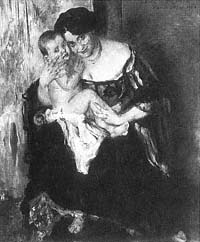
Figure 86
Lovis Corinth, Mother and Child , 1905.
Oil on canvas, 127 × 107 cm, B.-C. 312.
Present whereabouts unknown.
Photo: Marburg/Art Resource, New York.

Figure 87
Lovis Corinth, Mother and Child , 1906. Oil on canvas,
80 × 95 cm, B.-C. 326.
Present whereabouts unknown.
Photo: after Bruckmann.
In addition to several portraits of young Thomas (B.-C. 278, 311, 374) and three more double portraits of Charlotte with Wilhelmine, Thomas, and again Wilhelmine (B.-C. 392, 393, 456), there are several works that invest the subject of mother and child with a more general meaning. In a painting of 1906 (Fig. 87) both Charlotte and Thomas are shown in prototypical nudity. Charlotte reclines on a couch and turns, smiling toward the boy. The flower she holds
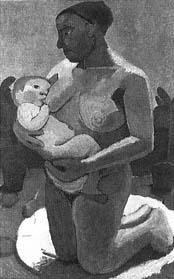
Figure 88
Paula Modersohn-Becker,
Kneeling Mother and Child ,
1907. Oil on canvas, 113 × 74 cm.
Staatliche Museen Preussischer
Kulturbesitz, Nationalgalerie,
Berlin (West) (NG 7/85).
Photo: Jörg P. Anders.
and the bouquet in the upper right corner of the composition underscore the allusion to fecundity and new life. Unfortunately, the painting is burdened by the implicit erotic appeal typical of Corinth's mature depictions of the female nude and remains much too close to the model to be convincing in generalized terms. The same physiognomic veracity and forced expression greatly diminish the effect of Motherly Love (B.-C. 457), another painting of Charlotte and Thomas, from 1911. The weakness of Corinth's solution in these pictures is especially apparent in comparison with Paula Modersohn-Becker's symbolic representations of about the same time (Fig. 88). Under the influence of van Gogh, Gauguin, and several primitive and antique sources Modersohn-Becker had evolved a simplified and monumental pictorial language with which to express convincingly the eternal truths of womanhood. Her anonymous mothers, painted in flat, warm colors and heavy, volumetric shapes, evoke the generative processes of life.
Corinth's pictures of his young family culminated in the group portrait (Fig. 89) he painted in November 1909. According to Charlotte Berend, he prepared the painting with great care. He selected a canvas that had exactly the same dimensions as the large mirror he was using for the occasion, and he insisted that the four figures pose together as a group rather than individually. While painting, Corinth kept moving back and forth between the canvas and his place in the composition.[17] The arrangement of the figures parallel to the picture plane might easily have resulted in a monotonous group-
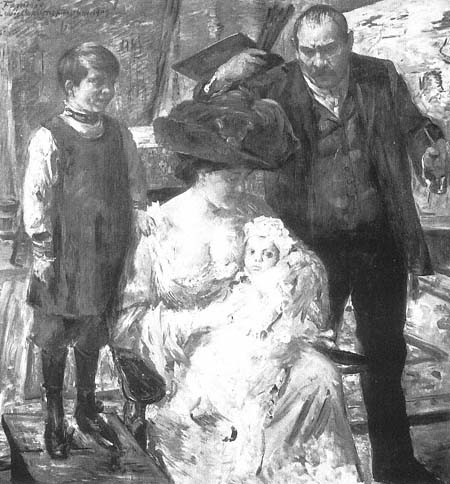
Figure 89
Lovis Corinth, The Artist and His Family , 1909. Oil on canvas, 175 × 166 cm,
B.-C. IV. Niedersächsisches Landesmuseum, Landesgalerie, Hannover (KM 7/1918).
ing had Corinth not enlivened the background with a variety of colors, textures, and shapes and allowed each figure a considerable measure of independence. The painting is indeed a study in contrasts skillfully reconciled. Thomas, who had just turned five, stands on a stool at the left and places one hand on his mother's shoulder. His attention is focused on the canvas on which Corinth is at work. Charlotte Berend, wearing a luxurious dress and a large hat, is seated in the middle, looking down at five-month-old Wilhelmine in her lap. Charlotte is the physical and psychological center of the painting, her role as mother underscored by her intimate contact with both children. Corinth shows himself in the act of painting and thus partakes of the family idyll primarily as an observer. The scattered attention of the various figures finally comes to rest on Wilhelmine, the only one in the group to look straight into the mirror. Corinth also emphasized the relationship of the figures coloristically. White is distributed so as to predominate in Charlotte and Wilhelmine. Shades of brown link the painter and his son. Charlotte, however, shares in both colors to a significant degree and thus further unifies the family gathered around her.