
The Return of Force: Toward a Performative Two-Body Theory
It should be clear by now that we are talking about the king's two bodies in a very performative sense. But the ramifications of Kantorowicz's dyad in such fully material terms need further clarification.[29] The king's body politic is performed via Apollo or the sun, his
[27] See Franko, Dance as Text , 63–107.
[28] Victor Turner, "Liminal to Liminoid," in From Ritual to Theatre: The Human Seriousness of Play (New York: PAJ, 1982), 54. I would argue that burlesque ballet, although clearly marginal, occurs remarkably close to the economic and political center, frequently even with the king's personal participation.
[29] The two-body doctrine is one of juridical separation, making it particularly applicable to the English monarchy. As Thomas Hobbes stated: "In a Body Politique, if the Representative be one man, whatever he does in the person of the Body, which is not warranted in his Latters, nor by the Lawes, is his own act, and not the act of the Body, nor of any other Member thereof besides himselfe" (Leviathan [1651; New York: Washington Square Press, 1964], 159). Regarding the place of kingship in French culture, Roger Chartier has discussed the merging of the two bodies into one as initiated by Louis XIII and sustained by Louis XIV; see his Cultural Origins of the French Revolution , trans. Lydia G. Cochrane (Durham: Duke University Press, 1991), 124–25.
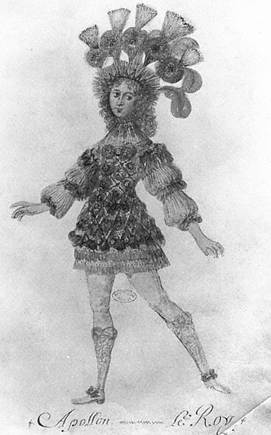
Figure 3.2
Louis XIV as Apollo in Les Noces de Pelée et
de Thétis , 1654. Reproduced by permission.
body natural via a fury. What does this mean for our understanding of power and representation in royal spectacle? Are they both equally powerful representations? How can we apprehend them in their hypothetical complementarity?
Let us consider for a moment Marin's analysis of sacrament and its
links to the power of representations. He gives as an example the body of Christ, present yet, in the language of the sacrament, invisible ("This is my body"); absent despite its symbolic visibility in the wafer whose materiality is consumed to produce presence as an idea (properly, to represent presence).[30] By extension, when Louis XIV performs the role of rising sun in Ballet de la nuit (1653), his natural body offers itself for visual consumption in a political sacrament of monarchical power as illuminating, but also blinding, radiance. The role of rising sun is, like the wafer, the visible talisman of an absence (a sign) producing the idea (representation) of body politic in the mind. When Louis XIV dances Apollo, there is royal sacrament. His glorious roles evidence the transubstantiation of body natural into body politic. Yet, what ramifications ensue for the two-body theory when he dances a coquette, a nymph, or a fury?
If an androgynous appearance marked the self-sufficiency of rulership in balletic terms, it is not surprising that Louis XIV should have presented a feminized appearance in his 1654 performance of Apollo, for it was as Apollo that he symbolized most unambiguously his rulership (fig. 3.2). Nevertheless, this monarch said to be enamored of ballet inherited androgyny stemming from two divergent courtly traditions: the official and the burlesque. The performance of androgyny had one leg, so to speak, in legitimacy and the other in irony or resistance. How did Louis XIV negotiate the cultural memory of this dual performance tradition in roles not otherwise associated with his ceremonious royal identity?
Consider his role as a Fury in Les Noces de Pelée et Thétis (1654).[31] In this work, as in many other ballets, the king plays more than one role. He first appears, in fact, as Apollo surrounded by his Muses. In the third scene, however, he plays one of nine furies of jealousy vomited from a sea monster's mouth. The monster has been called forth by Juno to prevent
[30] Louis Marin, La Critique du discours: Sur la "Logique de Port-Royal" et les "Pensées" de Pascal (Paris: Editions de Minuit, 1975), 254–55.
[31] The libretto, originally printed by Robert Ballard, has not been reprinted in any collection. The text is at the Bibliothèque Nationale [hereafter cited as BN]: In-8 BN Rés Yf 1460. Ballard also published a synopsis of the ballet, reprinted in Marie Françose Christout, Le Ballet de cour de Louis XIV, 1643–1672 (Paris: A. & J. Picard, 1967), 205–11. Some of the costume studies for Les Noces are housed in the Musée Carnavalet; see Laurence Guilmard-Geddes, "'Les Noces de Pélée et Thétis': Costumes de Ballet," in Dons et achats récents: Bulletin du Musée Carnavalet 30, no. 2 (1977): 5–9. See also Marie-Françoise Christout, "'Les Noces de Pelée et Thétis': Comédie italienne en musique entremêlée d'un ballet dansé par le roi (1654)," Baroque 5 (1972): 55–62; Charles I. Silin, Benserade and His Ballets de Cour (Baltimore: Johns Hopkins University Press, 1940), 232–38; and Christout, Ballet de cour de Louis XIV , 72–77.
Jupiter's abduction of Thetis. The king's presence in this entrée might seem unremarkable in that he is one among nine other performers. Special verses that single him out are, however, attributed to the king as Fury.
Et suis si tu peux cette jeune Furie,
Espagne, dont l'orgueil est trop long-temps debout,
Elle te va dompter d'une force aguerrie,
Et la torche à la main s'en va de bout en bout
Mettre le feu par tout.
Elle suit les meschans, les presse, les opprime,
Leur fait dans ses regards lire un sanglant decret,
Et dans le mesme instant qu'ils commettent le crime
Leur glisse dans le coeur un eternel regret,
Comme un serpent secret.
Que je voy de Beautez dont la rigueur extresme
A plus de mille Amans a causé le trepas,
Qui voudroient tout le jour, et toute la nuict mesme
Avoir cette Furie attachée à leurs pas,
Et qui ne l'auront pas.[32]
And follow if you can this young Fury,
Spain, whose pride has been too long afoot,
She will tame you with a warrior's seasoned force,
And torch in hand she will pass from end to end,
Setting fire everywhere.
She pursues the wicked, presses and oppresses them,
Has them read in her expression a bloody decree,
And in the very moment they commit their crime
Slips into their heart an eternal regret,
Like a secret serpent.
How many beauties I see whose extreme rigor
Caused the death of a thousand lovers,
Who would like to have all day, and all night,
This Fury behind them,
But who won't have her.
The king's verse introduces a triple scenario in which the Fury's pursuit of Jupiter, who is himself in pursuit of Thetis, is manipulated in several disconcerting ways. First, the political context of Spain in its relationship to France is foregrounded when the audience is asked to reposition the cross-dressed king ("that young Fury") as ostensible prey of
[32] Ballard, Les Noces , 21 (In-8 BN Rés. Yf 1460).
the Spanish. Yet the Fury is herself in pursuit of all evil forces, acting on them with terrible incendiary and bloody violence. By the third stanza, in typically burlesque fashion, the cross-dressed king is said to exert a sexual appeal on otherwise forbidding female spectators who presumably regret they will not themselves be persecuted by her. Thus, his violence is transformed into a sexually appealing quality. There are three levels at which the cross-dressed king interacts with his public: at the narrative level, the most straightforward, in which he plays a fury pursuing Jupiter; at the level of contradictory commentaries that introduce secondary allegorical senses with both political and sexual motifs; and finally, at the level of physical performance, wherein, it seems, the king's actual presence is called on either to unite these disparate interpretations or to succumb to their competing meanings. Here, the anomaly is less the cross-dressed king per se then the different interpretive claims being made for his energy and presence. To be pursued, as it were, by such competing texts would also be, for the Fury, necessarily to remarshal them in the name of her own violence or unlimited force—which is named as sex, violence, and magic. But s/he is caught up in a wider web that includes all facets of the performance tradition under study: legitimacy, resistance, and seduction (fig. 3.3).
Hermaphroditism, which has been shown to underwrite the ritual significance of royal succession in Le Ballet de Madame , underwrites in Les Noces the exceeding of power by force, of attraction by magic. Hermaphroditism, initially a balletic icon of royal succession, later a tool of dissident critique, finally became with Louis XIV the balletic sign of unpredictable royal agency. We could refer to it in general terms as seduction. At this juncture, let us note how dance studies induce a return to the issue of agency without discarding ideological critique.